Sunday Inspiration – Mother’s Day

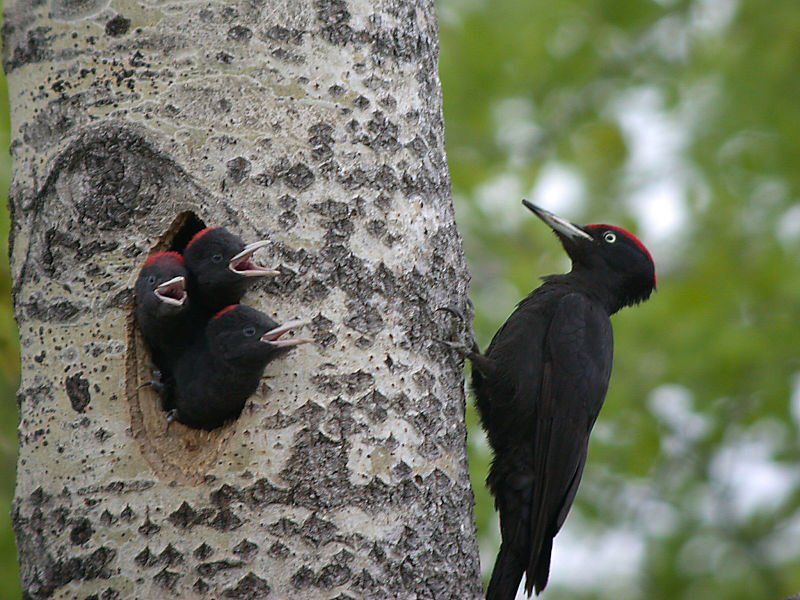
Black Woodpecker (Dryocopus martius) with Young ©WikiC

Black Woodpecker (Dryocopus martius) with Young ©WikiC

Since today is “Mother’s Day” here in the United States, it is appropriate to remember them.

My son, keep your father’s command, And do not forsake the law of your mother. Bind them continually upon your heart; Tie them around your neck. When you roam, they will lead you; When you sleep, they will keep you; And when you awake, they will speak with you. (Proverbs 6:20-22 NKJV)

Hooded Warbler (Wilsonia citrina) ©USFWS

Hooded Warbler (Wilsonia citrina) ©USFWS

Let your father and your mother be glad, And let her who bore you rejoice. (Proverbs 23:25 NKJV)

He grants the barren woman a home, Like a joyful mother of children. Praise the LORD! (Psalms 113:9 NKJV)


Greater Painted Snipe (Rostratula benghalensis) by W Kwong

Greater Painted Snipe (Rostratula benghalensis) by W Kwong

“HONOR YOUR FATHER AND MOTHER,” which is the first commandment with promise: “THAT IT MAY BE WELL WITH YOU AND YOU MAY LIVE LONG ON THE EARTH.” (Ephesians 6:2-3 NKJV)

But we were gentle among you, just as a nursing mother cherishes her own children. (1 Thessalonians 2:7 NKJV)


This slideshow requires JavaScript.

*

“Stay Close To Me” © the Hyssongs (used with permission of the Hyssong)

I know this is not the typical Mother’s Day song, but listen to the words. It is a journey being a mother from the day you become aware a child is on the way. Mothers make decisions many times daily and need to “Stay Close To Me (the Lord)” as they travel through “motherhood.”

Lord Bless your day and Happy Mother’s Day

Lee and Dan

*

Sunday Inspirations

Changed From the Inside Out

*

Ian’s Bird of the Week – Black-breasted Buzzard

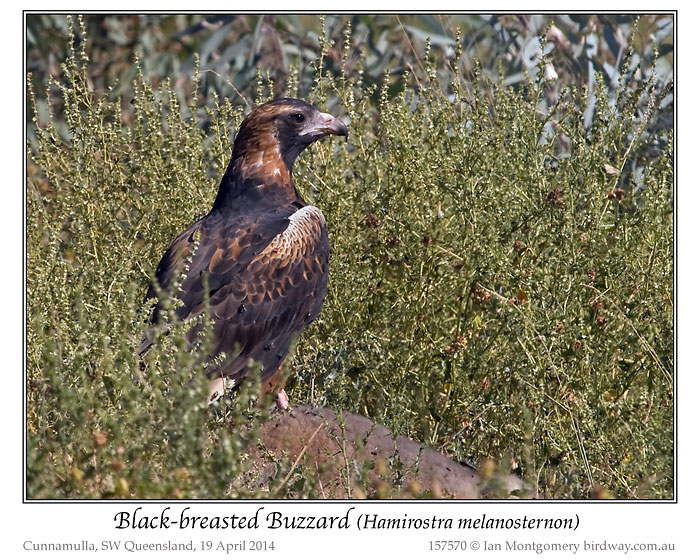
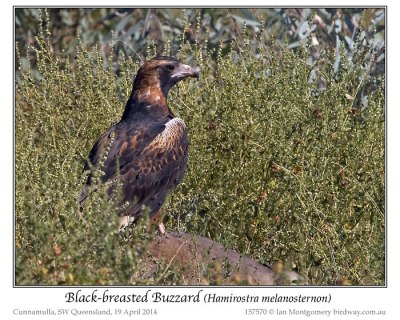
Black-breasted Buzzard (Hamirostra melanosternon) by Ian

Ian’s Bird of the Week – Black-breasted Buzzard ~ by Ian Montgomery

Newsletter ~ 5/8/14

I went to Bowra Station near Cunnamulla, SW Queensland, to meet some birding pals from Victoria for Easter. Cunnamulla is almost exactly half-way between Bluewater and Melbourne by the shortest inland route (2,532km Bluewater-Melbourne CBD) and Bowra is an AWC reserve, famous for its dry country birds and wildlife. I returned with an intractable bout of flu which has left me horizontal for 2 weeks, but I am now much better and able to tackle long-neglected tasks like the Bird of the Week. So, here is something worth waiting for, one of the less-well known endemic Australian raptors, the Black-breasted Buzzard.

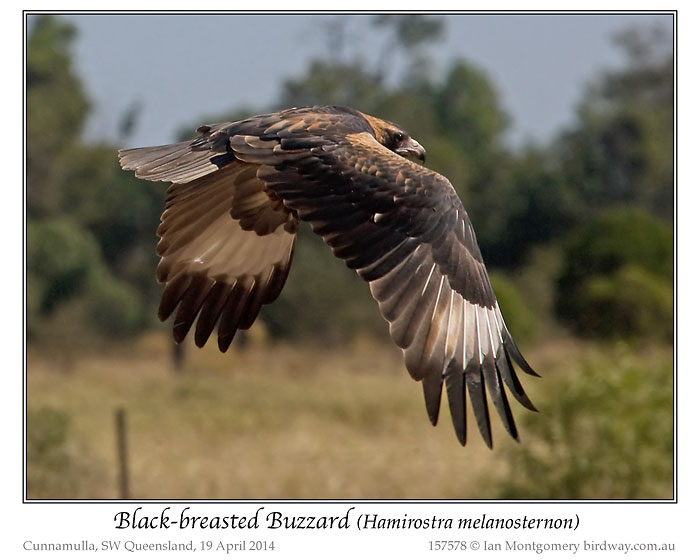
At the end of the drive from Bluewater to Bowra, I saw this raptor perched on road-kill – the euphemism used here for run-over native wildlife – near the entrance to Bowra, thought ‘that’s not a Black Kite’, turned the car round and picked up my camera to take the first photos of the trip. Reluctant to leave lunch behind, it tolerated my approach for about 30 seconds before flying away into the afternoon sunshine, second photo. In both photos, you can see the long, hooked bill that gives it its generic name (hamus is the Latin for hook), reddish crown and nape and the beginnings of it eponymous black-breast. In flight, you can see the characteristic white wing patches on the middle of the first six primary flight feathers, probably its best field mark and the complete absence of barring on the wing and tail feathers.
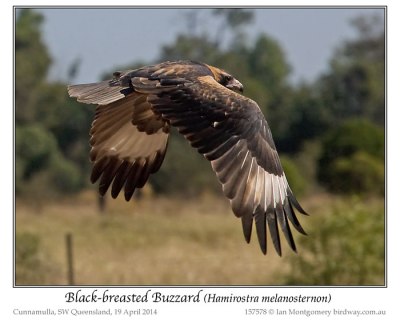
Black-breasted Buzzard (Hamirostra melanosternon) by Ian

This was the first time I’d seen a Black-breasted Buzzard either close up or perched. Mostly, one sees them singly and infrequently in flight soaring in the open skies of the drier parts of Australia. They’re common enough to have an official status of ‘Least Concern’ but uncommon enough to give me a thrill each time I see one. Apart from concerns of rarity, they’re impressive birds in their own right, being, I have just discovered, the third largest Australian raptor with a wingspan to 1.5m/5ft and an expert at soaring.
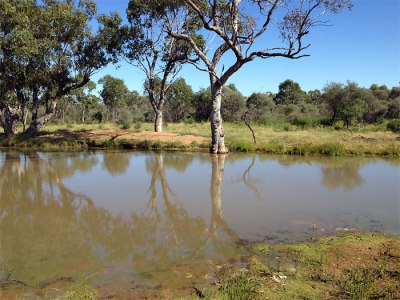
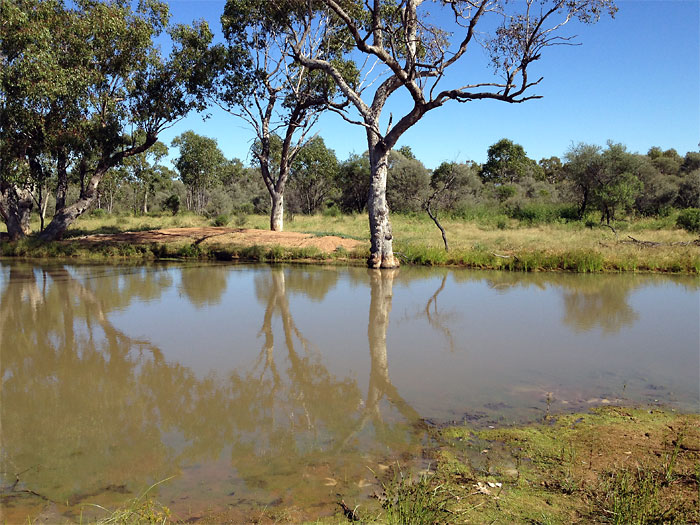
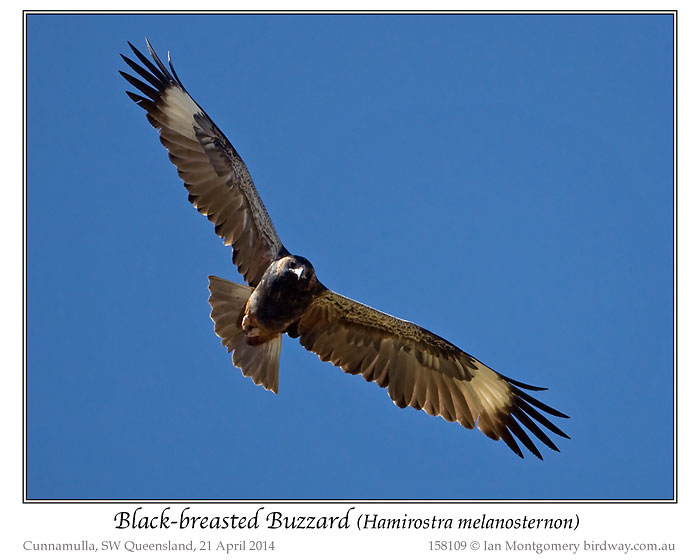
Two days later, we stopped for lunch at this dam at the far end of the property, about 15km/10 miles away from the entrance. A Black-breasted Buzzard soared high above us and then came round and flew overhead for a closer look, fourth photo. Comparing the pattern of wear on the flight feathers, indicates that this was the same individual. In this photo, the black breast of the adult bird is obvious as are the rusty flanks. Apart from dark blotches on the wing linings, the lack of barring is also apparent.

Black-breasted Buzzard (Hamirostra melanosternon) by Ian

Black-breasted Buzzards are known to feed on carrion and live prey, but their speciality is the eggs of large ground-nesting birds such as Brolgas, Bustards and even Emus. The latter have tough eggs which even that hooked beak would have trouble penetrating so, amazingly, these birds use stones to break them, dropping them from either a standing position or in flight. Though they are thought to belong to a rather ancient Australasian lineage of raptors this use of tools elevates them globally to the top of the class, sharing this position with the Egyptian Vulture which also throws stones at eggs. The Black-breasted Buzzard is the sole member of its genus (monotypic) and its closest relative is though to be the Square-tailed Kite, another monotypic, uncommon Australian endemic with dubious, gastronomic tastes, in its case nestlings. This ancient lineage is thought include a third Australian endemic, the Red Goshawk, and several New Guinea species including the long-tailed buzzards and perhaps the New Guinea Harpy Eagle. This just goes to show how indiscriminately common names like buzzards, goshawks, kites and eagles are applied to raptors.
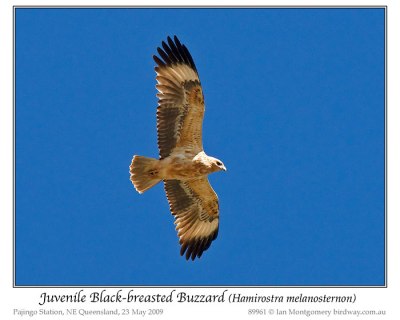
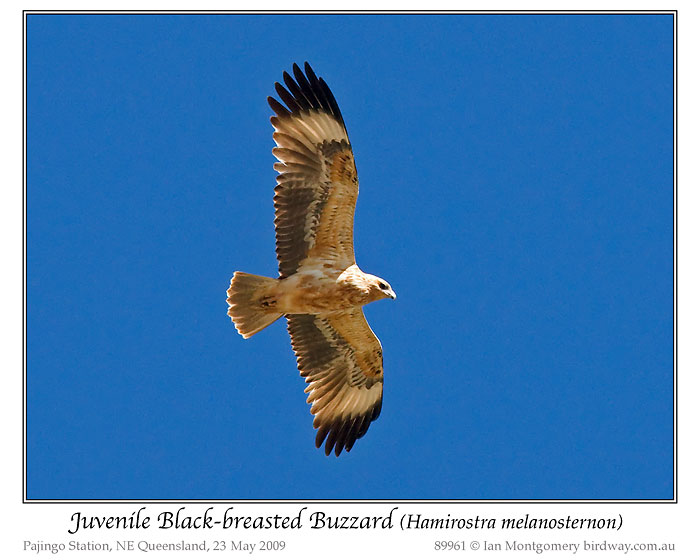
Black-breasted Buzzard (Hamirostra melanosternon) juvenile by Ian

The last photo shows a juvenile Black-breasted Buzzard photographed at a joint pre-merger Birds Australia and Townsville BOCA outing to a dry country station called Pajingo, south of Charters Towers in 2009. As you can see the juvenile lacks the black breast of the adult, though pale patch on the wing is very similar. At the time, we unanimously agreed that this was a pale morph Little Eagle. I posted it at such on the Birdway website and it wasn’t until last year that the error was brought to my attention. This is what Steve Debus, one of the Australian experts on raptors said: “the image shows virtually no typical light-morph Little Eagle characters, such as the pale ‘M’, or the barring on flight feathers (including primary ‘fingers’) and tail, feathered legs etc.” and other points made were the long, slender bill of the Black-breasted Buzzard and the ‘chunkier’ head of the Little Eagle. Good to know.

Best wishes
Ian

**************************************************
Ian Montgomery, Birdway Pty Ltd,
454 Forestry Road, Bluewater, Qld 4818
Tel 0411 602 737 ian@birdway.com.au
Bird Photos http://www.birdway.com.au/
Recorder Society http://www.nqrs.org.au


Lee’s Addition:

But these you shall not eat: the eagle, the vulture, the buzzard, (Deuteronomy 14:12 NKJV)

What a neat bird, but I agree with the verse. Don’t think I would care to eat a buzzard, especially after it eats “road-kill”  The colors on this Buzzard are really neat and would help it stay disguised until it is too late for its prey.

The Black-breasted Buzzard is a member of the Accipitridae – Kites, Hawks & Eagles Family.  Out of the 256 species in the family, 28 of them are Buzzards.

I just realized that I have not had any articles in the Birds of the Bible for Buzzards. Will have to make a page for them. Stay tuned.

See:

*
 

Sunday Inspiration – Jays and Cousins


Florida Scrub Jay (Aphelocoma coerulescens) by Dan

Florida Scrub Jay (Aphelocoma coerulescens) by Dan

And he sent forth a raven, which went forth to and fro, until the waters were dried up from off the earth. (Genesis 8:7 KJV)

Yesterday’s Birds of the Bible – Eurasian Jay? gave the idea for today’s Sunday Inspiration. Blue Jays are a favorite of mine, even though they can be a pest to other birds. Their warning cries of predators help offset their”peskiness.”

The Corvidae – Crows, Jays Family contains not only Jays and Crows,, but also Magpies, Treepies, Bushcrows, Nutcrackers, Choughs, Piapiac, Jackdaws,  Rook and Ravens. One of these is a Bird of the Bible; see – Birds of the Bible Raven.

The family has some plain birds, but the Lord has created many with beautiful colors like our Blue Jay and the Eurasian Jay. He designed them just the way He planned for the places they are to occupy. He love them all and know when any of them fall.

The Lord has “designed” us just the way He trusts we will serve Him. Some of us love his bird creations and want to share them and His Love for them and us. Some of you were give other likes and interests that He wants used.

*

This slideshow requires JavaScript.

*

A Psalm of David. Bless the LORD, O my soul: and all that is within me, bless his holy name. (Psalms 103:1 KJV)

“Bless The Lord Oh My Soul” by Sean Fielder

*

More:

Sunday Inspirations

Assurance: The Certainty of Salvation

*

Birds of the Bible – Eurasian Jay?

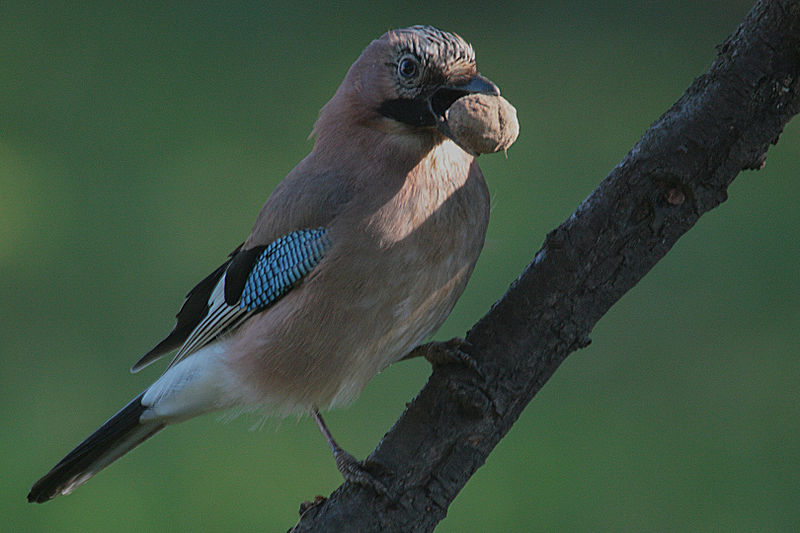
Eurasian Jay (Garrulus glandarius) ©© Pierre Dalous

Eurasian Jay (Garrulus glandarius) ©© Pierre Dalous

One generation shall praise Your works to another, And shall declare Your mighty acts. (Psalms 145:4 NKJV)

A new commandment I give to you, that you love one another; as I have loved you, that you also love one another. By this all will know that you are My disciples, if you have love for one another.” (John 13:34-35 NKJV)

How can an Eurasian Jay be a Bird of the Bible? Many times I have quoted the verse, in Job 12:17, about learning from the birds and now we have another bird we can learn from.  Focusing On Wildlife had an interesting article, Male Eurasian Jays Surprise Ornithologists.

Some quotes from the article:”The ability to disengage from our own desire to cater to someone else’s wishes is thought to be a unique feature of human cognition.” In their study, long story short, the male and female were fed different diets separate from each other. The male could watch the female eat, and when they were finally placed together, he would pick out her favorite food to get to her, even though his favorite was also there. “However, when the female’s desire differed from the male’s, then he took his partner’s wishes into account, often feeding her the food that she desired. This ability to ascribe to another individual an internal life-like one’s own and at the same time understand that the other’s internal, psychological states might differ from one’s own is called state-attribution.” “As humans, we ‘put ourselves into someone else’s shoes’ in order to respond to what the other person wants. Although we are biased by our own current desires,…”

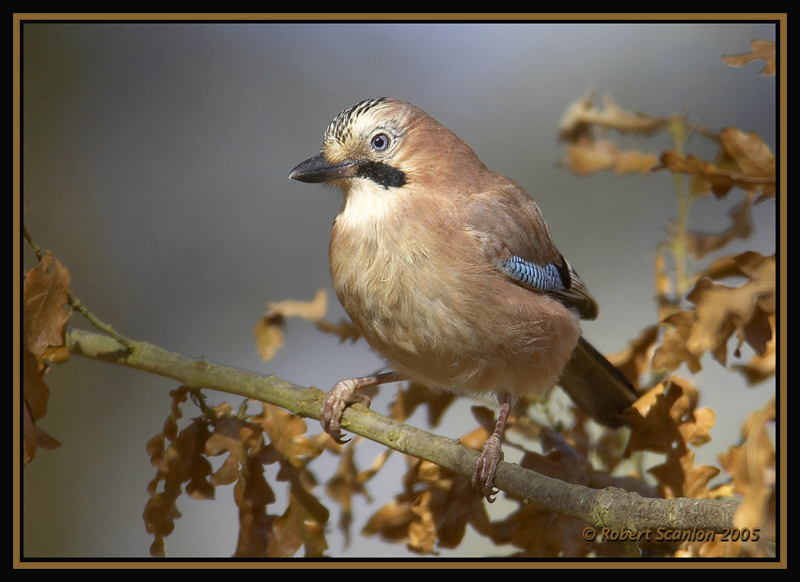
Eurasian Jay (Garrulus glandarius) by Robert Scanlon

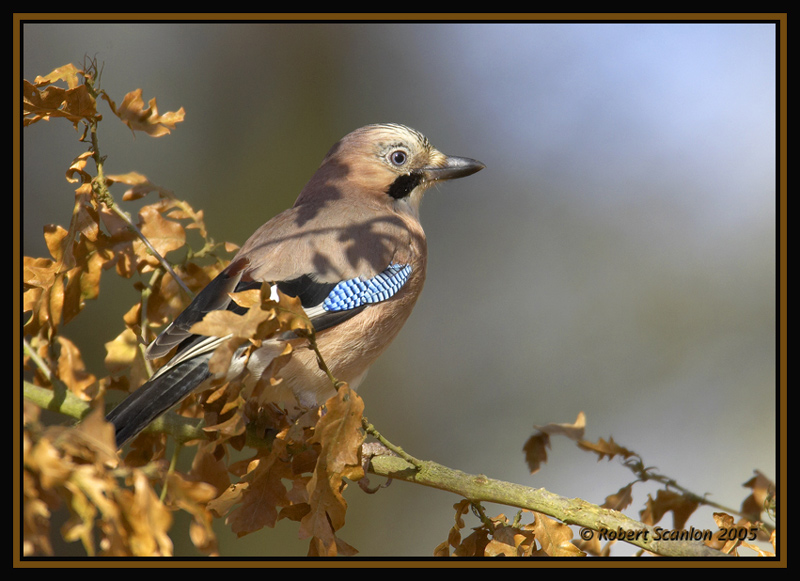
Eurasian Jay (Garrulus glandarius) by Robert Scanlon

This is My commandment, that you love one another as I have loved you. (John 15:12 NKJV)

Be kindly affectionate to one another with brotherly love, in honor giving preference to one another; (Romans 12:10 NKJV)

Eurasian Jay (Garrulus glandarius) ©WikiC

Eurasian Jay (Garrulus glandarius) ©WikiC

Therefore let us pursue the things which make for peace and the things by which one may edify another. (Romans 14:19 NKJV)

For you, brethren, have been called to liberty; only do not use liberty as an opportunity for the flesh, but through love serve one another. (Galatians 5:13 NKJV)

PAS-Corv Eurasian Jay (Garrulus glandarius)2 by Robert Scanlon

And may the Lord make you increase and abound in love to one another and to all, just as we do to you, so that He may establish your hearts blameless in holiness before our God and Father at the coming of our Lord Jesus Christ with all His saints. (1 Thessalonians 3:12-13 NKJV)

Therefore comfort each other and edify one another, just as you also are doing. (1 Thessalonians 5:11 NKJV)

The verses on this page should help us remember how we are supposed to put others first in our lives.

Is the Eurasian Jay a Bird of the Bible? I think so. How about you? Let us learn his lesson.

Eurasian Jay (Garrulus glandarius) by Nikhil Devasar

Eurasian Jay (Garrulus glandarius) by Nikhil Devasar

And let us consider one another in order to stir up love and good works, (Hebrews 10:24 NKJV)

Since you have purified your souls in obeying the truth through the Spirit in sincere love of the brethren, love one another fervently with a pure heart, (1 Peter 1:22 NKJV)

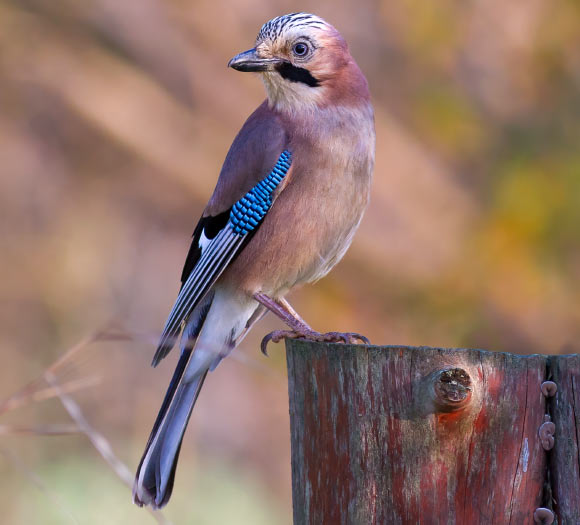
The Eurasian Jay (Garrulus glandarius) is a species of bird occurring over a vast region from Western Europe and north-west Africa to the Indian Subcontinent and further to the eastern seaboard of Asia and down into south-east Asia. Across its vast range, several very distinct racial forms look very different from each other, especially when forms at the extremes of its range are compared.

The bird is called jay, without any epithets, by English speakers in Great Britain and Ireland. It is the original ‘jay’ after which all others are named. (Wikipedia with editing)

The Jays belong to the Corvidae – Crows, Jays Family. There are 130 species in this family.

Eurasian Jay (Garrulus glandarius) ©WikiC

Eurasian Jay (Garrulus glandarius) ©WikiC

Finally, all of you be of one mind, having compassion for one another; love as brothers, be tenderhearted, be courteous; (1 Peter 3:8 NKJV)

Be hospitable to one another without grumbling. (1 Peter 4:9 NKJV)

Beloved, if God so loved us, we also ought to love one another. (1 John 4:11 NKJV)

See Also:

*

Crested Pigeon at Zoo Miami

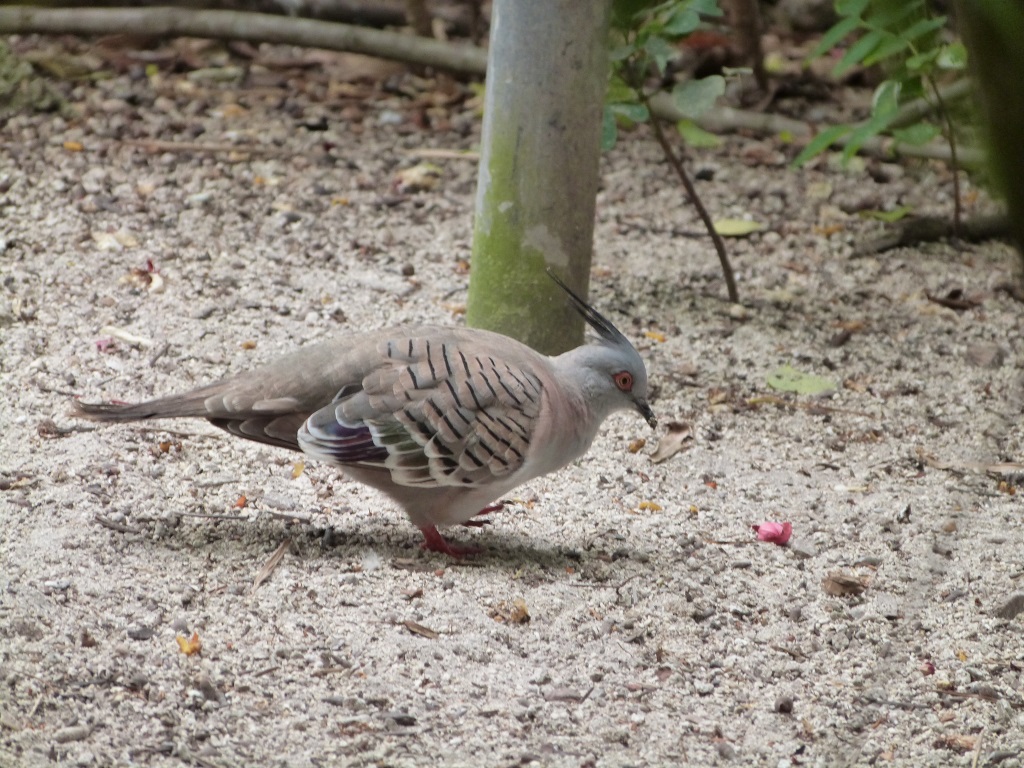
COL-Colu Crested Pigeon (Ocyphaps lophotes) at ZM by Lee

Crested Pigeon (Ocyphaps lophotes) at ZM by Lee

And he said unto him, Take me an heifer of three years old, and a she goat of three years old, and a ram of three years old, and a turtledove, and a young pigeon. (Genesis 15:9 KJV)

The Crested Pigeon was another interesting bird that we were able to watch at the Zoo Miami, Birds of Asia Aviary. I like their Crest. It adds some “class” to this creation from the Lord. They are colorful, but notice in the photos below how they blend in with their surrounding. The Creator has provided them with a nice camouflage design.

The Crested Pigeon (Ocyphaps lophotes, also commonly known as the Top Notch Pigeon) is a bird found widely throughout mainland Australia except for the far northern tropical areas. They belong to the Columbidae Family and is the only member of the genus Ocyphaps. There are only two Australian pigeon species that possess an erect crest, being the Crested Pigeon and the Spinifex Pigeon. The Crested Pigeon is the larger of the two species.

Habitat is grasslands, brush and wooded areas but they can also be seen at watercourses, homestead gardens, pastoral areas, sports grounds, and golf courses. Their habitat has expanded since settlement has produced pastoral lands (previously they were only found in inland and Western Australia). Foraging for grain, has adapted to grain farming areas, often feeding on the noxious weed of Salvation Jane. They are commonly misidentified as the Topknot Pigeon.

Their most distinctive behaviour is the beating and whistling sound their wings make when they take off. This is most likely to draw the attention of predators to birds on the wing, and away from any birds remaining on the ground and as an alarm call to other pigeons. When the birds land, the tail tilts upwards and the flight patterns are similar to the those of the Spotted Turtle-Dove. They are generally solitory. Although they can be seen in pairs, they can be highly social and tend to be seen in packs. They are highly gregarious birds when in contact with humans. (Wikipedia)


COL-Colu Crested Pigeon (Ocyphaps lophotes) at ZM by Lee

Crested Pigeon (Ocyphaps lophotes) at ZM by Lee

And I said, Oh that I had wings like a dove! for then would I fly away, and be at rest. (Psalms 55:6 KJV)

Lee’s Addition:

I trust you enjoy the Crested Pigeon (Ocyphaps lophotes). My computer is off line, in fact, not even set up. A new flooring is being installed in that room and it is getting a new coat of paint. So it will be down for several days. This is being scheduled ahead of time.

*

*

This slideshow requires JavaScript.

*

For The Sheer Joy of Variety! – Creation Moments


Greater Painted Snipe (Rostratula benghalensis) by W Kwong

Greater Painted Snipe (Rostratula benghalensis) by W Kwong

FOR THE SHEER JOY OF VARIETY!

“Woe unto him that striveth with his Maker! Let the potsherd strive with the potsherds of the earth. Shall the clay say to him that fashioneth it, What makest thou? or thy work, He hath no hands?” (Isaiah 45:9)

Did you ever try to plan all the details of a simple project? How many plans do you think the Lord had to make when He created living things? A billion? A billion times a billion?

The hierarchy of biological classification’s eight major taxonomic ranks

The hierarchy of biological classification’s eight major taxonomic ranks

We all know that it takes time to plan the most simple project. Did you ever think about the planning God had to do when He created all the different kinds of living things? Our word “species” today includes many creatures that the Bible counts as being the same “kind” – as when God created the kinds. But God did design the genetic information that allowed the kinds to produce these variations.

Yes, God’s act of creating living things was much more than just wishing. Just think that there are more than 20,000 different species of bees – some with very complex societies – and their own languages! The figures and the beauty of it all makes one wonder at God. Why are there 4,500 different species of sponges? Why are some creatures – never seen by humans until this century – so eerily beautiful? For that matter, why have so many different kinds of beautiful flowers?

The variety in the creation reflects some of the joy of creation that God felt, and shows us the incredible unbridled creativity of our wonderful God. The fact that there is only one species of human – all related – confirms the human history related in the Bible.

Prayer:
Dear heavenly Father, I know that I shall never have Your ability to plan and carry out those plans. I confess that too often I waste the time and energy You give me because I don’t even bother to use the abilities You have given me. Forgive me for Jesus’ sake, and for His sake help me to be more like You in this. Amen.
Notes:
Diagram: The hierarchy of biological classification’s eight major taxonomic ranks. The biblical “kind” is roughly the same as the “family” classification.
(Used with permission of Creation Moments©2014)


Lee’s Addition:

We mention the Lord’s fantastic variety in His avian creations often. This article fits right in with those thoughts and thought it should be shared.


This slideshow requires JavaScript.

*

I selected different photos for the same article on my other site:

Creation Moments’ – For The Sheer Joy of Variety!

*

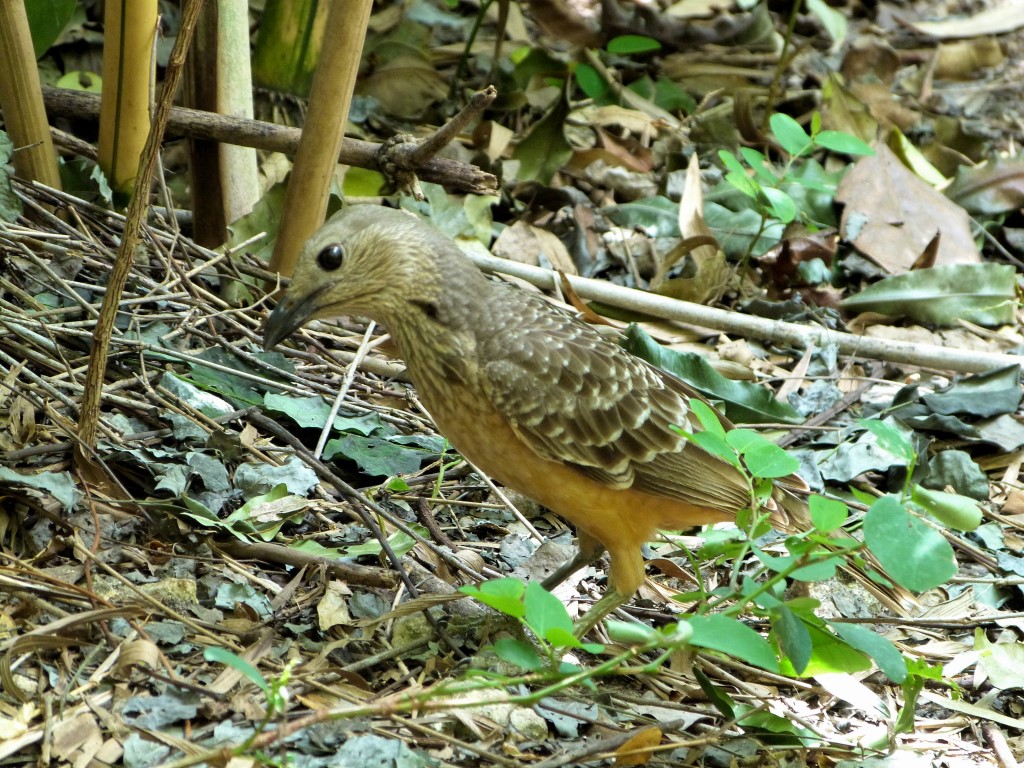
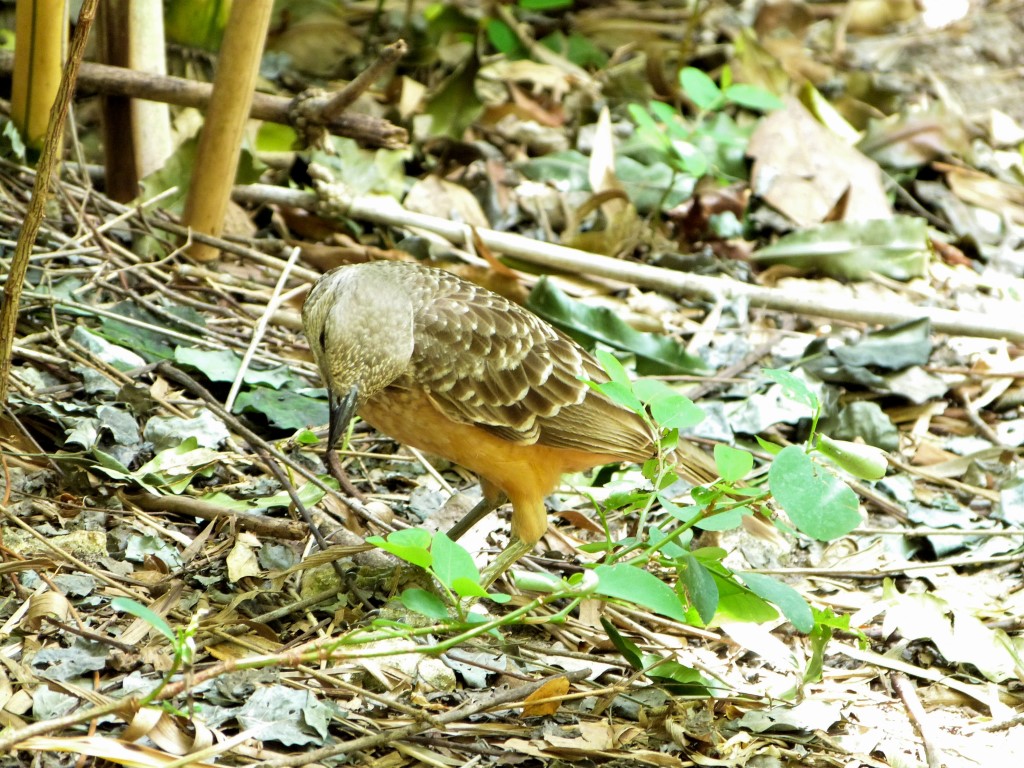
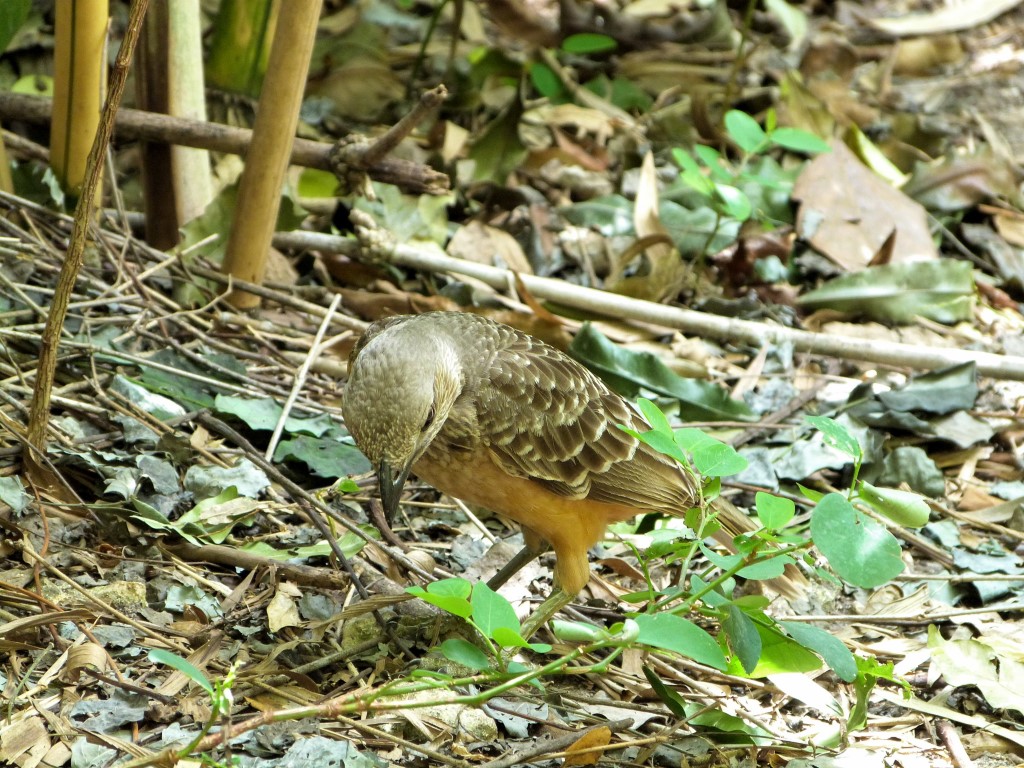
Fawn-breasted Bowerbird at Zoo Miami

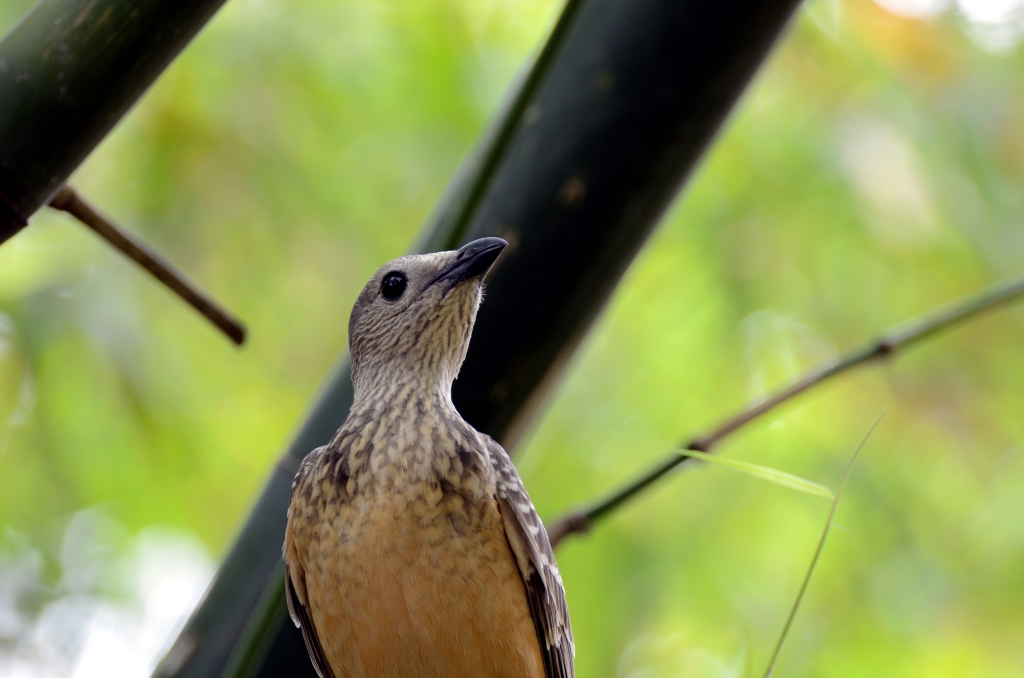
Fawn-breasted Bowerbird (Chlamydera cerviniventris) Zoo Miami by Lee

Fawn-breasted Bowerbird (Chlamydera cerviniventris) Zoo Miami by Lee

One of the neatest thing to watch on this last trip to the Wings of Asia Aviary at Zoo Miami was the Fawn-breasted Bowerbird working on his bower. “The bower itself is that of “avenue-type” with two sides of wall of sticks and usually decorated with green-colored berries.” In his case, he had green leaves laid out in front.

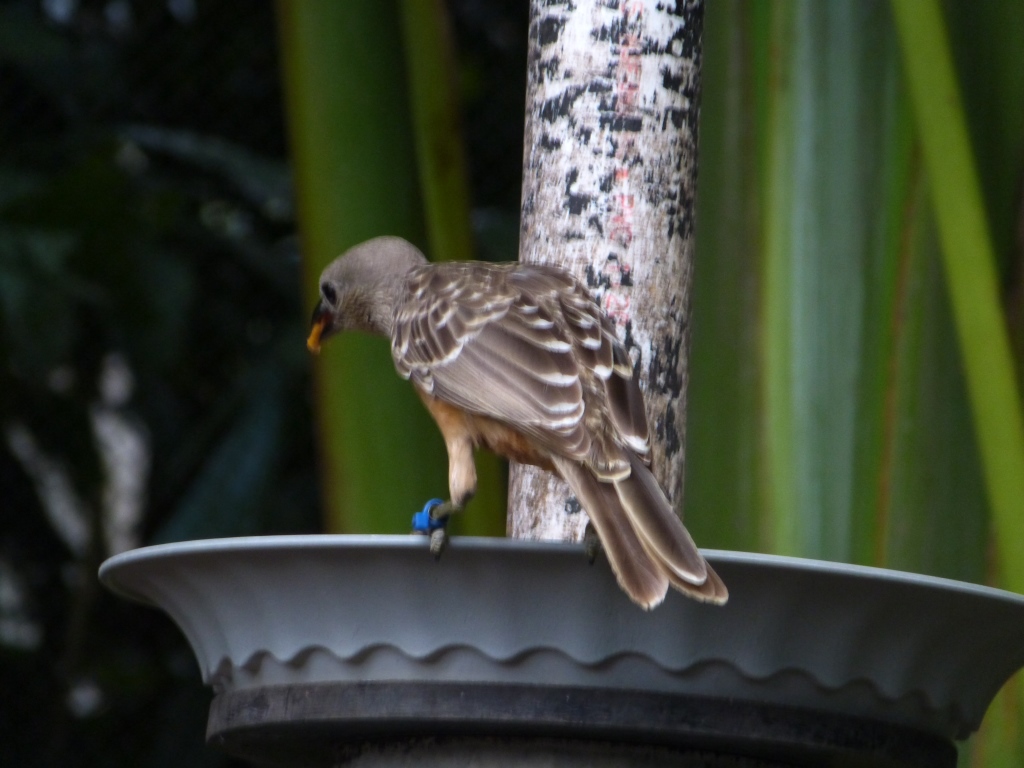
The Fawn-breasted Bowerbird (Chlamydera cerviniventris) is a medium-sized, up to 13 in (32 cm) long, bowerbird with a greyish brown spotted white plumage, a black bill, dark brown iris, yellow mouth and an orange buff below. Both sexes are similar. The female is slightly smaller than the male.

The Fawn-breasted Bowerbird is distributed in New Guinea and northern Australia, where it inhabits the tropical forests, mangroves, savanna woodlands and forest edges. Its diet consists mainly of figs, fruits and insects. The nest is a loose cup made of small sticks up in a tree. The bower itself is that of “avenue-type” with two sides of wall of sticks and usually decorated with green-colored berries. (Wikipedia with editing)

Fawn-breasted Bowerbird by Dan ZM

Fawn-breasted Bowerbird by Dan ZM

The Bowerbirds are in the Ptilonorhynchidae-Bowerbird Family. There are twenty species in the family, of which, 16 are Bowerbirds.

*

Here are two video clips of him working on the bower. Notice how he goes in and out the other end of the bower. Unfortunately we were only able to view it from the side. One shot he is actually placing the stick upright in the ground. (I recorded him for a bit and then Dan came along. As I was explaining it to him, I got tickled, so ignore the snorts.) I was absolutely amazed watching this bird, which the Lord created, knowing how to make his bower chamber.

*

*

Did you notice the birds chirping and singing in the background. It is so peaceful in that aviary. The birds have so much room and places to hang out. You actually “bird watch” there.

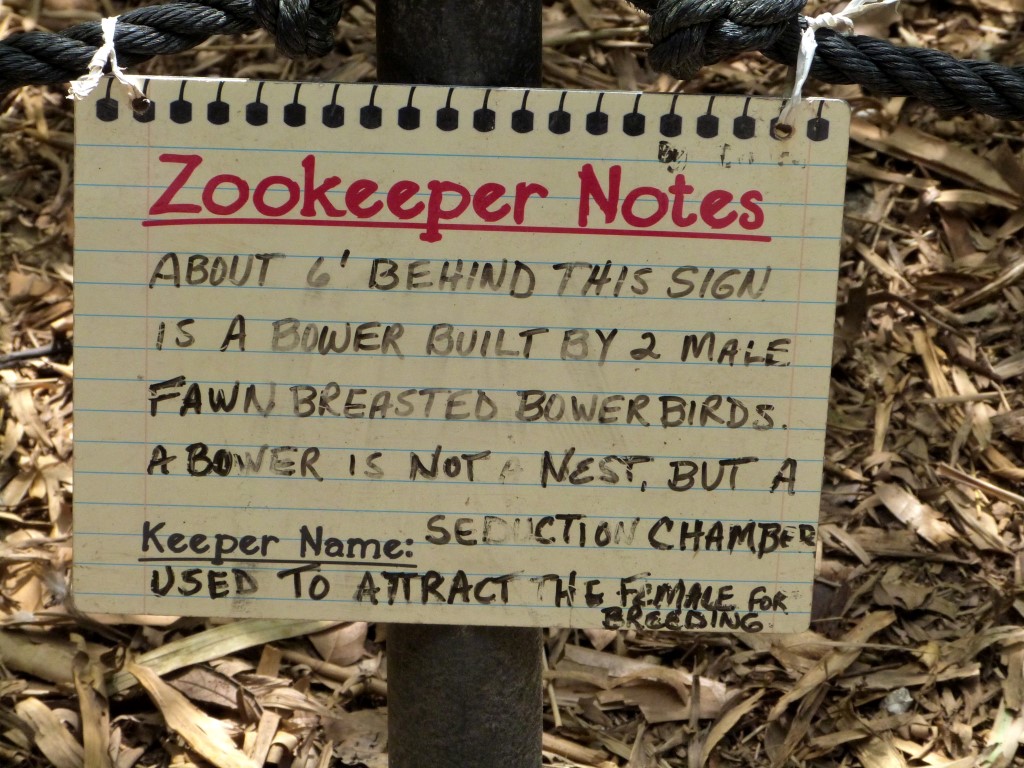
Fawn-breasted Bowerbird (Chlamydera cerviniventris) Sign Zoo Miami by Lee

Fawn-breasted Bowerbird (Chlamydera cerviniventris) Sign Zoo Miami by Lee

Bring out with you every living thing of all flesh that is with you: birds and cattle and every creeping thing that creeps on the earth, so that they may abound on the earth, and be fruitful and multiply on the earth.” (Genesis 8:17 NKJV)

This is the sign telling about the Bowerbird and their name for it; a “Seduction Chamber.” We know that the Lord commanded the birds to reproduce and this bird is only following instructions. He builds his bower to entice a female to be his mate.

We were discussing this and several verses came to our minds:

My son, if sinners entice you, Do not consent. (Proverbs 1:10 NKJV)

And you shall stone him with stones until he dies, because he sought to entice you away from the LORD your God, who brought you out of the land of Egypt, from the house of bondage. (Deuteronomy 13:10 NKJV)

And then if any man shall say to you, Lo, here is Christ; or, lo, he is there; believe him not: For false Christs and false prophets shall rise, and shall shew signs and wonders, to seduce, if it were possible, even the elect. (Mark 13:21-22 KJV)

And this is the promise that he hath promised us, even eternal life. These things have I written unto you concerning them that seduce you. (1 John 2:25-26 KJV)

The Fawn-breasted is fine in what he is doing, but we can learn by watching and taking heed for ourselves.

But ask now the beasts, and they shall teach thee; and the fowls of the air, and they shall tell thee: (Job 12:7 KJV)

*

*

Ptilonorhynchidae-Bowerbird Family

Fawn-breasted Bowerbird – Wikipedia

Bowerbirds – Wikipedia

*

I.O.C. Version 4.2 Updated

Spotted Elachura (Elachura formosa) ©Drawing WikiC

Spotted Elachura (Elachura formosa) formerly Spotted Wren-Babbler ©Drawing WikiC

So God created great sea creatures and every living thing that moves, with which the waters abounded, according to their kind, and every winged bird according to its kind. And God saw that it was good. And God blessed them, saying, “Be fruitful and multiply, and fill the waters in the seas, and let birds multiply on the earth.” So the evening and the morning were the fifth day. (Genesis 1:21-23 NKJV)

It has been time again for the International Ornithologists’ Union to update their IOC World Bird List. Version 4.2 was released last week and this site has been updated.

We are now up to 10,530 living species, 20,964 subspecies, in 40 Orders, 233 Families (plus 5 uncertain families) and 2273 Genera flying or swimming around the globe. They are still doing as commanded by the Lord to reproduce and keeping the ornithologist busy naming, renaming, and rearranging them.

This time they renamed one and moved it to a new family just for it. The Spotted Wren-Babbler (Spelaeornis formosus) was in the Timaliidae Family. It has been renamed the Spotted Elachura (Elachura formosa) and placed in its own Elachuridae Family. (I do not have permission yet to post a photo.)

Version 4.2 also took the Lark Family and tossed it up in the air and rearranged it. See the Alaudidae – Larks Family. The DNA researches are keeping them busy keeping up with how the birds bred. Some of the scientifc names were changed:

Madagascan Lark (Mirafra hova) now (Eremopterix hova)
White-winged Lark  (Melanocorypha leucoptera ) now (Alauda leucoptera)
Sand Lark (Calandrella raytal) now (Alaudala raytal)
Lesser Short-toed Lark (Calandrella rufescens) now (Alaudala rufescens)
Somali Short-toed Lark (Calandrella somalica) now (Alaudala somalica)
Athi Short-toed Lark (Calandrella athensis) now (Alaudala athensis)
Short-tailed Lark (Pseudalaemon fremantlii) now (Spizocorys fremantlii)

Version 4.2 made some minor spelling changes and added 13 species and deleted one.

Timneh Parrot (Psittacus timneh) ADD
Blue-bearded Helmetcrest (Oxypogon cyanolaemus) ADD
White-bearded Helmetcrest (Oxypogon lindenii) ADD
Buffy Helmetcrest (Oxypogon stuebelii) ADD
Acre Tody-Tyrant (Hemitriccus cohnhafti) ADD NEW
White-rumped Sirystes (Sirystes albocinereus) ADD
Todd’s Sirystes (Sirystes subcanescens) ADD
Negro Stipple-throated Antwren (Epinecrophylla pyrrhonota) ADD
Madeira Stipple-throated Antwren (Epinecrophylla amazonica) ADD
Snethlage’s Antpitta (Hylopezus paraensis) ADD
Alta Floresta Antpitta (Hylopezus whittakeri) ADD
Dusky Leaftosser (Sclerurus obscurior) ADD
Sidamo Lark (Heteromirafra sidamoensis) DEL
Tropeiro Seedeater (Sporophila beltoni) ADD

We now have 10,530 named of the Lord’s avian creations to enjoy and try to catch a glimpse of, and capture with a camera or video.

See:

Go out and have a great birdwatching adventure!

*

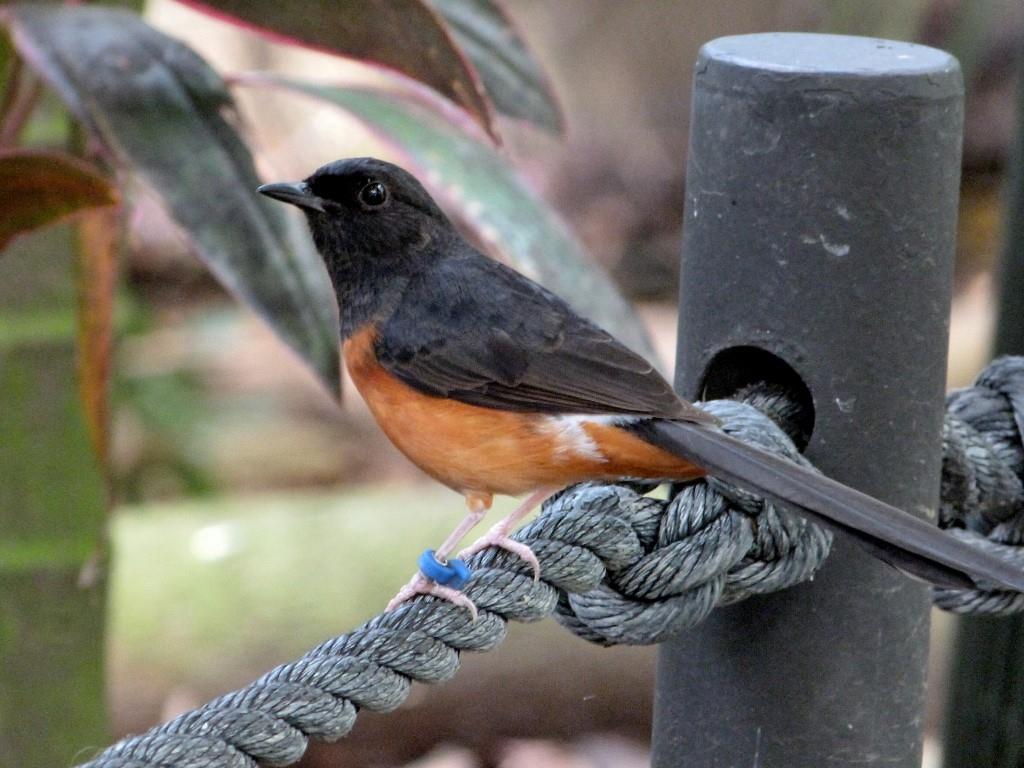
White-rumped Shama at Zoo Miami

White-rumped Shama (Copsychus malabaricus)  at Zoo Miami - Lee

White-rumped Shama (Copsychus malabaricus) at Zoo Miami – Lee

Even the stork in the sky Knows her seasons; And the turtledove and the swift and the thrush Observe the time of their migration; But My people do not know The ordinance of the LORD. (Jeremiah 8:7 NASB)

The White-rumped Shama (Copsychus malabaricus) is a small passerine bird of the family Muscicapidae. Native to densely vegetated habitats in the Indian Subcontinent and Southeast Asia, its popularity as a cage-bird and songster has led to it being introduced elsewhere.

It was formerly classified as a member of the thrush family, Turdidae, causing it to be commonly known as the White-rumped Shama Thrush or simply Shama Thrush.

They typically weigh between 28 and 34 g (1.0 and 1.2 oz) and are around 23–28 cm (9–11 in) in length. Males are glossy black with a chestnut belly and white feathers on the rump and outer tail. Females are more greyish-brown, and are typically shorter than males. Both sexes have a black bill and pink feet. Juveniles have a greyish-brown colouration, similar to that of the females, with a blotchy or spotted chest.

The voice of this species is rich and melodious which made them popular as cage birds in South Asia with the tradition continuing in parts of Southeast Asia. It is loud and clear, with a variety of phrases, and often mimics other birds. They also make a ‘Tck’ call in alarm or when foraging. One of the first recordings of a bird song that was ever made was of this species. This recording was made in 1889 from a captive individual using an Edison wax cylinder by Ludwig Koch in Germany. (Wikipedia)

Here is a video of the Shama singing the second day we were at the Wings of Asia aviary at the Zoo. The pair have a nest and I think the chicks have hatched. (Senior moment-I don’t remember what they told me.)

The LORD is my strength and my shield; my heart trusted in him, and I am helped: therefore my heart greatly rejoiceth; and with my song will I praise him. (Psalms 28:7 KJV)

I am kicking up dust again behind the scenes. The new IOC 4.2 list came out while we were at the zoo. So far I have 237 pages updated, all but the Lark family. They added a new family and are scrambling the Larks around. I am now preparing to do the indexes.  The new 4.2 count is 10,530 species in the world. Stay tuned.

Birds of the World – Families – done

Birds of the Bible – Thrush

White-rumped Shama – Wikipedia

*

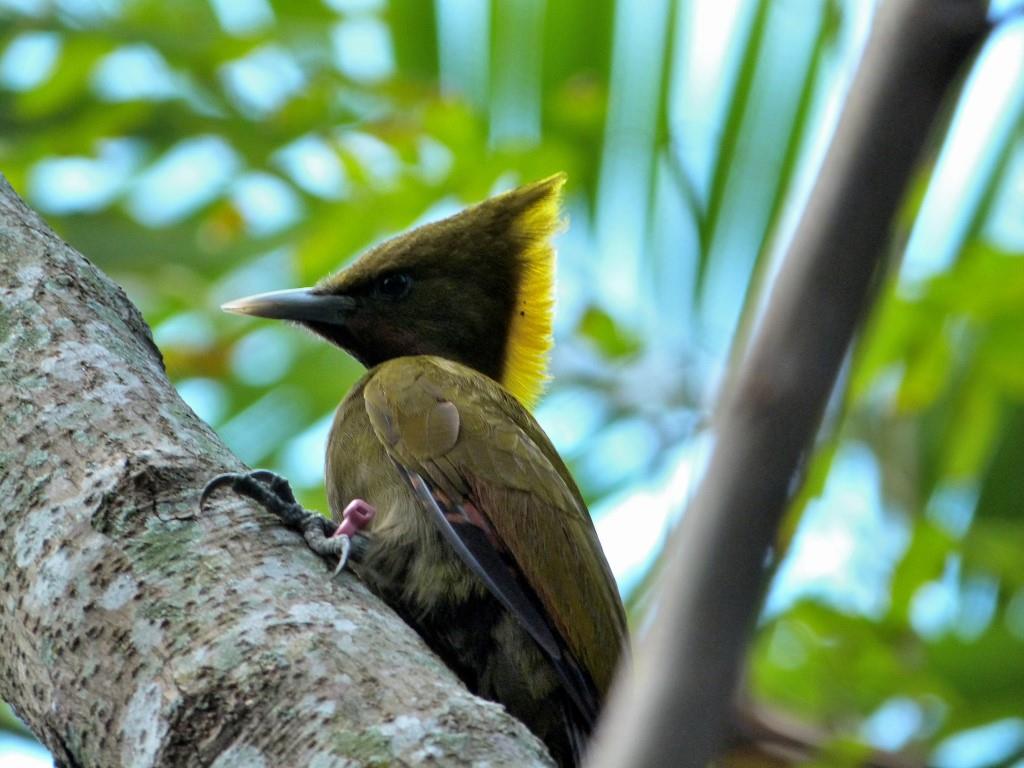
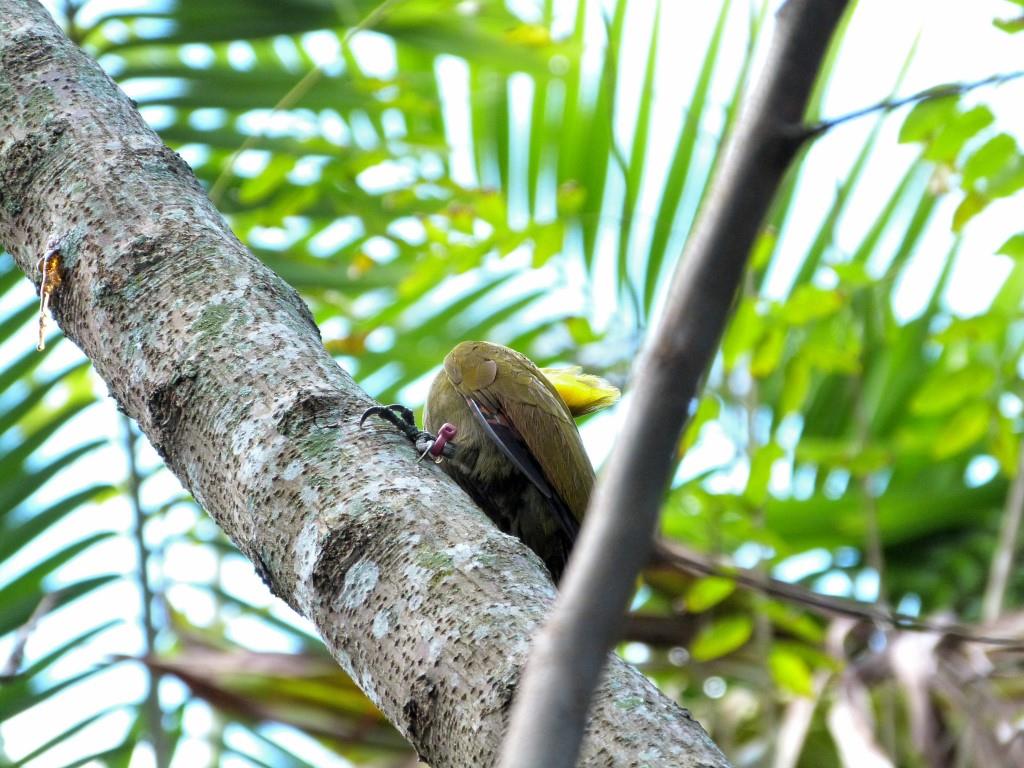
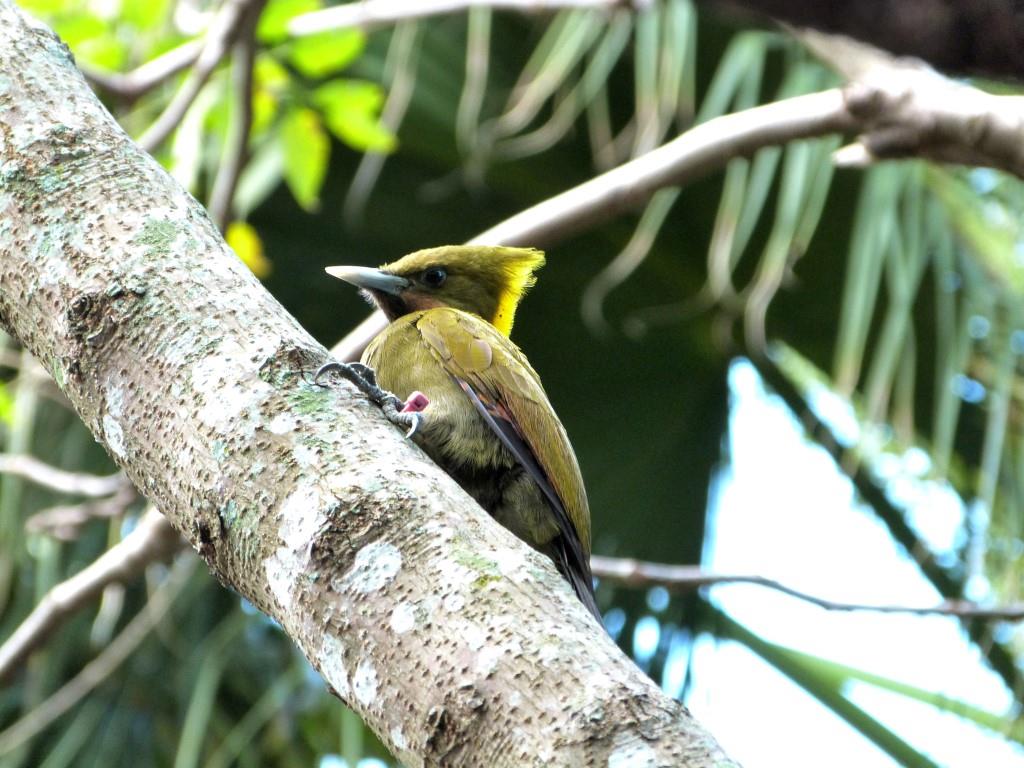
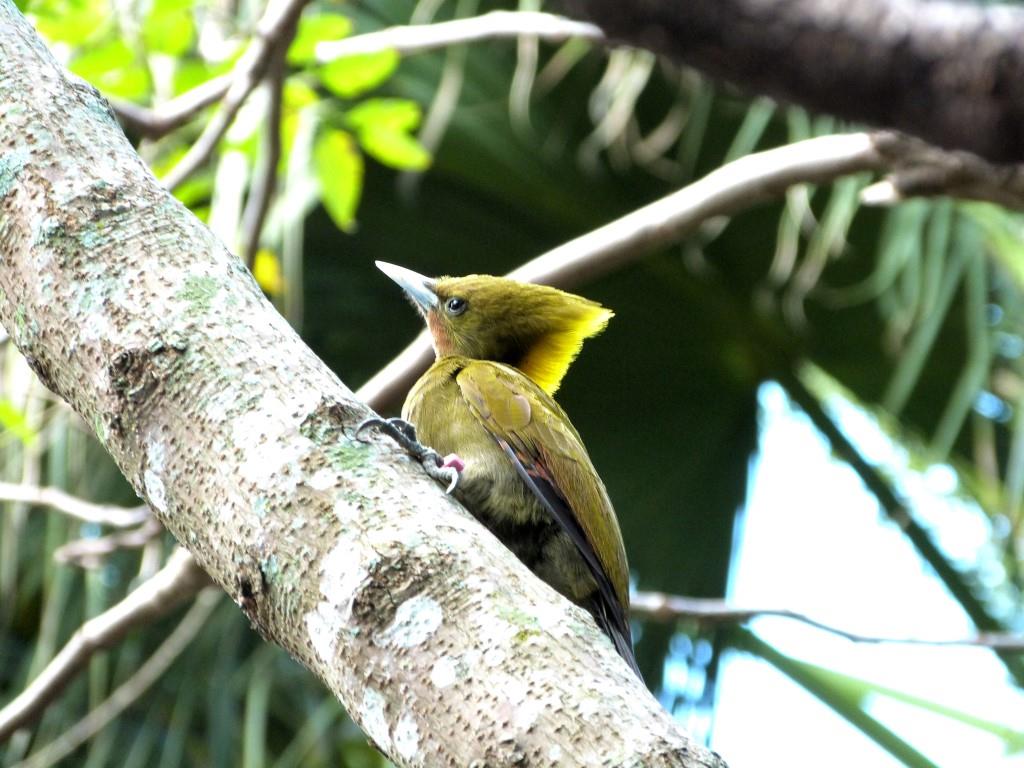
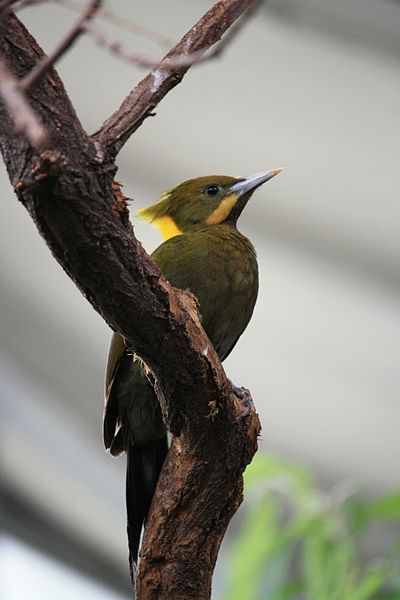
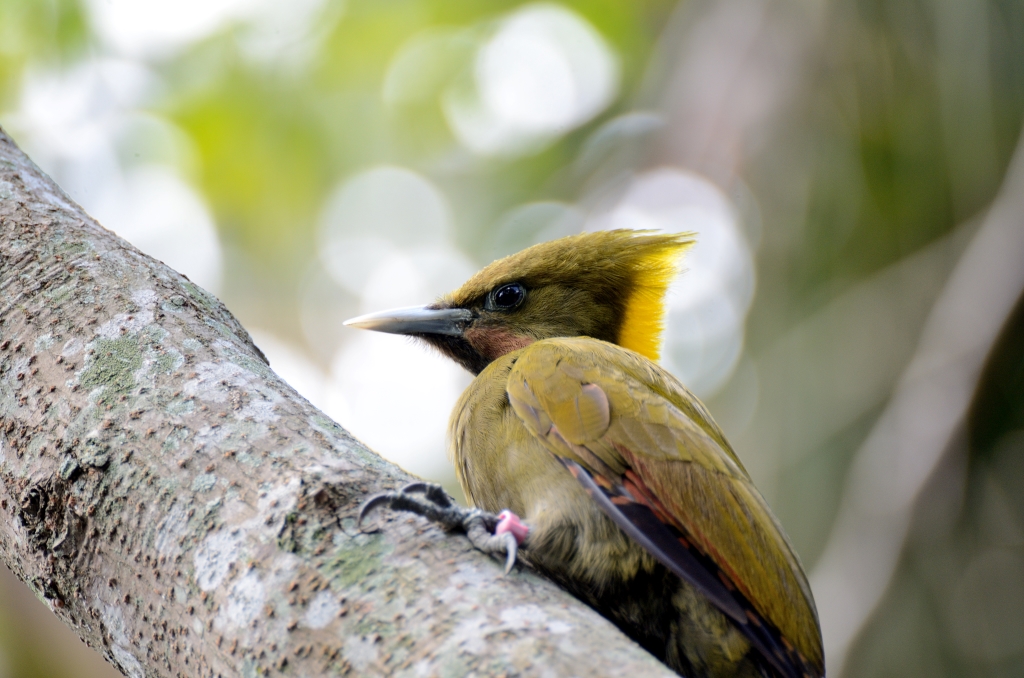
Zoo Miami’s Greater Yellownape

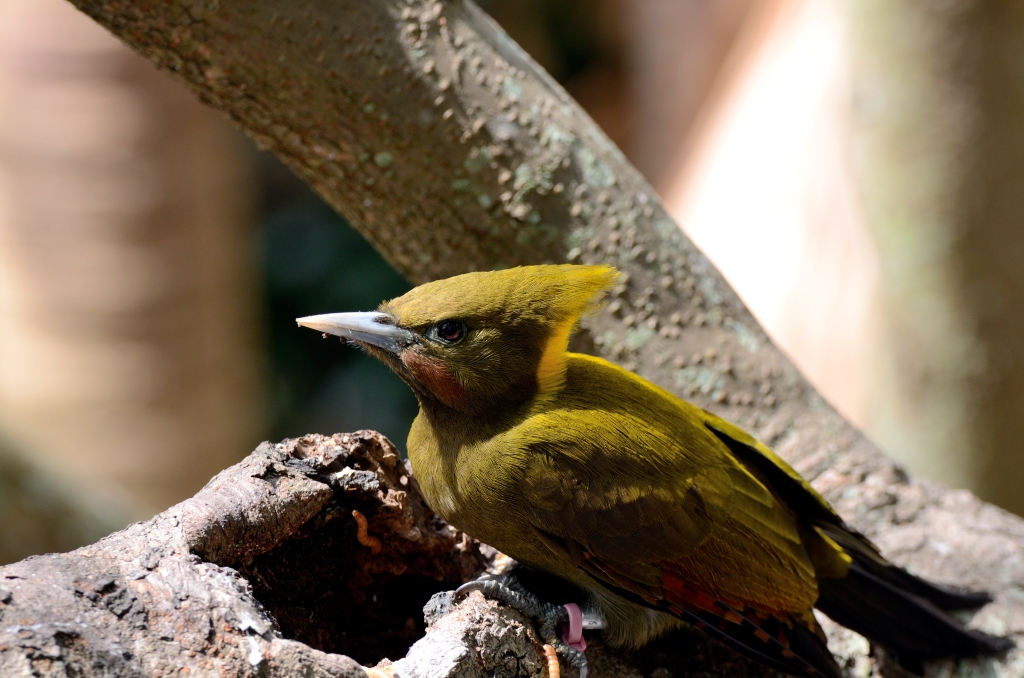
Greater Yellownape (Chrysophlegma flavinucha) female Zoo Miami by Lee

Greater Yellownape (Chrysophlegma flavinucha) female Zoo Miami by Lee

For they will be a graceful ornament on your head, And chains about your neck. (Proverbs 1:9 NKJV)

Here is one of my favorites at Zoo Miami’s Wings of Asia Aviary. They have 87 species and they are all my favorites, but this one is further up the scale. This is a Greater Yellownape (Chrysophlegma flavinucha) female and believe it is the only Yellownape there at present.

Dan and I went back down to Zoo Miami this week and spent two days just in the Aviary. When we were there earlier this year, most of my photos did not come out well. After some adjustments to my Panasonic Lumix FZ47 point-n-shoot (which I shoot in “program mode”), things didn’t do much better at first the first day. More adjustments and these came out better. Tuesday night in the motel, Dan made some more fixes. Yesterday, I finally got some really nice photos which I will share later.

Greater Yellownape (Chrysophlegma flavinucha) female Zoo Miami by Dan

Greater Yellownape (Chrysophlegma flavinucha) female Zoo Miami by Dan

My son, keep your father’s command, And do not forsake the law of your mother. Bind them continually upon your heart; Tie them around your neck. (Proverbs 6:20-21 NKJV)

For those of you into photography, the problem is that the Aviary is well landscaped with lots of trees and is covered with its wire mesh. My ISO and lens speed were to low to compensate for the environment. My camera normally does well when I am “outdoors” and not in an aviary. (As for ISOs and F-stops, I don’t know much them. I would rather study about the birds and let Dan worry about the camera.)

Back to our Yellownape. This is another neat creation from its Creator. They belong to the Woodpecker – Picidae Family. At the aviary, they call it the Greater Yellow Naped Woodpecker.

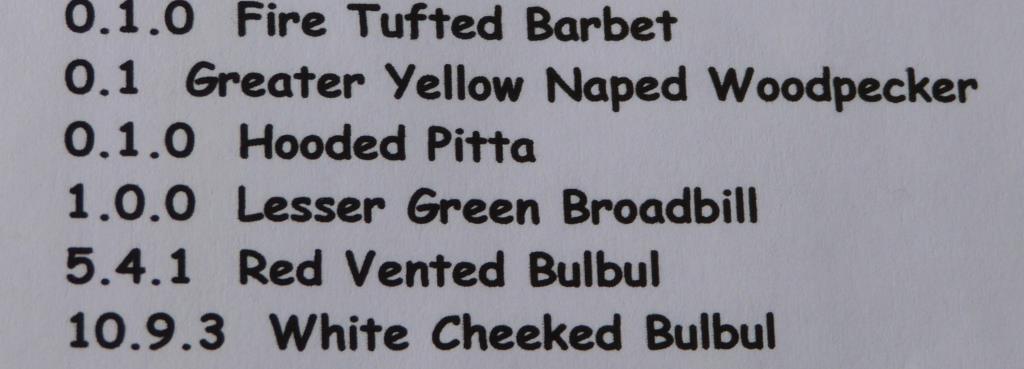
List of birds at Wings of Asia - Greater Yellow Nape

List of birds at Wings of Asia – Greater Yellownape

From a copy of their list, you can tell it is a female and the only one. The list has the number of males first, then number of females and then the third number is unknown sex. Every day they check on the birds and try to find each one. If after 3 days a bird isn’t spotted, then a real search begins. By following the counters around, who were very friendly and willing to help with names of birds, many of the birds come out and into view. Could it be because the counters have food with them? In fact some of the birds make themself right at home on the cart.

Counters with friends

Counters with friends

*

Counters with friends making themselves at home

Counters with friends making themselves at home

*

Counters with friends making themselves at home

Counters with friends making themselves at home

*

Actually the Yellownape came in close the second day, but I failed to get her photo, but Dan captured her in the second photo as she was eating worms from the hole in the tree. The worker had just placed some worms there to bring the birds in closer so they could be counted.

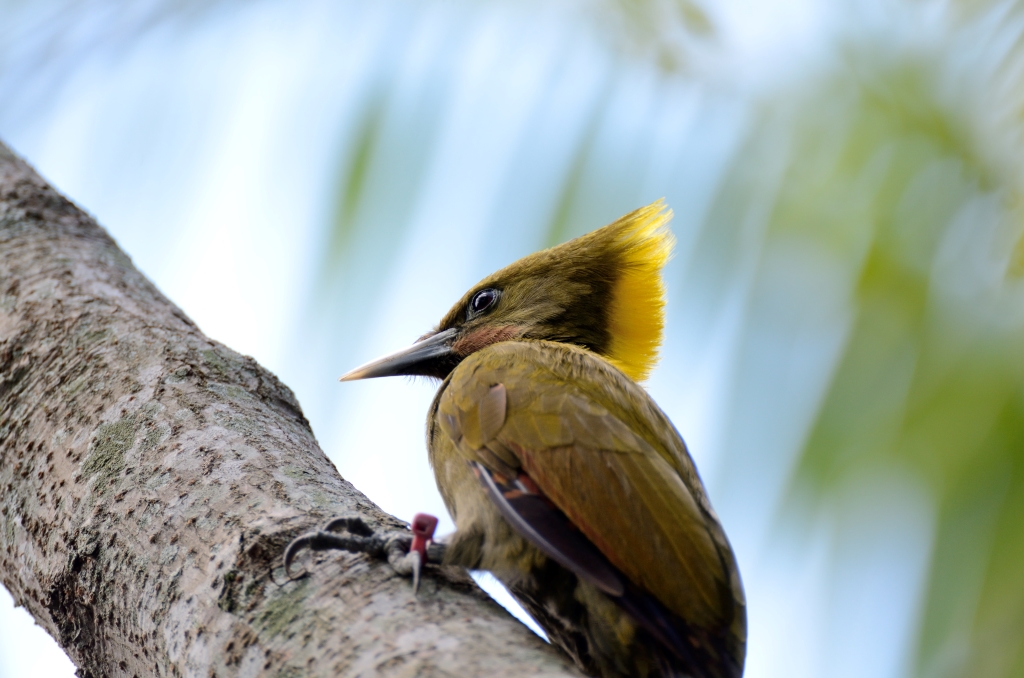
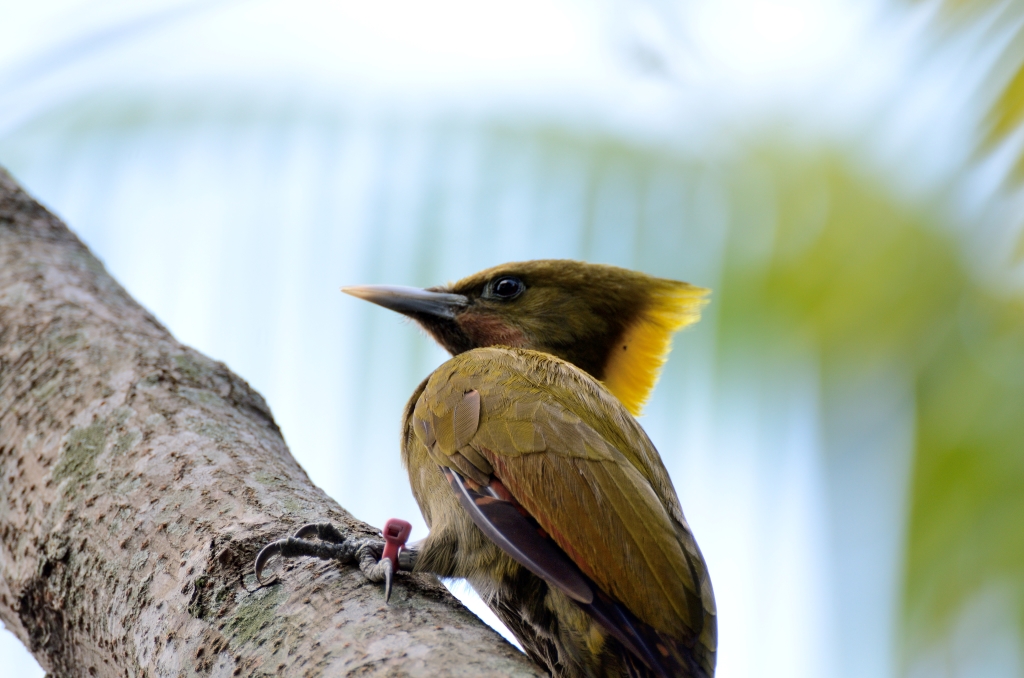
The Greater Yellownape is a large, olive-green woodpecker with prominent yellow-crested nape and throat. Dark olive-green with grey underparts. Crown brownish and flight feathers chestnut barred with black. Bill often looks whitish. “Nape” is the back or base of the neck area. See Birdwatching Term – Nape

It is found in Bangladesh, Bhutan, Cambodia, China, India, Indonesia, Laos, Malaysia, Myanmar, Nepal, Thailand, and Vietnam. Its natural habitats are subtropical or tropical moist lowland forests and subtropical or tropical moist montane forests. (Wikipedia)

Included in the photos below is a photo of a male from Wikipedia. Notice his line on his chin is more yellow than the female. Here is more of a rusty color.

Here are the photos of the Greater Yellownape (Chrysophlegma flavinucha).

“And he arose and came to his father. But when he was still a great way off, his father saw him and had compassion, and ran and fell on his neck and kissed him. …It was right that we should make merry and be glad, for your brother was dead and is alive again, and was lost and is found.’ ” (Luke 15:20, 32 NKJV)

See:

*

Ian’s Bird of the Week – Greater Sand Plover

Looking South from Croquette Point by Ian

Ian’s Bird of the Week – Greater Sand Plover ~ by Ian Montgomery

Newsletter ~ 4/14/14

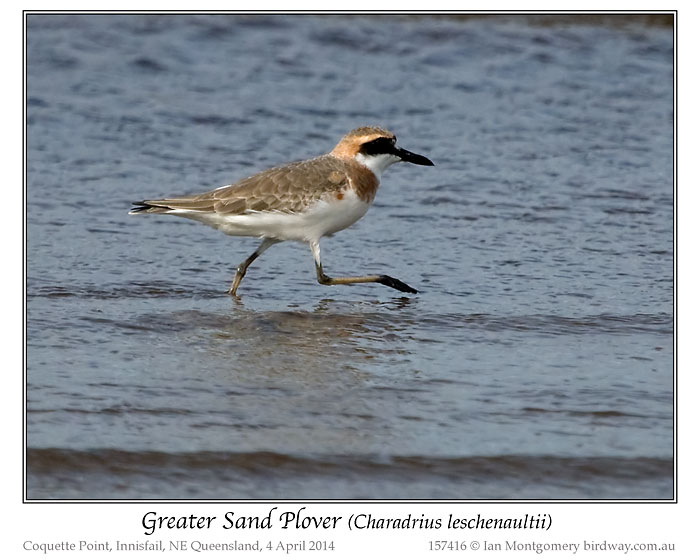
As I mentioned in the last email, I took advantage of a spell of reasonable weather to make a trip to Cairns to take location photos for Where to Find Birds in Northeast Queensland. On the way back, I visited Coquette Point near to check it out as it is listed in the book as a good spot for both mangrove birds and waders. Coquette Point and Flying Fish Point are the charmingly named headlands on the southern and northern banks of the mouth of the Johnstone River on which Innisfail, 100 km south of Cairns, is situated.

Although it mightn’t live up to the dream of an idyllic tropical paradise – I’m still itching from some sandfly bites and there have been recent sightings of Saltwater Crocodiles in the neighbourhood – it did indeed turn out to be good for birds. As well as a pair of Beach Stone-Curlews in the mangroves, there were several pairs of Greater Sand Plovers feeding in the shallows. At this time of the year, many waders are migrating back to their breeding grounds in the northern hemisphere and it is a good time to look for ones in breeding plumage, such as the one in the first photo.

Greater Sand Plover (Charadrius leschenaultii) by Ian

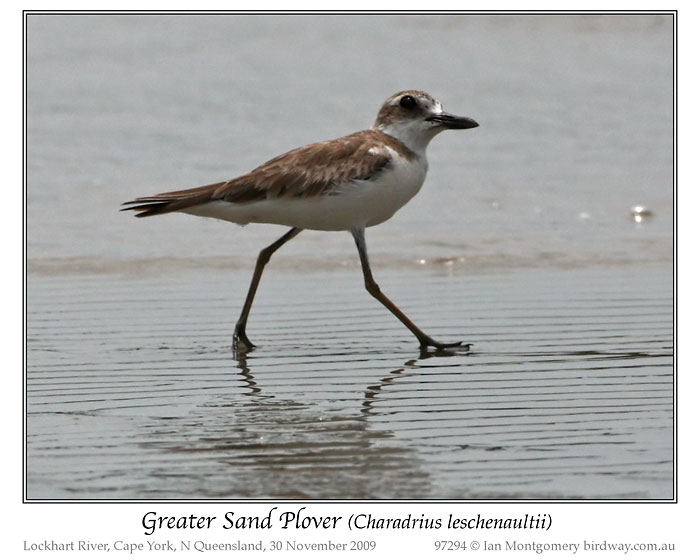
In non-breeding plumage most waders are, frankly, drab and often difficult to identify. Here is a Greater Sand Plover in non-breeding plumage on Cape York. This particular individual shows the characteristic long legs and large bill that distinguish it from the very similar Lesser or Mongolian Sand Plover, but Sand Plovers are quite variable in both size and bill length and I’m not always certain of identification, even with the aid of photos.

Greater Sand Plover (Charadrius leschenaultii) by Ian

Here, to illustrate the point, is a pair at Coquette Point. The bird in non-breeding plumage looks smaller than its companion, has the slightly hunched posture of the Lesser Sand Plover but its large bill, and guilt by association, would indicate a Greater.

Greater Sand Plover (Charadrius leschenaultii) by Ian

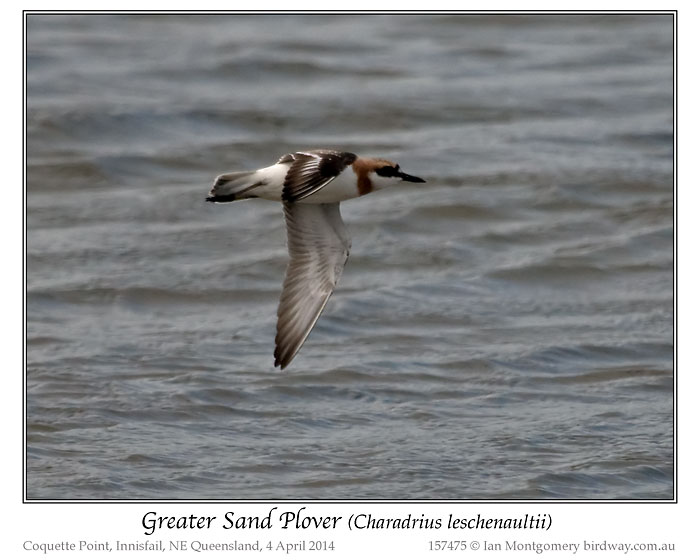
Finally, to complete the series, here is one of the Coquette Point birds in flight. The birds wintering in Australia belong to the nominate race leschenaultii and nest in Southern Siberia, Western China and Southern Mongolia. Their movements are not well understood but it is thought that they migrate non-stop, so this at least is one species of wader that doesn’t have to rely on the fast-disappearing mudflats of the Yellow Sea for refuelling stopovers.

Greater Sand Plover (Charadrius leschenaultii) by Ian 4

I’d always vaguely assumed that the person who named Flying Fish Point did so because he or she had seen Flying Fish there, but Coquette Point aroused my curiosity as there seemed nothing flirtatious about it. With the help of Google, I found out that George Dalrymple, one of the explorers in this part of the world was sent by the Queensland Government in 1873 to explore the inlets and rivers between Cardwell and Cooktown. His boats were two cutters, the Flying Fish and the Coquette and one of his companion policemen was Robert Johnstone. In Dalrymple’s report to Parliament he said “I therefore considered that I was justified in naming the river after Mr Johnstone, a gentleman who has become identified with discovery and enterprise on the north east coast and who first brought to light the real character and value of this fine river, and it’s rich agricultural land…”. This, incidentally, is what 19th Century cutters looked like.

Ancient British Navy Gun Cutter from Ian

Ancient British Navy Gun Cutter from Ian

Which, of course, begs the question of why a Queensland boat would be called Coquette. The only clue I could find was that the first Royal Navy ship called Coquette was a 28 gun one captured off the French in 1783 and put into service. After that the name ‘Coquette’ was used repeatedly for a series of smaller ships.

Greetings
Ian

**************************************************
Ian Montgomery, Birdway Pty Ltd,
454 Forestry Road, Bluewater, Qld 4818
Tel 0411 602 737 ian@birdway.com.au
Bird Photos http://www.birdway.com.au/
Recorder Society http://www.nqrs.org.au


Lee’s Addition:

Even the stork in the heavens knows her times, and the turtledove, swallow, and crane keep the time of their coming, but my people know not the rules of the LORD. (Jer 8:7 ESV)

Thanks again, Ian, for sharing another interesting bird. I find it interesting that his birds are migrating, but for the opposite reason ours are migrating. Cold is coming on down there and our are heading home because it is getting warmer. Either way, the birds are on the “move.”

Plovers are members of the Charadriidae – Plovers Family.

*
More:

Ian’s Bird of the Week

Charadriidae – Plovers Family

*

Sunday Inspiration – Palm Birds

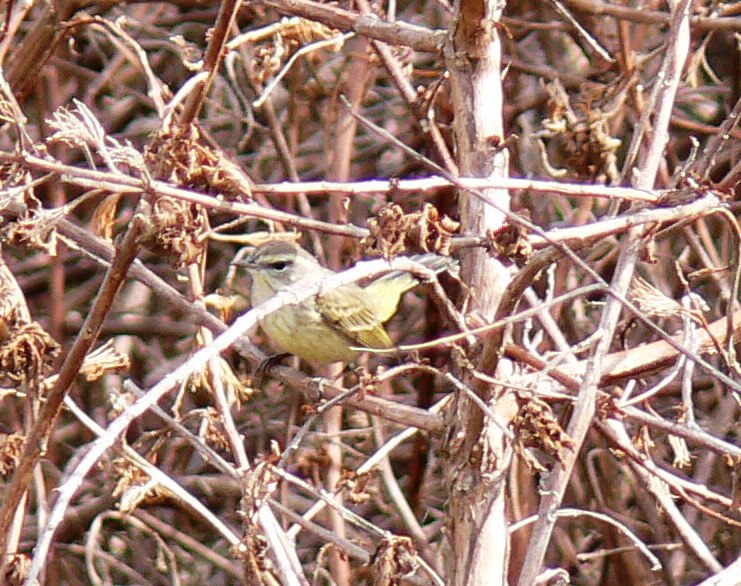
Palm Warbler (Dendroica palmarum) yellow by Lee

Palm Warbler (Dendroica palmarum) yellow by Lee

And ye shall take you on the first day the boughs of goodly trees,branches of palm trees, and the boughs of thick trees, and willows of the brook; and ye shall rejoice before the LORD your God seven days. (Leviticus 23:40 KJV) [Foretold]

The next day a great multitude that had come to the feast, when they heard that Jesus was coming to Jerusalem, took branches of palm trees and went out to meet Him, and cried out: “Hosanna! ‘BLESSED IS HE WHO COMES IN THE NAME OF THE LORD!’ The King of Israel!” Then Jesus, when He had found a young donkey, sat on it; as it is written: “FEAR NOT, DAUGHTER OF ZION; BEHOLD, YOUR KING IS COMING, SITTING ON A DONKEY’S COLT.” (John 12:12-15 NKJV) [Fulfilled]

This slideshow requires JavaScript.

*

Hosanna (Messiah Has Come) and Messiah – (Solo by Lisa Brock) from the Easter Musical 2013 by Faith Baptist Choir.

*

(I pushed the photos a little bit by including the Semipalmated Plover and Sandpiper)

See:

More Sunday Inspirations

Gospel Presentation

Formed By Him – “Palm” Birds

*