Ian’s Bird of the Week – Freckled Duck

Freckled Duck (Stictonetta naevosa) by Ian

Freckled Duck (Stictonetta naevosa) by Ian

Ian’s Bird of the Week – Freckled Duck ~ by Ian Montgomery

Newsletter ~ 9/30/13

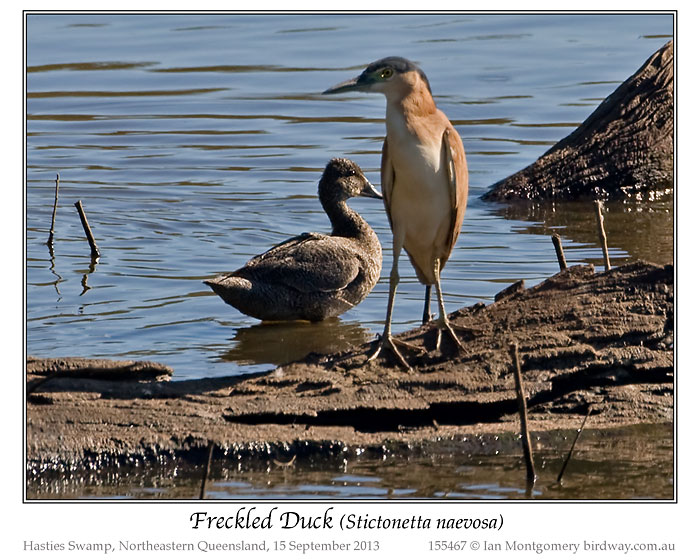
Several friends have inquired how I got on with the quest for Freckled Duck photos a fortnight ago, so here it is as bird of the week as it’s a rare and unusual duck, even if these ones didn’t want to cooperate in the portrait photo category. There were perhaps a dozen or more at the reported site of Hasties Swamp just south of Atherton town, but only two came within cooee of the hide and spent most of the day sitting on this log. Note the diagnostic ski-jump-shaped bill and the slight peak on the head of the bird on the end of the log. The duck beside this one is a Hardhead, so they’re approximately the same size.

It was a lovely day at Hasties (second photo), so it was no hardship loafing there waiting for the ducks to do something. The log the ducks liked is the farther one in this photo, but this was taken with my phone and makes it look farther away than it actually is. It’s a two storey hide, and this was taken from the upper deck, though I spent most of the time downstairs. The log was popular with various species of ducks including Pacific Blacks and Grey Teal, so the Freckled Ducks, all in non-breeding garb were easy to overlook.

Hasties Swamp, Atherton Tableland by Ian

Very occasionally, one of the ducks would swim over to a smaller log (hidden behind the branch in the second photo) and peck at a coot if it came too close. You can see the coot in the third photo.

Freckled Duck (Stictonetta naevosa) by Ian

Freckled Duck (Stictonetta naevosa) by Ian

Sometimes it would swim away to feed, but always on the other side of the log. In the fourth photo it is maybe contemplating such a foray, and is testing the water behind one of several Nankeen Night-Herons that came out to feed in the late afternoon – apparently they roost in the trees near the hide.
Freckled Duck (Stictonetta naevosa) by Ian

Freckled Duck (Stictonetta naevosa) by Ian

The fifth photo shows a distant pair of Freckled Ducks thirteen years ago in breeding condition at Werribee in Victoria and you can see the characteristic red colour of the male. The peaks look more conspicuous on both sexes, but I don’t know whether these feathers grow longer then or whether they are erectile.

Freckled Duck (Stictonetta naevosa) by Ian

Freckled Duck (Stictonetta naevosa) by Ian

So why is this rather drab duck so interesting to both birders and avian taxonomists? Firstly, it’s endemic to Australia and rare, particular in North Queensland. It’s main breeding range is in inland areas of New South Wales, Victoria, Southern Western Australia (an isolated population) and the channel country of Southwestern Queensland where breeding takes place in densely vegetated lakes and swamps, including lignum in more arid floodplains. When these areas dry out, the birds move to the coast, which is when they become easier to find. Presumably the birds currently in North Queensland (they’ve been reported in both Townsville and the Atherton Tableland) are from the Cooper’s Creek and Paroo River catchments.

Secondly, taxonomists find the Freckled Duck interesting because it has no close relatives. It is the only member of the genus Stictonetta and both morphological and DNA studies support placing it in own sub-family that diverged from other ducks and geese very early on. The name Stictonetta means ‘spotted duck’ in Greek and, in a case of tautological overkill, naevosa means ‘spot abundance’ in Latin.

I was going to include a Snake of the Week but this is getting rather long, so I’ll hold it over till next time.

Best wishes
Ian

**************************************************
Ian Montgomery, Birdway Pty Ltd,
454 Forestry Road, Bluewater, Qld 4818
Tel 0411 602 737 ian@birdway.com.au
Bird Photos http://www.birdway.com.au/
Recorder Society http://www.nqrs.org.au


Lee’s Addition:

What birdwatchers and photographers won’t go through to find those special and rare birds. Thanks, Ian, for showing us yet another interesting member of the Anatidae – Ducks, Geese & Swans Family. I am so thankful that Ian is letting me share his newsletters here on this blog. We have been introduced to numerous birds we have never have heard of, let along seen.

Check out all of Ian’s Anatidae Family photos.

Here are a few more facts about this duck from Wikipedia. The Freckled Duck (Stictonetta naevosa) is a moderately large, broad-bodied duck native to southern Australia. The duck is protected by law. Dark in colour with fine off-white speckles all over, it is most easily identified by its large head with a peaked (as opposed to rounded) crown.

The Freckled Duck feeds by dabbling in shallow water, often by wading near the edge. It prefers large, well-vegetated swamps, but moves to open water after breeding or in dry periods.

In flight, it has a distinctive rapid wing beat and holds its head low, making it appear hunchbacked. It does not turn rapidly and lands clumsily.

In dry years, the ephemeral wetlands of the Murray-Darling Basin and Lake Eyre disappear and Freckled Ducks migrate to permanent water in coastal regions. This concentration in populated areas, coupled with their habit of circling repeatedly at low altitude when disturbed (even when being shot at) makes them particularly vulnerable to hunting.

See:

Freckled Duck – Wikipedia

Ian’s Anatidae Family photos

Anatidae – Ducks, Geese & Swans Family

*
Ian’s Bird of the Week – Sarus Crane

Sarus Crane (Grus antigone) by Ian Montgomery

Sarus Crane (Grus antigone) by Ian Montgomery

Ian’s Bird of the Week – Sarus Crane ~ by Ian Montgomery

Newsletter – 9/19/13

I went up to the Atherton Tableland at the weekend to photograph Freckled Ducks at Hasties Swamp where these rare birds had recently been reported. The ducks were still there perching on a log at an inconvenient distance from the hide and, although I spent several hours on three occasions in the hide, they never came any closer and I gave them a wooden spoon award for being undynamic and uncooperative. However, Sarus Cranes, which winter in fields on the Tableland were more cooperative.

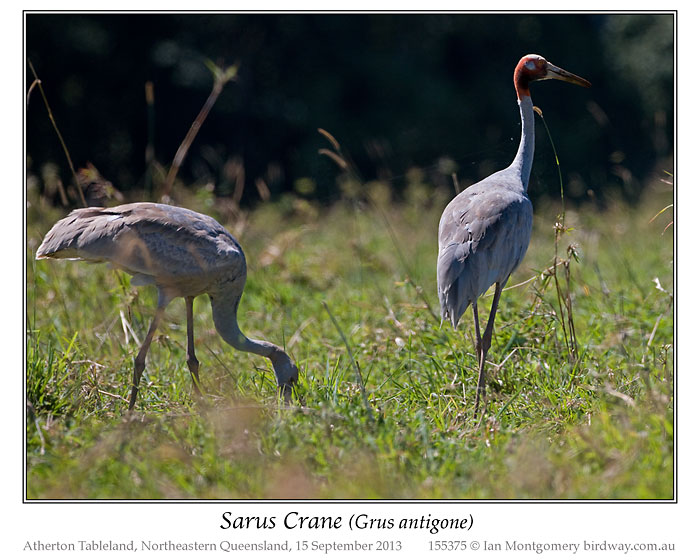
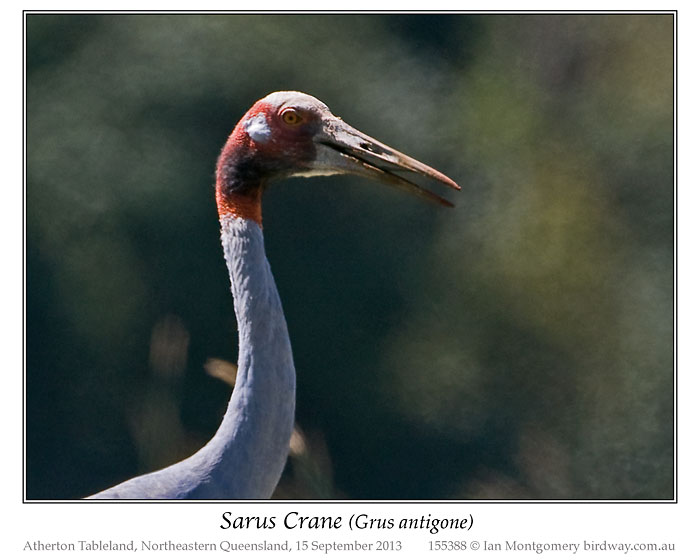
Before I tell you the odd story of their history in Australia, here is a spot-the-difference exercise comparing the Sarus Crane, first photo, with the much commoner and more widespread Brolga, second photo.

Brolga Crane (Grus rubicunda) by Ian Montgomery

Brolga Crane (Grus rubicunda) by Ian Montgomery

You have to spot only two differences: the red on the neck of the Sarus Crane extends much farther down than on the Brolga, and the Brolga has a dewlap, the flap of tissue hanging down from the chin. There is another difference: Sarus Cranes have pink legs, and Brolgas have grey ones, though this is often difficult to spot as the legs can be pinkish-grey in the Sarus Crane. Anyway, more about distinguish them later.

Sarus Crane (Grus antigone) by Ian Montgomery

Sarus Crane (Grus antigone) by Ian Montgomery

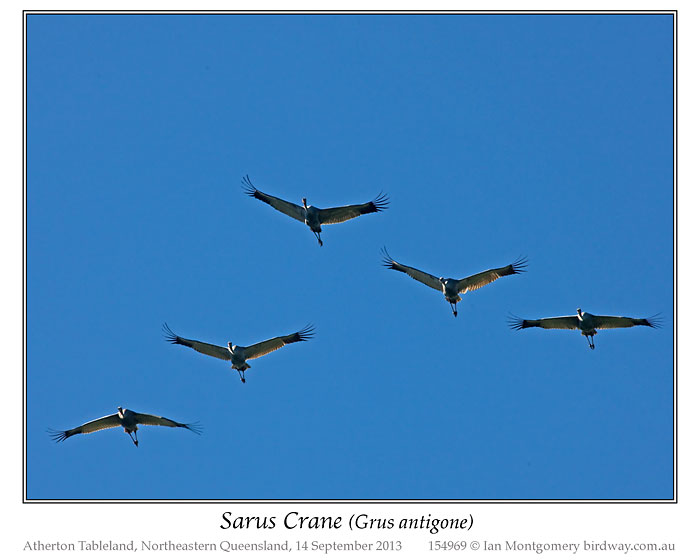
We first discovered a small party of Sarus Cranes feeding near the Malanda-Atherton Highway (opposite the upmarket Gallo chocolate and cheese place). While I was taking photos of them, a flock of about 60 joined them in the field except for 5 which obligingly flew over us, photos 3 and 4. In flight they look positively Jurassic Park-ish and make wonderful, insistent, gurgling, trumpeting noises.

Sarus Crane (Grus antigone) by Ian Montgomery

Sarus Crane (Grus antigone) by Ian Montgomery

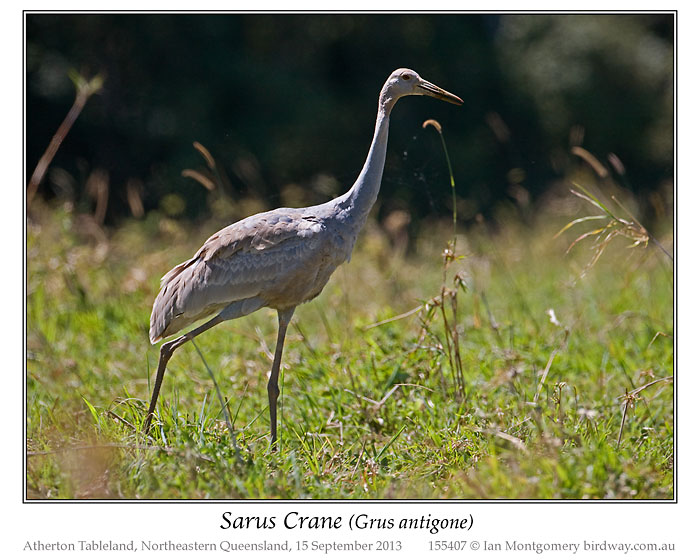
The next day, when I got bored waiting for the ducks to do something I went to Gallo for cheese and lunch and found a family, I presume, of Sarus Cranes – 2 adults and a juvenile – close to the road that goes from the Malanda-Atherton road to Yungaburra via the Curtain Fig National Park, photos 5 and 6 (the other adult is in the first photo).

Sarus Crane (Grus antigone) by Ian Montgomery

Sarus Crane (Grus antigone) by Ian Montgomery

In juvenile Sarus Cranes the red colour is replaced by buffish-cinnamon, usually darker than the one these photos.

Sarus Crane (Grus antigone) Juvenile by Ian Montgomery

Sarus Crane (Grus antigone) Juvenile by Ian Montgomery

The reason for the spot-the-difference exercise was to show that the two species are not hard to separate in the field. So, why were Sarus Cranes not positively identified in Australia until 1966 (in Normanton on the Gulf of Carpentaria)? The fashionable explanation at the time – which got unobservant birders off the hook – was they had recently colonised Australia from, presumably, Indochina, the nearest other place that they occur naturally. The Australian birds were conveniently similar to the Eastern Sarus Crane (race sharpii) that occurs there, even though it doesn’t migrate. Maybe they couldn’t cope with the sounds of war in Vietnam. It is now though that the Australian Sarus Cranes form another smaller race, gilliae, and have been here all along nesting in remote swamps on the Gulf of Carpentaria and Cape York Peninsula with at least some moving to the Atherton Tableland in winter.

Sarus Crane (Grus antigone) by Ian Montgomery

Sarus Crane (Grus antigone) by Ian Montgomery

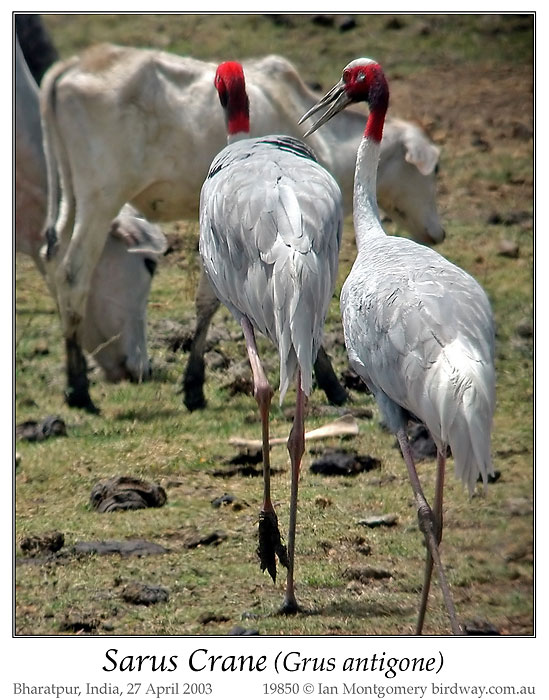
The last photo shows the nominate race, antigone, in India. It has white tertiary feathers (the bustle) and with a length of 176cm/70in (weight to 12kg/26lbs) is the world’s tallest flying bird. The population in India is perhaps 10,000, Indochina 1,000 and Australia 5,000. It is extinct in various countries including the Philippines (probably yet another race) and Pakistan and is under threat in Indochina. The Australia population is thought to be stable and may have benefitted from clearing of land for agriculture on the Atherton Tableland.

Best wishes
Ian

**************************************************
Ian Montgomery, Birdway Pty Ltd,
454 Forestry Road, Bluewater, Qld 4818
Tel 0411 602 737 ian@birdway.com.au
Bird Photos http://www.birdway.com.au/
Recorder Society http://www.nqrs.org.au


Lee’s Addition:

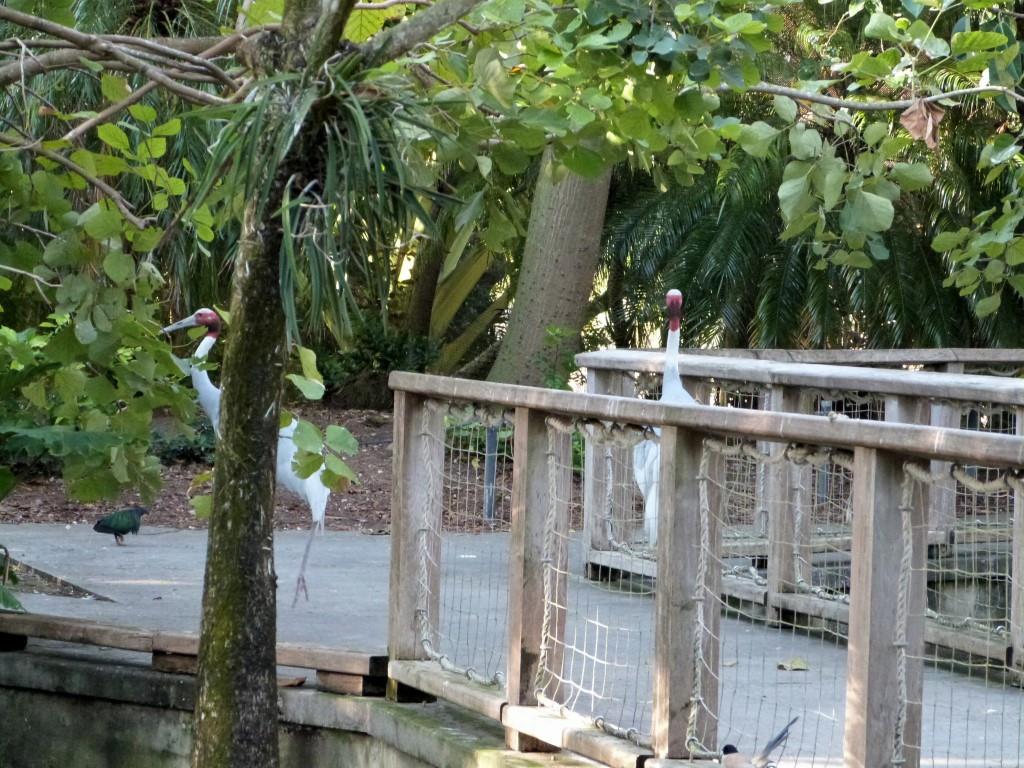
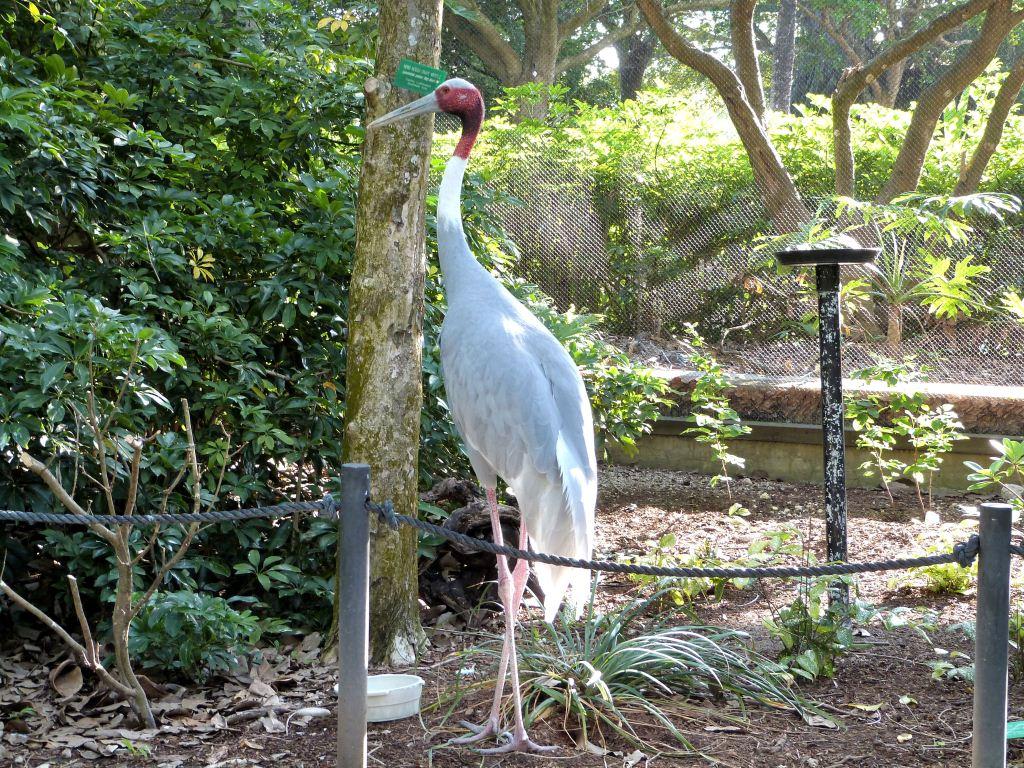
Thanks again, Ian, for sharing another great bird. I encountered my first Sarus Cranes at the Zoo Miami’s Wings of Asia Aviary. They were walking along the sidewalk, and like Ian said, they are tall. I am only 4’10” and they are over 5 feet. Needless to say, I gave them room when they walked by and also had to look up to them.

Sarus Crane (Grus antigone) by Lee at Wings of Asia

Sarus Crane (Grus antigone) by Lee at Wings of Asia

Like a crane or a swallow, so did I chatter: I did mourn as a dove: mine eyes fail with looking upward: O LORD, I am oppressed; undertake for me. (Isaiah 38:14 KJV)

Sarus and Brolga Cranes belong to the in the Gruidae – Crane Family and are also Birds of the Bible.

Sarus Crane (Grus antigone) by Lee at Wings of Asia

Sarus Crane (Grus antigone) by Lee at Wings of Asia

Yea, the stork in the heaven knoweth her appointed times; and the turtle and the crane and the swallow observe the time of their coming; but my people know not the judgment of the LORD. (Jeremiah 8:7 KJV)

See:

Ian’s Bird of the Week

Ian’s Crane Photos

Sarus Crane – Wikipedia

Gruidae – Crane Family

Birds of the Bible – Cranes

Birds of the Bible

*

Mousebirds at the Cincinnati Zoo

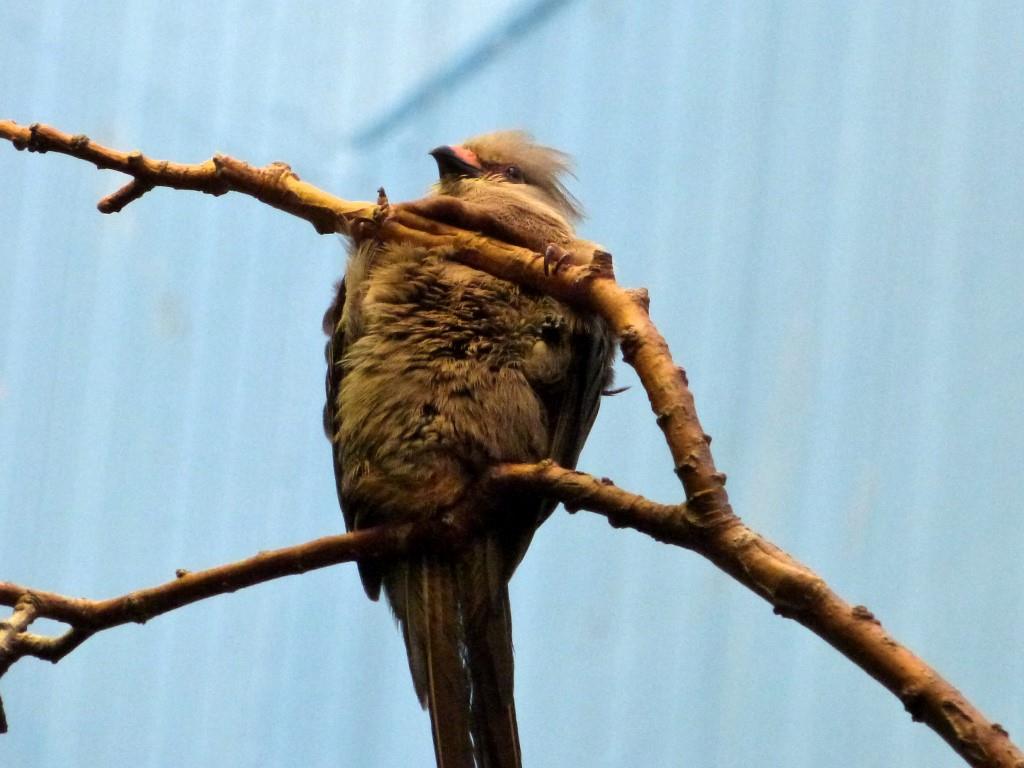
Blue-naped Mousebird (Urocolius macrourus) at Cincinnati Zoo) by Lee

Blue-naped Mousebird (Urocolius macrourus) at Cincinnati Zoo) by Lee

I know all the birds of the mountains, And the wild beasts of the field are Mine. (Psalms 50:11 NKJV)

I was happy to finally get to see the Mousebirds. Have known and read about them, but had not been able to watch them. They were on my “birds to see” list at the zoo.

Mousebirds belong to the Coliidae – Mousebirds Family which has six (6) members.

Blue-naped Mousebird (Urocolius macrourus) at Cincinnati Zoo) by Lee

Blue-naped Mousebird (Urocolius macrourus) at Cincinnati Zoo) by Lee

They are slender greyish or brown birds with soft, hairlike body feathers. They are typically about 10 cm in body length, with a long, thin tail a further 20–24 cm in length, and weigh 45–55 grams. They are arboreal and scurry through the leaves like rodents, in search of berries, fruit and buds. This habit, and their legs, gives rise to the group’s English name. They are acrobatic, and can feed upside down. All species have strong claws and reversible outer toes (pamprodactyl foot). They also have crests and stubby bills.

Mousebirds are gregarious, again reinforcing the analogy with mice, and are found in bands of about 20 in lightly wooded country. These birds build cup-shaped twig nests in trees, which are lined with grasses. Two to four eggs are typically laid, hatching to give quite precocious young which soon leave the nest and acquire flight.

Blue-naped Mousebird (Urocolius macrourus) at Cincinnati Zoo) by Lee

Blue-naped Mousebird (Urocolius macrourus) at Cincinnati Zoo) by Lee

One Mousebird, supposedly the male, was hopping up and down. This video shows the two of them. One watching and one jumping. The orange bird is ignoring the whole deal. (I had been watching for a while and then decided to video, of course he went behind the branch.)

(Wikipedia with editing)

Bonus:

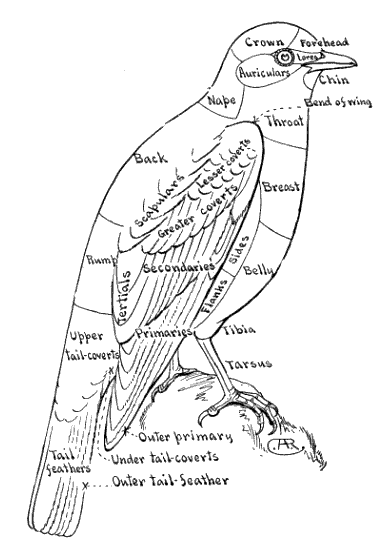
Nape – An easy definition is the back of the neck.

Topography of a Bird - Bluebird - Color Key to NA Birds

Notice the Nape between the Crown and the Back

There are quite a few birds that have colored napes that help identify them, such as Woodpeckers, Grebes, etc. Our Blue-naped Mousebird is one where the color of the “nape” is used in its name. While learning to bird watch, I kept saying (and still do) that the Lord should have placed little signs on them. That way when we look at them through binoculars, scopes, cameras, or our eyes, that we could just read the sign.

That is not the way it is, but there are many clues do that help us ID the birds. The variety of the birds with their colors and shapes keep us busy, but aren’t we thankful that He didn’t make them all alike. How boring that would be.

Here are the “-naped” birds:

Chestnut-naped Francolin (Pternistis castaneicollis)
Red-naped Ibis (Pseudibis papillosa)
White-naped Crane (Grus vipio)
Black-naped Tern (Sterna sumatrana)
Eastern Bronze-naped Pigeon (Columba delegorguei)
Western Bronze-naped Pigeon (Columba iriditorques)
Island Bronze-naped Pigeon (Columba malherbii)
Scaly-naped Pigeon (Patagioenas squamosa) –*LLABS*
Red-naped Fruit Dove (Ptilinopus dohertyi)
Black-naped Fruit Dove (Ptilinopus melanospilus) *LLABS*
Purple-naped Lory (Lorius domicella)
White-naped Lory (Lorius albidinucha)
Blue-naped Parrot (Tanygnathus lucionensis)
Yellow-naped Amazon (Amazona auropalliata)
Scaly-naped Amazon (Amazona mercenarius)
White-naped Swift (Streptoprocne semicollaris)
Red-naped Trogon (Harpactes kasumba)
Golden-naped Barbet (Megalaima pulcherrima)
Golden-naped Woodpecker (Melanerpes chrysauchen)
Red-naped Sapsucker (Sphyrapicus nuchalis)
White-naped Woodpecker (Chrysocolaptes festivus)
Blue-naped Pitta (Hydrornis nipalensis)
Rusty-naped Pitta (Hydrornis oatesi)
Grey-naped Antpitta (Grallaria griseonucha)
Chestnut-naped Antpitta (Grallaria nuchalis)
Ochre-naped Ground Tyrant (Muscisaxicola flavinucha)
Rufous-naped Ground Tyrant (Muscisaxicola rufivertex)
White-naped Xenopsaris (Xenopsaris albinucha)
White-naped Honeyeater (Melithreptus lunatus)
Red-naped Bushshrike (Laniarius ruficeps)
Rufous-naped Whistler (Aleadryas rufinucha)
Rufous-naped Greenlet (Hylophilus semibrunneus)
Black-naped Oriole (Oriolus chinensis)
Black-naped Monarch (Hypothymis azurea)
White-naped Monarch (Carterornis pileatus)
Azure-naped Jay (Cyanocorax heilprini)
White-naped Jay (Cyanocorax cyanopogon)
Rufous-naped Tit (Periparus rufonuchalis)
White-naped Tit (Parus nuchalis)
Rufous-naped Lark (Mirafra africana)
White-naped Yuhina (Yuhina bakeri)
Rufous-naped Wren (Campylorhynchus rufinucha)
Chestnut-naped Forktail (Enicurus ruficapillus)
Purple-naped Sunbird (Hypogramma hypogrammicum)
Golden-naped Weaver (Ploceus aureonucha)
Golden-naped Finch (Pyrrhoplectes epauletta)
Blue-naped Chlorophonia (Chlorophonia cyanea)
White-naped Brush Finch (Atlapetes albinucha)
Pale-naped Brush Finch (Atlapetes pallidinucha)
Rufous-naped Brush Finch (Atlapetes latinuchus)
Golden-naped Tanager (Tangara ruficervix)
Green-naped Tanager (Tangara fucosa)
White-naped Seedeater (Dolospingus fringilloides)

*

This slideshow requires JavaScript.

You can see by the photos that the “nape” can be narrow or very broad.

See:

Mousebirds – Carolinabirds

Mousebirds – The Online Zoo

Nape – All About Birds

Cincinnati Zoo Visit

*

Strutting Greater Flamingos at the Zoo

Greater Flamingo (Phoenicopterus roseus) at Cincinnati Zoo by Dan First walk

Greater Flamingo (Phoenicopterus roseus) at Cincinnati Zoo by Dan – First walk

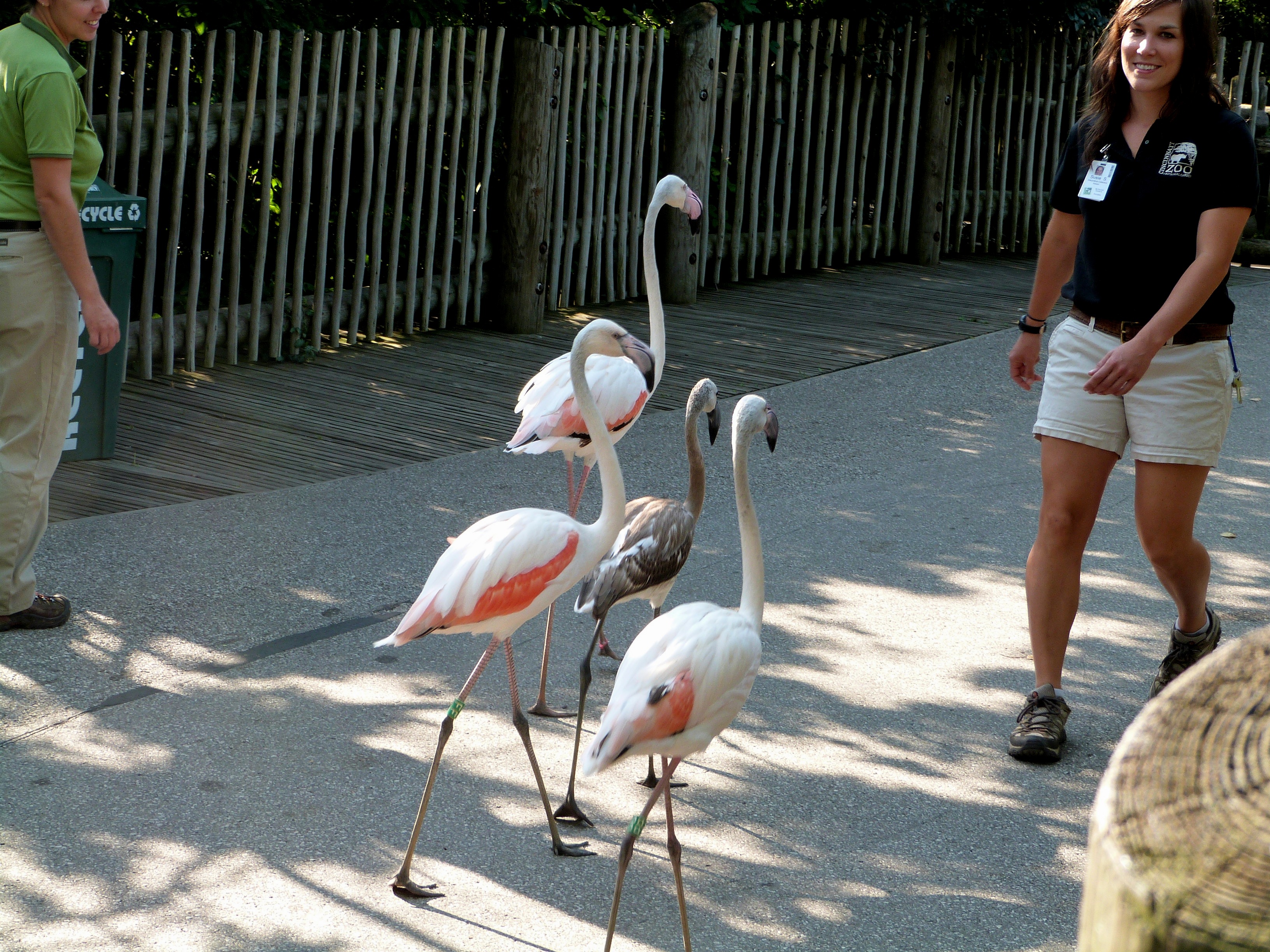
The Cincinnati Zoo has the Greater Flamingo (Phoenicopterus roseus) species, another beautiful creation from God, that they take for a walk. They walked past us twice so close you could touch them, which we didn’t.

It was really neat to watch them just strolling along as if you were walking your dogs or whatever. The Bible says:

For every kind of beast and bird, of reptile and creature of the sea, is tamed and has been tamed by mankind. (James 3:7 NKJV)

Well, the strolls were definitely an indication that these Greater Flamingos were in control of their trainers.

Greater Flamingo (Phoenicopterus roseus) at Cincinnati Zoo by Lee

Greater Flamingo (Phoenicopterus roseus) at Cincinnati Zoo by Lee

The Greater Flamingo (Phoenicopterus roseus) is the most widespread species of the flamingo family. They belong to the Phoenicopteridae – Flamingos Family. It is found in parts of Africa, southern Asia (coastal regions of Pakistan and India), and southern Europe (including Spain, Albania, Turkey, Greece, Cyprus, Portugal, Italy and the Camargue region of France). Some populations are short distance migrants, and sightings north of the breeding range are relatively frequent; however, given the species’ popularity in captivity, whether or not these are truly wild individuals is a matter of some debate.

This is the largest species of flamingo, averaging 43–60 in (110–150 cm) tall and weighing 4.4–8.8 lbs (2–4 kg). The largest male flamingos have been recorded at up to 74 in (187 cm) tall and 10 lbs (4.5 kg).[2] It is closely related to the American Flamingo and Chilean Flamingo.

Greater Flamingo (Phoenicopterus roseus) at Cincinnati Zoo by Lee

Greater Flamingo (Phoenicopterus roseus) at Cincinnati Zoo by Lee

Like all flamingos, this species lays a single chalky-white egg on a mud mound. Most of the plumage is pinkish-white, but the wing coverts are red and the primary and secondary flight feathers are black. The bill is pink with a restricted black tip, and the legs are entirely pink. The call is a goose-like honking. Sub-adult flamingos are whitish-grey and only attain the pink coloration several years into their adult life.

The bird resides in mudflats and shallow coastal lagoons with salt water. Using its feet, the bird stirs up the mud, then sucks water through its bill and filters out small shrimp, seeds, blue-green algae, microscopic organisms and mollusks. The Greater Flamingo feeds with its head down and its upper jaw is movable and not rigidly fixed to its skull.

Greater Flamingo (Phoenicopterus roseus) Juvenile at Cincinnati Zoo by Lee

Greater Flamingo (Phoenicopterus roseus) Juvenile at Cincinnati Zoo by Lee

The average lifespan in captivity, according to Zoo Basel, is over 60 years.

The oldest known Greater Flamingo, a resident of the Adelaide Zoo in Australia, is at least 77 years old. The bird’s exact age is not known; however, he was already a mature adult when he arrived in Adelaide in 1933, and he was still there as of 2011.

Here is a short video of them walking through the Cincinnati Zoo.

(Wikipedia with editing)

This slideshow requires JavaScript.

*

See:

*

Birdwatching at the Cincinnati Zoo II

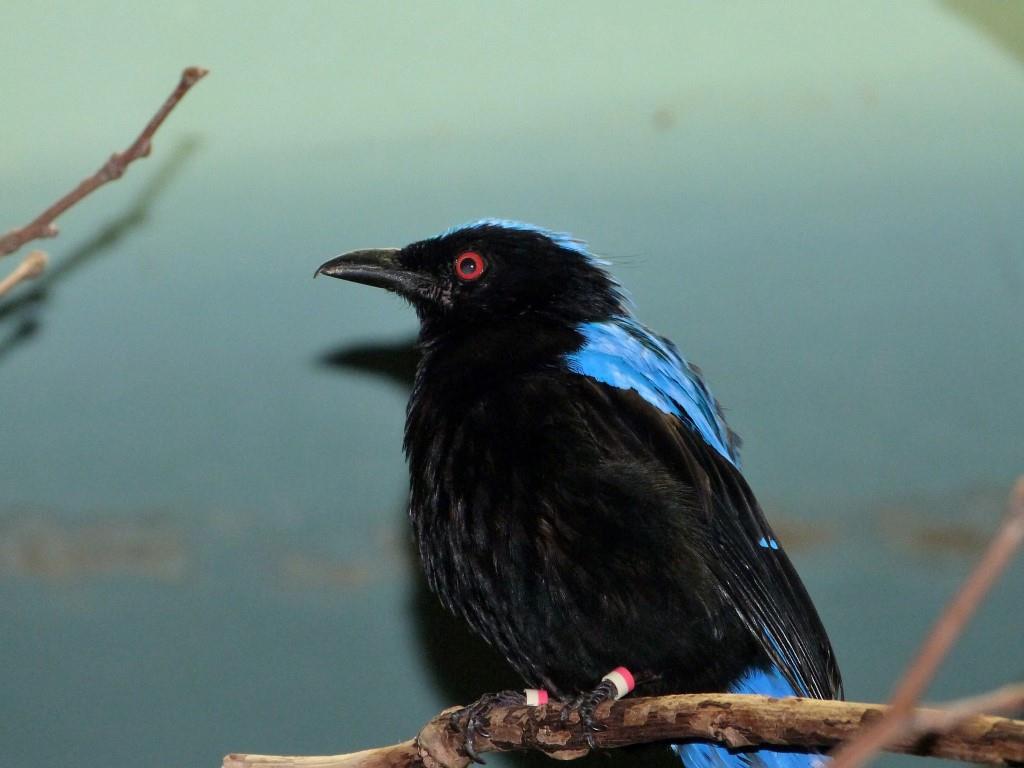
Asian Fairy-bluebird (Irena puella) at Cincinnati Zoo by Lee

Asian Fairy-bluebird (Irena puella) at Cincinnati Zoo by Lee

Declare His glory among the nations, His wonders among all peoples. (Psalms 96:3 NKJV)

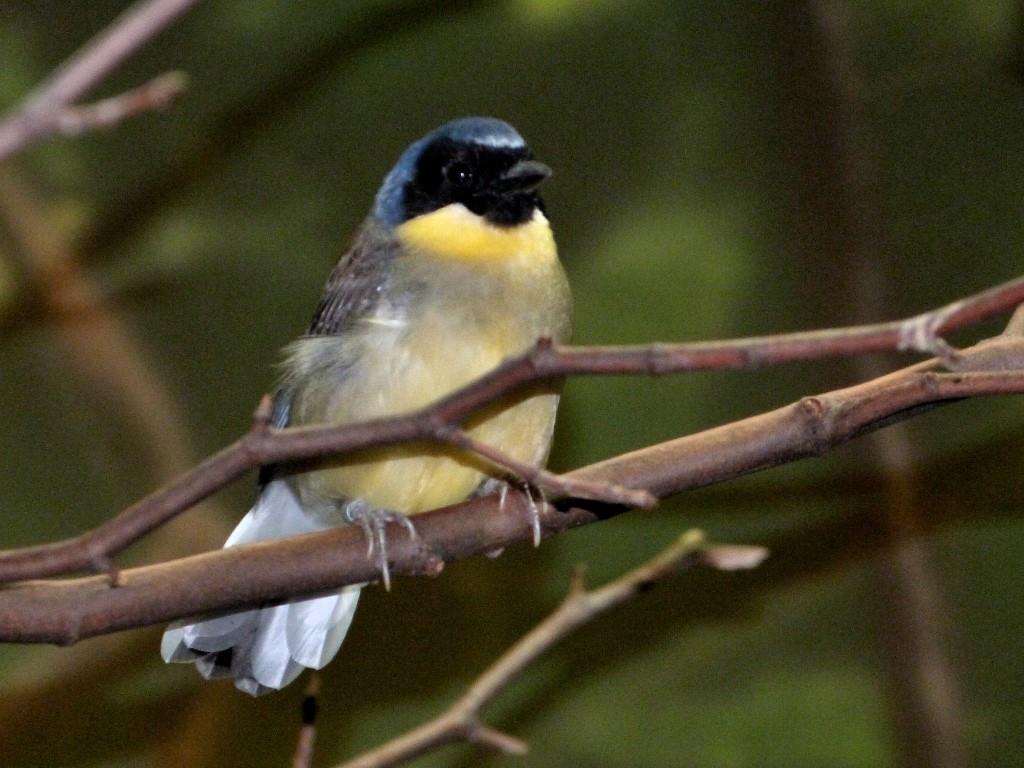
In Birdwatching at the Cincinnati Zoo I, you were introduced to the outside of the Wings of the World exhibit where the different birds are presented according to their habitats. Birds of the Bible – The Bat Revisited was about the two species of Bats at the Zoo. Today, I like to introduce two more species that the Lord created. The Asian Fairy-bluebird and the Blue-crowned Laughingthrush which were sharing the same aviary and the same tree.

The Asian Fairy-bluebird (Irena puella) is a medium-sized, arboreal passerine bird. They are members of the Irenidae – Fairy-bluebirds Family.

This fairy-bluebird is found in forests across tropical southern Asia from the Himalayan foothills, India and Sri Lanka east through Indochina, the Greater Sundas and Palawan (Philippines). Two or three eggs are laid in a small cup nest in a tree. The only other member of the genus and family is the Philippine Fairy-bluebird, I. cyanogastra, which replaces the Asian Fairy-bluebird in most of the Philippines.

Asian Fairy-bluebird (Irena puella) at Cincinnati Zoo by Lee

Asian Fairy-bluebird (Irena puella) at Cincinnati Zoo by Lee

The male has glossy, iridescent blue upperparts, and black underparts and flight feathers. The female and first year male are entirely dull blue-green.

The Asian Fairy Bluebird eats fruit, nectar and some insects. Its call is a liquid two note glue-it.

The name of this bird commemorates the French missionary Frédéric Courtois.

*

Blue-crowned Laughingthrush (Garrulax courtoisi) at Cincinnati Zoo by Lee

Blue-crowned Laughingthrush (Garrulax courtoisi) at Cincinnati Zoo by Lee

He will yet fill your mouth with laughter And your lips with shouting. (Job 8:21 NASB)

The other bird keeping him company is a Blue-crowned Laughingthrush. The Blue-crowned Laughingthrush or Courtois’s Laughingbird (Garrulax courtoisi) is a Chinese species of bird in the Leiothrichidae – Laughingthrushes Family. Until recently, this critically endangered species was generally treated as a subspecies of the Yellow-throated Laughingthrush, but that species has a pale grey (not bluish) crown.

It feeds principally on fruit and is generally found on the larger forest-trees.

Blue-crowned Laughingthrush (Garrulax courtoisi) at Cincinnati Zoo by Lee

Blue-crowned Laughingthrush (Garrulax courtoisi) at Cincinnati Zoo by Lee

It breeds from February to April, constructing a shallow cup-shaped nest, sometimes of moss and sometimes of small twigs, in a sapling or small tree. The eggs, which are generally two in number, are greenish white marked with brown.

*

Here are three short videos of them that I took. Sorry for the shakiness.

(Information from Wikipedia and other internet resources)

See Also:

*

Birds of the Bible – The Bat Revisited

Giant Fruit Bat at Cincinnati Zoo 9-5-13 by Dan

Giant Fruit Bat at Cincinnati Zoo by Dan

And the stork, the heron after her kind, and the lapwing, and the bat. All fowls that creep, going upon all four, shall be an abomination unto you. Yet these may ye eat of every flying creeping thing that goeth upon all four, which have legs above their feet, to leap withal upon the earth; Even these of them ye may eat; the locust after his kind, and the bald locust after his kind, and the beetle after his kind, and the grasshopper after his kind. But all other flying creeping things, which have four feet, shall be an abomination unto you.
(Leviticus 11:19-23 KJV)

While we were at the Cincinnati Zoo, we were able to see and photograph several Bat species. They were really cool and I wanted to share them with you.

Giant Fruit Bat at Cincinnati Zoo 9-5-13 by Lee

Giant Fruit Bat at Cincinnati Zoo by Lee

Then I remembered that I had written about them in Birds of the Bible – The Bat?, in 2010. In that article, the controversy over whether a Bat is a Bird was mentioned, with several commentary comments. This time, I am mainly sharing the photos of the Bats that are there at the Zoo and comments about them. Just one personal observation about the above verses. The use of “fowl” in the King James Version and some of the others seems to refer to any creature that had wings and flies. I quoted the whole context because; 1) The verse and chapter separations were inserted later, 2) Birds, bats, and insects all seem to be referred to with the same collective term, “fowl.” I do not have a problem with the bat. It is not a bird.

The only other verses using “bat” or “bats” are:

And the stork, and the heron after her kind, and the lapwing, and the bat. (Deuteronomy 14:18 KJV)

In that day a man shall cast his idols of silver, and his idols of gold, which they made each one for himself to worship, to the moles and to the bats; (Isaiah 2:20 KJV)

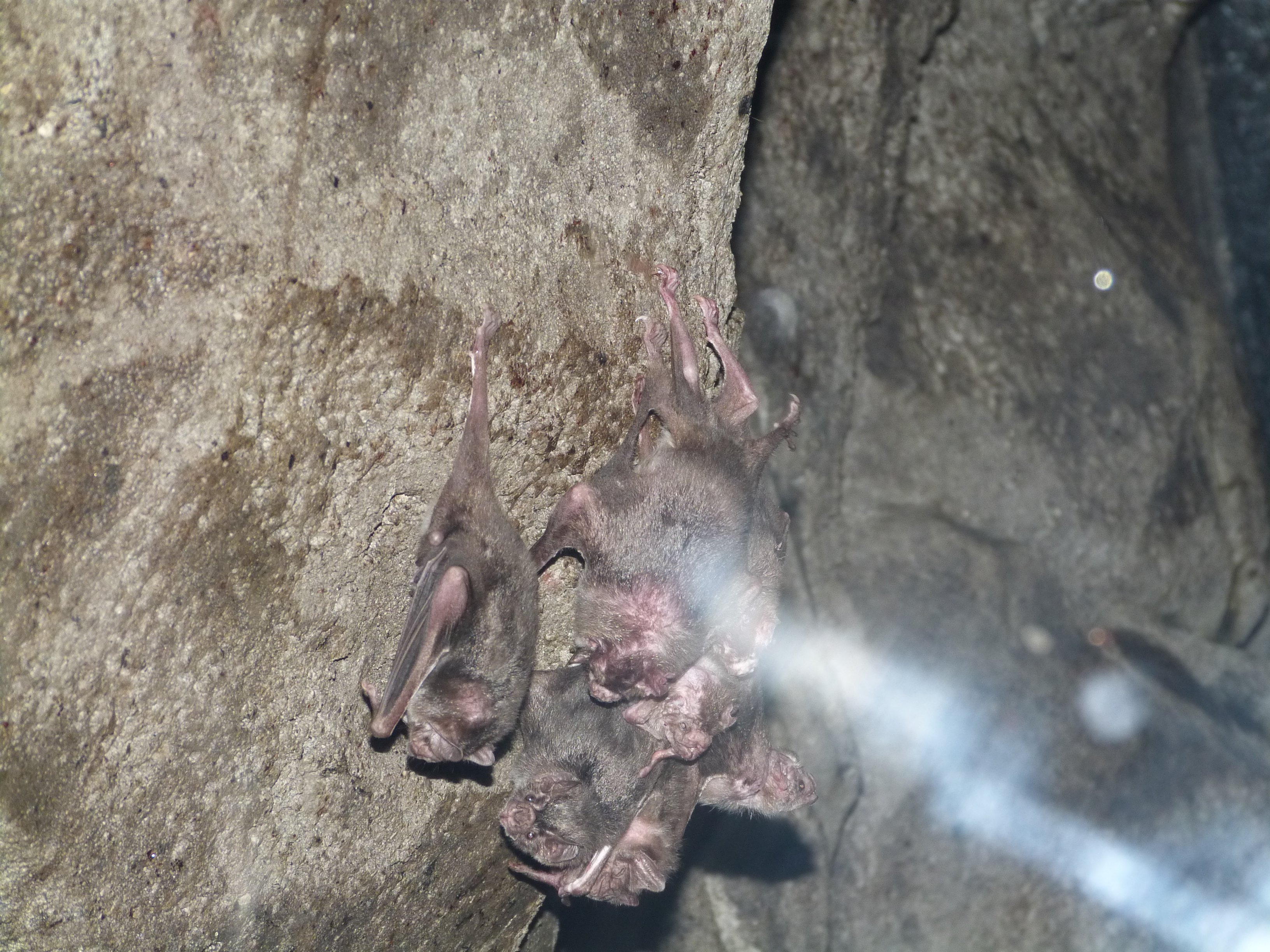
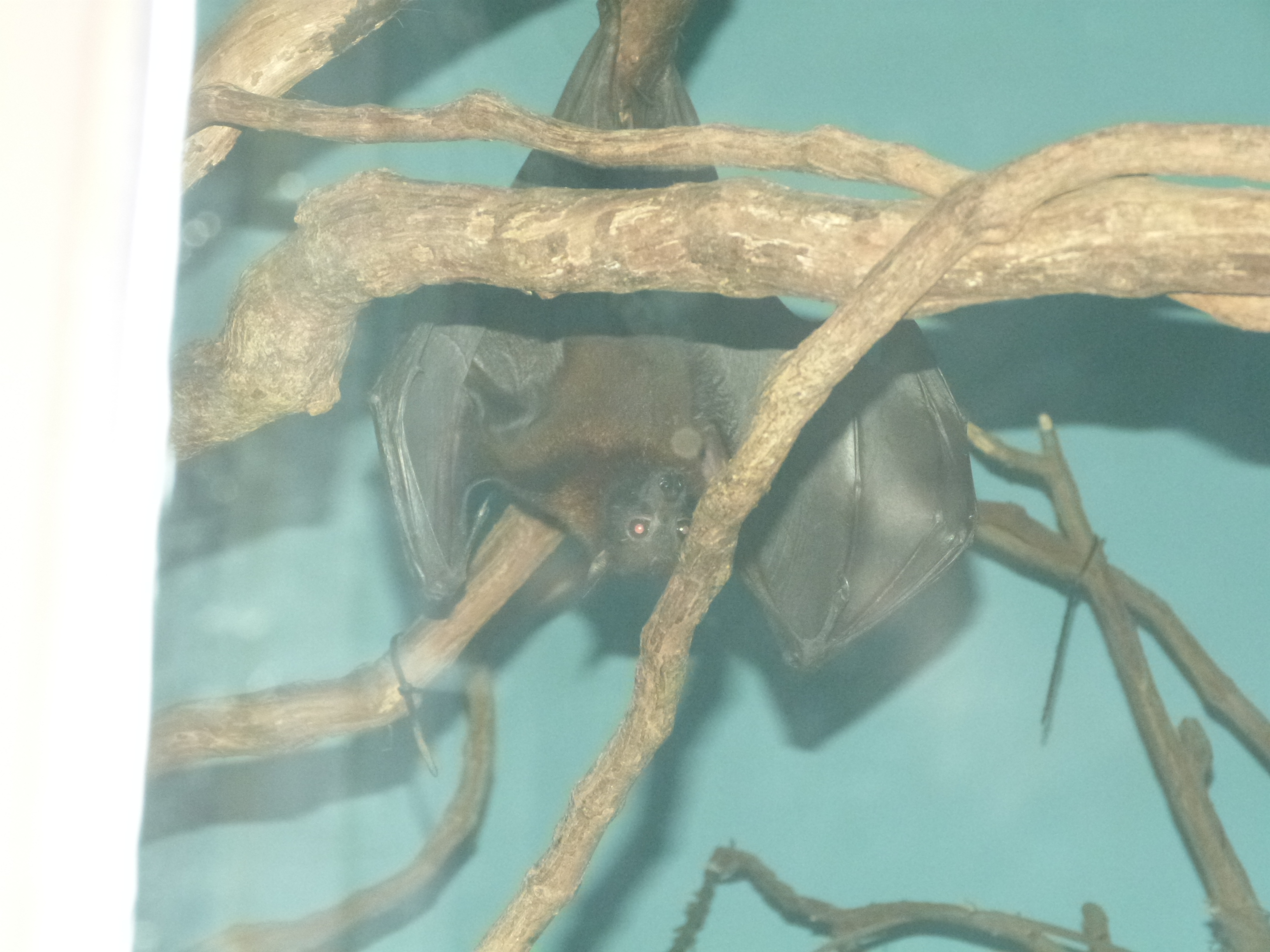
The bats we saw at the Cincinnati Zoo were the Giant Fruit Bats and the Vampire Bats. They are amazing creatures of design and creation from their Creator, the Lord.

*

Giant Fruit Bat at Cincinnati Zoo 9-5-13 by Lee

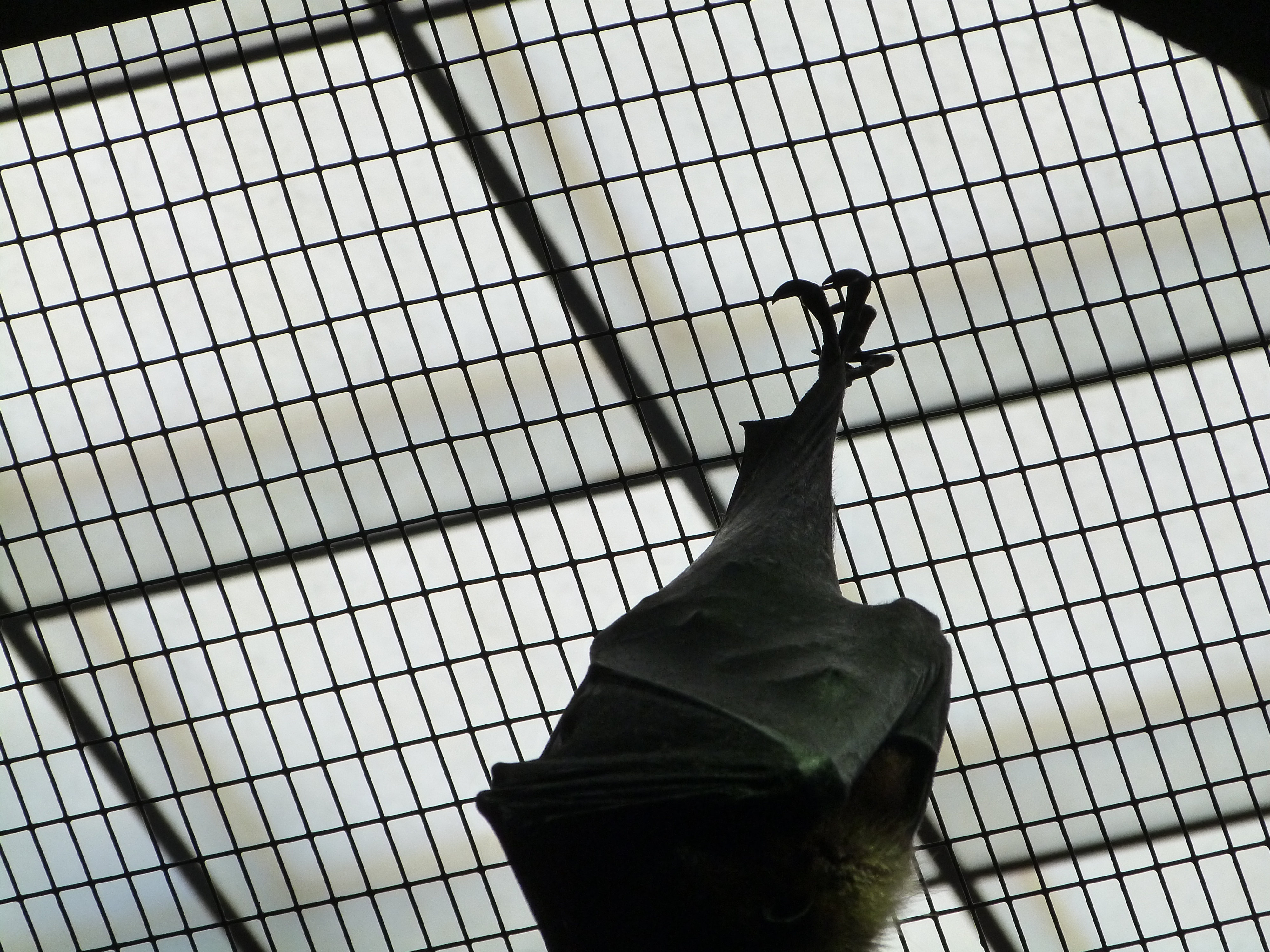
Giant Fruit Bat’s Foot amazed me

Giant Fruit Bat (Pteropus giganteus) or Indian Flying Fox is found in Bangladesh, China, India, the Maldives, Nepal, Pakistan, and Sri Lanka. Also known as the greater Indian fruit bat, it lives in mainly forests. It is a very large bat with a wingspan between 3 ft 10 in and 4 ft 10 in (1.2 and 1.5 m). It is nocturnal and feeds mainly on ripe fruits, such as mangoes and bananas, and nectar. This bat is gregarious and lives in colonies which can number a few hundred. Their offspring have no specific name besides ‘young’. They have one to two young.

The Indian flying fox lives in tropical forests and swamps, where a large body of water is nearby.

The way they were hanging up there amazed me. I zoomed in and took a photo of its foot. Also, they almost looked like a large cocoon hanging up there with the wings wrapped around them. The first photo, Dan caught one of them stretching.

*

*

Common Vampire Bat (Desmodus rotundus) Cincinnati Zoo 9-5-13 by Lee

Common Vampire Bat Cincinnati Zoo by Lee (Shot through glass into a dark exhibit)

(Common) Vampire Bat (Desmodus rotundus) – The common vampire bat mainly feeds on the blood of livestock, approaching its prey at night while they are sleeping. It uses its razor-sharp teeth to cut open the skin of its hosts and laps up their blood with its long tongue. They are native to the New World, ranging from Mexico to Brazil, Chile, and Argentina.

The common vampire bat is short-haired, with silver-gray fur on its undersides, sharply demarcated from the darker fur on its back. It has small, somewhat rounded ears, a deeply grooved lower lip, and a flat, leaf-shaped nose. A well-developed, clawed thumb on each wing is used to climb onto prey and to assist the animal in take-off. The bat averages about 3.5 in (9 cm) long with a wingspan of 7 in (18 cm). It commonly weighs about 2 oz (57 grams), but its weight can double after a single feeding. The braincase is relatively large, but the snout is reduced to accommodate large incisors and canines. It has the fewest teeth among bats.

Common Vampire Bat - Cincinnati Zoo by Lee

Common Vampire Bat – Cincinnati Zoo by Lee

Common vampire bats have good eyesight. They are able to distinguish different optical patterns and may use vision for long-range orientation. These bats also have well-developed senses of smell and hearing: the cochlea is highly sensitive to low-frequency acoustics, and the nasal passages are relatively large. They emit echolocation signals orally, and thus fly with their mouths open for navigation.

Common Vampire Bat - Cincinnati Zoo by Lee

Common Vampire Bat – Cincinnati Zoo by Lee

*

(Wikipedia with editing)

*

*

Links:

Cincinnati Zoo

Giant Fruit Bats – Cincinnati Zoo

Indian Flying Fox – Wikipedia

Vampire Bats – Cincinnati Zoo

Common Vampire Bat – Wikipedia

Birds of the Bible – The Bat?

Birds of the Bible

*

Birdwatching Term – Lobed Feet

Giant Coot (Fulica gigantea) Loped Feet ©©Flickr

Giant Coot (Fulica gigantea) Loped Feet ©©Flickr

Lobed Feet

Thou hast enlarged my steps under me, that my feet did not slip. (Psalms 18:36 KJV)

In the Coot article  they said: “Like other rails, they have long, lobed toes that are well adapted to soft, uneven surfaces. Coots have strong legs and can walk and run fast.”

Answers gives this definition: “Feet that have toes with stiff scale-covered flaps that extend to provide a surface analogous to webbing on a duck as an aid in swimming.”

The Lord designed these “lobed feet” to help the birds walk over uneven ground, in and out of water. He cares about all His creatures.

American Coot - from Color Key To North American Birds

American Coot – from Color Key To North American Birds

This Drawing from Color Key To North American Birds helps you to see their feet better.

It is neat to watch them walk around and see those “big feet.”

This video I took shows their feet.

*

*

See:

*

Ian’s Bird of the Week – Swamp Harrier

Swamp Harrier (Circus approximans) by Ian

Ian’s Bird of the Week – Swamp Harrier by Ian Montgomery

Newsletter – 9-2-13

Recently I was having trouble finding a reasonable photo of a Swamp Harrier for Where to Find Birds in Northeastern Queensland, when I remembered an encounter that I had with this one on a beach on Bruny Island in Southeastern Tasmania in late 2011. At the time, I was on the return leg of the trip to the Sub-Antarctic Islands via New Zealand and the Harrier photos got neglected in the excitement of posting penguin, petrel, prion and parakeet photos (not to mention albatrosses but they spoil the alliteration).

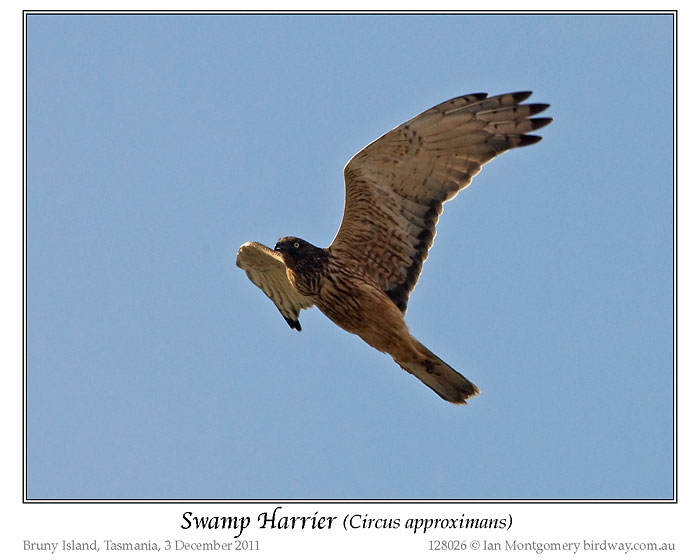
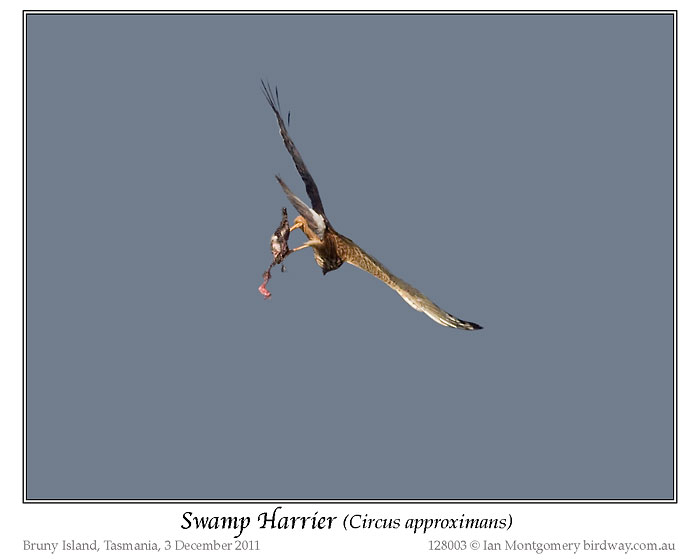
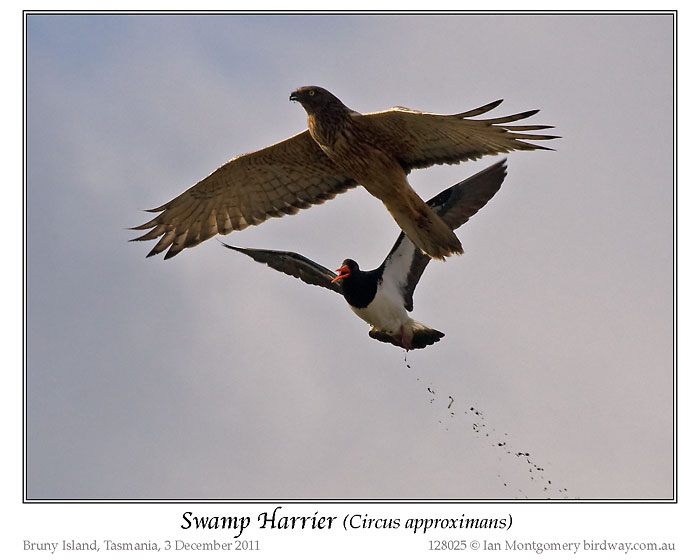
The encounter was the enactment of a minor natural tragedy that was sad to observe, and that may be a subconscious reason for the neglect. I’d actually photographed the bird first photo two minutes earlier struggling to fly into the teeth of a southerly gale and carrying an item of prey, that I couldn’t identify. The Harrier dropped it, back off to leeward and made another unsuccessful attempt to fly up-wind by flying low over the sea on the other side of me.

Swamp Harrier (Circus approximans) by Ian

This attempt failed too, and the bird came back for another try flying more or less overhead. At that point, it was attacked by a very distraught-looking Pied Oystercatcher looking for all the world as if it was on a retaliatory bombing raid. The Oystercatcher made a couple of passes at the Harrier, which eventually gave up the struggle and flew inland across the prevailing wind. I could only assume that the item of prey was the Oystercatcher’s chick and the field guide confirmed that these look like plover chicks, camouflaged speckled brown with white bellies. Predation is a natural part of life, but it was sad that the chick died for no purpose.

Swamp Harrier (Circus approximans) by Ian

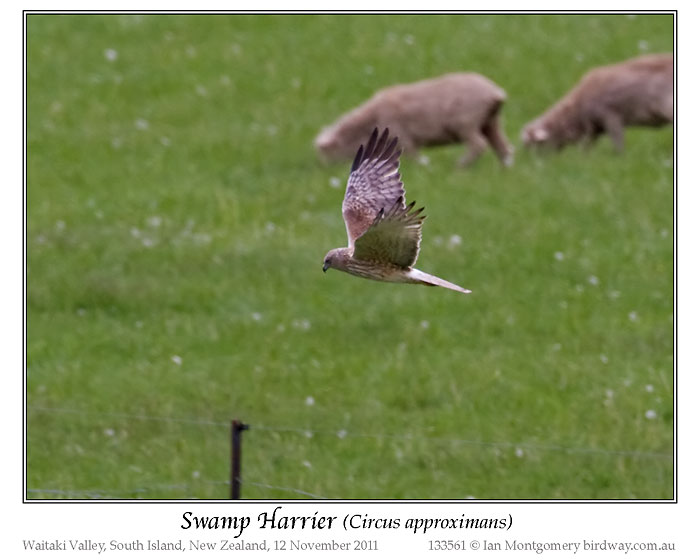
I’ve found Harriers difficult to photograph as they’re shy and normally keep their distance in flight. They are also terrestrial in their lifestyle, inhabiting tree-less plains and wetlands, hunting close to the ground and nesting and perching on the ground, usually invisible or nearly so in grass or reeds. They hunt by flying low over the land or water – quartering – and dropping suddenly to seize surprised prey (sorry, I’ve done it again) such as birds, small mammals and frogs in their long-legged talons. When quartering, they alternate between flapping their wings and gliding with the wings held in a characteristic V, like the bird in the fourth photo in an otherwise tranquil pastoral scene in New Zealand.

Swamp Harrier (Circus approximans) by Ian

Adult Swamp Harriers are brownish and streaked, with white rumps. Older males have greyish wings and grey tails, unmarked except for a sub-terminal band. Females are more rufous and have barred tails and both the Bruny Island and New Zealand birds are, I think, males. Juvenile Swamp Harriers look quite different and are rufous brown overall with pale rufous rather than white rumps, like the one in the fifth photo.

Swamp Harrier (Circus approximans) by Ian

In Australia, Swamp Harriers nest mainly in the south, including Tasmania and migrate north in winter – in North Queensland, we see them only in the winter months. In New Zealand they make local movements across Cook Strait and they turn up on various islands including Lord Howe and Norfolk. Raptors are poorly represented in New Zealand and the Swamp Harrier is the large bird of the prey, being the only breeding member of the Accipiter family (hawks, eagles, etc.), with the rarer New Zealand Falcon being the only breeding falcon. Swamp Harriers also breed in Melanesia and Polynesia as far east as Tonga. It has close relatives in Eurasia comprising the Eastern, Western, African and Madagascar Marsh Harriers.

Best wishes
Ian

**************************************************
Ian Montgomery, Birdway Pty Ltd,
454 Forestry Road, Bluewater, Qld 4818
Tel 0411 602 737 ian@birdway.com.au
Bird Photos http://www.birdway.com.au/
Recorder Society http://www.nqrs.org.au


Lee’s Addition:

And when the birds of prey swooped down upon the carcasses, Abram drove them away. (Genesis 15:11 AMP)

In this case, the Oystercatcher “drove them away.” You have to admit, that Oystercatcher looks right angry.

The Swamp Harrier is a member of the Accipitridae – Kites, Hawks & Eagles Family. There are 256 species, of which, 17 are Harriers or Harrier-hawks.

Ian already gave quite a bit of information about this beautiful bird. The diet of the Swamp Harrier is mainly ground birds and waterbirds, rabbits and other small mammals, reptiles, frogs and fish. During the Winter months harriers feed to a large extent on carrion, including roadkill.

This species nests on the ground, often in swamps, on a mound in reeds or other dense vegetation. The clutch size may range from 2 to 7, but is usually 3 or 4. The incubation period is about 33 days, with chicks fledging about 45 days after hatching. (Wikipedia)

See also:

Swamp Harrier – Wingspan

Swamp Harrier – Wikipedia

Ian’s Accipitridae Family Photos

Accipitridae – Kites, Hawks & Eagles Family

Ian’s Bird of the Week – Spotted Harrier

*

Vol 2, #6 – The Ring-necked Pheasant

Common Pheasant (Phasianus colchicus) "Ring-necked" for Birds Illustrated

Common Pheasant (Phasianus colchicus) “Ring-necked” for Birds Illustrated

From col. Chi. Acad. Sciences. Copyrighted by
Nature Study Pub. Co., 1897, Chicago.

THE RING-NECKED PHEASANT.

(RELOCATED – CLICK HERE)

Ian’s Bird of the Week – Spiny-cheeked Honeyeater

Spiny-cheeked Honeyeater (Acanthagenys rufogularis) by Ian

Spiny-cheeked Honeyeater (Acanthagenys rufogularis) by Ian

Ian’s Bird of the Week – Spiny-cheeked Honeyeater ~ Ian Montgomery

Newsletter – 8/20/13

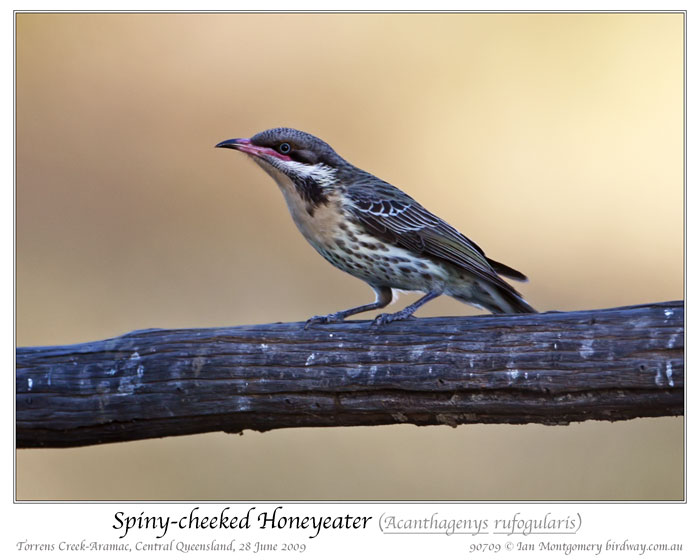
I’m currently preparing photos for a digital version of the book Where to Find Birds in North-East Queensland by Jo Wieneke (http://www.nqbirds.com). I’m finding that many of these have not yet featured as bird of the week, so here’s one that I came across a photo this morning that appealed to me, one of an unusual-looking honeyeater, the Spiny-cheeked, taken not long after sunrise at Gluepot, the BirdLife Australia mallee reserve in South Australia. At the time, I was spending some time each morning at a hide overlooking a drinking trough waiting for Scarlet-chested Parrots http://www.birdway.com.au/psittacidae/scarlet_chested_parrot/index.htm.

The Spiny-cheeked is a bird of dry country, so the easiest way to photograph it is as watering places, and the second photo was taken in Central Queensland south of Torrens Creek near a dam, this time close to sunset. It is a widespread and common in the more arid parts of mainland Australia except tropical Australia north of about 19ºS and Tasmania. It also occurs in scrubby coastal areas, such as southern Victoria. Like many dry-country birds it is nomadic and appears only rarely in Northeastern Queensland, though I did see one in the garden in the first house I lived in Townsville in 2002.

Spiny-cheeked Honeyeater (Acanthagenys rufogularis) by Ian

Spiny-cheeked Honeyeater (Acanthagenys rufogularis) by Ian

With a length of 23-26cm/9-10in, it’s quite large by honeyeater standards and the bare pink area on the face gives it some similarity to the Wattlebirds, also honeyeaters. Although it is the only member of the genus Acanthagenys, DNA studies have shown that it is related to both the Wattlebirds (Acanthocaera) and the Regent Honeyeater, another one with bare red skin, in this case around the eye. The Spiny-cheeked is quite vocal with a creaky, piping, rather Wattlebird-like song, often the first sign of its presence.

Feedback on the change in font was rather muted, with one in favour of the new one, one against it and one not liking the underlining of the scientific name. I can agree with all points of view and am undecided, though I’m using the new font for photos in the digital version of Jo Wieneke’s book. I’ve rather got used to it, though I’ve started putting the scientific name in grey to make the underlining less obvious as I’m constrained both by the convention of using either italics or underlining for scientific name and the lack of an italic option in an already italic-looking font. My thanks to those who took the trouble to respond.

Jo’s book has been out of print for a little while now, so the digital version is to fill the gap left by its disappearance from book shops. I’ll let you know when it is available: the aim is to publish it for Apple iBooks, Google PlayBooks and Amazon Kindle.

Best wishes
Ian

**************************************************
Ian Montgomery, Birdway Pty Ltd,
454 Forestry Road, Bluewater, Qld 4818
Tel 0411 602 737 ian@birdway.com.au
Bird Photos http://www.birdway.com.au/
Recorder Society http://www.nqrs.org.au


Lee’s Addition:

My son, eat honey because it is good, And the honeycomb which is sweet to your taste; (Pro 24:13 NKJV)

This Honeyeater belong to the Meliphagidae – Honeyeaters Family, which has 184 species. Check out Ian’s photos of this Family.

In addition to what Ian mentioned about the Spiny-cheeked Honeyeater, Wikipedia had this to say:

The honeyeater is mainly frugivorous, but will also eat nectar, blossoms, insects, reptiles, and young birds. Its habitat includes deserts, coastal scrubland, and dry woodlands. It is also found in mangroves and orchards. Its range includes most of Australia except for Tasmania, tropical Northern areas, the Southeastern coast.

The Spiny-cheeked Honeyeater is a grey-brown bird with a burnt orange throat and chest. It has grey wings edged with white, and a long tail with white tips. It has a pink, black-tipped bill.

*

Spiny-cheeked Honeyeater (Acanthagenys rufogularis) ©WikiC

Spiny-cheeked Honeyeater (Acanthagenys rufogularis) ©WikiC

*

Here is the song of a Spiny-cheeked from xeno-canto.

See:

*

Flight: The Genius of Birds Film

Flight DVD face

(Gen 1:21) So God created great sea creatures and every living thing that moves, with which the waters abounded, according to their kind, and every winged bird according to its kind. And God saw that it was good.

I have just had the privilege of “screening” the “FLIGHT: The Genius of Birds” film. After being contacted by its director, Lad, I accepted the offer to watch this amazing film all about the bird’s intelligently designed ability to fly. It is FANTASTIC!

Illustra Media produced this film and I am including their Trailer and three segments; the Embryonic Development, the Skeletal system, and the Hummingbird tongue.

Enjoy watching these. And this is only a part of a tremendously amazing film!

*

Flight: The Genius of Birds – Official Trailer

*

*

Embryonic Development

*

Iceland Gull (Larus glaucoides) chick-egg nest ©USFWS

Iceland Gull (Larus glaucoides) chick-egg nest ©USFWS

Out of the ground the LORD God formed every beast of the field and every bird of the air, and brought them to Adam to see what he would call them. And whatever Adam called each living creature, that was its name. (Gen 2:19)

*

*

Skeletal system

*

American White Pelican (Pelecanus erythrorhynchos) by AestheticPhotos

American White Pelican (Pelecanus erythrorhynchos) by AestheticPhotos

Many, O LORD my God, are thy wonderful works which thou hast done, and thy thoughts which are to us-ward: they cannot be reckoned up in order unto thee: if I would declare and speak of them, they are more than can be numbered. (Psa 40:5 KJV)

*

This clip tells about the skeletal makeup of the birds. They do a super job showing with their photography and illustrations. It helped me better understand how the bird’s bones and structure work together to enable birds to fly.
*

*

Hummingbird tongue

*

Rufous-tailed Hummingbird (Amazilia tzacatl) by Judd Patterson

Rufous-tailed Hummingbird (Amazilia tzacatl) by Judd Patterson

Such knowledge is too wonderful for me; it is high, I cannot attain unto it. (Psa 139:6 KJV)

*

I never imagined this is how they get the nectar. Wow!

*

I do not sell things here on the blog. My goal is to help promote this very informative video about how an Intelligent designer is behind all of the ingenious aspects of birds and their Flight. We know that the Lord Jesus Christ is that “intelligent designer’ and that He deserves all the credit.

In the beginning was the Word, and the Word was with God, and the Word was God. He was in the beginning with God. All things were made through Him, and without Him nothing was made that was made. (Joh 1:1-3)

Taken from YouTube – TO ORDER DVDs: www.illustramedia.com / FLIGHT: THE GENIUS OF BIRDS is the first episode in Illustra Media’s new series THE DESIGN OF LIFE. This remarkable documentary explores the evidence for intelligent design as revealed through the biological systems and mechanisms that make avian flight possible. Photographed in North America, England, Peru, Greenland, and Antarctica FLIGHT celebrates birds and the miracle of life in the skies.
The DVD is available for purchase now – visit www.illustramedia.com for more information.

*

Wordless Birds

*

Updated The Birdwatching Page 8/8/13

The Birdwatching Page was updated to add this video and links to photos of the birds shown. Here is the video and the photo links are on the Birdwatching Page.

And out of the ground the Lord God formed every [wild] beast and living creature of the field and every bird of the air and brought them to Adam to see what he would call them; and whatever Adam called every living creature, that was its name. (Genesis 2:19 AMP)

*

*