Birdwatching Thru the Bible – Vulture’s Eyes

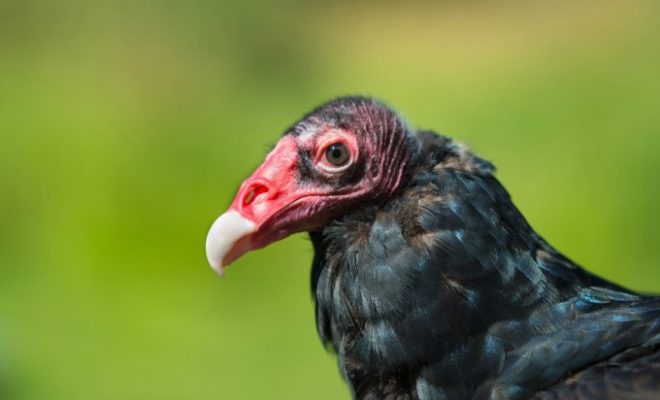
Vulture-turkey.Texas Hill Country

Ever since I posted the Lee’s Four Word Thursday – Vulture’s Eye, I have been curious about their eyes. Do they really have great vision? Is this verse in Job 28:7 the only reference to their eyes? The search began with that verse. Only the KJV, DRB versions use the word Vulture. (My E-sword versions). The other translations use Falcon, Hawk, and Kite. Apparently, all of the birds have great vision and are great hunters.

“There is a path which no fowl knoweth, and which the vulture’s eye hath not seen:” Job 28:7 KJV

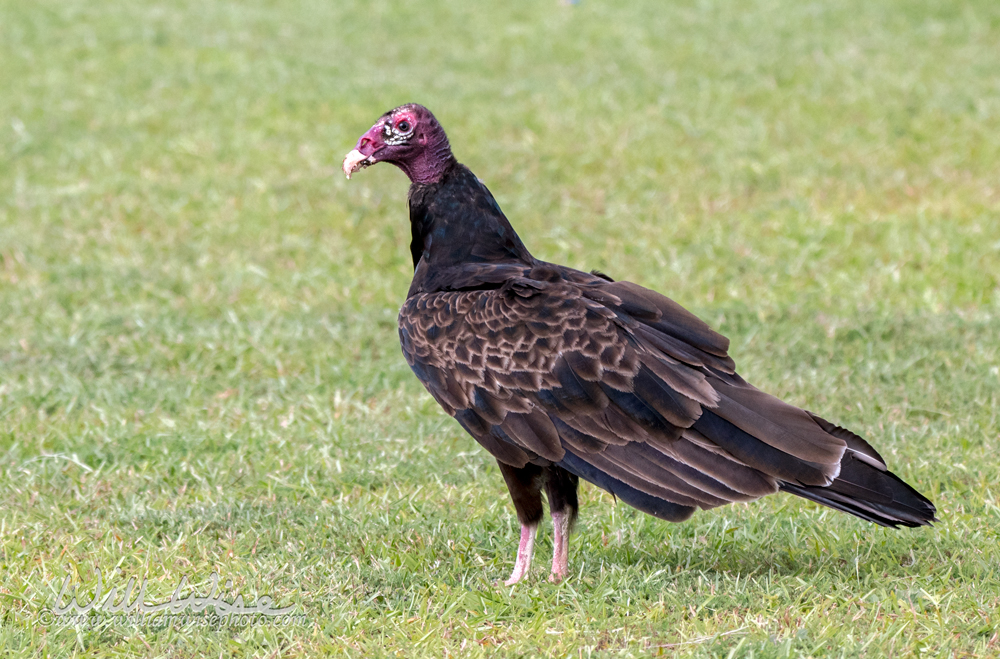
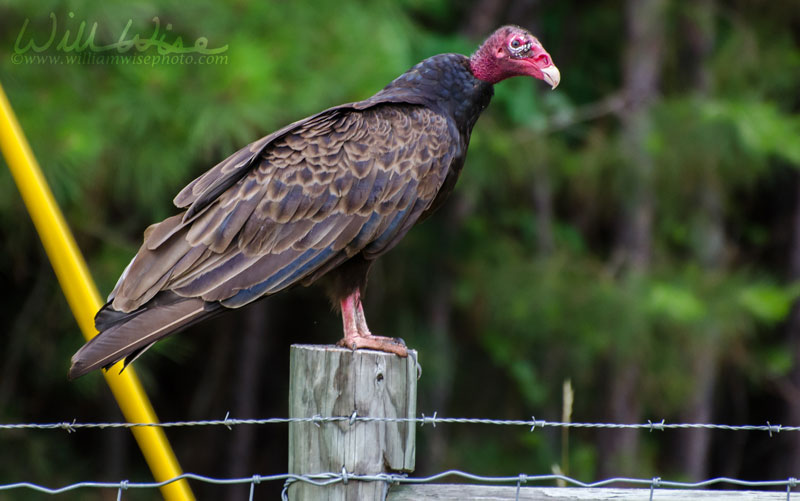
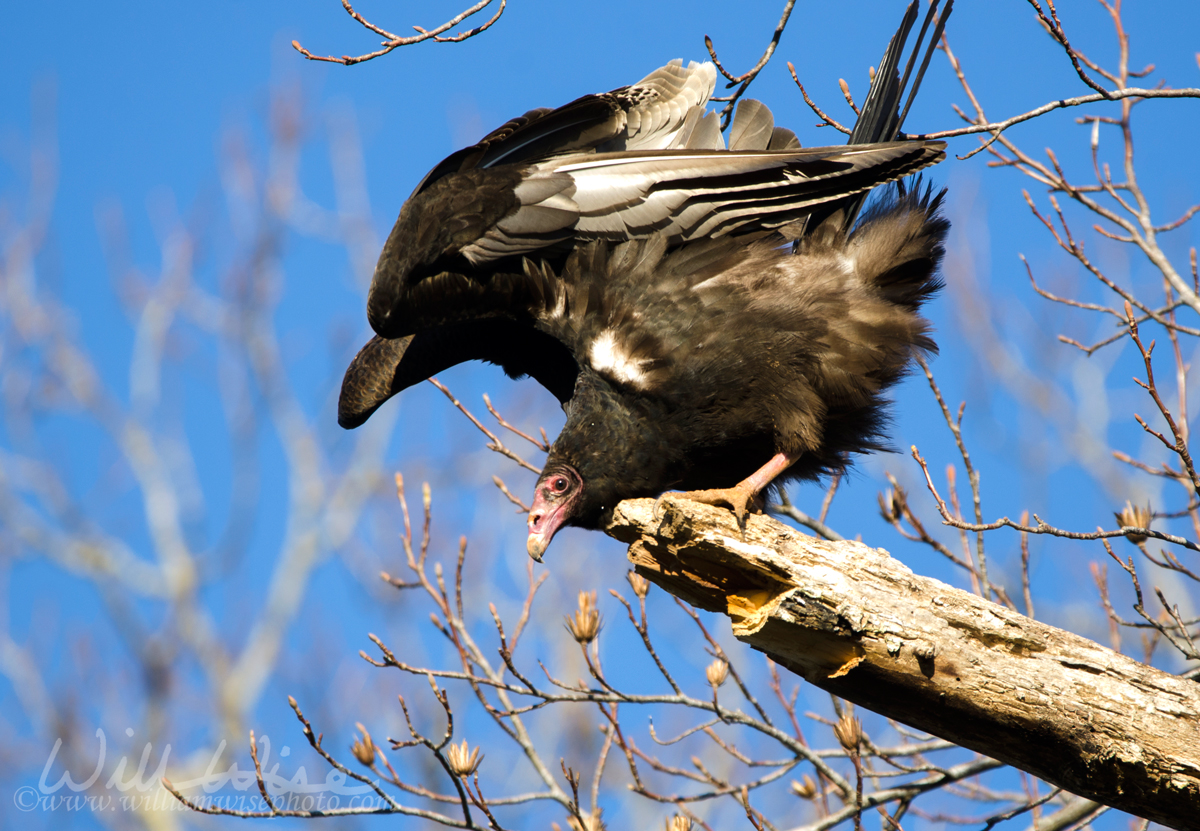
Turkey Vulture; Walton County, Georgia by William Wise

Turkey Vulture; Walton County, Georgia by William Wise

Here is an interesting article about Vultures: 50 Interesting Facts About Vultures

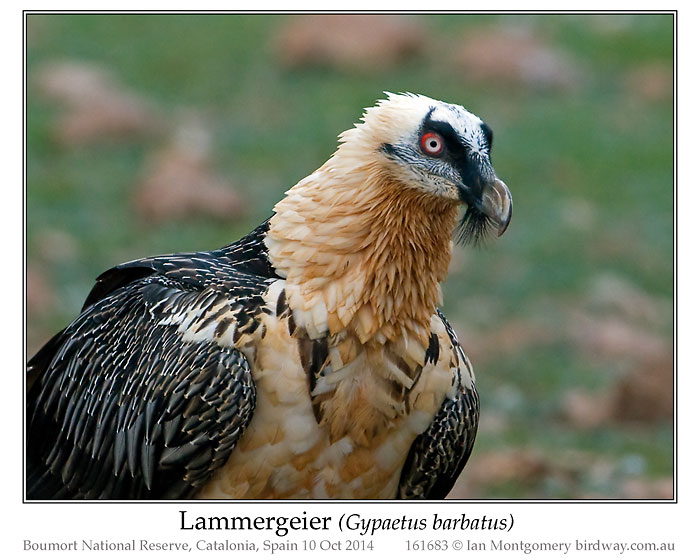
Bearded Vulture (Gypaetus barbatus) or Lammergeier by Ian

Bearded Vulture (Gypaetus barbatus) or Lammergeier by Ian

We have posted quite a few articles about the Vultures and here are just a few:

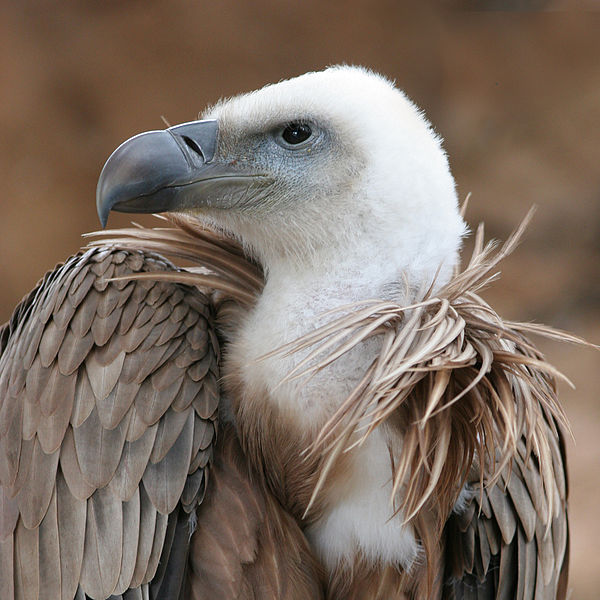
Griffon Vulture (Gyps fulvus) ©WikiC

Here are two more links (of which one was about the Vulture’s Eye):

Here’s another article that our Dr. Jim (JJSJ) gave us:

Christ’s Creativity in Canyon Critters

The Lord has provided these Vultures with great vision to enable them to find food, and actually help clean the landscape. If He can provide for the Birds of the Air, I know He can provide for us.

“I will instruct thee and teach thee in the way which thou shalt go: I will guide thee with mine eye.” (Psalms 32:8 KJV)

Good News

Lee’s Four Word Thursday – Vulture’s Eye

***

King Vulture Brevard Zoo 120913 by Lee

WHICH THE VULTURE’S EYE

***


“There is a path which no fowl knoweth, and which the vulture’s eye hath not seen:” (Job 28:7 KJV)

King Vulture at the Brevard Zoo by Lee

(This is a repost of 8/25/16)

*

More Daily Devotionals

*

Who Paints The Leaves?

Birds of Grand Canyon, Part 1: Introduction

Dr. James J. S. Johnson

Birds of Grand Canyon, Part 1: Introduction

 Who hath divided a watercourse for the overflowing of waters, or a way for the lightning of thunder? To cause it to rain on the earth, where no man is, on the wilderness, wherein there is no man?  To satisfy the desolate and waste ground, and to cause the bud of the tender herb to spring forth? (Job 38:25-27)

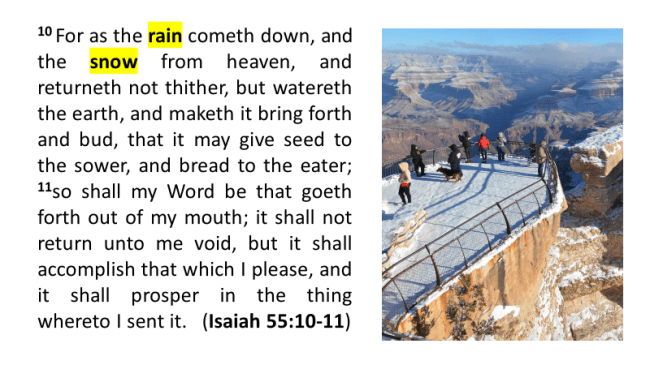
Welcome to the wonderful world of Grand Canyon wildlife!  Inside the Grand Canyon, and atop its ledge-like rims, live many creatures that God has fitted to flourish in that extreme habitat — including many precious birds!  Much of Grand Canyon is hot and dry, so many of its animals need to be designed and equipped for desert life, in order to thrive there generation after generation, season after season (Genesis 8:22).  However, atop the rims it can get quite cold in winter, with freezing temperatures, frigid winds, and snowfall – so not all of Grand Canyon’s wildlife are desert denizens.

[JJSJ’s ASIDE: this summer I’m privileged to participate in a GRAND CANYON EXPEDITION (September 3rd-7th, A.D.2024 — https://landmarkevents.org/gc5/ ), hosted by LANDMARK EVENTS ( http://www.LandmarkEvents.org ), God willing, river-rafting on a scenic stretch of the Colorado River, inside the inner gorge of the Grand Canyon, giving special attention to the wildlife that God provides for in that unique and astonishingly interesting habitat. The best Christ-honoring vacation/tour/adventure opportunities, that I can imagine (based on years of personal experiences), are those hosted by Landmark Events — check them out, early, to plan your next vacation/adventure, in America or beyond.]

So, some of Grand Canyon’s birds are not stereotypical “desert birds”, though many that live below are.

And, as the patriarch Job learned many centuries ago, God caringly provides for creatures that live in “wastelands” not dominated by humans — in extreme deserts, unattractive habitats for humans — God has provided for the physiological and metabolic nutrition needs of such desert denizens, including birds of such xeric and torrid lands, such as much of Grand Canyon (especially its Inner Gorge).

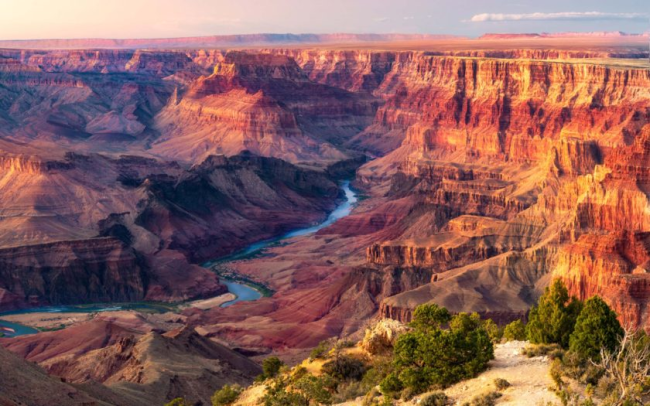
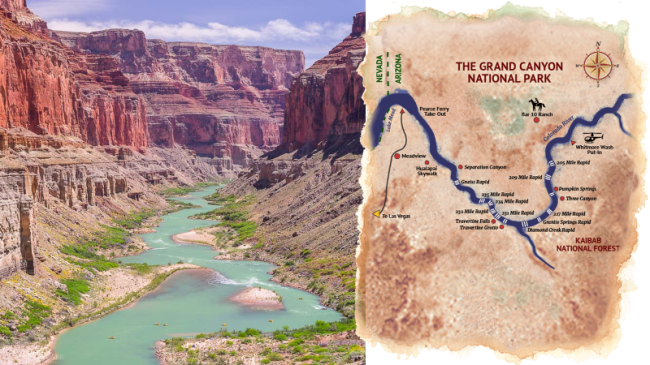
GRAND CANYON, showing COLORADO RIVER (Wallpapers13.com photo credit)

So, what kinds of birds call Grand Canyon “home”, or, at least, treat that canyon as a temporary home according to seasonal migration journeys?

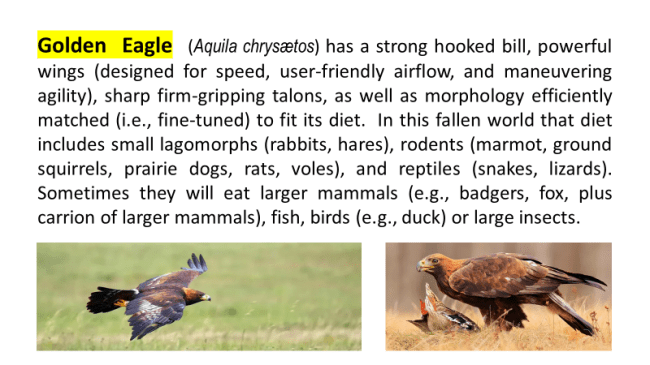
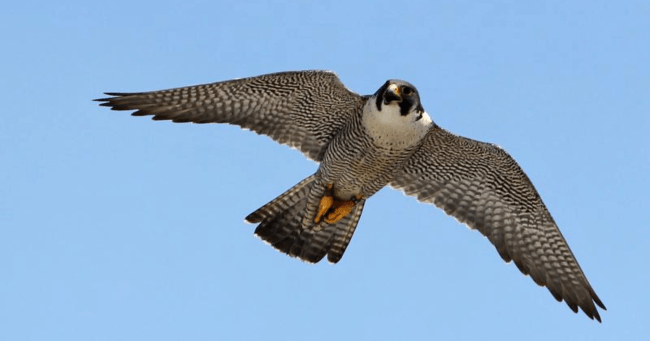
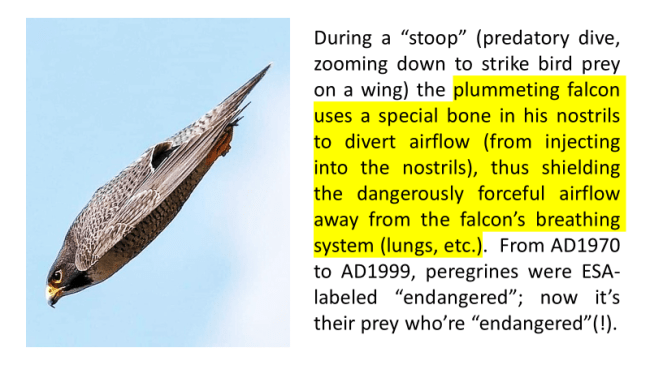
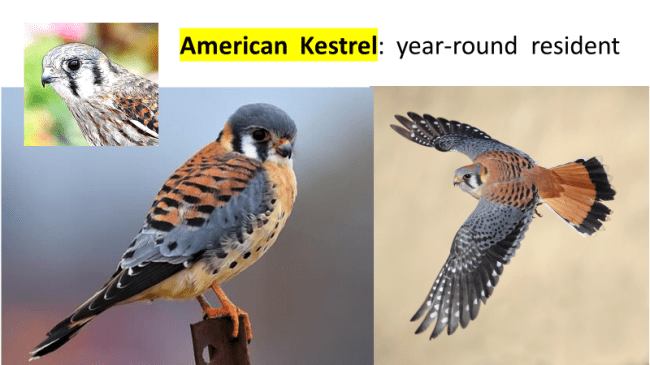
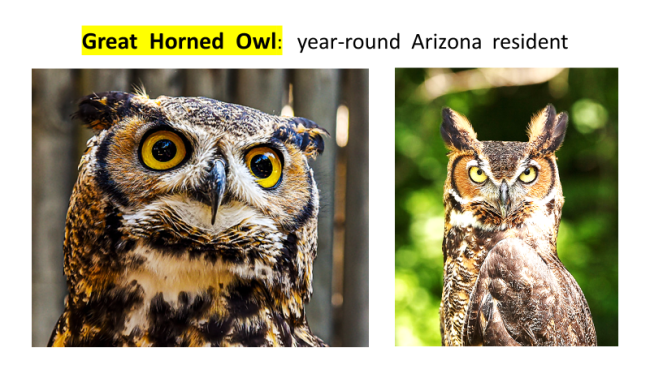
Grand Canyon has many large birds of prey, such as eagles (Golden Eagles and wintering Bald Eagles), hawks (Red-tailed Hawk, Sharp-shinned Hawk, Goshawk), falcons (Peregrine Falcon, American Kestrel), and owls (Great Horned Owl, Northern Pygmy Owl, Mexican Spotted Owl).  

PEREGRINE FALCON flying (Indianapolis Star photo credit)

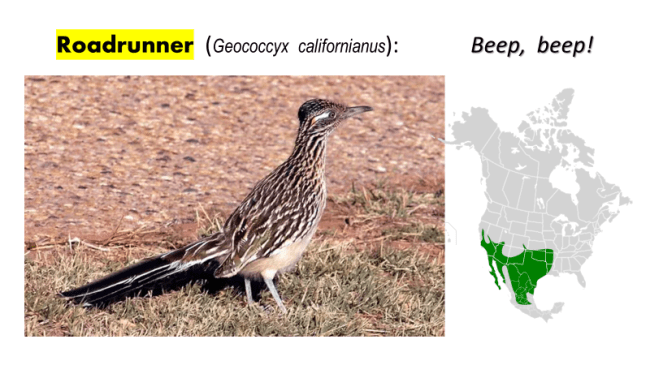
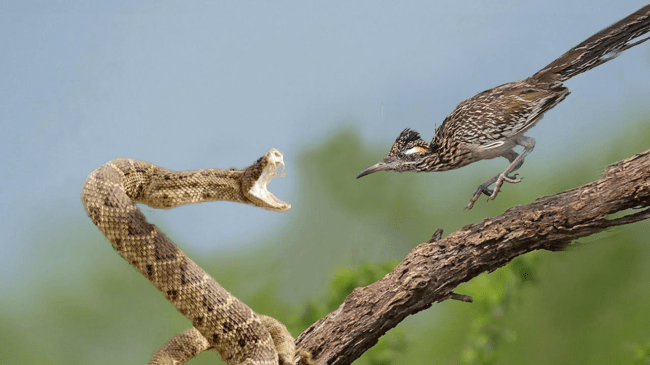
Although not classified as a “bird of prey”, the Roadrunner is proficient at killing and eating frogs, lizards, and even snakes! 

ROADRUNNER preparing to kill RATTLESNAKE
(Pinterest / Snake Channel YouTube photo credit)

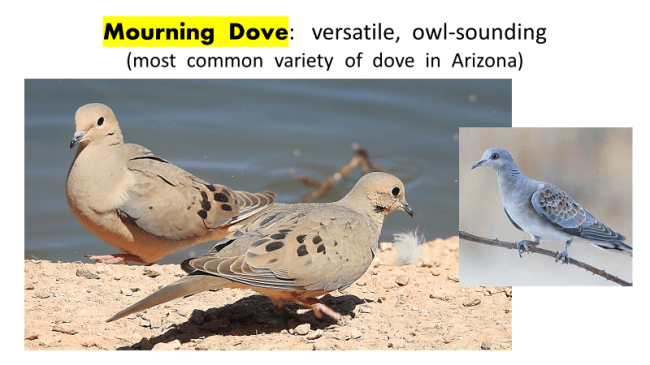
Some owl-sounding birds are actually Mourning Doves (Hoooo! Hoooo! Hoooo!), so they “bluff” at being predators of rodents (who actually threaten their eggs). 

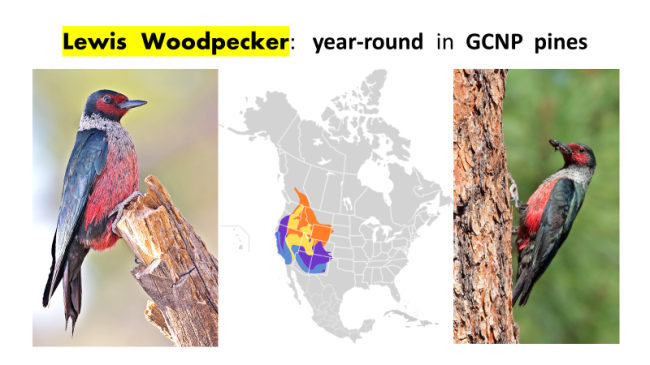
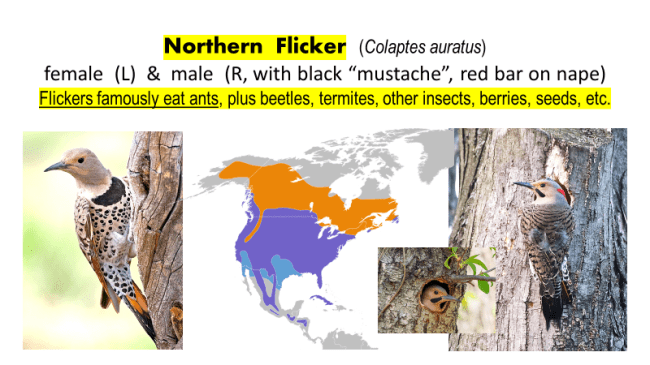
Grand Canyon’s rims and interiors have trees, so woodpeckers are to be expected. Resident woodpeckers include Lewis Woodpecker, Hairy Woodpecker, and Northern Flicker

(Many other birds love to dwell in evergreen trees, such as pinyon pines or ponderosa pines. (Even wild Blue Peafowl are found in the Grand Canyon’s conifers.)

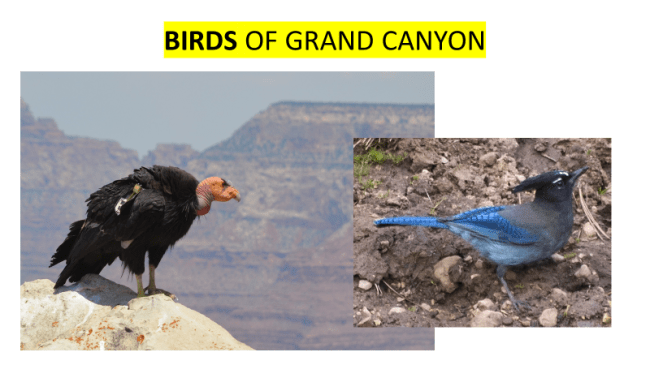
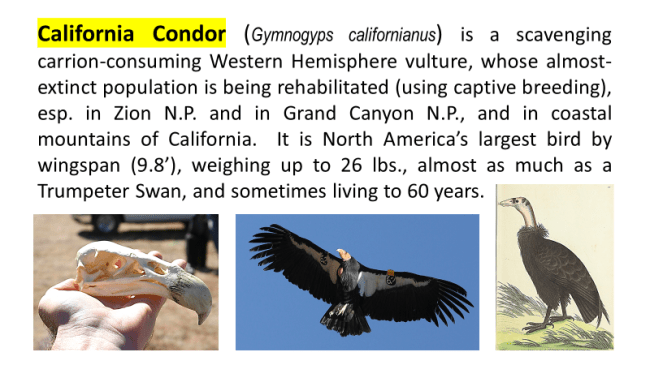
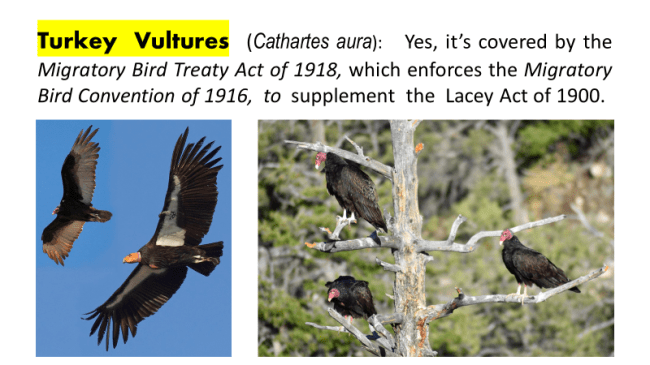
Scavenger birds of the canyon include the California Condor and Turkey Vulture, both serving as garbage pickup birds.

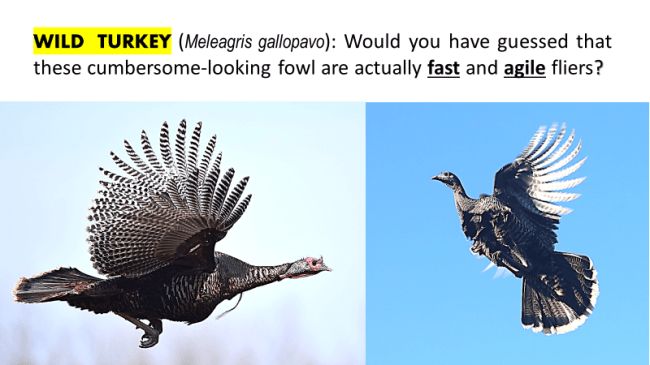
Galliformes (i.e., chicken-like ground-fowl) include Wild Turkey. 

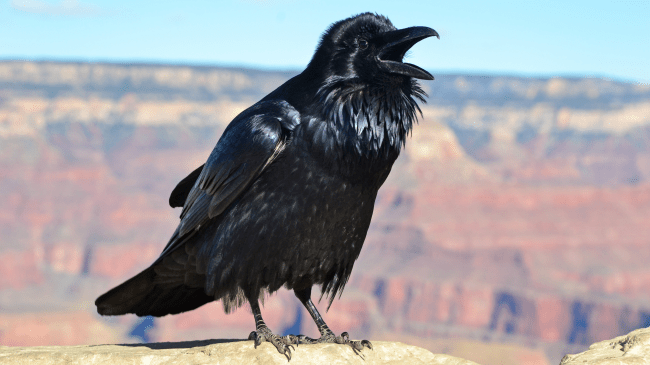
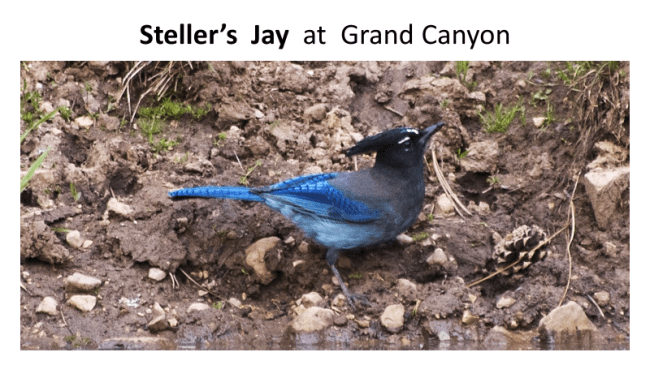
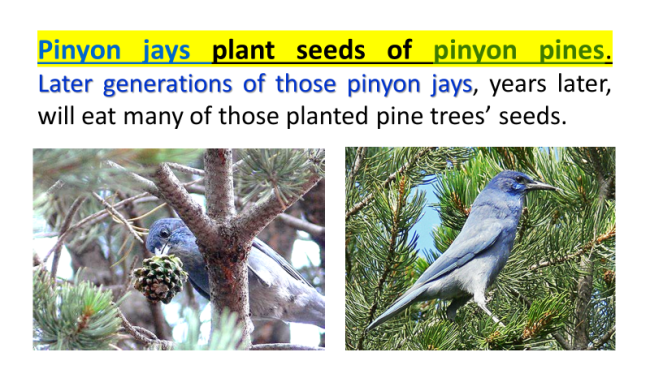
Corvids include Common Raven, Steller’s Jay, Pinyon Jay, Scrub Jay, etc. 

RAVEN at GRAND CANYON
(National Park Service photo credit)
STELLER’S JAY (National Park Service photo credit)

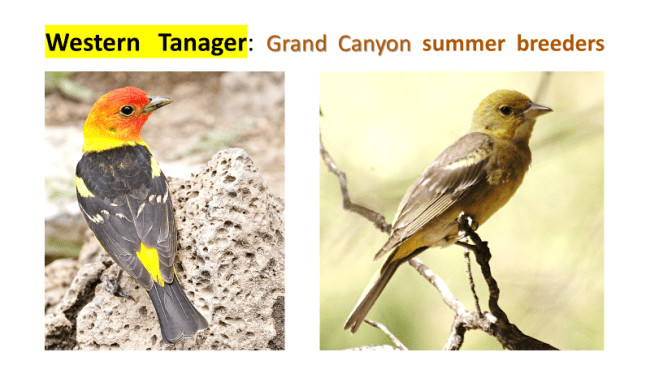
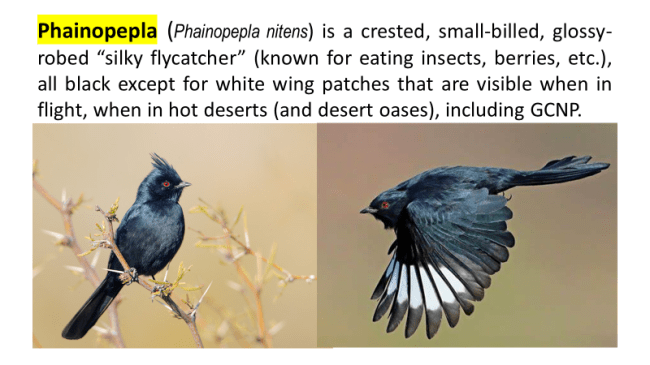
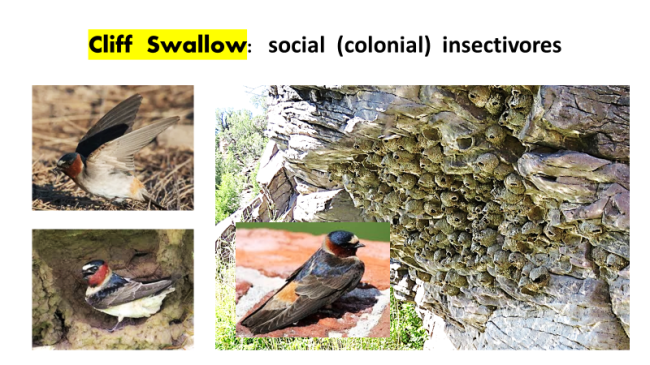
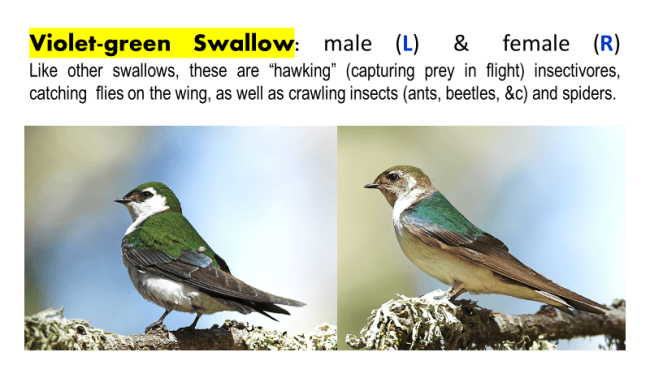
Other perching birds include Phainopepla, Dark-eyed Junco, European Starling, Western Tanager, Scott’s Oriole, Canyon Wren, Rock Wren, Mountain Chickadee, Common Grackle, Violet-green Swallow, Cliff Swallow, Brown Creeper, Western Bluebird, hummingbirds, etc.

PHAINOPEPLA
(perching: AnimalSpot.net photo credit
flying: eBird photo credit)

In short, Grand Canyon illustrate4s avian biodiversity — some specific examples of which will be, hopefully, inspected in future blogposts of this series.

There is so much more! This is just an introduction, D.v. —  meanwhile, welcome to the wonderful world of Grand Canyon’s avian wildlife!

Scripture Alphabet of Animals: The Vulture

White-backed Vulture (Gyps africanus) by Africaddict

White-backed Vulture (Gyps africanus) by Africaddict

Scripture Alphabet of Animals: The Vulture

By Harriet N. Cook (1814-1843)

The vulture is called a bird of prey, because it lives on flesh; but it has not such strong claws as the eagle, to seize and tear its food. It does not often kill other animals; but preys upon those that have been killed in some other way, or have died of themselves. It is a disagreeable bird, and one that you would not like very well to see; no wonder the Israelites were forbidden to eat it. It is about a yard long from the top of its head, and it sometimes measures two yards across the wings.

Black Vultures at Saddle Creek by Lee

Black Vultures at Saddle Creek by Lee

It lives only in warm or hot climates, and there it is very useful, though you might at first be puzzled to think how this can be. It is because it lives upon such things as would be very injurious to man if they were left to decay in the open air. It not only consumes the dead bodies of animals, but takes away many things from the streets of the cities which the inhabitants are too indolent to remove. It is for this reason that in the city of Cairo, in Egypt, there is a law forbidding any person to kill a vulture. These birds sometimes follow an army, and prey upon the bodies of those poor soldiers who have been killed in battle. Ah ! it is a sad thing to go to war; almost every thing about it is sad.

The vulture has a very keen eye, and, like the eagle, can see what is on the ground, even when it is very high in the air. This is referred to in the book of Job.

There is a path which no fowl knoweth, and which the vulture’s eye hath not seen.

Egyptian Vulture (Neophron percnopterus) by Nikhil

Egyptian Vulture (Neophron percnopterus) by Nikhil

It often happens in those countries that almost as soon as an ox, or a horse, or any other large animal has been killed, great multitudes of vultures will gather around, though not one could be seen in the sky before. they seem to fly down from every part of the heavens, and being to pull and struggle for the flesh of the animal; until in the course of a few hours nothing is left but the bones. We read in Isaiah,

There shall the vultures be gathered, every one with her mate.

This must have been written by one who had seen these birds coming together, as they do in great flocks or companies.

(Blog formatted by Lee)

See:

Harriet Newell Cook – Scripture Alphabet of Animals

Birds of the Bible

Birds of the Bible – Vulture

Accipitridae – Kites, Hawks & Eagles

Nave’s Topical Bible – Vulture

*

Halting the Plague

And Aaron took as Moses commanded, and ran into the midst of the congregation; and, behold, the plague was begun among the people: and he put on incense, and made an atonement for the people. And he stood between the dead and the living; and the plague was stayed.” Numbers 16:46-50

Turkey Vulture; Clarke County, Georgia. June 2015. ©www.williamwisephoto.com.

What was that created for?

God created all things, and He created all things with a purpose.  One critter with a disgusting duty is the vulture. Our roads are often littered with the poor critters that didn’t make it across alive. Standing around these piles are a macabre host of ominous black Vultures.

It is no doubt for this disgusting habit that God pronounced, “These, moreover, you shall detest among the birds; they are abhorrent, not to be eaten: the eagle and the vulture and the buzzard”. (Leviticus 11:13)  I’m sure none would argue with God and substitute a Turkey Vulture for a Thanksgiving Turkey!

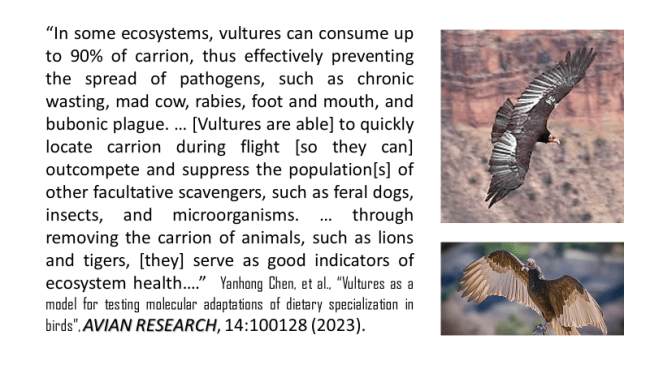
Although vultures carry the reputation of being nasty, disease and death spreading creatures, the opposite is true. Vultures help decrease the spread of disease. Without vultures, animal corpses would litter the landscape, contaminate the water supplies and disease could spread without check. Vultures are known as “dead-end hosts” and do not further spread diseases.

Halting the Plague

From this practical disease-reducing design, the vulture speaks a valuable lesson. We are seeing a virus affect the entire planet. But there is a plague far worse than Coronavirus; a plague that has killed, and will kill, every living person. The plague is called sin! With the entrance of sin, Satan has hijacked God’s perfect creation and not only mutated viruses to cause things like Coronavirus, but leads our lives, spiritually and physically, down a road of decay and death.

In the book of Numbers, because of the sin of rebellion, a plague began to spread among the people (please, I am not saying Coronavirus is God-unleashed plague). To end the plague, God told Aaron to light a censor and bring the smoking incense (representing prayer) between the diseased and the living. Aaron’s quick, unquestioning acceptance of his job stopped the spread from the corpses to the people. “And he stood between the dead and the living; and the plague was stayed.”

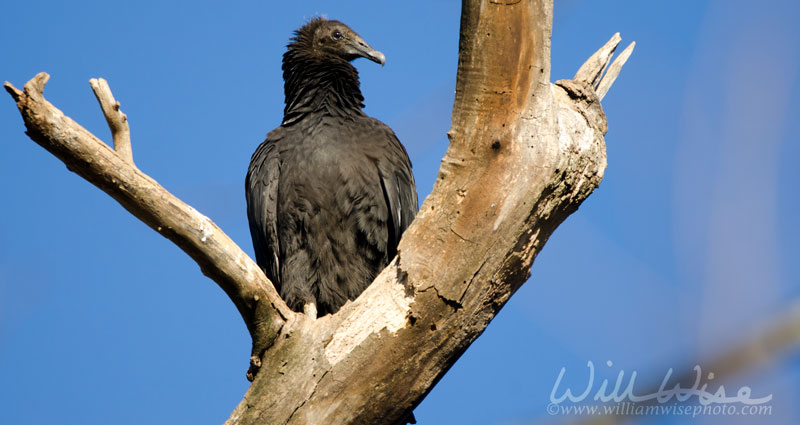
Black Vulture. Clarke County, Georgia. January, 2018. ©www.williamwisephoto.com.

A Pandemic of Revival

2 Corinthians 5:5 Now it is God who has made us for this very purpose…

We Christians are called to halt the plague of sin. Like Aaron with his flaming censer, we are to place ourselves in front of the tide of advancing sin and decay; to “stand between the living and the dead” and preach the cleansing Gospel of Jesus Christ. This Coronavirus outbreak is an opportunity to share with those in fear about the comfort through salvation. Let this virus pandemic become a pandemic of Revival! Be wise and take precautions, but let us serve those in need during this time and evangelize as we never have before! And even if confined at home, continue to pray in earnest.

We can halt the plague of sin by simple obedience to the will of God. But will God find us, like the vultures, ready and willing to “do the dirty work” which He has assigned us? If a vulture can stick his face in a putrid carcass without complaint, can we not be willing to do the will of God? If Jesus can silently accept the cross shouldn’t we accept any job which always works to the good in our lives? We can halt the plague of sin and death when we accept and carry out our God-assigned job descriptions.


Hi, I’m wildlife photographer and nature writer William Wise. I was saved under a campus ministry while studying wildlife biology at the University of Georgia. My love of the outdoors quickly turned into a love for the Creator and His works. I’m currently an animal shelter director and live in Athens, Georgia with my wife and two teenage daughters, who are all also actively involved in ministry. Creation Speaks is my teaching ministry that glorifies our Creator and teaches the truth of creation. William Wise Nature Notes is my wildlife and birding photo blog documenting the beauty, design and wonder of God’s creation. I am also a guest author at Lee’s Birdwatching Adventures and The Creation Club. — “What a wildly wonderful world, God! You made it all, with Wisdom at Your side, made earth overflow with your wonderful creations.” Psalms 104, The Message.

Birds Are Wonderful: V, W, and X !

BIRDS  ARE  WONDERFUL  . . .  V,  W,  and  X !

Dr. James J. S. Johnson

Jesus said: “Therefore I say to you, do not worry about your life, what you will eat or what you will drink . . . Is not life more than food, and the body more than clothing? Look at the birds of the air, . . . your heavenly Father feeds them. Are you not of more value than they?”   (Matthew 6:25-26)

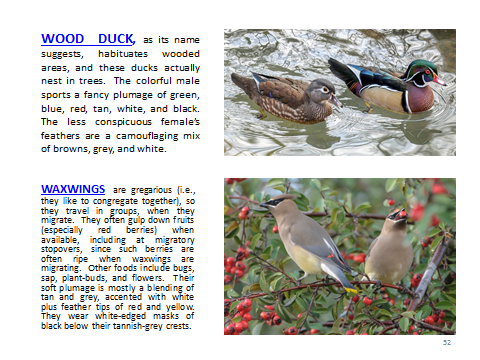
For ushering in this year of our Lord 2020,  below follows the eighth installment of alphabet-illustrating birds of the world, as part of this new series (“Birds Are Wonderful  —  and Some Are a Little Weird*).  The letter V is illustrated by Vasa Parrot, Vireos, and Vultures.  The letter W illustrated by Wood Duck, Waxwings, and Whinchat.  The letter X illustrated by Xavier’s Greenbul, Xingus Scale-backed Antbird, and Xantus’s Hummingbird.

“V” BIRDS:   Vasa Parrot, Vireos, and Vultures.

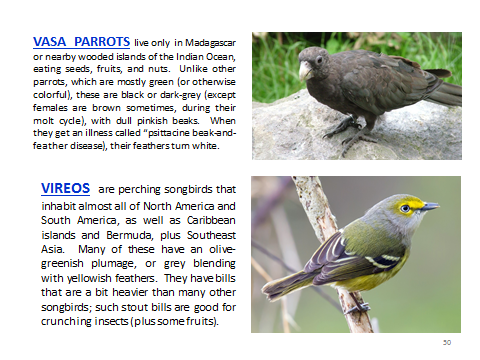
BAW-VasaParrot-Vireo

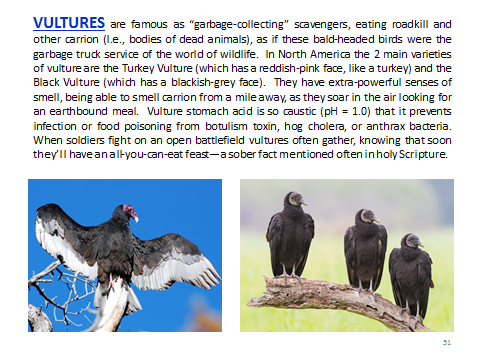
BAW-Vulture

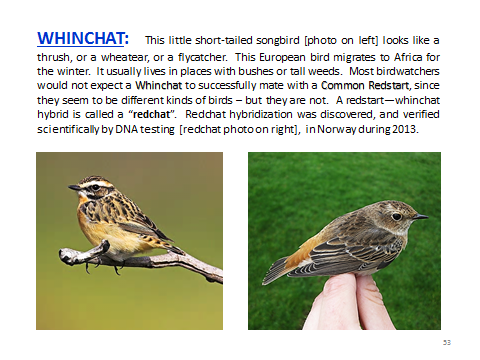
“W” BIRDS:  Wood Duck, Waxwings, and Whinchat.

BAW-WoodDuck-WaxwingsBAW-Whinchat

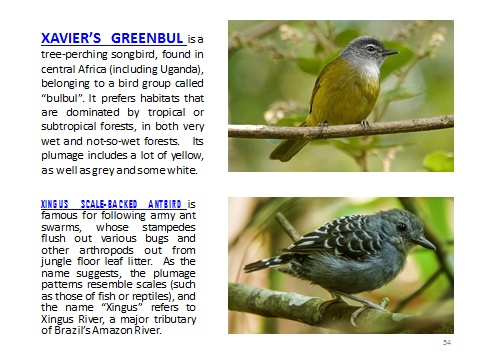
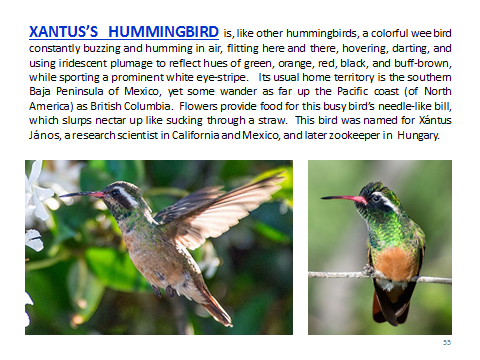
“X” BIRDS:  Xavier’s Greenbul, Xingus Scale-backed Antbird, and Xantus’s Hummingbird.

BAW-XavierGreenbul-XingusScalebackedAntbirdBAW-XantusHummingbird

Birds are truly wonderful — some are gracefully beautiful, like  Xantus’s Hummingbird, — and some, like the Vultures, are fascinatingly unusual, if not also a little weird!  (Stay tuned for more, D.v.)


* Quoting from “Birds Are Wonderful, and Some Are a Little Weird”, (c) AD2019 James J. S. Johnson   [used here by permission].

Vulture-turkey.TexasHillCountry

Two Suppers – By William Wise

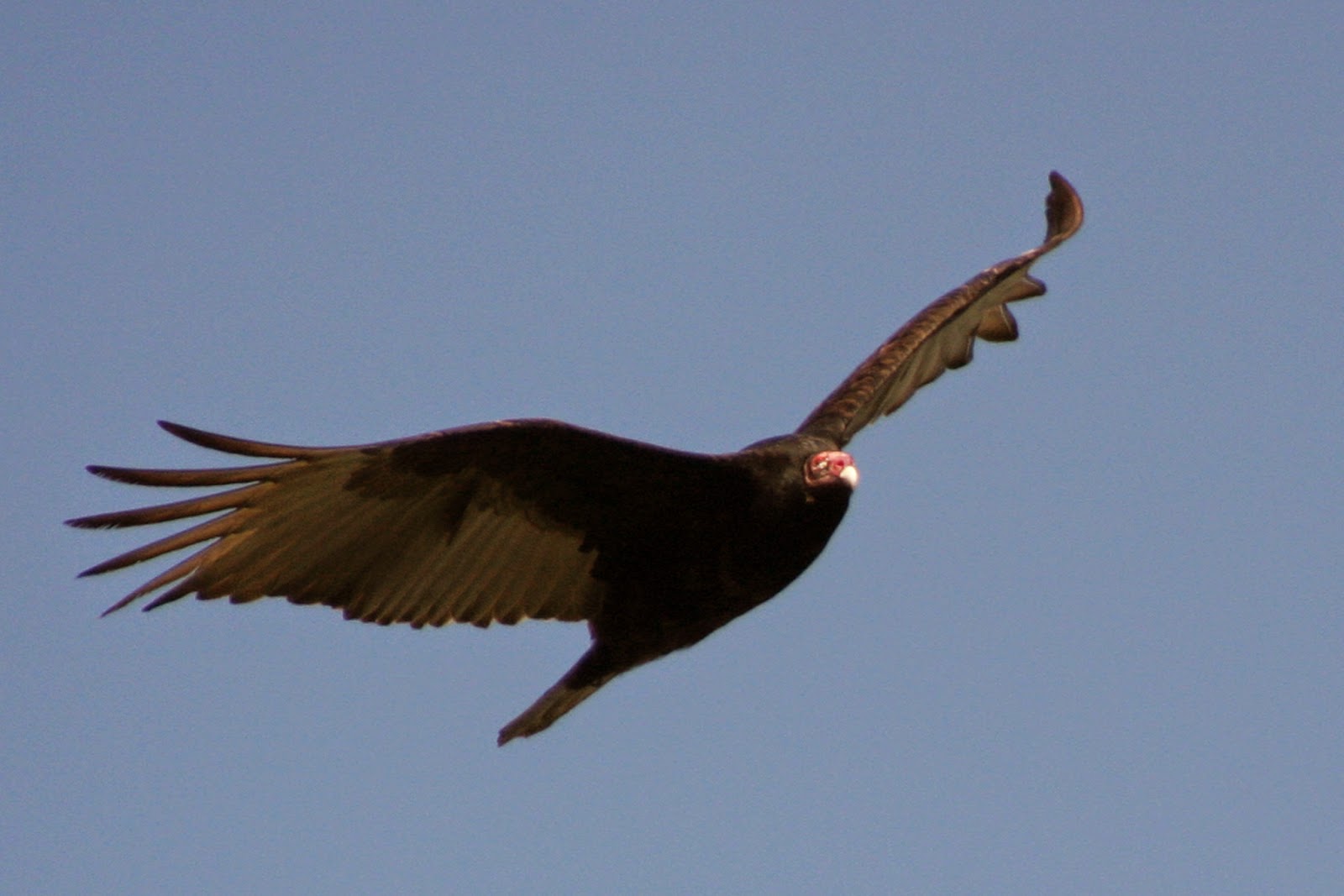
Turkey Vulture; Walton County, Georgia by William Wise

Turkey Vulture; Walton County, Georgia by William Wise

Two Suppers

By William Wise of www.williamwisephoto.com

Revelation 19:17-18  And I saw an angel standing in the sun; and he cried with a loud voice, saying to all the fowls that fly in the midst of heaven, Come and gather yourselves together unto the supper of the great God;  18 That ye may eat the flesh of kings, and the flesh of captains, and the flesh of mighty men, and the flesh of horses, and of them that sit on them, and the flesh of all men, both free and bond, both small and great.

While running a 10K race with my 69-year-old father, I laughed as he looked up and shouted at a group of circling vultures and said, “Go away! I’m not dead yet!” Although they were waiting to dine on him, he wasn’t quite ready to be their supper.

King James Authorized 1611 Pulpit Folio

The Bible tells us (and yes, I believe it) that one day in the future, God is going to host two great suppers, or feasts. The first is the party of the century… no, the party of the millennia… no, the party of the ages! It is called the Marriage Supper of the Lamb. And all the followers of Jesus Christ will be given clean, white garments and enjoy the greatest wedding reception of all time.

Georgia Vultures by William Wise

Georgia Vultures by William Wise

But simultaneously, there is another feast. It is called the Supper of the Great God. Those who did not RSVP for the Marriage Supper of the Lamb, but lived for themselves, will be attendees at this gathering. For it is a gathering of fowls; of carrion crows and vultures to feed upon the slain who turned in battle against returning Messiah. But you need not attend that feast.

Turkey Vulture; Clarke County, Georgia by William Wise

Turkey Vulture; Clarke County, Georgia by William Wise

When you pass a roadside party of vultures dining on last night’s unlucky road crossing, just remind yourself, “I’d rather feast at the Marriage Supper of the Lamb than be feasted upon at the Supper of the Great God.”


We are excited to introduce a new Photographer/Writer to the Lee’s Birdwatching Adventures blog. Not only is he a great Christian photographer, but a blogger who writes about Creation topics also. Welcome, William!

Check out his website at: http://www.williamwisephoto.com/index.html

Airplane Fingers – Creation Moments

AIRPLANE FINGERS

” Then God said, ‘Let the waters abound with an abundance of living creatures, and let birds fly above the earth across the face of the firmament of the heavens.'” Genesis 1:20

Aerodynamics, the science of flight, is a highly complex science. This is because many complex forces are acting on anything in flight. These forces include the power available for flight and drag produced by the flying object. Each of these categories include many additional forces that depend on the shape of the flying object, the shape and length of the wings, the speed and the altitude. This is why, for example, high altitude planes have very long wings.

Learjet 60 with winglets ©Myfreewallpapers

One critical force that has been under recent study is the turbulence that forms at the tips of the wings. The shorter the wing, the more energy consuming turbulence forms at the tip of the wing. Different wing designs have been tried to decrease this turbulence. Engineers have had some success reducing this turbulence with winglets. You may have seen these small vertical wings on the wingtips of some airplanes. Swiss researchers have been studying vultures with the hope of finding a better solution to this problem because vultures have a relatively short wing span that has proven to be surprisingly efficient. They discovered that this is because the feathers at the vultures’ wing tips spread out. They then tested a wing with a finger-like cascade of blades at the end.

Turkey Vulture in flight ©World Bird Sanctuary

Their new wing was more than four times more efficient than the average wing design in use today! It takes a great deal of faith in evolution to think that natural selection possesses such knowledge of aerodynamics. Clearly the vulture was designed by an intelligent Creator Who understands aerodynamics even better than we do!

Prayer:
I thank You, dear Father, that we can see Your wisdom in the creation. Amen.
Notes:
Wingfingers, Flying/January 1999, p.108. Photo: Learjet 60 with winglets. Courtesy of Adrian Pingstone. (PD)

©Creation Moments, with Permission, 2017

Wingtip Device – Wikipedia

More Interesting Articles

*

Lee’s Six Word Saturday – 12/31/16

***

King Vulture Brevard Zoo 120913 by Lee

THE VULTURE’S EYE HATH NOT SEEN

***


“There is a path which no fowl knoweth, and which the vulture’s eye hath not seen:” (Job 28:7 KJV)

King Vulture Brevard Zoo by Lee

*

More Daily Devotionals

Accipitridae – Family (Kites, Hawks & Eagles)

*

Lee’s Four Word Thursday – 8/25/16

***

King Vulture Brevard Zoo 120913 by Lee

WHICH THE VULTURE’S EYE

***


“There is a path which no fowl knoweth, and which the vulture’s eye hath not seen:” (Job 28:7 KJV)

King Vulture at the Brevard Zoo by Lee

*

More Daily Devotionals

*

Lee’s Three Word Wednesday – 5/18/16

***

Cinereous Vulture Chick -  ©Lincoln Park Zoo

IS IT I?

***


“And they were exceeding sorrowful, and began every one of them to say unto him, Lord, is it I?”  (Matthew 26:22)

Cinereous Vulture Chick – ©Lincoln Park Zoo

*

More Daily Devotionals

*

Pond-side Birdwatching in Florida I

PondsideBirdwatching.photo1

Pond-side Birdwatching in Florida,

from Chaplain Bob’s Backyard: Part 1

  by James J. S. Johnson

He turneth the wilderness into a standing water [’agam = “pond”], and dry ground into water-springs.  (Psalm 107:35)

Another wonderful morning in St. Petersburg (Florida), gazing at the duck pond and its marshy shores, with mocha coffee, buttered rye toast, and my feet propped up, birdwatching from the pond-side backyard of Chaplain Bob and Marcia Webel   —   under a huge beach umbrella, shielded from the occasional post-digestion droppings (!) from several ibises and ospreys perched in branches that hung over where were sat, birdwatching, properly outfitted with binoculars, coffee mugs, breakfast foods, and a bird-book. That is what I was doing, by God’s grace, on Monday morning (2-9-AD2015) during February (which, by the way,  is officially “National Bird-Feeding Month” – see 103rd Congress, Volume 140, Congressional Record, for 2-23-1994, U.S. House of Representatives, Rep. John Porter speaking on “National Wild Bird Feeding Month”).

The lacustrine birds (in this backyard-and-pond setting) were busy, busy, busy,  —  and noisy!  — with their morning activities.  Most of them were ducks (mallards and lesser scaups).  These lentic water-loving birds were busy:  some were paddling across the pond, quacking, splashing, dabbling or diving, others were perching on shoreline tree branches, or loitering in the pond-edge marshy plants.  Most of them were sporadically flying here and there, sometimes alone, sometimes as a group.  (And they noticed the presence of turtles in the water, as well as a dog on the shoreline.)   Sometimes tall wading birds (e.g., egrets and herons) perched atop the roofs of houses near the pond-shore. In that one morning, in just an hour or two, I saw at least 14 different birds, plus we heard the distinctive cooing of a mourning dove!

To memorialize the happy experience (which was all the more enjoyable because it was shared with my good friends Bob and Marcia Webel), please appreciate this quick report on those pond-side birds, blended with a few thoughts about those fair fowl —  all of which birds were so carefully made and maintained by our Lord Jesus Christ. Of course, it would take too long to report, now, on all 15 birds that we then observed.  So this report  (God willing)  will be just the first installment – reporting on the Great Blue Heron, Brown Pelican, Mallard, Double-Crested Cormorant, and Black Vulture,  —  within what should be a mini-series, eventually covering  all 15 of those beautiful-to-behold  backyard-pond-birds.

Great Blue Heron by Dan

Great Blue Heron

GREAT  BLUE  HERON   (Ardea herodias). The Great Blue Heron is a tall, majestic egret-like bird, poised and dignified.  It can stand still as a statue for a long time, waiting for its food to become snatchable.  When the heron spies its prey (likely a fish or frog – but maybe a small mammal, bird, lizard, or even a snake!), at the side of a pond, it stabs with sudden speed – the prey never saw that powerful, sharp, dagger-like beak coming – till it was too late! When in flight, the Great Blue Heron is graceful, purposeful, and dignified.  The National Audubon Society’s Field Guide to North American Birds – Eastern Region (Alfred A, Knopf, 1994 revised edition), co-authored by John Bull & John Farrand, Jr., reports (at its page 367) this description of the Great Blue Heron:  “A common, large, mainly [Confederate] grayish heron with pale or yellowish bill.” Its most habitat – which changes with seasonal migrations — is a pond’s edge, or that of a lake, stream, river, or marshland.  What a regal bird!  “For most of us, sightings of great blue herons are confined to a glimpse of the bird as it flies slowly and steadily overhead, wings arching gracefully down with each beat, neck bent back, and feet trailing behind.  At other times we see it on its feeding grounds, standing motionless and staring intently into shallow water, or wading with measured steps as it searches for prey.” [Quoting from “Great Blue Heron”, by Donald W. Stokes & Lillian Q. Stokes, in Bird Behavior, Volume III (Little, Brown & Co., 1989), page 25.]
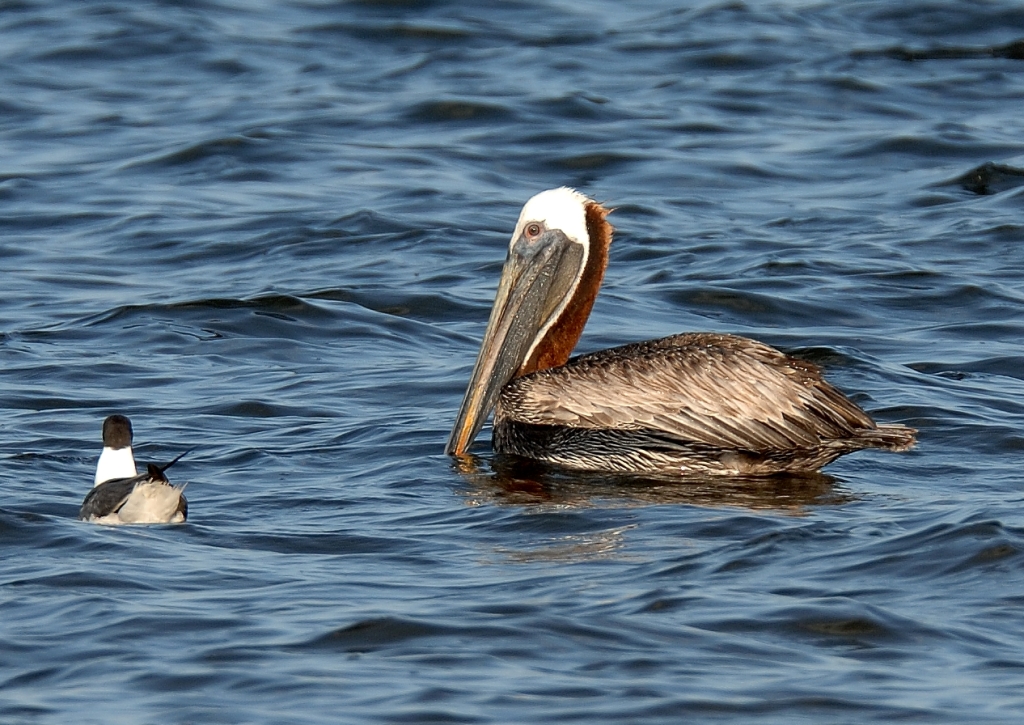
Brown Pelican and Laughing Gull by Dan MacDill Shore 2014

Brown Pelican and Laughing Gull by Dan MacDill Shore 2014

BROWN  PELICAN   (Pelecanus occidentalis). In their Field Guide to North American Birds – Eastern Region (noted above, in the Great Blue Heron entry), Bull & Farrand describe (at page 359) the Brown Pelican as a “very large, stocky bird with a dark brown body and a long flat bill”.  The adult storks have an ivory-white head, dark throat pouch, with dark brown hindneck coloring during the mating season.  The immature storks have dark brown heads and ivory-white breasts. These pelicans are year-round residents of Florida’s coastlands.  Bull & Farrand (on page 359) also report that the Brown Pelican is the “only nonwhite pelican in the world”, describing its eating habit as follows:  “…this marine bird obtains its food by diving from the air, its wings half folded as it plunges into the surf.  During one of these dives, the pouched bill takes in both fish and water; the bird drains out the water before throwing its head back and swallowing the fish.”  Donald and Lillian Stokes contrast this eating habit with that of the American White Pelican, which “feeds while floating on the water”.  (See Donald W. Stokes & Lillian Q. Stokes, Stokes Field Guide to Birds – Eastern Region [Little, Brown & Co., 1996], page 25.) One characteristic behavior of pelicans – the world over (including the Holy Land) – is the practice of adult pelicans regurgitating partially digested food into the mouths of their young.  “Pelicans” (Hebrew noun: qa’ath) are mentioned in Leviticus 11:18, Deuteronomy 14:17, and Psalm 102:6 [v. 7 in the Hebrew Bible’s verse numbering] – and apparently also in Isaiah 34:11 and Zephaniah 2:14.  George Cansdale says: “All pelicans feed their young by partly digested food, taken by the chick as it puts its head down the parent’s throat.  This regurgitation was the basis of the LXX and [Vulgate translation for] pelican, for [the Hebrew noun] qa’ath is said to mean ‘vomiter’.” (Quoting George S. Cansdale, All the Animals of the Bible [Zondervan, 1976], page 157.)  Cansdale rightly notices this, because the Hebrew noun for “vomitus” is qa’ (an etymologically related noun, which appears in Proverbs 26:11).
Mallard (Anas platyrhynchos) at Lake Parker By Dan'sPix

Mallard (Anas platyrhynchos) at Lake Parker By Dan’sPix

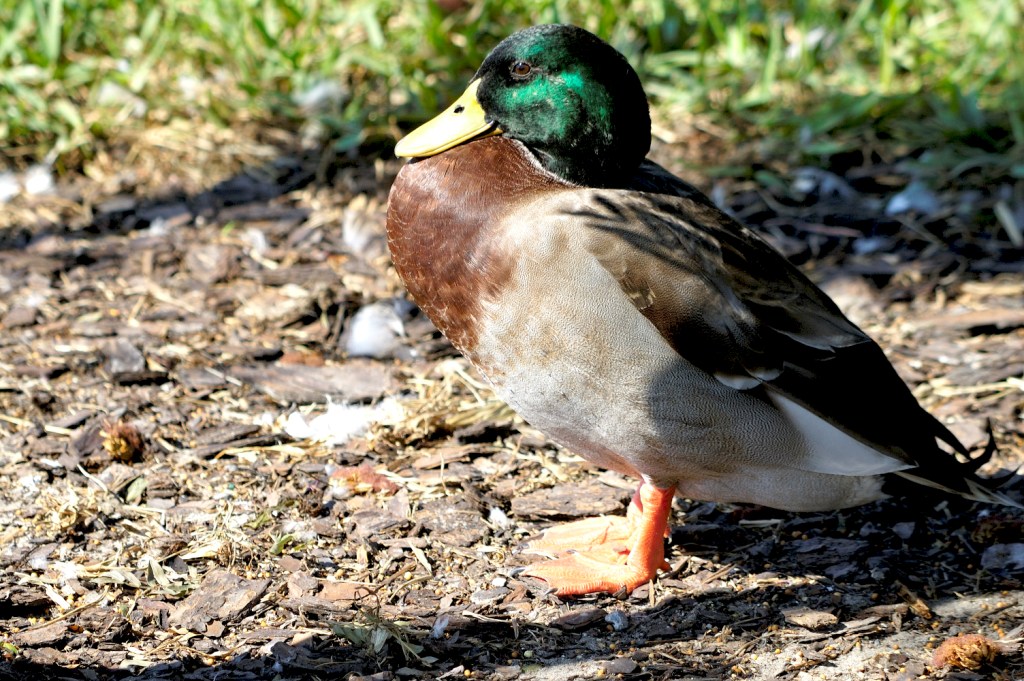
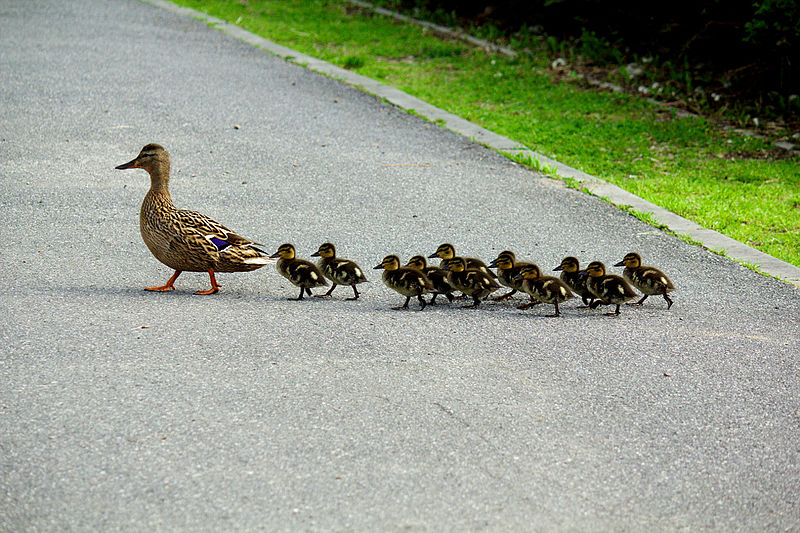
MALLARD   (a/k/a “GREEN-HEAD”:  Anas platyrhynchos). Mallards are nicknamed “green-heads”, due to the males’ iridescent green heads (which are bordered by a white neck ring).  The mallard male’s breast is chestnut-hued. Mallards live both on the coasts and inland (at ponds, lakes, prairie potholes, marshlands, including saltmarshes), including the entirety of America’s lower 48 states, so they are common (and well-known to American birdwatchers), so commonly known facts about them will not be repeated here.  Bull & Farrand [noted above, in the entry on Great Blue Heron] reports that the Mallard “is undoubtedly the most abundant duck in the world” (quoting page 392). Mallards are not only relatively ubiquitous, in their migratory or residential ranges (living or visiting in America, wherever migratory or residential ducks might be found), they are not shy around the habitat “edges” of human settlements.  Mallards frequent parks and backyards near ponds or other water bodies (including manmade reservoirs), often learning (and anticipating) that humans might provide bread crumbs or popcorn.  (But if you throw a piece of rotten banana into pond-water the mallards will not eat it.)  Donald Stokes reports that males and females make different noises:  “The quacking sound, which I had assumed that all Ducks made, can be made only by the female.  The male has two other calls of his own – a nasal rhaeb sound and a short Whistle-call, the latter accompanying all of the group courtship displays.”  (Donald W. Stokes, A Guide to Bird Behavior, Volume I (Stokes Nature Guides, Little, Brown & Co., 1979, page 31) Stokes goes on to say (pages 31-32) that this pattern of vocal behavior is not limited to Mallards – it also is observed in similar ducks including Gadwalls, Widgeons, Teals, Black Ducks, and Pintails.  Remember, therefore, if you see a large group of Mallards on a pond, and you hear a lot of quacking, it’s the females who are making all that noise.  (They might be trying to frighten of a turtle or other animal that is getting too close to their ducklings!)
Mallard Duck army marching (I know it's not a King, but it's cute) ©WikiC

Mallard Duck army marching ©WikiC

Mallards have good memories (as do all birds, I assume), and I have personal knowledge of that fact.  More than 15 years ago, my son and I would regularly feed the ducks (mostly mallards, plus lesser scaups during the winter months) at a pond near Furneaux Creek (in Denton County, Texas), in the evening. But one day we were in a hurry — I don’t recall why — so we drove straight home, bypassing the pond, then driving about a block, taking a right turn, then after another block taking another right turn, then driving down the hilly street to near the end of the cul-de-sac in our neighborhood, parking the car by our mailbox. However, as we got out of the car (and I approached our mailbox at the edge of our small front yard), and as we stepped onto the sidewalk toward our home’s front yard, we were greeted by a host of energetically quacking ducks! — apparently they wanted to know why we didn’t make our usual stop to feed them at the pond. Embarrassed, we quickly found something to feed them, and we quickly scattered food scraps on our front yard, to satisfy our avian guests (and they gobbled up all the bread scraps)! Yes, I felt a bit ashamed of myself, that day, for disappointing the mallards that day — but I’m pretty sure that they “forgave” us. Life gets busy — but that should not become an excuse for ignoring those whom we have an opportunity to be kind to (Galatians 6:10), even if they are mallards who live at a nearby pond.
Double-crested Cormorant (Phalacrocorax auritus) by Lee at Honeymoon Is SP

Double-crested Cormorant (Phalacrocorax auritus) by Lee at Honeymoon Is SP

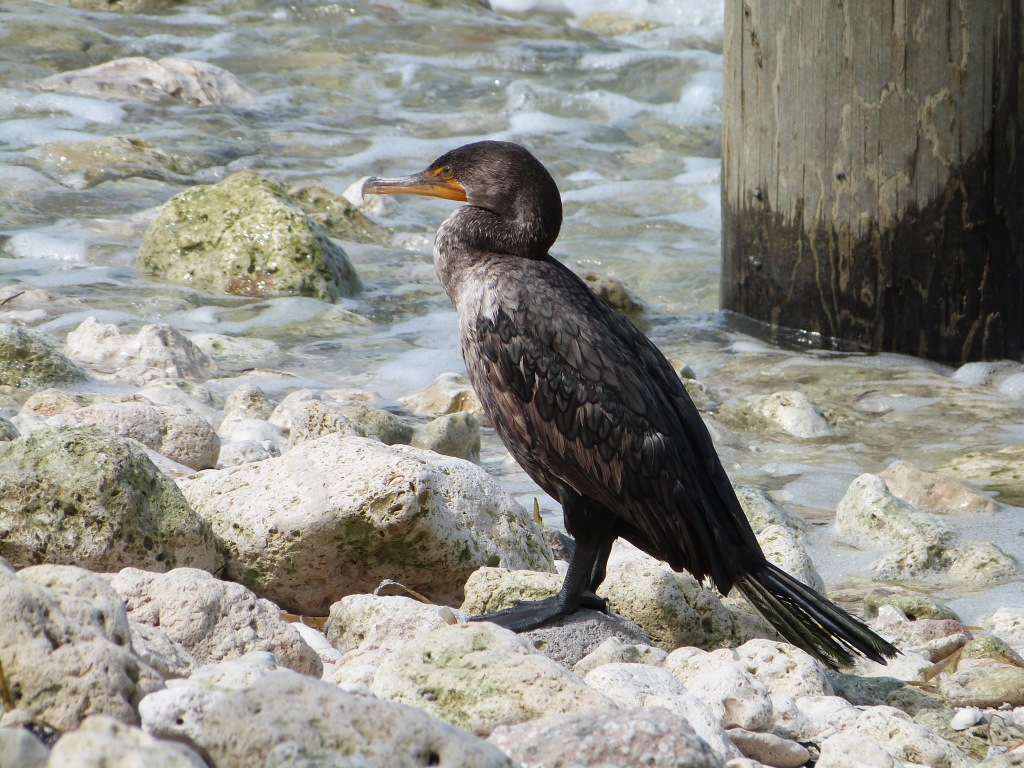
DOUBLE-CRESTED  CORMORANT   (Phalacrocorax auritus). The male of this bird is basically black, like a super-sized crow, with a goldish-orange bill and throat pouch, featuring a long neck that is usually posed in an S curve if perching.  (The female’s coloring is lighter – somewhat brownish-grey.)   But why is this bird called “double-crested”?   Don’t expect to observe any “crests” on its head (like a cardinal or a Steller’s jay), much less two of them!   Donald and Lillian Stokes inform us that the description “refers to crests that grow during breeding” that, even then, are “hard to see”.  (Stokes & Stokes, Stokes Field Guide to Birds – Eastern Region [noted above, in entry on Brown Pelican], page 27.)  Stokes & Stokes also note (on page 27) that this cormorant is the most common cormorant seen in the Eastern region of  America, on Atlantic (and Gulf of Mexico) coasts and farther inland, often wintering throughout the eastern half of Texas, and residing year-round in Florida.  (For example, the Heard Natural Science Museum and Wildlife Sanctuary — located in McKinney, Texas — is a good place to view these cormorants.) Cormorants are known to live in the coastal areas of the Holy Land.  The darting-to-its-prey habit, of diving cormorants, fits the Hebrew noun, shalak, often translated as “cormorant” (see Leviticus 11:17 & Deuteronomy 14:17). Like anhingas, these dark birds perch with outstretched wings, to dry out their wings after diving into and swimming in water for food (usually fish).  Like vultures, eagles, and hawks, these large birds have a bit of difficulty launching their heavy bodies from the ground, so after they do ascend high enough, to reach rising thermal air currents, they position themselves to “ride” those air currents (sometimes ascending as if riding an elevator), soaring and gliding whenever those air currents are conveniently available.   The double-crested cormorant’s neck is crooked in flight, unlike other cormorants.   These are gregarious birds – they nest in colonies and they often fly in groups, either in a straight line of in V formation.  (See Stokes & Stokes, page 27; see also page 361 of Bull & Farrand [noted above, in entry for Great Blue Heron].)
Black Vulture by Lee Myakka SP

Black Vulture by Lee Myakka SP

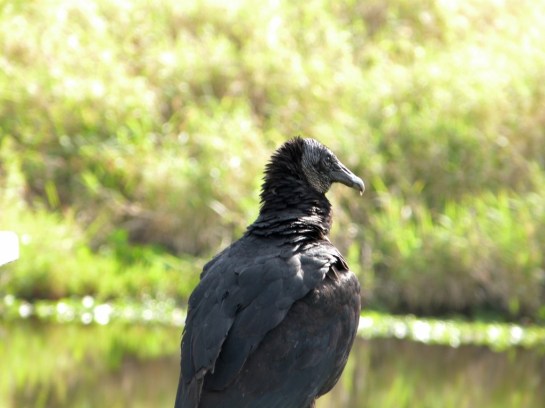
BLACK  VULTURE (Coragyps atratus). This eagle-like scavenger’s grey face distinguishes it from its cousin, the Turkey Vulture, which has a reddish-pink face Both of those faces are wrinkled, somber-looking, and – to put it bluntly – ugly.  The Black Vulture is distinguished by its conspicuously “short square tail that barely projects from the rear edge of the wings and by a whitish patch toward the wing tip”.  (Quoting Roger Tory Peterson, A Field Guide to the Birds Eastern Birds:  A Completely New Guide to All the Birds of Eastern and Central North America, abbreviated as “Eastern Birds” [Peterson Field Guides, Houghton Mifflin, 1980] page 160, with illustration on page 161.)  Black Vultures are somewhat feistier than their slightly larger cousins; they are known to scare off Turkey Vultures when there is competition for carrion.  (See Bull & Farrand [noted above, in entry for Great Blue Heron] at pages 416-417.   On the average, a Turkey Vulture grows about 4 inches larger than a Black Vulture, — yet both are about 2 feet long, from bill tip to tail tip.  Anyway, a vulture (sometimes colloquially called a “buzzard”) is a vulture is a vulture, and this is a vulture!   Vultures eat dead stuff – and sometimes even defenseless live animals.   Scavengers by God’s design (serving as garbage collectors/processors for this fallen world), vultures love to pick over and eat dead stuff!  God gave it a “naked” (featherless) head, which may be an advantage for keeping rotten food from besmirching its head with contagion, which might be more likely if its head was covered in feathers.  But Black Vultures   —   like other vultures  —   routinely consume flies-infested, rotting, bacteria-breeding dead animal carcasses  — why do they not get sick and die themselves of botulism or some other kind of food poisoning?  Dan “the Animal-man” Breeding has the answer:

“What is a vulture’s job? They find and eat what I call “road pizza.” They basically help keep the environment livable by limiting the build-up of dead animals and the spread of disease. God carefully designed vultures, giving them the needed tools to find, digest, and keep clean after eating dead animals.  Most meat-eating animals can find their dinner because it is mobile. Movement makes finding things easier. Have you noticed that when someone walks through your peripheral vision, you are acutely aware of it? But if you’ve misplaced your keys, it can take hours before you find them. God gave Buzz and vultures like him two special designs to help them find their motionless dinner—keen eyesight and an extraordinary sense of smell.
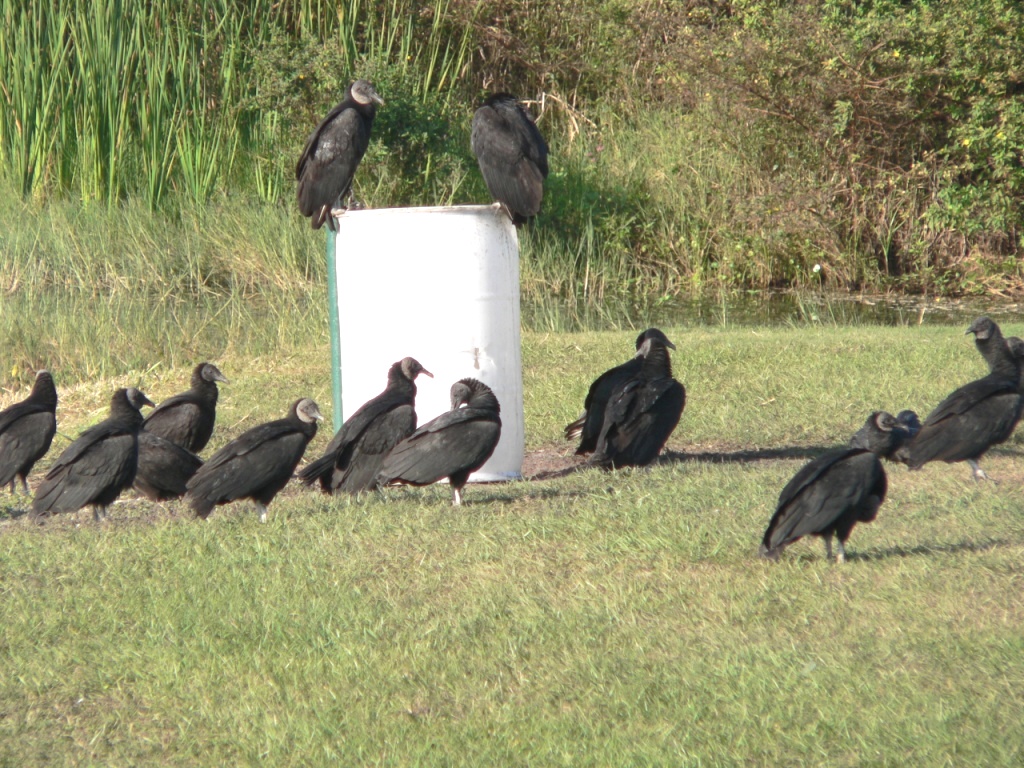
Black Vultures at Saddle Creek by Lee

Black Vultures at Saddle Creek by Lee

Vultures have very sharp eyesight. Even when they are soaring high above the ground, they can still see everything below them. God even provided them with sunglasses to protect their eyes against the sun’s harsh light. Vultures have dark lines around their eyes, which work the same way as the dark lines underneath a football player’s eyes. The dark color absorbs sunlight, reducing glare.  This way, vultures don’t have to worry about missing a single detail.  The lesser yellow-headed vultures have another advantage over most birds: a keen sense of smell. Their nares, or nose openings, look like holes in their beak. Wind from any direction funnels through the nares, which leads to the largest amount of sniffing possible. Each breeze is loaded with information, so God equipped these vultures with a very large olfactory lobe, able to handle all that information. Once the vultures find their dinner, how can they possibly eat it? Most other animals would get sick from eating dead animals. Why don’t vultures get sick all the time?  God gave them a very special digestive system. The acid in their crop (which functions like our stomach) is one of the strongest in the natural world. Strong enough to kill the harmful bacteria found in their dinner, it keeps them from getting sick from pretty much anything! In fact, vultures can use their digestive juices to defend themselves. If you were to startle a vulture while it was eating, you’d better back up quickly—vultures will vomit on you if you’re not careful. This not only makes them lighter (so they can more easily escape), but with the addition of the digestive acid, their lunch now smells much worse.”

(Quoting from  Dan Breeding, “Lesser Yellow-headed Vulture” [Answers in Genesis, 3-14-AD2012], posted at https://answersingenesis.org/birds/lesser-yellow-headed-vulture/ .)
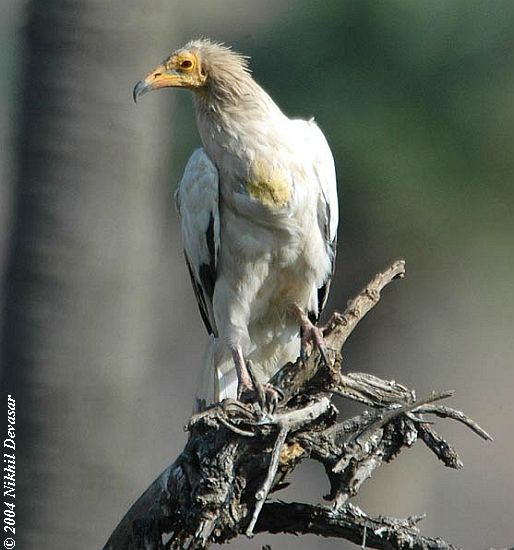
Egyptian Vulture (Neophron percnopterus) by Nikhil

Egyptian Vulture (Neophron percnopterus) by Nikhil

In the Holy Land proper (i.e., Israel), as well as in southwestern Europe and northern Africa to India, there is a vulture – the Egyptian Vulture (Neophron percnopterus – a/k/a White Scavenger Vulture) – that appears to match the Hebrew nouns rachma in Leviticus 11:18 (q.v.) and rachamah in Deuteronomy 14:17 (q.v.), and that same bird is nowadays known in Arabic as rachmah, essentially the same word.  (See, accord, George S. Cansdale, All the Animals of the Bible [Zondervan, 1976], pages 145-146.) The Black Vulture soars high in the sky, with a wingspan of about 5 feet (!), often in wide circles, scanning the ground for carrion – something dead yet nutritious to eat.   Scouting for rotting animal carcasses, vultures monitor the land below them:   marshy coastlands, tree-spotted hillsides, grasslands and other open fields, not-so-dense forests, riparian shore-banks, bushy thickets, — and but I’m not sure about the famous Hinckley under-brush of Minnesota (that we have heard so much about from Dr. Stan Toussaint — although he has confirmed that at Hinckley “the men are men, pansies are flowers, and the women are slightly above average”).  The Black Vulture’s body is heavy – like an eagle – so its wing-flappings are few, if possible, to conserve energy.  “Note the quick labored flapping — alternating with short glides”, notices Roger Tory Peterson (Eastern Birds, at page 160).  Its black-to-grey wings are two-tone-colored, with the flight feathers that trail behind the wings being paler (Peterson, Eastern Birds, page 160;  —  see also page 91 of Stokes & Stokes, Eastern Region, noted above in entry on Brown Pelican).  These scavengers are both residents and migrants:  they reside in most of the southern half of America’s lower 48 states, year-round, and summer in the northern half of those states.  Vultures are not picky eaters!  Roadkill, or even a partially picked-over animal carcass, is a wonderful “fast food” for a vulture.  If the roadkill (or other available animal carcass) is large enough it might provide a quick picnic for a family of vultures.

Wow!  That’s just 5 of the 15 birds we observed that morning, in the Webels’ pond-side backyard.   Stay tuned!  God willing, the other 10 birds will be given their proper recognition, at this excellent bird-site!

(On the morning of February 9th, AD2015, from the pond-side backyard of Bob & Marcia Webel (while enjoying breakfast and Christian fellowship with the Webels), I saw 14 birds:  Great Blue Heron, Brown Pelican, Mallard, Double-Crested Cormorant, and Black Vulture  –  as reported above – plus Wood Stork, Lesser Scaup, Osprey, Muscovy Duck, Great Egret, Snowy Egret, White Ibis, Common Tern, and Florida Gallinule, — plus the cooing of a nearby Mourning Dove was clearly recognizable.  It is hoped (D.v.) that later reports can supplement this one, so the latter-listed 10 birds will be properly recognized for their lacustrine appearances that morning.)

====================================================================================

James J. S. Johnson loves duck ponds, having formerly taught Environmental Limnology and Water Quality Monitoring for Dallas Christian College, as well as other courses on ecology and ornithology.  As noted in a recent comment to Emma Foster’s fascinating bird tale “The Old Man and the Ibises” (posted 2-11-AD2015), Jim enjoyed the habit of feeding ducks at a neighborhood pond during years when he lived near Furneaux Creek (in Carrollton, Texas).  Nowadays, from time to time, Jim feeds ducks (mostly mallards) and geese (mostly Canada geese) that visit the pond at the edge of his present home’s backyard.  Backyards and ponds are for bird-watching!

* Other Articles by James J. S. Johnson *