In a tropical rainforest by the shores of Chile, there lived two hummingbirds. One was named George and the other was named Frank. They both lived next door to each other in the rainforest and looked a lot alike. They both had pink, green, and blue feathers which were great camouflage. They were great friends.
Now George and Frank were hummingbirds so they were supposed to be able to fly backward. But George never could fly backward. Finally, one day, he was determined to learn how to fly that way. He flew over to Frank’s house, the next tree over, and knocked on the door with his long beak.
“I need your help,” he said. “I want to finally learn how to fly backward.”
“That will be easy,” said Frank. “I’ll show you.”
They found a big enough space to fly long distances and Frank demonstrated. He flew to a giant palm tree and back quite easily, flying backward. After several attempts, George wasn’t getting any better. The first three times, he fell; and, the fourth time, working his wings the wrong way, he flew into a tree and got his head stuck. Frank had to pull him out.
Then Frank had a solution. He grabbed a battery-powered fan and some rope. He tied the fan onto George’s stomach and turned it on. George was off! Sometimes he would fly so fast, he would run into a tree. A Toucan, living nearby, was so unhappy about this that he squawked angrily and chased them to another tree.
Eventually, George mastered flying backward with the fan, so Frank decided to try him once without it. George tried again and again, but it was always better with the fan. Frank helped him put it back on. George used the fan for flying backward from then on. That was just his way of doing it.
The End
(By Emma Foster a Kids Writer. She is 13.)
One who is righteous is a guide to his neighbor…. (Proverbs 12:26 ESV)
Everyone helps his neighbor and says to his brother, “Be strong!” (Isaiah 41:6 ESV)
“What does it cost this garniture of death?
It costs the life which God alone can give;
It costs dull silence where was music’s breath,
It costs dead joy, that foolish pride may live.
Ah, life, and joy, and song, depend upon it,
Are costly trimmings for a woman’s bonnet!”
—May Riley Smith.
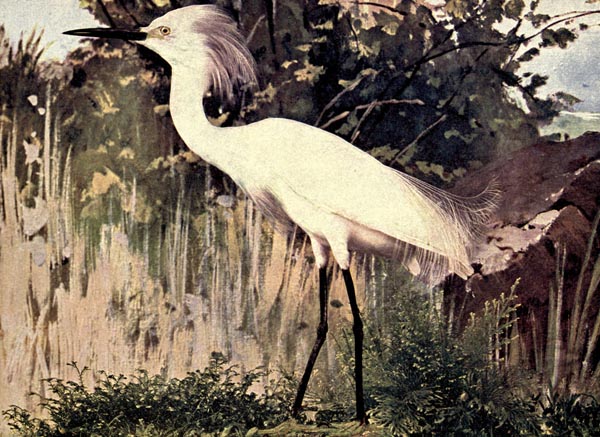
EMPERATE and tropical America, from Long Island to Oregon, south to Buenos Ayres, may be considered the home of the Snowy Heron, though it is sometimes seen on the Atlantic coast as far as Nova Scotia. It is supposed to be an occasional summer resident as far north as Long Island, and it is found along the entire gulf coast and the shores of both oceans. It is called the Little White Egret, and is no doubt the handsomest bird of the tribe. It is pure white, with a crest composed of many long hair-like feathers, a like plume on the lower neck, and the same on the back, which are recurved when perfect.
Snowy Herons nest in colonies, preferring willow bushes in the marshes for this purpose. The nest is made in the latter part of April or early June. Along the gulf coast of Florida, they nest on the Mangrove Islands, and in the interior in the willow ponds and swamps, in company with the Louisiana and Little Blue Herons. The nest is simply a platform of sticks, and from two to five eggs are laid.
Alas, plume hunters have wrought such destruction to these lovely birds that very few are now found in the old nesting places. About 1889, according to Mr. F. M. Woodruff, this bird was almost completely exterminated in Florida, the plume hunters transferring their base of operation to the Texas coast of the Gulf, and the bird is now in a fair way to be utterly destroyed there also. He found them very rare in 1891 at Matagorda Bay, Texas. This particular specimen is a remarkably fine one, from the fact that it has fifty-two plumes, the ordinary number being from thirty to forty.
Nothing for some time has been more commonly seen than the delicate airy plumes which stand upright in ladies’ bonnets. These little feathers, says a recent writer, were provided by nature as the nuptial adornment of the White Heron. Many kind-hearted women who would not on any account do a cruel act, are, by following this fashion, causing the continuance of a great cruelty. If ladies who are seemingly so indifferent to the inhumanity practiced by those who provide them with this means of adornment would apply to the Humane Education Committee, Providence, R. I., for information on the subject, they would themselves be aroused to the necessity of doing something towards the protection of our birds. Much is, however, being done by good men and women to this end.
The Little Egret moves through the air with a noble and rapid flight. It is curious to see it pass directly overhead. The head, body and legs are held in line, stiff and immovable, and the gently waving wings carry the bird along with a rapidity that seems the effect of magic.
An old name of this bird was Hern, or Hernshaw, from which was derived the saying, “He does not know a Hawk from a Hernshaw.” The last word has been corrupted into “handsaw,” rendering the proverb meaningless.
And the stork, the heron after her kind, and the lapwing, and the bat. (Leviticus 11:19 KJV)
American Ornithologists’ Union 1st edition (1886):
Snowy Heron ( Ardea candidissima)
was later changed to
American Ornithologists’ Union 2nd edition (incl. 15th suppl.): 1895
Snowy Egret ( Egretta candidissima)
then finally changed to the current with the
American Ornithologists’ Union 4th edition (1931):
Snowy Egret ( Egretta thula)
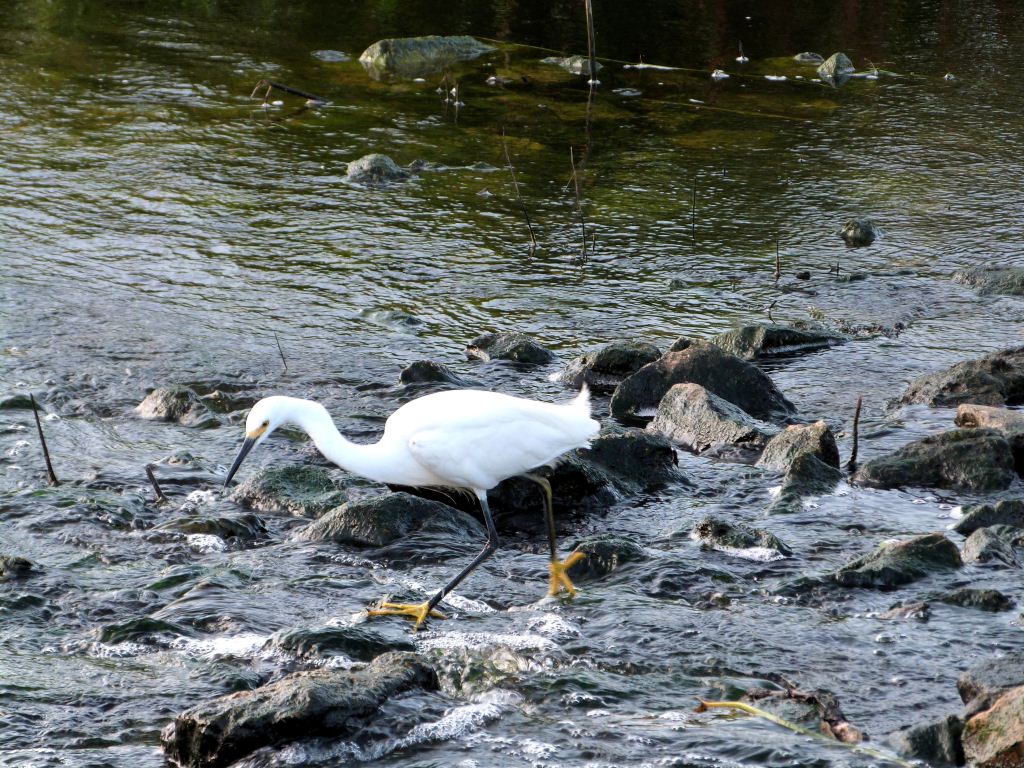
We have another case where the name and the scientific name has changed over time. The above give how the American Ornithologists’ Union progressed in the re-naming. I thoroughly enjoy watching the Snowys here. I think it is their yellow feet that amuses me so much. I am always trying to get a photo of the feet.
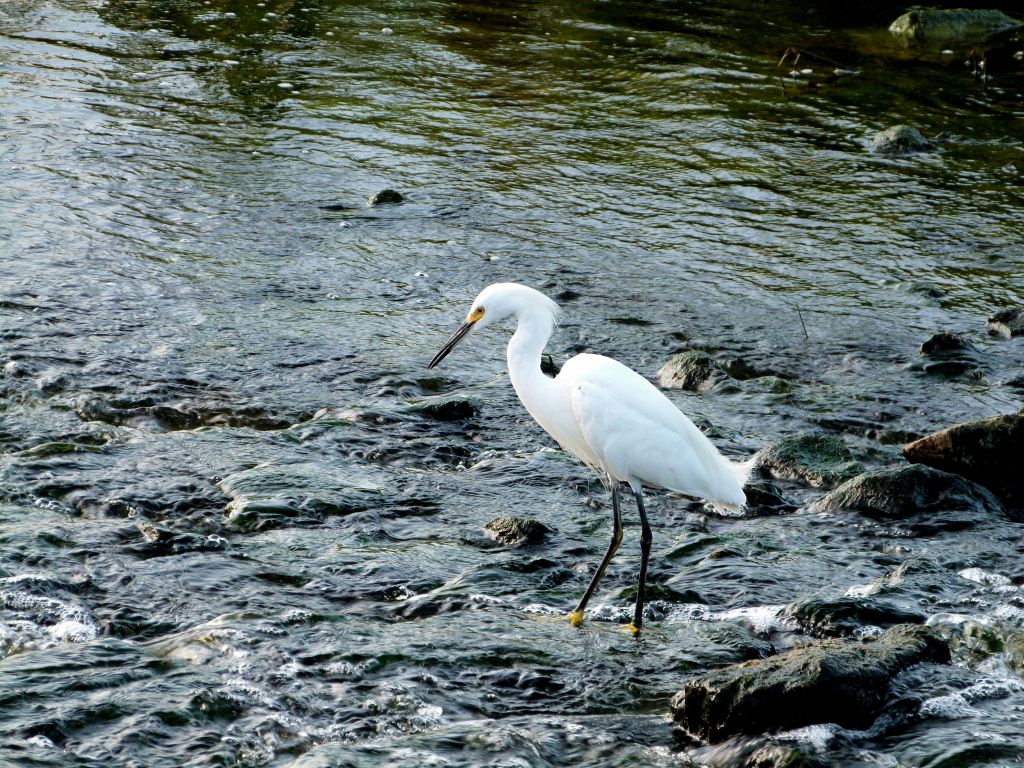
They are smaller than our Great Egret and I have been able to distinguish them from the Great and the Cattle Egrets finally. Once that yellow foot comes in sight, it’s a “no-brainer.”
Snowy Egret Circle B 8-3-12 by Lee
They are a medium-sized Heron that is all white. It has the yellow feet attached to its black legs. Their bill is dark and it pointed like most in the Heron families. That Family is the Ardeidae – Herons, Bitterns and also a Bible Bird.They and their kind are listed in the “do not eat” section for the Israelites. Even today, they are too much fun to watch than to eat.
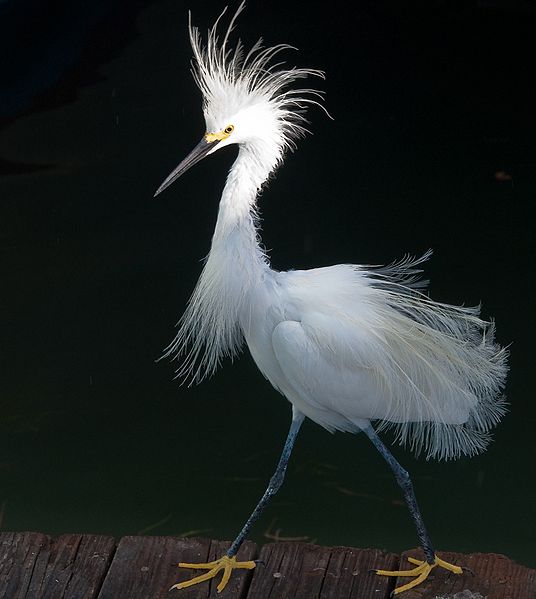
As stated above, their plumage was used a lot before that practice was stopped. Here is a photo from Wikipedia of the feathers displayed.
Their breeding habitat is large inland and coastal wetlands from the lower Great Lakes and southwestern United States to South America. The breeding range in eastern North America extends along the Atlantic and Gulf Coasts from Maine to Texas, and inland along major rivers and lakes. They nest in colonies, often with other waders, usually on platforms of sticks in trees or shrubs. Their flat, shallow nests are made of sticks and lined with fine twigs and rushes. Three to four greenish-blue, oval eggs are incubated by both adults. The young leave the nest in 20 to 25 days and hop about on branches near the nest before finally departing.
In warmer locations, some Snowy Egret are permanent residents; northern populations migrate to Central America and the West Indies. They may wander north after the breeding season, very rarely venturing to western Europe—the first bird sighted in Britain wintered in Scotland from 2001–2002.
The birds eat fish, crustaceans, insects and small reptiles. They stalk prey in shallow water, often running or shuffling their feet, flushing prey into view, as well “dip-fishing” by flying with their feet just over the water. Snowy Egrets may also stand still and wait to ambush prey, or hunt for insects stirred up by domestic animals in open fields.
The above article is the first article in the monthly serial that was started in January 1897 “designed to promote Knowledge of Bird-Live.” These include Color Photography, as they call them, today they are drawings. There are at least three Volumes that have been digitized by Project Gutenberg.
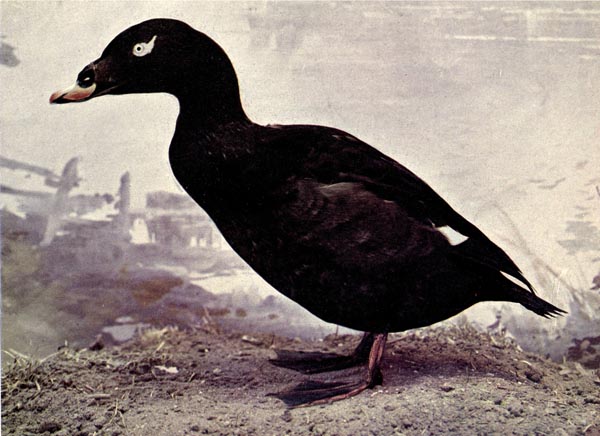
White-winged Scoter, From Birds Illustrated by Color Photography, 1897
THE AMERICAN SCOTER.
HE specimen we give of the American Scoter is one of unusual rarity and beauty of plumage. It was seen off the government pier, in Chicago, in November, 1895, and has been much admired.
The Scoter has as many names as characteristics, being called the Sea Coot, the Butter-billed, and the Hollow-billed Coot. The plumage of the full grown male is entirely black, while the female is a sooty brown, becoming paler below. She is also somewhat smaller.
This Duck is sometimes found in great numbers along the entire Atlantic coast where it feeds on small shell fish which it secures by diving. A few nest in Labrador, and in winter it is found in New Jersey, on the Great Lakes, and in California. The neighborhoods of marshes and ponds are its haunts, and in the Hudson Bay region the Scoter nests in June and July.
The nest is built on the ground near water. Coarse grass, feathers, and down are commonly used to make it comfortable, while it is well secreted in hollows in steep banks and cliffs. The eggs are from six to ten, of a dull buff color.
Prof. Cooke states that on May 2, 1883, fifty of these ducks were seen at Anna, Union county, Illinois, all busily engaged in picking up millet seed that had just been sown. If no mistake of identification was made in this case, the observation apparently reveals a new fact in the habits of the species, which has been supposed to feed exclusively in the water, and to subsist generally on fishes and other aquatic animal food.
From col. F. M. Woodruff. Summary
WHITE-WINGED SCOTER.—Oidemia deglandi. Other names: “American Velvet Scoter,” “White-winged Coot,” “Uncle Sam Coot.”
Range—Northern North America; breeding in Labrador and the fur countries; south in winter.
Nest—On the ground, beneath bushes.
Eggs—Six to ten; pale, dull buff.
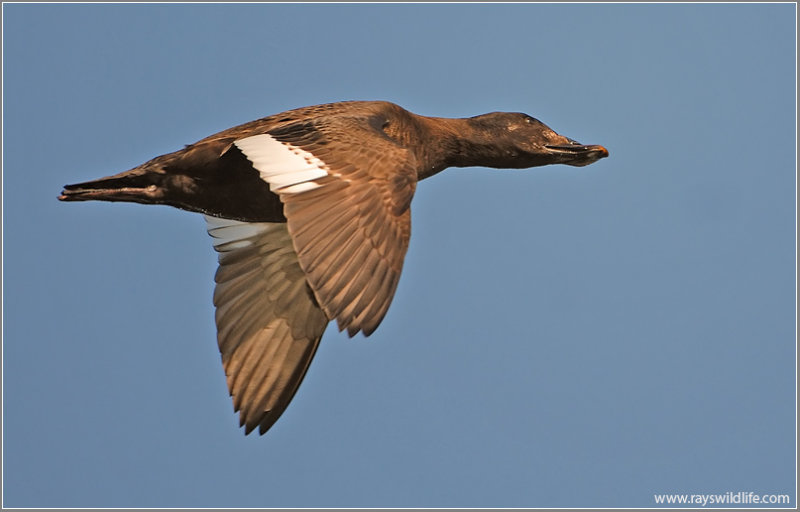
White-winged Scoter (Melanitta deglandi) by Ray
Lee’s Addition:
I have been hunted like a bird by those who were my enemies without cause; (Lamentations 3:52 ESV)
Look at the birds of the air: they neither sow nor reap nor gather into barns, and yet your heavenly Father feeds them. Are you not of more value than they? (Matthew 6:26 ESV)
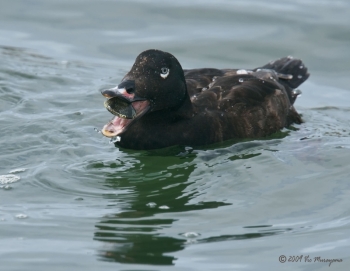
The article is titled “American Scoter” but the photos and information is mostly about the “White-winged Scoter”. I have provided information on both of those Scoters. I have never seen any of the Scoters that I remember. They are in the Anatidae – Ducks, Geese & Swans family. I love those eyes of the White-winged Scoter.
The scoters are stocky seaducks in the genus Melanitta. The drakes are mostly black and have swollen bills. Females are brown.
They breed in the far north of Europe, Asia and North America, and winter further south in temperate zones of those continents. They form large flocks on suitable coastal waters. These are tightly packed, and the birds tend to take off together.
Their lined nests are built on the ground close to the sea, lakes or rivers, in woodland or tundra. These species dive for crustaceans and molluscs.
There are five species, grouped into two subgenera:
subgenus Oidemia (Black and Common Scoters)
subgenus Melanitta (Surf, Velvet and White-winged Scoters)
The presumed fossil “scoter” Melanitta ceruttii which lived in California is now placed in the genus Histrionicus.
The adult female Black or American Scoter averages about 2.1 lbs.(980 grams ) and 18 inches (45 cm) in length, while the adult male is on average 2.4 lbs. (1100 grams) and 19 inches (49 cm) in length. It is characterized by its bulky shape and large bill. The male is all black with a very bulbous bill which is mostly yellow,a good relation with the common scoter. The female is a brown bird with pale cheeks, very similar to female Common Scoter. This is America’s only black duck, although the female may have some yellow around the nostrils.
This species can be distinguished from other scoters, apart from Common, by the lack of white anywhere on the drake, and the more extensive pale areas on the female.
Black Scoter and Common Scoter have diagnostically distinct vocalisations
The lined nest is built on the ground close to the sea, lakes or rivers, in woodland or tundra. 5-7 eggs are laid. Each eggs weighs from 2-2.6 oz (60-74 grams), or 8% of the females body weight. The incubation period may range from 27 to 31 days. Females brood their young extensively for about 3 weeks, after which the still flightless young must fend for themselves.
The White-winged Scoter (Melanitta deglandi) or (Melanitta fusca deglandi) is a large sea duck.It is characterised by its bulky shape and large bill. This is the largest species of scoter. Females range from 2.1-4.2 lb (950-1950 grams) and 19-22 inches (48–56 cm), averaging 2.6 lb (1180 grams) and 21 inches (52.3 cm). She is brown with pale head patches. The male ranges from 3-4.7 lb (1360-2128 grams) and from 21-24 inches (53–60 cm), averaging 3.6 lb (1380 grams) and 22 inches (55 cm). He is all black, except for white around the eye and a white speculum. This scoter’s bill has a black base and a large knob.
The white patches are visible but not conspicuous when the wings are folded.
There are a number of differing characteristic of the Eastern Siberian race and the American race from Alaska and Canada to west of the Hudson Bay. Males of the American subspecies have browner flanks, dark yellow coloration of most of the bill and a less tall bill knob, approaching the Velvet Scoter. The Asian form has a very tall knob at the base of its mostly orange-yellow bill. Females are identical in the field.
The White-winged Scoter was named for French zoologist Dr. Côme-Damien Degland (1787–1856).
It was formerly considered to be conspecific with the Velvet Scoter, and some taxonomists still regard it as so. These two species, and the Surf Scoter, are placed in the subgenus Melanitta, distinct from the subgenus Oidemia, Black and Common Scoters.
The White-winged Scoter breeds over the far north of Asia east of the Yenisey Basin, and North America. It wintersfurther south in temperate zones, on the Great Lakes, the coasts of the northern USA and the southern coasts of Canada, and Asia as far south as China. It forms large flocks on suitable coastal waters. These are tightly packed, and the birds tend to take off together.
The above article is the first article in the monthly serial that was started in January 1897 “designed to promote Knowledge of Bird-Live.” These include Color Photography, as they call them, today they are drawings. There are at least three Volumes that have been digitized by Project Gutenberg.
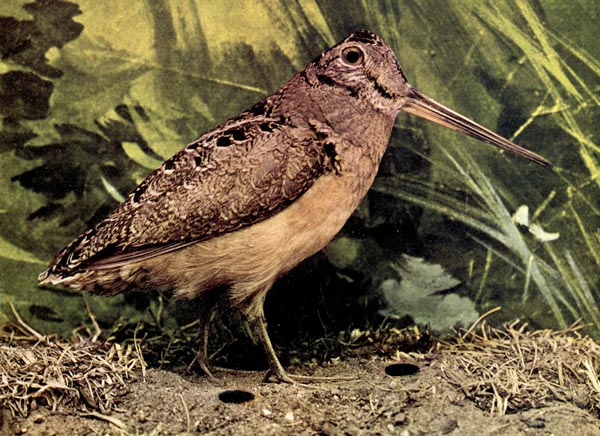
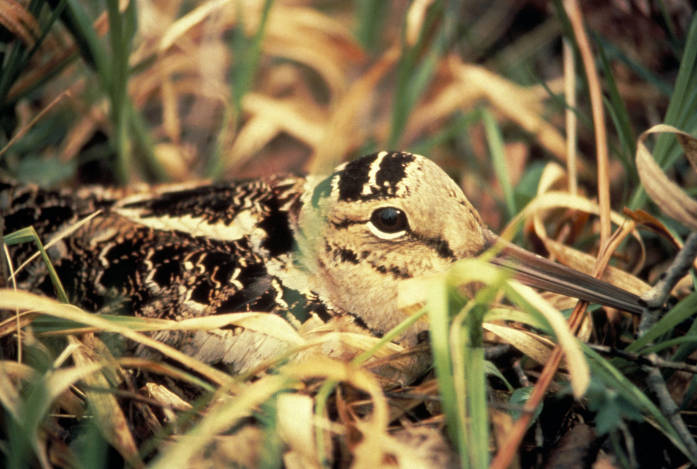
American Woodcock from Birds Illustrated by Color Photography, 1897 From col. Chi. Acad. Sciences.
THE AMERICAN WOODCOCK.
SN’T this American Woodcock, or indeed any member of the family, a comical bird? His head is almost square, and what a remarkable eye he has! It is a seeing eye, too, for he does not require light to enable him to detect the food he seeks in the bogs. He has many names to characterize him, such as Bog-sucker, Mud Snipe, Blind Snipe. His greatest enemies are the pot hunters, who nevertheless have nothing but praise to bestow upon him, his flesh is so exquisitely palatable. Even those who deplore and deprecate the destruction of birds are not unappreciative of his good qualities in this respect.
The Woodcock inhabits eastern North America, the north British provinces, the Dakotas, Nebraska and Kansas, and breeds throughout the range.
Night is the time when the Woodcock enjoys life. He never flies voluntarily by day, but remains secluded in close and sheltered thickets till twilight, when he seeks his favorite feeding places. His sight is imperfect by day, but at night he readily secures his food, assisted doubtless by an extraordinary sense of smell. His remarkably large and handsome eye is too sensitive for the glare of the sun, and during the greater part of the day he remains closely concealed in marshy thickets or in rank grass. In the morning and evening twilight and on moonlight nights, he seeks his food in open places. The early riser may find him with ease, but the first glow from the rays of the morning sun will cause his disappearance from the landscape.
He must be looked for in swamps, and in meadows with soft bottoms. During very wet seasons he seeks higher land—usually cornfields—and searches for food in the mellow plowed ground, where his presence is indicated by holes made by his bill. In seasons of excessive drought the Woodcock resorts in large numbers to tide water creeks and the banks of fresh water rivers. So averse is he to an excess of water, that after continued or very heavy rains he has been known suddenly to disappear from widely extended tracts of country.
A curious habit of the Woodcock, and one that is comparatively little known, is that of carrying its young in order to remove them from danger. So many trustworthy naturalists maintain this to be true that it must be accepted as characteristic of this interesting bird. She takes her young from place to place in her toe grasps as scarcity of food or safety may require.
As in the case of many birds whose colors adapt them to certain localities or conditions of existence, the patterns of the beautiful chestnut parts of the Woodcock mimic well the dead leaves and serve to protect the female and her young. The whistle made by their wings when flying is a manifestation of one of the intelligences of nature.
The male Woodcock, it is believed, when he gets his “intended” off entirely to himself, exhibits in peculiar dances and jigs that he is hers and hers only, or rises high on the wing cutting the most peculiar capers and gyrations in the air, protesting to her in the grass beneath the most earnest devotion, or advertising to her his whereabouts.
Here is a bird that is not often seen in the daytime. During the day he stays in the deep woods or among the tall marsh grasses.
It is at twilight that you may see him. He then comes out in search of food.
Isn’t he an odd-looking bird? His bill is made long so that he can bore into the soft ground for earthworms.
You notice his color is much like the Ruffed Grouse in June “BIRDS.” This seems to be the color of a great many birds whose home is among the grasses and dried leaves. Maybe you can see a reason for this.
Those who have watched the Woodcock carefully, say that he can move the tip end of the upper part of his bill. This acts like a finger in helping him to draw his food from the ground.
What a sight it must be to see a number of these weird-looking birds at work getting their food. If they happen to be in a swampy place, they often find earthworms by simply turning over the dead leaves.
If there should be, near by, a field that has been newly plowed, they will gather in numbers, at twilight, and search for worms.
The Woodcock has short wings for his size. He seems to be able to fly very fast. You can imagine how he looks while flying—his long bill out in front and his legs hanging down. Summary
AMERICAN WOODCOCK.—Philohela minor. Other names: “Bog-sucker,” “Mud Snipe,” “Blind Snipe.”
Range—Eastern North America, breeding throughout its range.
Nest—Of dried leaves, on the ground.
Eggs—Four; buffy, spotted with shades of rufous.
***************
Lee’s Addition:
You will seek me and find me, when you seek me with all your heart. (Jeremiah 29:13 ESV)
For the gate is narrow and the way is hard that leads to life, and those who find it are few. (Matthew 7:14 ESV)
That they should seek the Lord, if haply they might feel after him, and find him, though he be not far from every one of us: (Acts 17:27 KJV)
Thinking about how the Woodcock is protected by the way the Lord created it to blend in to the leaves and bark reminded me of trying to find something. The above verses came to mind. I trust we are all seeking the Lord, His Salvation and His Blessings.
The American Woodcock (Scolopax minor), sometimes colloquially referred to as the Timberdoodle, is a small chunky shorebird species found primarily in the eastern half of North America. Woodcock spend most of their time on the ground in brushy, young-forest habitats, where the birds’ brown, black, and gray plumage provides excellent camouflage.
Because of the male Woodcock’s unique, beautiful courtship flights, the bird is welcomed as a harbinger of spring in northern areas. It is also a popular game bird, with about 540,000 killed annually by some 133,000 hunters in the U.S.
The American Woodcock is the only species of Woodcock inhabiting North America. Although classified with the sandpipers and shorebirds in Family Scolopacidae, the American Woodcock lives mainly in upland settings. Its many folk names include timberdoodle, bogsucker, night partridge, brush snipe, hokumpoke, and becasse.
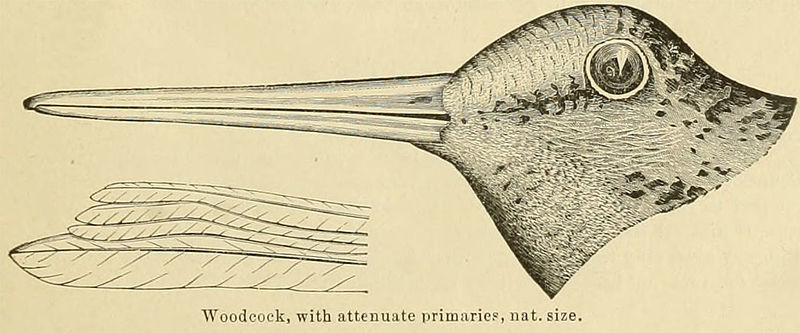
The American Woodcock has a plump body, short legs, a large, rounded head, and a long, straight bill. Adults are 10 to 12 inches (25 to 30 cm) long and weigh 5 to 8 ounces (140 to 230 g). Females are considerably larger than males. The bill is 2.5 to 2.75 inches (6.3 to 7.0 cm) long.
“Woodcock, with attenuate primaries, nat. size.” 1891.
The plumage is a cryptic mix of different shades of browns, grays, and black. The chest and sides vary from yellowish white to rich tans. The nape of the head is black, with three or four crossbars of deep buff or rufous. The feet and toes, which are small and weak, are brownish gray to reddish brown.
Woodcock have large eyes located high in the head, and their visual field is probably the largest of any bird, 360° in the horizontal plane and 180° in the vertical plane.
The Woodcock uses its long bill to probe in the soil for food, mainly invertebrates and especially earthworms. A unique bone-and-muscle arrangement lets the bird open and close the tip of its upper bill, or mandible, while it is sunk in the ground. Both the underside of the upper mandible and the long tongue are rough-surfaced for grasping slippery prey.
Color Key – Many of the members of the family Scolopacidæare probing Snipe. The Woodcock, Wilson Snipe, and Dowitcher are good examples. Their bill is long and sensitive and they can curve or move its tip without opening it at the base. When the bill is thrust into the mud the tip may therefore grasp a worm and it thus becomes a finger as well as a probe.
Besides the American Woodcock, there are these: (Photos from IBC)
Eurasian Woodcock (Scolopax rusticola)
Amami Woodcock (Scolopax mira)
Javan Woodcock (Scolopax saturata) or Dusky
New Guinea Woodcock (Scolopax rosenbergii)
Bukidnon Woodcock (Scolopax bukidnonensis)
Sulawesi Woodcock (Scolopax celebensis)
Moluccan Woodcock (Scolopax rochussenii) American Woodcock (Scolopax minor)
The above article is the first article in the monthly serial that was started in January 1897 “designed to promote Knowledge of Bird-Live.” These include Color Photography, as they call them, today they are drawings. There are at least three Volumes that have been digitized by Project Gutenberg.
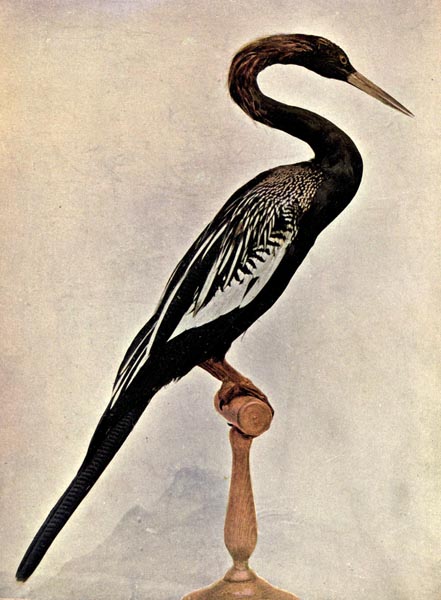
HE Snake Bird is very singular indeed in appearance, and interesting as well in its habits. Tropical and sub-tropical America, north to the Carolinas and Southern Illinois, where it is a regular summer resident, are its known haunts. Here it is recognized by different names, as Water Turkey, Darter, and Snake Bird. The last mentioned seems to be the most appropriate name for it, as the shape of its head and neck at once suggest the serpent. In Florida it is called the Grecian Lady, at the mouth of the Mississippi, Water Crow, and in Louisiana, Bec a Lancette. It often swims with the body entirely under water, its head and long neck in sight like some species of water snakes, and has no doubt more than once left the impression on the mind of the superstitious sailor that he has seen a veritable sea serpent, the fear of which lead him to exaggerate the size of it.
This bird so strange in looks and action is common in summer in the South Atlantic and Gulf States, frequenting the almost impenetrable swamps, and is a constant resident of Florida.
As a diver the Snake Bird is the most wonderful of all the Ducks. Like the Loon it can disappear instantly and noiselessly, swim a long distance and reappear almost in an opposite direction to that in which naturally it would be supposed to go. And the ease with which, when alarmed, it will drop from its perch and leave scarcely a ripple on the surface of the water, would appear incredible in so large a bird, were it not a well known fact. It has also the curious habit of sinking like a Grebe.
The nests of the Anhinga are located in various places, sometimes in low bushes at a height from the ground of only a few feet, or in the upper branches of high trees, but always over water. Though web footed, it is strong enough to grasp tightly the perch on which it nests. This gives it a great advantage over the common Duck which can nest only on the ground. Sometimes Snake Birds breed in colonies with various species of Herons. From three to five eggs, bluish, or dark greenish white, are usually found in the nest.
Prof. F. C. Baker, secretary of the Chicago Academy of Sciences, to whom we are indebted for the specimen presented here, captured this bird at Micco, Brevard Co., Florida, in April, 1889. He says he found a peculiar parasite in the brain of the Anhinga.
The Anhingas consist of but one species, which has a representative in the warmer parts of each of the great divisions of the earth. The number seen together varies from eight or ten to several hundred.
The hair-like feathers on the neck form a sort of loose mane.
When asleep the bird stands with its body almost erect. In rainy weather it often spends the greater part of the day in an erect attitude, with its neck and head stretched upward, remaining perfectly motionless, so that the water may glide off its plumage. The fluted tail is very thick and beautiful and serves as a propeller as well as a rudder in swimming. Summary
Nest—Of sticks, lined with moss, rootlets, etc., in a bush or tree over the water.
Eggs—Two to four; bluish white, with a chalky deposit.
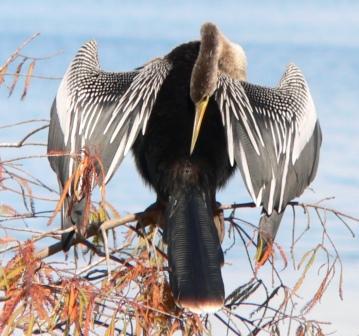
Anhinga Dryed at Lake Hollingsworth
Lee’s Addition:
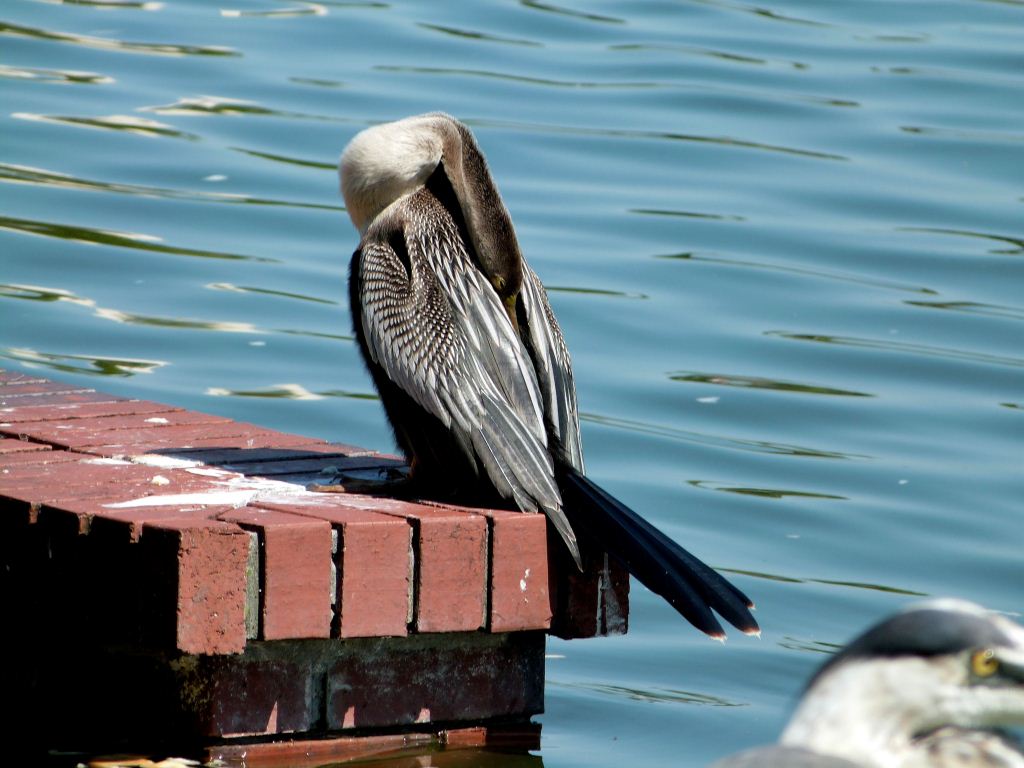
Anhingas are very common here in central Florida. We see them “hanging out to dry” all the time. That, or swimming in the lake with only their neck sticking out. They do look like a snake at times.
The Anhinga (Anhinga anhinga), sometimes called Snakebird, Darter, American Darter, or Water Turkey, is a water bird of the warmer parts of the Americas. The word anhinga comes from the Brazilian Tupi language and means devil bird or snake bird.
It is a cormorant-like bird with an average body length of 85 cm (33 in), a wingspan of 117 cm (46 in), and a mass of up to 1.35 kg (3.0 lb). It is a dark-plumaged piscivore with a very long neck, and often swims with only the neck above water. When swimming in this style the name Snakebird is apparent, since only the colored neck appears above water the bird looks like a snake ready to strike.
Most of the male Anhinga’s body is a glossy black green with the wings, base of wings, and tail being a glossy black blue. The tip of the tail has white feathers. The back of the head and the neck have elongated feathers that have been described as gray or light purple white. The upper back of the body and wings is spotted or streaked with white.
Anhinga Female resting
The female Anhinga is similar to the male Anhinga except that it has a pale gray-buff or light brown head, neck, and upper chest. The lower chest or breast is a chestnut color and as compared to the male, the female has a more brown back.
This bird is often mistaken for the Double-crested Cormorant due to its similar size and behavior. However, the two species can be differentiated by their tails and bills. The tail of the anhinga is wider and much longer than that of the cormorant. The bill of the anhinga is pointed, while the bill of the cormorant has a hook-tip.
The Anhinga is placed in the darter family, Anhingidae, and is closely related to Indian (Anhinga melanogaster), African (A. rufa), and Australian (A. novaehollandiae) Darters.
The above article is the first article in the monthly serial that was started in January 1897 “designed to promote Knowledge of Bird-Live.” These include Color Photography, as they call them, today they are drawings. There are at least three Volumes that have been digitized by Project Gutenberg.
the stork, the heron of any kind, the hoopoe, and the bat. (Leviticus 11:19 ESV)
All things were made through Him, and without Him nothing was made that was made. (John 1:3 NKJV)
Color Key To North American Birds cover
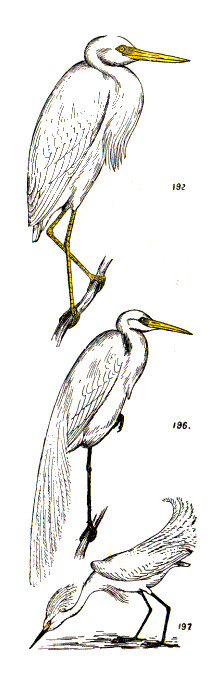
192. Great White Heron (Ardea occidentalis). Ads. White, no “aigrette” plumes. A white Heron about the size of a Great Blue Heron. What is supposed to be a gray-blue phase of this bird has been called, a bird which resembles No. 194, but has the head and neck whitish.Range.—Southern Florida, Cuba and Jamaica.
196. American Egret (Herodias egretta). L. 41. Ads. White, about 50 straight “aigrette” plumes grow from the back between the wings; legs and feet black. Ads. when not breeding and Yng., the same, but no plumes.Range.—Tropical and temperate America; breeds north to Virginia, southern Illinois, and California; later strays to New Brunswick, Minnesota, and Oregon; winters from southern California and Gulf States southward.
197. Snowy Heron (Egretta candidissima). L. 24. Ads. White, about 50 recurved “aigrette” plumes grow from back between the wings; legs black, feet yellow. Ads. when not breeding and Yng. The same, but no plumes.Range.—Tropical and temperate America; bred formerly north to Long Island, southern Illinois and California; now very rare in eastern North America; winters from Gulf States and southern California southward.
194. Great Blue Heron (Ardea herodias). L. 45; W. 18.5; B. 5.5; Tar. 7. Ads. Center of crown white, head crested; legs blackish. Yng. Similar, but no crest, crown wholly black, plumage more streaked.Range—Northern South America north to Arctic regions; breeds locally throughout most of North America range; winters from about latitude 42° southward.
194a. Northwest Coast Heron (A. h. fannini). Similar to No. 194 but much darker; upperparts bluish slate black; tarsus shorter, 5.3.Range.—Pacific coast from Vancouver to Sitka.
194b. Ward Heron (A. h. wardi). Similar to No. 194 but whiter below, neck darker; legs olive; larger, L. 52; W. 20; B. 6.5; Tar. 8.Range.—Florida; coast of Texas.
202. Black-crowned Night Heron (Nycticorax nycticorax nævius). L. 24. Ads. Crown and back greenish black lower back, wings and tail ashy; head with two or three rounded white plumes, except just after breeding season. Yng. Grayish brown streaked with white; below white streaked with blackish; outer webs of primaries, pale rufous. Notes. An explosiveqûawk.Range.—Western hemisphere; breeds in North America north to New Brunswick, Quebec, Manitoba, and Oregon; winters from California and Gulf States southward.
203. Yellow-crowned Night Heron (Nyctanassa violaceus). L. 23. Ads. Blue-gray; crown and ear-coverts whitish, rest of head black; scapulars streaked with black; head with two or three rounded, white plumes, except just after nesting season.Yng. Crown black, streaked with whitish; primaries bluish slate, no rufous; back brownish streaked with white; below whitish streaked with blackish.
Range.—Tropical and subtropical America; breeds north to South Carolina, southern Illinois, and Lower California; strays to Massachusetts and Colorado; winters from Gulf States southward.
198. Reddish Egret (Dichromanassa rufescens). L. 29. Two color phases independent of age. Ads. Dark phase, Head and neck rufous; back slate; about 30 “aigrette” plumes. White phase. White, including plumes; tips of primaries sometimes speckled with gray. Yng. Rufous and gray, or white, without plumes.Range.—West Indies and Central America north to coasts of Gulf States, Illinois (rarely), and Lower California.
199. Louisiana Heron (Hydranassa tricolor ruficollis). L. 26. Ads. “Aigrette” plumes, short, dirty gray; rump and belly white; legs blackish. Yng. Head and neck brownish; throat and line down foreneck white; above slaty washed with brownish, rump, and belly white.Range.—West Indies and Central America north to Gulf States, casually to Long Island and Indiana.
200. Little Blue Heron (Florida cœrulea). L. 22. Ads. Head and neck maroon; rest of plumage slaty blue. Yng. White, tips of primaries bluish, legs greenish yellow.Range.—Tropical America and eastern United States; breeds north to Virginia and Illinois, later may stray north as far as Nova Scotia; winters from South Atlantic and Gulf States southward.
201. Little Green Heron (Butorides virescens). L. 17. Smallest of our Herons. Ads. Crown, glossy green-black; throat and line down foreneck buffy; rest of head and neck purplish chestnut; back green washed with bluish gray. Yng. Neck and below streaked with blackish; back-feathers not lengthened; duller. Notes. A rattling oc-oc-oc-oc-oc, a startling scow, and, more rarely, a deep, hollow groan. (Brewster.)Range.—Tropical and temperate North America; breeds from Gulf States north to Nova Scotia and Manitoba; winters from Gulf States southward to northern South America.
201a. Frazar Green Heron (B. v. frazari). Similar to No. 201, but rather larger and darker, neck more purplish, light stripings on throat and foreneck more restricted. (Brewster.)
201b. Anthony Green Heron (B. v. anthonyi). Similar to No. 201, but slightly larger, and paler, light markings of wings, neck, and throat less restricted and whiter. (Mearns.)
Range.—Arid portions of southwestern United States, south into Mexico.
And the stork, the heron after her kind, and the lapwing, and the bat. (Leviticus 11:19)
Herons belong to the Family of Herons, Bitterns and Egrets called Ardeidae. There are 72 different types of Bitterns and Egrets, but most the species are the Herons. When the Bible says “after her kind” they are referring to that whole family of birds.
The herons are long-legged freshwater and coastal birds in the family Ardeidae, (some are called “egrets” or “bitterns” instead of “heron”). Within Ardeidae, all members of the genera Botaurus and Ixobrychus are referred to as “bitterns”, and Zigzag Heron or Zigzag Bittern. However, egrets are not a separate group from the herons, and tend to be named differently because they are mainly white and/or have decorative plumes. Although egrets have the same build as the larger herons, they tend to be smaller.
Although herons look like birds in some other families, such as the storks, ibises, spoonbills and cranes, they differ from these in flying with their necks retracted, not outstretched.
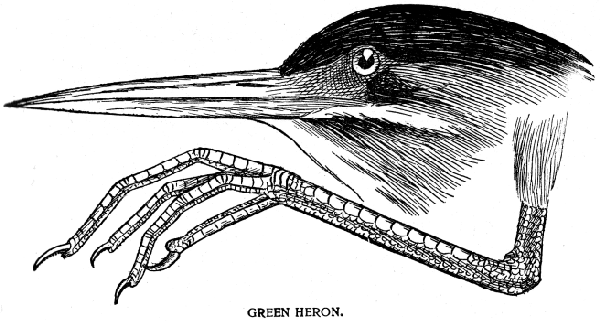
Green Heron – From Color Key
HERONS, EGRETS, AND BITTERNS. Ardeidæ.
Bill usually straight and sharply pointed; lores naked; head feathered; tarsus with transverse scales; middle toe-nail pectinate or with a comblike edge. (From Color Key to North American Birds, by Frank M. Chapman)
The herons are medium to large sized birds with long legs and necks. The smallest species is usually considered the Little Bittern, which can measure under 12 in (30 cm) in length, although all the species in the Ixobrychus genus are small and many broadly overlap in size. The largest species of heron is the Goliath Heron, which stand up to 60 in (152 cm) tall. The necks are able to kink in an s-shape, due to the modified shape of the sixth vertebrae. The neck is able to retract and extend, and is retracted during flight, unlike most other long-necked birds. The neck is longer in the day herons than the night herons and bitterns. The legs are long and strong and in almost every species are unfeathered. In flight the legs and feet are held backward. The feet of herons have long thin toes, with three forward pointing ones and one going backward.
Tricolored Heron Immature Lake Morton 8-3-12
The bill is generally long and harpoon like. It can vary from extremely fine, as in the Agami Heron, to thick as in the Grey Heron. The most atypical bill is owned by the Boat-billed Heron
Boat-billed Heron (Cochlearius cochlearius) Lowry Park Zoo 9-15-12
which has a broad thick bill. The bill, as well as other bare parts of the body, is usually yellow, black or brown coloured, although this colour can vary during the breeding season. The wings are broad and long, with 10-11 primaries primaries feathers (the Boat-billed Heron has only nine), 15-20 secondaries and 12 rectrices (10 in the bitterns). The feathers of the herons are soft and the plumage is usually blue, black, brown, grey or white, and can often be strikingly complex.
the stork, the heron of any kind; the hoopoe and the bat. (Deuteronomy 14:18 ESV)
The Herons listed in Leviticus 11 and Deuteronomy 14 were on a list of birds that were not to be eaten.
*
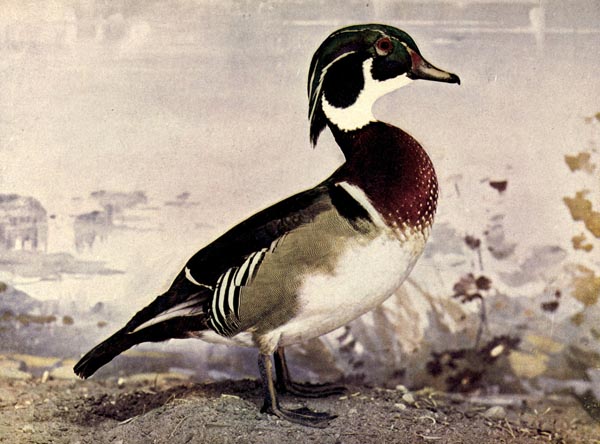
A great many people think that this is the most beautiful bird of North America. It is called Wood Duck because it usually makes its nest in the hollow of a tree that overhangs the water. If it can find a squirrel’s or woodpecker’s hole in some stump or tree, there it is sure to nest.
A gentleman who delighted in watching the Wood Duck, tells about one that built her nest in the hollow of a tree that hung over the water. He was anxious to see how the little ones, when hatched, would get down.
In a few days he knew that the ducklings were out, for he could hear their pee, pee, pee. They came to the edge of the nest, one by one, and tumbled out into the water.
You know a duck can swim as soon as it comes out of the egg.
Sometimes the nest is in the hollow of a tree that is a short distance from the water.
Now how do you suppose the ducklings get there as they do?
If the nest is not far from the ground, the mother bird lets them drop from it on the dried grass and leaves under the tree. She then carries them in her bill, one by one, to the water and back to the nest.
If the nest should be far from the ground, she carries them down one by one.
This same gentleman says that he once saw a Wood Duck carry down thirteen little ones in less than ten minutes. She took them in her bill by the back of the neck or the wing.
When they are a few days old she needs only to lead the way and the little ones will follow.
The Wood Duck is also called Summer Duck. This is because it does not stay with us during the winter, as most ducks do.
It goes south to spend the winter and comes back north early in the spring.
Wood Duck (Aix sponsa) by Dan
THE WOOD DUCK.
UITE the most beautiful of the native Ducks, with a a richness of plumage which gives it a bridal or festive appearance, this bird is specifically named Spousa, which means betrothed. It is also called Summer Duck, Bridal Duck, Wood Widgeon, Acorn Duck and Tree Duck.
It is a fresh water fowl, and exclusively so in the selection of its nesting haunts. It inhabits the whole of temperate North America, north to the fur countries, and is found in Cuba and sometimes in Europe. Its favorite haunts are wooded bottom-lands, where it frequents the streams and ponds, nesting in hollows of the largest trees. Sometimes a hole in a horizontal limb is chosen that seems too small to hold the Duck’s plump body, and occasionally it makes use of the hole of an Owl or Woodpecker, the entrance to which has been enlarged by decay.
Wilson visited a tree containing a nest of a Wood or Summer Duck, on the banks of Tuckahoe river, New Jersey. The tree stood on a declivity twenty yards from the water, and in its hollow and broken top, about six feet down, on the soft decayed wood were thirteen eggs covered with down from the mother’s breast. The eggs were of an exact oval shape, the surface smooth and fine grained, of a yellowish color resembling old polished ivory. This tree had been occupied by the same pair, during nesting time, for four successive years. The female had been seen to carry down from the nest thirteen young, one by one, in less than ten minutes. She caught them in her bill by the wing or back of the neck, landed them safely at the foot of the tree, and finally led them to the water. If the nest be directly over the water, the little birds as soon as hatched drop into the water, breaking their fall by extending their wings.
Many stories are told of their attachment to their nesting places. For several years one observer saw a pair of Wood Ducks make their nest in the hollow of a hickory which stood on the bank, half a dozen yards from a river. In preparing to dam the river near this point, in order to supply water to a neighboring city, the course of the river was diverted, leaving the old bed an eighth of a mile behind, notwithstanding which the ducks bred in the old place, the female undaunted by the distance which she would have to travel to lead her brood to the water.
While the females are laying, and afterwards when sitting, the male usually perches on an adjoining limb and keeps watch. The common note of the drake is peet-peet, and when standing sentinel, if apprehending danger, he makes a noise not unlike the crowing of a young cock, oe-eek. The drake does not assist in sitting on the eggs, and the female is left in the lurch in the same manner as the Partridge.
The Wood Duck has been repeatedly tamed and partially domesticated. It feeds freely on corn meal soaked in water, and as it grows, catches flies with great dexterity.
Summary
WOOD DUCK.—Aix sponsa. Coloring varied; most beautiful of ducks. Other names: “Summer Duck,” “Bridal Duck,” “Wood Widgeon,” “Tree Duck.”
Range—North America. Breeds from Florida to Hudson’s Bay; winters south.
Nest—Made of grasses, usually placed in a hole in tree or stump.
Eggs—Eight to fourteen; pale, buffy white.
Wood Duck by Dan at Lake Hollingsworth
Lee’s Addition:
The Wood Duck is in theAnatidae – Ducks, Geese & Swans Family. The Aix genus includes the Wood Duck and also the beautifulMandarin Duck(Aix galericulata). “The adult male has distinctive multicoloured iridescent plumage and red eyes,with a distinctive white flare down the neck. The female, less colourful, has a white eye-ring and a whitish throat. Both adults have crested heads.” When the male is in non-breeding plumage the colors are more like the female, but with some differences. Here is a photo taken yesterday at Lake Morton of a male Wood Duck.
Wood Duck Male Lake Morton 8-3-12
Here is a picture of the female I also photographed yesterday.
Wood Duck Female Lake Morton 8-3-12
The male’s call is a rising whistle, “jeeeeee”; the females utter a drawn-out, rising squeal, “oo-eek,” when flushed, and a sharp “cr-r-ek, cr-e-ek” for an alarm call.
Their breeding habitat is wooded swamps, shallow lakes, marshes or ponds, and creeks in eastern North America, the west coast of the United States and western Mexico. They usually nest in cavities in trees close to water, although they will take advantage of nesting boxes in wetland locations if available. Females line their nests with feathers and other soft materials, and the elevation provides some protection from predators. Unlike most other ducks, the Wood Duck has sharp claws for perching in trees and can, in southern regions, produce two broods in a single season—the only North American duck that can do so.
The population of the Wood Duck was in serious decline in the late 19th century as a result of severe habitat loss and market hunting both for meat and plumage for the ladies’ hat market in Europe. By the beginning of the 20th century Wood Ducks had virtually disappeared from much of their former range. In response to the Migratory Bird Treaty established in 1916 and enactment of the Federal Migratory Bird Treaty Act of 1918, wood duck populations began to recover slowly. By ending unregulated hunting and taking measures to protect remaining habitat, wood duck populations began to rebound in the 1920s. The development of the artificial nesting box in the 1930s gave an additional boost to Wood Duck production.
Landowners as well as park and refuge managers can encourage Wood Ducks by building Wood Duck nest boxes near lakes, ponds, and streams. Fulda, Minnesota has adopted the Wood Duck as an unofficial mascot, and a large number of nest boxes can be found in the area.
Expanding North American Beaver populations throughout the Wood Duck’s range have also helped the population rebound as beavers create an ideal forested wetland habitat for Wood Ducks.
The above article is the first article in the monthly serial that was started in January 1897 “designed to promote Knowledge of Bird-Live.” These include Color Photography, as they call them, today they are drawings. There are at least three Volumes that have been digitized by Project Gutenberg.
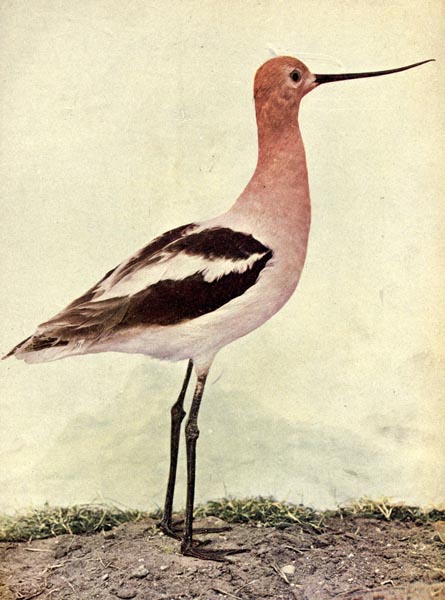
American Avocet – Birds Illustrated by Color Photography, 1897 From col. F. M. Woodruff
THE AMERICAN AVOCET.
HITE SNIPE, Yelper, Lawyer, and Scooper are some of the popular names applied in various localities to this remarkably long-legged and long and slender-necked creature, which is to be found in temperate North America, and, in winter, as far south as Cuba and Jamaica. In north-eastern Illinois the Avocet generally occurs in small parties the last of April and the first of May, and during September and the early part of October, when it frequents the borders of marshy pools. The bird combines the characteristics of the Curlew and the Godwit, the bill being recurved.
The cinnamon color on the head and neck of this bird varies with the individual; sometimes it is dusky gray around the eye, especially in the younger birds.
The Avocet is interesting and attractive in appearance, without having any especially notable characteristics. He comes and goes and is rarely seen by others than sportsmen.
american avocet. From col. F. M. Woodruff.
Summary
AMERICAN AVOCET.—Recurvirostra americana. Other names: “White Snipe,” “Yelper,” “Lawyer,” “Scooper.”
Range—Temperate North America.
Nest—A slight depression in the ground.
Eggs—Three or four; pale olive or buffy clay color, spotted with chocolate.
American Avocet (Recurvirostra americana) by Jim Fenton
Lee’s Addition:
All things were made by him; and without him was not any thing made that was made. (John 1:3 KJV)
The American Avocet (Recurvirostra americana) is a large wader in the avocet and stilt family, Recurvirostridae. This avocet has long, thin, gray legs, giving it its colloquial name, “blue shanks”. The plumage is black and white on the back with white on the underbelly. The neck and head are cinnamon colored in the summer and gray in the winter. The long, thin bill is upturned at the end. The adult bird measures 16–20 in (40–51 cm) in length, 27–30 in (68–76 cm) and 9.7–15 oz (275–420 g) in weight.
The breeding habitat is marshes, beaches, prairie ponds, and shallow lakes in the mid-west and on the Pacific coast of North America. American avocets form breeding colonies numbering dozens of pairs. When breeding is over the birds gather in large flocks, sometimes including hundreds of birds. Nesting occurs near water, usually on small islands or boggy shorelines where access by predators is difficult. The female lays four eggs in a saucer-shaped nest, and both sexes take turns incubating them. Upon hatching, the chicks feed themselves; they are never fed by their parents. They can walk, swim, and even dive within 24 hours of hatching.
This species is migratory, and mostly winters on the southern Atlantic and Pacific coasts of Mexico and the United States.
The American Avocet forages in shallow water or on mud flats, often sweeping its bill from side to side in water as it seeks its crustacean and insect prey.
The above article is the first article in the monthly serial that was started in January 1897 “designed to promote Knowledge of Bird-Live.” These include Color Photography, as they call them, today they are drawings. There are at least three Volumes that have been digitized by Project Gutenberg.
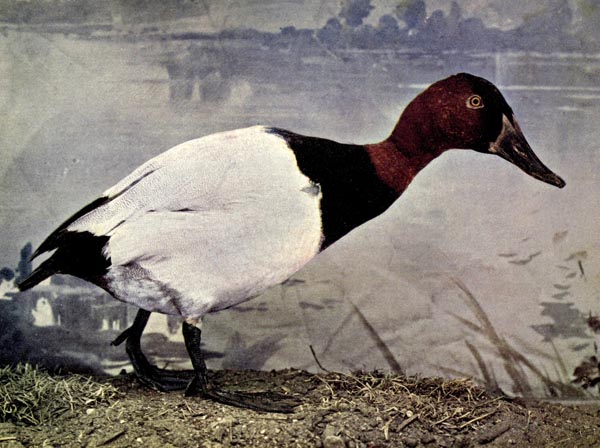
The Canvasback Duck, Birds Illustrated by Color Photography, 1897
THE CANVAS-BACK DUCK.
HITE-BACK, Canard Cheval, (New Orleans,) Bull-Neck, and Red-Headed Bull-Neck, are common names of the famous Canvas-Back, which nests from the northern states, northward to Alaska. Its range is throughout nearly all of North America, wintering from the Chesapeake southward to Guatemala.
“The biography of this duck,” says Mabel Osgood Wright, “belongs rather to the cook-book than to a bird list,” even its most learned biographers referring mainly to its “eatable qualities,” Dr. Coues even taking away its character in that respect when he says “there is little reason for squealing in barbaric joy over this over-rated and generally under-done bird; not one person in ten thousand can tell it from any other duck on the table, and only then under the celery circumstances,” referring to the particular flavor of its flesh, when at certain seasons it feeds on vallisneria, or “water celery,” which won its fame. This is really not celery at all, but an eel-grass, not always found through the range of the Canvas-Back. When this is scarce it eats frogs, lizards, tadpoles, fish, etc., so that, says Mrs. Osgood, “a certificate of residence should be sold with every pair, to insure the inspiring flavor.”
The opinion held as to the edible qualities of this species varies greatly in different parts of the country. No where has it so high a reputation as in the vicinity of Chesapeake Bay, where the alleged superiority of its flesh is ascribed to the abundance of “water celery.” That this notion is erroneous is evident from the fact that the same plant grows in far more abundance in the upper Mississippi Valley, where also the Canvas-Back feeds on it. Hence it is highly probable that fashion and imagination, or perhaps a superior style of cooking and serving, play a very important part in the case. In California, however, where the “water celery” does not grow, the Canvas-Back is considered a very inferior bird for the table.
It has been hunted on Chesapeake Bay and its tributaries with such inconsiderate greed that its numbers have been greatly reduced, and many have been driven to more southern waters.
In and about Baltimore, the Canvas-Back, like the famous terrapin, is in as high favor for his culinary excellence, as are the women for beauty and hospitality. To gratify the healthy appetite of the human animal this bird was doubtless sent by a kind Providence, none the less mindful of the creature comforts and necessities of mankind than of the purely aesthetic senses.
Summary
CANVAS-BACK.—Aythya vallisneria. Other names: “White-Back,” “Bull-Neck,” “Red-Headed Bull-Neck.”
Range—North America. Breeds only in the interior, from northwestern states to the Arctic circle; south in winter to Guatemala.
Nest—On the ground, in marshy lakesides.
Eggs—Six to ten; buffy white, with bluish tinge.
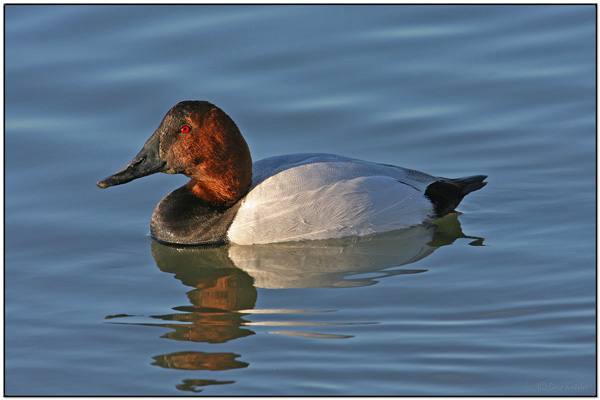
Canvasback (Aythya valisineria) by Daves BirdingPix
Lee’s Addition:
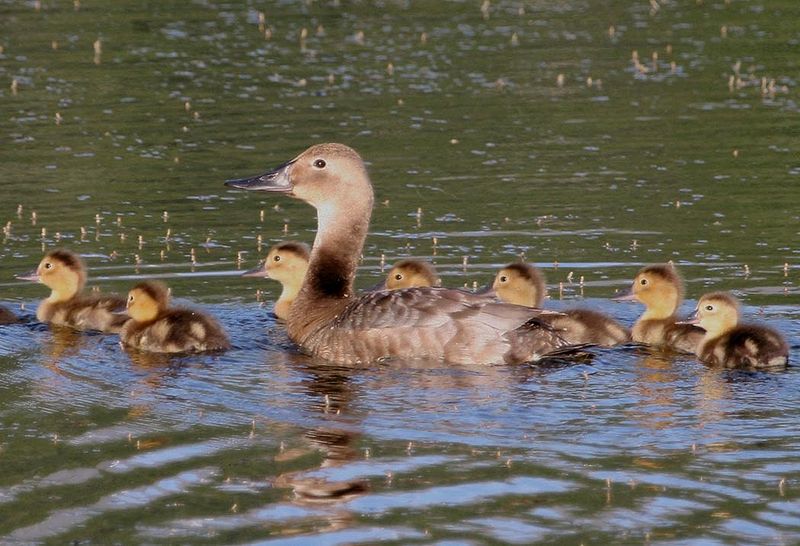
The Canvas-Back Duck is now the Canvasback (Aythya valisineria). Wikipedia (with editing) says The Canvasback is the largest of the North American diving ducks, that ranges from between 19–22 in (48–56 centimetres) long and weighs approximately 1.90–3.50 lbs (862–1,588 gram), with a wingspan of 31–35 in (79–89 centimetres). The canvasback has a distinctive wedge-shaped head and long graceful neck. The adult male (drake) has a black bill, a chestnut red head and neck, a black breast, a grayish back, black rump, and a blackish brown tail. The drake’s sides, back, and belly are white with fine vermiculation resembling the weave of a canvas, which gave rise to the bird’s common name. The bill is blackish and the legs and feet are bluish-gray. The iris is bright red in the spring, but duller in the winter. The adult female (hen) also has a black bill, a light brown head and neck, grading into a darker brown chest and foreback. The sides, flanks, and back are grayish brown. The bill is blackish and the legs and feet are bluish-gray. Its sloping profile distinguishes it from other ducks.
The breeding habitat of the Canvasback is in North America prairie potholes. The bulky nest is built from vegetation in a marsh and lined with down. Loss of nesting habitat has caused populations to decline. (That and apparently the killing of them per the article.) It prefers to nest over water on permanent prairie marshes surrounded by emergent vegetation, such as cattail and bulrushes, which provide protective cover. Other important breeding areas are the subarctic river deltas in Saskatchewan and the interior of Alaska.
It has a clutch size of approximately 5-11 eggs that are a greenish drab. The chicks are covered in down at hatching and able to leave the nest soon after. The Canvasback sometimes lays its eggs in other Canvasback nests and Redheads often parasitize Canvasback nests.
In the early 1950s it was estimated that there were 225,000 Canvasbacks wintering in the Chesapeake Bay; this represented one-half of the entire North American population. By 1985, there were only 50,000 ducks wintering there, or one-tenth of the population. Canvasbacks were extensively hunted around the turn of the 19th to 20th century, but federal hunting regulations restrict their harvest, so hunting was ruled out as a cause for the decline. Scientists have now concluded that the decline in duck populations was due to the decline in submerged aquatic vegetation acreage. Today the population has stabilized and is even increasing slightly, although it is nowhere near previous levels.
The above article is the first article in the monthly serial that was started in January 1897 “designed to promote Knowledge of Bird-Live.” These include Color Photography, as they call them, today they are drawings. There are at least three Volumes that have been digitized by Project Gutenberg.
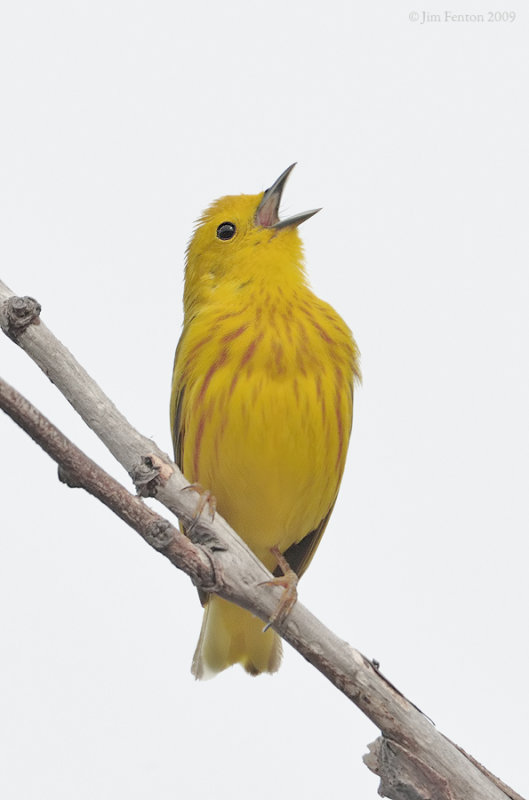
American Yellow Warbler (Dendroica aestiva) by J Fenton
Vol. II. No. 1. JULY, 1897.
BIRD SONG.
T SHOULD not be overlooked by the young observer that if he would learn to recognize at once any particular bird, he should make himself acquainted with the song and call notes of every bird around him. The identification, however, of the many feathered creatures with which we meet in our rambles has heretofore required so much patience, that, though a delight to the enthusiast, few have time to acquire any great intimacy with them. To get this acquaintance with the birds, the observer has need to be prepared to explore perilous places, to climb lofty trees, and to meet with frequent mishaps. To be sure if every veritable secret of their habits is to be pried into, this pursuit will continue to be plied as patiently as it has ever been. The opportunity, however, to secure a satisfactory knowledge of bird song and bird life by a most delightful method has at last come to every one.
A gentleman who has taken a great interest in Birds from the appearance of the first number, but whose acquaintance with living birds is quite limited, visited one of our parks a few days ago, taking with him the latest number of the magazine. His object, he said, was to find there as many of the living forms of the specimens represented as he could. “Seating myself amidst a small grove of trees, what was my delight at seeing a Red Wing alight on a telegraph wire stretching across the park. Examining the picture in Birds I was somewhat disappointed to find that the live specimen was not so brilliantly marked as in the picture. Presently, however, another Blackbird alighted near, who seemed to be the veritable presentment of the photograph. Then it occurred to me that I had seen the Red Wing before, without knowing its name. It kept repeating a rich, juicy note, oncher-la-ree-e! its tail tetering at quick intervals. A few days later I observed a large number of Red Wings near the Hyde Park water works, in the vicinity of which, among the trees and in the marshes, I also saw many other birds unknown to me. With Birds in my hands, I identified the Robin, who ran along the ground quite close to me, anon summoning with his beak the incautious angle worm to the surface. The Jays were noisy and numerous, and I observed many new traits in the Wood Thrush, so like the Robin that I was at first in some doubt about it. I heard very few birds sing that day, most of them being busy in search of food for their young.”
[continued on page 17.]
BIRD SONG—Continued from page 1.
Many of our singing birds may be easily identified by any one who carries in his mind the images which are presented in our remarkable pictures. See the birds at home, as it were, and hear their songs.
Those who fancy that few native birds live in our parks will be surprised to read the following list of them now visible to the eyes of so careful an observer as Mr. J. Chester Lyman.
“About the 20th of May I walked one afternoon in Lincoln Park with a friend whose early study had made him familiar with birds generally, and we noted the following varieties:
“On a similar walk, one week earlier, we saw about the same number of varieties, including, however, the Yellow Breasted Chat, and the Mourning, Bay Breasted, and Blue Yellow Backed Warblers.”
The sweetest songsters are easily accessible, and all may enjoy their presence.
C. C. Marble.
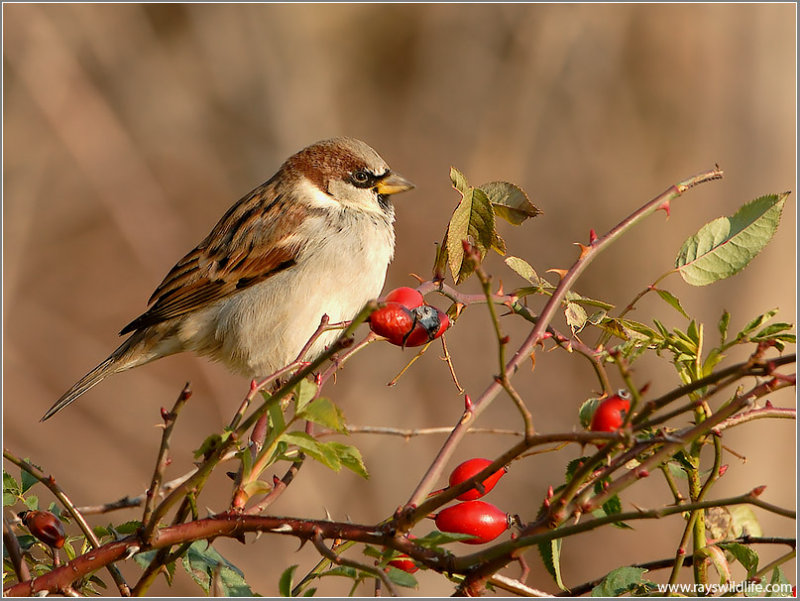
House Sparrow by Ray
Lee’s Addition:
You make springs gush forth in the valleys; they flow between the hills; they give drink to every beast of the field; the wild donkeys quench their thirst. Beside them the birds of the heavens dwell; they sing among the branches. (Psalms 104:10-12 ESV)
I added links toxeno-canto.org for the sound of the birds on the list. It took awhile to figure out what some of the birds are called today. I am sure some are incorrect, but did my best. I used the “song” recordings where available and a few of the “call” ones where either the birds don’t sing or no recording is available.
They each have a distinct sound even as an instrument does.
Even things without life, whether flute or harp, when they make a sound, unless they make a distinction in the sounds, how will it be known what is piped or played? For if the trumpet makes an uncertain sound, who will prepare for battle? (1 Corinthians 14:7-8 NKJV)
If the birds changed songs all the time, how would they find mates, defend their territory, or know the sound of an enemy? Isn’t the Lord gracious in the way He designed the birds to sing so uniquely.
Listening to them was actually quite enjoyable. They each have their own way of communicating to their fellow birds and/or enemies.
The above article is the first article in the monthly serial that was started in January 1897 “designed to promote Knowledge of Bird-Live.” These include Color Photography, as they call them, today they are drawings. There are at least three Volumes that have been digitized by Project Gutenberg.
Hey Kids,
Welcome to the colorful world of Bird.
I know you guys and gals love birds
and that too colorful birds..
But, I wonder how many really know
why God gave colorful gapes for chicks?
May be some of you would love to know the reason, right?
Here we go… Check this out..
The mother bird understands
whether her chicks need food or not
from the colors of their gapes.
Similarly, the chick recognises its mother in this way
and understands that the food has arrived.
As seen in these examples in nature,
living beings need to know the meaning of colors
in order to survive.
They also need to possess proper systems of perception..
As kids you too should know the meaning of colors..
Whenever you see RED,
think of the blood that Jesus shed for you and me
on the cross of Calvary..
Whenever you see WHITE,
Think of the Holy Spirit who is willing
to intercede for us..
Whenever you see YELLOW,
think of the golden lanes of heaven,
where you and I would walk with our Lord Jesus…
When you see ORANGE,
think of the eternal fire in hell,
that would consume all sinner..
Though ye have lien among the pots, yet shall ye be as the wings of a dove covered with silver, and her feathers with yellow gold (Psalm 68:13)












 Lee's Birdwatching Adventures Plus