“A” is for Accipiter and Alcid: “A” Birds, Part 2
Dr. James J. S. Johnson
There is a way that seems right to a man, but its end is the way of death. (Proverbs 14:12)
(Patience! The relevance of this verse will be noted near the end of this article.)
As noted in Part 1 (of the “A” Birds review), “A” is for Avocets, Albatrosses, Accipiters, and Alcids (including Auklets and the Atlantic Puffin), — plus Antbirds and a few other birds omitted here. This study now continues (after having reviewed Avocets and Albatrosses) with 2 categories of birds that start with the letter “A”, Accipiters and Alcids.
SHARP-SHINNED HAWK (Accipiter striatus)
What are some of the accipiters hawks, also called “bird hawks”?
One example of an accipiter is the Northern Goshawk (Accipiter gentilis), depicted below.
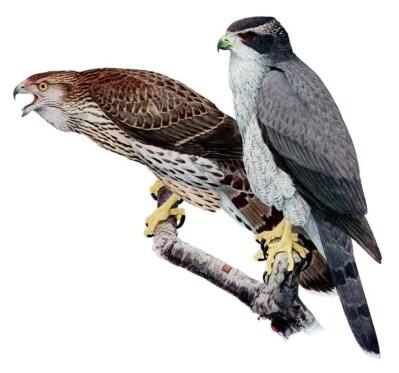
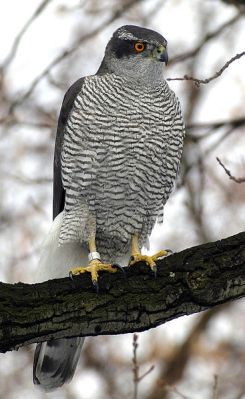
Northern Goshawk (Accipiter gentilis) ©WikiC
[Northern Goshawk: juvenile (brown) & adults (grey)]
“Accipiter” is an avian category term used for grouping similar bird-eating hawks, the so-called “bird hawks” (many of these slim raptors are known as sparrow-hawks or goshawks), such as Northern Goshawk (Accipiter gentilis), Cooper’s Hawk (Accipiter cooperii), and Sharp-shinned Hawk (Accipiter striatus).
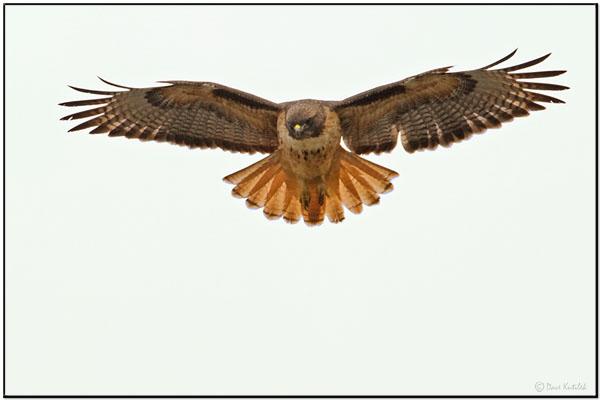
Regarding accipiter hawks, the eminent ornithologist Roger Tory Peterson says: “Long-tailed woodland raptors with rounded wings [and long tails, which they use a rudders for steering quick turns], adapted [i.e., designed by God] for hunting among the trees. Typical flight consists of several quick beats and a glide … [chiefly eating] birds, [plus] some small mammals.” [Quoting Roger Tory Peterson, A Field Guide to Western Birds (Houghton Mifflin, 1990, 3rd edition; maps by Virginia Marie Peterson), page 172.] Regarding the difference between the slim hawks grouped as “accipiters” and the larger high-soaring hawks called “buteos”, see Lee’s “Birds of the Bible: Hawks” .
For specific information about Northern Goshawk (Accipiter gentilis), which appears on the flag of the Azores, see “Flag that Bird! (Part 1)”.
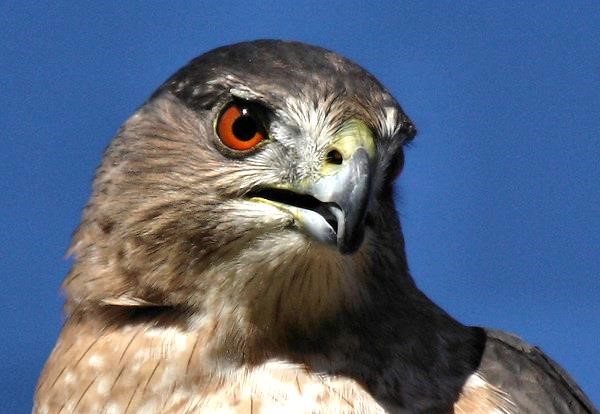
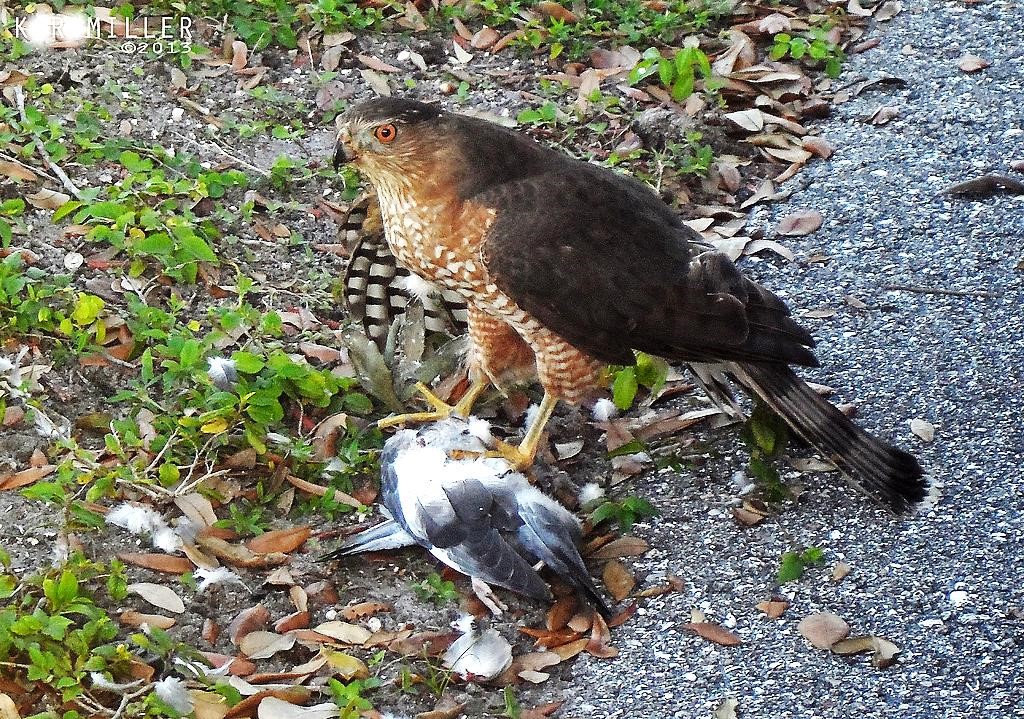
Now for a representative of the accipiter hawks, the Cooper’s Hawk.
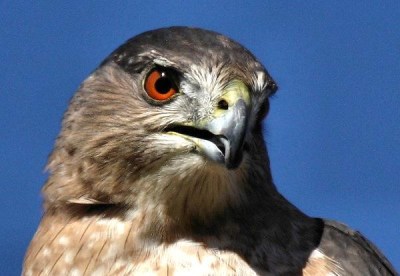
[COOPER’S HAWK (female): “mug shot”]
For another “in-your-face” close-up view of a Cooper’s Hawk, showing the detail of its beak (profile view), see “Cooper’s Hawk” .
As shown in a Terry Sohl range map [which was deleted from this blog, at Terry Sohl’s insistence — because, being an atheist, he hated to see his map being used on a blog that honors God as the Creator], the permanent (i.e., year-round) range of the Cooper’s Hawk covers almost all America’s “lower 48” states, except that accipiter only stays for breeding in the northernmost states (Maine, New Hampshire, Vermont, most of New York, much of Michigan, northern Wisconsin, most of Minnesota, North and South Dakota, Montana, some of northern Wyoming, the Idaho Panhandle, and northern Washington). [NOTE: the above-referenced Terry Sohl range map is not shown here, because Mr. Sohl, as a self-described “hardcore atheist”, does not want his maps associated with a Christian blogsite.]
Cooper’s Hawks are stereotypical “bird hawks” (formerly called “chicken hawks” in some rural areas). These aerial raptors rely upon surprise — mostly hunting, ambushing, snatching, and then eating, small and medium-sized birds, such as picids (woodpeckers, flickers, and sapsuckers), smaller corvids (jays), icterids (blackbirds, grackles, and orioles), galliforms (wildfowl such as quail, domestic chickens, grouse, bobwhites, pheasants, and Mexico’s wood partridges), columbids (doves, including pigeons), cuculids (cuckoos, roadrunners, anis), thrushes, (including robins), warblers, starlings, etc. Supplementing their bird diet, Cooper’s Hawks (especially those in America’s West) are also known to capture and eat small rodents (squirrels, chipmunks, and mice), lagomorphs (rabbits and hares), and even bats.
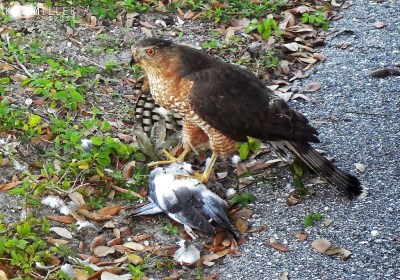
The Cooper’s Hawk (Accipiter cooperii) can live as long as 20 years, although its lifestyle usually shortens that lifespan – chest puncture impact/trauma injuries, occurring during a chase, are observed on carcasses of many of these accipiters.
Disappointingly, despite its noble name, is not named for England’s eminent scholar Dr. Bill Cooper. (Actually, the hawk’s association with the name “Cooper” refers to an American naturalist named William Cooper, who lived in the late AD1700s and early AD1800s – some of his work was used by ornithologists John James Audubon, Charles Lucien Bonaparte, and others). Regardless, it is worth noting, here, that Dr. Bill Cooper does allude to trained “hawks” as they (and pigeons) were used in festive pageantries during the falconry-adorned Dark Ages, when Great Britain suffered being deprived of Scripture accessibility, prior to the Protestant Reformation dawning under the helpful ministries of Dr. John Wycliffe, Lollards, and William Tyndale. [See William R. Cooper’s annotated translation of THE CHRONICLE OF THE EARLY BRITONS: Brut y Bryttaniait, (AD2002), at page 52, posted CLICK HERE
Ironically, Cooper Hawk female adults are larger than their male counterparts. Consequently, Cooper Hawk males demonstrate respect (seen in submissive body language) when approaching females. However, communications are primarily a matter of vocalizations (with the male having a higher-pitched voice!), rather than body language, because the usual habitat of Cooper Hawks is visually crowded by trees and dense vegetation, so body gestures may not be practical for communicating except at short distances.
But now we turn, briefly, to introduce some seabirds called “alcids”.
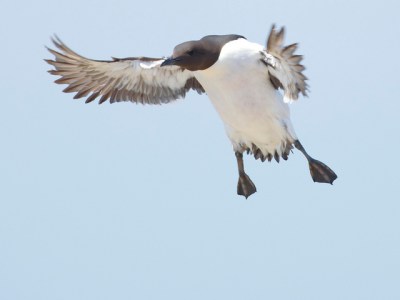
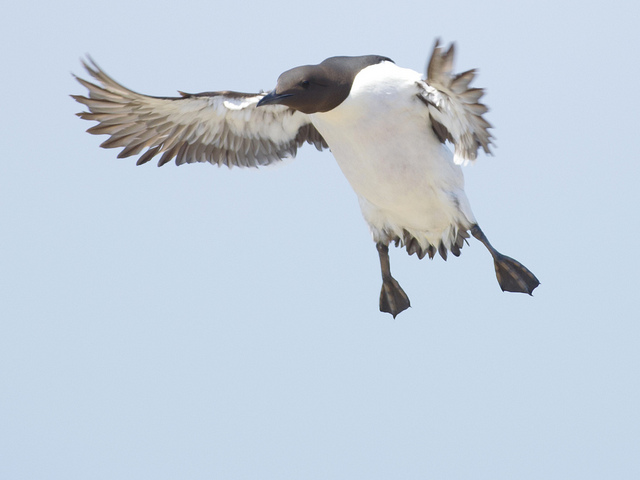
Black Guillemot (Cepphus grylle) ©FLickr Ray Morris
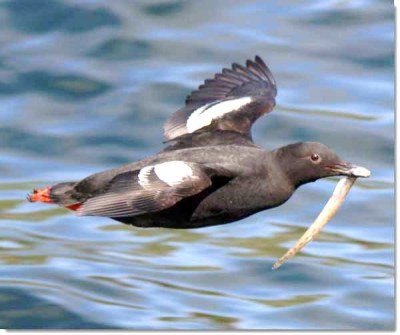
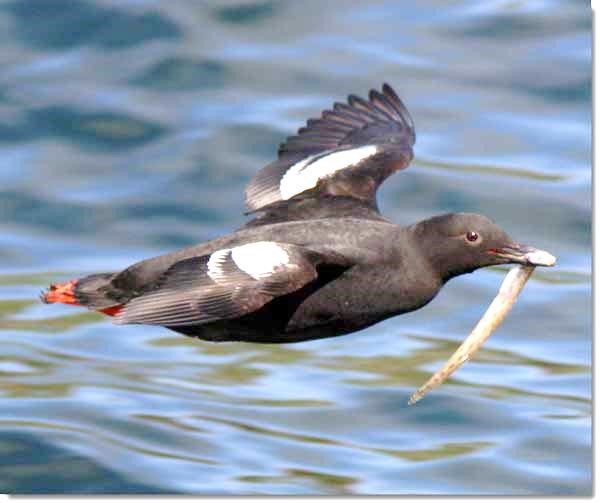
Pigeon Guillemot (Cepphus columba)
[guillemots: approaching beach for landing (T); carrying caught fish (B)]
“Alcid” is an avian category term (previously called “auks”) used to denote another group of similar birds, i.e., the auk-like bird group that includes puffins (like the Atlantic Puffin, Tufted Puffin, and Horned Puffin); auklets (like Least Auklet and Cassin’s Auklet); murres (like Common Murre and Thick-billed Murre); murrelets (like Xantus’s Murrelet, Ancient Murrelet, Marbled Murrelet, and Guadalupe Murrelet); guillemots (like Common Guillemot and Black Guillemot); the Razorbill auk (2/3 of whom breed in Iceland); the high-arctic-island-dwelling Little Auk (a/k/a Dovekie), and the now-extinct Great Auk.
Alcids spend much time at sea, hunting seafood (usually small fish, though sometimes shrimp or other miniature sea creatures, such as baby squid), but they breed on coastal land (often in the crevices of or atop shoreline cliffs that are not easily accessed by terrestrial predators) in fairly dense breeding colonies. [E.g., for movie footage of a Canadian guillemot colony, to see the video posted CLICK HERE.

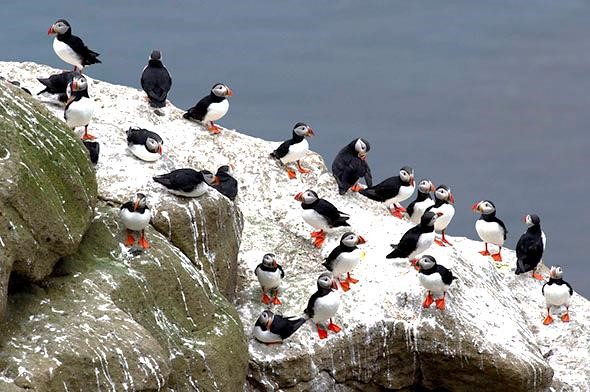
Atlantic Puffin colony on Farne Islands, near England’s Northumberland coast
For a listing of about 2 dozen alcids, with photographs (and some video footage), see Lee’s “Alcidae – Auks”.
Regarding alcids (a/k/a “auks”), the eminent ornithologist Roger Tory Peterson says: “The northern [hemisphere’s] counterparts of the [similarly piscivorous divers, yet much larger] penguins, but auks fly [in the air, as well as underwater], beating their small narrow wings in a whit, often veering. They have short necks and pointed, stubby, or deep and laterally compressed bills. Auks swim and dive expertly. Most [alcid] species nest on sea cliffs in crowded colonies … [habitually eating] fish, crustaceans, [and sometimes a few] mollusks.” [Quoting Roger Tory Peterson, A Field Guide to Western Birds (Houghton Mifflin, 1990, 3rd edition; maps by Virginia Marie Peterson), page 32.]
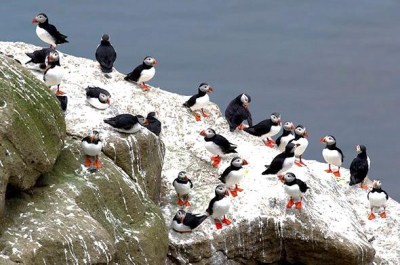
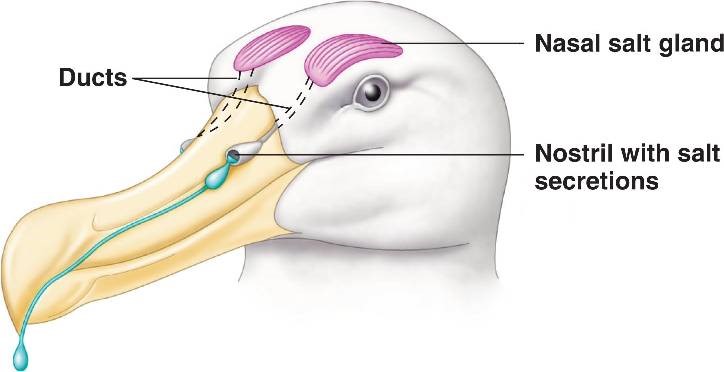
Alcids have mostly black-and-white plumage, so they look superficially like miniature penguins. Alcids have short wings, so their wing-flapping must be quick and intense — in order to succeed is getting and staying aloft. Yet their flying prowess enables their populations to eat, successfully, as they propel their streamlined bodies down through the air, diving into the seawater (with powerful wingbeats propelling and “paddling” them underwater) toward their prey, which usually is some kind of fish (such as herring, sprats, and capelin). These seabirds get their needed water by drinking ocean-water; their highly efficient salt glands (located inside their nostrils) facilitate desalination of ocean-water, supplemented by salt-removing kidney excretions.
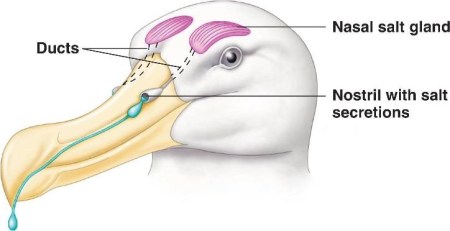
Later, in this article, one alcids will receive special attention, the Atlantic Puffin (Fratercula arctica), who (like other alcids) ranges the North Atlantic’s northern latitudes. (The Xantus’s Murrelet will be featured later, D.v., because birds with names starting with “X” are few and far between!)
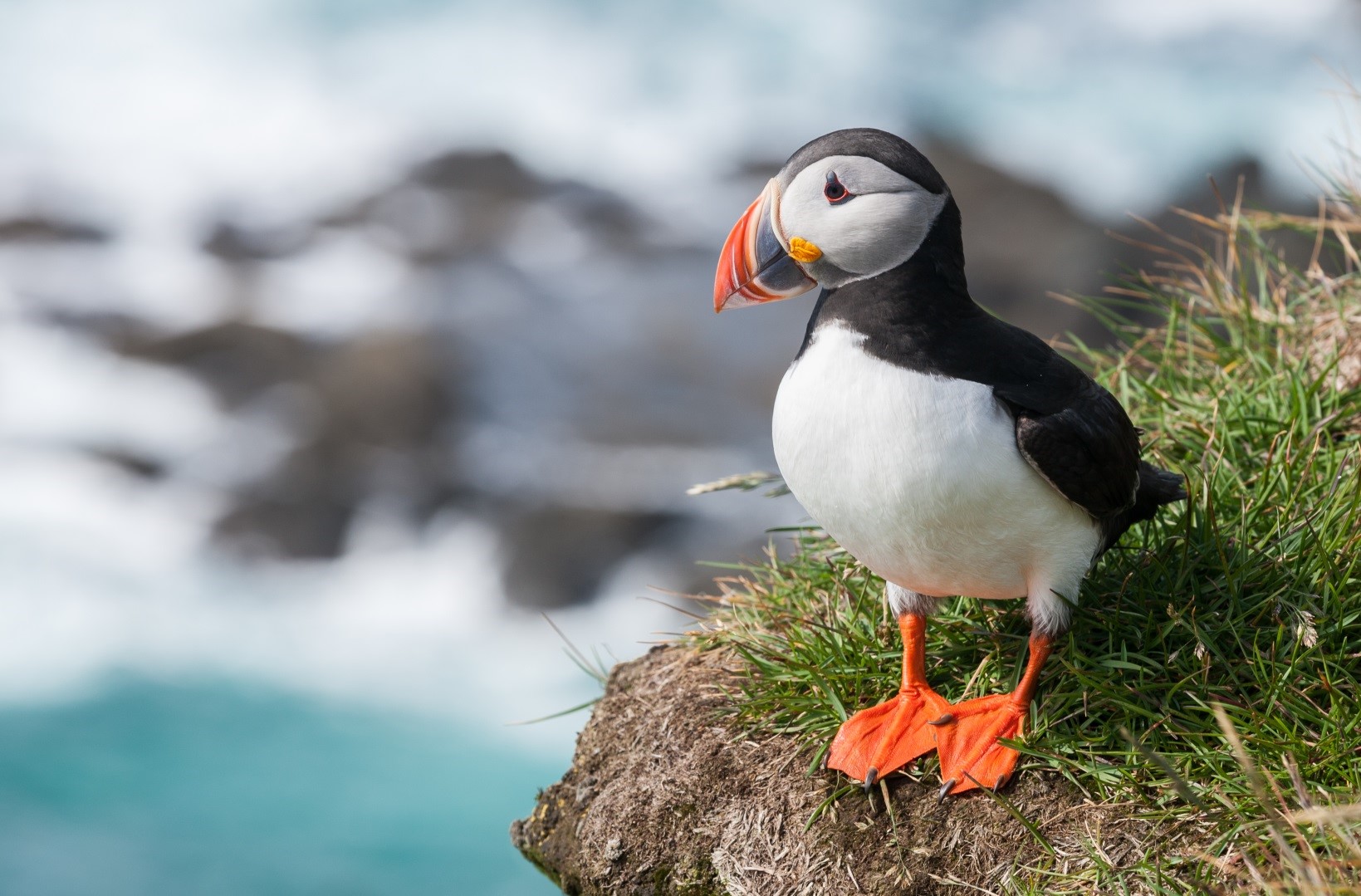
Now for another “A” bird, an alcid of Viking seawaters, Atlantic Puffin.
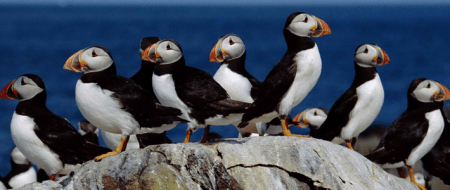
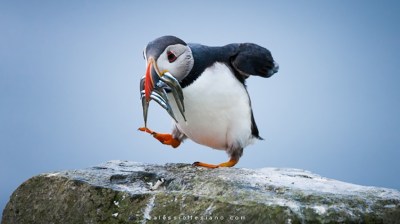
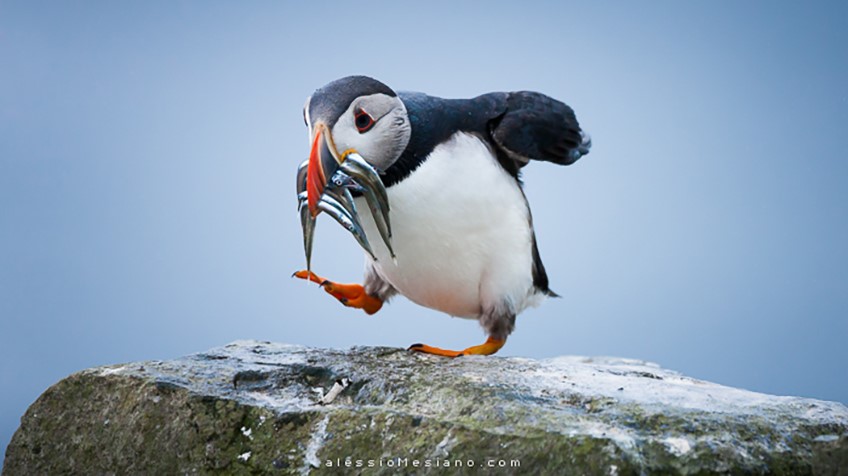
Atlantic Puffins, as “pursuit-divers”, love to eat fish. Puffins thrive on ocean-caught herring, sand-eel, capelin, sprats, and small gadids (such as hake, whiting, and shore rockling), although they actually eat their catch on land. Puffin chicks are mostly fed sand-eels. Yet observations of puffin stomach contents, presumably done when puffins were dead ( J ), show that their fish diets are supplemented by small shellfish, mollusks, and marine annelid worms (a/k/a “bristle worms”), especially if the birds were last eating in coastal seawaters.
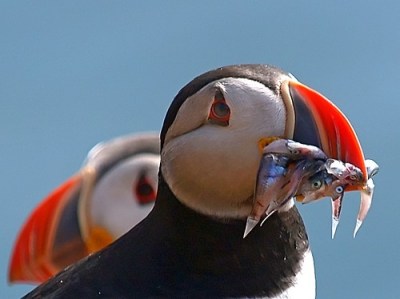
The Atlantic Puffin (Fratercula arctica), as noted above, is one of many Northern Hemisphere alcids. The arctic/subarctic seawaters and coastlands of the northern Pacific Ocean host the Horned Puffin and the Tufted Puffin, but only the Atlantic Puffin is found in the arctic/subarctic waters of the North Atlantic Ocean and its coastlands. The primary range of the Atlantic Puffin is in the waters between and alongside northeastern North America, southern Greenland, Iceland, all of the British Isles, Scandinavian coasts (excluding Baltic Sea coasts), northwestern Russia, Svalbard, and other islands of the Arctic Ocean.
Specifically, the Atlantic Puffin has an extended range that includes the coastlands once visited by Norse Vikings, focusing mostly on the frigid North’s coastlines, yet (due to migration) stretching farther south than most would expect of this alcid, as geographer Mia Bennett insightfully observes:
The Farne Islands, England lie at 55 degrees N. Off the coast of Northumberland, they’re not too far from Newcastle, England and Edinburgh, Scotland. I took a boat trip out to the islands a few weeks ago and saw thousands of puffins. The black and white birds were diving, bobbing, and flying with fish in their beaks.
Puffins are usually associated with the Arctic, so I was surprised to see them in the country I’ve called home for the past ten months. Even though I wasn’t really that far north – still eleven degrees south of the Arctic Circle – the presence of puffins made me feel closer to the Arctic than I have since I was in Trømsø in January.
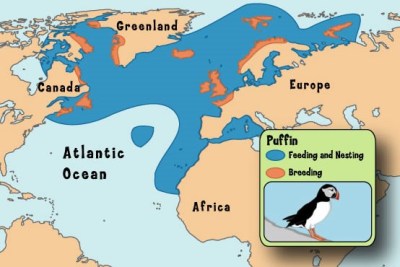
[Atlantic Puffin range map accompanying Mia Bennett’s article]
A map of the global puffin habitat reveals that the species generally breeds in places we call the Arctic, but also places we wouldn’t, namely the British Isles, Normandy and Brittany, and Canada’s Maritime Provinces. Puffins fly as far south as Morocco, providing a link between ecosystems in Africa and the Arctic.
The map of the puffin habitat bears an odd resemblance to that of the Viking raids:
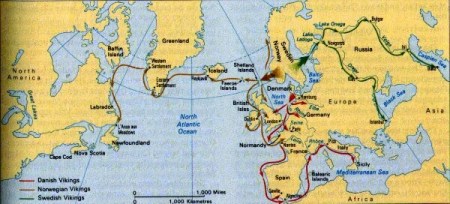
[Viking range map accompanying Mia Bennett’s article]
Visualizing the extent of the puffin habitat and the Viking raids helps us to reconceptualize what the Arctic means and to understand its place in relation to the rest of the world. The region can be defined beyond a strict adherence to lines of latitude like the Arctic Circle. In their own ways, puffins, and the Vikings before them, help link the circumpolar north into more southern-lying lands like Spain and Morocco. The flight of the puffin, which winters south of the Arctic, reminds me of the fish protein commodity chain that begins up in the Lofoten Islands, Norway, where I saw Lithuanian fishermen hanging cod to dry. The protein powder made from ground up fish heads would be sent on to Nigeria – yet another North-South chain, this time to do with goods rather than animals or people.
As for the UK, a lot more connects the country to the Arctic than puffins. Klaus Dodds, a geography professor and Arctic specialist at Royal Holloway, and Duncan Depledge, his doctoral student and a researcher at the Royal United Services Institute for Defence and Security Studies (RUSI), outline what they see as the country’s priorities in a RUSI report. They write, “The UK has a 400-year-old relationship with the Arctic, created and consolidated by exploration, science, security, resources, commerce and the popular imagination.” The near hero-worship of explorers like Robert F. Scott and television shows like BBC’s Frozen Planet attest to the continuing prominence of the Arctic in British popular culture, even if Westminster isn’t paying the High North (or even the north of England, for that matter) too much heed.
[Quoting Mia M. Bennett, “As the Puffin Flies: The U.K. and the Arctic” (emphasis added)] Bennett’s allusion to Captain Robert Scott is a good reminder of the quixotic quandaries (and deadly dangers) that can go with idolizing evolutionists and their animistic “natural selection” mythologies.

How so? Robert Scott and others learned the hard way – the cold reality – that trying to prove the Bible wrong about origins, while trying to backdate “proof” for Darwin’s speculations, paves a miserable path to self-destruction.
“There is a way that seems right to a man, but its end is the way of death.” (Proverbs 14:12)
(See “Penguin Eggs to Die for”.) What a quixotic quest that Antarctic expedition was – futilely trying to prove that Darwin’s “natural selection” theory was right, and that the Holy Bible was wrong. What a tragic folly it was.
Even today there are similar enterprises, albeit less exotic, following fables and materialistic myths (see 1st Timothy 6:20) – rather than embracing the “inconvenient” truth that Genesis reports the facts!
For a recent example, exhibiting editorial resistance to admitting that Darwin’s “natural selection” theory is pseudo-scientific “emperor’s new clothes” sophistry, — compare “Mislabeling Crabs and Creationists”, as published ultra vires in Creation Research Society Quarterly, 52(2):50 (fall 2015) (displaying unauthorized censorship, ironically exemplifying my article’s caveat that some professing creationists have compromised with Darwinian concepts/terminology, and are doing so surreptitiously), — with my authorized version, “Charading Crabs and Creationists”, posted at Bibleworld Adventures, posted at http://bibleworldadventures.com/2015/10/23/mislabeling-crabs-and-creationists/ (10-23-AD2015). Using unfair surprise and the equivalent of editorial forgery, the CRSQ version replaced the critical phrase “natural selection” with “descent-with-modification”, without any advance notice to me, the author (much less getting any pre-publication authorization from me, for that meaning-quashing edit), of CRSQ‘s decision to insert such terminology transmogrification. In essence, the unauthorized editing, in the CRSQ version (that removed my phrase “natural selection” and replaced it by the inapposite term “descent-with-modification”), showcases the very problem of underhanded/undercover defense of “natural selection” sophistry. [For more on this topic, see the comments regarding Dr. Randy Guliuzza within “A Bohemian Goose and Saxon Swan”, posted at https://leesbird.com/2014/12/10/a-bohemian-goose-and-a-saxon-swan/ .]
Now, back to the puffins: why do so many people love to see Atlantic Puffins?

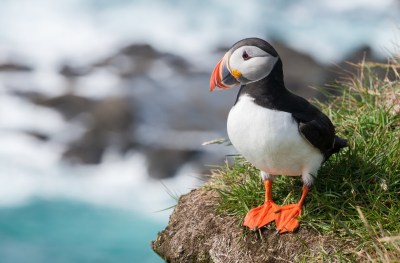
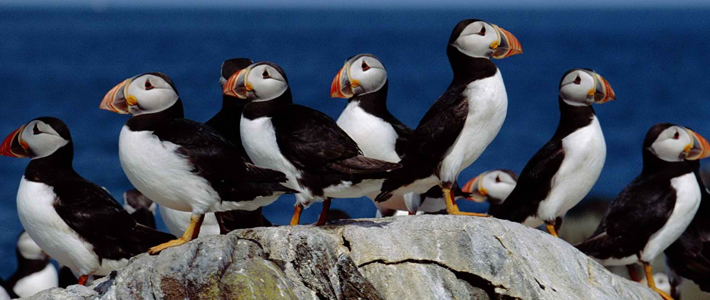
Perhaps because the Atlantic Puffin is one of the most cute and colorful alcids — if not also goofy-looking (in a clownish way) — of the North Atlantic latitudes.
With a face like that, surely the Atlantic Puffin has won many a beauty contest!
Of course, other birds have names that start with “A” – but readers can only read for so long, and this article is already long enough!
Meanwhile, God willing, the next study in this alphabetic series (to be delivered in parts) will be about some “B” birds – such as Bee-eaters, Bittern, Bluebird, Bunting, and Buteos. So stay tuned! ><> JJSJ profjjsj@verizon.net
Birds of the Bible: Hawks
Flag that Bird! (Part 1)
Alcidae – Auks
Penguin Eggs to Die for
*
















 Lee's Birdwatching Adventures Plus