Birds Vol 1 #5 – The Scissor-tailed Flycatcher

Scissor-tailed Flycatcher Birds Illustrated by Color Photography, 1897

Scissor-tailed Flycatcher Birds Illustrated by Color Photography, 1897

Birds Illustrated by Color Photography – Revisited

Vol 1. May, 1897 No. 5

*

THE SCISSOR-TAILED FLYCATCHER.

F for Birds Illustrated by Color Photography

LYCATCHERS are all interesting, and many of them are beautiful, but the Scissor-tailed species of Texas is especially attractive. They are also known as the Swallow-tailed Flycatcher, and more frequently as the “Texan Bird of Paradise.” It is a common summer resident throughout the greater portion of that state and the Indian Territory, and its breeding range extends northward into Southern Kansas. Occasionally it is found in southwestern Missouri, western Arkansas, and Illinois. It is accidental in the New England states, the Northwest Territory, and Canada. It arrives about the middle of March and returns to its winter home in Central America in October. Some of the birds remain in the vicinity of Galveston throughout the year, moving about in small flocks.

There is no denying that the gracefulness of the Scissor-tailed Flycatcher should well entitle him to the admiration of bird-lovers, and he is certain to be noticed wherever he goes. The long outer tail feathers he can open and close at will. His appearance is most pleasing to the eye when fluttering slowly from tree to tree on the rather open prairie, uttering his twittering notes, “Spee-spee.” When chasing each other in play or anger these birds have a harsh note like “Thish-thish,” not altogether agreeable. Extensive timber land is shunned by this Flycatcher, as it prefers more open country, though it is often seen in the edges of woods. It is not often seen on the ground, where its movements are rather awkward. Its amiability and social disposition are observed in the fact that several pairs will breed close to each other in perfect harmony. Birds smaller than itself are rarely molested by it, but it boldly attacks birds of prey. It is a restless bird, constantly on the lookout for passing insects, nearly all of which are caught on the wing and carried to a perch to be eaten. It eats moths, butterflies, beetles, grasshoppers, locusts, cotton worms, and, to some extent, berries. Its usefulness cannot be doubted. According to Major Bendire, these charming creatures seem to be steadily increasing in numbers, being far more common in many parts of Texas, where they are a matter of pride with the people, than they were twenty years ago.

The Scissor-tails begin housekeeping some time after their arrival from Central America, courting and love making occupying much time before the nest is built. They are not hard to please in the selection of a suitable nesting place, almost any tree standing alone being selected rather than a secluded situation. The nest is bulky, commonly resting on an exposed limb, and is made of any material that may be at hand. They nest in oaks, mesquite, honey locust, mulberry, pecan, and magnolia trees, as well as in small thorny shrubs, from five to forty feet from the ground. Rarely molested they become quite tame. Two broods are often raised. The eggs are usually five. They are hatched by the female in twelve days, while the male protects the nest from suspicious intruders. The young are fed entirely on insects and are able to leave the nest in two weeks. The eggs are clear white, with markings of brown, purple, and lavender spots and blotches.
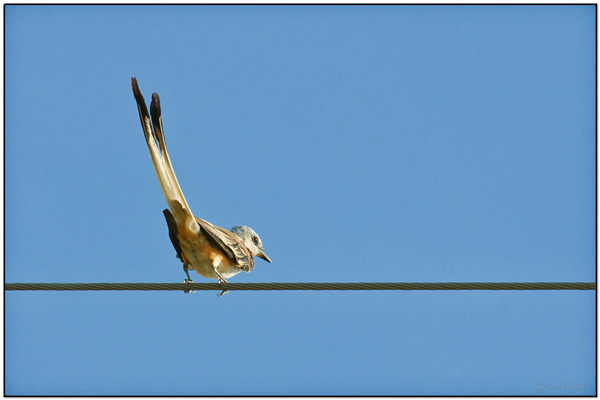
Scissor-tailed Flycatcher (Tyrannus forficatus) by Daves BirdingPix

Scissor-tailed Flycatcher (Tyrannus forficatus) by Daves BirdingPix


Lee’s Addition:

I know all the birds of the mountains, And the wild beasts of the field are Mine. (Psalms 50:11 NKJV)

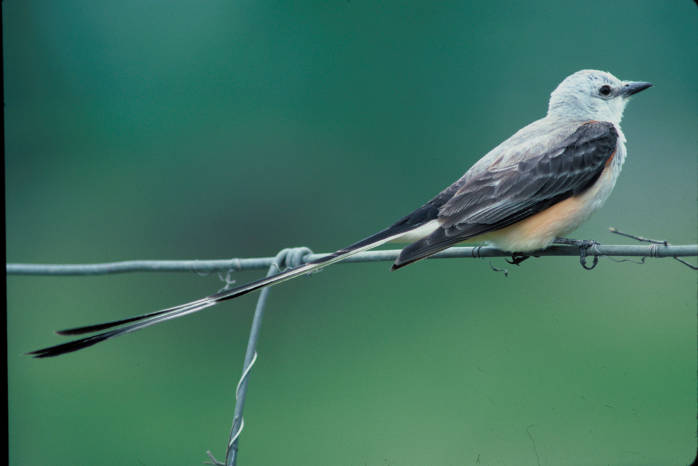
The Lord has given us another beautiful bird to enjoy. The Scissor-tailed Flycatchers are in the Tyrant Flycatchers – Tyrannidae Family. Adult birds have pale gray heads and upper parts, light underparts, salmon-pink flanks, and dark gray wings. Their extremely long, forked tails, which are black on top and white on the underside, are characteristic and unmistakable. At maturity, the bird may be up to 14.5 inches (37 cm) in length. Immature birds are duller in color and have shorter tails. A lot of these birds have been reported to be more than 40 cm.

They build a cup nest in isolated trees or shrubs, sometimes using artificial sites such as telephone poles near towns. The male performs a spectacular aerial display during courtship with his long tail forks streaming out behind him. Both parents feed the young. Like other kingbirds, they are very aggressive in defending their nest. Clutches contain three to six eggs.
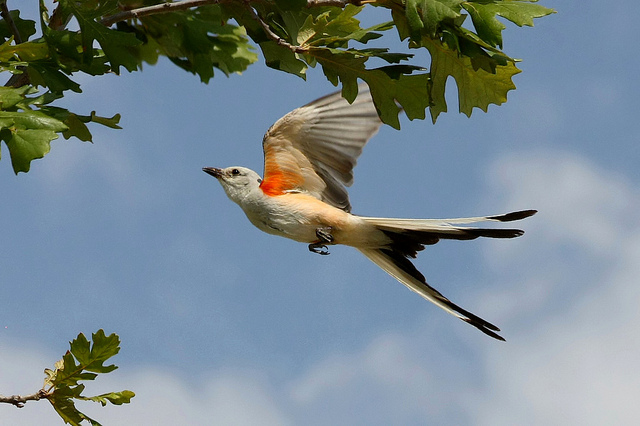
Scissor-tailed Flycatcher (Tyrannus forficatus) ©TexasEagle

Scissor-tailed Flycatcher (Tyrannus forficatus) ©TexasEagle

In the summer, Scissor-tailed flycatchers feed mainly on insects (grasshoppers, robber-flies, and dragonflies), which they may catch by waiting on a perch and then flying out to catch them in flight (hawking). For additional food in the winter they will also eat some berries.

Since the article was written they are increased their range. Their breeding habitat is open shrubby country with scattered trees in the south-central states of Texas, Oklahoma, Kansas; western portions of Louisiana, Arkansas, and Missouri; far eastern New Mexico; and northeastern Mexico. Reported sightings record occasional stray visitors as far north as southern Canada and as far east as Florida and Georgia. They migrate through the Gulf states of Mexico to their winter non-breeding range, from southern Mexico to Panama. Pre-migratory roosts and flocks flying south may contain as many as 1,000 birds.
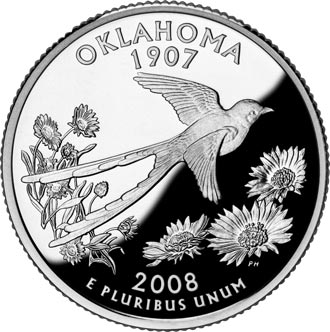
Scissor-tailed Flycatcher - Oklahoma-quarter

Scissor-tailed Flycatcher – Oklahoma-quarter

The scissor-tailed flycatcher is the state bird of Oklahoma, and is displayed in flight with tail feathers spread on the reverse of the Oklahoma Commemorative Quarter.

There are actually four Scissor-tailed named birds in the world:

Scissor-tailed Flycatcher
Scissor-tailed Hummingbird
Scissor-tailed Kite
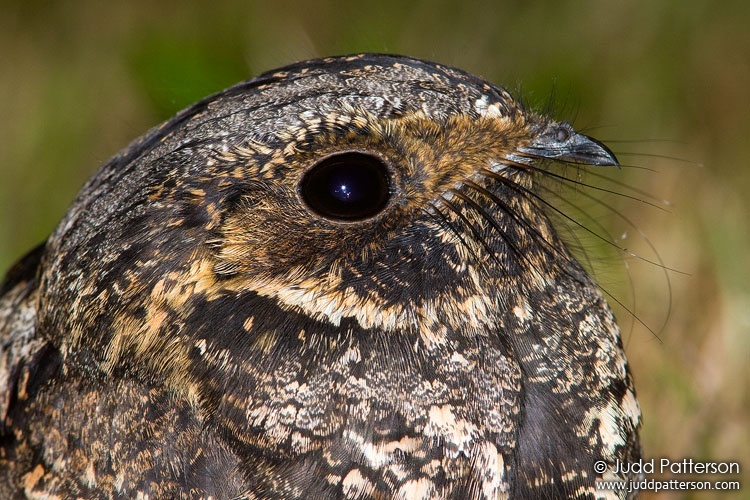
Scissor-tailed Nightjar
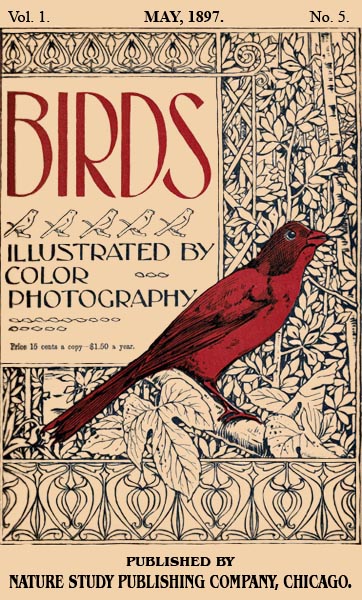
Birds Illustrated by Color Photograhy Vol 1 May, 1897 No 5 - Cover

Birds Illustrated by Color Photograhy Vol 1 May, 1897 No 5 – Cover

Birds Illustrated by Color Photography – Revisited – Introduction

The above article is the first article in the monthly serial that was started in January 1897 “designed to promote Knowledge of Bird-Live.” These include Color Photography, as they call them, today they are drawings. There are at least three Volumes that have been digitized by Project Gutenberg.

To see the whole series of – Birds Illustrated by Color Photography – Revisited

*

(Information from Wikipedia and other internet sources)

Next Article – The Prothonotary Yellow Warblers

Previous Article – The Black-Capped Chickadee

Gospel Message

Links:

Birds of Oklahoma Plus

Scissor-tailed Flycatcher – All About Birds

Scissor-tailed Flycatcher – Wikipedia

Tyrant Flycatchers – Tyrannidae Family

*
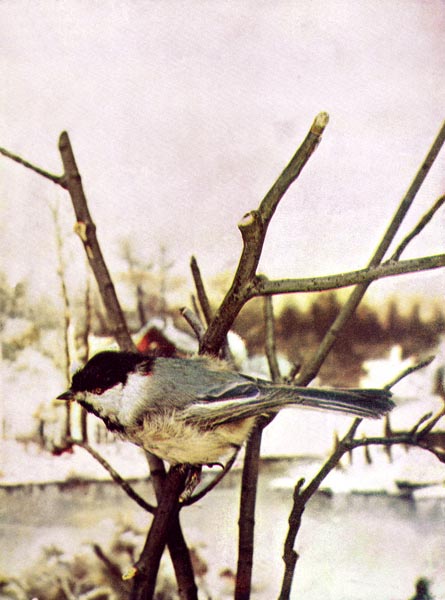
Birds Vol 1 #5 – The Black-capped Chickadee

Chickadee by.Birds Illustrated by Color Photography, 1897

Chickadee by.Birds Illustrated by Color Photography, 1897

Birds Illustrated by Color Photography – Revisited

Vol 1. May, 1897 No. 5

*

CHICKADEE.

Bird of the Merry Heart.Here is a picture of a bird that is always merry. He is a bold, saucy little fellow, too, but we all love him for it. Don’t you think he looks some like the Canada Jay that you saw in April “Birds?” I think most of you must have seen him, for he stays with us all the year, summer and winter. If you ever heard him, you surely noticed how plainly he tells you his name. Listen—“Chick-a-dee-dee; Chick-a-dee; Hear, hear me”—That’s what he says as he hops about from twig to twig in search of insects’ eggs and other bits for food. No matter how bitter the wind or how deep the snow, he is always around—the same jolly, careless little fellow, chirping and twittering his notes of good cheer.

Like the Yellow Warblers, Chickadees like best to make their home in an old stump or hole in a tree—not very high from the ground. Sometimes they dig for themselves a new hole, but this is only when they cannot find one that suits them. The Chickadee is also called Black-capped Titmouse. If you look at his picture you will see his black cap. You’ll have to ask someone why he is called Titmouse. I think Chickadee is the prettier name, don’t you? If you want to get well acquainted with this saucy little bird, you want to watch for him next winter, when most of the birds have gone south. Throw him crumbs of bread and he will soon be so tame as to come right up to the door step.

THE BLACK-CAPPED CHICKADEE.

“Chic-chickadee dee!” I saucily say; My heart it is sound, my throat it is gay! Every one that I meet I merrily greet With a chickadee dee, chickadee dee! To cheer and to cherish, on roadside and street, My cap was made jaunty, my note was made sweet.

Chickadeedee, Chickadeedee! No bird of the winter so merry and free; Yet sad is my heart, though my song one of glee, For my mate ne’er shall hear my chickadeedee.

I “chickadeedee” in forest and glade, “Day, day, day!” to the sweet country maid; From autumn to spring time I utter my song Of chickadeedee all the day long! The silence of winter my note breaks in twain, And I “chickadeedee” in sunshine and rain.

Chickadeedee Chickadeedee! No bird of the winter so merry and free; Yet sad is my heart, though my song one of glee, For my mate ne’er shall hear my chickadeedee.—C. C. M.

imga1

SAUCY little bird, so active and familiar, the Black-Capped Chickadee, is also recognized as the Black Capped Titmouse, Eastern Chickadee, and Northern Chickadee. He is found in the southern half of the eastern United States, north to or beyond forty degrees, west to eastern Texas and Indian Territory. The favorite resorts of the Chickadee are timbered districts, especially in the bottom lands, and where there are red bud trees, in the soft wood of which it excavates with ease a hollow for its nest. It is often wise enough, however, to select a cavity already made, as the deserted hole of the Downy Woodpecker, a knot hole, or a hollow fence rail.

In the winter season it is very familiar, and is seen about door yards and orchards, even in towns, gleaning its food from the kitchen remnants, where the table cloth is shaken, and wherever it may chance to find a kindly hospitality. In an article on “Birds as Protectors of Orchards,” Mr. E. H. Forbush says of the Chickadee: “There is no bird that compares with it in destroying the female canker-worm moths and their eggs.” He calculated that one Chickadee in one day would destroy 5,550 eggs, and in the twenty-five days in which the canker-worm moths run or crawl up the trees 138,750 eggs. Mr. Forbush attracted Chickadees to one orchard by feeding them in winter, and he says that in the following summer it was noticed that while trees in neighboring orchards were seriously damaged by canker-worms, and to a less degree by tent caterpillars, those in the orchard which had been frequented by the Chickadee during the winter and spring were not seriously infested, and that comparatively few of the worms and caterpillars were to be found there. His conclusion is that birds that eat eggs of insects are of the greatest value to the farmer, as they feed almost entirely on injurious insects and their eggs, and are present all winter, where other birds are absent.

The tiny nest of the Chickadee is made of all sorts of soft materials, such as wool, fur, feathers, and hair placed in holes in stumps of trees. Six to eight eggs are laid, which are white, thickly sprinkled with warm brown. Mrs. Osgood Wright tells a pretty incident of the Chickadees, thus: “In the winter of 1891-2, when the cold was severe, the snow deep, and the tree trunks often covered with ice, the Chickadees repaired in flocks daily to the kennel of our old dog Colin and fed from his dish, hopping over his back and calling Chickadee, dee, dee, in his face, a proceeding that he never in the least resented, but seemed rather to enjoy it.”

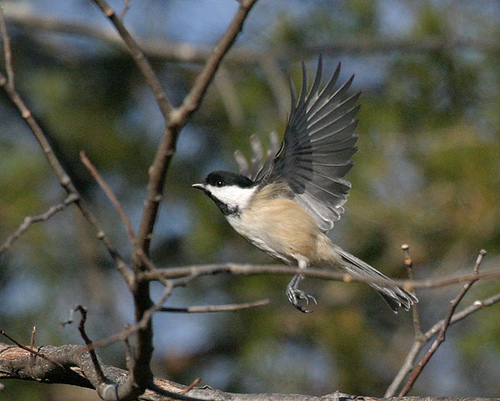
Black-capped Chickadee (Poecile atricapillus) by Kent Nickell

Black-capped Chickadee (Poecile atricapillus) by Kent Nickell


Lee’s Addition:

A merry heart makes a cheerful countenance, But by sorrow of the heart the spirit is broken. The heart of him who has understanding seeks knowledge, But the mouth of fools feeds on foolishness. All the days of the afflicted are evil, But he who is of a merry heart has a continual feast. Better is a little with the fear of the LORD, Than great treasure with trouble. (Proverbs 15:13-16 NKJV)

The Black-capped Chickadee (Poecile atricapillus) is a small, North American songbird, a passerine bird in the Tit, Chickadee – Paridae Family. It is the state bird of both Maine and Massachusetts in the United States, and the provincial bird of New Brunswick in Canada. It is notable for its capacity to lower its body temperature during cold winter nights, its good spatial memory to relocate the caches where it stores food, and its boldness near humans (they can feed from the hand).

On cold winter nights, these birds reduce their body temperature by up to 10–12 °C (from their normal temperature of about 42 °C) to conserve energy.[8] Such a capacity for torpor is rare in birds (or at least, rarely studied). Other bird species capable of torpor include the Common Swift Apus apus, the Common Poor-will Phalaenoptilus nuttallii, the Lesser Nighthawk Chordeiles acutipennis, and various species of hummingbirds.

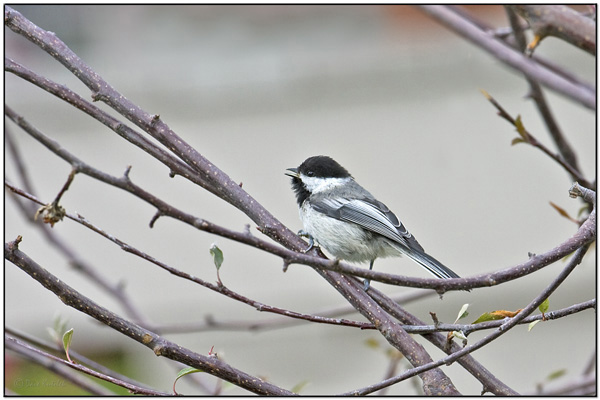
Black-capped Chickadee by Dave's BirdingPix

Black-capped Chickadee by Dave’s BirdingPix

The Black-capped Chickadee has a black cap and bib with white sides to the face. Its underparts are white with rusty brown on the flanks. Its back is gray and the tail is normally slate-gray. This bird has a short dark bill (8.0-9.5 mm), short rounded wings (63.5-67.5 mm) and a long tail (58–63 mm). Total body length is 12–15 cm (4.7–5.9 in), wingspan is 16–21 cm (6.3–8.3 in) and body mass is 9–14 g (0.32–0.49 oz). Sexes look alike, but males are slightly larger and longer than females.

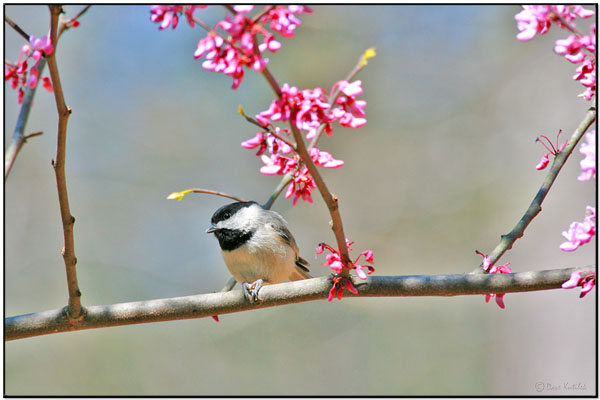
Although range can generally be used to separate them, the Black-capped Chickadee is very similar in appearance to the Carolina Chickadee. The Black-capped is larger on average but this cannot be used reliably for identification. The most obvious difference between the two is in the wing feathers. In the Black-capped Chickadee, the wing feathers have white edges that are larger and more conspicuous than those of the Carolina Chickadee.

Carolina Chickadee (Poecile carolinensis) by Daves BirdingPix

Carolina Chickadee (Poecile carolinensis) by Daves BirdingPix

A merry heart does good, like medicine, But a broken spirit dries the bones. (Proverbs 17:22 NKJV)

*
Birds Illustrated by Color Photograhy Vol 1 May, 1897 No 5 - Cover

Birds Illustrated by Color Photograhy Vol 1 May, 1897 No 5 – Cover

Birds Illustrated by Color Photography – Revisited – Introduction

The above article is the first article in the monthly serial that was started in January 1897 “designed to promote Knowledge of Bird-Live.” These include Color Photography, as they call them, today they are drawings. There are at least three Volumes that have been digitized by Project Gutenberg.

To see the whole series of – Birds Illustrated by Color Photography – Revisited

*

(Information from Wikipedia and other internet sources)

Next Article – The Scissor-Tailed Flycatcher

Previous Article – The Marsh Hawk

Links:

Black-capped Chickadee All About Birds

All About Black-capped Chickadee – Sialis

Black-capped Chickadee – National Geographic

Tit, Chickadee – Paridae Family

Black-capped Chickadee – Wikipedia

*


Start Birdwatching Today: Enjoy The Lord’s Paintbrush – U.S.

Wood Duck by Dan at Lake Hollingsworth

Wood Duck by Dan at Lake Hollingsworth

I trust you are enjoying our “Start Birdwatching Today!” series. We have been trying to motivate you to go out and observe the many birds around you.

Seeing as our subtitle is “Birdwatching from a Christian Perspective,” I want to do a few articles that you won’t see in most birding books. We believe that the world and all that its critters were created by the Lord and not evolved.

For thus says the Lord–Who created the heavens, God Himself, Who formed the earth and made it, Who established it and did not create it to be a worthless waste; He formed it to be inhabited–I am the Lord, and there is no one else. (Isaiah 45:18 AMP)
O LORD, how manifold are Your works! In wisdom You have made them all. The earth is full of Your possessions—
(Psalms 104:24 NKJV)
Have you not known? Have you not heard? The everlasting God, the LORD, The Creator of the ends of the earth, Neither faints nor is weary. His understanding is unsearchable. (Isaiah 40:28 NKJV)

While creating the birds, the Lord has used a fantastic array of colors and designs. I can imagine Him using a fine brush when some of my favorite birds here in America were being dressed for “His pleasure.”

Look at this Blue Jay, seen in most parts of our country or his cousins out west. Can’t you just imagine a painter or artist putting the colors and marks on him?

Blue Jay (Cyanocitta cristata) by Daves BirdingPix

Blue Jay (Cyanocitta cristata) by Daves BirdingPix

His cousin the Green Jay from down in the valley of Texas.

Green Jay (Cyanocorax luxuosus) by S Slayton

Green Jay (Cyanocorax luxuosus) by S Slayton

Or, how about a Painted Bunting that looks like He just took a little dab of this and a little dab of that?

Painted Bunting (Passerina ciris) ©©Flickr

Painted Bunting (Passerina ciris) ©©Flickr

The Northern Flicker

Northern Flicker (Colaptes auratus) Red-shafted ©WikiC

Northern Flicker (Colaptes auratus) Red-shafted ©WikiC

and its cousin the Acorn Woodpecker.

Acorn Woodpecker (Melanerpes formicivorus) (3) by Raymond Barlow

Acorn Woodpecker (Melanerpes formicivorus) (3) by Raymond Barlow

Tiny birds that have iridescent colors like our Hummingbirds just glisten when the light shines on them the right way. Our eastern Ruby-throated Hummingbird

Ruby-throated Hummingbird by Ray's Wildlife

Ruby-throated Hummingbird by Ray’s Wildlife

and the western Magnificent Hummingbird.

Magnificent Hummingbird (Eugenes fulgens) by Judd Patterson

Magnificent Hummingbird (Eugenes fulgens) by Judd Patterson

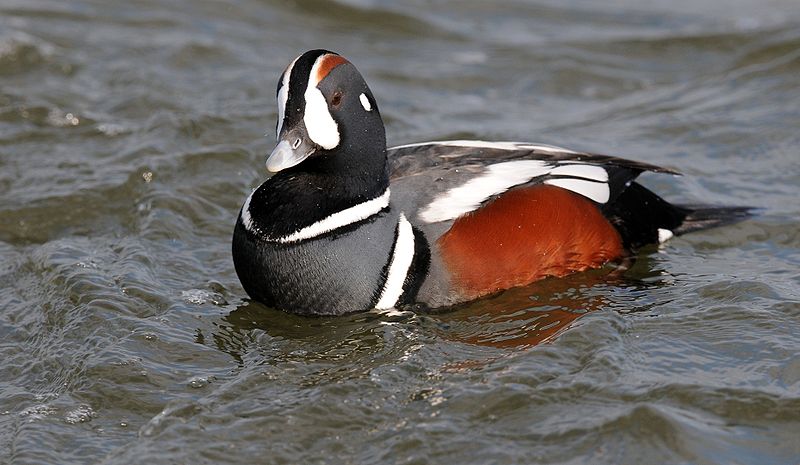
Do you see a designer and a painter at work? My favorite one of all is the Wood Duck at the top. Dan took that at Lake Morton in Lakeland. (It really is a live duck, not a painting.)  Those fine lines are just awesome to me. They actually have a cousin that hangs out more on the western side of America. It is the Harlequin Duck.

Harlequin Duck (Histrionicus histrionicus) ©WikiC

Harlequin Duck (Histrionicus histrionicus) ©WikiC

There are many more that could be shown, but if you”Start Birdwatching Today” they may just pass by for you to take a look. Then thank the Lord for His many blessings to us.

Oh, the depth of the riches both of the wisdom and knowledge of God! How unsearchable are His judgments and His ways past finding out! (Romans 11:33 NKJV)

See the whole “Start Birdwatching Today” series

*

Birds in Hymns – Pleasant Are Thy Courts Above

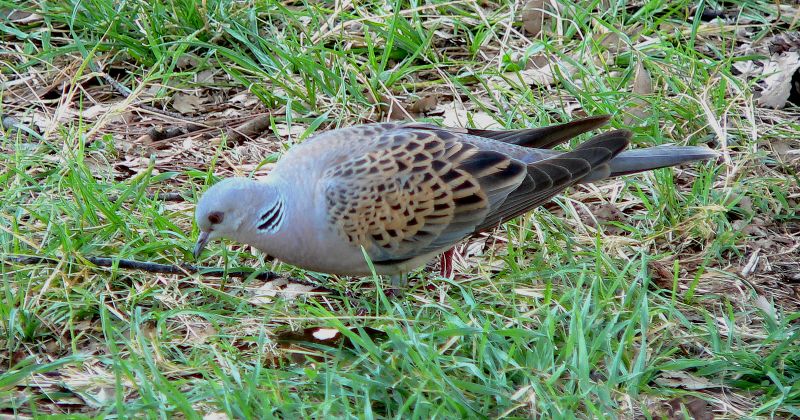
European Turtle Dove (Streptopelia turtur) ©WikiC

European Turtle Dove (Streptopelia turtur) ©WikiC

For a day in thy courts is better than a thousand. I had rather be a doorkeeper in the house of my God, than to dwell in the tents of wickedness. (Psalms 84:10 KJV)

Words – Hen­ry F. Lyte, 1834

Music – Ben­e­ven­to, ar­ranged from Sam­u­el Webbe, Sr.,  (1740-1816), 1792

Al­ter­nate tune:  Maid­stone, Wal­ter B. Gil­bert, 1863


Pleasant Are Thy Courts Above

Ben­e­ven­to

Maid­stone

Pleasant are Thy courts above,
In the land of light and love;
Pleasant are Thy courts below
In this land of sin and woe;
O, my spirit longs and faints
For the converse of Thy saints,
For the brightness of Thy face,
For Thy fullness, God of grace.

Happy birds that sing and fly
Round Thy altars, O most High;
Happier souls that find a rest
In a heavenly Father’s breast;
Like the wandering dove that found
No repose on earth around,
They can to their ark repair,
And enjoy it ever there.

Happy souls, their praises flow
Even in this vale of woe;
Waters in the desert rise,
Manna feeds them from the skies;
On they go from strength to strength,
Till they reach Thy throne at length,
At Thy feet adoring fall,
Who hast led them safe through all.

Lord, be mine this prize to win,
Guide me through a world of sin,
Keep me by Thy saving grace,
Give me at Thy side a place;
Sun and shield alike Thou art,
Guide and guard my erring heart.
Grace and glory flow from Thee;
Shower, O shower them, Lord, on me.

*

Wordless Birds

Song Sparrow (Melospiza melodia) by Ray

Song Sparrow

*

Birds Vol 1 #5 – Marsh Hawk

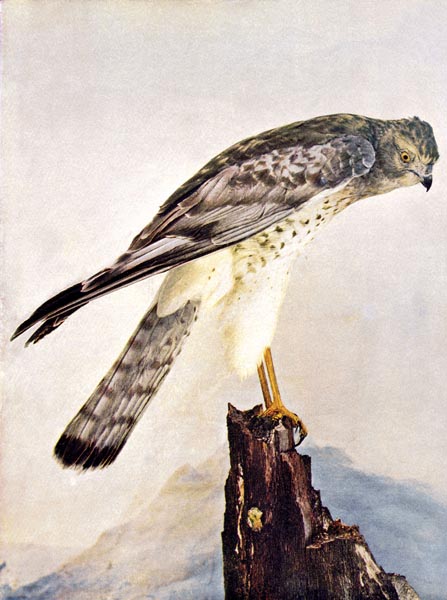
Marsh Hawk for Birds Illustrated by Color Photography, 1897

Marsh Hawk for Birds Illustrated by Color Photography, 1897

Birds Illustrated by Color Photography – Revisited

Vol 1. May, 1897 No. 5

*

THE MARSH HAWK.

imgo

NE of the most widely distributed birds of North America is the Marsh Hawk, according to Wilson, breeding from the fur regions around Hudson’s Bay to Texas, and from Nova Scotia to Oregon and California. Excepting in the Southern portion of the United States, it is abundant everywhere. It makes its appearance in the fur countries about the opening of the rivers, and leaves about the beginning of November. Small birds, mice, fish, worms, and even snakes, constitute its food, without much discrimination. It is very expert in catching small green lizards, animals that can easily evade the quickest vision.

It is very slow on the wing, flies very low, and in a manner different from all others of the hawk family. Flying near the surface of the water, just above the weeds and canes, the Marsh Hawk rounds its untiring circles hour after hour, darting after small birds as they rise from cover. Their never ending flight, graceful as it is, becomes monotonous to the watcher. Pressed by hunger, they attack even wild ducks.

In New Jersey, Pennsylvania, and Delaware, where it sweeps over the low lands, sailing near the earth, in search of a kind of mouse very common in such situations, it is chiefly known as the Mouse Hawk. In the southern rice fields it is useful in preventing to some extent the ravages of the swarms of Bobolinks. It has been stated that one Marsh Hawk was considered by planters equal to several negroes for alarming the rice birds. This Hawk when feeding is readily approached.

The birds nest in low lands near the sea shore, in the barrens, and on the clear table-lands of the Alleghanies, and once a nest was found in a high covered pine barrens of Florida.

The Marsh Hawks always keep together after pairing, working jointly in building the nest, in sitting upon the eggs, and in feeding the young. The nest is clumsily made of hay, occasionally lined with feathers, pine needles, and small twigs. It is built on the ground, and contains from three to five eggs of a bluish white color, usually more or less marked with purplish brown blotches. Early May is their breeding time.

It will be observed that even the Hawk, rapacious as he undoubtedly is, is a useful bird. Sent for the purpose of keeping the small birds in bounds, he performs his task well, though it may seem to man harsh and tyranical. The Marsh Hawk is an ornament to our rural scenery, and a pleasing sight as he darts silently past in the shadows of falling night.

Hen (Northern) Harrier (Circus cyaneus) by J Fenton

Hen (Northern) Harrier (Circus cyaneus) by J Fenton


Lee’s Addition:

Is it by your wisdom [Job] that the hawk soars and stretches her wings toward the south [as winter approaches]? (Job 39:26 AMP)

“Hawks are one of our Birds of the Bible and belongs to the Kites, Hawk & Eagles – Accipitridae Family. The Marsh Hawk today is know as the Hen Harrier (Circus cyaneus). Most know it as the Northern Harrier or Marsh Hawk. It migrates to more southerly areas in winter. Eurasian birds move to southern Europe and southern temperate Asia, and American breeders to the southernmost USA, Mexico, and Central America. In the mildest regions, such as France, Great Britain, and the southern US, Hen Harriers may be present all year, but the higher ground is largely deserted in winter.

C. c. hudsonius (Linnaeus, 1766), the Northern Harrier, breeds in North America and is sometimes considered a distinct species C. hudsonius. The male’s plumage is darker grey than that of C. c. cyaneus and the female is also darker and more rufous in colour.” (Wikipedia places it with the Hen Harrier)(*Update*) The IOC 3.1 shows the Hen and Northern Harriers re-split. The Northern Harrier is now Circus hudsonius. Are you confused? So am I.

The Hen Harrier is 43–52 cm (17–20 in) long with a 97–118 cm (38–46 in) wingspan. It resembles other harriers in having distinct male and female plumages. The sexes also differ in weight, with males weighing an average of 350 grams (12 oz) and females an average of 530 grams (19 oz).

Northern Harrier (Circus hudsonius) ©WikiC

Northern Harrier (Circus hudsonius) ©WikiC

*

Birds Illustrated by Color Photograhy Vol 1 May, 1897 No 5 - Cover

Birds Illustrated by Color Photograhy Vol 1 May, 1897 No 5 – Cover

Birds Illustrated by Color Photography – Revisited – Introduction

The above article is the first article in the monthly serial that was started in January 1897 “designed to promote Knowledge of Bird-Live.” These include Color Photography, as they call them, today they are drawings. There are at least three Volumes that have been digitized by Project Gutenberg.

To see the whole series of – Birds Illustrated by Color Photography – Revisited

*

(Information from Wikipedia and other internet sources)

Next Article – The Black-Capped Chickadee

Previous Article – The Orchard Oriole

Links:

Northern Harrier – All About Birds

Hen Harrier – Wikipedia

*


Birds Vol 1 #5 – Orchard Oriole

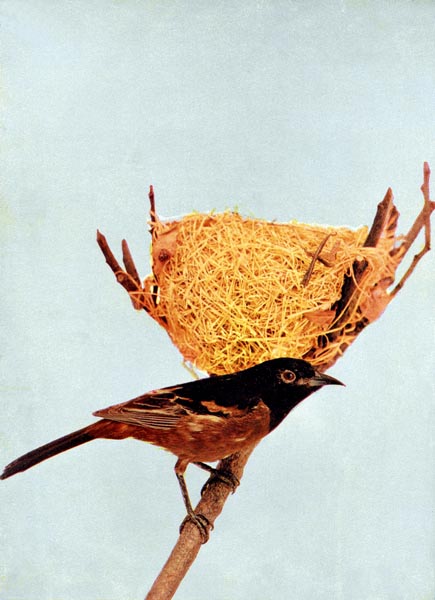
Orchard Oriole by Birds Illustrated by Color Photography, 1897

Orchard Oriole by Birds Illustrated by Color Photography, 1897

Birds Illustrated by Color Photography – Revisited

Vol 1. May, 1897 No. 5

*

THE ORCHARD ORIOLE

The Orchard Oriole is here.
Why has he come? To cheer, to cheer—C. C. M.

imgt

HE Orchard Oriole has a general range throughout the United States, spending the winter in Central America. It breeds only in the eastern and central parts of the United States. In Florida it is a summer resident, and is found in greatest abundance in the states bordering the Mississippi Valley. This Oriole appears on our southern border about the first of April, moving leisurely northward to its breeding grounds for a month or six weeks, according to the season, the males preceding the females several days.

Though a fine bird, and attractive in his manners and attire, he is not so interesting or brilliant as his cousin, the Baltimore Oriole. He is restless and impulsive, but of a pleasant disposition, on good terms with his neighbors, and somewhat shy and difficult to observe closely, as he conceals himself in the densest foliage while at rest, or flies quickly about from twig to twig in search of insects, which, during the summer months, are his exclusive diet.

The favorite haunts of this very agreeable songster, as his name implies, are orchards, and when the apple and pear trees are in bloom, and the trees begin to put out their leaves, his notes have an ecstatic character quite the reverse of the mournful lament of the Baltimore species. Some writers speak of his song as confused, but others say this attribute does not apply to his tones, the musician detecting anything but confusion in the rapidity and distinctness of his gushing notes. These may be too quick for the listener to follow, but there is harmony in them.

In the Central States hardly an orchard or a garden of any size can be found without these birds. They prefer to build their nests in apple trees. The nest is different, but quite as curiously made as that of the Baltimore. It is suspended from a small twig, often at the very extremity of the branches. The outer part of the nest is usually formed of long, tough grass, woven through with as much neatness and in as intricate a manner as if sewed with a needle. The nests are round, open at the top, about four inches broad and three deep.

It is admitted that few birds do more good and less harm than our Orchard Oriole, especially to the fruit grower. Most of his food consists of small beetles, plant lice, flies, hairless caterpillars, cabbage worms, grasshoppers, rose bugs, and larvæ of all kinds, while the few berries it may help itself to during the short time they last are many times paid for by the great number of insect pests destroyed, making it worthy the fullest protection.

The Orchard Oriole is very social, especially with the king bird. Most of his time is spent in trees. His flight is easy, swift, and graceful. The female lays from four to six eggs, one each day. She alone sits on the eggs, the male feeding her at intervals. Both parents are devoted to their young.

The fall migration begins in the latter part of July or the beginning of August, comparatively few remaining till September.

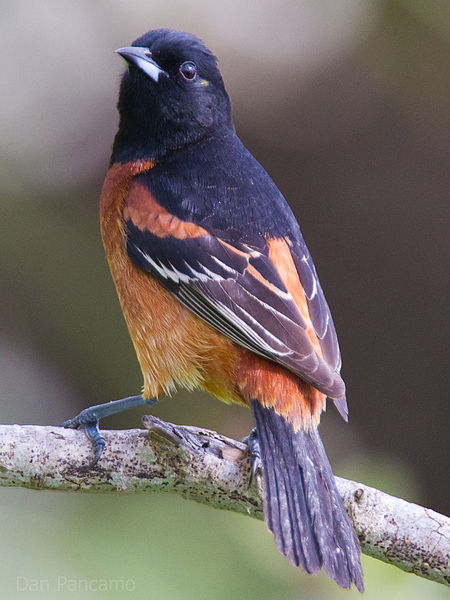
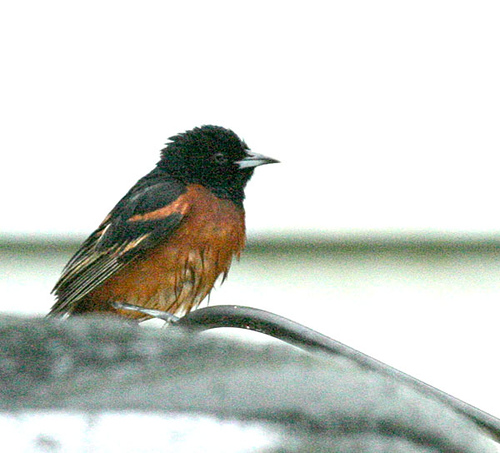
Orchard Oriole (Icterus spurius) ©WikiC

Orchard Oriole (Icterus spurius) ©WikiC


Lee’s Addition:

Its leaves were fair and its fruit abundant, and in it was food for all. The living creatures of the field found shade under it, and the birds of the sky dwelt in its branches; and all flesh was fed from it. (Daniel 4:12 AMP)

The Orchard Oriole is in the Icteridae – Oropendolas, Orioles & Blackbirds Family. It  is the smallest North American species of icterid blackbird. The subspecies of the Caribbean coast of Mexico, I. s. fuertesi, is sometimes considered a separate species, the Ochre Oriole.

This species is 6.3 inches (16 cm) long and weighs 20 g. The bill is pointed and black with some blue-gray at the base of the lower mandible (Howell and Webb 1995). The adult male of the nominate subspecies has chestnut on the underparts, shoulder, and rump, with the rest of the plumage black. In the subspecies I. s. fuertesi, the chestnut is replaced with ochre (Howell and Webb 1995). The adult female and the juvenile of both subspecies have olive-green on the upper parts and yellowish on the breast and belly. All adults have pointed bills and white wing bars. (Orchard Orioles are considered to be adults after their second year.) One-year-old males are yellow-greenish with a black bib.

Orchard Oriole (Icterus spurius) m by Kent Nickell

Orchard Oriole (Icterus spurius) m by Kent Nickell

Orchard Oriole sound from xeno-canto.org

Birds Illustrated by Color Photograhy Vol 1 May, 1897 No 5 - Cover

Birds Illustrated by Color Photograhy Vol 1 May, 1897 No 5 – Cover

Birds Illustrated by Color Photography – Revisited – Introduction

The above article is the first article in the monthly serial that was started in January 1897 “designed to promote Knowledge of Bird-Live.” These include Color Photography, as they call them, today they are drawings. There are at least three Volumes that have been digitized by Project Gutenberg.

To see the whole series of – Birds Illustrated by Color Photography – Revisited

*

(Information from Wikipedia and other internet sources)

Next Article – The Marsh Hawk

Previous Article – The Screech Owl

Sharing The Gospel

Links:

Icteridae – Oropendolas, Orioles & Blackbirds Family

Orchard Oriole – All About Birds

Orchard Oriole – Wikipedia

Orchard Oriole – National Geographic

*


Feedback: Dinosaurs Living with People—The Biblical Worldview – Answers in Genesis

Dinosaur Fossil from OCR.org

I love this statement that they started their answer with in the excerpt they had in their Answers Weekly Newsletter.

Since the Bible is the Word of God, and since God cannot lie, then the Bible is trustworthy. That is our starting point.

That is exactly how I feel about what is written by me here on this blog. I start with knowing that God’s Word is truth and that all these birds that were created for our enjoyment, were Created By God, Not Made in China or Made in the USA, but Made By God.

Anyway, the following article excerpt came from Feedback. It has to do with Dinosaurs living with humans.

Q: Why do we believe dinosaurs lived with people?

A: Since the Bible is the Word of God, and since God cannot lie, then the Bible is trustworthy. That is our starting point. We are told that land animals were created on Day Six, and this would include dinosaurs. Since Day Six is also when man was created, we certainly believe dinosaurs lived at the same time as man.

How do you explain the various petroglyphs of dinosaurs found around the world? How do you explain the fact that so many dragon legends from around the world describe creatures that match what we know about dinosaurs from their fossils? How do you explain the biblical account that seems to describe something like a brachiosaurus, called behemoth in Job 40:15–24?

Feedback: Dinosaurs Living with People—The Biblical Worldview – Answers in Genesis.

To read the whole article CLICK HERE

*

Birds Vol 1 #5 – Screech Owl

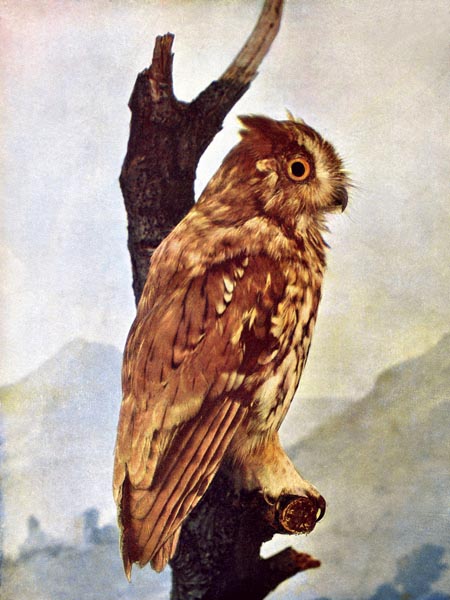
Screech Owl for Birds Illustrated by Color Photography, 1897

Screech Owl for Birds Illustrated by Color Photography, 1897

Birds Illustrated by Color Photography – Revisited

Vol 1. May, 1897 No. 5

*

THE MOTTLED OR “SCREECH” OWL.

imgn

IGHT WANDERER,” as this species of Owl has been appropriately called, appears to be peculiar to America. They are quite scarce in the south, but above the Falls of the Ohio they increase in number, and are numerous in Virginia, Maryland, and all the eastern districts. Its flight, like that of all the owl family, is smooth and noiseless. He may be sometimes seen above the topmost branches of the highest trees in pursuit of large beetles, and at other times he sails low and swiftly over the fields or through the woods, in search of small birds, field mice, moles, or wood rats, on which he chiefly subsists.

The Screech Owl’s nest is built in the bottom of a hollow trunk of a tree, from six to forty feet from the ground. A few grasses and feathers are put together and four or five eggs are laid, of nearly globular form and pure white color. This species is a native of the northern regions, arriving here about the beginning of cold weather and frequenting the uplands and mountain districts in preference to the lower parts of the country.

In the daytime the Screech Owl sits with his eyelids half closed, or slowly and alternately opening and shutting, as if suffering from the glare of day; but no sooner is the sun set than his whole appearance changes; he becomes lively and animated, his full and globular eyes shine like those of a cat, and he often lowers his head like a cock when preparing to fight, moving it from side to side, and also vertically, as if watching you sharply. In flying, it shifts from place to place “with the silence of a spirit,” the plumage of its wings being so extremely fine and soft as to occasion little or no vibration of the air.

The Owl swallows its food hastily, in large mouthfuls. When the retreat of a Screech Owl, generally a hollow tree or an evergreen in a retired situation, is discovered by the Blue Jay and some other birds, an alarm is instantly raised, and the feathered neighbors soon collect and by insults and noisy demonstration compel his owlship to seek a lodging elsewhere. It is surmised that this may account for the circumstance of sometimes finding them abroad during the day on fences and other exposed places.

Both red and gray young are often found in the same nest, while the parents may be both red or both gray, the male red and the female gray, or vice versa.

The vast numbers of mice, beetles, and vermin which they destroy render the owl a public benefactor, much as he has been spoken against for gratifying his appetite for small birds. It would be as reasonable to criticise men for indulging in the finer foods provided for us by the Creator. They have been everywhere hunted down without mercy or justice.

During the night the Screech Owl utters a very peculiar wailing cry, not unlike the whining of a puppy, intermingled with gutteral notes. The doleful sounds are in great contrast with the lively and excited air of the bird as he utters them. The hooting sound, so fruitful of “shudders” in childhood, haunts the memory of many an adult whose earlier years, like those of the writer, were passed amidst rural scenery.

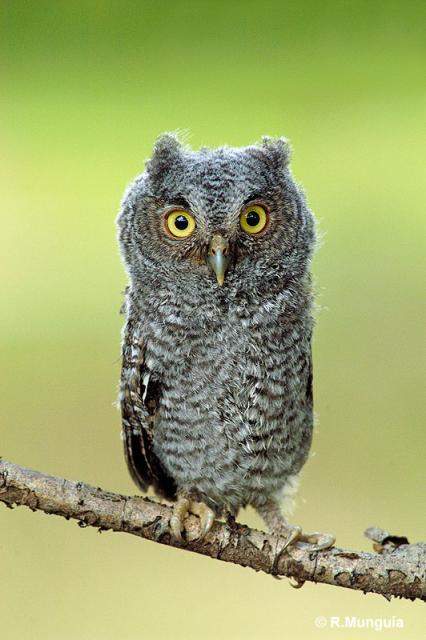
Eastern Screech Owl (Megascops asio) baby Reinier Munguia

Eastern Screech Owl (Megascops asio) baby Reinier Munguia


THE SCREECH OWL.

I wouldn’t let them put my picture last in the book as they did my cousin’s picture in March “Birds.” I told them I would screech if they did.

You don’t see me as often as you do the Blue-bird, Robin, Thrush and most other birds, but it is because you don’t look for me. Like all other owls I keep quiet during the day, but when night comes on, then my day begins. I would just as soon do as the other birds—be busy during the day and sleep during the night—but really I can’t. The sun is too bright for my eyes and at night I can see very well. You must have your folks tell you why this is.

I like to make my nest in a hollow orchard tree, or in a thick evergreen. Sometimes I make it in a hay loft. Boys and girls who live in the country know what a hay loft is.

People who know me like to have me around, for I catch a good many mice, and rats that kill small chickens. All night long I fly about so quietly that you could not hear me. I search woods, fields, meadows, orchards, and even around houses and barns to get food for my baby owls and their mamma. Baby owls are queer children. They never get enough to eat, it seems. They are quiet all day, but just as soon as the sun sets and twilight gathers, you should see what a wide awake family a nest full of hungry little screech owls can be.

Did you ever hear your mamma say when she couldn’t get baby to sleep at night, that he is like a little owl? You know now what she means. I think I hear my little folks calling for me so I’ll be off. Good night to you, and good morning for me.

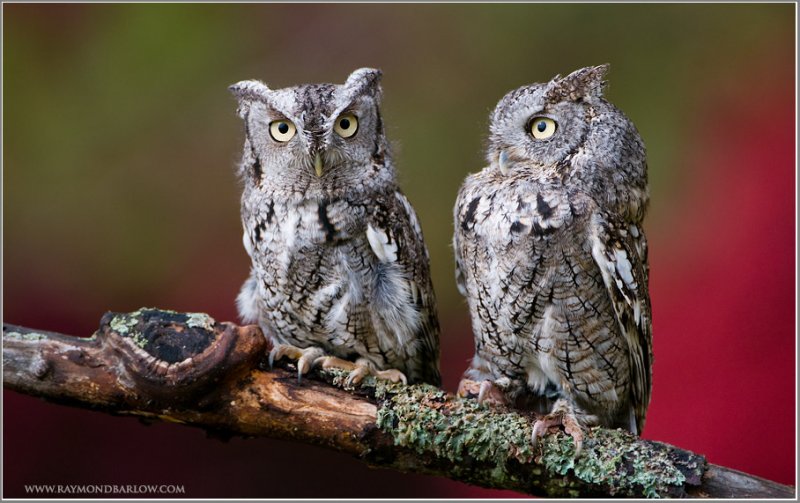
Eastern Screech Owl (Megascops asio) (captive) by Raymond Barlow

Eastern Screech Owl (Megascops asio) (captive) by Raymond Barlow


Lee’s Addition:

Owls belong to the Strigidae – Owls Family which has 207 members. Like most Owls, the females are larger than the males and both are small and agile. They stand about 7-10 in. tall and wings are 18-24 inches across. “They have prominent, wide-set feather tufts with bright yellow eyes. They have different brownish hues with whitish, patterned underside. This coloration helps them get camouflage against the tree bark. They have well-developed raptorial claws and curved bill. They use them as a tool to tear their prey into pieces that are small enough for them to swallow. They tend to carry their prey to the nest and then eat it.”

The Lord has wonderfully created them for just the roll they play, as mentioned above. He has given them special feathers on the fronts of their wings, like most owls, that give them their stealthy quite approach. They are a Bible Bird, as Scripture says, have helped teach man. Our Stealth bombers, I understand, used some of these ideas to help keep the planes “stealthy.”

But now ask the beasts, and they will teach you; And the birds of the air, and they will tell you; Or speak to the earth, and it will teach you; And the fish of the sea will explain to you. Who among all these does not know That the hand of the LORD has done this, In whose hand is the life of every living thing, And the breath of all mankind? (Job 12:7-10 NKJV)

Thought you might enjoy hearing the sound of a Screech Owl

There actually 25 Owls in the Megascops genera, 25 of them named Screech Owls. This article is leaned toward the Eastern Screech Owl.
Eastern Screech Owl (Megascops asio)
Western Screech Owl (Megascops kennicottii)
Balsas Screech Owl (Megascops seductus)
Pacific Screech Owl (Megascops cooperi)
Whiskered Screech Owl (Megascops trichopsis)
Tropical Screech Owl (Megascops choliba)
West Peruvian Screech Owl (Megascops roboratus)
Koepcke’s Screech Owl (Megascops koepckeae)
Bare-shanked Screech Owl (Megascops clarkii)
Bearded Screech Owl (Megascops barbarus)
Rufescent Screech Owl (Megascops ingens)
Colombian Screech Owl (Megascops colombianus)
Cinnamon Screech Owl (Megascops petersoni)
Cloud-forest Screech Owl (Megascops marshalli)
Tawny-bellied Screech Owl (Megascops watsonii)
Middle American Screech Owl (Megascops guatemalae)
Vermiculated Screech Owl (Megascops vermiculatus)
Roraiman Screech Owl (Megascops roraimae)
Napo Screech Owl (Megascops napensis)
Choco Screech Owl (Megascops centralis)
Yungas Screech Owl (Megascops hoyi)
Black-capped Screech Owl (Megascops atricapilla)
Long-tufted Screech Owl (Megascops sanctaecatarinae)
Puerto Rican Screech Owl (Megascops nudipes)
White-throated Screech Owl (Megascops albogularis)
Palau Owl (Pyrroglaux podargina)
Bare-legged Owl (Margarobyas lawrencii)

Birds Illustrated by Color Photograhy Vol 1 May, 1897 No 5 - Cover

Birds Illustrated by Color Photograhy Vol 1 May, 1897 No 5 – Cover

Birds Illustrated by Color Photography – Revisited – Introduction

The above article is the first article in the monthly serial that was started in January 1897 “designed to promote Knowledge of Bird-Live.” These include Color Photography, as they call them, today they are drawings. There are at least three Volumes that have been digitized by Project Gutenberg.

To see the whole series of – Birds Illustrated by Color Photography – Revisited

*

(Information from Wikipedia and other internet sources)

Next Article – The Orchard Oriole

Previous Article – National Council of Women

ABC’s Of The Gospel

Links:

Eastern Screech Owl All About Birds

Western Screech Owl – All About Birds

*


Start Birdwatching Today: What is that Sound?

Birds are very vocal at times and they give us a great clue as to what bird it is. Eventually as you become better in your birdwatching adventures, it will help to learn some of their sounds and noises.

As you are observing birds that are singing or calling, you can learn to associate that sound to that bird. That is the beginning and it is almost automatic. When you hear a bird, but do not see it, then you will either recall one you have seen and be able to ID it, or you can start studying the sounds so the next time you can know what the unseen bird is.

There are several methods that birders use. Audio CDs and computer programs have Bird sounds along with photos of the bird to assist your learning.

The Internet has places like the WhatBird, All About Birds, Birding by Ear Basics,

Here is an interesting video about blind people birding by ear. Very interesting.

Here are some of the birds you may already know. These are local birds here, but also seen around other parts of the country. Also a very nice verse to remember while “birding by sound.” I used this verse when taking my General Amateur License test that was all Morse Code. It helped calm my heart even though it refers to the Lord hearing us, but it helped me to hear those dots and dashes. (Only 8 of 115 of us passed the test that day.)

LORD, thou hast heard the desire of the humble: thou wilt prepare their heart, thou wilt cause thine ear to hear: (Psalms 10:17 KJV)

All of these sounds are coming from the Xeno-canto.org website.

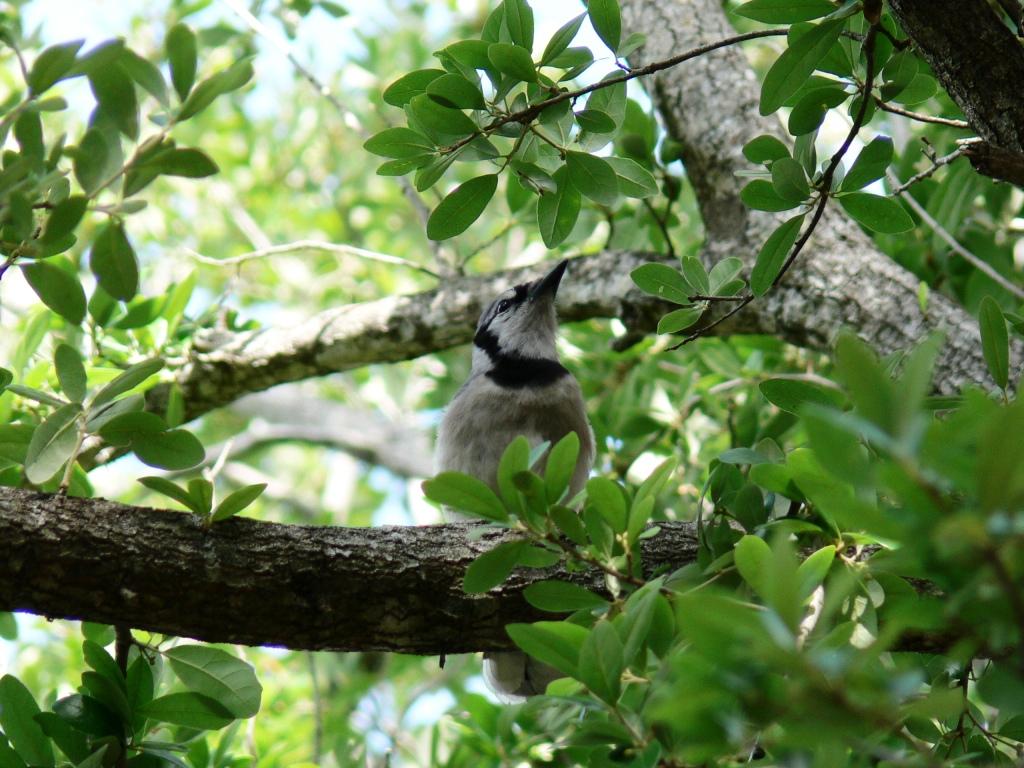
Blue Jay in tree at Hampton Pines

Blue Jay in tree at Hampton Pines

Blue Jay

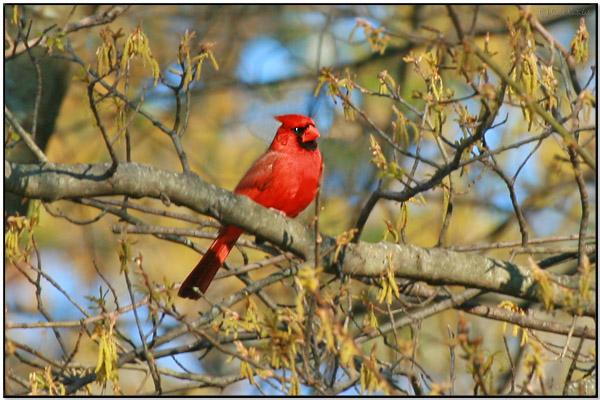
Northern Cardinal (Cardinalis cardinalis) by Daves BirdingPix

Northern Cardinal

Boat-tailed Grackle (Quiscalus major) at Lake Howard, Winter Haven, Florida By Dan’sPix

Boat-tailed Grackle

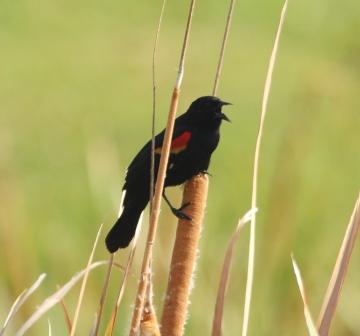
Red-winged Blackbird at Bok Sanctuary

Red-winged Blackbird at Bok Sanctuary

Red-winged Blackbird

Whip-poor-will (Caprimulgus vociferus) by BirdsInFocus

Whip-poor-will (Caprimulgus vociferus) by BirdsInFocus

Eastern Whip-poor-will

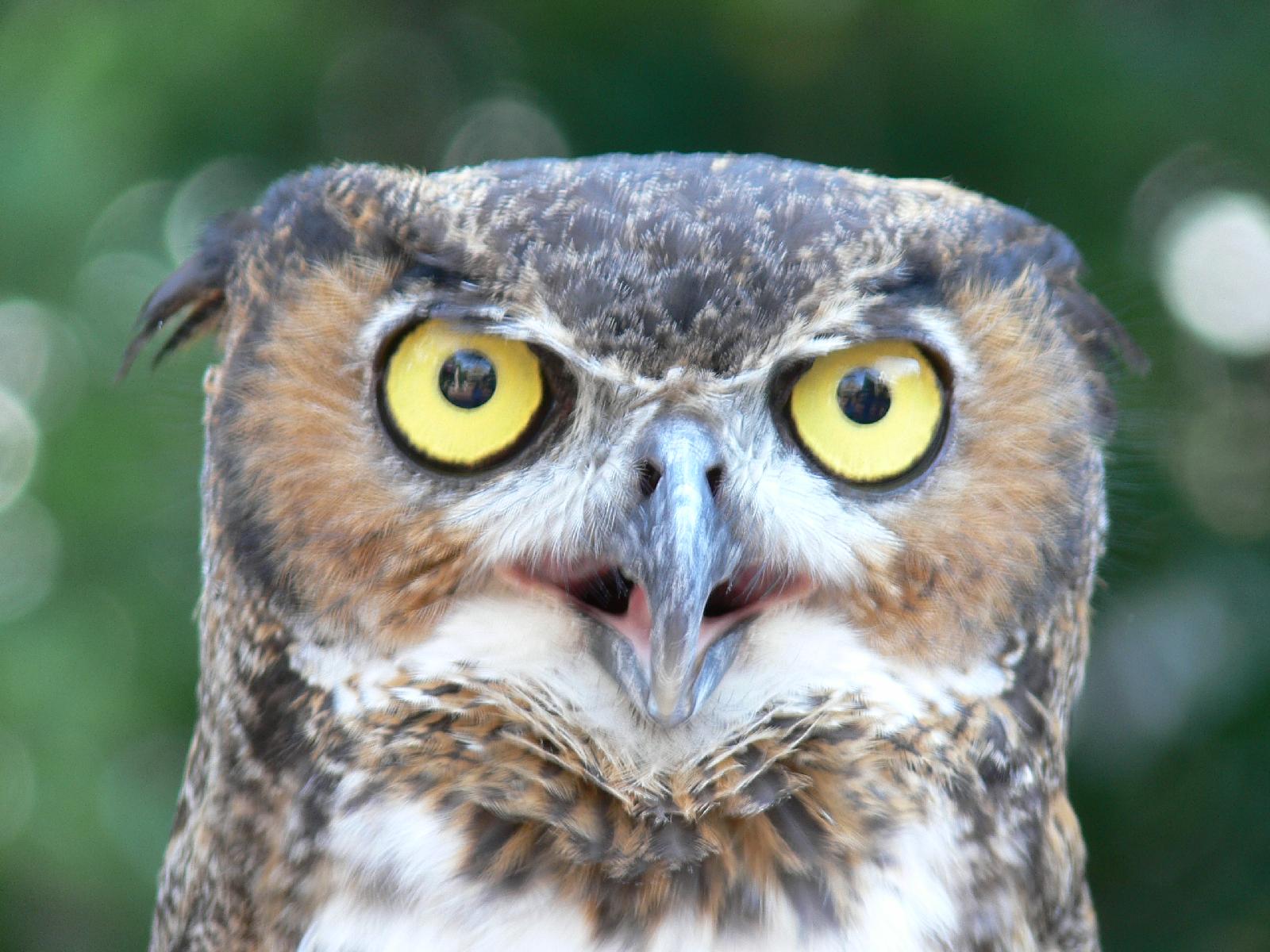
Great Horned Owl – Lowry Pk Zoo by Lee

Great Horned Owl

How many did you all ready know?

Some like to put words to their sounds like these from Birding By Ear — Bird Song Identification

Listen here to a few bird songs and calls that have good mnemonic phrases:
Eastern Towhee — “Drink your tea-ea-ea”
Whip-poor-will — The name says it all.
Black-capped chickadee — Some music and talk first, then the “Chick-a-dee-dee-dee”
White throated sparrow — “Poor Sam Peabody, Peabody, Peabody”
Black-throated green warbler — “Zee zee zee zoo zee”
Barred Owl — “Who cooks for you, who cooks for you all”

Links:
WhatBird
All About Birds
Birding by Ear Basics
*

Start Birdwatching Today Series

*

Birds Vol 1 #5 – National Council of Women

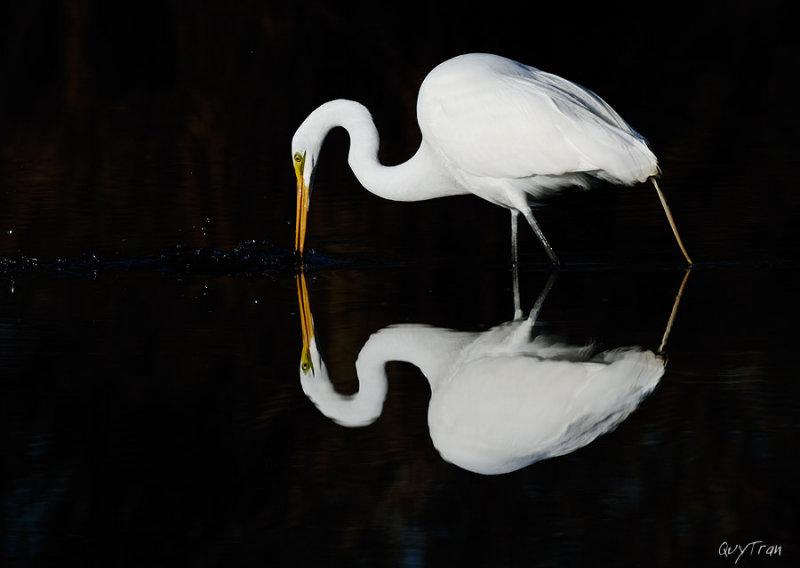
Western Great Egret (Ardea alba) by Quy Tran

Western Great Egret (Ardea alba) by Quy Tran

Birds Illustrated by Color Photography – Revisited

Vol 1. May, 1897 No. 5

*

NATIONAL COUNCIL OF WOMEN.

Extract from the report of the committee on dress, by its chairman, Mrs. Frank Johnson.

Birds, Wings and Feathers Employed as Garniture.

From the school-room there should certainly emanate a sentiment which would discourage forever the slaughter of birds for ornament.

The use of birds and their plumage is as inartistic as it is cruel and barbarous.

The Halo.

“One London dealer in birds received, when the fashion was at its height, a single consignment of thirty-two thousand dead humming birds, and another received at one time, thirty thousand aquatic birds and three hundred thousand pairs of wings.”

Think what a price to pay,
Faces so bright and gay,
Just for a hat!
Flowers unvisited, mornings unsung,
Sea-ranges bare of the wings that o’erswung—
Bared just for that!

Think of the others, too,
Others and mothers, too,
Bright-Eyes in hat!
Hear you no mother-groan floating in air,
Hear you no little moan—birdling’s despair—
Somewhere for that?

Caught ’mid some mother-work,
Torn by a hunter Turk,
Just for your hat!
Plenty of mother-heart yet in the world:
All the more wings to tear, carefully twirled!
Women want that?

Oh, but the shame of it,
Oh, but the blame of it,
Price of a hat!
Just for a jauntiness brightening the street!
This is your halo—O faces so sweet—
Death, and for that!—W. C. Gannett.


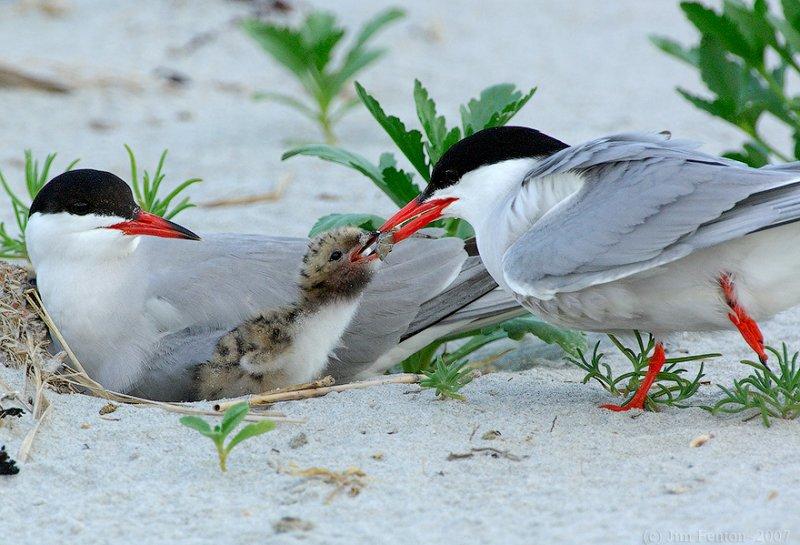
Common Tern (Sterna hirundo) by J Fenton

Common Tern (Sterna hirundo) by J Fenton

Lee’s Addition:

I am so glad this campaign was started way back then. Wow! Do you realize how many birds were killed just so the ladies could be ” in style”? Here is a quote from the Feather Trade article. “On two days in 1886, ornithologist Frank Chapman walked the streets of New York City and recorded the types of birds he saw on ladies hats. On his walks he counted the wings, feathers, heads, and entire bodies of 174 birds representing 40 different species decorating the hats of ladies, including 21 hats decorated with parts of the common tern. Frank Chapman went on to start the annual Christmas Bird Count in 1890!”

If these were the feathers from chickens or turkeys I might understand part of it, but that above quote is terrible. And that is just 2 days. Another quote, this time from the National Parks article, “The long, white plumes of egrets had become more valuable than gold. To satisfy the demands of this latest fashion trend, more than 5 million birds a year were being slaughtered; nearly 95 percent of Florida’s shore birds had been killed by plume hunters.”

We are given a dominion mandate over the birds and critters to help maintain them. Yes, we are allowed to eat some, but to slaughter just for fashion or to hang a trophy bird or animal on a wall, there is a difference.

And God blessed them. And God said to them, “Be fruitful and multiply and fill the earth and subdue it, and have dominion over the fish of the sea and over the birds of the heavens and over every living thing that moves on the earth.” (Genesis 1:28 ESV)

Here are some articles about this issue:

The Feather Trade

The Call for a Featherless Hat – National Parks

Birds Illustrated by Color Photograhy Vol 1 May, 1897 No 5 - Cover

Birds Illustrated by Color Photograhy Vol 1 May, 1897 No 5 – Cover

Birds Illustrated by Color Photography – Revisited – Introduction

The above article is the first article in the monthly serial that was started in January 1897 “designed to promote Knowledge of Bird-Live.” These include Color Photography, as they call them, today they are drawings. There are at least three Volumes that have been digitized by Project Gutenberg.

To see the whole series of – Birds Illustrated by Color Photography – Revisited

*

(Information from Wikipedia and other internet sources)

Next Article – The Screech Owl

Previous Article – Nesting Time

Gospel Message

Ad for Birds Illustrated by Color Photography, 1897

Ad for Birds Illustrated by Color Photography, 1897

Birds of the Bible – Silly Dove

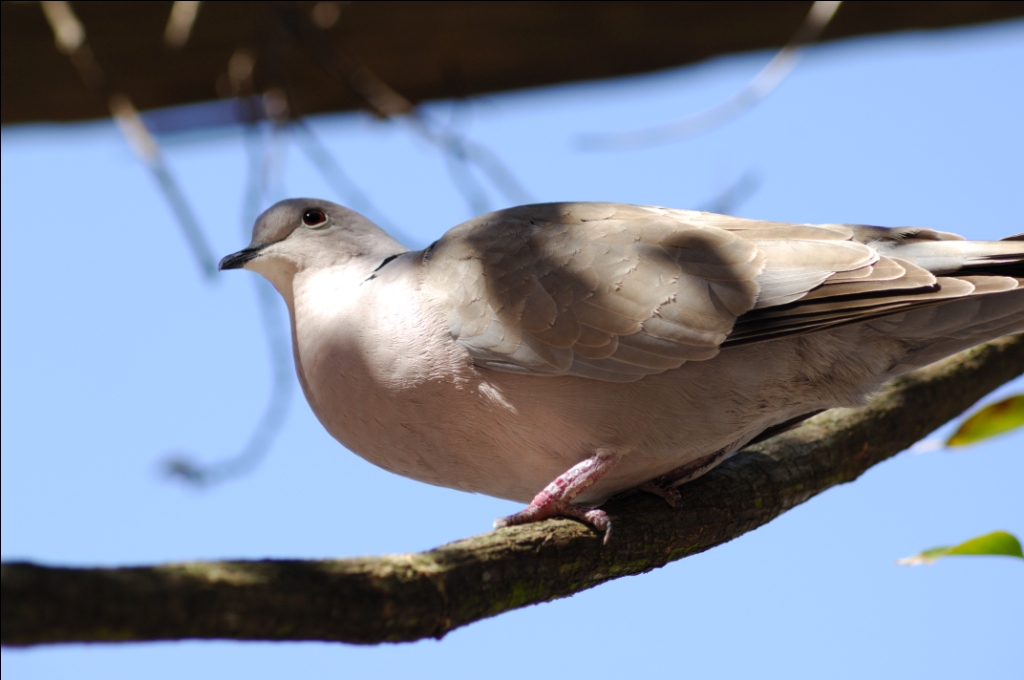
Eurasian Collared Dove (Streptopelia decaocto) by Lee

Ephraim is like a dove, silly and without sense, calling to Egypt, going to Assyria. (Hosea 7:11 ESV)

I came across this verse yesterday in my reading of Scripture. Hadn’t noticed it before, at least that I recall. So what it is this about a “Silly Dove”? After checking Wikipedia, nothing showed up that indicates silliness. Then it was off to Cornell’s About Birds, still nothing indicating a silly dove. Even checked their PigeonWatch, no luck. (Doves and Pigeons are in the same family, Columbidae) At a dove hunting site, they indicated that they were easy to flush out to either shoot or capture.

Now it is time for e-Sword to help figure this out. Putting Hosea 7:11 in the compare mode revealed most of the versions used “silly”, but a few other words show up such as; mindless, foolish, senseless, decoyed, easily deceived.

The second part of the verse says the dove is “without sense.” Again here are some of the other translations; without understanding, not having a heart or heartless, without wisdom, fluttering back and forth, lacking sense, clueless, easily tricked.

When the commentaries were checked out, then the verse started making more sense. In context, Ephraim is being called the “silly dove” because of their trying to depend on others instead of God. God is trying to get them to turn back to Him, but they are “easily deceived.” Are people not like that today? They would rather search out other philosophies (like evolution) or religions instead of turning to their Creator God.

Eurasian Collared Dove (Streptopelia decaocto) by Dan

Eurasian Collared Dove (Streptopelia decaocto) by Dan

Comments from the Commentaries:

(JFB)
like a silly dove — a bird proverbial for simplicity: easily deceived.
without heart — that is, understanding.
call to Egypt — Israel lying between the two great rival empires Egypt and Assyria, sought each by turns to help her against the other. As this prophecy was written in the reign of Hoshea, the allusion is probably to the alliance with So or Sabacho II (of which a record has been found on the clay cylindrical seals in Koyunjik), which ended in the overthrow of Hoshea and the deportation of Israel (2Ki_17:3-6). As the dove betrays its foolishness by fleeing in alarm from its nest only to fall into the net of the fowler, so Israel, though warned that foreign alliances would be their ruin, rushed into them.

(Believer’s Bible Commentary) Ephraim flew like a silly dove . . . to Egypt and Assyria for help, but God would catch the dove in a net and punish the people.

Ephraim also is like a silly dove without heart – A bird that has little understanding; that is easily snared and taken; that is careless about its own young, and seems to live without any kind of thought. It has been made, by those who, like itself, are without heart, the symbol of conjugal affection. Nothing worse could have been chosen, for the dove and its mate are continually quarrelling.

(Exposing the Word) A Silly Dove- unstable, flitting from one hope to another. God stands trying to catch them in the snare accord to verse 12.

(Geneva Translation Notes) That is, without all judgment, as those that cannot tell whether it is better to cleave only to God, or to seek the help of man.

(Haydock) Decoyed. Hebrew, “stupid,” chap. iv. 11. The dove is the only bird which is not grieved at the loss of its young. (St. Jerome) — It returns to the same nest, though repeatedly robbed, forgetting past dangers. (Theodoret) — Thus Israel is not reclaimed, though idolatry has so often proved its ruin. — Egypt. Jeroboam had returned thither, and at his return brought about a division of the kingdom, 3 Kings xi. 40. Osee, the last king, applied to Sua, and this provoked the Assyrians to destroy the kingdom. They pretended that it was tributary to them, after Phul had been invited to assist Manahem for a thousand talents, 4 Kings xv. 19., and xvii. 4. Thus was a worldly policy confounded.

(John Wesley Explanatory Notes) Like a silly dove – Ephraim is now become like the dove in weakness and fear, as well as in imprudence and liableness to be deceived. Without heart – Without either discretion or courage. To Assyria – Instead of going to God, who alone can help.

(J Vernon McGee) This is another interesting illustration. If you have ever been dove hunting, you know that if a dove has a nest with eggs or little ones in it she will act as if she has a broken wing and actually let you get very close to her. She tries to lure you away from her nest. Actually, that is not a very smart move on the part of the dove for two reasons. When a dove lets you get that close to her, you know there is a nest nearby. Secondly, she endangers her own life.

Now here was Ephraim. She refused to run to God for help. So first she ran down to Egypt for help. When Egypt wouldn’t give her the help she wanted, she went up to Assyria and asked for help. She went back and forth like a silly dove. What a picture!

(Life Application Study Bible) Israel’s King Menahem had paid Assyria to support him in power (2Ki_15:19-20); King Hoshea turned against Assyria and went to Egypt for help (2Ki_17:4). Israel’s kings went back and forth, allying themselves with different nations when they should have allied themselves with God.

Mourning Dove by Reinier Munguia

Mourning Dove by Reinier Munguia

The explanation I like the best comes from Dr. Joe Temple about the Dove. This is his understanding of it. I know I am quoting much, but it makes great sense.

The Innocent Dove

Hosea 7

11 Ephraim also is like a silly dove without heart: they call to Egypt, they go to Assyria.

Here Ephraim is compared to a silly dove. A better word for silly would be innocent . Ephraim was innocent enough to think that Egypt and Assyria could come to her rescue when the chastening hand of God was resting upon her. Oftentimes Hosea had seen a dove ensnared because of its innocence, because it was not wary of that that would ensnare it. He recognized that characteristic of the dove and he said, “Ephraim is just like that.”

Go with me to the New Testament and notice the Lord Jesus Christ not only told us to be bird watchers, but He was a bird watcher Himself, for He noticed the characteristics of the dove and brought one of those characteristics to the attention of the people to whom He was speaking. This needs to be emphasized for us today. Notice, Matthew, chapter 10, verse 16. He said to His disciples:

Matthew 10

16 Behold, I send you forth as sheep in the midst of wolves: be ye therefore wise as serpents, and harmless as doves.

Notice: “…harmless as doves.” A better word for harmless is innocent . The reason that He said that is that He wanted us to be wise concerning the things of God and simple and innocent concerning the things that are evil. I think that one of the biggest lies that the Devil is telling Christian people today, particularly Christian parents, is that their children must not be too protected, for if they are, they will not know how to handle themselves in a world that is full of sin. The Devil is suggesting to people today that Christian people need to be familiar with all of the sinful things that are going on in the world so that they will know how to react when they face them.

I don’t believe that. I believe your children can be grounded in the Word of God so that they live by princiiples that are applicable to any situation in any generation, and I believe you can be likewise. I always respond to the suggestion that we need to know about sin so that we know how to react to it with a statement that a man from another generation made when he said, “You don’t have to go through the sewer to know how dirty it is. All you need to do is go down to the sewage plant and you will know. Go where the sewer comes out.” The devil would have us believe we have to be involved in order to know what is going on. We don’t. Remember the dove. Christ said, “I am sending you out into the world which is full of wolves, ready to pounce on you, but I want you to be wise as serpents and innocent as doves.”

Links:

Cool Pigeon Facts – Cornell

Mourning Dove – All About Birds

Wordless Birds

*

Birdwatching at MacDill AFB, May 2012

Dan and Black Skimmers

Dan and Black Skimmers

Today, Dan and I had to run over to Tampa for a couple of errands. We stopped by the MacDill AF Base to see how the birds were faring out on their beach on Tampa Bay. When we were there a month or so ago, there were lots of shorebirds. Since there have been many of reports lately from the Listing Service of migrants passing through the state, we thought we would take a look. Tampa is about 45 miles to the west of us and closer to the Gulf of Mexico. We didn’t have the time to go on over to the gulf.

Yellow-crowned Night Heron

Yellow-crowned Night Heron

Our biggest surprise, and the only one, was a pair of Yellow-crowned Night Herons along one of the canals. Down at the beach, we only found the usual Skimmers, Laughing and Ring-billed Gulls, two kinds of Terns; Royal and Sandwich, Turnstones, Willet, White Ibises, and the proverbial Brown Pelicans flying by in formation. A little disappointing, but enjoyable none the less. Even when I only see one bird, I enjoy my birdwatching adventures. I assume most of the birds have already passed by or they were not in much of a beach mood today.

Ruddy Turnstone

Ruddy Turnstone

Even though few species seen today, aren’t they all amazing to watch? I am always amazed at the variety of birds that we get the pleasures of watching.

Which doeth great things past finding out; yea, and wonders without number. (Job 9:10 KJV)

White Ibis

White Ibis

And

Some of the birds at the beach

Some of the birds at the beach Laughing Gulls, Royal Terns and Black Skimmers

I also shot a video of some of the birds at the shore. There are Black Skimmers, which I think are cute walking around, Royal Terns, Sandwich Tern and Laughing Gulls relaxing together.

*

*

One other bird spotted out my back window a few days ago was this House Finch. All winter the normal House Finches and some orange variant ones visited the feeders. This one seems to have combined the two together. Thought it was rather different and wanted to share it. It was shot through the window and screen, so not the best shot.

Interesting House Finch at feeder

Interesting House Finch at feeder

*