ROCK WREN: Living Life upon the Rock

ROCK WREN:  Living Life upon the Rock

Dr. James J. S. Johnson
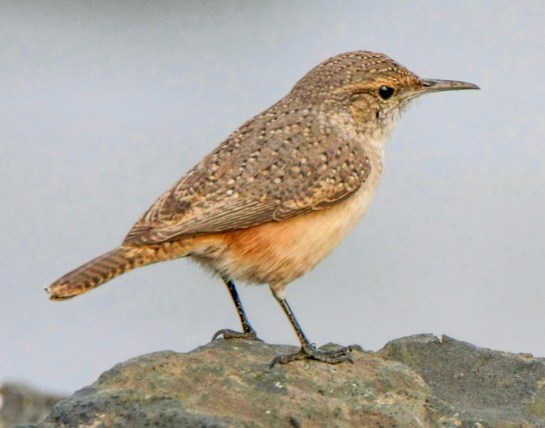
rockwren.discoverlife

ROCK WREN (credit: DiscoverLife.org)

“And, I [Jesus] say also unto thee, that thou art Peter [petros = little stone/rock, a masculine noun in Greek], and upon this rock [petra = large rock formation, a feminine noun in Greek, such as is used as in Matthew 7:24-27, to denote a rock formation large enough to serve as a stable foundation for a building  —  see Matthew 7:24-27, where a form of the Greek noun petra is translated “rock”]  I will build My church; and the gates of Hell shall not prevail against it.  (Matthew 16:18)
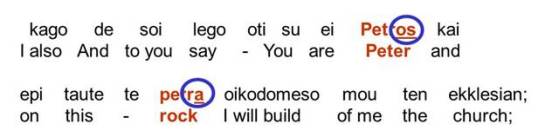
matthew16.18-interlinear

Rocks are important.

Simon Peter himself was a little rock, yet his God-given faith in what God revealed about Jesus  –  namely, that Jesus is the divine Messiah-Savior (i.e., see Matthew 7:24 & 16:16)  — was comparable to a huge boulder-sized rock formation (see Matthew 7:24-27 & Luke 6:46-49), was the truth foundation of the Christianity (see also John 20:31).

In other words, to understand the Greek wordplay that Christ used (in Matthew chapter 16), it is necessary to see how Christ used the term “rock” (i.e., the feminine noun PETRA) in Matthew 7:24-27, in His parable about the wise man building his house upon the “rock” (PETRA).  Simon Peter came to believe in Jesus as the Scripture-defined Messiah, and Peter’s belief in that Messianic truth is the equivalent of Peter wisely building his core faith (and thus also life) upon the right “Rock”.

chapel-built-upon-rock-jross-video.com-allensparkcolorado

Chapel Built Upon Rock, Allenspark, Colorado ( jross-video.com photo )

In fact, even birds appreciate the value of rocks!

Albeit birds are known for habituating trees (Daniel 4:14; Matthew 13:19) and mountains (Psalm 11:1; Psalm 50:11; Psalm 104:12; Isaiah 18:6), some birds are famous for living in rocky habitats (Job 39:27-29; Jeremiah 49:16; Obadiah 1:4).

Consider the following birds: Rock Ptarmigan (Lagopus muta), Rock Partridge (Alectoris graeca), Rock Bush Quail (Perdicula argoondah), Southern Rockhopper Penguin (Eudyptes chrysocome), Northern Rockhopper Penguin (Eudyptes moseleyi),  Rock Shag (Phalacrocorax magellanicus), Rock Kestrel (Falco rupicolus), Rock Sandpiper (Calidris/Erolia ptilocnemis), Rock Pratincole (Glareola nuchalis), Rock Dove (Columba livia —  a/k/a “common pigeon”), Chestnut-quilled Rock Pigeon (Petrophassa rufipennis), White-quilled Rock Pigeon (Petrophassa albipennis), New Zealand Rock Wren (Xenicus gilviventris), Andean Cock-of-the-Rock (Rupicola peruvianus —  a/k/a “tunki”), Cape Rockjumper (Chaetops frenatus — a/k/a Rufous Rockjumper), Rock Wren (Salpinctes obsoletus), Common Rock Thrush (Monticola saxatilis, — a/k/a rufous-tailed rock thrush), Rock Sparrow (Petronia petronia).
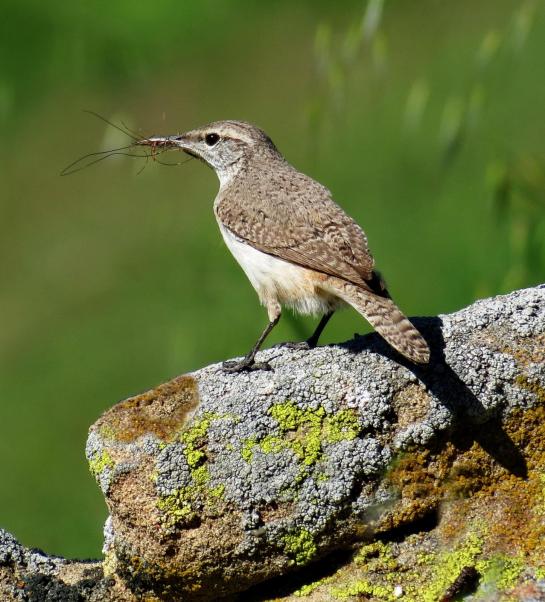
rock-wren-with-horse-hair-fbo-nest.hbw-alive

ROCK WREN, with nest-building material (photo credit: HBW Alive)

The ROCK WREN (Salpinctes obsoletus) is a small yet hearty passerine that often dwells in habitats devoid of thick forests, such as some of the rock-dominated deserts of America’s Great West, including canyonlands sprinkled with pinyon pine and mesquites.

It was Friday, March 3rd in AD2018, when I spied a Rock Wren inside Palo Duro Canyon, a huge canyonland featuring rocky wilderness within the Texas Panhandle.

paloduro-lighthousetrail-wikipedia

LIGHTHOUSE, Palo Duro Canyon   (Wikipedia photo)

The sighting occurred during a hike along Lighthouse Trail, in an area dominated by canyon rocks sprinkled by scrubby pines and mesquite trees. The Rock Wren was perched in the branches of a mesquite tree  —  a welcome sign of life in an otherwise fairly desolate and dry desert.  In the photograph (below) you can see that I had my binoculars, for sighting birds, although the woolly mammoth in the background was photo-shopped into the picture by my cousin Don Barber.

jjsj-palodurocanyon-mastodon

JJSJ  in  PALO DURO CANYON   (woolly mammoth inserted by Don Barber)

The hike and the Rock Wren sighting were the occasion for composing this limerick:

ROCK WRENS ARE TOUGH ENOUGH FOR PALO DURO CANYON

In the canyon, near Lighthouse Trail,

‘Twas a bird, with an upturned tail;

In weather-worn mesquite,

It sang out a trill-tweet —

Though petite, Rock Wrens aren’t frail!

In other words, Rock Wrens are tough enough to survive (and even thrive) in the hot wilderness canyonland of Palo Duro Canyon, where the wildlife must tolerate months without any precipitation  —  and (non-winter) temperatures well above 100 degrees Fahrenheit.

(At this point, based on personal experience, I have a practical tip, for hiking Lighthouse Trail in Palo Duro Canyon:  take extra bottles of drinkable water; don’t expect any cell-phone coverage inside the canyon; use sun-screen on your exposed skin, but don’t put sun-screen on your forehead  —  because the hot sun quickly causes sunscreen [on your forehead] to drip down into your eyes, and that can painfully burn your eyes for hours afterwards, especially when there is no available source of running water for flushing it out of your eyes.)

To sum it up, there are quite a few birds (including the Rock Wren) that thrive in rocky habitats, like Palo Duro Canyon  —  you might say those resilient birds really rock!
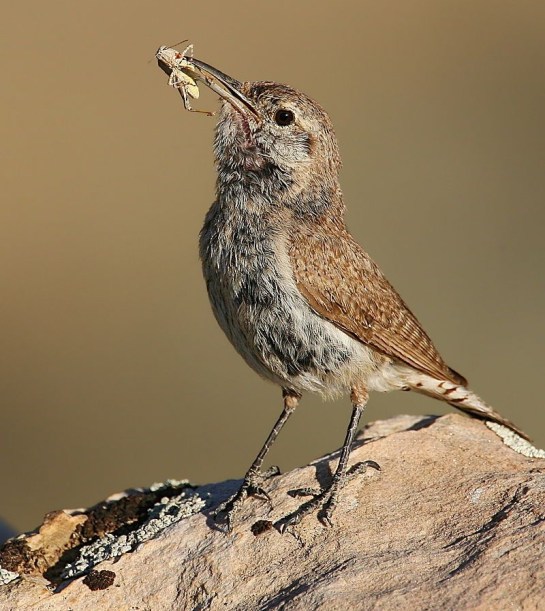
rockwren-with-grasshopper.wikipedia

ROCK WREN with grasshopper (Wikipedia photo)


Owls in Flight: Being Quiet on Purpose

Owls in Flight:  Being Quiet on Purpose

Dr. James J. S. Johnson

And that ye study to be quiet, and to do your own business, and to work with your own hands, as we commanded you.   (1st Thessalonians 4:11)

Image result for barn owl flight

Barn Owls, like other owls, are aerial predators who hunt by night — quietly.  This airborne silence arms hunting owls with the element of surprise, as has been proven by acoustical studies documented in a BBC video YouTube recording:

[ “Experiment!  How Does an Owl Fly So Silently?  Super Powered Owls”  BBC ]

One of the stellar creation biologists/ecologists, nowadays, is Dr. David Catchpoole, from down under — with years of service as a scientist for the Queensland (Australia) Department of Primary Industries, specializing in tropical fruit tees (especially mango), as well as years of service teaching tropical horticulture at James Cook University.

Once an atheist evolutionist, Dr. Catchpoole is now (and has been for decades) a Bible-believing creation scientist, quick to glorify God for His magnificent creatures.  In a recent article Dr. Catchpoole described how God has designed and bioengineered owls, because they are nocturnal birds of prey, to fly quietly.

If you watch an owl flapping or gliding, it’s like viewing film footage with the sound on ‘mute’ — they are so silent.  That’s because their wings have velvety surfaces, comb-like serrations at the leading edge, and trailing-edge fringes which dramatically suppress the sound of air rushing over the wings.  Therefore the owl’s prey (mice and voles) can be taken by surprise.  Also, with wing noise suppressed to a level below the owl’s own hearing range, they can better hear (and thus locate) prey while flying — crucial for hunting at night. …

Owl wings have already inspired quieter fan blades in computers.  More recently, [biomimetics technology] researchers using wind tunnel facilities have explored these noise suppression characteristics in more detail, especially the leading-edge [single-barb-tipped] serrations.  The owl wing design also efficiently resolves the trade-off between effective sound suppression [needs for surprising prey] and aerodynamic force production [needed for flying]. In striving to understand how, [biomimetics technology] researchers see an ultimate goal of mimicking those design aspects across many man-made technologies.  For example, so the blades of multi-rotor drones can ‘chop’ the air more quietly, without unduly sacrificing lift; similarly in other aircraft, wind turbines, and fluid machinery in general.

[Quoting David Catchpoole, “As Silent as a Flying Owl”, CREATION, 40(2):56 (April-June 2018).]   Although the night-flying Barn Owl doesn’t put out much sound, it does take sound in, through its sensitive hearing system.  In fact, short feathers (near its ears) are designed into grooves (by each ear) that facilitates efficient reception of airborne sound waves (revealing where its prey is) into the owl’s ears!

These owls hear prey well, but their prey do not hear the owls (usually until it’s too late)!

barnowl-wildwatchcams-wa-gov

BARN OWL (Washington Dep’t of Fish & Wildlife)

What can I add to those insights?  Like an owl on the wing, I’ll just be quiet!


Bible Birds – Hawk Introduction

Red-tailed Hawk (Buteo jamaicensis) by Dan (closeup)

“Does the hawk fly by your wisdom, And spread its wings toward the south? (Job 39:26 NKJV)

According to the King James Version of Scripture, the other two verses with hawk in them are:

“the ostrich, the short-eared owl, the sea gull, and the hawk after its kind;” (Leviticus 11:16 NKJV)

“the ostrich, the short-eared owl, the sea gull, and the hawk after their kinds;” (Deuteronomy 14:15 NKJV)

For more advanced reading, you can check out Birds of the Bible – Clean vs. Unclean,  Birds of the Bible – The Law Of The Birds and Deuteronomy 14:11-18 Visualized on Leesbird.com

What is a Hawk? To what Family of birds does it belong?

Harris Hawk in Training at National Aviary

Hawks are one of God’s Created Avian Wonders. The bird family of Hawks, Accipitridae, not only includes Hawks, but also Eagles, Kites, Harriers, Vultures, plus more. The Lord has given them great eyesight, hearing, and speed.

Hawks have excellent eyesight. They can see up to 8 times more clearly than the sharpest human eye. Eyesight is primarily used for hunting.

Their hearing is acute, but their sense of smell is poor.

Hawk species are known for their speed, particularly when chasing prey. During the hunt, some species of hawks can dive 240 kilometers (150 miles) per hour through the air. [Just Fun Facts]

“All hawks are almost exactly the same structurally as all other birds, and the distinguishing features that set them apart from all of the other hawks are minute. Hawks are distinguished from all other birds, especially falcons, by their broader, more rounded wings. They also have sharp, curved, hooked bills, strong feet with curved talons, and amazing sight capabilities. All hawks have uniform 20/2 vision, exactly 8 times better than a human with good eyesight! Almost all male hawks are smaller than females.” Hawks – CreationWiki [with editing]

Great Black Hawk (Buteogallus urubitinga) ©WikiC
Sharp-shinned Hawk (Accipiter striatus) ©USFWS
Short-tailed Hawk (Buteo brachyurus) ©WikiC

Hawks are in the Accipitridae Family of Kites, Hawks & Eagles and you can read more about them in the Birds of the Bible – Hawk section.
Hawks have claws which are used for catching their prey. Beware of these:

Red-tailed Hawk (Buteo jamaicensis) talons by Beedie
  • A Cooper’s Hawk captures a bird with its feet and kills it by repeated squeezing. Falcons tend to kill their prey by biting it, but Cooper’s Hawks hold their catch away from the body until it dies. [Cool Fact from All about Birds]

Hawks and the other birds in this family did not always prey (catch) other living critters. Because of sin, these avian creations from the Lord, were placed under God’s curse. One day, when that curse is removed, the birds of prey will become birds of play [with others.]

Check out All About Birds – Hawks and Falcons

See also:

Accipitriformes – Order, Accipitridae – Family (Kites, Hawks & Eagles)

ABC’s of the Gospel

Ravin’ about Corvid Hybrids: Something to Crow About!

Ravin’ about Corvid Hybrids:

Something to Crow About!

Dr. James J. S. Johnson

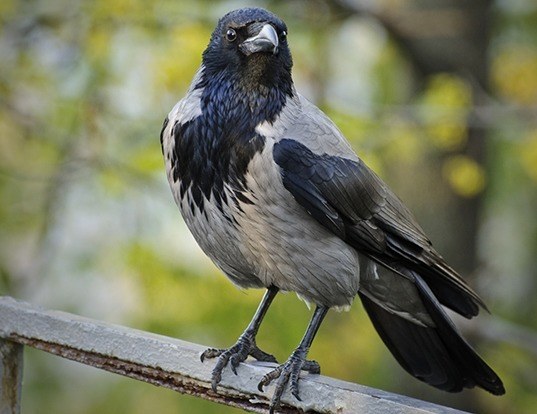
HoodedCrow.WorldLifeExpectancy-photoHOODED CROW   (World Life Expectancy photo)
“Every raven after his kind”   (Leviticus 11:15)

Who provides for the raven his food? When his young ones cry unto God, they wander for lack of food.   (Job 38:41)

Consider the ravens: for they neither sow nor reap; they neither have storehouse nor barn, yet God feeds them; how much more are ye better than birds?   (Luke 12:24)

There is, as Moses noted, a “kind” (i.e., genetically related family) of birds that we call “corvids”, crow-like birds, including ravens. [In the English Bible (KJV), these birds are always called “ravens”.]

These black (or mostly black – see Song of Solomon 5:11) omnivores are known to “crow”, often calling out a harsh KAWWWW!   Also famous for their “ravenous” appetites and eating habits, it is no wonder that the English labeled many varieties of these corvid birds as “ravens”.

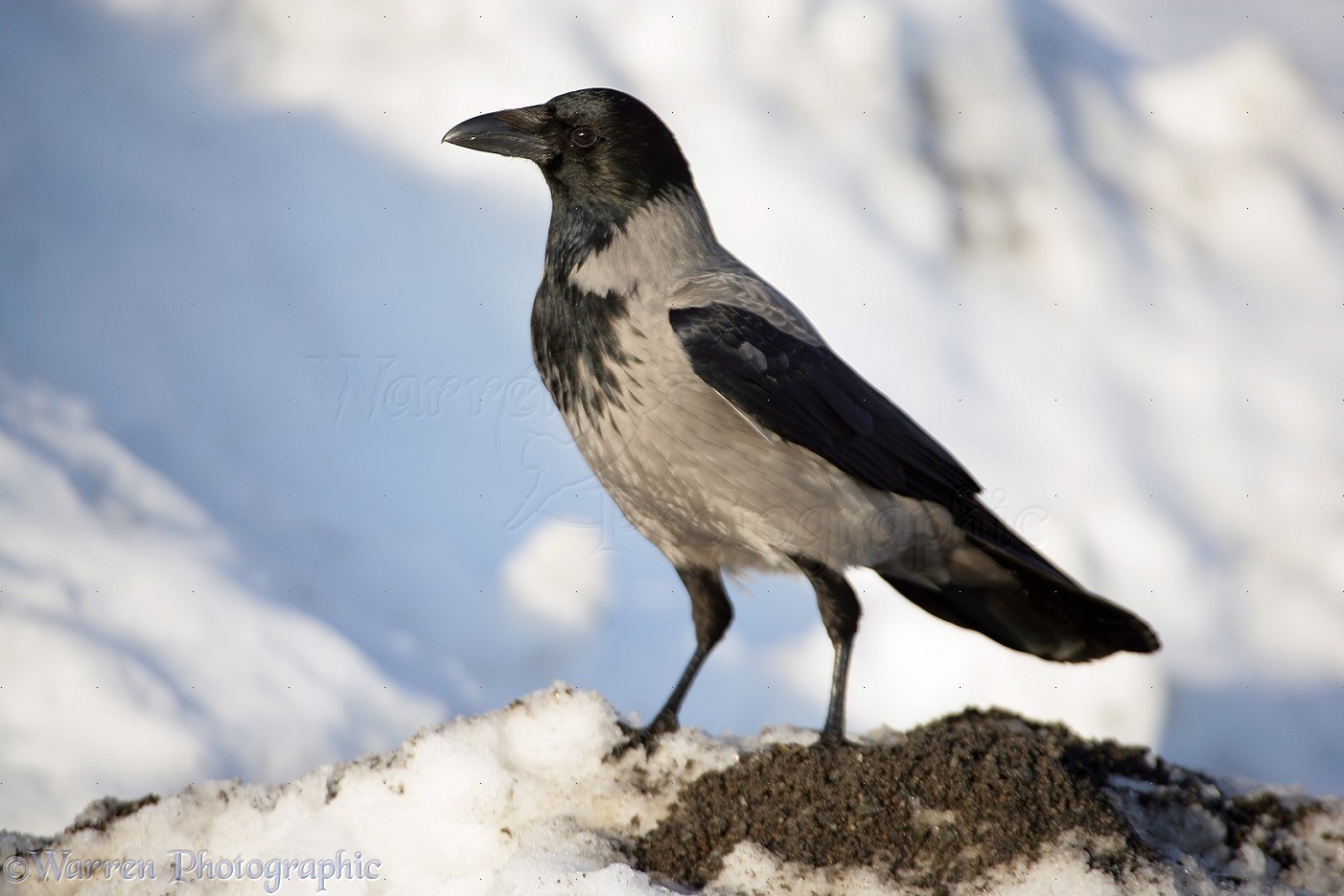
The HOODED CROW (Corvus cornix) lives and thrives in the Great North – including Sweden, Finland, and Russia.  This I learned firsthand, on July 6th of AD2006, while visiting a grassy park near the Vasa Museum of Stockholm, Sweden.  The next day (July 7th of AD2006), it was my privilege to see another Hooded Crow in a heavily treed park in Helsinki, Finland.  Again, two days later (i.e., the 9th of July, AD2006), while visiting Pushkin (near St. Petersburg, Russia), I saw a Hooded Crow, in one of the “garden” parks of Catherine’s Palace.  Obviously, Hooded Crows appreciate high-quality parks of northern Europe!

HoodedCrow.WarrenPhotographic

HOODED CROW   (photo credit:  Warren Photographic)

The physical appearance of a Hooded Crow is, as one bird-book describes, “unmistakable”.

Unmistakable. Head, wings and tail black, but body grey (can show pinkish cast in fresh plumage).

[Quoting Chris Kightley, Steve Madge, & Dave Nurney, POCKET GUIDE TO THE BIRDS OF BRITAIN AND NORTH-WEST EUROPE (Yale University Press / British Trust for Ornithology, 1998), page 271.]

Like most large corvids, the Hood Crow is quite versatile in filling various habitats.

Wary, aggressive scavenger found in all habitats from city centre to tideline, forest to mountain top. Generally seen in ones and twos, but the adage ‘crows alone, rooks in a flock’ unreliable; often accompanies other crows, and hundreds may gather at favoured feeding spots and roosts. Watch for crow’s frequent nervy wing flicks whenever on ground or perched. Calls varied. Typically a loud, angry kraa, usually given in series of 2—6 calls. Unlike Rook, pairs nest alone (usually in tree).

[Again quoting Kightley, Madge, & Nurney, POCKET GUIDE TO THE BIRDS OF BRITAIN AND NORTH-WEST EUROPE, page 271.]

CarrionCrow.YvesThonnerieux-OuisseauxBirds

CARRION CROW   (Yves Thonnerieux / Ouiseaux-Birds photo)

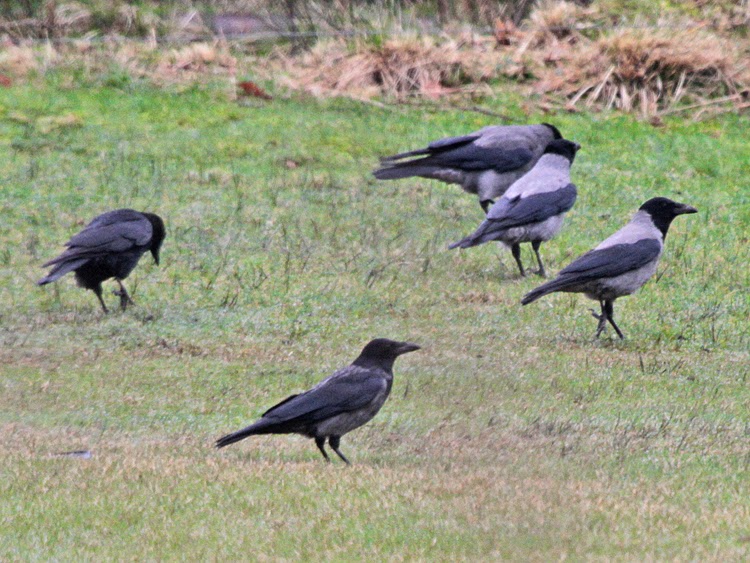
Yet the HOODED CROW is not a genetically self-contained “species”, regardless of what taxonomists might wish about them.  They happily hybridize with other crows, especially the CARRION CROW [Corvus corone], whose international range the Hooded Crow overlaps.

Carrion-Hooded-Crows-mixing.BirdHybrids-photo

CARRION CROWS + HOODED CROWS = HYBRIDS   (Bird Hybrids photo)

CARRION AND HOODED CROWS. The familiar crow. Two distinct races occur … [In the]British Isles and western Europe, Carrion Crow (Corvus corone) is common everywhere except north and west Scotland, Ireland, Isle of Man and Europe east of Denmark, where it is replaced by Hooded (Corvus cornix). Where breeding ranges overlap hybrids are frequent [emphasis added by JJSJ].

[Again quoting Kightley, Madge, & Nurney, POCKET GUIDE TO THE BIRDS OF BRITAIN AND NORTH-WEST EUROPE, page 271.]

The Carrion-Hooded Crow hybrids are also noted within a larger discussion (i.e., pages 224-228) of Corvid family hybrids, in Eugene M. McCarthy, HANDBOOK OF AVIAN HYBRIDS OF THE WORLD (Oxford University Press, 2006), at page 227.

Corvids.JelmerPoelstra-UppsalaUniv-image

CORVIDS   Jelmer Poelstra / Uppsala Univ. image

Dr. McCarthy, an avian geneticist, has accumulated and summarized genetic research on Carrion-Hooded hybrids, especially examples observed in Eurasia:

Because the Carrion Crow has a split range … with the Hooded Crow intervening … there are two long contact zones, one extending from N. Ireland, through N. Scotland, to N.W. Germany, then S to N Italy, and another stretching from the Gulf of Ob (N Russia) to the Aral Sea. … Even in the center of the [overlap] zone, only 30% of [these corvid] birds are obviously intermediate. Due to hybridization these [corvid] birds are now sometimes lumped, but Parkin et al. (2003) recommend against this treatment since the two have obvious differences in plumage, as well as in vocalizations and ecology, and because hybrids have lower reproductive success than either parental type. Hybrid young are less viable, too, than young produced from unmixed mating (Saino and Villa 1992). Genetic variability increases within the hybrid zone (as has been observed in many other types of crossings). Occasional mixed pairs occur well outside [the overlap range] zones (e.g., Schlyter reports one from Sweden).

[Quoting Eugene M. McCarthy, HANDBOOK OF AVIAN HYBRIDS OF THE WORLD (Oxford University Press, 2006), at page 227.]

Dr. McCarthy, on pages 224-228, lists several other examples of documented corvid hybridizations, including: Corvus capellanus [Mesopotamian Crow] X Corvus corone [Carrion Crow]; Corvus cornix [Hooded Crow] X Pica pica [Black-billed Magpie]; Corvus albus [Pied Crow] X Corvus albicollis [White-necked Raven];  Corvus albus  [Pied Crow] X Corvus ruficollis [Brown-necked Raven]; Corvus albus [Pied Crow] X Corvus splendens [House Crow]; Corvus brachyrhynchos [American Crow] X Corvus caurinus [Northwestern Crow]; Corvus corax [Common Raven] X Corvus brachyrhynchos [American Crow]; Corvus corax [Common Raven] X Corvus corone [Carrion Crow]; Corvus corax [Common Raven] X Corvus cryptoleucus [Chihuahuan Raven]; Corvus corax [Common Raven] X Corvus levaillantii [Jungle Crow]; Corvus corax [Common Raven] X Corvus macrorhynchos [Large-billed Crow]; Corvus corax [Common Raven] X Corvus ruficollis [Brown-necked Raven]; Corvus corone [Carrion Crow] X Corvus macrorhynchos [Large-billed Crow];   Corvus daururicus [Jackdaw, a/k/a “Coloeus dauuricus”] X Corvus monedula [Jackdaw, a/k/a “Coloeus mondela”]; Corvus levaillantii [Jungle Crow] X Corvus macrorhynchos [Large-billed Crow]; Pica nuttalli [Yellow-billed Magpie] X Pica pica [Black-billed Magpie]; plus it looks like an occasional Rook [Corvus frugilegus] joins the “mixer”, etc.   Looks like a good mix or corvids!

Avian hybrids, of course, often surprise and puzzle evolutionist taxonomists, due to their faulty assumptions and speculations about so-called “speciation” – as was illustrated, during AD2013, in the discovery of Norway’s “Redchat”  —  see “Whinchat, Redstart, & Redchat:  Debunking the ‘Speciation’ Myth Again”, posted at https://leesbird.com/2017/12/12/whinchat-redstart-redchat-debunking-the-speciation-myth-again/ .

CorvidRanges.Wikipedia

CORVID RANGES of the world   (Wikipedia map)

Meanwhile, as the listed examples (of corvid hybridizations) above show, corvid hybrids are doing their part to “fill the earth”, including Hooded-Carrion Crows.

Now that is are something to crow about!               ><> JJSJ   profjjsj@aol.com


Bible Birds – Ibis Introduction

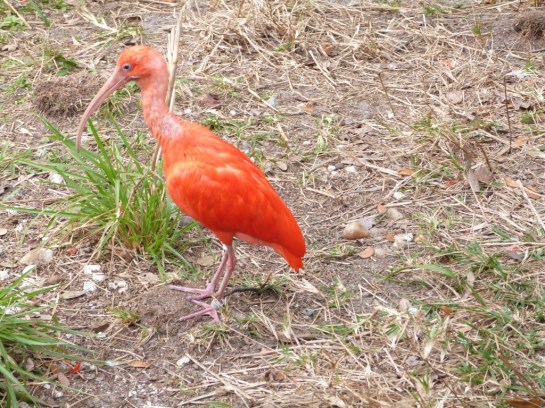
Scarlet Ibis (Eudocimus ruber) Brevard Zoo by Lee

“and for a long time birds and hedgehogs, and ibises and ravens shall dwell in it: and the measuring line of desolation shall be cast over it, and satyrs shall dwell in it.” (Isaiah 34:11 Brenton)

Many of the birds in the Bible are listed differently in some versions. The Ibises is only listed in this verse in the Brenton, DRB, and the ABP versions. Most of the different versions list Pelicans, Cormorants, Bitterns, Heron, and Storks. The Pelicans, Cormorants, Bitterns, and Heron are all found in thePELECANIFORMES Order of birds. The Storks are in the close CICONIIFORMES Order.

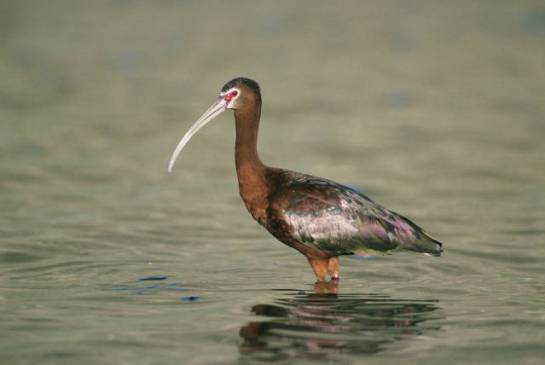
White-faced Ibis (Plegadis chihi) ©USFWS

All of these birds enjoy similar surroundings and the Ibises and Spoonbills make up the Threskiornithidae Family.
The ibises (collective plural ibis; classical plurals ibides and ibes) are a group of long-legged wading birds, that inhabit wetlands, forests and plains. “Ibis” derives from the Latin and Ancient Greek word for this group of birds. It also occurs in the scientific name of the cattle egret, (Bubulcus ibis), mistakenly identified in 1757 as being the sacred ibis.

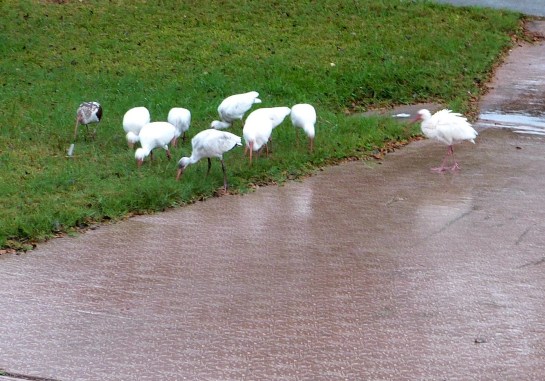
American White Ibis (Eudocimus albus) 1st Birds of 2014 by Lee cropped

Ibises all have long, down-curved bills, and usually feed as a group, probing mud for food items, usually crustaceans. They are monogamous and highly territorial while nesting and feeding. Most nest in trees, often with spoonbills or herons. The word ibis comes from Latin ibis from Greek ἶβις ibis from Egyptian hb, hīb.

Bible Birds – Ibis

Bible Birds

Birds of the Bible – Ibises

Threskiornithidae Family

Bible Birds – Swift Introduction

Bible Birds – Swift Introduction

Alpine Swift (Tachymarptis melba) ©WikiC

“Even the stork in the sky Knows her seasons; And the turtledove and the swift and the thrush Observe the time of their migration; But My people do not know The ordinance of the LORD.” (Jeremiah 8:7 NASB)

The different versions of the Bible, translate this verse with different birds named. Many use either the Swift or the Swallow. They are similar but are in different bird families. The Swifts are in the Apodidae family and Swallows are in the Hirundinidae Family. Mainly, the verse is saying that the birds have more wisdom than some people.

Resemblances between swifts and swallows are similar because of their lifestyles based on catching insects in flight. They were both created with that ability. Both of them migrate or fly to other areas during the seasons. They need warmer weather to have an abundance of flying insects to feast on. [eat]

Glossy Swiftlet (Collocalia esculenta) by Nikhil Devasar

The family name, Apodidae, is derived from the Greek ἄπους (ápous), meaning “footless”, a reference to the small, weak legs of these most aerial of birds. The tradition of depicting swifts without feet continued into the Middle Ages, as seen in the heraldic martlet.

Some species of swifts are among the fastest animals on the planet, with some of the fastest measured flight speeds of any bird. “Swifts are the fastest of birds. Larger species are amongst the fastest fliers in the animal kingdom, with the white-throated needletail having been reported flying at up to 169 km/h (105 mph). Even the common swift can cruise at a maximum speed of 31 metres per second (112 km/h; 70 mph). In a single year the common swift can cover at least 200,000 km.” [Wikipedia]

See Swift – Creationwiki

Bible Birds – Swift

Bible Birds

Bible Birds – Sea Gulls Introduction

Bible Birds – Sea Gulls Introduction

Silver Gull (Chroicocephalus novaehollandiae) by Ian

Bible Birds – Sea Gulls

“the ostrich, the short-eared owl, the sea gull, and the hawk after its kind;” (Leviticus 11:16 NKJV)

“and the ostrich, and the night-hawk, and the sea-mew, and the hawk after its kinds;” (Leviticus 11:16 JPS)

The Sea Gull or Sea-mew is mentioned in many versions of the Bible. It is unclear if this is the correct bird, but many believe so. This bird is listed with others on the “Do Not Eat” list. The Jewish people were reminded not to eat some birds.

Leviticus chapter 11 and Deuteronomy chapter 14 have those lists. The LORD was protecting His people from becoming sick. Also, some birds were not to be eaten because “God said not to”. Have your parents ever told you not to eat something because it would make you sick. Did you do it anyway? That is disobedience. These people were to be obedient, just as you and I are supposed to obey.

Silver Gull (Chroicocephalus novaehollandiae) by Ian

Silver Gull (Chroicocephalus novaehollandiae) by Ian

The Gulls or Seagulls are seabirds in the Laridae family. They are closely related to the terns and only distantly related to auks, skimmers, and more distantly to the waders. An older name for gulls is mews, cognate with German Möwe, Danish måge, Dutch meeuw, and French mouette; this term can still be found in certain regional dialects.

Gulls are typically medium to large birds, usually grey or white, often with black markings on the head or wings. They typically have harsh wailing or squawking calls; stout, longish bills; and webbed feet. Most gulls are ground-nesting carnivores which take live food or scavenge. Live food often includes crabs and small fish. Gulls have unhinging jaws which allow them to consume large prey. Gulls are typically coastal or inland species, rarely going far out to sea, except for the kittiwakes.

The large species take up to four years to attain full adult plumage, but two years is typical for small gulls. Large white-headed gulls live long, with a maximum age of 49 years recorded for the herring gull.

Iceland Gull (Larus glaucoides) chick-egg nest ©USFWS

Iceland Gull (Larus glaucoides) chick-egg nest ©USFWS

Gulls nest in large, densely packed, noisy colonies. They lay two or three speckled eggs in nests composed of vegetation. The young are relatively mature from the moment of birth, born with dark mottled down and mobile upon hatching.

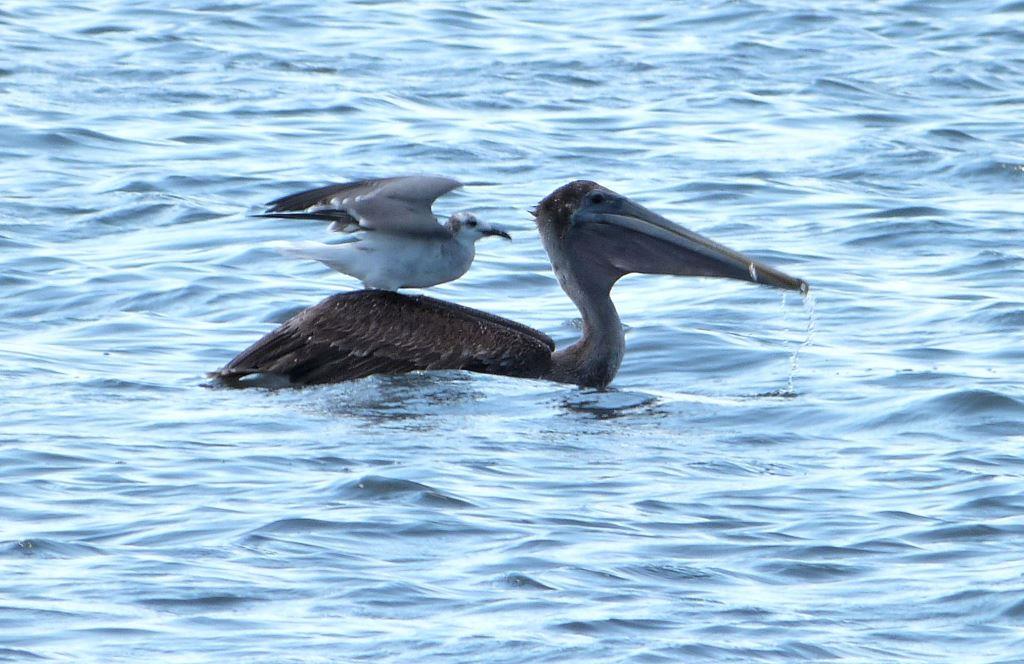
Laughing Gull landing on Brown Pelican

Laughing Gull landing on Brown Pelican by Lee

Gulls are resourceful, inquisitive, and intelligent, the larger species in particular. For example, many gull colonies display mobbing behavior, attacking and harassing predators and other intruders. Certain species have exhibited tool-use behavior, such as the herring gull, using pieces of bread as bait with which to catch goldfish, for example.

More Information:

Story of the Wordless Book

Did Dinosaurs Turn into Birds? – Answers Chapter 24

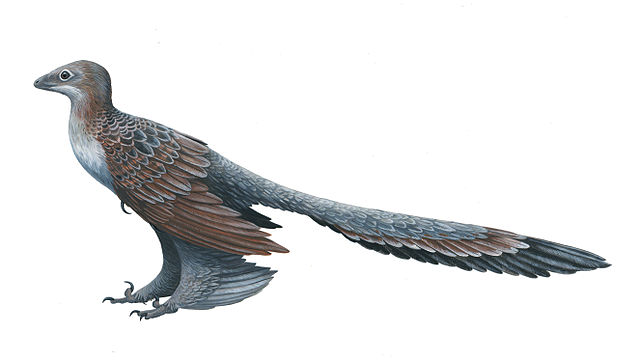
Changyuraptor yangi (aka feathered dinosaur) ©WikiC

Wow! Answers in Genesis placed the whole Chapter 24 of the New Answers Book 1 online. This chapter discusses the question:

Did Dinosaurs Turn into Birds?

Introduction

According to many evolutionists today, dinosaurs are really not extinct but rather are feeding at our bird feeders even as we speakFor many evolutionists, it would seem, birds simply are dinosaursWith this sort of bias, it is quite easy for evolutionists to find supposed evidence to support the notion that birds evolved from dinosaurs.

But what does the Bible tell us about the origin of birds, and just how good is the scientific evidence that some dinosaurs evolved into birds?…..

To see the whole article – Click Here

Newest Articles on the Kid’s Blog

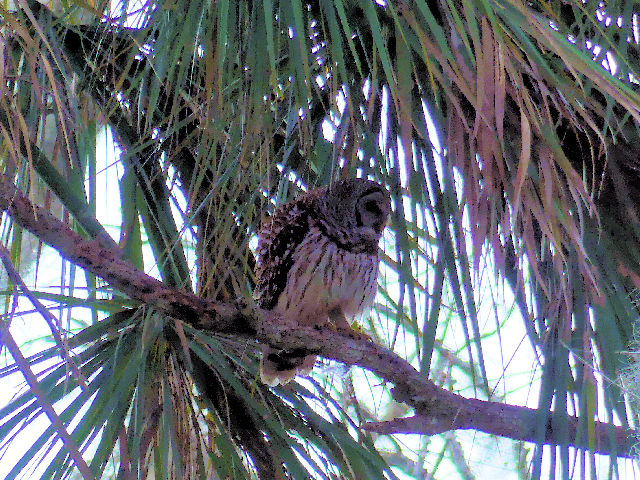
Barred Owl at Circle B by Lee

Our latest trip to Circle B Bar Reserve was rewarded with my first sighting of a wild Barred Owl. We have seen them in Zoos, but never in the wild.

See – Bible Birds – Owl’s Provision

Bible Birds – Holding On With My Feet

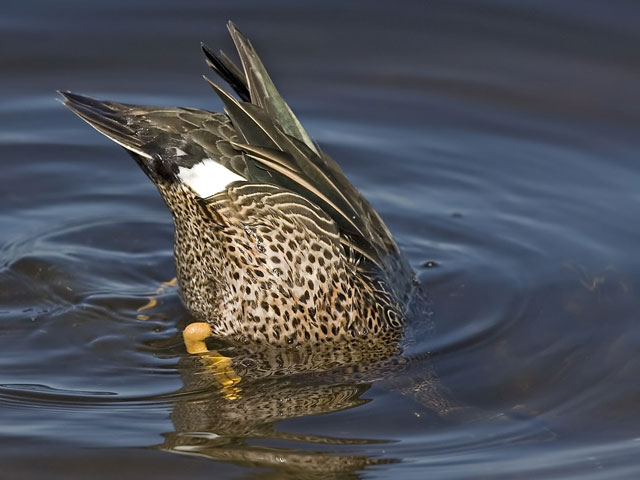
Blue-Winged-Teal-Dabbling ©Flyways USFWS

Blue-Winged-Teal-Dabbling ©Flyways USFWS

Birdwatching Term – Dabbling Duck

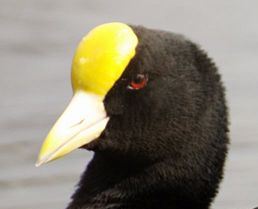
White-winged Coot (Fulica leucoptera) Cropped ©WikiC

White-winged Coot (Fulica leucoptera) Cropped ©WikiC

Birdwatching Term – Frontal Shield

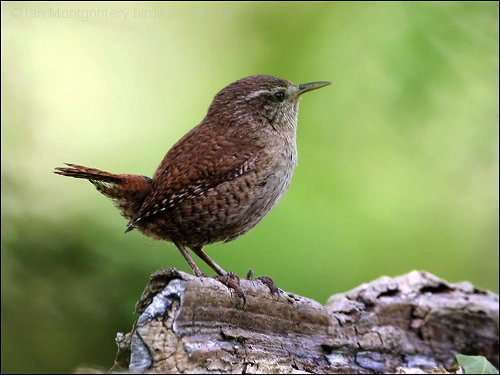
Winter Wren (Troglodytes troglodytes) by Ian

Winter Wren (Troglodytes troglodytes) by Ian

Jenny Wren Arrives – Chapter 1

Hope you will check these out and if you like them, consider following that blog also. Lots of interesting things to share with your children and grandchildren.

“And thou shalt love the LORD thy God with all thine heart, and with all thy soul, and with all thy might. And these words, which I command thee this day, shall be in thine heart: And thou shalt teach them diligently unto thy children, and shalt talk of them when thou sittest in thine house, and when thou walkest by the way, and when thou liest down, and when thou risest up.” (Deuteronomy 6:5-7 KJV)

No, the posts aren’t scripture, but there are always principles to grow and learn by. Enjoy!

Sharing the Gospel

Bible Birds – Owl’s Provision

Barred Owl at Circle B by Lee

Barred Owl at Circle B by Lee

“The beast of the field shall honour me, the dragons and the owls: because I give waters in the wilderness, and rivers in the desert, to give drink to my people, my chosen.” (Isaiah 43:20 KJV)

We were recently out to Circle B Bar Reserve and spotted this Barred Owl. There have been numerous articles here about this Owl, but this is the first time I have seen one in the Wild. I have heard them, but not seen them.

As we were getting our cameras out of the car [and my walker] we spotted a group of birders concentrating on one area. They pointed out a palm tree with a dark figure in it.

Barred Owl in the Palm Tree – Do you see it?

The rest of the photos have been lightened up to see it better. When we first spotted it, it was still, as if asleep. After walking to the marsh and back, I searched for the Owl again. Sure enough, he was still there. This time looking around. [top two photos] It is always enjoyable to spot an owl in the daytime. They are mostly nighttime birds.

“The beast of the field shall honour me, the dragons and the owls” Why do they honor the Lord their Creator? One reason is because He “give waters in the wilderness, and rivers in the desert, to give drink to my people, my chosen.” The water that is provided for people also provides water for the critters and birds to drink.

May this Barred Owl be a reminder of the love and provisions that the Lord provides for us. He cares about us and wants us to ask for and thank Him for all the good provisions (food, water, house, bed, clothes, parents, etc.) He gives.

“But ask now the beasts, and they shall teach thee; and the fowls of the air, and they shall tell thee:” (Job 12:7 KJV)

See:

Many More Birds Have Arrived!

Birds of the Bible for Kids is Under Construction
Keep Checking

The dust is thinning out a bit.

Here is the Latest list of pages and articles that have flown over to the Birds of the Bible for Kids site. The ones in blue are the newest arrivals. Wow! I had forgotten about so many of these articles. They are being re-published to current dates.

I trust you will check some of these out. If you have youngsters and/or teenagers, or, grandchildren, you may want to share these with them.

The Bible Bird indexes that are now open are GROWING:

“I will meditate also of all thy work, and talk of thy doings.” (Psalms 77:12 KJV)

Bible Birds

Brown Pelican and Laughing Gull - Waiting

Waiting

Here are some of the articles that are active again: (reverse order as they were released)

STAY TUNED!!

Really Really Dusty!!

Birds of the Bible for Kids is Under Construction
Keep Checking

At times I think I may have bitten off more than I can chew. It was easier moving the Birds of the Bible for Kids material over here than it is trying to move it back to the original location. :)

Things are progressing over there, but it is still quite dusty.

Dust storm over I-10 in Arizona ©AZGeology

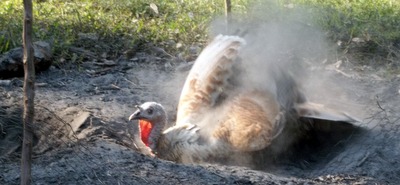
In fact, the birds have been taking “Dust Baths”!!

Turkey taking a Dust Bath ©Jim Block

Here’s another one I caught Dust Bathing with some of the dust that is being kicked up:

Dust Bathing

There has been some progress though. All of the Scriptural Alphabet of Animals are active.

Here are some of what has been going on over at Birds of the Bible for Kids:

The Bible Bird indexes that are open are:

Bible Birds

Here are some of the articles that are active again: (reverse order as they were released)

STAY TUNED!!