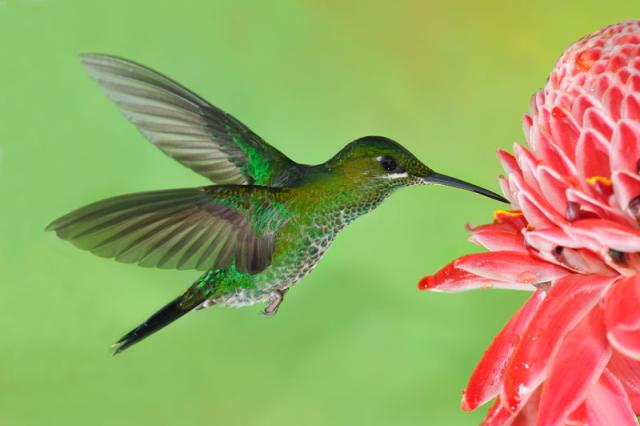
This is the second set of Christmas Birds. This time the Green Birds are featured. Hope you enjoyed the Christmas Birds – Red.
Again the Lord created these birds and colored them for their protection and to show off to their mates. There are many more that could be shown, but you may want to find some yourself.
Have you not known? Have you not heard? The everlasting God, the LORD, The Creator of the ends of the earth, Neither faints nor is weary. His understanding is unsearchable. (Isaiah 40:28 NKJV)
*
This slideshow requires JavaScript.
*
Here is the Music as Choir Entered for the Cantata (looped)
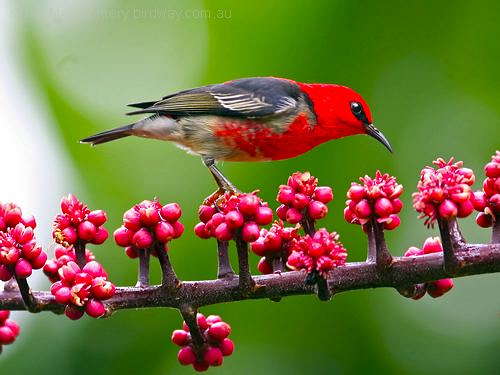
Now that Christmas is just over a week away, it’s time to see some of the birds that have “traditional” Christmas colors. Today’s color will be birds that have some sort of red on them. Other colors will be shown during the week. I have added new photos this year and some new colors later in the week.
When the Lord created the birds (fowls), He used many different colors, most for the protection of the bird (to blend in) or for display to attract a mate (to stand out).
We trust you enjoy the photos and that you are blessed as you consider the bird’s Creator, Who came to earth as a babe in a manger, so that He might redeem us from our sin. “All things were made through him, and without him was not any thing made that was made. (John 1:3)
But made himself of no reputation, and took upon him the form of a servant, and was made in the likeness of men: And being found in fashion as a man, he humbled himself, and became obedient unto death, even the death of the cross. (Philippians 2:7-8 KJV)
*
This slideshow requires JavaScript.
Come now, and let us reason together, saith the LORD: though your sins be as scarlet, they shall be as white as snow; though they be red like crimson, they shall be as wool. (Isaiah 1:18 KJV)
I thought it might be enjoyable to bring back a series of Christmas Birds that were first published in 2010 and reposted in 2013. [Who can remember back then? :) ] I hope you will enjoy seeing them again, or for the first time.
Christmas White-eye (Zosterops natalis) by Ian
Luke 2:15-20 KJV
(15) And it came to pass, as the angels were gone away from them into heaven, the shepherds said one to another, Let us now go even unto Bethlehem, and see this thing which is come to pass, which the Lord hath made known unto us.
(16) And they came with haste, and found Mary, and Joseph, and the babe lying in a manger.
(17) And when they had seen it, they made known abroad the saying which was told them concerning this child.
(18) And all they that heard it wondered at those things which were told them by the shepherds.
(19) But Mary kept all these things, and pondered them in her heart.
(20) And the shepherds returned, glorifying and praising God for all the things that they had heard and seen, as it was told unto them.
While searching to find birds to write about with a Christmas theme, I came across the Territory of Christmas Island which belongs to Australia. It is in the Indian Ocean and only has a population of 1,403 residents who live in a number of “settlement areas” on the northern tip of the island.
*
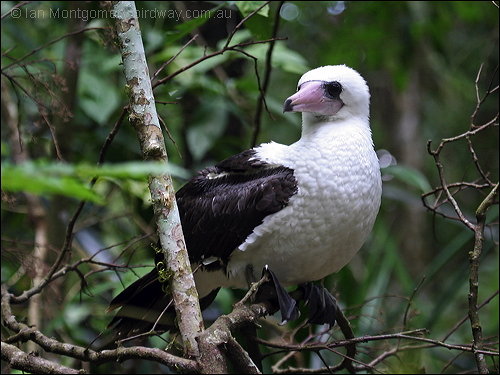
Abbott’s Booby (Papasula abbotti) by Ian
The island’s geographic isolation and history of minimal human disturbance has led to a high level of endemism (or state of being unique to a defined geographic location, such as an island, nation or other defined zone, or habitat type, and found only there) among its flora and fauna, which is of significant interest to scientists and naturalists. 63% of its 135 square kilometres (52 sq mi) is an Australian national park. There exist large areas of primary monsoonal forest.
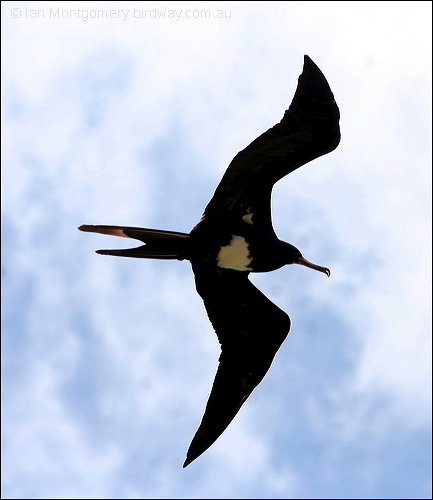
Christmas Frigatebird (Fregata andrewsi) by Ian
Christmas Island is a focal point for sea birds of various species. Eight species or subspecies of sea birds nest on the island. The most numerous is the Red-footed Booby that nests in colonies, in trees, on many parts of the shore terrace. The widespread Brown Booby nests on the ground near the edge of the seacliff and inland cliffs. Abbott’s Booby nests on tall emergent trees of the western, northern and southern plateau rainforest. The Christmas Island forest is the only nesting habitat of the Abbott’s Booby left in the world. The endemic Christmas Island Frigatebird (listed as endangered) has nesting areas on the north-eastern shore terraces and the more widespread Great Frigatebirds nest in semi-deciduous trees on the shore terrace with the greatest concentrations being in the North West and South Point areas. The Common Noddy and two species of bosuns or tropicbirds, with their brilliant gold or silver plumage and distinctive streamer tail feathers, also nest on the island.
Christmas Imperial Pigeon (Ducula whartoni) by Ian Montgomery
Of the ten native land birds and shorebirds, seven are endemic species or subspecies. This includes the Christmas Island Thrush, and the Christmas Island Imperial Pigeon. Some 86 migrant bird species have been recorded as visitors to the Island.
Seriously, we love Storks here on the blog. And we know that the stork family were, like other birds, created by God. Take a look through some of our previous post abort Storks:
Song of Solomon 2:12
“The flowers appear on the earth; the time of singing has come, and the voice of the turtledove is heard in our land.”
The Bible speaks of bird calls as songs, as most of us do. However, evolutionary theory has led some scientists to say that we are merely assigning human meanings to the calls of birds. They say that the bird calls have nothing to do with real music.
Ornithologists have known for some time that bird songs use the same musical scales as our music. Decades ago, it was noted that some of Beethoven’s work could be heard from the European blackbird. The music was the same as the opening rondo of Beethoven’s “Violin Concert in D, Opus 61.” Since these birds pass their songs from generation to generation, Beethoven could have gotten the lilting music from the forefathers of today’s European blackbird! The songs of some species, like the song sparrow, follow the form of a sonata, beginning with a strong theme, then the theme is musically played with, and for a finish, the original theme is then repeated. Mozart had a starling as a pet. Once, having heard Mozart play his “Piano Concerto in C Major,” the starling not only imitated it, but changed the sharps to flats! Mozart exclaimed, “That was beautiful!” When the starling died, Mozart held an elaborate funeral for it. Eight days later he wrote “A Musical Joke,” which contains the same elaborate structure found in starling song.
Do birds make true music, as the Bible says? Contrary to what some evolutionists say, Beethoven and Mozart certainly thought they did.
Prayer: Lord, I thank You for the gift of music, and I await the music of heaven. Amen.
Author: Paul A. Bartz
Ref: Science News, 4/15/00, pp. 252‑254, “Music without Borders.” PhotoA Song Sparrow singing by Keith CCA 2.0
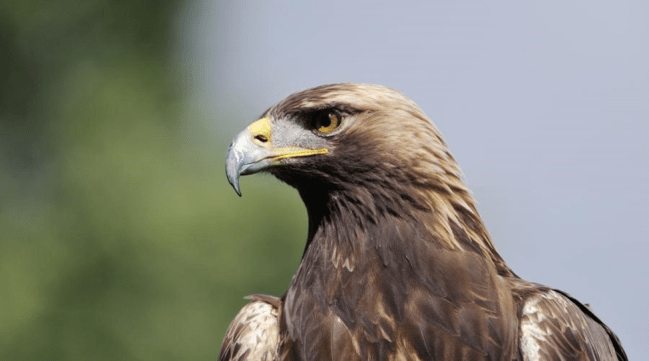
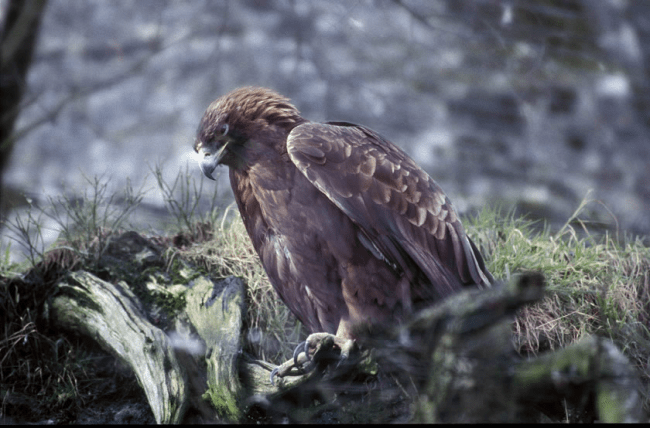
GOLDEN EAGLE [photo credit: THE SCOTTISH BANNER, November AD2022]
“Does the hawk fly by your wisdom, and spread its wings toward the south? Does the eagle mount up at your command, and make its nest on high? On the rock it dwells and resides, on the crag of the rock and the stronghold. From there it spies out the prey; its eyes observe from afar.”
JOB 39:26-29
It’s time for some good news—Golden eagles, thanks to some successfully relocated from the Outer Hebrides, are making a comeback in southern Scotland! Consider this happy report from the online November (AD2022) issue of THE SCOTTISH BANNER:
The pioneering South of Scotland Golden Eagle Project has become the first in the UK to successfully translocate free-flying young golden eagles (aged between 6 months and 3 years) to boost a low population of this iconic bird. These new additions bring the total number of golden eagles in the south of Scotland to around 33 – the highest number recorded here in the last three centuries. Taking a new research approach, under licence from NatureScot, the team leading the ground-breaking charity project revealed that they had successfully caught, transported and released seven golden eagles from the Outer Hebrides. . . .
The Outer Hebrides were selected as the source to boost the south of Scotland population because these Islands host one of the highest densities of golden eagles in Europe. The birds were released almost immediately on arrival in a secret location in the southern uplands of Scotland. The project team is continuing to monitor the birds’ progress to see if they settle and breed in the area. If they do, this could be a ground-breaking for the project.
Francesca Osowska, NatureScot’s Chief Executive, said: “This ground-breaking project has accomplished so much over just a few years, bringing a viable population of golden eagles back to south Scotland . . . it’s wonderful to see a success like this. Golden eagles are a vital part of Scotland’s wildlife, and we’re passionate about returning them to places where they used to thrive. . . .”
[Quoting Staff writer, “South of Scotland Golden Eagle Population Reaches New Heights Thanks to Novel Research Technique”, THE SCOTTISH BANNER, November AD2022.]
For another photograph of this magnificent raptor, see ornithologist Lee Dusing’s post “Golden Eagles in Scotland”, posted November 28th of AD2018, at https://leesbird.com/2018/11/28/golden-eagles-in-scotland-youtube/ — wherein Lee cites the very relevant Scripture, Job 39:27.
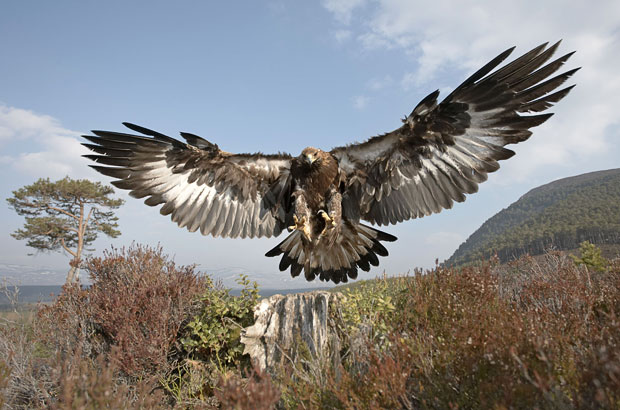
GOLDEN EAGLE (Wilderness Scotland photo credit)
For extra explanation about how eagles fly—thanks to God’s bioengineering design and construction of these heavy-bodied (and often-soaring) birds—review my online article titled “Hawks and eagles Launching Skyward”, ACTS & FACTS, 47(4):21 (April 2018), posted at www.icr.org/article/hawks-eagles-launching-skyward — noting that the same Hebrew verb [paras], which is used to describe raptor birds’ wing-spread in Job 39:26, is likewise used in Isaiah 33:23 to describe how boat-sails are spread out to catch (and thus harness the power of) the wind.
God taught the patriarch Job a lot about His creation in the “nature sermon” (filled with rhetorical questions) in Job 38–41. God used examples of wildlife to illustrate His wise and caring providence. In particular, He challenged Job to appreciate how and why hawks and eagles fly high in the skies above, looking far and wide for earthbound food. . . .
Some who read Job 39:26 assume hawk migration is the question’s topic. But because God compares the hawk’s aerial behavior to eagle flight, the context suggests otherwise. Both raptors require special aerodynamics to lift their heavy bodies into the air. God designed these raptors to utilize weather-powered “elevators” to ascend into air currents. . . .
Rising hot-air currents routinely blow in from south of Israel, so hawks can “catch a ride” simply by stretching out their wings southward, just as sailors harness wind to power boats at sea. Gliding and soaring on extended wings reduces air resistance as well as the hawk’s need to burn energy by flapping.
Likewise, when God commands wind to blow, eagles can “mount up” (literally, “cause to fly”) upon rising thermal air currents—as if they were elevators—and glide almost effortlessly until they spy food far below with their super-powerful distance vision.
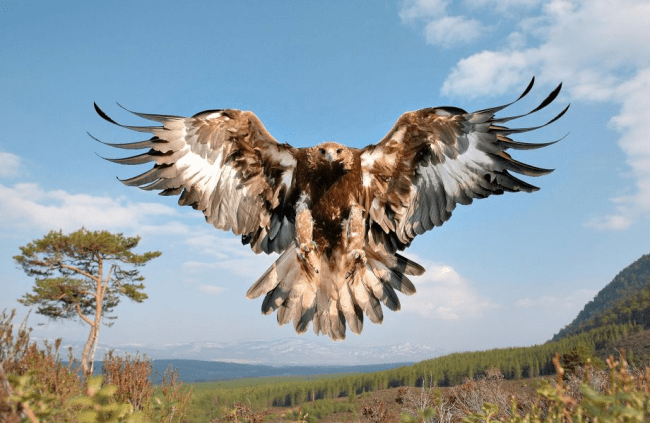
GOLDEN EAGLE in Cairngorms Park, Scotland (Peter Cairns / NATUREPL.COM photo credit)
Eagles are majestic birds famous for nesting in high places (Obadiah 1:4), moving through the air in marvelous maneuvering movements (Proverbs 30:19), energized and powered by God’s sustaining enablements (Isaiah 40:31).
When I think of eagles—both golden eagles and bald eagles, or any other kind of eagles—and contemplate what God has put into these magnificent birds, I think of the old doxological hymn HOW GREAT THOU ART!
Bar-Tailed Godwit’s Migration Sets Nonstop Mileage Marathon Record, for Aerial Flapping Flight Over the Pacific Ocean
And God said, Let the waters bring forth abundantly the moving creature that hath life, and fowl that may fly above the earth in the open firmament of heaven.
(Genesis 1:20)
It seems that nonstop flying, over thousands of miles of ocean, is not limited to Boeing 747s — just ask an over-the-ocean-flying migratory Bar-tailed Godwit, a long-hauling tough-traveling sandpiper known to scientists as Limosa lapponica.
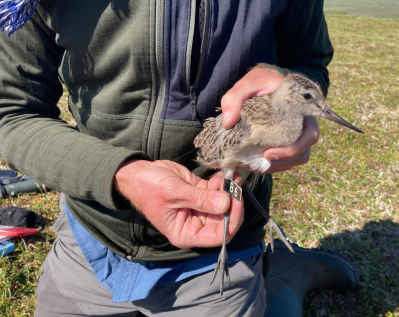
Tagging juvenile BAR-TAILED GODWIT “B6” on July 15th AD2022, near Nome, Alaska
(Photo credit: Dan Ruthrauff / U.S. Geological Survey)
Yet some scientists have recently documented the ecological advantages to such seasonal migratory flights, even when those aerial migrations include staggeringly long nonstop over-the-ocean wing-flapping flights:
Mountain ranges, deserts, ice fields and oceans generally act as barriers to the movement of land-dependent animals, often profoundly shaping migration routes. [This study] used satellite telemetry to track the southward flights of bar-tailed godwits (Limosa lapponica baueri), shorebirds whose breeding and nonbreeding areas are separated by the vast central Pacific Ocean. Seven females with surgically implanted transmitters flew non-stop 8117–11680 km … directly across the Pacific Ocean; two males with external transmitters flew non-stop along the same corridor for 7008–7390 km. Flight duration ranged from 6.0 to 9.4 days … for birds with implants and 5.0 to 6.6 days for birds with externally attached transmitters…. [It seems] that this transoceanic route may function as an ecological corridor rather than a barrier, providing a wind-assisted passage relatively free of pathogens and predators.
(quoting Gill et al., cited below)
[Quoting from Robert E. Gill, Jr., T. Lee Tibbitts, et al., “Extreme Endurance Flights by Landbirds Crossing the Pacific Ocean: Ecological Corridor Rather than Barrier?” PROCEEDINGS OF THE ROYAL SOCIETY B, 276:447-457 (posted online October 29th AD2008.]
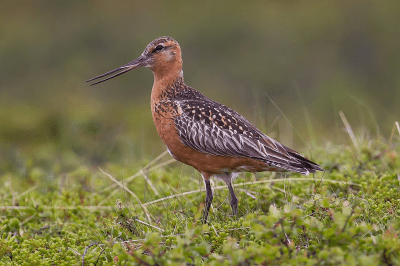
BAR-TAILED GODWIT in breeding plumage (photo credit: Wikipedia/Andreas Trepte)
This is not the first time that ornithologist Robert E. Gill, Jr. has reported on the tremendous treks of Bar-tailed Godwits migrating southwardly from Alaska to New Zealand and Eastern Australia. [See Robert E. Gill, Jr., Theunis Piersma, et al., “Crossing the Ultimate Ecological Barrier: Evidence for an 11000-km-Long Nonstop Flight from Alaska to New Zealand and Eastern Australia by Bar-tailed Godwits”, THE CONDOR, 107(1):1-20 (February 2005), noting that observations indicate that the Alaska-based Bar-tailed Godwits “migrate directly across the Pacific, a distance of 11 000 km” and that they do so “in a single flight without stopping to rest or refuel”.]
In short, these birds know how to use wind currents to their advantage—which is not news to Bible readers, especially to those who have considered the thermal air currents referred to in Job 39:26-29, which says:
Doth the hawk fly by thy wisdom, and stretch her wings toward the south? Doth the eagle mount up at thy command, and make her nest on high? She dwelleth and abideth on the rock, upon the crag of the rock, and the strong place. From thence she seeketh the prey, and her eyes behold afar off.
(Job 39:26-29,)
[For analysis of this Bible passage, from a creation ornithology perspective, see also JJSJ, “Hawks and Eagles Launching Skyward”, ACTS & FACTS, 47(4):21 (April 2018), posted at www.icr.org/article/hawks-eagles-launching-skyward .]
God designed and made bird wings. Bird wings, almost without exception, were designed for winds. (Penguins, of course, are exceptions—their wings were designed for underwater “flying”.) For a technical study that documents how important winds are for wings—of Bar-tailed Godwits—see Jesse R. Conklin & Phil F. Battley, “Impacts of Wind on Individual Migration Schedules of New Zealand Bar-tailed Godwits”, BEHAVIORAL ECOLOGY, 22(4):854-861 (June 2011), documenting how some Bar-tailed Godwits time their departure dates to maximize harnessing helpful wind currents for nonstop flying migrations.
On the Pacific Ocean side of the globe, these phenological patterns are conspicuously exhibited in the migrations of wading shorebirds, such as skinny-legged sandpipers, who flap their wings in flight (as opposed to relying mostly on gliding). But one such migratory sandpiper—the Bar-tailed Godwit, takes wing-flapping flight to the maximum!
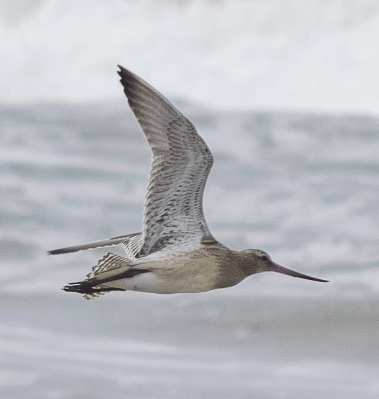
BAR-TAILED GODWIT, in flight over the ocean
(photo credit: Wikipedia/Paul van de Velde)
In particular, the New Zealand-breeding subspecies of that marathon-migrating wading bird (Limosa lapponica baueri), has been making ornithology news, again, this year. But before considering this year’s news, consider news about Bar-tailed Gotwits from last year:
On September 28, one small bird completed a very long flight. An adult, male Bar-tailed Godwit, known by its tag number 4BBRW, touched down in New South Wales, Australia, after more than 8,100 miles in transit from Alaska —flapping its wings for 239 hours without rest, and setting the world record for the longest continual flight by any land bird by distance. And 4BBRW isn’t even done yet. In the next few days, the Godwit is expected to end its southbound migration in New Zealand after its well-earned island stopover, says Adrian Riegen, a builder from West Auckland [New Zealand] and a passionate birdwatcher.
From his home office, usually reserved for managing building projects, Riegen keeps tabs on 4BBRW and 19 other Bar-tailed Godwits fitted with solar-powered location trackers. During migration season, he spends at least an hour each morning going through the most recent location data and writes a daily report for the ongoing project, run by the Pūkorokoro Miranda Shorebird Center, an education and research nonprofit in Miranda, New Zealand, where many Godwits spend non-breeding months. All of the best tidbits he compiles are disseminated to the center’s followers on Facebook and Twitter, so that people can follow along with the birds’ cross-hemisphere, trans-oceanic journeys—speed bumps and all. “It’s such an amazing story,” Riegen says. “We want to share it as widely as we can.”
Although 4BBRW’s feat is astounding, it may not be particularly surprising. Bar-tailed Godwits are incredible migrants: Individuals have broken the “longest, non-stop, migration” record more than once since satellite tracking began in 2007 and regularly make continuous flights of more than 7,000 miles.
In fact, 4BBRW previously held the world record for his 2020 flight of 7,580 miles. And just three days before 4BBRW’s 2021 touch-down, a female godwit, tagged 4BYWW, completed a trip of a similar distance that was briefly considered the record. While multiple subspecies of Bar-tailed Godwit make long distance journeys around the world, the New Zealand-Alaska population travels the farthest in its migration loop. “It’s this thing of imagination and magic that we have in this world, to think this tiny little bird traveled thousands of miles,” says Audubon Alaska executive director Natalie Dawson.
Unlike albatross or other long-flying seabirds, godwits are active flyers [a/k/a “flappers”], not gliders—their wings are moving the whole time. “It just beggars belief, really,” Riegen says. “I mean, though I’ve known that for decades now, I still find it hard to imagine how anything can keep up that sort of effort 24-hours a day, without taking a break.”
“4BBRW has outdone itself two years in a row. Project researchers are hoping the location trackers last for many more years, so they can continue to keep tabs on how birds’ paths change over time.”
With that impressive background we can appreciate the latest news about the long-distance nonstop migration of this tough-travelling shorebird:
This [October] is the time of year when Alaska’s migratory birds uproot and move to warmer places. But one shorebird in particular made history this past week after it was tracked flying thousands of miles nonstop [calculated as 8,425 or perhaps 8,435 aerial miles!] to the southern hemisphere, drawing international attention and potentially giving scientists new insight into the future of a declining population of shorebirds.
Earlier this week [at the end of October AD2022], a bar-tailed godwit, tagged as “B6″, completed its migration from the Western Alaska coast to Southern Australia, a non-stop journey of nearly 8,500 miles completed in 11 days. …
The center of attention: a four-month-old shorebird weighing just 600 grams — a little more than a pound, or slightly heavier than a can of beans. The journey, tracked for the first time using a real-time solar-powered transmitter, is being described as a world record.
Lee Tibbitts, a wildlife biologist with the U.S. Geological Survey’s Alaska Science Center, has been researching these birds for decades and was part of the team that began observational studies about 40 years ago, before technology enabled satellite tracking.
Prior to this work, nobody really believed that nonstop migration across the Pacific Ocean was possible, said Dan Ruthrauff, a USGS research wildlife biologist who helped tag B6.
B6 is the first tagged Alaska-breeding bar-tailed godwit chick whose migration was successfully tracked. Not only did it complete its migration, but it flew nearly 1,600 miles farther than its species’typical migration route from Alaska to New Zealand –– something Ruthrauff hypothesizes could have been a result of strong easterly winds.
“They don’t land on the water. They don’t glide. This is flapping flight for a week and a half,” he said.
The chick [Bar-tailed Godwit identified as “B6”] was just one of three that was fitted with a transmitter this summer. The other two transmitters are still sending signals from the tundra on the Seward Peninsula. Ruthrauff guesses that they were too loose and fell off the birds before their migration.
The transmitter, attached using surgical-grade silicon tubing, weighs just five grams and fits like a fanny pack, Ruthrauff said. The antenna trails off from the bird’s tail and is fitted with a solar panel. Once fitted with the transmitter, all that was left for Ruthrauff and his team to do was to wait.
During that time, B6 moved to its staging area on the Kuskokwim Delta and stayed there for about six weeks, fattening up on clams, worms and berries for the trip –– much like a bear getting ready for hibernation. “It’s pretty crazy how much bigger they get,” Ruthrauff said. “It’s mostly just fat –– little butter balls.”
In preparation for the trip, these birds increase the size of their gizzard, stomach, kidney, liver and length of their intestine in order to metabolize the foods that they’re eating, Ruthrauff said. As they approach time to migrate, the digestive tract begins to atrophy while their heart and pectoral muscles increase in size.
Bar-tailed godwit chicks migrate without their adult counterparts and are known to take advantage of weather systems along their route.
Set up with a “smokin’” tailwind, B6 departed Alaska on Oct. 12. (quoting Mesner, cited below)
[Quoting Emily Mesner, ANCHORAGE DAILY NEWS, posted October 31st AD2022, at news.yahoo.com/juvenile-shorebird-tagged-alaska…]
A map showing the migration route of bar-tailed godwit, B6.
(Image credit: courtesy of Jesse Conklin/Max Planck Institute of Ornithology)
Providentially, Godwit B6 arrived safely on October 23rd of AD2022, in Eastern Australia. What an exhausting nonstop trip!
The obvious take-away lesson, from this astounding journey, is that the southward migration of Alaska’s Bar-tailed Godwits cannot be the product of random trail-and-error experiments by birds trying to “evolve” in a supposedly “survival-of-the-fittest” world, as imagined by evolutionists.
Rather, these brave birds can only survive and thrive in this world, the real world that the Holy Bible perfectly describes, because God has carefully and caringly provided these wing-flapping migrants with whatever they need to succeed—and they do, thanks to their (and our) Creator, the Lord Jesus Christ!
And God said, Let the waters bring forth abundantly the moving creature that hath life, and fowl that may fly above the earth in the open firmament of heaven.
(Genesis 1:20)
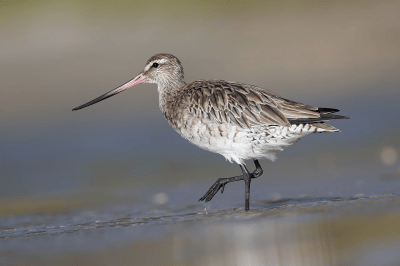
BAR-TAILED GODWIT over-wintering plumage, Australia
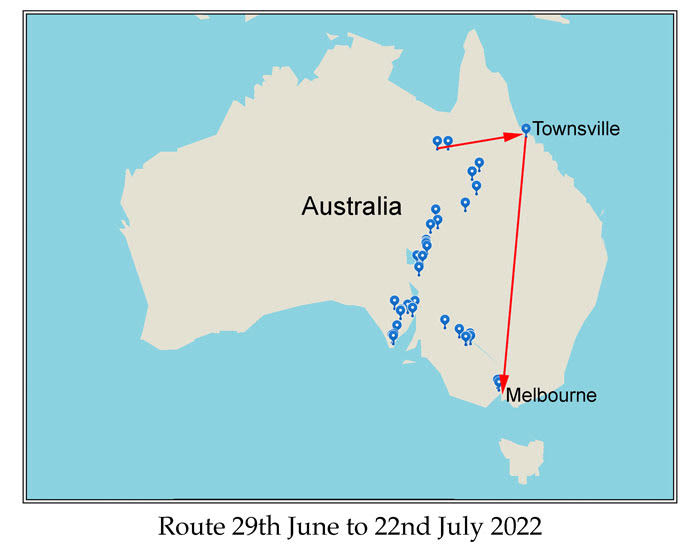
In July I went on an overland bird-watching trip organised by a friend of mine in Melbourne. The main goal was finding arid country birds for two English birders. I tagged along to take some photos. We met up in Melbourne. Then we drove through Western Victoria to the Eyre Peninsula in South Australia, along the Birdsville Track and through Western Queensland to Mt Isa. I flew home from there, while the others continued to the Gulf of Carpentaria and finally to Cairns, so that the English pair could fly back to London.
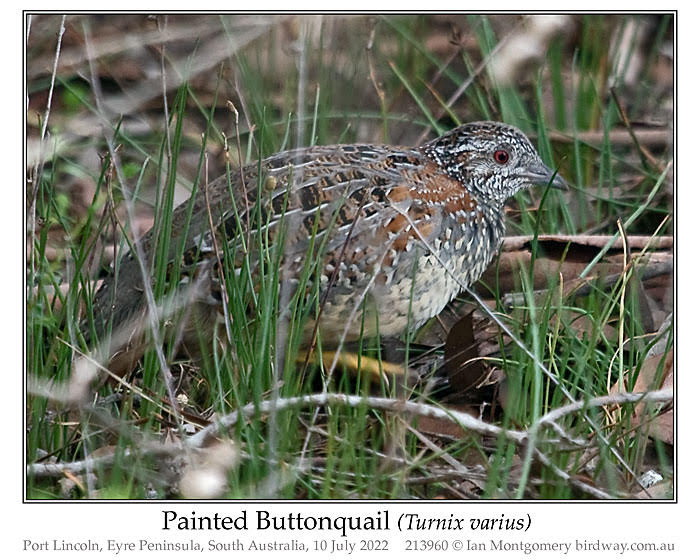
Australia has four species of bird called “Painted”, and we saw three of these on the trip, so I thought I’d do a Painted edition of the Irregular Bird. The first that we saw, and perhaps the one best deserving the moniker, is the Painted Buttonquail. It’s quite a work of art, meticulously and delicately decorated with a grey, rufous and black background highlighted with white streaks and spots. The result is both strikingly beautiful and brilliantly camouflaged against the woodland leaf litter where it occurs.
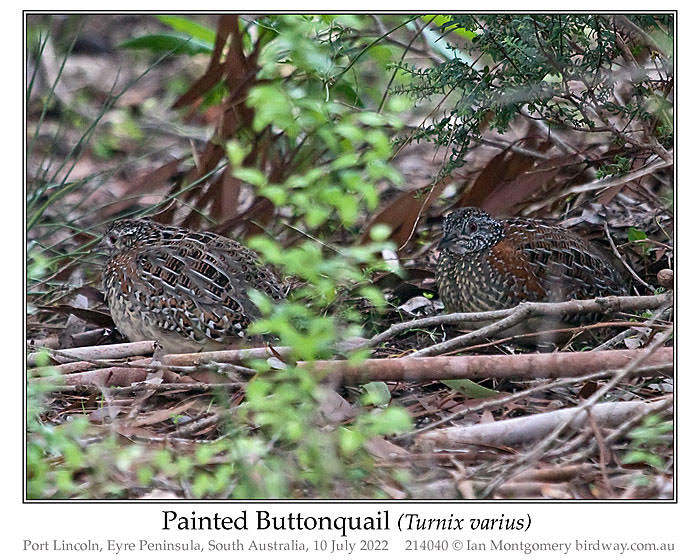
Buttonquails are strange quail-like birds related to waders rather than game birds. They are well represented in Australia with seven of the seventeen global species, the others being distributed throughout Asia, Africa and Southern Europe. They’re cryptic and hard to see, though the feeding habits of the Painted make it easier to find than the others. They search for food by rotating in a tight circle in leaf litter, like the pair in the second photo, leaving circular bare patches called “platelets”. Fresh platelets in an area known for them are a good indication that careful searching for them is justified.
Buttonquails are one of the groups of birds where there is a gender reversal in display, incubating the eggs and rearing the young. So the females are more brightly coloured. Note that the female on the right of this pair has brighter rufous plumage on the shoulders, and she is larger than her male partner.
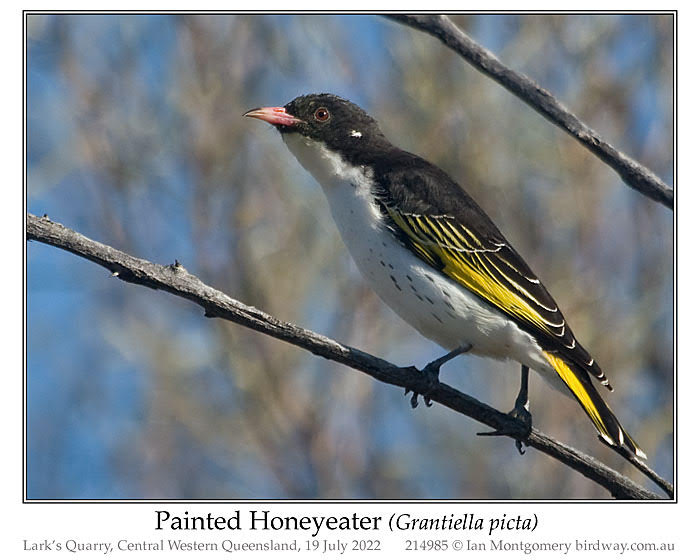
The next painted species we encountered was this Painted Honeyeater in central Western Queensland. This is an inland species breeding mainly in Victoria and New South Wales. In winter it migrates north and can be found sparsely distributed through southern and Western Queensland and the eastern part of the Northern Territory. It’s paint job isn’t as carefully executed as in some of the other painted birds, though it has bold yellow stripes on the wings. delicate black streaks on the flanks and a pink bill.
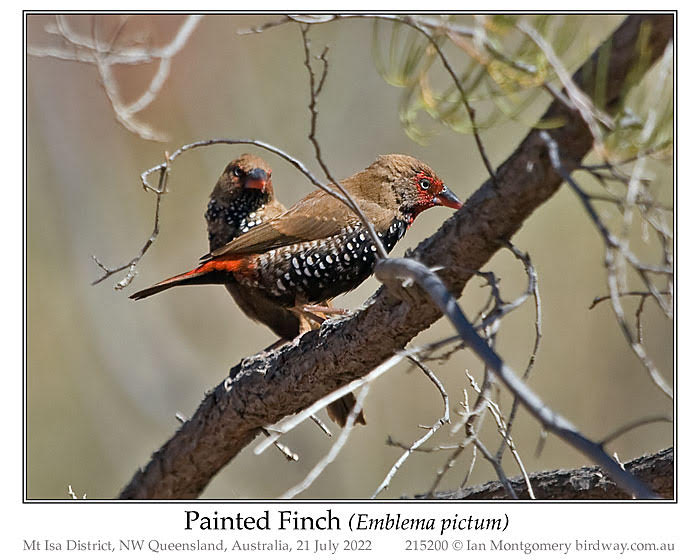
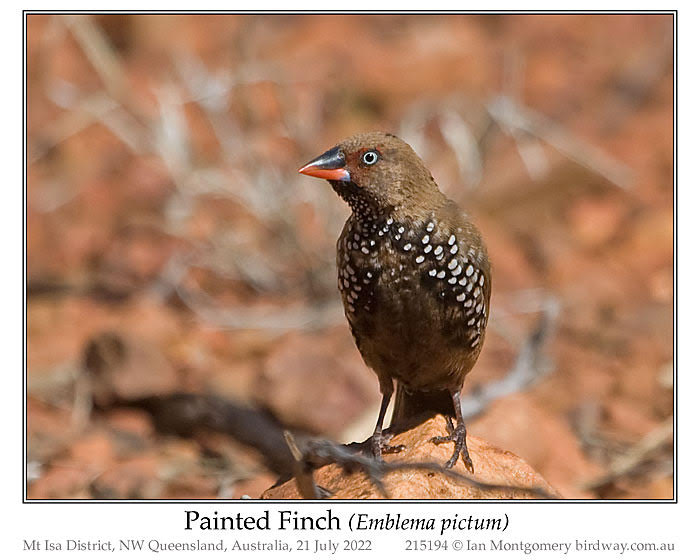
Species number three was the Painted Finch, a striking bird of arid country such as spinifex with a wide mainly tropical distribution from Western Queensland through the Northern Territory to Western Australia. Both sexes are red and brown with black heavily daubed with white spots. The male, in front in the first photo, has more red than the female behind him. The bird in the second photo is also a female.
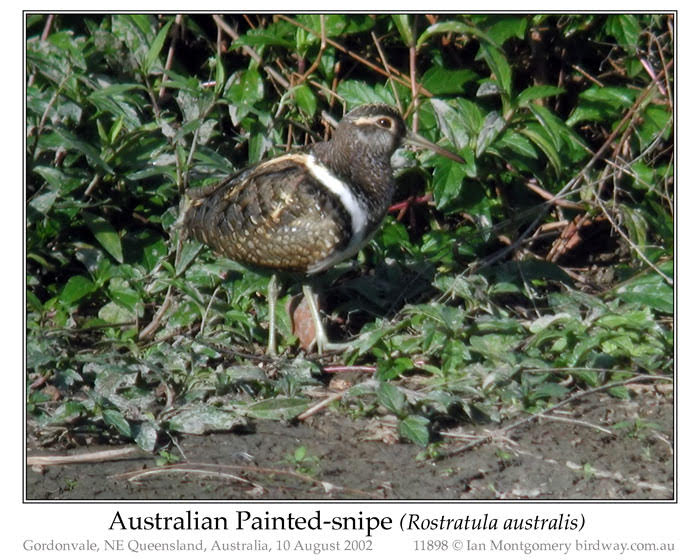
I’ve included the only other painted Australia bird, the Australian Painted-snipe, a bird of grassy wetlands. It’s rare and endangered owing to habitat loss and hard to find, though it turns up unexpectedly in different places.
The one in this photo is a male. Females are larger and more colourful, and you’re right: there’s a swapping of gender roles here too. It seems to be a habit among painted bird species, artistic license I suppose. Painted-snipes form their own family but they are thought to be related to Jacanas, which also swap roles. Maybe I should do an Irregular Bird on Australian Rainbow birds, though the sexes in these are almost identical and their preferences may be gender fluid for all we know.
Thanks, Ian for another irregular birding report. Looks like your birding trips are as irregular as ours are. (We have not been birding in months.)
What beautiful birds with designs and colors from their Creator. It is amazing that these colors also help protect them by blending them in with their surroundings. Thanks again for sharing your latest adventure with us.
“That they may see, and know, and consider, and understand together, that the hand of the LORD hath done this, and the Holy One of Israel hath created it.” (Isaiah 41:20 KJV)
Have you been surveilled lately? Is someone watching how you live? In particular, are any chickens checking up on you, as they look through a window of your house, to see what’s going on inside?
JJSJ (Glen Eyrie, A.D.2021), speaking on God’s creation — notice my red crab necktie [photo credit: David Rives]
As part of a Bible study at Glen Eyrie, Colorado (during September A.D.2021, led by creationists Dr. Jobe Martin & David Rives), our group reviewed various Bible passages, including one Scripture from the 1st chapter of the apostle Peter’s first epistle:
Of which salvation the prophets have enquired and searched diligently, who prophesied of the grace that should come unto you, searching what, or what manner of time the Spirit of Christ Who was in them did signify (when He testified beforehand the sufferings of Christ, and the glory that should follow)–unto whom [i.e., unto the O.T. prophets] it was revealed, that not unto themselves, but unto us [i.e., N.T. believers in Jesus] they did minister the things, which are now reported unto you by those who have preached the Gospel unto you, with the Holy Spirit sent down from heaven–which things the angels desire to look into.
(1st Peter 1:10-12)
In the above-quoted passage, which reports on the big picture (past, present, and future–Heaven and Earth), Peter refers to the wonderful redemption that God gives unto all of us who believe in the Lord Jesus Christ as our personal Savior. Specifically, Peter speaks of the magnificent salvation that we Christians now enjoy–as the free gift God gave us in and through Christ–which gracious salvation was prophesied of, centuries ago, by the Old Testament prophets (as is noted in Verses 10 & 11). And, amazingly (as we see in Verse 12), even the angels of Heaven have “desire[d] to look into” the glorious destiny that we forgiven human sinners enjoy because of our permanent relationship to Jesus Christ.
Imagine how angels marvel, as they watch human sinners being forgiven, being justified by Christ’s once-for-all death as our Substitute, guaranteed everlasting life in Heaven because Christ conquered death at His resurrection! In short, the angels of Heaven (whose creaturely lives never experience redemption) are curious, watching our being-redeemed-in-Christ lives as a must-see “spectacle”!
For I think that God hath set forth us the apostles last, as it were appointed to death; for we are made a spectacle unto the world, and unto angels, and unto men.
(1st Corinthians 4:9)
So the elect angels are curious “spectators“, observing how God works in our lives. In fact, as the Old Testament book of JOB indicates, even fallen angels learn from watching our lives (Job 1:6-12 & 2:1-6).
But that’s not all. Even chickens get curious at times! Hens like to watch humans. (Sometimes even roosters care about what humans are doing!)
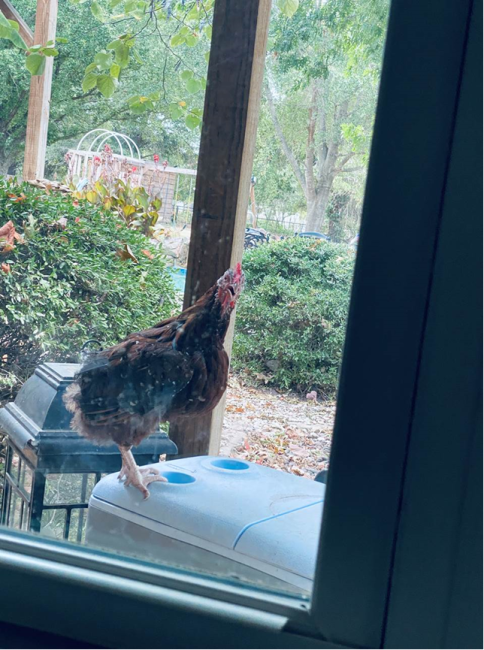
This cellphone photograph [see below, “peeping poultry“] is of 1 of about 16 laying hens that our dottir (Krista) is raising in her backyard (i.e., her egg-laying hens are housed inside a “palace”-like chicken coup, along with their rude rooster); our dottir regularly lets these “free-range” chickens roam in the backyard, sometimes for hours, so long as no hungry hawks are seen lurking aloft.
A few days ago one particular hen was especially curious—so she perched herself atop something, in order to see through a window—to check out what was happening inside the human family’s house!
So there you have it! — not only angels, but even chicken, care to see what we humans are doing. So, be careful how you live — you are being surveilled!
(Actually, the fact that God watches us, always, is more than enough reason to live carefully and to do right: “For the Father, up above, is looking down in love, so be careful, little hands, what you do.”)
family get-together at Krista’s house (No wonder chickens are curious about those happy humans!)
The Bank Swallow, the Kingfisher and the Sparrow Hawk.
The Burgess Bird Book For Children
Chapter 22
*
CHAPTER XXII. Some Feathered Diggers.
Peter Rabbit scampered along down one bank of the Laughing Brook,
eagerly watching for a high, gravelly bank such as Grandfather Frog had
said that Rattles the Kingfisher likes to make his home in. If Peter had
stopped to do a little thinking, he would have known that he was simply
wasting time. You see, the Laughing Brook was flowing through the Green
Meadows, so of course there would be no high, gravelly bank, because the
Green Meadows are low. But Peter Rabbit, in his usual heedless way, did
no thinking. He had seen Rattles fly down the Laughing Brook, and so he
had just taken it for granted that the home of Rattles must be somewhere
down there.
At last Peter reached the place where the Laughing Brook entered the
Big River. Of course, he hadn’t found the home of Rattles. But now he did
find something that for the time being made him quite forget Rattles and
his home. Just before it reached the Big River the Laughing Brook wound
through a swamp in which were many tall trees and a great number of
young trees. A great many big ferns grew there and were splendid to hide
under. Peter always did like that swamp.
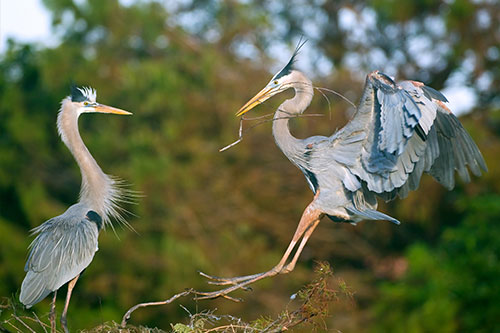
Great Blue Herons. American Expedition
He had stopped to rest in a clump of ferns when he was startled by
seeing a great bird alight in a tree just a little way from him. His
first thought was that it was a Hawk, so you can imagine how surprised
and pleased he was to discover that it was Mrs. Longlegs. Somehow
Peter had always thought of Longlegs the Blue Heron as never alighting
anywhere except on the ground. But here was Mrs. Longlegs in a tree.
Having nothing to fear, Peter crept out from his hiding place that he
might see better.
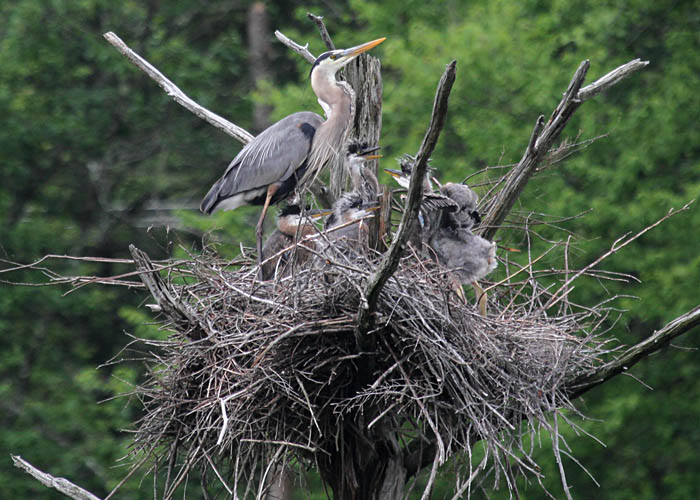
In the tree in which Mrs. Longlegs was perched and just below her he
saw a little platform of sticks. He didn’t suspect that it was a nest,
because it looked too rough and loosely put together to be a nest.
Probably he wouldn’t have thought about it at all had not Mrs. Longlegs
settled herself on it right while Peter was watching. It didn’t seem big
enough or strong enough to hold her, but it did.
Great Blue Heron-nest. Naturally-Curious Mary Holland
“As I live,” thought Peter, “I’ve found the nest of Longlegs! He and
Mrs. Longlegs may be good fishermen, but they certainly are mighty poor
nest-builders. I don’t see how under the sun Mrs. Longlegs ever gets on
and off that nest without kicking the eggs out.”
Peter sat around for a while, but as he didn’t care to let his presence
be known, and as there was no one to talk to, he presently made up his
mind that being so near the Big River he would go over there to see if
Plunger the Osprey was fishing again on this day.
When he reached the Big River, Plunger was not in sight. Peter was
disappointed. He had just about made up his mind to return the way he
had come, when from beyond the swamp, farther up the Big River, he heard
the harsh, rattling cry of Rattles the Kingfisher. It reminded him of
what he had come for, and he at once began to hurry in that direction.
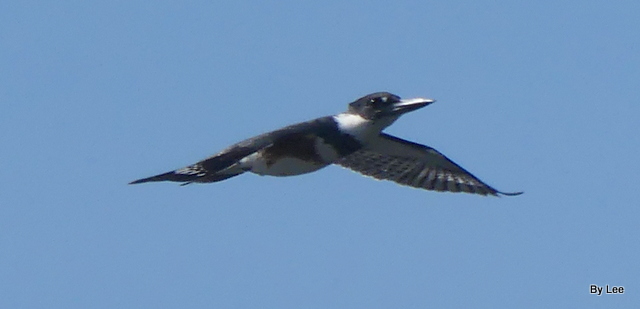
Belted Kingfisher at 11:24 am on 11/25/20 by Lee
Peter came out of the swamp on a little sandy beach. There he squatted
for a moment, blinking his eyes, for out there the sun was very bright.
Then a little way beyond him he discovered something that in his eager
curiosity made him quite forget that he was out in the open where it was
anything but safe for a Rabbit to be. What he saw was a high sandy bank.
With a hasty glance this way and that way to make sure that no enemy was
in sight, Peter scampered along the edge of the water till he was right
at the foot of that sandy bank. Then he squatted down and looked eagerly
for a hole such as he imagined Rattles the Kingfisher might make.
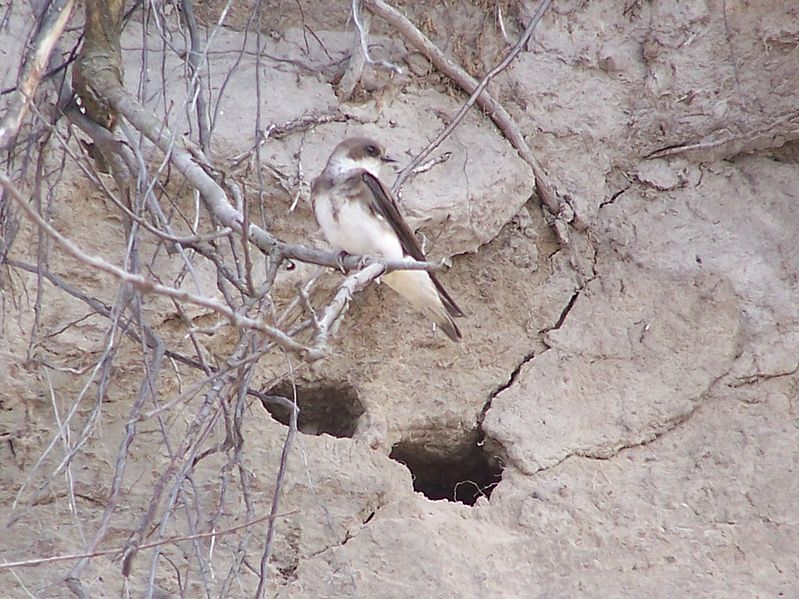
Instead of one hole he saw a lot of holes, but they were very small
holes. He knew right away that Rattles couldn’t possibly get in or out
of a single one of those holes. In fact, those holes in the bank were
no bigger than the holes Downy the Woodpecker makes in trees. Peter
couldn’t imagine who or what had made them.
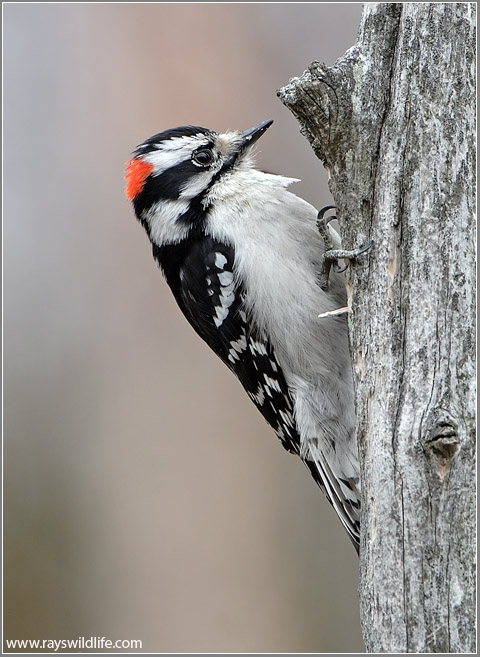
Downy Woodpecker (Picoides pubescens) by Raymond Barlow
As Peter sat there staring and wondering a trim little head appeared
at the entrance to one of those holes. It was a trim little head with a
very small bill and a snowy white throat. At first glance Peter thought
it was his old friend, Skimmer the Tree Swallow, and he was just on the
point of asking what under the sun Skimmer was doing in such a place as
that, when with a lively twitter of greeting the owner of that little
hole in the bank flew out and circled over Peter’s head. It wasn’t
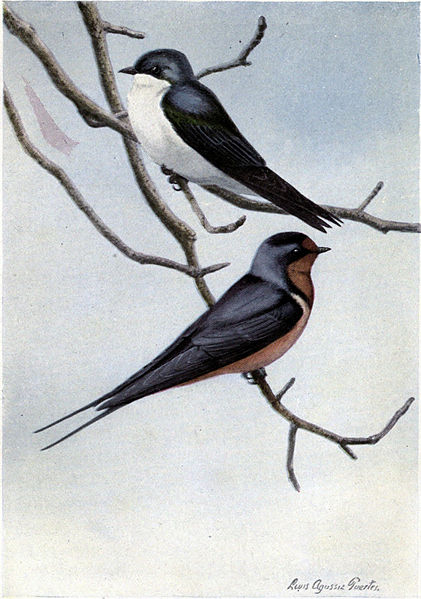
Skimmer at all. It was Banker the Bank Swallow, own cousin to Skimmer
the Tree Swallow. Peter recognized him the instant he got a full view of
him.
In the first place Banker was a little smaller than Skimmer. Then too,
he was not nearly so handsome. His back, instead of being that
beautiful rich steel-blue which makes Skimmer so handsome, was a sober
grayish-brown. He was a little darker on his wings and tail. His breast,
instead of being all snowy white, was crossed with a brownish band. His
tail was more nearly square across the end than is the case with other
members of the Swallow family.
“Wha–wha–what were you doing there?” stuttered Peter, his eyes popping
right out with curiosity and excitement.
“Why, that’s my home,” twittered Banker.
“Do–do–do you mean to say that you live in a hole in the ground?”
cried Peter.
“Certainly; why not?” twittered Banker as he snapped up a fly just over
Peter’s head.
“I don’t know any reason why you shouldn’t,” confessed Peter. “But
somehow it is hard for me to think of birds as living in holes in the
ground. I’ve only just found out that Rattles the Kingfisher does. But
I didn’t suppose there were any others. Did you make that hole yourself,
Banker?”
“Of course,” replied Banker. “That is, I helped make it. Mrs. Banker did
her share. ‘Way in at the end of it we’ve got the nicest little nest of
straw and feathers. What is more, we’ve got four white eggs in there,
and Mrs. Banker is sitting on them now.”
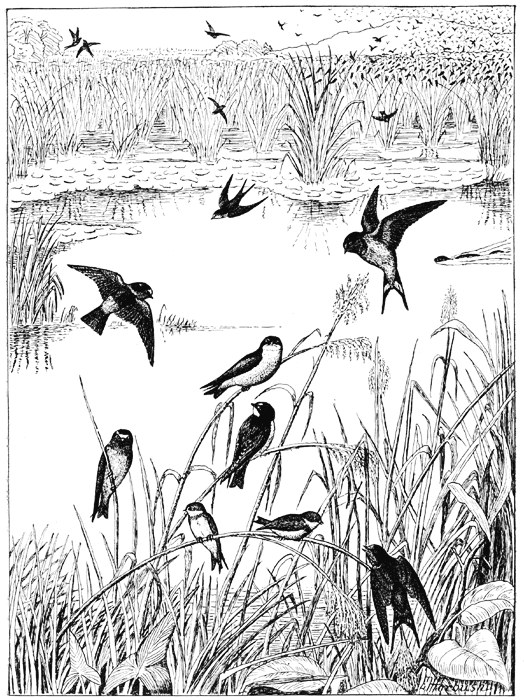
Swallow Friends – Burgess Book (Can be colored)
By this time the air seemed to be full of Banker’s friends, skimming and
circling this way and that, and going in and out of the little holes in
the bank.
“I am like my big cousin, Twitter the Purple Martin, fond of society,”
explained Banker. “We Bank Swallows like our homes close together. You
said that you had just learned that Rattles the Kingfisher has his home
in a bank. Do you know where it is?”
“No,” replied Peter. “I was looking for it when I discovered your home.
Can you tell me where it is?”
“I’ll do better than that;” replied Banker. “I’ll show you where it is.”
He darted some distance up along the bank and hovered for an instant
close to the top. Peter scampered over there and looked up. There, just
a few inches below the top, was another hole, a very much larger hole
than those he had just left. As he was staring up at it a head with a
long sharp bill and a crest which looked as if all the feathers on the
top of his head had been brushed the wrong way, was thrust out. It was
Rattles himself. He didn’t seem at all glad to see Peter. In fact, he
came out and darted at Peter angrily. Peter didn’t wait to feel that
sharp dagger-like bill. He took to his heels. He had seen what he
started out to find and he was quite content to go home.
Peter took a short cut across the Green Meadows. It took him past a
certain tall, dead tree. A sharp cry of “Kill-ee, kill-ee, kill-ee!”
caused Peter to look up just in time to see a trim, handsome bird whose
body was about the size of Sammy Jay’s but whose longer wings and longer
tail made him look bigger. One glance was enough to tell Peter that
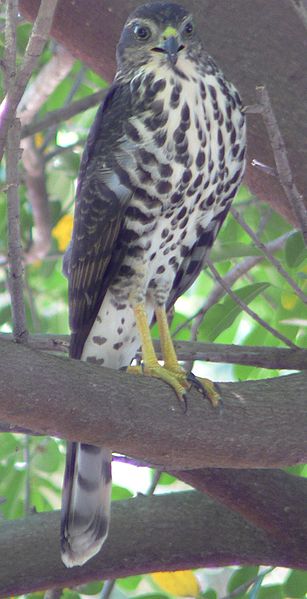
this was a member of the Hawk family, the smallest of the family. It was
Killy the Sparrow Hawk. He is too small for Peter to fear him, so now
Peter was possessed of nothing more than a very lively curiosity, and
sat up to watch.
Out over the meadow grass Killy sailed. Suddenly, with beating wings,
he kept himself in one place in the air and then dropped down into the
grass. He was up again in an instant, and Peter could see that he had a
fat grasshopper in his claws. Back to the top of the tall, dead tree
he flew and there ate the grasshopper. When it was finished, he sat up
straight and still, so still that he seemed a part of the tree itself.
With those wonderful eyes of his he was watching for another grasshopper
or for a careless Meadow Mouse.
Very trim and handsome was Killy. His back was reddish-brown crossed by
bars of black. His tail was reddish-brown with a band of black near
its end and a white tip. His wings were slaty-blue with little bars
of black, the longest feathers leaving white bars. Underneath he was a
beautiful buff, spotted with black. His head was bluish with a reddish
patch right on top. Before and behind each ear was a black mark. His
rather short bill, like the bills of all the rest of his family, was
hooked.
As Peter sat there admiring Killy, for he was handsome enough for any
one to admire, he noticed for the first time a hole high up in the trunk
of the tree, such a hole as Yellow Wing the Flicker might have made and
probably did make. Right away Peter remembered what Jenny Wren had
told him about Killy’s making his nest in just such a hole. “I wonder,”
thought Peter, “if that is Killy’s home.”
Just then Killy flew over and dropped in the grass just in front of
Peter, where he caught another fat grasshopper. “Is that your home up
there?” asked Peter hastily.
“It certainly is, Peter,” replied Killy. “This is the third summer Mrs.
Killy and I have had our home there.”
“You seem to be very fond of grasshoppers,” Peter ventured.
“I am,” replied Killy. “They are very fine eating when one can get
enough of them.”
“Are they the only kind of food you eat?” ventured Peter.
Killy laughed. It was a shrill laugh. “I should say not,” said he. “I
eat spiders and worms and all sorts of insects big enough to give a
fellow a decent bite. But for real good eating give me a fat Meadow
Mouse. I don’t object to a Sparrow or some other small bird now and
then, especially when I have a family of hungry youngsters to feed. But
take it the season through, I live mostly on grasshoppers and insects
and Meadow Mice. I do a lot of good in this world, I’d have you know.”
Peter said that he supposed that this was so, but all the time he
kept thinking what a pity it was that Killy ever killed his feathered
neighbors. As soon as he conveniently could he politely bade Killy
good-by and hurried home to the dear Old Briar-patch, there to think
over how queer it seemed that a member of the hawk family should nest
in a hollow tree and a member of the Swallow family should dig a hole in
the ground.
*** Bold points for questions at the bottom or for Christian traits.
A man who has friends must himself be friendly, But there is a friend who sticks closer than a brother.
(Proverbs 18:24 NKJV)
So God created great sea creatures and every living thing that moves, with which the waters abounded, according to their kind, and every winged bird according to its kind. And God saw that it was good.
(Genesis 1:21 NKJV)
“And every living substance was destroyed which was upon the face of the ground, both man, and cattle, and the creeping things, and the fowl of the heaven;.” Genesis 7:23a
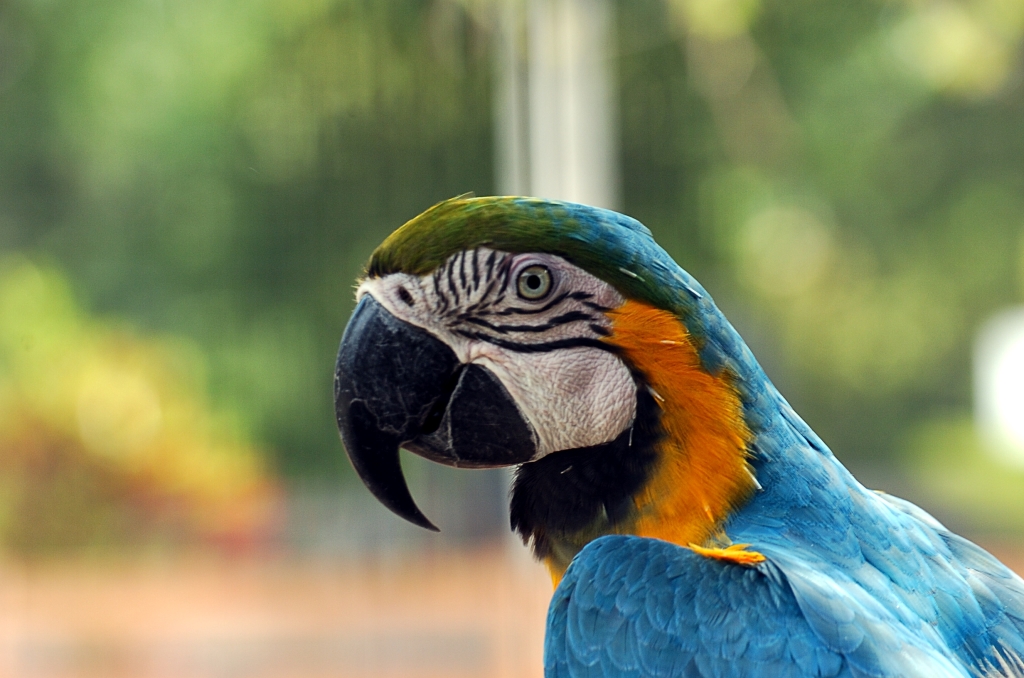
According to evolution theory, birds should not have been around at the time of the dinosaurs. This is especially true of the parrot, which is supposed, by those who believe in evolution, to be a more highly-evolved bird.
A fossilized parrot’s beak was dug up 40 years ago, but ignored. It was recently rediscovered at the University of California, Berkeley, by a graduate student. The problem, for evolutionists, is that they date the rock in which the beak was found as coming from the Cretaceous period when the dinosaurs lived and birds had not yet evolved. X‑ray study of the fossilized beak shows that the beak has the same blood vessel and nerve channels as a modern parrot. But it is not just one parrot’s beak that has been found in rocks from the age of dinosaurs. Loons, frigate‑birds and other shore bird fossils have also been found in rock that was supposedly laid down during the time of the dinosaurs!
Fossils are remains of living things rapidly buried, we believe, at the time of the Genesis Flood. However, it is perhaps not too surprising that bird fossils and dinosaur fossils are generally not found together; indeed, bird fossils in any part of the earth’s strata are extremely rare. This is because while dinosaur bones are very robust, bird bones and beaks are extremely fragile and would not have survived the turmoil of the Genesis Flood. The very few that have been fossilized tell us of very rapid and deep burial that would be expected during the Biblical Flood.
Prayer: I thank You, Lord, for making Your Word trustworthy in everything. Amen.
SCISSOR-TAILED FLYCATCHER: the Texas Bird of Paradise
Dr. James J. S. Johnson
And the LORD shall make thee the head, and not the tail [zânâb]; and thou shalt be above only, and thou shalt not be beneath; if that thou hearken unto the commandments of the LORD thy God, which I command thee this day, to observe and to do them.
(Deuteronomy 28:13)
Usually we think of “head” as being valuable and important, but “tail” not so much. Being a “head” is desirable; being a “tail” not so — as Moses indicated in Deuteronomy 28:13, quoted above. (See also, indicating likewise, Deuteronomy 28:44 & Isaiah 9:15.) However, when God made birds, on Day #5 of Creation Week (Genesis 1: 20-23), God made them with feathered tails that blend practical traits (such as aerodynamic rudder functionality) with beauty (such as the extravagant tail of a peacock).
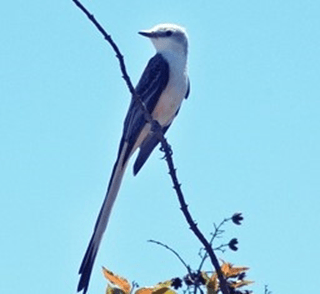
Among the “tyrant” flycatchers, certainly there is no better example of this blending, of beauty and bioengineering, than the Scissor-tailed Flycatcher, famous for eating flies on the fly.
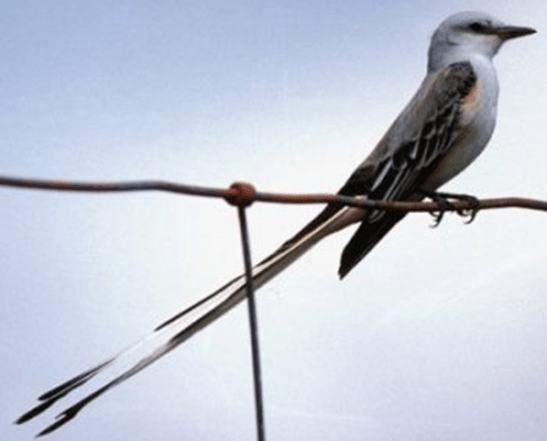
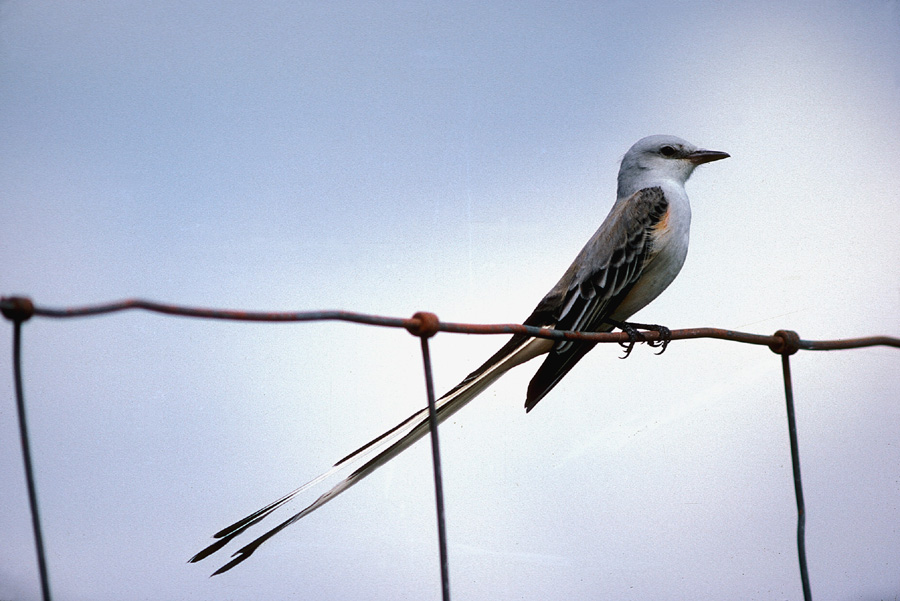
SCISSOR-TAILED FLYCATCHER perching on fence Texas Parks & Wildlife Dep’t photo credit
Earlier this month [June A.D.2022], on 2 different occasions, I saw Scissor-tailed Flycatchers (Tyrannus forficatus) in my neighborhood. One was larger than the other, so those must have been different Scissortails, because the size difference would not have occurred in just 3 days’ time!
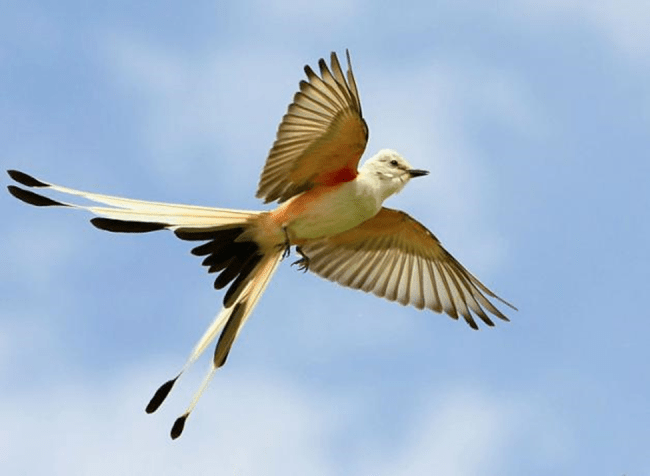
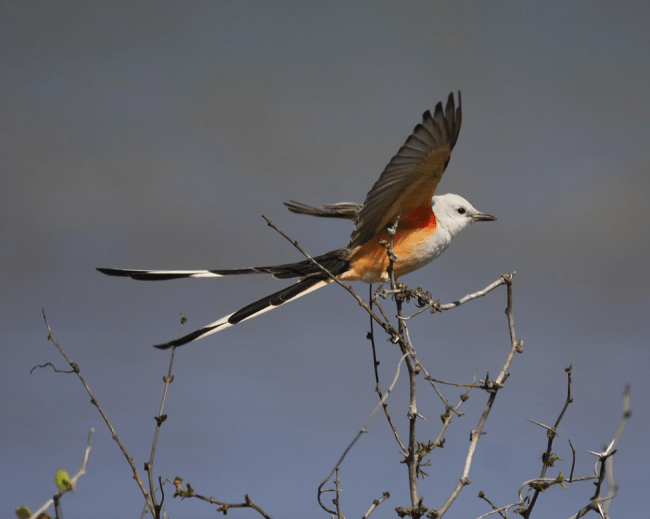
SCISSOR-TAILED FLYCATCHER flying Ken Slade / BirdNote.org photo credit
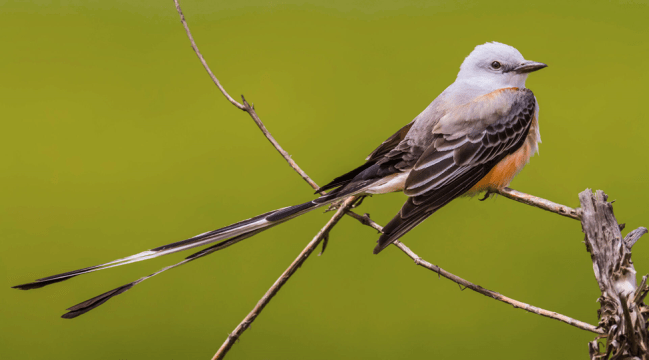
Scissor-tailed Flycatchers are beautiful squeaky-voiced birds with long-streaming split tail plumage that looks like long scissor blades. The Scissortail’s head and most of their plumage (neck, upper back, and breast) is soft-looking ivory-white (to very light grey), plus white-edged black on wings and tail feathers, with sides (flanks) and underwings that feature salmon-like orange-pink.
14” [long, including tail feathers.] Very long split tail; pale gray body; pinkish wash on flanks. In flight: Underwings bright pinkish orange. … Feeding: Flies from perch to catch insects on the ground [such as grasshoppers or beetles] or in the air [such as flies and dragonflies].
[Quoting from Donald Stokes & Lillian Stokes, “Scissor-tailed Flycatcher (Tyrannus forficatus)”, STOKES FIELD GUIDE TO BIRDS: WESTERN REGION (Boston: Little, Brown & Company, 1996), page 312.
This flycatcher (which also eats lots of grasshoppers) is well established throughout Texas, the Lone Star State, which is itself quite a range. The Scissortail’s breeding range also includes Oklahoma (where it is the official state bird — a fact that I learned from Christian attorney Don Totusek!), as well as large parts of Kansas, Missouri, western Arkansas, western Louisiana, and small parts of eastern Colorado and Nebraska. Probably the best places to see them during breeding season are Texas, Oklahoma, and Kansas. As migrants, these kingbirds fly south of the USA for the winter, e.g., into Mexico—although some are observed over-wintering in southern Florida. [See, accord, Robert C. Tweit, “Scissor-tailed Flycatcher”, in Texas A&M AgriLife Research’s TEXAS BREEDING BIRD ATLAS, posted at https://txtbba.tamu.edu/species-accounts/scissor-tailed-flycatcher/ .]
If you have ever seen a Scissor-tailed Flycatcher you won’t forget it—Scissortails are unlike any bird you have ever seen, unless you have seen their shorter-tailed cousin called Mexico’s Fork-tailed Flycatcher (Tyrannus savanna, known in French as le tyran á queue fourchue = “the tyrant of the fork-tail”), with whom Scissortails can mate. In fact, Scissortails are also known to hybridize with Couch’s Kingbird (Tyrannus couchii), as well as with Western Kingbirds (Tyrannus verticalis), which themselves hybridize with Eastern Kingbirds (Tyrannus tyrannus) — so there are many “cousins” within the greater kind-family of aggressive insectivores we call “tyrant kingbirds”. [See Eugene M. McCarthy, HANDBOOK OF AVIAN HYBRIDS OF THE WORLD (Oxford, U.K.: Oxford University Press, 2006), pages 203-204; see also Alexander J. Worm, Diane V. Roeder, Michael S. Husak, Brook L. Fluker, & Than J. Boves, “Characterizing Patterns of Introgressive Hybridization Between Two Species of Tyrannus Following Concurrent Range Expansion”, IBIS (International Journal of Avian Science), 161(4):770-780 (October 2019).]
One Scissortail (that I saw recently) was flying between trees on the side of a golf course. The other Scissortail was flying from a residential lawn, that had a few trees and bushes, to another residential lawn, that also had a few trees and bushes.
No surprise there, because Scissortails prefer to hunt insects in areas that mix open fields with trees and shrub cover, such as the semi-open country of grassy prairies, farm fields, suburb clearings, and ranchlands sporadically dotted with honey mesquite (Prosopis glandulosa) trees.
Scissor-tailed Flycatchers (Tyrannus forficatus) are Neotropical migrants that breed throughout the south-central United States with the highest breeding densities in southern Oklahoma and northern Texas, corresponding to the core of the breeding range … In their breeding range, they occupy open areas that provide adequate hunting perches and nesting sites including savannahs, prairies, brush patches, agricultural fields and pastures. … Scissor-tailed Flycatchers require trees for nesting and hunting perches to support their foraging strategy given that they are sit-and-scan foragers that utilize perches such as shrubs, trees, utility wires and fences, while they scan for insect prey …. Most prey are captured in the air [“hawking”] a short distance from the perch [citation omitted] which further indicates the need for open habitat to facilitate foraging.
[Quoting from Erin E. Feichtinger & Joseph A. Veech, “Association of Scissor-Tailed Flycatchers (Tyrannus forficatus) with Specific Land-Cover Types in South-Central Texas”, WILSON JOURNAL OF ORNITHOLOGY, 125(2):314-321 (2013), at page 314.]
In other words, Scissortails prefer habitats with ecotones where open-field and forest-cover micro-habitats overlap, i.e., preferring to nest and hunt “in landscapes (linear transects 0.8-40.2 km in length and 2.4 km wide) with a mix of “open country” and “closed forest” than in landscapes comprise mostly of either of these two general cover types.” [Quoting from Feichtinger & Veech, page 314.]
Scissortails perch and wait, watching for their next prey to move into capture range. Their method of hunting, called “hawking”, involves an aerial dash (with a sudden spurt of speed) toward a soon-to-be-seized target. In more casual flight, however, this beautiful kingbird is easier to see and to appreciate.
The scissor-tailed flycatcher, with its namesake long, forked tails, is one of the most recognizable bird species on the Katy Prairie and throughout southeast Texas’s coastal prairie ecosystem. The male’s tail can reach up to 15 inches long while the female’s tail can reach about 10.5 inches, making the scissor-tailed flycatcher a spectacular sight to see. The species name forficata, not surprising, derives from the Latin word for ‘scissors’ (forfex). The scissortail is a member of the Tyrannus, or ‘tyrant-like’ genus. This genus earned its name because several of its species are extremely aggressive on their breeding territories, where they will attack larger birds such as crows, hawks, and owls.
During the reproduction season between April and August, the male [Scissortail] performs a spectacular aerial display during courtship, sharply rising and descending in flight, its long tail streamers opening and closing, while the bird gives sharp calls. He may even perform backwards somersaults in the air.
“Somersaults in the air”? That reminds me of when I did flips, in the air, on a neighbor’s trampoline, more than a half-century ago. But those days are over. (At least I hope they are!)
Nowadays I’d be happy to see a Scissor-tailed Flycatcher do aerial somersaults, as I sit comfortably in an Adirondack chair. A glass of iced tea would help the birdwatching experience. Maybe, too, I could better appreciate looking, at a Scissortail’s salmon-colored underwings and flanks, as I snack on some smoked salmon.
But I digress.
SCISSOR-TAILED FLYCATCHER perching National Audubon Society photo credit






 “The wings of the ostrich wave proudly, But are her wings and pinions like the kindly stork’s? (Job 39:13 NKJV)