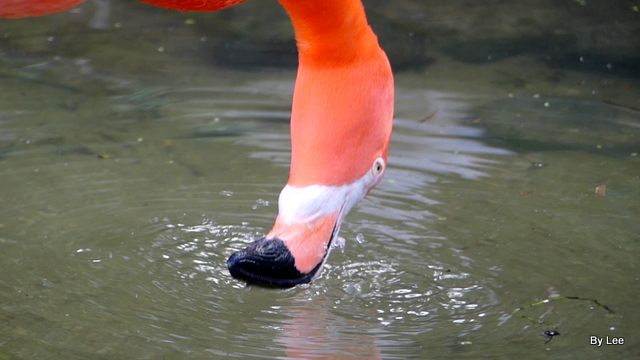
Flamingo Filtering at Gatorland – 12/30/20

Surface Filtering

Today Dan and I finally went on a short birding trip. We drove over to Orlando’s Gatorland (45 miles). I finally have something to write about besides the birds seen through our back patio door.

It was sort of quiet, as far as the number of birds, this time of year. We normally go over in late January or February. Then there are nesting birds. I never saw even one nest today. Yet, what we did see was great, as always. So, this is the first post of some of the interesting sights today.

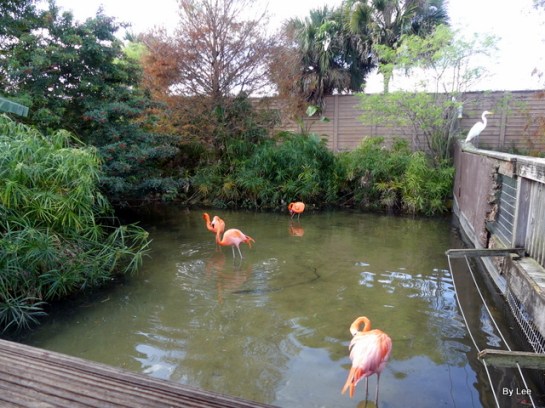
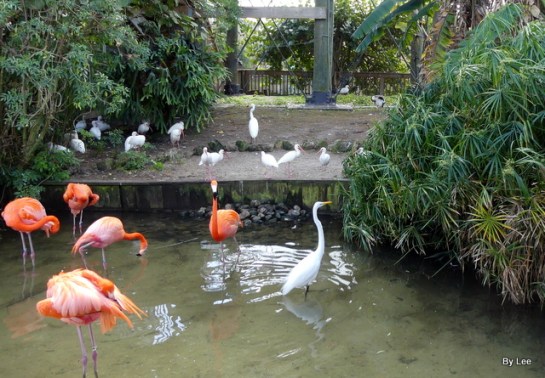
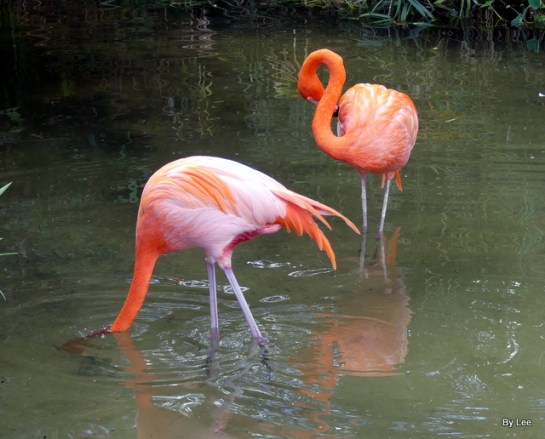
We were watching the Flamingos, which is almost at the end or the path we take around Gatorland. What impressed me today was watching this Flamingo filtering on the surface. Here is a video of what I saw:

I didn’t know what that was actually called until I came home and looked it up. Normally, they put their necks down in the water and “filter” along the bottom. Less often they “filter” on the surface, which this Flamingo was doing today. It gives a great way to see how they are actually filtering. I was amazed just watching.

“Flamingos filter-feed on brine shrimp. Their oddly shaped beaks are specially adapted to separate mud and silt from the food they eat, and are uniquely used upside-down. The filtering of food items is assisted by hairy structures called lamellae which line the mandibles, and the large rough-surfaced tongue. (Wikipedia – Filter Feeders)

“Ye blind guides, which strain at a gnat, and swallow a camel.” (KJV)  or the ERV says, “You guide the people, but you are blind! Think about a man picking a little fly out of his drink and then swallowing a camel! You are like that.” Matthew 23:24

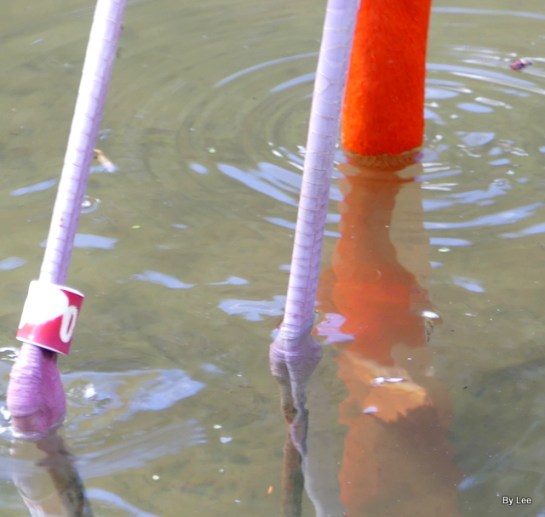
Here are some more of the photos from the Flamingo pond:

A Few Other Flamingo and Gatorland Articles:

Phoenicopteridae – Flamingos

Tickle Me Tuesday’s – Flamingos

Sunday Inspiration – Flamingos and Tropicbirds

“F” is for Flamingos and Frigatebirds: “F” Birds, Part 1
Gatorland’s Taxi Service

Gatorland’s Fearless Egret

Gatorland From Dan’s Camera

Sharing The Gospel


Noise Pollution

Be gracious in your speech. The goal is to bring out the best in others in a conversation, not put them down, not cut them out. Colossians 4:6 The Message

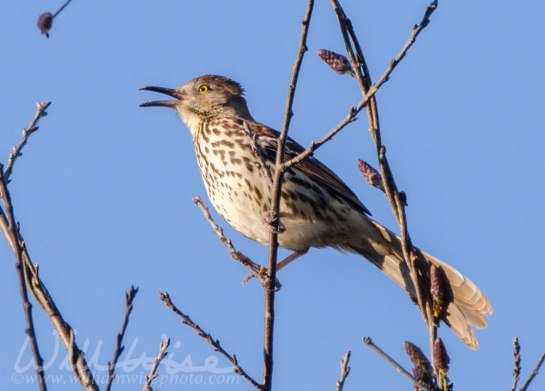
Brown Thrasher singing in a tree against a blue sky. March, 2018; Walton County, Georgia. ©www.williamwisephoto.com.

Last summer I decided to try my hand at recording bird songs. I downloaded a recommended app and went out into the field. While listening to the wonderful songs of a Brown Thrasher, I just knew I had a great recording. But when I got back inside to listen, I was shocked. Car engines, airplane noise, the air conditioning unit… all of them destroying the talented thrush’s solo. I soon found that the hardest part of getting good bird recordings was finding a quiet place to record them.

Noise pollution! I had never really realized just how much noise there is out there… in nature as well as the world of social interactions! The good and pleasant conversation is drowned out by contempt and complaint.

Ecclesiastes 10:20 Never curse the king, not even in your thoughts, nor the rich man, either; for a little bird may tell them what you’ve said.

Often, there isn’t much you can do to control nose pollution, except to decide that you won’t add to it. You can control your own speech! Am I adding to the noise pollution by complaining, attacking and slandering? Am I civil and encouraging in my speech? How are people left feeling after a conversation with me: uplifted or dragged down into the mud?

How did people feel after an encounter with Jesus?  The disciples on the road to Emmaus related their experience: “They began telling each other how their hearts were warmed as he talked with them and explained the Scriptures during the walk down the road.” Let us strive to produce the same fruit with our words.

Deuteronomy 32:2 NLT “Let my teaching fall on you like rain; let my speech settle like dew. Let my words fall like rain on tender grass, like gentle showers on young plants.”


Hi, I’m wildlife photographer and nature writer William Wise. I was saved under a campus ministry while studying wildlife biology at the University of Georgia. My love of the outdoors quickly turned into a love for the Creator and His works. I’m currently an animal shelter director and live in Athens, Georgia with my wife and two teenage daughters, who are all also actively involved in ministry. Creation Speaks is my teaching ministry that glorifies our Creator and teaches the truth of creation.  — “What a wildly wonderful world, God! You made it all, with Wisdom at Your side, made earth overflow with your wonderful creations.” Psalms 104, The Message.

That “Devil Bird” Kingfisher

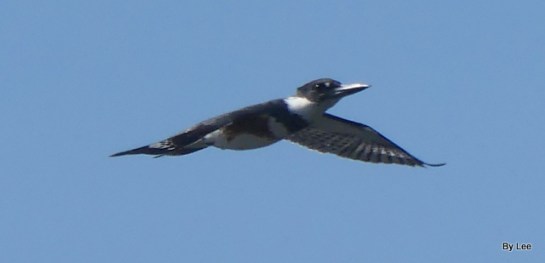
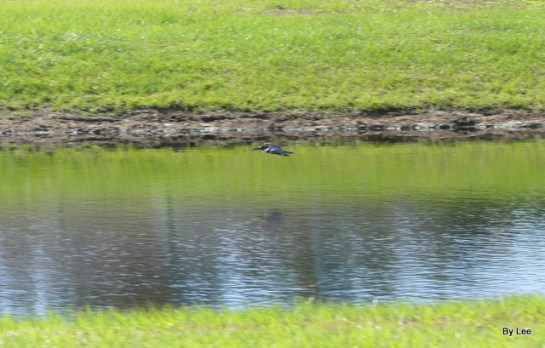
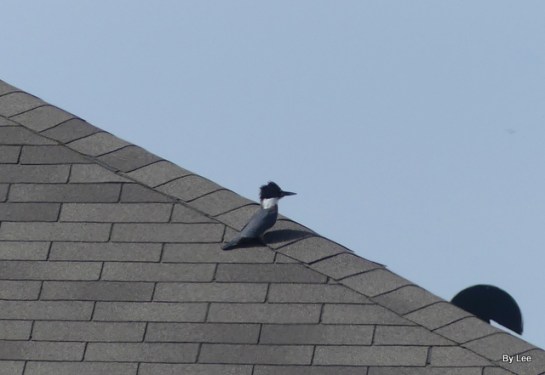
Female Belted Kingfisher at 11:24 am on 11/25/20 by Lee

In my last article, Time to Get Back to Bird Blogging, I mentioned the “Devil Bird.” Or, the “now you see him, now you don’t bird.” :)

The Belted Kingfisher, our local kingfisher, has managed to slow down long enough (or I was fast enough) to get at least a few photos of him or her (I figured out as I posted this) in the past from our back door.

“The belted kingfisher (Megaceryle alcyon) is a large, conspicuous water kingfisher. All kingfishers were formerly placed in one family, Alcedinidae, but recent research suggests that this should be divided into three subfamilies.

The belted kingfisher is a stocky, medium-sized bird that measures between 28–35 cm (11–14 in) in length with a wingspan of between 48–58 cm (19–23 in). This kingfisher can weigh from 113 to 178 g (4.0 to 6.3 oz). The adult female averages slightly larger than the adult male.

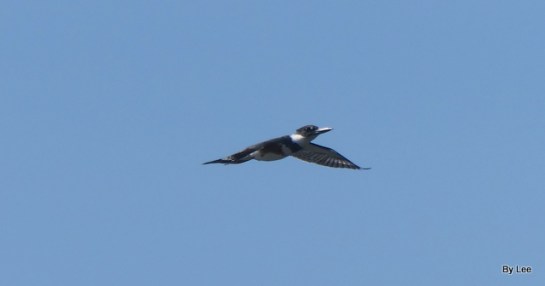
Female Belted Kingfisher at 11:27 am on 11/25/20 by Lee

This species has a large head with a shaggy crest. Its long, heavy bill is black with a grey base. These features are common in many kingfisher species. This kingfisher shows reverse sexual dimorphism, with the female more brightly coloured than the male. Both sexes have a slate blue head, large white collar, a large blue band on the breast, and white underparts. The back and wings are slate blue with black feather tips with little white dots. The female features a rufous band across the upper belly that extends down the flanks. Juveniles of this species are similar to adults, but both sexes feature the rufous band on the upper belly. Juvenile males will have a rufous band that is somewhat mottled while the band on females will be much thinner than that on adult females.” (Wikipedia)

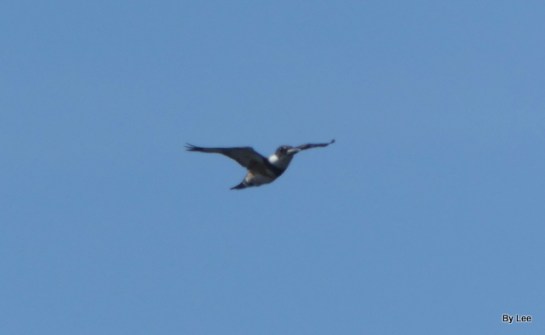
Female Belted Kingfisher at 11:27 am on 11/25/20 by Lee

Just thought I would share a four minute delight of the Female Belted Kingfisher that zoomed around by the back water. These are zoomed in, and I only shoot program mode, so I am happy that I could at least figure out that this was a female.

Sort of life our lives, now we are here, and soon we are gone. “Come now, you who say, “Today or tomorrow we will go to such and such a city, spend a year there, buy and sell, and make a profit”; whereas you do not know what will happen tomorrow. For what is your life? It is even a vapor that appears for a little time and then vanishes away. Instead you ought to say, “If the Lord wills, we shall live and do this or that.”
(James 4:13-15 NKJV)

Enjoy!

Wordless Birds

Belted Kingfisher – Wikipedia

Writing the Book of Your Wonders

“I’m thanking you, God, from a full heart, I’m writing the book on your wonders.” Psalms 9:1, The Message

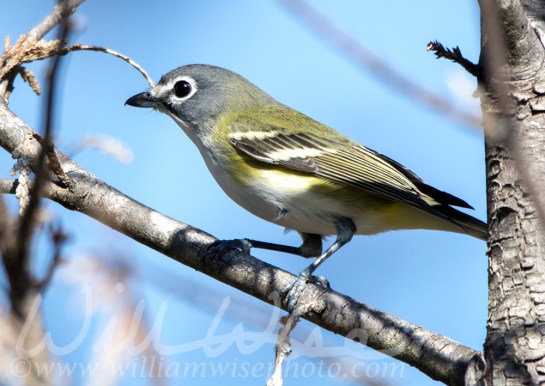
A beautiful Blue-headed Vireo (Vireo solitarius) photographed December 12, 2020 in  Greene County, Georgia. ©www.williamwisephoto.com

The joy and practice of writing about the wonders of creation is nothing new. The Bible tells us that in his four-thousand and five proverbs and songs (that’s a lot of blogging!), King Solomon “spoke of trees, from the cedar that is in Lebanon to the hyssop that grows out of the wall. He spoke also of beasts, and of birds, and of reptiles, and of fish.”

While I’m no Solomon, I have been journaling and blogging for several years now. I confess that I don’t journal every day, and I’ve certainly gone through some dry spells. But even if there are gaps, it has proved to be an invaluable habit. While the whole process can seem introspective, and even self-centered, I see it as a form of worship.

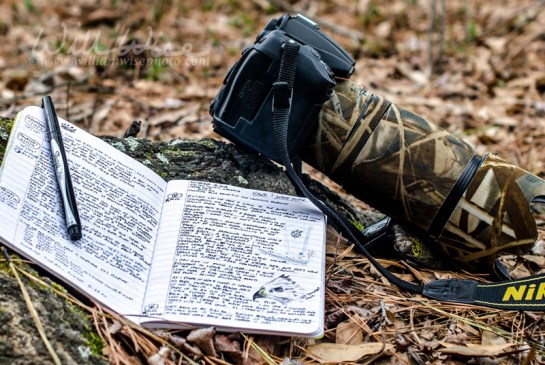
Nature Photography Journal ©www.williamwisephoto.com.

How often did King David refer to the natural wonders around him as he wrote Psalms in praise to the God of heaven? “When I consider thy heavens, the work of thy fingers, the moon and the stars, which thou hast ordained…” A view towards the mountains of Israel caused David’s heart to leap in praise, and his pen to write poems and songs of worship.

“My heart is overflowing with a good theme; I recite my composition concerning the King; My tongue is the pen of a ready writer.” Psalm 45

Even the simplest blog post and photograph can glorify the Creator. Pointing out the wonders of His creation exalts our God as the creator and sustainer of all things. Recognizing and delighting in the works of His hands, rather than in some other pursuit, is giving praise where praise is due.  It is not a replacement for the lifting of hands in the congregation, but can certainly produce a fuller, more vibrant life of worship.


Hi, I’m wildlife photographer and nature writer William Wise. I was saved under a campus ministry while studying wildlife biology at the University of Georgia. My love of the outdoors quickly turned into a love for the Creator and His works. I’m currently an animal shelter director and live in Athens, Georgia with my wife and two teenage daughters, who are all also actively involved in ministry. Creation Speaks is my teaching ministry that glorifies our Creator and teaches the truth of creation.  — “What a wildly wonderful world, God! You made it all, with Wisdom at Your side, made earth overflow with your wonderful creations.” Psalms 104, The Message.

Hide and Seek

Have you ever shouted to God, “COME OUT, COME OUT WHEREVER YOU ARE!”?

Ezekiel 39:29  “Neither will I hide my face any more from them…”

A Brown-headed Nuthatch (Sitta pusilla) appears to play hide-and-seek in a nest cavity. March 31, 2017; Walton County, Georgia. ©www.williamwisephoto.com.

Birding can sometimes feel like a game of hide-and-seek. The birds have the “hide” part down pat! They are masters of camouflage and stealth, and seem to know the cleverest places to hide. So the birders must play the “seek” side of the game. We maximize our chances of finding particular bird species by learning where they live – their range and habitat within the range – and going where the birds are!

There are times it seems like God is playing hide-and-seek with us. Our theology says God is omnipresent, but our feelings say He has hidden Himself and is nowhere to be found.  Like Martha and Mary when their brother Lazarus passed away, we blame God for being absent when crisis and need hits — “Lord, if thou hadst been here, my brother had not died.” (John 11:21).

But have you thought that maybe God isn’t hiding; and perhaps the problem is with our seeking? Jesus was quite willing to commune with those who desired His company. When two disciples asked, “Where dwellest thou?” Jesus offered the open invitation of come and see (John 1:38). Since the Bible promises us that He is a rewarder of them that diligently seek Him (Hebrews 11:6), perhaps our seeking isn’t as diligent as we thought.

God is not hiding. He can be seen in the design, order and complexity of nature around us… especially the birds! And just like searching for a bird in its range and habitat, we maximize our chances by seeking God in the right places. Where does God “hide”? Maybe He is “hidden” in that Bible on your bookshelf? Or perhaps He can be found in that church down the road? One thing is certain: if you are honest and diligent, He will be found!

Deuteronomy 30:11-14 “For this commandment which I command thee this day, it is not hidden from thee, neither is it far off. It is not in heaven, that thou shouldest say, Who shall go up for us to heaven, and bring it unto us, that we may hear it, and do it? Neither is it beyond the sea, that thou shouldest say, Who shall go over the sea for us, and bring it unto us, that we may hear it, and do it? But the word is very nigh unto thee, in thy mouth, and in thy heart, that thou mayest do it.”


Hi, I’m wildlife photographer and nature writer William Wise. I was saved under a campus ministry while studying wildlife biology at the University of Georgia. My love of the outdoors quickly turned into a love for the Creator and His works. I’m currently an animal shelter director and live in Athens, Georgia with my wife and two teenage daughters, who are all also actively involved in ministry. Creation Speaks is my teaching ministry that glorifies our Creator and teaches the truth of creation.  — “What a wildly wonderful world, God! You made it all, with Wisdom at Your side, made earth overflow with your wonderful creations.” Psalms 104, The Message.

Update and Release of Rockefeller

In Rockefeller the Saw-Whet Owl in Christmas Tree, you were introduced to Rockefeller, the little Saw-Whet Owl that was found in the Christmas Tree.

They promised they would release him last week-end, but released the owl last Tuesday, November the 24th. Here is a video of that release.

As this little owl was given compassion, and they helped him renew his strength, so we need “renewal” from time to time.

“Restore us to You, O LORD, that we may be restored; Renew our days as of old,” (Lamentations 5:21 NASB)

“and be renewed in the spirit of your mind, and that you put on the new man which was created according to God, in true righteousness and holiness.” (Ephesians 4:23-24 NKJV)

The Wise Owl

Taking and Making Opportunities

2 Timothy 4:2 “Preach the word; be instant in season, out of season…”

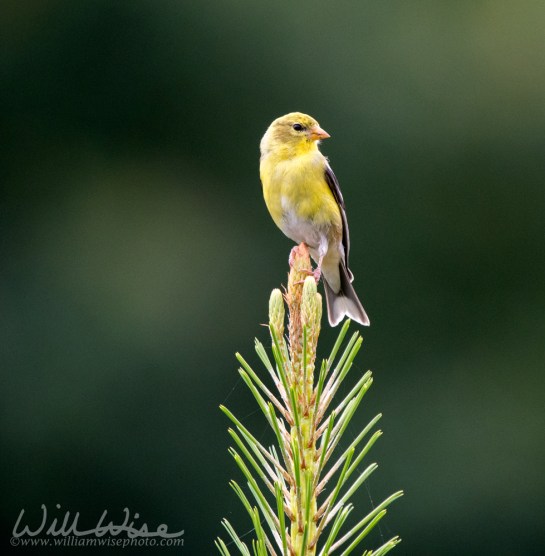
Bright yellow female American Goldfinch perched on pine sapling. Spinus tristis is a North American songbird. Photographed June 17, 2020 in Walton County, Georgia USA. ©www.williamwisephoto.com.

People have asked me, “How are you able to photograph so many different animals?” A big part of the equation is taking and making opportunities. This success principle holds true in many areas: financial investors watch the markets to take advantage of opportune seasons to invest, while ingenious entrepreneurs create a market where none existed before. Taking an opportunity, or making one, can bring success.

There are times that wildlife photography opportunities present themselves; say, a Red-tailed Hawk swooping down on a roadside squirrel, or a Gray Fox cutting through your backyard. You have to be always ready to take those opportunities when presented. But most of the time, birds don’t swoop in and pose when we set up a tripod and camera. We must make opportunities by travelling to areas that maximize our chances of wildlife viewing, such as birding hotspots, parks and wildlife refuges.

In the Bible, the Apostle Paul passes along this same strategy for success to the young pastor Timothy. William Barclay’s translation of 2 Timothy 4:2 says, “Urge it upon people whether you can take an opportunity or have to make an opportunity.” Paul isn’t speaking about wildlife photography or financial investments, but about eternal investments: souls! There are times that opportunities to witness present themselves, such as in a long line at Walmart. Other strategies include making evangelistic opportunities such as outdoor concerts and testimony services, or mini neighborhood healing crusades.

So, a greater question than “how do I photograph more birds?”, is “how do I win more souls?”!  Hobbies and recreation are fine – and I’d say they are even essential to mental health – but do I spend as much time seeking to bring people for Christ as I do on photography? Or do I squander my evangelistic opportunities on other pursuits?

Just some food for thought. As for me, I will pursue and enjoy both!


Hi, I’m wildlife photographer and nature writer William Wise. I was saved under a campus ministry while studying wildlife biology at the University of Georgia. My love of the outdoors quickly turned into a love for the Creator and His works. I’m currently an animal shelter director and live in Athens, Georgia with my wife and two teenage daughters, who are all also actively involved in ministry. Creation Speaks is my teaching ministry that glorifies our Creator and teaches the truth of creation.  — “What a wildly wonderful world, God! You made it all, with Wisdom at Your side, made earth overflow with your wonderful creations.” Psalms 104, The Message.

Just Some Reviews of Several Previous Posts

Two Deer At Shi Shi Beach ©WikiC

While I am continuing to move articles from Birds of the Bible for Kids site to this one, I come across previous post, that were just delightful. Many of you enjoyed them as well. Just thought you might like a look back at a few of them:

A Curious, Leeping or Panting Deer?

This has two videos of deer running and bounding in water. Take a look!

Black-Crowned Night Heron at S Lk Howard

Black-Crowned Night Heron at S Lk Howard

Also, here are a couple of videos of resourceful Heron at work:

Black-Crowned Heron Fishing With Patience and Bread

and a

Green Heron Fishing With Bread

*

Wordless Birds

Rockefeller the Saw-Whet Owl in Christmas Tree

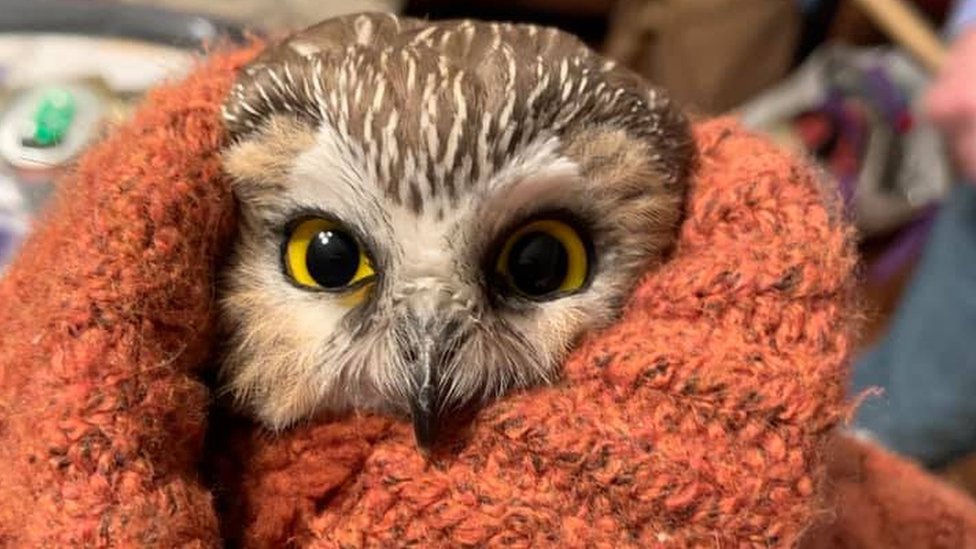
Rockefeller the Saw-Whet Owl ©BBC

Here’s an interesting story about a Saw-Whet Owl which showed up in the Rockefeller Christmas tree being delivered.

Northern Saw-Whet Owls are like other Owls. They appear on the “Do Not Eat” list. Too cute to eat this Little Owl.

“And the owl, and the night hawk, and the cuckow, and the hawk after his kind, And the little owl, and the cormorant, and the great owl,” (Leviticus 11:16-17 KJV)

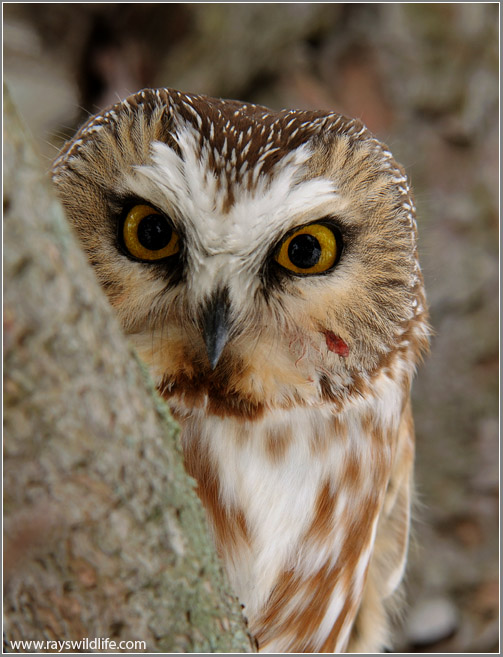
Saw-whet Owl by Ray

Saw-whet Owl by Ray

Birds of the Bible – Owls

Bible Birds – Owls

Northern Saw-Whet Owls – All About Birds

Northern Saw-Whet Owls – Wikipedia

From Decorah Eagles – Most Adorable Eaglet

“Who satisfieth thy mouth with good things; so that thy youth is renewed like the eagle’s.” (Psalms 103:5 KJV)

“Out of the ground the LORD God formed every beast of the field and every bird of the air, and brought them to Adam to see what he would call them. And whatever Adam called each living creature, that was its name.” (Genesis 2:19 NKJV)

What an interesting video! Enjoy!

Bible Birds – Eagle

Birds of the Bible – Eagle

Wordless Birds

Bible Bird – Gier Eagle (Egyptian Vulture)

and the gier-eagle,

“But these are they of which ye shall not eat: … And the pelican, and the gier eagle, and the cormorant,” (Deuteronomy 14:17 KJV)

Gier eagleHeb. raham = “parental affection,” Leviticus 11:18 ; Deuteronomy 14:17 ; RSV, “vulture”), a species of vulture living entirely on carrion. “It is about the size of a raven; has an almost triangular, bald, and wrinkled head, a strong pointed beak, black at the tip, large eyes and ears, the latter entirely on the outside, and long feet.” It is common in Egypt, where it is popularly called “Pharaoh’s chicken” (the Neophron percnopterus), and is found in Palestine only during summer. Tristram thinks that the Hebrew name, which is derived from a root meaning “to love,” is given to it from the fact that the male and female bird never part company.

Egyptian Vulture (Neophron percnopterus) Flying ©WikiC

The name Gier Eagle is no longer used. It is known by other names today, such as; Egyptian Vulture (Neophron percnopterus) or White Scavenger Vulture, or Pharaoh’s Chicken.

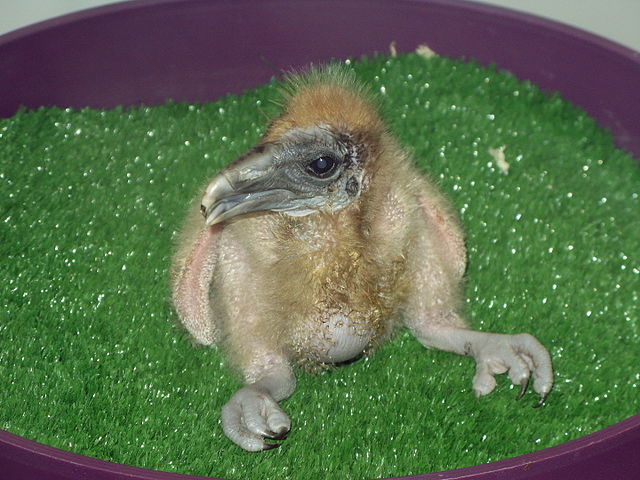
Egyptian Vulture (Neophron percnopterus) 18 day old ©WikiC

Egyptian Vulture (Neophron percnopterus)
18 day old ©WikiC

Egyptian Vulture (Neophron percnopterus) Egg ©WikiC

“The Egyptian vulture  is a small Old World vulture and the only member of the genus Neophron. It is widely distributed; the Egyptian vulture is found from the Iberian Peninsula and North Africa to India.”

Egyptian Vulture (Neophron percnopterus) ©WikiC

“It is widely distributed; the Egyptian vulture is found from the Iberian Peninsula and North Africa to India. The contrasting underwing pattern and wedge-shaped tail make it distinctive in flight as it soars in thermals during the warmer parts of the day. Egyptian vultures feed mainly on carrion but are opportunistic and will prey on small mammals, birds, and reptiles. They also feed on the eggs of other birds, breaking larger ones by tossing a large pebble onto them.”

Egyptian Vulture (Neophron percnopterus) ©WikiC

“The use of tools is rare in birds and apart from the use of a pebble as a hammer, Egyptian vultures also use twigs to roll up wool for use in their nest. Egyptian vultures that breed in the temperate regions migrate south in winter while tropical populations are relatively sedentary.” Wikipedia

Whatever this bird is called, I still wouldn’t want to eat it.

Relocated from the Kid’s Blog

Bible Birds – Eagles

Bible Birds

Wordless Toucan

Birds With Arms?

Thought you might enjoy watching these:


If birds had arms, then they would not be able to fly or do the amazing things that the Creator meant for them to do. We were all given exactly what we need by our Lord Jesus Christ, the Creator of all.

“In the beginning was the Word, and the Word was with God, and the Word was God. The same was in the beginning with God. All things were made by him; and without him was not any thing made that was made.” (John 1:1-3 KJV)

Transfered from the Kid’s Blog – Thought you might enjoy it.

See:

If Dogs Could Fly: More than Wings are Needed for Flying High!