Birds Vol 1 #4 – The Canada Jay (Grey)

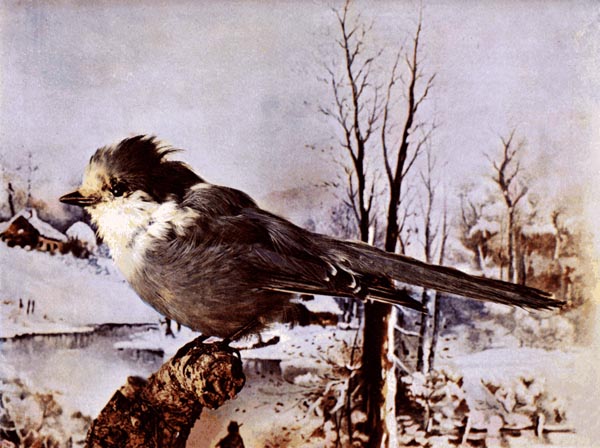
Canada Jay (Grey) for Birds Illustrated by Color Photography, 1897

Canada Jay (Grey) for Birds Illustrated by Color Photography, 1897

Birds Illustrated by Color Photography – Revisited

Vol 1. April, 1897 No. 4

*

THE CANADA JAY.

I don’t believe I shall let this bird talk to you, boys and girls, for I’m afraid he will not tell you what a funny fellow he is. Isn’t he a queer looking bird? See how ruffled up his feathers are. He looks as though he forgot to fix up, just as some little boys forget to comb their hair before going to school. Well, to tell the truth, he is a very careless bird and does very funny things sometimes. He can’t be trusted. Just listen to some of the names that people give him—“Meat Bird,” “Camp Robber.” I think you can guess why he is called those names. Hunters say that he is the boldest of birds, and I think they are right, for what bird would dare to go right into a tent and carry off things to eat. A hunter thought he would play a joke on one of these birds. He had a small paper sack of crackers in the bottom of his boat. The Jay flew down, helped himself to a cracker and flew away with it to his nest. While he was gone the hunter tied up the mouth of the bag. In a few moments the Jay was back for more. When he saw he could not get into the bag, he just picked it up and carried it off. The joke was on the hunter after all. Look at him. Doesn’t he look bold enough to do such a trick? Look back at your February number of “Birds” and see if he is anything like the Blue Jay. He is not afraid of the snow and often times he and his mate have built their nest, and the eggs are laid while there is still snow on the ground. Do you know of any other birds who build their nests so early? There is one thing about this bird which we all admire—he is always busy, never idle; so we will forgive him for his funny tricks.
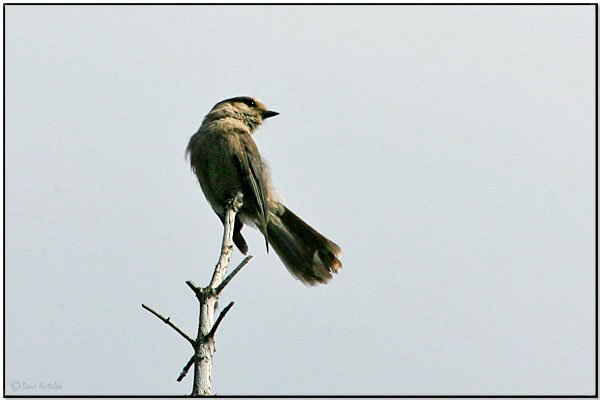
Grey Jay (Perisoreus canadensis) by Daves BirdingPix

Grey Jay (Perisoreus canadensis) by Daves BirdingPix


THE CANADA JAY.

imgm

ANY will recognize the Canada Jay by his local names, of which he has a large assortment. He is called by the guides and lumbermen of the Adirondack wilderness, “Whisky Jack” or “Whisky John,” a corruption of the Indian name, “Wis-ka-tjon,” “Moose Bird,” “Camp Robber,” “Hudson Bay Bird,” “Caribou Bird,” “Meat Bird,” “Grease Bird,” and “Venison Heron.” To each of these names his characteristics have well entitled him. The Canada Jay is found only in the more northern parts of the United States, where it is a resident and breeds. In northern Maine and northern Minnesota it is most common; and it ranges northward through the Dominion of Canada to the western shores of Hudson Bay, and to the limit of timber within the Arctic Circle east of the Rocky Mountains. Mr. Manly Hardy, in a special bulletin of the Smithsonian Institution, says, “They are the boldest of our birds, except the Chickadee, and in cool impudence far surpass all others. They will enter the tents, and often alight on the bow of a canoe, where the paddle at every stroke comes within eighteen inches of them. I know nothing which can be eaten that they will not take, and I had one steal all my candles, pulling them out endwise, one by one, from a piece of birch bark in which they were rolled, and another pecked a large hole in a keg of castile soap. A duck which I had picked and laid down for a few minutes had the entire breast eaten out by one or more of these birds. I have seen one alight in the middle of my canoe and peck away at the carcass of a beaver I had skinned. They often spoil deer saddles by pecking into them near the kidneys. They do great damage to the trappers by stealing the bait from traps set for martens and minks, and by eating trapped game. They will sit quietly and see you build a log trap and bait it, and then, almost before your back is turned, you hear their hateful “Ca-ca-ca,” as they glide down and peer into it. They will work steadily, carrying off meat and hiding it. I have thrown out pieces, and watched one to see how much he would carry off. He flew across a wide stream and in a short time looked as bloody as a butcher from carrying large pieces; but his patience held out longer than mine. I think one would work as long as Mark Twain’s California Jay did trying to fill a miner’s cabin with acorns through a knot hole in the roof. They are fond of the berries of the mountain ash, and, in fact, few things come amiss; I believe they do not possess a single good quality except industry.” Its flight is slow and laborious, while it moves on the ground and in trees with a quickness and freedom equal to that of our better known Bluejay. The nesting season begins early, before the snow has disappeared, and therefore comparatively little is known about its breeding habits. It is then silent and retiring and is seldom seen or heard. The nest is quite large, made of twigs, fibres, willow bark, and the down of the cottonwood tree, and lined with finer material. The eggs, so far as is known, number three or four. They are of a pale gray color, flecked and spotted over the surface with brown, slate gray, and lavender.
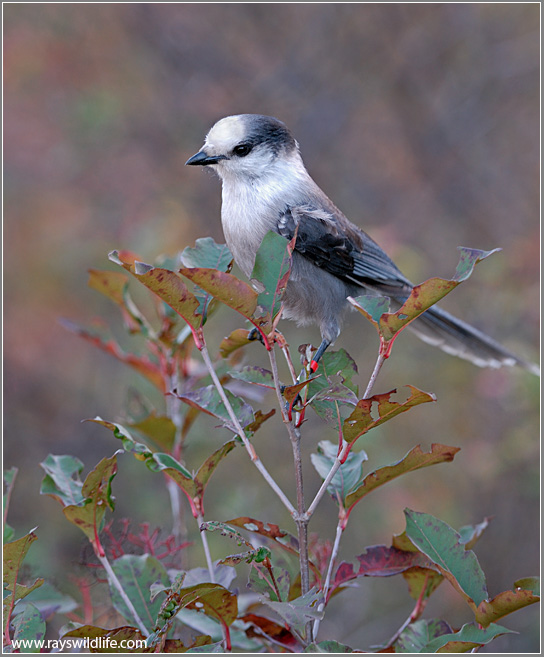
Grey Jay (Perisoreus canadensis) by Raymond Barlow

Grey Jay (Perisoreus canadensis) by Raymond Barlow


Lee’s Addition: What an industrious bird! From what was written above, it seems this jay knows no bounds to providing for its family and apparently its curiosity.

Wealth gained hastily will dwindle, but whoever gathers little by little will increase it. (Proverbs 13:11 ESV) When you give it to them, they gather it up; when you open your hand, they are filled with good things. (Psalms 104:28 ESV)

The Gray Jay (Perisoreus canadensis), also Grey Jay, Canada Jay, or Whiskey Jack, is a member of the crow and jay family (Corvidae) found in the boreal forests across North America north to the tree-line and in subalpine forests of the Rocky Mountains south to New Mexico and Arizona. It is one of three members of the genus Perisoreus, the others being the Siberian Jay found from Norway to eastern Russia and the Sichuan Jay restricted to the mountains of eastern Tibet and northwestern Sichuan. All three species store food and live year-round on permanent territories in coniferous forests.

The vast majority of Gray Jays live where there is a strong presence of one or more of black spruce, white spruce, Englemann spruce, jack pine, or lodgepole pine. Gray Jays do not inhabit the snowy, coniferous, and therefore seemingly appropriate Sierra Nevada of California where no spruce and neither of the two named pines occur. Nor do Gray Jays live in lower elevations of coastal Alaska or British Columbia dominated by Sitka spruce. The key habitat requirements may be sufficiently cold temperatures to ensure successful storage of perishable food and tree bark with sufficiently pliable scales arranged in a shingle-like configuration that allows Gray Jays to wedge food items easily up into dry, concealed storage locations. Storage may also be assisted by the antibacterial properties of the bark and foliage of boreal tree species. An exception to this general picture may be the well-marked subspecies P. c. obscurus, once given separate specific status as the “Oregon Jay”. It lives right down to the coast from Washington to northern California in the absence of cold temperatures or the putatively necessary tree species.

Gray Jays typically breed at 2 years of age. Pairs are monogamous and remain together for their lifetime, but a male or female will find another mate following the disappearance or death of their partner. Nesting typically occurs in March and April. Male Gray Jays choose a nest site in a mature coniferous tree and take the lead in construction. Cup-shaped nests were constructed with brittle dead twigs pulled off of trees, as well as bark strips and lichens. Cocoons of the forest tent caterpillar (Malacosoma dysstria) filled the interstitial spaces of the nest. Nests are usually built on the southwestern side of a tree for solar warming and are usually
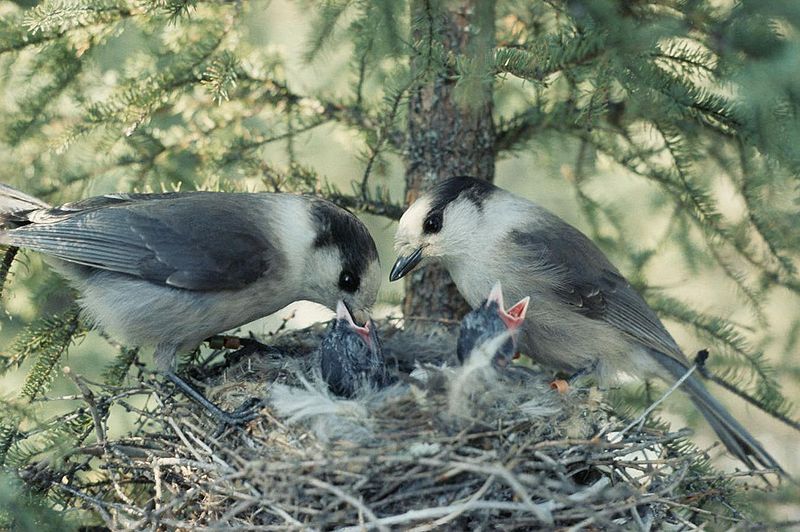
Grey Jay (Perisoreus canadensis) Feeding at Nest ©WikiC

Grey Jay (Perisoreus canadensis) Feeding at Nest ©WikiC

Gray Jay young are altricial. Nestling growth is most rapid from the 4th through the 10th day following hatching. Young are fed food carried in the throats of both parents.

Gray Jays do not hammer food with their bill as do other jays, but wrench, twist, and tug food apart. Gray Jays commonly carry large food items to nearby trees to eat or process for storage, possibly as defense against large scavengers. They are “scatterhoarders”, caching food items among scattered sites for later consumption.

Any food intended for storage is manipulated in the mouth and formed into a bolus (rounded mass) that is coated with sticky saliva, adhering to anything it touches. The bolus is stored in bark crevices, under tufts of lichen, or among conifer needles.

Risk and energy expenditure are factors in food selection for Gray Jay, which selects food on the basis of profitability to maximize caloric intake. Increased handling, searching, or recognition times for a preferred food item lowers its profitability.

The Gray Jay takes advantage of man-made sources of food, hence the names “camp robber” and “whiskey Jack”. According to Maccarone and Montevecchi, human observers do not inhibit Gray Jay’s feeding behavior; however, Rutter claims that “once having identified man with food it does not forget”. He found that after a nesting female was accustomed to being fed by humans she could be enticed to leave the nest during incubation and brooding.

Gray Jays cache thousands of food items every day during the summer for use the following winter. Caching behavior allows for permanent residence in boreal and subalpine forests, ensures a food source in areas with high elevations and cyclic availability of food resources, and favors the retention of young and a kin-selected social organization. In southern portions of the Gray Jay’s range, food is not cached during summer because of the chance of spoilage and the reduced need for winter stores. Cached items can be anything from carrion to bread crumbs and are formed into a bolus before being cached. Cached food is sometimes used to feed nestlings and fledglings.

Caching is inhibited by the presence of Steller’s jays and Gray Jays from adjacent territories, which follow resident Gray Jays to steal cached food. Gray Jays carry large food items to distant cache sites for storage more often than small food items. To prevent theft, they also tend to carry valuable food items further from the source when caching in the company of 1 or more Gray Jays. Scatterhoarding discourages pilferage by competitors. Cache thievery increases with increased cache density.

When exploiting distant food sources found in clearings, Gray Jays temporarily concentrated their caches in an arboreal site along the edge of a black spruce forest in interior Alaska. This allowed a high rate of caching in the short term and reduced the jay’s risk of predation. A subsequent recaching stage occurred, and food items were transferred to widely scattered sites to reduce theft.
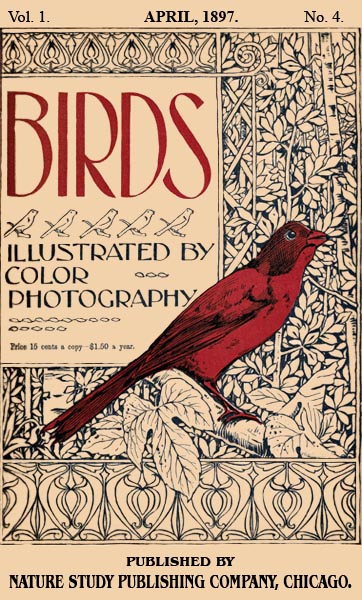
Birds Illustrated by Color Photograhy Vol 1 April 1897 No 4 – Cover

Birds Illustrated by Color Photography – Revisited – Introduction

The above article is the first article in the monthly serial for February 1897 “designed to promote Knowledge of Bird-Live.” These include Color Photography, as they call them, today they are drawings. There are at least three Volumes that have been digitized by Project Gutenberg.

To see the whole series of – Birds Illustrated by Color Photography – Revisited

*

(Information from Wikipedia and other internet sources)

Next Article – The Purple Gallinule

Previous Article – The Rose-Breasted Grosbeak

ABC’s Of The Gospel

Links:

Corvidae – Crows, Jays Family

Grey Jays – Wikipedia

*


Birds Vol 1 #4 – The Rose-Breasted Grosbeak

Rose-breasted Grosbeak (Pheucticus ludovicianus)

Rose-breasted Grosbeak for Birds Illustrated

Birds Illustrated by Color Photography – Revisited

Vol 1. April, 1897 No. 4

*

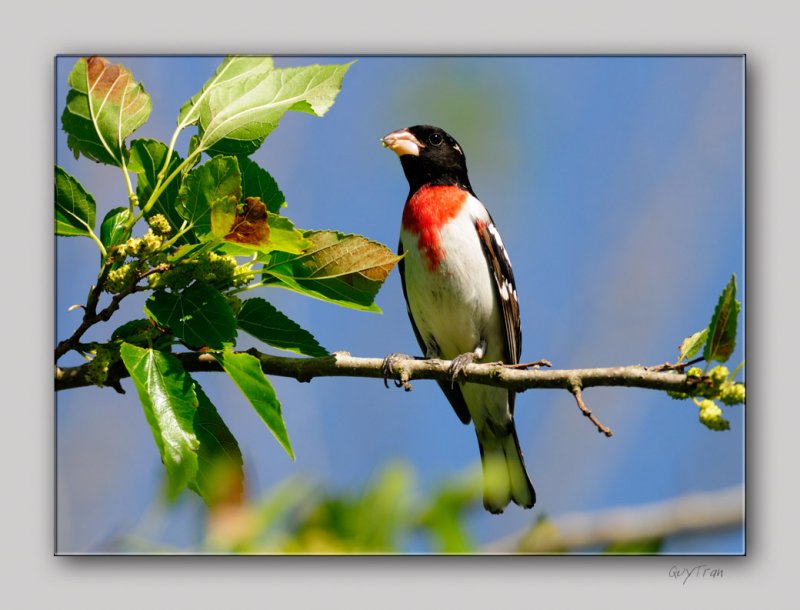
THE ROSE-BREASTED GROSBEAK.

imgt

HIS is an American bird, and has been described under various names by various authors. It is found in the lower parts of Pennsylvania, in the state of New York, and in New England, particularly in autumn, when the berries of the sour gum are ripe, on the kernels of which it eagerly feeds. As a singer it has few superiors. It frequently sings at night, and even all night, the notes being extremely clear and mellow. It does not acquire its full colors until at least the second spring or summer. It is found as far east as Nova Scotia, as far west as Nebraska, and winters in great numbers in Guatemala. This Grosbeak is common in southern Indiana, northern Illinois, and western Iowa. It is usually seen in open woods, on the borders of streams, but frequently sings in the deep recesses of forests. In Mr. Nuttall’s opinion this species has no superior in song, except the Mocking Bird.

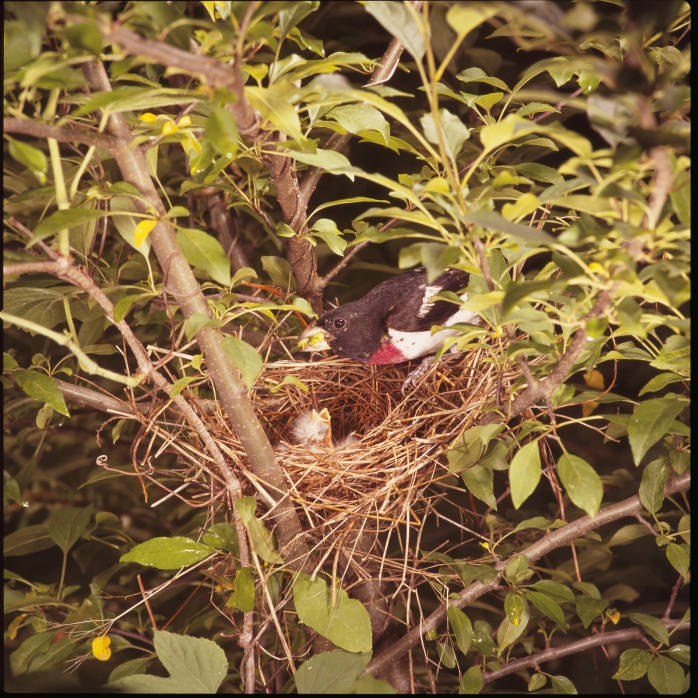
The Rose-Breasted Grosbeaks arrive in May and nest early in June. They build in low trees on the edges of woods, frequently in small groves on the banks of streams. The nest is coarsely built of waste stubble, fragments of leaves, and stems of plants, intermingled with and strengthened by twigs and coarser stems. It is eight inches wide, and three and a half high, with a cavity three inches in diameter and one in depth, being quite shallow for so large a nest.

Dr. Hoy, of Racine, states that on the 15th of June, within six miles of that city, he found seven nests, all within a space of not over five acres, and he was assured that each year they resort to the same locality and nest in this social manner. Six of these nests were in thorn-trees, all were within six to ten feet of the ground, near the center of the top. Three of the four parent birds sitting on the nests were males. When a nest was disturbed, all the neighboring Grosbeaks gathered and appeared equally interested.

It is frequently observed early in the month of March, making its way eastward. At this period it passes at a considerable height in the air. On the banks of the Schuylkill, early in May, it has been seen feeding on the tender buds of trees. It eats various kinds of food, such as hemp-seed, insects, grasshoppers, and crickets with peculiar relish. It eats flies and wasps, and great numbers of these pests are destroyed by its strong bill. During bright moonshiny nights the Grosbeak sings sweetly, but not loudly. In the daytime, when singing, it has the habit of vibrating its wings, in the manner of the Mocking-bird.

The male takes turns with his mate in sitting on the eggs. He is so happy when on the nest that he sings loud and long. His music is sometimes the cause of great mourning in the lovely family because it tells the egg hunter where to find the precious nest.

Rose-breasted Grosbeak (Pheucticus ludovicianus) by Quy Tran

Rose-breasted Grosbeak (Pheucticus ludovicianus) by Quy Tran


Lee’s Addition:

For I delivered unto you first of all that which I also received, how that Christ died for our sins according to the scriptures; And that he was buried, and that he rose again the third day according to the scriptures: (1 Corinthians 15:3-4 KJV)

The Rose-breasted Grosbeak, Pheucticus ludovicianus, is a large seed-eating songbird in the cardinal family. It breeds in cool-temperate North America, migrating to tropical America in winter. They belong to the Cardinalidae – Grosbeaks, Saltators & Allies Family.

Adult birds are 7.1–7.5 in (18–19 cm)  long and weigh 1.6–1.7 oz (45–47 g) on average. At all ages and in both sexes, the beak is dusky horn-colored, and the feet and eyes are dark.

Rose-breasted Grosbeak (Pheucticus ludovicianus) by Raymond Barlow

Rose-breasted Grosbeak (Pheucticus ludovicianus) by Raymond Barlow

The adult male in breeding plumage has a black head, wings, back and tail, and a bright rose-red patch on its breast; the wings have two white patches and rose-red linings. Its underside and rump are white. Males in nonbreeding plumage have largely white underparts, supercilium and cheeks. The upperside feathers have brown fringes, most wing feathers white ones, giving a scaly appearance. The bases of the primary remiges are also white. The adult female has dark grey-brown upperparts – darker on wings and tail –, a white supercilium, a buff stripe along the top of the head, and black-streaked white underparts, which except in the center of the belly have a buff tinge. The wing linings are yellowish, and on the upperwing there are two white patches like in the summer male. Immatures are similar, but with pink wing-linings and less prominent streaks and usually a pinkish-buff hue on the throat and breast. At one year of age—in their first breeding season—males are scaly above like fully adult males in winter plumage, and still retail the immature’s browner wings.

The song is a subdued mellow warbling, resembling a more refined version of the American Robin’s (Turdus migratorius). Males start singing early, occasionally even when still in winter quarters. The call is a sharp pink or pick.

Rose-breasted Grosbeak from xeno-canto by Chris Parrish

The Rose-breasted Grosbeak’s breeding habitat is open deciduous woods across most of Canada and the northeastern USA. In particular the northern birds migrate south through the United States east of the Rocky Mountains, to winter from central-southern Mexico through Central America and the Caribbean to Peru and Venezuela. The southern limit of its wintering range is not well known; it was for example only recorded in the Serranía de las Quinchas (Colombia) in the 1990s. In winter, they prefer more open woodland, or similar habitat with a loose growth of trees, such as forest edges, parks, gardens and plantations, ranging from sea level into the hills, e.g. up to 5,000 ft (1,500 m) ASL in Costa Rica.

The first birds leave the breeding grounds as early as August, while the last ones do not return until mid-late May. In general, however, they migrate south in late September or in October, and return in late April or early May. It appears as if they remain on their breeding grounds longer today than they did in the early 20th century, when migrants were more commonly seen in May and August than in April or September. The Rose-breasted Grosbeak occurs as a very rare vagrant in western Europe.

Rose-breasted Grosbeak (Pheucticus ludovicianus) at nest ©USFWS

Rose-breasted Grosbeak (Pheucticus ludovicianus) at nest ©USFWS

It builds a twig nest in a tree or large shrub. The Rose-breasted Grosbeak forages in shrubs or trees for insects, seeds and berries, also catching insects in flight and occasionally eating nectar. It usually keeps to the treetops, and only rarely can be seen on the ground. During breeding it is fairly territorial; in winter, it roams the lands in groups of about a handful of birds, and sometimes in larger flocks of a dozen or more. In the winter quarters, they can be attracted into parks, gardens, and possibly even to bird feeders by fruit like Trophis racemosa. Other notable winter food includes Jacaranda seeds and the fruits of the introduced Busy Lizzy (Impatiens walleriana).

Birds Illustrated by Color Photograhy Vol 1 April 1897 No 4 – Cover

Birds Illustrated by Color Photography – Revisited – Introduction

The above article is the first article in the monthly serial for February 1897 “designed to promote Knowledge of Bird-Live.” These include Color Photography, as they call them, today they are drawings. There are at least three Volumes that have been digitized by Project Gutenberg.

To see the whole series of – Birds Illustrated by Color Photography – Revisited

*

(Information from Wikipedia and other internet sources)

Next Article – The Canada Jay

Previous Article – The Long-Eared Owl (Great Horned)

Wordless Birds

Links:

Rose-breasted Grosbeak – Wikipedia

Cardinals or Cardinalidae – Wikipedia

Grosbeak – Wikipedia

*
 

Birds Vol 1 #3 – The Long-Eared Owl

Great Horned Owl - Birds Illustrated by Color Photography

Great Horned Owl – Birds Illustrated by Color Photography

Birds Illustrated by Color Photography – Revisited

Vol 1. March, 1897 No. 3

*

THE LONG-EARED OWL.

imgt

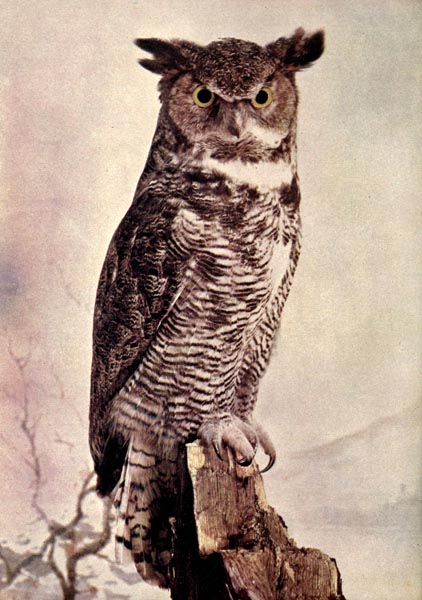
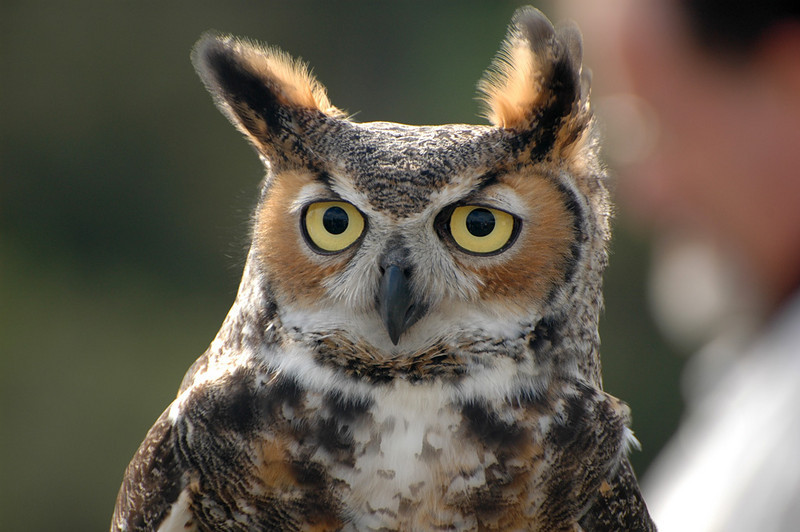
HE name of the Long-Eared Owl is derived from the great length of his “ears” or feather-tufts, which are placed upon the head, and erect themselves whenever the bird is interested or excited. It is the “black sheep” of the owl family, the majority of owls being genuine friends of the agriculturist, catching for his larder so many of the small animals that prey upon his crops. In America he is called the Great Horned Owl—in Europe the Golden Owl. (Today it is the Eurasian Eagle-Owl, I believe.)

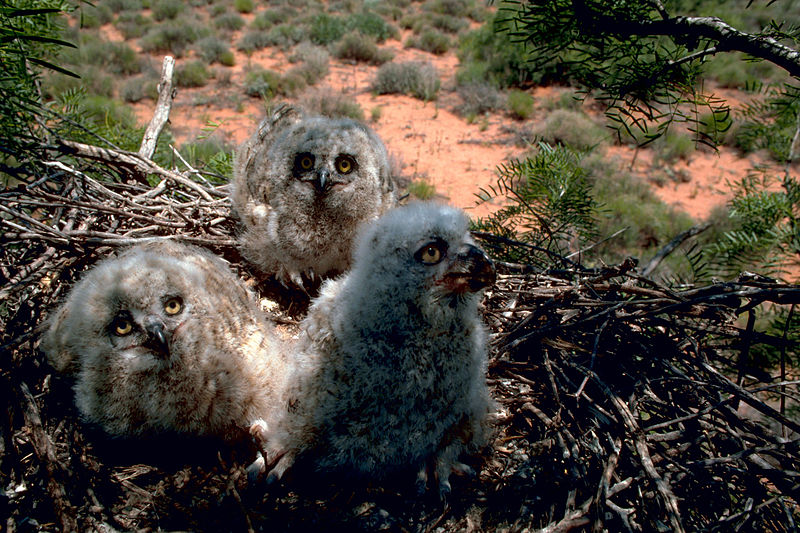
Nesting time with the owl begins in February, and continues through March and April. The clown-like antics of both sexes of this bird while under the tender influence of the nesting season tend somewhat to impair their reputation for dignity and wise demeanor. They usually have a simple nest in a hollow tree, but which seems seldom to be built by the bird itself, as it prefers to take the deserted nest of some other bird, and to fit up the premises for its own use. They repair slightly from year to year the same nest. The eggs are white, and generally four or five in number. While the young are still in the nest, the parent birds display a singular diligence in collecting food for them.

If you should happen to know of an owl’s nest, stand near it some evening when the old birds are rearing their young. Keep quiet and motionless, and notice how frequently the old birds feed them. Every ten minutes or so the soft flap, flap of their wings will be heard, the male and female alternately, and you will obtain a brief glimpse of them through the gloom as they enter the nesting place. They remain inside but a short time, sharing the food equally amongst their brood, and then are off again to hunt for more. All night, were you to have the inclination to observe them, you would find they pass to and fro with food, only ceasing their labors at dawn. The young, as soon as they reach maturity, are abandoned by their parents; they quit the nest and seek out haunts elsewhere, while the old birds rear another, and not infrequently two more broods, during the remainder of the season.

The habits of the Long-Eared Owl are nocturnal. He is seldom seen in the light of day, and is greatly disturbed if he chance to issue from his concealment while the sun is above the horizon. The facial disk is very conspicuous in this species. It is said that the use of this circle is to collect the rays of light, and throw them upon the eye. The flight of the owl is softened by means of especially shaped, recurved feather-tips, so that he may noiselessly steal upon his prey, and the ear is also so shaped as to gather sounds from below.

The Long-Eared Owl is hardly tameable. The writer of this paragraph, when a boy, was the possessor, for more than a year, of a very fine specimen. We called him Judge. He was a monster, and of perfect plumage. Although he seemed to have some attachment to the children of the family who fed him, he would not permit himself to be handled by them or by any one in the slightest. Most of his time he spent in his cage, an immense affair, in which he was very comfortable. Occasionally he had a day in the barn with the rats and mice.

The owl is of great usefulness to gardener, agriculturist, and landowner alike, for there is not another bird of prey which is so great a destroyer of the enemies of vegetation.

Great Horned Owl LPZoo by Lee


THE OWL.

We know not alway
Who are kings by day,
But the king of the night is the bold brown owl!


I wonder why the folks put my picture last in the book. It can’t be because they don’t like me, for I’m sure I never bother them. I don’t eat the farmer’s corn like the crow, and no one ever saw me quarrel with other birds.

Maybe it is because I can’t sing. Well, there are lots of good people that can’t sing, and so there are lots of good birds that can’t sing.

Did you ever see any other bird sit up as straight as I do? I couldn’t sit up so straight if I hadn’t such long, sharp claws to hold on with.

My home is in the woods. Here we owls build our nests—most always in hollow trees.

During the day I stay in the nest or sit on a limb. I don’t like day time for the light hurts my eyes, but when it begins to grow dark then I like to stir around. All night long I am wide awake and fly about getting food for my little hungry ones. They sleep most of the day and it keeps me busy nearly all night to find them enough to eat.

I just finished my night’s work when the man came to take my picture. It was getting light and I told him to go to a large stump on the edge of the woods and I would sit for my picture. So here I am. Don’t you think I look wise? How do you like my large eyes? If I could smile at you I would, but my face always looks sober. I have a great many cousins and if you really like my picture, I’ll have some of them talk to you next month. I don’t think any of them have such pretty feathers though. Just see if they have when they come.

Well, I must fly back to my perch in the old elm tree. Good-bye.

Great Horned Owl (Bubo virginianus) chicks - WikiC

Great Horned Owl (Bubo virginianus) chicks – WikiC


THE OWL.

In the hollow tree, in the old gray tower,
The spectral owl doth dwell;
Dull, hated, despised in the sunshine hour,
But at dusk he’s abroad and well!
Not a bird of the forest e’er mates with him;
All mock him outright by day;
But at night, when the woods grow still and dim,
The boldest will shrink away!

O! when the night falls, and roosts the fowl,
Then, then, is the reign of the Horned Owl!

And the owl hath a bride, who is fond and bold,
And loveth the wood’s deep gloom;
And, with eyes like the shine of the moonstone cold,
She awaiteth her ghastly groom.
Not a feather she moves, not a carol she sings,
As she waits in her tree so still,
But when her heart heareth his flapping wings,
She hoots out her welcome shrill!

O! when the moon shines, and dogs do howl,
Then, then, is the joy of the Horned Owl!

Mourn not for the owl, nor his gloomy plight!
The owl hath his share of good—
If a prisoner he be in the broad daylight,
He is lord in the dark greenwood!
Nor lonely the bird, nor his ghastly mate,
They are each unto each a pride;
Thrice fonder, perhaps, since a strange, dark fate
Hath rent them from all beside!

So, when the night falls, and dogs do howl,
Sing, Ho! for the reign of the Horned Owl!
We know not alway
Who are kings by day,
But the King of the Night is the bold Brown Owl!

Bryan W. Procter
(Barry Cornwall.)

Great Horned Owl (Bubo virginianus) by Bob-Nan

Great Horned Owl (Bubo virginianus) by Bob-Nan


Lee’s Addition:

Our Owl friend is a Bird of the Bible also. Owls are mentioned in 8 to 9 verses in Scripture, depending on which version. The KJV has 8 “owl” and 1 “owls” mentioned. The “horned owl” is mentioned in several versions. They are also one of the Birds of Prey mentioned in the Bible.

The little owl, the great owl, the horned owl, (Deuteronomy 14:16 AMP)

The Owls belong to two families, the  Strigidae – Owl which has the “True Owls” and the  Tytonidae – Barn Owls. The two families make up the Strigiformes Order.

The Great Horned Owls range in length from 18–27 in (46–69 cm) and have a wingspan of 40–60.5 in (101–153 cm); Females are larger than males, an average adult being 22 in (55 cm) long with a 49 in (124 cm) wingspan and weighing about 3.1 lbs (1400 g). Depending on subspecies, Great Horned Owls can weigh from 0.72 to 2.55 kg (1.6 to 5.6 lb). At present there are 14 subspecies.

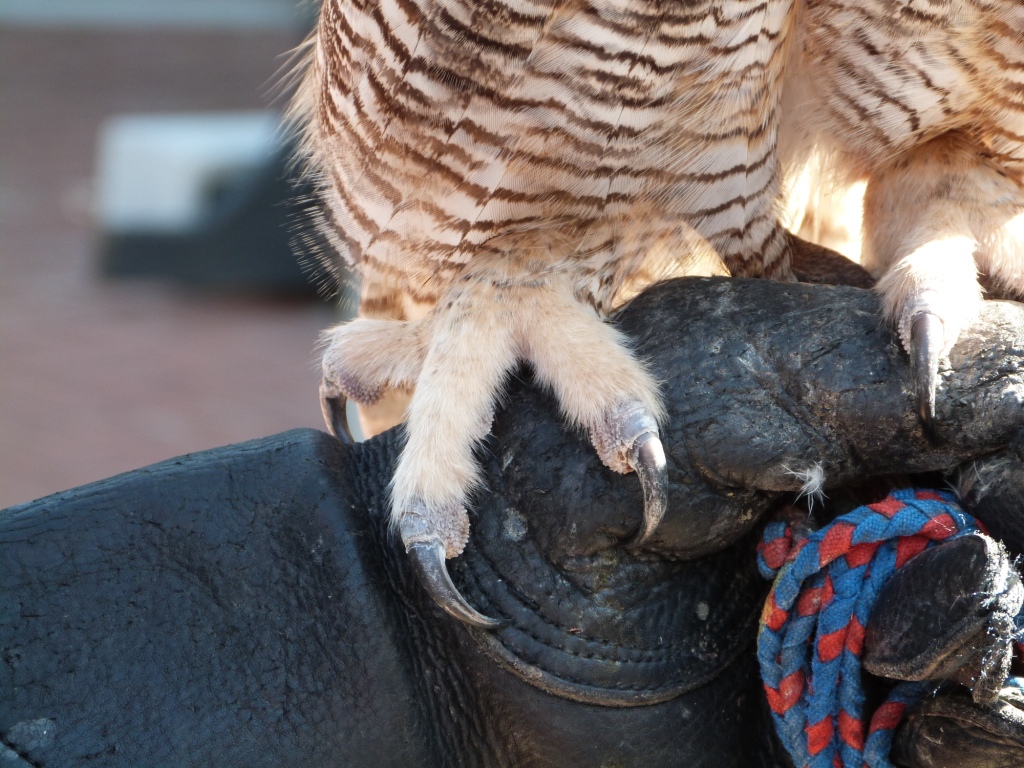
Adults have large ear tufts, a reddish, brown or gray face and a white patch on the throat. The iris is yellow, except the amber-eyed South American Great Horned Owl (B. V. nacurutu). Its “horns” are neither ears nor horns, simply tufts of feathers. The underparts are light with brown barring; the upper parts are mottled brown. The legs and feet are covered in feathers up to the talons. There are individual and regional variations in color; birds from the sub-Arctic are a washed-out, light-buff color, while those from Central America can be a dark chocolate brown.

Their call is a low-pitched but loud ho-ho-hoo hoo hoo; sometimes it is only four syllables instead of five. The female’s call is higher and rises in pitch at the end of the call. Young owls make hissing or screeching sounds that are often confused with the calls of Barn Owls.

Great Horned Owl call by Jesse Fagan

Owls were given spectacular binocular vision allowing them to pinpoint prey and see in low light. The eyes of Great Horned Owls are nearly as large as those of humans and are immobile within their circular bone sockets. Instead of turning their eyes, they turn their heads. Therefore, their neck must be able to turn a full 270 degrees in order to see in other directions without moving its entire body.

An owl’s hearing is as good as – if not better than – its vision; they have better depth perception[citation needed] and better perception of sound elevation (up-down direction) than humans. This is due to owl ears not being placed in the same position on either side of their head: the right ear is typically set higher in the skull and at a slightly different angle. By tilting or turning its head until the sound is the same in each ear, an owl can pinpoint both the horizontal and vertical direction of a sound.

Closeup of Great Horned Owl toes and talons

Great Horned Owl Foot LPZoo by Lee

These birds hunt at night by waiting on a high perch and swooping down on prey. Prey can vary greatly based on opportunity. The predominant prey group are small to medium-sized mammals such as hares, rabbits (statistically the most regular prey, juvenile raccoons, rats, squirrels, mice, moles, voles, shrews, bats, armadillos, muskrats, weasels and gerbils. It is even a natural predator of prey two to three times heavier than itself such as porcupines, marmots and skunks. Birds also comprise a large portion of a Great Horned Owl’s diet, ranging in size from kinglets to Great Blue Herons. Waterbirds, especially coots and ducks, are hunted; even raptors, up to the size of Red-tailed Hawk and Snowy Owls, are sometimes taken. Regular avian prey includes woodpeckers, grouse, crows, pigeons, herons, gulls, quail, turkey and various passerines. Reptiles (to the size of young American alligators, amphibians, fish, crustaceans and even insects are only occasional prey. In addition, the Great Horned Owl will predate on domesticated cats and small or young dogs.

When the Lord has created these birds Hi also gave them 200–300 pounds per square inch of crushing power in their talons. An average adult human male has about 60 pounds per square inch in his hands. In northern regions, where larger prey that cannot be eaten quickly are most prevalent, they may let uneaten food freeze and then thaw it out later using their own body heat. They also tend to eat and regurgitate food in the same locations.

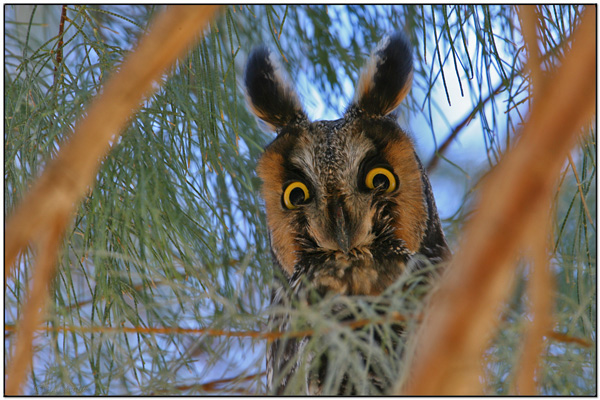
The article is titled the Long-eared Owl. Actually there really is a Long-eared Owl.

Long-eared Owl (Asio otus) by Daves BirdingPix

Long-eared Owl (Asio otus) by Daves BirdingPix


Birds Illustrated by Color Photograhy Vol 1 March 1897 No 3 - Cover

Birds Illustrated by Color Photography – Revisited – Introduction

The above article is the first article in the monthly serial for February 1897 “designed to promote Knowledge of Bird-Live.” These include Color Photography, as they call them, today they are drawings. There are at least three Volumes that have been digitized by Project Gutenberg.

To see the whole series of – Birds Illustrated by Color Photography – Revisited

*

(Information from Wikipedia and other internet sources)

Next Article – The Rose-Breasted Grosbeak

Previous Article – The Meadow Lark

Sharing The Gospel

Links:

Birds of the Bible – Owls

Great Horned Owls – Wikipedia

Long-eared Owls – Wikipedia

Eurasian Eagle-Owl – Wikipedia

*

Birds Vol 1 #3 – The Meadowlark

Meadowlark - Birds Illustrated by Color Photography, 1897

Meadowlark – Birds Illustrated by Color Photography, 1897

Birds Illustrated by Color Photography – Revisited

Vol 1. March, 1897 No. 3

*

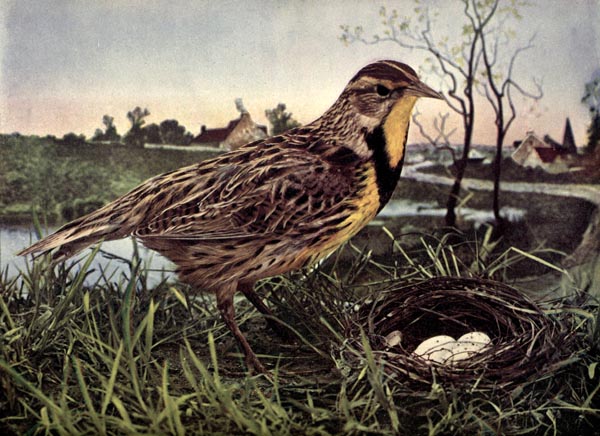
THE MEADOW LARK.

“Not an inch of his body is free from delight.
Can he keep himself still if he would? Oh, not he!
The music stirs in him like wind through a tree.”


imgt

HE well known Meadow or Old Field Lark is a constant resident south of latitude 39, and many winter farther north in favorite localities. Its geographical range is eastern North America, Canada to south Nova Scotia, Quebec, and Ontario to eastern Manitoba; west to Minnesota, Iowa, Missouri, eastern Kansas, the Indian Territory, and Texas; south to Florida and the Gulf coast, in all of which localities, except in the extreme north, it usually rears two or three broods in a season. In the Northern States it is only a summer resident, arriving in April and remaining until the latter part of October and occasionally November. Excepting during the breeding season, small flocks may often be seen roving about in search of good feeding grounds. Major Bendire says this is especially true in the fall of the year. At this time several families unite, and as many as two dozen may occasionally be flushed in a field, over which they scatter, roaming about independently of each other. When one takes wing all the others in the vicinity follow. It is a shy bird in the East, while in the middle states it is quite the reverse. Its flight is rather laborious, at least in starting, and is continued by a series of rapid movements of the wings, alternating with short distances of sailing, and is rarely protracted. On alighting, which is accompanied with a twitching of its tail, it usually settles on some fence rail, post, boulder, weedstock, or on a hillock in a meadow from which it can get a good view of the surroundings, and but rarely on a limb of a tree. Its favorite resorts are meadows, fallow fields, pastures, and clearings, but in some sections, as in northern Florida, for instance, it also frequents the low, open pine woods and nests there.

The song of the Meadow Lark is not much varied, but its clear, whistling notes, so frequently heard in the early spring, are melodious and pleasing to the ear. It is decidedly the farmers’ friend, feeding, as it does, on noxious insects, caterpillars, moths, grasshoppers, spiders, worms and the like, and eating but little grain. The lark spends the greater part of its time on the ground, procuring all its food there. It is seldom found alone, and it is said remains paired for life.

Nesting begins in the early part of May and lasts through June. Both sexes assist in building the nest, which is always placed on the ground, either in a natural depression, or in a little hollow scratched out by the birds, alongside a bunch of grass or weeds. The nest itself is lined with dry grass, stubble, and sometimes pine needles. Most nests are placed in level meadows. The eggs and young are frequently destroyed by vermin, for the meadow lark has many enemies. The eggs vary from three to seven, five being the most common, and both sexes assist in the hatching, which requires about fifteen or sixteen days. The young leave the nest before they are able to fly—hiding at the slightest sign of danger. The Meadow Lark does not migrate beyond the United States. It is a native bird, and is only accidental in England. The eggs are spotted, blotched, and speckled with shades of brown, purple and lavender. A curious incident is told of a Meadow Lark trying to alight on the top mast of a schooner several miles at sea. It was evidently very tired but would not venture near the deck.

Circle B – Eastern Meadowlark by Lee


THE MEADOW LARK.

I told the man who wanted my picture that he could take it if he would show my nest and eggs. Do you blame me for saying so? Don’t you think it makes a better picture than if I stood alone?

Mr. Lark is away getting me some breakfast, or he could be in the picture, too. After a few days I shall have some little baby birds, and then won’t we be happy.

Boys and girls who live in the country know us pretty well. When they drive the cows out to pasture, or when they go out to gather wild flowers, we sit on the fences by the roadside and make them glad with our merry song.

Those of you who live in the city cannot see us unless you come out into the country.

It isn’t very often that we can find such a pretty place for a nest as we have here. Most of the time we build our nest under the grass and cover it over, and build a little tunnel leading to it. This year we made up our minds not to be afraid.

The people living in the houses over there do not bother us at all and we are so happy.

You never saw baby larks, did you? Well, they are queer little fellows, with hardly any feathers on them.

Last summer we had five little birdies to feed, and it kept us busy from morning till night. This year we only expect three, and Mr. Lark says he will do all the work. He knows a field that is being plowed, where he can get nice, large worms.

Hark! that is he singing. He will be surprised when he comes back and finds me off the nest. He is so afraid that I will let the eggs get cold, but I won’t. There he comes, now.


Western Meadowlark (Sturnella neglecta)©USFWS

Western Meadowlark (Sturnella neglecta)©USFWS

Lee’s Addition:

For ye shall go out with joy, and be led forth with peace: the mountains and the hills shall break forth before you into singing, and all the trees of the field shall clap their hands. (Isaiah 55:12 KJV)

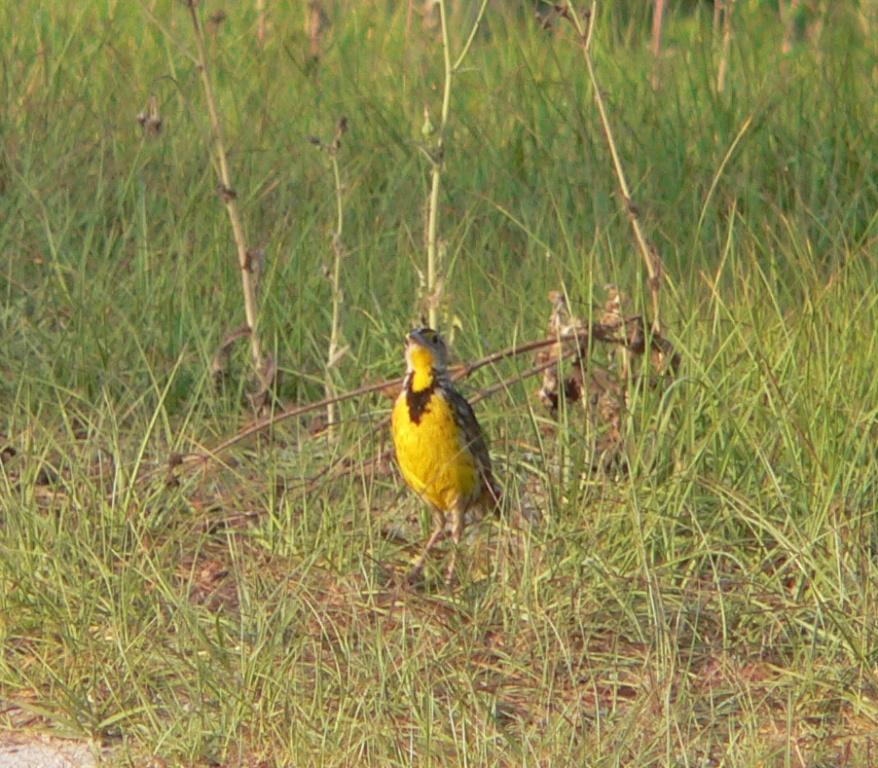
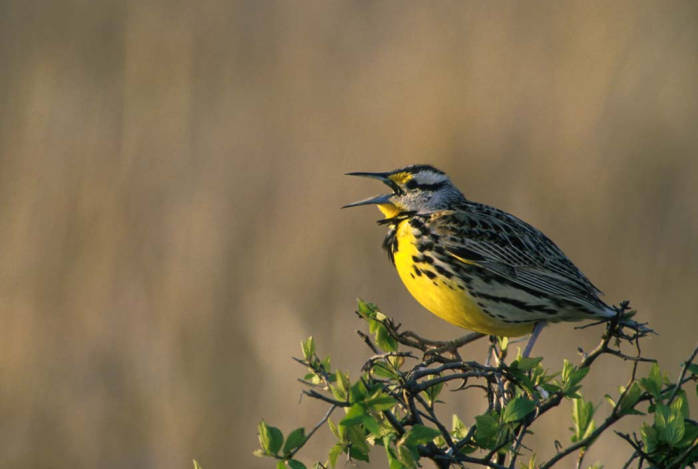
Meadowlarks are birds belonging to the genus Sturnella in the New World family Icteridae. The two here in the U. S. are the Eastern and Western Meadowlarks. Very southern US can see the Lillian’s

This genus includes two species of largely insectivorous grassland birds. In all species the male at least has a black or brown back and extensively red or yellow underparts.
The genus Sturnella comprises:

Birds Illustrated by Color Photograhy Vol 1 March 1897 No 3 - Cover

Birds Illustrated by Color Photography – Revisited – Introduction

The above article is the first article in the monthly serial for February 1897 “designed to promote Knowledge of Bird-Live.” These include Color Photography, as they call them, today they are drawings. There are at least three Volumes that have been digitized by Project Gutenberg.

To see the whole series of – Birds Illustrated by Color Photography – Revisited

*

(Information from Wikipedia and other internet sources)

Next Article – The Long-Eared Owl (Great Horned)

Previous Article – The Black Tern

Sharing The Gospel

Links:

Wikipedia – Meadowlarks

*

Birds Vol 1 #3 – The Black Tern

Black Tern, Mother and young with eggs, for Birds Illustrated

Black Tern, Mother and young with eggs, for Birds Illustrated

Birds Illustrated by Color Photography – Revisited

Vol 1. March, 1897 No. 3

THE BLACK TERN.

imgt

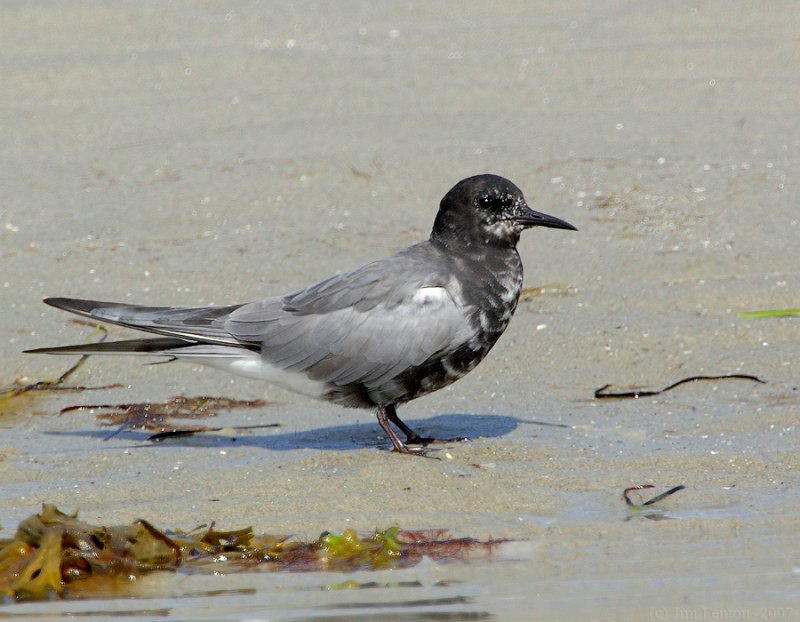
HE TERN,” says Mr. F. M. Woodruff, of the Chicago Academy of Sciences, “is the only representative of the long-winged swimmers which commonly nests with us on our inland fresh water marshes, arriving early in May in its brooding plumage of sooty black. The color changes in the autumn to white, and a number of the adult birds may be found, in the latter part of July, dotted and streaked here and there with white. On the first of June, 1891, I found a large colony of Black Terns nesting on Hyde Lake, Cook County, Illinois. As I approached the marsh a few birds were seen flying high in the air, and, as I neared the nesting site, the flying birds gave notes of alarm, and presently the air was filled with the graceful forms of this beautiful little bird. They circled about me, darting down to within a few feet of my head, constantly uttering a harsh, screaming cry. As the eggs are laid upon the bare ground, which the brownish and blackish markings so closely resemble, I was at first unable to find the nests, and discovered that the only way to locate them was to stand quietly and watch the birds. When the Tern is passing over the nest it checks its flight, and poises for a moment on quivering wings. By keeping my eyes on this spot I found the nest with very little trouble. The complement of eggs, when the bird has not been disturbed, is usually three. These are laid in a saucer shaped structure of dead vegetation, which is scraped together, from the surface of the wet, boggy ground. The bird figured in the plate had placed its nest on the edge of an old muskrat house, and my attention was attracted to it by the fact that upon the edge of the rat house, where it had climbed to rest itself, was the body of a young dabchick, or piedbilled grebe, scarcely two and one-half inches long, and not twenty-four hours out of the egg, a beautiful little ball of blackish down, striped with brown and white. From the latter part of July to the middle of August large flocks of Black Terns may be seen on the shores of our larger lakes on their annual migration southward.”

The Rev. P. B. Peabody, in alluding to his observation of the nests of the Tern, says: “Amid this floating sea of aquatic nests I saw an unusual number of well constructed homes of the Tern. Among these was one that I count a perfect nest. It rested on the perfectly flat foundation of a small decayed rat house, which was about fourteen inches in diameter. The nest, in form, is a truncated cone (barring the cavity), was about eight inches high and ten inches in diameter. The hollow—quite shallow—was about seven inches across, being thus unusually large. The whole was built up of bits of rushes, carried to the spot, these being quite uniform in length—about four inches.” After daily observation of the Tern, during which time he added much to his knowledge of the bird, he pertinently asks: “Who shall say how many traits and habits yet unknown may be discovered through patient watching of community-breeding birds, by men enjoying more of leisure for such delightful studies than often falls to the lot of most of us who have bread and butter to earn and a tiny part of the world’s work to finish?”

Black Tern (Chlidonias niger) by J Fenton

Black Tern (Chlidonias niger) by J Fenton


Lee’s Addition:

The Terns are in the Charadriiformes Order and the Laridae Family is part of that order. Laridaes include Gulls, Terns and Skimmers. The Tern, per se, is not a Gull, but are related and would be close in “kind.” The Birds of the Bible – Sea Gulls gives several articles that have been written here. The Sea Gull is found in the list of unclean birds given in Leviticus and Deuteronomy.

the ostrich, the short-eared owl, the sea gull, and the hawk after its kind; (Leviticus 11:16 NKJV)

“The Black Tern, Chlidonias niger, is a small tern generally found in or near inland water in Europe and North America. As its name suggests, it has predominantly dark plumage. Adult are 25 cm (9.75 in) long, with a wing span 6/1 cm (24 in), and weigh 62 g (2.2 oz). They have short dark legs and a short, weak-looking black bill, measuring 27–28 mm, nearly as long as the head. The bill is long, slender, and looks slightly decurved. The North American race, C. n. surinamensis, is distinguishable from the European form in all plumages, and is considered by some to be a separate species.

In flight, the build appears slim. The wing-beats are full and dynamic, and flight is often erratic as it dives to the surface for food; similar to other tern species.

North American Black terns migrate to the coasts of northern South America, some to the open ocean. Old World birds winter in Africa.
Unlike the “white” Sterna terns, these birds do not dive for fish, but forage on the wing picking up items at or near the water’s surface or catching insects in flight. They mainly eat insects and fish as well as amphibians.

The North American population has declined in recent times due to loss of habitat. Point Pelee National Park in Canada boasts a robust population of black terns.” (Wikipedia)

Black Tern (Chlidonias niger) by J Fenton

Black Tern (Chlidonias niger) by J Fenton

*

Birds Illustrated by Color Photograhy Vol 1 March 1897 No 3 - Cover

Birds Illustrated by Color Photography – Revisited – Introduction

The above article is the first article in the monthly serial for February 1897 “designed to promote Knowledge of Bird-Live.” These include Color Photography, as they call them, today they are drawings. There are at least three Volumes that have been digitized by Project Gutenberg.

To see the whole series of – Birds Illustrated by Color Photography – Revisited

*

(Information from Wikipedia and other internet sources)

Next Article – The Meadow Lark

Previous Article – The Return Of The Birds

Wordless Birds

Links:

All About Birds – Black Tern

Black Tern with eggs at nest photo – ARKive

Black Tern – Wikipedia

Ad in the Birds Illustrated by Color Photography, 1897

Ad in the Birds Illustrated by Color Photography, 1897

*

Birds Vol 1 #3 – The Return of the Birds

Eastern Bluebird (Sialia sialis) by S Slayton

Eastern Bluebird (Sialia sialis) by S Slayton

Birds Illustrated by Color Photography – Revisited

Vol 1. March, 1897 No. 3

*

THE RETURN OF THE BIRDS.

“Everywhere the blue sky belongs to them and is their appointed rest, and their native country, and their own natural home which they enter unannounced as lords that are certainly expected, and yet there is a silent joy at their arrival.”

imgt

HE return of the birds to their real home in the North, where they build their nests and rear their young, is regarded by all genuine lovers of earth’s messengers of gladness and gayety as one of the most interesting and poetical of annual occurrences. The naturalist, who notes the very day of each arrival, in order that he may verify former observation or add to his material gathered for a new work, does not necessarily anticipate with greater pleasure this event than do many whose lives are brightened by the coming of the friends of their youth, who alone of early companions do not change. First of all—and ever the same delightful warbler—the Bluebird, who, in 1895, did not appear at all in many localities, though here in considerable numbers last year, betrays himself. “Did he come down out of the heaven on that bright March morning when he told us so softly and plaintively that, if we pleased, spring had come?” Sometimes he is here a little earlier, and must keep his courage up until the cold snap is over and the snow is gone. Not long after the Bluebird, comes the Robin, sometimes in March, but in most of the northern states April is the month of his arrival. With his first utterance the spell of winter is broken, and the remembrance of it afar off. Then appears the Woodpecker in great variety, the Flicker usually arriving first. He is always somebody’s old favorite, “announcing his arrival by a long, loud call, repeated from the dry branch of some tree, or a stake in the fence—a thoroughly melodious April sound.”

Few perhaps reflect upon the difficulties encountered by the birds themselves in their returning migrations. A voyager sometimes meets with many of our common birds far out at sea. Such wanderers, it is said, when suddenly overtaken by a fog, completely lose their sense of direction and become hopelessly lost. Humming birds, those delicately organized, glittering gems, are among the most common of the land species seen at sea.

The present season has been quite favorable to the protection of birds. A very competent observer says that not all of the birds migrated this winter. He recently visited a farm less than an hour’s ride from Chicago, where he found the old place, as he relates it, “chucked full of Robins, Blackbirds, and Woodpeckers,” and others unknown to him. From this he inferred they would have been in Florida had indications predicted a severe winter. The trees of the south parks of Chicago, and those in suburban places, have had, darting through their branches during the months of December and January, nearly as many members of the Woodpecker tribe as were found there during the mating season in May last.

Alas, that the Robin will visit us in diminished numbers in the approaching spring. He has not been so common for a year or two as he was formerly, for the reason that the Robins died by thousands of starvation, owing to the freezing of their food supply in Tennessee during the protracted cold weather in the winter of 1895. It is indeed sad that this good Samaritan among birds should be defenseless against the severity of Nature, the common mother of us all. Nevertheless the return of the birds, in myriads or in single pairs, will be welcomed more and more, year by year, as intelligent love and appreciation of them shall possess the popular mind.

American Robin (Turdus migratorius) by S Slayton

American Robin (Turdus migratorius) by S Slayton


Lee’s Addition:

Even the stork in the heavens Knows her appointed times; And the turtledove, the swift, and the swallow Observe the time of their coming. But My people do not know the judgment of the LORD. (Jeremiah 8:7 NKJV)

This time of the year the birds head back north, at least in North America. Unfortunately they leave us here in Florida where some of them have been on their winter vacation. Birdwatching excitement slows down for us, but picks up for those of you who have been without your avian friends during the winter. Trust me, they are on the way.  We have been out watching birds several times this last week or so and the winter birds have left or are packing their bags and folding up their lounge chairs. We are getting a few of the migrants that are passing through on their way north. They land to rest and feed, then off they go again. Keep your eyes alert, northern friends, the birds are coming.

Birds Illustrated by Color Photograhy Vol 1 March 1897 No 3 - Cover

Birds Illustrated by Color Photography – Revisited – Introduction

The above article is the first article in the monthly serial for February 1897 “designed to promote Knowledge of Bird-Live.” These include Color Photography, as they call them, today they are drawings. There are at least three Volumes that have been digitized by Project Gutenberg.

To see the whole series of – Birds Illustrated by Color Photography – Revisited

*

(Information from Wikipedia and other internet sources)

Next Article – The Black Tern

Previous Article – The Crow and The Common Crow

ABC’s of the Gospel

Links:

Birds of the Bible – Migration
Interesting – Migration and Mechanics of Flight
Interesting Things – Amazing Bird Migration
The Flight of Migratory Birds by Werner Gitt
Bird Migration – Wikipedia
Birds of the Bible – Hawk Migration
Interesting Things – A Lesson from the Stork
Bar-tailed Godwit Migration – Wikipedia
Do Migratory Birds Practice Preventative Medicine?

Ad in Birds Illustrated by Color Photography, 1897

Ad in Birds Illustrated by Color Photography, 1897

*

Birds Vol 1 #3 – The Crow and Common Crow

Common Crow - Birds Illustrated

Common Crow – Birds Illustrated

Birds Illustrated by Color Photography – Revisited

Vol 1. March, 1897 No. 3

*

THE CROW.

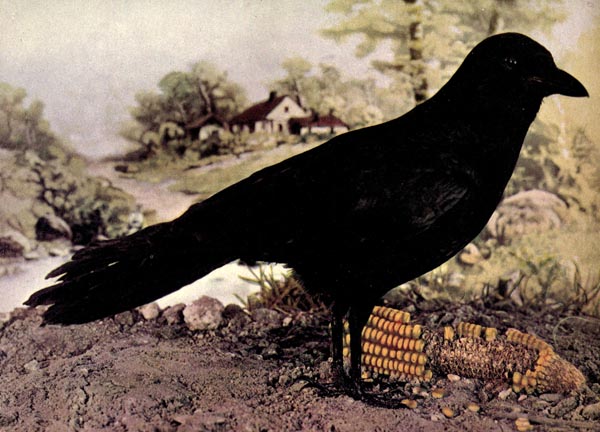
Caw! Caw! Caw! little boys and girls. Caw! Caw! Caw! Just look at my coat of feathers. See how black and glossy it is. Do you wonder I am proud of it?

Perhaps you think I look very solemn and wise, and not at all as if I cared to play games. I do, though; and one of the games I like best is hide-and-seek. I play it with the farmer in the spring. He hides, in the rich, brown earth, golden kernels of corn. Surely he does it because he knows I like it, for sometimes he puts up a stick all dressed like a man to show where the corn is hidden. Sometimes I push my bill down into the earth to find the corn, and at other times I wait until tiny green leaves begin to show above the ground, and then I get my breakfast without much trouble. I wonder if the farmer enjoys this game as much as I do. I help him, too, by eating worms and insects.

During the spring and summer I live in my nest on the top of a very high tree. It is built of sticks and grasses and straw and string and anything else I can pick up. But in the fall, I and all my relations and friends live together in great roosts or rookeries. What good times we do have—hunting all day for food and talking all night. Wouldn’t you like to be with us?

The farmer who lives in the house over there went to the mill to-day with a load of corn.

One of the ears dropped out of the wagon and it didn’t take me long to find it. I have eaten all I can possibly hold and am wondering now what is the best thing to do. If you were in my place would you leave it here and not tell anybody and come back to-morrow and finish it? Or would you fly off and get Mrs. Crow and some of the children to come and finish it? I believe I’ll fly and get them. Good-bye.

Caw! Caw! Caw!

Fish Crow (Corvus ossifragus) at Lake Morton By Dan'sPix

Fish Crow (Corvus ossifragus) at Lake Morton By Dan’sPix


THE COMMON CROW.

“The crow doth sing as merry as the lark,
When neither is attended.”


F for Birds Illustrated by Color Photography

EW birds have more interesting characteristics than the Common Crow, being, in many of his actions, very like the Raven, especially in his love for carrion. Like the Raven, he has been known to attack game, although his inferior size forces him to call to his assistance the aid of his fellows to cope with larger creatures. Rabbits and hares are frequently the prey of this bird which pounces on them as they steal abroad to feed. His food consists of reptiles, frogs, and lizards; he is a plunderer of other birds’ nests. On the seashore he finds crabs, shrimps and inhabited shells, which he ingeniously cracks by flying with them to a great height and letting them fall upon a convenient rock.

The crow is seen in single pairs or in little bands of four or five. In the autumn evenings, however, they assemble in considerable flocks before going to roost and make a wonderful chattering, as if comparing notes of the events of the day.

The nest of the Crow is placed in some tree remote from habitations of other birds. Although large and very conspicuous at a distance, it is fixed upon one of the topmost branches quite out of reach of the hand of the adventurous urchin who longs to secure its contents. It is loosely made and saucer shaped. Sticks and softer substances are used to construct it, and it is lined with hair and fibrous roots. Very recently a thrifty and intelligent Crow built for itself a summer residence in an airy tree near Bombay, the material used being gold, silver, and steel spectacle frames, which the bird had stolen from an optician of that city. Eighty-four frames had been used for this purpose, and they were so ingeniously woven together that the nest was quite a work of art. The eggs are variable, or rather individual, in their markings, and even in their size. The Crow rarely uses the same nest twice, although he frequently repairs to the same locality from year to year. He is remarkable for his attachment to his mate and young, surpassing the Fawn and Turtle Dove in conjugal courtesy.

And he lives to a good old age. Instances are not rare where he has attained to half a century, without great loss of activity or failure of sight.

At Red Bank, a few miles northeast of Cincinnati, on the Little Miami River, in the bottoms, large flocks of Crows congregate the year around. A few miles away, high upon Walnut Hills, is a Crow roost, and in the late afternoons the Crows, singly, in pairs, and in flocks, are seen on the wing, flying heavily, with full crops, on the way to the roost, from which they descend in the early morning, crying “Caw! Caw!” to the fields of the newly planted, growing, or matured corn, or corn stacks, as the season may provide.

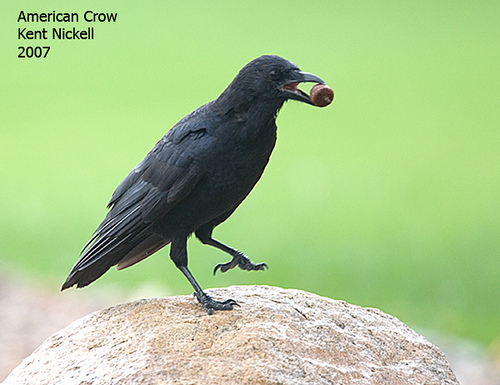
American Crow (Corvus brachyrhynchos) by Kent Nickell

American Crow (Corvus brachyrhynchos) by Kent Nickell


Lee’s Addition:

The Raven family which includes the Crows is mentioned in Scripture in the list of unclean birds in Leviticus and Deuteronomy (14:14) as “after its kind.”

every raven after its kind, (Leviticus 11:15 NKJV)

Crows form the genus Corvus in the Corvidae – Crows, Jays Family. Ranging in size from the relatively small pigeon-size jackdaws (Eurasian and Daurian) to the Common Raven of the Holarctic region and Thick-billed Raven of the highlands of Ethiopia, the 40 or so members of this genus occur on all temperate continents (except South America) and several offshore and oceanic islands (except for a few, which included Hawaii, which had the Hawaiian crow that went extinct in the wild in 2002). In the United States and Canada, the word “crow” is used to refer to the American Crow.

The crow genus makes up a third of the species in the Corvidae family. A group of crows is called a flock or, more poetically, a murder, But the term “murder of crows” mostly reflects a time when groupings of many animals had colorful and poetic names. For example, other “group” names include: an ostentation of peacocks, a parliament of owls, a knot of frogs, and a skulk of foxes.

Recent research has found some crow species capable not only of tool use but of tool construction as well. Crows are now considered to be among the world’s most intelligent animals. As a group, crows show remarkable examples of intelligence. Crows and ravens often score very highly on intelligence tests. Certain species top the avian IQ scale. Wild hooded crows in Israel have learned to use bread crumbs for bait-fishing. Crows will engage in a kind of mid-air jousting, or air-“chicken” to establish pecking order. Crows have been found to engage in feats such as sports, tool use, the ability to hide and store food across seasons, episodic-like memory,[vague] and the ability to use individual experience in predicting the behavior of environmental conspecifics.

One species, the New Caledonian Crow, has also been intensively studied recently because of its ability to manufacture and use its own tools in the day-to-day search for food. These tools include ‘knives’ cut from stiff leaves and stiff stalks of grass. Another skill involves dropping tough nuts into a trafficked street and waiting for a car to crush them open. On October 5, 2007, researchers from the University of Oxford, England presented data acquired by mounting tiny video cameras on the tails of New Caledonian Crows. It turned out that they use a larger variety of tools than previously known, plucking, smoothing, and bending twigs and grass stems to procure a variety of foodstuffs.  Recent research suggests that crows have the ability to recognize one individual human from another by facial features.

Birds Illustrated by Color Photograhy Vol 1 March 1897 No 3 - Cover

Birds Illustrated by Color Photography – Revisited – Introduction

The above article is the first article in the monthly serial for February 1897 “designed to promote Knowledge of Bird-Live.” These include Color Photography, as they call them, today they are drawings. There are at least three Volumes that have been digitized by Project Gutenberg.

To see the whole series of – Birds Illustrated by Color Photography – Revisited

*

(Information from Wikipedia and other internet sources)

Next Article – The Return Of The Birds

Previous Article – The Bobolink

Sharing The Gospel

Links:

Corvidae – Crows, Jays Family 

Crow – Wikipedia

Birds of the Bible – Ravens

*

Ad for Birds Illustrated by Color Photography, 1897

Ad for Birds Illustrated by Color Photography, 1897

*

Birds Vol 1 #3 – The Bobolink

Bobolinks - for Birds Illustrated

Bobolinks – for Birds Illustrated

Birds Illustrated by Color Photography – Revisited

Vol 1. March, 1897 No. 3

*

THE BOBOLINK.

“When Nature had made all her birds,
And had no cares to think on,
She gave a rippling laugh,
And out there flew a Bobolinkon.”


imgn

O American ornithologist omits mention of the Bobolink, and naturalists generally have described him under one of the many names by which he is known. In some States he is called the Rice Bird, in others Reed Bird, the Rice or Reed Bunting, while his more familiar title, throughout the greater part of America, is Bobolink, or Bobolinkum. In Jamaica, where he gets very fat during his winter stay, he is called the Butter Bird. His title of Rice Troopial is earned by the depredations which he annually makes upon the rice crops, though his food “is by no means restricted to that seed, but consists in a large degree of insects, grubs, and various wild grasses.” A migratory bird, residing during the winter in the southern parts of America, he returns in vast multitudes northward in the early Spring. According to Wilson, their course of migration is as follows: “In April, or very early in May, the Rice Buntings, male and female, arrive within the southern boundaries of the United States, and are seen around the town of Savannah, Georgia, sometimes in separate parties of males and females, but more generally promiscuously. They remain there but a short time, and about the middle of May make their appearance in the lower part of Pennsylvania. While here the males are extremely gay and full of song, frequenting meadows, newly plowed fields, sides of creeks, rivers, and watery places, feeding on May flies and caterpillars, of which they destroy great quantities. In their passage, however, through Virginia at this season, they do great damage to the early wheat and barley while in their milky state. About the 20th of May they disappear on their way to the North. Nearly at the same time they arrive in the State of New York, spread over the whole of the New England States, as far as the river St. Lawrence, and from Lake Ontario to the sea. In all of these places they remain during the Summer, building their nests and rearing their young.”

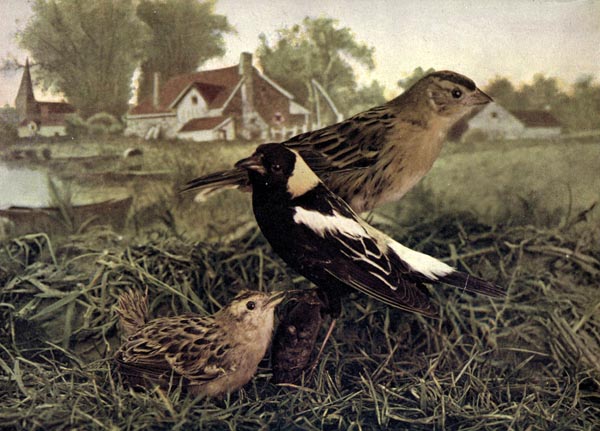
The Bobolink’s song is a peculiar one, varying greatly with the occasion. As he flys southward, his cry is a kind of clinking note; but the love song addressed to his mate is voluble and fervent. It has been said that if you should strike the keys of a pianoforte haphazard, the higher and the lower singly very quickly, you might have some idea of the Bobolink’s notes. In the month of June he gradually changes his pretty, attractive dress and puts on one very like the females, which is of a plain rusty brown, and is not reassumed until the next season of nesting. The two parent birds in the plate represent the change from the dark plumage in which the bird is commonly known in the North as the Bobolink, to the dress of yellowish brown by which it is known throughout the South as the Rice or Reed Bird.

His nest, small and a plain one, too, is built on the ground by his industrious little wife. The inside is warmly lined with soft fibers of whatever may be nearest at hand. Five pretty white eggs, spotted all over with brown are laid, and as soon

“As the little ones chip the shell
And five wide mouths are ready for food,
‘Robert of Lincoln’ bestirs him well,
Gathering seeds for this hungry brood.”

Bobolink (Dolichonyx oryzivorus) CC Pair ramendan

Bobolink (Dolichonyx oryzivorus) CC Pair ramendan

Other birds may like to travel alone, but when jolly Mr. Bobolink and his quiet little wife come from the South, where they have spent the winter, they come with a large party of friends. When South, they eat so much rice that the people call them Rice Birds. When they come North, they enjoy eating wheat, barley, oats and insects.

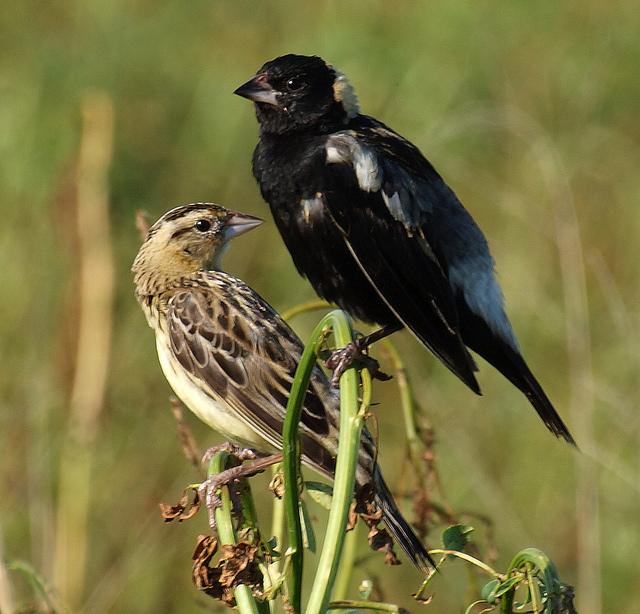
Mr. and Mrs. Bobolink build their simple little nest of grasses in some field. It is hard to find on the ground, for it looks just like dry grass. Mrs. Bobolink wears a dull dress, so she cannot be seen when she is sitting on the precious eggs. She does not sing a note while caring for the eggs. Why do you think that is?

Mr. Bob-Linkum does not wear a sober dress, as you can see by his picture. He does not need to be hidden. He is just as jolly as he looks. Shall I tell you how he amuses his mate while she is sitting? He springs from the dew-wet grass with a sound like peals of merry laughter. He frolics from reed to post, singing as if his little heart would burst with joy.

Don’t you think Mr. and Mrs. Bobolink look happy in the picture? They have raised their family of five. Four of their children have gone to look for food; one of them—he must surely be the baby—would rather stay with his mamma and papa. Which one does he look like?

Many birds are quiet at noon and in the afternoon. A flock of Bobolinks can be heard singing almost all day long. The song is full of high notes and low, soft notes and loud, all sung rapidly. It is as gay and bright as the birds themselves, who flit about playfully as they sing. You will feel like laughing as merrily as they sing when you hear it some day.

Bobolink (Dolichonyx oryzivorus) by J Fenton

Bobolink (Dolichonyx oryzivorus) by J Fenton


Lee’s Addition:

Even the birds in the sky know the right time to do things. The storks, doves, swifts, and thrushes know when it is time to fly to a new home. But my people don’t know what the LORD wants them to do. (Jeremiah 8:7 ERV)

The Bobolink (Dolichonyx oryzivorus) is a small New World blackbird and the only member of genus Dolichonyx. They are in the Icteridae – Oropendolas, Orioles & Blackbirds Family.

Adults are 16–18 cm (6–8 in) long with short finch-like bills. They weigh about 1 ounce (28 g).[1] Adult males are mostly black, although they do display creamy napes, and white scapulars, lower backs and rumps. Adult females are mostly light brown, although their coloring includes black streaks on the back and flanks, and dark stripes on the head; their wings and tails are darker. The collective name for a group of bobolinks is a chain.[2]
[edit]Distribution and movements

These birds migrate to Argentina, Bolivia and Paraguay. One bird was tracked flying 12,000 miles (19,000 km) over the course of the year, and up to 1,100 miles (1,800 km) in one day. They often migrate in flocks, feeding on cultivated grains and rice, which leads to them being considered a pest by farmers in some areas. Although Bobolinks migrate long distances, they have rarely been sighted in Europe—like many vagrants from the Americas, the overwhelming majority of records are from the British Isles.[citation needed] Each fall, Bobolinks gather in large numbers in South American rice fields, where they are inclined to eat grain. This has earned them the name “ricebird” in these parts. However, they are called something entirely different in Jamaica (Butterbirds) where they are collected as food, being that they are very fat as they pass through on migration.

Their breeding habitats are open grassy fields, especially hay fields, across North America. In high-quality habitats, males are often polygynous. Females lay 5 to 6 eggs in a cup-shaped nest, which is always situated on the ground and is usually well-hidden in dense vegetation. Both parents feed the young.

Bobolinks forage on, or near the ground, and mainly eat seeds and insects. Males sing bright, bubbly songs in flight; these songs gave this species its common name.

Birds Illustrated by Color Photograhy Vol 1 March 1897 No 3 - Cover

Birds Illustrated by Color Photography – Revisited – Introduction

The above article is the first article in the monthly serial for February 1897 “designed to promote Knowledge of Bird-Live.” These include Color Photography, as they call them, today they are drawings. There are at least three Volumes that have been digitized by Project Gutenberg.

To see the whole series of – Birds Illustrated by Color Photography – Revisited

*

(Information from Wikipedia and other internet sources)

Next Article – The Bobolink

Previous Article – The Japan Pheasant

Wordless Birds

Links:

Birds of the World – Woodpeckers

Flicker – Wikipedia

Woodpecker – Wikipedia

*
Birds Vol 1 #3 – The Flicker

Flicker

Birds Illustrated by Color Photography – Revisited

Vol 1. March, 1897 No. 3

*

THE FLICKER.

imga1

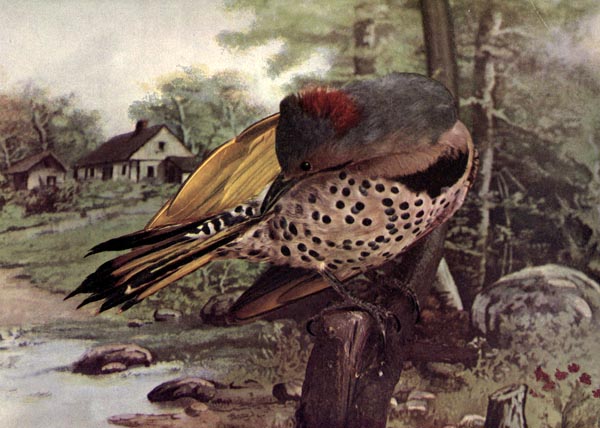
GREAT variety of names does this bird possess. It is commonly known as the Golden Winged Woodpecker, Yellow-shafted Flicker, Yellow Hammer, and less often as High-hole or High-holer, Wake-up, etc. In suitable localities throughout the United States and the southern parts of Canada, the Flicker is a very common bird, and few species are more generally known. “It is one of the most sociable of our Woodpeckers, and is apparently always on good terms with its neighbors. It usually arrives in April, occasionally even in March, the males preceding the females a few days, and as soon as the latter appear one can hear their voices in all directions.”

The Flicker is an ardent wooer. It is an exceedingly interesting and amusing sight to see a couple of males paying their addresses to a coy and coquettish female; the apparent shyness of the suitors as they sidle up to her and as quickly retreat again, the shy glances given as one peeps from behind a limb watching the other—playing bo-peep—seem very human, and “I have seen,” says an observer, “few more amusing performances than the courtship of a pair of these birds.” The defeated suitor takes his rejection quite philosophically, and retreats in a dignified manner, probably to make other trials elsewhere. Few birds deserve our good will more than the Flicker. He is exceedingly useful, destroying multitudes of grubs, larvæ, and worms. He loves berries and fruit but the damage he does to cultivated fruit is very trifling.

The Flicker begins to build its nest about two weeks after the bird arrives from the south. It prefers open country, interspersed with groves and orchards, to nest in. Any old stump, or partly decayed limb of a tree, along the banks of a creek, beside a country road, or in an old orchard, will answer the purpose. Soft wood trees seem to be preferred, however. In the prairie states it occasionally selects strange nesting sites. It has been known to chisel through the weather boarding of a dwelling house, barns, and other buildings, and to nest in the hollow space between this and the cross beams; its nests have also been found in gate posts, in church towers, and in burrows of Kingfishers and bank swallows, in perpendicular banks of streams. One of the most peculiar sites of his selection is described by William A. Bryant as follows: “On a small hill, a quarter of a mile distant from any home, stood a hay stack which had been placed there two years previously. The owner, during the winter of 1889-90, had cut the stack through the middle and hauled away one portion, leaving the other standing, with the end smoothly trimmed. The following spring I noticed a pair of flickers about the stack showing signs of wanting to make it a fixed habitation. One morning a few days later I was amused at the efforts of one of the pair. It was clinging to the perpendicular end of the stack and throwing out clipped hay at a rate to defy competition. This work continued for a week, and in that time the pair had excavated a cavity twenty inches in depth. They remained in the vicinity until autumn. During the winter the remainder of the stack was removed. They returned the following spring, and, after a brief sojourn, departed for parts unknown.”

From five to nine eggs are generally laid. They are glossy white in color, and when fresh appear as if enameled.

The young are able to leave the nest in about sixteen days; they crawl about on the limbs of the tree for a couple of days before they venture to fly, and return to the nest at night.

Northern Flicker (Colaptes auratus) Red-shafted ©WikiC

Northern Flicker (Colaptes auratus) Red-shafted ©WikiC


Lee’s Addition:

A man that hath friends must shew himself friendly: and there is a friend that sticketh closer than a brother. (Proverbs 18:24 KJV)

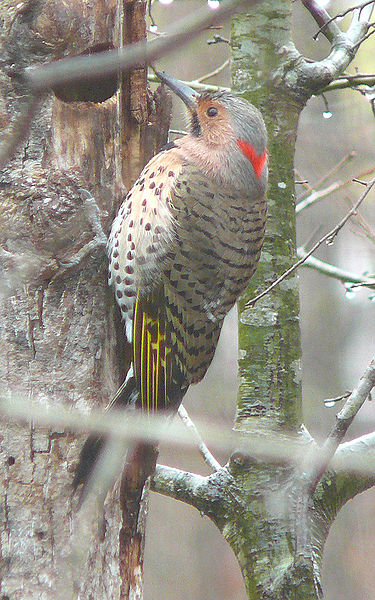
The Northern Flicker (Colaptes auratus) is a medium-sized member of the woodpecker family. It is native to most of North America, parts of Central America, Cuba, the Cayman Islands, and is one of the few woodpecker species that migrate. There are over 100 common names for the Northern Flicker. Among them are: Yellowhammer, clape, gaffer woodpecker, harry-wicket, heigh-ho, wake-up, walk-up, wick-up, yarrup, and gawker bird. Many of these names are attempts at imitating some of its calls.

The Northern Flicker is part of the genus Colaptes which encompasses 12 New-World woodpeckers. There are two living and one extinct subspecies of Colaptes auratus species. The existing sub-species were at one time considered separate species but they commonly interbreed where ranges overlap and are now considered one species by the American Ornithologists Union. Whether or not they are separate species is a well-known example of the species problem.

Northern Flicker (Colaptes auratus) Yellow shafted ©WikiC

Northern Flicker (Colaptes auratus) Yellow shafted ©WikiC

The Yellow-shafted Flicker Colaptes auratus resides in eastern North America. They are yellow under the tail and underwings and have yellow shafts on their primaries. They have a grey cap, a beige face and a red bar at the nape of their neck. Males have a black moustache. Colaptes comes from the Greek verb colapt, to peck. Auratus is from the Latin root aurat, meaning “gold” or “golden” and refers to the bird’s underwing.

Under the name “Yellowhammer” it is the state bird of Alabama.

The Red-shafted Flicker Colaptes auratus cafer resides in western North America. They are red under the tail and underwings and have red shafts on their primaries. They have a beige cap and a grey face. Males have a red moustache.

According to the Audubon guide, “flickers are the only woodpeckers that frequently feed on the ground”, probing with their beak, also sometimes catching insects in flight. Although they eat fruits, berries, seeds and nuts, their primary food is insects. Ants alone can make up 45% of their diet. Other invertebrates eaten include flies, butterflies, moths, beetles, and snails. Flickers also eat berries and seeds, especially in winter, including poison oak and ivy, dogwood, sumac, wild cherry and grape, bayberries, hackberries, and elderberries, and sunflower and thistle seeds. Flickers often go after ants underground (where the nutritious larvae live), hammering at the soil the way other woodpeckers drill into wood. Their tongues can dart out 2 inches beyond the end of the bill to snare prey. As well as eating ants, flickers have a behavior called anting, during which they use the acid from the ants to assist in preening, as it is useful in keeping them free of parasites.

Campo Flicker (Colaptes campestris) by Dario Sanches

Campo Flicker (Colaptes campestris) by Dario Sanches

The Northern Flicker is in the Picidae – Woodpeckers Family of the Piciformes Order. There are 6 Flickers; the Northern, Gilded, Fernandina’s, Chilean, Andean, and Campo Flicker. The other subgenus of the Colaptes (Chrysoptilus) includes the Black-necked, Spot-breasted, Green-barred, Golden-olive, Gray-crowned, Bronze-winged, and the Crimson-mantled Woodpeckers. The whole Woodpecker family has 231 species.

Birds Illustrated by Color Photograhy Vol 1 March 1897 No 3 - Cover

Birds Illustrated by Color Photography – Revisited – Introduction

The above article is the first article in the monthly serial for February 1897 “designed to promote Knowledge of Bird-Live.” These include Color Photography, as they call them, today they are drawings. There are at least three Volumes that have been digitized by Project Gutenberg.

To see the whole series of – Birds Illustrated by Color Photography – Revisited

*

(Information from Wikipedia and other internet sources)

Next Article – The Bobolink

Previous Article – The Japan Pheasant

ABC’s of the Gospel

Links:

Birds of the World – Woodpeckers

Flicker – Wikipedia

Woodpecker – Wikipedia

*
Birds Vol 1 #3 – The Japan Pheasant

Japan Pheasant for Birds Illustrated

Japan Pheasant for Birds Illustrated

Birds Illustrated by Color Photography – Revisited

Vol 1. March, 1897 No. 3

*

THE JAPAN PHEASANT.

imgo

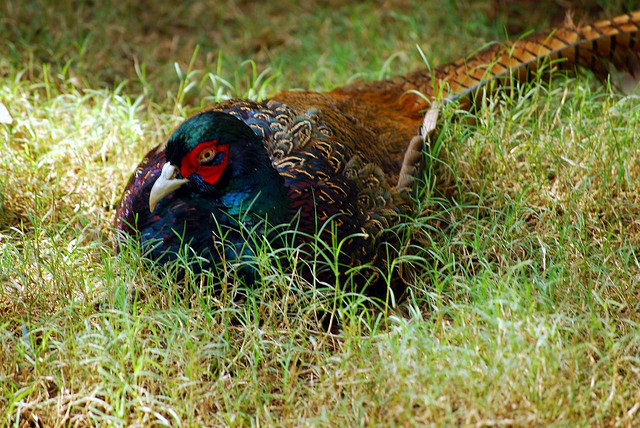
RIGINALLY the Pheasant was an inhabitant of Asia Minor but has been by degrees introduced into many countries, where its beauty of form, plumage, and the delicacy of its flesh made it a welcome visitor. The Japan Pheasant is a very beautiful species, about which little is known in its wild state, but in captivity it is pugnacious. It requires much shelter and plenty of food, and the breed is to some degree artificially kept up by the hatching of eggs under domestic hens and feeding them in the coop like ordinary chickens, until they are old and strong enough to get their own living.

The food of this bird is extremely varied. When young it is generally fed on ants’ eggs, maggots, grits, and similar food, but when it is full grown it is possessed of an accommodating appetite and will eat many kinds of seeds, roots, and leaves. It will also eat beans, peas, acorns, berries, and has even been known to eat the ivy leaf, as well as the berry.

This Pheasant loves the ground, runs with great speed, and always prefers to trust to its legs rather than to its wings. It is crafty, and when alarmed it slips quickly out of sight behind a bush or through a hedge, and then runs away with astonishing rapidity, always remaining under cover until it reaches some spot where it deems itself safe. The male is not domestic, passing an independent life during a part of the year and associating with others of its own sex during the rest of the season.

The nest is very rude, being merely a heap of leaves and grass on the ground, with a very slight depression. The eggs are numerous, about eleven or twelve, and olive brown in color. In total length, though they vary considerably, the full grown male is about three feet. The female is smaller in size than her mate, and her length a foot less.

The Japan Pheasant is not a particularly interesting bird aside from his beauty, which is indeed brilliant, there being few of the species more attractive.

Green Pheasant (Phasianus versicolor) ©WikiC

Green Pheasant (Phasianus versicolor) ©WikiC


Lee’s Addition:

The Green Pheasant, Phasianus versicolor, also known as Japanese Pheasant, is native to the Japanese Archipelago, to which it is endemic. The male (cock) is distinguished from that species by its dark green plumage on the breast and mantle. The male also has an iridescent violet neck, red bare facial skin and purplish green tail. The female is smaller than male and has a dull brown plumage with dark spots.

This species is common and widespread throughout its native range. It frequents farmlands and is often seen close to human settlements; it also has been introduced in Hawaii and (unsuccessfully) in North America as a gamebird.

Some authorities consider the Green Pheasant a subspecies of the Common Pheasant. The Pheasant is in the Phasianidae – Pheasants, Fowl & Allies Family or the Galliformes Order. There are 181 members in the family.

Green Pheasant (Phasianus versicolor) ©©dhruvara

Green Pheasant (Phasianus versicolor) ©©dhruvara

It is the national bird of Japan. “It originally was designated as such in 1947 at the 81st Meeting of the National Bird Society of Japan. The Japanese pheasant was most likely selected because this green pheasant in unique to Japan,and futhermore because it appears in Japanese folk tales and so has become an integral part of the Japanese cultural landscape.”

Fagiano Okayama football club, a club based in Okayama, Okayama Prefecture, has a mascot based on the Green Pheasant.

*

Birds Illustrated by Color Photograhy Vol 1 March 1897 No 3 - Cover

Birds Illustrated by Color Photography – Revisited – Introduction

The above article is the first article in the monthly serial for February 1897 “designed to promote Knowledge of Bird-Live.” These include Color Photography, as they call them, today they are drawings. There are at least three Volumes that have been digitized by Project Gutenberg.

To see the whole series of – Birds Illustrated by Color Photography – Revisited

*

(Information from Wikipedia and other internet sources)

Next Article – The Flicker

Previous Article – The Brown Thrush

Sharing The Gospel

Links:

Green Pheasant – Wikipedia

Phasianidae – Wikipedia

Destinations, Green Pheasant

Video of Green Pheasant – from IBC

*

Ad from Article in 1897

Ad from Birds Illustrated by Photography, 1897

Ad from Birds Illustrated by Photography, 1897

Birds Vol 1 #3 – The Brown Thrush (Thrasher)

Brown Thrasher (Toxostoma rufum)

Brown Thrasher (Toxostoma rufum) – Birds Illustrated

Birds Illustrated by Color Photography – Revisited

Vol 1. March, 1897 No. 3

*

THE BROWN THRUSH.

“However the world goes ill,
The Thrushes still sing in it.”


imgt

HE Mocking-bird of the North, as the Brown Thrush (Brown Thrasher today) has been called, arrives in the Eastern and Middle States about the 10th of May, at which season he may be seen, perched on the highest twig of a hedge, or on the topmost branch of a tree, singing his loud and welcome song, that may be heard a distance of half a mile. The favorite haunt of the Brown Thrush, however, is amongst the bright and glossy foliage of the evergreens. “There they delight to hide, although not so shy and retiring as the Blackbird; there they build their nests in greatest numbers, amongst the perennial foliage, and there they draw at nightfall to repose in warmth and safety.” The Brown Thrasher sings chiefly just after sunrise and before sunset, but may be heard singing at intervals during the day. His food consists of wild fruits, such as blackberries and raspberries, snails, worms, slugs and grubs. He also obtains much of his food amongst the withered leaves and marshy places of the woods and shrubberies which he frequents. Few birds possess a more varied melody. His notes are almost endless in variety, each note seemingly uttered at the caprice of the bird, without any perceptible approach to order.

The site of the Thrush’s nest is a varied one, in the hedgerows, under a fallen tree or fence-rail; far up in the branches of stately trees, or amongst the ivy growing up their trunks. The nest is composed of the small dead twigs of trees, lined with the fine fibers of roots. From three to five eggs are deposited, and are hatched in about twelve days. They have a greenish background, thickly spotted with light brown, giving the whole egg a brownish appearance.

The Brown Thrush leaves the Eastern and Middle States, on his migration South, late in September, remaining until the following May.


THE THRUSH’S NEST.

“Within a thick and spreading hawthorn bush
That overhung a molehill, large and round,
I heard from morn to morn a merry thrush
Sing hymns of rapture while I drank the sound
With joy—and oft an unintruding guest,
I watched her secret toils from day to day;
How true she warped the moss to form her nest,
And modeled it within with wood and clay.
And by and by, with heath-bells gilt with dew,
There lay her shining eggs as bright as flowers,
Ink-spotted over, shells of green and blue:
And there I witnessed, in the summer hours,
A brood of nature’s minstrels chirp and fly,
Glad as the sunshine and the laughing sky.”


THE BROWN THRUSH.

Dear Readers:

My cousin Robin Redbreast told me that he wrote you a letter last month and sent it with his picture. How did you like it? He is a pretty bird—Cousin Robin—and everybody likes him. But I must tell you something of myself.

Folks call me by different names—some of them nicknames, too.

The cutest one of all is Brown Thrasher. I wonder if you know why they call me Thrasher. If you don’t, ask some one. It is really funny.

Some people think Cousin Robin is the sweetest singer of our family, but a great many like my song just as well.

Early in the morning I sing among the bushes, but later in the day you will always find me in the very top of a tree and it is then I sing my best.

Do you know what I say in my song? Well, if I am near a farmer while he is planting, I say: “Drop it, drop it—cover it up, cover it up—pull it up, pull it up, pull it up.”

One thing I very seldom do and that is, sing when near my nest. Maybe you can tell why. I’m not very far from my nest now. I just came down to the stream to get a drink and am watching that boy on the other side of the stream. Do you see him?

One dear lady who loves birds has said some very nice things about me in a book called “Bird Ways.” Another lady has written a beautiful poem about my singing. Ask your mamma or teacher the names of these ladies. Here is the poem:

There’s a merry brown thrush sitting up in a tree.
He is singing to me! He is singing to me!
And what does he say—little girl, little boy?
“Oh, the world’s running over with joy!
Hush! Look! In my tree,
I am as happy as happy can be.”

And the brown thrush keeps singing, “A nest, do you see,
And five eggs, hid by me in the big cherry tree?
Don’t meddle, don’t touch—little girl, little boy—
Or the world will lose some of its joy!
Now I am glad! now I am free!
And I always shall be,
If you never bring sorrow to me.”

So the merry brown thrush sings away in the tree
To you and to me—to you and to me;
And he sings all the day—little girl, little boy—
“Oh, the world’s running over with joy!
But long it won’t be,
Don’t you know? don’t you see?
Unless we’re good as good can be.”

Brown Thrasher (Toxostoma rufum) By Dan'sPix

Brown Thrasher (Toxostoma rufum) By Dan’sPix


Lee’s Addition:

The Brown Thrush mentioned in this article is now known as the Brown Thrasher. They are members of the Mimidae – Mockingbirds, Thrashers Family. The family not only has the Thrashers (14) and Mockingbirds (16), but also Catbirds (2) and Tremblers (2).

The Brown Thrasher is bright reddish-brown above with thin, dark streaks on its buffy underparts. Its long, rufous tail is rounded with paler corners, and eyes are a brilliant gold. Adults average about 11.5 in (29 cm) long with a wingspan of 13 in (33 cm), and weigh 2.4 oz (68 g).

It is found in thickets and dense brush, often searching for food in dry leaves on the ground. It also enjoys the convergence of mowed to unmowed lawns, particularly if there are ample shrubs or shrubby trees, i.e., fruit orchards that the undergrowth is left undisturbed. It also enjoys perennial gardens and can be seen jumping from the ground to catch insects on flowers and foliage. Its breeding range includes the United States and Canada east of the Rocky Mountains. It is a partial migrant, with northern birds wintering in the southern USA, where it occurs throughout the year.

The female lays 3 to 5 eggs in a twiggy nest lined with grass. The nest is built in a dense shrub or low in a tree. Both parents incubate and feed the young. These birds raise two or three broods in a year. They are able to call in up to 3000 distinct songs. The male sings a series of short repeated melodious phrases from an open perch to defend his territory and is also very aggressive in defending the nest.

Brown Thrasher by Chris Parrish

The Brown Thrasher is the official state bird of Georgia, and was the inspiration for the name of Atlanta’s former National Hockey League team, the Atlanta Thrashers.(Wikipedia)

Brown Thrasher (Toxostoma rufum) ©WikiC

Brown Thrasher (Toxostoma rufum) ©WikiC

The flowers appear on the earth; the time of the singing of birds is come, and the voice of the turtle is heard in our land; (Song of Solomon 2:12 KJV)

Birds Illustrated by Color Photograhy Vol 1 March 1897 No 3 - Cover

Birds Illustrated by Color Photography – Revisited – Introduction

The above article is the first article in the monthly serial for February 1897 “designed to promote Knowledge of Bird-Live.” These include Color Photography, as they call them, today they are drawings. There are at least three Volumes that have been digitized by Project Gutenberg.

To see the whole series of – Birds Illustrated by Color Photography – Revisited

*

*

(Information from Wikipedia and other internet sources)

Next Article – The Japan Pheasant

Previous Article – The Swallow

ABC’s of the Gospel

Links:

Brown Thrasher – Wikipedia

Wood Thrush – WhatBird

*


Birds Vol 1 #3 – The Swallow

Barn Swallow

Barn Swallow by Birds Illustrated

Birds Illustrated by Color Photography – Revisited

Vol 1. March, 1897 No. 3

*

THE SWALLOW.

“Come, summer visitant, attach
To my reedroof thy nest of clay,
And let my ear thy music catch,
Low twitting underneath the thatch,
At the gray dawn of day.”


imgs

URE harbingers of spring are the Swallows. They are very common birds, and frequent, as a rule, the cultivated lands in the neighborhood of water, showing a decided preference for the habitations of man. “How gracefully the swallows fly! See them coursing over the daisy-bespangled grass fields; now they skim just over the blades of grass, and then with a rapid stroke of their long wings mount into the air and come hovering above your head, displaying their rich white and chestnut plumage to perfection. Now they chase each other for very joyfulness, uttering their sharp twittering notes; then they hover with expanded wings like miniature Kestrels, or dart downwards with the velocity of the sparrowhawk; anon they flit rapidly over the neighboring pool, occasionally dipping themselves in its calm and placid waters, and leaving a long train of rings marking their varied course. How easily they turn, or glide over the surrounding hedges, never resting, never weary, and defying the eye to trace them in the infinite turnings and twistings of their rapid shooting flight. You frequently see them glide rapidly near the ground, and then with a sidelong motion mount aloft, to dart downwards like an animated meteor, their plumage glowing in the light with metallic splendor, and the row of white spots on the tail contrasting beautifully with the darker plumage.”

The Swallow is considered a life-paired species, and returns to its nesting site of the previous season, building a new nest close to the old one. His nest is found in barns and outhouses, upon the beams of wood which support the roof, or in any place which assures protection to the young birds. It is cup-shaped and artfully moulded of bits of mud. Grass and feathers are used for the lining. “The nest completed, five or six eggs are deposited. They are of a pure white color, with deep rich brown blotches and spots, notably at the larger end, round which they often form a zone or belt.” The sitting bird is fed by her mate.

The young Swallow is distinguished from the mature birds by the absence of the elongated tail feathers, which are a mark of maturity alone. His food is composed entirely of insects. Swallows are on the wing fully sixteen hours, and the greater part of the time making terrible havoc amongst the millions of insects which infest the air. It is said that when the Swallow is seen flying high in the heavens, it is a never failing indication of fine weather.

A pair of Swallows on arriving at their nesting place of the preceding Summer found their nest occupied by a Sparrow, who kept the poor birds at a distance by pecking at them with his strong beak whenever they attempted to dislodge him. Wearied and hopeless of regaining possession of their property, they at last hit upon a plan which effectually punished the intruder. One morning they appeared with a few more Swallows—their mouths filled with a supply of tempered clay—and, by their joint efforts in a short time actually plastered up the entrance to the hole, thus barring the Sparrow from the home which he had stolen from the Swallows.

Barn Swallow by Dan


Lee’s Addition:

While visiting Cade’s Cove in the Smokey Mountains of Tennessee, found these Barn Swallows in an old house exhibit. We watched them, but they did not see alarmed by our being there. Having grown up in the city, this was my first experience being up close and personal with swallows.

Barn Swallow in Cades Cove by Dan

Barn Swallow in Cades Cove by Dan

Here are a couple of my attempts to capture the babies and then one of the parents that was sitting on the fireplace mantle keeping an eye on us. Guess they were making sure that we didn’t hurt their offspring.

Smoky-Cades Cove - Swallows in nest by Lee

Smoky-Cades Cove – Swallows in nest by Lee

And the adult (cropped):

Barn Swallow on Fireplace - Smoky-Cades Cove by Lee

Barn Swallow on Fireplace – Smoky-Cades Cove by Lee

Swallows are mentions several times in Scripture and therefore are one of the Birds of the Bible.

Yea, the sparrow hath found an house, and the swallow a nest for herself, where she may lay her young, even thine altars, O LORD of hosts, my King, and my God. (Psalms 84:3 KJV)
As the bird by wandering, as the swallow by flying, so the curse causeless shall not come. (Proverbs 26:2 KJV)
Like a crane or a swallow, so did I chatter: I did mourn as a dove: mine eyes fail with looking upward: O LORD, I am oppressed; undertake for me. (Isaiah 38:14 KJV)

The Barn Swallow (Hirundo rustica) is the most widespread species of swallow in the world.] It is a distinctive passerine bird with blue upperparts, a long, deeply forked tail and curved, pointed wings. It is found in Europe, Asia, Africa and the Americas. In Anglophone Europe it is just called the Swallow; in Northern Europe it is the only common species called a “swallow” rather than a “martin”.

There are six subspecies of Barn Swallow, which breed across the Northern Hemisphere. Four are strongly migratory, and their wintering grounds cover much of the Southern Hemisphere as far south as central Argentina, the Cape Province of South Africa, and northern Australia. Its huge range means that the Barn Swallow is not endangered, although there may be local population declines due to specific threats, such as the construction of an international airport near Durban.

The Barn Swallow is a bird of open country which normally uses man-made structures to breed and consequently has spread with human expansion. It builds a cup nest from mud pellets in barns or similar structures and feeds on insects caught in flight. This species lives in close association with humans, and its insect-eating habits mean that it is tolerated by man; this acceptance was reinforced in the past by superstitions regarding the bird and its nest. There are frequent cultural references to the Barn Swallow in literary and religious works due to both its living in close proximity to humans and its conspicuous annual migration. The Barn Swallow is the national bird of Estonia.

Barn Swallow (Hirundo rustica) WikiC

Barn Swallow (Hirundo rustica) ©WikiC

The adult male Barn Swallow of the nominate subspecies H. r. rustica is 17–19 cm (6.7–7.5 in) long including 2–7 cm (0.8–2.8 in) of elongated outer tail feathers. It has a wingspan of 32–34.5 cm (12.6–13.6 in) and weighs 16–22 g (0.56–0.78 oz). It has steel blue upperparts and a rufous forehead, chin and throat, which are separated from the off-white underparts by a broad dark blue breast band. The outer tail feathers are elongated, giving the distinctive deeply forked “swallow tail.” There is a line of white spots across the outer end of the upper tail.

The female is similar in appearance to the male, but the tail streamers are shorter, the blue of the upperparts and breast band is less glossy, and the underparts more pale. The juvenile is browner and has a paler rufous face and whiter underparts. It also lacks the long tail streamers of the adult.

The song of the Barn Swallow is a cheerful warble, often ending with su-seer with the second note higher than the first but falling in pitch. Calls include witt or witt-witt and a loud splee-plink when excited.[5] The alarm calls include a sharp siflitt for predators like cats and a flitt-flitt for birds of prey like the Hobby. This species is fairly quiet on the wintering grounds.

The distinctive combination of a red face and blue breast band render the adult Barn Swallow easy to distinguish from the African Hirundo species and from the Welcome Swallow (Hirundo neoxena) with which its range overlaps in Australasia. In Africa the short tail streamers of the juvenile Barn Swallow invite confusion with juvenile Red-chested Swallow (Hirundo lucida), but the latter has a narrower breast band and more white in the tail. (Wikipedia)

*

Birds Illustrated by Color Photograhy Vol 1 March 1897 No 3 - Cover

Birds Illustrated by Color Photography – Revisited – Introduction

The above article is the first article in the monthly serial for February 1897 “designed to promote Knowledge of Bird-Live.” These include Color Photography, as they call them, today they are drawings. There are at least three Volumes that have been digitized by Project Gutenberg.

To see the whole series of – Birds Illustrated by Color Photography – Revisited

*

(Information from Wikipedia and other internet sources)

Next Article – The Brown Thrush

Previous Article – Little Boy Blue – The Blue Bird

Sharing The Gospel

Links:

Birds of the Bible – Swallow

Hirundinidae – Swallows, martins

Barn Swallow – Wikipedia

An Ad from the Publication:

Racycle Ad - Birds Illustrated - 1897

Racycle Ad – Birds Illustrated – 1897