Evolution is full of Surprises! and will Explain Anything (Re-post)

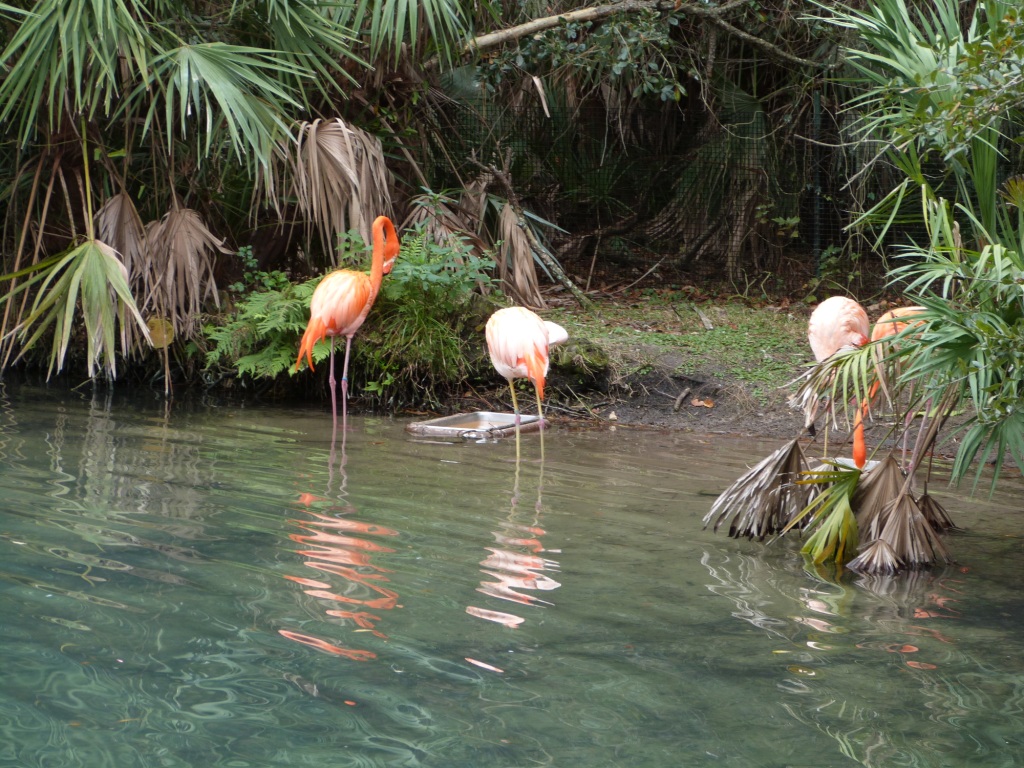
American Flamingo (Phoenicopterus ruber) Brevard Zoo by Lee

American Flamingo (Phoenicopterus ruber) Brevard Zoo by Lee

“During my research I noticed how common it is to run into articles that talk about how “surprising,” “unexpected,” or even “baffling” the results of a study or find is to scientists. Although I know Creation Scientists are probably often surprised as well, I can’t help thinking that scientists would be less surprised if they all had a more accurate worldview.”…

To see the rest of this very interesting article:

Evolution is full of Surprises! and will Explain Anything.

In the beginning was the Word, and the Word was with God, and the Word was God. He was in the beginning with God. All things were made through Him, and without Him nothing was made that was made. In Him was life, and the life was the light of men. And the light shines in the darkness, and the darkness did not comprehend it. (John 1:1-5 NKJV)

This is from CreationScience4Kids

*

Bird of the Week – Antarctic Tern

Antarctic Tern (Sterna vittata) by Ian (1)

Antarctic Tern (Sterna vittata) by Ian (1)

Bird of the Week – Antarctic Tern ~ by Ian Montgomery

Newsletter – 8-28-12

I’ve been adding photos from the recent Hong Kong, Finland, Ireland trip to the website and have encountered a few that are also on the Australian list such as the Arctic Tern. That was my initial choice for this week’s bird until I changed it to the closely related but lesser known Antarctic Tern as I took some photos of it on the Sub-Antarctic Islands trip last November that I would like to share. It is also on the Australian list and breeds at Macquarie and Heard Islands, though it is regarded as a very rare vagrant to the mainland.

We first encountered them at Snares, on the day after leaving Dunedin, first photo. Snares is a nature reserve and we weren’t allowed to land there but, as you can judge from the photo, weather conditions were good and we could get very close to some of the birds and mammals in the Zodiacs. This bird is in breeding plumage and the coral red bill and leg colour is sufficient to distinguish it from the similar breeding Common and Arctic Terns, both of which spend the northern winter in the southern hemisphere. These two breed in the northern hemisphere in the northern summer and both the time of the year and the location are also sufficient circumstantial evidence to eliminate birds of those species in breeding plumage. Apart from that, there are other subtler differences relating to size, plumage and proportions with the Antarctic Tern being both larger and stockier than the other two.

Antarctic Tern (Sterna vittata) by Ian (2)

Antarctic Tern (Sterna vittata) by Ian (2)

Some of these difference, such as the extent of transparency and dark webs in the flight feathers can only be seen in flight, second photo. If you’re not too worried about identification, then you can appreciate the beauty of all these elegant mid-sized terns and, given their graceful flight and forked tails, it’s no wonder that they have been called Sea Swallows. This photo was taken the following day at Enderby Island, one of the Auckland Islands. We were allowed to land there and it proved to be a fascinating place. At a small colony of nesting Antarctic Terns the bird in the third photo is just landing at its neat grassy nest to incubate the two eggs.

Antarctic Tern (Sterna vittata) by Ian (3)

Antarctic Tern (Sterna vittata) by Ian (3)

Both at Snares and on Enderby, there were other similar terns in non-breeding plumage, fourth photo, hanging around the edges of the breeding colony. This is where separation of the three species gets tough and is either a fascinating challenge or a nightmare for keen birders – depending on one’s attitude – and it’s no surprise that in the British Isles Common and Arctic Terns are collectively and wryly referred to as ‘Comic’ Terns. Birders have it fairly easy there and don’t have to worry about Antarctic Terns (we won’t even discuss the South American and Kerguelen Terns which complete the quintet). At Snares, we were tempted to identify this as an Arctic Tern. Arctic Terns, incidentally, easily win the prize for migration, breeding in the higher latitudes of the northern hemisphere and wintering on the coast of Antarctica.

Antarctic Tern (Sterna vittata) by Ian (4)

Antarctic Tern (Sterna vittata) by Ian (4)

It wasn’t until we got to Enderby and found more of these non-breeding birds in close proximity to breeding Antarctic Terns that we could compare the two sorts side by side and conclude that they were non-breeding Antarctic Terns. When I got home, the Handbook of Birds of the World, confirmed that in some places one year old birds, not old enough to breed, do occur at colonies. It may well be that the few records of Antarctic Terns for mainland Australia is more a reflection of the difficulties of separating non-breeding birds, that their actual rarity.

Back at the website, recent additional species from the trip that might be of interest include:

Best wishes
Ian

**************************************************
Ian Montgomery, Birdway Pty Ltd,
454 Forestry Road, Bluewater, Qld 4818
Tel 0411 602 737 ian@birdway.com.au
Check the latest website updates:
http://www.birdway.com.au/#updates


Lee’s Addition:

and let birds fly above the earth across the expanse of the heavens. (Genesis 1:20 ESV)

I am glad Ian figures these birds out for us. I have a real challenge just with the Terns I see at our shores. Like Ian tells us, the real ID problem comes when they are in their non-breeding plumages.

Thanks again, Ian, for sharing your birdwatching adventures with us.

Terns are put of the Laridae Family. Check out all of Ian’s Laridae – Sternini & Rynchopin Genus photos, then check out the Laridae – Gulls, Terns and Skimmers Family here.

*

Halcyone (Kingfisher)

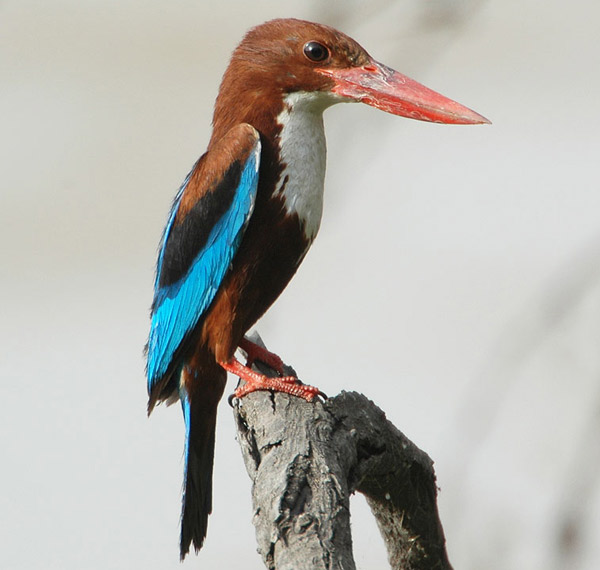
White-throated Kingfisher (Halcyon smyrnensis) by Nikhil Devasar

White-throated Kingfisher (Halcyon smyrnensis) by Nikhil Devasar

Halcyone ~ from The Curious Book of Birds

HALCYONE

Cur Book of Birds letter-tHE story of the first Kingfisher is a sad one, and you need not read it unless for a very little while you wish to feel sorry.

Long, long ago when the world was new, there lived a beautiful princess named Halcyone. She was the daughter of old Æolus, King of the Winds, and lived with him on his happy island, where it was his chief business to keep in order the four boisterous brothers, Boreas, the North Wind, Zephyrus, the West Wind, Auster, the South Wind, and Eurus, the East Wind. Sometimes, indeed, Æolus had a hard time of it; for the Winds would escape from his control and rush out upon the sea for their terrible games, which were sure to bring death and destruction to the sailors and their ships. Knowing them so well, for she had grown up with these rough playmates, Halcyone came to dread more than anything else the cruelties which they practiced at every opportunity.

One day the Prince Ceyx came to the island of King Æolus. He was the son of Hesperus, the Evening Star, and he was the king of the great land of Thessaly. Ceyx and Halcyone grew to love each other dearly, and at last with the consent of good King Æolus, but to the wrath of the four Winds, the beautiful princess went away to be the wife of Ceyx and Queen of Thessaly.

For a long time they lived happily in their peaceful kingdom, but finally came a day when Ceyx must take a long voyage on the sea, to visit a temple in a far country. Halcyone could not bear to have him go, for she feared the dangers of the great deep, knowing well the cruelty of the Winds, whom King Æolus had such difficulty in keeping within bounds. She knew how the mischievous brothers loved to rush down upon venturesome sailors and blow them into danger, and she knew that they especially hated her husband because he had carried her away from the island where she had watched the Winds at their terrible play. She begged Ceyx not to go, but he said that it was necessary. Then she prayed that if he must go he would take her with him, for she could not bear to remain behind dreading what might happen.

But Ceyx was resolved that Halcyone should not go. The good king longed to take her with him; no more than she could he smile at the thought of separation. But he also feared the sea, not on his own account, but for his dear wife. In spite of her entreaties he remained firm. If all went well he promised to return in two months’ time. But Halcyone knew that she should never see him again as now he spoke.

The day of separation came. Standing heart-broken upon the shore, Halcyone watched the vessel sail away into the East, until as a little speck it dropped below the horizon; then sobbing bitterly she returned to the palace.

Now the king and his men had completed but half their journey when a terrible storm arose. The wicked Winds had escaped from the control of good old Æolus and were rushing down upon the ocean to punish Ceyx for carrying away the beautiful Halcyone. Fiercely they blew, the lightning flashed, and the sea ran high; and in the midst of the horrible tumult the good ship went to the bottom with all on board. Thus the fears of Halcyone were proved true, and far from his dear wife poor Ceyx perished in the cruel waves.

That very night when the shipwreck occurred, the sad and fearful Halcyone, sleeping lonely at home, knew in a dream the very calamity which had happened. She seemed to see the storm and the shipwreck, and the form of Ceyx appeared, saying a sad farewell to her. As soon as it was light she rose and hastened to the seashore, trembling with a horrible dread. Standing on the very spot whence she had last seen the fated ship, she looked wistfully over the waste of stormy waters. At last she spied a dark something tossing on the waves. The object floated nearer and nearer, until a huge breaker cast before her on the sand the body of her drowned husband.

“O dearest Ceyx!” she cried. “Is it thus that you return to me?” Stretching out her arms toward him, she leaped upon the sea wall as if she would throw herself into the ocean, which advanced and retreated, seething around his body. But a different fate was to be hers. As she leaped forward two strong wings sprouted from her shoulders, and before she knew it she found herself skimming lightly as a bird over the water. From her throat came sounds of sobbing, which changed as she flew into the shrill piping of a bird. Soft feathers now covered her body, and a crest rose above the forehead which had once been so fair. Halcyone was become a Kingfisher, the first Kingfisher who ever flew lamenting above the waters of the world.

The sad bird fluttered through the spray straight to the body that was tossed upon the surf. As her wings touched the wet shoulders, and as her horny beak sought the dumb lips in an attempt to kiss what was once so dear, the body of Ceyx began to receive new life. The limbs stirred, a faint color returned to the cheeks. At the same moment a change like that which had transformed Halcyone began to pass over her husband. He too was becoming a Kingfisher. He too felt the thrill of wings upon his shoulders, wings which were to bear him up and away out of the sea which had been his death. He too was clad in soft plumage with a kingly crest upon his kingly head. With a faint cry, half of sorrow for what had happened, half of joy for the future in which these two loving ones were at least to be together, Ceyx rose from the surf-swept sand where his lifeless limbs had lain and went skimming over the waves beside Halcyone his wife.

Oriental Dwarf-Kingfisher (Ceyx erithaca) by Khong Tuck Khoon

Oriental Dwarf-Kingfisher (Ceyx erithaca) by Khong Tuck Khoon

So those unhappy mortals became the first kingfishers, happy at last in being reunited. So we see them still, flying up and down over the waters of the world, royal forms with royal crests upon their heads.

They built their nest of the bones of fish, a stout and well-joined basket which floated on the waves as safely as any little boat. And while their children, the baby Halcyons, lay in this rocking cradle, for seven days in the heart of winter, no storms ever troubled the ocean and mariners could set out upon their voyages without fear.

For while his little grandchildren rocked in their basket, the good King Æolus, pitying the sorrows of his daughter Halcyone, was always especially careful to chain up in prison those wicked brothers the Winds, so that they could do no mischief of any kind.

And that is why a halcyon time has come to mean a season of peace and safety.

Belted Kingfisher (Megaceryle alcyon) by Daves BirdingPix

Belted Kingfisher (Megaceryle alcyon) by Daves BirdingPix


Lee’s Addition:

Another enjoyable Bird Tale from the Curious Book of Birds. Kingfishers belong to the Alcedinidae – Kingfishers Family. There are two genus in the Kingfishers called Ceyx and Halcyon. Humm! What do you think? Must be those that name birds read the story?

We know the Lord created Kingfishers, but it is fun to read stories about them, even if they are make-believe.

And when he (Jesus) had finished speaking, he said to Simon, “Put out into the deep and let down your nets for a catch.” And Simon answered, “Master, we toiled all night and took nothing! But at your word I will let down the nets.” And when they had done this, they enclosed a large number of fish, and their nets were breaking. (Luke 5:4-6 ESV)

Kingfishers don’t have to use nets like these fishermen, which were the disciples. But they obeyed and they received a great many fish.

(Photos added by me.)

Links:

White-throated Kingfisher (Halcyon smyrnensis) by Nikhil Devasar


  Alcedinidae – Kingfishers Family


Painted Bunting (Passerina ciris) ©©Flickr


  Bird Tales


Curious Book of Birds - Cover


  The Curious Book of Birds


Spanish Sparrow (Passer Hispaniolensis) female ©WikiC


  Wordless Birds


*

King of the Birds

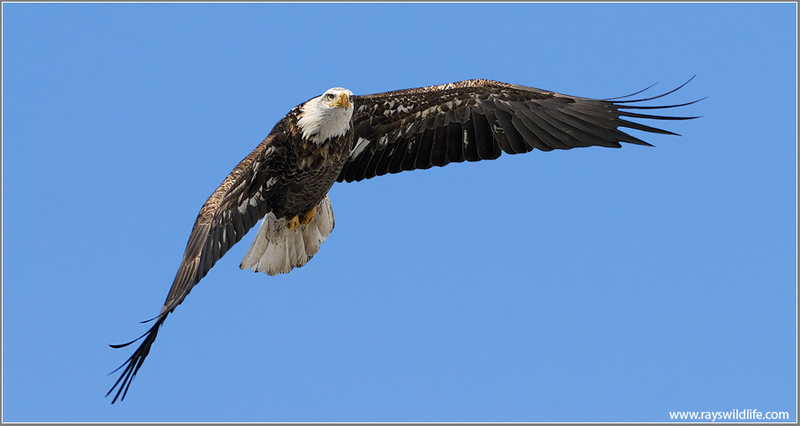
Bald Eagle (Haliaeetus leucocephalus) by Ray

Bald Eagle (Haliaeetus leucocephalus) by Ray

King of the Birds ~ from The Curious Book of Birds

KING OF THE BIRDS

Cur Book of Birds letter-oNCE upon a time, when the world was very new and when the birds had just learned from Mother Magpie how to build their nests, some one said, “We ought to have a king. Oh, we need a king of the birds very much!”

For you see, already in the Garden of Birds trouble had begun. There were disputes every morning as to which was the earliest bird who was entitled to the worm. There were quarrels over the best places for nest-building and over the fattest bug or beetle; and there was no one to settle these difficulties. Moreover, the robber birds were growing too bold, and there was no one to rule and punish them. There was no doubt about it; the birds needed a king to keep them in order and peace.

So the whisper went about, “We must have a king. Whom shall we choose for our king?”

They decided to hold a great meeting for the election. And because the especial talent of a bird is for flying, they agreed that the bird who could fly highest up into the blue sky, straight toward the sun, should be their king, king of all the feathered tribes of the air.

Therefore, after breakfast one beautiful morning, the birds met in the garden to choose their king. All the birds were there, from the largest to the smallest, chirping, twittering, singing on every bush and tree and bit of dry grass, till the noise was almost as great as nowadays at an election of two-legged folk without feathers. They swooped down in great clouds, till the sky was black with them, and they were dotted on the grass like punctuation marks on a green page. There were so many that not even wise Mother Magpie or old Master Owl could count them, and they all talked at the same time, like ladies at an afternoon tea, which was very confusing.

Little Robin Redbreast was there, hopping about and saying pleasant things to every one, for he was a great favorite. Gorgeous Goldfinch was there, in fine feather; and little Blackbird, who was then as white as snow. There were the proud Peacock and the silly Ostrich, the awkward Penguin and the Dodo, whom no man living has ever seen. Likewise there were the Jubjub Bird and the Dinky Bird, and many other curious varieties that one never finds described in the wise Bird Books,—which is very strange, and sad, too, I think. Yes, all the birds were there for the choosing of their king, both the birds who could fly, and those who could not. (But for what were they given wings, if not to fly? How silly an Ostrich must feel!)

Now the Eagle expected to be king. He felt sure that he could fly higher than any one else. He sat apart on a tall pine tree, looking very dignified and noble, as a future king should look. And the birds glanced at one another, nodded their heads, and whispered, “He is sure to be elected king. He can fly straight up toward the sun without winking, and his great wings are so strong, so strong! He never grows tired. He is sure to be king.”

Thus they whispered among themselves, and the Eagle heard them, and was pleased. But the little brown Wren heard also, and he was not pleased. The absurd little bird! He wanted to be king himself, although he was one of the tiniest birds there, who could never be a protector to the others, nor stop trouble when it began. No, indeed! Fancy him stepping as a peacemaker between a robber Hawk and a bloody Falcon. It was they who would make pieces of him. But he was a conceited little creature, and saw no reason why he should not make a noble sovereign.

Cobb's Wren (Troglodytes cobbi) ©WikiC

Cobb’s Wren (Troglodytes cobbi) ©WikiC

“I am cleverer than the Eagle,” he said to himself, “though he is so much bigger. I will be king in spite of him. Ha-ha! We shall see what we shall see!” For the Wren had a great idea in his wee little head—an idea bigger than the head itself, if you can explain how that could be. He ruffled up his feathers to make himself as huge as possible, and hopped over to the branch where the Eagle was sitting.

“Well, Eagle,” said the Wren pompously, “I suppose you expect to be king, eh?”

The Eagle stared hard at him with his great bright eyes. “Well, if I do, what of that?” he said. “Who will dispute me?”

“I shall,” said the Wren, bobbing his little brown head and wriggling his tail saucily.

“You!” said the Eagle. “Do you expect to fly higher than I?”

“Yes,” chirped the Wren, “I do. Yes, I do, do, do!”

“Ho!” said the Eagle scornfully. “I am big and strong and brave. I can fly higher than the clouds. You, poor little thing, are no bigger than a bean. You will be out of breath before we have gone twice this tree’s height.”

“Little as I am, I can mount higher than you,” said the Wren.

“What will you wager, Wren?” asked the Eagle. “What will you give me if I win?”

“If you win you will be king,” said the Wren. “But beside that, if you win I will give you my fat little body to eat for your breakfast. But if I win, Sir, I shall be king, and you must promise never, never, never, to hurt me or any of my people.”

“Very well. I promise,” said the Eagle haughtily. “Come now, it is time for the trial, you poor little foolish creature.”

The birds were flapping their wings and singing eagerly, “Let us begin—begin. We want to see who is to be king. Come, birds, to the trial. Who can fly the highest? Come!”

Then the Eagle spread his great wings and mounted leisurely into the air, straight toward the noonday sun. And after him rose a number of other birds who wanted to be king,—the wicked Hawk, the bold Albatross, and the Skylark singing his wonderful song. The long-legged Stork started also, but that was only for a joke. “Fancy me for a king!” he cried, and he laughed so that he had to come down again in a minute. But the Wren was nowhere to be seen. The truth was, he had hopped ever so lightly upon the Eagle’s head, where he sat like a tiny crest. But the Eagle did not know he was there.

Black-browed Albatross (Thalassarche melanophris) by Bob-Nan

Black-browed Albatross (Thalassarche melanophris) by Bob-Nan

Soon the Hawk and the Albatross and even the brave little Skylark fell behind, and the Eagle began to chuckle to himself at his easy victory. “Where are you, poor little Wren?” he cried very loudly, for he fancied that the tiny bird must be left far, far below.

“Here I am, here I am, away up above you, Master Eagle!” piped the Wren in a weak little voice. And the Eagle fancied the Wren was so far up in the air that even his sharp eyes could not spy the tiny creature. “Dear me!” said he to himself. “How extraordinary that he has passed me.” So he redoubled his speed and flew on, higher, higher.

Presently he called out again in a tremendous voice, “Well, where are you now? Where are you now, poor little Wren?”

Once more he heard the tiny shrill voice from somewhere above piping, “Here I am, here I am, nearer the sun than you, Master Eagle. Will you give up now?”

Of course the Eagle would not give up yet. He flew on, higher and higher, till the garden and its flock of patient birds waiting for their king grew dim and blurry below. And at last even the mighty wings of the Eagle were weary, for he was far above the clouds. “Surely,” he thought, “now the Wren is left miles behind.” He gave a scream of triumph and cried, “Where are you now, poor little Wren? Can you hear me at all, down below there?”

But what was his amazement to hear the same little voice above his head shrilling, “Here I am, here I am, Sir Eagle. Look up and see me, look!” And there, sure enough, he was fluttering above the Eagle’s head. “And now, since I have mounted so much higher than you, will you agree that I have won?”

“Yes, you have won, little Wren. Let us descend together, for I am weary enough,” cried the Eagle, much mortified; and down he swooped, on heavy, discouraged wings.

“Yes, let us descend together,” murmured the Wren, once more perching comfortably on the Eagle’s head. And so down he rode on this convenient elevator, which was the first one invented in this world.

When the Eagle nearly reached the ground, the other birds set up a cry of greeting.

“Hail, King Eagle!” they sang. “How high you flew! How near the sun! Did he not scorch your Majesty’s feathers? Hail, mighty king!” and they made a deafening chorus. But the Eagle stopped them.

“The Wren is your king, not I,” he said. “He mounted higher than I did.”

“The Wren? Ha-ha! The Wren! We can’t believe that The Wren flew higher than you? No, no!” they all shouted. But just then the Eagle lighted on a tree, and from the top of his head hopped the little Wren, cocking his head and ruffling himself proudly.

“Yes, I mounted higher than he,” he cried, “for I was perched on his head all the while, ha-ha! And now, therefore, I am king, small though I be.”

Now the Eagle was very angry when he saw the trick that had been played upon him, and he swooped upon the sly Wren to punish him. But the Wren screamed, “Remember, remember your promise never to injure me or mine!” Then the Eagle stopped, for he was a noble bird and never forgot a promise. He folded his wings and turned away in disgust.

“Be king, then, O cheat and trickster!” he said.

“Cheat and trickster!” echoed the other birds. “We will have no such fellow for our king. Cheat and trickster he is, and he shall be punished. You shall be king, brave Eagle, for without your strength he could never have flown so high. It is you whom we want for our protector and lawmaker, not this sly fellow no bigger than a bean.”

So the Eagle became their king, after all; and a noble bird he is, as you must understand, or he would never have been chosen to guard our nation’s coat of arms. And besides this you may see his picture on many a banner and crest and coin of gold or silver, so famous has he become.

But the Wren was to be punished. And while the birds were trying to decide what should be done with him, they put him in prison in a mouse-hole and set Master Owl to guard the door. Now while the judges were putting their heads together the lazy Owl fell fast asleep, and out of prison stole the little Wren and was far away before any one could catch him. So he was never punished after all, as he richly deserved to be.

The birds were so angry with old Master Owl for his carelessness that he has never since dared to show his face abroad in daytime, but hides away in his hollow tree. And only at night he wanders alone in the woods, sorry and ashamed.


Lee’s Addition:

No one who trusts in you will be disappointed. But disappointment will come to those who try to deceive others. They will get nothing. (Psalms 25:3 ERV)

We are not supposed to cheat or deceive others.

The wise accept instruction, but fools argue and bring trouble on themselves. Honest people can always feel secure, but lying cheaters will be caught. (Proverbs 10:8-9 ERV)

(Photos added by me.)

Links:

Bald Eagle (Haliaeetus leucocephalus) by Quy Tran


  Accipitridae – Family (Kites, Hawks & Eagles) Family


Painted Bunting (Passerina ciris) ©©Flickr


  Bird Tales


Curious Book of Birds - Cover


  The Curious Book of Birds


Spanish Sparrow (Passer Hispaniolensis) female ©WikiC


  Wordless Birds


*

Mother Magpie’s Kindergarten

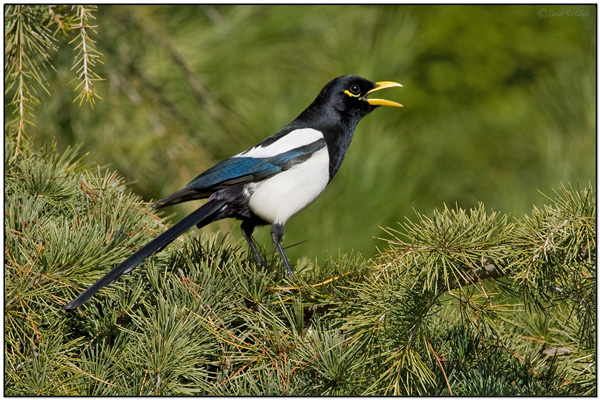
Yellow-billed Magpie (Pica nuttalli) by Daves BirdingPix

Yellow-billed Magpie (Pica nuttalli) by Daves BirdingPix

Mother Magpie’s Kindergarten ~ from The Curious Book of Birds

MOTHER MAGPIE’S KINDERGARTEN

Cur Book of Birds letter-dID you ever notice how different are the nests which the birds build in springtime, in tree or bush or sandy bank or hidden in the grass? Some are wonderfully wrought, pretty little homes for birdikins. But others are clumsy, and carelessly fastened to the bough, most unsafe cradles for the feathered baby on the treetop. Sometimes after a heavy wind you find on the ground under the nest poor little broken eggs which rolled out and lost their chance of turning into birds with safe, safe wings of their own. Now such sad things as this happen because in their youth the lazy father and mother birds did not learn their lesson when Mother Magpie had her class in nest-making. The clumsiest nest of all is that which the Wood-Pigeon tries to build. Indeed, it is not a nest at all, only the beginning of one. And there is an old story about this, which I shall tell you.

In the early springtime of the world, when birds were first made, none of them—except Mother Magpie—knew how to build a nest. In that lovely garden where they lived the birds went fluttering about trying their new wings, so interested in this wonderful game of flying that they forgot all about preparing a home for the baby birds who were to come. When the time came to lay their eggs the parents knew not what to do. There was no place safe from the four-legged creatures who cannot fly, and they began to twitter helplessly: “Oh, how I wish I had a nice warm nest for my eggs!” “Oh, what shall we do for a home?” “Dear me! I don’t know anything about housekeeping.” And the poor silly things ruffled up their feathers and looked miserable as only a little bird can look when it is unhappy.

All except Mother Magpie! She was not the best—oh, no!—but she was the cleverest and wisest of all the birds; it seemed as if she knew everything that a bird could know. Already she had found out a way, and was busily building a famous nest for herself. She was indeed a clever bird! She gathered turf and sticks, and with clay bound them firmly together in a stout elm tree. About her house she built a fence of thorns to keep away the burglar birds who had already begun mischief among their peaceful neighbors. Thus she had a snug and cosy dwelling finished before the others even suspected what she was doing. She popped into her new house and sat there comfortably, peering out through the window-slits with her sharp little eyes. And she saw the other birds hopping about and twittering helplessly.

“What silly birds they are!” she croaked. “Ha, ha! What would they not give for a nest like mine!”

But presently a sharp-eyed Sparrow spied Mother Magpie sitting in her nest.

“Oho! Look there!” he cried. “Mother Magpie has found a way. Let us ask her to teach us.”

Then all the other birds chirped eagerly, “Yes, yes! Let us ask her to teach us!”

So, in a great company, they came fluttering, hopping, twittering up to the elm tree where Mother Magpie nestled comfortably in her new house.

“O wise Mother Magpie, dear Mother Magpie,” they cried, “teach us how to build our nests like yours, for it is growing night, and we are tired and sleepy.”

The Magpie said she would teach them if they would be a patient, diligent, obedient class of little birds. And they all promised that they would.

She made them perch about her in a great circle, some on the lower branches of the trees, some on the bushes, and some on the ground among the grass and flowers. And where each bird perched, there it was to build its nest. Then Mother Magpie found clay and bits of twigs and moss and grass—everything a bird could need to build a nest; and there is scarcely anything you can think of which some bird would not find very useful. When these things were all piled up before her she told every bird to do just as she did. It was like a great big kindergarten of birds playing at a new building game, with Mother Magpie for the teacher.

She began to show them how to weave the bits of things together into nests, as they should be made. And some of the birds, who were attentive and careful, soon saw how it was done, and started nice homes for themselves. You have seen what wonderful swinging baskets the Oriole makes for his baby-cradle? Well, it was the Magpie who taught him how, and he was the prize pupil, to be sure. But some of the birds were not like him, nor like the patient little Wren. Some of them were lazy and stupid and envious of Mother Magpie’s cosy nest, which was already finished, while theirs was yet to do.

As Mother Magpie worked, showing them how, it seemed so very simple that they were ashamed not to have discovered it for themselves. So, as she went on bit by bit, the silly things pretended that they had known all about it from the first—which was very unpleasant for their teacher.

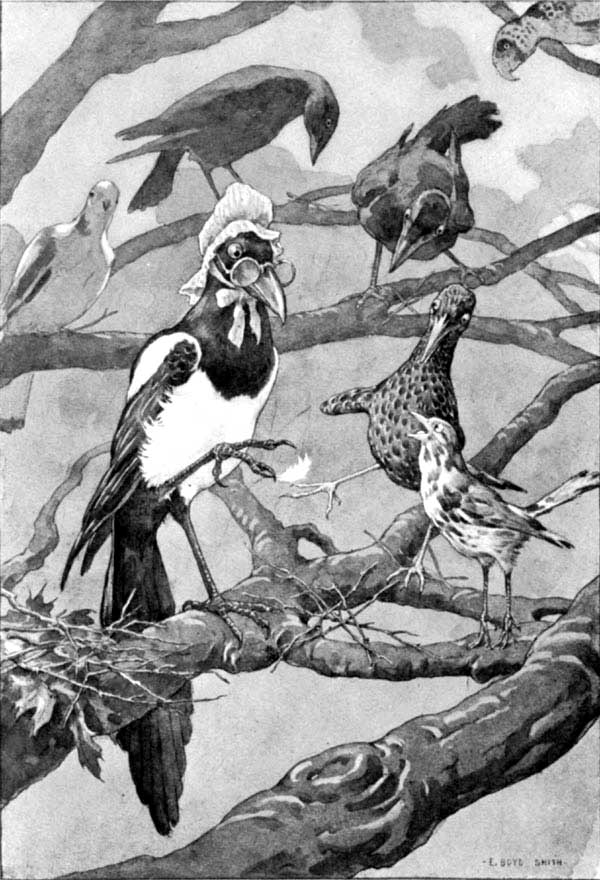
Mother Magpie took two sticks in her beak and began like this: “First of all, my friends, you must lay two sticks crosswise for a foundation, thus,” and she placed them carefully on the branch before her.

“Oh yes, oh yes!” croaked old Daddy Crow, interrupting her rudely. “I thought that was the way to begin.”

Mother Magpie snapped her eyes at him and went on, “Next you must lay a feather on a bit of moss, to start the walls.”

Western Jackdaw (Coloeus monedula) ©WikiC

Western Jackdaw (Coloeus monedula) ©WikiC

“Certainly, of course,” screamed the Jackdaw. “I knew that came next. That is what I told the Parrot but a moment since.”

Mother Magpie looked at him impatiently, but she did not say anything. “Then, my friends, you must place on your foundation moss, hair, feathers, sticks, and grass—whatever you choose for your house. You must place them like this.”

“Yes, yes,” cried the Starling, “sticks and grass, every one knows how to do that! Of course, of course! Tell us something new.”

"Next you must lay a feather"

“Next you must lay a feather”

Now Mother Magpie was very angry, but she kept on with her lesson in spite of these rude and silly interruptions. She turned toward the Wood-Pigeon, who was a rattle-pated young thing, and who was not having any success with the sticks which she was trying to place.

“Here, Wood-Pigeon,” said Mother Magpie, “you must place those sticks through and across, criss-cross, criss-cross, so.”

“Criss-cross, criss-cross, so,” interrupted the Wood-Pigeon. “I know. That will do-o-o, that will do-o-o!”

Mother Magpie hopped up and down on one leg, so angry she could hardly croak.

“You silly Pigeon,” she sputtered, “not so. You are spoiling your nest. Place the sticks so!”

“I know, I know! That will do-o-o, that will do-o-o!” cooed the Wood-Pigeon obstinately in her soft, foolish little voice, without paying the least attention to Mother Magpie’s directions.

Common Wood Pigeon (Columba palumbus) with newly hatched young ©WikiC

Common Wood Pigeon (Columba palumbus) with newly hatched young ©WikiC

“We all know that—anything more?” chirped the chorus of birds, trying to conceal how anxious they were to know what came next, for the nests were only half finished.

But Mother Magpie was thoroughly disgusted, and refused to go on with the lesson which had been so rudely interrupted by her pupils.

“You are all so wise, friends,” she said, “that surely you do not need any help from me. You say you know all about it,—then go on and finish your nests by yourselves. Much luck may you have!” And away she flew to her own cosy nest in the elm tree, where she was soon fast asleep, forgetting all about the matter.

But oh! What a pickle the other birds were in! The lesson was but half finished, and most of them had not the slightest idea what to do next. That is why to this day many of the birds have never learned to build a perfect nest. Some do better than others, but none build like Mother Magpie.

But the Wood-Pigeon was in the worst case of them all. For she had only the foundation laid criss-cross as the Magpie had shown her. And so, if you find in the woods the most shiftless, silly kind of nest that you can imagine—just a platform of sticks laid flat across a branch, with no railing to keep the eggs from rolling out, no roof to keep the rain from soaking in—when you see that foolishness, you will know that it is the nest of little Mistress Wood-Pigeon, who was too stupid to learn the lesson which Mother Magpie was ready to teach.

And the queerest part of all is that the birds blamed the Magpie for the whole matter, and have never liked her since. But, as you may have found out for yourselves, that is often the fate of wise folk who make discoveries or who do things better than others.


Lee’s Addition:

Let the wise hear and increase in learning, and the one who understands obtain guidance, (Proverbs 1:5 ESV)

(Photos added by me.)

Links:

Black-billed Magpie (Pica hudsonia) ©USFWS


  Corvidae – Crows, Jays, Ravens Family


Painted Bunting (Passerina ciris) ©©Flickr


  Bird Tales


Curious Book of Birds - Cover


  The Curious Book of Birds


Spanish Sparrow (Passer Hispaniolensis) female ©WikiC


  Wordless Birds


*

The Disobedient Woodpecker

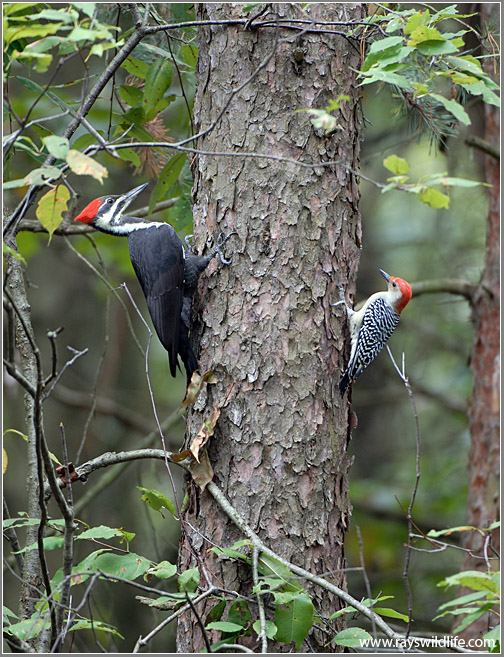
Pileated and Red-bellied Woodpecker on same tree by Ray

Pileated and Red-bellied Woodpecker on same tree by Ray

The Disobedient Woodpecker ~ from The Curious Book of Birds

THE DISOBEDIENT WOODPECKER

Cur Book of Birds letter-lONG, long ago, at the beginning of things, they say that the Lord made the world smooth and round like an apple. There were no hills nor mountains: nor were there any hollows or valleys to hold the seas and rivers, fountains and pools, which the world of men would need. It must, indeed, have been a stupid and ugly earth in those days, with no chance for swimming or sailing, rowing or fishing. But as yet there was no one to think anything about it, no one who would long to swim, sail, row, and fish. For this was long before men were created.

The Lord looked about Him at the flocks of newly made birds, who were preening their wings and wondering at their own bright feathers, and said to Himself,—

“I will make these pretty creatures useful, from the very beginning, so that in after time men shall love them dearly. Come, my birds,” He cried, “come hither to me, and with the beaks which I have given you hollow me out here, and here, and here, basins for the lakes and pools which I intend to fill with water for men and for you, their friends. Come, little brothers, busy yourselves as you would wish to be happy hereafter.”

Then there was a twittering and fluttering as the good birds set to work with a will, singing happily over the work which their dear Lord had given them to do. They pecked and they pecked with their sharp little bills; they scratched and they scratched with their sharp little claws, till in the proper places they had hollowed out great basins and valleys and long river beds, and little holes in the ground.

Then the Lord sent great rains upon the earth until the hollows which the birds had made were filled with water, and so became rivers and lakes, little brooks and fountains, just as we see them to-day. Now it was a beautiful, beautiful world, and the good birds sang happily and rejoiced in the work which they had helped, and in the sparkling water which was sweet to their taste.

All were happy except one. The Woodpecker had taken no part with the other busy birds. She was a lazy, disobedient creature, and when she heard the Lord’s commands she had only said, “Tut tut!” and sat still on the branch where she had perched, preening her pretty feathers and admiring her silver stockings. “You can toil if you want to,” she said to the other birds who wondered at her, “but I shall do no such dirty work. My clothes are too fine.”

Now when the world was quite finished and the beautiful water sparkled and glinted here and there, cool and refreshing, the Lord called the birds to Him and thanked them for their help, praising them for their industry and zeal. But to the Woodpecker He said,—

“As for you, O Woodpecker, I observe that your feathers are unruffled by work and that there is no spot of soil upon your beak and claws. How did you manage to keep so neat?”

The Woodpecker looked sulky and stood upon one leg.

“It is a good thing to be neat,” said the Lord, “but not if it comes from shirking a duty. It is good to be dainty, but not from laziness. Have you not worked with your brothers as I commanded you?”

“It was such very dirty work,” piped the Woodpecker crossly; “I was afraid of spoiling my pretty bright coat and my silver shining hose.”

“Oh, vain and lazy bird!” said the Lord sadly. “Have you nothing to do but show off your fine clothes and give yourself airs? You are no more beautiful than many of your brothers, yet they all obeyed me willingly. Look at the snow-white Dove, and the gorgeous Bird of Paradise, and the pretty Grosbeak. They have worked nobly, yet their plumage is not injured. I fear that you must be punished for your disobedience, little Woodpecker. Henceforth you shall wear stockings of sooty black instead of the shining silver ones of which you are so proud. You who were too fine to dig in the earth shall ever be pecking at dusty wood. And as you declined to help in building the water-basins of the world, so you shall never sip from them when you are thirsty. Never shall you thrust beak into lake or river, little rippling brook or cool, sweet fountain. Raindrops falling scantily from the leaves shall be your drink, and your voice shall be heard only when other creatures are hiding themselves from the approaching storm.”

It was a sad punishment for the Woodpecker, but she certainly deserved it. Ever since that time, whenever we hear a little tap-tapping in the tree city, we know that it is the poor Woodpecker digging at the dusty wood, as the Lord said she should do. And when we spy her, a dusty little body with black stockings, clinging upright to the tree trunk, we see that she is creeping, climbing, looking up eagerly toward the sky, longing for the rain to fall into her thirsty beak. She is always hoping for the storm to come, and plaintively pipes, “Plui-plui! Rain, O Rain!” until the drops begin to patter on the leaves.


Rufous-bellied Woodpecker (Dendrocopos hyperythrus) by Nikhil Devasar

Rufous-bellied Woodpecker (Dendrocopos hyperythrus) by Nikhil Devasar

Lee’s Addition:

Children, obey your parents in the Lord: for this is right. Honour thy father and mother; (which is the first commandment with promise;) That it may be well with thee, and thou mayest live long on the earth. (Ephesians 6:1-3 KJV)
Children, obey your parents in all things: for this is well pleasing unto the Lord. (Colossians 3:20 KJV)

Apparently the Woodpecker had not learned to obey. I trust you are obeying your parents. You are also to honor or give respect to your father and mother.

Now don’t think unkindly about the real Woodpeckers, because of course this is only a story. I think Woodpeckers are really neat birds and the Lord has provided them with just the right beak so it can make holes for a nest and for digging out worms.

Links:


  Picidae – Woodpeckers Family


Painted Bunting (Passerina ciris) ©©Flickr


  Bird Tales


Curious Book of Birds - Cover


  The Curious Book of Birds


Spanish Sparrow (Passer Hispaniolensis) female ©WikiC


  Wordless Birds


*

The Gorgeous Goldfinch – from The Curious Book of Birds

American Goldfinch (Carduelis tristis) on Thistle by Fenton

American Goldfinch (Carduelis tristis) on Thistle by Fenton

The Gorgeous Goldfinch ~ from The Curious Book of Birds

THE GORGEOUS GOLDFINCH

Cur Book of Birds letter-tHE Goldfinch who lives in Europe is one of the gaudiest of the little feathered brothers. He is a very Joseph of birds in his coat of many colors, and folk often wonder how he came to have feathers so much more gorgeous than his kindred. But after you have read this tale you will wonder no longer.

You must know that when the Father first made all the birds they were dressed alike in plumage of sober gray. But this dull uniform pleased Him no more than it did the birds themselves, who begged that they might wear each the particular style which was most becoming, and by which they could be recognized afar.

So the Father called the birds to Him, one by one, as they stood in line, and dipping His brush in the rainbow color-box painted each appropriately in the colors which it wears to-day. (Except, indeed, that some had later adventures which altered their original hues, as you shall hear in due season.)

But the Goldfinch did not come with the other birds. That tardy little fellow was busy elsewhere on his own affairs and heeded not the Father’s command to fall in line and wait his turn for being made beautiful.

So it happened that not until the painting was finished and all the birds had flown away to admire themselves in the water-mirrors of the earth, did the Goldfinch present himself at the Father’s feet out of breath.

“O Father!” he panted, “I am late. But I was so busy! Pray forgive me and permit me to have a pretty coat like the others.”

“You are late indeed,” said the Father reproachfully, “and all the coloring has been done. You should have come when I bade you. Do you not know that it is the prompt bird who fares best? My rainbow color-box has been generously used, and I have but little of each tint left. Yet I will paint you with the colors that I have, and if the result be ill you have only yourself to blame.”

The Father smiled gently as He took up the brush which He had laid down, and dipped it in the first color which came to hand. This He used until there was no more, when He began with another shade, and so continued until the Goldfinch was completely colored from head to foot. Such a gorgeous coat! His forehead and throat were of the most brilliant crimson. His cap and sailor collar were black. His back was brown and yellow, his breast white, his wings golden set off with velvet black, and his tail was black with white-tipped feathers. Certainly there was no danger of his being mistaken for any other bird.

When the Goldfinch looked down into a pool and saw the reflection of his gorgeous coat, he burst out into a song of joy. “I like it, oh, I like it!” he warbled, and his song was very sweet. “Oh, I am glad that I was late, indeed I am, dear Father!”

But the kind Father sighed and shook His head as He put away the brush, exclaiming, “Poor little Goldfinch! You are indeed a beautiful bird. But I fear that the gorgeous coat which you wear, and which is the best that I could give you, because you came so late, will cause you more sorrow than joy. Because of it you will be chased and captured and kept in captivity; and your life will be spent in mourning for the days when you were a plain gray bird.”

And so it happened. For to this day the Goldfinch is persecuted by human folk who admire his wonderful plumage and his beautiful song. He is kept captive in a cage, while his less gorgeous brothers fly freely in the beautiful world out of doors.

Cur Book of Birds img4-full

Such a gorgeous coat!

Such a gorgeous coat!


Lee’s Addition:

Then God said, “Let the waters abound with an abundance of living creatures, and let birds fly above the earth across the face of the firmament of the heavens.” So God created great sea creatures and every living thing that moves, with which the waters abounded, according to their kind, and every winged bird according to its kind. And God saw that it was good. And God blessed them, saying, “Be fruitful and multiply, and fill the waters in the seas, and let birds multiply on the earth.” So the evening and the morning were the fifth day. (Genesis 1:20-23 NKJV)

This is the first story to be published here from the Curious Book of Birds by Abbie Farwell Brown. This was published in 1903 and is in the public domain. The stories are cute and enjoyable to read. They will be under “From the Past” authors.

They are good stories, but not all the facts are right. 
Just enjoy them anyway. 
(Lee)
European Goldfinch (Carduelis carduelis) by W Kwong

European Goldfinch (Carduelis carduelis) by W Kwong

Links:

European Goldfinch (Carduelis carduelis) by W Kwong


   Fringillidae – Finches Family


Painted Bunting (Passerina ciris) ©©Flickr


  Bird Tales


Curious Book of Birds - Cover


  The Curious Book of Birds


Spanish Sparrow (Passer Hispaniolensis) female ©WikiC


  Wordless Birds


*

Nuggets Plus – To Breathe Life Eternal

Nuggets Plus

Nuggets Plus

Nuggets Plus – To Breathe Life Eternal ~ by a j mithra

Tiny pores in bird eggshells
allow the embryo to breathe.
Domestic hen’s egg has around 7500 pores.
The pores all over the body
that Jesus got from the lashes,
three nails,
a crown of thorns
and the spear on His rib
allows humanity to breathe life eternal…
Oh! What a loving God we serve!!
 

But he was wounded for our transgressions,
he was bruised for our iniquities:
the chastisement of our peace was upon him;
>and with his stripes we are healed. (Isaiah 53:5)

To See Photo of an Eggshell Pore:

http://www.tailfeathersnetwork.com/community/showthread.php/35653-Egg-shell-pore-pictures

Yours in YESHUA,

a j mithra

Please visit us at:

ajmithra21

*
Ian’s Bird of the Week – Sooty Oystercatcher

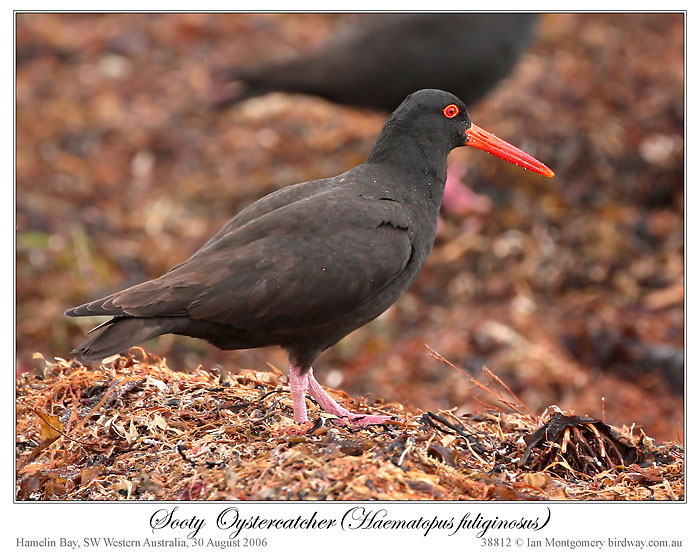
Sooty Oystercatcher (Haematopus fuliginosus fuliginosus) by Ian 1

Sooty Oystercatcher (Haematopus fuliginosus fuliginosus) by Ian 1

Ian’s Bird of the Week – Sooty Oystercatcher ~ by Ian Montgomery

Newsletter – 8-16-12
Back to Australia for this week’s bird, the Sooty Oystercatcher. Oystercatchers are large, conspicuous, noisy and mostly popular waders, though not greatly loved by those who harvest shellfish such as mussels. There are about a dozen closely-related species worldwide, two of which are resident in Australia, the Pied and the Sooty. Both occur right around the coasts of Australia and Tasmania, with the Sooty being the less common. It is primarily an inhabitant of rocky shores, first photo, while the Pied is found mainly in sandy habitats. At 46-49cm/18-19in the Sooty is slightly shorter on average than the Pied 48-51cm and distinguished by its all black plumage.

Two races are recognised, though their status and range are uncertain. The nominate race (fuliginosus) occurs in southern Australia and is characterised by the narrower red eye-ring and finer bill like the bird in the first photo, taken near Sydney. The northern race (opthalmicus) has a fleshier, more orange eye-ring and a thicker bill. It is supposed to occur from Shark Bay in Western Australia to Lady Elliot Island at the southern end of the Great Barrier Reef in Queensland, but the bird in the second photo taken near Lennox Head in northern NSW fits this description. There is disagreement in the field guides about whether opthalmicus has a longer or shorter bill.

Sooty Oystercatcher (Haematopus fuliginosus opthalmicus) by Ian 2

Sooty Oystercatcher (Haematopus fuliginosus opthalmicus) by Ian 2

The diets of the two species differ. The Pied feeds mainly by probing sand and soil for worm and other burrowing invertebrates. The Sooty feeds mainly on intertidal invertebrates on rocks such as gastropods (third photo), limpets, crustaceans, echinoderms and ascidians.

Sooty Oystercatcher (Haematopus fuliginosus fuliginosus) by Ian 3

Sooty Oystercatcher (Haematopus fuliginosus fuliginosus) by Ian 3

They will also feed on beaches near rocky headlands and the one in the fourth photo is part of a small flock probing through piles of washed-up seaweed.

Sooty Oystercatcher (Haematopus fuliginosus fuliginosus) by Ian 4

Sooty Oystercatcher (Haematopus fuliginosus fuliginosus) by Ian 4

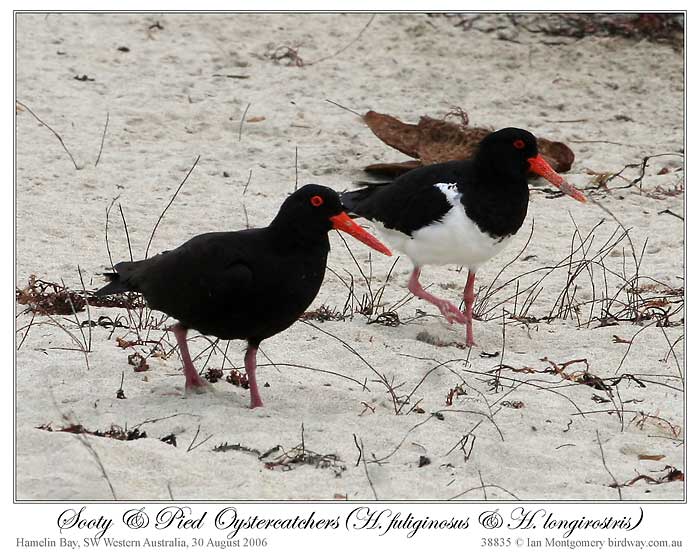
There is some overlap in the habitats of the two species, so they are occasionally found together. The fifth photo show two walking in step along a beach at the end of August and look like more than just good friends. The breeding season of southern Sooties starts in September and the two species have been known to hybridise, so draw your own conclusions.

Sooty Oystercatcher (H fuliginosus) and Pied (H longirostris) by Ian 5

Sooty Oystercatcher (H fuliginosus) and Pied (H longirostris) by Ian 5

A third species, the South Island Pied Oystercatcher of New Zealand, sometimes turns up on the east coast sometimes and more frequently on Lord Howe and Norfolk Islands. This is subtly different from the Pied Oystercatcher and a challenge for enthusiastic birders to identify.

Best wishes

Ian

**************************************************
Ian Montgomery, Birdway Pty Ltd,
454 Forestry Road, Bluewater, Qld 4818
Tel 0411 602 737 ian@birdway.com.au
Check the latest website updates:
http://www.birdway.com.au/#updates


Lee’s Addition:

Thanks again, Ian, for sharing your birds with us. We always learn something neat about birds and their behaviors. I have seen our two Oystercatchers, the Black and the American. That Sooty seem similar to our Black.

Oystercatchers belong to the Haematopodidae – Oystercatchers Family. There are 12 members in the family, one of which is extinct.

Who, when he had found one pearl of great price, went and sold all that he had, and bought it. (Matthew 13:46 KJV)

Ian said, “not greatly loved by those who harvest shellfish such as mussels.” Maybe that is because they are looking for those pearls of great price and the Oystercatchers are beating them to it. Humm!

Check out:

Ian’s Oystercatcher pages and then

The Haematopodidae – Oystercatchers Family here

*

Birds of the Bible – Jeremiah 8:7

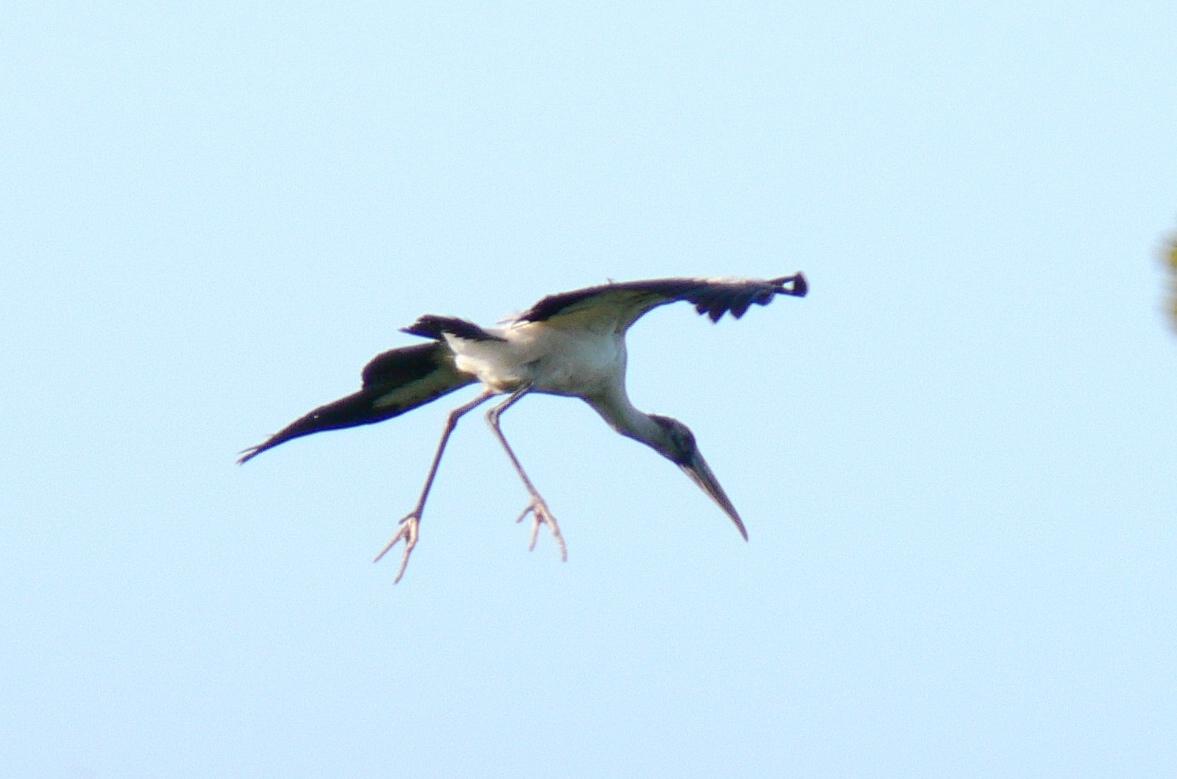
Wood Stork with landing gear down

Wood Stork with landing gear down

Jeremiah 8:7 has been used in several Birds of the Bible articles before. See Birds of the Bible:

So what else can be found out about that verse? Those of you that follow this blog know that I enjoy digging into the Bible with my e-Sword program. It is a free program that can be downloaded. It has different versions of the Bible that can be downloaded free or some with a small fee. Also available are dictionaries, commentaries, maps, notes, references and STEP additions. For the price, FREE, it is hard to beat. There are also links to other sites to get even more add-ons. Check out their LINKS page. Two favorites of mine are the ESS and the Bible Support sites.

The Bible tells us to study the Bible and we should. I try to read several chapters every day and meditate on what I read. Then along with that I like to dig deeper into Scripture and mine some great promises and truths out. Then other times, like this article, I am just digging out the birds mentioned in the different versions of this verse. I don’t endorse every version I have loaded on my e-Sword, but I do like to compare all of them.

But continue thou in the things which thou hast learned and hast been assured of, knowing of whom thou hast learned them; And that from a child thou hast known the holy scriptures, which are able to make thee wise unto salvation through faith which is in Christ Jesus. All scripture is given by inspiration of God, and is profitable for doctrine, for reproof, for correction, for instruction in righteousness: That the man of God may be perfect, throughly furnished unto all good works. (2 Timothy 3:14-17 KJV)

Well, back to Jeremiah 8:7. Here’s the verse:

Yea, the stork in the heaven knoweth her appointed times; and the turtle and the crane and the swallow observe the time of their coming; but my people know not the judgment of the LORD. (Jeremiah 8:7 KJV)

Using the “Compare” mode, let’s see which birds are mentioned. Most mention the Stork, Turtle or Turtle-dove, Swallow, and the Crane. It is referring to them having the knowledge to know when to migrate, but “but my people know not the rules of the LORD.” (ESV) See the other articles for more details.

*

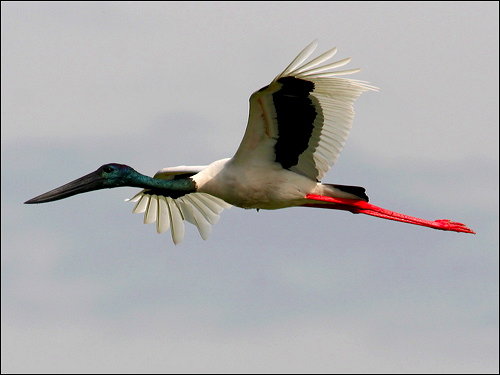
Black-necked Stork (Jabiru) (Ephippiorhynchus asiaticus) by Ian

Black-necked Stork (Jabiru) (Ephippiorhynchus asiaticus) by Ian

The H####’s are from Strong’s Hebrew and Greek Dictionaries. Using the KJV+ for the numbers.
H2624
חסידה
chăsı̂ydâh
khas-ee-daw’
Feminine of H2623; the kind (maternal) bird, that is, a stork: – X feather, stork.

Stork or storks – every version except two – DRB (kite), MSG (see bottom)
*

Adamawa Turtle Dove (Streptopelia hypopyrrha) ©WikiC

Adamawa Turtle Dove (Streptopelia hypopyrrha) ©WikiC

H8449
תּר תּור
tôr tôr
tore, tore
Probably the same as H8447; a ring dove, often (figuratively) as a term of endearment: – (turtle) dove.

Dove, Turtle, Turtle-doves, Mourning Doves – same family, no problem
*

Welcome Swallow (Hirundo neoxena) by Ian

Welcome Swallow (Hirundo neoxena) by Ian

H5693
עגוּר
‛âgûr
aw-goor’
Passive participle (but with active sense) of an unused root meaning to twitter; probably the swallow: – swallow.

Swallow – most versions
Swift – instead of Swift – ERV, NASB, NAS77, NIV, NIrV
Swift and Swallow – NKJV
The Swift and the Swallow both behave alike in some ways even though they are not in the same family. I even confuse them at times.
*

Crane Migration over Israel

Crane Migration over Israel

H5483
סס סוּס
sûs sûs
soos, soos
From an unused root meaning to skip (properly for joy); a horse (as leaping); also a swallow (from its rapid flight): – crane, horse ([-back, -hoof]).
Now we see where two different birds could be used. From here on the different versions begin to differ.

Crane – Most use Crane, but here are some of the differences
Sparrows – APB, Brenton
Thrushes – CEV, ERV, ECB, GNB, LITV, NAS77, NASB
Quite a difference in the birds here.
*

Eastern Bluebird (Sialia sialis) by S Slayton

Eastern Bluebird (Sialia sialis) by S Slayton

I saved the most interesting translation till last. Actually, it is a paraphrase and not a true translation. It does give me three more named birds. So far I haven’t seen them anywhere else, so for now they will not get their own page.

Cranes know when it’s time to move south for winter. And robins, warblers, and bluebirds know when it’s time to come back again. But my people? My people know nothing, not the first thing of GOD and his rule. (Jeremiah 8:7 MSG)

Does it matter if there is a difference in these versions? Yes and no. Yes, the Bible should be translated as close to the original as possible. No, in the sense that all these birds were given the knowledge to migrate by the Lord. And the truth of people not knowing the truth about God and what He wants for their lives. The birds obey, man doesn’t.

See More Birds of the Bible

Thought:

The method I used to study this verse can be applied to any verse or passage you wish to dig into. I used the Strong’s Hebrew and Greek because, of course, I have no clue as to what those word are. But using those help me/you understand the meaning of the word as it was originally written or as close as we can get to it. As our language has changed over the years, our meanings have also changed. It helps to read other versions when studying the Bible. I know some don’t agree and I won’t go there. The Lord has many truths to find in His Word. Maybe you like plants or animals, or like to study one person at a time, or a promise and the different ways it is presented, whatever. Study.

Gospel Message

*

Ian’s Bird of the Week – White-throated Dipper

Ian’s Bird of the Week – White-throated Dipper  ~ by Ian Montgomery

Newsletter – 8-5-12

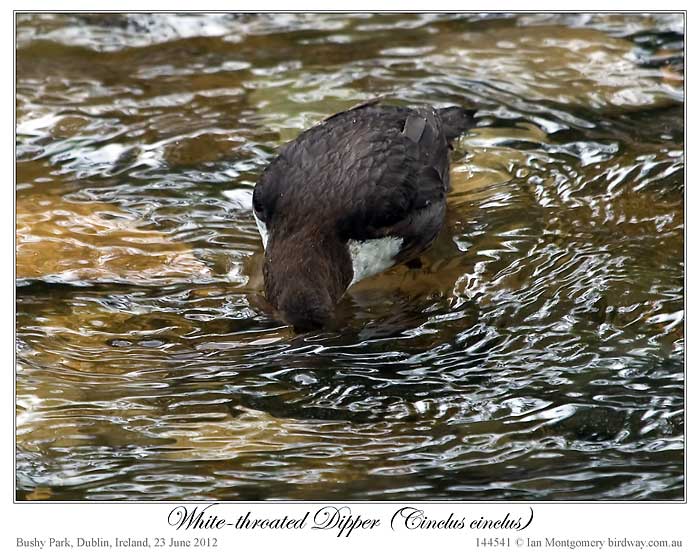
Here’s another species from Bushy Park in Dublin, the White-throated Dipper, this time on the River Dodder. This featured as bird of the week 5 years ago, so please forgive the repetition but I have some nice photos to share. Dippers – there are 6 species world-wide – are rather special in that they are the only truly aquatic Passerines (song birds), living exclusively on and in fast flowing streams and rivers and getting all their food from the water. They are dumpy, short-tailed, starling-sized birds and, as they often cock their tails, look a bit like giant (Winter) Wrens.

White-throated Dipper (Cinclus cinclus) by Ian 1

White-throated Dipper (Cinclus cinclus) by Ian 1

They also build domed nests but the resemblance to wrens ends there, though, and they are unrelated belonging to their own family, the Cinclidae. They feed on aquatic larvae, such as Caddis Fly larvae, and other invertebrates such as freshwater crustaceans and molluscs.

White-throated Dipper (Cinclus cinclus) by Ian 2

White-throated Dipper (Cinclus cinclus) by Ian 2

Not only do they wade and swim with ease, they will also walk along the bottom of the stream gripping onto stones with their strong feet and even dive, using their wings to propel themselves under water.

White-throated Dipper (Cinclus cinclus) by Ian 3

White-throated Dipper (Cinclus cinclus) by Ian 3

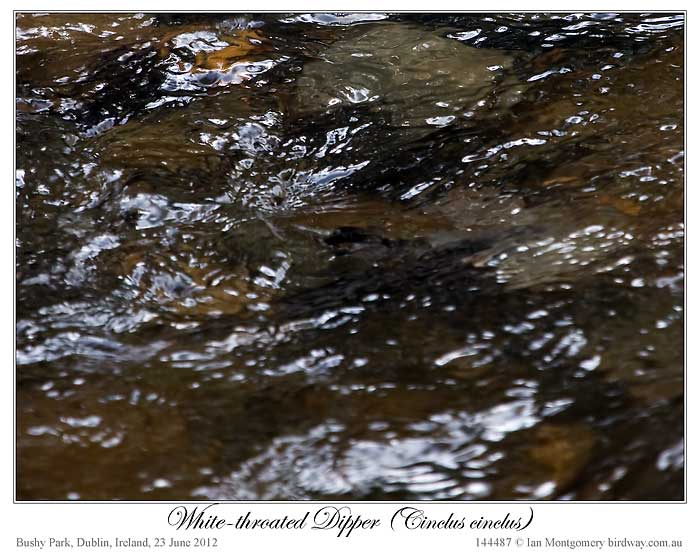
The bird in the third photo is almost completely submerged, and if you look carefully at the fourth photo, the brown shape in the centre is a completely submerged one with only a little eddy to show where it went under the surface.

White-throated Dipper (Cinclus cinclus) by Ian 4

White-throated Dipper (Cinclus cinclus) by Ian 4

They use their slightly upturned bill to probe for food under rocks and stones. The one in the fifth photo has just surfaced with a tasty grub.

White-throated Dipper (Cinclus cinclus) by Ian 5

White-throated Dipper (Cinclus cinclus) by Ian 5

This same bird only moments before had appeared with a Caddis Fly larva in its characteristic tube, made out of spun silk and often camouflaged with attached sand, sixth photo. The presence of Caddis Fly larvae is supposed to indicated a healthy river system, though the depressing amount of water-borne litter in the River Dodder makes it look otherwise.

White-throated Dipper (Cinclus cinclus) by Ian 6

White-throated Dipper (Cinclus cinclus) by Ian 6

We saw Dippers on most occasions when we took the dogs for a walk. It’s popular jogging and dog-walking spot and the Dippers are used to disturbance and are remarkably approachable, being usually rather shy. They nest here too, and the slight bemused looking individual in the seventh photo is a recently-fledged juvenile, distinguishable by the scaly pattern on the chest, the overall grey colour and the pale legs.

White-throated Dipper (Cinclus cinclus) by Ian 7

White-throated Dipper (Cinclus cinclus) by Ian 7

I’ve seen Brown Dippers in the Himalayas in Sikkim, White-capped Dippers in the Andes in Ecuador and American Dippers in the Cascade Mountains of Northeastern California. The White-throated Dipper is a bird of mainly and often icy, highland streams in Europe, North Africa and the Middle East. Seeing them so easily in suburban Dublin, between Terenure and Rathfarnham 6 km from the city centre (take the 15B bus) is truly wonderful.

Best wishes
Ian
**************************************************
Ian Montgomery, Birdway Pty Ltd,
454 Forestry Road, Bluewater, Qld 4818
Tel 0411 602 737 ian@birdway.com.au
Check the latest website updates:
http://www.birdway.com.au/#updates


Lee’s Addition:

Let the rivers clap their hands; Let the hills be joyful together before the LORD, (Psalms 98:8 NKJV)

What an amazing little bird. Its ability to swim and walk underwater is very interesting. Thanks again, Ian, for sharing another of your adventures.

As Ian mentioned they are in the Cinclidae family. There are five species in that family. After checking out his photos, check the Birds of the World page here.

Ian’s Cinclidae Family page.

Cinclidae – Dipper Family

Dippers – Wikipedia

Dippers – IBC

*

Herons – Color Key to North American Birds, by Frank M. Chapman

Herons

Color Key to North American Birds, by Frank M. Chapman, 2011

*

Ardeidae – Herons, Bitterns, Egrets Family

Herons

the stork, the heron of any kind, the hoopoe, and the bat. (Leviticus 11:19 ESV)

All things were made through Him, and without Him nothing was made that was made. (John 1:3 NKJV)

Color Key To North American Birds cover

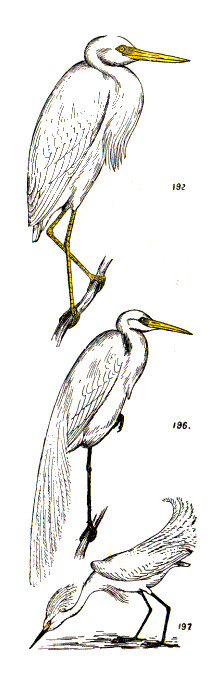
Bird Images pg_092192. Great White Heron (Ardea occidentalis). Ads. White, no “aigrette” plumes. A white Heron about the size of a Great Blue Heron. What is supposed to be a gray-blue phase of this bird has been called, a bird which resembles No. 194, but has the head and neck whitish.Range.—Southern Florida, Cuba and Jamaica.

196. American Egret (Herodias egretta). L. 41. Ads. White, about 50 straight “aigrette” plumes grow from the back between the wings; legs and feet black. Ads. when not breeding and Yng., the same, but no plumes.Range.—Tropical and temperate America; breeds north to Virginia, southern Illinois, and California; later strays to New Brunswick, Minnesota, and Oregon; winters from southern California and Gulf States southward.

197. Snowy Heron (Egretta candidissima). L. 24. Ads. White, about 50 recurved “aigrette” plumes grow from back between the wings; legs black, feet yellow. Ads. when not breeding and Yng. The same, but no plumes.Range.—Tropical and temperate America; bred formerly north to Long Island, southern Illinois and California; now very rare in eastern North America; winters from Gulf States and southern California southward.

194. Great Blue Heron (Ardea herodias). L. 45; W. 18.5; B. 5.5; Tar. 7. Ads. Center of crown white, head crested; legs blackish. Yng. Similar, but no crest, crown wholly black, plumage more streaked.Range—Northern South America north to Arctic regions; breeds locally throughout most of North America range; winters from about latitude 42° southward.

194a. Northwest Coast Heron (A. h. fannini). Similar to No. 194 but much darker; upperparts bluish slate black; tarsus shorter, 5.3.Range.—Pacific coast from Vancouver to Sitka.

194b. Ward Heron (A. h. wardi). Similar to No. 194 but whiter below, neck darker; legs olive; larger, L. 52; W. 20; B. 6.5; Tar. 8.Range.—Florida; coast of Texas.

202. Black-crowned Night Heron (Nycticorax nycticorax nævius). L. 24. Ads. Crown and back greenish black lower back, wings and tail ashy; head with two or three rounded white plumes, except just after breeding season. Yng. Grayish brown streaked with white; below white streaked with blackish; outer webs of primaries, pale rufousNotes. An explosiveqûawk.Range.—Western hemisphere; breeds in North America north to New Brunswick, Quebec, Manitoba, and Oregon; winters from California and Gulf States southward.

203. Yellow-crowned Night Heron (Nyctanassa violaceus). L. 23. Ads. Blue-gray; crown and ear-coverts whitish, rest of head black; scapulars streaked with black; head with two or three rounded, white plumes, except just after nesting season.Yng. Crown black, streaked with whitish; primaries bluish slate, no rufous; back brownish streaked with white; below whitish streaked with blackish.

Range.—Tropical and subtropical America; breeds north to South Carolina, southern Illinois, and Lower California; strays to Massachusetts and Colorado; winters from Gulf States southward.

198. Reddish Egret (Dichromanassa rufescens). L. 29. Two color phases independent of age. Ads. Dark phase, Head and neck rufous; back slate; about 30 “aigrette” plumes. White phase. White, including plumes; tips of primaries sometimes speckled with gray. Yng. Rufous and gray, or white, without plumes.Range.—West Indies and Central America north to coasts of Gulf States, Illinois (rarely), and Lower California.

199. Louisiana Heron (Hydranassa tricolor ruficollis). L. 26. Ads. “Aigrette” plumes, short, dirty gray; rump and belly white; legs blackish. Yng. Head and neck brownish; throat and line down foreneck white; above slaty washed with brownish, rump, and belly white.Range.—West Indies and Central America north to Gulf States, casually to Long Island and Indiana.

200. Little Blue Heron (Florida cœrulea). L. 22. Ads. Head and neck maroon; rest of plumage slaty blue. Yng. White, tips of primaries bluish, legs greenish yellow.Range.—Tropical America and eastern United States; breeds north to Virginia and Illinois, later may stray north as far as Nova Scotia; winters from South Atlantic and Gulf States southward.

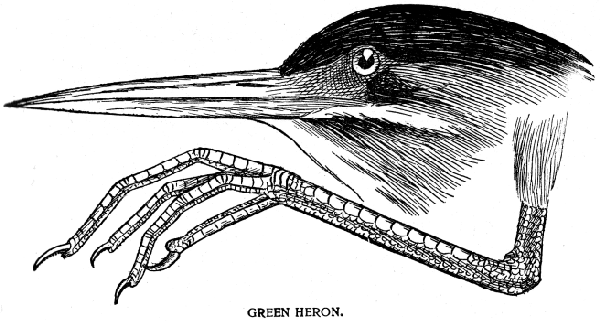
201. Little Green Heron (Butorides virescens). L. 17. Smallest of our Herons. Ads. Crown, glossy green-black; throat and line down foreneck buffy; rest of head and neck purplish chestnut; back green washed with bluish gray. Yng. Neck and below streaked with blackish; back-feathers not lengthened; duller. Notes. A rattling oc-oc-oc-oc-oc, a startling scow, and, more rarely, a deep, hollow groan. (Brewster.)Range.—Tropical and temperate North America; breeds from Gulf States north to Nova Scotia and Manitoba; winters from Gulf States southward to northern South America.

201a. Frazar Green Heron (B. v. frazari). Similar to No. 201, but rather larger and darker, neck more purplish, light stripings on throat and foreneck more restricted. (Brewster.)

201b. Anthony Green Heron (B. v. anthonyi). Similar to No. 201, but slightly larger, and paler, light markings of wings, neck, and throat less restricted and whiter. (Mearns.)

Range.—Arid portions of southwestern United States, south into Mexico.


Green Heron – From Color Key

*