Birds of the Bible – Name Study – Heron

Great Blue Heron (Ardea herodias) Watching young nearby by Lee at Viera Wetlands

Great Blue Heron (Ardea herodias) Watching young nearby by Lee at Viera Wetlands

Let’s look into a name study for another Bird of the Bible – this time the Heron. Our fishing Green Heron directed my thinking towards the Heron. So, let’s see what we can find out about how they are mentioned in Scripture.

The Heron and their kind are mentioned in Leviticus and Deuteronomy in the list of “Unclean Birds” or the “Do not eat” list.

And the stork, the heron after her kind, and the lapwing, and the bat. (Leviticus 11:19 KJV)

And the stork, and the heron after her kind, and the lapwing, and the bat. (Deuteronomy 14:18 KJV)

Those are the only two references to Herons in the King James Version. But how do other versions translate this bird? That is what these name study articles do. Dig around in the Word. I use e-Sword’ s compare mode to see the different versions.

Brenton, as does the APB, DRB, ISV, and NET  has the Heron in Psalms:

There the sparrows will build their nests; and the house of the heron takes the lead among them. Psalms 104:17 Brenton)

The Bishops and CJB only use Heron in Deuteronomy, but not Leviticus.

The Phillips does not even use the word “Heron.”

Here is the Hebrew word used in these verses:

H601
אנפה
‘ănâphâh
an-aw-faw’
From H599; an unclean bird, perhaps the parrot (from its irascibility): – heron.

*

The DRB also uses Heron in Job:

The wing of the ostrich is like the wings of the heron, and of the hawk. (Job 39:13 DRB)

The GW shows Heron in these verses:

“It will become the possession of herons. It will become pools of water. I’ll sweep it with the broom of destruction,” declares the LORD of Armies. (Isaiah 14:23 GW)

Pelicans and herons will take possession of the land. Owls and crows will live there. He will stretch the measuring line of chaos and the plumb line of destruction over it. (Isaiah 34:11 GW)

Flocks will lie down in it along with animals of every kind. Even pelicans and herons will nest on top of its columns. Listen! A bird will sing in a window. The doorway will be in ruins, because the LORD will expose the cedar beams. (Zephaniah 2:14 GW)

Isaiah 14:23 uses H7090 which is:

H7090
קפּד קפּוד
qippôd qippôd
kip-pode’, kip-pode’
From H7088; a species of bird, perhaps the bittern (from its contracted form): – bittern.

Isaiah 34:11 GW and Zephaniah 2:14 GW both use the same H7090. The word is translated as “Bittern” in the KJV for all three verses. The Ardeidae- Herons, Bitterns Family consists of Heron, Egrets and Bitterns so, there doesn’t seem to be a problem there, especially since the first two verses said, “heron after her kind.” They are related.

The DRB’s (1899 Douay-Rheims Bible) translation, to me, does not seem to match the rest of the other translations.
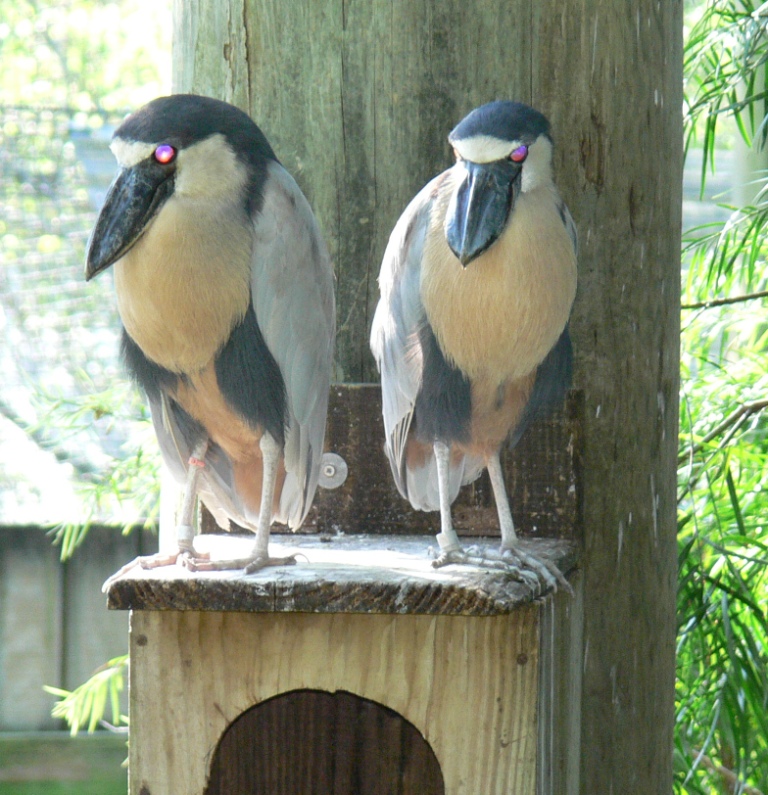
Boat-billed Heron (Cochlearius cochlearius) by Lee at LPZoo

Boat-billed Heron (Cochlearius cochlearius) by Lee at LPZoo

Herons:

The herons are long-legged freshwater and coastal birds in the family Ardeidae, with 72 recognised species (some are called “egrets” or “bitterns” instead of “heron”). Within Ardeidae, all members of the genera Botaurus and Ixobrychus are referred to as “bitterns”, and — including the Zigzag Heron or Zigzag Bittern — are a monophyletic group within the Ardeidae. However, egrets are not a biologically distinct group from the herons, and tend to be named differently because they are mainly white and/or have decorative plumes. Although egrets have the same build as herons, they tend to be smaller.

The classification of the individual heron/egret species is fraught with difficulty, and there is still no clear consensus about the correct placement of many species into either of the two major genera, Ardea and Egretta. One species formerly considered to constitute a separate monotypic family Cochlearidae, the Boat-billed Heron, is now regarded as a member of the Ardeidae.

Although herons resemble birds in some other families, such as the storks, ibises, spoonbills and cranes, they differ from these in flying with their necks retracted, not outstretched. They are also one of the bird groups that have powder down. Some members of this group nest colonially in trees, while others, notably the bitterns, use reedbeds.

Grey Heron (Ardea cinerea) by W Kwong

Grey Heron (Ardea cinerea) by W Kwong

The herons are a widespread family, they exist on all continents except Antarctica, and are present in most habitats except the coldest extremes of the Arctic, extremely high mountains and the driest deserts. Almost all species are associated with water, they are essentially non-swimming waterbirds that feed on the margins of lakes, rivers, swamps, ponds and the sea. They are predominately found in lowland areas, although some species live in alpine areas, and the majority of species occur in the tropics.

The herons are a highly mobile family, with most species being at least partially migratory. Birds are particularly inclined to disperse widely after breeding but before the annual migration where the species is colonial, searching out new feeding areas and reducing the pressures on feeding grounds near the colony. The migration typically occurs at night, usually as individuals or in small groups.

The herons and bitterns are carnivorous. The members of this family are mostly associated with wetlands and water, and feed on a variety of live aquatic prey. The diet includes a wide variety of aquatic animals, including fish, reptiles, amphibians, crustaceans, molluscs and aquatic insects. Individual species may be generalists or specialise in certain prey types, like the Yellow-crowned Night Heron, which specialises in crustaceans, particularly crabs. Many species will also opportunistically take larger prey, including birds and bird eggs, rodents, and more rarely carrion. Even more rarely there have been reports of herons eating acorns, peas and grains, but most vegetable matter consumed is accidental.

The most common hunting technique is for the bird to sit motionless on the edge of or standing in shallow water and wait until prey comes within range. (Birds of the Bible – Patient Herons) Birds may either do this from an upright posture, giving them a wider field of view for seeing prey, or from a crouched position, which is more cryptic and means the bill is closer to the prey when it is located. Having seen prey the head is moved from side to side, so that the heron can calculate the position of the prey in the water and compensate for refraction, and then the bill is used to spear the prey.
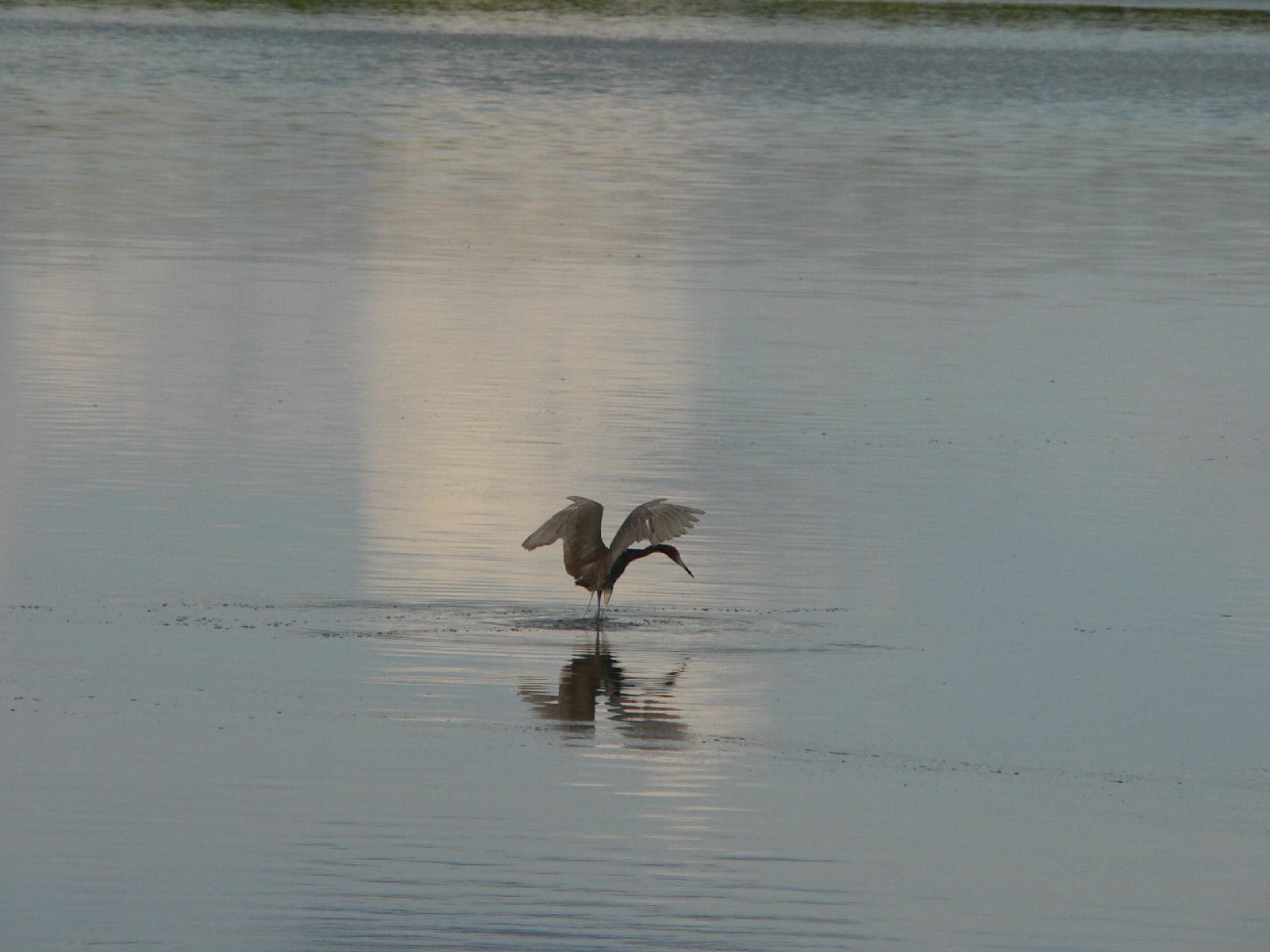
Reddish Egret scarring up breakfast

Reddish Egret scarring up breakfast

In addition to sitting and waiting, herons may feed more actively. They may walk slowly, at around or less than 60 paces a minute, snatching prey when it is observed. Other active feeding behaviours include foot stirring and probing, where the feet are used to flush out hidden prey. The wings may be used to frighten prey (or possibly attract it to shade) or to reduce glare; the most extreme example of this is exhibited by the Black Heron, which forms a full canopy with its wings over its body.

Some species of heron, such as the Little Egret and Grey Heron, have been documented using bait in order to lure prey to within striking distance. Herons may use items already in place, or actively add items to the water in order to attract fish. Items used may be man-made, such as bread; alternatively Striated Herons in the Amazon have been watched repeatedly dropping seeds, insects, flowers and leaves into the water to catch fish. (Green Heron Fishing With Bread)

(Heron information from Wikipedia with editing)

Names of Birds Study

Birds of the Bible – Herons

*

Green Heron Fishing With Bread

You have got to watch this Green Heron fishing with bread. The video speaks for itself.

Look at the birds of the air, for they neither sow nor reap nor gather into barns; yet your heavenly Father feeds them. Are you not of more value than they? (Matthew 6:26 NKJV)

*

*

Ardeidae- Herons, Bitterns

Birds of the Bible – Herons

Bible Birds – Herons

*

Birds of the Bible – Remembering

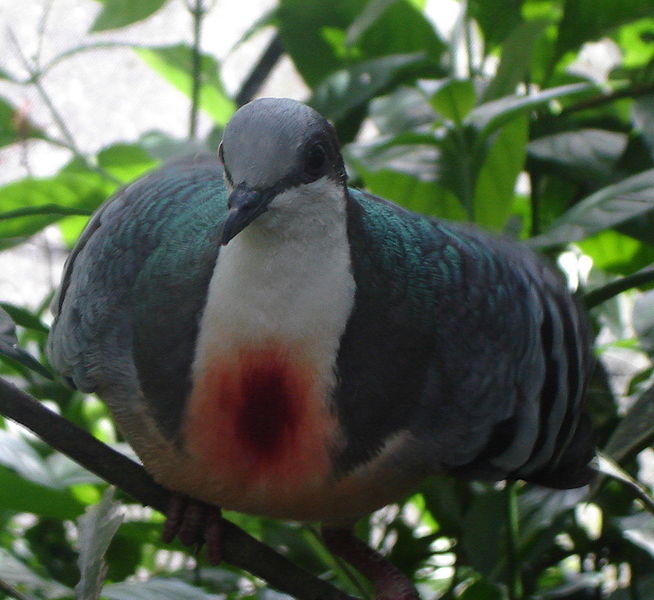
Bleeding-Heart Pigeon ©WikiC

Bleeding-Heart Pigeon ©WikiC

And God remembered Noah, and every living thing, and all the cattle that was with him in the ark: and God made a wind to pass over the earth, and the waters asswaged; (Genesis 8:1 KJV)

Today, here in the United States, is Memorial Day. A day when we remember those who have given their all in the service of our country. We honor those who we can no longer thank. As this is being written, they are laying a wreath at the tomb of the unknown soldier at Arlington National Cemetary.

My father was one of those who passed away as a result of his being in the trenches in WW I. He suffered for several years from the effects of the “mustard gas” that was sprayed on them. It is good for us to remember things and honor events.

Yesterday, in the morning service, the event of the 12 stones being taken for the Jordon River by the Israelites for a memorial was taught. That was a memorial to remind them of the way the LORD protected them and made a way for them to cross over the Jordon. It is good to remember things and honor events.

And Joshua said unto them, Pass over before the ark of the LORD your God into the midst of Jordan, and take ye up every man of you a stone upon his shoulder, according unto the number of the tribes of the children of Israel: That this may be a sign among you, that when your children ask their fathers in time to come, saying, What mean ye by these stones? Then ye shall answer them, That the waters of Jordan were cut off before the ark of the covenant of the LORD; when it passed over Jordan, the waters of Jordan were cut off: and these stones shall be for a memorial unto the children of Israel for ever. (Joshua 4:5-7 KJV)

Mourning Dove (Zenaida macroura) by Quy Tran

Mourning Dove (Zenaida macroura) by Quy Tran

Our Scripture above is where the God remembered those He was protecting from the flood that were aboard the ark. He did not forget them. In time, the waters went down and they were able to leave the ark.

And it came to pass in the six hundred and first year, in the first month, the first day of the month, that the waters were dried up from the earth; and Noah removed the covering of the ark and looked, and indeed the surface of the ground was dry. And in the second month, on the twenty-seventh day of the month, the earth was dried. Then God spoke to Noah, saying, “Go out of the ark, you and your wife, and your sons and your sons’ wives with you. Bring out with you every living thing of all flesh that is with you: birds and cattle and every creeping thing that creeps on the earth, so that they may abound on the earth, and be fruitful and multiply on the earth.” (Genesis 8:13-17 NKJV)

It does us good to remember what the God has done through His creation and protection during the flood. Just as He provided salvation for them from the flood, and only those in the ark were saved. Today, we have a Savior who said:

Jesus saith unto him, I am the way, the truth, and the life: no man cometh unto the Father, but by me. (John 14:6 KJV)

Bald Eagle Brings Nesting Material by Aesthetic Photos

Bald Eagle Brings Nesting Material by Aesthetic Photos

Happy Memorial Day! Lord Bless your day as you remember.

See:

Gospel Message

Birds of the Bible

Bible Birds

P.S. Check out this article:

‘Sarge, Will You Tell Us About God?’ – The Story of God’s Miraculous Protection of an Entire U. S. Marine Unit, From A Walk In The Word

*

Ian’s Bird of the Week – Providence Petrel

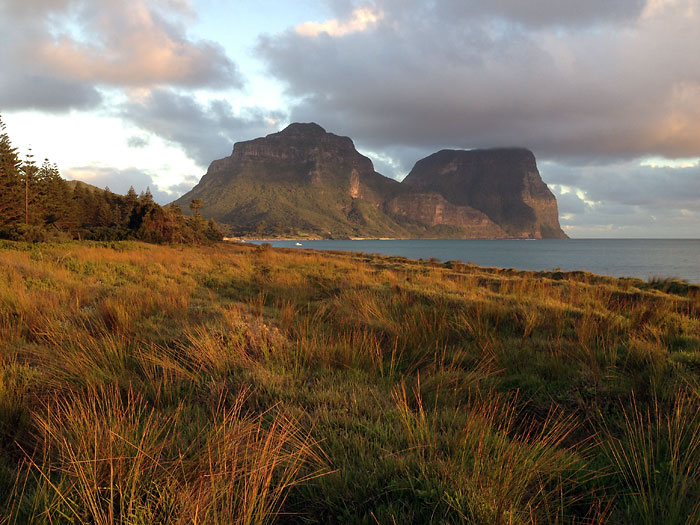
Lord Howe Island by Ian

Lord Howe Island by Ian

Ian’s Bird of the Week – Providence Petrel ~ by Ian Montgomery

Newsletter ~ 5/20/13

Your collective moral support did it again, thank you very much, so here is the Providence Petrel the other really special bird species of Lord Howe Island. ‘Special’ in the sense that after its extermination on Norfolk Island by 1800, Lord Howe was its last remaining breeding site, saving it from extinction. Unlike Norfolk Island which lacks very high mountains, Lord Howe has two fairly inaccessible ones, Mount Lidgbird, on the left in the first photo, and the taller Mount Gower on the right and it is on the tops and slopes of these that the Providence Petrel breeds.

You need to be a mountaineer to climb Mount Lidgbird and young and very fit to climb Mount Gower. We took the easier option of going by boat to the base of Mount Gower where we got good views of many Petrels in flight preparing to land at their nesting burrows. They are winter breeders, returning to the island in March and laying eggs in May. They seem reluctant to actually land, so each afternoon the air around the two Mountains swarms with these birds like clouds of insects and it is a wonderful sight.

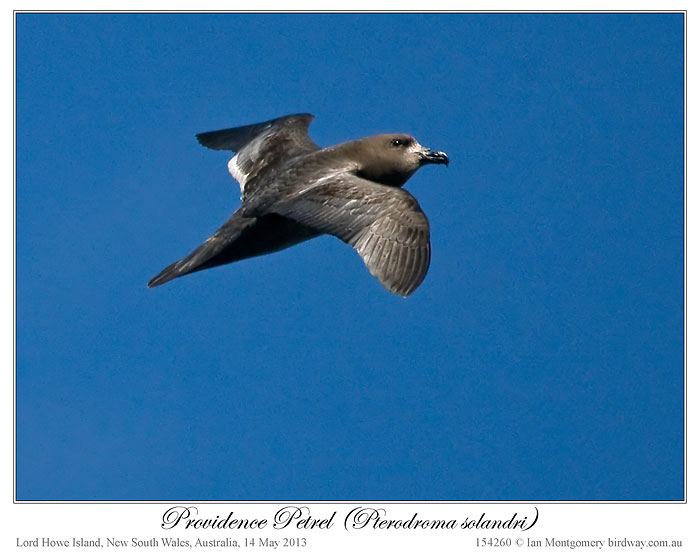
Providence Petrel (Pterodroma solandri) by Ian

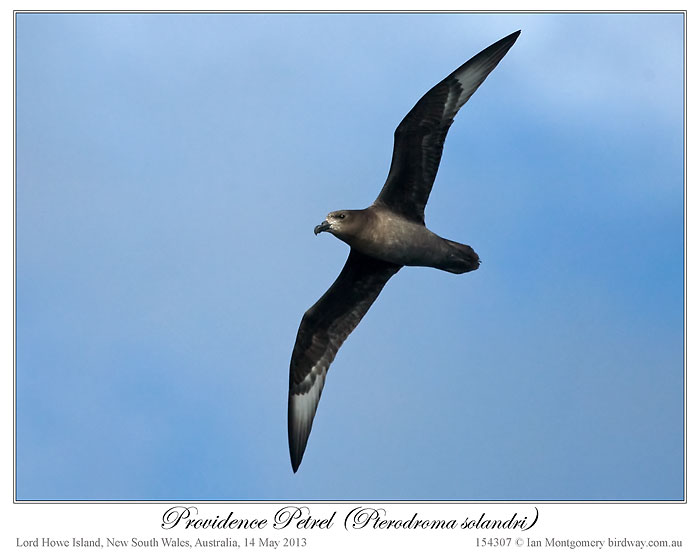
Very clumsy on the ground, they are fast and agile in the air so I was happy to get a few reasonable shots given the choppy conditions without falling overboard. The first Petrel photo shows the characteristic overall dark bird (it looks lighter than usual against Mount Gower) with the characteristic white patches on the primary wing feathers and under wing coverts that distinguishes it from most other similar petrels. The second petrel shot, shows the upper wings – these are all dark and lack the white shafts to the primaries that distinguish the similar Kermadec Petrel. Other field marks are the scaly white feathers on the face and the dark neck and upper breast.

Providence Petrel (Pterodroma solandri) by Ian

The third petrel photo shows a more characteristic dorsal shot with the bird silhouetted against the sky and shows it long slender wings. The birds average 40cm/16 in in length with a wingspan of about 1 m/3 ft 3 in. After breeding, the disperse to the North Pacific. For food, they dive into the water for crustaceans, squid and small fish.

Providence Petrel (Pterodroma solandri) by Ian

Providence Petrel (Pterodroma solandri) by Ian

The Lord Howe population is estimated at about 30,000 pairs. Feral pigs were eliminated as part of the Woodhen recovery project and the Petrels are recolonising the lower slopes of the mountains. They were rediscovered on Phillip Island close to Norfolk Island in 1985 and the current population there is less than 100 pairs. The elimination from Norfolk Island took place between 1790 and 1800 with perhaps one million adults and young being harvested in the period 1790-1793.

Best wishes
Ian

**************************************************
Ian Montgomery, Birdway Pty Ltd,
454 Forestry Road, Bluewater, Qld 4818
Tel 0411 602 737 ian@birdway.com.au
Check the latest website updates:
http://www.birdway.com.au/#updates


Lee’s Addition:

Let them give glory unto the LORD, and declare his praise in the islands. (Isaiah 42:12 KJV)

Ian has shared another of his birdwatching adventures with us. It’s good to hear that the Petrels there are making a comeback.

Petrels belong to the Procellaridae Family. The family consists of Petrels, Shearwaters, Fulmars, and Prions,

“The Providence Petrel (Pterodroma solandri) is a species that burrows in one location; isolated Lord Howe Island, some 800km from the Australian mainland in the Tasman Sea.

Of roughly pigeon like proportions (40cm), the bird was once also numerous on Norfolk Island (to Australia). However, its population here was consumed by starving epicurean transportees, sent to Norfolk Island as way of punishment. Nonetheless it numbers some 100,000 on Lord Howe. Graceful and supple in flight, the Providence Petrel has a cumbersome propensity on the ground, making it vulnerable from attack by predators.

Despite its reasonably copious strength of numbers, the Providence Petrel is deemed to be in a precarious disposition because its breeding is confined to two mountain tops and one tiny islet, and is therefore at great risk from a catastrophe.

This species is classified as vulnerable. Main causes of death are predation by the endangered Lord Howe Rail and flooding of burrows. Other dangers include rat predation and drowning in longline fishing gear. The current population is estimated at 64,000.

The scientific name of this species was given in honour of the Swedish botanist Daniel Solander, Solander’s Petrel being an alternative common name.” (Information from Wikipedia)

See:

Ian’s Petrel Photos

Procellariidae – Petrels, Shearwaters Family

Providence Petrel – Wikipedia

Ian’s Bird of the Week

*

Birdwatching Adventure – May 2013

Sunrise at Patrick AFB by Lee

Sunrise at Patrick AFB by Lee

And they rose up early in the morning, and the sun shone upon the water, … (2 Kings 3:22a KJV)

We just got back from a spontaneous three day trip down to the Palm Beach Zoo, (Palm Beach, FL) and up to the Viera Wetlands (Viera, FL) and then back home yesterday. As we rode along and since I haven’t been driving because of my eye situation, I kept a list of the birds along the way. The list below was the ones I reported to e-Bird. This includes the birds that were at the Zoo, but not captives. Our loop took us down US 27 and then back up I-95, through Orlando and back across I-4 to Winter Haven. Not a bad list. The ones in bold were special finds. In fact, the Northern Rough-winged Swallow and Bank Swallow were added to my life list. I am now at 245 on their list. The list was kept for each county we went through. (It gave me something to do while riding.)

Black-bellied Whistling-Duck
Muscovy Duck (Domestic type)
Indian Peafowl (Domestic type)
Wood Stork
Magnificent Frigatebird
Double-crested Cormorant
Anhinga
Brown Pelican
Least Bittern
Great Blue Heron
Great Egret
Little Blue Heron
Tricolored Heron
Cattle Egret
Black-crowned Night-Heron
White Ibis
Glossy Ibis
White-faced Ibis
Black Vulture
Turkey Vulture
Osprey
Swallow-tailed Kite
Bald Eagle
Red-shouldered Hawk
Common Gallinule
American Coot
Sandhill Crane
Ruddy Turnstone
Sanderling
Rock Pigeon
Eurasian Collared-Dove
Mourning Dove
Belted Kingfisher
Red-bellied Woodpecker
Crested Caracara
American Crow
Fish Crow
Northern Rough-winged Swallow
Bank Swallow
Northern Mockingbird
European Starling
Northern Cardinal
Red-winged Blackbird
Common Grackle
Boat-tailed Grackle
House Sparrow

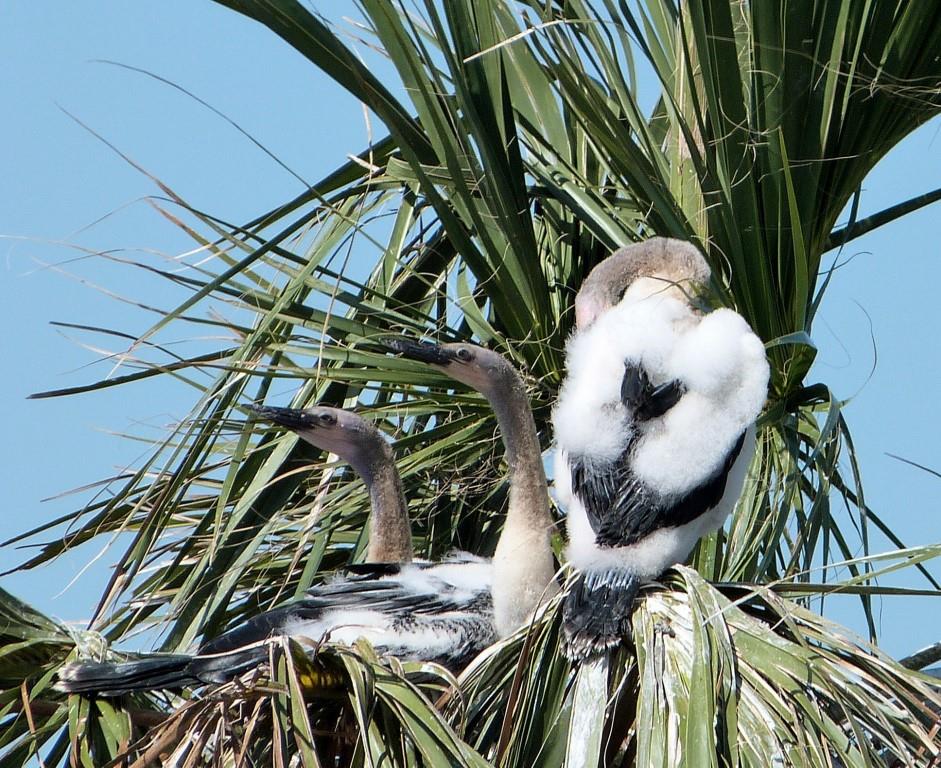
Anhinga (Anhinga anhinga) Immatures at Viera Wetland by Lee

Anhinga (Anhinga anhinga) Immatures at Viera Wetland by Lee

The Viera Wetlands count is included with those above, but is the individual count just for Viera. That actually was a birdwatching destination and e-Bird likes it counted separately. It is one of our favorites over on the east side of Florida. Unfortunately, it has apparently been dry over there, plus most of the Winter Birds have gone back north. So, the birding wasn’t as plentiful as normal. Here is the list of the birds we saw.  We stopped there in the afternoon on Wednesday and then visited it again Thursday before heading home. We saw 23 species altogether .

Species Name 15-May 16-May
Black-bellied Whistling-Duck 2
Anhinga 9 6
Brown Pelican 2
Least Bittern 1
Great Blue Heron 8 6
Great Egret 10 14
Little Blue Heron 1 1
Tricolored Heron 1 1
Cattle Egret 11 15
White Ibis 7 7
Glossy Ibis 2 7
White-faced Ibis 1
Turkey Vulture 1 15
Osprey 2
Common Gallinule 5 13
American Coot 8 4
Belted Kingfisher 1
Red-bellied Woodpecker 2
Crested Caracara 1
Fish Crow 1 2
Red-winged Blackbird 10 12
Common Grackle 3
Boat-tailed Grackle 18 22

*

Northern Crested Caracara (Caracara cheriway) at Viera Wetlands by Lee

Northern Crested Caracara (Caracara cheriway) at Viera Wetlands by Lee

The Crested Caracara was the best find. We had taken our photos and had stopped at the exit to put our cameras away. Dan had his in the trunk and mine was bagged when I look up and there he was right by us on the ground. Needless to say, we scrambled to get the camera back out, hoping we wouldn’t scare it off. As you can see, we got the photos of him.

I will save the Palm Beach Zoo birds and photos until another post. I took over 700, so it might take a day or two.

Great Blue Heron (Ardea herodias) Watching young nearby by Lee at Viera Wetlands

Great Blue Heron (Ardea herodias) Watching young nearby at Viera Wetlands

Here is what is being watched so closely:

Great Blue Heron (Ardea herodias) Young by Lee at Viera Wetlands

Great Blue Heron (Ardea herodias) Young at Viera Wetlands

See:

Viera Wetlands

e-Bird Home Page

Wordless Birds

*

Birds of the Bible – Herons On Tampa Bay

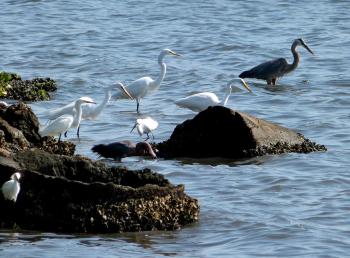
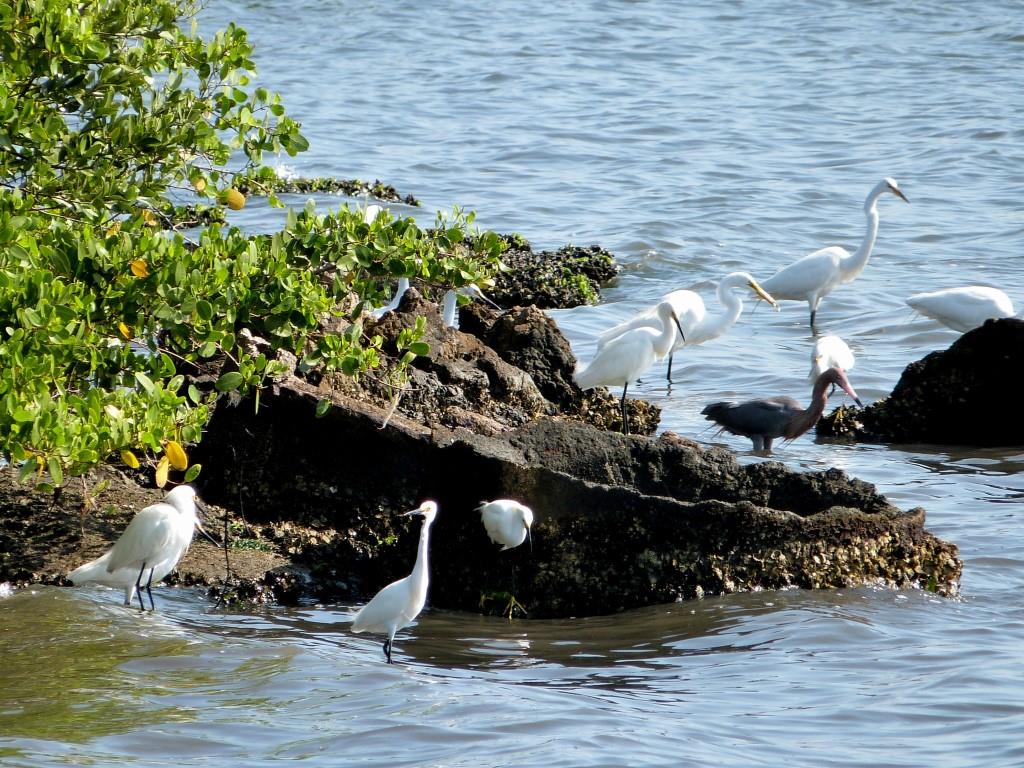
Reddish, Snowys, Greats Egrets and Great Blue Heron 5-10-13 by Lee at MacDill

Reddish, Snowys, Greats Egrets and Great Blue Heron (5-10-13) by Lee

And the stork, the heron after her kind, and the lapwing, and the bat. (Leviticus 11:19 KJV)

Herons are one of the species listed on the “Do not eat list” as we have written about before in the various Birds of the Bible – Heron articles. The first one was written back in 2008 when I first started the blog.

Since we were out birdwatching last week over in Tampa at the bay, I thought I would share some of those photos and update the Heron information some more. We saw a Great Blue Heron, several Little Blue Herons, and several others that are “after her kind” and in the same Ardeidae – Heron, Bittern  family. There were Snowy Egrets and Great Egrets fishing along with the others. The Little Blue Herons were in breeding plumage which you could tell because of their exceptionally blue beaks. (Not real clear-I was zoomed from quite a distance)

Little Blue Heron and Snowy Egrets by Lee from distance

Little Blue Heron and Snowy Egrets by Lee from distance

Herons are only mentioned twice in Scripture; Leviticus 11:19 and in Deuteronomy 14:18. That modern-day family, Ardiedae, currently has 72 members which includes not only Herons and Egrets, but also Bitterns. Some of them are grouped together like, Tiger Herons, Night Herons, Pond Herons, Reef Herons and Cattle Egrets. Not sure about the Tiger Herons but the night, pond, reef, and cattle name give you a clue as to where you might find them out and about.

And the stork, and the heron after her kind, and the lapwing, and the bat. (Deuteronomy 14:18 KJV)

The herons are long-legged freshwater and coastal birds in the family Ardeidae, (some are called “egrets” or “bitterns” instead of “heron”). Within Ardeidae, all members of the genera Botaurus and Ixobrychus are referred to as “bitterns”, and — including the Zigzag Heron or Zigzag Bittern — are a monophyletic group within the Ardeidae. However, egrets are not a biologically distinct group from the herons, and tend to be named differently because they are mainly white and/or have decorative plumes. Although egrets have the same build as herons, they tend to be smaller.

Great Egret (Ardea alba) Swallowing MacDil by Lee

Great Egret (Ardea alba) Swallowing by Lee

The classification of the individual heron/egret species is fraught with difficulty, and there is still no clear consensus about the correct placement of many species into either of the two major genera, Ardea and Egretta. Similarly, the relationship of the genera in the family is not completely resolved. However, one species formerly considered to constitute a separate monotypic family Cochlearidae, the Boat-billed Heron, is now regarded as a member of the Ardeidae.

Although herons resemble birds in some other families, such as the storks, ibises, spoonbills and cranes, they differ from these in flying with their necks retracted, not outstretched. They are also one of the bird groups that have powder down. Some members of this group nest colonially in trees, while others, notably the bitterns, use reedbeds.

The largest species of heron is the Goliath Heron, which stand up to 152 cm (60 in) tall. The necks are able to kink in an s-shape, due to the modified shape of the sixth vertebrae. The neck is able to retract and extend, and is retracted during flight, unlike most other long-necked birds. The neck is longer in the day herons than the night herons and bitterns. The legs are long and strong and in almost every species are unfeathered from the lower part of the tibia (the exception is the Zigzag Heron). In flight the legs and feet are held backward. The feet of herons have long thin toes, with three forward pointing ones and one going backward.

Reddish-Snowys-Greats Egrets -Great Blue Heron by Lee

Reddish-Snowys-Greats Egrets – Snowy in front with yellow feet

The herons are a widespread family with a cosmopolitan distribution. They exist on all continents except Antarctica, and are present in most habitats except the coldest extremes of the Arctic, extremely high mountains and the driest deserts. Almost all species are associated with water, they are essentially non-swimming waterbirds that feed on the margins of lakes, rivers, swamps, ponds and the sea. They are predominately found in lowland areas, although some species live in alpine areas, and the majority of species occur in the tropics.

While the family exhibits a range of breeding strategies, overall the herons are monogamous and mostly colonial. Most day-herons and night-herons are colonial, or partly colonial depending on circumstances, whereas the bitterns and tiger-herons are mostly solitary nesters. Colonies may contain several species as well as other types of waterbird. In a study of Little Egrets and Cattle Egrets in India the majority of the colonies surveyed contained both species. (Wikipedia with editing)

See:

Birds of the Bible

Birds of the Bible – Heron – Page

Bible Birds – Herons [younger readers]

Birds of the Bible – Herons – Article

Heron – Wikipedia

Ardeidae – Heron, Bitterns  family

*

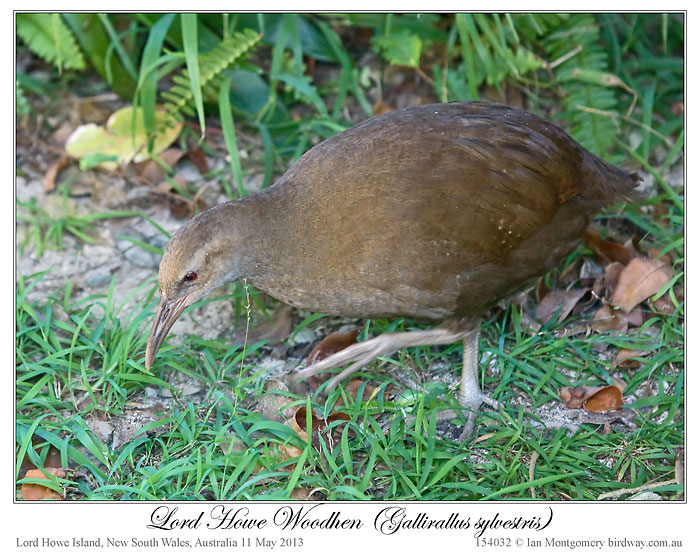
Ian’s Bird of the Week – Lord Howe Woodhen

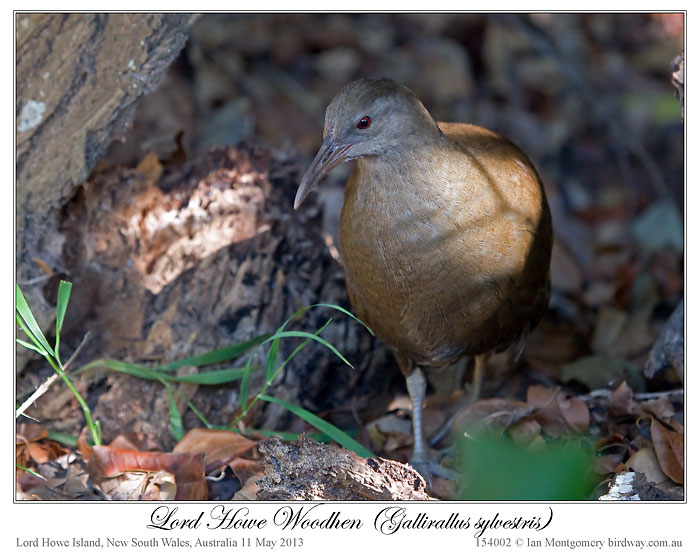
Lord Howe Woodhen (Gallirallus sylvestris) by Ian

Lord Howe Woodhen (Gallirallus sylvestris) by Ian

Ian’s Bird of the Week – Lord Howe Woodhen ~ By Ian Montgomery

Newsletter ~ 5/11/13

My sister Gillian and I arrived for a week’s visit to Lord Howe Island this morning. I haven’t been here since a visit with my mother on her last trip to Australia in 1992. That was in pre-digital photography days, so I am of course keen to photograph some of the local specialties. Perhaps at the top of the list is the famous flightless Lord Howe Woodhen, saved from probably extinction by a captive breeding program in the late 1970s and early 1980s. We had barely finished unpacking when a pair came past our front door to welcome us to the island.

The bird in the first photo has, like many of the population of 200-300 birds, coloured legs bands to assist in monitoring the population. Its partner, second photo, lacked bands and is naturally more photogenic from a wildlife viewpoint, so I concentrated my efforts on it.

Lord Howe Woodhen (Gallirallus sylvestris) by Ian

Lord Howe Woodhen (Gallirallus sylvestris) by Ian

In the gloom of the Kentia Palm forest that covers much of the lowland of the island, the birds look greyish and are quite difficult to see. When they move into the sunlight, like the one in the third photo that has found fruit from the tree outside our room, the warm chestnut colour of the plumage becomes apparent.

Lord Howe Woodhen (Gallirallus sylvestris) by Ian

Lord Howe Woodhen (Gallirallus sylvestris) by Ian

Woodhens form permanent pair bonds and defend their territories which are several hectares in size. Both these birds are adult, recognisable by their red eyes. With a length of 36 cm/14 in these are largish rails, bigger than the related Buff-banded Rail which is also present on the island (and has also wandered past our room).

Lord Howe Woodhen (Gallirallus sylvestris) by Ian

Lord Howe Woodhen (Gallirallus sylvestris) by Ian

Being flightless, tame and good to eat the population declined seriously after the island was settled and by the 1970s only a few survived on the fairly inaccessible tops of the two tall mountains, Mounts Gower and Lidgbird when some of the birds were captured and bred in a protected enclosure in the lowland area. A fellow postgraduate student of mine at Sydney University in the 1970s, Ben Miller, played a major role in the project. You will be able to read all about it in a book, The Woodhen, due for publication next month by CSIRO Publishing and written by Clifford Frith. See http://www.publish.csiro.au/pid/7011.htm. Cliff is also a friend of mine, so I feel quite a strong connection to the Woodhen and am happy to now be able to offer it to you and include photos of it on my website.

Next target is the Providence Petrel, so wish me luck. After its extinction on Norfolk Island – where it was regarded as ‘Provident’ – it survived only on Lord Howe, though a small colony has recently become re-established on Phillip Island off Norfolk.

Best wishes
Ian

**************************************************
Ian Montgomery, Birdway Pty Ltd,
454 Forestry Road, Bluewater, Qld 4818
Tel 0411 602 737 ian@birdway.com.au
Check the latest website updates:
http://www.birdway.com.au/#updates


Lee’s Addition:

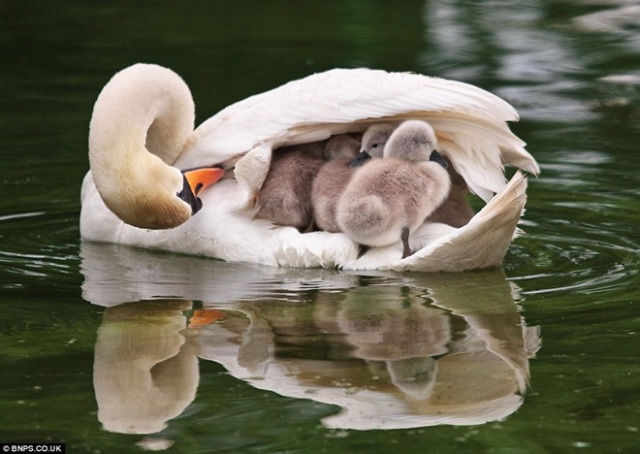
… how often would I have gathered thy children together, as a hen doth gather her brood under her wings, and ye would not! (Luke 13:34b KJV)

Never heard of a Woodhen before. Thanks, Ian, for introducing us to another one of the Lord’s creations. According to my list from IOC, there are only three Woodhens; the Lord Howe, Samoan and Makira Woodhens (The last two seem to be called woodhens only by IOC). They are in the Rallidae – Rails, Crakes & Coots Family. One other bird sometimes refered to as a Woodhen is the Weka.

“The Lord Howe Woodhen (Gallirallus sylvestris) also known as the Lord Howe Island Woodhen or Lord Howe (Island) Rail, is a flightless bird of the rail family (Rallidae). It is endemic to Lord Howe Island off the Australian coast. It is a small olive-brown bird, with a short tail and a down-curved bill. The Lord Howe Island Rail lives in sub-tropical forests, feeding on earthworms, crustaceans, fruit, and taking the eggs of shearwaters and petrels.

Woodhens mate for life and are usually encountered in pairs. They are territorial and will appear from the forest’s understory to investigate the source of any unusual noise. A mated pair will defend an area of approximately 3 hectares, with offspring being expelled from this area once grown. The population of birds is thus restricted by the amount of available territory.

Today there are about 250 birds, which may be the optimal population size for the island. (Wikipedia with editing)

See:

Ian’s Rails and Allies

Rallidae – Rails, Crakes & Coots Family

Lord Howe Woodhen – Wikipedia

Woodhen (Weka)  – Wikipedia

*

Bible Birds – Mother Birds and Their Young – (Re-post)

My Mom and Me 26

Yesterday’s My Mom And Me – Email blog inspired me to write a new article for the Birds of the Bible For Kids. It is called:”

Bible Birds – Mother Birds and Their Young.

Please check it out. It is geared for a younger audience.

*

Bible Birds – Mother Birds and Their Young

My Mom and Us

My Mom and Us

Yesterday, in My Mom and Me – Photos, you saw many photos of Mother Animals and Mother Birds with their young ones. Does the Bible mention mother birds and their young or eggs. Yes, it does.

“If a bird’s nest happens to be before you along the way, in any tree or on the ground, with young ones or eggs, with the mother sitting on the young or on the eggs, you shall not take the mother with the young;

you shall surely let the mother go, and take the young for yourself, that it may be well with you and that you may prolong your days. (Deuteronomy 22:6-7 NKJV)

That is very interesting verse. It tells us not to take both the mother and the young or eggs. Do you know why? Look at the last verse; it says “may be well with you and you will prolong your days (live longer). Do you know another reason not to take both? The Lord commanded the animals and birds to have babies and fill the earth. If you kill them both, then none of that family will be able to have more baby birds or the young will not get to grow up and have baby birds. Soon, there wouldn’t be any more of those kinds of birds and they would become “extinct.”

The Lord told us from the very beginning of the Bible to have “dominion” over the birds and animals. That does not mean to be mean to them, but more like to watch over them and care for them. That is what our verse above is telling us. Not to destroy all of them, but to leave some of the family alive to carry on.

Gather the people–men, women, children, and foreigners living within your gates–so that they may listen and learn to fear the LORD your God and be careful to follow all the words of this law. (Deuteronomy 31:12 HCSB)

Wordless Birds

See:

More Bible Birds

*

My Mom And Me – Email

(Received this as an email. – Not sure who to credit them to.)

*

Here’s your AWE! for the day!!!

*

This slideshow requires JavaScript.

*

Bring forth every living thing that is with you of all flesh–birds and beasts and every creeping thing that creeps on the ground–that they may breed abundantly on the land and be fruitful and multiply upon the earth. (Genesis 8:17 AMP)

*

Ian’s Bird of the Week – White-throated (and Large-tailed) Nightjar

White-throated Nightjar - (Eurostopodus mystacalis) by Ian 1

Ian’s Bird of the Week – White-throated (and Large-tailed) Nightjar ~ by Ian Montgomery

Newsletter – 04-29-13

On the recent inland trip I searched without success in various places for the Spotted Nightjar, a dry country species that roosts in spinifex and open woodland. Sometimes it is to be seen on gravel roads at night, but it seems rather shy and it’s still on my wanted-to-photograph list. I’m back home in Bluewater near Townsville with my sister Gillian, also interested in birds and on a visit from Ireland, so last Tuesday we drove up to the highland mixed forest, part sclerophyll part rainforest, on the range at the end of Forestry Road where I live. She spotted the bird in the first photo which we had disturbed walking along a forest track.

This is a White-throated Nightjar, also on my wanted list as the only one I had photographed before was the one in the second photo, taken 5 years ago in the vestibule of Reef HQ, the aquarium in Townsville in the less than ideal natural surroundings of the roof supports.

White-throated Nightjar - (Eurostopodus mystacalis) by Ian 2

The sharp-eyed among you may have noticed that both photos were taken in April. This is no coincidence as this species is mainly seen here on migration and there are other reports of it turning up in strange places here, including a disused railway carriage that was used as travel accommodation for several years. Incidentally, its specific name mystacalis means ‘moustached’.

A much commoner species here is the Large-tailed Nightjar, often heard at night around Townsville in gallery forest, rainforest and mangroves. It has an unmistakable, very persistent ‘chop’ ‘chop’ call that gives it its colloquial name of Carpenter Bird or Axe Bird, and I often here it near my house, particular on moonlit nights.

Large-tailed Nightjar (Caprimulgus macrurus) by Ian 3

On the day we saw the White-throated Nightjar I had been hoping that we’d see Large-tailed Nightjars on Forestry Road when we returned home at dusk, but the White-throated got in first. So we were delighted to see 3 Large-tailed as well on the way home, including one that obligingly flew up into a tree beside the road and called to us as we illuminated it with a spotlight. I had said to Gillian a few days before that this was one of the few places I knew where you could easily see two species of Stone-curlew/Thicknee in one day after we had seen a pair of Beach Stone-curlews when we went for fish and chips at nearby Balgal Beach and then found two Bush Stone-Curlews in the garden when we returned home. I could perhaps have said the same about Nightjars. You could also say something about the irony of travelling to distant places when there are so many things to be seen in one own back yard.

Best wishes
Ian

**************************************************
Ian Montgomery, Birdway Pty Ltd,
454 Forestry Road, Bluewater, Qld 4818
Tel 0411 602 737 ian@birdway.com.au
Check the latest website updates:
http://www.birdway.com.au/#updates


Lee’s Addition:

How true it is that sometimes we find great treasure right in our own back yard. I am so thankful, Ian, that you share so many of your adventures with us. And, it is nice to share those adventures with your sister.

We have been able to see three members of the Caprimulgidae – Nightjars Family; the Common Nighthawk, Whip-poor-will and the Chuck-will’s-widow.

They are also mentioned in Scripture – Birds of the Bible – Nighthawks and Nightjars

And the owl, and the night hawk, and the cuckow, and the hawk after his kind, (Deuteronomy 14:15 KJV)

See Also:

Ian’s Caprimulgidae Family Photos

Caprimulgidae – Nightjars Family

Nightjar– Wikipedia

*

Missing Bird Photos Desired – “Birdographers” Needed

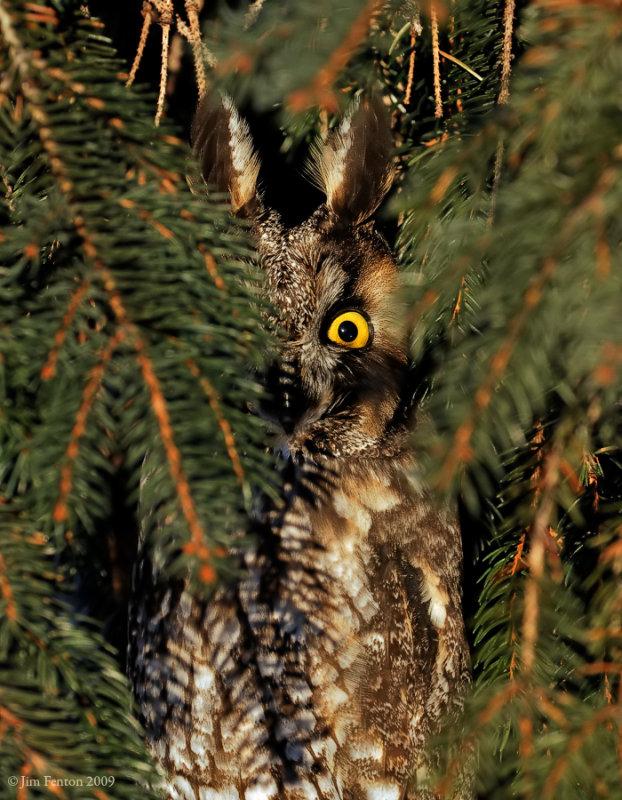
Long-eared Owl (Asio otus) by J Fenton

Long-eared Owl (Asio otus) by J Fenton

On Saturday, I concluded my search for the Birds of the World list of birds. Out of 10,615 (or 10,625) there are 74 birds who seem to have stayed hidden from the view of all the “Birdographers.” That is my name for those who are photographers, videographers, artists and stamp makers. All the major Ornithology and Birding websites are in need of them also.

I am thankful for every photo, drawing, video, specimen and sound recording of the birds that have links to them. They represent dedicated birdwatchers who have been on adventures that have taken them to places many of us would not go. Jungles, swamps, mountains, deserted islands, mudholes, etc have been traipsed so that these images could be recorded. Thank you, thank you, thank you!

When I started listing the Birds of the World several years back, I never envisioned ever seeing the images of as many as I have seen now. According to the IOC Version 3.3 list, I have seen over 10,500 species of the Lord’s fantastically created birds. That does not rate in any counting system used by birders, but it sure has been an unexpected enjoyment for me even though it represents hours of searching and updating the pages here. I have been exposed to birds that are so unique, beautiful, ugly, colorful, dull, loud, quite, etc. that I never knew even existed. Wow!

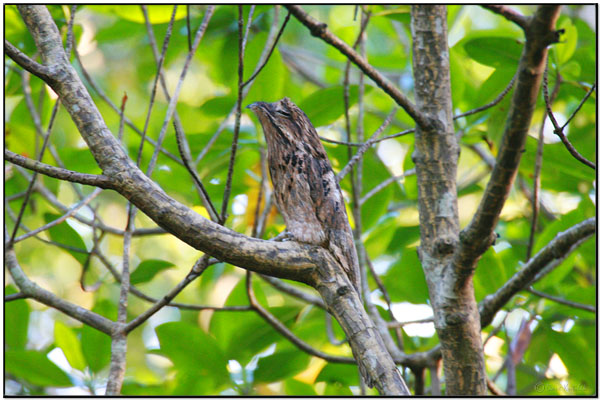
Common Potoo (Nyctibius griseus) by Daves BirdingPix

Do you see me?

Now for the plea. I made a page that list all the missing species, Missing Birds Needed. If anyone who has a photo, video, drawing, or whatever of those birds, or knows where a link can be found to them, please leave a comment or send me an email at:

Lee@Leesbird.com

Yes, there are sites out there that show photos for the listed birds, but they are of another bird in the family or genus. Here, and I am sure there are some mistakes, I would rather have a blank instead of misleading someone to think that is the real bird. Most leave the photo blank, but a few don’t. I fell for that a few times until I learned, now I am trying to find those misleading photos.

One of the biggest problems finding the birds is that the species have had name changes and several names at the same time. They also keep splitting the subspecies off into a new species. Toward the end of my searching, I felt like a detective trying to figure out a bird’s name and its past names just to be able to find it.

And further, my son, be admonished by these. Of making many books there is no end, and much study is wearisome to the flesh. (Ecclesiastes 12:12 NKJV)

Again, if you can help, check out the Missing Birds Needed page and see if you could supply an image or link to one. Let’s see if we can reduce that number down. I haven’t quit my search, just resting until the IOC updates their list next month and I get to start searching again.

Also, if you would like to become one of our photographers, leave a note.

*

Either what woman having ten pieces of silver, if she lose one piece, doth not light a candle, and sweep the house, and seek diligently till she find it? And when she hath found it, she calleth her friends and her neighbours together, saying, Rejoice with me; for I have found the piece which I had lost. Likewise, I say unto you, there is joy in the presence of the angels of God over one sinner that repenteth. (Luke 15:8-10 KJV)

*

Wordless Birds

*