I almost cracked up when I read the title Stephen gave me for this blog. He gave me the suggested titles and I am suppose to write the articles. Some deal! We would like this series to be informative, but mainly to encourage all of us to “start birdwatching today” no matter our level of experience.
So, why should you go outside? Mainly, because that is where most of the birds are. Yes, there are some in cages in peoples house, but the majority are outside flying freely about waiting for you to come watch them. The birds are busy doing what the Lord designed them to do; singing, building nests, eating, finding food for their young, arguing sometimes (especially those in the Dove-Pigeon family), Why do they argue? They are actually showing dominance or defending their territory, or who knows what else. If you are not outside, you might miss all this. You can watch through your window, so even those who are ill or handicapped, can still get to enjoy the antics of our avian friends.
According to Job, you might even learn something from watching the birds:
But now ask the beasts, and they will teach you; And the birds of the air, and they will tell you; (Job 12:7 NKJV)
Who teaches us more than the beasts of the earth, And makes us wiser than the birds of heaven? (Job 35:11 NKJV)
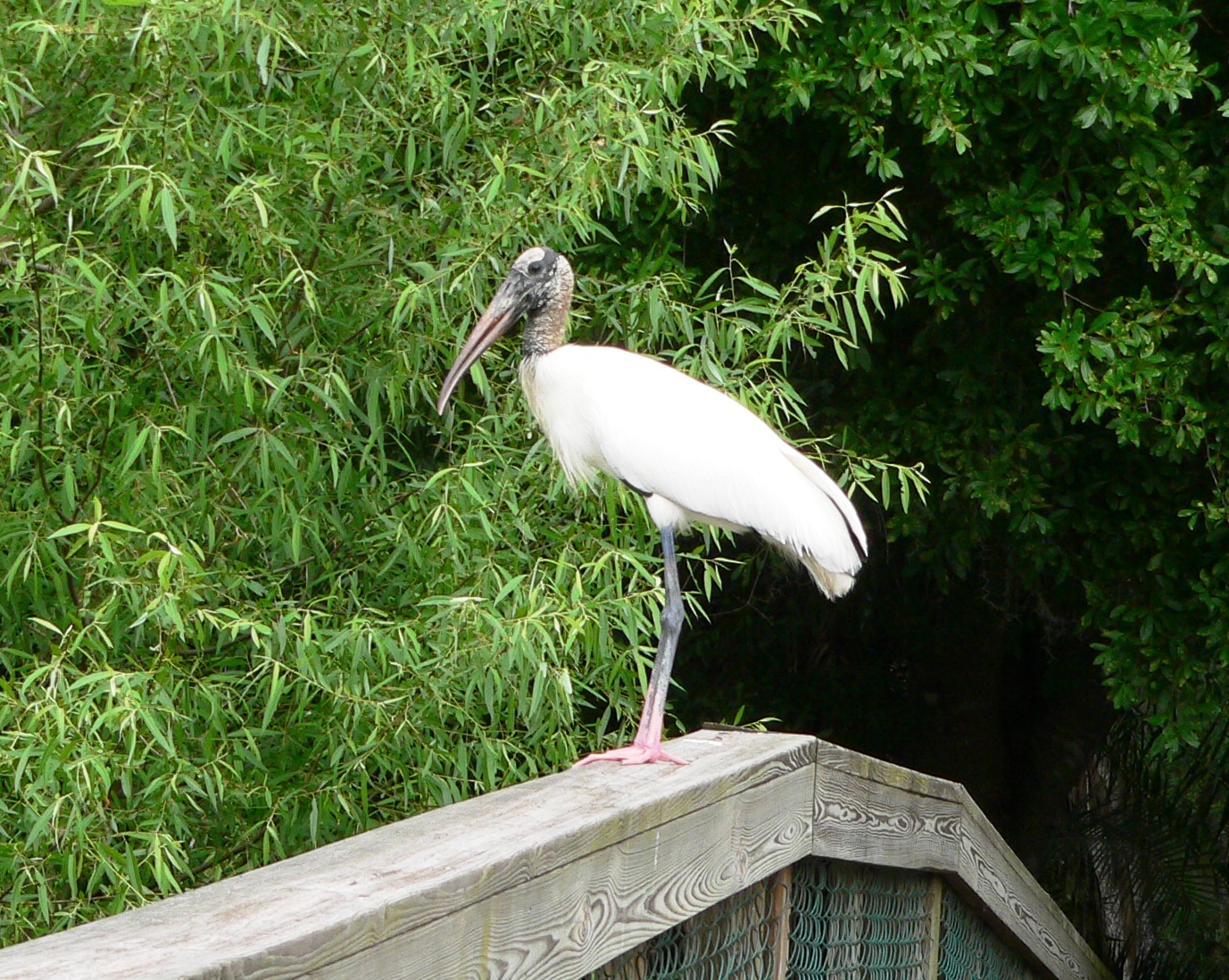
Wood Stork at S. Lake Howard Nature Park
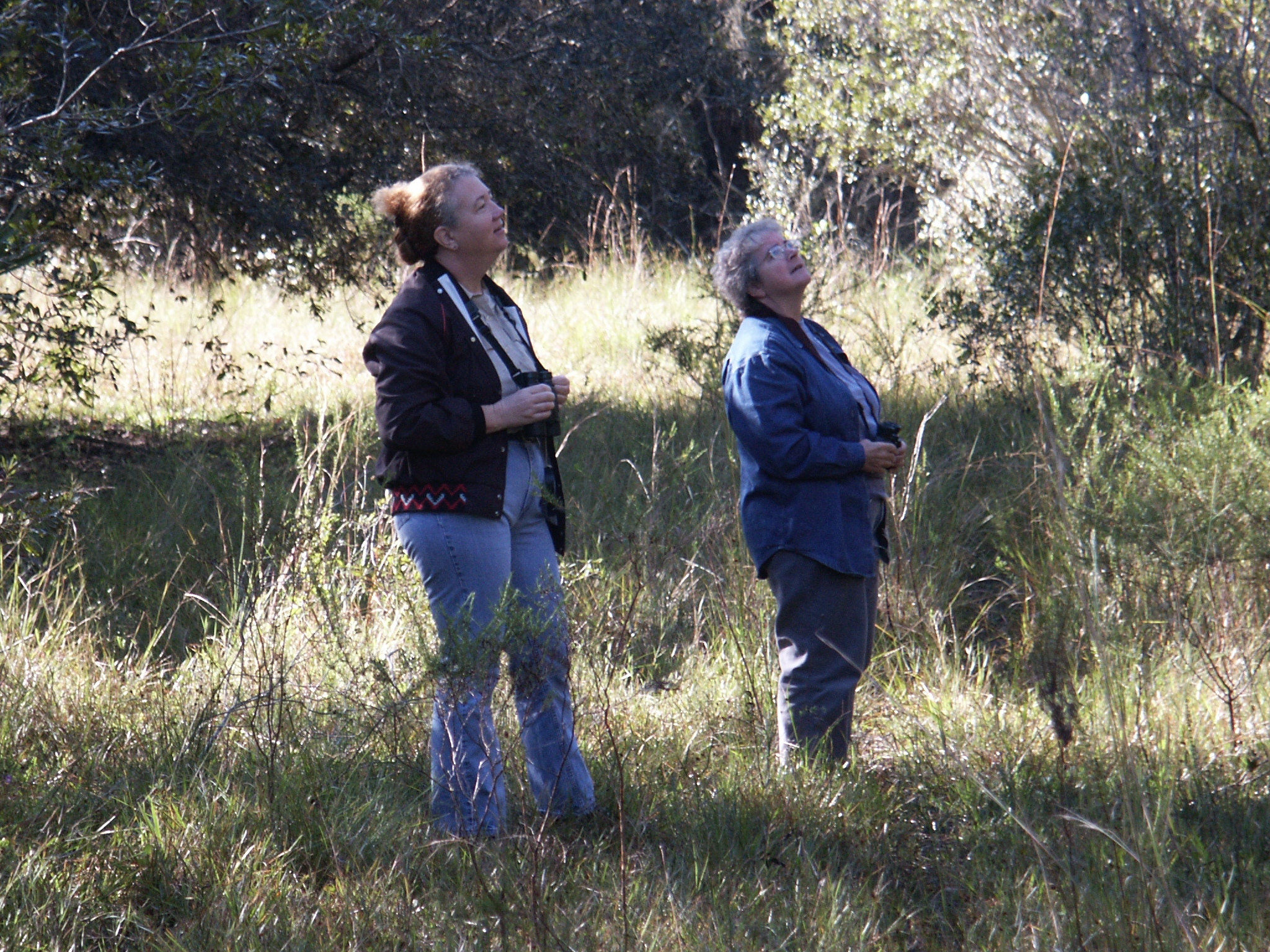
Stare at the birds? If you do that to a person, they get upset, but I am not sure a bird would, but then again they just might. One of the things I was taught when I first became interested in birding or birdwatching was to have “soft eyes.” If you stare at a tree or a certain area, you might see a bird. If you look at a tree, but not stare, then you can catch movement or activity in that tree that you might miss if you are only staring at one spot.
Are there times to stare? When I am really concentrating on a bird that I have already spotted, then, yes, I will stare as I try to observe details about the bird. But we will save those details for another blog.
Enough for this article. So either slide your chair or wheelchair up to the window, or go outside and stare at the birds, after you find one.
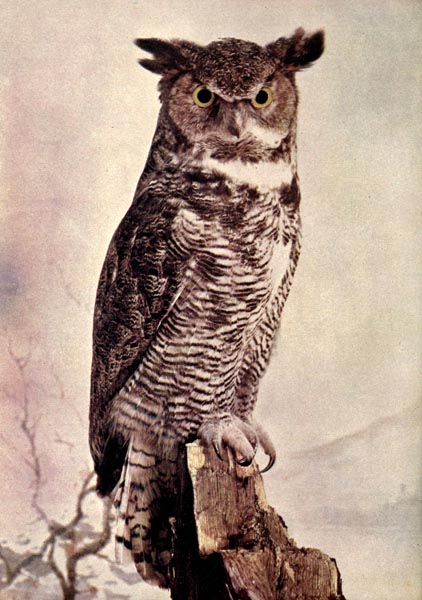
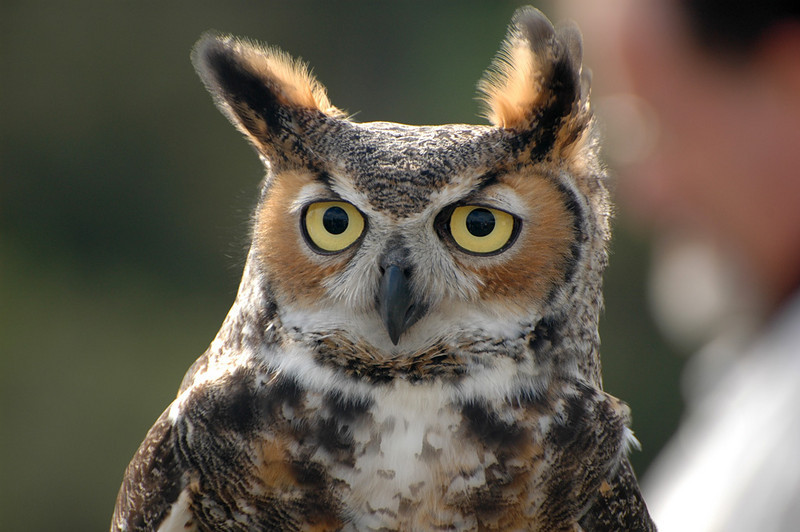
Great Horned Owl – Birds Illustrated by Color Photography
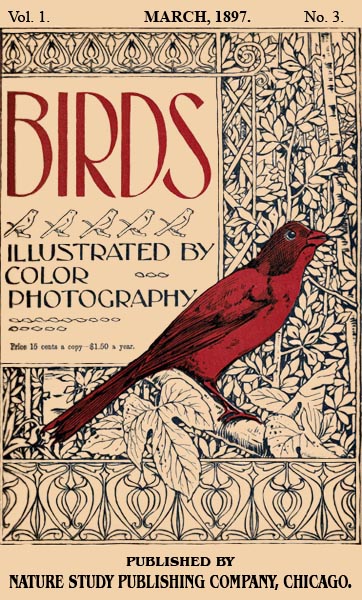
Birds Illustrated by Color Photography – Revisited
Vol 1. March, 1897 No. 3
*
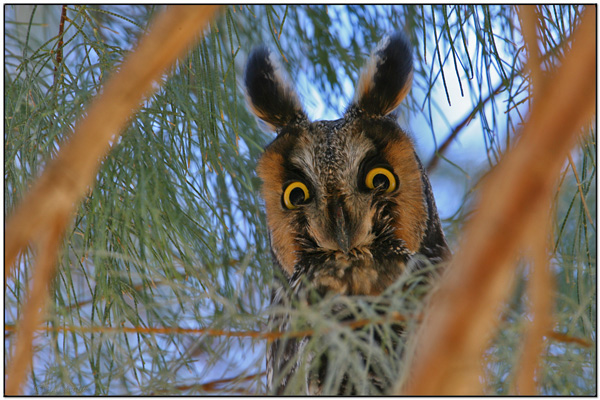
THE LONG-EARED OWL.
HE name of the Long-Eared Owl is derived from the great length of his “ears” or feather-tufts, which are placed upon the head, and erect themselves whenever the bird is interested or excited. It is the “black sheep” of the owl family, the majority of owls being genuine friends of the agriculturist, catching for his larder so many of the small animals that prey upon his crops. In America he is called the Great Horned Owl—in Europe the Golden Owl. (Today it is the Eurasian Eagle-Owl, I believe.)
Nesting time with the owl begins in February, and continues through March and April. The clown-like antics of both sexes of this bird while under the tender influence of the nesting season tend somewhat to impair their reputation for dignity and wise demeanor. They usually have a simple nest in a hollow tree, but which seems seldom to be built by the bird itself, as it prefers to take the deserted nest of some other bird, and to fit up the premises for its own use. They repair slightly from year to year the same nest. The eggs are white, and generally four or five in number. While the young are still in the nest, the parent birds display a singular diligence in collecting food for them.
If you should happen to know of an owl’s nest, stand near it some evening when the old birds are rearing their young. Keep quiet and motionless, and notice how frequently the old birds feed them. Every ten minutes or so the soft flap, flap of their wings will be heard, the male and female alternately, and you will obtain a brief glimpse of them through the gloom as they enter the nesting place. They remain inside but a short time, sharing the food equally amongst their brood, and then are off again to hunt for more. All night, were you to have the inclination to observe them, you would find they pass to and fro with food, only ceasing their labors at dawn. The young, as soon as they reach maturity, are abandoned by their parents; they quit the nest and seek out haunts elsewhere, while the old birds rear another, and not infrequently two more broods, during the remainder of the season.
The habits of the Long-Eared Owl are nocturnal. He is seldom seen in the light of day, and is greatly disturbed if he chance to issue from his concealment while the sun is above the horizon. The facial disk is very conspicuous in this species. It is said that the use of this circle is to collect the rays of light, and throw them upon the eye. The flight of the owl is softened by means of especially shaped, recurved feather-tips, so that he may noiselessly steal upon his prey, and the ear is also so shaped as to gather sounds from below.
The Long-Eared Owl is hardly tameable. The writer of this paragraph, when a boy, was the possessor, for more than a year, of a very fine specimen. We called him Judge. He was a monster, and of perfect plumage. Although he seemed to have some attachment to the children of the family who fed him, he would not permit himself to be handled by them or by any one in the slightest. Most of his time he spent in his cage, an immense affair, in which he was very comfortable. Occasionally he had a day in the barn with the rats and mice.
The owl is of great usefulness to gardener, agriculturist, and landowner alike, for there is not another bird of prey which is so great a destroyer of the enemies of vegetation.
Great Horned Owl LPZoo by Lee
THE OWL.
We know not alway
Who are kings by day,
But the king of the night is the bold brown owl!
I wonder why the folks put my picture last in the book. It can’t be because they don’t like me, for I’m sure I never bother them. I don’t eat the farmer’s corn like the crow, and no one ever saw me quarrel with other birds.
Maybe it is because I can’t sing. Well, there are lots of good people that can’t sing, and so there are lots of good birds that can’t sing.
Did you ever see any other bird sit up as straight as I do? I couldn’t sit up so straight if I hadn’t such long, sharp claws to hold on with.
My home is in the woods. Here we owls build our nests—most always in hollow trees.
During the day I stay in the nest or sit on a limb. I don’t like day time for the light hurts my eyes, but when it begins to grow dark then I like to stir around. All night long I am wide awake and fly about getting food for my little hungry ones. They sleep most of the day and it keeps me busy nearly all night to find them enough to eat.
I just finished my night’s work when the man came to take my picture. It was getting light and I told him to go to a large stump on the edge of the woods and I would sit for my picture. So here I am. Don’t you think I look wise? How do you like my large eyes? If I could smile at you I would, but my face always looks sober. I have a great many cousins and if you really like my picture, I’ll have some of them talk to you next month. I don’t think any of them have such pretty feathers though. Just see if they have when they come.
Well, I must fly back to my perch in the old elm tree. Good-bye.
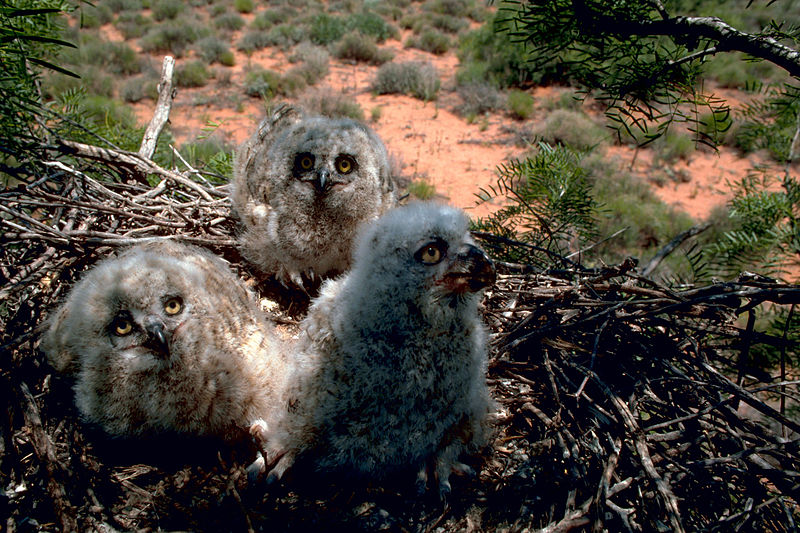
Great Horned Owl (Bubo virginianus) chicks – WikiC
THE OWL.
In the hollow tree, in the old gray tower,
The spectral owl doth dwell;
Dull, hated, despised in the sunshine hour,
But at dusk he’s abroad and well!
Not a bird of the forest e’er mates with him;
All mock him outright by day;
But at night, when the woods grow still and dim,
The boldest will shrink away!
O! when the night falls, and roosts the fowl,
Then, then, is the reign of the Horned Owl!
And the owl hath a bride, who is fond and bold,
And loveth the wood’s deep gloom;
And, with eyes like the shine of the moonstone cold,
She awaiteth her ghastly groom.
Not a feather she moves, not a carol she sings,
As she waits in her tree so still,
But when her heart heareth his flapping wings,
She hoots out her welcome shrill!
O! when the moon shines, and dogs do howl,
Then, then, is the joy of the Horned Owl!
Mourn not for the owl, nor his gloomy plight!
The owl hath his share of good—
If a prisoner he be in the broad daylight,
He is lord in the dark greenwood!
Nor lonely the bird, nor his ghastly mate,
They are each unto each a pride;
Thrice fonder, perhaps, since a strange, dark fate
Hath rent them from all beside!
So, when the night falls, and dogs do howl,
Sing, Ho! for the reign of the Horned Owl!
We know not alway
Who are kings by day,
But the King of the Night is the bold Brown Owl!
Bryan W. Procter
(Barry Cornwall.)
Great Horned Owl (Bubo virginianus) by Bob-Nan
Lee’s Addition:
Our Owl friend is a Bird of the Bible also. Owls are mentioned in 8 to 9 verses in Scripture, depending on which version. The KJV has 8 “owl” and 1 “owls” mentioned. The “horned owl” is mentioned in several versions. They are also one of the Birds of Prey mentioned in the Bible.
The little owl, the great owl, the horned owl, (Deuteronomy 14:16 AMP)
The Great Horned Owls range in length from 18–27 in (46–69 cm) and have a wingspan of 40–60.5 in (101–153 cm); Females are larger than males, an average adult being 22 in (55 cm) long with a 49 in (124 cm) wingspan and weighing about 3.1 lbs (1400 g). Depending on subspecies, Great Horned Owls can weigh from 0.72 to 2.55 kg (1.6 to 5.6 lb). At present there are 14 subspecies.
Adults have large ear tufts, a reddish, brown or gray face and a white patch on the throat. The iris is yellow, except the amber-eyed South American Great Horned Owl (B. V. nacurutu). Its “horns” are neither ears nor horns, simply tufts of feathers. The underparts are light with brown barring; the upper parts are mottled brown. The legs and feet are covered in feathers up to the talons. There are individual and regional variations in color; birds from the sub-Arctic are a washed-out, light-buff color, while those from Central America can be a dark chocolate brown.
Their call is a low-pitched but loud ho-ho-hoo hoo hoo; sometimes it is only four syllables instead of five. The female’s call is higher and rises in pitch at the end of the call. Young owls make hissing or screeching sounds that are often confused with the calls of Barn Owls.
Great Horned Owl call by Jesse Fagan
Owls were given spectacular binocular vision allowing them to pinpoint prey and see in low light. The eyes of Great Horned Owls are nearly as large as those of humans and are immobile within their circular bone sockets. Instead of turning their eyes, they turn their heads. Therefore, their neck must be able to turn a full 270 degrees in order to see in other directions without moving its entire body.
An owl’s hearing is as good as – if not better than – its vision; they have better depth perception[citation needed] and better perception of sound elevation (up-down direction) than humans. This is due to owl ears not being placed in the same position on either side of their head: the right ear is typically set higher in the skull and at a slightly different angle. By tilting or turning its head until the sound is the same in each ear, an owl can pinpoint both the horizontal and vertical direction of a sound.
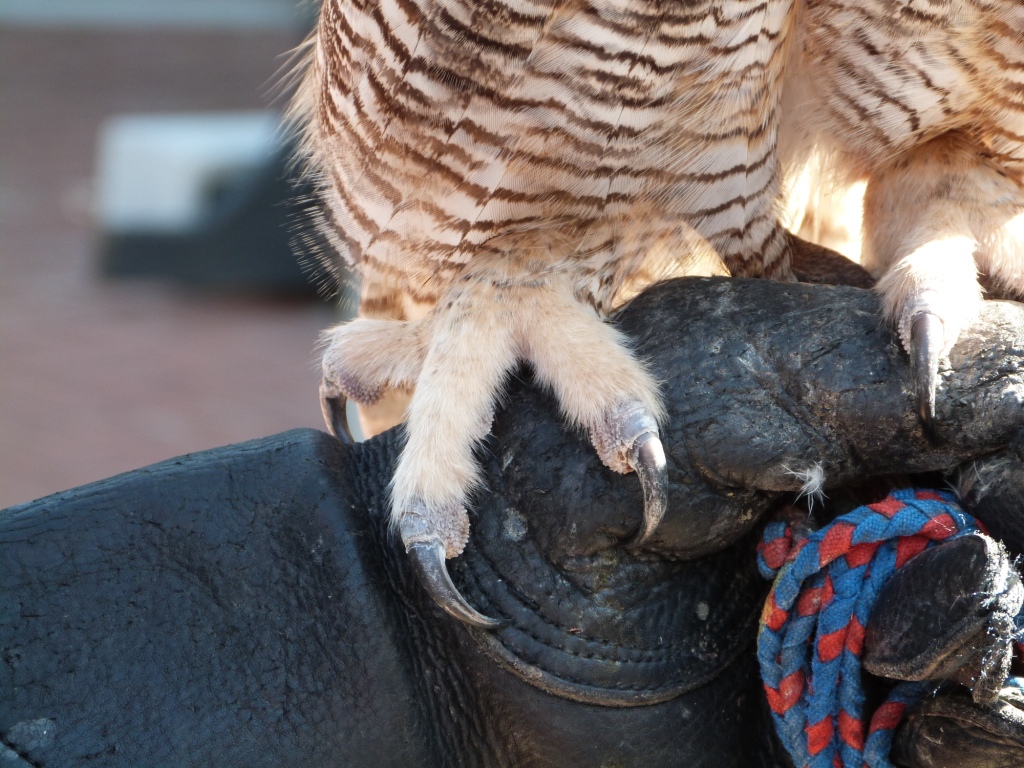
Closeup of Great Horned Owl toes and talons
Great Horned Owl Foot LPZoo by Lee
These birds hunt at night by waiting on a high perch and swooping down on prey. Prey can vary greatly based on opportunity. The predominant prey group are small to medium-sized mammals such as hares, rabbits (statistically the most regular prey, juvenile raccoons, rats, squirrels, mice, moles, voles, shrews, bats, armadillos, muskrats, weasels and gerbils. It is even a natural predator of prey two to three times heavier than itself such as porcupines, marmots and skunks. Birds also comprise a large portion of a Great Horned Owl’s diet, ranging in size from kinglets to Great Blue Herons. Waterbirds, especially coots and ducks, are hunted; even raptors, up to the size of Red-tailed Hawk and Snowy Owls, are sometimes taken. Regular avian prey includes woodpeckers, grouse, crows, pigeons, herons, gulls, quail, turkey and various passerines. Reptiles (to the size of young American alligators, amphibians, fish, crustaceans and even insects are only occasional prey. In addition, the Great Horned Owl will predate on domesticated cats and small or young dogs.
When the Lord has created these birds Hi also gave them 200–300 pounds per square inch of crushing power in their talons. An average adult human male has about 60 pounds per square inch in his hands. In northern regions, where larger prey that cannot be eaten quickly are most prevalent, they may let uneaten food freeze and then thaw it out later using their own body heat. They also tend to eat and regurgitate food in the same locations.
The article is titled the Long-eared Owl. Actually there really is a Long-eared Owl.
The above article is the first article in the monthly serial for February 1897 “designed to promote Knowledge of Bird-Live.” These include Color Photography, as they call them, today they are drawings. There are at least three Volumes that have been digitized by Project Gutenberg.
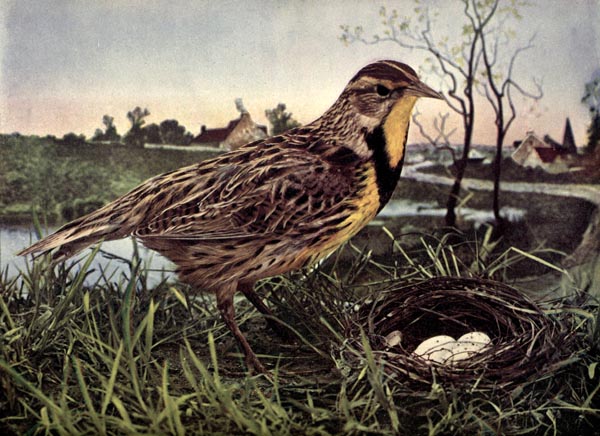
Meadowlark – Birds Illustrated by Color Photography, 1897
Birds Illustrated by Color Photography – Revisited
Vol 1. March, 1897 No. 3
*
THE MEADOW LARK.
“Not an inch of his body is free from delight.
Can he keep himself still if he would? Oh, not he!
The music stirs in him like wind through a tree.”
HE well known Meadow or Old Field Lark is a constant resident south of latitude 39, and many winter farther north in favorite localities. Its geographical range is eastern North America, Canada to south Nova Scotia, Quebec, and Ontario to eastern Manitoba; west to Minnesota, Iowa, Missouri, eastern Kansas, the Indian Territory, and Texas; south to Florida and the Gulf coast, in all of which localities, except in the extreme north, it usually rears two or three broods in a season. In the Northern States it is only a summer resident, arriving in April and remaining until the latter part of October and occasionally November. Excepting during the breeding season, small flocks may often be seen roving about in search of good feeding grounds. Major Bendire says this is especially true in the fall of the year. At this time several families unite, and as many as two dozen may occasionally be flushed in a field, over which they scatter, roaming about independently of each other. When one takes wing all the others in the vicinity follow. It is a shy bird in the East, while in the middle states it is quite the reverse. Its flight is rather laborious, at least in starting, and is continued by a series of rapid movements of the wings, alternating with short distances of sailing, and is rarely protracted. On alighting, which is accompanied with a twitching of its tail, it usually settles on some fence rail, post, boulder, weedstock, or on a hillock in a meadow from which it can get a good view of the surroundings, and but rarely on a limb of a tree. Its favorite resorts are meadows, fallow fields, pastures, and clearings, but in some sections, as in northern Florida, for instance, it also frequents the low, open pine woods and nests there.
The song of the Meadow Lark is not much varied, but its clear, whistling notes, so frequently heard in the early spring, are melodious and pleasing to the ear. It is decidedly the farmers’ friend, feeding, as it does, on noxious insects, caterpillars, moths, grasshoppers, spiders, worms and the like, and eating but little grain. The lark spends the greater part of its time on the ground, procuring all its food there. It is seldom found alone, and it is said remains paired for life.
Nesting begins in the early part of May and lasts through June. Both sexes assist in building the nest, which is always placed on the ground, either in a natural depression, or in a little hollow scratched out by the birds, alongside a bunch of grass or weeds. The nest itself is lined with dry grass, stubble, and sometimes pine needles. Most nests are placed in level meadows. The eggs and young are frequently destroyed by vermin, for the meadow lark has many enemies. The eggs vary from three to seven, five being the most common, and both sexes assist in the hatching, which requires about fifteen or sixteen days. The young leave the nest before they are able to fly—hiding at the slightest sign of danger. The Meadow Lark does not migrate beyond the United States. It is a native bird, and is only accidental in England. The eggs are spotted, blotched, and speckled with shades of brown, purple and lavender. A curious incident is told of a Meadow Lark trying to alight on the top mast of a schooner several miles at sea. It was evidently very tired but would not venture near the deck.
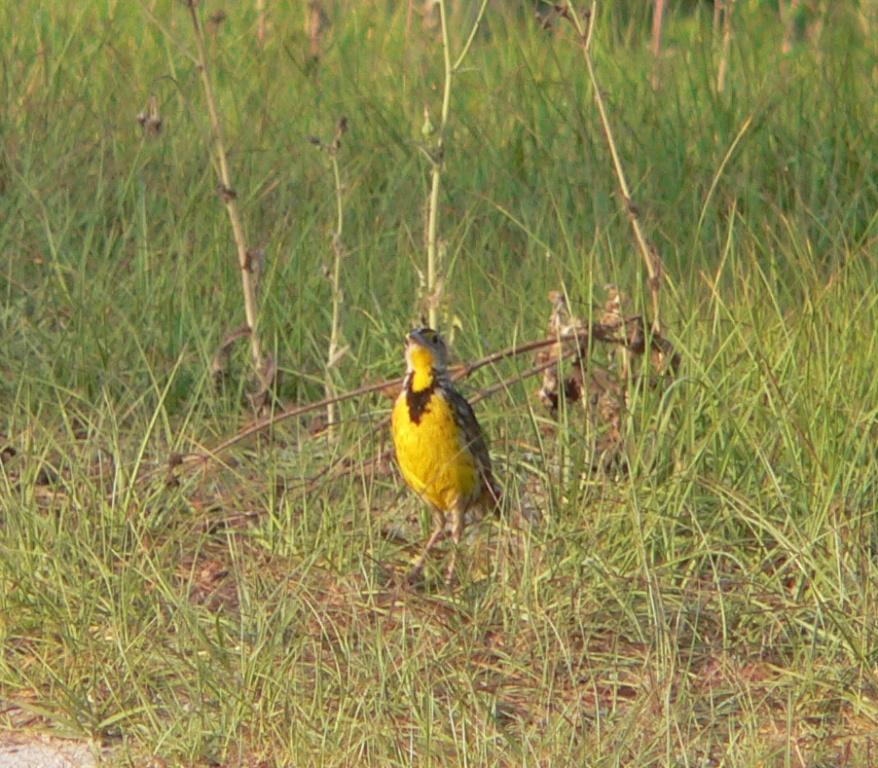
Circle B – Eastern Meadowlark by Lee
THE MEADOW LARK.
I told the man who wanted my picture that he could take it if he would show my nest and eggs. Do you blame me for saying so? Don’t you think it makes a better picture than if I stood alone?
Mr. Lark is away getting me some breakfast, or he could be in the picture, too. After a few days I shall have some little baby birds, and then won’t we be happy.
Boys and girls who live in the country know us pretty well. When they drive the cows out to pasture, or when they go out to gather wild flowers, we sit on the fences by the roadside and make them glad with our merry song.
Those of you who live in the city cannot see us unless you come out into the country.
It isn’t very often that we can find such a pretty place for a nest as we have here. Most of the time we build our nest under the grass and cover it over, and build a little tunnel leading to it. This year we made up our minds not to be afraid.
The people living in the houses over there do not bother us at all and we are so happy.
You never saw baby larks, did you? Well, they are queer little fellows, with hardly any feathers on them.
Last summer we had five little birdies to feed, and it kept us busy from morning till night. This year we only expect three, and Mr. Lark says he will do all the work. He knows a field that is being plowed, where he can get nice, large worms.
Hark! that is he singing. He will be surprised when he comes back and finds me off the nest. He is so afraid that I will let the eggs get cold, but I won’t. There he comes, now.
For ye shall go out with joy, and be led forth with peace: the mountains and the hills shall break forth before you into singing, and all the trees of the field shall clap their hands. (Isaiah 55:12 KJV)
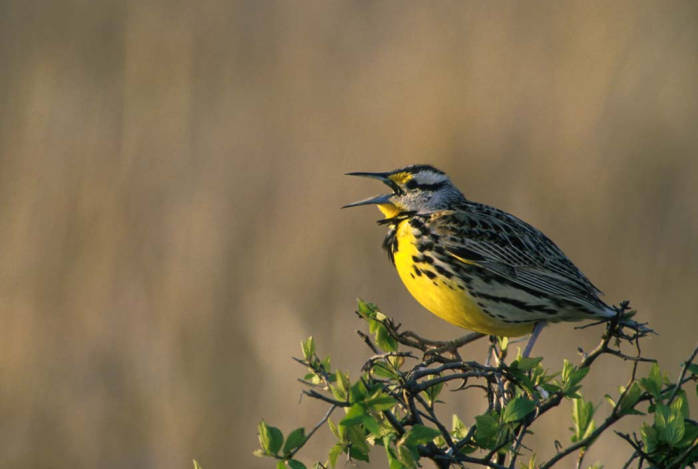
Meadowlarks are birds belonging to the genus Sturnella in the New World family Icteridae. The two here in the U. S. are the Eastern and Western Meadowlarks. Very southern US can see the Lillian’s
This genus includes two species of largely insectivorous grassland birds. In all species the male at least has a black or brown back and extensively red or yellow underparts.
The genus Sturnella comprises:
The above article is the first article in the monthly serial for February 1897 “designed to promote Knowledge of Bird-Live.” These include Color Photography, as they call them, today they are drawings. There are at least three Volumes that have been digitized by Project Gutenberg.
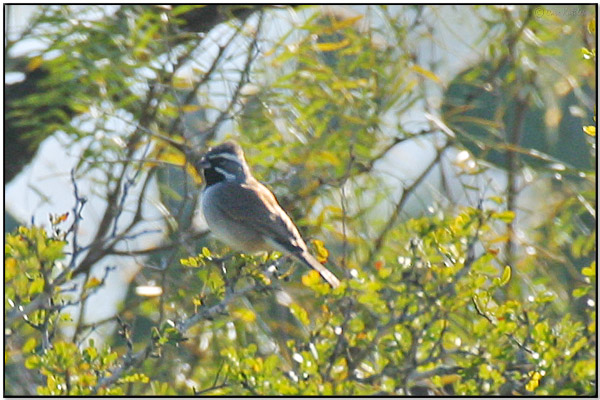
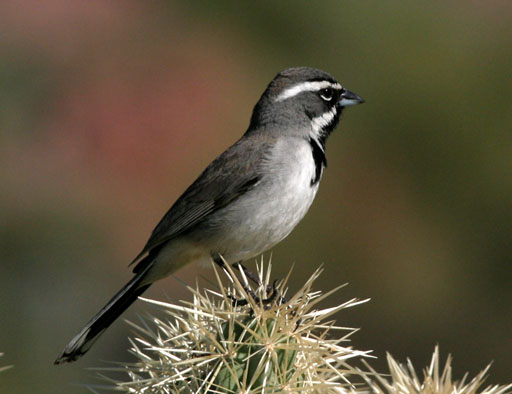
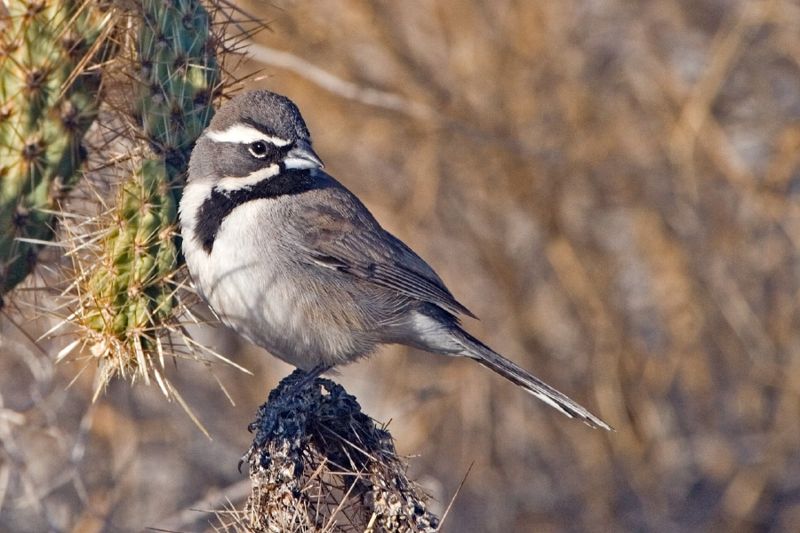
The Black-throated Sparrow – The Desert Dwellers ~ by a j mithra
The Black-throated Sparrow (Amphispiza bilineata) is a very distinctive small, brown bird found in open areas with scattered shrubs and trees, including deserts and semi-desert grasslands in the intermountain region in the western United States, northern Mexico, and Baja California. It is sometimes referred to as the Desert Sparrow, due to its preferred habitat of arid desert hillsides and scrub. This name usually refers to the Desert Sparrow of Africa and Asia.
Though this little bird chooses to dwell among the desert, it never has stopped singing has it?
Shadrach, Meshach and Abednego did just that when they were thrown into the furnace which was seven times hotter.
That may be the reason why the Lord who is the pillar of cloud strolled with them in the furnace that day!
Probably they knew the secret that our God loves to dwell among our praises.
Peter and Silas did just that when they were beaten, bruised, chained and thrown into the jail. But, still they praised and you know what happened? Their praise released not only their bondages but also of those who were with them and it also shook the jail’s floor..
Have you ever tried praising God in your darkest hour?
Try worshipping like Peter and Silas and you will see the light shine not just at the end of the tunnel but all around you and also over every one who is the dark around you…
I will bless the LORD at all times: his praise shall continually be in my mouth. (Psalm 34:1)
The Black-throated Sparrow is a small, gray sparrow that reaches a length of about 4.5-5.5 inches and has a distinctive black throat, with a bold white stripe above its eye and another down its cheek. The black tail is outlined in white except at the tips of the middle tail feathers. Juveniles, who retain this plumage into October, lack the black throat of adults and are lightly streaked.
Usually found in cactus and sagebrush deserts, especially on rocky slopes..
Sagebrush has bacteriostatic, astringent, and antioxidant properties.
Sagebrush kills bacteria, inhibits free radicals, and has anti-inflammatory and anti-carcinogenic actions, and so is most useful as a cleansing first aid wash for disinfecting wounds and skin irritations.
The leaves can be very useful in the kitchen as a means of protecting stored dried food from insects and rodents.
This maybe the reason for these little birds to choose a desert like place to live, since these plants grow among the dry desert slopes.
Don’t ever think that God has placed you in a dry desert to punish you..
He separates you so that you will turn into a better vessel that would glorify His name..
And I will bring the third part through the fire, and will refine them as silver is refined, and will try them as gold is tried: they shall call on my name, and I will hear them: I will say, Itis my people: and they shall say, The LORD is my God. (Zechariah 13:9)
The Black-throated Sparrow is considered to be better adapted to this type of ecosystem than any other seed-eating bird in North America. Adapted to dry habitats, Black-throated Sparrows can survive long periods of time without supplemental water, obtaining moisture from the seeds and insects that make up their diet. In the hottest part of the summer, however, supplemental water is necessary. In the winter, seeds make up the majority of their diet. During the breeding and nestling season, insects become more important. When available, berries and other fruits, as well as fresh green shoots, are also part of their diet.
Do you feel that God has put you in the wrong place?
Remember that God has created you to be unique to live where no one else can even dream of stepping in.
Have you forgotten that you can do all things through Christ who strengthens you?
Humble yourselves therefore under the mighty hand of God, that he may exalt you in due time: (I Peter 5:6)
They travel in small groups, though larger groups may accumulate around sources of water in the desert.
Right now, you and your family may not see hope and may feel like as if you are wandering through the desert.
I just want to encourage you that God does not take us to the desert to kill us but to show us that He is still care for us.
If God can give water to these birds in the desert, will He not give us?
Well, He is still able to bring everything from nothing.
So, congregate as a family in the presence of the Living Water and look out for a miracle which is on its way..
He turneth the wilderness into a standing water, and dry ground into watersprings. (Psalm 107:35)
Its call is high and bell-like, and its song is a fairly simple, mechanical tinkling.
You don’t have to be a great singer to bring God’s presence.
Our God is a simple God and He prefers our worship to be just simple.
Remember God doesn’t look for your voice; He just wants to hear your noise.
The wall of Jericho came down due to the noise and not the voice of Joshua and his people.
So the people shouted when the priests blew with the trumpets: and it came to pass, when the people heard the sound of the trumpet, and the people shouted with a great shout, that the wall fell down flat, so that the people went up into the city, every man straight before him, and they took the city. (Joshua 6:20)
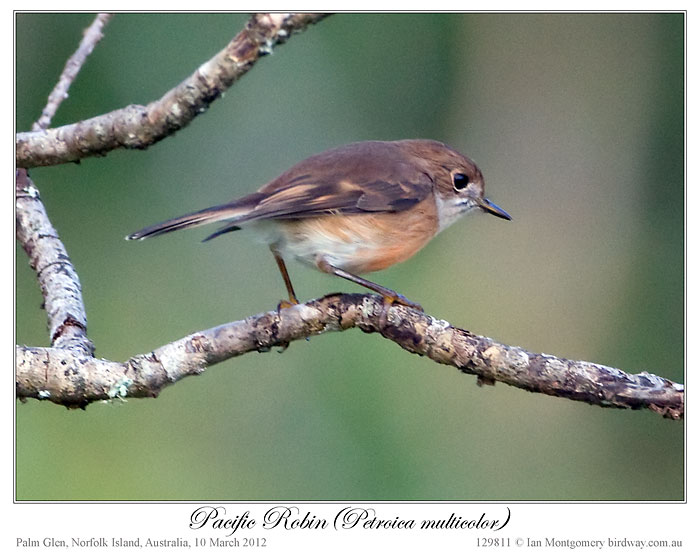
Ian’s Bird of the Week – Pacific Robin ~ by Ian Montgomery
Newsletter – 3/25/12
The Pacific Robin was another bird that I was keen to photograph on Norfolk Island. It has only recently been split from the mainland Scarlet Robin and, until that happened, it attracted little attention. As a consequence, I had trouble sourcing photos, particularly of adult males, and getting reliable material for the description of the species for the digital version of the Australian field guide by Pizzey and Knight.
It’s not common on Norfolk Island with an estimated population of 400-500 species and its distribution is restricted to areas of native forest. Happily, there was a resident family at the place, Palm Glen, where we did regular evening vigils for the Norfolk Island Parakeet and, being more confiding than Scarlet Robins, the members of the family proved to be good subjects for photography. The first photo shows the adult male. At first glance, it looks like a small Scarlet Robin, but closer examination reveals the diagnostic lack of white on the flight feathers of the wing and the outer tail feathers: the only white on the wing is the secondary wing coverts. Another supposed difference is a smaller area of white on the forehead, but this bird at least seemed to me to show much more white, extending back to a point above the rear of the eyes. If you’re interested, compare with http://www.birdway.com.au/petroicidae/scarlet_robin/index.htm .
Pacific Robin (Petroica multicolor) by Ian 2 Fem L-Juv R
The second photo shows the adult female, left, and the juvenile, right, posing obligingly for comparison. Both lack the obvious white forehead spot characteristic of, in fact diagnostic of, their Scarlet Robin counterparts and also lack white in the outer tail feathers. The colours are also richer and the wing stripes are a deeper buff, almost blending with the buffish-brown of the rest of the wings and back. The third photos shows the same female face-on, and the lack of the white spot is more obvious: there is only slight white scalloping.
Pacific Robin (Petroica multicolor) by Ian 3 Fem
The fourth photo is another shot of the same juvenile, showing the lack of white on the outer tail feathers.
Pacific Robin (Petroica multicolor) by Ian 4 Juv
Having noticed the large amount of white on the forehead of the male, I kept an eye out for another individual and eventually photographed this one, fifth photo, on nearby Mount Pitt. This too had a large white spot.
Pacific Robin (Petroica multicolor) by Ian 5
The Pacific Robin, as now described, is quite widely distributed on islands in the South Pacific from the Solomons in the north via Vanuata and Fiji to Norfolk Island in the south. It is quite variable in plumage and 14 races have been described. It is closely related to the Tomtit of New Zealand, the males of which vary in colour from the white-breasted (North Island), through yellow-breasted (South Island) to the complete black race on the Snares: http://www.birdway.com.au/petroicidae/tomtit/index.htm. There is clearly enough material here to keep a South-sea-island-loving taxonomist busy for at least a lifetime and I won’t say anything further except to note an interesting historical twist in the story of the splitting of the Pacific and Scarlet Robins.
Norfolk Island was settled in the same year as Sydney, 1788, and one result of that was that the Scarlet Robin was described using a Norfolk Island specimen (the type specimen) by German Naturalist Johann Gmelin in 1789 and given the specific name multicolor.When the species was split 210 years later, the rules governing taxonomy insist that this name remains with the Norfolk Island bird, so the mainland species becomes the new one and was named boodang after the SE Australian race (up till thenPetroica multicolour boodang). To avoid confusion in Australia (at the risk maybe of increasing it in the Pacific Islands) the common name Scarlet was transferred to the new species and the new name Pacific was given to the old species.
I’m sure this family of birds at Palm Glen would be astounded to learn that their kind is the subject of such intense scrutiny!
He answered and said to them, “When it is evening you say, ‘It will be fair weather, for the sky is red’; (Matthew 16:2 NKJV)
Those changes aught to keep the Bird Guide writers busy keeping up with the divisions and name changing. What a gorgeous bird and fantastic photography. Thanks again, Ian, for sharing all these great birds.
It seems small in the photos, so I checked to see its size. “The Pacific Robin is a small passerine, 4.5-5.3 in (11.5–13.5 cm) long and weighing .31-.38 oz (9–11 g.) Over much of its range it is the smallest species of bird. Pretty small.
“The Pacific Robin is a seasonal breeder, although the timing of the breeding season varies across its range. Information on the timing of the season is patchy or absent in many islands. On Norfolk Island the breeding season is from September to December, and in Vanuatu the season is from October to January. Parents with young have been seen in mid August in the Solomon Islands and in June through to September in Samoa. The species builds a compact nest which is a cup of plant fibres and spider webs. The outside of the nest is decorated with moss and lichen, and is therefore easily overlooked. The nest is usually set into a fork or stump on a tree branch, or on a horizontal branch.
Around two to four eggs are laid in each clutch, with two being the typical clutch size in Norfolk Island, and two to three being typical in Fiji. The eggs are dull grey or greenish, and are incubated by the female. The nests of Pacific Robins are parastised by Fan-tailed Cuckoos where the two species co-occur.” (Wikipedia)
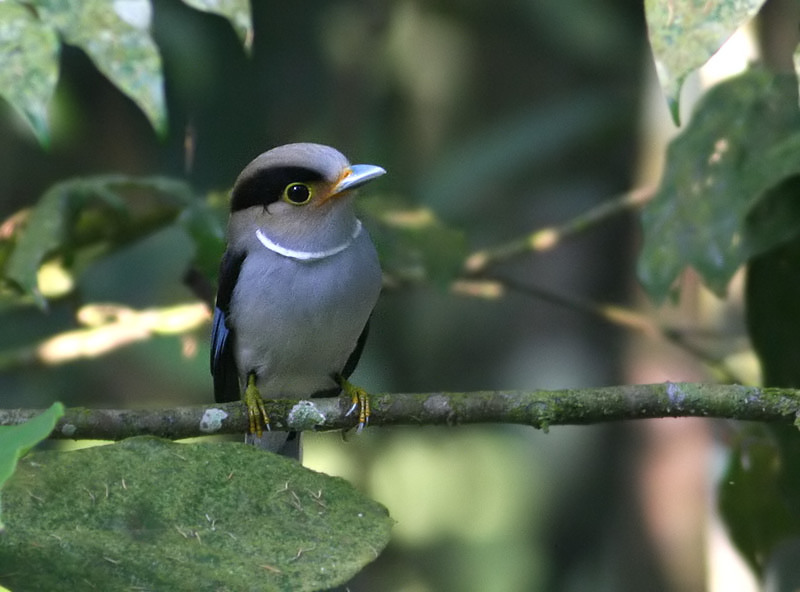
Silver-breasted Broadbill (Serilophus lunatus) by Peter Ericsson
We know from Genesis 1 that the God created the birds, along with everything else. They were created on the fifth day. When Adam became conscience, the birds and critters were already present for him to discover and enjoy.
Then God said, “Let the waters abound with an abundance of living creatures, and let birds fly above the earth across the face of the firmament of the heavens.” So God created great sea creatures and every living thing that moves, with which the waters abounded, according to their kind, and every winged bird according to its kind. And God saw that it was good. And God blessed them, saying, “Be fruitful and multiply, and fill the waters in the seas, and let birds multiply on the earth.” So the evening and the morning were the fifth day. (Genesis 1:20-23 NKJV)
Then the LORD God brought the birds to Adam to let him give them a name.
Out of the ground the LORD God formed every beast of the field and every bird of the air, and brought them to Adam to see what he would call them. And whatever Adam called each living creature, that was its name. (Genesis 2:19 NKJV)
Psalm 111 reminds us that the things that were created are great and are to be “sought out” and enjoyed.
The works of the LORD are great, sought out of all them that have pleasure therein. His work is honourable and glorious: and his righteousness endureth for ever. He hath made his wonderful works to be remembered: the LORD is gracious and full of compassion. (Psalms 111:2-4 KJV)
Fast forward to today. If Adam was to enjoy the birds and put names on them, should we not try to discover them, enjoy them, and try to figure out what their names are?
Galah (Eolophus roseicapilla) and Dan at Brevard Zoo
The birds are all around us, in the sky flying or gliding on the wind (currents), on the power lines, on feeders, on bushes, in trees, or singing or calling in the distant. (Sometimes they are even on cameras.)
Start birdwatching today for pleasure and realize the goodness of the Lord to us.
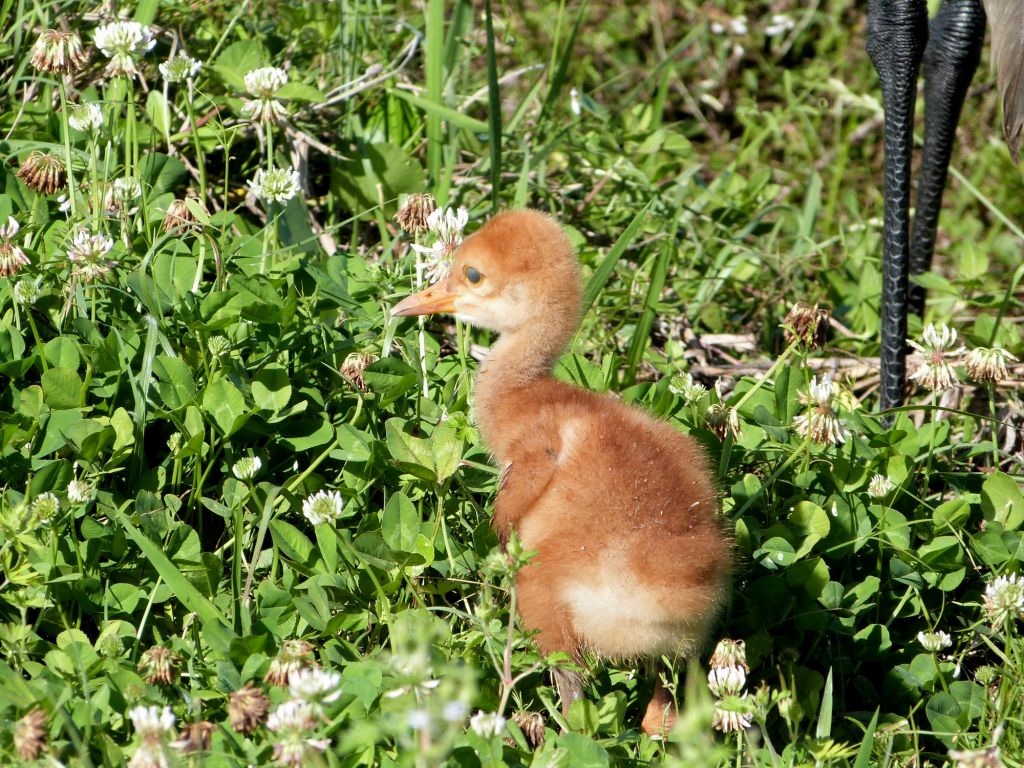
We had not been to Circle B recently, nor especially out to the Marsh by the windmill. Actually the windmill has lost its blades. It is a long trek out there for me, but praise the Lord, one of the workers came along with one of their vehicles and gave us a ride to the marsh. We were greeted by a group photographing Sandhill Cranes with their baby. That would have made the trip worth it alone.
Of course there were other birds awaiting our arrival. It is never boring out there. Since we had parked up by the entrance to get to the marsh, when we got out of the car and were getting our cameras and binoculars, we were greeted by the sound of a Pileated Woodpecker. When we returned, the Pileated showed off and we got some close-up shots of two of them. They were right by the pavilion and didn’t seem to mind those of us nearby.
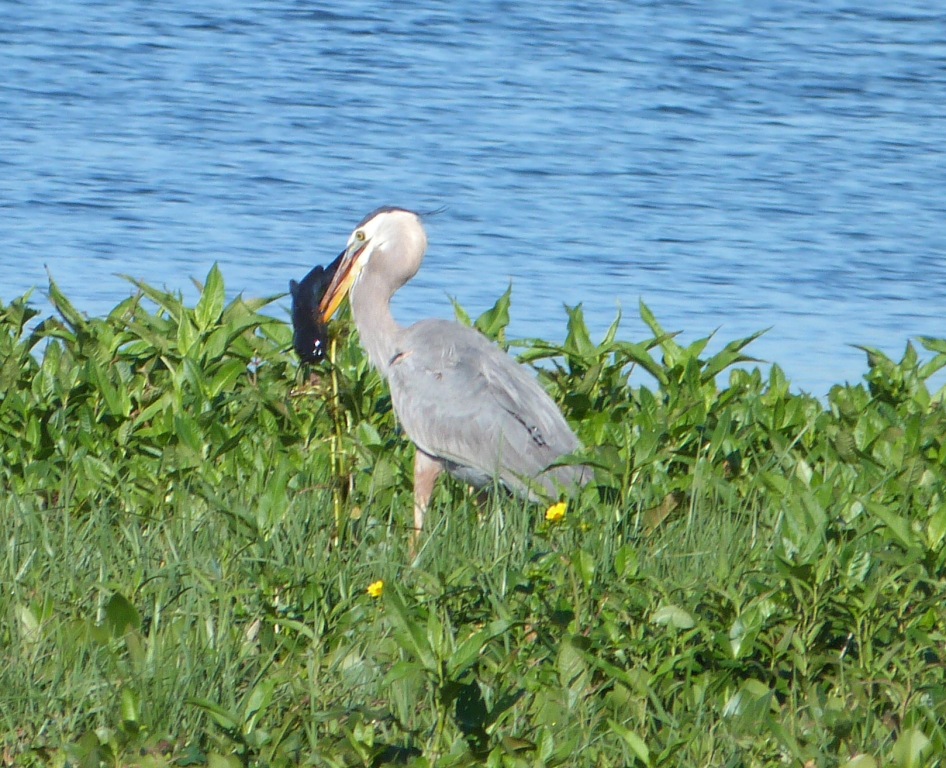
Great Blue Heron with Catfish at Circle B by Lee - cropped
Another neat observation was the Great Blue Heron that caught a fish, actually a catfish. He was out from the edge a bit, but was able to zoom in on him. Took some video of it trying to kill the fish.
It is still quite dry out there as the rains have not started yet. It has been rather dry this winter. Water levels are still low.
I am including some photos and video taken out at Circle B that day. Video has segment of Great Blue with the Catfish and a close-up of the Pileated Woodpecker. Notice how he uses his tail to support himself.
This slideshow requires JavaScript.
In the beginning was the Word, and the Word was with God, and the Word was God. He was in the beginning with God. All things were made through Him, and without Him nothing was made that was made. (John 1:1-3 NKJV)
Here is the list from e-bird for that trip. (37 species total)
Black Tern, Mother and young with eggs, for Birds Illustrated
Birds Illustrated by Color Photography – Revisited
Vol 1. March, 1897 No. 3
THE BLACK TERN.
HE TERN,” says Mr. F. M. Woodruff, of the Chicago Academy of Sciences, “is the only representative of the long-winged swimmers which commonly nests with us on our inland fresh water marshes, arriving early in May in its brooding plumage of sooty black. The color changes in the autumn to white, and a number of the adult birds may be found, in the latter part of July, dotted and streaked here and there with white. On the first of June, 1891, I found a large colony of Black Terns nesting on Hyde Lake, Cook County, Illinois. As I approached the marsh a few birds were seen flying high in the air, and, as I neared the nesting site, the flying birds gave notes of alarm, and presently the air was filled with the graceful forms of this beautiful little bird. They circled about me, darting down to within a few feet of my head, constantly uttering a harsh, screaming cry. As the eggs are laid upon the bare ground, which the brownish and blackish markings so closely resemble, I was at first unable to find the nests, and discovered that the only way to locate them was to stand quietly and watch the birds. When the Tern is passing over the nest it checks its flight, and poises for a moment on quivering wings. By keeping my eyes on this spot I found the nest with very little trouble. The complement of eggs, when the bird has not been disturbed, is usually three. These are laid in a saucer shaped structure of dead vegetation, which is scraped together, from the surface of the wet, boggy ground. The bird figured in the plate had placed its nest on the edge of an old muskrat house, and my attention was attracted to it by the fact that upon the edge of the rat house, where it had climbed to rest itself, was the body of a young dabchick, or piedbilled grebe, scarcely two and one-half inches long, and not twenty-four hours out of the egg, a beautiful little ball of blackish down, striped with brown and white. From the latter part of July to the middle of August large flocks of Black Terns may be seen on the shores of our larger lakes on their annual migration southward.”
The Rev. P. B. Peabody, in alluding to his observation of the nests of the Tern, says: “Amid this floating sea of aquatic nests I saw an unusual number of well constructed homes of the Tern. Among these was one that I count a perfect nest. It rested on the perfectly flat foundation of a small decayed rat house, which was about fourteen inches in diameter. The nest, in form, is a truncated cone (barring the cavity), was about eight inches high and ten inches in diameter. The hollow—quite shallow—was about seven inches across, being thus unusually large. The whole was built up of bits of rushes, carried to the spot, these being quite uniform in length—about four inches.” After daily observation of the Tern, during which time he added much to his knowledge of the bird, he pertinently asks: “Who shall say how many traits and habits yet unknown may be discovered through patient watching of community-breeding birds, by men enjoying more of leisure for such delightful studies than often falls to the lot of most of us who have bread and butter to earn and a tiny part of the world’s work to finish?”
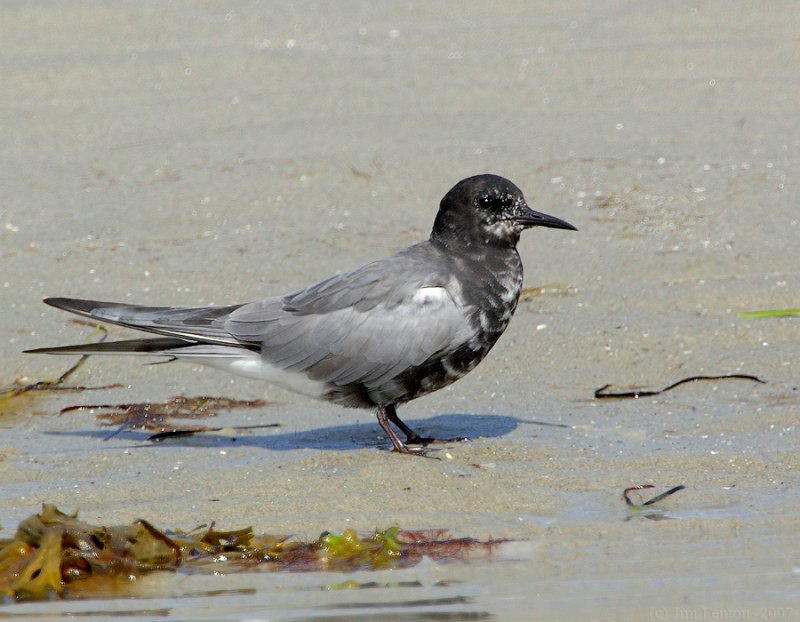
Black Tern (Chlidonias niger) by J Fenton
Lee’s Addition:
The Terns are in the Charadriiformes Orderand the Laridae Familyis part of that order. Laridaes include Gulls, Terns and Skimmers. The Tern, per se, is not a Gull, but are related and would be close in “kind.” The Birds of the Bible – Sea Gulls gives several articles that have been written here. The Sea Gull is found in the list of unclean birds given in Leviticus and Deuteronomy.
the ostrich, the short-eared owl, the sea gull, and the hawk after its kind; (Leviticus 11:16 NKJV)
“The Black Tern, Chlidonias niger, is a small tern generally found in or near inland water in Europe and North America. As its name suggests, it has predominantly dark plumage. Adult are 25 cm (9.75 in) long, with a wing span 6/1 cm (24 in), and weigh 62 g (2.2 oz). They have short dark legs and a short, weak-looking black bill, measuring 27–28 mm, nearly as long as the head. The bill is long, slender, and looks slightly decurved. The North American race, C. n. surinamensis, is distinguishable from the European form in all plumages, and is considered by some to be a separate species.
In flight, the build appears slim. The wing-beats are full and dynamic, and flight is often erratic as it dives to the surface for food; similar to other tern species.
North American Black terns migrate to the coasts of northern South America, some to the open ocean. Old World birds winter in Africa.
Unlike the “white” Sterna terns, these birds do not dive for fish, but forage on the wing picking up items at or near the water’s surface or catching insects in flight. They mainly eat insects and fish as well as amphibians.
The North American population has declined in recent times due to loss of habitat.Point Pelee National Park in Canada boasts a robust population of black terns.” (Wikipedia)
The above article is the first article in the monthly serial for February 1897 “designed to promote Knowledge of Bird-Live.” These include Color Photography, as they call them, today they are drawings. There are at least three Volumes that have been digitized by Project Gutenberg.
Birds Illustrated by Color Photography – Revisited
Vol 1. March, 1897 No. 3
*
THE RETURN OF THE BIRDS.
“Everywhere the blue sky belongs to them and is their appointed rest, and their native country, and their own natural home which they enter unannounced as lords that are certainly expected, and yet there is a silent joy at their arrival.”
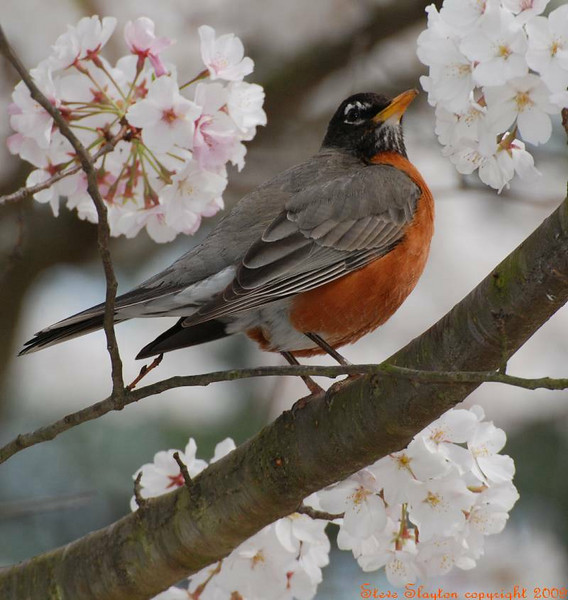
HE return of the birds to their real home in the North, where they build their nests and rear their young, is regarded by all genuine lovers of earth’s messengers of gladness and gayety as one of the most interesting and poetical of annual occurrences. The naturalist, who notes the very day of each arrival, in order that he may verify former observation or add to his material gathered for a new work, does not necessarily anticipate with greater pleasure this event than do many whose lives are brightened by the coming of the friends of their youth, who alone of early companions do not change. First of all—and ever the same delightful warbler—the Bluebird, who, in 1895, did not appear at all in many localities, though here in considerable numbers last year, betrays himself. “Did he come down out of the heaven on that bright March morning when he told us so softly and plaintively that, if we pleased, spring had come?” Sometimes he is here a little earlier, and must keep his courage up until the cold snap is over and the snow is gone. Not long after the Bluebird, comes the Robin, sometimes in March, but in most of the northern states April is the month of his arrival. With his first utterance the spell of winter is broken, and the remembrance of it afar off. Then appears the Woodpecker in great variety, the Flicker usually arriving first. He is always somebody’s old favorite, “announcing his arrival by a long, loud call, repeated from the dry branch of some tree, or a stake in the fence—a thoroughly melodious April sound.”
Few perhaps reflect upon the difficulties encountered by the birds themselves in their returning migrations. A voyager sometimes meets with many of our common birds far out at sea. Such wanderers, it is said, when suddenly overtaken by a fog, completely lose their sense of direction and become hopelessly lost. Humming birds, those delicately organized, glittering gems, are among the most common of the land species seen at sea.
The present season has been quite favorable to the protection of birds. A very competent observer says that not all of the birds migrated this winter. He recently visited a farm less than an hour’s ride from Chicago, where he found the old place, as he relates it, “chucked full of Robins, Blackbirds, and Woodpeckers,” and others unknown to him. From this he inferred they would have been in Florida had indications predicted a severe winter. The trees of the south parks of Chicago, and those in suburban places, have had, darting through their branches during the months of December and January, nearly as many members of the Woodpecker tribe as were found there during the mating season in May last.
Alas, that the Robin will visit us in diminished numbers in the approaching spring. He has not been so common for a year or two as he was formerly, for the reason that the Robins died by thousands of starvation, owing to the freezing of their food supply in Tennessee during the protracted cold weather in the winter of 1895. It is indeed sad that this good Samaritan among birds should be defenseless against the severity of Nature, the common mother of us all. Nevertheless the return of the birds, in myriads or in single pairs, will be welcomed more and more, year by year, as intelligent love and appreciation of them shall possess the popular mind.
American Robin (Turdus migratorius) by S Slayton
Lee’s Addition:
Even the stork in the heavens Knows her appointed times; And the turtledove, the swift, and the swallow Observe the time of their coming. But My people do not know the judgment of the LORD. (Jeremiah 8:7 NKJV)
This time of the year the birds head back north, at least in North America. Unfortunately they leave us here in Florida where some of them have been on their winter vacation. Birdwatching excitement slows down for us, but picks up for those of you who have been without your avian friends during the winter. Trust me, they are on the way. We have been out watching birds several times this last week or so and the winter birds have left or are packing their bags and folding up their lounge chairs. We are getting a few of the migrants that are passing through on their way north. They land to rest and feed, then off they go again. Keep your eyes alert, northern friends, the birds are coming.
The above article is the first article in the monthly serial for February 1897 “designed to promote Knowledge of Bird-Live.” These include Color Photography, as they call them, today they are drawings. There are at least three Volumes that have been digitized by Project Gutenberg.
Birds Illustrated by Color Photography – Revisited
Vol 1. March, 1897 No. 3
*
THE CROW.
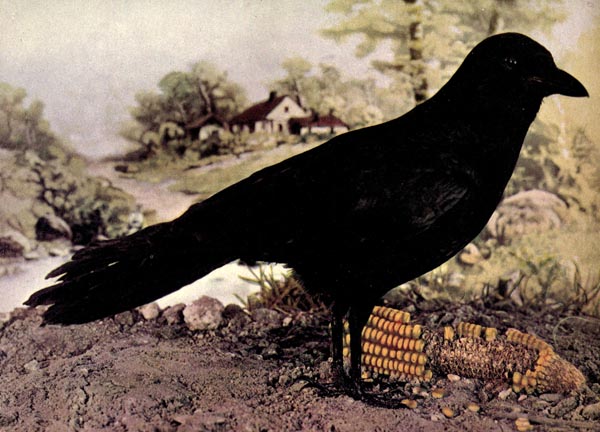
Caw! Caw! Caw! little boys and girls. Caw! Caw! Caw! Just look at my coat of feathers. See how black and glossy it is. Do you wonder I am proud of it?
Perhaps you think I look very solemn and wise, and not at all as if I cared to play games. I do, though; and one of the games I like best is hide-and-seek. I play it with the farmer in the spring. He hides, in the rich, brown earth, golden kernels of corn. Surely he does it because he knows I like it, for sometimes he puts up a stick all dressed like a man to show where the corn is hidden. Sometimes I push my bill down into the earth to find the corn, and at other times I wait until tiny green leaves begin to show above the ground, and then I get my breakfast without much trouble. I wonder if the farmer enjoys this game as much as I do. I help him, too, by eating worms and insects.
During the spring and summer I live in my nest on the top of a very high tree. It is built of sticks and grasses and straw and string and anything else I can pick up. But in the fall, I and all my relations and friends live together in great roosts or rookeries. What good times we do have—hunting all day for food and talking all night. Wouldn’t you like to be with us?
The farmer who lives in the house over there went to the mill to-day with a load of corn.
One of the ears dropped out of the wagon and it didn’t take me long to find it. I have eaten all I can possibly hold and am wondering now what is the best thing to do. If you were in my place would you leave it here and not tell anybody and come back to-morrow and finish it? Or would you fly off and get Mrs. Crow and some of the children to come and finish it? I believe I’ll fly and get them. Good-bye.
Caw! Caw! Caw!
Fish Crow (Corvus ossifragus) at Lake Morton By Dan’sPix
THE COMMON CROW.
“The crow doth sing as merry as the lark,
When neither is attended.”
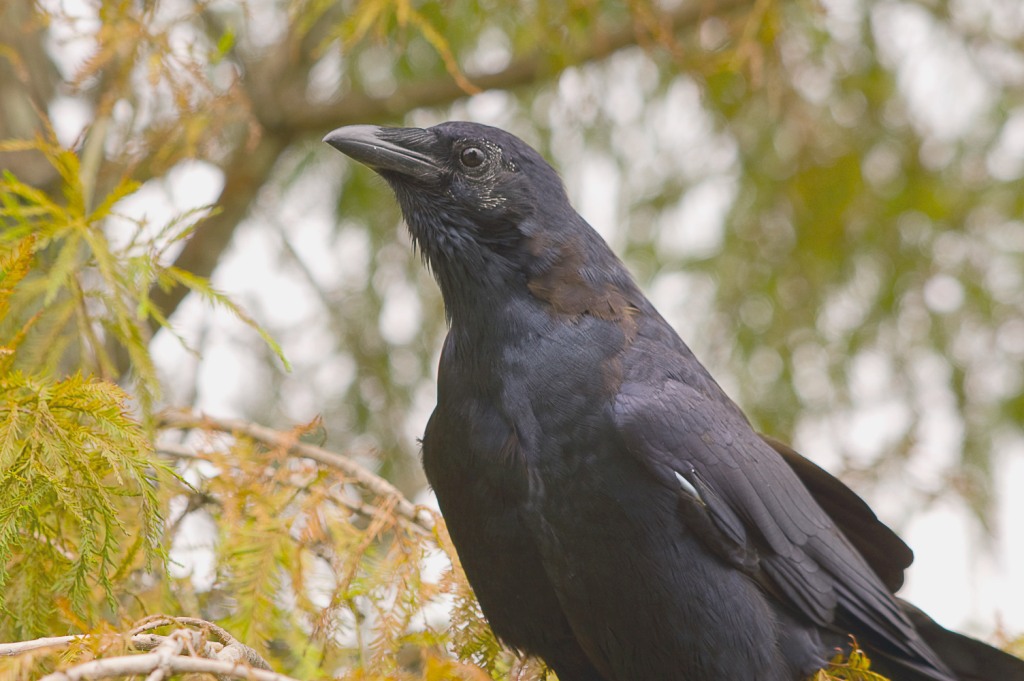
EW birds have more interesting characteristics than the Common Crow, being, in many of his actions, very like the Raven, especially in his love for carrion. Like the Raven, he has been known to attack game, although his inferior size forces him to call to his assistance the aid of his fellows to cope with larger creatures. Rabbits and hares are frequently the prey of this bird which pounces on them as they steal abroad to feed. His food consists of reptiles, frogs, and lizards; he is a plunderer of other birds’ nests. On the seashore he finds crabs, shrimps and inhabited shells, which he ingeniously cracks by flying with them to a great height and letting them fall upon a convenient rock.
The crow is seen in single pairs or in little bands of four or five. In the autumn evenings, however, they assemble in considerable flocks before going to roost and make a wonderful chattering, as if comparing notes of the events of the day.
The nest of the Crow is placed in some tree remote from habitations of other birds. Although large and very conspicuous at a distance, it is fixed upon one of the topmost branches quite out of reach of the hand of the adventurous urchin who longs to secure its contents. It is loosely made and saucer shaped. Sticks and softer substances are used to construct it, and it is lined with hair and fibrous roots. Very recently a thrifty and intelligent Crow built for itself a summer residence in an airy tree near Bombay, the material used being gold, silver, and steel spectacle frames, which the bird had stolen from an optician of that city. Eighty-four frames had been used for this purpose, and they were so ingeniously woven together that the nest was quite a work of art. The eggs are variable, or rather individual, in their markings, and even in their size. The Crow rarely uses the same nest twice, although he frequently repairs to the same locality from year to year. He is remarkable for his attachment to his mate and young, surpassing the Fawn and Turtle Dove in conjugal courtesy.
And he lives to a good old age. Instances are not rare where he has attained to half a century, without great loss of activity or failure of sight.
At Red Bank, a few miles northeast of Cincinnati, on the Little Miami River, in the bottoms, large flocks of Crows congregate the year around. A few miles away, high upon Walnut Hills, is a Crow roost, and in the late afternoons the Crows, singly, in pairs, and in flocks, are seen on the wing, flying heavily, with full crops, on the way to the roost, from which they descend in the early morning, crying “Caw! Caw!” to the fields of the newly planted, growing, or matured corn, or corn stacks, as the season may provide.
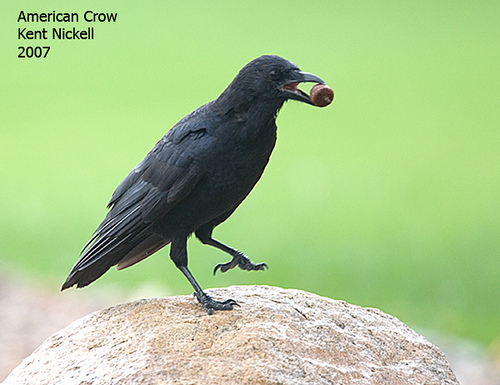
American Crow (Corvus brachyrhynchos) by Kent Nickell
Lee’s Addition:
The Raven family which includes the Crows is mentioned in Scripture in the list of unclean birds in Leviticus and Deuteronomy (14:14) as “after its kind.”
every raven after its kind, (Leviticus 11:15 NKJV)
Crows form the genus Corvus in the Corvidae – Crows, Jays Family. Ranging in size from the relatively small pigeon-size jackdaws (Eurasian and Daurian) to the Common Raven of the Holarctic region and Thick-billed Raven of the highlands of Ethiopia, the 40 or so members of this genus occur on all temperate continents (except South America) and several offshore and oceanic islands (except for a few, which included Hawaii, which had the Hawaiian crow that went extinct in the wild in 2002). In the United States and Canada, the word “crow” is used to refer to the American Crow.
The crow genus makes up a third of the species in the Corvidae family. A group of crows is called a flock or, more poetically, a murder, But the term “murder of crows” mostly reflects a time when groupings of many animals had colorful and poetic names. For example, other “group” names include: an ostentation of peacocks, a parliament of owls, a knot of frogs, and a skulk of foxes.
Recent research has found some crow species capable not only of tool use but of tool construction as well. Crows are now considered to be among the world’s most intelligent animals. As a group, crows show remarkable examples of intelligence. Crows and ravens often score very highly on intelligence tests. Certain species top the avian IQ scale. Wild hooded crows in Israel have learned to use bread crumbs for bait-fishing. Crows will engage in a kind of mid-air jousting, or air-“chicken” to establish pecking order. Crows have been found to engage in feats such as sports, tool use, the ability to hide and store food across seasons, episodic-like memory,[vague] and the ability to use individual experience in predicting the behavior of environmental conspecifics.
One species, the New Caledonian Crow, has also been intensively studied recently because of its ability to manufacture and use its own tools in the day-to-day search for food. These tools include ‘knives’ cut from stiff leaves and stiff stalks of grass. Another skill involves dropping tough nuts into a trafficked street and waiting for a car to crush them open. On October 5, 2007, researchers from the University of Oxford, England presented data acquired by mounting tiny video cameras on the tails of New Caledonian Crows. It turned out that they use a larger variety of tools than previously known, plucking, smoothing, and bending twigs and grass stems to procure a variety of foodstuffs. Recent research suggests that crows have the ability to recognize one individual human from another by facial features.
The above article is the first article in the monthly serial for February 1897 “designed to promote Knowledge of Bird-Live.” These include Color Photography, as they call them, today they are drawings. There are at least three Volumes that have been digitized by Project Gutenberg.
Our Assistant to the Pastor, Stephen, has asked if I would consider another series for our Church’s Blog, the Fountain. Thanks to Stephen and his assistance in getting the first “Birds of the Bible” series started, those articles and this resulting blog have grown beyond what was ever imagined. Now, we are beginning another new series.
Some of his first suggestions were like, “Birdwatching for Dummies” and I assured him that that book had already been written. The Complete Idiot’s Guide to Birdwatching has also been written. Between the two of us, we just want to encourage you to start birding today.
Okay, so I am suppose to start “birdwatching,” what is it?
“Birding”, “Birdwatching”, “Bird Watching”, “Looking at or for birds”, “Enjoying seeing birds” or whatever you want to call it, are basically the same. It amounts to watching the many wonderful birds that the Lord has created. If you observe only one bird, you are still “birding.”
The flowers appear on the earth; the time of the singing of birds is come, and the voice of the turtle is heard in our land; (Song of Solomon 2:12 KJV)
Cattle Egrets and Juvenile White Ibis at S Lake Howard
So watch for future titles like:
Start Birdwatching Today: Some Background Information
Start Birdwatching Today: Why Should I Go Outside and Stare at Birds?
Start Birdwatching Today: The Few Tools You Need To Be A Birdwatcher
Start Birdwatching Today: Where Do I Go?
Start Birdwatching Today: What Kind of Bird is This?













 Lee's Birdwatching Adventures Plus