Little Blue Heron at a Rural Pondshore, Seen at a Summer Rekefest

Little Blue Heron at a Rural Pondshore, Seen at a Summer Rekefest

~ by James J. S. Johnson
Reddish Egret in a rural Pondshore at Summer Rekefest

Not that which goeth into the mouth defileth a man; but that which cometh out of the mouth, this defileth a man. … Do not ye yet understand, that whatsoever entereth in at the mouth goeth into the belly, and is cast out into the draught? But those things which proceed out of the mouth come forth from the heart; and they defile the man. For out of the heart proceed evil thoughts, murders, adulteries, fornications, thefts, false witness, blasphemies; these are the things which defile a man, but to eat with unwashen hands defileth not a man. (Matthew 15:11 & 15:17-20)

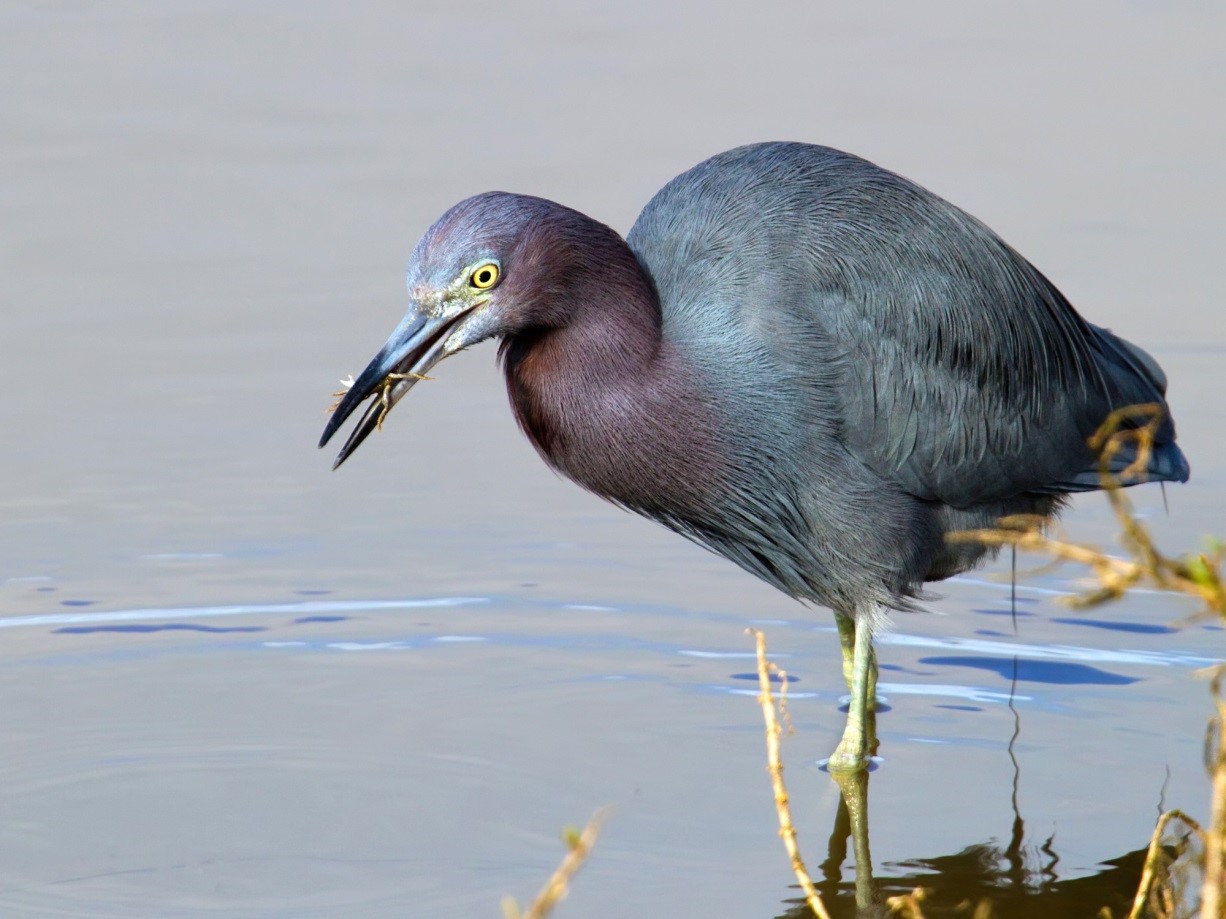
Little Blue with big fish in mouth

When thinking about the eating behavior of long-legged wading birds—such as the Little Blue Heron—I remembered this proverb, spoken by the Lord Jesus Christ (in Matthew 15:11-20 & Mark 7:15-23), that observes that digestion depends upon what is put into an eater’s mouth. Whatever exits out of a mouth (whether it be words or regurgitated food!) had to have been inside, already, before it can exit! On that happy note I now remember seeing a Little Blue Heron, wading in pondshore waters.

On a pleasant Saturday, June 20th of AD2015, in Ferris, Texas – a good day for an outdoor Rekefest (shrimp feast party – more on that later!), graced by a busy host of local birds, including Black-capped Chickadees, House Finches, Cardinals, and a Little Blue Heron.
This report will focus only on the Little Blue Heron, which I then saw, wading in shallow pondshore waters. (For the geographically curious, Ferris is a city about 15 miles south of Dallas, somewhat hilly and forested, covering land in both Dallas and Ellis Counties.)
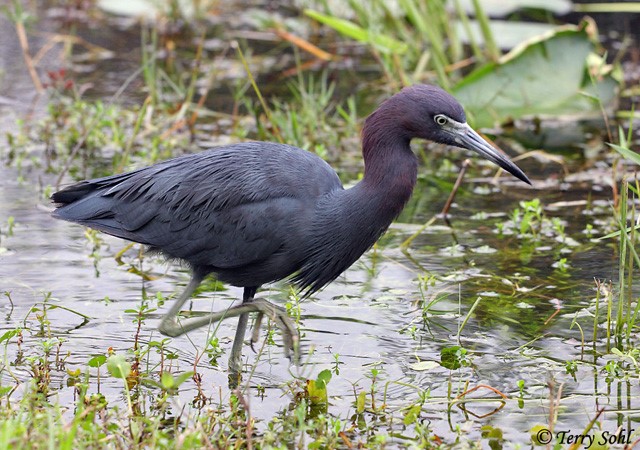
Little Blue walking through water

LITTLE BLUE HERON (Egretta caerulea, a/k/a Florida caerulea)
The Little Blue Heron is a long-legged wetland-dwelling wading bird (i.e., shorebird) of the heron/egret family, with a “summer” (March to October) breeding range that includes the eastern half of Texas.
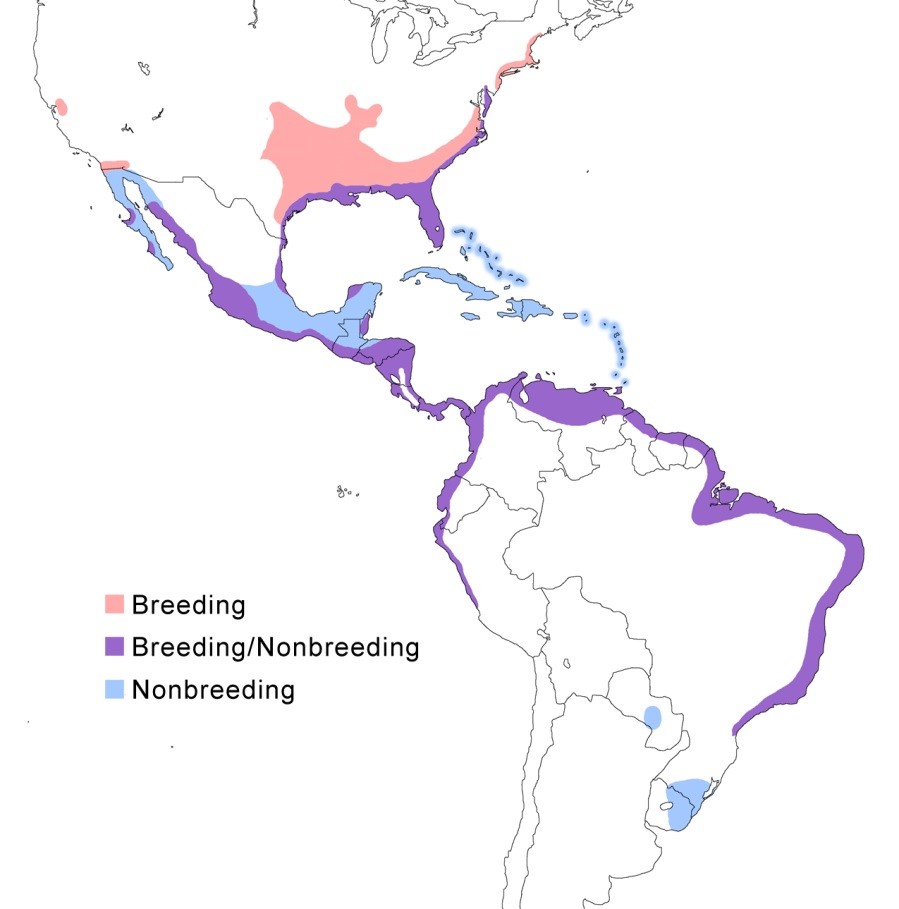
Little Blue Map
For these herons wetland habitats are “home” – whether they be freshwater pondshores, waterlogged meadows, brackish swamps, tidal mudflats, marshlands, estuaries, ricefields, or even slow-moving streams (e.g., where waters slow down and pool at bends in the stream). Little Blue Herons build stick nests, in colonies, like other herons and egrets, in trees and shrubs. [See Roger Tory Peterson, A FIELD GUIDE TO THE BIRDS OF TEXAS AND ADJACENT STATES (Houghton Mifflin, 1988), pages 16 & 28-29.]
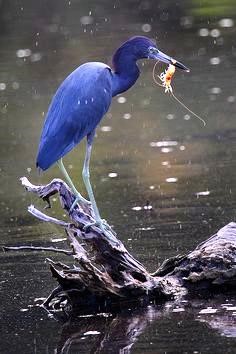
Little Blue Heron with cache
Depending on the lighting this bird’s plumage appears mostly as bluish-grey or even a dull purplish-blue (with a maroon head and neck, sometimes with bronze-like highlighting). Their eyes are yellowish, their legs are dull (depending upon lighting, sometimes appearing yellowish-green, sometimes as pale grey-blue), and their dark necks are distinctively maroon or purplish. Unlike the Reddish Egret’s pale-pink bill (with its black tip), the Little Blue Heron has a distinctively light-blue bill (also with a black tip).

Little Blue Herons grow to about 2 feet high, with an outstretched wingspan of about 3 feet! During their juvenile stage (first year) these herons are mostly white, except for darkish wing-tips (and dull green legs). Such juveniles resemble Snowy Egrets and sometimes are permitted to mingle with the snowies.
At rest, as well as in flight, Little Blue Herons typically hold their necks in an S-curve position.
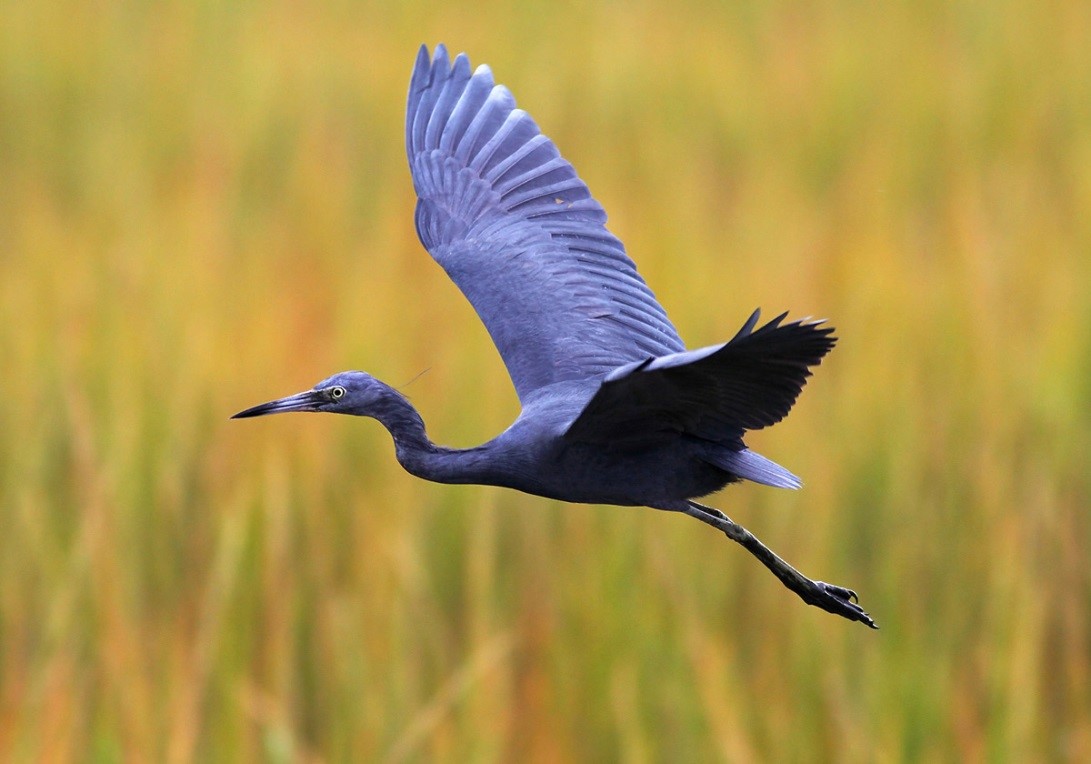
Little Blue in Flight
When the evening sun descends toward the horizon, and dusk approaches sunset, Little Blue Herons became active. At dawn, as the morning sun rises, they are likewise active. Wading into the shallow waters of a pond or the lotic pooling of brackish waters, these herons are known to spread their wings like a shady picnic umbrella, obscuring sunlight glare on the water – this enables them to better see and stalk potential prey in the shallow water – such as a frog or snake or fish.

If necessary, to catch evasive fish, these herons may dash about, chasing, in time stabbing their catch with their sharply pointed javelin-like bills. However, most of the time these herons prefer to stand still, like a statue, and wait for their meal to appear at a catchable spot in the shallow water.

Little Blue with medium fish in mouth

Snatched food is swallowed whole, digested, and indigestible parts (like bones) are expelled by regurgitation. (Fun to watch if you know what you are looking at – imagine watching a Little Blue Heron eat a crayfish, followed by disposal of the indigestible parts!)
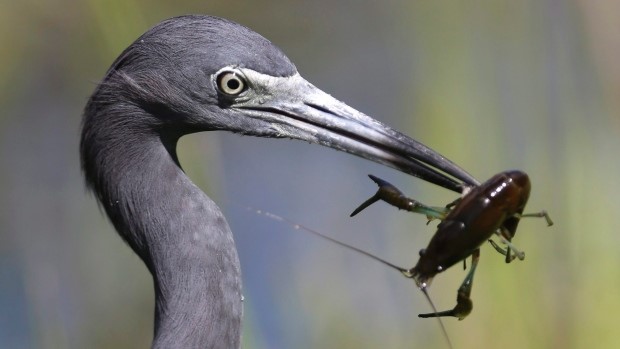
Little Blue with a Crayfish

Also, like many other parent birds, these herons use regurgitation as a convenient mode of food transmission from parent to young, depositing partially digested food into the hungry mouths of their dependent chicks.

Back to the Rekefest event – which was the official reason why my wife and I were in Ferris (see photograph below — showing Dave Olson, Wayne Rohne, & others — at a different Rekefest hosted by NST’s Snorre chapter, in Houston), at the hospitable home of John and Mari-Anne Moore, that Saturday — eating Nordic shrimp the traditional (Norwegian) way, along with other members and guests of the Norwegian Society of Texas (Viking Chapter).

Of course I had sufficient table manners to not eat like a Little Blue Heron, so I disposed of the shells of my boiled shrimp (after enjoying each one that entered my own digestive system!) with proper etiquette. (And we bought extra shrimp “to go” before we left.)
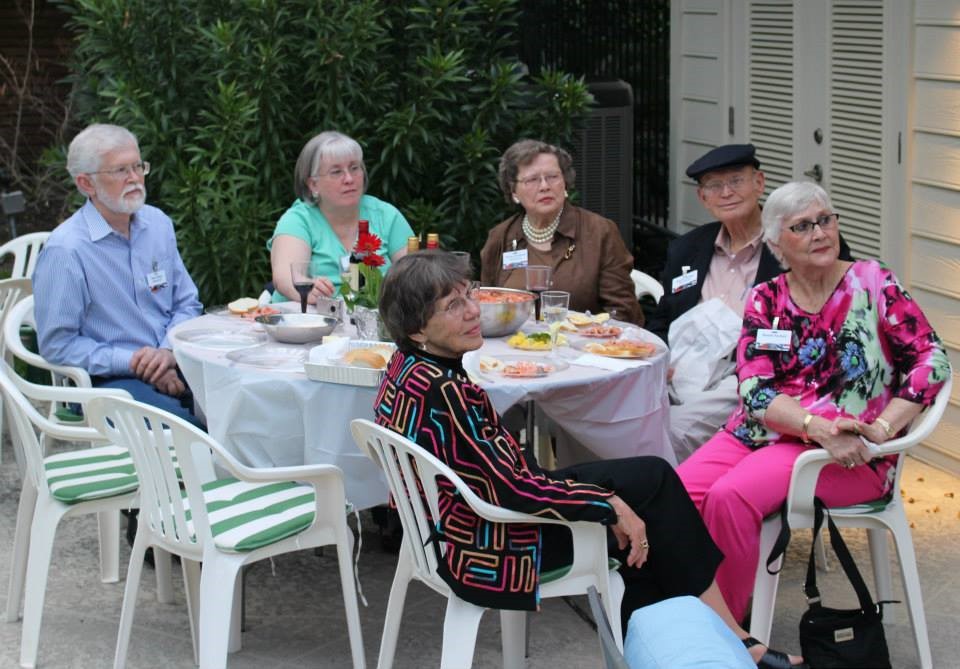
Norwegian Society of Texas - Viking Chapter Rekefest event

But the lesson of the “in-and-out” proverb remains: whatever exits from our mouths must have been there, already, before it came out. Words flowing out, from our mouths, originate as thoughts, actively proceeding from our “hearts” – so let us carefully guard our hearts, and our lips, so that what we say is helpful, blessing others!

2 For in many things we offend all. If any man offend not in word, the same is a perfect man, and able also to bridle the whole body. 3 Behold, we put bits in the horses’ mouths, that they may obey us; and we turn about their whole body. 4 Behold also the ships, which though they be so great, and are driven of fierce winds, yet are they turned about with a very small helm, wherever the governor desires. 5 Even so the tongue is a little member, and boasts great things. Behold, how great a matter a little fire kindles! 6 And the tongue is a fire, a world of iniquity: so is the tongue among our members, that it defiles the whole body, and sets on fire the course of nature; and it is set on fire of hell. 7 For every kind of beasts, and of birds, and of serpents, and of things in the sea, is tamed, and hath been tamed of mankind. 8 But the tongue can no man tame; it is an unruly evil, full of deadly poison. 9 Therewith bless we God, even the Father; and therewith curse we men, which are made after the image of God. 10 Out of the same mouth proceedeth blessing and cursing; my brethren, these things ought not so to be! 11 Doth a fountain send forth at the same place sweet water and bitter? 12 Can the fig tree, my brethren, bear olive berries? Or a vine, figs? Likewise can no fountain both yield saltwater and freshwater. 13 Who is a wise man and endued with knowledge among you? Let him show out of a good conversation his works with meekness of wisdom. (James 3:2-13)

*

Fair Use image credit:

Ardeidae – Herons, Bitterns

James J. S. Johnson

Orni-Theology

*

2015 in review

The WordPress.com stats helper monkeys prepared a 2015 annual report for this blog.

Here’s an excerpt:

The Louvre Museum has 8.5 million visitors per year. This blog was viewed about 220,000 times in 2015. If it were an exhibit at the Louvre Museum, it would take about 9 days for that many people to see it.

Click here to see the complete report.

Thanks again for all of you who have made 2015 such a great blogging year by dropping in to reading our posts. We here at the blog are trusting the Lord that He will give us another great year in 2016, giving credit and praising the Creator of all these neat birds in the world.

Happy New Year and Lord’s Greatest Blessings to you all.

Bluebirds of Happiness, Plus Enjoying A Lutefisk Banquet

Bluebirds of Happiness,

Plus Enjoying A Lutefisk Banquet


by James J. S. Johnson

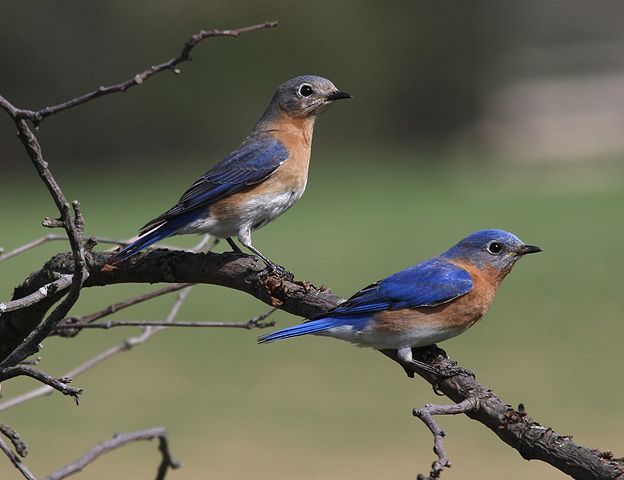
Eastern Bluebird (Sialia sialis) ©WikiC

Eastern Bluebird (Sialia sialis) ©WikiC

Happy is the man that findeth wisdom, and the man that getteth understanding.   (Proverbs 3:13)

He that handleth a matter wisely shall find good: and whoso trusteth in the Lord, happy is he.   (Proverbs 16:20)

Happy is that people, that is in such a case: yea, happy is that people, whose God is the Lord.  (Psalm 144:15)


In honor of the so-called “bluebird of happiness” (with apologies to song lyricist Edward Heyman and vocalist Jan Peerce), we can think for a moment about being “happy”.   (In fact, nowadays, isn’t it just “ducky” to appreciate being “happy, happy, happy”?)

Years ago someone told me that the Bible only promises “joy” to godly people, never “happiness”.  The idea was that “joy” is a gladness that is content in the Lord, regardless  whether the surrounding circumstances are pleasant or unpleasant.  (“Happiness depends on what is happening to you”, I was told, “but joy is only dependent upon your appreciation for God Himself  —  glorifying Him and enjoying Him forever.”)

Wise-sounding sound bites, right?  But is that Biblically sound advice?  Not quite.

While it is certainly true that our joy should be anchored in the Lord, as we appreciate belonging to Him (Nehemiah 8:10; Psalm 100:1; Luke 10:20 & 15:6-7; Philippians 1:3-6 & 1:25-26 & 4:4; etc.),  —  it is also Biblically proper to enjoy being happy  —  glad  — as we enjoy appreciating and experiencing the many blessings that God gives to us, here and there, from time to time (Proverbs 3:13 & 16:20; Job 5:17; Psalm 146:5-9; Esther 8:16-17 & 9:17-19 & 9:22; John 13:17; Romans 14:21; 1st Peter 3:14 & 4:14)!

In fact, if a happy occasion is honoring to God, surely it will blend joy with happiness (compare holiday happiness in Esther 9:17-19 with the “joy” mentioned in Esther 9:22).

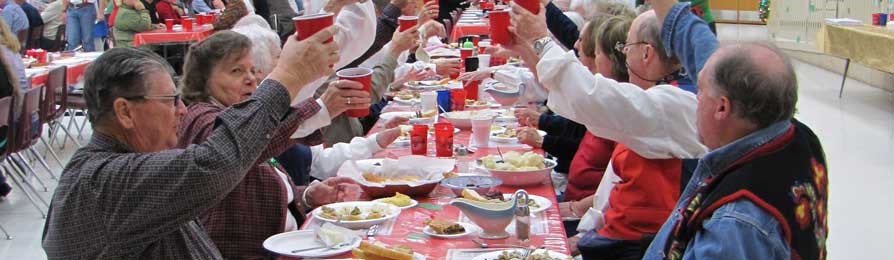
Fair Use credit: Norwegian Society of Texas, including Steve Ogden, toasting at Cranfills Gap Lutefisk Supper

Fair Use credit: Norwegian Society of Texas, including Steve Ogden, toasting at Cranfills Gap Lutefisk Supper

[ Fair Use credit: Norwegian Society of Texas, including Steve Ogden, toasting at Cranfills Gap Lutefisk Supper]

So, it’s not unbiblical to be happy about being happy (being compassionately sensitive to context, of course – see Romans 12:15).  In fact, we should enjoy being happy with gladness, living life with a song in our heart  — and laughter should not be a stranger!

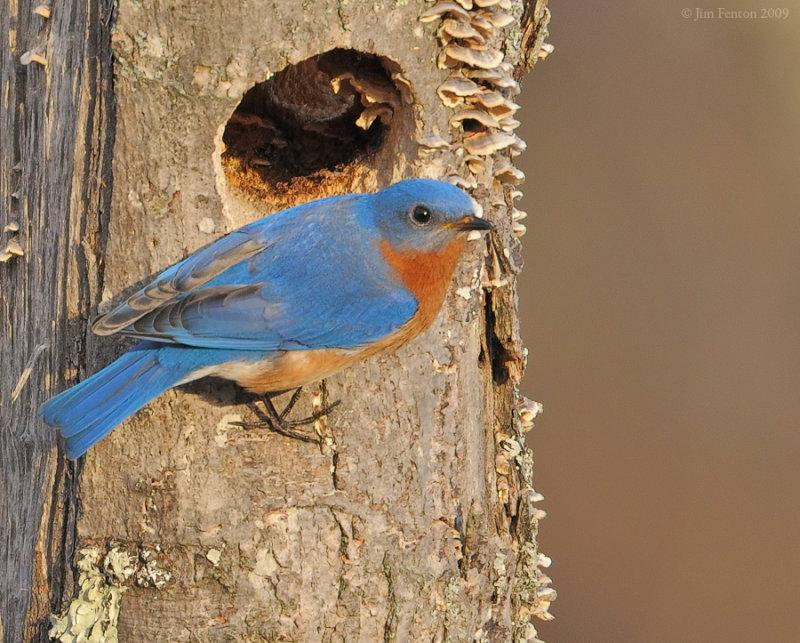
Accordingly, with those happy thoughts in mind, let us now consider the famous “bluebird of happiness”.  (By the way, that popular phrase caused my own mother, who recently left Earth for glory, to especially appreciate Eastern Bluebirds   —   she was known to greet family and friends with the words, “welcome to the happy home!”)   And all bluebirds need “homes” to nest in.

Eastern Bluebird (Sialia sialis) by J Fenton

Eastern Bluebird (Sialia sialis) by J Fenton

So what kind of bluebirds (“of happiness”, presumably) do we have in America?

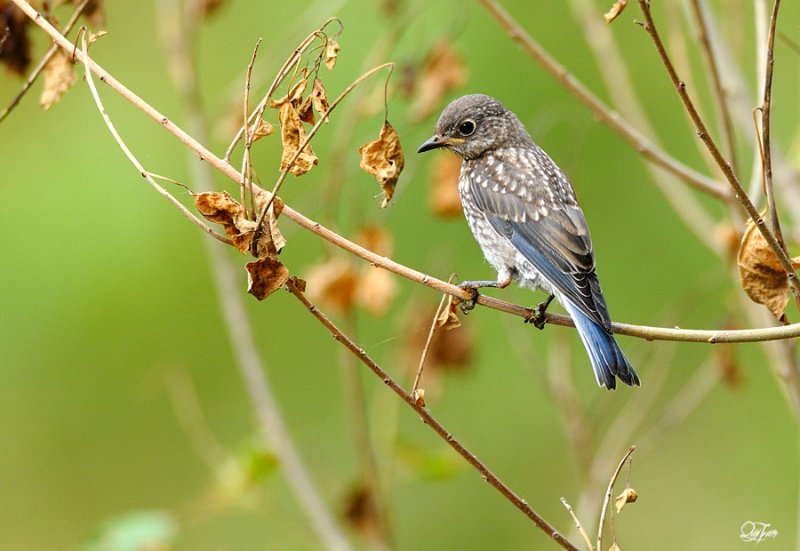
There are three bluebirds in America:  Eastern Bluebird (Sialia sialis – bright blue above, orange underneath, ranging mostly east of the Rocky Mountains), Mountain Bluebird (Sialia currucides – bright blue above and light-blue underneath, ranging mostly in and west of the Rocky Mountains); and Western Bluebird (Sialia mexicana – bright blue above, with underside blue at the “bib” and orange on the lower underside, ranging mostly in and west of the Rocky Mountains).

Western Bluebird (Sialia mexicana) juvenile by Quy Tran

Western Bluebird (Sialia mexicana) juvenile by Quy Tran

Mountain Bluebird (Sialia currucoides) by Daves BirdingPix

Mountain Bluebird (Sialia currucoides) by Daves BirdingPix

Since last Saturday I saw a brilliant blue-backed Eastern Bluebird, flying in the Texas “hill country” (where they often winter), I will now limit my comments to the Eastern Bluebird.

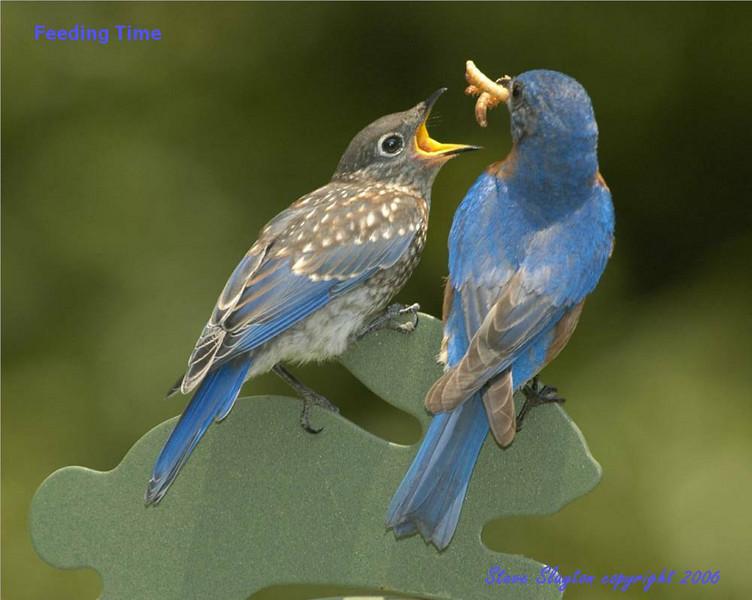
Eastern Bluebird (Sialia sialis) by S Slayton

Eastern Bluebird (Sialia sialis) by S Slayton

Roger Tory Peterson gives the following description of the Eastern Bluebird:

“A bit larger than a sparrow, a blue bird with a rusty red breast; appears round-shouldered when perched.  Female duller than male [no jokes, please!]; young bird is speckle-breasted, grayish, devoid of red, but always with the same telltale blue in wings and tail. … Habitat: Open country with scattered trees; farms, roadsides.”

[Quoting from Roger Tory Peterson, A FIELD GUIDE TO THE BIRDS:   A Completely New Guide to All the Birds of Eastern and Central North America, 4th ed. (Houghton Mifflin, 1980; abbreviated title: EASTERN BIRDS), page 220 & Map 301.]

[another picture of an Eastern Bluebird, or 2 or more]

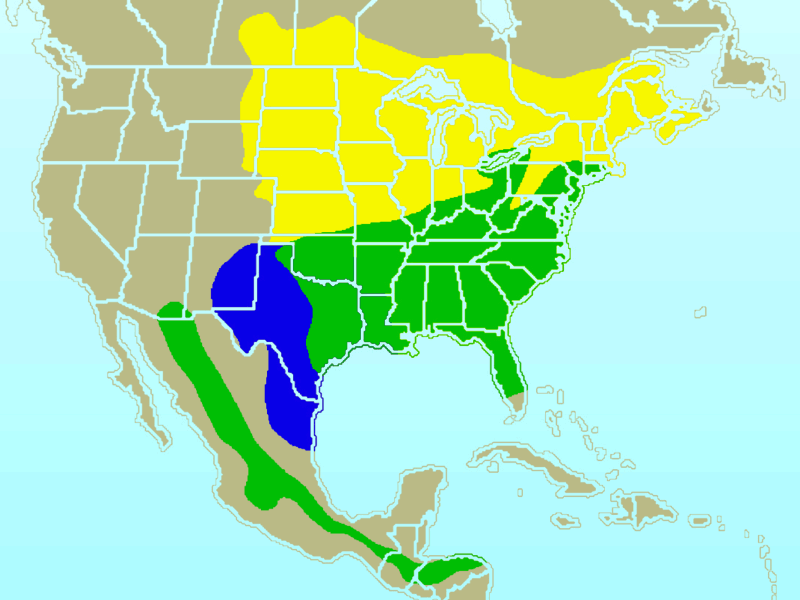
In fact, the Eastern Bluebird is the official state bird for both Missouri (since AD1927) and New York (since AD1970), where it is often found, especially in summer months (according the Peterson’s EASTERN BIRDS, at Map 266).  In America, the Eastern Bluebird is the most common of the three bluebirds, and it is the only one that is commonly found east of the Great Plains.

Eastern_Bluebird-rangemap rangemap Y-Sum B-win G-yr rnd

Eastern_Bluebird-rangemap rangemap Y-Sum B-win G-yr rnd ©WikiC

Just a couple of generations ago, colorful bluebirds frequently (and happily) displayed their brilliant blue plumage plentifully in Texas,  –  ranging from the Piney Woods of East Texas, westward into the Hill Country (east of where West Texas touches the Rocky Mountains).  However, their numbers have declined, as their nesting range habitats have shrunk (and as competitive avian “demographics” have changed their nesting-dependent procreative  opportunities).

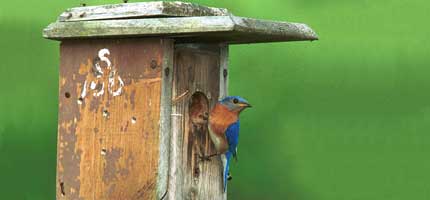
At one point Eastern Bluebird populations were so depressed (due to nesting challenges, especially as bluebird-friendly cavity trees disappeared), that efforts (by local Audubon Society chapters and other bird-lovers) were exerted to expand their nesting opportunities, by providing birdhouses equipped with ingress-egress holes tailored to suit these birds (and thus to deter their nests from invading competitors or predators).

Eastern Bluebird (by www.portal.state.pa.us)

Eastern Bluebird (by http://www.portal.state.pa.us)

Specifically, birdhouse openings were sized to be no larger than 1.5 inches in diameter, in places where bluebirds habituate (such as along roadsides and in open fields), and bluebird populations have improved  —  happily!  So the population trend, for America’s bluebirds, appears to be headed for a “happy ending”.

Now I return to why I was traveling in the Texas Hill Country, when I saw a bright blue Eastern Bluebird – flying from one rural field over to another – on a cool winter morning.

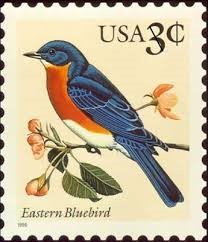
Eastern Bluebird postage PD

Eastern Bluebird postage PD

In fact, my wife and I were driving through Bosque County, into Clifton and later onto Cranfills Gap, to celebrate Norwegian Christmas festivities.

And, for the brave at heart (and stomach), the highlight of that Saturday was a Lutefisk Supper, a tradition (in that area) originally sponsored by St. Olaf Lutheran Church (of Cranfills Gap), now provided as a feast-fundraiser for Cranfills Gap High School.  Of course, Norwegian-American Christmas festivities are happy activities, which is only proper  —  because holiday happiness has a Biblical precedent from the Old Testament (see, e.g., Esther 8:17-19).

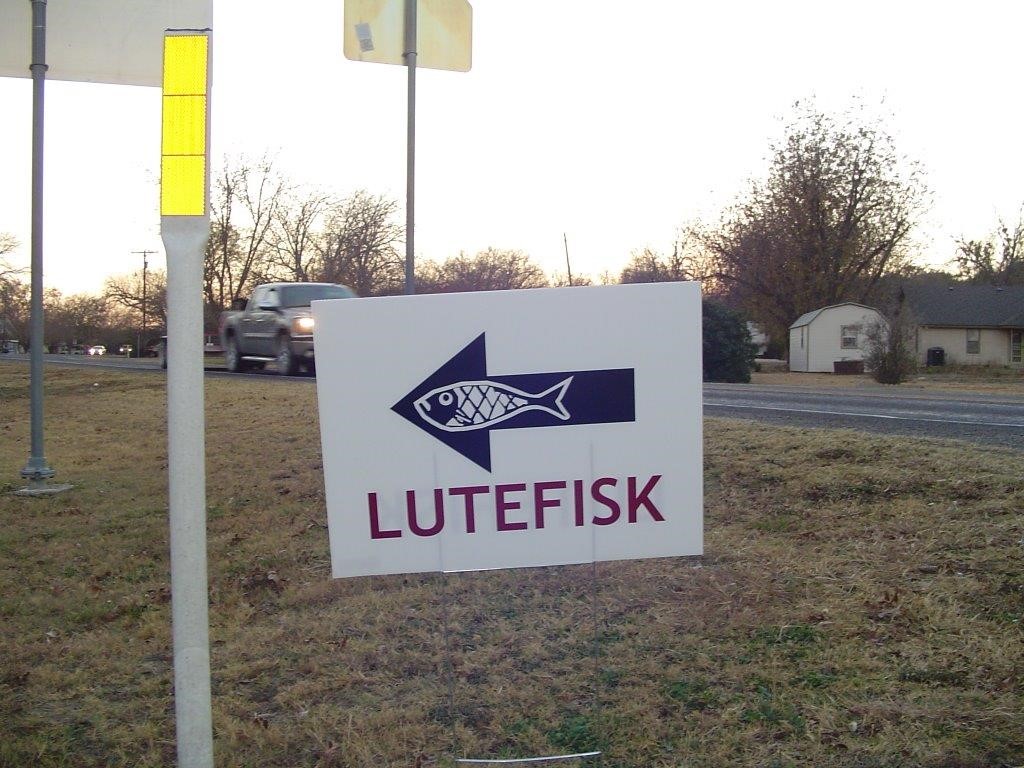
Cranfills Gap Lutefisk Supper road-sign photograph by James J. S. Johnson

Cranfills Gap Lutefisk Supper road-sign photograph by James J. S. Johnson

So what is a “lutefisk supper”?  Why do some regard it as a holiday festivity?

For many of Nordic heritage, especially those who are unusually brave in their cuisine adventures, a unique and historic preparation of codfish, called LUTEFISK, is an unforgettable Christmas tradition:

LUTEFISK SUPPER

‘The Lutefisk Supper is one of the most interesting events in Cranfills Gap [a town in Bosque County, Texas] and is centered round a dried fish imported from Norway.  The tradition began many years ago sponsored by the Ladies’ Aid [Society] of the St. Olaf Lutheran Church.  After several years of time-consuming preparations, organizing, cooking, and serving, the crowds attending the supper became so large that the ladies of the church felt they could no longer carry on this custom so it was discontinued.

In 1965, Oliver Hanson had an idea for a way to financially help the [Cranfills Gap] school’s athletic programs.  To do this, the Lions’ Booster Club of Cranfills Gap High School revived the tradition of serving the Lutefisk Supper.

This group took on the arduous task of preparing the fish.  The fish comes from Norway in 100-pound bales [i.e., stacks of dried codfish]. The weight of each dry fish is from one and a half to two pounds and has already been split in half.  Volunteers saw each dried fish into chunks [note: nowadays the hard-dried codfish is usually cut by a woodshop’s power jigsaw] about four inches long, and then skin the fish of its dry, parchment-like skin.  This is a slow and difficult job.  Next, the fish is soaked in a solution of lye [a strongly alkaline solution, usually dominated by potassium hydroxide] and water for 72 hours.  At the end of these three days, the [now softened] fish is taken out and rinsed and cleaned of any excess skin or any brown spots.  Most of the fins are removed.  Next, the fish is soaked in a solution of lime [limewater is an alkaline solution of calcium hydroxide] and water for a period of 72 hours.  The fish are taken out at the end of that time and carefully cleaned again.  After this cleansing, the fish are then soaked in clear water for 96 hours, changing the water every twelve hours [culminating ten days of various soakings of the no-longer-stiff stockfish!].  By this time the chunks have swelled to four and a half to five times the beginning size and are white.  At cooking time, the fish are placed into a cheesecloth bag, put into a pot of salted, boiling water and boiled about five to ten minutes.  The boiled fish is served with melted butter, white sauce, and boiled Irish potatoes.  Plenty of salt and pepper is a necessity!

Lutefisk serves to bring the [Bosque County] community together as an all out effort probably not seen anywhere else.  On the first Saturday of December almost every able-bodied person in the Gap community begins his or her assigned task[s]—some bake turkeys, some peel potatoes, some bake pies [one favorite being a combined cherry-and-apple pie!], others donate coffee, tea, or sugar.  The person in charge of organizing the dinner assigned duties and food preparation.  Tickets are usually sold in advance, but also at the door [of the Cranfills Gap High School gymnasium].  By 4:00 pm the guests begin to arrive.  The [high school] cafetorium will seat about 200 people at one time.  The food is served family style and high school girls are the waitresses.  The boys wash the dishes.  Through the years, each December as many as 900—1,000 guests have eaten a very delicious meal.

If a diner is not so certain about lutefisk…[!] turkey, dressing, green beans, [cranberry sauce, in lieu of lingonberries] and pie complete the menu.  The cost of the fish has increased from $500 for a 100# bale to $2000 for an 80# box.  An adult ticket in 1965 cost $4.50, but today the ticket is $18.  In the fifty years the Booster Club has sponsored this traditional supper, $250,000 has been donated to the school towards various projects and improvements.

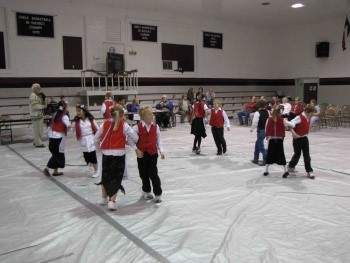
Betty Carlson Smith added more interest in this event when she began teaching elementary age kids several Norwegian [folk] dances.  These dances are performed in the gym for those waiting for their time to be served.  Betty has since retired but the dance tradition [in the gymnasium ‘waiting room’] continues.  For a very reasonable price there is good food, great service, friendly hospitality, and fun.”

Quoting from Darla Kinney, Charlene Tergerson, Rita Hanson, & Laverne Smith, CRANFILLS GAP, TEXAS:  LOKING BACK AND MOVING FORWARD, November 2015 edition (Cranfills Gap, Texas: Cranfills Gap Chamber of Commerce Historical Committee, 2015), page 56-58.

Students Skinning Codfish, in preparation for Cranfills Gap Lutefisk Supper

Students Skinning Codfish, in preparation for Cranfills Gap Lutefisk Supper

So there you have it!  Lutefisk banquets, to Nordic-Americans, are often part of Christmas tradition,  —  and if you are anywhere near Cranfills Gap (Texas), for the first weekend in December, you might want to check out the annual Lutefisk Supper (Saturday evening), and enjoy watching young children dance, as you wait to be called to the banquet table!

Norwegian folk dancing by children at Cranfills Gap: entertainment before lutefisk supper

Norwegian folk dancing by children at Cranfills Gap: entertainment before lutefisk supper

Some of us are happy as bluebirds when feasting on lutefisk.  (And some, for various reasons, prefer to abstain!)

But regardless of how you celebrate the Savior’s birth at Bethlehem (fulfilling the Messianic prophecy of Micah 5:2),  —  whether by eating lutefisk, lefse, and lingonberries  –  or  whether you rejoice in Christ’s historic arrival, by observing some other cultural custom, –  the key is to joyously and gratefully appreciate that the Lord Jesus Christ is the Reason for the season!  JOY TO THE WORLD, THE LORD IS COME!

*


[Fair Use image credit:

Turdidae – Thrushes

James J. S. Johnson

Orni-Theology

Wordless Birds

*

Endemic Treasures of the Cook Islands: Atiu Swiftlet and ‘Gospel Day’ Holidays

Endemic Treasures of the Cook Islands: 

Atiu Swiftlet and ‘Gospel Day’ Holidays

James J. S. Johnson

I thank my God upon every remembrance of you, always in every prayer of mine for you all making request with joy, for your fellowship in the Gospel from the first day until now, being confident of this very thing, that He Who has begun a good work in you will perform it until the day of Jesus Christ.  (Philippians 1:3-6)

Fair Use photo credit: https://en.wikipedia.org/wiki/Atiu_swiftlet#/media/File:Kopeka_bird.jpg

Atiu Swiftlet (Aerodramus sawtelli, a/k/a Kopeka) ©WikiC

The Atiu Swiftlet (Aerodramus sawtelli, a/k/a Sawtelli’s Swift), known locally as the “Kopeka”, is a small member of the swift family, only known to dwell on the Pacific island of Atiu, one of the Cook Islands.

Like other swifts it is sooty-brown in color, with its upper side being darker than its lower side.  Those who have studied the Atiu Swiftlet report that it nests in limestone caves, yet ranges over farmed lands and areas dominated by ferns.

Because it appears to only reside in one place, in the wild, it is said to be “endemic”, i.e., endemic to the island of Atiu.  However, some taxonomists think the Atiu Swiftlet is only an inbred variety of swift that is conspecific with  the Polynesian Swiftlet (Aerodramus leucophaeus, a/k/a Tahitian Swiftlet), the White-rumped Swiftlet (Aerodramus spodiopygius), and maybe even the Australian Swiftlet (Aerodramus terraereginae).  Regardless of taxonomic “lumping” or “splitting”, the Atiu Swiftlet is mainly distinguished from  other swifts by its troglodyte nesting habits and its limited range.)  But for now we may assume that the Atiu Swiftlet, as a separate “species” or as an endemic “subspecies”, is unique to the Cook Islands.  Most who read these sentences, before today, had never heard of an “Atiu Swiftlet” – but the Atiu Swiftlets are not worried  about their relative obscurity, because God’s caring providence is what they need (Matthew 5:26), not acclaim or fame from folks around the world.

In fact, the Cook Islands host another unusual, not-so-famous, “endemic” treasure – a set of “Gospel Day” holidays, commemorating how God provided the Gospel of Christ (via British missionaries) unto that group of islands in the South Pacific.

Fair Use credit_www.pacificresort.com_national-gospel-day-public-holiday-pacific-resort-rarotonga.jpeg

In particular, the Cook Islands – for many years – have officially celebrated, with pageantry and gratitude to God, the arrival of Bible-based Christianity (in the early AD1800s), with the various component islands having specific days for recognizing “Gospel Day” as a memorial of the British missionary outreach that blessed their respective islands.Cooks Island Map

Here are the days that have been (historically) celebrated as “Gospel Day” in the Cook Islands archipelago:  March 13th (Penrhyn Gospel Day); May 25th (Palmerston Gospel Day); June 15th (Mangaia Gospel Day); July 19th (Atiu Gospel Day, Mitiaro Gospel Day, and Mauke Gospel Day); August 8th (Manihiki Gospel Day), August 15th (Rakahanga Gospel Day); October 26th (Aitutaki Gospel Day); December 6th (Pukapuka Gospel Day); — plus there is a “National Gospel Day” collectively celebrated in the Cook Islands on October 27th.

Wow!  What godly tradition!  What other nations show such respect for Christ?

As part of celebrating Gospel Day, in the Cook Islands, elaborate and expressive “nuku” dramas are acted out, by actors wearing colorful costumes who dramatize mankind’s opportunity to be redeemed, in Christ, from sin (sometimes even enacting New York City’s 9/11 Twin Towers disaster, to illustrate the global war between good and evil).  Hymn singing – and lots of it! – and dancing and music-making dominate much of the day, as well as feasting (coconut, arrowroot, pawpaw fruit, chicken, salt-meat, etc.), prayer, and interactive Bible-based worship activities.

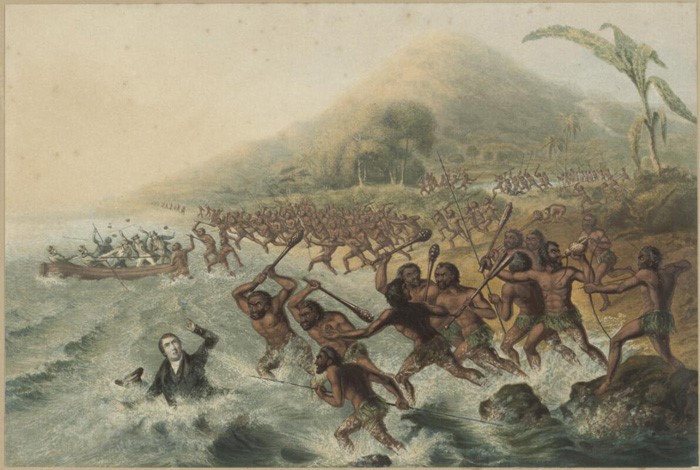
The missionary efforts of John Williams

The missionary efforts of John Williams (“Apostle of the South Seas”, born near London), an English missionary to the Pacific, is recalled with thanksgiving, as well as the historic themes of Christianity.  John Williams (of the London Missionary Society) was murdered (and cannibalized) in AD1839 on the beach at Erromango, in Vanuatu, after a fruitful season of faithful missionary outreach to South Pacific islanders.

gospeldays 2

[For more details on how Gospel Day is celebrated in the Cook Islands, see http://www.cookislands.org.uk/gospelday.html and, especially for diary-like details, see youtube clip:  https://www.youtube.com/watch?v=IN9S9m1pNes .]

gospeldays 3

The tradition continues, although the calendaring aspects of this multi-island tradition have changed, in recent times, due to a governmental effort to standardize the holiday (for the Sunday closest to the original Gospel Day, for each island), and to coordinate with  a new public holiday called “Ra O Te Ui Airki” (on July 6th), according to a news report (dated October 19, 2011) saying:

“From next year, October 26 will be the only public holiday to celebrate Gospel Day as all individual outer island gospel days, including that of Rarotonga, will be celebrated on the closest Sunday to the date of Christianity arriving to the respective islands. The change in the public holiday status of the island Gospel Days is due to a new public holiday on July 6 to be known as the Ra O Te Ui Ariki out of respect for the countrys aronga mana, its ui ariki, ui mataiapo, ui rantagira and taunga [whatever that means!].  Next year churches will have the opportunity once again put their Bible story telling skills on display again when the nuku is organised to commemorate the national Gospel Day.”   [Quoting from http://www.cookislandsnews.com/item/32483-no-nuku-on-gospel-day/32483-no-nuku-on-gospel-day ].

Regardless of whatever day the arrival of the Christian Gospel is celebrated in each of the Cook Islands (as well as the historic day when each one of us, individually, received the Gospel), every day should be a day of appreciating the precious Gospel truth  —  and a time of joy (Luke 10:20) in knowing that God cares to reach and to forgive us, in His Son, the Lord Jesus (Philippians 1:3-6), if we willingly receive Him (John 1:12).   ><>  JJSJ

gospeldays 4

*
Photo Credits:

[ Fair Use photo credit:  https://en.wikipedia.org/wiki/Atiu_swiftlet#/media/File:Kopeka_bird.jpg ]

[Fair Use credit: http://www.pacificresort.com/Images/WhatsOn/national-gospel-day-public-holiday-pacific-resort-rarotonga.jpeg]

[Fair Use image credit: http://www.cookislands.org.uk/image/gospeldays-CORRECTED.jpg]

*

More:

*

Choreographed Choir on the Wing: Birds of a Feather Flock Together

Choreographed Choir on the Wing: 

Birds of a Feather Flock Together

Not forsaking the assembling of ourselves together, as the manner of some is; but exhorting one another, and so much the more, as ye see the day approaching.   (Hebrews 10:25)

James J. S. Johnson

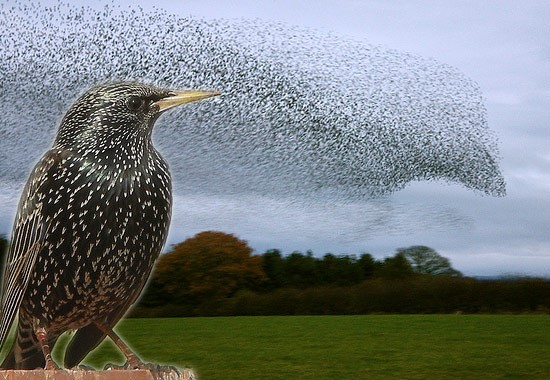
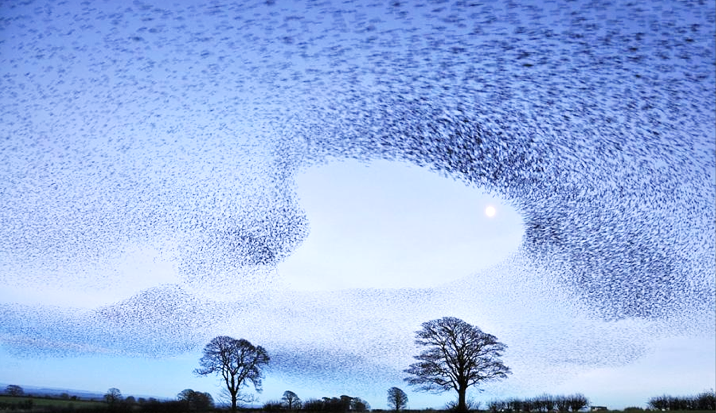
Starling and Murmuration

Starling and Murmeration 

[ Fair Use credit: https://files.allaboutbirds.net/wp-content/uploads/2013/02/starlings.jpg ]

Not only do “birds of a feather flock together”, people who belong together should get together.  And the orderly assembling of both people and birds can give us a preview of coming attractions – when the world that we now know is replaced by one redeemed (Romans 8:18-28), where we gather together in glory, as a harmonious heavenly host.

Accordingly, seeing hundreds (if not thousands) of European starlings, flying like a flexible fluid, in choreographed unison, provides an birdwatching foretaste of (someday) seeing the heavenly host in action.  But there are other notable types of gatherings-in-motion, of kindred spirits “flocking together”.

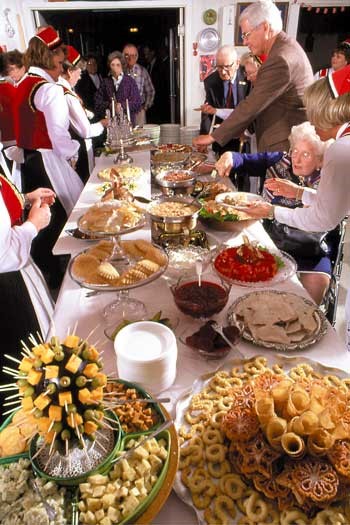
Serving line at Norse smörgåsbord, showing artistic presentation of Nordic cuisine

Serving line at Norse smörgåsbord, showing artistic presentation of Nordic cuisine

[serving line at Norse smörgåsbord, showing artistic presentation of Nordic cuisine  — Fair Use credit:   Smorgasbord.jpg ]

Last Saturday was a special event for my wife and me:  the annual Norwegian smörgåsbord hosted by the Women’s auxiliary of Our Savior’s Lutheran Church of Norse, Texas.  The event is so popular that you must (literally) “win the lottery” to be allowed to purchase tickets to the event!

announcement of 67th annual smörgåsbord hosted by Our Savior’s Lutheran Church of Norse, Texas

Copy of announcement of 67th annual smörgåsbord hosted by Our Savior’s Lutheran Church of Norse, Texas

This delightfully colorful and tasty feast, hosted by a rural Norwegian-immigrant-established rural congregation in the Texas “hill country” of Bosque County (located between Clifton and Cranfills Gap) is a multi-generational tradition of faith, food, fun, and fellowship – and a fundraiser for the more-than-a-century-old church (see http://oursaviorsnorse.org/ ).

hors d’ouvres served at Norse smörgåsbord

hors d’ouvres served at Norse smörgåsbord

[hors d’ouvres served at Norse smörgåsbord  —  Fair Use credit: http://oursaviorsnorse.org/smorgasbord.html ]

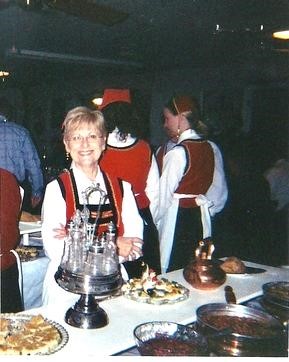
Church members dress in bunads (festive Norwegian costume of the AD1800s), as they usher attendees and/or serve attendees.  The feast begins with a Scripture-based devotional with bilingual music and table prayer, in the sanctuary, followed by a short walk to the fellowship hall, where the meal is served.

Serving line at Norse smörgåsbord, showing servers in bunad costumes

[serving line at Norse smörgåsbord, showing servers in bunad costumes  —  Fair Use credit: http://oursaviorsnorse.org/smorgasbord.html ]

The mix of delectable dishes, of Norwegian-American cuisine, is too many for me to mention here  —  however, I will mention just a few that I enjoyed:  pickled herring, salmon mold, Norwegian meatballs, ham, turkey, stuffed eggs (i.e., what many non-Norwegians call “deviled eggs”), several kinds of cheese (including gjetost, brunost, gamalost), lefse (i.e., Norwegian potato bread that looks like a flour tortilla), lingonberry jam, lima beans, beets, various breads (including Swedish rye), potato salad, outstanding coffee, and various cookies (including krumkaker, rosettes, sandbakkels, fattigman).  And more!

Dessert tray served at Norse smörgåsbord

[dessert tray served at Norse smörgåsbord  —  Fair Use credit: http://oursaviorsnorse.org/smorgasbord.html ]

The Lutheran church building itself, which includes modernized modifications of the original structure, is a reverent monument to the glory and worship of God  — the church was established by Norwegian immigrant settlers who came in AD1854.  The church building was begun in AD1875 and originally completed in AD1885.  The church sanctuary pews (and other chancel furniture) are original.

Our Savior’s Lutheran Church of Norse, in Bosque County, Texas

Our Savior’s Lutheran Church of Norse, in Bosque County, Texas

[Our Savior’s Lutheran Church of Norse, in Bosque County, Texas –  Fair Use credit:  NorseTexasOurSaviorsLutheranChurch1003BGibson.jpg ]
Bosque County’s Norwegian pioneers burial site in Norse

Bosque County’s Norwegian pioneers burial site in Norse

[ Bosque County’s Norwegian pioneers burial site in Norse  —  Fair Use credit: Norwegian.settlers.monument.jpg  ]

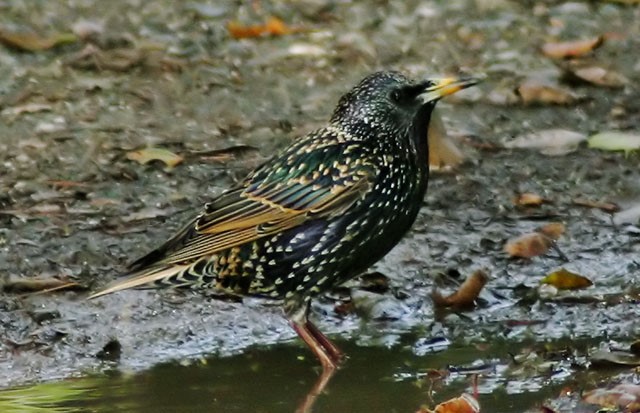
But more than that splendid kindred-spirit event, at the Lutheran Church last Saturday, reminded me of the phrase “birds of feather flock together”.  Why? Because en route to that wonderful event, which was about a 3-hour-drive (one way) for my wife and me, we were slowed down in our southward trek through construction-delayed traffic, along Interstate 35-W.  The construction activities on the west side of highway were reshaping the land surfaces and drainage patterns, enabling recent rainwater to collect in a large mud-puddle, by a large “blanket” of black that somehow quivered with motion.  Why was that black “blanket” moving?  It was a mob of star-spangle-jacketed European starlings (Sturnus vulgaris) congregated there – more than your eyes could count!  The pooled water had attracted a mega-flock of European starlings (which at first glance looked like a black blanket covering the ground), some of which drank water while others waited nearby, for their turns at the “watering hole”.

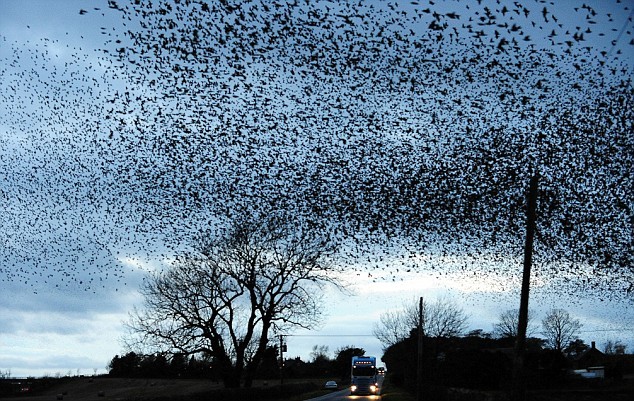
Murmuration by Dailymail

Murmuration by Dailymail

[Fair Use credit: http://i.dailymail.co.uk/i/pix/2008/Murmuration by Dailymail ]

But more spectacular than these earth-bound  starlings (in and at the mud-puddle) were their swarming legions of cousins, swirling, and looping in the air above, — called a “murmuration” of starlings.  This fluid flock of aerial acrobats were graciously swirling, curving, arching, banking, spinning, irrupting, swerving, pouring, turning, dipping, spreading, blending, soaring – in harmony, each one perfectly synched to one another like a living fabric of black-winged wonders, dancing in the wind – a choreographed choir of chattering starlings.

 European Starling


European Starling

[ Fair Use credit: http://animalia-life.com/data_images/european-starling/european-starling2.jpg ]

There is nothing quite like watching a living, flowing, swirling cloud of European starlings, flying as a fluid flock – a harmonious team of airborne navigators – in numbers and motions that prevent spectator quantification.  The starlings’ murmuration is more than “birds of a feather flock together”; this is “birds of a feather fly like a fluid-fabric together!” – truly an amazing display of God’s handiwork in flying feathers.

As we watched in amazement, at the synchronized motions of these little black (and somewhat iridescent) marvels, we thought about the high-speed harmony God has directed these starlings to implement, in their humble little lives.  God-honoring harmony – what a concept!

Of course, if we “forsake the assembling of ourselves together” we cannot achieve any such choreography. And, when we do get together, we do well to focus on our unity in Christ, which means prioritizing and practicing  the truth in love.

Starling Flying Mob

Starling Flying Mob

[ Fair Use credit: http://mudfooted.com/images/murmuration-bird-flock.png]

Behold, how good and how pleasant it is for brethren to dwell together in unity(Psalm 133:1)

Starling Murmuration ©Flickr Donald Macauley

*
More Orni-Theology Articles

More of James J. S. Johnson’s Articles

*
Enter Into His Gates With Thanksgiving

Enter into His gates with thanksgiving

James J. S. Johnson

Make a joyful noise unto the Lord, all ye lands.  Serve the Lord with gladness; come before His presence with singing.  Know ye that the Lord He is God; it is He Who hath made us, and not we ourselves; we are His people, and the sheep of His pasture.  Enter into His gates with thanksgiving, and into His courts with praise; be thankful unto Him, and bless His name.  For the Lord is good; His mercy is everlasting; and His truth endureth to all generations.  (Psalm 100)

Sometimes what you expect to find, is not what you find.  This is true of Grenada’s official bird, if you assume it matches Grenada’s official coat of arms.  This is also true if you imagine that the Thanksgiving holiday, as it is celebrated in Grenada, is like the Thanksgiving holiday as it is celebrated in America.

Fair Use credit: http://tolweb.org/tree/ToLimages/217681451_7e4971beab_o.250a.jpg

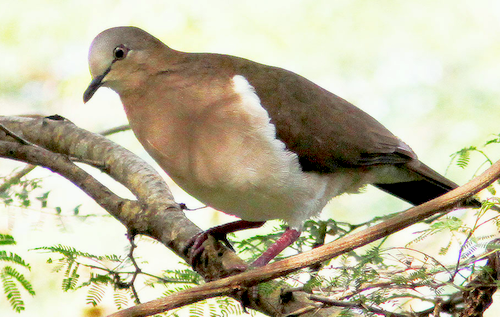
Grenada’s official coat of arms includes an Armadillo and a Grenada Dove (Leptotila wells  —  a/k/a Well’s dove or pea dove), positioned above the motto “Ever conscious of God, we aspire, build, and advance as one people.”   The Grenada Dove is endemic to Grenada – i.e., only on the island of Grenada is the Grenada Dove found in the wild, and even there it is critically “endangered” (i.e., close to extinction).   The dove’s coloring, as depicted on the Grenada coat of arms, however, does not closely match the actual coloring of the real bird.

(Grenada coat of arms – public domain)

(Grenada coat of arms – public domain)

The dove’s coloring, as depicted on the Grenada coat of arms, however, does not closely match the actual coloring of the real bird.  The actual Grenada Dove has little blue to it (depending on the lighting used to view it)  –  rather, brown and buff dominate its overall coloring.  One wonders why, therefore, the heraldic depiction shows indigo-blue and azure, with yellow highlighting.  Consider the more realistic depictions before, as shown by photographic and postage images.

Fair use credit:  grenada national archiveshttps://grenadanationalarchives.wordpress.com/tag/leptotila-wellis/ (from the website of the National Archives of Grenada)

(Grenada postage stamp issued in February of AD1974 – public domain)

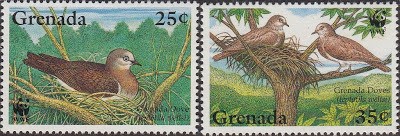
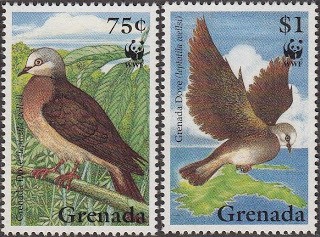
Consider also these special World Wildlife Fund-logo Grenada postage stamps,  showing Grenada Doves.

Grenada stamps 1

Grenada stamps 2

(Grenda postage stamps issued in January AD1995 – public domain)

The lesson here, apparently, is that heraldic coat-of-arms depictions of birds can (sometimes) be quite unrealistic – or else the artist might be depicting the wrong bird!

But Grenada’s coat of arms is not the only surprise in its national symbols.

Consider now the holiday we call “Thanksgiving”.

In the United States of America, for a contrasting example, the holiday of “Thanksgiving” (celebrated on the fourth Thursday in November) commemorates the gratitude of Plymouth Pilgrims, as pioneer survivors, who thanked God at harvest time in AD1621, for His providence — see “Strangers and Pilgrims (and the American Turkey)”, posted at https://leesbird.com/2014/11/25/strangers-and-pilgrims/ .  The Pilgrims’ survival and early successes, due to God’s providence, are also celebrated in the Netherlands, in Leiden, to commemorate how the Pilgrims lived in Holland during AD1609-AD1620.  A special Thanksgiving worship service is conducted, there, on the morning of America’s Thanksgiving, in Pieterskerk [“Peter’s church”], a Gothic church that was originally Roman Catholic (from its architectural beginning in AD1390), yet became Protestant during the Dutch Reformation, and became the burial site for John Robinson, pastor of the Pilgrims prior to their migratory journey to America.

Canadians observe a similar holiday, called l’Action de grâce in French, on the second Monday in October.

Norfolk Island, an external territory of Australia, celebrates Thanksgiving on the last Wednesday of November, so that Norfolk Island’s celebration of Thanksgiving occcurs either the day before, or six days after, the day when Americans celebrate Thanksgiving.

Saint Lucia, an island nation on the eastern edge of the Caribbean Sea, celebrates Thanksgiving on the first Monday in October.

Christians in Germany have a similar harvest-thanksgiving holiday, Erntedankfest, in early October, at about the same time that its Bavarians are celebrating Oktoberfest.

Thanksgiving is supposed to be focused on thanking God —  even the name of the holiday suggests as much.  However, although gratitude to God  –-  for harvest blessings  —  was the original reason for most harvest festival-oriented “thanksgiving” holidays, many Thanksgiving traditions have forgotten the historic importance of thanking God for His caring providences, by focusing more on distractive parades (e.g., Macy’s, IKEA’s, McDonald’s), football games, and feasting  —  with such festive celebrations discounted in slang as “Turkey Day”. (British Laird Bill Cooper was quite disappointed to learn of this trivialized secularization of what was originally a holy day/holiday.)

But how is Thanksgiving celebrated in Grenada, and why ?

First, consider where Grenada is located – Grenada is an island nation situated slightly east of South America, north of Venezuela.  Politically speaking, the nation of Grenada actually includes the main island (called “Grenada”) plus a few smaller islands, some but not all of “the Grenadines”, which are situated north of the Martinique Channel – with several of the other Grenadine islands (located south of the Martinique Channel) jurisdictionally belonging to the Caribbean nation called “St. Vincent and the Grenadines”.

grenada map

In AD1498 the main island of Grenada was visited by Christopher Columbus, who named it “Concepcion”.

Grenada was later visited by Britons, then French; it was eventually settled by French colonists. Later, as part of the Treaty of Paris (in AD1763), Grenada became a British colony.  Grenada shed its colonial status, however, in AD1974, as it then became officially independent of the United Kingdom, although it remained an affiliate of the British Commonwealth.

So far so good, it seemed, until AD1983, when a Communist military takeover occurred on the island, led by General Hudson Austin (who was politically backed by Cuba, and aided by Cuban soldiers), actually seized control from a prior Communist takeover (i.e., one Communist regime killed off the leadership of a prior Communist dictatorship).  American students were put in jeopardy so President Ronald Reagan authorized a military rescue operation, which included defeating the “New Jewel Movement” (i.e., the second Communist dictatorship).

Thus, beginning on October 25th of AD1983, the “New Jewel Movement” Communists, who had seized the country, were soon opposed by a coalition of rescue forces, comprised of the United States and several Caribbean allies (from six Caribbean nations, including Jamaica and Barbados), in a complicated military effort called “Operation Urgent Fury” – which included U.S. Army Rangers, U.S. Marines, Delta Force, 82nd Airborne paratroopers, and U.S. Navy SEALs.  Because the rescue operation was so successful – and peace was restored to Grenada (with the Cuban soldiers being expelled) a holiday of gratitude was established – October 25th became Thanksgiving Day for Grenada.

Operation Urgent Fury photograph

Operation Urgent Fury photograph (public domain, AD1983) M102 howitzers (320th Field Artillery Regiment) firing on Grenada island.

Bottom line:   we all  –  whether Americans or Grenadians or anyone else for whom Christ died  —  have a lot to be thankful for, on whatever day that we celebrate Thanksgiving (and on every other day of the year!).

In accord with Psalm 100 we should, daily, “enter into His gates with thanksgiving, and into His courts with praise; be thankful unto Him, and bless His name”.

The Ghost Army – Repost

An inflatable dummy tank ©WikiC

An inflatable dummy tank ©WikiC

The Ghost Army:  Moaning Noises Can be Scary!

– by James J. S. Johnson, J.D., Th.D. *

[Lee’s introductionThe current Acts & Facts from Institute for Creation Research has this very interesting article by Dr. James J. S. Johnson, who formerly taught courses on ornithology, ecology, limnology, and other bioscience-related courses at Dallas Christian College.]

Sometimes the best defense is an offense, even when the “offense” is really a bold bluff. This tactic is valued in wartime, and when God uses this principle He deserves our reverent adn admiring appreciation.

America’s top-secret World War II “Ghost Army” used cleverness and technology to fool German forces by masking military vulnerabilities. Yet the main fakery they used wasn’t mere camouflage—the daring deception involved threat-reversal mimicry….

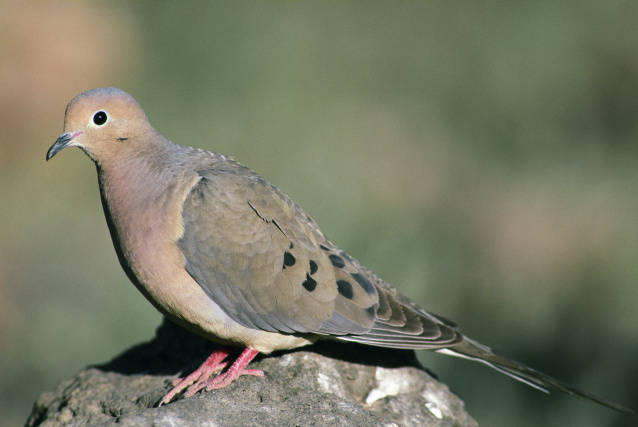
Mourning Dove (Zenaida macroura) ©USFWS

Mourning Dove (Zenaida macroura) ©USFWS

Such is ordinary life for the mourning dove (Zenaida macroura), which feeds on the ground and nests there or within shrubs, on buildings, or in trees—the same places where opportunistic and omnivorous rats, like Rattus rattus and Rattus norvegicus, roam for food. Consequently, dove eggs and hatchlings are sometimes vulnerable to prowling predatory rats.3 … [Click here to see the whole article.]

O the depth of the riches both of the wisdom and knowledge of God! how unsearchable are his judgments, and his ways past finding out! For who hath known the mind of the Lord? or who hath been his counsellor? (Romans 11:33-34 KJV)

*

*

Skinny As A Rail? Not Me!

Clapper Rail (Rallus crepitans) ©WikiC

Clapper Rail (Rallus crepitans) ©WikiC

Skinny as a rail? Not me!

~ James J. S. Johnson

“But when thou art bidden, go and sit down in the lowest room; that when he that bade thee cometh, he may say unto thee, Friend, go up higher: then shalt thou have respect in the presence of them that sit at meat with thee.”    (Luke 14:10)

Luzon Bleeding-heart by Dan

Orni-Theology

Is it really advantageous to be frequently noticed?  Is having a “low profile” a prudent practice?  Surely when someone gets a reputation, for being a “show-off”, the spotlight becomes a disadvantage.

When I was a teenager I was called “skinny as a rail”.  Once I arrived at age 20, however, for some reason I stopped hearing that description.  Of course, I blame my weight gain on getting married to a wonderful cook (who, for 3-dozen-plus years, has made eating an ongoing adventure!)!  Actually, I am not too far from being double the weight that I had, 121 pounds, when I got married!

Hmmm – maybe exercise has something to do with it, too.  It’s been a long time since someone said (of me), “he’s so skinny, if he turned sideways we couldn’t see him!”  It is the literal truth that my wife has been with me “through thick and thin”.

But this is supposed to be about birds.

Railway ©WikiC

Railway ©WikiC

So now we should consider something that Robert and Alice Lippson, both ecologists, have to say about being “skinny as a rail”.

“’As thin as a rail’—is it the narrow steel ribbon of a railroad track or the slim boards that make up a fence?  Just where did that old saw come from, anyway?  It pertains to certain members of the Rallidae family, the rails, which also includes coots and gallinules.  The rails have thin, compressed bodies that allow them to thread their way through seemingly impenetrable thickets and literally to disappear into the marsh. … Rails are usually brown and patterned or mottled with white [feathers], while coots are slate or soot colored.  Rails are found in the [Chesapeake] Bay wetlands year-round.”

[Quoting Alice Jane Lippson & Robert L. Lippson, LIFE IN THE CHESAPEAKE BAY:   An Illustrated Guide to the Fishes, Invertebrates, Plants, Birds, and Other Inhabitants of the Bays and Inlets from Cape Cod to Cape Hatteras, 3rd Edition (Baltimore:  The Johns Hopkins University Press, 2006), page 232.]

Perhaps the most prominent rail in the Chesapeake Bay region is the Marsh Hen, also called the “Clapper Rail” (Rallus crepitans, a/k/a Rallus longirostris), known for its harsh-sounding clattering vocalizations [klek-klek-klek-klek-klek] that almost sounds like rattling or rapid clapping.

The Clapper Rail is routinely found in salt marshes and some freshwater marshes on America’s East Coast, from Massachusetts to Florida, plus in wetlands bordering California’s inland Salton Sea, and even along the banks of the lower parts of the Colorado River.  [See John Bull & John Farrand, Jr., NATIONAL AUDUBON SOCIETY FIELD GUIDE TO NORTH AMERICAN BIRDS, EASTERN REGION, revised edition (New York:  Alfred A. Knopf, 1994), page 455.]

Have I ever seen one?  Probably not.  But that’s not unusual, according to Lippson & Lippson, who say that hearing one is more likely than seeing one, especially due to their habit of being more active at night.  [Lippson & Lippson, page 232.]  But, if you do see a Clapper Rail, it might not realize you are watching!

Clapper Rail (Rallus crepitans) ©WikiC

Clapper Rail (Rallus crepitans) ©WikiC

“Clapper rails are secretive birds and are usually not seen unless forced off the reed floor by high tides.  Then they are frequently seen along the edge of the marsh and even along nearby roads.  Even though they are in the open and quite visible, clapper rails apparently think they are still in the marsh, unseen and safe.  Like the least bittern, they are reluctant fliers and when flushed will make brief [airborne] sorties, legs dangling, then drop and disappear into the marsh vegetation.  Curiously enough, rails are capable of making long migratory flights.  The best way to ‘see’ a rail is with your ears:  listen for the clattering “kek-kek-kek”, especially in the early evening and at dawn.  The clapper rail is widely distributed throughout the [Chesapeake] Bay.”  [Quoting Lippson & Lippson, page 232.]

So much for keeping a low profile, especially when perils are near!  If you can be inconspicuous, it’s usually to your advantage, — but, if not, it’s good to have a Plan B (like the Clapper Rail’s getaway response) if you need one.

Meanwhile, don’t forget the lesson of Luke 14:10.  Routinely assume that you should take a “low profile”.  If you are directed “up” (i.e., promoted to a “higher” responsibility), so be it,  —  trusting God to guide you, use the “high profile” opportunity to honor God.  Yet don’t forget: the Clapper Rail strategy has its merits  –  if you are inconspicuous you are less likely to become somebody’s target!

*

Rallidae – Rails, Crakes and Coots

Orni-Theology

James J. S. Johnson

Good News

Clapper Rail by Lee at Merritt Island NWR

*

Want a Home in the Mountains? Some Birds Have One!

Want a Home in the Mountains?   Some Northern Flickers Have One!

James J. S. Johnson

I know all the fowls [i.e., birds] of the mountains; and the wild beasts of the field are Mine.    Psalm 50:11

Mountains are wonderful places to see God’s handiwork, including the many birds dwelling in (and around) mountains year-round or seasonally.  Some of my best bird-watching has been done in mountains, usually the Rocky Mountains or Appalachians. (This birding report notes the Rocky Mountains’ Northern Flicker.)

SANGRE2©WikiC

Of specific mountain ranges, one of my all-time favorite mountain ranges is the Sangre de Cristo Range, northern part of the Sangre de Cristo Mountains (themselves a range within the Rocky Mountains) that runs north-to-south in southern Colorado, spilling into northern New Mexico.  Within that range my favorite mountain is Horn Peak, near Horn Creek Christian Family Camp (where Dr. Stan Toussaint occasionally taught the Scriptures) and Sangre de Cristo Seminary, not far outside of Westcliffe, Colorado.  The elevation there ranges about 8500 feet, with Horn Peak peaking at about 14,000 feet!

Sangre de Cristo Range Looking West ©WikiC

Sangre de Cristo Range Looking West ©WikiC

“Sangre de Cristo” is Spanish for “blood of Christ”, perhaps an indication that the range was named when its snow-capped mountains were reflecting a scarlet-hued sunset.  In any case, it’s magnificently beautiful out there.

Sangre de Christo Mountains, Winter Sunset ©WikiC

Sangre de Christo Mountains, Winter Sunset ©WikiC

Much of Colorado’s Sangre de Cristo Range is located within two of America’s national forests:  San Isabel National Forest (containing the range’s northeastern portion), and the Rio Grande National Forest (containing most of the southwestern portion, i.e., the San Luis Valley).   Amazingly, the Sangre de Cristo Mountains border a very unusual inland sand dunes area (the largest in North America), the Great Sand Dunes National Park and Preserve.   By the way, where did all that sand come from?  (Hint: check out Genesis chapters 6-9.)

Dunes great sand ©WikiC

Great Sand Dunes ©WikiC

In the montane forests on the slope of Horn Peak (and Little Horn Peak) there is a Protestant Reformation-based seminary named “Sangre de Cristo Seminary”, founded by Dr. Dwight F. Zeller.  (FYI: its website is http://sdcs76.org/  — which includes a music-enhanced PowerPoint slide show on its homepage.)

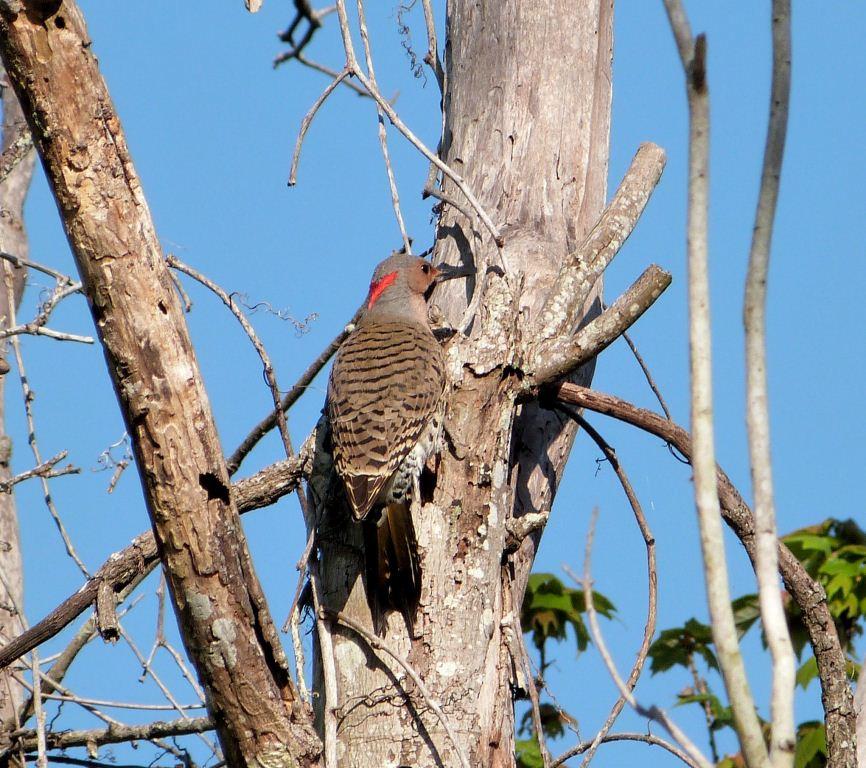
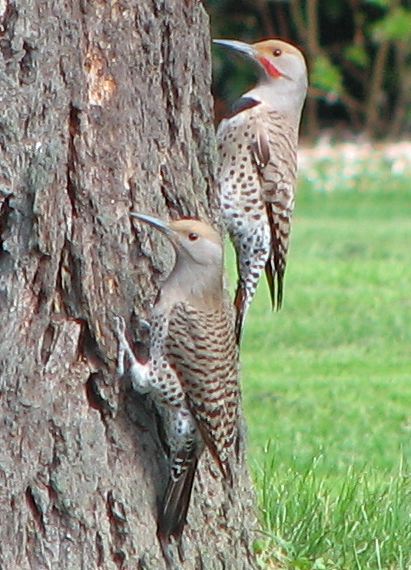
If you drive up to the entrance of the seminary campus, especially in the summer, roll down your car’s windows – and listen.  Actually, park your car and find a “blind” where you can observe the trees around you – if you stay still for a while you are likely to see the varied bird life of those montane evergreen forests.  One bird that you may hear before you see it, the Northern Flicker (Colaptes auratus), because a stone’s throw from the seminary’s mountain road entrance, which is thick with evergreen trees, is (or at least “was” – in the late AD1990s) a tree that served as the home of a Northern Flicker family.  Many summer days, during the mid-to-late AD1990s, I have found a comfortable place to sit, there – hidden — so that I could observe that Northern Flicker tree-home, without being observed by the Northern Flickers that continually went in and out, in and out, therefrom.

Northern Flicker cropped by Lee at S. Lk Howard Ntr Pk

Northern Flicker cropped by Lee

Flickers routinely convert a tree into a tree-house!

Orni-Theology with Luzan Bleeding-heart by Dan

Orni-Theology

Says ornithologist Mary Taylor Gray, in her book WATCHABLE BIRDS OF THE ROCKY MOUNTAINS (Mountain Press Publishing, 1992), at pages 30, “Flickers nest in holes in trees, fenceposts, telephone poles and the like, excavating the nest hole by pecking.  They are important homebuilders for other cavity-nesting birds who, with bills too weak to make their own holes, use those abandoned by woodpeckers.  Both the male and the female flicker incubate the eggs and care for the young [hatchlings].  When the adults bring food to the nest, they light on the tree, then disappear into the nest cavity.  As the babies get older, they learn to expect the parents, poking their heads out of the nest and squawking to be fed.”  That description of Northern Flicker behavior (with illustrative photographs on page 31), by Mary Taylor Gray, perfectly fits what I have observed (and what my wife observed), summer after summer, at Sangre de Cristo Seminary’s campus.

But what were those woodpeckers eating?

Bugs of all kinds strive in the Sangre de Cristo montane forests, crawling on the ground and in trees and bushes – the bugs are very active there during the summer – and that’s fine for flickers!  Says ornithologist Stan Tekiela, in his book  BIRDS OF COLORADO FIELD GUIDE (Adventure Publications, 2001), on page 147, “The flicker is the only woodpecker to regularly feed on the ground, preferring ants and beetles.  Produces antacid saliva [without the need for Nexium!] to neutralize the acidic defense of ants.”  (Although such a diet would bug me, the flickers seem to enjoy it.)

Northern Flicker (Colaptes auratus) red-shafted F-left M-right ©WikiC

Northern Flicker (Colaptes auratus) red-shafted F-left M-right ©WikiC

The two main varieties are the “red-shafted” and “yellow-shafted” forms, though hybridized  versions occur where the ranges overlap, in the western edge of the great plains (where the prairies merge into the Rocky Mountains), and this Northern Flicker looked like such a hybrid.  After my wife and I watched it go into its tree-hole, again and again, we suddenly learned why that tree-hole was the scene of such repeated in-and-out activity:  cautiously baby flickers poked their little heads out, perhaps curious about the outside world, or maybe in hopes that the next airborne meal was soon headed home!

Northern Flicker (Female Yellow-shafted) ©WikiC

Northern Flicker (Female Yellow-shafted) ©WikiC

In recalling those cool summer days, when I watched for birds in the montane forests by Sangre de Cristo Seminary – sometimes with my wife, sometimes alone – I realized that all around me the hungry were being fed.  Baby flickers were being fed by their woodpecker parents.  But also seminary students, instructed by godly teachers, were being fed the Word of God (Deuteronomy 8:3, quoted in Matthew 4:4 & Luke 4:4.)

So, good eating can mean physical food (like bugs for hungry flickers!), or it can mean spiritual food (like the Holy Bible, for hungry Christians).  Bon appetite!

Northern Flicker feeding baby ©WikiC

Northern Flicker feeding baby ©WikiC


Lee’s Addition:

Thanks, James for a very interesting article to share with us. Love those Flickers.

More articles:

Orni-Theology

James J. S. Johnson

Picidae – Woodpeckers

Northern Flicker – All About Birds

Northern Flicker – Wikipedia

*

A Diet of Jackdaws and Ravens

Western Jackdaw (Coloeus monedula) ©WikiC

Western Jackdaw (Coloeus monedula) ©WikiC

A Diet of Jackdaws and Ravens

by James J. S. Johnson

God is our refuge and strength, a very present help in trouble. … The Lord of hosts is with us; the God of Jacob is our refuge. Selah.  (Psalm 46:1 & 46:11)

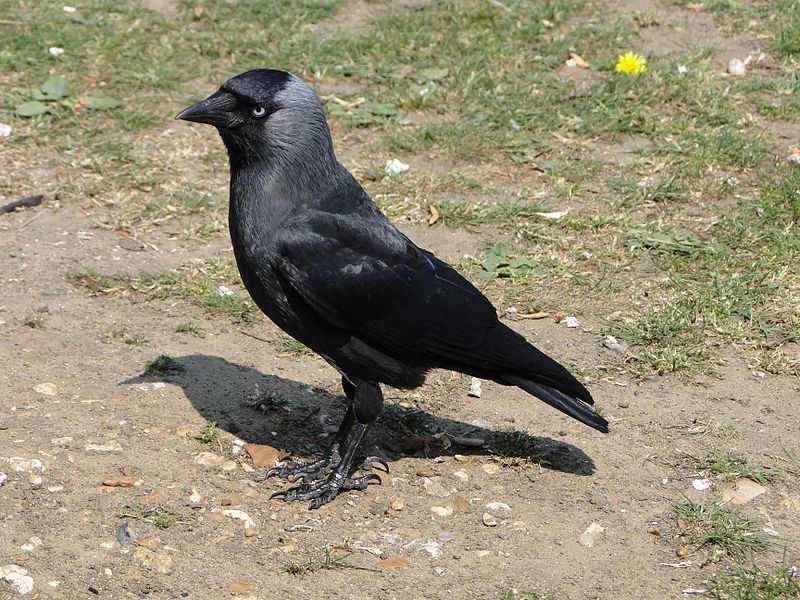
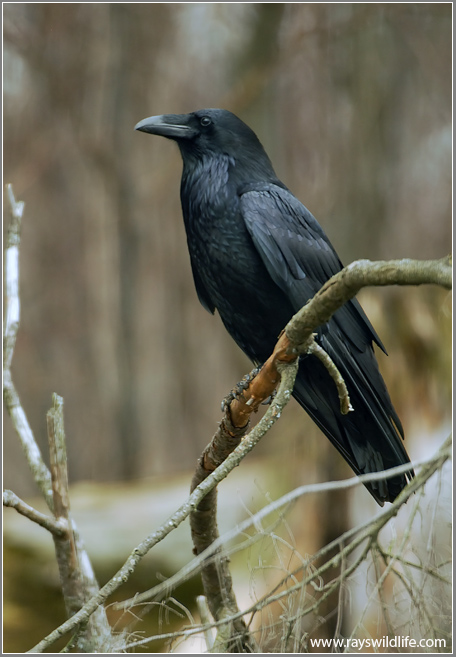
Looking at ravens, recently, I was reminded of the 46th Psalm and a hymn that majestically paraphrases its doxological theology.  Also I was reminded of the Jackdaw (Corvus monedula), which is cousin to the Raven (Corvus corax), both of which corvids range in Germany.

Northern Raven (Corvus corax) by Ray

Northern Raven (Corvus corax) by Ray

But how are these – Psalm 46, a hymn, ravens, and jackdaws — connected?

Let’s begin with a famous hymn that paraphrases, in lyrical dignity, from the content of the 46th Psalm. Surely you recognize these lyrics:

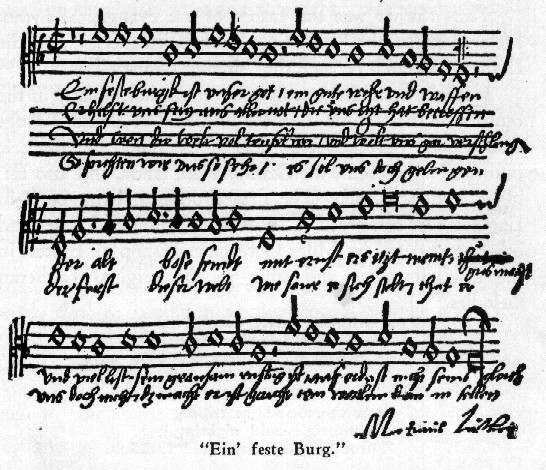
Luther's Ein Feste Burg

Luther’s Ein Feste Burg

Of course, the lyrics are penned by a Saxon theologian of the AD1500s, in German, so maybe an English translation (of that hymn’s lyrics) would be more helpful.  This German hymn (“Ein feste Burg ist unser Gott”) was translated into English, as early as AD1539, by Bible translator Miles Coverdale, with the title “Oure God is a defence and towre” [notice obsolete spellings of “our”, “defense”, and “tower”].  The hymn’s composition (AD1529), as well as its original melody and meter, comes to us thanks to Dr. Martin Luther, the great Reformer.

But the most familiar English translation of this heroic hymn, by Frederick Hedge (AD1853), is “A mighty fortress is our God, a bulwark never failing”, which begins:

  1. A mighty fortress is our God, a bulwark never failing;
    our helper he amid the flood of mortal ills prevailing.
    For still our ancient foe doth seek to work us woe;
    his craft and power are great, and armed with cruel hate,
    on earth is not his equal.
  2. Did we in our own strength confide, our striving would be losing,
    were not the right man on our side, the man of God’s own choosing.
    Dost ask who that may be? Christ Jesus, it is he;
    Lord Sabaoth, his name, from age to age the same,
    and he must win the battle.
  3. And though this world, with devils filled, should threaten to undo us,
    we will not fear, for God hath willed his truth to triumph through us.
    The Prince of Darkness grim, we tremble not for him;
    his rage we can endure, for lo, his doom is sure;
    one little word shall fell him.
  4. That word above all earthly powers, no thanks to them, abideth;
    the Spirit and the gifts are ours, thru him who with us sideth.
    Let goods and kindred go, this mortal life also;
    the body they may kill; God’s truth abideth still;
    his kingdom is forever.

Of course, Lutheran choirs and organists know this hymn well!

Yet how does this hymn, and its music-loving author (Dr. Martin Luther), relate to a “diet of jackdaws and ravens”?

In the year AD1530 an ecclesiastical confrontation was scheduled to occur at Augsburg (a city in Bavaria, Germany), but Dr. Luther was persuaded to stay behind – mostly for his personal safety’s sake – in Coburg (a town of Bavaria, near Augsburg) because Luther was declared an “outlaw” at the Diet of Worms, so he was an unprotected target).  So Luther staid there, writing to his friend Philip Melanchthon (and others), as Luther waited for the next important event to occur in Germany’s (and Europe’s) Reformation.  But Luther was not one who would contently wait while others battled – and the controversy would have reminded Luther of prior confrontations that he had personally experienced, in defense and promotion of Luther’s Bible-based faith.

Martin Luther by Cranach restoration ©WikiC

Martin Luther by Cranach restoration ©WikiC

While in Coburg, therefore, Luther’s imagination could picture the clutter and cawing of agenda-driven clergymen (and bustling government officials) who were gathering, in Augsburg, to cluck about theological controversies, at what would be a hotly contested “diet” (conference of representative delegates).  Luther could easily imagine the conspiring conversations of the corrupt clergymen who would soon be attending and arguing at the Augsburg “diet”, seeking to ensnare Melanchthon and Luther’s other Protestant allies.

In Barnas Seares’ biography of Dr. Luther, titled THE LIFE OF LUTHER, WITH SPECIAL REFERENCE TO ITS EARLIER PERIODS AND THE OPENING SCENES OF THE REFORMATION (American Sunday-School Press, 1850; 2010 reprint by Attic Books), he describes how Luther’s birdwatching provoked memories of prior confrontational conferences:

A mind like Luther’s could not remain inactive, and, for want of other employment, he suffered his fancy to picture to itself a diet of birds, as he saw them congregate before his window, much as he saw persecuting bishops in the huntsmen and hounds while engaged in the chase at Wartburg [where Luther was sequestered, hidden from his persecutors, during the time Luther translated the Bible in German].  The reader will easily recognize the satire.  The sportive letter [written by Luther] was addressed to his table companions at Wittenberg, and reads thus:

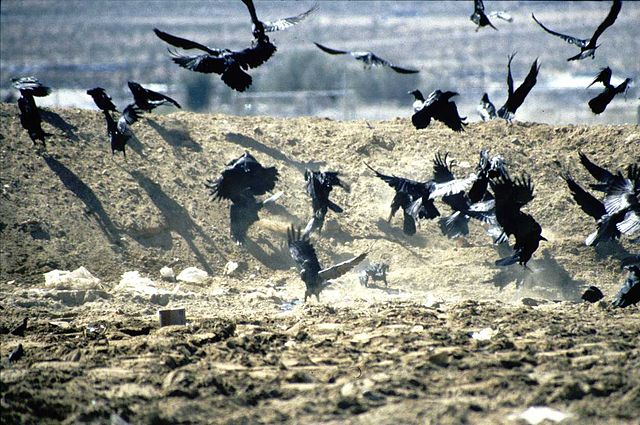
Common Ravens Feeding ©WikiC

Common Ravens Feeding ©WikiC

‘Grace and peace in Christ, dear friends.  … [Luther then explains that he and two other men] do not go to the Augsburg diet, though we are attending another one in this place.  There is, directly before my window, a grove where the jackdaws and ravens have appointed a diet; and there is such a coming and going, and such a hubbub, day and night, that you would think them all tipsy.  Old and young keep up such a cackling, that I wonder how their breath holds out so long.  I should like to know if there are any of these nobles and knights with you, for it seemeth to me that all in the world are gathered together here.  I have not yet seen their emperor, but the nobles and great ones are all the time moving and frisking before us; not gayly attired, but of one uniform colour, all black and all gray-eyed.  They all sing the same song, though with the pleasing diversity of young and old, great and small.  They pay no regard to the great palace and hall, for their hall hath the high blue heavens for its ceiling, the ground for its floor, the beautiful green branches for its paneling, and the ends of the world for its walls.  They don’t trouble themselves about horses and wagons, for they have winged wheels wherewith to escape from fire-arms.  They are great and mighty lords; but what decisions they come [to] I know not.  But, so far as I can learn through an interpreter, they meditate a mighty crusade against wheat, barley, oats, malt, and all kinds of corn and grain, and there is here many a hero, who will perform great deeds. … I consider all these nothing but the sophists and papists, with their preachers and secretaries, and must have them all before me thus at once, that I may hear their lovely voices and their preaching, and see how useful a class they are, to devour all that the earth bringeth forth, and cackle for it a while.’” [Quoting Luther, as quoted within Sears, at pages 449-451, with emphasis added.]

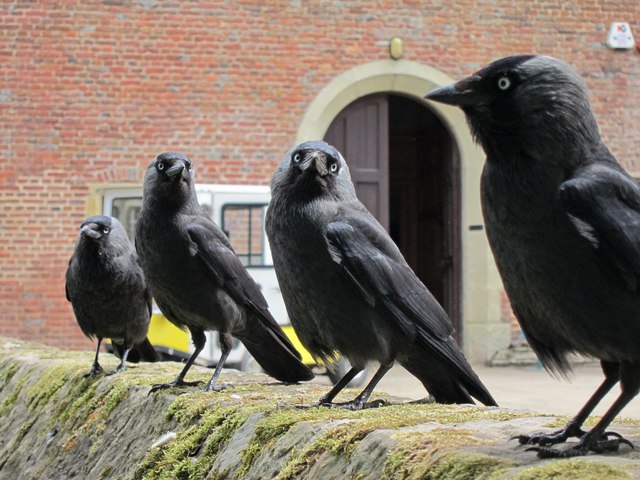
Jackdaws at Herstmonceux Castle

Jackdaws at Herstmonceux Castle

Somehow the busy yacking and cawing of the jackdaws and ravens, in Coburg, reminded Dr. Luther of the conspiring ecclesiastical kleptocrats whom he observed (and contended with), those crooked racketeers famous for grabbing (but not for giving) —  just as jackdaws and ravens are famous for shamelessly raiding the crop-fields that others work long and hard to produce food from.  (See 1st Peter 5:2-3; some things don’t change much!)

Quite a “diet”, pardon the pun.

*

James J. S. Johnson’s Articles

Orni-Theology

Jackdaw and Raven Corvidae Family

*

Birdwatching on Danish Zealand: Remembering a Sandwich Tern, at Hamlet’s Castle

Birdwatching on Danish Zealand:

Remembering a Sandwich Tern, at Hamlet’s Castle

 ~By James J. S. Johnson

Photo taken from http://mw2.google.com/mw-panoramio/photos/medium/14567172.jpg
(Photo taken from http://mw2.google.com/mw-panoramio/photos/medium/14567172.jpg )

This will be written for the generation to come, that a people yet to be created may praise the LORD. (Psalm 102:18)

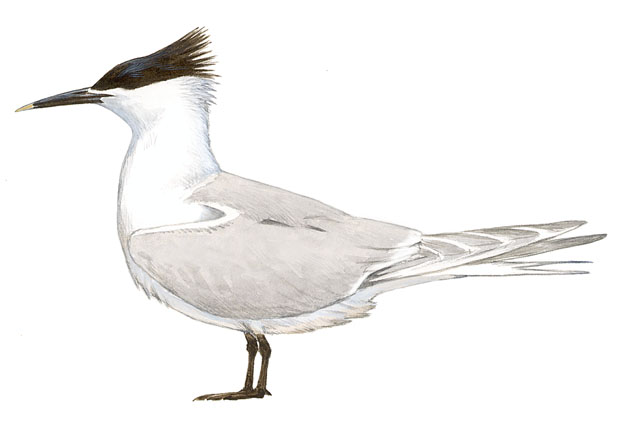
Sandwich Tern

(picture taken from http://blog.fuertecharter.com/wp-content/uploads/2015/04/F295_Dibujo_01.jpg)

The SANDWICH TERN (Thalasseus sanvicensis) is, as its name suggests, a member of the “tern” [Sternidae] family of seagulls.  (The term “Sandwich” refers to Sandwich, in Kent, western England, where this tern was formally identified in AD1787 by ornithologist-physician John Latham, MD.)

The Sandwich Tern is medium-to-large in size (for a tern), with a fairly large head (for a tern), a long thin bill, and a relatively short tail.   It may grow to 16 inches in length and 36 inches in wingspan (!), so it is obviously designed for aerodynamic flight – well-fitted for flying above its oceanic and coastland habitats.  Its thin bill is black, with a “butter-yellow” tip.  The Sandwich Tern is mostly white, appearing whiter (especially from a distance) than the Common Tern and Arctic Tern; it has greyish-white wings and (top) tail feathers.  The newer feathers, produced according to the tern’s molting cycle, are more greyish in color. The top and back of its flat-crowned head is black.  It has short black legs.

Sandwich Tern (Thalasseus sandvicensis) ©Rafy Rodriguez

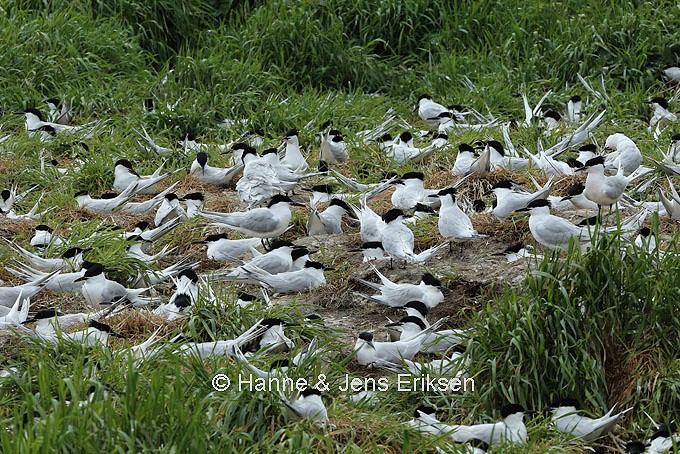
Sandwich Terns are sociable, nesting in densely packed colonies, sometimes mixed with other terns and small seagulls. [See Chris Kightley, Steve Madge, & Dave Nurney, POCKET GUIDE TO THE BIRDS OF BRITAIN AND NORTH-WEST EUROPE (New Haven: Yale University Press, 1998), page 150.]

Some consider the Cabot’s Tern of North America, which winters in and near the Caribbean (including Florida), as a close cousin of the Sandwich Tern.

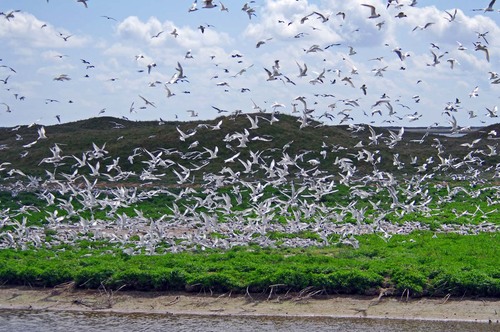
SandwichTerns

Photo taken from http://www.birdsoman.com/Birds/061-Gulls/SandwichTern/SandwichTern-19098.jpg

The Sandwich Tern’s summer range is predominantly coastal – not surprising for a tern, with its most populous summer range includes various coastal shores of the British Isles (England, Scotland, Orkney, Hebrides, Ireland — but not Wales), Holland (where it is called Grote stern), and Denmark (where it is called Splitterne), especially from late March through early October.  (Sandwich Terns are known to winter in various coastal areas of North Africa.)

Besides those coastlands, the Sandwich Tern is also known as a summer visitor in parts of France (where it is called Sterne caugek), Estonia, Belgium, and Germany (where it is called Brandseeschwalbe).  Its migratory travels allow it to be observed in other countries as well, such as Poland (breeding), Sweden (where it is called Kentsk tärna – often seen where Sweden almost touches Denmark), Norway (as a “vagrant”), Spain’s Mediterranean coast, and even northeastern Italy.  [See Roger Tory Peterson, Guy Mountfort, & P. A. D. Hollom, A FIELD GUIDE TO BIRDS OF BRITAIN AND EUROPE, 5th edition (Boston: Houghton Mifflin, 1993), page 134 & Range Map 174.]

SandwichTern - Cemlyn Lagoon Anglesy

SandwichTern – Cemlyn Lagoon Anglesy

[ photo taken from https://ateambirding.files.wordpress.com/2013/07/0611-sandwich-tern-cemlyn-lagoon-anglesy-29th-june-2013-img_6143.jpg ]

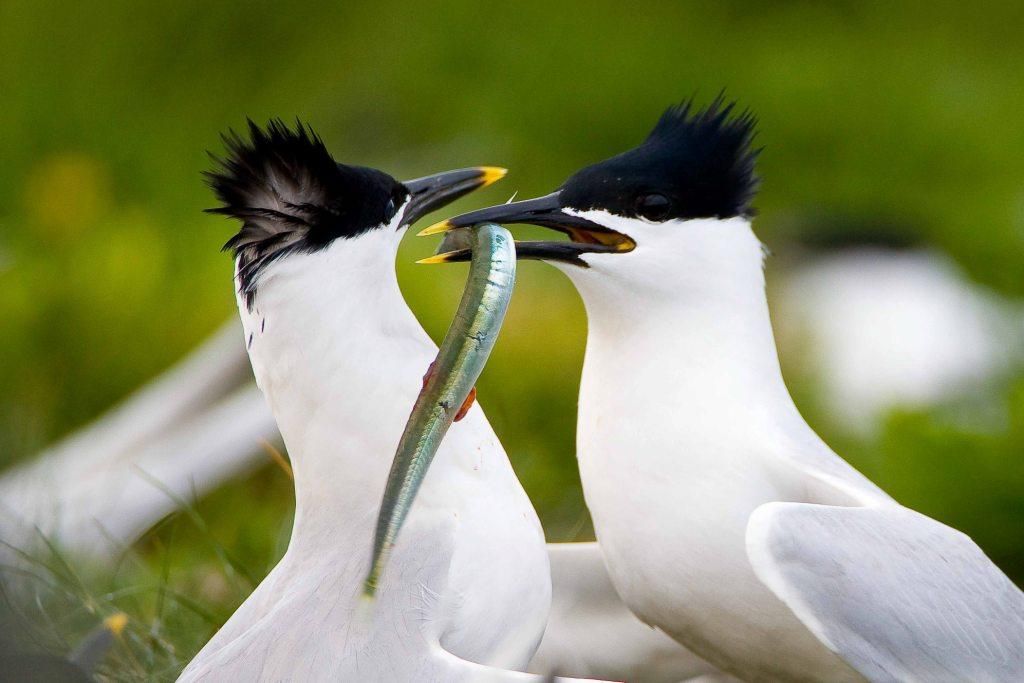
Like other terns (and gulls and fulmars, etc.), Sandwich Terns enjoy eating fish! Sandwich Terns catch their piscatorial repast by plunge-diving into the ocean.  (Occasionally they frequent lakes and ponds near coastlines, so lacustrine fish are also vulnerable to terns who elect to “go fishing” there.)

Sandwich Tern ©Jürgen Reich

Sandwich Tern ©Jürgen Reich

[Photo taken from http://www.helcom.fi/PublishingImages/baltic-sea-trends/environment-fact-sheets/latest-fact-sheets/population-development-of-sandwich-tern/Brandseeschwalben%20J%C3%BCrgen%20Reich_1.jpg ]

In addition to the shorelands of the British Isles, some parts of the Baltic Sea’s western coastline also host Sandwich Terns in the summer – including the shores at and near “Hamlet’s Castle” in Helsingør, in eastern Denmark.  In fact, it was at “Hamlet’s Castle” where I saw a Sandwich Tern on the 4th of July in AD2006.

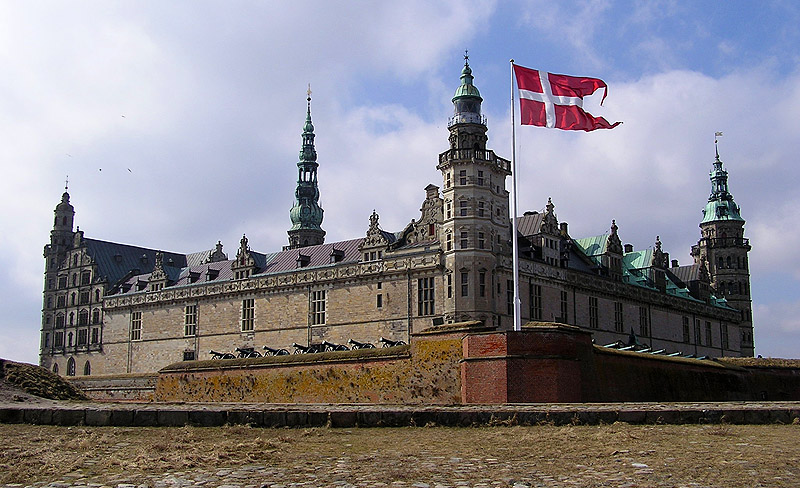
Medieval castle at Helsingør (on the island of Zealand)

Medieval castle at Helsingør (on the island of Zealand)

Photo from  https://en.wikipedia.org/wiki/Kronborg#/media/File:Helsingoer_Kronborg_Castle.jpg

Why is the medieval castle at Helsingør (on the island of Zealand, at the narrowest part of the strait of Øresund, which strait separated Denmark and Sweden), built back in the AD1420s (by the Kalmar Union triple-crown king, Eirik, “king of Denmark, Sweden, and Norway, king of the Wends and the Goths, and Duke of Pomerania”), called “Hamlet’s Castle”?

“Shakespeare brought Kronborg Slot [i.e., Kronborg Castle] world renown as the [fictional] backdrop of his ‘HAMLET’.  Most of the magnificent Renaissance castle, which has had its present appearance since 1585, is accessible to the public.”  [Quoting Reinhard Ilg, JOURNEY THROUGH DENMARK (Stürtz, 2002; translation by Faith Gibson Tegethoff; photos by Tina Herzig & Horst Herzig), page 46.]

Kronborg Castle

Kronborg Castle

[ photo taken from  http://i1.trekearth.com/photos/2765/tdanny_denmark_kronborg_1.jpg ]

In Shakespeare’s famous play, HAMLET, the fundamental question of life is asked, “To be, or not to be?”  This is a fundamental question for every human being, yet it was beforehand a fundamental question that was considered and decided by God Himself, when He chose to give each one of us the lives we call our own.  Why?  While Shakespeare’s character Hamlet considered the grave question of whether to end his earthly existence with the famous words “to be, or not to be”, the choice even more basic than that was God’s sovereign decision to create us “to be” in the first place! [See, regarding this great question of life, considered with Psalm 102:18, http://www.icr.org/article/people-yet-be-created/ .

Just as the Lord chose to imagine and invent the maritime birds that we call Sandwich Terns, of His own beneficent and sovereign volition, He chose to imagine and invent us, as the specific (and unique) humans who each one of us is.  What a choice God made, when He did so!

And, knowing that we needed redemption, as human sinners descended from Adam, God also foresaw the need for the Lord Jesus Christ to be our Redeemer – so He planned for Christ’s Messiahship – long before we ever were created as the individuals we are  (John 17:24;  Ephesians 1:4;  1st Peter 1:20)all wonderful Bible verses, that Bob Webel taught me as a teenager!).

It is God’s providential grace and kindness that He chose to make us.  It is even more grace and kindness that He provided redemption in Christ to save us!   How should we then live, to appreciate Him for Who He isthat is the question, that (by God’s grace) our lives must daily answer!

This will be written for the generation to come, that a people yet to be created may praise the LORD. (Psalm 102:18)

*

Orni-Theology

James J. S. Johnson

People Yet To Be Created

Sandwich Terns – All About Birds

Sandwich Tern – Wikipedia

*

“Flag That Bird!” (Part 5)

Black Swan ©WikiC
“Flag That Bird!”  (Part 5)

by James J. S. Johnson

Better is the end of a thing than the beginning thereof: and the patient in spirit is better than the proud in spirit.  (Ecclesiastes 7:8)

This is the fifth and last article in this “Flag that bird!” series, on various birds that appear on national flags.  (In other words, this is this mini-series’ “swan song”.)

All of us know enthusiasm-fueled folks who proudly launch into a new project – yet they soon falter, when the initial excitement fizzles, and they somehow fail to employ the prolonged patience to follow a long-term project through to completion.  (But, as we all know, “a job half-done is a job undone”.)  Thankfully, this blogsite mini-series, on “flag birds”, has now reached its proper closure!  Of course, there are other flags (such as state and provincial flags) that depict birds, but this set of articles has predominantly focused on birds portrayed on national flags.  Accordingly, as promised before, this final sequel features two huge birds, a swan and a crane, plus another bird whose identity is less than fully certain.

For a quick review, these vexillology-related birds were previously featured, as follows:

Part 1, posted at Flag That Bird – Part 1  — Belgium’s Wallonian Chicken (Gallus gallus domesticus); Portugal’s Northern Goshawk (Accipiter gentilis); Burma’s Green Peafowl (Pavo muticus); and Dominica’s Sisserou Parrot (Amazona imperialis);

Part 2, posted at Flag That Bird – Part 2  — the British Antarctic Territory’s Emperor Penguin (Aptenodytes forsteri), and the Saint Helena Plover, a/k/a Saint Helena’s skinny-legged “Wirebird” (Charadrius sanctaehelenae);

Part 3, posted at Flag That Bird – Part 3  — Kiribati’s Great Frigatebird Emperor Penguin (Fregata minor); and

Part 4, posted at Flag That Bird – Part 4  — Papua New Guinea’s Raggiana Bird-of-Paradise (Paradisaea raggiana, f/k/a Gerrus paradisaea), and the ubiquitous Dove, best illustrated by the common pigeon, a/k/a Rock Dove (Columbia livia).

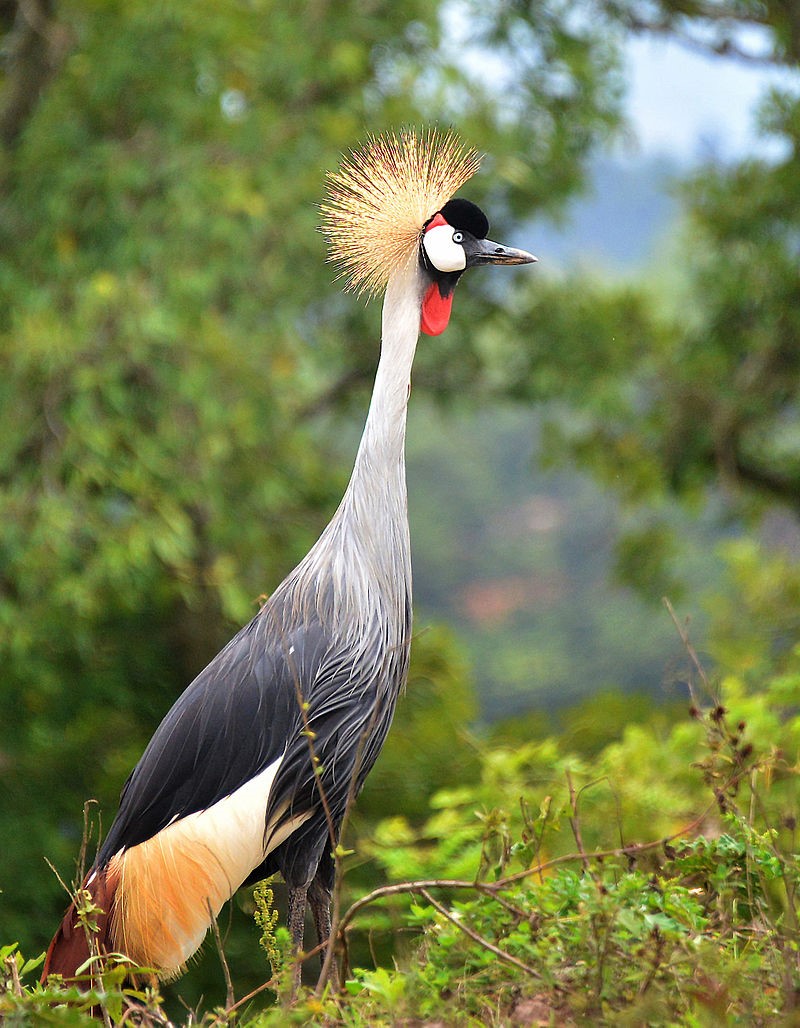
In this article, three remaining birds will be introduced:  (1) the black swan of Western Australia (Cygnus atratus); (2) the black and white “piping shrike” of South Australia, the exact identity of which is questionable, although this article will assume it is the same bird as the Australian magpie, perhaps more particularly the subspecies known as Cracticus tibicen telonocua, f/k/a Gymnorhina tibicen leuconota (e.g., by explorer Charles Sturt); and (3) Uganda’s crested crane (Balearica regulorum gibbericeps).

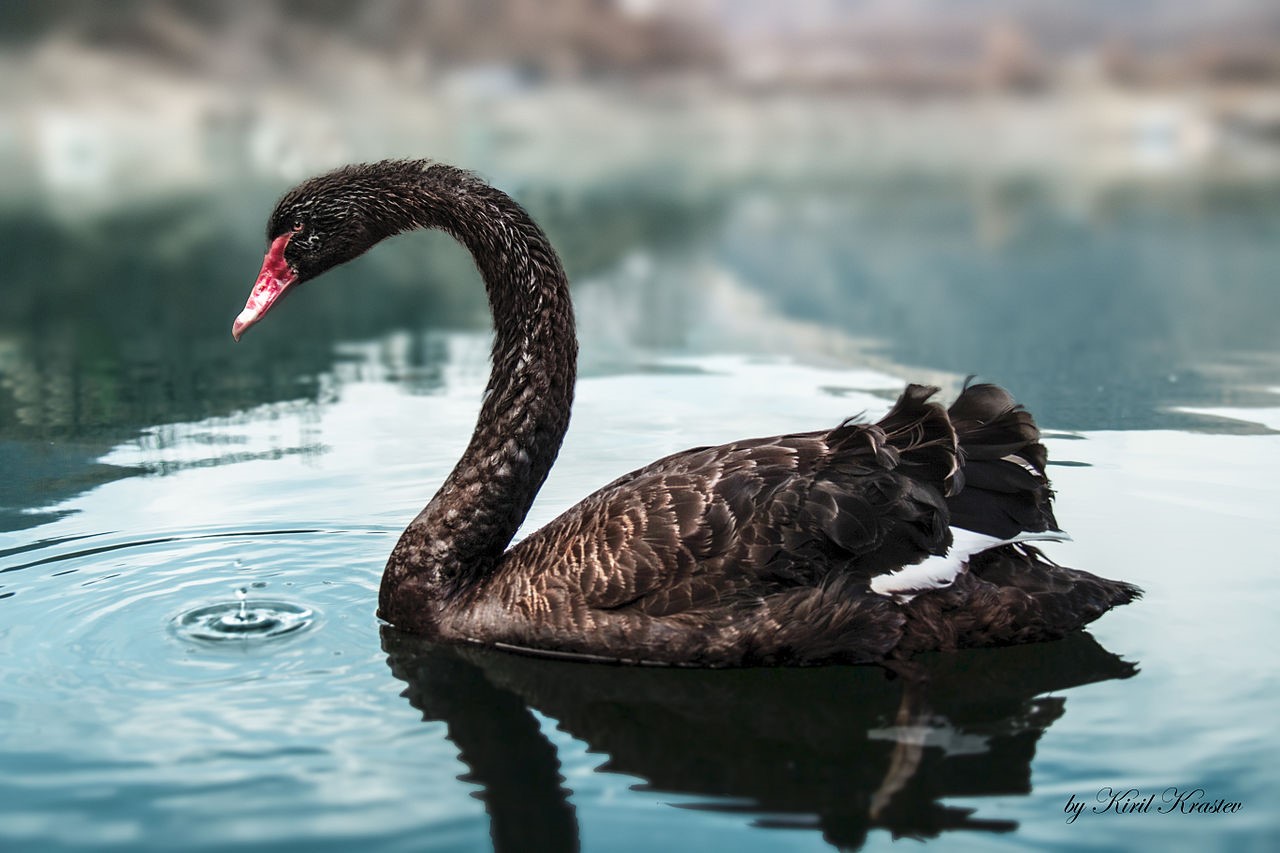
Black  Swan (Cygnus atratus).

Black Swan (Cygnus atratus) Ruffled ©WikiC

Black Swan (Cygnus atratus) Ruffled ©WikiC

Western Australia’s Black Swan (Cygnus atratus) appears on the official state flag of Western Australia (sometimes contracted as “Westralia”), which occupies the western third (i.e., almost a million square miles) of that island-continent country.  The Black Swan also presents prominently on Western Australia’s official coat-of-arms, flanked by two kangaroos.

Flag that bird - Flag of Western Australia

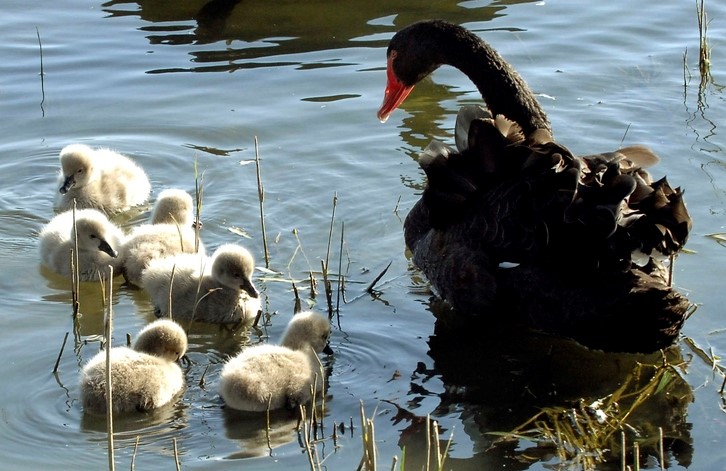
The Black Swan is well-named – their feathers are black (or black-grey, depending on how the sun shines on them), with a few white flight feathers.  Their bills are mostly bright scarlet, with a whitish bar near the tip.  And they are huge birds – adults can weigh between 8 to almost 20 pounds!  The wingspan breadth is between 5 to 6½ feet, like the length of a human lying down!  Their babies (called “cygnets”), however, are fuzzy white chicks, with dark bills, cute as they can be.

Black Swan (Cygnus atratus) with Cygnets ©WashPost

Black Swan (Cygnus atratus) with Cygnets ©WashPost

The first time that I ever saw Black Swans, excluding the confined context of a zoo’s aviary, was at The Broadmoor hotel complex in Colorado (located at the edge of Colorado Springs and Manitou Springs, within view of Pike’s Peak – an area perfect for viewing magpies).  But the Black Swan is not native to North America – it is an Aussie native.

Black Swan (Cygnus atratus) with Cygnets ©Broadmoor

Black Swan (Cygnus atratus) with Cygnets ©Broadmoor

Like other swans (e.g., the Trumpeter Swan, described at Trumpeting A Wildlife Conservation Comeback, its neck is S-curved and very long – in fact, the Black Swan has the longest neck of any swan.

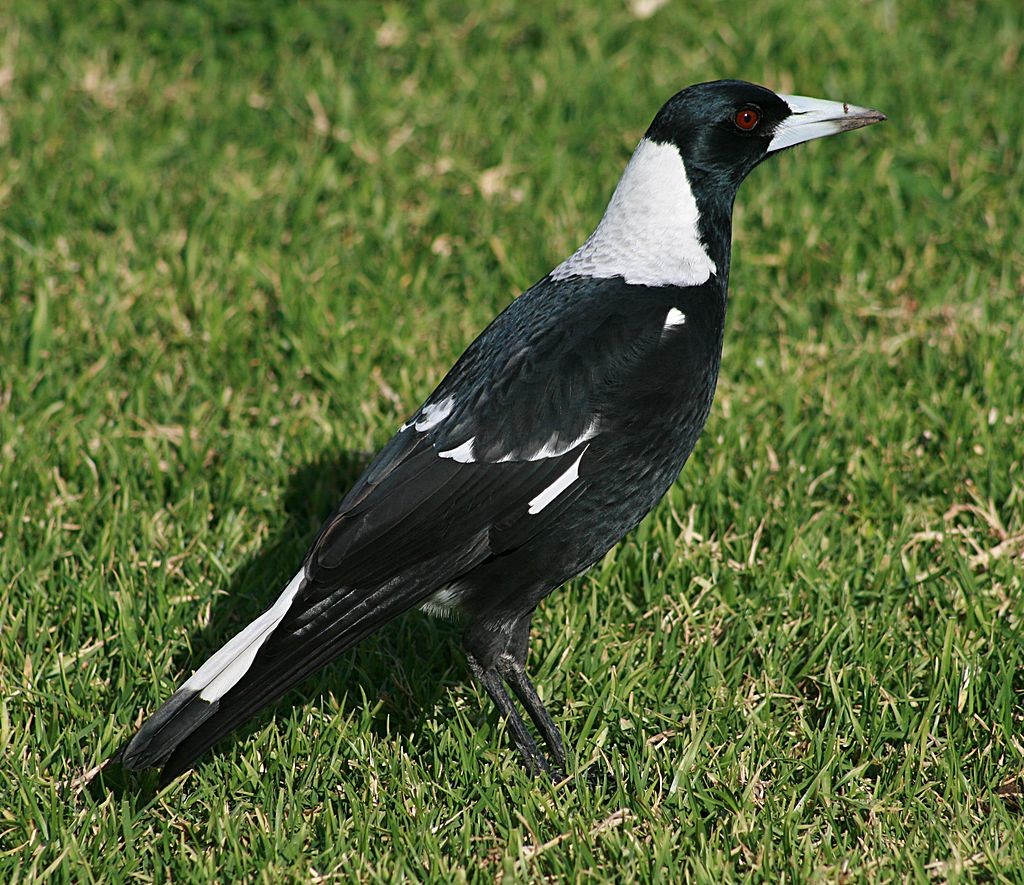
Australian Magpie (Cracticus tibicen, a/k/a Gymnorhina tibicen).

The official state flag of South Australia features a bird called a “piping shrike”, but what bird is that?  Many have analytically identified it as the species now called the Australian Magpie, (Cracticus tibicen), perhaps more particularly the subspecies once called the “White-backed Crow Shrike”, which his now called the white-backed magpie (Cracticus tibicen telonocua, f/k/a Gymnorhina tibicen leuconota).

Flag that bird - Flag of Western Australia - Magpie

The Australian Magpie has several subspecies nowadays, nine according to some taxonomists – although ornithologists know that such lump-or-split classifications are vulnerable to slippery subjectivities.  [For an insight into the arbitrary subjectivity of “lumper”-versus-“splitter” taxonomy, see Footnote #2 within http://www.icr.org/article/valuing-gods-variety .]

Australia Magpie on Dead Branch ©WikiC

Australia Magpie on Dead Branch ©WikiC

The Australian Magpie is deemed a type of “butcherbird” as opposed to the “corvid” category that includes the “magpies” of Europe and America.  The Australian Magpie is famous for its singing, entertaining (those with ears to hear) with a complex repertoire of vocalizations.  The black-and-white opportunist has habituated to human-dominated habitats, such as the agricultural fields of farms, gardens, and even wooded parklands.

Australia Magpie ©WikiC

Australia Magpie ©WikiC

The Australian Magpie is not a picky eater – its diet includes both plants and animals.  Its preferred diet, however, is dominated by a variety of larval and adult invertebrates, such as insects (like ants, moths, beetles, bees, wasps, cockroaches) and arachnids (like spiders, scorpions), as well as earthworms, millipedes.  The Australian Magpie is also known to eat some small vertebrates, such as rodents (like mice), lizards (like skinks), and/or amphibians (like frogs and toads).

Some compare the problem-solving resourcefulness and the brash cockiness – of this bird – to the national “reputation” displayed by many Aussie ex-patriots.  (Maybe Ken Ham should set the record straight on that topic!)  The Australian Magpie is quite a clever problem-solver  — it has been observed breaking off the stingers of bees and wasps, before swallowing such otherwise-dangerous bugs!  The Australian Magpie is not timid – it will defend its territory against raptors trespassing therein, such as Brown Goshawks.

Crested Crane (Balearica regulorum gibbericeps).

The official flag of Uganda sports a stylized depiction of a Crested Crane, a/k/a “East African Crowned Crane” (Balearica regulorum gibbericeps), which is a subspecies of the Grey Crowned Crane (Balearica regulorum).  The same crane appears on the Ugandan coat-of-arms.

The Ugandan coat-of-arms provides a more realistic picture of a Crested Crane.

Ugandan coat-of-arms Crested Crane

The East African Crowned Crane (a/k/a Crested Crane) is a tall bird, standing up to 4 feet tall!  It can weigh 6 to 8 pounds, while sporting a wingspan breadth of 6½ feet.  The plumage is dominated by slate-grey feathers, with wing feathers of white and chestnut orange.  The Crested Crane’s black head is adorned by white cheeks (accented with red) and a showy 3D “fan” crest, of golden top feathers, somewhat resembling fireworks.

Grey Crowned Crane ©WikiC

Grey Crowned Crane ©WikiC

Cranes – of various species – are famous for their long necks and long thin legs. Unlike herons (which fly with their necks “pulled back”), the Crested Crane (like other cranes) flies with its neck straightened and outstretched.  Like other cranes, the Crested Crane is gregarious – their aggregate nesting territories may host a flock of up to 200 residents.  These cranes are typically monogamous and territorial.  These socially stable birds are known to live as long as 20 to even 40 years of age.

In the wild, the Created Crane eats a mix of seeds (such as grains), other plant materials, insects, and worms.  Other foods eaten include eggs and fish, and even small lizards and frogs.  This diet is similar to the diet of other cranes (e.g., Sandhill Crane, Whooping Crane, Common Crane, etc.) around the world.  Cranes routinely eat whatever is available and convenient, so cranes are classified as “opportunist” feeders – consuming small mammals (like rodents), fish, snails, amphibians (like frogs), worms, insects, seeds (like grains, nuts, acorns), berries, root vegetables, and other plant materials (such as leaves.  As a matter of biome ecology, most cranes prefer wetlands, such as mudflats and other shorelands, or in wide open fields, such as prairies.

Common Crane in Estonia ©WikiC

Common Crane in Estonia Wetland ©WikiC

The “Common Crane” (Grus grus) is a cousin the these African cranes.  The Common Crane has a summer range, typically boreal forests (called taiga in Russia) that covered most of the top half of Eurasia, with blotches of winter ranges in Europe (Spain), Asia (e.g., China), and parts of Africa.

The zoologist George Cansdale [see his ALL THE ANIMALS OF THE BIBLE LANDS, pages 158-159] – after analyzing the mix of Biblical, ornithological, and biogeographical evidence – concludes that the Hebrew noun ‘agûr (e.g., in Jeremiah 8:7 & Isaiah 38:14) refers to the noisy Common Crane (Grus grus), an identification that the learned Hebrew scholar John Joseph Owens concurs with [see his ANALYTICAL KEY TO THE OLD TESTAMENT, volume 4, pages 116 & 242].  Matching the ‘agûr of Isaiah 38:14, the Common Crane is clamorously noisy, especially when agitated.  Cranes are also phenological migrants, a trait that accords with Jeremiah 8:7.

A review of our introductory verse provides another insight, the contrast between patience and pride:

Better is the end of a thing than the beginning thereof: and the patient in spirit is better than the proud in spirit.  (Ecclesiastes 7:8)

In Ecclesiastes 7:8 the Hebrew adjective translated “patient” is ’erek – it denotes someone or something that is prolonged, drawn out, slow, longsuffering.  Accordingly, to be “patient in spirit” is to be willing to wait one’s turn, according to God’s providential line-up (and timing).  A humble person doesn’t butt in line; he or she patiently waits in the queue, for his or her turn.

In Ecclesiastes 7:8 the Hebrew adjective translated “proud” is gabah  — it denotes someone or something that is high, haughty, or high-minded, in some contexts what we sometimes call “uppity”.  Accordingly, to be “proud in spirit” is to regard one’s self as higher that one should, which is the opposite of what God (through Paul) commands us to be:

Let nothing be done through strife or vainglory; but in lowliness of mind let each [i.e., all of us] esteem others better than themselves.  Look not every man on his own things, but every man also on the things of others.  (Philippians 2:3-4)

Interestingly, humility and patience go well together, because accomplishing a long-term project often requires interacting successfully with other people, and getting other people to coöperate with you (so that your goals can be furthered) routinely requires you to serve their needs and goals.  This is called mutual symbiosis when we see it in birds; we call it “win-win” coöperation when humans do it.  In win-win situations the coöperating parties both further their respective goals, so their interactive relationship is not one-sided. (Contrast this with “parasite”-like people, who habitually take, but won’t give).

Unsurprisingly those who are haughty-minded, being selfish, are slow to appreciate this life principle, because “uppity” people cannot understand or accept the law of Acts 20:35, that “it is more blessed to give than to receive” (quoting the Lord Jesus Christ Himself).  Consequently, many who could help them, with their project checklists, may shy away  –  why host a parasite?   And so it is that many who are haughty are proud to assertively start – yet don’t finish – complex projects that require prolonged patience.   Why?  Part of the cost of succeeding was the cost of benefiting others who contribute to the project.  The end is predictable:  failure and shame.

For which of you, intending to build a tower, sitteth not down first, and counteth the cost, whether he have sufficient to finish it?  (Luke 14:28)

A sober lesson for long-term projects (including long-term relationships)!  Yet, this is a lesson much needed in America, nowadays, where impatient and high-minded “get-rich-quick” tactics all-too-often end in disappointment and discord.  (This author has seen many illustrations of this in business bankruptcy cases and in employment law contexts.)

In sum, thankfully, this “flags” the end of this mini-series on national vexillology-related birds.

*

“Flag That Bird!”(Part 1)(Part 2)(Part 3)(Part 4) 

Orni-Theology

James J. S. Johnson’s Articles

*