Drummers and Carpenters – Chapter 11

Downy Woodpecker (Picoides pubescens) Brevard Zoo by Dan

Is it a Downy or Hairy Woodpecker? Brevard Zoo by Dan

Drummers and Carpenters

The Downy, Hairy and Red-headed Woodpeckers.

The Burgess Bird Book For Children

*

Listen to the story read.

CHAPTER 11. Drummers and Carpenters.

Peter Rabbit was so full of questions that he hardly knew which one to ask first. But Yellow Wing the Flicker didn’t give him a chance to ask any. From the edge of the Green forest there came a clear, loud call of, “Pe-ok! Pe-ok! Pe-ok!”

“Excuse me, Peter, there’s Mrs. Yellow Wing calling me,” exclaimed Yellow Wing, and away he went. Peter noticed that as he flew he went up and down. It seemed very much as if he bounded through the air just as Peter bounds over the ground. “I would know him by the way he flies just as far as I could see him,” thought Peter, as he started for home in the dear Old Briar-patch. “Somehow he doesn’t seem like a Woodpecker because he is on the ground so much. I must ask Jenny Wren about him.”

It was two or three days before Peter had a chance for a bit of gossip with Jenny Wren. When he did the first thing he asked was if Yellow Wing is a true Woodpecker.

Northern Flicker (Colaptes auratus) red-shafted F-left M-right ©WikiC

Northern Flicker (Colaptes auratus) red-shafted F-left M-right ©WikiC

“Certainly he is,” replied Jenny Wren. “Of course he is. Why under the sun should you think he isn’t?”

“Because it seems to me he is on the ground more than he’s in the trees,” retorted Peter. “I don’t know any other Woodpeckers who come down on the ground at all.”

“Tut, tut, tut, tut!” scolded Jenny. “Think a minute, Peter! Think a minute! Haven’t you ever seen Redhead on the ground?”

Peter blinked his eyes. “Ye-e-s,” he said slowly. “Come to think of it, I have. I’ve seen him picking up beechnuts in the fall. The Woodpeckers are a funny family. I don’t understand them.”

Just then a long, rolling rat-a-tat-tat rang out just over their heads. “There’s another one of them,” chuckled Jenny. “That’s Downy, the smallest of the whole family. He certainly makes an awful racket for such a little fellow. He is a splendid drummer and he’s just as good a carpenter. He made the very house I am occupying now.”

Peter was sitting with his head tipped back trying to see Downy. At first he couldn’t make him out. Then he caught a little movement on top of a dead limb. It was Downy’s head flying back and forth as he beat his long roll. He was dressed all in black and white. On the back of his head was a little scarlet patch. He was making a tremendous racket for such a little chap, only a little bigger than one of the Sparrow family.

“Is he making a hole for a nest up there?” asked Peter eagerly.

“Gracious, Peter, what a question! What a perfectly silly question!” exclaimed Jenny Wren scornfully. “Do give us birds credit for a little common sense. If he were cutting a hole for a nest, everybody within hearing would know just where to look for it. Downy has too much sense in that little head of his to do such a silly thing as that. When he cuts a hole for a nest he doesn’t make any more noise than is absolutely necessary. You don’t see any chips flying, do you?”

“No-o,” replied Peter slowly. “Now you speak of it, I don’t. Is—is he hunting for worms in the wood?”

Jenny laughed right out. “Hardly, Peter, hardly,” said she. “He’s just drumming, that’s all. That hollow limb makes the best kind of a drum and Downy is making the most of it. Just listen to that! There isn’t a better drummer anywhere.”

But Peter wasn’t satisfied. Finally he ventured another question. “What’s he doing it for?”

“Good land, Peter!” cried Jenny. “What do you run and jump for in the spring? What is Mr. Wren singing for over there? Downy is drumming for precisely the same reason—happiness. He can’t run and jump and he can’t sing, but he can drum. By the way, do you know that Downy is one of the most useful birds in the Old Orchard?”

Just then Downy flew away, but hardly had he disappeared when another drummer took his place. At first Peter thought Downy had returned until he noticed that the newcomer was just a bit bigger than Downy. Jenny Wren’s sharp eyes spied him at once.

“Hello!” she exclaimed. “There’s Hairy. Did you ever see two cousins look more alike? If it were not that Hairy is bigger than Downy it would be hard work to tell them apart. Do you see any other difference, Peter?”
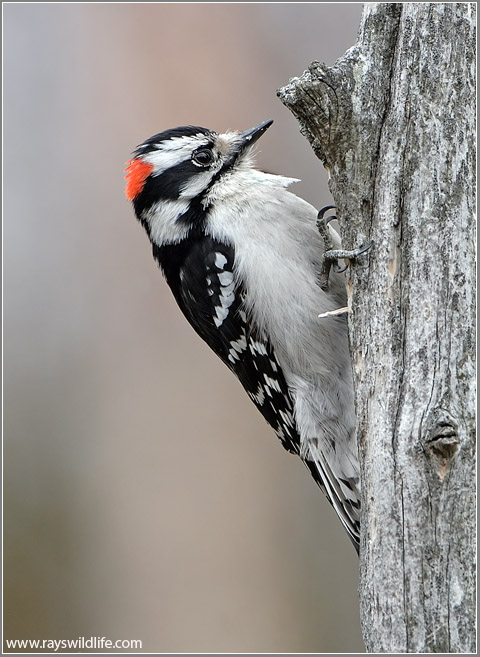
Downy Woodpecker (Picoides pubescens) by Raymond Barlow

Downy Woodpecker (Picoides pubescens) by Raymond Barlow

Peter stared and blinked and stared again, then slowly shook his head. “No,” he confessed, “I don’t.”

“That shows you haven’t learned to use your eyes, Peter,” said Jenny rather sharply. “Look at the outside feathers of his tail; they are all white. Downy’s outside tail feathers have little bars of black. Hairy is just as good a carpenter as is Downy, but for that matter I don’t know of a member of the Woodpecker family who isn’t a good carpenter. Where did you say Yellow Wing the Flicker is making his home this year?”

“Over in the Big Hickory-tree by the Smiling Pool,” replied Peter. “I don’t understand yet why Yellow Wing spends so much time on the ground.”

Ants,” replied Jenny Wren. “Just ants. He’s as fond of ants as is Old Mr. Toad, and that is saying a great deal. If Yellow Wing keeps on he’ll become a ground bird instead of a tree bird. He gets more than half his living on the ground now. Speaking of drumming, did you ever hear Yellow Wing drum on a tin roof?”

Peter shook his head.

“Well, if there’s a tin roof anywhere around, and Yellow Wing can find it, he will be perfectly happy. He certainly does love to make a noise, and tin makes the finest kind of a drum.”

Just then Jenny was interrupted by the arrival, on the trunk of the very next tree to the one on which she was sitting, of a bird about the size of Sammy Jay. His whole head and neck were a beautiful, deep red. His breast was pure white, and his back was black to nearly the beginning of his tail, where it was white.
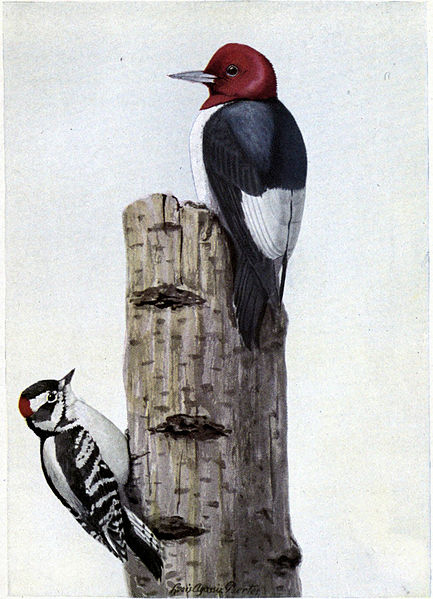
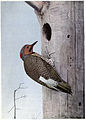
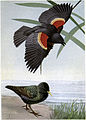
Redhead the Woodpecker, Downy the Woodpecker - Burgess Bird Book ©©

Redhead the Woodpecker, Downy the Woodpecker – Burgess Bird Book ©©

“Hello, Redhead!” exclaimed Jenny Wren. “How did you know we were talking about your family?”

“Hello, chatterbox,” retorted Redhead with a twinkle in his eyes. “I didn’t know you were talking about my family, but I could have guessed that you were talking about some one’s family. Does your tongue ever stop, Jenny?”

Jenny Wren started to become indignant and scold, then thought better of it. “I was talking for Peter’s benefit,” said she, trying to look dignified, a thing quite impossible for any member of the Wren family to do. “Peter has always had the idea that true Woodpeckers never go down on the ground. I was explaining to him that Yellow Wing is a true Woodpecker, yet spends half his time on the ground.”

Redhead nodded. “It’s all on account of ants,” said he. “I don’t know of any one quite so fond of ants unless it is Old Mr. Toad. I like a few of them myself, but Yellow Wing just about lives on them when he can. You may have noticed that I go down on the ground myself once in a while. I am rather fond of beetles, and an occasional grasshopper tastes very good to me. I like a variety. Yes, sir, I certainly do like a variety—cherries, blackberries, raspberries, strawberries, grapes. In fact most kinds of fruit taste good to me, not to mention beechnuts and acorns when there is no fruit.

Jenny Wren tossed her head. “You didn’t mention the eggs of some of your neighbors,” said she sharply.

Redhead did his best to look innocent, but Peter noticed that he gave a guilty start and very abruptly changed the subject, and a moment later flew away.

“Is it true,” asked Peter, “that Redhead does such a dreadful thing?”

Jenny bobbed her head rapidly and jerked her tail. “So I am told,” said she. “I’ve never seen him do it, but I know others who have. They say he is no better than Sammy Jay or Blacky the Crow. But gracious, goodness! I can’t sit here gossiping forever.” Jenny twitched her funny little tail, snapped her bright eyes at Peter, and disappeared in her house.

Bold points for questions at the bottom or for Christian traits.

*

For thou shalt eat the labour of thine hands: happy shalt thou be, and it shall be well with thee. (or your beak) (Psalms 128:2 KJV)

He that handleth a matter wisely shall find good: and whoso trusteth in the LORD, happy is he. (Proverbs 16:20 KJV)

Seems like these woodpeckers enjoy doing what that is a sign they are happy?

  • Who are the four members of the Woodpecker family mentioned?
  • How does a Woodpecker fly?
  • Which is the smallest member of the family?
  • Can you describe him?
  • Which Woodpecker is just a little bit larger?
  • What about its tail?
  • Which one likes to eat on the ground half the time?
  • What is he looking for?
  • What does Redhead like to eat?

Links:

Woodpeckers – Picidae Family

Woodpecker – All About Birds

Woodpecker – Wikipedia

*

Links:
Creaker the Purple Grackle, The Male Cowbird - Burgess Bird Book ©©Thum


  Next Chapter Some Unlikely Relatives


Burgess-Bird-Book-for-Children


Burgess Bird Book For Children


Robust Woodpecker (Campephilus robustus) by BirdPhotos_com


Wordless Birds

*

*


The Old Man and the Ibises

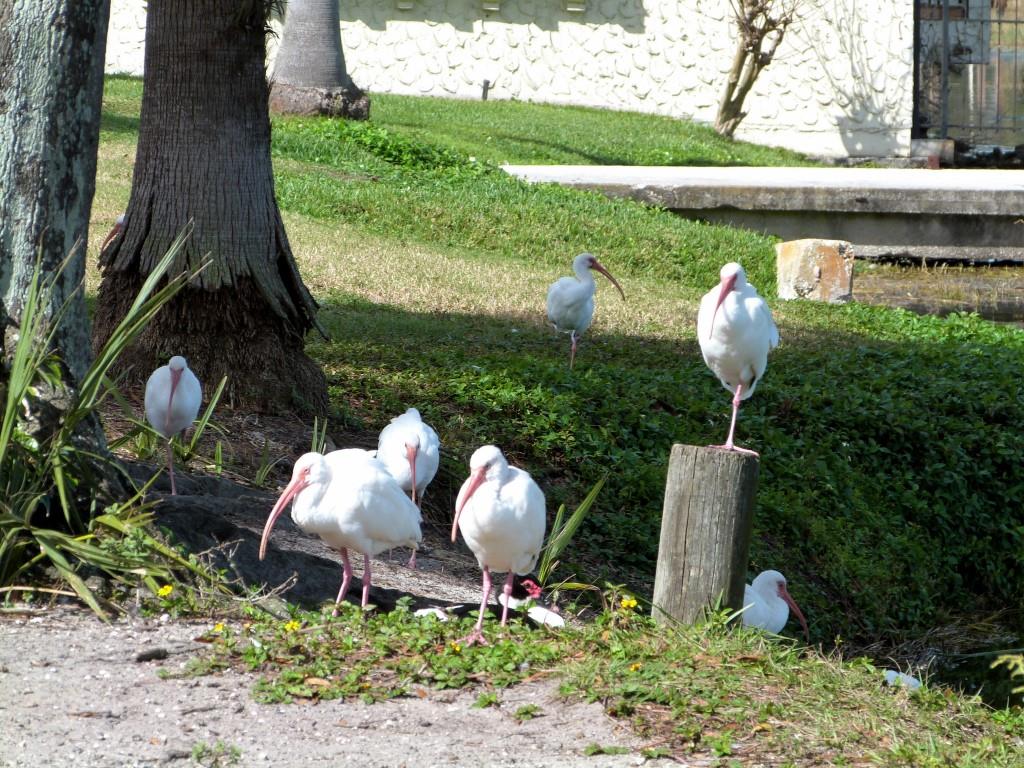
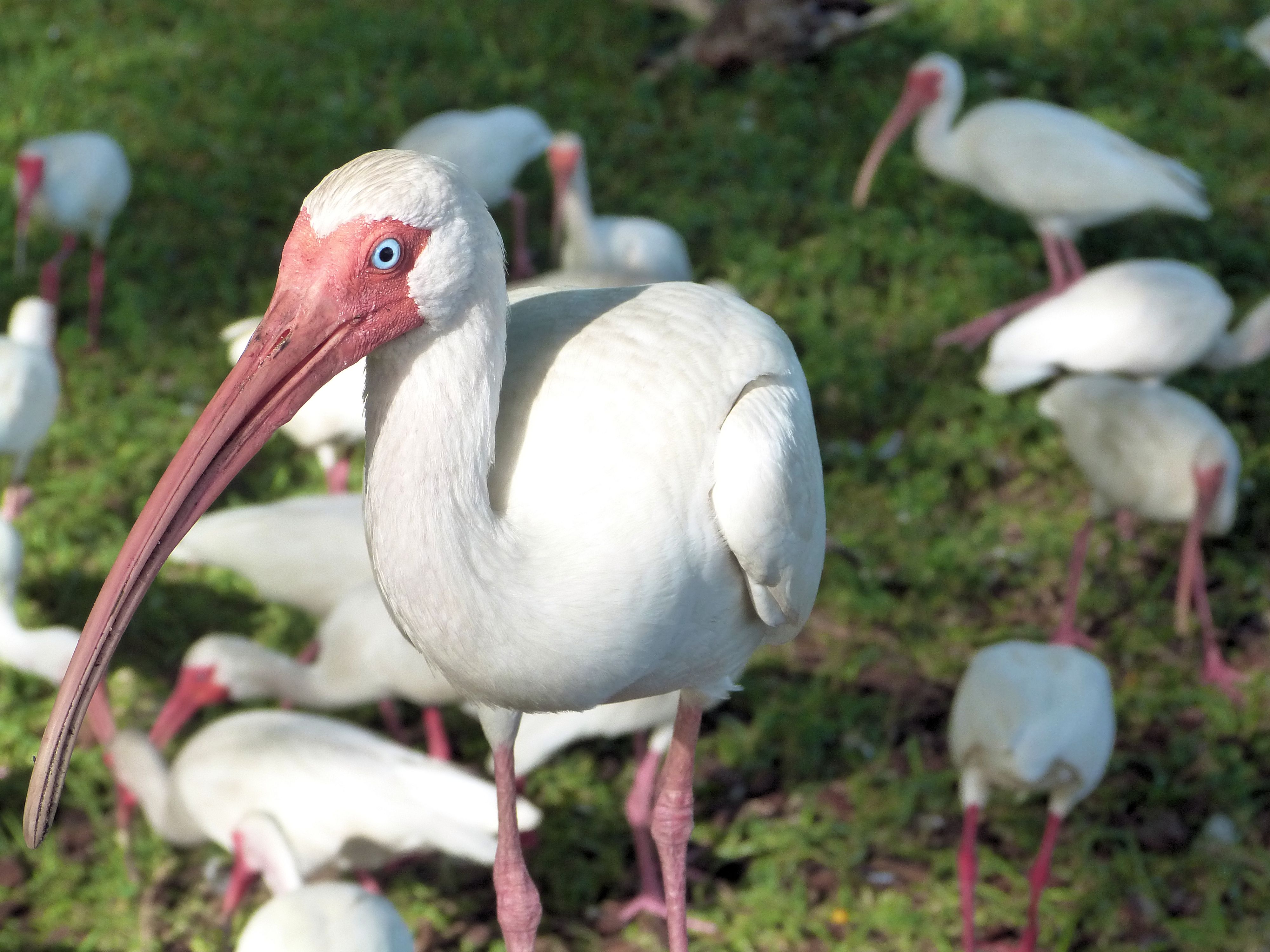
White Ibises

White Ibises at the park by Lee

The Old Man and the Ibises

by Emma Foster

Once there was a little boy who had short brown hair and was kind of short for his age. Every week, his parents would take him to a small park by a big lake.

When they arrived, the little boy fed  the ibises bread and talked to them about how he was about to start school. The ibises ate as much bread as they could hold and decided they liked hearing the little boy talk.

Several years passed and the little boy became a teenager. He started having problems with his grades. After failing another math test, the boy drove down to the park with some bread. Watching the ibises fly over and eat the bread made the boy feel a lot better and the ibises listened patiently as he told them all about how he could not get his grades to improve.

Eventually the teenage boy became a man and got married. The ibises started to multiply. A few years later, the man brought his children to the park. The ibises did the same. The man and his wife watched as their kids fed the ibises and as the ibises showed their children how to eat the bread with them. The man also taught his children how to talk to them.

White Ibis on Table by Lee

White Ibis on Table Listening by Lee

Many years passed and all the man’s children grew up and moved away. The man grew old, but he still drove to the park every week to feed the ibises.

Finally, one day, the old man grew too old to drive. He took one last drive to the park however. The ibises came as usual. The old man told the ibises that he wouldn’t be able to come and see them anymore because he couldn’t drive much longer. The ibises were very sad when they heard this statement. As the old man drove home, the ibises decided to fly after his car and follow him home. Soon there was a great flock of birds following the old man’s car.

The next day the old man opened his front door to get the mail and found the flock of ibises. The old man was very happy about the ibises coming to his house every day. From that day on, the ibises flew to the old man’s’ house so he could feed them bread.

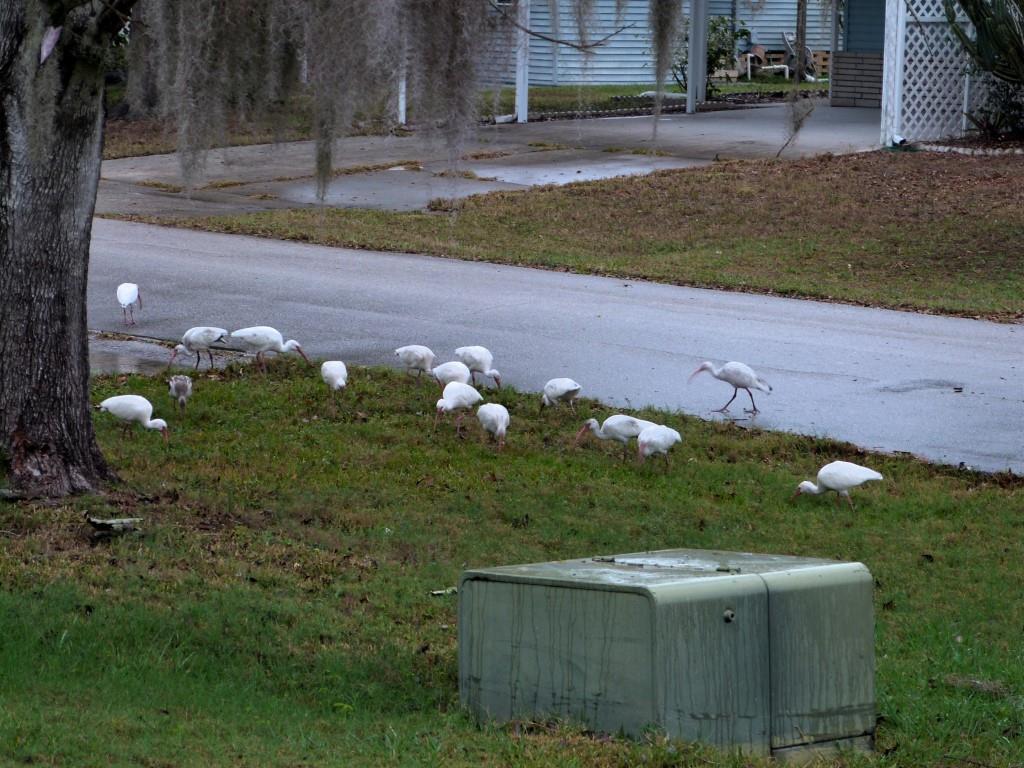
American White Ibis (Eudocimus albus) 1st Birds of 2014 by Lee

American White Ibis (Eudocimus albus) coming to the yard by Lee

The End


Lee’s Addition:

Put on therefore, as the elect of God, holy and beloved, bowels of mercies, kindness, humbleness of mind, meekness, longsuffering; (Colossians 3:12 KJV)

Emma has written another fine Bird Tale for us. It is enjoyable to watch as she is developing her writing skills. Each tale is better than the one before. This one is very heart touching. (Maybe it meant a lot because I wonder if the birds will come “people-watching” here when I can no longer go watch them.)

A man that hath friends must shew himself friendly: and there is a friend that sticketh closer than a brother. (Proverbs 18:24 KJV)

To shew forth thy lovingkindness in the morning, and thy faithfulness every night, (Psalms 92:2 KJV)

There is much friendliness and kindness shown in this story.

More Bird Tales by Emma Foster

Other Bird Tales

Wordless Birds

*

Designed for Flight – Creation Moments TV

An eagle fishing

An eagle fishing

For thus says the LORD: “Behold, one will fly swiftly like an eagle And spread out his wings against Moab. (Jeremiah 48:40 NASB)

Creation Moments articles have been used here many times. Now they have a YouTube Channel called Creation Moments TV.

While checking out their new videos, I found this one about birds and thought you might enjoy seeing it. Watching instead of reading is more enjoyable at times. Though reading is still good for us or else those of us who do blogs would be out of business.

God created the great sea monsters and every living creature that moves, with which the waters swarmed after their kind, and every winged bird after its kind; and God saw that it was good. (Genesis 1:21 NASB)

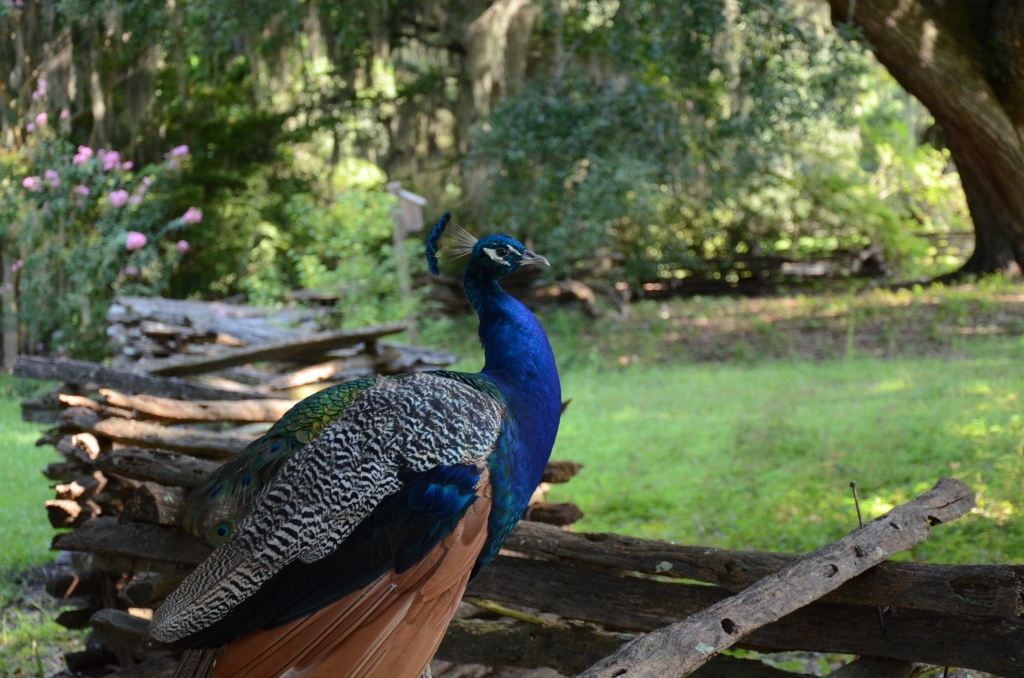
Peacock at Magnolia Plantation by Dan

Peacock at Magnolia Plantation by Dan

Creation Moments TV

Interesting Things from Creation Moments

When I Consider

*

Live Cams from All About Birds

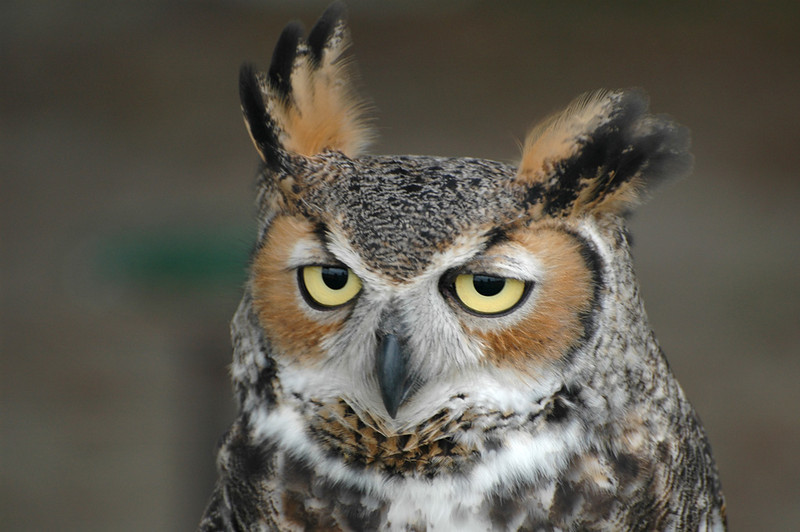
Great Horned Owl (Bubo virginianus) by Bob-Nan

Great Horned Owl (Bubo virginianus) by Bob-Nan

The little owl, and the great owl, and the swan, (Deuteronomy 14:16 KJV)

There shall the great owl make her nest, and lay, and hatch, and gather under her shadow: there shall the vultures also be gathered, every one with her mate. (Isaiah 34:15 KJV)

Are you aware of the Live Cameras that All About Birds are sharing? They are very interesting to watch. The latest that was shared with me is a Great Horned Owl nest Cam in Savannah, GA.

Take a look”

Here is a link that shows more about the Great Horned Owls there.

http://cams.allaboutbirds.org/channel/46/Great_Horned_Owls/

How about some Laysan Albatross nest in Hawaii?

Here is there link for the Albatross.

http://cams.allaboutbirds.org/channel/41/Laysan_Albatross/

Aren’t these amazing? It is alway great to watch the Lord’s amazing creations, but to get to see them at the nest or at feeders is neat with today’s technology.

If you would like to see all the current Cams from All About Birds click this link. Not all the camera are operating all the time, but this page will help you find the live one as the current time.

http://cams.allaboutbirds.org/all-cams/

*

Birds of the Bible – Owls

Strigidae – Owls

Diomedeidae – Albatrosses Family

*


Redwing and Yellow Wing – Chapter 10

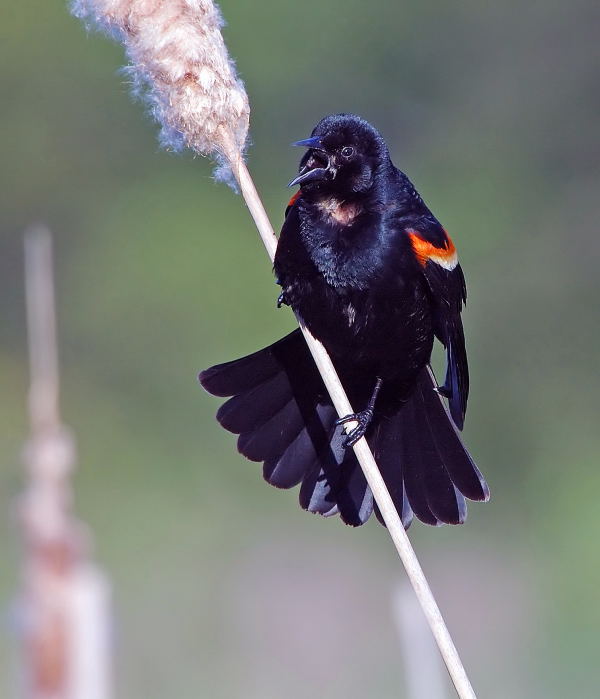
Red-winged Blackbird (Agelaius phoeniceus) by Ray

Redwing and Yellow Wing

The Red-winged Blackbird and the Golden-winged Flicker.

The Burgess Bird Book For Children

*

CHAPTER 10. Redwing and Yellow Wing.

Listen to the story read.

Peter had come over to the Smiling Pool especially to pay his respects to Redwing the Blackbird, so as soon as he could, without being impolite, he left Mrs. Teeter sitting on her eggs, and Teeter himself bobbing and bowing in the friendliest way, and hurried over to where the bulrushes grow. In the very top of the Big Hickory-tree, a little farther along on the bank of the Smiling Pool, sat some one who at that distance appeared to be dressed all in black. He was singing as if there were nothing but joy in all the great world. “Quong-ka-reee! Quong-ka-reee! Quong-ka-reee!” he sang. Peter would have known from this song alone that it was Redwing the Blackbird, for there is no other song quite like it.

As soon as Peter appeared in sight Redwing left his high perch and flew down to light among the broken-down bulrushes. As he flew, Peter saw the beautiful red patch on the bend of each wing, from which Redwing gets his name. “No one could ever mistake him for anybody else,” thought Peter, “For there isn’t anybody else with such beautiful shoulder patches.”

“What’s the news, Peter Rabbit?” cried Redwing, coming over to sit very near Peter.

“There isn’t much,” replied Peter, “excepting that Teeter the Sandpiper has four eggs just a little way from here.”

Redwing chuckled. “That is no news, Peter,” said he. “Do you suppose that I live neighbor to Teeter and don’t know where his nest is and all about his affairs? There isn’t much going on around the Smiling Pool that I don’t know, I can tell you that.”

Peter looked a little disappointed, because there is nothing he likes better than to be the bearer of news. “I suppose,” said he politely, “that you will be building a nest pretty soon yourself, Redwing.”

Redwing chuckled softly. It was a happy, contented sort of chuckle. “No, Peter,” said he. “I am not going to build a nest.”

“What?” exclaimed Peter, and his two long ears stood straight up with astonishment.

“No,” replied Redwing, still chuckling. “I’m not going to build a nest, and if you want to know a little secret, we have four as pretty eggs as ever were laid.”

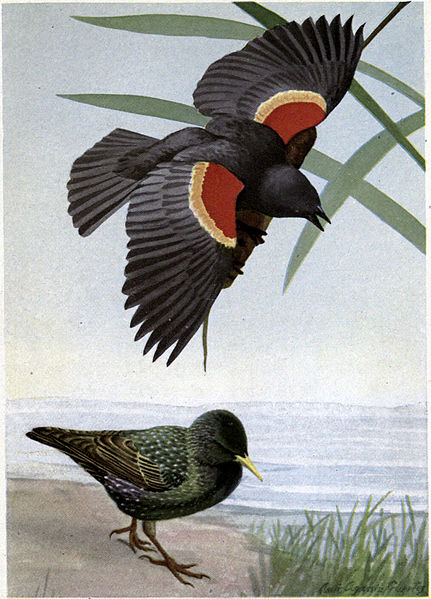
Redwing the Blackbird, Speckles the Starling - Burgess Bird Book ©©

Redwing the Blackbird, Speckles the Starling – Burgess Bird Book ©©

Peter fairly bubbled over with interest and curiosity. “How splendid!” he cried. “Where is your nest, Redwing? I would just love to see it. I suppose it is because she is sitting on those eggs that I haven’t seen Mrs. Redwing. It was very stupid of me not to guess that folks who come as early as you do would be among the first to build a home. Where is it, Redwing? Do tell me.”

Redwing’s eyes twinkled.

     "A secret which is known by three
      Full soon will not a secret be,"

said he. “It isn’t that I don’t trust you, Peter. I know that you wouldn’t intentionally let my secret slip out. But you might do it by accident. What you don’t know, you can’t tell.”

“That’s right, Redwing. I am glad you have so much sense,” said another voice, and Mrs. Redwing alighted very near to Redwing.

Peter couldn’t help thinking that Old Mother Nature had been very unfair indeed in dressing Mrs. Redwing. She was, if anything, a little bit smaller than her handsome husband, and such a plain, not to say homely, little body that it was hard work to realize that she was a Blackbird at all. In the first place she wasn’t black. She was dressed all over in grayish-brown with streaks of darker brown which in places were almost black. She wore no bright-colored shoulder patches. In fact, there wasn’t a bright feather on her anywhere. Peter wanted to ask why it was that she was so plainly dressed, but he was too polite and decided to wait until he should see Jenny Wren. She would be sure to know. Instead, he exclaimed, “How do you do, Mrs. Redwing? I’m ever so glad to see you. I was wondering where you were. Where did you come from?”

“Straight from my home,” replied Mrs. Redwing demurely. “And if I do say it, it is the best home we’ve ever had.”

Redwing chuckled. He was full of chuckles. You see, he had noticed how eagerly Peter was looking everywhere.

“This much I will tell you, Peter,” said Redwing; “our nest is somewhere in these bulrushes, and if you can find it we won’t say a word, even if you don’t keep the secret.”

Then Redwing chuckled again and Mrs. Redwing chuckled with him. You see, they knew that Peter doesn’t like water, and that nest was hidden in a certain clump of brown, broken-down rushes, with water all around. Suddenly Redwing flew up in the air with a harsh cry. “Run, Peter! Run!” he screamed. “Here comes Reddy Fox!

Peter didn’t wait for a second warning. He knew by the sound of Redwing’s voice that Redwing wasn’t joking. There was just one place of safety, and that was an old hole of Grandfather Chuck’s between the roots of the Big Hickory-tree. Peter didn’t waste any time getting there, and he was none too soon, for Reddy was so close at his heels that he pulled some white hairs out of Peter’s tail as Peter plunged headfirst down that hole. It was a lucky thing for Peter that that hole was too small for Reddy to follow and the roots prevented Reddy from digging it any bigger.

For a long time Peter sat in Grandfather Chuck’s old house, wondering how soon it would be safe for him to come out. For a while he heard Mr. and Mrs. Redwing scolding sharply, and by this he knew that Reddy Fox was still about. By and by they stopped scolding, and a few minutes later he heard Redwing’s happy song. “That means,” thought Peter, “that Reddy Fox has gone away, but I think I’ll sit here a while longer to make sure.”

Now Peter was sitting right under the Big Hickory-tree. After a while he began to hear faint little sounds, little taps, and scratching sounds as of claws. They seemed to come from right over his head, but he knew that there was no one in that hole but himself. He couldn’t understand it at all.

Finally Peter decided it would be safe to peek outside. Very carefully he poked his head out. Just as he did so, a little chip struck him right on the nose. Peter pulled his head back hurriedly and stared at the little chip which lay just in front of the hole. Then two or three more little chips fell. Peter knew that they must come from up in the Big Hickory-tree, and right away his curiosity was aroused. Redwing was singing so happily that Peter felt sure no danger was near, so he hopped outside and looked up to find out where those little chips had come from. Just a few feet above his head he saw a round hole in the trunk of the Big Hickory-tree. While he was looking at it, a head with a long stout bill was thrust out and in that bill were two or three little chips. Peter’s heart gave a little jump of glad surprise.

Northern Flicker (Colaptes auratus) yellow-shafted ©WikiC

Northern Flicker (Colaptes auratus) yellow-shafted ©WikiC

Yellow Wing!” he cried. “My goodness, how you startled me!”

The chips were dropped and the head was thrust farther out. The sides and throat were a soft reddish-tan and on each side at the beginning of the bill was a black patch. The top of the head was gray and just at the back was a little band of bright red. There was no mistaking that head. It belonged to Yellow Wing the Flicker beyond a doubt.

“Hello, Peter!” exclaimed Yellow Wing, his eyes twinkling. “What are you doing here?”

“Nothing,” replied Peter, “but I want to know what you are doing. What are all those chips?”

“I’m fixing up this old house of mine,” replied Yellow Wing promptly. “It wasn’t quite deep enough to suit me, so I am making it a little deeper. Mrs. Yellow Wing and I haven’t been able to find another house to suit us, so we have decided to live here again this year.” He came wholly out and flew down on the ground near Peter. When his wings were spread, Peter saw that on the under sides they were a beautiful golden-yellow, as were the under sides of his tail feathers. Around his throat was a broad, black collar. From this, clear to his tail, were black dots. When his wings were spread, the upper part of his body just above the tail was pure white.

“My,” exclaimed Peter, “you are a handsome fellow! I never realized before how handsome you are.”

Yellow Wing looked pleased. Perhaps he felt a little flattered. “I am glad you think so, Peter,” said he. “I am rather proud of my suit, myself. I don’t know of any member of my family with whom I would change coats.”

A sudden thought struck Peter. “What family do you belong to?” He asked abruptly.

“The Woodpecker family,” replied Yellow Wing proudly.

*

Nevertheless if you warn the righteous man that the righteous should not sin, and he does not sin, he shall surely live because he took warning; also you will have delivered your soul.” (Ezekiel 3:21 NKJV)

I do not write these things to shame you, but as my beloved children I warn you. (1 Corinthians 4:14 NKJV)

That was mighty nice of Redwing to warn Peter Rabbit. We need to listen when others warn us. Like, “don’t get too close to the fire” or “watch out for the cars!” We should also help others by warning them so they don’t get hurt. We need to tell others about Christ and warn them to not ignore His teaching.

Some questions to see if you remember the tale:

  • Who is our newest bird?
  • What does he have on his shoulders?
  • What does his song sound like?
  • Does Mrs. Redwing look like him? Describe her.
  • Why did Redwing warn Peter Rabbit?
  • What family does the Yellow Wing belong to?

Links:

*

Links:


  Next Chapter (Drummers and Carpenters)


Burgess-Bird-Book-for-Children


Burgess Bird Book For Children


Wordless Birds – Toucan


*

Bird’s Egg Evolution – Creation Moments

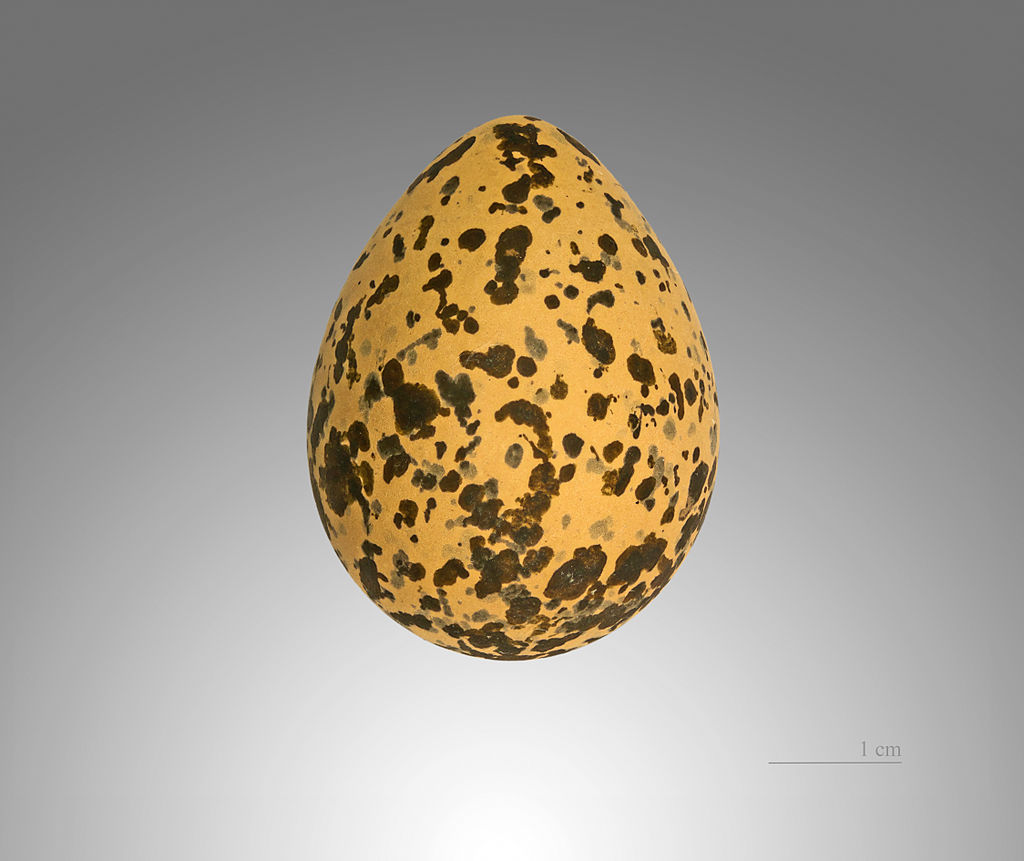
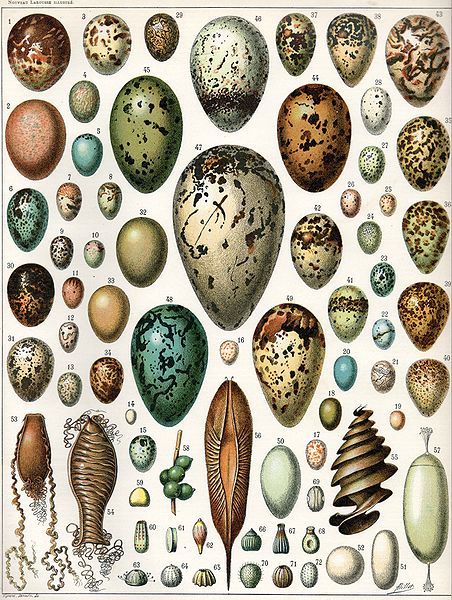
Spur-winged Lapwing (Vanellus spinosus) Egg ©Wiki

Spur-winged Lapwing (Vanellus spinosus) Egg ©Wiki

BIRDS EGG EVOLUTION

“Which leaveth her eggs in the earth, and warmeth them in dust, and forgetteth that the foot may crush them, or that the wild beast may break them.” (Job 39:14-15)

The creation is literally filled with millions of what those who believe in evolution call “happy coincidences.” But when you encounter millions of instances of what appears to be thoughtful design, the obvious conclusion is that there is a Designer. Take the example of bird eggs.

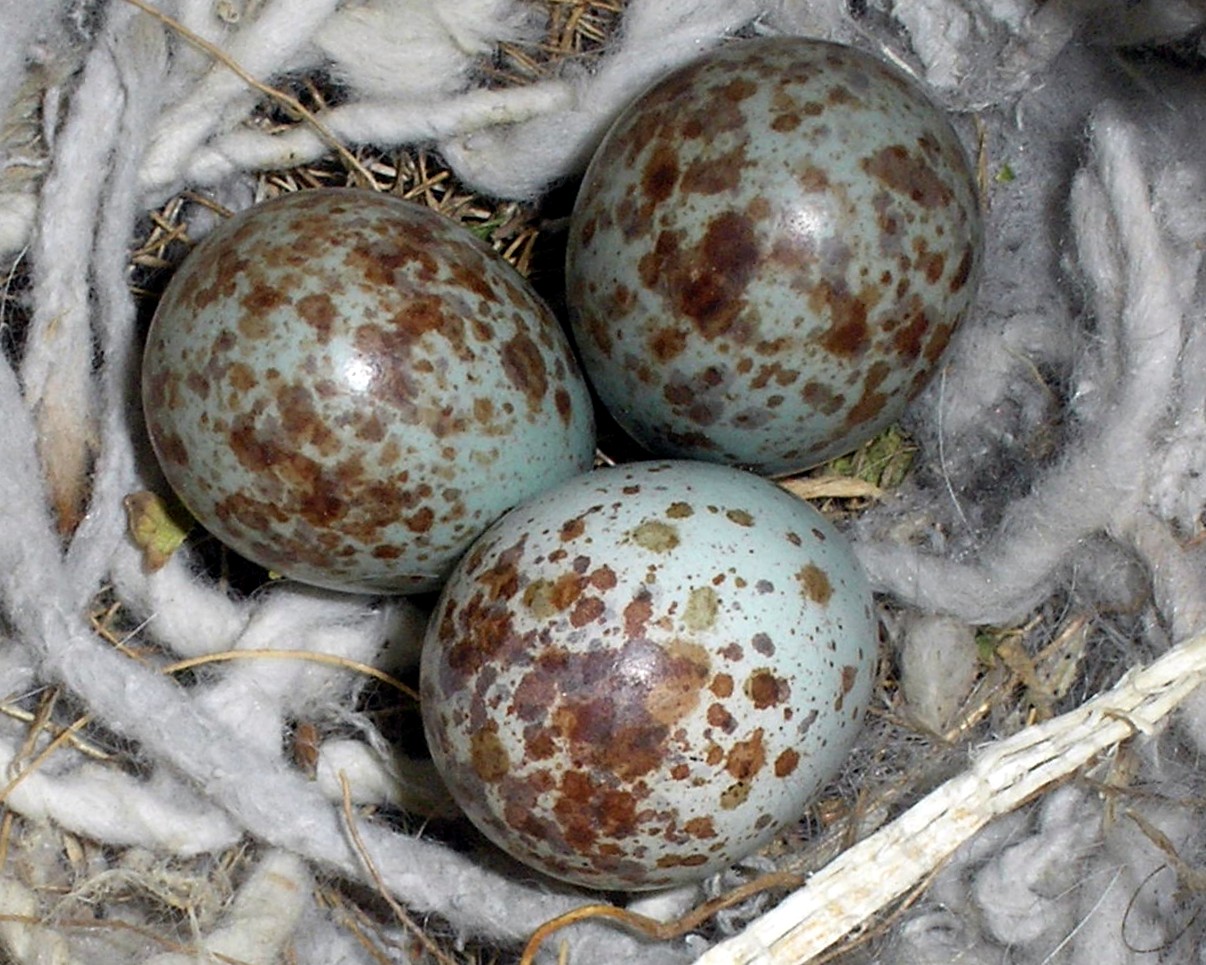
Northern Mockingbird (Mimus polyglottos) eggs ©WikiC

Northern Mockingbird (Mimus polyglottos) eggs ©WikiC

The shape of the egg makes it strong. This strength comes in handy in a busy nest. Mom and dad are coming and going, and they turn the eggs periodically during incubation. But all eggs are not equally egg shaped, and there is a pattern to their shapes. Birds like robins that build a nice, dish shaped nest tend to lay eggs that are more round in shape. Screech owls, which lay their eggs at the bottom of a hole in a tree, also have round shaped eggs. Birds like the killdeer barely build any kind of nest and lay eggs on the ground where almost-round eggs could roll away. For this reason, birds such as a kildeer lay much more sharply pointed eggs which are designed to pivot on their small end. Likewise, eggs that are laid where predators are not likely to see them are usually pale or solid in color, but eggs laid out in the open are camouflaged. Moreover, baby birds that hatch in protected nests, like the bluebird, tend to be naked, blind and helpless. But the unprotected killdeer hatchlings are ready to leave the nest within minutes of hatching.

All coincidences? It seems more scientific to say that here we have a few of the many fingerprints of our wise Creator!

Prayer:
I praise You, Father, for how Your glory is reflected in the creation. Amen.

Notes:
Jim Williams, “Bird basics: egg size, color and shape”, Star Tribune, 7/29/99, p. 8. Illustration: Long elliptical egg of a loon. (PD)

©Creation Moments, 2015 (Used with permission)

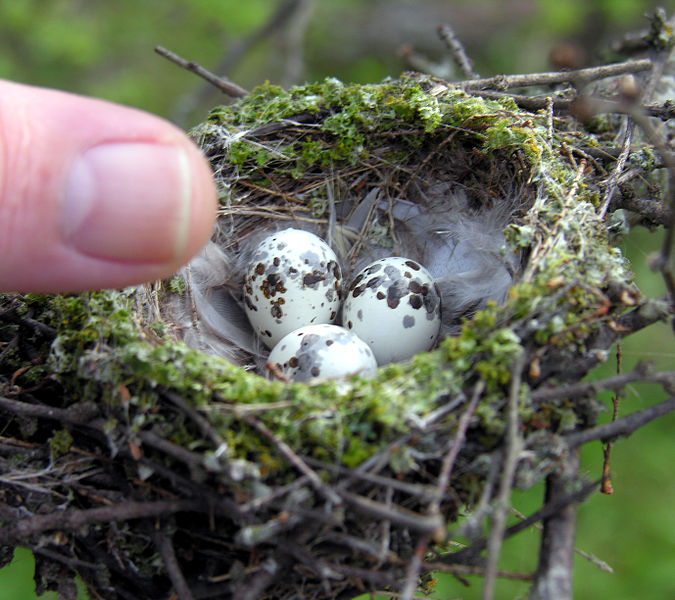
Vermilion Flycatcher (Pyrocephalus rubinus) Eggs ©WikiC

Vermilion Flycatcher (Pyrocephalus rubinus) Eggs ©WikiC


Lee’s Addition:

So teach us to number our days, that we may apply our hearts unto wisdom. (Psalms 90:12 KJV)

O LORD, how manifold are thy works! in wisdom hast thou made them all: the earth is full of thy riches. (Psalms 104:24 KJV)

Another reminder of how great and wise our Creator is.

Different Eggs- Birds and Others - from Wikipedia

Different Eggs- Birds and Others – from Wikipedia

Incredible Chicken Egg
Birds of the Bible – Bird Egg Facts
Formed By Him – Bird Eggs

*

Longbill and Teeter – Chapter 9

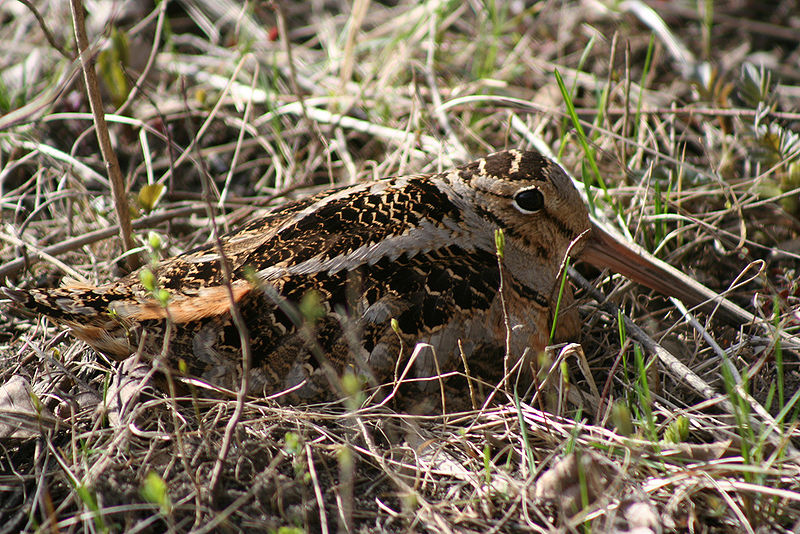
American Woodcock (Scolopax minor) ©WikiC

American Woodcock (Scolopax minor) ©WikiC

Longbill and Teeter

The Woodcock and the Spotted Sandpiper.

The Burgess Bird Book For Children

*

CHAPTER 9. Longbill and Teeter.

Listen to the story read.

From the decided way in which Jenny Wren had popped into the little round doorway of her home, Peter knew that to wait in the hope of more gossip with her would be a waste of time. He wasn’t ready to go back home to the dear Old Briar-patch, yet there seemed nothing else to do, for everybody in the Old Orchard was too busy for idle gossip. Peter scratched a long ear with a long hind foot, trying to think of some place to go. Just then he heard the clear “peep, peep, peep” of the Hylas, the sweet singers of the Smiling Pool.

“That’s where I’ll go!” exclaimed Peter. “I haven’t been to the Smiling Pool for some time. I’ll just run over and pay my respects to Grandfather Frog, and to Redwing the Blackbird. Redwing was one of the first birds to arrive, and I’ve neglected him shamefully.”

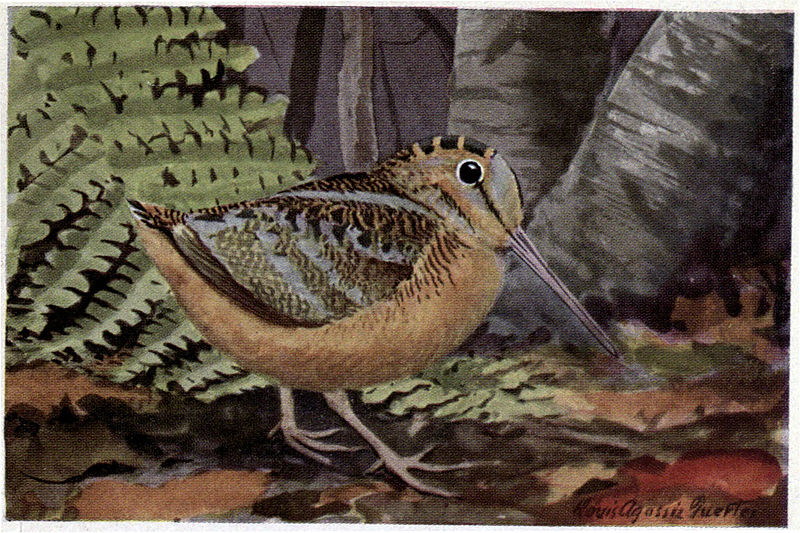
When Peter thinks of something to do he wastes no time. Off he started, lipperty-lipperty-lip, for the Smiling Pool. He kept close to the edge of the Green Forest until he reached the place where the Laughing Brook comes out of the Green Forest on its way to the Smiling Pool in the Green Meadows. Bushes and young trees grow along the banks of the Laughing Brook at this point. The ground was soft in places, quite muddy. Peter doesn’t mind getting his feet damp, so he hopped along carelessly. From right under his very nose something shot up into the air with a whistling sound. It startled Peter so that he stopped short with his eyes popping out of his head. He had just a glimpse of a brown form disappearing over the tops of some tall bushes. Then Peter chuckled. “I declare,” said he, “I had forgotten all about my old friend, Longbill the Woodcock. He scared me for a second.”

Longbill the Woodcock - Burgess Bird Book ©©

Longbill the Woodcock – Burgess Bird Book ©©

“Then you are even,” said a voice close at hand. “You scared him. I saw you coming, but Longbill didn’t.”

Peter turned quickly. There was Mrs. Woodcock peeping at him from behind a tussock of grass.

“I didn’t mean to scare him,” apologized Peter. “I really didn’t mean to. Do you think he was really very much scared?”

“Not too scared to come back, anyway,” said Longbill himself, dropping down just in front of Peter. “I recognized you just as I was disappearing over the tops of the bushes, so I came right back. I learned when I was very young that when startled it is best to fly first and find out afterwards whether or not there is real danger. I am glad it is no one but you, Peter, for I was having a splendid meal here, and I should have hated to leave it. You’ll excuse me while I go on eating, I hope. We can talk between bites.”

“Certainly I’ll excuse you,” replied Peter, staring around very hard to see what it could be Longbill was making such a good meal of. But Peter couldn’t see a thing that looked good to eat. There wasn’t even a bug or a worm crawling on the ground. Longbill took two or three steps in rather a stately fashion. Peter had to hide a smile, for Longbill had such an air of importance, yet at the same time was such an odd looking fellow. He was quite a little bigger than Welcome Robin, his tail was short, his legs were short, and his neck was short. But his bill was long enough to make up. His back was a mixture of gray, brown, black and buff, while his breast and under parts were a beautiful reddish-buff. It was his head that made him look queer. His eyes were very big and they were set so far back that Peter wondered if it wasn’t easier for him to look behind him than in front of him.

American Woodcock (Scolopax minor) on nest © USFWS

American Woodcock (Scolopax minor) on nest © USFWS

Suddenly Longbill plunged his bill into the ground. He plunged it in for the whole length. Then he pulled it out and Peter caught a glimpse of the tail end of a worm disappearing down Longbill’s throat. Where that long bill had gone into the ground was a neat little round hole. For the first time Peter noticed that there were many such little round holes all about. “Did you make all those little round holes?” exclaimed Peter.

“Not at all,” replied Longbill. “Mrs. Woodcock made some of them.”

“And was there a worm in every one?” asked Peter, his eyes very wide with interest.

Longbill nodded. “Of course,” said he. “You don’t suppose we would take the trouble to bore one of them if we didn’t know that we would get a worm at the end of it, do you?”

Peter remembered how he had watched Welcome Robin listen and then suddenly plunge his bill into the ground and pull out a worm. But the worms Welcome Robin got were always close to the surface, while these worms were so deep in the earth that Peter couldn’t understand how it was possible for any one to know that they were there. Welcome Robin could see when he got hold of a worm, but Longbill couldn’t. “Even if you know there is a worm down there in the ground, how do you know when you’ve reached him? And how is it possible for you to open your bill down there to take him in?” asked Peter.

Longbill chuckled. “That’s easy,” said he. “I’ve got the handiest bill that ever was. See here!” Longbill suddenly thrust his bill straight out in front of him and to Peter’s astonishment he lifted the end of the upper half without opening the rest of his bill at all. “That’s the way I get them,” said he. “I can feel them when I reach them, and then I just open the top of my bill and grab them. I think there is one right under my feet now; watch me get him.” Longbill bored into the ground until his head was almost against it. When he pulled his bill out, sure enough, there was a worm. “Of course,” explained Longbill, “it is only in soft ground that I can do this. That is why I have to fly away south as soon as the ground freezes at all.”

“It’s wonderful,” sighed Peter. “I don’t suppose any one else can find hidden worms that way.”

“My cousin, Jack Snipe, can,” replied Longbill promptly. “He feeds the same way I do, only he likes marshy meadows instead of brushy swamps. Perhaps you know him.”

Wilson's Snipe (Gallinago delicata) at Circle B by Dan

WWilson’s Snipe (Gallinago delicata) at Circle B by Dan

Peter nodded. “I do,” said he. “Now you speak of it, there is a strong family resemblance, although I hadn’t thought of him as a relative of yours before. Now I must be running along. I’m ever so glad to have seen you, and I’m coming over to call again the first chance I get.”

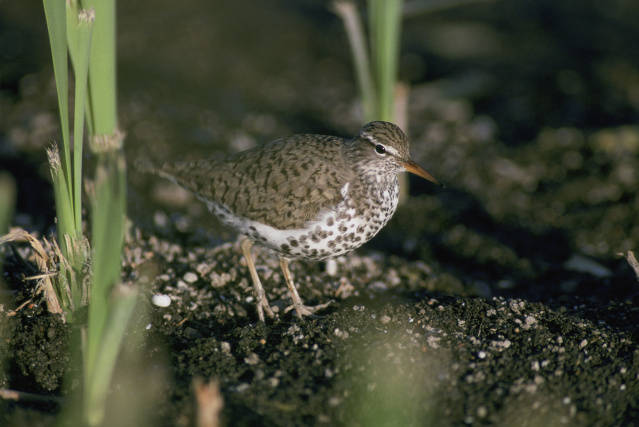
So Peter said good-by and kept on down the Laughing Brook to the Smiling Pool. Right where the Laughing Brook entered the Smiling Pool there was a little pebbly beach. Running along the very edge of the water was a slim, trim little bird with fairly long legs, a long slender bill, brownish-gray back with black spots and markings, and a white waistcoat neatly spotted with black. Every few steps he would stop to pick up something, then stand for a second bobbing up and down in the funniest way, as if his body was so nicely balanced on his legs that it teetered back and forth like a seesaw. It was Teeter the Spotted Sandpiper, an old friend of Peter’s. Peter greeted him joyously.

“Peet-weet! Peet-weet!” cried Teeter, turning towards Peter and bobbing and bowing as only Teeter can. Before Peter could say another word Teeter came running towards him, and it was plain to see that Teeter was very anxious about something. “Don’t move, Peter Rabbit! Don’t move!” he cried.

“Why not?” demanded Peter, for he could see no danger and could think of no reason why he shouldn’t move. Just then Mrs. Teeter came hurrying up and squatted down in the sand right in front of Peter.

“Thank goodness!” exclaimed Teeter, still bobbing and bowing. “If you had taken another step, Peter Rabbit, you would have stepped right on our eggs. You gave me a dreadful start.”

Spotted Sandpiper (Actitis macularius) ©USFWS

Spotted Sandpiper (Actitis macularius) ©USFWS

Peter was puzzled. He showed it as he stared down at Mrs. Teeter just in front of him. “I don’t see any nest or eggs or anything,” said he rather testily.

Mrs. Teeter stood up and stepped aside. Then Peter saw right in a little hollow in the sand, with just a few bits of grass for a lining, four white eggs with big dark blotches on them. They looked so much like the surrounding pebbles that he never would have seen them in the world but for Mrs. Teeter. Peter hastily backed away a few steps. Mrs. Teeter slipped back on the eggs and settled herself comfortably. It suddenly struck Peter that if he hadn’t seen her do it, he wouldn’t have known she was there. You see she looked so much like her surroundings that he never would have noticed her at all.

“My!” he exclaimed. “I certainly would have stepped on those eggs if you hadn’t warned me,” said he. “I’m so thankful I didn’t. I don’t see how you dare lay them in the open like this.”

Mrs. Teeter chuckled softly. “It’s the safest place in the world, Peter,” said she. “They look so much like these pebbles around here that no one sees them. The only time they are in danger is when somebody comes along, as you did, and is likely to step on them without seeing them. But that doesn’t happen often.”


Spotted Sandpiper (Actitis macularius) Eggs ©WikiC

Lee’s Addition:

“You shall hide them in the secret place of Your presence From the plots of man; You shall keep them secretly in a pavilion… (Psalms 31:20 NKJV)

“Hide me from the secret plots of the wicked,… (Psalms 64:2a NKJV)

Our Lord created these birds with a neat bills to help them feed and also great colors to help them stay hidden from danger.

These birds all belong to the Scolopacidae – Sandpipers, Snipes Family. There are 96 species in this family.

Questions to answer:

  • What is Longbill’s first reaction at danger?
  • Can you describe Longbill’s tail, neck and eyes?
  • What is special about his bill?
  • Who is Longbill’s cousin?
  • Where does he like to catch worms?
  • Who is Tweeter?
  • Why did she stop Peter Rabbit?

Links:


*

Links:

Redwing the Blackbird, Speckles the Starling - Burgess Bird Book ©©Thum


  Next Chapter Redwing and Yellow Wing


Burgess-Bird-Book-for-Children


Burgess Bird Book For Children


ABC’s Of The Gospel

*


Bird-watching Devotional Activity

Philippine Eagle-Owl (Bubo philippensis) by Bob Kaufman

Philippine Eagle-Owl (Bubo philippensis) by Bob Kaufman

“By them the birds of the heavens have their home; They sing among the branches. (Psalms 104:12 NKJV)

Myra has become a dear friend through this blog. She lives in the Philippines and enjoys birdwatching. She used some of this blog’s information several years ago for a class in birdwatching at a Christian Camp there. Now, she has written a Birdwatching Devotional and I asked if I could share it with you. Of course, no problem.

Here is an excerpt from her e-mail that tells about it.

Just want to share something I wrote.  I was in a southern province recently to cover the opening of a retreat center run by the organization I work for (http://cctmalungon.blogspot.com/).  I got to bird watch the next morning during my quiet time, and started writing a devotional activity.  I finished writing it yesterday.
I am praying the management of the retreat center will be interested in my suggestions to promote bird watching there, and hoping the attached devotional will be printed out and placed inside each room.

*

MRTC Bird-watching Devotional Activity 1

It is often easier to hear birds than to see them, so for this devotional activity, we will simply listen to the sounds they make.  Bring your Bible, a pen, and this sheet. Find a quiet, shady spot. Read Psalm 104:1 – 17, 24 – 28. Notice that the psalmist mentions birds singing among the branches (v.12).  Now close your eyes and listen to the bird sounds around you.

In the space below use tally marks (four vertical and one diagonal line like those used to score games) to make a record of the different kind of bird sounds you hear:

_

_

_

_

_

_

Which of the following sounds did you hear?

_____Chirp

_____Tweet

_____Peep

_____Warble

_____Cheep

_____Hoot

_____Whoop

_____Trill

_____Whistle

_____Squawk

_____Caw

_____Coo

These are all English words based on sounds made by birds. In the spaces below, write how some of the bird sounds sound to you.  Use your own spelling – spell them the way they sound to you!  For example, “Wit-hooooooo! Wit-hoooooooo! Wit-hooo-tu-ri-ri!

_________________________

_________________________

_________________________

_________________________

_________________________

_________________________

Now reread Psalm 104:12 & 24.  The bird sounds you heard tell us of the wisdom and the infinite creativity with which God made the world. What fun He must have had assigning birds to sing high notes and low notes, long notes and short notes, to make soft sounds or loud sounds and an endless combination of these! Some birds make lovely, melodic sounds, while others are madakdak! Imagine the bird sounds and bird songs Adam and Eve heard in the Garden of Eden. But songs and sounds are just one aspect birds. God gave them feathers of different colors; He gave them beaks and feet of different shapes and sizes for a lot of different uses.  He gave them the wonderful gift of flight.  Praise God for His wisdom!

Now reread Psalm 27 & 28, as well as Matthew 6:25 – 27.   God paid detailed attention to birds when He made them.  Up until today, our Heavenly Father feeds them. When He opens His hands “they are filled with good things.” We, His children, are so much more important to Him than birds.  Rejoice in the attention God pays to the details of your life!  Thank Him for his loving care and faithful provision.

Dear Father, thank you for the birds.  I praise you for the wisdom with which you made them.  I bow in awe and amazement at your infinite creativity. Forgive me Father when I forget that you love me more than you love the birds.  Help me to always remember that to You,  I am more valuable than they. Thank you for your care and provision, for your nearness and presence.  I love you! In Jesus Name, Amen.

Myra Gaculais del Rosario

Malungon, Sarangani – December 13, 2014

Taytay, Rizal – January 8, 2015

“O LORD, how manifold are Your works! In wisdom You have made them all. The earth is full of Your possessions—This great and wide sea, In which are innumerable teeming things, Living things both small and great. There the ships sail about; There is that Leviathan Which You have made to play there. These all wait for You, That You may give them their food in due season. What You give them they gather in; You open Your hand, they are filled with good. (Psalms 104:24-28 NKJV)


What a gorgeous place to go birdwatching.

What a gorgeous place to go birdwatching. Malungon Retreat and Community Resource Center

Lee’s Addition:

In the multitude of my thoughts within me thy comforts delight my soul. (Psalms 94:19 KJV)

One of the reasons to share this is that you or some of the Camp and Home-school groups could use it. Also, it could be a start to writing some of your own devotionals along this line.

You can download the file by clicking this link:

MRTC Bird Watching Devotional Activity 1 by Myra Gaculais del Rosario

*

Birds of the Bible – Church Camp In Philippines

*


Old Clothes and Old Houses – Chapter 8

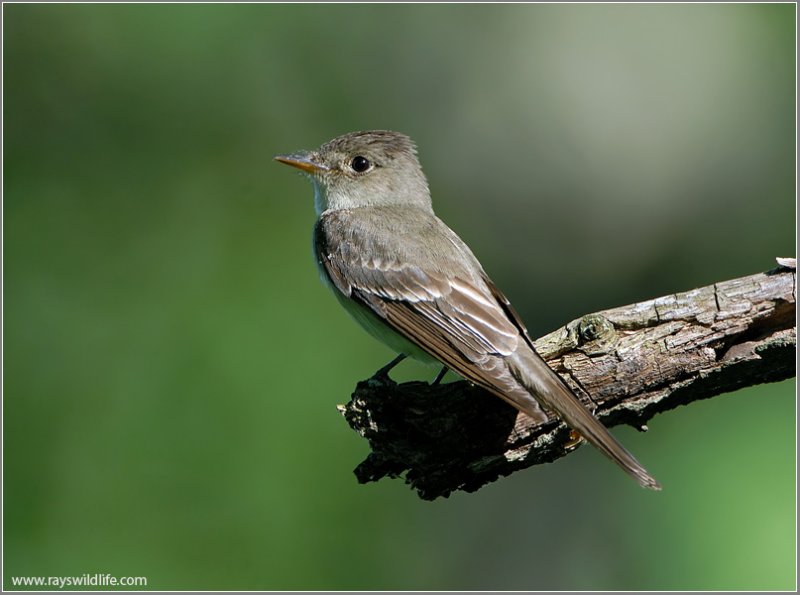
Eastern Wood Pewee (Contopus virens) by Raymond Barlow

Eastern Wood Pewee (Contopus virens) by Raymond Barlow

Old Clothes and Old Houses

The Wood Peewee and Some Nesting Places.

The Burgess Bird Book For Children

*

CHAPTER 8. Old Clothes and Old Houses.

Listen to the story read.

“I can’t stop to talk to you any longer now, Peter Rabbit,” said Jenny Wren, “but if you will come over here bright and early to-morrow morning, while I am out to get my breakfast, I will tell you about Cresty the Flycatcher and why he wants the cast-off clothes of some of the Snake family. Perhaps I should say WHAT he wants of them instead of WHY he wants them, for why any one should want anything to do with Snakes is more then I can understand.”

With this Jenny Wren disappeared inside her house, and there was nothing for Peter to do but once more start for the dear Old Briar-patch. On his way he couldn’t resist the temptation to run over to the Green Forest, which was just beyond the Old Orchard. He just HAD to find out if there was anything new over there. Hardly had he reached it when he heard a plaintive voice crying, “Pee-wee! Pee-wee! Pee-wee!” Peter chuckled happily. “I declare, there’s Pee-wee,” he cried. “He usually is one of the last of the Flycatcher family to arrive. I didn’t expect to find him yet. I wonder what has brought him up so early.”

It didn’t take Peter long to find Pewee. He just followed the sound of that voice and presently saw Pewee fly out and make the same kind of a little circle as the other members of the family make when they are hunting flies. It ended just where it had started, on a dead twig of a tree in a shady, rather lonely part of the Green Forest. Almost at once he began to call his name in a rather sad, plaintive tone, “Pee-wee! Pee-wee! Pee-wee!” But he wasn’t sad, as Peter well knew. It was his way of expressing how happy he felt. He was a little bigger than his cousin, Chebec, but looked very much like him. There was a little notch in the end of his tail. The upper half of his bill was black, but the lower half was light. Peter could see on each wing two whitish bars, and he noticed that Pewee’s wings were longer than his tail, which wasn’t the case with Chebec. But no one could ever mistake Pewee for any of his relatives, for the simple reason that he keeps repeating his own name over and over.

Wood Pewee of Birds Illustrated by Color Photography, 1897

“Aren’t you here early?” asked Peter.

Pewee nodded. “Yes,” said he. “It has been unusually warm this spring, so I hurried a little and came up with my cousins, Scrapper and Cresty. That is something I don’t often do.”

“If you please,” Peter inquired politely, “why do folks call you Wood Pewee?”

Pewee chuckled happily. “It must be,” said he, “because I am so very fond of the Green Forest. It is so quiet and restful that I love it. Mrs. Pewee and I are very retiring. We do not like too many near neighbors.”

“You won’t mind if I come to see you once in a while, will you?” asked Peter as he prepared to start on again for the dear Old Briar-patch.

“Come as often as you like,” replied Pewee. “The oftener the better.”

Back in the Old Briar-patch Peter thought over all he had learned about the Flycatcher family, and as he recalled how they were forever catching all sorts of flying insects it suddenly struck him that they must be very useful little people in helping Old Mother Nature take care of her trees and other growing things which insects so dearly love to destroy.

But most of all Peter thought about that odd request of Cresty’s, and a dozen times that day he found himself peeping under old logs in the hope of finding a cast-off coat of Mr. Black Snake. It was such a funny thing for Cresty to ask for that Peter’s curiosity would allow him no peace, and the next morning he was up in the Old Orchard before jolly Mr. Sun had kicked his bedclothes off.

Jenny Wren was as good as her word. While she flitted and hopped about this way and that way in that fussy way of hers, getting her breakfast, she talked. Jenny couldn’t keep her tongue still if she wanted to.

“Did you find any old clothes of the Snake family?” she demanded. Then as Peter shook his head her tongue ran on without waiting for him to reply. “Cresty and his wife always insist upon having a piece of Snake skin in their nest,” said she. “Why they want it, goodness knows! But they do want it and never can seem to settle down to housekeeping unless they have it. Perhaps they think it will scare robbers away. As for me, I should have a cold chill every time I got into my nest if I had to sit on anything like that. I have to admit that Cresty and his wife are a handsome couple, and they certainly have good sense in choosing a house, more sense than any other member of their family to my way of thinking. But Snake skins! Ugh!”

Downy Woodpecker (Picoides pubescens) by Raymond Barlow

Downy Woodpecker (Picoides pubescens) by Raymond Barlow

“By the way, where does Cresty build?” asked Peter.

In a hole in a tree, like the rest of us sensible people,” retorted Jenny Wren promptly.

Peter looked quite as surprised as he felt. “Does Cresty make the hole?” he asked.

“Goodness gracious, no!” exclaimed Jenny Wren. “Where are your eyes, Peter? Did you ever see a Flycatcher with a bill that looked as if it could cut wood?” She didn’t wait for a reply, but rattled on. “It is a good thing for a lot of us that the Woodpecker family are so fond of new houses. Look! There is Downy the Woodpecker hard at work on a new house this very minute. That’s good. I like to see that. It means that next year there will be one more house for some one here in the Old Orchard. For myself I prefer old houses. I’ve noticed there are a number of my neighbors who feel the same way about it. There is something settled about an old house. It doesn’t attract attention the way a new one does. So long as it has got reasonably good walls, and the rain and the wind can’t get in, the older it is the better it suits me. But the Woodpeckers seem to like new houses best, which, as I said before, is a very good thing for the rest of us.”

Who is there besides you and Cresty and Bully the English Sparrow who uses these old Woodpecker houses?” asked Peter.

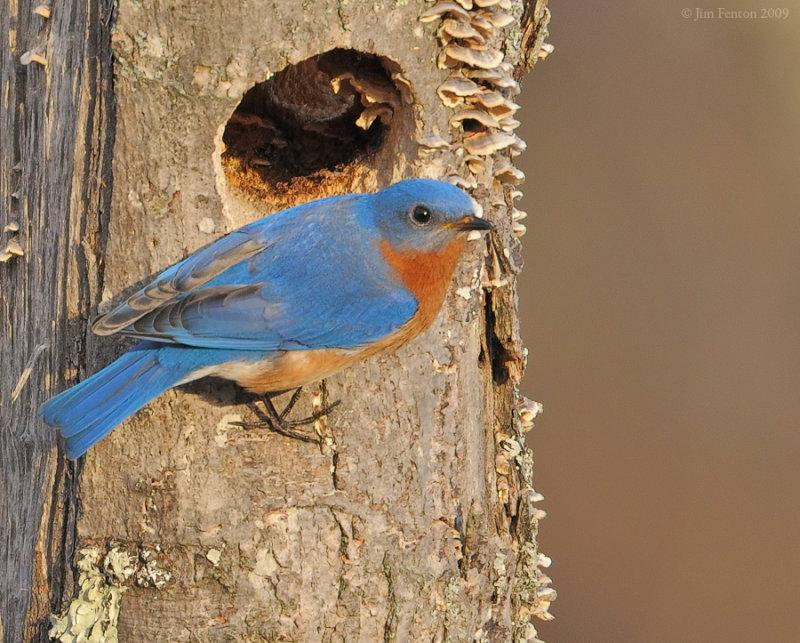
Eastern Bluebird (Sialia sialis) by J Fenton

Eastern Bluebird (Sialia sialis) by J Fenton

“Winsome Bluebird, stupid!” snapped Jenny Wren.

Peter grinned and looked foolish. “Of course,” said he. “I forgot all about Winsome.”

“And Skimmer the Tree Swallow,” added Jenny.

“That’s so; I ought to have remembered him,” exclaimed Peter. “I’ve noticed that he is very fond of the same house year after year. Is there anybody else?”

Again Jenny Wren nodded. “Yank-Yank the Nuthatch uses an old house, I’m told, but he usually goes up North for his nesting,” said she. “Tommy Tit the Chickadee sometimes uses an old house. Then again he and Mrs. Chickadee get fussy and make a house for themselves. Yellow Wing the flicker, who really is a Woodpecker, often uses an old house, but quite often makes a new one. Then there are Killy the Sparrow Hawk and Spooky the Screech Owl.”

Peter looked surprised. “I didn’t suppose THEY nested in holes in trees!” he exclaimed.

“They certainly do, more’s the pity!” snapped Jenny. “It would be a good thing for the rest of us if they didn’t nest at all. But they do, and an old house of Yellow Wing the Flicker suits either of them. Killy always uses one that is high up, and comes back to it year after year. Spooky isn’t particular so long as the house is big enough to be comfortable. He lives in it more or less the year around. Now I must get back to those eggs of mine. I’ve talked quite enough for one morning.”

“Oh, Jenny,” cried Peter, as a sudden thought struck him.

House Wren (Troglodytes aedon) by Ray

House Wren (Troglodytes aedon) by Ray

Jenny paused and jerked her tail impatiently. “Well, what is it now?” she demanded.

“Have you got two homes?” asked Peter.

“Goodness gracious, no!” exclaimed Jenny. “What do you suppose I want of two homes? One is all I can take care of.”

“Then why,” demanded Peter triumphantly, “does Mr. Wren work all day carrying sticks and straws into a hole in another tree? It seems to me that he has carried enough in there to build two or three nests.”

Jenny Wren’s eyes twinkled, and she laughed softly. “Mr. Wren just has to be busy about something, bless his heart,” said she. “He hasn’t a lazy feather on him. He’s building that nest to take up his time and keep out of mischief. Besides, if he fills that hollow up nobody else will take it, and you know we might want to move some time. Good-by, Peter.” With a final jerk of her tail Jenny Wren flew to the little round doorway of her house and popped inside.


Lee’s Addition:

“But now ask the beasts, and they will teach you; And the birds of the air, and they will tell you; (Job 12:7 NKJV)

*

  • What is Peter Rabbit still trying to find?
  • Has he found out why it is need for yet?
  • Who is our newest arrival?
  • Is he on time or early?
  • What does Pewee’s bill look like?
  • Is tail longer or shorter than his wings?
  • Can you find and name the birds listed that use tree holes?
  • Were the birds friendly and kind in this chapter?

A man who has friends must himself be friendly, But there is a friend who sticks closer than a brother. (Proverbs 18:24 NKJV)

“But now ask the beasts, and they will teach you; And the birds of the air, and they will tell you; (Job 12:7 NKJV)

Links:

*

Links:

Longbill the Woodcock - Burgess Bird Book ©©Thum


  Next Chapter (Longbill and Teeter.)


Burgess-Bird-Book-for-Children


Burgess Bird Book For Children


ABC’s Of The Gospel


Alternative Bird Lists

Various Lists

Various Lists

“Then the LORD said to Moses, “Number every firstborn male of the sons of Israel from a month old and upward, and make a list of their names. (Numbers 3:40 NASB)

Saw this on Alternative Life List from About, which was a side-link from Keeping a Life Yard List.

“Many birders keep a life list, but the guidelines for what birds count on a life list that will be accepted by organizations or competitions can be strict. Fortunately, there are many alternative ways to keep a life list, from serious to silly, and each one adds a new dimension to enjoying the record-keeping side of birding.

Here are some of the List they suggest:

  • Geographic Lists:
  • Seasonal Lists:
  • Photographic Lists:
  • Subspecies Lists
  • Sound Lists
On Way to Lowry Pk Zoo - Crossed County line at 8:42

On Way to Lowry Pk Zoo – Crossed County line at 8:42

Then they list Silly Options For Fun Life Lists:

  • Captive Birds: (See them often)
  • Extinct Birds: (That might be a little difficult)
  • Taxidermy Birds: (Don’t do too many museums)
  • Hollywood Birds: (That might be interesting, you hear them in the backgrounds a lot)
  • Book Birds: (Yep, not too hard)
  • Dream Birds: (That would be hard if you don’t dream much – Wish Birds might be better)
  • Missed Birds: (That might be REAL easy)

I think I need to keep a Captive Bird List (my Zoos, Aviaries, Wildlife Rehabs and other places that have birds that are not free to leave.)

The Photographic Life List also sounds interesting. (I have plenty of “proof shots”)

eBird Report

eBird Report

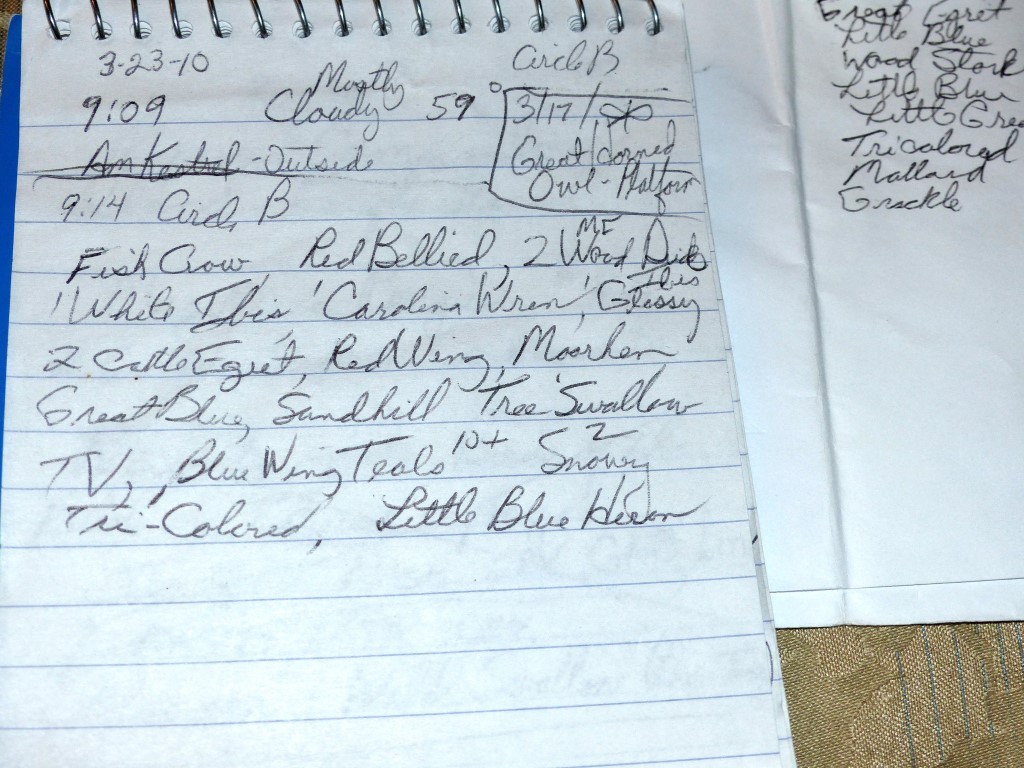
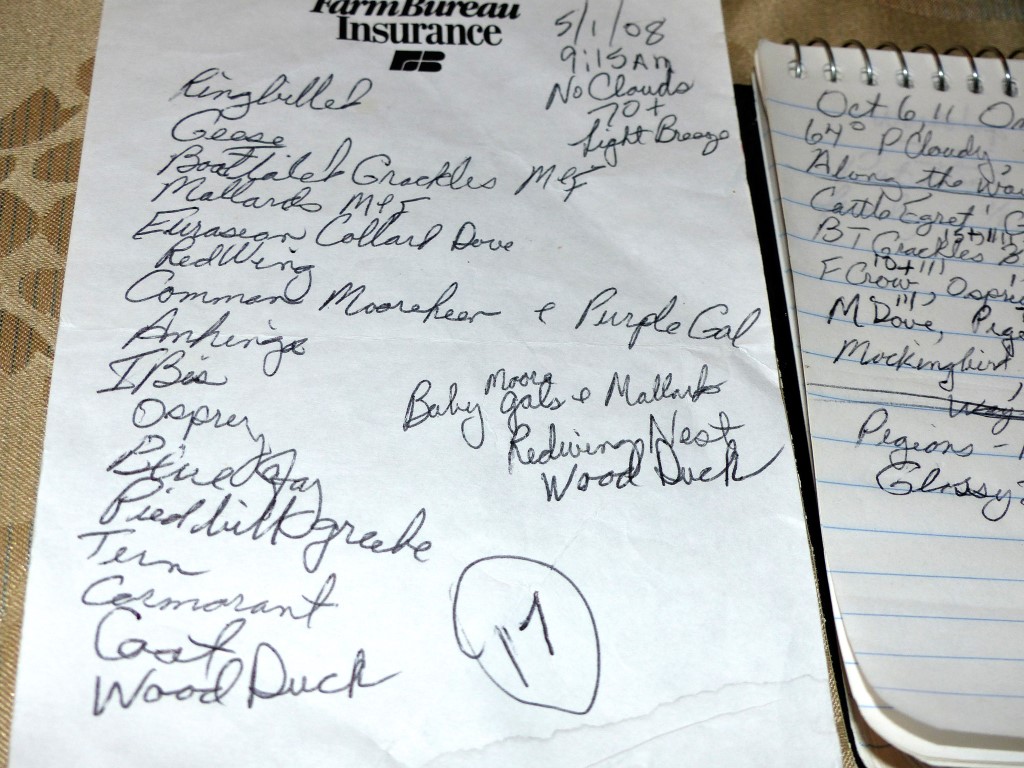
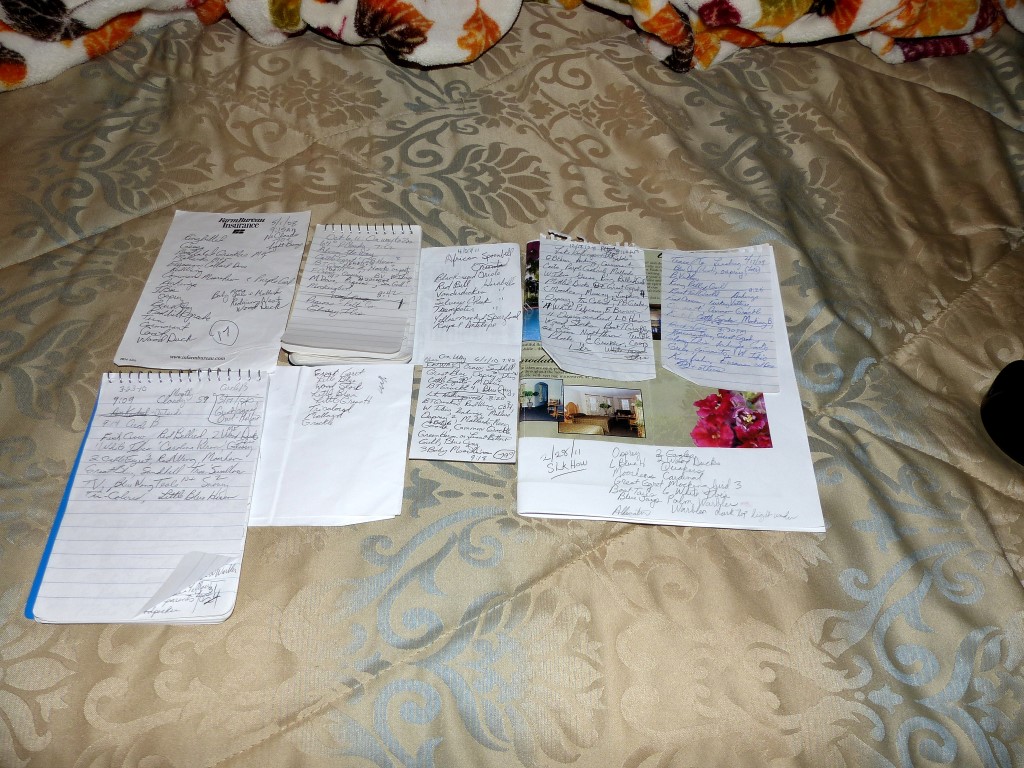
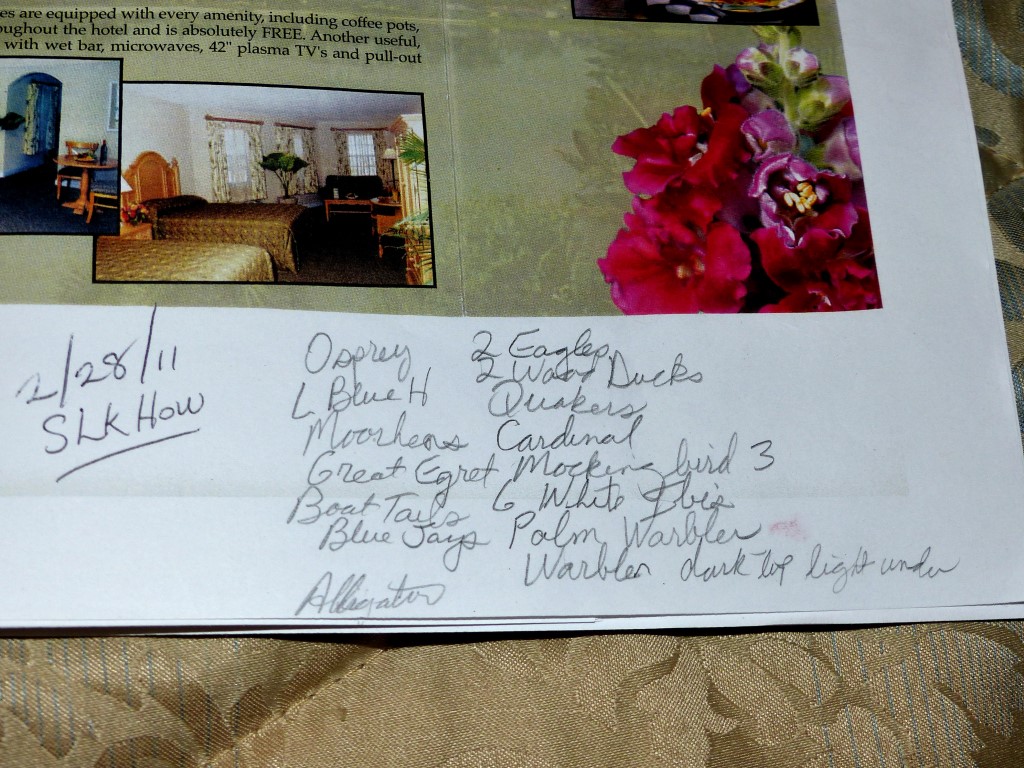
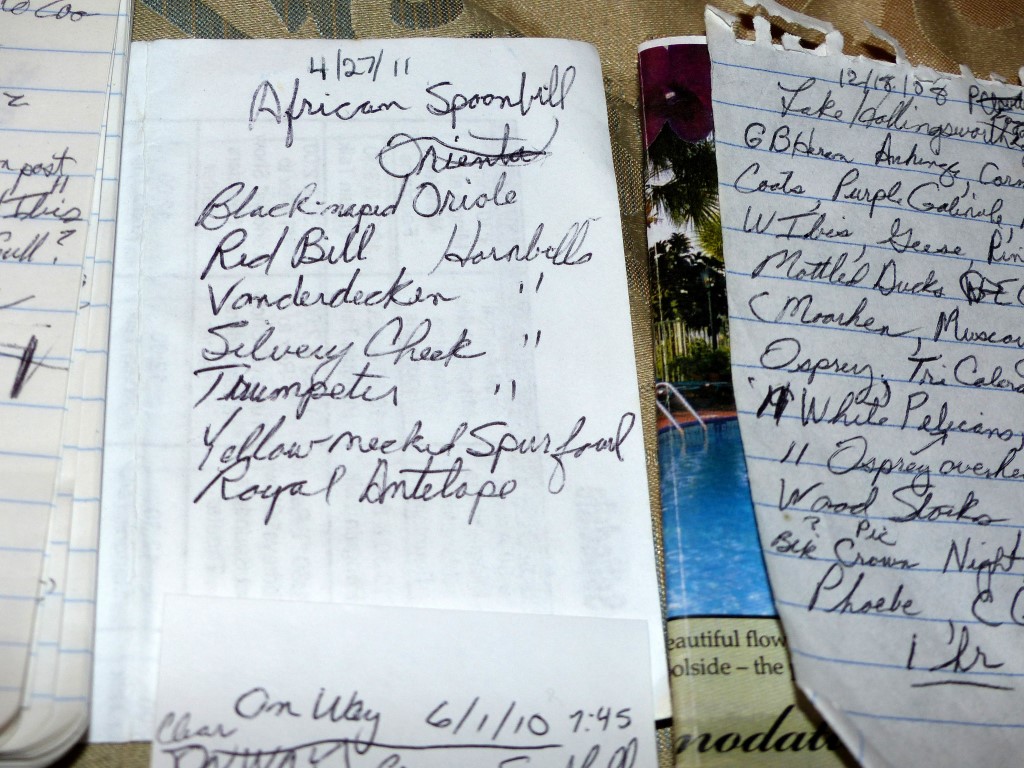
Do you keep a list of birds? I do, but am not always faithful to record them. As we go on trips, I record all the birds I see as Dan drives. I include even the county, time, temp, and whether clear, cloudy, etc. I use eBird to keep North American birds, but again, don’t always log my findings until later. (or when I re-find my notepad)

Here are photos of some list written on trips and outings. You can tell if I forgot my Notepad, I am resourceful.

My List of ALL the Birds I Have Seen is really a combination of many of these.

I have written about Birdwatching Lists before, but found that article interesting and thought you might like to see how I do some of the listing. As you can see, it is not very scientific. Sometimes I draw a marking or shape to help ID it later. Now days, I try to capture my unknowns with my camera. Easier than drawing and I get to keep my eye on the bird.

What ever way you keep a list or lists is up to each one. The main thing is to get out and enjoy the beautiful birds the Lord has created for us to enjoy. I would rather miss getting something on my list, than missing the opportunity to watch the bird as long as possible. For some birds will only give you a glimpse of itself before it dashes away.

Finding a verse to use that had the word “list” in it required me to use my e-Sword again. Looking at different versions I was able to find some The KJV used, “number of their names,” the CJV used “determine how many there are,” DRB used “shalt take the sum of them” and the CRV used probably the best for this, “Write their names on a list”

Check out some other articles we have written about this:

*

Martha and the Go-Kart Race

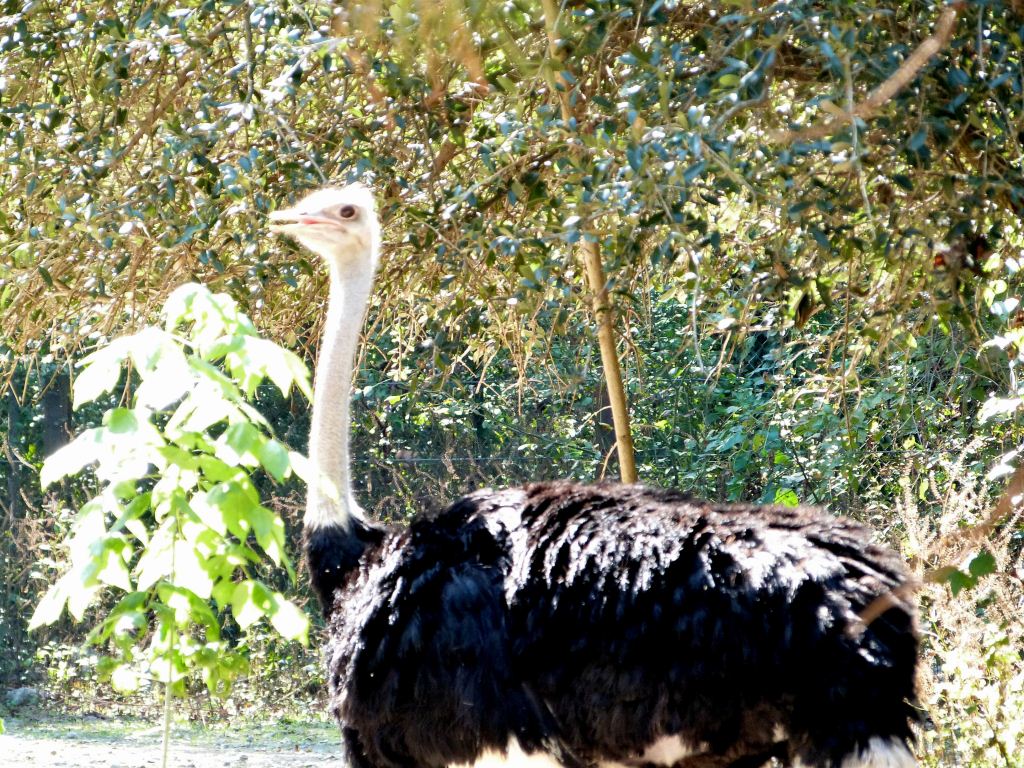
Common Ostrich (Struthio camelus) at Riverbanks Zoo SC by Lee

Common Ostrich (Struthio camelus) at Riverbanks Zoo SC by Lee

Martha and the Go-Kart Race ~ by Emma Foster

There was once an enormous ostrich named Martha who was extremely tall with a really long neck. She lived at the zoo and every day people would come there to look at her and all the strange and exotic animals. Many people came to look at Martha every day.

One day a flyer that had been left on the ground by a boy who was passing them out was blown in by the wind into Martha’s exhibit. She glanced down at the flyer. In big bold letters it said: GO-KART RACE THIS SATURDAY! The flyer went on to explain the instructions and it said that all ages were admitted. Martha decided right then and there she would enter the race.

That night, Martha sneaked out of her exhibit by climbing over the fence and sneaked into the shed in the back of the zoo. Finding some wooden boards, a hammer and nails, and a few other things, Martha set to work and eventually constructed her go-kart by Saturday.

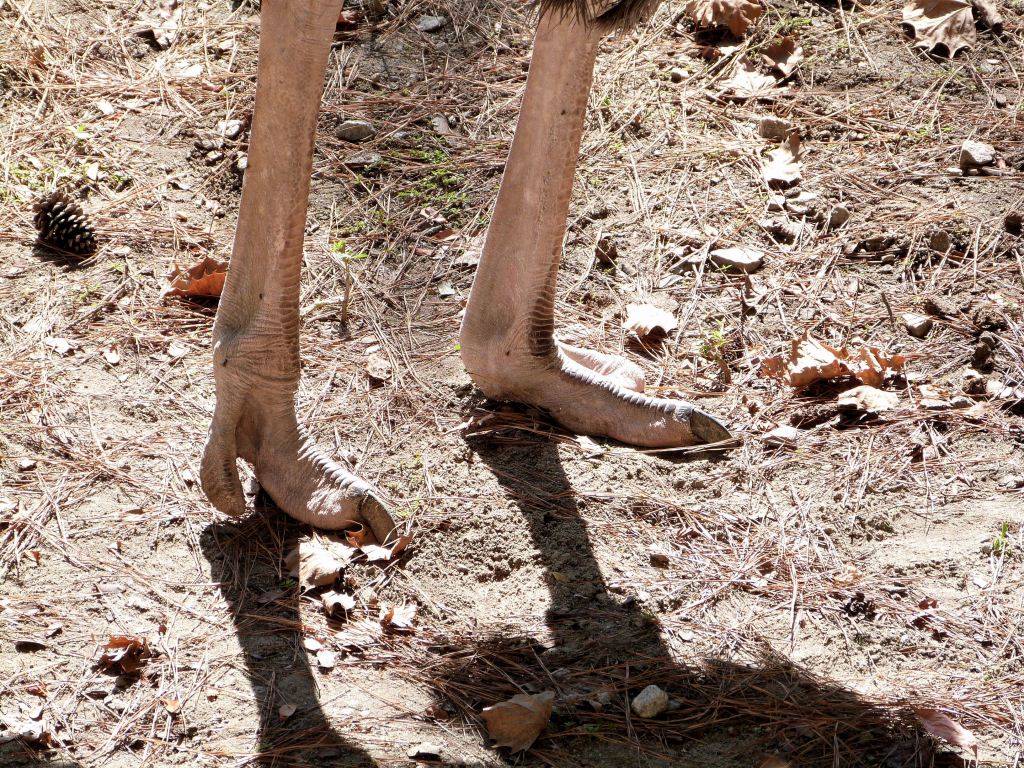
Common Ostrich (Struthio camelus) Foot at Riverfront Zoo SC by Lee

Common Ostrich (Struthio camelus) Foot at Riverfront Zoo SC by Lee

On the day of the race, Martha pushed her go-kart up to the starting line. All of the kids stared at her as she tried to get into the go-kart. It was difficult because of her long legs, but Martha eventually managed to get settled.

A man from the sideline swung a flag signaling to start the race. Martha zoomed down the road and turned a corner. After a few more turns Martha and the others drove over a bridge and eventually down a steep hill.

Ostrich

Ostrich

Martha spotted the finish line. She was in the lead. In a few seconds Martha crossed the finish line and won first place. Now every time someone at the zoo passed by Martha’s exhibit, they would see her first place trophy and her go-kart. The people at the zoo would always say they had never seen a better racer and the zoo keepers never figured out how she escaped from her exhibit.

The End


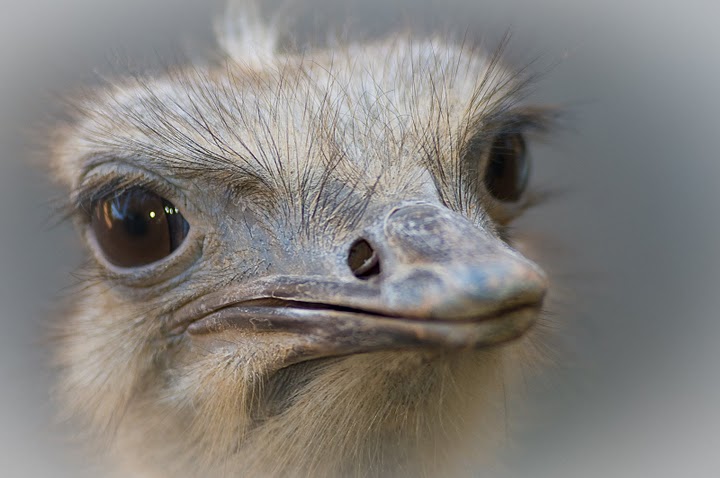
Common Ostrich (Struthio camelus) Closeup by WikiC

Common Ostrich (Struthio camelus) Closeup by ©WikiC

Lee’s Addition:

Gavest thou the goodly wings unto the peacocks? or wings and feathers unto the ostrich? (Job 39:13 KJV)

Well, our young writer has come up with another interesting Bird Tale. Emma continues to amaze me with her stories. Thanks, again, Emma. Keep up the good work. Lord Bless you as you continue to develop in wisdom and with the Lord.

See her other stories:

Also:

*

Merry Christmas from Golden Eagle

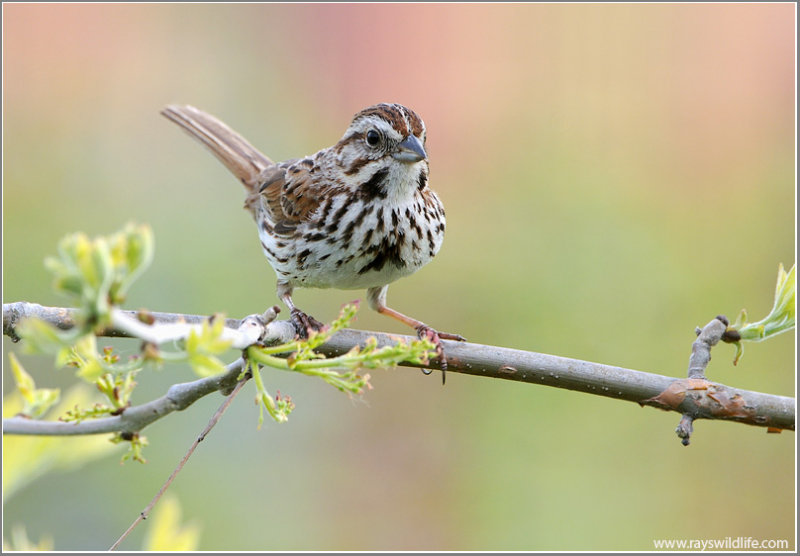
Song Sparrow by Ray

Song Sparrow by Ray

Merry Christmas from Golden Eagle

“His EYE is on the sparrow and I know He (Jesus) watches me!” This is the Golden Eagle and I just landed in a muddy pond. My wings are wet, my feathers are ruffled, and my left talon is crushed. What am I to do? Look up to God because He is looking down on me! Boys and girls did you know that we are open books to God? Why He knows everything about us and then some!

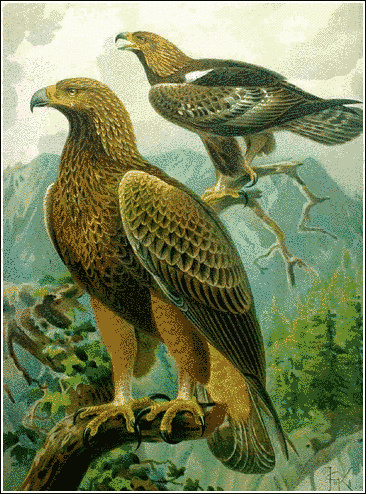
Golden Eagle ©PD

Golden Eagle ©PD

The eyes of the Lord are in every place, beholding the evil and the good. (Proverbs 15:3) This is the time of year when that list is pulled out. You know that list of boys and girls, that naughty and nice list? They say that eyes from the North Pole are watching us. Well, I don’t know about that. I have circled the North Pole way up in the atmosphere and all I could see was a bunch of my fellow penguins. I could be wrong; they might live down in Antarctica. The point is Jesus IS watching from His throne in the Heavens!

Royal Penguin (Eudyptes schlegeli) by Ian 6

Royal Penguin (Eudyptes schlegeli) by Ian

FOR PROMOTION COMETH NEITHER FROM THE EAST, NOR FROM THE WEST, NOR FROM THE SOUTH. (Psalm 75:6) Guys, that means it comes from the NORTH! That’s where God’s throne is in Heaven. The New Jerusalem, the golden city with the pearly gates.

Light of Christ ©©

We need to live in the white light of Jesus Christ. We need to live like Abraham Lincoln. Remember, “Honest Abe” from school? Be honest with God and honest with yourself. Read Romans chapter 2. In Romans Paul talks about our consciences. We know when we do something wrong like telling a lie. We know that’s wrong, we do not need someone to tell us that is wrong. Why?

“Which shew the work of the law written in their hearts, their conscience also bearing witness, and their thoughts the mean while accusing or else excusing one another.” (Romans 2:15)

God shines a spot-light into our souls, our hearts, our innermost being. “All the ways of a man are clean in his own eyes; but the Lord weigheth the spirits.” (Proverbs 16:2)

Spotlight ©©

Spotlight ©©

“Jesus did not commit himself unto them…FOR HE KNEW WHAT WAS IN MAN.” Jesus knows each and everything about you. There are no secrets with God. You cannot hide anything from Him, so live your life in His very Presence every day!

The Bible says, “Curse not the king, no not in thy thought; and curse not the rich in thy bedchamber: for a bird of the air shall carry the voice, and that which hath wings shall tell the matter.” (Ecclesiastes 10:20) The expression, “a little birdie told me” probably comes from this Bible verse. The reason a bird can tell things is because God knows everything! He reads our thoughts, He knows our motives, and He is keeping track of everything we say or do!

Bring all your thoughts to Jesus by reading His book, THE BIBLE. Begin to think like God thinks. Turn your eyes on Jesus and experience what God has for you!

And bring “INTO CAPTIVITY EVERY THOUGHT TO THE OBEDIENCE OF CHRIST.” (II Corinthians 10:5)

Reading the Bible

Reading the Bible

Read your Bibles and OBEY them! If you do, you will come out on top. Because God will “bring every work into judgment, with every secret thing, whether it be good, or whether it be evil.” (Ecclesiastes 12:14)

And you know about those gifts? Jesus will share His whole Creation with you in the future and you will have many gracious GIFTS from the Lord Jesus Christ. This Christmas give Jesus the gift of your heart and life by accepting HIS FREE GIFT OF SALVATION AND ETERNAL LIFE!

Merry Christmas from the Golden Eagle!

*

Golden Eagle

Kids, You Are Special

ABC’s Of The Gospel

*