Ian’s Bird of the Week – Cape Petrel ~ by Ian Montgomery
My records show that no Petrel and only one Shearwater (Buller’s) has ever featured as bird of the week. That’s partly because, until recently, I didn’t have many photos of members of this family of seabirds (Procellaridae) but that has been largely corrected by recent trips to the Sub-Antarctic and Norfolk Island. Petrels and Shearwaters are often challenging birds to identify, so I’m going to start with an easy and attractive one that featured prominently on the Sub-Antarctic Islands trip last November.
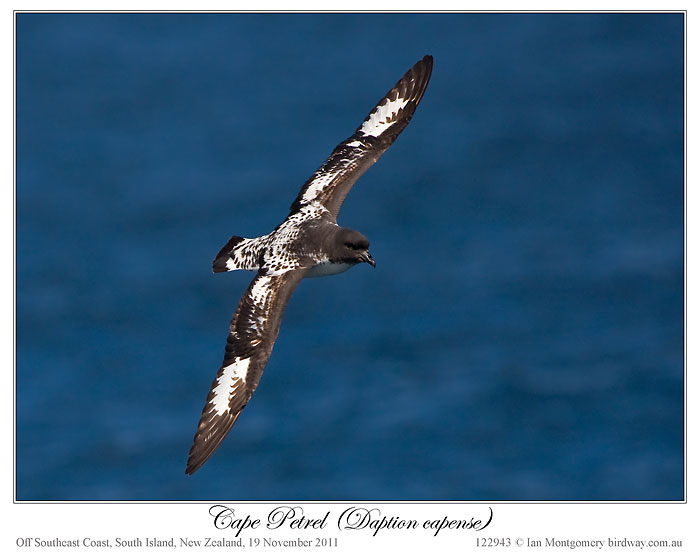
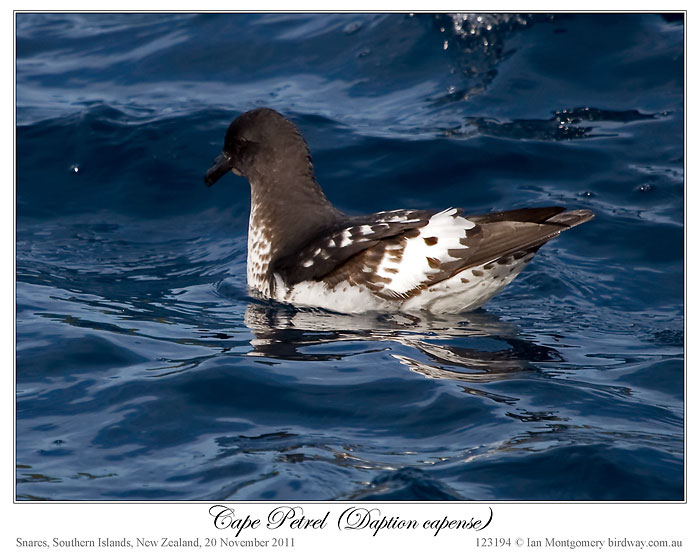
The striking chequered black and white pattern on the back and wings is unique. The white patches on the primary and secondary flight feathers are translucent and appears as ‘windows’ when seen from below in bright light, as in the second photo. We encountered Cape Petrels soon after leaving Dunedin, and as they follow ships, they were almost constant companions for most of the voyage.
Cape Petrel (Daption capense) by Ian 2
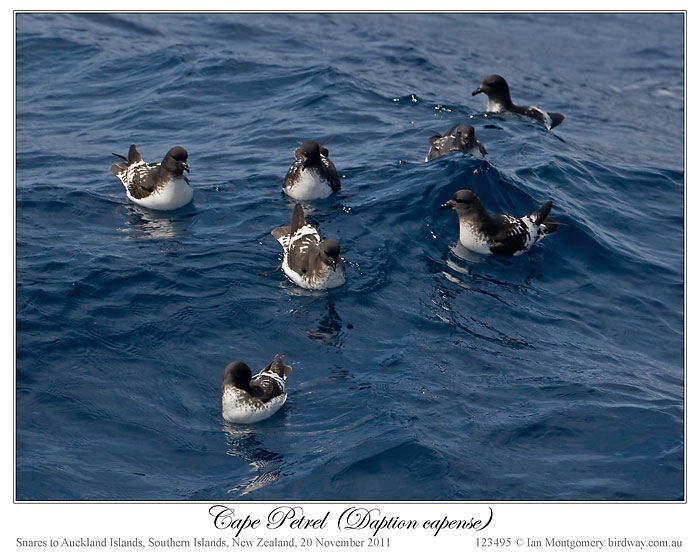
With a length of 35-40cm/14-16in, they’re comparable in size to a domestic pigeon, though with much longer wings, and are often called Cape Pigeons. They feed on krill, small fish, etc., either by swimming buoyantly on the surface and pecking in a rather pigeon-like fashion or by snatching morsels in flight. They’ll readily feed on marine scraps left by others and often follow whales.
Cape Petrel (Daption capense) by Ian 3
As you can guess from the name, the species was originally named from a specimen collected at the Cape of Good Hope and described by the father of taxonomy, Linnaeus, in 1758. Cape Petrels are very characteristic bird of the southern oceans right around the planet and range from the coast of Antarctica to the Tropic of Capricorn, and even reach the equator in the cold Humboldt current on the western side of South America. They occur around Australia in the southern winter but are mainly an offshore bird, unless beach-wrecked by storms. The global population is in the millions, and they can occur in large flocks, though we encountered them mainly in small numbers.
Cape Petrel (Daption capense) by Ian 4
The nest on most of the sub-Antartic Islands around the world and on islands along the coast of Antarctica itself. There is a small colony on Macquarie Island and larger colonies on the Southern Islands of New Zealand (Snares, Auckland, Campbell, Bounty, Antipodes and Chatham). These belong to a separate race, australe, smaller than the nominate race.
Cape Petrel (Daption capense) by Ian 5
I loved watching them soaring and wheeling around the ship, and they looked as if they enjoyed it too. I got very used to their attendance and found their familiar presence reassuring in the vast and sometimes alien and stormy remoteness of the Southern Ocean.
I have another request for moral and spiritual support (and so far you’ve never failed me :-})! I’m planning to go to Eungella National Park west of Mackay next weekend in search of the Eungella Honeyeater. I’ve never seen it before, and we need photos for the Pizzey and Knight digital project.
Best wishes
Ian
*************************************************
Ian Montgomery, Birdway Pty Ltd,
454 Forestry Road, Bluewater, Qld 4818B
Tel 0411 602 737 ian@birdway.com.au
Check the latest website updates: http://www.birdway.com.au/#updates
**************************************************
Lee’s Addition:
And unto one he gave five talents, to another two, and to another one; to every man according to his several ability; and straightway took his journey. (Matthew 25:15 KJV)
Looks like the Petrel flew under some dropping white paint. I am sure that it helped in IDing it. Ian is correct about that unique pattern. I am amazed at how unique all the birds were created. Each has its own patterns, food requirements and places to live. Just like all of us. We each have a unique niche to find and enjoy. Thankfully, Ian has found one of his niches. He is an adventurous and fantastic photographer.
Yes, Ian, we will be praying for you as you take this next adventure to find the Eungella Honeyeater and whatever else pops up in front of your lens. Also for your safe journey.
Smith’s Longspur for Birds Illustrated by Col F. M. Woodruff
Birds Illustrated by Color Photography – Revisited
Vol 1. April, 1897 No. 4
*
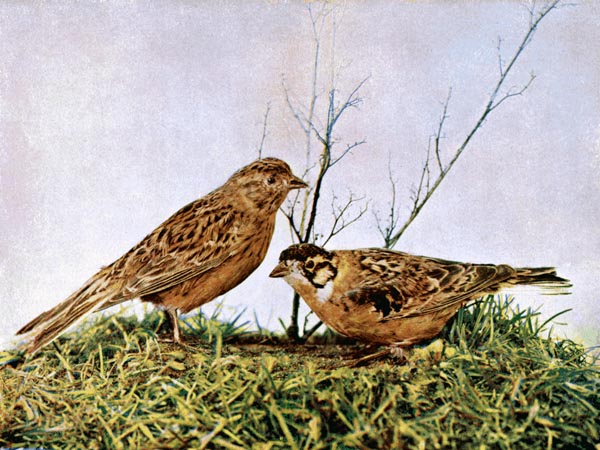
SMITH’S PAINTED LONGSPUR.
MITH’S Painted Longspur is usually considered a rare bird in the middle west, but a recent observer found it very common in the fields. He saw twenty-five on October 3rd of last year. They were associated with a large flock of Lapland Longspurs. On account of its general resemblance to the latter species it is often overlooked. It is found in the interior of North America from the Arctic coast to Illinois and Texas, breeding far north, where it has a thick, fur-lined, grass nest, set in moss on the ground. Like the Lapland Longspur, it is only a winter visitor. It is not so generally distributed as that species, the migrations being wholly confined to the open prairie districts. Painted Longspurs are generally found in large flocks, and when once on the ground begin to sport. They run very nimbly, and when they arise utter a sharp click, repeated several times in quick succession, and move with an easy undulating motion for a short distance, when they alight very suddenly, seeming to fall perpendicularly several feet to the ground. They prefer the roots where the grass is shortest. When in the air they fly in circles, to and fro, for a few minutes, and then alight, keeping up a constant chirping or call. They seem to prefer the wet portions of the prairie. In the breeding seasons the Longspur’s song has much of charm, and is uttered like the Skylark’s while soaring. The Longspur is a ground feeder, and the mark of his long hind claw, or spur, can often be seen in the new snow. In 1888 the writer saw a considerable flock of Painted Longspurs feeding along the Niagara river near Fort Erie, Canada.
The usual number of eggs found in a nest is four or five, and the nests, for the most part, are built of fine dry grasses, carefully arranged and lined with down, feathers, or finer materials similar to those of the outer portions. They are sometimes sunk in an excavation made by the birds, or in a tuft of grass, and in one instance, placed in the midst of a bed of Labrador tea. When the nest is approached, the female quietly slips off, while the male bird may be seen hopping or flying from tree to tree in the neighborhood of the nest and doing all he can to induce intruders to withdraw from the neighborhood. The eggs have a light clay-colored ground, marked with obscure blotches of lavender and darker lines, dots, and blotches of purplish brown. The Longspur is a strong flier, and seems to delight in breasting the strongest gales, when all the other birds appear to move with difficulty, and to keep themselves concealed among the grass. While the colors of adult males are very different in the Longspur family, the females have a decided resemblance. The markings of the male are faintly indicated, but the black and buff are wanting.
Behold the fowls of the air: for they sow not, neither do they reap, nor gather into barns; yet your heavenly Father feedeth them. Are ye not much better than they? (Matthew 6:26 KJV)
“If you come across a bird’s nest in any tree or on the ground, with young ones or eggs and the mother sitting on the young or on the eggs, you shall not take the mother with the young. (Deuteronomy 22:6 ESV)
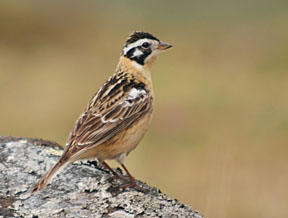
The Smith’s Longspur, Calcarius pictus, is a small ground-feeding bird from the familyCalcariidae, which also contains the longspurs.
These birds have short cone-shaped bills, streaked backs, and dark tails with white outer retrices. In breeding state plumage (mostly formed by worn basic plumage), the male has pumpkin orange throat, nape, and underparts contrasting with an intricate black-and-white face pattern. The white lesser coverts are quite pronounced on a male in spring and early summer. Females and immatures have lightly streaked buffy underparts, dark crowns, brown wings with less obvious white lesser coverts, and a light-colored face. The tail is identical at all ages.
This bird breeds in open grassy areas near the tree line in northern Canada and Alaska. The female lays 3 to 5 eggs in a grass cup nest on the ground. These birds nest in small colonies; males do not defend territory. Both males and females may have more than one mate. The parents, one female and possibly more than one male, feed the young birds.
In winter, they congregate in open fields, including airports, in the south-central United States.
Migration is elliptical, with northbound birds staging in Illinois in the spring and southbound birds flying over the Great Plains in the fall.
These birds forage on the ground, gathering in flocks outside of the nesting season. They mainly eat seeds, also eating insects in summer. Young birds are mainly fed insects.
The song is a sweet warble that’s inflected at the end, somewhat reminiscent of Chestnut-sided Warbler. The call is a dry rattle, like a shorterned version of the call of a female Brown-headed Cowbird. It is noticebaly drier than that of Lapland Longspur.
Audubon named this bird after his friend Gideon B. Smith.
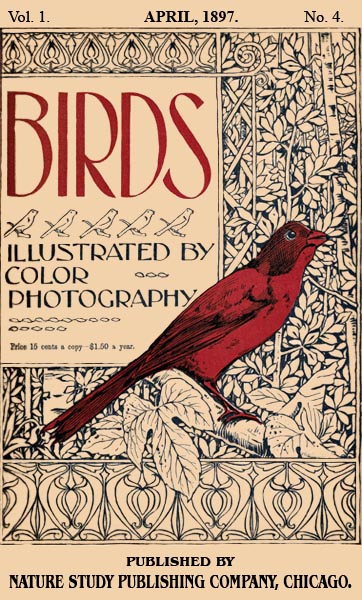
Birds Illustrated by Color Photograhy Vol 1 April 1897 No 4 – Cover
The above article is the first article in the monthly serial for February 1897 “designed to promote Knowledge of Bird-Live.” These include Color Photography, as they call them, today they are drawings. There are at least three Volumes that have been digitized by Project Gutenberg.
Bird of the Week – Grey Ternlet ~ by Ian Montgomery
Newsletter ~ 4/10/12
Last week we had the (Common) White Tern or White Noddy. Here is its counterpart the Grey Ternlet, often called the Grey Noddy. It is also an island species but is restricted in range to the Western and South Pacific. In the Australian regions it, like the White Tern, occurs on both Lord Howe and Norfolk Islands. Unlike the White Tern, it nests mainly on inaccessible rock cliffs and I had had only distant views of it on Lord Howe 20 years ago. The situation was similar on Norfolk Island, and the first photo, taken at Captain Cook’s Lookout, was our first view of any. This photo, I might add, was taken with a 500mm telephoto lens, so we were nowhere near them.
Grey Noddy (Procelsterna albivitta) by Ian 1
So we hoped that our planned boat trip to nearby Phillip Island would provide better views and photo opportunities. It was late in the nesting season, though, and when we returned to the rocky cove to be picked up by the boat, we still hadn’t seen any, even in the distance. Getting on and off the boat was an interesting exercise as there is no wharf, just a north-facing cove, sheltered in southerly winds and swell, with a slippery rock shelf, best negotiated in stockinged feet for better traction, second photo (that’s Norfolk Island in the background).
Grey Noddy (Procelsterna albivitta) by Ian 2
We were just getting ready to board the approaching boat, when two Grey Ternlets landed on a rocky cliff nearby, and the boat was forgotten while I dug the camera out of my backpack. The two birds were an adult and a juvenile, the adult standing over the juvenile, which has dark markings on the head, in the third photo.
Grey Noddy (Procelsterna albivitta) by Ian 3
I moved closer to them, but the adult flew off, leaving the youngster to its fate, fourth photo.
Grey Noddy (Procelsterna albivitta) by Ian 4
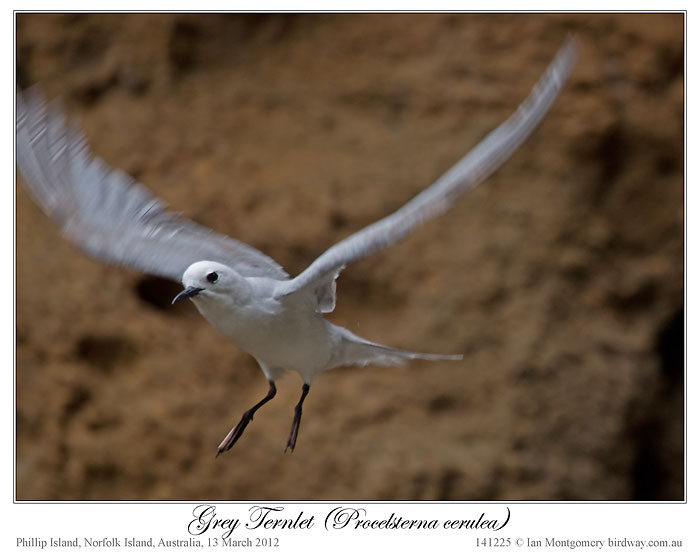
The adult had landed almost out of sight behind a rocky outcrop, but I got a photo of it when it took off a little later, fifth photo.
Grey Noddy (Procelsterna albivitta) by Ian 5
Anyway, it was time to leave the Ternlets to their own devices and get on the boat. We were to see more Grey Ternlets on the cliffs of Norfolk Island, including a flock of about 15, but we never got close to them again. It was a great ending to a very successful trip to Phillip Island and we didn’t mind too much getting rather wet from the spray on the way back to Norfolk Island, the cameras being safety stowed in a dry spot.
Best wishes
Ian
**************************************************
Ian Montgomery, Birdway Pty Ltd,
454 Forestry Road, Bluewater, Qld 4818
Tel 0411 602 737 ian@birdway.com.au
Check the latest website updates: http://www.birdway.com.au/#updates
**************************************************
Lee’s Addition:
What scenery and what a beautiful Noddy. These Noddies or Ternlets like to nest on protected cliffs it appears.
The place where you live is safe. Your nest is on a high cliff. (Numbers 24:21a NIrV)
The Grey Noddy or Grey Ternlet (Procelsterna albivitta) is a seabird belonging to the tern family Laridae. It was once regarded as a pale morph of the Blue Noddy (Procelsterna cerulea) but is now often considered to be a separate species. It occurs in subtropical and warm temperate waters of the south Pacific Ocean.
It is 25–30 cm (9.8–12 in) long with a wingspan of 46–61 cm (18–24 in) and a weight of about 75 grams (2.6 oz). The tail is fairly long and notched. The plumage is pale grey, almost white on the head and underparts but darker on the back, tail and wings. The wings have dark tips and a white hind edge and are mainly white underneath. The eye is black and appears large due to the black patch in front of it. There is a white patch behind the eye. The thin, pointed bill is black and the legs and feet are also black apart from pale yellow webs.
It feeds in shallow water, not moving far from the breeding colonies. It gathers in large feeding flocks which can contain thousands of individuals. They feed by hovering over the water and dropping down to pick food from the surface. Plankton forms the bulk of the diet and small fish are also eaten.
Breeding takes place in colonies on rocky islands. The nest site is a sheltered rocky surface or underneath a boulder or clump of vegetation. A single egg is laid. Juvenile birds are browner than the adults and have darker, more contrasting flight feathers.
The Grey Noddy is usually silent but has a soft, purring call.
(The verse is out of context, but the nest on the cliff fit with these birds. Wikipedia cited.)
Surprisingly when I put “open” and “eye” into my Bible search with e-Sword to find a verse for this article, I found 49 verses that had both words. The reason for a verse with your eyes being open, is that is your first tool you need as a birdwatcher when you go birding is your eyes. Here are a few examples:
Gen_21:19 And God opened her eyes, and she saw a well of water; …
Num_22:31 Then the LORD opened the eyes of Balaam, and he saw the angel of the LORD standing in the way…
2Kiing_6:17 And Elisha prayed, and said, LORD, I pray thee, open his eyes, that he may see. And the LORD opened the eyes of the young man; and he saw: and, behold, the mountain was full of horses and chariots of fire round about Elisha.
2King_6:20 … that Elisha said, LORD, open the eyes of these men, that they may see. And the LORD opened their eyes, and they saw; and, behold,
Psa_119:18 Open thou mine eyes, that I may behold wondrous things out of thy law.
Mat_20:33 They say unto him, Lord, that our eyes may be opened.
I know these verses do not apply to birding or birdwatching, but I think they reveal some truths that do apply. The LORD or God opened their eyes. Would it be wrong for us to ask the Lord to open our eyes to see His marvelous creation, especially the birds. Once their eyes were opened, they saw different things. We are going to see different birds on different outings.
Also, Christ said in the Sermon on the Mount: “Look at the birds of the air:…” (Matthew 6:26 ESV)
The second “tool” that is very useful is your ears. Some people cannot see because of blindness or poor sight, but does that keep them from birding? No! Fanny Crosby was blinded early in life, but in my opinion, she was a fantastic birder. She may not have seen, but she “heard” the birds. When I first started my research for Birds in Hymns, of the first 44 hymns I found 10 were written by Fanny Crosby! Here are two examples:
“Happy am I, the bird is singing” – Tried and True
“And the bird in the greenwood is singing with glee” – Praise the Giver of All
Listening to the sounds around you can reveal hidden treasures. Birds sing, call, alert other birds of danger, make sounds with their wings, etc. Having our ears open to their sounds can help locate them. After awhile, with a little practice, you will recognize birds just by their calls and songs. Even if you never see the bird, the avian friend can be counted on your “life list,” but that is another article.
The first two tools, Eyes and Ears, could be summarized as “Awareness.” If you are not aware of the birds, you will miss finding them. Basically, those two tools are all you need.
Third: To find the birds and see them closer, a pair of binoculars are very useful. It is not required, but I use mine most of the time to observe better details that help me identify the birds. There are lots of articles in books and on the internet about which pair to buy, what strength they should be, how much to pay, etc.
So what should you buy? Every birdwatcher will give you different thoughts, but here is what I have. I use a 8 X 42 lens. “The first number is the power of magnification of the binocular. With an 8×42 binocular, the object being viewed appears to be eight times closer than you would see it with the unaided eye.” “The second number in the formula (8×42) is the diameter of the objective front lens. The larger the objective lens, the more light that enters the binocular and the brighter the image.” (Bushnell) There are things like the kind of lens, coating, field of view, etc. that you can get from their site and others.
My only other advise is not to buy a 10X or larger because it is harder to hold the image steady, at least for birdwatching.
The fourth “tool” would be a small notebook to keep a list of the birds you see. Even if you don’t know what they are at first you can still make notes of what they looked like, colors, sounds, beak shape, feet, wings, time and date, and other notes about your observing the bird. Later, that will help to identify the bird. More on “Lists” in another article.
The last main tool would be a Bird Guide to find out which bird you just saw. (Again, another article) You can use the internet to assist in that also, like What Bird.
There are other tools that are useful, but when you first Start Birdwatching Today, they are not a necessity, but in time, they also become very useful. Here are a few:
Camera – helps with ID
Spotting Scope – great for birds far away
Audio Tapes of Birds – to learn their songs
Handheld Electronic Devices – helps ID in the field
We are trying to keep this series simple, at least at first, so that you realize that you can “Start Birdwatching TODAY”
Birds Illustrated by Color Photography – Revisited
Vol 1. April, 1897 No. 4
*
THE ROSE-BREASTED GROSBEAK.
HIS is an American bird, and has been described under various names by various authors. It is found in the lower parts of Pennsylvania, in the state of New York, and in New England, particularly in autumn, when the berries of the sour gum are ripe, on the kernels of which it eagerly feeds. As a singer it has few superiors. It frequently sings at night, and even all night, the notes being extremely clear and mellow. It does not acquire its full colors until at least the second spring or summer. It is found as far east as Nova Scotia, as far west as Nebraska, and winters in great numbers in Guatemala. This Grosbeak is common in southern Indiana, northern Illinois, and western Iowa. It is usually seen in open woods, on the borders of streams, but frequently sings in the deep recesses of forests. In Mr. Nuttall’s opinion this species has no superior in song, except the Mocking Bird.
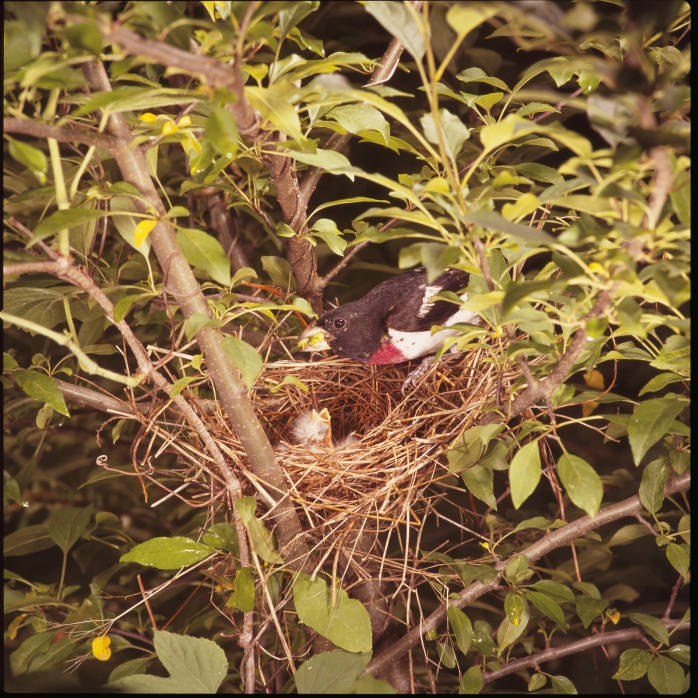
The Rose-Breasted Grosbeaks arrive in May and nest early in June. They build in low trees on the edges of woods, frequently in small groves on the banks of streams. The nest is coarsely built of waste stubble, fragments of leaves, and stems of plants, intermingled with and strengthened by twigs and coarser stems. It is eight inches wide, and three and a half high, with a cavity three inches in diameter and one in depth, being quite shallow for so large a nest.
Dr. Hoy, of Racine, states that on the 15th of June, within six miles of that city, he found seven nests, all within a space of not over five acres, and he was assured that each year they resort to the same locality and nest in this social manner. Six of these nests were in thorn-trees, all were within six to ten feet of the ground, near the center of the top. Three of the four parent birds sitting on the nests were males. When a nest was disturbed, all the neighboring Grosbeaks gathered and appeared equally interested.
It is frequently observed early in the month of March, making its way eastward. At this period it passes at a considerable height in the air. On the banks of the Schuylkill, early in May, it has been seen feeding on the tender buds of trees. It eats various kinds of food, such as hemp-seed, insects, grasshoppers, and crickets with peculiar relish. It eats flies and wasps, and great numbers of these pests are destroyed by its strong bill. During bright moonshiny nights the Grosbeak sings sweetly, but not loudly. In the daytime, when singing, it has the habit of vibrating its wings, in the manner of the Mocking-bird.
The male takes turns with his mate in sitting on the eggs. He is so happy when on the nest that he sings loud and long. His music is sometimes the cause of great mourning in the lovely family because it tells the egg hunter where to find the precious nest.
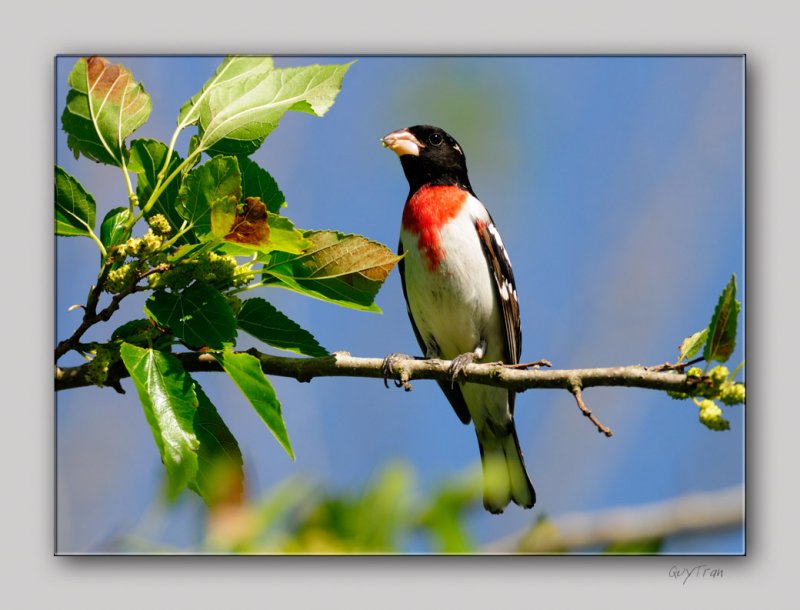
Rose-breasted Grosbeak (Pheucticus ludovicianus) by Quy Tran
Lee’s Addition:
For I delivered unto you first of all that which I also received, how that Christ died for our sins according to the scriptures; And that he was buried, and that he rose again the third day according to the scriptures: (1 Corinthians 15:3-4 KJV)
The Rose-breasted Grosbeak, Pheucticus ludovicianus, is a large seed-eating songbird in the cardinal family. It breeds in cool-temperate North America, migrating to tropical America in winter. They belong to the Cardinalidae – Grosbeaks, Saltators & Allies Family.
Adult birds are 7.1–7.5 in (18–19 cm) long and weigh 1.6–1.7 oz (45–47 g) on average. At all ages and in both sexes, the beak is dusky horn-colored, and the feet and eyes are dark.
Rose-breasted Grosbeak (Pheucticus ludovicianus) by Raymond Barlow
The adult male in breeding plumage has a black head, wings, back and tail, and a bright rose-red patch on its breast; the wings have two white patches and rose-red linings. Its underside and rump are white. Males in nonbreeding plumage have largely white underparts, supercilium and cheeks. The upperside feathers have brown fringes, most wing feathers white ones, giving a scaly appearance. The bases of the primary remiges are also white. The adult female has dark grey-brown upperparts – darker on wings and tail –, a white supercilium, a buff stripe along the top of the head, and black-streaked white underparts, which except in the center of the belly have a buff tinge. The wing linings are yellowish, and on the upperwing there are two white patches like in the summer male. Immatures are similar, but with pink wing-linings and less prominent streaks and usually a pinkish-buff hue on the throat and breast. At one year of age—in their first breeding season—males are scaly above like fully adult males in winter plumage, and still retail the immature’s browner wings.
The song is a subdued mellow warbling, resembling a more refined version of the American Robin’s (Turdus migratorius). Males start singing early, occasionally even when still in winter quarters. The call is a sharp pink or pick.
Rose-breasted Grosbeak from xeno-canto by Chris Parrish
The Rose-breasted Grosbeak’s breeding habitat is open deciduous woods across most of Canada and the northeastern USA. In particular the northern birds migrate south through the United States east of the Rocky Mountains, to winter from central-southern Mexico through Central America and the Caribbean to Peru and Venezuela. The southern limit of its wintering range is not well known; it was for example only recorded in the Serranía de las Quinchas (Colombia) in the 1990s. In winter, they prefer more open woodland, or similar habitat with a loose growth of trees, such as forest edges, parks, gardens and plantations, ranging from sea level into the hills, e.g. up to 5,000 ft (1,500 m) ASL in Costa Rica.
The first birds leave the breeding grounds as early as August, while the last ones do not return until mid-late May. In general, however, they migrate south in late September or in October, and return in late April or early May. It appears as if they remain on their breeding grounds longer today than they did in the early 20th century, when migrants were more commonly seen in May and August than in April or September. The Rose-breasted Grosbeak occurs as a very rare vagrant in western Europe.
It builds a twig nest in a tree or large shrub. The Rose-breasted Grosbeak forages in shrubs or trees for insects, seeds and berries, also catching insects in flight and occasionally eating nectar. It usually keeps to the treetops, and only rarely can be seen on the ground. During breeding it is fairly territorial; in winter, it roams the lands in groups of about a handful of birds, and sometimes in larger flocks of a dozen or more. In the winter quarters, they can be attracted into parks, gardens, and possibly even to bird feeders by fruit like Trophis racemosa. Other notable winter food includes Jacaranda seeds and the fruits of the introduced Busy Lizzy (Impatiens walleriana).
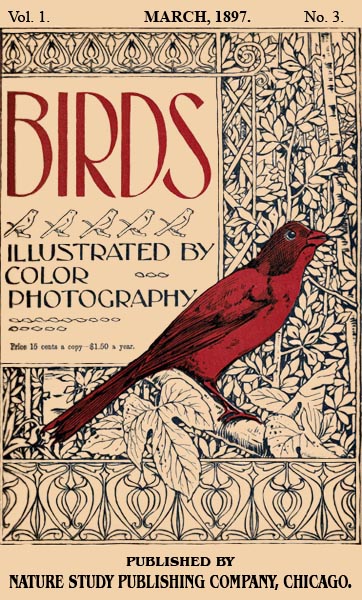
Birds Illustrated by Color Photograhy Vol 1 April 1897 No 4 – Cover
The above article is the first article in the monthly serial for February 1897 “designed to promote Knowledge of Bird-Live.” These include Color Photography, as they call them, today they are drawings. There are at least three Volumes that have been digitized by Project Gutenberg.
Ian’s Bird of the Week – Common White Tern ~ by Ian Montgomery
Newsletter – 4/2/12
Another species on my photo list on Norfolk Island was the (Common) White Tern. I’d admired on Lord Howe Island more than twenty years ago, before I got seriously into bird photography. They’re only Common if you’re on a remote coral or rocky island in the Pacific, Indian and Atlantic Oceans, but the label really means ‘standard’ and reflects a split of the species, not universally recognised, into ‘Standard’ and Little White Tern. It used to have the attractive name ‘White Noddy’, until some prosaic purist decided that only terns belong the genus Anous were real Noddies.
They are unusually looking terns, with a pointy, slightly upturned bill and very white, actually translucent, feathers, usually described as ‘ethereal’. Seen against the sunlight, the effect is something like looking at an X-ray as in the second photo. In this one, you can see the bill is very thin laterally so it is shaped more like a pair of scissors.
White Terns are numerous on Norfolk Island and as they nest on the branches of Norfolk Island Pines, you see them all over the island. If you’re used to seeing terns near water, it’s initially slightly disconcerting to see them flying around in forest. Many of these are parents feeding young, but do also see pairs or small groups of birds, as in the third photo, and very pretty they are too.
In March, the breeding season is nearly over, but there are still some hungry and very bored looking chicks in the pines waiting for a feed. The single egg is laid precariously in a concavity on a branch or palm frond. Norfolk Island pines, with their horizontal limbs, are ideal for this and the recent establishment of breeding White Terns on Lord Howe Island can probably be attributed to the introduction of Norfolk Island Pines.
The fourth photo shows a nearly fledged juvenile. At this age they look like furry toys, but the slightly younger ones, that were just losing the last traces of their down, often looked quite comical. The bird in the fifth photo shows one that looks for all the world like an aged goddess of the silver screen who doesn’t believe in growing old gracefully, with faux eye-lashes, smudged mascara, thinning hair, an ancient fur coat and a grumpy expression.
Hopefully, though, it has a bright future ahead.
Best wishes
Ian<
**************************************************
Ian Montgomery, Birdway Pty Ltd,
454 Forestry Road, Bluewater, Qld 4818
Tel 0411 602 737 ian@birdway.com.au
Check the latest website updates: http://www.birdway.com.au/#updates
**************************************************
Lee’s Addition:
What a description of the that last photos. Puts a chuckle in you. What is so amazing is that it fits.
“The White Tern (Gygis alba) is a small seabird found across the tropical oceans of the world. It is sometimes known as the Fairy Tern although this name is potentially confusing as it is the common name of the Fairy Tern Sternula nereis. Other names for the species include Angel Tern and White Noddy.
The White Tern is a small, all white tern with a long black bill, related to the noddies. It ranges widely across the Pacific and Indian Oceans, and also nests in some Atlantic islands. It nests on coral islands, usually on trees with thin branches but also on rocky ledges and on man-made structures. The White Tern feeds on small fish which it catches by plunge diving.
…there are costs associated with tree nesting, as the eggs and chicks are vulnerable to becoming dislodged by heavy winds. For this reason the White Tern is also quick to relay should it lose the egg. The newly hatched chicks have well developed feet with which to hang on to their precarious nesting site. It is a long-lived bird, having been recorded living for 17 years.” (Wikipedia)
Looks like the Lord, in his creation of these chicks, provided feet that can help them hold on.
All the birds of the heavens made their nests in its boughs; under its branches all the beasts of the field gave birth to their young, and under its shadow lived all great nations. (Ezekiel 31:6 ESV)
Ian’s Bird of the Week – Pacific Robin ~ by Ian Montgomery
Newsletter – 3/25/12
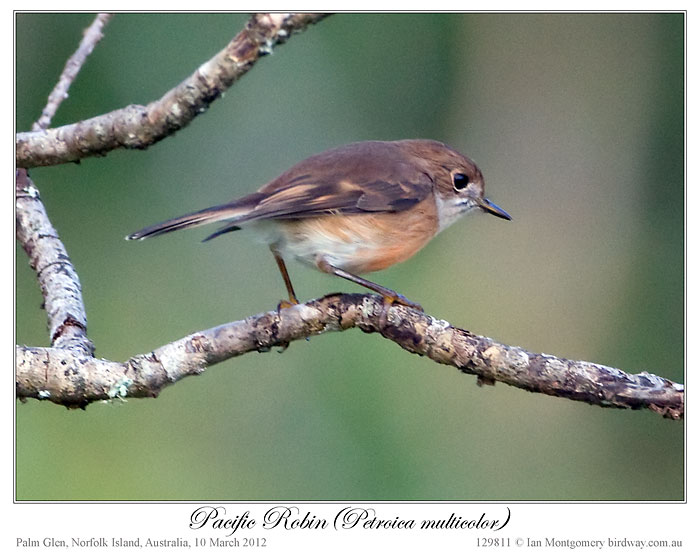
The Pacific Robin was another bird that I was keen to photograph on Norfolk Island. It has only recently been split from the mainland Scarlet Robin and, until that happened, it attracted little attention. As a consequence, I had trouble sourcing photos, particularly of adult males, and getting reliable material for the description of the species for the digital version of the Australian field guide by Pizzey and Knight.
It’s not common on Norfolk Island with an estimated population of 400-500 species and its distribution is restricted to areas of native forest. Happily, there was a resident family at the place, Palm Glen, where we did regular evening vigils for the Norfolk Island Parakeet and, being more confiding than Scarlet Robins, the members of the family proved to be good subjects for photography. The first photo shows the adult male. At first glance, it looks like a small Scarlet Robin, but closer examination reveals the diagnostic lack of white on the flight feathers of the wing and the outer tail feathers: the only white on the wing is the secondary wing coverts. Another supposed difference is a smaller area of white on the forehead, but this bird at least seemed to me to show much more white, extending back to a point above the rear of the eyes. If you’re interested, compare with http://www.birdway.com.au/petroicidae/scarlet_robin/index.htm .
Pacific Robin (Petroica multicolor) by Ian 2 Fem L-Juv R
The second photo shows the adult female, left, and the juvenile, right, posing obligingly for comparison. Both lack the obvious white forehead spot characteristic of, in fact diagnostic of, their Scarlet Robin counterparts and also lack white in the outer tail feathers. The colours are also richer and the wing stripes are a deeper buff, almost blending with the buffish-brown of the rest of the wings and back. The third photos shows the same female face-on, and the lack of the white spot is more obvious: there is only slight white scalloping.
Pacific Robin (Petroica multicolor) by Ian 3 Fem
The fourth photo is another shot of the same juvenile, showing the lack of white on the outer tail feathers.
Pacific Robin (Petroica multicolor) by Ian 4 Juv
Having noticed the large amount of white on the forehead of the male, I kept an eye out for another individual and eventually photographed this one, fifth photo, on nearby Mount Pitt. This too had a large white spot.
Pacific Robin (Petroica multicolor) by Ian 5
The Pacific Robin, as now described, is quite widely distributed on islands in the South Pacific from the Solomons in the north via Vanuata and Fiji to Norfolk Island in the south. It is quite variable in plumage and 14 races have been described. It is closely related to the Tomtit of New Zealand, the males of which vary in colour from the white-breasted (North Island), through yellow-breasted (South Island) to the complete black race on the Snares: http://www.birdway.com.au/petroicidae/tomtit/index.htm. There is clearly enough material here to keep a South-sea-island-loving taxonomist busy for at least a lifetime and I won’t say anything further except to note an interesting historical twist in the story of the splitting of the Pacific and Scarlet Robins.
Norfolk Island was settled in the same year as Sydney, 1788, and one result of that was that the Scarlet Robin was described using a Norfolk Island specimen (the type specimen) by German Naturalist Johann Gmelin in 1789 and given the specific name multicolor.When the species was split 210 years later, the rules governing taxonomy insist that this name remains with the Norfolk Island bird, so the mainland species becomes the new one and was named boodang after the SE Australian race (up till thenPetroica multicolour boodang). To avoid confusion in Australia (at the risk maybe of increasing it in the Pacific Islands) the common name Scarlet was transferred to the new species and the new name Pacific was given to the old species.
I’m sure this family of birds at Palm Glen would be astounded to learn that their kind is the subject of such intense scrutiny!
He answered and said to them, “When it is evening you say, ‘It will be fair weather, for the sky is red’; (Matthew 16:2 NKJV)
Those changes aught to keep the Bird Guide writers busy keeping up with the divisions and name changing. What a gorgeous bird and fantastic photography. Thanks again, Ian, for sharing all these great birds.
It seems small in the photos, so I checked to see its size. “The Pacific Robin is a small passerine, 4.5-5.3 in (11.5–13.5 cm) long and weighing .31-.38 oz (9–11 g.) Over much of its range it is the smallest species of bird. Pretty small.
“The Pacific Robin is a seasonal breeder, although the timing of the breeding season varies across its range. Information on the timing of the season is patchy or absent in many islands. On Norfolk Island the breeding season is from September to December, and in Vanuatu the season is from October to January. Parents with young have been seen in mid August in the Solomon Islands and in June through to September in Samoa. The species builds a compact nest which is a cup of plant fibres and spider webs. The outside of the nest is decorated with moss and lichen, and is therefore easily overlooked. The nest is usually set into a fork or stump on a tree branch, or on a horizontal branch.
Around two to four eggs are laid in each clutch, with two being the typical clutch size in Norfolk Island, and two to three being typical in Fiji. The eggs are dull grey or greenish, and are incubated by the female. The nests of Pacific Robins are parastised by Fan-tailed Cuckoos where the two species co-occur.” (Wikipedia)
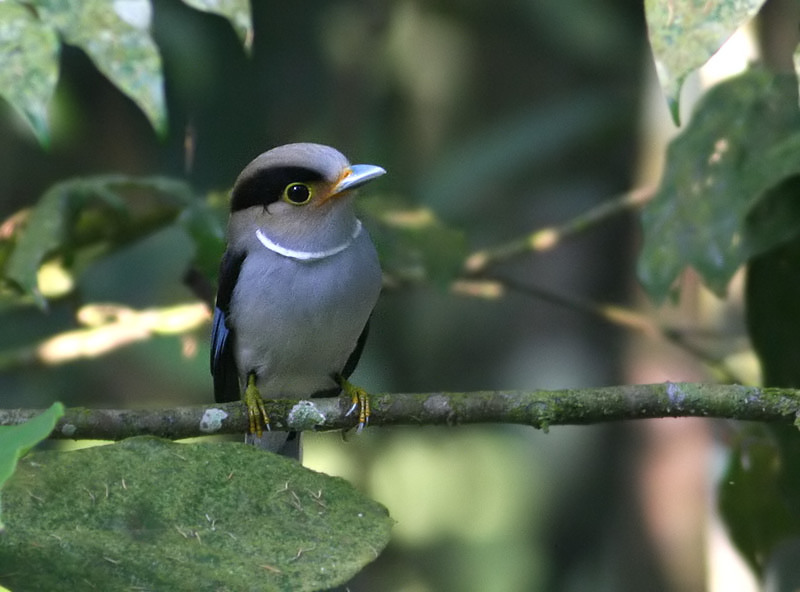
Silver-breasted Broadbill (Serilophus lunatus) by Peter Ericsson
We know from Genesis 1 that the God created the birds, along with everything else. They were created on the fifth day. When Adam became conscience, the birds and critters were already present for him to discover and enjoy.
Then God said, “Let the waters abound with an abundance of living creatures, and let birds fly above the earth across the face of the firmament of the heavens.” So God created great sea creatures and every living thing that moves, with which the waters abounded, according to their kind, and every winged bird according to its kind. And God saw that it was good. And God blessed them, saying, “Be fruitful and multiply, and fill the waters in the seas, and let birds multiply on the earth.” So the evening and the morning were the fifth day. (Genesis 1:20-23 NKJV)
Then the LORD God brought the birds to Adam to let him give them a name.
Out of the ground the LORD God formed every beast of the field and every bird of the air, and brought them to Adam to see what he would call them. And whatever Adam called each living creature, that was its name. (Genesis 2:19 NKJV)
Psalm 111 reminds us that the things that were created are great and are to be “sought out” and enjoyed.
The works of the LORD are great, sought out of all them that have pleasure therein. His work is honourable and glorious: and his righteousness endureth for ever. He hath made his wonderful works to be remembered: the LORD is gracious and full of compassion. (Psalms 111:2-4 KJV)
Fast forward to today. If Adam was to enjoy the birds and put names on them, should we not try to discover them, enjoy them, and try to figure out what their names are?
Galah (Eolophus roseicapilla) and Dan at Brevard Zoo
The birds are all around us, in the sky flying or gliding on the wind (currents), on the power lines, on feeders, on bushes, in trees, or singing or calling in the distant. (Sometimes they are even on cameras.)
Start birdwatching today for pleasure and realize the goodness of the Lord to us.
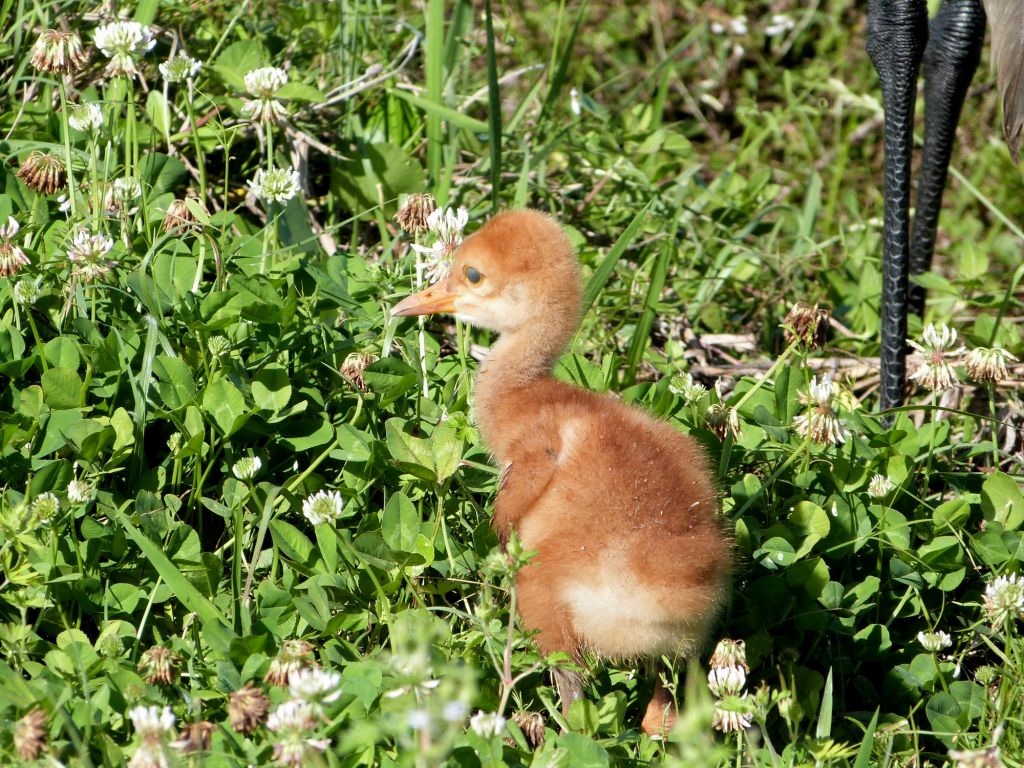
We had not been to Circle B recently, nor especially out to the Marsh by the windmill. Actually the windmill has lost its blades. It is a long trek out there for me, but praise the Lord, one of the workers came along with one of their vehicles and gave us a ride to the marsh. We were greeted by a group photographing Sandhill Cranes with their baby. That would have made the trip worth it alone.
Of course there were other birds awaiting our arrival. It is never boring out there. Since we had parked up by the entrance to get to the marsh, when we got out of the car and were getting our cameras and binoculars, we were greeted by the sound of a Pileated Woodpecker. When we returned, the Pileated showed off and we got some close-up shots of two of them. They were right by the pavilion and didn’t seem to mind those of us nearby.
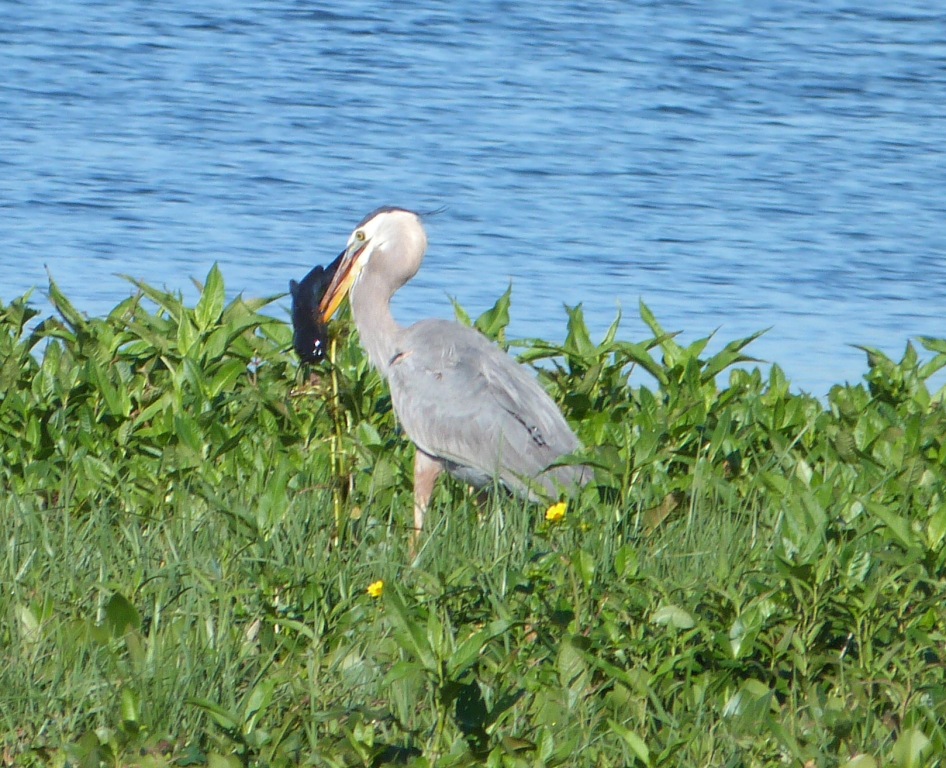
Great Blue Heron with Catfish at Circle B by Lee - cropped
Another neat observation was the Great Blue Heron that caught a fish, actually a catfish. He was out from the edge a bit, but was able to zoom in on him. Took some video of it trying to kill the fish.
It is still quite dry out there as the rains have not started yet. It has been rather dry this winter. Water levels are still low.
I am including some photos and video taken out at Circle B that day. Video has segment of Great Blue with the Catfish and a close-up of the Pileated Woodpecker. Notice how he uses his tail to support himself.
This slideshow requires JavaScript.
In the beginning was the Word, and the Word was with God, and the Word was God. He was in the beginning with God. All things were made through Him, and without Him nothing was made that was made. (John 1:1-3 NKJV)
Here is the list from e-bird for that trip. (37 species total)
Black Tern, Mother and young with eggs, for Birds Illustrated
Birds Illustrated by Color Photography – Revisited
Vol 1. March, 1897 No. 3
THE BLACK TERN.
HE TERN,” says Mr. F. M. Woodruff, of the Chicago Academy of Sciences, “is the only representative of the long-winged swimmers which commonly nests with us on our inland fresh water marshes, arriving early in May in its brooding plumage of sooty black. The color changes in the autumn to white, and a number of the adult birds may be found, in the latter part of July, dotted and streaked here and there with white. On the first of June, 1891, I found a large colony of Black Terns nesting on Hyde Lake, Cook County, Illinois. As I approached the marsh a few birds were seen flying high in the air, and, as I neared the nesting site, the flying birds gave notes of alarm, and presently the air was filled with the graceful forms of this beautiful little bird. They circled about me, darting down to within a few feet of my head, constantly uttering a harsh, screaming cry. As the eggs are laid upon the bare ground, which the brownish and blackish markings so closely resemble, I was at first unable to find the nests, and discovered that the only way to locate them was to stand quietly and watch the birds. When the Tern is passing over the nest it checks its flight, and poises for a moment on quivering wings. By keeping my eyes on this spot I found the nest with very little trouble. The complement of eggs, when the bird has not been disturbed, is usually three. These are laid in a saucer shaped structure of dead vegetation, which is scraped together, from the surface of the wet, boggy ground. The bird figured in the plate had placed its nest on the edge of an old muskrat house, and my attention was attracted to it by the fact that upon the edge of the rat house, where it had climbed to rest itself, was the body of a young dabchick, or piedbilled grebe, scarcely two and one-half inches long, and not twenty-four hours out of the egg, a beautiful little ball of blackish down, striped with brown and white. From the latter part of July to the middle of August large flocks of Black Terns may be seen on the shores of our larger lakes on their annual migration southward.”
The Rev. P. B. Peabody, in alluding to his observation of the nests of the Tern, says: “Amid this floating sea of aquatic nests I saw an unusual number of well constructed homes of the Tern. Among these was one that I count a perfect nest. It rested on the perfectly flat foundation of a small decayed rat house, which was about fourteen inches in diameter. The nest, in form, is a truncated cone (barring the cavity), was about eight inches high and ten inches in diameter. The hollow—quite shallow—was about seven inches across, being thus unusually large. The whole was built up of bits of rushes, carried to the spot, these being quite uniform in length—about four inches.” After daily observation of the Tern, during which time he added much to his knowledge of the bird, he pertinently asks: “Who shall say how many traits and habits yet unknown may be discovered through patient watching of community-breeding birds, by men enjoying more of leisure for such delightful studies than often falls to the lot of most of us who have bread and butter to earn and a tiny part of the world’s work to finish?”
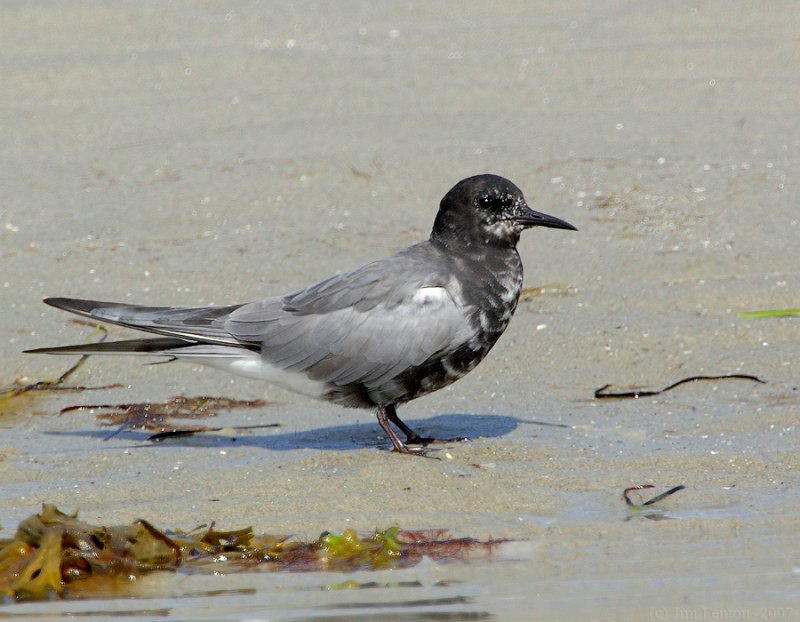
Black Tern (Chlidonias niger) by J Fenton
Lee’s Addition:
The Terns are in the Charadriiformes Orderand the Laridae Familyis part of that order. Laridaes include Gulls, Terns and Skimmers. The Tern, per se, is not a Gull, but are related and would be close in “kind.” The Birds of the Bible – Sea Gulls gives several articles that have been written here. The Sea Gull is found in the list of unclean birds given in Leviticus and Deuteronomy.
the ostrich, the short-eared owl, the sea gull, and the hawk after its kind; (Leviticus 11:16 NKJV)
“The Black Tern, Chlidonias niger, is a small tern generally found in or near inland water in Europe and North America. As its name suggests, it has predominantly dark plumage. Adult are 25 cm (9.75 in) long, with a wing span 6/1 cm (24 in), and weigh 62 g (2.2 oz). They have short dark legs and a short, weak-looking black bill, measuring 27–28 mm, nearly as long as the head. The bill is long, slender, and looks slightly decurved. The North American race, C. n. surinamensis, is distinguishable from the European form in all plumages, and is considered by some to be a separate species.
In flight, the build appears slim. The wing-beats are full and dynamic, and flight is often erratic as it dives to the surface for food; similar to other tern species.
North American Black terns migrate to the coasts of northern South America, some to the open ocean. Old World birds winter in Africa.
Unlike the “white” Sterna terns, these birds do not dive for fish, but forage on the wing picking up items at or near the water’s surface or catching insects in flight. They mainly eat insects and fish as well as amphibians.
The North American population has declined in recent times due to loss of habitat.Point Pelee National Park in Canada boasts a robust population of black terns.” (Wikipedia)
The above article is the first article in the monthly serial for February 1897 “designed to promote Knowledge of Bird-Live.” These include Color Photography, as they call them, today they are drawings. There are at least three Volumes that have been digitized by Project Gutenberg.
Birds Illustrated by Color Photography – Revisited
Vol 1. March, 1897 No. 3
*
THE RETURN OF THE BIRDS.
“Everywhere the blue sky belongs to them and is their appointed rest, and their native country, and their own natural home which they enter unannounced as lords that are certainly expected, and yet there is a silent joy at their arrival.”
HE return of the birds to their real home in the North, where they build their nests and rear their young, is regarded by all genuine lovers of earth’s messengers of gladness and gayety as one of the most interesting and poetical of annual occurrences. The naturalist, who notes the very day of each arrival, in order that he may verify former observation or add to his material gathered for a new work, does not necessarily anticipate with greater pleasure this event than do many whose lives are brightened by the coming of the friends of their youth, who alone of early companions do not change. First of all—and ever the same delightful warbler—the Bluebird, who, in 1895, did not appear at all in many localities, though here in considerable numbers last year, betrays himself. “Did he come down out of the heaven on that bright March morning when he told us so softly and plaintively that, if we pleased, spring had come?” Sometimes he is here a little earlier, and must keep his courage up until the cold snap is over and the snow is gone. Not long after the Bluebird, comes the Robin, sometimes in March, but in most of the northern states April is the month of his arrival. With his first utterance the spell of winter is broken, and the remembrance of it afar off. Then appears the Woodpecker in great variety, the Flicker usually arriving first. He is always somebody’s old favorite, “announcing his arrival by a long, loud call, repeated from the dry branch of some tree, or a stake in the fence—a thoroughly melodious April sound.”
Few perhaps reflect upon the difficulties encountered by the birds themselves in their returning migrations. A voyager sometimes meets with many of our common birds far out at sea. Such wanderers, it is said, when suddenly overtaken by a fog, completely lose their sense of direction and become hopelessly lost. Humming birds, those delicately organized, glittering gems, are among the most common of the land species seen at sea.
The present season has been quite favorable to the protection of birds. A very competent observer says that not all of the birds migrated this winter. He recently visited a farm less than an hour’s ride from Chicago, where he found the old place, as he relates it, “chucked full of Robins, Blackbirds, and Woodpeckers,” and others unknown to him. From this he inferred they would have been in Florida had indications predicted a severe winter. The trees of the south parks of Chicago, and those in suburban places, have had, darting through their branches during the months of December and January, nearly as many members of the Woodpecker tribe as were found there during the mating season in May last.
Alas, that the Robin will visit us in diminished numbers in the approaching spring. He has not been so common for a year or two as he was formerly, for the reason that the Robins died by thousands of starvation, owing to the freezing of their food supply in Tennessee during the protracted cold weather in the winter of 1895. It is indeed sad that this good Samaritan among birds should be defenseless against the severity of Nature, the common mother of us all. Nevertheless the return of the birds, in myriads or in single pairs, will be welcomed more and more, year by year, as intelligent love and appreciation of them shall possess the popular mind.
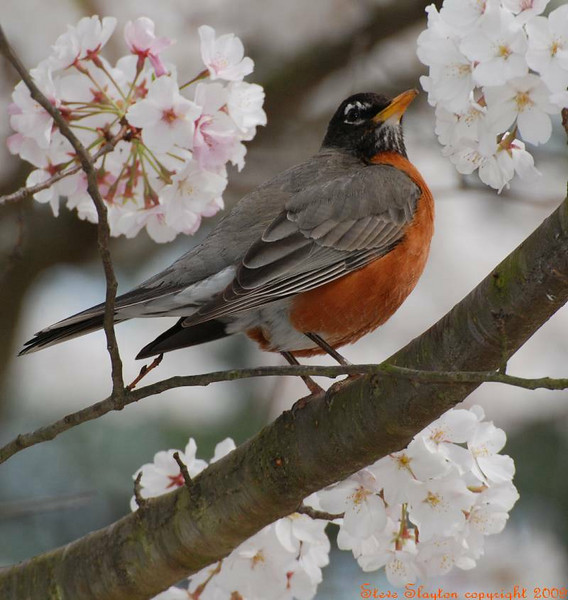
American Robin (Turdus migratorius) by S Slayton
Lee’s Addition:
Even the stork in the heavens Knows her appointed times; And the turtledove, the swift, and the swallow Observe the time of their coming. But My people do not know the judgment of the LORD. (Jeremiah 8:7 NKJV)
This time of the year the birds head back north, at least in North America. Unfortunately they leave us here in Florida where some of them have been on their winter vacation. Birdwatching excitement slows down for us, but picks up for those of you who have been without your avian friends during the winter. Trust me, they are on the way. We have been out watching birds several times this last week or so and the winter birds have left or are packing their bags and folding up their lounge chairs. We are getting a few of the migrants that are passing through on their way north. They land to rest and feed, then off they go again. Keep your eyes alert, northern friends, the birds are coming.
The above article is the first article in the monthly serial for February 1897 “designed to promote Knowledge of Bird-Live.” These include Color Photography, as they call them, today they are drawings. There are at least three Volumes that have been digitized by Project Gutenberg.
Ephesians 2:10
For we are his workmanship, created in Christ Jesus unto good works, which God hath before ordained that we should walk in them.
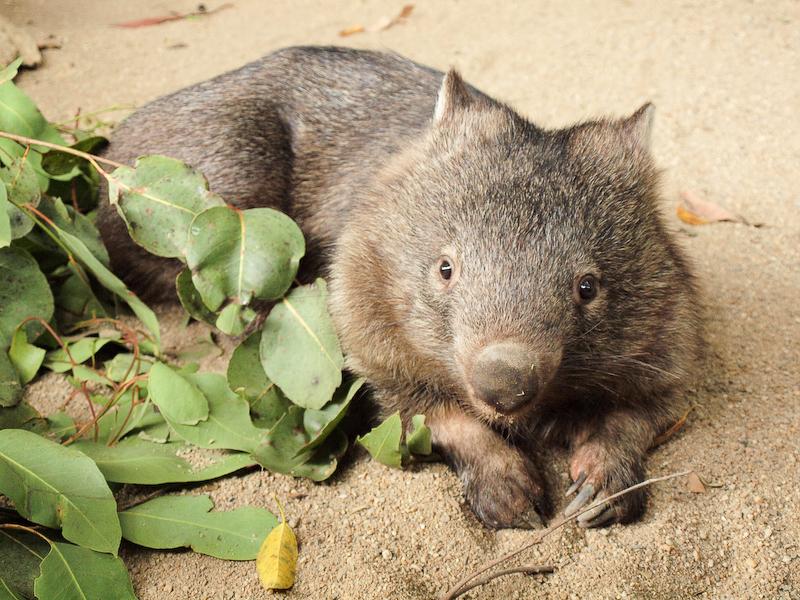
Australia has many animals that are not found anywhere else in the world today. One of the most unique is the wombat, which looks like a small bear with brown fur. The wombat is a burrowing animal.
Like many of Australia’s animals, the wombat is a marsupial, having a pouch in which its prematurely born young complete their development. The pouches owned by most marsupials are open at the top toward the mother’s head. This works fine for the kangaroo and other marsupials – no one ever saw a kangaroo standing on its head.
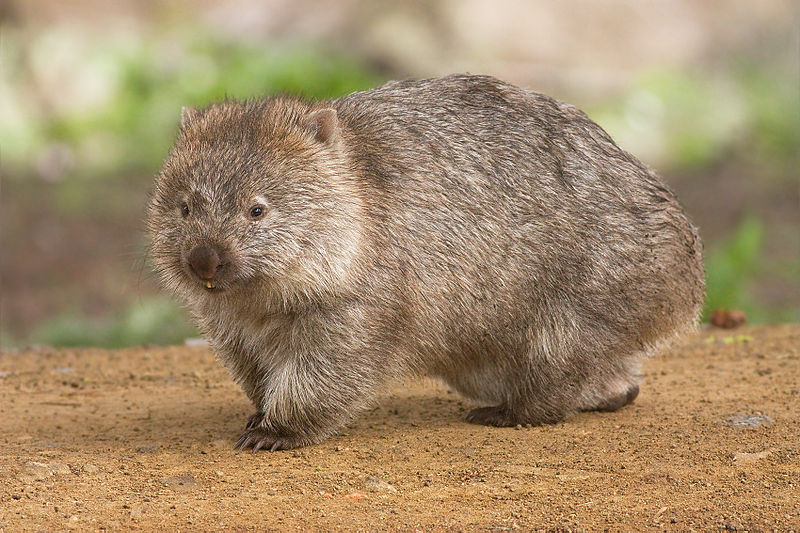
Common Wombat (Vombatus ursinus)-Maria Island National Park
But the wombat is a burrowing animal. If its pouch opened toward the mother’s head, it would very quickly fill with dirt, which wouldn’t do the young wombat inside the pouch any good. So, unlike any other marsupial, the wombat’s pouch opens toward the animal’s hind legs – it points backward!
The marsupial’s pouch is a wondrous enough invention all by itself. But this pouch is a clear case of a specialized intelligent design for a unique situation. If the wombat’s backward pouch had been produced by mutations, how would baby wombats have gotten by during the millions of years of trial and error needed to redesign the pouch? It’s easy to see the wombat’s backward pouch as a humorous hint from the Creator that human theories simply cannot replace the account of creation that He has revealed to us in the Bible!
Prayer:
Lord, I thank You that You have so carefully planned every detail of the creation for the benefit of every creature. When things don’t seem to be going well in my life, comfort me with the fact that You are still in charge and that You care about the details of my life, too. Amen.
Notes:
Major, Trevor. 1989. “The backward wombat.” Reasoning from Revelation, August. p. 3.


















 Lee's Birdwatching Adventures Plus