Ian’s Bird of the Week – Ouvéa Parakeet

Ian’s Bird of the Week – Ouvéa Parakeet ~ by Ian Montgomery

Newsletter ~ 9/2/15

I was half-way through preparing this bird of the week this afternoon when my 2008 iMac died, or at least got terribly ill, so I’ve delivered it to the Mac Doctors and am now working on my laptop. Thank goodness for automatic backups, as I lost only the email itself and the map below that I was in the middle of preparing. I want to get the email out today so that i can delivery 4 birds of the week this month – my level of enthusiasm for doing the bird of the week has risen considerably since I started preparing the first volume of the Diary of a Bird Photographer.

Anyway, back to the Loyalty Islands off the west coast of the main island of New Caledonia. After spending the morning in Lifou, we flew to the neighbouring island, Ouvéa, home to the endemic Ouvéa Parakeet. Ouvéa is a long thin island, thinnest in the middle in a way that reminded me of both Bribie Island in Tasmania and Lord Howe Island. Like Lord Howe, it has a coral lagoon on one side and an ocean beach on the other but the resemblance largely ends there, as Ouvéa is a coral atoll and very flat, while Lord Howe is volcanic in origin and spectacularly mountainous.

Map of where Ouvéa Parakeet Found, by Ian

Map of where Ouvéa Parakeet Found, by Ian

The parakeet occurs mainly on the northern end of the island so its geographical range is tiny – see the scale on the map above, courtesy of Google Earth. The airport is on the southern end and we decided not to emulate some energetic birders who wrote a trip report and travelled from the airport to the north end of the island by bicycle. Instead, we had booked a rental car at the airport and booked accommodation in a tribal village called Gossanah in parakeet territory near where our bird guide Benoit lived. I’ll say a bit more about both our guide and accommodation later, but first the parakeet.

Ouvéa Parakeet (Eunymphicus uvaeensis) by Ian

It was dark by the time we reached Gossanah, so parakeet hunting had to wait until the morning. I was woken up by early-riser Joy with the exciting news that there were parakeets in the grounds of where we were staying. I stumbled out bleary-eyed (remember we had got up at 4:30am the morning before to get our flight to Lihou) camera in hand and sure enough there they were, or there it was, first photo. Later we joined Benoit and he took us around his garden and though an area of adjacent rainforest. There we found some more parakeets, including the one in the second photo.
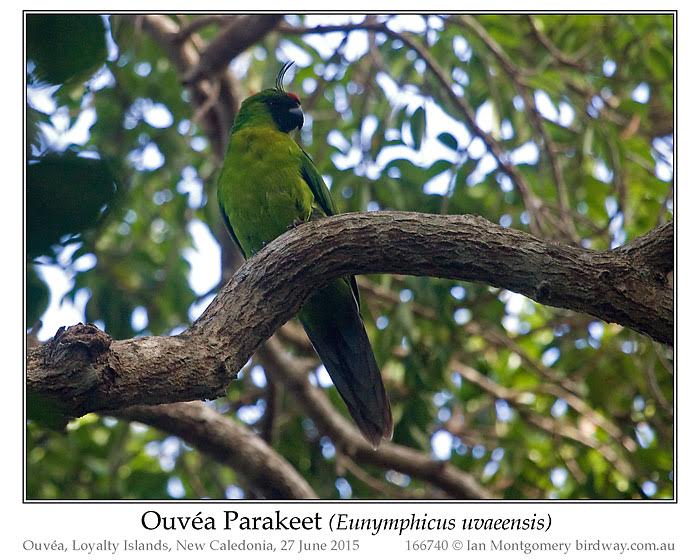
Ouvéa Parakeet (Eunymphicus uvaeensis) by Ian

They aren’t as brightly coloured as the Horned Parakeet of the main island, Grand Terre, and the crest is different, containing more than two feathers and lacking red tips. The Ouvéa Parakeet used to be treated as a race of the Horned, but has now been given full species status.

Ouvéa Parakeet (Eunymphicus uvaeensis) Nesting Hollow by Ian

Benoit showed us an active nesting hollow, third photo. We saw a parakeet flying into it and waited for it to reappear, but it had either settled down for the morning or had more patience than we had. The parakeets are very partial to the seeds of Papaya. They don’t wait for the fruit to ripen before they chew their way into the centre to get at the seeds.

Papaya

Papaya

The parakeets are protected and the population has increased in recent years. We got the impression that the islanders are rather ambivalent about the birds. They are proud to have such an unusual endemic bird – its iconic status is actively promoted by the authorities – but are concerned about its effect on their largely subsistent way of life.

Ouvéa Parakeet (Eunymphicus uvaeensis) by Ian

Ouvéa Parakeet (Eunymphicus uvaeensis) by Ian

We stayed at a tribal home stay called Beauvoisin – ‘good neighbour’ run by Marc and his wife (see http://www.iles-loyaute.com/en/Prestataire/Fiche/1374/beauvoisin). They provided dinner in the evening, accommodation in a circular hut and breakfast – Joy took the photo above of me emerging from the hut in the morning. We enjoyed it very much and Marc and his family were delightful and looked after us very well. They spoke some English and have a Facebook page. Benoit Tangopi our guide was great too and we saw a variety of other interesting birds on the walk through the rainforest. We contacted him by phone +687 800549, but you might need to brush up your French as he doesn’t speak much English.

Greetings
Ian

**************************************************
Ian Montgomery, Birdway Pty Ltd,
454 Forestry Road, Bluewater, Qld 4818
Tel 0411 602 737 ian@birdway.com.au
Check the latest website updates:
http://www.birdway.com.au/#updates


Lee’s Addition:


If a bird’s nest should chance to be before you in the way, in any tree or on the ground, with young ones or eggs, and the mother bird is sitting on the young or on the eggs, you shall not take the mother bird with the young. You shall surely let the mother bird go, and take only the young, that it may be well with you and that you may prolong your days. (Deuteronomy 22:6-7 AMP)

Thanks, Ian, for taking us along on another birdwatching adventure. I don’t speak French, so we are glad you did the talking and photographing. Another neat creation you have found for us to enjoy.

*

Ian’s Bird of the Week Newsletters

Ian’s Ouvéa Parakeet Photos

Psittaculidae – Old World Parrots

Wordless Birds

*

Diary of a Bird Photographer!

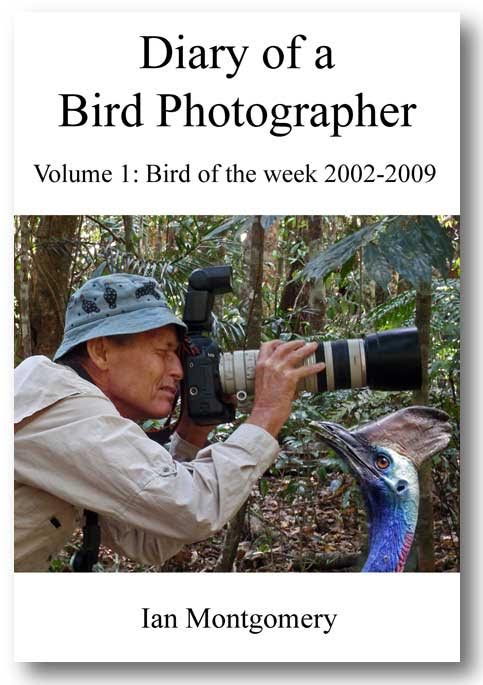
y electronic book Diary of a Bird Photographer has been released worldwide today, 31 August, on Apple iTunes BooksGoogle Books and Kobo Books! Find out more about it including availability, pricing, compatible devices and screenshots on the BIrdway website: http://www.birdway.com.au/birdphotographersdiary01.htm.

Ian's Book

Ian’s Book

With the increasing abundance of excellent bird photos on the internet, I am finding it more difficult to sell photos so moving into publishing is important for the future of my Birdway website and the Bird of the Week newsletter. Diary of a Bird Photographer contains the first 341 Bird of the Week postings spanning the period 2002-2009, contains more than 500 photos and 80,000 words – the length of an average novel. Depending on sales, l plan to publish 2010-2014 as another book.

With a recommended retail price of 8.00AUD, 7USD, 6EUR or the equivalent in your local currency it represents great value. By buying it for yourself and/or your friends or family and recommending it to others, you’ll earn my gratitude and show your appreciation for the bird of the week! Maybe you could forward this email to anyone who you think might be interested: that would be wonderful.

Greetings
Ian

PS Next bird of the week, a special parrot and the random bird of the week, should be out later today.

**************************************************
Ian Montgomery, Birdway Pty Ltd,
454 Forestry Road, Bluewater, Qld 4818
Tel 0411 602 737 ian@birdway.com.au
Bird Photos http://www.birdway.com.au/
Recorder Society http://www.nqrs.org.au


Lee’s Addition:

Seem’s as though Ian has written a book. Here is his newsletter telling about his “Diary of a Bird Photographer!”

His regular weekly newsletter – Ian’s Bird of the Week – will be published tomorrow.

Sunday Inspiration – Cupwings, Crombecs and Bush Warblers

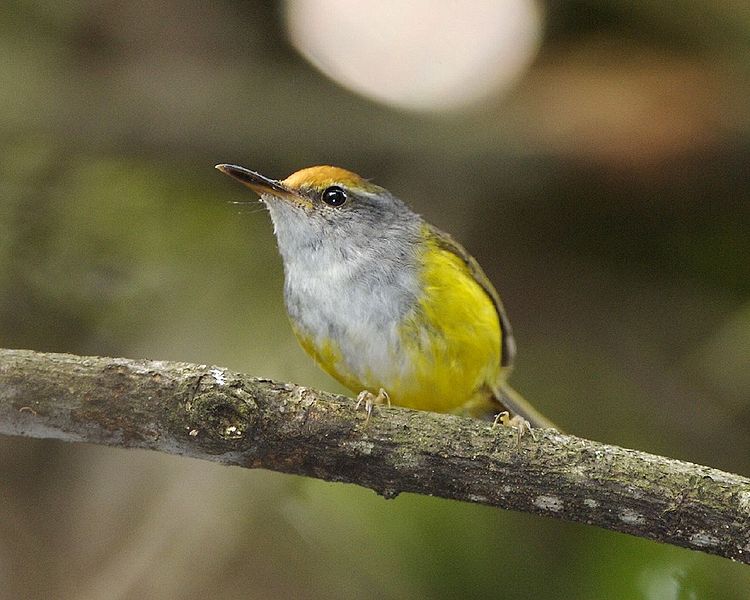
Mountain Tailorbird (Phyllergates cucullatus) by© Wiki

Mountain Tailorbird (Phyllergates cucullatus) by© Wiki

For by Him all things were created that are in heaven and that are on earth, visible and invisible, whether thrones or dominions or principalities or powers. All things were created through Him and for Him. (Colossians 1:16 NKJV)

I trust you are enjoying this Sunday Inspiration series of the Lord’s Creation of the PASSERIFORMES – Passerines (Songbirds) Order. This week’s collection of little Passerines are from three families. Of the 130 families in the Order, we have arrived at numbers 76, 77, and 78. By now, you have see over half the Songbird species in the world. Of the 40 Orders of Birds, the Passerines are the largest.

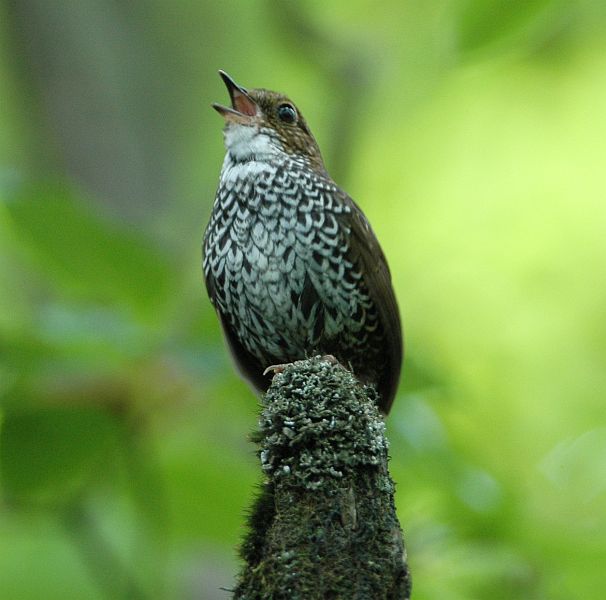
Scaly-breasted Wren-babbler (Pnoepyga albiventer) ©©

Scaly-breasted Cupwing (Pnoepyga albiventer) ©©

Immediately there fell from his eyes something like scales, and he received his sight at once; and he arose and was baptized. (Acts 9:18 NKJV)

Pnoepygidae – Cupwing [8.2 Version just changed these to Cupwings] has only five species and are endemic to southern and south eastern Asia. The genus contains four species. The genus has long been placed in the babbler family Timaliidae. A 2009 study of the DNA of the families Timaliidae and the Old World warblers (Sylviidae) found no support for the placement of the genus in either family, prompting the authors to erect a new monogeneric family, the Pnoepygidae.

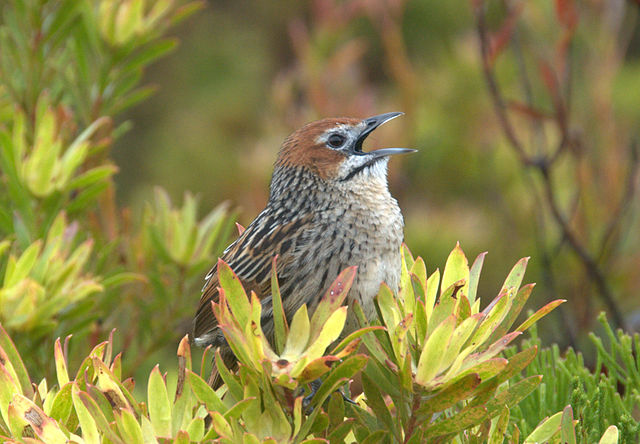
Cape Grassbird (Sphenoeacus afer) ©WikiC

Cape Grassbird (Sphenoeacus afer) ©WikiC

Sing unto him, sing psalms unto him, talk ye of all his wondrous works. (1 Chronicles 16:9 KJV)

Macrosphenidae – Crombecs, African Warblers family has eighteen (18) members in its family. The African warblers are a newly erected family, Macrosphenidae, of songbirds. Most of the species were formerly placed in the Old World warbler family Sylviidae, although one species, the Rockrunner, was placed in the babbler family Timaliidae. A series of molecular studies of the Old World warblers and other bird families in the superfamily Sylvioidea (which includes the larks, swallows and tits) found that the African warblers were not part of the family Sylviidae but were instead an early offshoot (basal) to the entire Sylvioidea clade.

Chestnut-crowned Bush Warbler (Cettia major) ©WikiC

Chestnut-crowned Bush Warbler (Cettia major) ©WikiC

The simple inherit folly: but the prudent are crowned with knowledge. (Proverbs 14:18 KJV)

Cettiidae – Cettia Bush Warblers and Allies total up 32 species.

Cettiidae is a newly validated family of small insectivorous songbirds (“warblers”) It contains the typical bush warblers (Cettia) and their relatives. As common name, cettiid warblers is usually used.

Its members occur mainly in Asia and Africa, ranging into Wallacea and Europe. The monarch warblers (Erythrocercus), Tit Hylia Pholidornis and Green Hylia (Hylia) are exclusively found in the forests of Africa. The pseudo-tailorbirds, tesias and stubtails, as well as Tickellia and Abroscopus warblers are mostly found in the forests of south and southeastern Asia, with one species reaching as far north as Japan and Siberia. The genus Cettia has the widest distribution of the family, reaching from Western Europe across Asia to the Pacific islands of Fiji and Palau. Most of the species in the genus are sedentary, but the Asian Stubtail is wholly migratory and the Japanese Bush Warbler and Cetti’s Warbler are partly migratory over much of their range. A few species, such as the Pale-footed Bush Warbler, are altitudinal migrants.

The species are small, stubby birds. Most have moderately long to long tails, while the stubtails and tesias have tiny tails that do not even emerge past their tail retrices. The group is typically clad in dull plumage, often with a line above the eye. Some, like the monarch-warblers (Erythrocercus), are much different in appearance, having areas of bright yellow plumage. (Wikipedia)

This slideshow requires JavaScript.

Listen as you watch the birds:

“Bow The Knee” ~ Sheila Vegter and Jacob (her son who is playing the piano and singing)

*

Sunday Inspirations

PASSERIFORMES – Passerines (Songbirds)

Pnoepygidae – Cupwings

Macrosphenidae – Crombecs, African Warblers

Cettiidae – Cettia Bush Warblers and Allies

Good News

*

Helps For Updating Bird List To I.O.C. Version 5.3

Mourning Dove by Reinier Munguia

Mourning Dove by Reinier Munguia

Out of the ground the LORD God formed every beast of the field and every bird of the air, and brought them to Adam to see what he would call them. And whatever Adam called each living creature, that was its name. So Adam gave names to all cattle, to the birds of the air, and to every beast of the field… (Genesis 2:19-20a NKJV)

Today I want to share a little behind the scene helps that really make updating a blog and your files. As you may be aware, we use the I.O.C.’s list of world bird names here. About every quarter, they (IOC) delete, add, and revise the species names and positions in the list of all the birds in the world. If you are nutty enough to have had the bright idea, like I did several years back, to list ALL THE BIRDS, then you have a headache every quarter.

Each update they (IOC) provide files you can download with all the birds listed. Most of these are in the Excel format. Spreadsheets like Excel and others can greatly speed up fixing the list to update my site. I use simple (and I mean simple) formulas to combine the bird’s name and its scientific name together with the parenthesis around it. Then just copy the formula down the 10,000 plus birds and “wa laa” you have a

Black-headed Ibis (Threskiornis melanocephalus) instead of  a

Black-headed Ibis” and aThreskiornis melanocephalus with no parenthesis to be found.

=CONCATENATE(E796,” (“,G796,”)”)

E796 is the cell of the English name and G796 is the cell of the Scientific name. The ,” (, and the ,”)” tells it to add a space and parenthesis, and a parenthesis at the end.

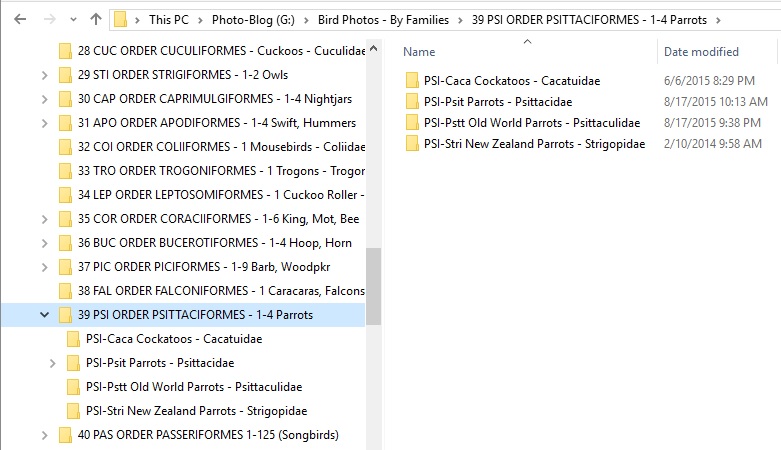
I also came up with a naming system to help find the photos of birds on the hard drives. I use a 3-letter code – All Caps – for the Order of birds, a dash(-), followed by a 4-letter code to represent the Family of the birds. It really helps in aiding to find bird photos or to rename them. (that is next)

Another great program, this one is free, is ReNamer from Den4B.com. I use this a lot. ReNamer lets you change the name of files enmasse. File explorer will let you rename a group of files, but you cannot go in there and just change parts of it like ReNamer can do. As I mentioned in the last post about I.O.C. Version 5.3, the Parrot family was split into two families. Fixing the pages that list all the birds was tedious enough, but having to separate the photos on my hard drive was another situation.

My File Explorer - For Parrots

My File Explorer – For Parrots

My Code for the original Parrot family was PSI-Psit (PSITTACIFORMES order and Psittacidae family) and now with the new Psittaculidae family I came up with PSI-Pstt. So how am I suppose to rename over 200 photos in the new family to the new code? Easy with ReNamer. Drag the files you want to rename into ReNamer, add a new Rule (Replace PSI-Psit with PSI-Pstt), then press the “Rename” button and 200 plus photos are renamed. There are lots of other options. It is a fantastic program in my opinion.

ReNamer from den4b.com

ReNamer from den4b.com

I know for some of you, this was a little more technical than normal, but thought you might find something in it you can use on your projects. The CONCATENATE (combining) feature of Excel and the ReNamer program are both very useful.

Because of health issues and other events going on, the update to I.O.C. Ver. 5.3 has not moved as fast as other versions. I am working on it and here are the families updated so far. I have been making a change to the pages as I work on them. I am adding a slideshow at the bottom of each page. Stay tuned!

‘I have made the earth, the man and the beast that are on the ground, by My great power and by My outstretched arm, and have given it to whom it seemed proper to Me. (Jeremiah 27:5 NKJV)

I.O.C. Version 5.3

Tinamous – Tinamidae
Ostriches – Struthionidae
Rheas – Rheidae
Cassowaries – Casuariidae
Emu – Dromaiidae
Kiwis – Apterygidae
Screamers – Anhimidae
Magpie Goose – Anseranatidae
Ducks, Geese and Swans – Anatidae
Megapodes – Megapodiidae
Chachalacas, Curassows and Guans – Cracidae
Guineafowl – Numididae
New World Quail – Odontophoridae
Pheasants and allies – Phasianidae
Loons – Gaviidae
Penguins – Spheniscidae
Austral Storm Petrels – Oceanitidae
Albatrosses – Diomedeidae
Northern Storm Petrels – Hydrobatidae
Petrels, Shearwaters – Procellariidae
Diving Petrels – Pelecanoididae
Grebes – Podicipedidae
Flamingos – Phoenicopteridae
Tropicbirds – Phaethontidae
Storks – Ciconiidae
Ciconiidae – Storks
* The Parrots
Strigopidae – New Zealand Parrots
Cacatuidae – Cockatoos
Psittacidae – African and New World Parrots
Psittaculidae – Old World Parrots
*
New Parrot Family – I.O.C. 5.3 Version

Mulga Parrot (Psephotellus varius) by Ian

Mulga Parrot (Psephotellus varius) by Ian

My son, fear thou the LORD and the king: and meddle not with them that are given to change: (Proverbs 24:21 KJV)

Finally have my computer and Excel back up running. I decided to start working on the new I.O.C. 5.3 version and was surprised to see that they had divided the Psittacidae – Parrots Family. Well, that family had 369 species and now the new family has been named Pittaculidae –  “Old World Parrots” with 192 parrots.

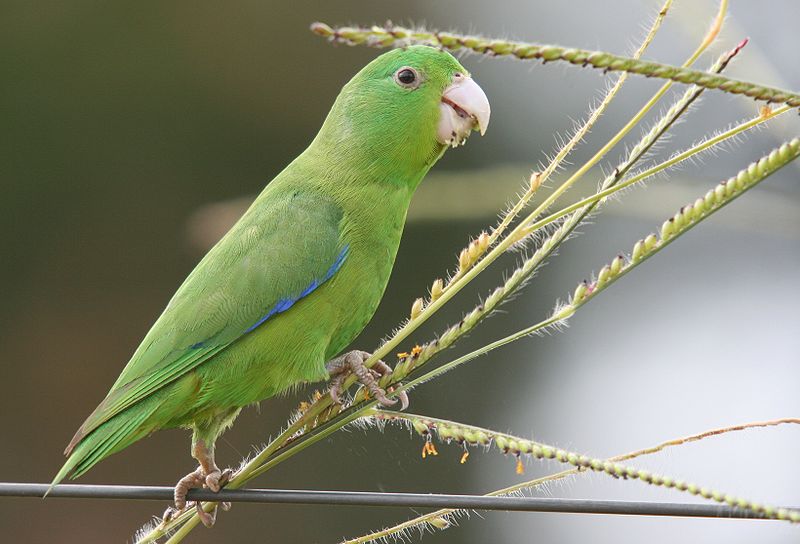
Blue-winged Parrotlet (Forpus xanthopterygius) ©WikiC

Blue-winged Parrotlet (Forpus xanthopterygius) ©WikiC

The old family, Psittacidae – African and New World Parrots has 178 avian wonders. They added two new ones to this family; the Turquoise-winged Parrolett (Forpus spengeli) and the Large-billed Parrotlet (Forpus crassirostris) that were subspecies of the Blue-winged Parrotlet family.

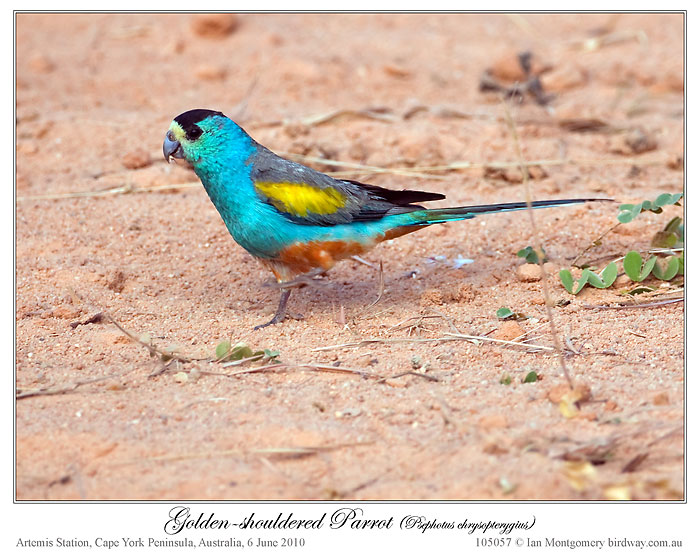
Golden-shouldered Parrot (Psephotellus chrysopterygius) by Ian

Golden-shouldered Parrot (Psephotellus chrysopterygius) by Ian

In the new Psittaculidae – Old World Parrots Family they changed the genus of several birds:

Mulga Parrot (Psephotus varius) to (Psephotellus varius)
Hooded Parrot (Psephotus dissimilis) to (Psephotellus dissimilis)
Golden-shouldered Parrot (Psephotus chrysopterygius) to (Psephotellus chrysopterygius)
Paradise Parakeet (Psephotus pulcherrimus) to (Psephotellus pulcherrimus)

Purple-crowned Lorikeet (Parvipsitta porphyrocephala) WikiC

Purple-crowned Lorikeet (Parvipsitta porphyrocephala) WikiC

Little Lorikeet (Glossopsitta pusilla) to (Parvipsitta pusilla)
Purple-crowned Lorikeet (Glossopsitta porphyrocephala) to (Parvipsitta porphyrocephala)

Cardinal Lory (Pseudeos cardinalis) Busch Gardens, Tampa Bay WikiC

Cardinal Lory (Pseudeos cardinalis) Busch Gardens, Tampa Bay WikiC

Cardinal Lory (Chalcopsitta cardinalis) to (Pseudeos cardinalis)

For now, that is about as far as I have gotten with the update. That was a major reshuffle which I plan to tell about in the next blog. Stay tuned!

The PSITTACIFORMES – Parrot Order

Strigopidae – New Zealand Parrots
Cacatuidae – Cockatoos
Psittacidae – African and New World Parrots
Psittaculidae – Old World Parrots

Gideon

*

Ian’s Bird of the Week – Goliath Imperial Pigeon

Ian’s Bird of the Week – Goliath Imperial Pigeon ~ by Ian Montgomery

Newsletter – 8/17/15

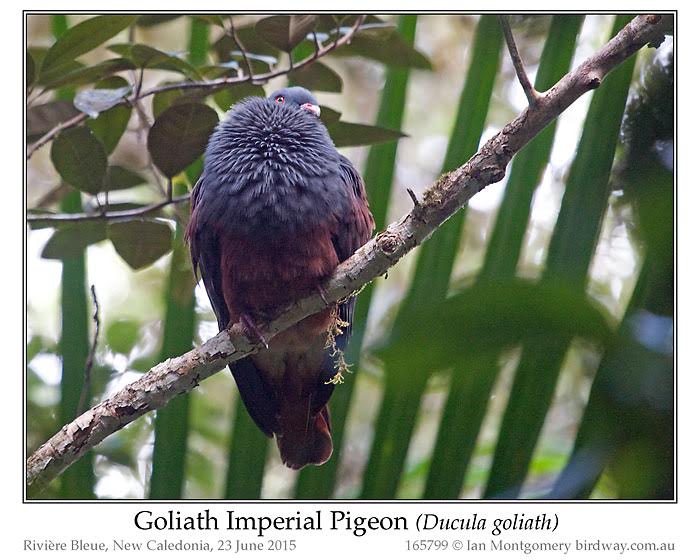
A characteristic sound of montane forests in New Caledonia is the far-carrying call of this splendid pigeon, the Goliath or New Caledonian Imperial Pigeon. The tone is similar to someone blowing in a (large) bottle but the rhythm accelerates like the sound of a table-tennis ball being dropped on a table. Needless to say, we started calling it the ping-pong pigeon. We first heard them in the dense forests of Rivière Bleue, but had trouble actually seeing any apart from one that flew off from feeding on Pandanus fruit. We eventually tracked this one through the forest and found it putting on a display.

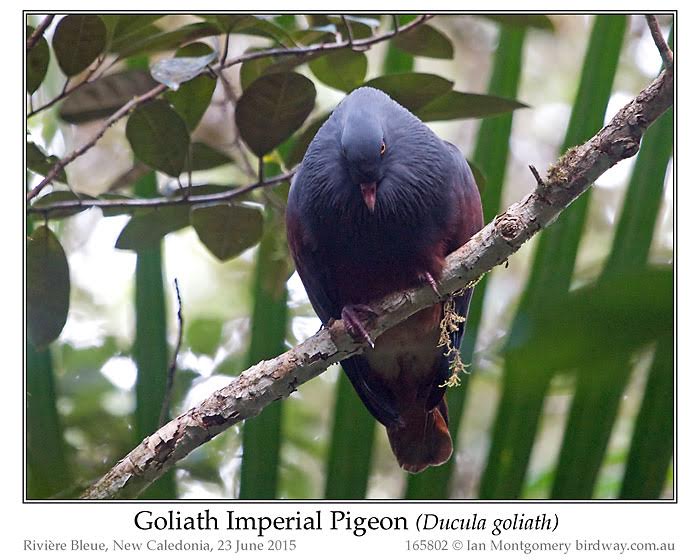
Goliath Imperial Pigeon (Ducula goliath) by IanThe display is similar to that of the domestic pigeon, alternating between puffing out the crop to show the silvery-tipped bifurcated feathers to best advantage (first photo) and bowing (second photo). The head, upperparts and breast are a steely grey while the breast is a rich rufous colour and the vent pale. The iris is a vivid orange red. With a length of up to 51cm/20in and weighing up to 720g/1.6lb, this is a huge pigeon, which unfortunately makes it good to eat. For comparison the Torresian (Pied) Imperial Pigeon of northern and northeastern Australia measures up to 44cm in length and 550g in weight.

Goliath Imperial Pigeon (Ducula goliath) by Ian

It is endemic to the main island of New Caledonia (Grande Terre) and the Isle of Pines. The population has suffered from habitat loss and hunting, so it remains common only in protected areas and is currently listed as Near Threatened. After our hard work finding it in Rivière Bleue we were amused to find one on perched in the open on a power line beside the road to Mount Koghi two days later, third photo. We also heard several and photographed one at Les Grandes Fougères.

Goliath Imperial Pigeon (Ducula goliath) by Ian

The subject of each bird of the week is usually a species that hasn’t featured previously. This tends to mean that I don’t get to share with you new photos of previous subjects. So I’ve decided to include random photos from time to time, such as this one of a Noisy Pitta. I was contacted by a neighbour recently with a wonderful, well-watered garden in which this Pitta has recently taken up residence. Pittas are such beautiful birds and I like this photo because of the way the bird is framed by the leaves behind it.

Noisy Pitta (Pitta versicolor) by Ian

Greetings,
Ian

P.S. (Be warned: this is a commercial break!) Did you know that some ebook sellers provide facilities of giving book as gifts. Maybe you know someone who would enjoy Where to Find Birds in Northeastern Queensland ($13.20 to $22). Kobo books has ebook readers from most devices and computer so check out their page on gifts. With Kobo you go to this page first and then browse for the item you want to give. With Apple iPads and iPhones, you find the item first e.g. Where to Find Birds on Northeastern Queensland in the iTunes Store and then select the Share icon at top right and select Gift:

COL-Colu Goliath Imperial Pigeon (Ducula goliath) by Ian AD

I haven’t found a similar facility in the iTunes store accessed from an Apple computer (the share icon is peculiar to iOS). You can however give gift cards with suggestions from iTunes, Google Play and Kobo.

**************************************************
Ian Montgomery, Birdway Pty Ltd,
454 Forestry Road, Bluewater, Qld 4818
Tel 0411 602 737 ian@birdway.com.au
Bird Photos http://www.birdway.com.au/
Recorder Society http://www.nqrs.org.au


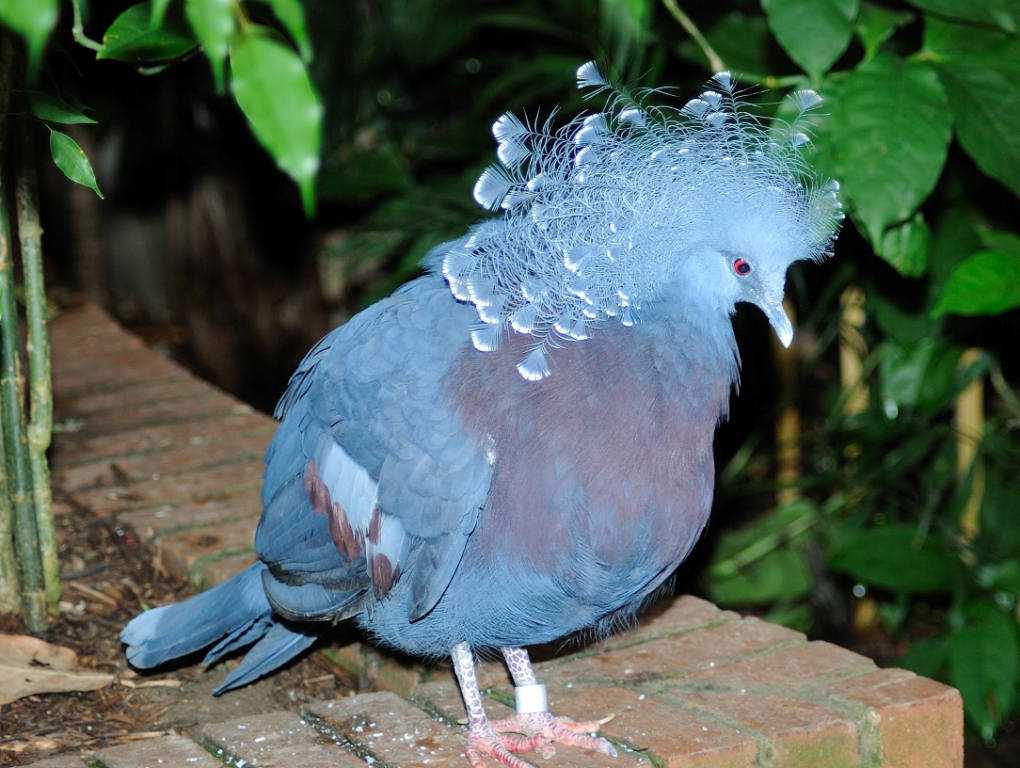
Victoria Crowned Pigeon by Dan at National Aviary

Victoria Crowned Pigeon by Dan at National Aviary

Lee’s Addition:

And a champion went out of the camp of the Philistines named Goliath of Gath, whose height was six cubits and a span [almost ten feet]. (1 Samuel 17:4 AMP)

We have seen the Victoria Crowned Pigeons at Zoos and they are typically 73 to 75 cm (29 to 30 in) long. Ian’s 51cm/20in Goliath Imperial Pigeon is not too far behind. The well-known rock dove is 29 to 37 cm (11 to 15 in) long, for comparison.  However you look at it, they are quite big. One source mentioned that the Goliaths are very strong flyers.

That is also a great photo of the Noisy Pitta. Thanks, Ian for sharing your photos with us each week (or whenever).

Ian’s Bird of the Week newsletters

Columbidae – Pigeons, Doves Family

Wordless Birds

*

Sunday Inspiration – Bulbuls

White-eared (Cheeked) Bulbul (Pycnonotus leucotis) at Zoo Miami by Lee

White-eared (Cheeked) Bulbul (Pycnonotus leucotis) at Zoo Miami by Lee

 Then the trees of the forest will sing for joy before the LORD; For He is coming to judge the earth. O give thanks to the LORD, for He is good; For His lovingkindness is everlasting. (1 Chronicles 16:33-34 NASB)

Bulbuls are a family, Pycnonotidae, of medium-sized passerine songbirds. Many forest species are known as greenbuls, brownbuls, leafloves, bristlebills, finchbills and  a Malia. The family is distributed across most of Africa and into the Middle East, tropical Asia to Indonesia, and north as far as Japan. A few insular species occur on the tropical islands of the Indian Ocean There are 151 species in around 28 genera. While some species are found in most habitats, overall African species are predominantly found in rainforest whilst rainforest species are rare in Asia, instead preferring more open areas.

Collared Finchbill by Dan at Zoo Miami

Bulbuls are short-necked slender passerines. The tails are long and the wings short and rounded. In almost all species the bill is slightly elongated and slightly hooked at the end. They vary in length from 13 cm for the tiny greenbul to 29 cm in the straw-headed bulbul. Overall the sexes are alike, although the females tend to be slightly smaller. In a few species the differences are so great that they have been described as functionally different species. The soft plumage of some species is colourful with yellow, red or orange vents, cheeks, throat or supercilia, but most are drab, with uniform olive-brown to black plumage. Species with dull coloured eyes often sport contrasting eyerings. Some have very distinct crests. Bulbuls are highly vocal, with the calls of most species being described as nasal or gravelly. One author described the song of the brown-eared bulbul as “the most unattractive noises made by any bird”

Let the field be joyful, and all that is therein: then shall all the trees of the wood rejoice (Psalms 96:12 KJV)

Maybe in the case of that brown-eared bulbul, this verse would be more appropriate:

Make a joyful noise unto the LORD, all the earth: make a loud noise, and rejoice, and sing praise. (Psalms 98:4 KJV)

This slideshow requires JavaScript.

“How Deep The Father’s Love For Us” ~ played by Megan Fee and Jill Foster

How deep the Father’s love for us
How vast beyond all measure
That He should give His only Son
To make a wretch His treasure

How great the pain of searing loss
The Father turns His face away
As wounds which mar the Chosen One
Bring many sons to glory

Behold the man upon a cross
My sin upon His shoulders
Ashamed, I hear my mocking voice
Call out among the scoffers

It was my sin that held Him there
Until it was accomplished
His dying breath has brought me life
I know that it is finished

I will not boast in anything
No gifts, no power, no wisdom
But I will boast in Jesus Christ
His death and resurrection

Why should I gain from His reward?
I cannot give an answer
But this I know with all my heart
His wounds have paid my ransom

Why should I gain from His reward?
I cannot give an answer
But this I know with all my heart
His wounds have paid my ransom

For God so loved the world, that he gave his only begotten Son, that whosoever believeth in him should not perish, but have everlasting life. (John 3:16 KJV)

*
More Sunday Inspirations

Pycnonotidae – Bulbuls Family

Bulbul – Wikipedia

Falling Plates

*

Taking A Ride

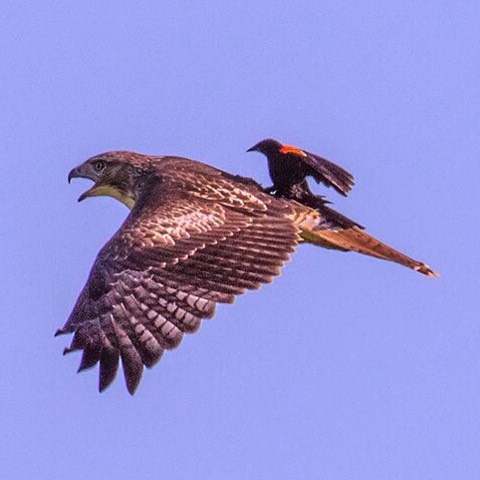
Blackbird on a Hawk's Back ©Dept of Interior

Blackbird on a Hawk’s Back ©Dept of Interior

Terrors shall make him afraid on every side and shall chase him at his heels. (Job 18:11 AMP)

Here we go again with a smaller bird attacking a larger bird. This time a Red-winged Blackbird is on a Hawk’s back.

See Rare Picture: Blackbird “Rides” Hawk. from Focusing on Wildlife.

*

Crow Versus Eagle, Free Ride Instead

Woodpecker With A Weasel On It’s Back

Birds of the Bible – Get Off My Back

Wordless Birds

*

Sunday Inspiration – Larks

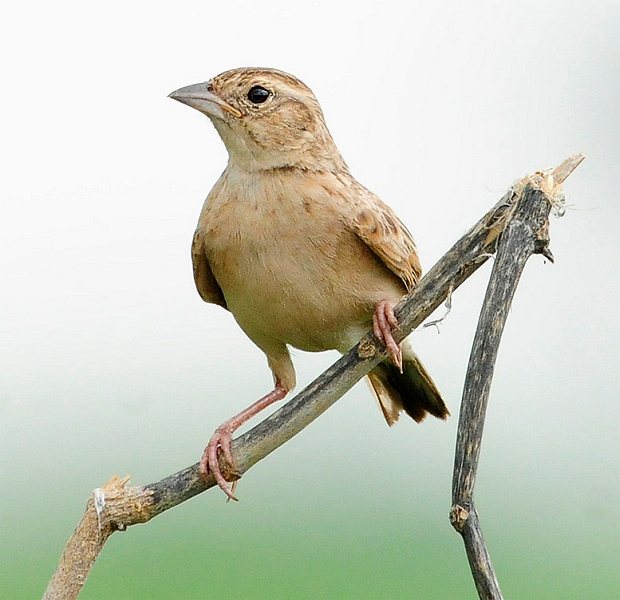
Singing Bush Lark (Mirafra cantillans) by Nikhil Devassar

Singing Bush Lark (Mirafra cantillans) by Nikhil Devassar

The Lark family has 97 members which are busy doing what the Lord commanded them  to when they left the Ark:

Then God spoke to Noah, saying, “Go out of the ark, you and your wife, and your sons and your sons’ wives with you. Bring out with you every living thing of all flesh that is with you: birds and cattle and every creeping thing that creeps on the earth, so that they may abound on the earth, and be fruitful and multiply on the earth.” So Noah went out, and his sons and his wife and his sons’ wives with him. Every animal, every creeping thing, every bird, and whatever creeps on the earth, according to their families, went out of the ark.(Genesis 8:15-19 NKJV)

Larks are passerine birds of the family Alaudidae. All species occur in the Old World, and in northern and eastern Australia. Only one, the Horned Lark, is native to North America. Habitats vary widely, but many species live in dry regions.

They have more elaborate calls than most birds, and often extravagant songs given in display flight (Kikkawa 2003). These melodious sounds (to human ears), combined with a willingness to expand into anthropogenic habitats — as long as these are not too intensively managed — have ensured larks a prominent place in literature and music, especially the Eurasian Skylark in northern Europe and the Crested Lark and Calandra Lark in southern Europe.

Personally, these Larks look very similar to Sparrows, which are very common.

Are not two sparrows sold for a copper coin? And not one of them falls to the ground apart from your Father’s will. (Matthew 10:29 NKJV)

Larks, commonly consumed with bones intact, have historically been considered wholesome, delicate, and light game. Yet. Traditionally larks are kept as pets in China. In Beijing, larks are taught to mimic the voice of other songbirds and animals. It is an old-fashioned habit of the Beijingers to teach their larks 13 kinds of sounds in a strict order (called “the 13 songs of a lark”, Chinese: 百灵十三套). The larks that can sing the full 13 sounds in the correct order are highly valued. (Info from Wikipedia)

This slideshow requires JavaScript.

“His Eye Is On The Sparrow ” – by Kathy Lisby, Faith Baptist Church
*
Sunday Inspirations

Alaudidae – Larks Family

Larks – Wikipedia

Sharing The Gospel

*


Ian’s Bird of the Week – Yellow-bellied Robin/Flyrobin

Ian’s Bird of the Week – Yellow-bellied Robin ~ by Ian Montgomery

Newsletter – 8-7-15

If your familiar with Australian birds you might assume – initially – that this photo was taken in an Australian rainforest, though you might have trouble pinning down the actual species.

Yellow-bellied Flyrobin (Microeca or Eopsaltria flaviventis) by Ian

Its dumpy shape and short tail suggested strongly to me the Pale-yellow Robin (Tregellasio capito) of coastal eastern Australia, second photo, but the colour pattern on the breast is more like the Western Yellow Robin (Eopsaltria griseogularis) of coastal southwestern Australia (no photo, sorry). It’s behaviour was very like that of the Pale-yellow Robin, often perching at precipitous angles on steep branches on the vertical trunks of trees.

Pale-yellow Robin (Tregellasia capito) by Ian

In fact I assumed that it was in the same genus as the Pale-Yellow (Tregellasio) and was surprised the find later that it was either in the same genus as the Eastern and Western Yellow Robins (Eopsaltria) or in the process of being moved to Microeca, the genus that includes the Jacky Winter, the Lemon-bellied and Yellow-legged Flycatchers or Flyrobins as the purists would have, being Australasian Robins. The reason for the move is based on genetic studies (Loynes et al , 2007).

Yellow-bellied Flyrobin (Microeca or Eopsaltria flaviventis) by Ian

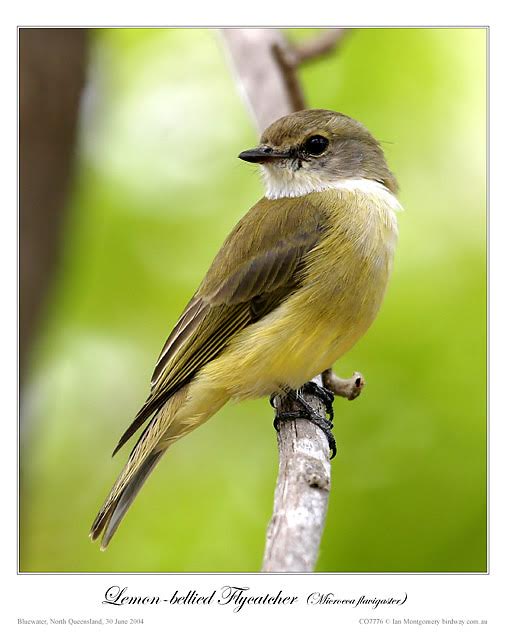
The fourth photo shows the Lemon-bellied Flycatcher/Flyrobin for comparison; it featured as bird of the week almost exactly ten years ago.

Lemon-bellied Flyrobin (Microeca flavigaster) by Ian

When we were in New Caledonia, I was intrigued by the call of the Yellow-bellied (Fly)robin. It didn’t sound like the Pale-yellow Robin or the any of the Yellow Robins, all of which have rather monotonous repeated calls. The Yellow-bellied sounded rather like the rhythmic ‘squeaky bicycle wheel’ songs of the unrelated Gerygones. It does, however, sound rather like that of the Lemon-bellied Flycatcher/Flyrobin, however, which supports the genetic analysis and the subsequent taxonomic switch. If you want to compare them, you can do so here http://www.xeno-canto.org/species/Microeca-flavigaster and http://www.xeno-canto.org/species/Microeca-flaviventris.

Both these web pages show distribution maps, so it would be interesting to speculate whether the ancestors of the Yellow-bellied got to New Caledonia from New Guinea or from Australia. Either way they’d either have had to do some island hopping or got carried across by one of the many cyclones that track from east to west across the southwestern Pacific.

Yellow-bellied Flyrobin (Microeca or Eopsaltria flaviventis) by Ian

Anyway, enough about taxonomy and back to the original point about similarities between the birds of Australia and those of New Caledonia. So far, the birds of the week have dealt with the more unusual ones that represent either families (the Kagu) or genera (Horned Parakeet, Crow Honeyeater) not found in Australia. Most of the other endemic species have counterparts in the same genus in Australia. That had its own fascination coming across familiar-looking but different species but we were left in no doubt that we were still in the Australasian ecozone. To handle this on the Birdway website, the original Australian section – which became Australia and New Zealand after 2012 – is now becoming the Australasian section and I’ve put a map of the ecozone on the home page to support this.

I’ve more or less finished putting the New Caledonian bird photos on the website: http://www.birdway.com.au/index.htm#updates. Here are links to some species with Australian counterparts that probably won’t feature as bird of the week that may be of interest:

Greetings
Ian

P.S. (Be warned: this is a commercial break!) If you’ve ever been to Northern Queensland, might ever go there or are interested in the region (who couldn’t be?) then your life isn’t complete without the ebook Where to Find Birds in Northeastern Queensland. The price ranges from AUD13.22 on Google Play to AUD22.00 in the Apple iTunes Store.

**************************************************
Ian Montgomery, Birdway Pty Ltd,
454 Forestry Road, Bluewater, Qld 4818
Tel 0411 602 737 ian@birdway.com.au
Bird Photos http://www.birdway.com.au/
Where to Find Birds in Northern QueenslandiTunes; Google Play Kobo Books
Recorder Society http://www.nqrs.org.au


Lee’s Addition:

What an adorable little Flyrobin. As Ian said, the name Robin or Flyrobin is in flux. When I check the I.O.C. list, which is what this blog uses, the Microeca flavivetris is called the Yellow-bellied Flyrobin.

Out of the ground the LORD God formed every beast of the field and every bird of the air, and brought them to Adam to see what he would call them. And whatever Adam called each living creature, that was its name. So Adam gave names to all cattle, to the birds of the air, and to every beast of the field. But for Adam there was not found a helper comparable to him. (Genesis 2:19-20 NKJV)

Wonder is Adam kept changing the names.? While checking out the I.O.C., I realized that the new 5.3 version is out. Guess I’ll have to start updating the site again. :) or maybe it is :(

*

Ian’s Bird of the Week

Ian’s Birdway Site

Good News

*

Are Dinosaurs Extinct? (Re-post)

Here is an interesting Creation Moments Minute from Creation Moments:

I am a brother to dragons, and a companion to owls. (Job 30:29 KJV)

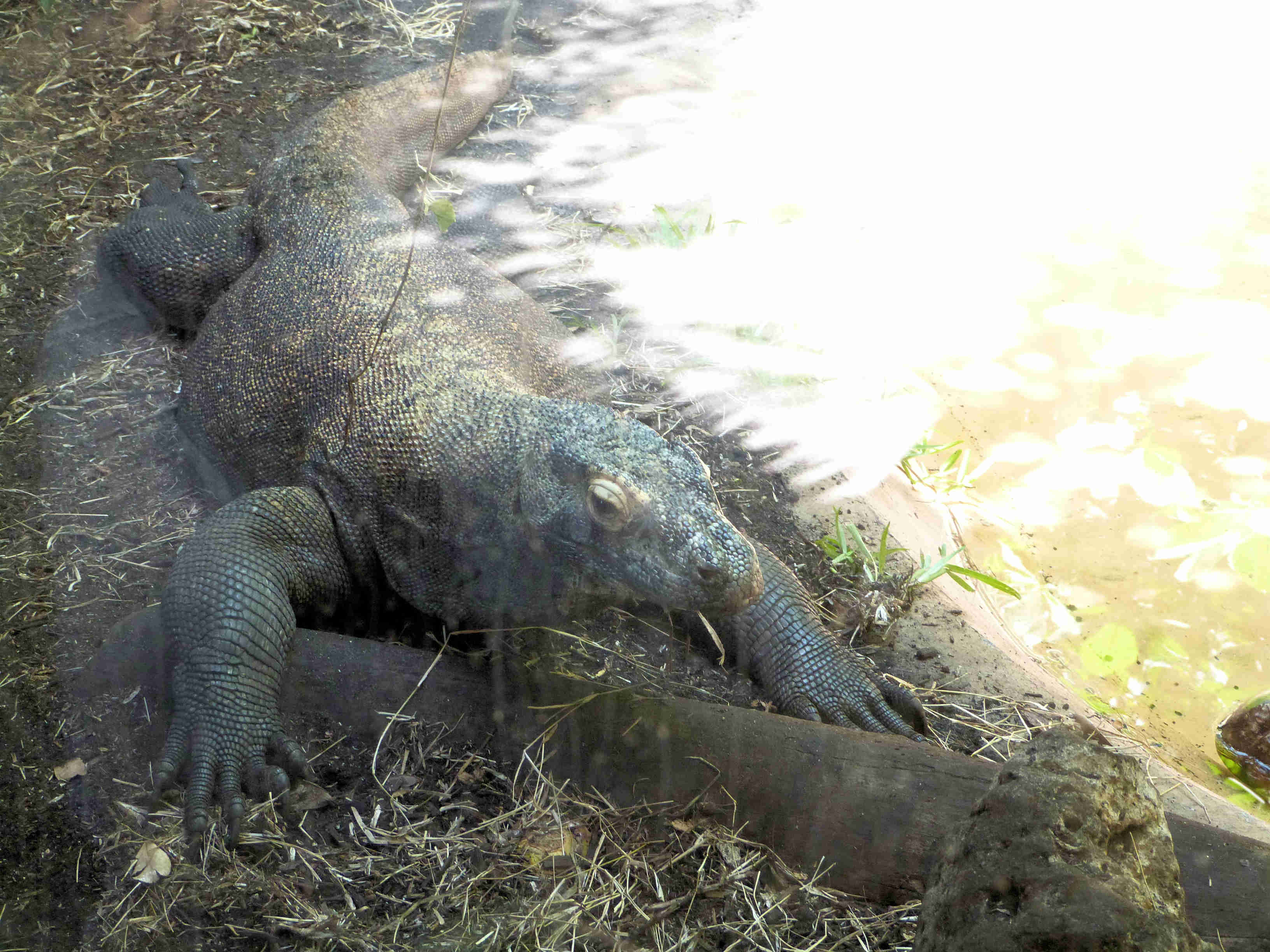
We see these quite frequently in the Zoos. Lowry Park Zoo in Tampa has one we have watched, but he usually just lays there and looks around. The one in the video surprised me that they can run that fast.

This one was taken at the Palm Beach Zoo in Florida last year.

Kamodo Dragon Palm Beach Zoo by Lee

Kamodo Dragon Palm Beach Zoo by Lee

The beast of the field shall honour me, the dragons and the owls: because I give waters in the wilderness, and rivers in the desert, to give drink to my people, my chosen. (Isaiah 43:20 KJV)

*

*

Sunday Inspiration – Tits, Chickadees and Penduline Tits

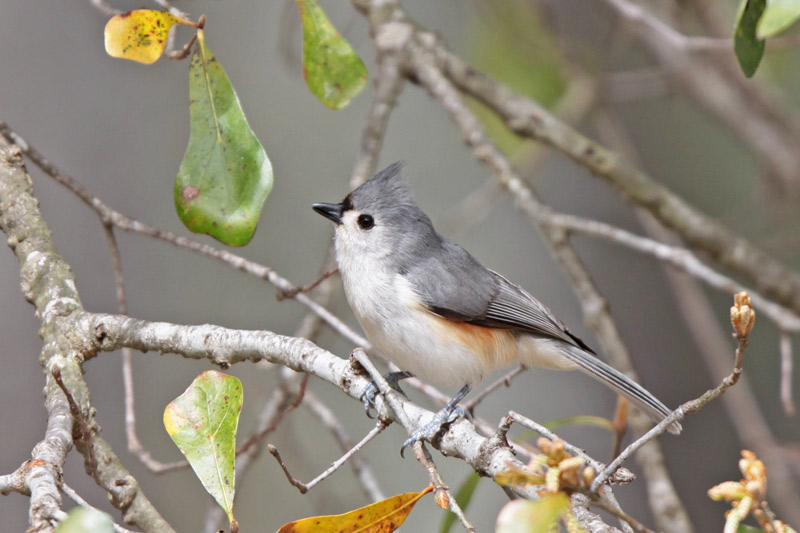
Tufted Titmouse (Baeolophus bicolor) by Margaret Sloan

Tufted Titmouse (Baeolophus bicolor) by Margaret Sloan

The little birds have places for themselves, where they may put their young, even your altars, O Lord of armies, my King and my God. (Psalms 84:3 BBE)

This week we come to two families of avian wonders that are next to one another in taxonomic order. The families are the Paridae – Tits, Chickadees with 61 species and the Remizidae – Penduline Tits with 11 more cuties.

The tits, chickadees, and titmice constitute the Paridae, a large family of small passerine birds which occur in the Northern Hemisphere and Africa. Most were formerly classified in the genus Parus.

These birds are called either “chickadees” (derived from their distinctive “chick-a dee dee dee” alarm call) or “titmice” in North America, and just “tits” in the rest of the English-speaking world. The name titmouse is recorded from the 14th century, composed of the Old English name for the bird, mase (Proto-Germanic *maison, German Meise), and tit, denoting something small. The spelling (formerly titmose) was influenced by mouse in the 16th century. Emigrants to New Zealand presumably identified some of the superficially similar birds of the genus Petroica of the family Petroicidae, the Australian robins, as members of the tit family, giving them the title tomtit, although, in fact, they are not related.

These birds are mainly small, stocky, woodland species with short, stout bills. Some have crests.  They are adaptable birds, with a mixed diet including seeds and insects. Many species live around human habitation and come readily to bird feeders for nuts or seed, and learn to take other foods.

Verdin (Auriparus flaviceps) Building Nest ©Earle Robinson

Verdin (Auriparus flaviceps) Building Nest ©Earle Robinson

The Penduline Tits constitute a family of small passerine birds, related to the true tits. All but the Verdin and Fire-capped Tit make elaborate bag nests hanging from trees (whence “penduline”, hanging), usually over water; inclusion of the fire-capped tit in this family is disputed by some authorities.

Verdin (Auriparus flaviceps) by D

Verdin (Auriparus flaviceps) by D

The Verdin was one of the Life Birds seen on our vacation this year. Didn’t want to stay put to have its photo taken. Then again, most of the titmice act that way. (Is it titmouses or titmice? :)  )

This slideshow requires JavaScript.

Little is much when God is in it, and these little birds are great creations from their Creator.

So God created great sea creatures and every living thing that moves, with which the waters abounded, according to their kind, and every winged bird according to its kind. And God saw that it was good. (Genesis 1:21 NKJV)

“Just a Little Talk With Jesus Makes It Right” ~ Vegter Quartet (together for Vi’s 90th Birthday)

*