Who teaches us more than the beasts of the earth, And makes us wiser than the birds of heaven?’ (Job 35:11 NKJV)
*
*
Who teaches us more than the beasts of the earth, And makes us wiser than the birds of heaven?’ (Job 35:11 NKJV)
*
*
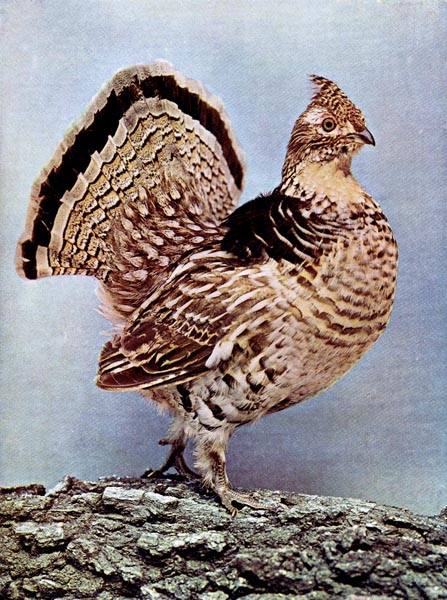
Ruffed Grous for Birds Illustrated by Color Photography, 1897, From col. F. M. Woodruff
*

HE Ruffed Grouse, which is called Partridge in New England and Pheasant in the Middle and Southern States, is the true Grouse, while Bob White is the real Partridge. It is unfortunate that they continue to be confounded. The fine picture of his grouseship, however, which we here present should go far to make clear the difference between them.
The range of the Ruffed Grouse is eastern United States, south to North Carolina, Georgia, Mississippi, and Arkansas. They hatch in April, the young immediately leaving the nest with the mother. When they hear the mother’s warning note the little ones dive under leaves and bushes, while she leads the pursuer off in an opposite direction. Building the nest and sitting upon the eggs constitute the duties of the female, the males during this interesting season keeping separate, not rejoining their mates until the young are hatched, when they begin to roam as a family.
Like the Turkey, the Ruffed Grouse has a habit of pluming and strutting, and also makes the drumming noise which has caused so much discussion. This noise “is a hollow vibrating sound, beginning softly and increasing as if a small rubber ball were dropped slowly and then rapidly bounced on a drum.” While drumming the bird contrives to make himself invisible, and if seen it is difficult to get the slightest clue to the manner in which the sound is produced. And observers say that it beats with its wings on a log, that it raises its wings and strikes their edges above its back, that it claps them against its sides like a crowing rooster, and that it beats the air. The writer has seen a grouse drum, appearing to strike its wings together over its back. But there is much difference of opinion on the subject, and young observers may settle the question for themselves. When preparing to drum he seems fidgety and nervous and his sides are inflated. Letting his wings droop, he flaps them so fast that they make one continuous humming sound. In this peculiar way he calls his mate, and while he is still drumming, the hen bird may appear, coming slyly from the leaves.
The nest is on the ground, made by the female of dry leaves and a few feathers plucked from her own breast. In this slight structure she lays ten or twelve cream-colored eggs, specked with brown.
The eyes of the Grouse are of great depth and softness, with deep expanding pupils and golden brown iris.
Coming suddenly upon a young brood squatted with their mother near a roadside in the woods, an observer first knew of their presence by the old bird flying directly in his face, and then tumbling about at his feet with frantic signs of distress and lameness. In the meantime the little ones scattered in every direction and were not to be found. As soon as the parent was satisfied of their safety, she flew a short distance and he soon heard her clucking call to them to come to her again. It was surprising how quickly they reached her side, seeming to pop up as from holes in the ground.
At first sight most of you will think this is a turkey. Well, it does look very much like one. He spreads his tail feathers, puffs himself up, and struts about like a turkey. You know by this time what his name is and I think you can easily see why he is called Ruffed.
This proud bird and his mate live with us during the whole year. They are found usually in grassy lands and in woods.
Here they build their rude nest of dried grass, weeds and the like. You will generally find it at the foot of a tree, or along side of an old stump in or near swampy lands.
The Ruffed Grouse has a queer way of calling his mate. He stands on a log or stump, puffed up like a turkey—just as you see him in the picture. Then he struts about for a time just as you have seen a turkey gobbler do. Soon he begins to work his wings—slowly at first, but faster and faster, until it sounds like the beating of a drum.
His mate usually answers his call by coming. They set up housekeeping and build their rude nest which holds from eight to fourteen eggs. As soon as the young are hatched they can run about and find their own food. So you see they are not much bother to their parents. When they are a week old they can fly. The young usually stay with their parents until next Spring. Then they start out and find mates for themselves.
I said at the first that the Ruffed Grouse stay with us all the year. In the winter, when it is very cold, they burrow into a snowdrift to pass the night. During the summer they always roost all night.
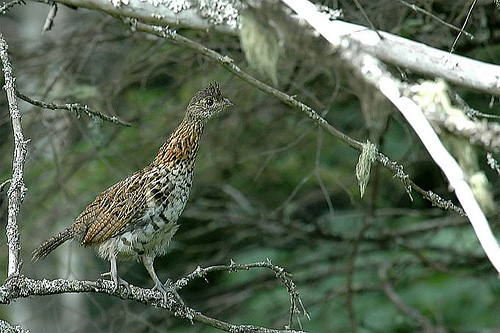
Ruffed Grouse (Bonasa umbellus) by Kent Nickel
Lee’s Addition:
If a bird’s nest happens to be before you along the way, in any tree or on the ground, with young ones or eggs, with the mother sitting on the young or on the eggs, you shall not take the mother with the young; you shall surely let the mother go, and take the young for yourself, that it may be well with you and that you may prolong your days. (Deuteronomy 22:6-7 NKJV)
Here is another one of God’s neat birds. The Ruffed Grouse (Bonasa umbellus) is a medium-sized grouse occurring in forests from the Appalachian Mountains across Canada to Alaska. It is non-migratory. The Ruffed Grouse is frequently referred to as a “partridge”. This is technically wrong—partridges are unrelated phasianids, and in hunting may lead to confusion with the Grey Partridge, it is a bird of woodlands, not open areas. It is a very popular game bird.
The Ruffed Grouse is also the state bird of Pennsylvania.
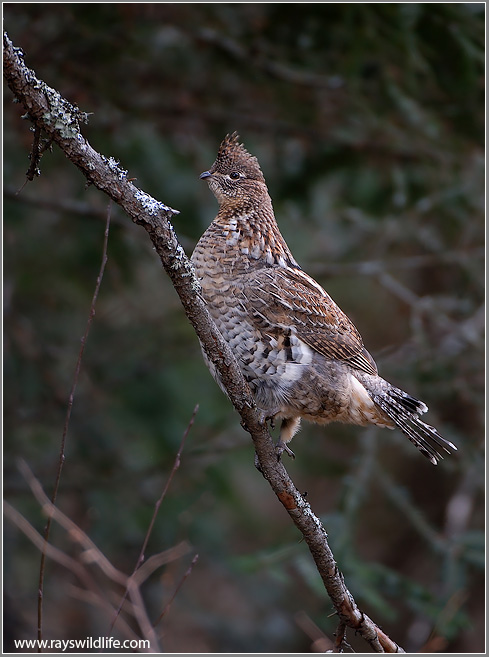
Ruffed Grouse (Bonasa umbellus) by Raymond Barlow
Ruffed Grouse look like chickens in appearance. They are medium to large with a thick body with a small crest on their head. When they fly their wings are rounded. Their coloration works very well to blend them with their habitat. The Lord has provided that protection for them. “One of the interesting ruffed grouse facts is that during winter, these birds develop a web-like structure that joins their toes, so that they can walk easily on snow.” Buzzle.com
The Ruffed Grouse is one of 182 members of the Phasianidae – Pheasants, Fowls and Allies Family. Other birds that are similar are found in the Galliformes Order.
Here is a video of a Ruffed Grouse drumming from YouTube from TheMusicofNature
*
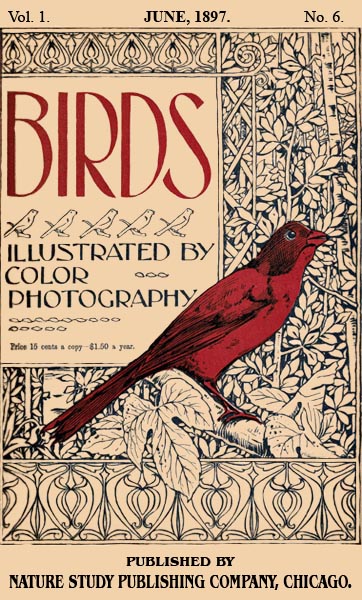
Birds Illustrated by Color Photograhy Vol 1 June, 1897 No 6 – Cover
Birds Illustrated by Color Photography – Revisited – Introduction
The above article is the first article in the monthly serial that was started in January 1897 “designed to promote Knowledge of Bird-Live.” These include Color Photography, as they call them, today they are drawings. There are at least three Volumes that have been digitized by Project Gutenberg.
To see the whole series of – Birds Illustrated by Color Photography – Revisited
*
(Information from Wikipedia and other internet sources)
Next Article – The Black And White Creeping Warbler
Previous Article – The Scarlet Tanager
Links:
Ruffed Grouse – All About Birds
Ruffed Grouse – Wikipedia
*

Red Bird – Northern Cardinal for Birds Illustrated
*

MERICAN RED BIRDS are among our most common cage birds, and are very generally known in Europe, numbers of them having been carried over both to France and England. Their notes are varied and musical; many of them resembling the high notes of a fife, and are nearly as loud. They are in song from March to September, beginning at the first appearance of dawn and repeating successively twenty or thirty times, and with little intermission, a favorite strain.
The sprightly figure and gaudy plumage of the Red Bird, his vivacity, strength of voice, and actual variety of note, and the little expense with which he is kept, will always make him a favorite.
This species is more numerous to the east of the great range of the Alleghenies, but is found in Pennsylvania and Ohio, and is numerous in the lower parts of the Southern States. In January and February they have been found along the roadsides and fences, hovering together in half dozens, associating with snow birds, and various kinds of sparrows. In the northern states they are migratory, and in the southern part of Pennsylvania they reside during the whole year, frequenting the borders of rivulets, in sheltered hollows, covered with holly, laurel, and other evergreens. They love also to reside in the vicinity of fields of Indian corn, a grain that constitutes their chief and favorite food. The seeds of apples, cherries, and other fruit are also eaten by them, and they are accused of destroying bees.
Early in May the Red Bird begins to prepare his nest, which is very often fixed in a holly, cedar or laurel bush. A pair of Red Birds in Ohio returned for a number of years to build their nest in a honeysuckle vine under a portico. They were never disturbed and never failed to rear a brood of young. The nest was constructed of small twigs, dry weeds, slips of vine bark, and lined with stalks of fine grass. Four eggs of brownish olive were laid, and they usually raised two broods in a season.
In confinement they fade in color, but if well cared for, will live to a considerable age. They are generally known by the names: Red Bird, Virginia Red Bird, Virginia Nightingale, and Crested Red Bird. It is said that the female often sings nearly as well as the male.
THE REDBIRDS.
Two Redbirds came in early May,
Flashing like rubies on the way;
Their joyous notes awoke the day,
And made all nature glad and gay.
Thrice welcome! crested visitants;
Thou doest well to seek our haunts;
The bounteous vine, by thee possessed,
From prying eyes shall keep thy nest.
Sing to us in the early dawn;
’Tis then thy scarlet throats have drawn
Refreshing draughts from drops of dew,
The enchanting concert to renew.
No plaintive notes, we ween, are thine;
They gurgle like a royal wine;
They cheer, rejoice, they quite outshine
Thy neighbor’s voice, tho’ it’s divine.
Free as the circumambient air
Do thou remain, a perfect pair,
To come once more when Proserpine
Shall swell the buds of tree and vine.
—C. C. M.
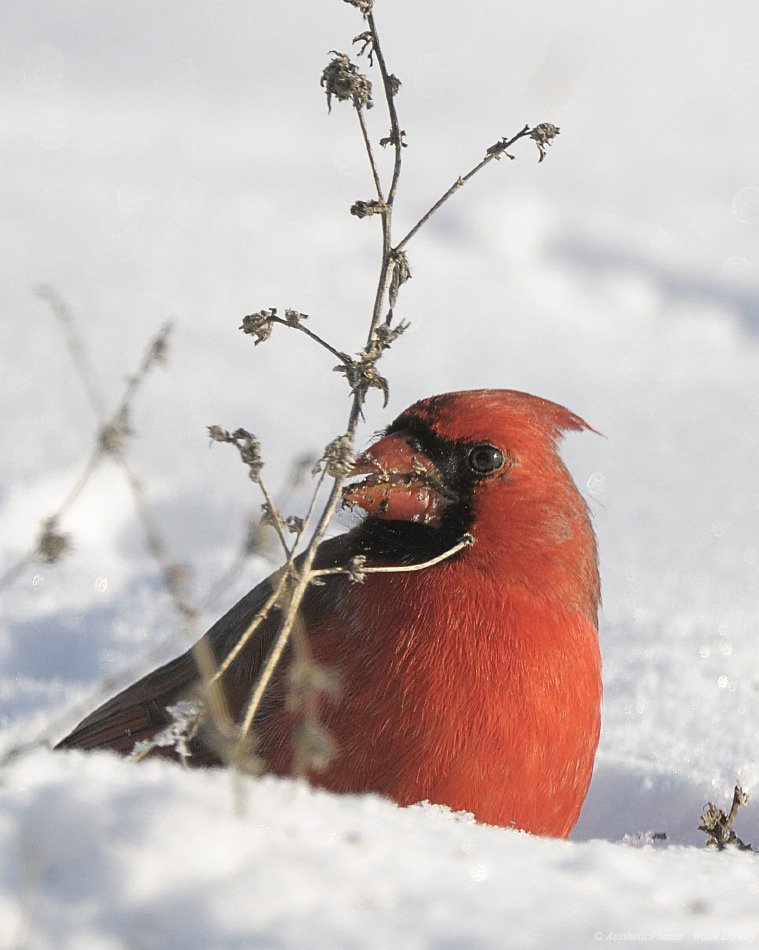
Northern Cardinal (Cardinalis cardinalis) by Aestheticphotos
THE RED BIRD.
Is it because he wears a red hat,
That we call him the Cardinal Bird?
Or is it because his voice is so rich
That scarcely a finer is heard?
’Tis neither, but this—I’ve guessed it, I’m sure—
His dress is a primary color of Nature.
It blends with the Oriole’s golden display,
And the garment of Blue Bird completes the array.
—C. C. M.
Lee’s Addition:
Come now, and let us reason together, saith the LORD: though your sins be as scarlet, they shall be as white as snow; though they be red like crimson, they shall be as wool. (Isaiah 1:18 KJV)
I hadn’t realized that back in 1897 that they carried the Cardinal or Red Bird overseas to be in cages. I suppose it is no different than those here, even today, cage birds from other countries. Personally, I think they should all be free, other than places like zoos where they are breeding them to help preserve endangered species. Even those young should be released once their numbers improve.
The Northern Cardinal is a favorite for most of us probably because they are seen in so many areas of our country. We had a pair stop by for a visit to the feeders within the last week. One chilly morning, the male sat out there and looked twice as large as normal. He was fluffed up trying to stay warm. Their song is quite known and we can hear them singing and identify them by there different songs and calls.
(Audio from xeno-canto.org)
The Northern Cardinal is one of three birds in the genus Cardinalis and is included in the family Cardinalidae, which is made up of passerine birds found in North and South America.
The Northern Cardinal was one of the many species originally described by Linnaeus in his 18th century work, Systema Naturae. It was initially included in the genus Loxia, which now contains only crossbills. In 1838, it was placed in the genus Cardinalis and given the scientific name Cardinalis virginianus, which means “Virginia Cardinal”. In 1918, the scientific name was changed to Richmondena cardinalis to honor Charles Wallace Richmond, an American ornithologist. In 1983, the scientific name was changed again to Cardinalis cardinalis and the common name was changed to “Northern Cardinal”, to avoid confusion with the seven other species also termed cardinals.
The common name, as well as the scientific name, of the Northern Cardinal refers to the cardinals of the Roman Catholic Church, who wear distinctive red robes and caps. The term “Northern” in the common name refers to its range, as it is the northernmost cardinal species.
The Northern Cardinal is a mid-sized songbird with a body length of 20–23 cm (7.9–9.1 in) and a wingspan of 25–31 cm (9.8–12 in). It weighs about 45 g (1.6 oz). The male is slightly larger than the female. The male is a brilliant crimson red with a black face mask over the eyes, extending to the upper chest. The color is dullest on the back and wings. The female is fawn, with mostly grayish-brown tones and a slight reddish tint on the wings, the crest, and the tail feathers. The face mask of the female is gray to black and is less defined than that of the male. Both sexes possess prominent raised crests and bright coral-colored beaks. The beak is cone-shaped and strong.

Northern Cardinal (Cardinalis cardinalis) Female ©WikiC
The Northern Cardinal is found in residential areas throughout its range. Backyard birders attract it using feeders containing seeds, particularly sunflower seeds and safflower seeds. Although some controversy surrounds bird feeding, an increase in backyard feeding by humans has generally been beneficial to this species. It has an estimated global range of 5,800,000 square kilometers (2,239,392.5 sq mi) and a global population estimated to be about 100,000,000 individuals. Populations appear to remain stable. It was once prized as a pet due to its bright color and distinctive song. In the United States, this species receives special legal protection under the Migratory Bird Treaty Act of 1918, which also banned their sale as cage birds. It is also protected by the Convention for the Protection of Migratory Birds in Canada. It is illegal to take, kill, or possess Northern Cardinals, and violation of the law is punishable by a fine of up to 15,000 US dollars and imprisonment of up to six months.
In the United States, the Northern Cardinal is the mascot of a number of athletic teams. In professional sports, it is the mascot of the St. Louis Cardinals of Major League Baseball’s National League and the Arizona Cardinals of the National Football League. In college athletics, it is the mascot of many schools, including the University of Louisville, the State University of New York at Plattsburgh, Ball State University, Illinois State University, Lamar University, the Catholic University of America, Wesleyan University, Wheeling Jesuit University, Massachusetts College of Pharmacy and Health Sciences, North Idaho College and Saint John Fisher College. It is also the state bird of seven states, more than any other species: North Carolina, West Virginia, Ohio, Illinois, Indiana, Kentucky, and Virginia. It was also a candidate to become the state bird of Delaware, but lost to the Blue Hen of Delaware.
*
*
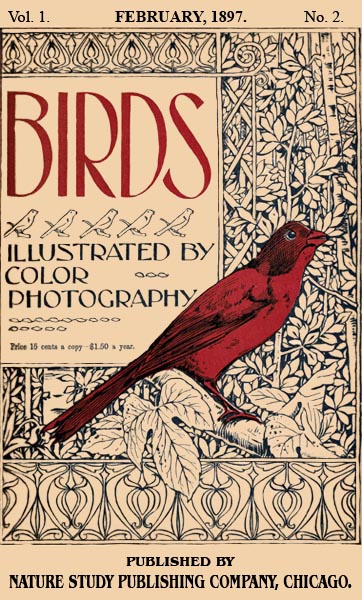
Birds Illustrated by Color Photograhy Vol 1 February 1897 No 2 – Cover
Birds Illustrated by Color Photography – Revisited – Introduction
The above article is the first article in the monthly serial for February 1897 “designed to promote Knowledge of Bird-Live.” These include Color Photography, as they call them, today they are drawings. There are at least three Volumes that have been digitized by Project Gutenberg.
To see the whole series of – Birds Illustrated by Color Photography – Revisited
*
(Information from Wikipedia and other internet sources)
Next Article – Little Boy Blue – The Blue Bird
Previous Article – Blue Mountain Lory (Rainbow Lorikeet)
Links:
Cardinalidae – Grosbeaks, Saltators & Allies
Northern Cardinal (Wikipedia)
*
Was sent a link to this fantastic video of how birds camouflage their nests by BBC Wildlife. This shows some of the great instinct and capabilities given to the birds by their Creator.
All the birds of the heavens made their nests in its boughs; Under its branches all the beasts of the field brought forth their young; And in its shadow all great nations made their home. (Ezekiel 31:6 NKJV)
Trust will enjoy this as well.
*
*
Another parable He put forth to them, saying: “The kingdom of heaven is like a mustard seed, which a man took and sowed in his field, which indeed is the least of all the seeds; but when it is grown it is greater than the herbs and becomes a tree, so that the birds of the air come and nest in its branches.” (Matthew 13:31-32 NKJV)
See also:
*
P.S. I know this is a short post, but last night I just discovered that the Slide.Com, which I used for many slideshows on various blogs, is closing. That means I have tons of work to do behind the scenes while I fix all of those and use another slideshow program. Watch out for dust!
Updated 2 Hours later: Just finished one with the new style Slideshow. I kind of like the new style. What do you think?
*
*
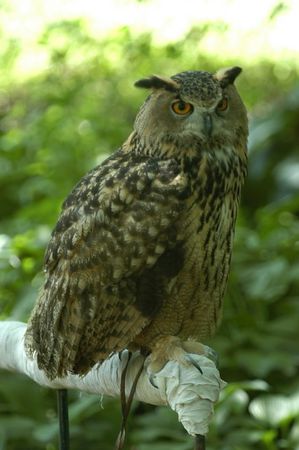
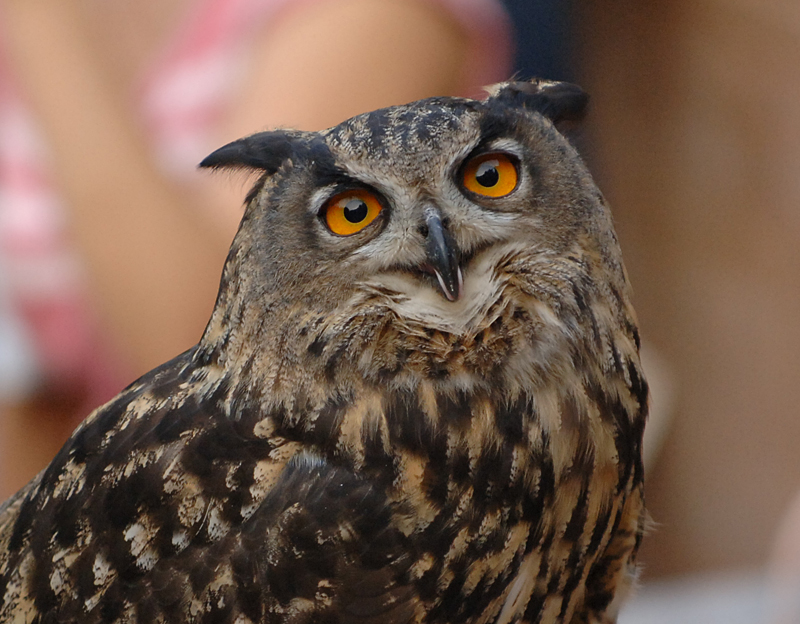
Eurasian Eagle-Owl (Bubo bubo) by Bob-Nan
The video below was to me as a link in an e-mail. It was posted by vurtrunner in Full HD High Speed. It is worth showing again here and especially since it is a Bird of the Bible. What an awesome shot. The way the feet open up at the last seconds amazed me. Another interesting thing is the way he is so steadfast and aims right for his target. Thanks, Pastor Pete, for sending the link.
Therefore, my beloved brethren, be ye stedfast, unmoveable, always abounding in the work of the Lord, forasmuch as ye know that your labour is not in vain in the Lord. (1 Corinthians 15:58 KJV)
There are actually 15 Eagle-Owl in the world and the video did not say which one this one is. Looking at the photos I can find, most likely this is an Eurasian Eagle-Owl. The Eagle-Owls are the Eurasian Eagle-Owl, Indian, Pharaoh, Cape, Spotted, Greyish, Fraser’s, Usambara, Spot-bellied, Barred, Shelley’s, Verreaux’s, Dusky, Akun, and Philippine Eagle-Owl. They are in the Stringidae Family of the Strigiformes Order. Also, the Eagle-Owls are in the genus Bubo, which also included the horned owls (Snowy Owl, Great Horned Owl, Lesser Horned Owl) and one fish owl (Blakiston’s Fish Owl). “This genus, depending on definition, contains about one or two dozen species of typical owls (family Strigidae) and is found in many parts of the world. Some of the largest living Strigiformes are in Bubo. Traditionally, only owls with ear-tufts were included here, but that is no longer the case.” (Wikipedia)
The beast of the field shall honour me, the dragons and the owls: because I give waters in the wilderness, and rivers in the desert, to give drink to my people, my chosen. (Isaiah 43:20 KJV)
*
See More:
Here is a video that I shot out at the Circle B Bar Reserve in Lakeland, FL on January 18th. We went out to watch some of the 4,000 American White Pelicans land at the marsh. We got there about 4:30 pm and stayed until almost 6 pm.
I left the sound on so that you can catch the amazement in my voice. My english is terrible and my words nutty, but I was thoroughly enjoying my “birdwatching adventure.” This is what it is really like to go birdwatching with me. I get so amazed at watching God’s created critters.
Thou wilt shew me the path of life: in thy presence is fulness of joy; at thy right hand there are pleasures for evermore. (Psalms 16:11 KJV)
I have more of these and pictures, but will save them for another time. Slower connections speeds will have enough problems loading just one video.
On the video I said about 100 feet over my head, it was more like 20-30 feet over our heads. The pelicans were landing right behind us.
My friend, Dawn, who writes the Dawn’s Bloggy Blog, posted this and thought you might enjoy it. We met a few years ago at the Birding Festival in Titusville, FL. They travel in a motorhome and she never seems to run out of interesting adventures.
These are Cedar Waxwings drinking. A sparrow and an American Robin also show up.
If thine enemy be hungry, give him bread to eat; and if he be thirsty, give him water to drink: (Pro 25:21)
Jesus answered and said unto her, Whosoever drinketh of this water shall thirst again: But whosoever drinketh of the water that I shall give him shall never thirst; but the water that I shall give him shall be in him a well of water springing up into everlasting life. (Joh 4:13-14)
To learn more about Waxwings see:
Cedar Waxwing – by A. J. Mithra
Ian’s Bird of the Week – Cedar Waxwing
Bombycillidae – Waxwings
*
Today is my birthday and a j mithra, one of our writers, sent me the following video. Thought I would share it with all of you. Thanks, a j.
In India “a j” is recovering and in a cast, but he found time to make this. Please keep him in your prayers.
So even to old age and gray hairs, O God, do not forsake me, until I proclaim your might to another generation, your power to all those to come. (Psalms 71:18 ESV)
*
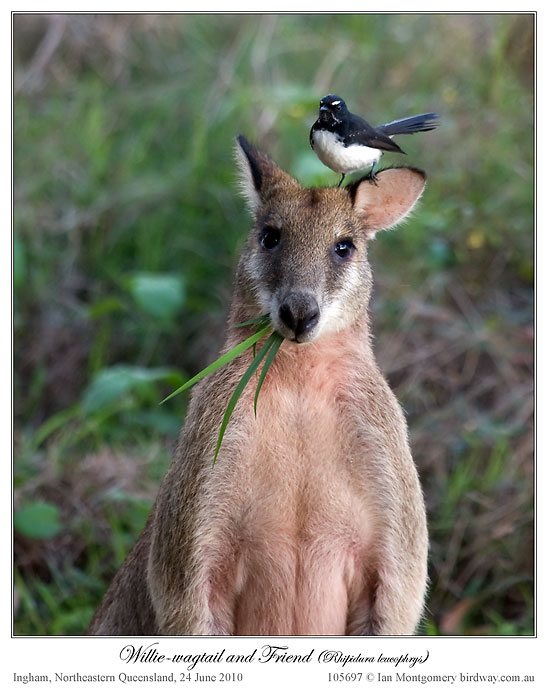
Willie Wagtail (Rhipidura leucophrys) on Wallaby by Ian
Ian’s Bird of the Week – Willie Wagtail ~ Ian Montgomery
Newsletter – 06-30-10
Very common birds like Willie-wagtails often get overlooked in the Bird of the Week in the pursuit of the rare and exotic. It takes the unusual antics of a particular individual to get noticed, such as this Willie-wagtail, perched cheekily on the head of an Agile Wallaby at Tyto Wetlands near Ingham last week.
Perhaps ‘unusual’ isn’t strictly true, as Graham Pizzey’s Field Guide to the Birds of Australia describes the behaviour of this species as: ‘bold, perky; watches from low branches, fence-posts … backs of farm-animals’. The wallaby might be offended at being described as a mere farm-animal, though this one seems to be doing its best to imitate a country yokel by chewing grass and assuming a dopey expression.
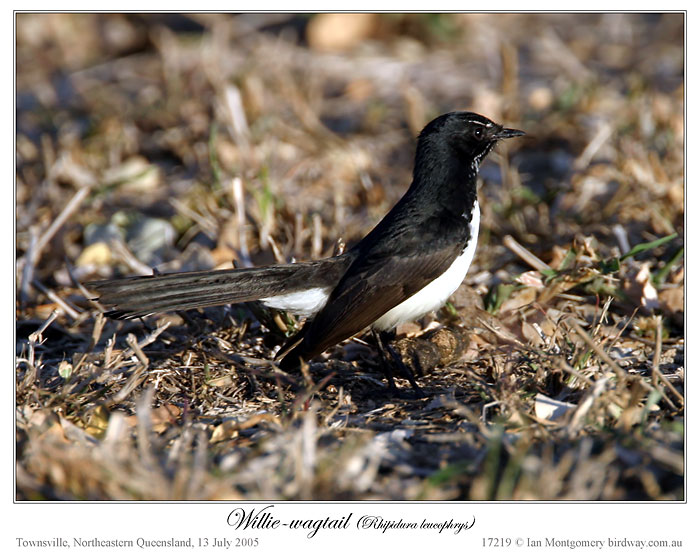
Willie Wagtail (Rhipidura leucophrys) on Wallaby by Ian
The Willie-wagtail is a popular and widespread species, occurring in a very wide range of habitats throughout Australia. It is absent from southern Tasmania and, for reasons not understood, curiously uncommon in the Townsville district, where the second photo was taken. It gets its name from its habit of fanning its tail and swinging it from side to side, (and spreading its wings) apparently to disturb the insects on which it feeds.
Back at the website, I’m continuing the task of updating all the family thumbnail pages. I’ve finished the first 100 families with only about 40 of the Passerine (perching bird) families to complete. Along the way, I’ve also added some new photos including ones of the following species:
Tawny Frogmouth
Burrowing Owl
Dollarbird
Red-backed Kingfisher
Yellow-billed Kingfisher
Best wishes,
Ian
—
Ian Montgomery, Birdway Pty Ltd,
454 Forestry Road, Bluewater, Qld 4818
Phone: +61-7 4751 3115
Preferred Email: ian@birdway.com.au
Website: http://birdway.com.au
Lee’s Addition:
I see Ian has a nice sense of humor. Love his description of the Wallaby. Neat little bird, thanks, Ian, for another great Bird of the Week.
Ian mentioned the birds as being “bold, perky; watches.” That brought to mind a few verses:
In the day when I cried out, You answered me, And made me bold with strength in my soul. (Psalms 138:3 NKJV)
The wicked flee when no one pursues, But the righteous are bold as a lion. (Proverbs 28:1 NKJV)
The eyes of the LORD are in every place, Keeping watch on the evil and the good. (Proverbs 15:3 NKJV)
Watch, stand fast in the faith, be brave, be strong. (1 Corinthians 16:13 NKJV)
The Wagtail is in the Rhipiduridae Family which includes all the Fantails, one Wagtail and one Silktail. The Order is the Passeriformes.
Below is a video of a Willie Wagtail on a rock, calling and waging tail, by Nick Talbot.

Here is a Video from Creation Moments about bird migration that you might find interesting. Our amazing Creator continues to show His marvelous Omniscience.
Here’s Wikipedia’s information about the Manx Shearwater
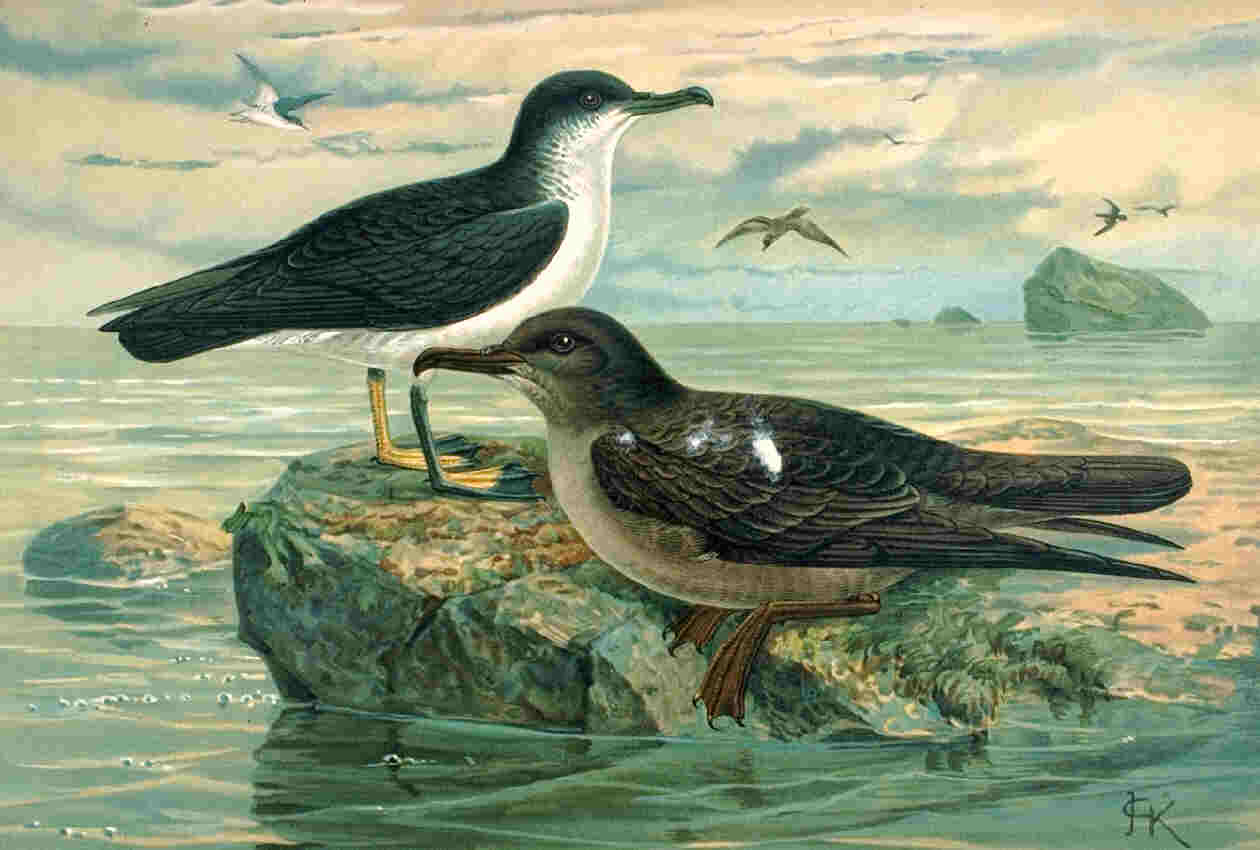
Manx Shearwaters
*
 Lee's Birdwatching Adventures Plus