Dan and I have been off on a trip to the mountains of Tennessee and made some interesting stops along the way. Haven’t always had an internet connection to be able to post new articles. Put the blog on “auto-pilot” before we left. (PS – We just got home and I thought I released this 2 days ago.)
We stopped at the Jacksonville Zoo in Florida to do some birdwatching. Have lots of photos to go through, but thought I would share a video I took of the Cape Thick-knee, as they call it. One reason I enjoyed these birds is because of the size of their eyes to their heads. They were so friendly and quite vocal. This is just one of the times they were “sounding off.”
Checked with Wikipedia to see what they say about the Thick-knee. It is actually the Double-striped Thick-knee (Burhinus bistriatus). They are related to the stone-curlews. They are in the Burhinidae Family which has ten species of Thick-knees and Stone-curlews. According to the Chicago Zoo, their Cape Thick-knee is the Double-striped and Wikipedia says it is the Striped Thick-knee. I am not sure if what we saw is the one or two striped bird, so we will call it the Cape.
It is a resident breeder in Central and South America from southern Mexico south to Colombia, Venezuela and northern Brazil. It also occurs on Hispaniola and some of the Venezuelan islands, and is a very rare vagrant to Trinidad, Curaçao and the USA.
This is a largely nocturnal and crepuscular species of arid grassland, savanna, and other dry, open habitats. The nest is a bare scrape into which two olive-brown eggs are laid and incubated by both adults for 25–27 days to hatching. The downy young are precocial and soon leave the nest.
The Double-striped Thick-knee is a medium-large wader with a strong black and yellow bill, large yellow eyes, which give it a reptilian appearance, and cryptic plumage. The scientific genus name refers to the prominent joints in the long greenish-grey legs, and bistriatus to the two stripes of the head pattern.
The adult is about 46–50 cm long and weighs about 780-785 g. It has finely streaked grey-brown upperparts, and a paler brown neck and breast merging into the white belly. The head has a strong white supercilium bordered above by a black stripe. Juveniles are similar to adults, but have slightly darker brown upperparts and a whitish nape.
Double-striped Thick-knee is striking in flight, with a white patch on the dark upperwing, and a white underwing with a black rear edge. However, it avoids flying, relying on crouching and camouflage for concealment. The song, given at night, is a loud kee-kee-kee.
There are four subspecies, differing in size and plumage tone, but individual variation makes identification of races difficult.
The Double-striped Thick-knee eats large insects and other small vertebrate and invertebrate prey. It is sometimes semi-domestcated because of its useful function in controlling insects, and has benefited from the clearing of woodlands to create pasture.
BigNewsStory.com – Baby Golden Eagle Survives Utah Wildfire
A baby golden eagle is recovering at a wildlife rehabilitation facility after officials say it miraculously survived a Utah wildfire last month.
Kent Keller told The Salt Lake Tribune (http://bit.ly/NKy8WO ) he feared the worst when he returned to the nest site west of Utah Lake to retrieve a leg band he had attached to the male eaglet June 1.
But the veteran Utah Division of Wildlife Resources volunteer found the burned bird alive on June 28 behind a charred tree, about 25 feet below the nest that was burned to a crisp in the 5,500-acre Dump Fire near Saratoga Springs.
“I thought there was no chance he would be alive. I was stunned when I saw him standing there,” Keller said. “I thought maybe I could rebuild the nest a little bit, but I took a good look at him and realized that was not going to happen.”
The 70-day-old eaglet had suffered burns on his talons, beak, head and wings. His flight feathers were melted down to within an inch or two of his wing and tail. He’s very underweight at just over five pounds.
Keller realized the eagle would not fly for at least a year and that the parents eventually would stop providing food. Not a stick from the nest was left after the fire sparked by target shooters swept through
“I’ve seen nests burn before, but this is the first year I have seen one burn with young in it,” he told the Tribune. “They are usually long gone and flying when fire season starts.”
After permission was secured from state and federal wildlife agencies, the Wildlife Rehabilitation Center of Northern Utah in Ogden assumed care of the eaglet this week.
“I wasn’t sure he was going to make it,” said DaLyn Erickson, executive director of the center. “He kind of had that look like he may have given up.”
But the eagle named Phoenix has since taken to eating beef heart and venison. He’s treated several times a day for his burns and seems to be gaining strength.
“He looks good now,” said Amber Hansen, a member of the center’s board of directors. “But we think if he had been there (at the nest site) another day, he probably would not have survived.”
What seems to have saved his life during the fire was the insulation offered by his down feathers and once-thick body, according to the wildlife rehabilitation center.
Officials hope the bird can be released back into the wild next year, but say it’s too early to tell about its future. Volunteers will work to keep him as wild as possible.
“It depends on how much follicle damage there is to his wings,” Hansen said. “If they are not too burned, he should be able to molt into new feathers next year and hopefully be able to fly.”
This was taken from TedTalks.com and was received by me in an e-mail. It is FANTASTIC!
I do not know the story behind the video, but I see God’s mighty creation at work in helping plants be pollinated. The photography is phenomenal.
The flowers appear on the earth; the time of the singing of birds is come, and the voice of the turtle is heard in our land; (Song of Solomon 2:12 KJV)
The grass withereth, the flower fadeth: but the word of our God shall stand for ever. (Isaiah 40:8 KJV)
By them the birds of the heavens have their home; They sing among the branches. (Psalms 104:12 NKJV)
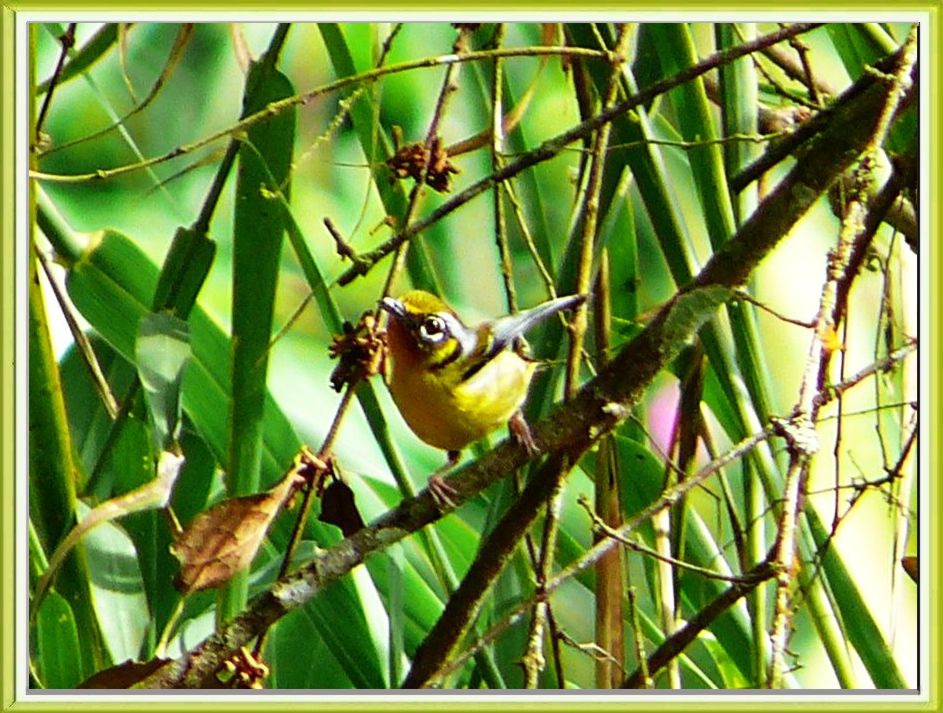
While looking through ajmithra’s YouTubes, I came across this video about the Common Iora (Aegithina tiphia) and thought I would share it. I always enjoy how he takes the sounds of birds and turns them into music. The little puffy cheeks are cute.
*
*
A j mithra (ajmithra as he prefers) has written many articles for our blog. Check out his page here and his YouTube videos.
Ioras are in the Aegithinidae – Ioras family of small passerine bird species found in India and southeast Asia. The family has only four species in a single genus, Aegithina. They are one of only three bird families that are entirely endemic to the Indomalayan ecozone. They were formerly grouped with the other two of those families, the Leafbirds and Fairy-Bluebirds, in the family Irenidae. Their Order is the Passeriformes
The Ioras are small to medium small sized passerines, ranging from 11.5–15.5 cm (4.5–6.1 in) in length. Overall the males are larger than the females. These are reminiscent of the bulbuls, but whereas that group tends to be drab in colouration, the ioras are more brightly coloured. The group exhibits sexual dimorphism in its plumage, with the males being brightly plumaged in yellows and greens. Unlike the leafbirds, ioras have thin legs, and their bills are proportionately longer. Calls are strident whistles; songs are musical to human ears.
Ioras eat insects and spiders, which they find by nimbly gleaning the leaves of the slenderest outer twigs.
In the two species whose male courtship displays are known, they are elaborate, culminating in the males’ parachute-style descent looking like “green balls of fluff”. The nests are compact open cups felted to branches with spiderweb. Females lay 2 or 3 eggs, which have pinkish speckles and red and purple lines. They incubate at night; the males, by day. Incubation lasts about 14 days. Both parents are responsible for brooding and feeding the chicks.
Curse not the king, no not in thy thought; and curse not the rich in thy bedchamber: for a bird of the air shall carry the voice, and that which hath wings shall tell the matter. (Ecclesiastes 10:20 KJV)
Talking birds! Is it possible? Solomon wrote about it in Ecclesiastes while telling people not to curse the king, even in your bedroom. Are there birds who could tell your words? First lets look at the words of Scripture in just that part of the verse. Again, I have used my e-Sword Bible program and a few other printed versions.
(ACV) For a bird of the heavens shall carry the voice, and that which has wings shall tell the matter.
(ABP+) For a winged creature of heaven shall carry your voice, and the one having the wings shall report your word.
(AKJV) for a bird of the air shall carry the voice, and that which has wings shall tell the matter.
(AMP) for a bird of the air will carry the voice, and a wing creature will tell the matter.
(ASV) for a bird of the heavens shall carry the voice, and that which hath wings shall tell the matter.
(BBE) because a bird of the air will take the voice, and that which has wings will give news of it.
(Bishops) (10:19) for a byrde of the ayre shall betray thy voyce, and with her fethers shall she bewray thy wordes.
(Brenton) for a bird of the air shall carry thy voice, and that which has wings shall report thy speech.
(CEV) A little bird might hear and tell everything.
(Darby) for the bird of the air will carry the voice, and that which hath wings will tell the matter.
(DRB) because even the birds of the air will carry thy voice, and he that hath wings will tell what thou hast said.
(ERV) A little bird might fly and tell them everything you said.
(ESV) for a bird of the air will carry your voice, or some winged creature tell the matter.
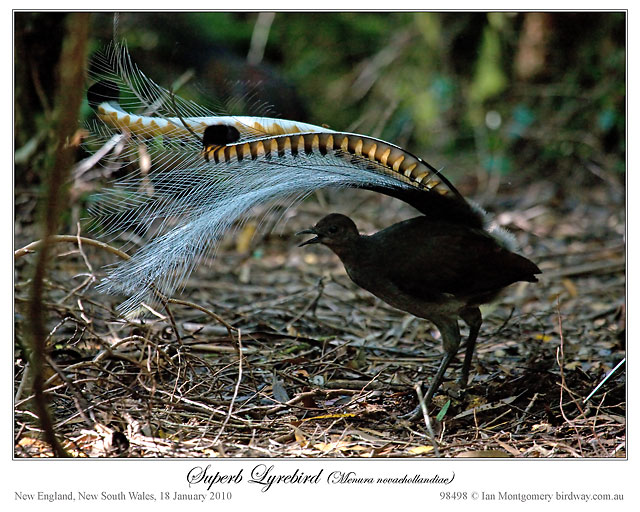
Superb Lyrebird (Menura novaehollandiae) by Ian
(Geneva) for the foule of the heauen shall carie the voice, & that which hath wings, shall declare the matter.
(GNB) A bird might carry the message and tell them what you said.
(GW) A bird may carry your words, or some winged creature may repeat what you say.
(ISV) For a bird will fly by and tell what you say, or something with wings may talk about it.
(JPS) for a bird of the air shall carry the voice, and that which hath wings shall tell the matter.
(KJV)for a bird of the air shall carry the voice, and that which hath wings shall tell the matter.
(KJV-1611) for a bird of the aire shall carry the voyce, and that which hath wings shall tell the matter.
(LITV) for a bird of the heavens may carry the voice; yea, the lord of wings may tell the matter.
(MKJV) for a bird of the air shall carry the voice, and that which has wings shall tell the matter.
(NASB) for a bird of the heavens will carry the sound and the winged creature will make the matter known.
(NIV) because a bird of the air may carry your words, and a bird on the wing may report what you say.
(NKJV) For a bird of the air may carry your voice, And a bird in flight may tell the matter.
(RV) for a bird of the air shall carry the voice, and that which hath wings shall tell the matter.
(Webster)for a bird of the air will carry the voice, and that which hath wings will tell the matter.
(YLT) For a fowl of the heavens causeth the voice to go, And a possessor of wings declareth the word.
Talking birds are birds that can mimic human speech. Talking birds have varying degrees of intelligence and communication capabilities: some, like the crow, a highly intelligent bird, are only able to mimic a few words and phrases, whilst some budgerigars have been observed to have a vocabulary of almost two thousand words. The Hill Myna is a commonly kept pet, well known for its talking ability – whilst its relative, the European Starling, is also adept at mimicry. Wild cockatoos in Australia have been reported to have learned human speech from ex-captive birds that have integrated into the flock. (See the Article – Wikipedia)
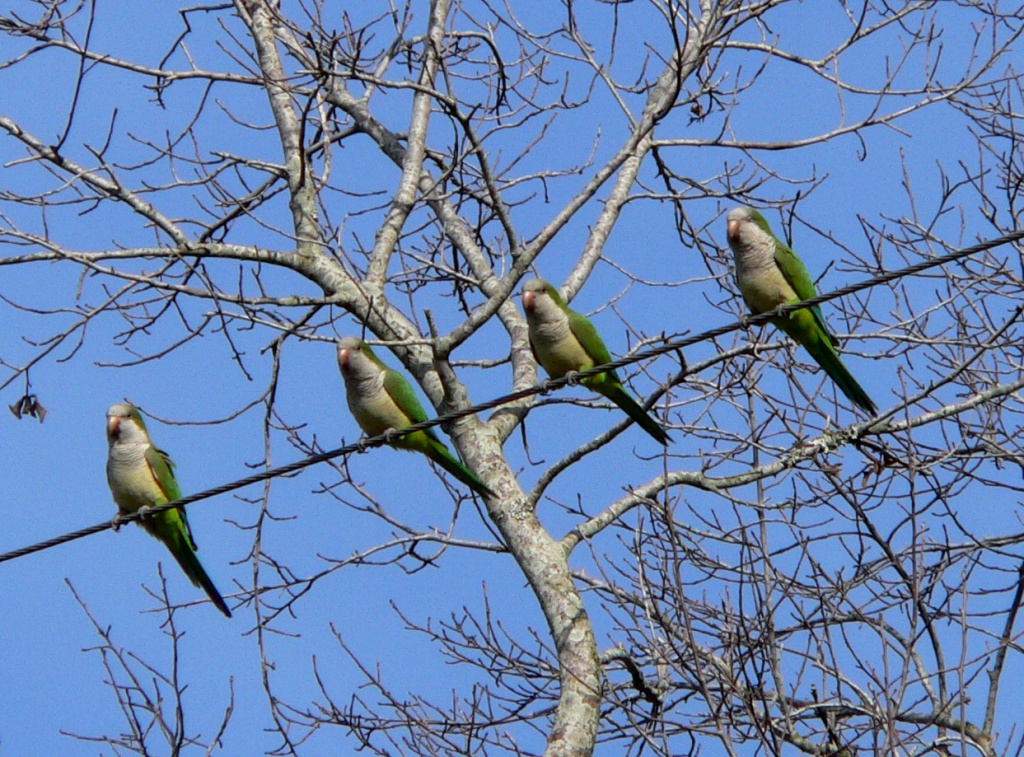
Monk Parakeets at S Lake Howard Nature Park by Lee
Dan and I had a Monk Parakeet that talked. Once Hoppi began to talk, he picked up everything you said. He even learned to call our dog, having heard us calling for him. Our dog would even look his way and head toward Hoppi when he called. Praise the Lord we are Christians, because that bird would repeat our conversations. I doubt he knew what he was saying, other than associating words with actions, but Hoppi did repeat what you had said.
*
From the article in Wikipedia:
In 1995 a budgerigar named Puck was credited by Guinness World Records as having the largest vocabulary of any bird, at 1,728 words.
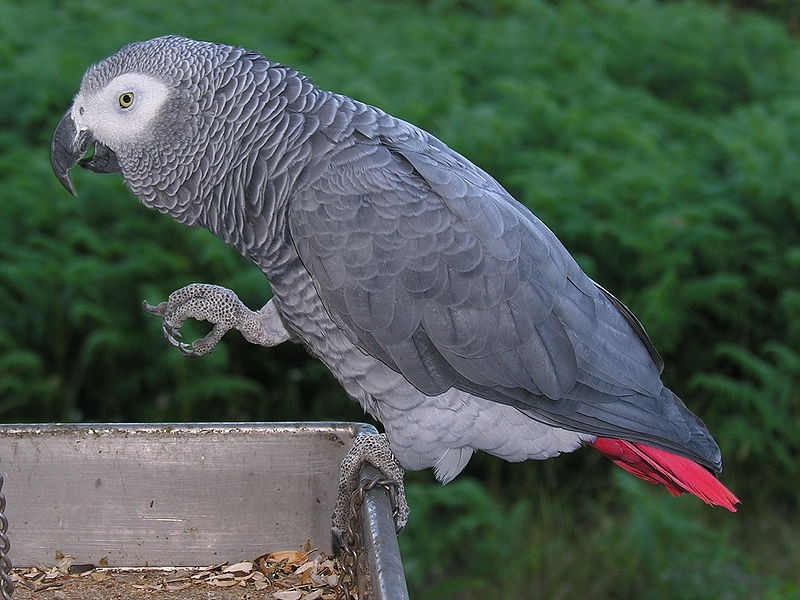
The African Grey Parrots are particularly noted for their cognitive abilities. Some of the most notable African Grey Parrots are Alex, Prudle, N’kisi and a new rising star, Einstein. Alex had a vocabulary of about 100 words, but he was one of the most famous birds because of his cognitive abilities. In 2005, World Science reported that Alex understood the concept of zero. Alex died on September 6, 2007. Prudle held the Guinness world record for bird with biggest vocabulary for many years with a documented vocabulary of 800 words. N’kisi is noted for his impressive English usage skills and other abilities. As of January 2004, he had a documented vocabulary of 950 words and shows signs of a sense of humor. N’kisi is believed to be one of the most advanced users of human language in the animal world. Einstein appeared on many television shows and became famous for her ability to recreate sounds as well as voice. Video clips show her making the sound of a laser beam and an evil laugh. She has been trained by Stephanie White. African Grey Sparky is popular on YouTube for copying one liners from the sitcom Still Game in a broad Scottish accent. Bibi, a Congo African Grey Parrot, is best known for her ability to use greetings from 20 different languages, earning her the nickname “The Polyglot Parrot.” At only three years of age, Bibi has already developed a vocabulary of about 300 words, and she understands the concepts of color and shape.
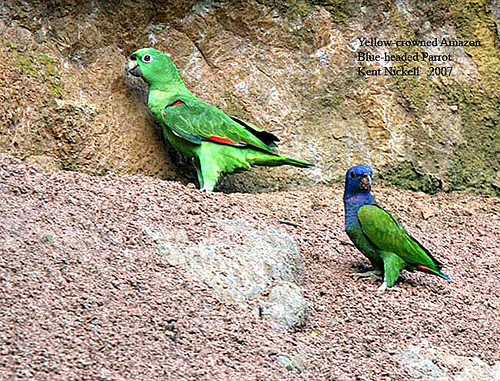
Yellow-crowned Amazon, Blue-headed Parrot by Kent Nickell
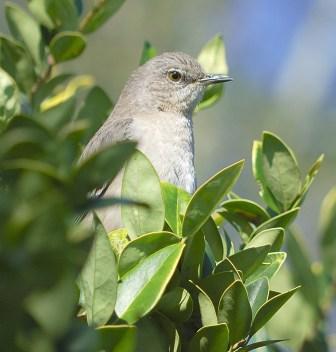
Amazon parrots – Many species of Amazona (particularly the yellow-head variety) are outstanding talkers. Yellow-napes, Double Yellow-headed, Yellow-crowned, and Panama Amazons are highly regarded as talking parrots. Other parrots – Most parrot species are capable of imitating human words. Many can learn to use phrases in context; they can also be trained to imitate any words. Monk Parakeets (also known as Quaker parrots) are also reputed to be skilled talkers. Hill Mynas – Hill Mynas are renowned for their ability to mimic the human voice. Many have claimed that the Hill Myna is the best talking bird and the best mimic in the world. Lyrebird, ability to mimic natural and artificial sounds from their environment Mockingbird, ability to mimic natural and artificial sounds from their environment
Passerine – Songbirds
Sounds like we need to watch what we say, not only about the king, but everyone. Even if the birds don’t hear us, the Lord hears our words and our thoughts.
Let the words of my mouth, and the meditation of my heart, be acceptable in thy sight, O LORD, my strength, and my redeemer. (Psalms 19:14 KJV)
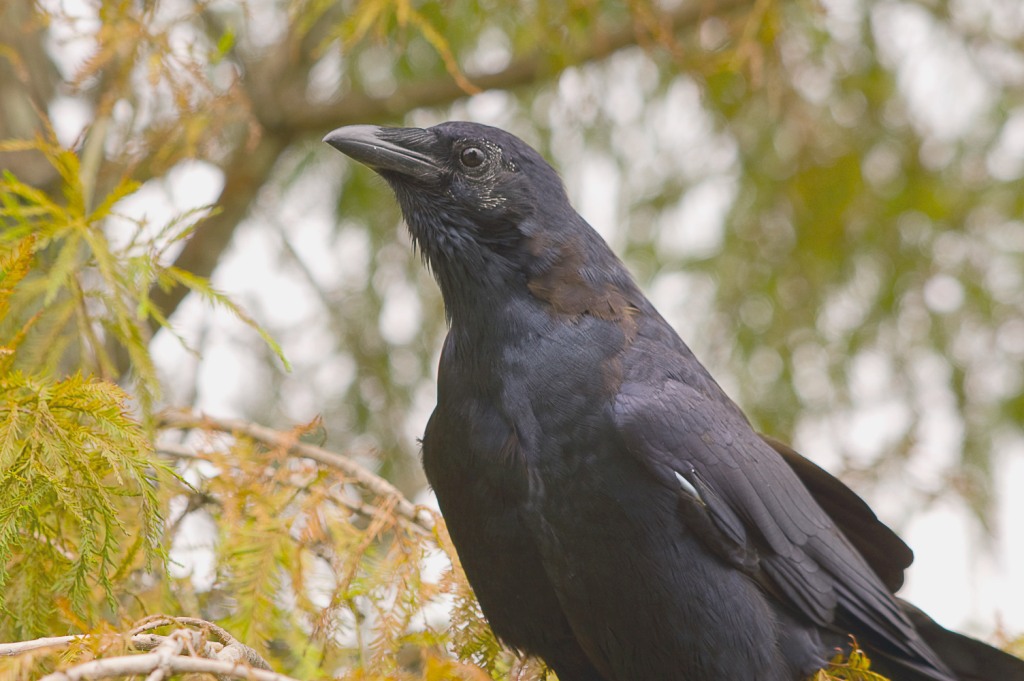
Fish Crow (Corvus ossifragus) at Lake Morton By Dan'sPix
Here are some “one liners” about gossip from Zingers by Croft M. Pentz:
Blessed are the hard of hearing, for they shall miss much small talk.
Trying to squash a rumor is like trying to unring a bell
A rumor is about as hard to unspread as butter.
Can you imagine anyone as unhappy as a person with a live secret and a dead telephone.
Busy souls have no time to be busybodies.
When a little bird has told you something, be sure that bird was not a cuckoo.
There is another verse in Scripture that mentions the birds telling something, but it is used in a different context. We will save that for another Birds of the Bible article.
But ask now the beasts, and they shall teach thee; and the fowls of the air, and they shall tell thee: (Job 12:7 KJV)
Job 12:7
Why is Your apparel red, And Your garments like one who treads in the winepress? (Isaiah 63:2 NKJV)
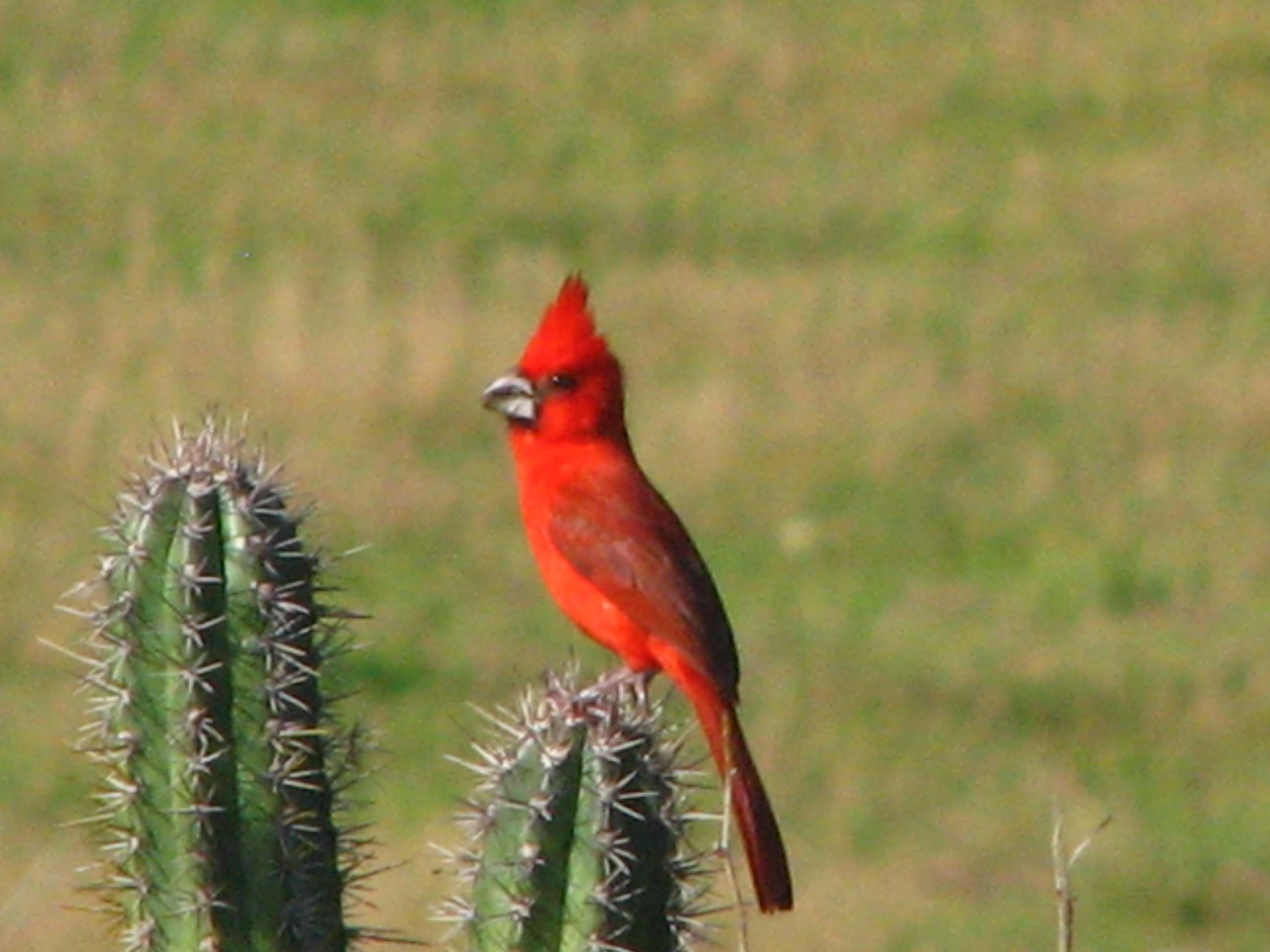
The Cardinalis genus of the Cardinalidae – Grosbeaks, Saltators & Allies Family includes three species. Oswaldtanager of YouTube caught a great video of the Vermilion Cardinal (Cardinalis phoeniceus) and I wanted to share it. These are only found in Colombia and Venezuela.
*
*
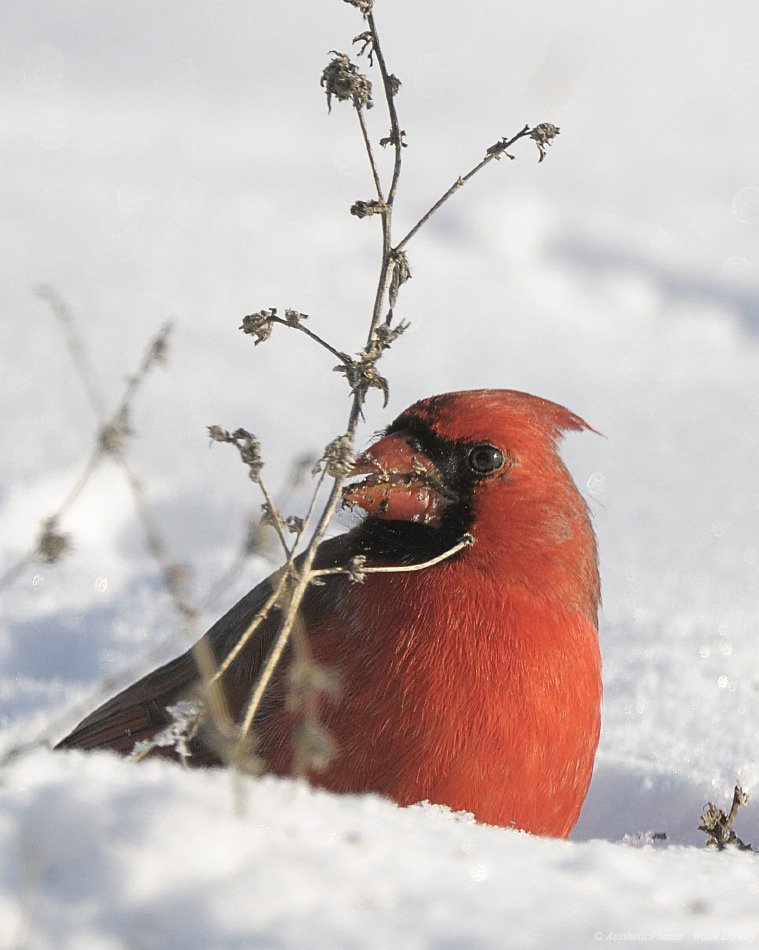
Here in the United States, we get to see the Northern Cardinal (Cardinalis cardinalis)
Northern Cardinal (Cardinalis cardinalis) by Aestheticphotos
and the Pyrrhuloxia (Cardinalis sinuatus). These are the other two genus members.
These are robust, seed-eating birds with strong bills. They are typically associated with open woodland. The sexes usually have distinctive appearances; the family is named for the red plumage (colored cardinal like the color of a Catholic cardinal’s vestments) of males of the type species, the Northern Cardinal.
The Cardinals or Cardinalidae are a family of passerine birds found in North and South America. The South American cardinals in the genus Paroaria are placed in another family, the Emberizidae.
Dan and I finally found a little time to go birdwatching, and since I was sore from a fall, decided to just go to Lake Hollingsworth and Lake Morton in Lakeland, Florida. Neither require a lot of walking, but we can always find something worth looking at. Both lakes had some great finds.
Lake Hollingsworth had the usually Mallards, White Ibises, Boat-tailed Grackles, Common Moorhens, “Aflac” Ducks being fed by a couple of ladies. We heard several Blue Jays, Red-bellied Woodpecker, and a Red-shouldered Hawk. A flock of about 50 Fish Crows made their noisy flight over and around for several minutes. We also saw a Great Egret, Osprey, Wood Storks, Great Blue Herons, Cormorant, Limpkin and a Purple Gallinule.
The best find was to watch an Anhinga trying to stay cool. I video taped the bird vibrating its throat. Birds do not have sweat glands, so this is one of the ways they cool down. It actually wasn’t too hot, 79°, but the humidity was at 85%. We all were warm. Below is some of that video.
And he cried and said, Father Abraham, have mercy on me, and send Lazarus, that he may dip the tip of his finger in water, and cool my tongue; for I am tormented in this flame. (Luke 16:24 KJV)
After that we drove about a mile north to Lake Morton. Again, the birds were gathered around a family feeding them. (These are the only two places we go locally where they feed wildlife.) This time the Mallards, White Ibises, and Boat-tailed Grackles were joined by 8 Wood Storks, Gulls, and Common Grackles. Also spotted were Mute Swans, a Black Swan, Wood Ducks, Red-bellied Woodpecker, some sort of Tern and a Snowy Egret showing off his yellow feet.
The prize here was finding a family of Limpkins. The mom, dad, and 5 juveniles were in the tall grass by the lake. Tried to get photos through the grass, but as you know, that can be a challenge. I turned my camera on to video and took the following:
All in all, the Lord provided a great day for birdwatching and let His creation of birds be seen. What would life be like without the neat things the Lord has provided to make our journey so enjoyable. All we have to do is look around us and observe.
*
Below is an interesting video sent to me by e-mail.
*
*
For the wrath of God is revealed from heaven against all ungodliness and unrighteousness of men, who hold the truth in unrighteousness; Because that which may be known of God is manifest in them; for God hath shewed it unto them. For the invisible things of him from the creation of the world are clearly seen, being understood by the things that are made, even his eternal power and Godhead; so that they are without excuse: (Romans 1:18-20 KJV)
In whom we have redemption through his blood, even the forgiveness of sins: Who is the image of the invisible God, the firstborn of every creature: For by him were all things created, that are in heaven, and that are in earth, visible and invisible, whether they be thrones, or dominions, or principalities, or powers: all things were created by him, and for him: And he is before all things, and by him all things consist. (Colossians 1:14-17 KJV)
I received this in an e-mail and thought it was worth repeating. This is a way of saying thanks to our military men and women. Thank You! You are remembered, loved, and prayed for by many of us.
This film was made by a 15 year old girl. It is the hottest thing on the internet and on Fox News. Lizzie Palmer who put this YouTube program together, is 15 years old. There have been over 3,000,000 hits as of this morning. In case you missed it, here it is.
Please keep our military members and veterans in our thoughts and prayers and the military of many nations. (At least the ones on the good side.)
Hear my prayer, O God; give ear to the words of my mouth. (Psalms 54:2 KJV)
Therefore I say unto you, What things soever ye desire, when ye pray, believe that ye receive them, and ye shall have them. (Mark 11:24 KJV)
For the eyes of the Lord are over the righteous, and his ears are open unto their prayers: but the face of the Lord is against them that do evil. (1 Peter 3:12 KJV)
Graham1281 has a YouTube Channel with over 200 of his accordion songs. He is from Inverness, U. K. and has given permission to use his music for backgrounds of our videos here. I came across this video while looking through his channel and decided to share it. Hope you enjoy.
“A wonderfully catchy tune written by Freeland Barbour for his friend Bobby Tulloch. Medicinecrow requested this tune and I was more than happy to oblige. The tune has fair Isle connections and so do I. My late stepfather ( George Eunson ) was born and lived a few of his childhood years there and also spent part of his early life in Lerwick. I too worked in Lerwick for 3 years myself and loved it.
The pictures are all of the birds around the Fair Isle. Hope you enjoy this and please keepthe requests coming. I’ve never enjoyed my playing so much for years.” (Graham Wilson)
And God said, “Let the waters swarm with swarms of living creatures, and let birds fly above the earth across the expanse of the heavens.” (Genesis 1:20 ESV)
Here is another of his bird related videos – The Cuckoo Waltz
Black-eared Shrike-babbler (Pteruthius melanotis) by Khong T Khoon
From time to time we are blessed to receive the permission to use material from Photographers and/or Videographers. Recently, Khong Tuck Khoon gave his permission to use his videos and photographs. Khong is known as “wondersf” on YouTube and has over 800 video on his Birds of Malaysia channel.
Khong T Khoon’s video of a Silver-breasted Broadbill (Serilophus lunatus)
Khong also has his regular website, Malaysian Birds, which has “Birds photos, Bird lists, Bird Calls & tips on birding in Malaysia.” There he has over 7,000 photos of birds from Malaysia. He has them listed from A to Z and by 57 Families. He is from Penang, Malaysia and is retired.
One of the interesting parts of his site is about the Nesting Birds stories he shows with photos. I really enjoyed the story of the Flameback and the Coppersmith, though part of the ending was sad.
Also, prior to “wondersf” giving his permission, “redshouldervids” gave us the honor of using his videos also. Both have been added to the sidebar, but I had failed to introduce Derek.
Long-eared Owl (Asio otus) by Derek or “redshouldervid”
Here is his video of a Singing Western Meadowlark.
Thanks to both of you for letting your photos and videos being made available for our readers to enjoy your views through your lens. Please visit their sites for many more delights.
If you would like to allow permission to use your handiwork and be added to our photographers and videographers, leave a comment or write us at: Lee@leesbird.com
Southern Carmine Bee-eater (Merops nubicoides) by Africaddict
We have written several articles about the Bee-eaters, but they are so pretty and colorful, that they are being presented again. When the Lord created them, He did not spare on the “color pallet.” Nor did He fail to provide them with the ability to know how to remove the stinger and poison of the bees and other insects before eating them.
For by him were all things created, that are in heaven, and that are in earth, visible and invisible, whether they be thrones, or dominions, or principalities, or powers: all things were created by him, and for him: And he is before all things, and by him all things consist. (Colossians 1:16-17 KJV)
This video tells about how the Bee-eater cooperate together in communities. Trust you will enjoy watching it.
“The bee-eaters are a group of near-passerine birds in the family Meropidae. Most species are found in Africa and Asia but others occur in southern Europe, Australia, and New Guinea. They are characterised by richly coloured plumage, slender bodies, and usually elongated central tail feathers. All have long downturned bills and pointed wings, which give them a swallow-like appearance when seen from afar. There are 26 different species of bee-eaters.
As the name suggests, bee-eaters predominantly eat flying insects, especially bees and wasps, which are caught in the air by sallies from an open perch.[1] While they pursue any type of flying insect, honey bees predominate in their diet. Hymenoptera (ants, bees and wasps) comprise from 20% to 96% of all insects eaten, with honey bees comprising approximately one-third of the Hymenoptera.
Carmine BeeEater (Merops nubicus or nubicoides) by Marc at Africaddict
Before eating its meal, a bee-eater removes the sting by repeatedly hitting and rubbing the insect on a hard surface. During this process, pressure is applied to the insect thereby extracting most of the venom.[1] Notably, the birds only catch prey that are on the wing and ignore flying insects once they land.
Bee-eaters are gregarious. They form colonies by nesting in burrows tunnelled into the side of sandy banks, such as those that have collapsed on the edges of rivers. Their eggs are white and they generally produce 2-9 eggs per clutch (depending on species). As they live in colonies, large numbers of these holes are often seen together, white streaks from their accumulated droppings accentuating the entrances to the nests. Most of the species in the family are monogamous, and both parents care for the young, sometimes with the assistance of other birds in the colony.” (From Wikipedia)
Some of the articles we have done that mention the Bee-eaters are:
The Bee-eaters are in the Coraciiformes Order which included the Roller, Kingfisher, Todie, Motmot Families. The Meropidae Family is the one that contains the 26 Bee-eater species.
Chestnut-headed Bee-eater (Merops leschenaulti) by Nikhil Devasar





 Lee's Birdwatching Adventures Plus

