Birds of the Bible – Name Study – Heron

Great Blue Heron (Ardea herodias) Watching young nearby by Lee at Viera Wetlands

Great Blue Heron (Ardea herodias) Watching young nearby by Lee at Viera Wetlands

Let’s look into a name study for another Bird of the Bible – this time the Heron. Our fishing Green Heron directed my thinking towards the Heron. So, let’s see what we can find out about how they are mentioned in Scripture.

The Heron and their kind are mentioned in Leviticus and Deuteronomy in the list of “Unclean Birds” or the “Do not eat” list.

And the stork, the heron after her kind, and the lapwing, and the bat. (Leviticus 11:19 KJV)

And the stork, and the heron after her kind, and the lapwing, and the bat. (Deuteronomy 14:18 KJV)

Those are the only two references to Herons in the King James Version. But how do other versions translate this bird? That is what these name study articles do. Dig around in the Word. I use e-Sword’ s compare mode to see the different versions.

Brenton, as does the APB, DRB, ISV, and NET  has the Heron in Psalms:

There the sparrows will build their nests; and the house of the heron takes the lead among them. Psalms 104:17 Brenton)

The Bishops and CJB only use Heron in Deuteronomy, but not Leviticus.

The Phillips does not even use the word “Heron.”

Here is the Hebrew word used in these verses:

H601
אנפה
‘ănâphâh
an-aw-faw’
From H599; an unclean bird, perhaps the parrot (from its irascibility): – heron.

*

The DRB also uses Heron in Job:

The wing of the ostrich is like the wings of the heron, and of the hawk. (Job 39:13 DRB)

The GW shows Heron in these verses:

“It will become the possession of herons. It will become pools of water. I’ll sweep it with the broom of destruction,” declares the LORD of Armies. (Isaiah 14:23 GW)

Pelicans and herons will take possession of the land. Owls and crows will live there. He will stretch the measuring line of chaos and the plumb line of destruction over it. (Isaiah 34:11 GW)

Flocks will lie down in it along with animals of every kind. Even pelicans and herons will nest on top of its columns. Listen! A bird will sing in a window. The doorway will be in ruins, because the LORD will expose the cedar beams. (Zephaniah 2:14 GW)

Isaiah 14:23 uses H7090 which is:

H7090
קפּד קפּוד
qippôd qippôd
kip-pode’, kip-pode’
From H7088; a species of bird, perhaps the bittern (from its contracted form): – bittern.

Isaiah 34:11 GW and Zephaniah 2:14 GW both use the same H7090. The word is translated as “Bittern” in the KJV for all three verses. The Ardeidae- Herons, Bitterns Family consists of Heron, Egrets and Bitterns so, there doesn’t seem to be a problem there, especially since the first two verses said, “heron after her kind.” They are related.

The DRB’s (1899 Douay-Rheims Bible) translation, to me, does not seem to match the rest of the other translations.
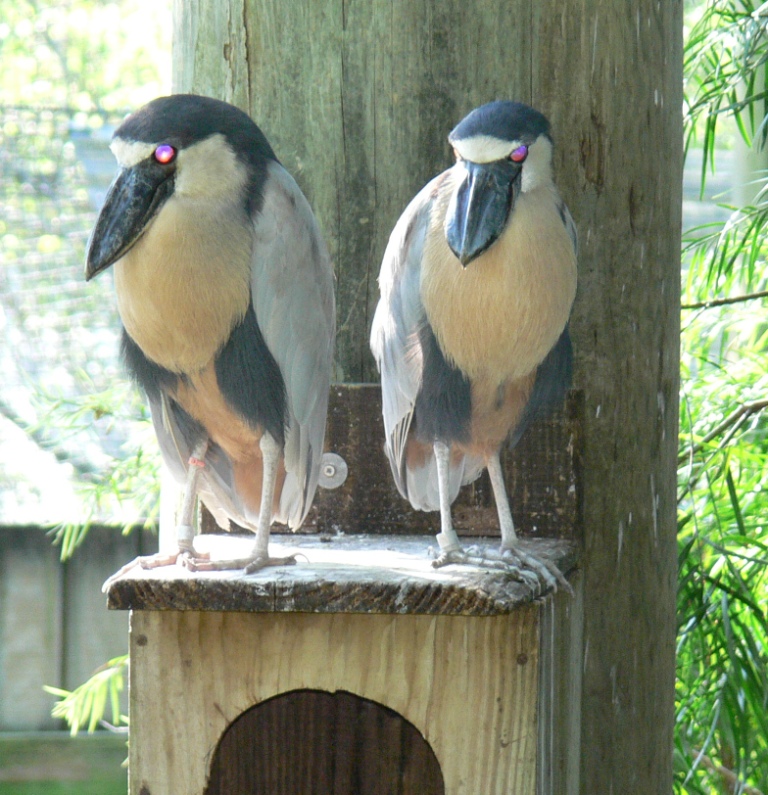
Boat-billed Heron (Cochlearius cochlearius) by Lee at LPZoo

Boat-billed Heron (Cochlearius cochlearius) by Lee at LPZoo

Herons:

The herons are long-legged freshwater and coastal birds in the family Ardeidae, with 72 recognised species (some are called “egrets” or “bitterns” instead of “heron”). Within Ardeidae, all members of the genera Botaurus and Ixobrychus are referred to as “bitterns”, and — including the Zigzag Heron or Zigzag Bittern — are a monophyletic group within the Ardeidae. However, egrets are not a biologically distinct group from the herons, and tend to be named differently because they are mainly white and/or have decorative plumes. Although egrets have the same build as herons, they tend to be smaller.

The classification of the individual heron/egret species is fraught with difficulty, and there is still no clear consensus about the correct placement of many species into either of the two major genera, Ardea and Egretta. One species formerly considered to constitute a separate monotypic family Cochlearidae, the Boat-billed Heron, is now regarded as a member of the Ardeidae.

Although herons resemble birds in some other families, such as the storks, ibises, spoonbills and cranes, they differ from these in flying with their necks retracted, not outstretched. They are also one of the bird groups that have powder down. Some members of this group nest colonially in trees, while others, notably the bitterns, use reedbeds.

Grey Heron (Ardea cinerea) by W Kwong

Grey Heron (Ardea cinerea) by W Kwong

The herons are a widespread family, they exist on all continents except Antarctica, and are present in most habitats except the coldest extremes of the Arctic, extremely high mountains and the driest deserts. Almost all species are associated with water, they are essentially non-swimming waterbirds that feed on the margins of lakes, rivers, swamps, ponds and the sea. They are predominately found in lowland areas, although some species live in alpine areas, and the majority of species occur in the tropics.

The herons are a highly mobile family, with most species being at least partially migratory. Birds are particularly inclined to disperse widely after breeding but before the annual migration where the species is colonial, searching out new feeding areas and reducing the pressures on feeding grounds near the colony. The migration typically occurs at night, usually as individuals or in small groups.

The herons and bitterns are carnivorous. The members of this family are mostly associated with wetlands and water, and feed on a variety of live aquatic prey. The diet includes a wide variety of aquatic animals, including fish, reptiles, amphibians, crustaceans, molluscs and aquatic insects. Individual species may be generalists or specialise in certain prey types, like the Yellow-crowned Night Heron, which specialises in crustaceans, particularly crabs. Many species will also opportunistically take larger prey, including birds and bird eggs, rodents, and more rarely carrion. Even more rarely there have been reports of herons eating acorns, peas and grains, but most vegetable matter consumed is accidental.

The most common hunting technique is for the bird to sit motionless on the edge of or standing in shallow water and wait until prey comes within range. (Birds of the Bible – Patient Herons) Birds may either do this from an upright posture, giving them a wider field of view for seeing prey, or from a crouched position, which is more cryptic and means the bill is closer to the prey when it is located. Having seen prey the head is moved from side to side, so that the heron can calculate the position of the prey in the water and compensate for refraction, and then the bill is used to spear the prey.
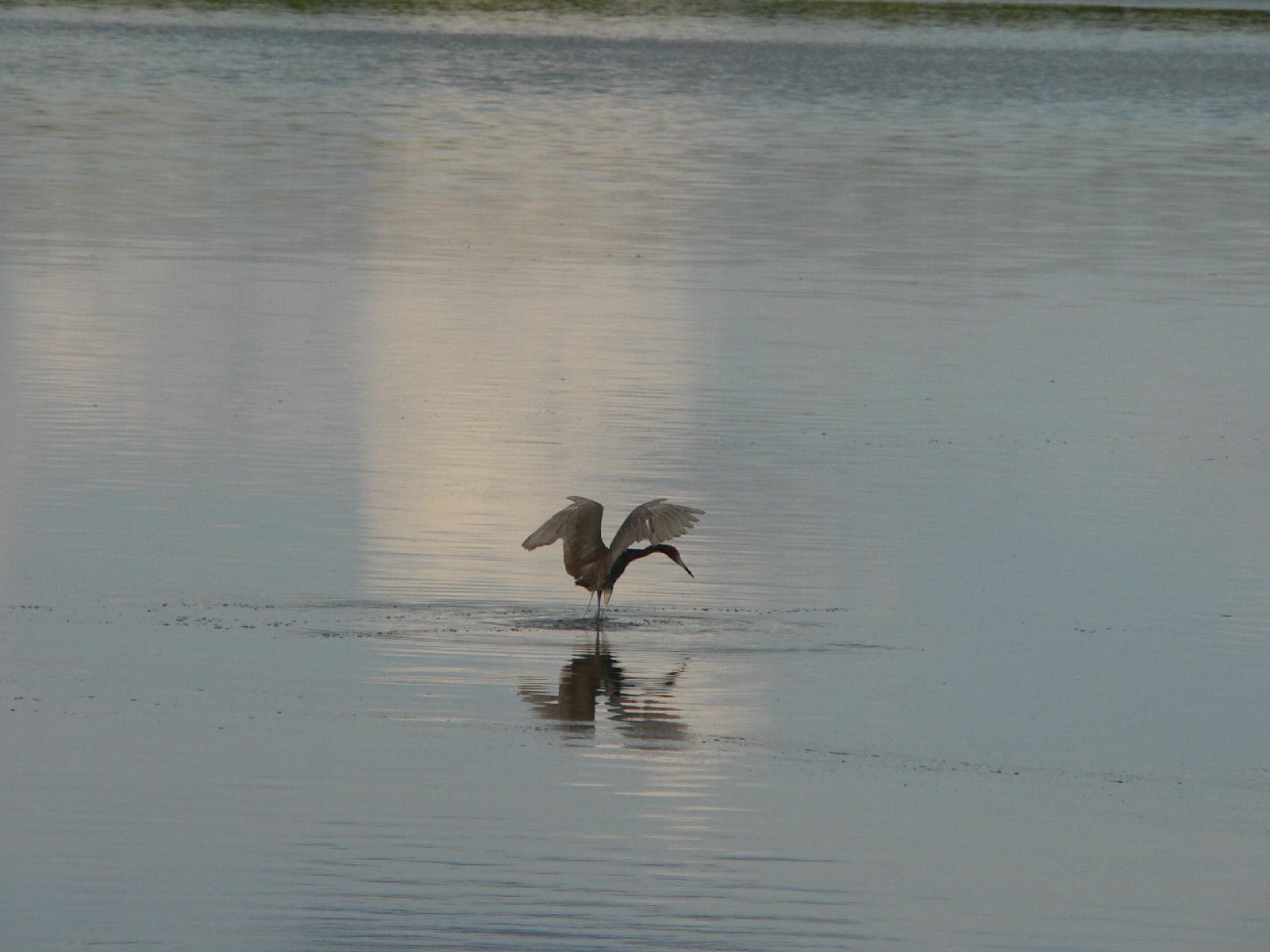
Reddish Egret scarring up breakfast

Reddish Egret scarring up breakfast

In addition to sitting and waiting, herons may feed more actively. They may walk slowly, at around or less than 60 paces a minute, snatching prey when it is observed. Other active feeding behaviours include foot stirring and probing, where the feet are used to flush out hidden prey. The wings may be used to frighten prey (or possibly attract it to shade) or to reduce glare; the most extreme example of this is exhibited by the Black Heron, which forms a full canopy with its wings over its body.

Some species of heron, such as the Little Egret and Grey Heron, have been documented using bait in order to lure prey to within striking distance. Herons may use items already in place, or actively add items to the water in order to attract fish. Items used may be man-made, such as bread; alternatively Striated Herons in the Amazon have been watched repeatedly dropping seeds, insects, flowers and leaves into the water to catch fish. (Green Heron Fishing With Bread)

(Heron information from Wikipedia with editing)

Names of Birds Study

Birds of the Bible – Herons

*

Birdwatching Tips – Herons, Egrets, Bitterns

Little Blue Heron at Lake Hollingsworth

Little Blue Heron at Lake Hollingsworth

Lev 11:19  And the stork, the heron after her kind, and the lapwing, and the bat.

Peterson’s Field Guide Videos have great information about how to identify birds in the Heron, Egrets and Bittern Family. This is a very good video.
*

*

See the other video in this series:

Peterson Field Guide-Videos

*

Ardeidae- Herons, Bitterns

Birds of the Bible – Herons

Wordless Birds

*

Green Heron Fishing With Bread

You have got to watch this Green Heron fishing with bread. The video speaks for itself.

Look at the birds of the air, for they neither sow nor reap nor gather into barns; yet your heavenly Father feeds them. Are you not of more value than they? (Matthew 6:26 NKJV)

*

*

Ardeidae- Herons, Bitterns

Birds of the Bible – Herons

Bible Birds – Herons

*

Birds of the Bible – Remembering

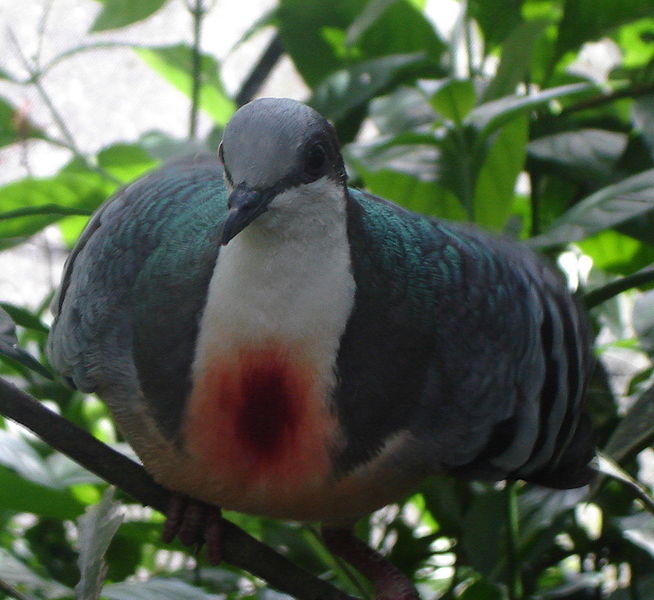
Bleeding-Heart Pigeon ©WikiC

Bleeding-Heart Pigeon ©WikiC

And God remembered Noah, and every living thing, and all the cattle that was with him in the ark: and God made a wind to pass over the earth, and the waters asswaged; (Genesis 8:1 KJV)

Today, here in the United States, is Memorial Day. A day when we remember those who have given their all in the service of our country. We honor those who we can no longer thank. As this is being written, they are laying a wreath at the tomb of the unknown soldier at Arlington National Cemetary.

My father was one of those who passed away as a result of his being in the trenches in WW I. He suffered for several years from the effects of the “mustard gas” that was sprayed on them. It is good for us to remember things and honor events.

Yesterday, in the morning service, the event of the 12 stones being taken for the Jordon River by the Israelites for a memorial was taught. That was a memorial to remind them of the way the LORD protected them and made a way for them to cross over the Jordon. It is good to remember things and honor events.

And Joshua said unto them, Pass over before the ark of the LORD your God into the midst of Jordan, and take ye up every man of you a stone upon his shoulder, according unto the number of the tribes of the children of Israel: That this may be a sign among you, that when your children ask their fathers in time to come, saying, What mean ye by these stones? Then ye shall answer them, That the waters of Jordan were cut off before the ark of the covenant of the LORD; when it passed over Jordan, the waters of Jordan were cut off: and these stones shall be for a memorial unto the children of Israel for ever. (Joshua 4:5-7 KJV)

Mourning Dove (Zenaida macroura) by Quy Tran

Mourning Dove (Zenaida macroura) by Quy Tran

Our Scripture above is where the God remembered those He was protecting from the flood that were aboard the ark. He did not forget them. In time, the waters went down and they were able to leave the ark.

And it came to pass in the six hundred and first year, in the first month, the first day of the month, that the waters were dried up from the earth; and Noah removed the covering of the ark and looked, and indeed the surface of the ground was dry. And in the second month, on the twenty-seventh day of the month, the earth was dried. Then God spoke to Noah, saying, “Go out of the ark, you and your wife, and your sons and your sons’ wives with you. Bring out with you every living thing of all flesh that is with you: birds and cattle and every creeping thing that creeps on the earth, so that they may abound on the earth, and be fruitful and multiply on the earth.” (Genesis 8:13-17 NKJV)

It does us good to remember what the God has done through His creation and protection during the flood. Just as He provided salvation for them from the flood, and only those in the ark were saved. Today, we have a Savior who said:

Jesus saith unto him, I am the way, the truth, and the life: no man cometh unto the Father, but by me. (John 14:6 KJV)

Bald Eagle Brings Nesting Material by Aesthetic Photos

Bald Eagle Brings Nesting Material by Aesthetic Photos

Happy Memorial Day! Lord Bless your day as you remember.

See:

Gospel Message

Birds of the Bible

Bible Birds

P.S. Check out this article:

‘Sarge, Will You Tell Us About God?’ – The Story of God’s Miraculous Protection of an Entire U. S. Marine Unit, From A Walk In The Word

*

Birdwatching Adventure – May 2013

Sunrise at Patrick AFB by Lee

Sunrise at Patrick AFB by Lee

And they rose up early in the morning, and the sun shone upon the water, … (2 Kings 3:22a KJV)

We just got back from a spontaneous three day trip down to the Palm Beach Zoo, (Palm Beach, FL) and up to the Viera Wetlands (Viera, FL) and then back home yesterday. As we rode along and since I haven’t been driving because of my eye situation, I kept a list of the birds along the way. The list below was the ones I reported to e-Bird. This includes the birds that were at the Zoo, but not captives. Our loop took us down US 27 and then back up I-95, through Orlando and back across I-4 to Winter Haven. Not a bad list. The ones in bold were special finds. In fact, the Northern Rough-winged Swallow and Bank Swallow were added to my life list. I am now at 245 on their list. The list was kept for each county we went through. (It gave me something to do while riding.)

Black-bellied Whistling-Duck
Muscovy Duck (Domestic type)
Indian Peafowl (Domestic type)
Wood Stork
Magnificent Frigatebird
Double-crested Cormorant
Anhinga
Brown Pelican
Least Bittern
Great Blue Heron
Great Egret
Little Blue Heron
Tricolored Heron
Cattle Egret
Black-crowned Night-Heron
White Ibis
Glossy Ibis
White-faced Ibis
Black Vulture
Turkey Vulture
Osprey
Swallow-tailed Kite
Bald Eagle
Red-shouldered Hawk
Common Gallinule
American Coot
Sandhill Crane
Ruddy Turnstone
Sanderling
Rock Pigeon
Eurasian Collared-Dove
Mourning Dove
Belted Kingfisher
Red-bellied Woodpecker
Crested Caracara
American Crow
Fish Crow
Northern Rough-winged Swallow
Bank Swallow
Northern Mockingbird
European Starling
Northern Cardinal
Red-winged Blackbird
Common Grackle
Boat-tailed Grackle
House Sparrow

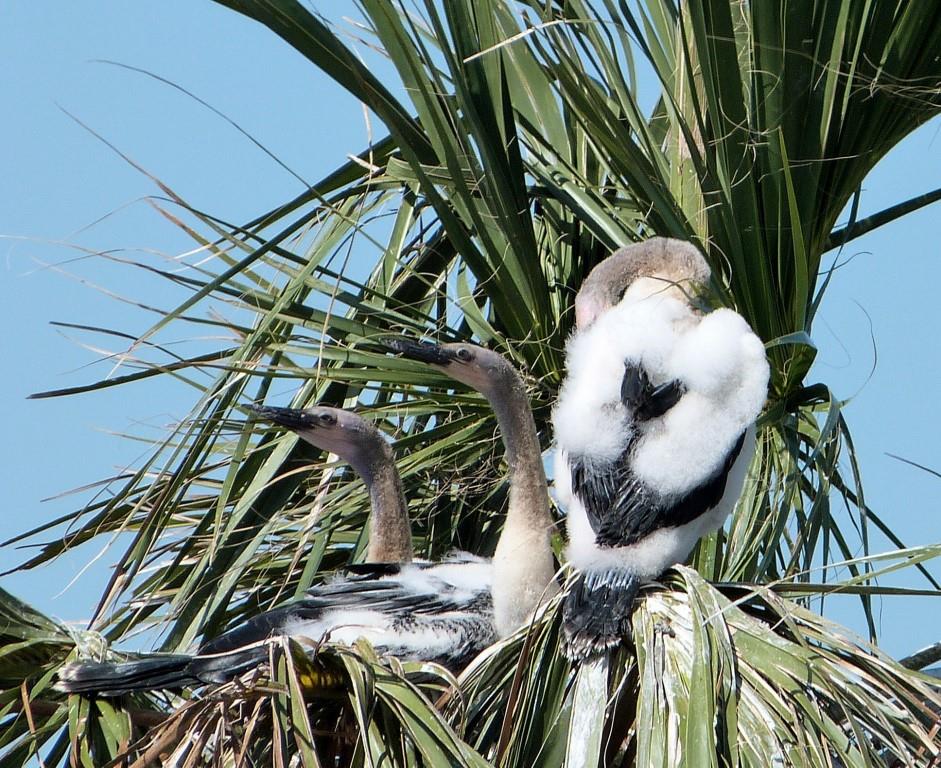
Anhinga (Anhinga anhinga) Immatures at Viera Wetland by Lee

Anhinga (Anhinga anhinga) Immatures at Viera Wetland by Lee

The Viera Wetlands count is included with those above, but is the individual count just for Viera. That actually was a birdwatching destination and e-Bird likes it counted separately. It is one of our favorites over on the east side of Florida. Unfortunately, it has apparently been dry over there, plus most of the Winter Birds have gone back north. So, the birding wasn’t as plentiful as normal. Here is the list of the birds we saw.  We stopped there in the afternoon on Wednesday and then visited it again Thursday before heading home. We saw 23 species altogether .

Species Name 15-May 16-May
Black-bellied Whistling-Duck 2
Anhinga 9 6
Brown Pelican 2
Least Bittern 1
Great Blue Heron 8 6
Great Egret 10 14
Little Blue Heron 1 1
Tricolored Heron 1 1
Cattle Egret 11 15
White Ibis 7 7
Glossy Ibis 2 7
White-faced Ibis 1
Turkey Vulture 1 15
Osprey 2
Common Gallinule 5 13
American Coot 8 4
Belted Kingfisher 1
Red-bellied Woodpecker 2
Crested Caracara 1
Fish Crow 1 2
Red-winged Blackbird 10 12
Common Grackle 3
Boat-tailed Grackle 18 22

*

Northern Crested Caracara (Caracara cheriway) at Viera Wetlands by Lee

Northern Crested Caracara (Caracara cheriway) at Viera Wetlands by Lee

The Crested Caracara was the best find. We had taken our photos and had stopped at the exit to put our cameras away. Dan had his in the trunk and mine was bagged when I look up and there he was right by us on the ground. Needless to say, we scrambled to get the camera back out, hoping we wouldn’t scare it off. As you can see, we got the photos of him.

I will save the Palm Beach Zoo birds and photos until another post. I took over 700, so it might take a day or two.

Great Blue Heron (Ardea herodias) Watching young nearby by Lee at Viera Wetlands

Great Blue Heron (Ardea herodias) Watching young nearby at Viera Wetlands

Here is what is being watched so closely:

Great Blue Heron (Ardea herodias) Young by Lee at Viera Wetlands

Great Blue Heron (Ardea herodias) Young at Viera Wetlands

See:

Viera Wetlands

e-Bird Home Page

Wordless Birds

*

Birds of the Bible – Herons On Tampa Bay

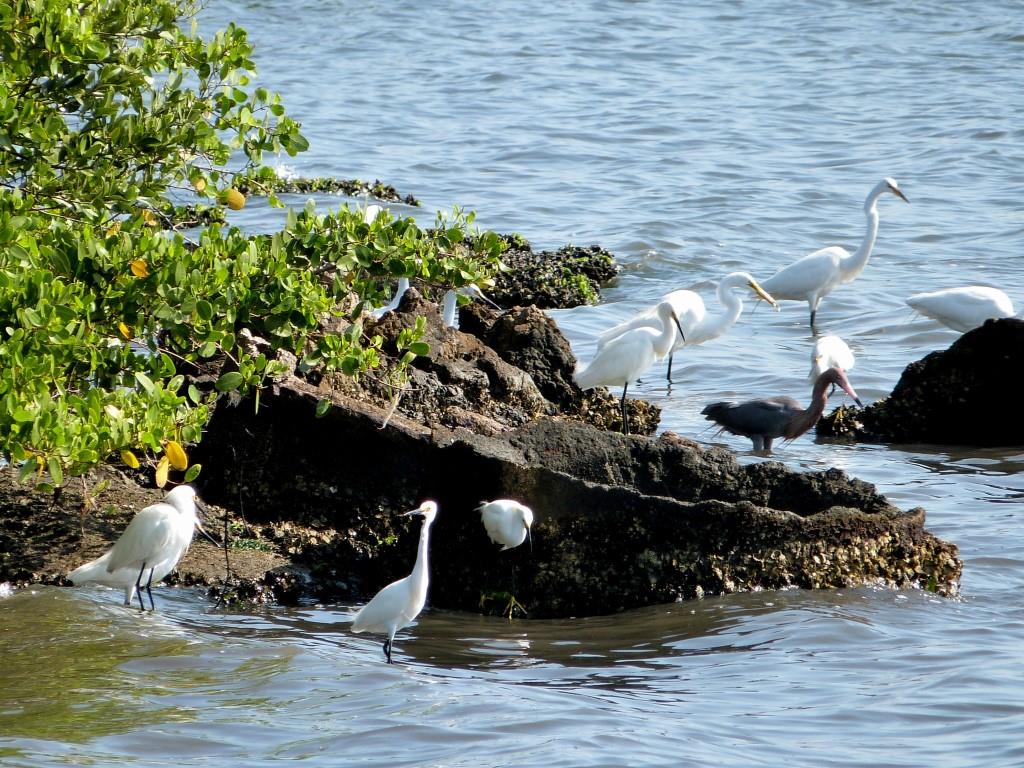
Reddish, Snowys, Greats Egrets and Great Blue Heron 5-10-13 by Lee at MacDill

Reddish, Snowys, Greats Egrets and Great Blue Heron (5-10-13) by Lee

And the stork, the heron after her kind, and the lapwing, and the bat. (Leviticus 11:19 KJV)

Herons are one of the species listed on the “Do not eat list” as we have written about before in the various Birds of the Bible – Heron articles. The first one was written back in 2008 when I first started the blog.

Since we were out birdwatching last week over in Tampa at the bay, I thought I would share some of those photos and update the Heron information some more. We saw a Great Blue Heron, several Little Blue Herons, and several others that are “after her kind” and in the same Ardeidae – Heron, Bittern  family. There were Snowy Egrets and Great Egrets fishing along with the others. The Little Blue Herons were in breeding plumage which you could tell because of their exceptionally blue beaks. (Not real clear-I was zoomed from quite a distance)

Little Blue Heron and Snowy Egrets by Lee from distance

Little Blue Heron and Snowy Egrets by Lee from distance

Herons are only mentioned twice in Scripture; Leviticus 11:19 and in Deuteronomy 14:18. That modern-day family, Ardiedae, currently has 72 members which includes not only Herons and Egrets, but also Bitterns. Some of them are grouped together like, Tiger Herons, Night Herons, Pond Herons, Reef Herons and Cattle Egrets. Not sure about the Tiger Herons but the night, pond, reef, and cattle name give you a clue as to where you might find them out and about.

And the stork, and the heron after her kind, and the lapwing, and the bat. (Deuteronomy 14:18 KJV)

The herons are long-legged freshwater and coastal birds in the family Ardeidae, (some are called “egrets” or “bitterns” instead of “heron”). Within Ardeidae, all members of the genera Botaurus and Ixobrychus are referred to as “bitterns”, and — including the Zigzag Heron or Zigzag Bittern — are a monophyletic group within the Ardeidae. However, egrets are not a biologically distinct group from the herons, and tend to be named differently because they are mainly white and/or have decorative plumes. Although egrets have the same build as herons, they tend to be smaller.

Great Egret (Ardea alba) Swallowing MacDil by Lee

Great Egret (Ardea alba) Swallowing by Lee

The classification of the individual heron/egret species is fraught with difficulty, and there is still no clear consensus about the correct placement of many species into either of the two major genera, Ardea and Egretta. Similarly, the relationship of the genera in the family is not completely resolved. However, one species formerly considered to constitute a separate monotypic family Cochlearidae, the Boat-billed Heron, is now regarded as a member of the Ardeidae.

Although herons resemble birds in some other families, such as the storks, ibises, spoonbills and cranes, they differ from these in flying with their necks retracted, not outstretched. They are also one of the bird groups that have powder down. Some members of this group nest colonially in trees, while others, notably the bitterns, use reedbeds.

The largest species of heron is the Goliath Heron, which stand up to 152 cm (60 in) tall. The necks are able to kink in an s-shape, due to the modified shape of the sixth vertebrae. The neck is able to retract and extend, and is retracted during flight, unlike most other long-necked birds. The neck is longer in the day herons than the night herons and bitterns. The legs are long and strong and in almost every species are unfeathered from the lower part of the tibia (the exception is the Zigzag Heron). In flight the legs and feet are held backward. The feet of herons have long thin toes, with three forward pointing ones and one going backward.

Reddish-Snowys-Greats Egrets -Great Blue Heron by Lee

Reddish-Snowys-Greats Egrets – Snowy in front with yellow feet

The herons are a widespread family with a cosmopolitan distribution. They exist on all continents except Antarctica, and are present in most habitats except the coldest extremes of the Arctic, extremely high mountains and the driest deserts. Almost all species are associated with water, they are essentially non-swimming waterbirds that feed on the margins of lakes, rivers, swamps, ponds and the sea. They are predominately found in lowland areas, although some species live in alpine areas, and the majority of species occur in the tropics.

While the family exhibits a range of breeding strategies, overall the herons are monogamous and mostly colonial. Most day-herons and night-herons are colonial, or partly colonial depending on circumstances, whereas the bitterns and tiger-herons are mostly solitary nesters. Colonies may contain several species as well as other types of waterbird. In a study of Little Egrets and Cattle Egrets in India the majority of the colonies surveyed contained both species. (Wikipedia with editing)

See:

Birds of the Bible

Birds of the Bible – Heron – Page

Bible Birds – Herons [younger readers]

Birds of the Bible – Herons – Article

Heron – Wikipedia

Ardeidae – Heron, Bitterns  family

*

Bible Birds – Mother Birds and Their Young – (Re-post)

My Mom and Me 26

Yesterday’s My Mom And Me – Email blog inspired me to write a new article for the Birds of the Bible For Kids. It is called:”

Bible Birds – Mother Birds and Their Young.

Please check it out. It is geared for a younger audience.

*

Bible Birds – Mother Birds and Their Young

My Mom and Us

My Mom and Us

Yesterday, in My Mom and Me – Photos, you saw many photos of Mother Animals and Mother Birds with their young ones. Does the Bible mention mother birds and their young or eggs. Yes, it does.

“If a bird’s nest happens to be before you along the way, in any tree or on the ground, with young ones or eggs, with the mother sitting on the young or on the eggs, you shall not take the mother with the young;

you shall surely let the mother go, and take the young for yourself, that it may be well with you and that you may prolong your days. (Deuteronomy 22:6-7 NKJV)

That is very interesting verse. It tells us not to take both the mother and the young or eggs. Do you know why? Look at the last verse; it says “may be well with you and you will prolong your days (live longer). Do you know another reason not to take both? The Lord commanded the animals and birds to have babies and fill the earth. If you kill them both, then none of that family will be able to have more baby birds or the young will not get to grow up and have baby birds. Soon, there wouldn’t be any more of those kinds of birds and they would become “extinct.”

The Lord told us from the very beginning of the Bible to have “dominion” over the birds and animals. That does not mean to be mean to them, but more like to watch over them and care for them. That is what our verse above is telling us. Not to destroy all of them, but to leave some of the family alive to carry on.

Gather the people–men, women, children, and foreigners living within your gates–so that they may listen and learn to fear the LORD your God and be careful to follow all the words of this law. (Deuteronomy 31:12 HCSB)

Wordless Birds

See:

More Bible Birds

*

My Mom And Me – Email

(Received this as an email. – Not sure who to credit them to.)

*

Here’s your AWE! for the day!!!

*

This slideshow requires JavaScript.

*

Bring forth every living thing that is with you of all flesh–birds and beasts and every creeping thing that creeps on the ground–that they may breed abundantly on the land and be fruitful and multiply upon the earth. (Genesis 8:17 AMP)

*