
Summer Yellow-Bird for Birds Illustrated by Color Photography, 1897
THE YELLOW WARBLER.
(RELOCATED – CLICK HERE)
Summer Yellow-Bird for Birds Illustrated by Color Photography, 1897
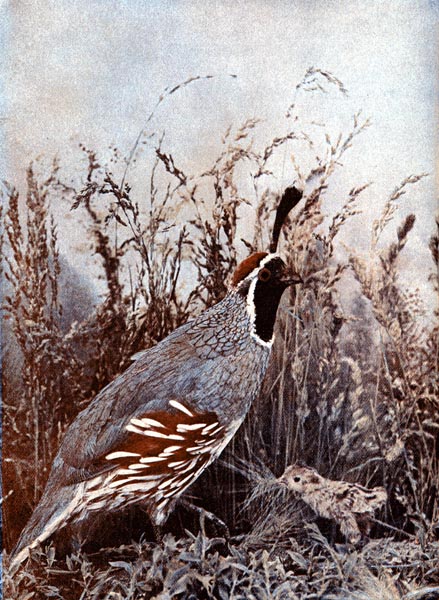
Gambel’s Partridge by Birds Illustrated by Color Photography
From col. F. M. Woodruff.

AMBEL’S PARTRIDGE, of which comparatively little is known, is a characteristic game bird of Arizona and New Mexico, of rare beauty, and with habits similar to others of the species of which there are about two hundred. Mr. W. E. D. Scott found the species distributed throughout the entire Catalina region in Arizona below an altitude of 5,000 feet. The bird is also known as the Arizona Quail.
The nest is made in a depression in the ground sometimes without any lining. From eight to sixteen eggs are laid. They are most beautifully marked on a creamy-white ground with scattered spots and blotches of old gold, and sometimes light drab and chestnut red. In some specimens the gold coloring is so pronounced that it strongly suggests to the imagination that this quail feeds upon the grains of the precious metal which characterizes its home, and that the pigment is imparted to the eggs.
After the nesting season these birds commonly gather in “coveys” or bevies, usually composed of the members of but one family. As a rule they are terrestrial, but may take to trees when flushed. They are game birds par excellence, and, says Chapman, trusting to the concealment afforded by their dull colors, attempt to avoid detection by hiding rather than by flying. The flight is rapid and accompanied by a startling whirr, caused by the quick strokes of their small, concave, stiff-feathered wings. They roost on the ground, tail to tail, with heads pointing outward; “a bunch of closely huddled forms—a living bomb whose explosion is scarcely less startling than that of dynamite manufacture.”
The Partridge is on all hands admitted to be wholly harmless, and at times beneficial to the agriculturist. It is an undoubted fact that it thrives with the highest system of cultivation, and the lands that are the most carefully tilled, and bear the greatest quantity of grain and green crops, generally produce the greatest number of Partridges.
Summary:
GAMBEL’S PARTRIDGE.—Callipepla gambeli.
Range—Northwestern Mexico, Arizona, New Mexico, southern Utah, and western Utah and western Texas.
Nest—Placed on the ground, sometimes without any lining.
Eggs—From eight to sixteen.

Gambel’s Quail (Callipepla gambelii) by S Slayton
Lee’s Addition:
Partridges are mentioned in two verses, thus making it a Bible Bird. Of course, the Gambel’s is not mentioned, only his family. They belong to the Galliformes order and are now called the Gambel’s Quail. They are in the Odontophoridae – New World Quail Family along with 33 other species (3.1 IOC).
Now therefore, let not my blood fall to the earth away from the presence of the LORD, for the king of Israel has come out to seek a single flea like one who hunts a partridge in the mountains. (1 Samuel 26:20 ESV)
Like the partridge that gathers a brood that she did not hatch, so is he who gets riches but not by justice; in the midst of his days they will leave him, and at his end he will be a fool. (Jeremiah 17:11 ESV)
Since they are now known as Quails, that species also appears in Scripture four times. Exodus 16:13, Numbers 11:31-32, and Psalms 105:40 all mention quail as a provision for His people. We were privileged to see the Gambel’s Quail in California in 1999. They are so neat walking around with that top knot bobbing along.
In the evening quail came up and covered the camp, and in the morning dew lay around the camp. (Exodus 16:13 ESV)
Then a wind from the LORD sprang up, and it brought quail from the sea and let them fall beside the camp, about a day’s journey on this side and a day’s journey on the other side, around the camp, and about two cubits above the ground. And the people rose all that day and all night and all the next day, and gathered the quail. Those who gathered least gathered ten homers. And they spread them out for themselves all around the camp. (Numbers 11:31-32 ESV)
They asked, and he brought quail, and gave them bread from heaven in abundance. (Psalms 105:40 ESV)
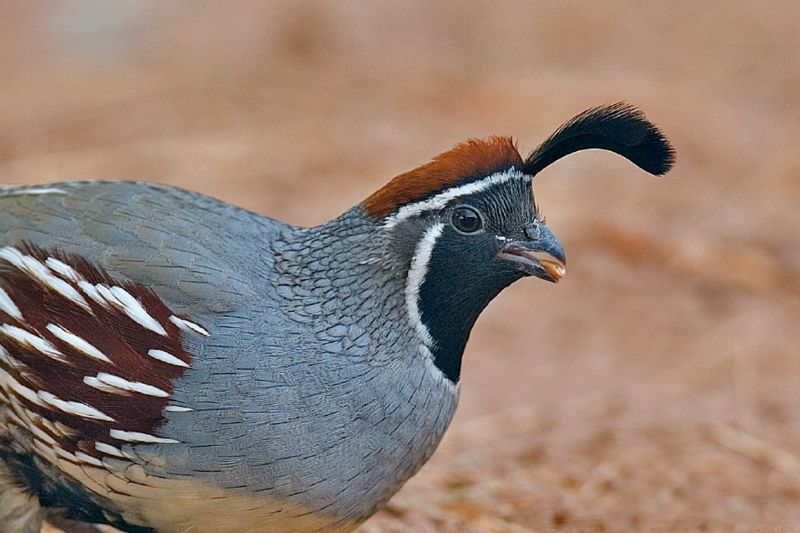
Gambel’s Quail (Callipepla gambelii) ©WikiC
“The Gambel’s Quail, Callipepla gambelii, is a small ground-dwelling bird in the New World quail family. It inhabits the desert regions of Arizona, California, Colorado, New Mexico, Nevada, Utah, Texas, and Sonora; also New Mexico-border Chihuahua and the Colorado River region of Baja California. The Gambel’s quail is named in honor of William Gambel, a 19th century naturalist and explorer of the Southwestern United States.” (Wikipedia)
*
Birds Illustrated by Color Photography – Revisited – Introduction
The above article is the first article in the monthly serial that was started in January 1897 “designed to promote Knowledge of Bird-Live.” These include Color Photography, as they call them, today they are drawings. There are at least three Volumes that have been digitized by Project Gutenberg.
To see the whole series of – Birds Illustrated by Color Photography – Revisited
*
(Information from Wikipedia and other internet sources)
Next Article – The Yellow Warbler
The Previous Article – To A Water-Fowl
Links:
Odontophoridae – New World Quail Family
GALLIFORMES – Fowl, Quail, Guans, Currasows, Megapodes Order
Gambel’s Quail – Wikipedia
Gambel’s Quail – All About Birds
*
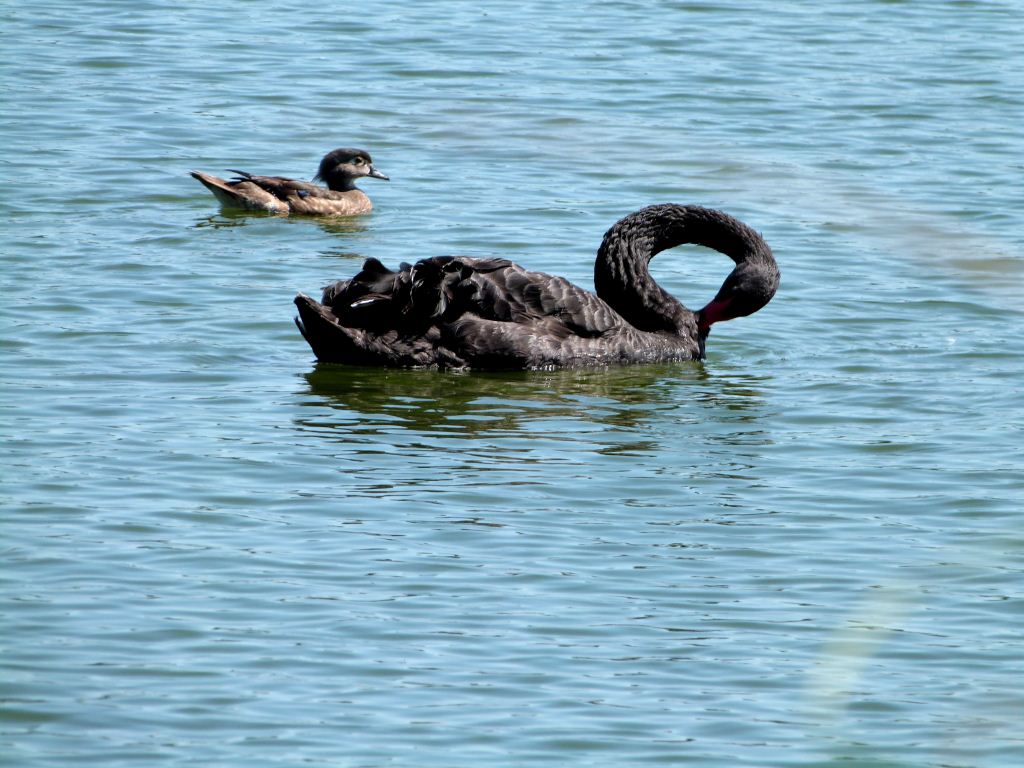
Black Swan and Wood Duck female
Whither, ’midst falling dew
While glow the heavens with the last steps of day,
Far through their rosy depths dost thou pursue
Thy solitary way?
Vainly the fowler’s eye
Might mark thy distant flight to do thee wrong,
As, darkly painted on the crimson sky,
Thy figure floats along.
Seek’st thou the plashy brink
Of weedy lake, or marge of river wide,
Or where the rocky billows rise and sink
On the chafed ocean side.
There is a Power whose care
Teaches thy way along that pathless coast—
The desert and illimitable air—
Lone wandering, but not lost.
All day thy wings have fanned,
At that far height, the cold thin atmosphere,
Yet stoop not, weary, to the welcome land
Though the dark night is near.
And soon that toil shall end;
Soon shalt thou find a summer home, and nest,
And scream among thy fellows; reeds shall bend,
Soon o’er thy sheltered nest.
Thou’rt gone, the abyss of heaven
Hath swallowed up thy form; yet on my heart
Deeply has sunk the lesson thou hast given,
And shall not soon depart.
He who from zone to zone,
Guides through the boundless sky thy certain flight,
In the long way that I must tread alone,
Will lead my steps aright.
William Cullen Bryant.
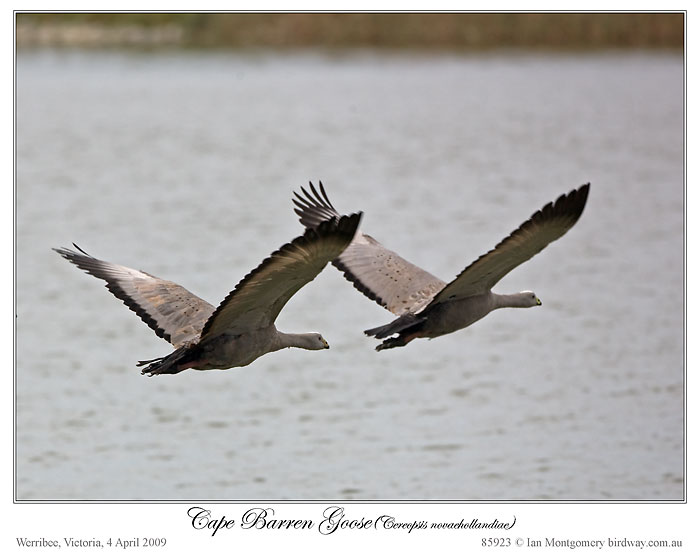
Cape Barren Goose (Cereopsis novaehollandiae) by Ian
Lee’s Addition:
Storks know when to fly south. So do doves, swifts and thrushes. But my people do not know what I require them to do. (Jeremiah 8:7 NIrV)
“But now ask the beasts, and they will teach you; And the birds of the air, and they will tell you; (Job 12:7 NKJV)
Wikipedia say this of Waterfowl They “are certain wildfowl of the order Anseriformes, especially members of the family Anatidae, which includes ducks, geese, and swans.
They are strong swimmers with medium to large bodies. They have historically been an important food source, and continue to be hunted as game, or raised as poultry for meat and eggs. The domestic duck is sometimes kept as a pet.
Some definitions of the term ‘waterfowl’ include the saltwater shorebirds or waders, gulls, pelicans, and herons, as well as seabirds such as the albatross, but ‘fowl’ especially refers to birds used by humans for game.
*
Birds Illustrated by Color Photography – Revisited – Introduction
The above article is the first article in the monthly serial that was started in January 1897 “designed to promote Knowledge of Bird-Live.” These include Color Photography, as they call them, today they are drawings. There are at least three Volumes that have been digitized by Project Gutenberg.
To see the whole series of – Birds Illustrated by Color Photography – Revisited
*
(Information from Wikipedia and other internet sources)
Next Article – Gambel’s Partridge
The Previous Article – The Turkey Vulture
Links:
*

Eagle in Tree on a windy day by Dan
These were the visions of my head while on my bed: I was looking, and behold, A tree in the midst of the earth, And its height was great. The tree grew and became strong; Its height reached to the heavens, And it could be seen to the ends of all the earth. Its leaves were lovely, Its fruit abundant, And in it was food for all. The beasts of the field found shade under it, The birds of the heavens dwelt in its branches, And all flesh was fed from it. (Daniel 4:10-12 NKJV)
What an interesting passage. Actually, this was part of the vision or dream that Nebuchadnezzar had and he is revealing it to Daniel. He is looking for an explanation for it. (See Daniel 4:19 + for the interpretation)
Daniel gives him the interpretation in the rest of the Chapter 4, but I want to concentrate on the tree and the birds. I have seen so many photos and witnessed birds enjoying themselves in the trees. The Lord created them all and provides for the tree, the beast, the birds, and us.
The trees provide food (fruit and seeds), leaves give shade for the animals and birds, the limbs provide a resting place, especially for birds, but I have seen a few leopards and koalas resting on them also.
Verse like:
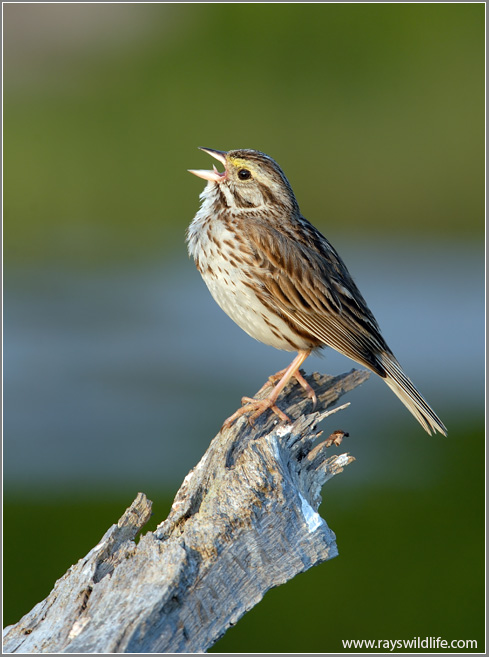
Savannah Sparrow singing by Ray
By them the birds of the heavens have their home; They sing among the branches. (Psalms 104:12 NKJV)
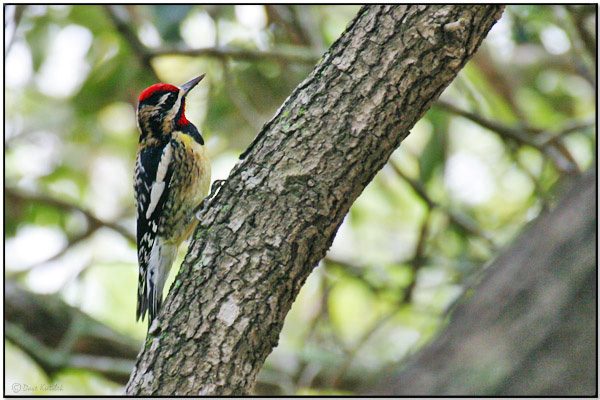
Yellow-bellied Sapsucker (Sphyrapicus varius) by Daves BirdingPix
The trees of the LORD are full of sap, The cedars of Lebanon which He planted, (Psalms 104:16 NKJV) (Many birds like the sap – Sapsuckers for one)
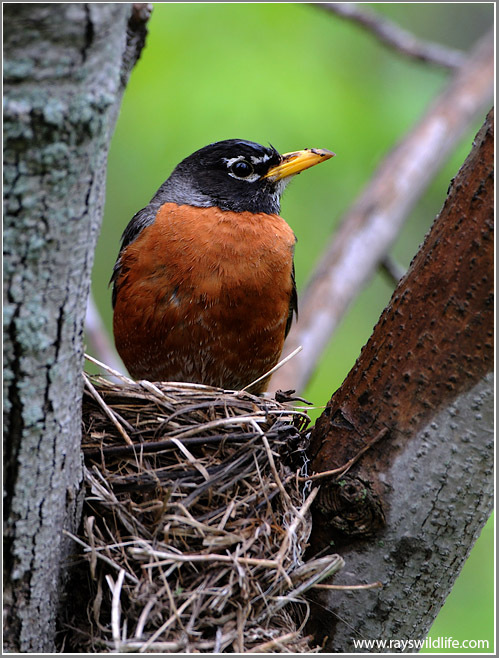
American Robin (Turdus migratorius) in nest by Ray
Where the birds make their nests; The stork has her home in the fir trees. (Psalms 104:17 NKJV)
And Jesus said to him, “Foxes have holes and birds of the air have nests, but the Son of Man has nowhere to lay His head.” (Matthew 8:20 NKJV)
Another parable He put forth to them, saying: “The kingdom of heaven is like a mustard seed, which a man took and sowed in his field, which indeed is the least of all the seeds; but when it is grown it is greater than the herbs and becomes a tree, so that the birds of the air come and nest in its branches.” (Matthew 13:31-32 NKJV)

Cedar Waxwing on Cedar Tree at Birdwatchers Digest.
Also he spoke of trees, from the cedar tree of Lebanon even to the hyssop that springs out of the wall; he spoke also of animals, of birds, of creeping things, and of fish. (1 Kings 4:33 NKJV)
*
Our Great Creator has wonderfully designed so many things to work together to provide for each other. Birds need trees and trees need birds. He is worthy of our praise and thanksgiving. And don’t you just enjoy watching the birds in the trees?
For His merciful kindness is great toward us, And the truth of the LORD endures forever. Praise the LORD! (Psalms 117:2 NKJV)
Yes, they shall sing of the ways of the LORD, For great is the glory of the LORD. (Psalms 138:5 NKJV)
Scarlet Myzomela (Myzomela sanguinolenta) by Ian
Great is our Lord, and mighty in power; His understanding is infinite. (Psalms 147:5 NKJV)
For the LORD your God is God of gods and Lord of lords, the great God, mighty and awesome, who shows no partiality nor takes a bribe. (Deuteronomy 10:17 NKJV)
*

Turkey Vulture Tree at Saddle Creek by Lee
This bird is found mostly in the southern states. Here he is known by the more common name of Turkey Buzzard.
He looks like a noble bird but he isn’t. While he is well fitted for flying, and might, if he tried, catch his prey, he prefers to eat dead animals.
The people down south never think of burying a dead horse or cow. They just drag it out away from their homes and leave it to the Vultures who are sure to dispose of it.
It is very seldom that they attack a live animal.
They will even visit the streets of the cities in search of dead animals for food, and do not show much fear of man. Oftentimes they are found among the chickens and ducks in the barn-yard, but have never been known to kill any.
One gentleman who has studied the habits of the Vulture says that it has been known to suck the eggs of Herons. This is not common, though. As I said they prefer dead animals for their food and even eat their own dead.
The Vulture is very graceful while on the wing. He sails along and you can hardly see his wings move as he circles about looking for food on the ground below.
Many people think the Vulture looks much like our tame turkey.
If you know of a turkey near by, just compare this picture with it and you won’t think so.
See how chalk-white his bill is. No feathers on his head, but a bright red skin.
What do you think of the young chick? It doesn’t seem as though he could ever be the large, heavy bird his parent seems to be.
Now turn back to the first page of July “Birds” and see how he differs from the Eagle.

THE TURKEY VULTURE
From col. F. M. Woodruff.

URKEY BUZZARD is the familiar name applied to this bird, on account of his remarkable resemblance to our common Turkey. This is the only respect however, in which they are alike. It inhabits the United States and British Provinces from the Atlantic to the Pacific, south through Central and most of South America. Every farmer knows it to be an industrious scavenger, devouring at all times the putrid or decomposing flesh of carcasses. They are found in flocks, not only flying and feeding in company, but resorting to the same spot to roost; nesting also in communities; depositing their eggs on the ground, on rocks, or in hollow logs and stumps, usually in thick woods or in a sycamore grove, in the bend or fork of a stream. The nest is frequently built in a tree, or in the cavity of a sycamore stump, though a favorite place for depositing the eggs is a little depression under a small bush or overhanging rock on a steep hillside.
Renowned naturalists have long argued that the Vulture does not have an extraordinary power of smell, but, according to Mr. Davie, an excellent authority, it has been proven by the most satisfactory experiments that the Turkey Buzzard does possess a keen sense of smell by which it can distinguish the odor of flesh at a great distance.
The flight of the Turkey Vulture is truly beautiful, and no landscape with its patches of green woods and grassy fields, is perfect without its dignified figure high in the air, moving round in circles, steady, graceful and easy, and apparently without effort. “It sails,” says Dr. Brewer, “with a steady, even motion, with wings just above the horizontal position, with their tips slightly raised, rises from the ground with a single bound, gives a few flaps of the wings, and then proceeds with its peculiar soaring flight, rising very high in the air.”
The Vulture pictured in the accompanying plate was obtained between the Brazos river and Matagorda bay. With it was found the Black Vulture, both nesting upon the ground. As the nearest trees were thirty or forty miles distant these Vultures were always found in this situation. The birds selected an open spot beneath a heavy growth of bushes, placing the eggs upon the bare ground. The old bird when approached would not attempt to leave the nest, and in the case of the young bird in the plate, the female to protect it from harm, promptly disgorged the putrid contents of her stomach, which was so offensive that the intruder had to close his nostrils with one hand while he reached for the young bird with the other.
The Turkey Vulture is a very silent bird, only uttering a hiss of defiance or warning to its neighbors when feeding, or a low gutteral croak of alarm when flying low overhead.
The services of the Vultures as scavengers in removing offal render them valuable, and almost a necessity in southern cities. If an animal is killed and left exposed to view, the bird is sure to find out the spot in a very short time, and to make its appearance as if called by some magic spell from the empty air.
“Never stoops the soaring Vulture
On his quarry in the desert,
On the sick or wounded bison,
But another Vulture, watching,
From his high aerial lookout,
Sees the downward plunge and follows;
And a third pursues the second,
Coming from the invisible ether,
First a speck, and then a Vulture,
Till the air is dark with pinions.”
Summary:
TURKEY VULTURE.—Catharista Atrata.
Range—Temperate America, from New Jersey southward to Patagonia.
Nest—In hollow stump or log, or on ground beneath bushes or palmettos.
Eggs—One to three; dull white, spotted and blotched with chocolate marking.
Turkey Vulture flying by – LPP
Lee’s Addition:
There is a path which no fowl knoweth, and which the vulture’s eye hath not seen: (Job 28:7 KJV)
We see Turkey and Black Vulture quite frequently here. I only disagree with one part of the article. “The Vulture is very graceful while on the wing. He sails along and you can hardly see his wings move as he circles about looking for food on the ground below.”
The way I distinguish the Turkey and Black Vultures apart is that the Black (BV) is steady on the wing, but the Turkey TV) is wobbly on the wing. They have a rocking motion, even when it is not windy. Another way to tell the two apart is the V of the Turkey and the flatter wings of the Black, who also has white on the tips of their wings.
They belong to the Cathartidae – New World Vultures Family. There are 7 Vultures and 2 Condors in that family.
*
Birds Illustrated by Color Photography – Revisited – Introduction
The above article is the first article in the monthly serial that was started in January 1897 “designed to promote Knowledge of Bird-Live.” These include Color Photography, as they call them, today they are drawings. There are at least three Volumes that have been digitized by Project Gutenberg.
To see the whole series of – Birds Illustrated by Color Photography – Revisited
*
(Information from Wikipedia and other internet sources)
Next Article – To A Water-Fowl
The Previous Article – The Evening Grosbeak
Links:
Birds of the Bible – Gathering of Vultures or Eagles
Birds of the Bible – Griffon Vulture
Scripture Alphabet of Animals: The Vulture
Birds of the Bible – Vulture Eyesight
When I Consider! – Turkey Vulture
Turkey Vulture – Wikipedia
*
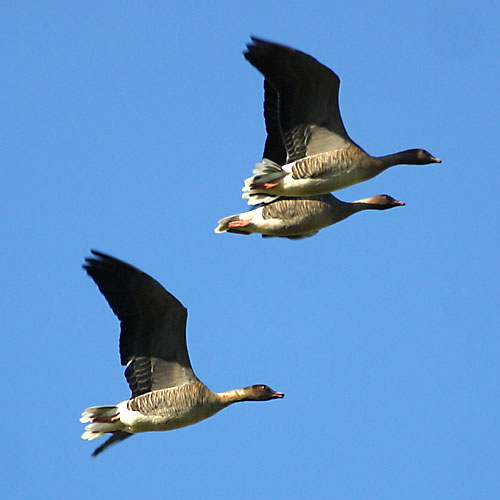
Pink-footed Goose (Anser brachyrhynchus) ©Arthur Grosset
Where did they go? I was wondering that a little over a week ago when we drove 50 miles to Orlando. I keep a small notebook and write down the birds we see as Dan drives. As cross into each county, I start my list for that county by drawing a line, putting the time, temperature if I know it, and what the sky looks like. Other than a Turkey Vulture or Black Vulture in each county, nothing was flying. We saw a few grackles, a Mockingbird, and a few Fish Crows. Coming back, one county I wrote “none” on my notebook. Normally here in Central Florida, we see birds around the ponds and lake. Nothing that day.
The next day, we drove 50 the other direction to Tampa to go to the Lowry Park Zoo. I knew those birds would be there. They are captive. I had the same results. One or two birds, but nothing flying. When I attended church the next day, I had several people tell me that they hadn’t seen any birds at their feeders and wondered if I knew why. I didn’t and don’t have a clue.
I am curious if it is that way up north when the birds start their migrations. You see them one day and then not the next. Our summer birds seem to be here year-round, or at least I thought so.
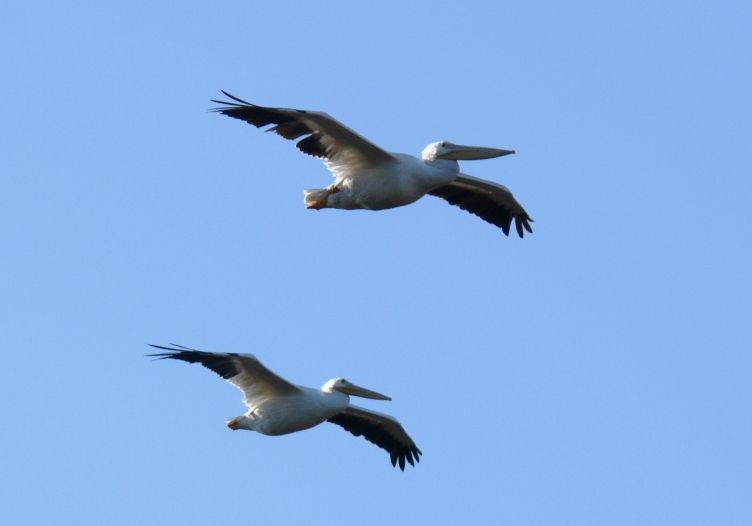
American White Pelican (Pelecanus erythrorhynchos) by Lee
All of that reminded me of the verses in Jeremiah:
I beheld, and indeed there was no man, And all the birds of the heavens had fled. (Jeremiah 4:25 NKJV)
I will take up a weeping and wailing for the mountains, And for the dwelling places of the wilderness a lamentation, Because they are burned up, So that no one can pass through; Nor can men hear the voice of the cattle. Both the birds of the heavens and the beasts have fled; They are gone. (Jeremiah 9:10 NKJV)
That also caused me to think about this past summer. Where did it go? Where did those days and hours go that I had so many plans for. I especially thought I would work on this blog while the birds were gone north for the summer. Well, guess what? Here it is Autumn and it didn’t happen. In fact I am busier now than before they left. I was putting out about one article a day and now struggle to get one out every few days.
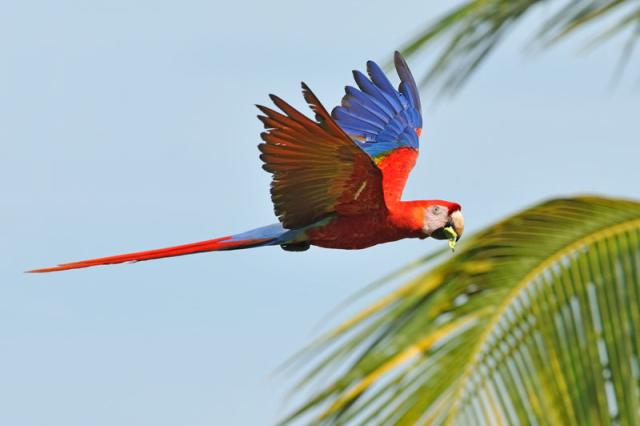
Scarlet Macaw (Ara macao) Reinier Munguia
Do these verses cause you also to consider where time goes?
Indeed, You have made my days as handbreadths, And my age is as nothing before You; Certainly every man at his best state is but vapor. Selah (Psalms 39:5 NKJV)
Come now, you who say, “Today or tomorrow we will go to such and such a city, spend a year there, buy and sell, and make a profit”; whereas you do not know what will happen tomorrow. For what is your life? It is even a vapor that appears for a little time and then vanishes away. Instead you ought to say, “If the Lord wills, we shall live and do this or that.” (James 4:13-15 NKJV)
This post is just a “rambling” post, but I’m sure most of those who visit here that have blogs have felt the same way at times. I don’t want to just put a post up just for the sake of putting one up. I prefer for it to mean, instill or teach something.

ActiveLink for today
Seems like lately, everything vies for my time. I have been on Weight Watchers since January (lost 30 lbs so far) and now even they are after my time. They recently released “ActiveLink” which monitors our movements. Sitting at a computer for hours, does not movement make. So now I have to get up and, ugh, exercise every so often or at least walk around. It will be worth it, but it takes “TIME.” That isn’t the only thing I have added lately. I am in new Ladies Bible Study and now I have “homework.” Time, time, time, where does it go?
Can you relate to any of this? I would venture to say many of you can. Oh, but isn’t the Lord great? When we do get time to see his fantastic creation, especially His birds, don’t they bring joy to you?
See also:
Birds of the Bible – Birds of the Air
*

Brent/Brant Goose (Branta bernicla) by Ian 1
Ian’s Bird of the Week – Brent/Brant Goose ~ by Ian Montgomery
Newsletter – 9-27-12
My apologies for the long delay since the past posting on the Barnacle Goose. I’m now back home in North Queensland after the unplanned trip to Ireland following the death of my brother in law Gerald and resuming my normal life.
On 6 September we took the dogs for a walk along the strand at the Bull Island in Dublin Bay. As we were leaving, I was surprised to see a flock of Brent Geese, close relatives of the Barnacle Goose so early in the season. Brent Geese are common winter visitors to Ireland but do not usually arrive until much later in September or early October. A week later we visited a strand just north of Clogherhead in Co. Louth and there was another, more accessible flock there and the first photo shows three adults feeding on ‘sea lettuce’, a green alga of the genus Ulva which, along with the sea grass Zostera, often called eel grass, is the main food of Brent Geese in winter.
These are adults, recognisable by the white ‘necklaces’ and the dark, unstriped wings. Different races of Brent/Brant Geese – ‘Brent’ in the British Islands, ‘Brant’ in North America – vary mainly in the colour of the breast. These are Pale-bellied Brent Geese – race hrota – and most of these nest in Greenland and winter in Ireland, one of few species with a transatlantic migration. The nominate Dark-bellied Brent Goose (bernicla) breeds mainly in Russia and winters in northeastern Europe, including Great Britain, and is rare in Ireland. Just after seeing these birds, I read an online newspaper article about the early arrival of Brent Geese in Strangford Lough in Co. Down, Northern Ireland and the writer suggested that favourable tail winds during migration had maybe caused the birds to skip their normal stopover in Iceland, and fly straight to their wintering grounds.

Brent/Brant Goose (Branta bernicla) by Ian 2
Among the 70 or so birds in the flock, there were several juveniles including a party of 2 adults and 3 juveniles that stayed together and were maybe a family. The second photo shows three of these birds. The one on the right in the foreground is an adult with dark wings, even though its necklace is rather indistinct. The other two lack the necklace (or are just beginning to acquire one), have stripy wings and have darker mottled rather than scaly breasts. At this age, the juveniles are indistinguishable from Dark-bellied Brent Geese and I initially mistakenly identified them as Dark-bellied. The third photo shows this party coming in to land, looking for all the world like a Peter Scott painting. The mountains in the near background on the left are the Cooley Mountains in northern Co. Louth with the Mourne Mountains in Co. Down in the background.
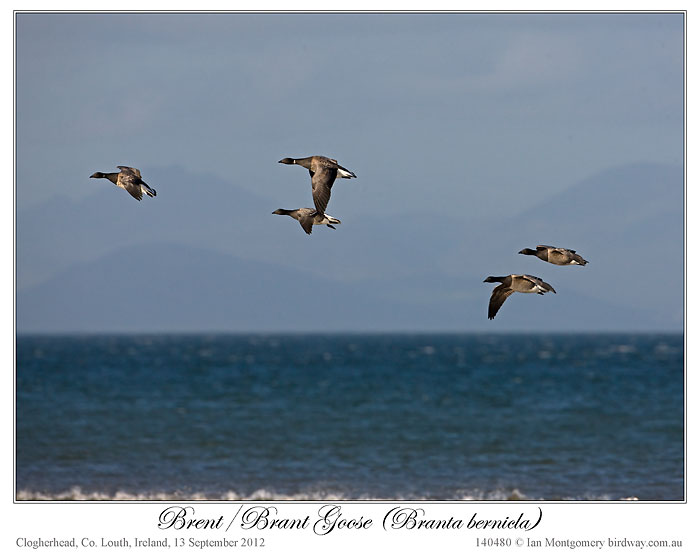
Brent/Brant Goose (Branta bernicla) by Ian 3
With a length of 55-62cm/22-24in, these are smaller than Barnacle Geese and comparable in size to Mallard. Juvenile birds acquire the necklace and breast colour of the adult birds in late September or October, but retain the white wing stripes and are referred to as first winter birds. The fourth photo, taken a few years ago on a wintry January day, shows a first winter bird, complete with necklace and and striped wings being followed by two dark-winged adults.

Brent/Brant Goose (Branta bernicla) by Ian 4
I’ve never seen Dark-bellied Brent Geese, but in northern Alaska in June 2008 I came across the western North American race, the Black Brant (nigricans) on its breeding ground on the tundra, fifth photo. The Brent Goose breeds as far north as any bird species in the world at locations such as Ellesmere Island, the northernmost in Canada, and in Spitsbergen, only 10º or 11º from the Arctic Pole.

Brent/Brant Goose (Branta bernicla) by Ian 5
This has a very broad necklace and dark brown breast almost merging with the dark brown neck. This is easier to see in the sixth photo. This has sometimes been treated as a separate species.

Brent/Brant Goose (Branta bernicla) by Ian 6
In recent decades the populations of Brent Geese have increased greatly. There are about 115,000 Black Brants and about 40,000 Pale-bellied winter in Ireland and 90,000 Dark-bellied winter in Britain.
Best wishes
Ian
**************************************************
Ian Montgomery, Birdway Pty Ltd,
454 Forestry Road, Bluewater, Qld 4818
Tel 0411 602 737 ian@birdway.com.au
Check the latest website updates:
http://www.birdway.com.au/#updates
Lee’s Addition:
And God said, “Let the waters swarm with swarms of living creatures, and let birds fly above the earth across the expanse of the heavens.” (Genesis 1:20 ESV)
Again, Ian, Our deepest sympathy over your loss. We are glad you are back safely at home.
These geese and all the information about them is very interesting and informative. See all of Ian’s Anseranatidae & Anatidae Family. He has quite a selection of them that he has photographed over time.
See also the Anatidae Family here.
*
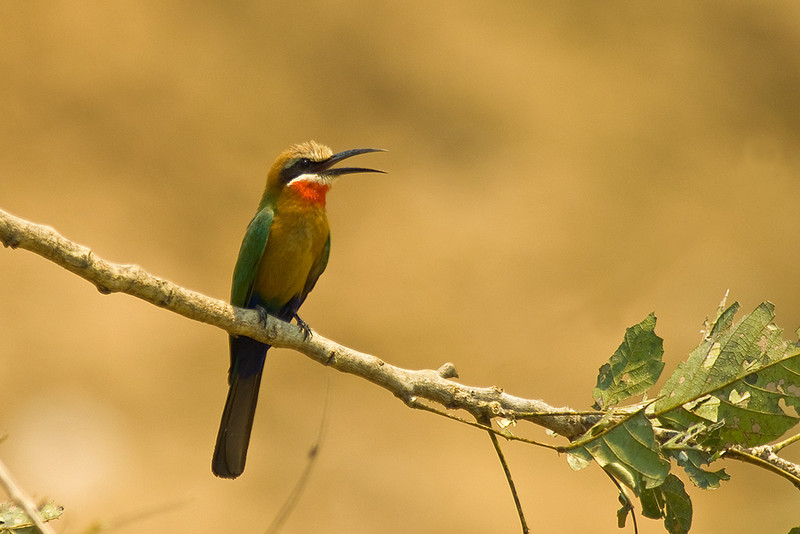
White-fronted Bee-eater (Merops bullockoides) by Africaddict
And as ye would that men should do to you, do ye also to them likewise.” (Luke 6:31)
The White-fronted Bee-eater is an East African bird that lives in clans of up to fourteen members.
White-fronted bee-eaters have several problems to deal with. Since they nest on the cliffs overlooking riverbanks, youngsters need a great deal of attention until they learn to fly. Once they are on their own, the young birds are often put to work by their parents as helpers. A father may even drive away his sons’ mates in order to keep them as helpers.
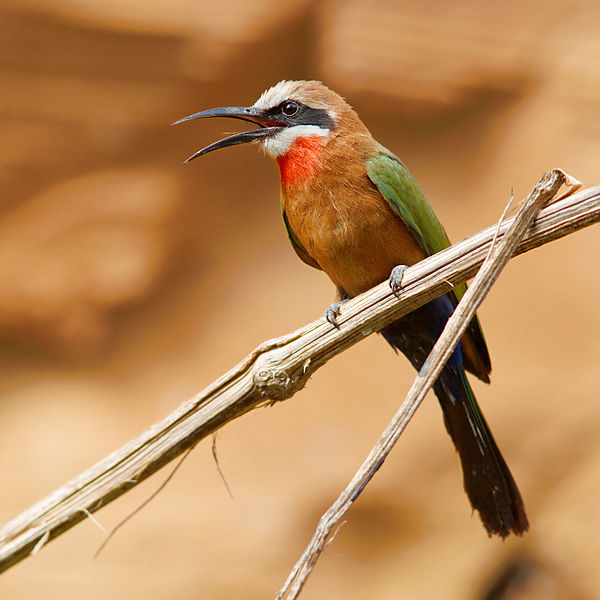
White-fronted Bee-eater (Merops bullockoides) ©WikiC
Helpers bring food for their mother, brothers and sisters. They also clean the nest area and watch for danger. However, the most important job is guarding the nest at egg-laying time. This is necessary because a female who doesn’t have her own nest will sneak into another bee-eater’s nest and lay her eggs there. If the eggs are laid before the owner of the nest starts laying her eggs, she will simply toss out the foreign egg. If there are eggs already in the nest, she will also care for the foreign eggs. The important job of guarding the nest is usually given to a daughter. However, scientists have observed that sometimes it is the daughter, while on guard duty with the mother absent, who sneaks into the nest and adds a few eggs of her own!
In His goodness, the Creator has given bee-eaters a way of life in which helping each other is part of their nature. This kindness toward each other improves the quality of life. It can serve as an example to us that the world is not designed to favor the survival of the most selfish or aggressive.
Prayer:
Dear Lord, in a world that sees only personal loss when kindness is offered, help me to remember that You gave me all things freely. Help me to see the reward of good will in helping others, even those who cannot help me in return. Amen.

White-fronted Bee-eater (Merops bullockoides) cropped by Bob-Nan
Lee’s Addition:
Bee-eaters are one of the Lord more beautiful bird creations. I always enjoy see their photos. Soon we are going to a Zoo that I understand has Bee-eaters. Needless to say I am anxious to see them. Aren’t they gorgeous?
They belong to the Meropidae – Bee-eaters Family.
White-fronted Bee-eater – Wikipedia
*

The Evening Grosbeak by Birds Illustrated by Bird Photography, 1897

ANDSOMER birds there may be, but in the opinion of many this visitant to various portions of western North America is in shape, color, and markings one of the most exquisite of the feather-wearers. It has for its habitation the region extending from the plains to the Pacific ocean and from Mexico into British America. Toward the North it ranges further to the east; so that, while it appears to be not uncommon about Lake Superior, it has been reported as occuring in Ohio, New York, and Canada. In Illinois it was observed at Freeport during the winter of 1870 and 1871, and at Waukegan during January, 1873. It is a common resident of the forests of the State of Washington, and also of Oregon. In the latter region Dr. Merrill observed the birds carrying building material to a huge fir tree, but was unable to locate the nest, and the tree was practically inaccessable. Mr. Walter E. Bryant was the first to record an authentic nest and eggs of the Evening Grosbeak. In a paper read before the California Academy of Sciences he describes a nest of this species containing four eggs, found in Yolo county, California. The nest was built in a small live oak, at a height of ten feet, and was composed of small twigs supporting a thin layer of fibrous bark and a lining of horse hair. The eggs are of a clear greenish-ground color, blotched with pale brown. According to Mr. Davie, one of the leading authorities on North American birds, little if any more information has been obtained regarding the nests and eggs of the Evening Grosbeak.
As to its habits, Mr. O. P. Day says, that about the year 1872, while hunting during fine autumn weather in the woods about Eureka, Illinois, he fell in with a number of these Grosbeaks. They were feeding in the tree tops on the seeds of the sugar maple, just then ripening, and were excessively fat. They were very unsuspicious, and for a long time suffered him to observe them. They also ate the buds of the cottonwood tree in company with the Rose-Breasted Grosbeak.
The song of the Grosbeak is singularly like that of the Robin, and to one not thoroughly familiar with the notes of the latter a difference would not at first be detected. There is a very decided difference, however, and by repeatedly listening to both species in full voice it will be discovered more and more clearly. The sweet and gentle strains of music harmonize delightfully, and the concert they make is well worth the careful attention of the discriminating student. The value of such study will be admitted by all who know how little is known of the songsters. A gentleman recently said to us that one day in November the greater part of the football field at the south end of Lincoln Park was covered with Snow Birds. There were also on the field more than one hundred grammar and high school boys waiting the arrival of the football team. There was only one person present who paid any attention to the birds which were picking up the food, twittering, hopping, and flying about, and occasionally indulging in fights, and all utterly oblivious of the fact that there were scores of shouting school boys around and about them. The gentleman called the attention of one after another of ten of the high school boys to the snow birds and asked what they were. They one and all declared they were English Sparrows, and seemed astounded that any one could be so ignorant as not to know what an English Sparrow was. So much for the city-bred boy’s observation of birds.
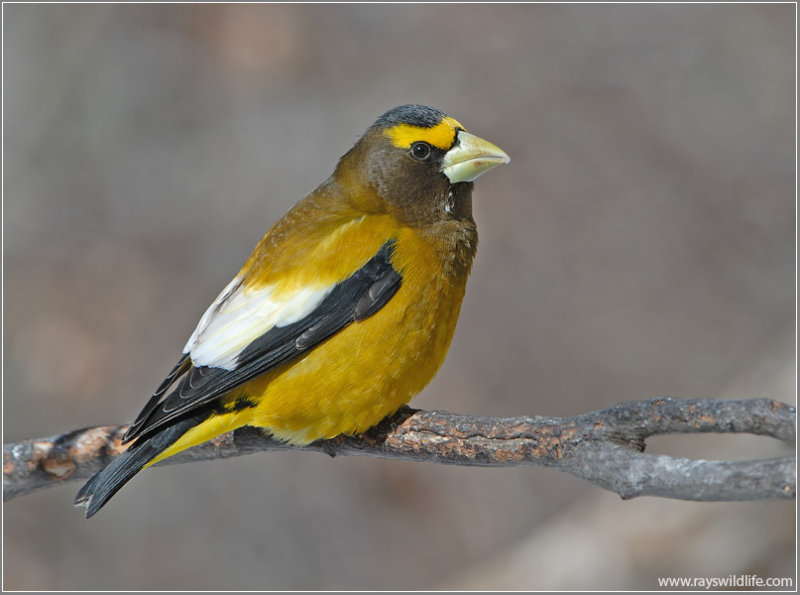
Evening Grosbeak (Hesperiphona vespertina) male by Raymond Barlow
In the far Northwest we find this beautiful bird the year around. During the winter he often comes farther south in company with his cousin, the Rose-Breasted Grosbeak.
What a beautiful sight it must be to see a flock of these birds—Evening Grosbeaks and Rose-Breasted in their pretty plumage.
Grosbeaks belong to a family called Finches. The Sparrows, Buntings, and Crossbills belong to the same family. It is the largest family among birds.
You will notice that they all have stout bills. Their food is mostly grains and their bills are well formed to crush the seeds.
Look at your back numbers of “Birds” and notice the pictures of the other Finches I have named. Don’t you think Dame Nature is very generous with her colors sometimes?
Only a few days ago while strolling through the woods with my field glass, I saw a pretty sight. On one tree I saw a Redheaded Woodpecker, a Flicker, an Indigo Bunting, and a Rose-Breasted Grosbeak. I thought then, if we could only have the Evening Grosbeak our group of colors would be complete.
Have you ever wondered at some birds being so prettily dressed while others have such dull colors?
Some people say that the birds who do not sing must have bright feathers to make them attractive. We cannot believe this. Some of our bright colored birds are sweet singers, and surely many of our dull colored birds cannot sing very well.
Next month you will see the pictures of several home birds. See if dull colors have anything to do with sweet song.
Lee’s Addition:
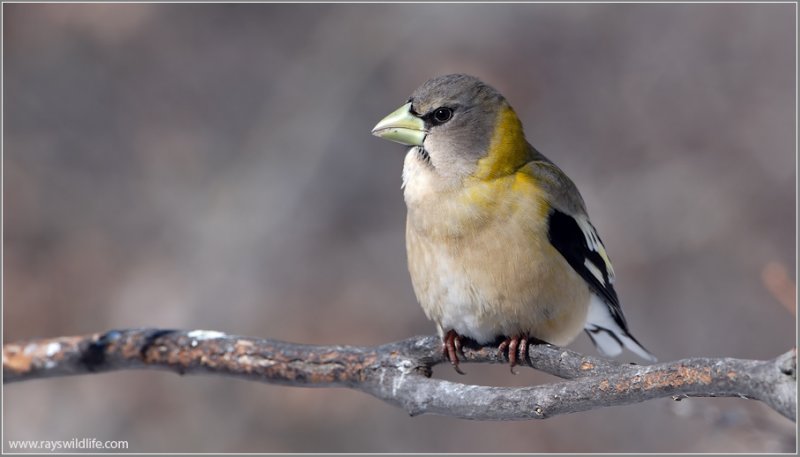
Evening Grosbeak (Hesperiphona vespertina) female by Raymond Barlow
By awesome deeds you answer us with righteousness, O God of our salvation, the hope of all the ends of the earth and of the farthest seas; the one who by his strength established the mountains, being girded with might; who stills the roaring of the seas, the roaring of their waves, the tumult of the peoples, so that those who dwell at the ends of the earth are in awe at your signs. You make the going out of the morning and the evening to shout for joy. (Psalms 65:5-8 ESV)
What a beautiful bird the Lord created in the Evening Grosbeak. The Grosbeaks are in the Cardinalidae – Grosbeaks, Saltators & Allies Family. There are 17 Grosbeaks in the family and are found in 9 genera. The Evening Grosbeak is in the
The Evening Grosbeak (Coccothraustes vespertinus) is a large finch. In the past, it was treated in a genus of its own as Hesperiphona vespertina, but is now usually placed in the same genus as the Hawfinch of Eurasia.
The breeding habitat is coniferous and mixed forest across Canada and the western mountainous areas of the United States and Mexico. It is an extremely rare vagrant to the British Isles, with just two records so far. The nest is built on a horizontal branch or in a fork of a tree.
The migration of this bird is variable; in some winters, it may wander as far south as the southern U.S.
The Evening Grosbeak is similar in appearance to the Eurasian Hawfinch, both being bulky, heavily built finches with large bills and short tails. The Evening Grosbeak ranges in length from 6.3 to 8.7 in (16 to 22 cm) in length and spans 12 to 14 in (30 to 36 cm) across the wings. In a large sampling of grosbeaks in Pennsylvania during winter, males weighed from 1.37 to 3.04 oz (38.7 to 86.1 g), with an average of 2.1 oz (60 g), while females weighed from 1.52 to 2.59 oz (43.2 to 73.5 g), with an average of 2.07 oz (58.7 g). The adult has a short black tail, black wings and a large pale bill. The adult male has a bright yellow forehead and body; its head is brown and there is a large white patch in the wing. The adult female is mainly olive-brown, greyer on the underparts and with white patches in the wings.
These birds forage in trees and bushes, sometimes on the ground. They mainly eat seeds, berries and insects. Outside of the nesting season they often feed in flocks. Sometimes, they will swallow fine gravel.
The range of this bird has expanded far to the east in historical times, possibly due to plantings of Manitoba maples and other maples and shrubs around farms and the availability of bird feeders in winter.
“Calls from a large flock visiting a feeder” – from xeno-canto
*
Birds Illustrated by Color Photography – Revisited – Introduction
The above article is the first article in the monthly serial that was started in January 1897 “designed to promote Knowledge of Bird-Live.” These include Color Photography, as they call them, today they are drawings. There are at least three Volumes that have been digitized by Project Gutenberg.
To see the whole series of – Birds Illustrated by Color Photography – Revisited
*
(Information from Wikipedia and other internet sources)
Next Article – The Turkey Vulture
The Previous Article – Wilson’s Phalarope
Links:
Cardinalidae – Grosbeaks, Saltators & Allies Family
Evening Grosbeak – Wikipedia
Evening Grosbeak – All About Birds
Evening Grosbeak Sounds – xeno-canto
*
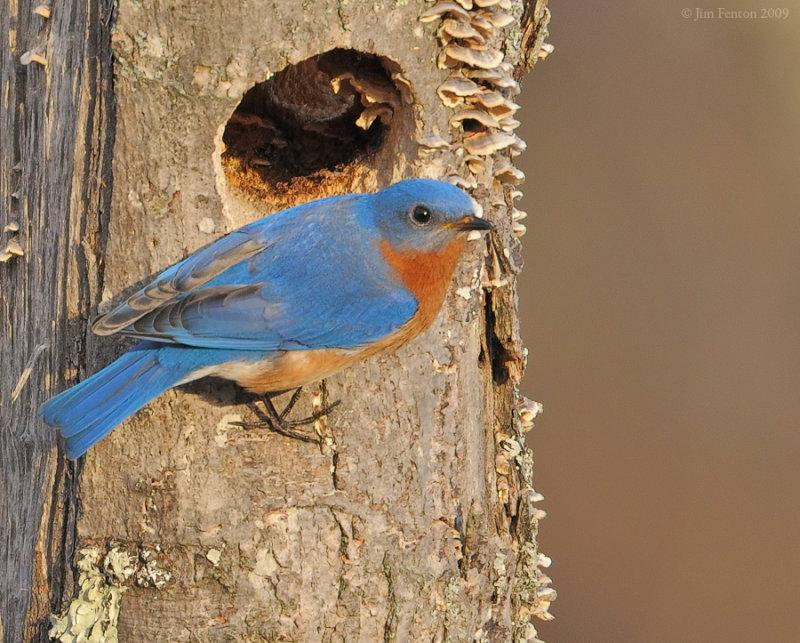
Eastern Bluebird (Sialia sialis) by J Fenton
Cranes know when it’s time to move south for winter. And robins, warblers, and bluebirds know when it’s time to come back again. But my people? My people know nothing, not the first thing of GOD and his rule. (Jeremiah 8:7 MSG)
As far as I know, the only Version of the Bible (English) that used the word “bluebirds is the Message. It is not a version I use, but that verse makes for chance to write about the Bluebirds. In many of the other versions, “Thrush” is used. Bluebirds are in the Turdidae – Thrushes Family. There are three species; the Eastern, Western and Mountain Bluebirds. In a completely different family, the Irenidae – Fairy-bluebirds Family you will find the Asian and Philippine Fairy-bluebirds. These are not “thrushes” per se.
This verse has been written about in Birds of the Bible – Thrush and Thrushes II. It mentions that the birds know more about migration than the people know that much about God and His dominion.
Do the Bluebirds migrate? Only the Eastern Bluebird. Here is their range map. Yellow is summer, blue – winter and green is year round. The summer breeding range extends as far north as the Pacific Northwest, British Columbia, and Montana. The northern Western Bluebirds can migrate to the southern parts of the range; southern birds are often permanent residents. The mountain bluebird is migratory. The Mountain Bluebird range varies from Mexico in the winter to as far north as Alaska, throughout the western U.S. and Canada. Northern birds migrate to the southern parts of the range; southern birds are often permanent residents. Some birds may move to lower elevations in winter.
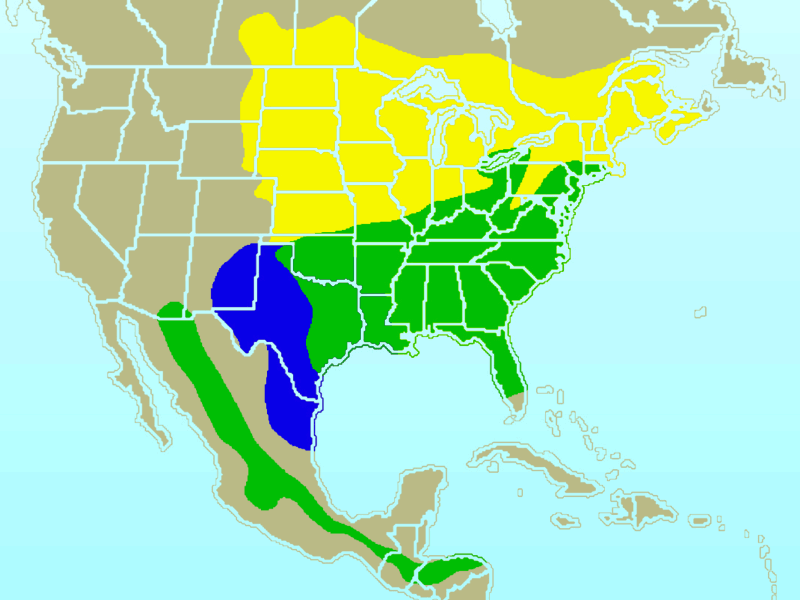
Eastern Bluebird rangemap Y-Sum B-win G-yr rnd ©WikiC
So, not so sure that was a good choice of birds to use especially since they aren’t even anywhere near the Middle East. Nevertheless they are beautiful birds that the Lord has created for His pleasure and our enjoyment. The majority of their diet is “insects and other invertebrates. The remainder of the bird’s diet is made up of wild fruits. Favored insect foods include grasshoppers, crickets, katydids, and beetles. Other food items include earthworms, spiders, millipedes, centipedes, sow bugs and snails. (Eastern) Bluebirds are very helpful with pest control in the territory surrounding the nest.”

Mountain Bluebird (Sialia currucoides) by Daves BirdingPix
All three of them are cavity dwellers or nest box residents. They are all territorial and “Bluebirds can typically produce between two and four broods during the spring and summer (March through August in the Northeastern United States). Males identify potential nest sites and try to attract prospective female mates to those nesting sites with special behaviors that include singing and flapping wings, and then placing some material in a nesting box or cavity. If the female accepts the male and the nesting site, she alone builds the nest and incubates the eggs.”
“The bluebirds are a group of medium-sized, mostly insectivorous or omnivorous birds in the genus Sialia of the thrush family (Turdidae). Bluebirds are one of the few thrush genera in the Americas. They have blue, or blue and red, plumage. Female birds are less brightly colored than males, although color patterns are similar and there is no noticeable difference in size between sexes.
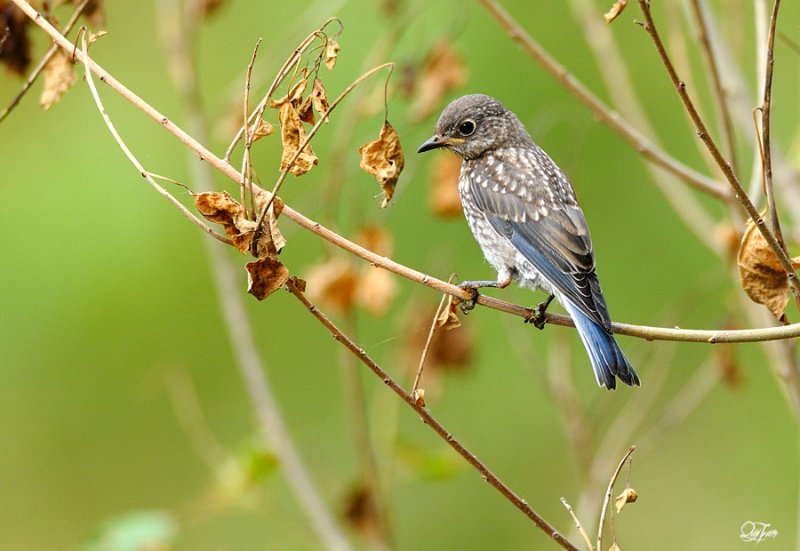
Western Bluebird (Sialia mexicana) juvenile by Quy Tran
Western Bluebirds are sometimes confused with other bluebirds, however they can be distinguished without difficulty. The Western Bluebird has a blue (male) or gray (female) throat, the Eastern Bluebird has an orange throat, and the Mountain Bluebird lacks orange color anywhere on its body.
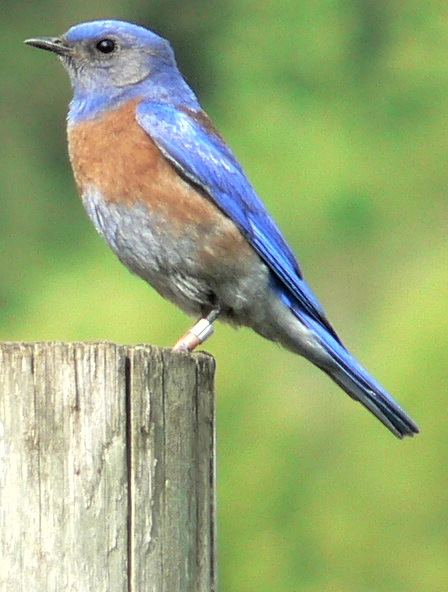
Western Bluebird (Sialia mexicana) ©WikiC
I know all the birds of the hills, and all that moves in the field is mine. (Psalms 50:11 ESV)
See:
Eastern, Western, Mountian Bluebirds – Wikipedia
*
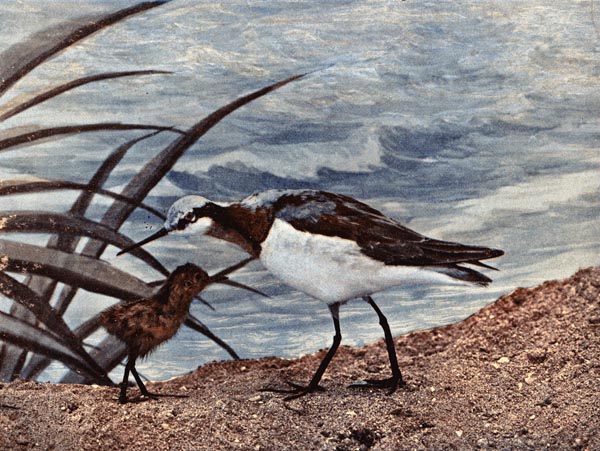
Wilson’s Phalarope for Birds Illustrated by Color Photography
 ERHAPS the most interesting, as it is certainly the most uncommon, characteristic of this species of birds is that the male relieves his mate from all domestic duties except the laying of the eggs. He usually chooses a thin tuft of grass on a level spot, but often in an open place concealed by only a few straggling blades. He scratches a shallow depression in the soft earth, lines it with a thin layer of fragments of old grass blades, upon which the eggs, three or four, are laid about the last of May or first of June. Owing to the low situation in which the nest is placed, the first set of eggs are often destroyed by a heavy fall of rain causing the water to rise so as to submerge the nest. The instinct of self preservation in these birds, as in many others, seems lacking in this respect. A second set, numbering two or three, is often deposited in a depression scratched in the ground, as at first, but with no sign of any lining.
Wilson’s Phalarope is exclusively an American bird, more common in the interior than along the sea coast. The older ornithologists knew little of it. It is now known to breed in northern Illinois, Iowa, Wisconsin, Minnesota, the Dakotas, Utah, and Oregon. It is recorded as a summer resident in northern Indiana and in western Kansas. Mr. E. W. Nelson states that it is the most common species in northern Illinois, frequenting grassy marshes and low prairies, and is not exceeded in numbers even by the ever-present Spotted Sandpiper. While it was one of our most common birds in the Calumet region it is now becoming scarce.
The adult female of this beautiful species is by far the handsomest of the small waders. The breeding plumage is much brighter and richer than that of the male, another peculiar characteristic, and the male alone possesses the naked abdomen. The female always remains near the nest while he is sitting, and shows great solicitude upon the approach of an intruder. The adults assume the winter plumage during July.

Wilson’s Phalarope (Phalaropus tricolor) by J Fenton
Lee’s Addition:
Out of the ground the LORD God formed every beast of the field and every bird of the air, and brought them to Adam to see what he would call them. And whatever Adam called each living creature, that was its name. So Adam gave names to all cattle, to the birds of the air, and to every beast of the field. But for Adam there was not found a helper comparable to him. (Genesis 2:19-20 NKJV)
What another fantastically created bird. The Phalaropes belong to the Scolopacidae – Sandpipers, Snipes family. There are 96 species in the family, with 3 of those in the Phalaropus genus; the Wilson’s, Red-necked and Red Phalaropes. Phalarope are sometimes called “wadepipers.” They are especially notable for two things: their unusual nesting behavior (see above), and their unique feeding technique. When feeding, a phalarope will often swim in a small, rapid circle, forming a small whirlpool. This behavior is thought to aid feeding by raising food from the bottom of shallow water. The bird will reach into the center of the vortex with its bill, plucking small insects or crustaceans caught up therein.
The Wilson’s Phalarope, Phalaropus tricolor, is a small wader. This bird, the largest of the phalaropes, breeds in the prairies of North America in western Canada and the western United States. It is migratory, wintering around the central Andes in South America. They are passage migrants through Central America around March/April and again during September/October. The species is a rare vagrant to western Europe.
This species is often very tame and approachable. Its common name commemorates the American ornithologist Alexander Wilson. Sometimes, it is placed in a monotypic genus Steganopus.
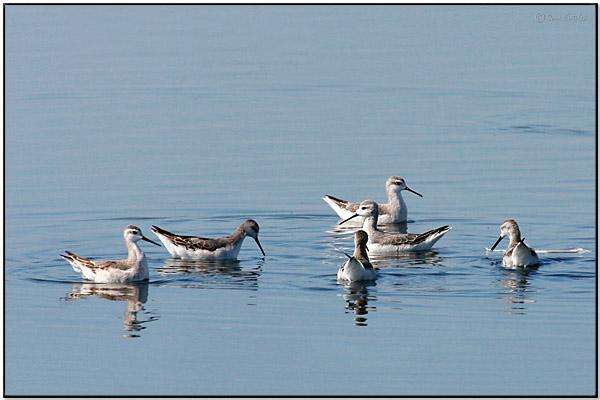
Wilson’s Phalarope (Phalaropus tricolor) by Daves BirdingPix
Wilson’s Phalarope is slightly larger than the Red Phalarope at about 9.1 in (23 cm) in length. As are all 3 phalaropes, it is a unique, dainty shorebird with lobed toes and a straight fine black bill. The breeding female is predominantly gray and brown above, with white underparts, a reddish neck and reddish flank patches. The breeding male is a duller version of the female, with a brown back, and the reddish patches reduced or absent. In a study of breeding phalaropes in Saskatchewan Providence in Canada, females were found to average around 10% larger in standard measurements and to weigh around 30% more than the males. Females weighed from 68 to 79 g (2.4 to 2.8 oz), whereas the males average 1.83 oz (51.8 g).
Young birds are grey and brown above, with whitish underparts and a dark patch through the eye. In winter, the plumage is essentially grey above and white below, but the dark eyepatch is always present.
*
Birds Illustrated by Color Photography – Revisited – Introduction
The above article is the first article in the monthly serial that was started in January 1897 “designed to promote Knowledge of Bird-Live.” These include Color Photography, as they call them, today they are drawings. There are at least three Volumes that have been digitized by Project Gutenberg.
To see the whole series of – Birds Illustrated by Color Photography – Revisited
*
(Information from Wikipedia and other internet sources)
Next Article – The Evening Grosbeak
The Previous Article – The Skylark
Links:
*
Scolopacidae – Sandpipers, Snipes Family
Wilson’s Phalarope – Wikipedia
Phalarope – Wikipedia
*

 Lee's Birdwatching Adventures Plus