Bird Nests are Important — the Bible Says So

Dr. James J. S. Johnson

BIRD NESTS ARE IMPORTANT: THE BIBLE SAYS SO

And Jesus said unto him, Foxes have holes, and birds of the air have nests; but the Son of man hath not where to lay his head.  (Luke 9:58)
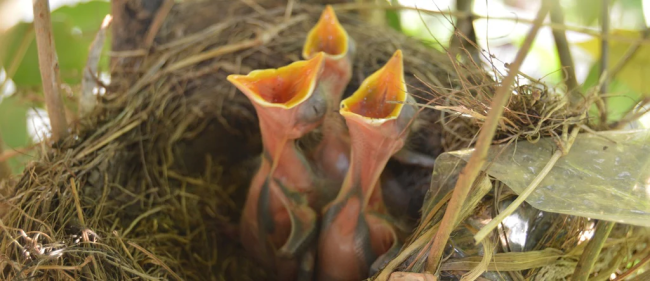
Hungry nestlings! (WhirlyBird photo credit)

NEST – this simple word “nest” represents an enormously important part of a bird’s life.  

Do you recall the first times you ever saw a bird nest, close up? Did you realize, then, that the nest was “home” to the birds who resided therein?

A baby bird’s beginning is experienced inside a nest.  From embryonic egg to hatchling, from hatchling to fledgling, a baby bird’s life adventures are “hatched” inside a nest of some kind.  Consequently, nests are the childhood homes to young nestling birds, plus parent birds repeat their multi-generational nest life as they reproduce and nurture their own next generation of their kind.

For most birds, springtime means mating, and mating time means nesting.  As soon as nesting begins in earnest, everything changes.  The earth becomes quieter, the sight of a bird [displaying to attract a prospective mate] rarer.  Despite the seeming tranquility, there’s much ado and excitement among the birds.  The joy of expressing the springtime, of finding or reclaiming a mate, has been exchanged for the silence and secrecy of very private moments as birds begin the work of creating their homes. 

[Quoting Sharon A. Cohen, BIRD NESTS (Harper Collins, 1993), page 7.]
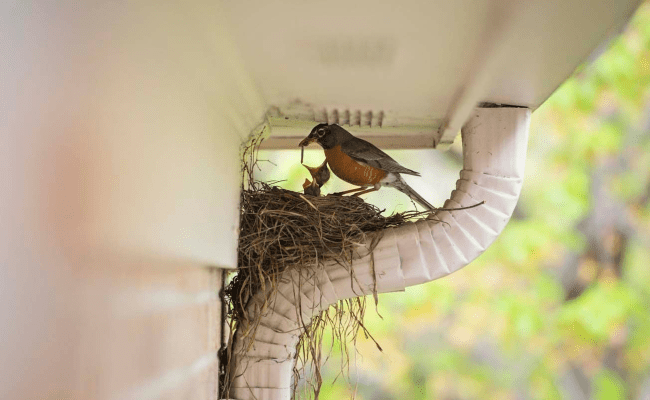
GUTTER NEST! (Bob Vila photo credit)

And what a variety of nests there are, because God has programmed different birds to build and indwell different types of nests. 

Some nests are mere scrapes upon a strategic patch of ground.  Other nests are burrowed underground.  Many are designed to be camouflaged or otherwise hidden.  Some nests are tree-nestled demitasses.  Some nests are holes on the sides fo trees or cacti.  Some nests are mostly reshaped mud.  Some nests are located on shorelines of freshwater, brackish water, or oceanic seashores. Some nests are in rocks, often at high altitudes. 

Many bird nests go unnoticed by human eyes, yet our Heavenly Father always notices and cares about bird nests, everywhere and at all times.

Are not two sparrows sold for a farthing? And one of them shall not fall on the ground without your Father.  (Matthew 10:29)

The diversity of avian nesting habits displays God’s love for variety, as one would expect, since we see countless proofs of God’s love of variety in how animals (including birds of all kinds) are fruitful, multiply, and fill niches all over the earth. [See JJSJ, “Valuing God’s Variety”, posted at www.icr.org/article/valuing-gods-variety  —  see also JJSJ, “God Fitted Habitats for Biodiversity”, posted at www.icr.org/article/god-fitted-habitats-for-biodiversity .]
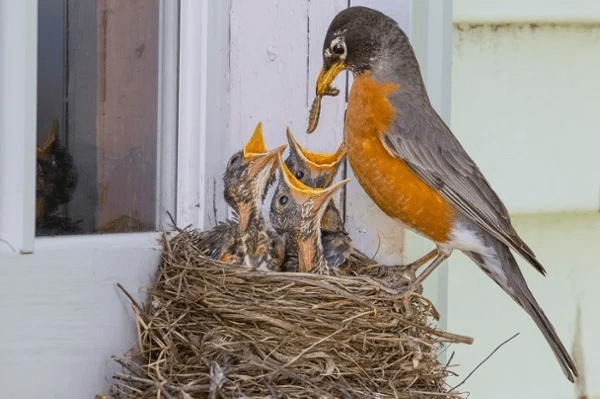
ROBIN NEST (Bird Barrier photo credit)

Accordingly, expect to find variety in bird nests.

A hummingbird hovers over a spider’s web, spending several seconds latching onto a thread of silk [to be incorporated as stabilizing material for the hummer’s coin-sized nest].  A woodpecker suspends his tree-drumming and instead works on excavating a nest hole with his mate.  A shorebird slinks into a quiet area unnoticed and lays her single egg on [a strategically selected patch of] bare sand.  In the privacy of their own world[s], often far beyond human ken, birds settle down to build their nests and breed young.  After mating takes place, attracting attention is no longer a priority.  Instead it is protecting the nest and incubating eggs that matter.  All living beings are driven to reproduce, and most lay eggs.  What makes birds different form other egg-laying creatures is that the embryo inside each egg is as warm-blooded as a human, and like a human, requires the warmth provided by its parent, or by an adequate substitute, to develop and to thrive.  Because it is so fragile, the egg must be coddled in a secure place until its occupant is ready to leave and face the rigors of the outside world.  Encased in its [calcium carbonate-structured] shell, the tiny chick’s only hope is that its parents [or foster-parents] do know what is best.  The nest the adult birds provide furnishes the warmth and protection necessary for the chicks’ survival.

[Quoting Sharon A. Cohen, BIRD NESTS (Harper Collins, 1993), pages 7-8.]

Nest are so important – because God made them to have value  —  that we should expect them to be mentioned within the HOLY BIBLE’s pages. 

Sure enough, the holy Scriptures refer to bird nests, repeatedly.  A few such examples follow.

Before reviewing those examples, however, it is worth noticing that the usual Hebrew noun translated “nest” is qên, which first appears in Genesis 6:14 (referring to “homes” aboard Noah’s Ark), where the King James Version of the English Bible translates it as “rooms”.  Yet, even in that Ark housing context, a qên was one of many temporal “homes” (i.e., onboard chambers, like “cabins” or “staterooms” within an ocean-faring cruise ship), used for security and protection from hostile external conditions.  Based upon etymologically related Hebrew words it appears that the underlying connotation is the idea of specifically claimed property (i.e., acquired and possessed as “private” property) that belongs to a specific individual, or to a specific group (such as a specific family).

OSPREYS NESTING
(photo credit: Massachusetts Wildlife)
  1. Location, location, location —  where you nest matters! 

Where a bird nest is positioned is important.  Maybe the best place for a nest—such as an Osprey nest—is high upon a relatively inaccessible rocky clifftop, or within the higher branches of a tall tree.  [See Donald Stokes & Lillian Stokes, A GUIDE TO BIRD BEHAVIOR, Volume III (Little Brown & Co., 1989), page 163.]

And he looked on the Kenites, and took up his parable, and said, ‘Strong is thy dwelling-place, and thou puttest [i.e., you position] thy nest in a rock.’  (Numbers 24:21, with “nest” [qên] as noun)

And for many large birds of prey, such as eagles, nesting in high places is the way to go.  (Perhaps such birds feel “high and mighty”!)

Thy terribleness hath deceived thee, and the pride of thine heart, O thou that dwellest in the clefts of the rock, that holdest the height of the hill: though thou shouldest make thy nest as high as the eagle, I will bring thee down from thence, saith the Lord. (Jeremiah 49:16, with “nest” [qên] as noun)

Though thou exalt thyself as the eagle, and though thou set thy nest among the stars, thence will I bring thee down, saith the Lord.  (Obadiah 1:4)

Woe to him that covets an evil covetousness to his house, that he may set his nest on high, that he may be delivered from the power of evil!   (Habakkuk 2:9, with “nest” [qên] as noun)

No need for humans to feel “high and mighty” – God resists the proud but he upholds the humble-hearted.  (And pride routinely “goeth” before a fall.)

2. Multi-generational reproductive success is priority!

Birds of prey include hawks, eagles, owls, and more. Yet birds themselves are often prey to predators of many kinds, including humans who eat birds, both domesticated and wild—such as chicken, turkey, goose, and the eggs fo many kinds of birds.  But if one generation of predators greedily consumes all of a prey population, the next generation of those predators would be deprived of a food source, which would be harmful to both the predator population and the prey population.  Accordingly, it is good for a generation of predators to only eat a limited amount of a prey population, so that future generations of both predators and prey can benefit (form continued reproductive success of the prey population.  That stewardship principle—applying restraint in lieu of greedy wastefulness—is what Moses commanded the Israelites as a conservation law for their future entry into and settlement in the Promised Land of Canaan.

If a bird’s nest chance to be before thee in the way in any tree, or on the ground, whether they be young ones, or eggs, and the mother sitting upon the young, or upon the eggs, thou shalt not take the mother with the young; but thou shalt in any wise let the mother go, and take the young to thee; that it may be well with thee, and that thou mayest prolong days.  (Deuteronomy 22:6-7, with “nest” [qên] as noun)

3. Nests are where good parenting is needed!

How eagle parents treat their young has been a subject of some confusion over the  years, due to a less-than-clear-and-accurate translation of Deuteronomy 32:11.  That confusion has already been addressed in “Clarifying Confusion about Eagles’ Wings”, posted at  https://leesbird.com/2022/09/27/clarifying-confusion-about-eagles-wings/   —   so that discussion will not be repeated here.  Suffice it to say, here, that eagle parents care for their young!  Like many—but not all—animal parents, eagle parents go to great efforts to raise their nestling children, training them for life as fledglings.

As an eagle, he [i.e., God, in relation to His people Israel] stirs up his [i.e., God’s] nest, he {i.e., God] flutters over his [i.e., God’s] young, he [I.e., God] spreads abroad his [i.e., God’s] wings, he [i.e., God] taketh them, he [i.e., God] bears them [i.e., the Israelites as God’s people] on his [i.e., God’s] wings…. (Deuteronomy 32:11, literal translation, with editorial clarifications, with “nest” [qên] as a metaphoric noun)

This is comparable to how the Lord Jesus Christ compared His willingness to protect Jews to a mother hen’s protectiveness, as demonstrated in her welcoming and refuge-providing wingspread, noted in Matthew 23:37 and also in Luke 13:34.

4. Nests should be places of domestic security: “home sweet home”.

Then I said, I shall die in my nest, and I shall multiply my days as the sand.  (Job 29:18, with “nest” [qên] as noun)

The patriarch Job, unto his “friendly” counsellors, once lamented his former life of blessing, before his torturous trials were suddenly dumped upon his head. Job related how he expected to live a long life of uninterrupted blessing, ultimately dying at peace in his own “nest” (i.e., “home sweet home”).  But, God had other plans—ultimately better (albeit bumpier) plans for Job’s earthly pilgrimage.

5. The ability, of birds to make nests, is God-given, i.e., God-programmed.

Doth the eagle mount up at thy command, and make her nest on high?  (Job 39:27, with “nest” [qên] as noun)

The eagle has designed (i.e., pre-programmed) abilities and inclinations to make its nest in high places, and to mount up into the air suing thermal air currents.  The eagle did not invent these designed traits – God designed the eagle’s physical traits and pre-programmed abilities, including the know-how (and the how-to) needed for successfully building eyries atop high montane places or in trees. [For more on this Scripture about eagle behavior, see “JOB Chapter 39:  God’s Wisdom and Providence, Exhibited in Wildlife Pair””, posted at  ttps://rockdoveblog.wordpress.com/?s=Job+39%3A27 .]

6. Nests are for raising children, i.e., the next generation.

Yea, the sparrow hath found a house, and the swallow a nest for herself, where she may lay her young, even thine altars, O Lord of hosts, my King, and my God.  (Psalm 84:3, with “nest” [qên] as noun)

Notice that the sparrow’s “house” is parallel in meaning to the “nest’ of the swallow.  In other words, a “nest” is a “house” for dwelling in, and especially for raising young in.

7. Particular types of nests are selected according who will be living therein.

Where the birds make their nests: as for the stork, the fir trees are her house.  (Psalm 104:17, with “nest” [qânan] as verb)

In the above-quoted psalm we are reminded that storks are known to make their homes within the branches of fir trees.  (Storks are also known as predictable migrants—see Jeremiah 8:7, described in “A Lesson from the Stork”, posted at www.icr.org/article/lesson-from-stork .)

8. Wandering from the security of the nest can lead to many dangers.

As a bird that wanders from her nest, so is a man that wanders from his place.  (Proverbs 27:8, with “nest” [qên] as noun)

For it shall be, that, as a wandering bird cast out of the nest, so the daughters of Moab shall be at the fords of Arnon.  (Isaiah 16:2, with “nest” [qên] as noun)

One of the advantages of many bird nests is camouflage—being hidden form the sight of hungry predators.  There is a security that comes with staying inside one’s proper home.  Not that any home (or nest) is “bulletproof” from danger, but there are often many more dangers lurking about, the farther that one wanders away from home. (The same is true for young who are expelled from home.)  Consequently, the high mortality rate is why birds routinely try to raise more hatchlings than themselves.  In other words, two parent birds need to strive for replacing themselves with more than just two children, in order to mitigate the risks that their progeny will become prey (literally “dead meat”) before they progeny can successfully reproduce the next generation. 

[The overall concept of multi-generational replacement, as a matter of population biology, is discussed in “Post-Flood Repopulation:  From 8 to 8,000,000,000!” posted at  www.icr.org/article/post-flood-repopulation-from-8-8000000000 .]

9. Bird eggs are a valuable source of good (i.e., nutritionally rich) food.

And my hand hath found as a nest the riches of the people: and as one gathers eggs that are left, have I gathered all the earth; and there was none that moved the wing, or opened the mouth, or peeped.  (Isaiah 10:14, with “nest” [qên] as noun)

Isaiah stated the obvious—eggs are valuable; in fact, they are like a store of “riches”, nutritionally speaking.  This nutrition fact concurs with the mention of eggs as a “good” food, in contrast to bad food.  See Luke 11:11-13, where giving eggs to eat is recognized (by Christ Himself, the Creator of all food) as “good gifts to your children”.   

10. Places are recognized as “wild places”, if dominated by many predators.

There shall the great owl make her nest, and lay, and hatch, and gather under her shadow; there shall the vultures also be gathered, everyone with her mate. (Isaiah 34:15, with “nest” [qânan] as verb)

The context of this somber prophecy, of Isaiah, is God judging (i.e., punishing) the Edomites, because of the Edomites’ wicked mistreatment of Israelites (see Isaiah 34:6-8), with the resultant desolation of the Edomites’ land—which punitive desolation to include Edomite lands becoming overtaken by birds of prey (se Isaiah 34:10-16).  Thus, if Edomite lands are, in the prophesied future, dominated by the nests of predatory animals—including predatory birds—such lands are to be recognized as “wild places” (wildernesses), not fit for human habitation.

11. Flexibility increases opportunities to “fit” and “fill” different situations

O ye that dwell in Moab, leave the cities, and dwell in the rock, and be like the dove that makes her nest in the sides of the hole’s mouth.  (Jeremiah 48:28, with “nest” [qânan] as verb)

Doves, which include pigeons, are famous for adjusting themselves to the most diverse of habitats.  Years ago, this writer (with family) was exploring an underground “lava tube” cave at Craters of the Moon park, in Idaho.  Inside this most inhospitable venue, perched within a crack in the cavernous ceiling, there was a nest with two pigeons therein!  Doves can live successfully almost anywhere – they are peaceful, yet flexible and opportunistic.  

12. Tree branches are often a hospitable home for nesting birds.

All the fowls of heaven made their nests in his boughs, and under his branches did all the beasts of the field bring forth their young, and under his shadow dwelt all great nations. (Ezekiel 31:6, with “nest” [qânan] as verb)

The tree that thou sawest, which grew, and was strong, whose height reached unto the heaven, and the sight thereof to all the earth, whose leaves were fair, and the fruit thereof much, and in it was meat for all; under which the beasts of the field dwelt, and upon whose branches the fowls of the heaven had their habitation. (Daniel 4:20-21)

Even in Nebuchadnezzar’s dream he recognized that tree branches (a/k/a boughs) are good sites for bird nests!

Saving the best for last: Christ prepared for bird homes via nesting habitats and nesting skills.

And Jesus saith unto him, The foxes have holes, and the birds of the air have nests; but the Son of man hath not where to lay his head.  (Matthew 8:20, with “nests” [κατασκηνωσεις] as noun)

And Jesus said unto him, Foxes have holes, and birds of the air have nests; but the Son of man hath not where to lay his head.  (Luke 9:58, with “nest” [κατασκηνωσεις] as noun)

Behold the kindness of our Lord Jesus Christ:  He did not insist on having a “home” when He came to Earth to be our Savior.  However, as our kind Creator He even prepared fitting homes fo His animal creatures, such as foxes and “birds of the air”.

Speaking of “home”, it is the very Creator-Redeemer, our Lord Jesus Christ, Who is our true home.

Accordingly, settling (domesticating) specific niches in the earth—even migratory stopover homes—and utilizing home bases for family life activities is needful to fill the multitude of Earth’s multifarious habitats. To achieve this goal, God has providentially equipped creatures with physical bodies (with helpful anatomies and physiologies) and programmed bio-informational instructions (coding and equipping for habitat-interactive behaviors) that are fitted to the dynamic challenges of physical environments (and biotic communities) all over the globe. As earthbound pilgrims, we pass through this mortal life (Hebrews 11:131 Peter 2:11), interfacing with an all-too-often hostile culture (Hebrews 11:36-38). We long for a truly secure home—where we really belong.

But, as Christians, what is our true home? It is not residential real estate housing (Philippians 3:20Hebrews 11:8-14). Our true homes are not even the earthly bodies that we temporally inhabit, although they are the “tents” we know best (2 Corinthians 5:1-42 Peter 1:13). For Christians, ultimately, our real eternal home is God Himself (Psalm 90:12 Corinthians 5:6John 14:2-6). As our Creator, He started us. As our Redeemer, we finish with Him. What a homecoming we wait for!

[Quoting from “Why We Want to Go Home”, posted at www.icr.org/article/why-we-want-go-home .]
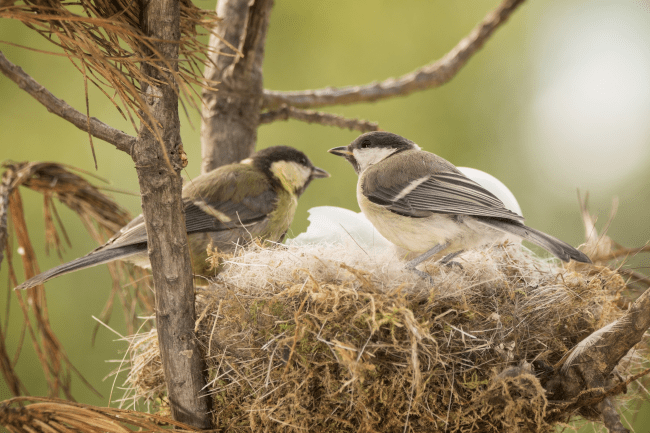
“HOME SWEET HOME” (The Spruce photo credit)

Maybe there are more examples, of bird nests being mentioned in Scripture.  But, at least, the examples listed above show that bird nests are important, so important (to God) that they merit repeated mention, in the only book that God Himself wrote.
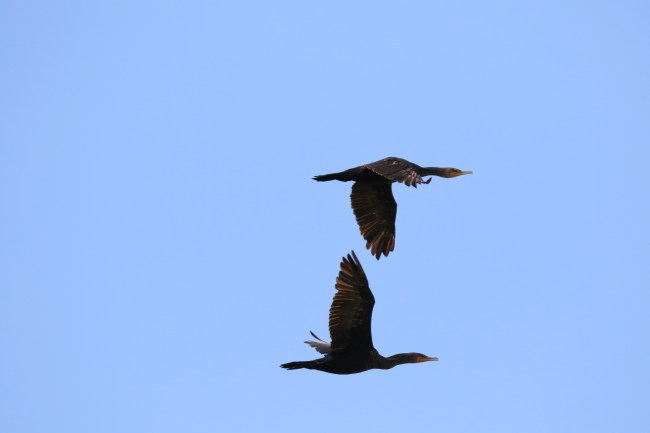
Cormorants are Great; Great Cormorants are Really Great!

Cormorants are Great; Great Cormorants are Really Great!

Dr. James J. S. Johnson

But the cormorant [shalak] and the bittern shall possess it [i.e., the land of Idumea, a/k/a Edom]; the owl also and the raven shall dwell in it; and He [i.e., the LORD, in judgment] shall stretch out upon it the line of confusion, and the stones of emptiness.

Isaiah 34:11
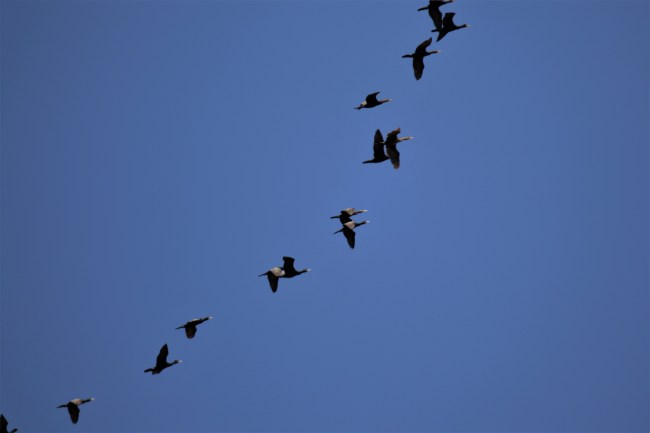
GREAT CORMORANTS in flight (Minnesota)
photo credit: Bryce Gaudian

In some contexts, CORMORANTS are not deemed as indicators of blessing — as in Isaiah 34;11, where it is prophetically mentioned as an indicator that the land of Edom is catastrophically destroyed. However, in many other contexts, these magnificent birds are recognized as wonderful creatures whom God has equipped to live by bodies of water, both freshwater and seawater.

GREAT CORMORANT aloft (Minnesota)
photo credit: Bryce Gaudian

Cormorants love to live by bodies of water. Cormorants are found busy hunting — darting (befitting the Hebrew noun shalak, in Leviticus 11:17 & Deuteronomy 14:17, translated “cormorant”, which matches the darting-like targeting movements) for food over and near coastlines, including the coasts of islands, such as the Hebridean isle of Staffa, which was reported earlier (on this Christian birdwatching blog), in the report titled “Birdwatching at Staffa: Puffins, Shags, and more”, posted at https://leesbird.com/2019/07/22/birdwatching-at-staffa-puffins-shags-more/ (July 22nd A.D.2019), citing Isaiah 42:12. [Regarding “cormorants” in the Holy Bible, see George S. Cansdale, ALL THE ANIMALS OF THE BIBLE LANDS (Zondervan, 1976), at page 175.]

Cormorants constitute a large “family” of birds; the mix of “cousins” include Crowned Cormorant (Phalacrocorax coronatus), Brandt’s Cormorant (Phalacrocorax penicillatus), Galapagos Cormorant (Phalacrocorax harrisi), Bank Cormorant (Phalacrocorax neglectus), Neo-tropic Cormorant (Phalacrocorax brasilianus), Double-crested Cormorant (Phalacrocorax auritus), Indian Cormorant Phalacrocorax fuscicollis), Socotra Cormorant (Phalacrocorax nigrogularis), Cape Cormorant (Phalacrocorax capensis), Guanay Cormorant (Phalacrocorax bougainvillii, a/k/a Guanay Shag), Kerguelen Shag (Phalacrocorax verrucosus), Imperial Shag (Phalacrocorax atriceps), Antarctic Shag (Phalacrocorax bransfieldensis). South Georgia Shag (Phalacrocorax georgianus), Campbell Island Shag (Phalacrocorax campbelli), New Zealand King Shag (Phalacrocorax carunculatus), Bronze Shag (Phalacrocorax chalconous), Chatham Island Shag (Phalacrocorax onslowi), Auckland Island Shag (Phalacrocorax colensoi), Rock Shag (Phalacrocorax magellanicus), Bounty Island Shag (Phalacrocorax ranfurlyi), Red-faced Cormorant (Phalacrocorax urile, a/k/a Red-faced Shag), European Shag (Phalacrocorax aristotelis), Pelagic Cormorant (Phalacrocorax pelagicus, a/k/a Pelagic Shag), Red-legged Cormorant (Phalacrocorax gaimardi), Spotted Shag (Phalacrocorax punctatus), Pied Cormorant (Phalacrocorax varius), Great Cormorant (Phalacrocorax carbo), Japanese Cormorant (Phalacrocorax capillatus), Olivaceous Cormorant (Phalacrocorax olivaceus, a/k/a Mexican Cormorant), and Pitt Island Shag (Phalacrocorax featherstoni).

That’s a lot of cormorant “cousins”, worldwide! [For details on each of these “cousins”, see pages 116-136 of Jim Enticott & David Tipling, SEABIRDS OF THE WORLD: THE COMPLETE REFERENCE (Stackpole Books, 1997).]

Notice: Cormorants are not anhingas!

To distinguish these 2 large black fish-loving birds, see “Of Cormorants and Anhingas” (June 13th A.D.2019), posted at https://leesbird.com/2019/06/13/of-cormorants-and-anhingas/ .

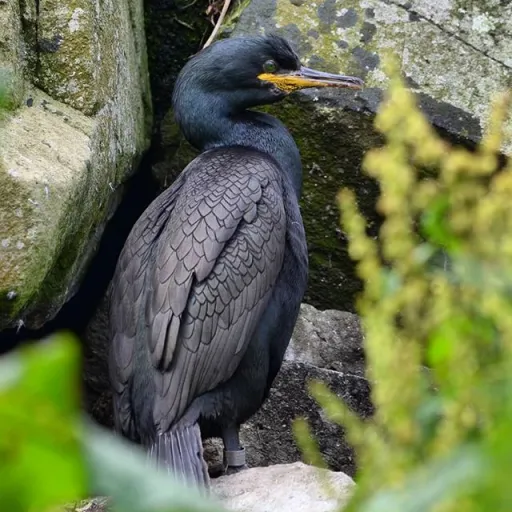
SHAG (a type of Cormorant), at Staffa, Hebrides (Scotland)
photo credit: Public Insta

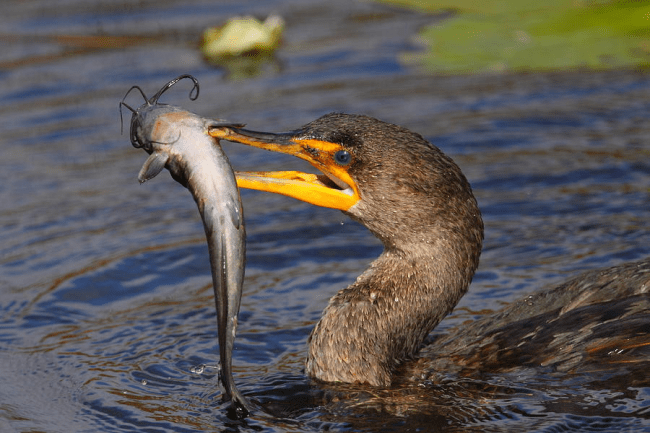
Cormorants are famous “fishermen” along ocean coastlines, yet cormorants also thrive in inland freshwater habitats, such as over and near ponds and lakes, such as the Double-crested Cormorants that frequent inland ponds in Denton County, Texas, where they catch “fish of the day”.

DOUBLE-CRESTED CORMORANT with fish
photo credit: Bruce J. Robinson

Cormorants are generally described, by ornithologist Roger Tory Peterson, as follows:

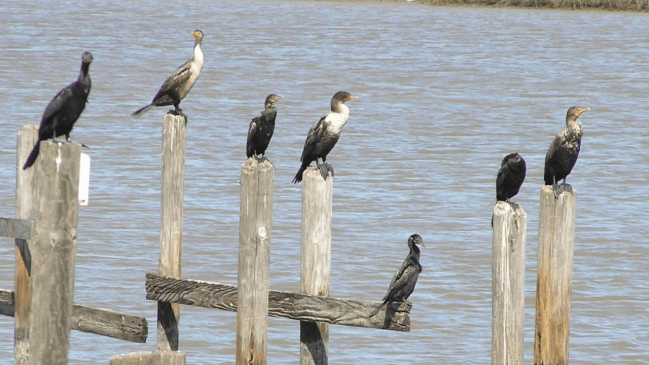
Large, blackish, slender-billed water birds. Often confused with loons, but tail longer, bill hook-tipped. In flight, wing action is more rapid and axis of body and neck is tilted upward slightly (loon’s neck droops). Young birds are browner, with a pale or whitish breast. Flocks [of cormorants] fly in line or wedge formation very much like geese but they are silent. Cormorants often perch in upright positions on buoys or posts with neck in an S [posture]; sometimes strike a “spread eagle” pose. Swimming, they lie low like loons, but with necks more erect and snakelike, and bills tilted upward at an angle. Food: Fish (chiefly non-game). Nearly cosmopolitan [in range].

[Quoting Roger Tory Peterson, cited below]

[See Roger Tory Peterson, A FIELD GUIDE TO THE BIRDS OF TEXAS AND ADJACENT STATES (Houghton Mifflin, 1988), page 10.]

Specifically, the Double-crested Cormorant (Phalacrocorax auritis) is perhaps the most common winter migrant of the cormorants; also, the Double-crested Cormorant is often seen in the coastline areas of Texas’ Gulf of Mexico shores.

GREAT CORMORANTS descending (Minnesota)
photo credit: Bryce Gaudian

Have you ever watching a silhouetted cormorant — or two — or three — winging their way across the late afternoon sky? It is a wonder to behold!

GREAT CORMORANTS silhouetted against the sky
photo credit: Bryce Gaudian

Now, try to imagine a dozen, or more, cormorants, flying in series. That’s a wondrous wonder to behold! That constitutes one of the “wonders without number” that Scripture refers to (in Job 9:10).

serial “line” of GREAT CORMORANTS in flight (Texas)
photo credit: Bryce Gaudian

And now here is my closing limerick, about cormorants:

APPRECIATING HUMBLE CORMORANTS (AND SHAGS)

Cormorants are not known to brag,

If they’re so-called, or called “shag”;

They oft fly, in a line,

And on fish, they oft dine

But cormorants aren’t known to brag.

DOUBLE-CRESTED CORMORANTS perching on posts
photo credit: Mark Eising Birding

(Dr. Jim Johnson formerly taught ornithology and avian conservation at Dallas Christian College, among other subjects, and he has served as a naturalist-historian guest lecturer aboard 9 international cruise ships, some of which sailed in seawaters frequented by cormorants and shags. Jim was introduced to Christian birdwatching as an 8-year-old, by his godly 2nd grade teacher, Mrs. Thelma Bumgardner.)

Truth or Fiction? – Storks

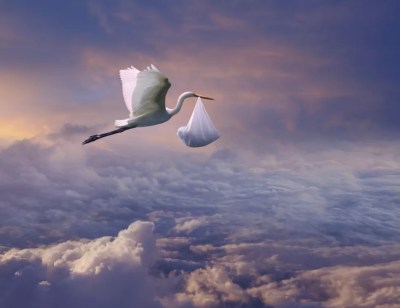
Special delivery! (Image credit John LundGetty Images)

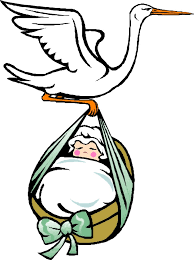
As many of you have heard, it’s been said that Storks are known to deliver babies. I’ve seen many drawings over the years of such an event.

You may have seen photos like these:


Here is a link to an interesting article about this truth or myth: What’s Behind the Myth That Storks Deliver Babies?

After reading through that article, you are now sure that Storks delivering babies is a myth, right?

But hold on. Not so fast!! Dr. Jim (Dr. J.J.S. Johnson) sent me this RARE photo of a real delivery!

“The wings of the ostrich wave proudly, But are her wings and pinions like the kindly stork’s? (Job 39:13 NKJV)
Seriously, we love Storks here on the blog. And we know that the stork family were, like other birds, created by God. Take a look through some of our previous post abort Storks:

Birds of the Bible – Storks

Or use the Search mode to find other interesting articles that our writers have posted over the years.

Oh! And thanks, Dr. Jim, for sending me this amazing delivery. :)

Good News

Clarifying Confusion about Eagles’ Wings

Clarifying Confusion about Eagles’ Wings

Dr. James J. S. Johnson

“As an Eagle stirreth vp her nest, fluttereth ouer her yong, spreadeth abroad her wings, taketh them, beareth them on her wings:”

Deuteronomy 32:11 (KJV translation, with AD1611 spellings)
GOLDEN EAGLES nesting

Based upon a verse in Deuteronomy, 32:11, many expect that an eagle mother, in the wild, sometimes “carries” her young eaglets “on their wings”. Yet that behavior is not observed, in the wild (or in captivity), so Bible skeptics allege this discrepancy as a so-called Bible “error”—but is this a straw-man accusation, based upon a translation confusion? Yes, a less-than-literal translation (form Hebrew into English) has caused confusion with this verse.

To recognize what is true, careful observations are needed, both when studying God’s Word and when studying God’s world (Johnson, 2014).  So, when Scripture refers to the world of wildlife, as it often does, due diligence should be given to the Biblical exegesis and to the “science”.

QUESTIONDoes the text of Deuteronomy 32:11 actually say that an eagle mother “carries” young eaglets “upon her wings”?

ANSWERNo.  Many English translations and paraphrases confuse the literal meaning of this Biblical Hebrew text.

The first problem in the puzzle: English Bible translations (that are popularly available) do not clearly matched the singulars to the plurals, and other literal aspects of the Hebrew text of Deuteronomy 32:11. Also, even grammatical gender information is sometimes garbled in translation.

In particular, the literal Hebrew indicates that it is God Who carries on His wings, not the eagle parent. To a large degree, the confusion is rooted to imprecise translations of the English text of Deuteronomy 32:11, particularly where “her” is sometimes translated for “him”, as well as twice “them” for “him”.  This confusion-clearing clarification—by looking at the actual Hebrew text of Deuteronomy 32:11—was buttressed by the analysis of Hans-Georg Wünch (Wünch, 2016), which specially scrutinized the pertinent Hebrew nouns and verbs.  Details on this follow.

Although the King James Version of the English Bible is usefully very literal (and precise), in those very rare situations where the King James Version mistranslates the underlying Hebrew text’s words, it is likely to be with those KJV Bible verses that describe wildlife. In other words, in the English text of the KJV you are more likely to have imprecise/non-literal translations – perhaps due to the historical life experiences (and priorities) of the King James translators (working in the early A.D. 1600s, finishing in A.D.1611).

In short, the KJV text of Deuteronomy 32:11 is suggesting that eagle parents “carry” eaglets “upon their wings”. However, the Biblical Hebrew text (i.e., the Masoretic Text of Deuteronomy 32:11), interpreted within the immediate context of verses 9-13, is anthropomorphically recalling how God historically “took” and “carried” Jacob (i.e., both “Jacob” the man, as well as the Jewish nation that is ethnically descended from Jacob, i.e., “Israel”). This is comparable to how the Lord Jesus Christ compared His willingness to protect Jews to a mother hen’s protectiveness, in Matthew 23:37 and also in Luke 13:34.

However, the most important key (to solving the puzzle of this confusing-on-the-surface passage), to properly understanding this verse, is to recognize that the subject noun of most (if not all) of the contextual sentences, is God, not a mother bird — although you must look back to Deuteronomy 32:9 to see that Deuteronomy 32:11’s subject noun is “the LORD” [Hebrew YHWH], i.e., God. (Notice also the action verbs in the Biblical context – most of these verbs refer to God only.)

Also, the relevant bird (translated “eagle” in King James Version) is mentioned in a way that is best translated “like an eagle” (or “like a vulture”, depending on how you translate NESHER, which is Hebrew noun for the bird in question). Careful context reading is needed, to recognize how much of the verse applies to the simile phrase “like an eagle”, because not all of the activities that are part of Deuteronomy 32:9-13 correspond to eagle behavior comparison.

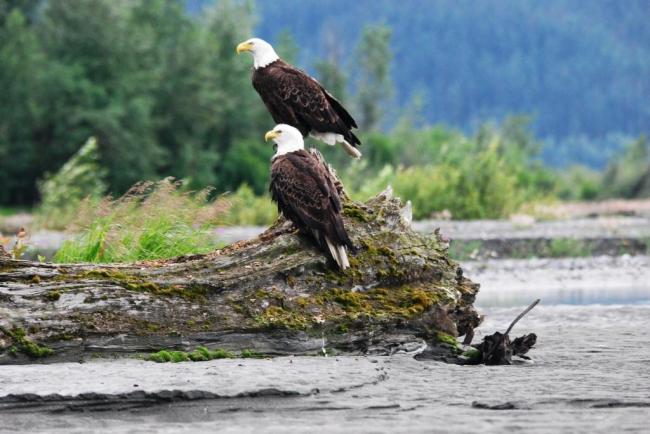
BALD EAGLES near Skagway, Alaska

Therefore, let us look at the overall context, i.e., Deuteronomy 32:9-13). Below I have inserted, using brackets, clarifying nouns (or pronouns), to match the literal meaning of the specific Scripture verbs and pronouns.

Also, keep in mind that “the LORD” [YHWH] is masculine, “Jacob” [Ya‘aqōb] is masculine, and “eagle” [nesher] is also masculine, so matching each pronoun to its proper noun requires some context-based interpretation. This is further complicated by a mistranslation in the English phrase “her nest” because the Hebrew literally says “his nest”, i.e., the Hebrew word for “nest” [qēn] has a masculine singular suffix.

In other words, Deuteronomy 32:11 is literally saying “his nest”. The same English mistranslation appears in the English phrase “her young” (which literally says “his young” in the Hebrew). Likewise, the same English mistranslation appears twice in the English phrase “her wings” (which twice literally says “his wings” in the Hebrew).

Confusingly, the Hebrew-to-English translation plot thickens.

In the English translation, of Deuteronomy 32:11, the plural pronoun “them” appears twice where it should say “him”, because the Hebrew pronominal suffix is a 3rd person singular, not a 3rd person plural.
This is, in my opinion, the most important clue, in conjunction with the plural noun “young”, for solving this puzzle, because the “taking” action – as well as the bearing action – has “him” as its (singular) direct object, yet the noun translated “young” is plural, so the taking and bearing action did not happen to young birds — rather, the taking and bearing action happened to “him”, which the overall context (of Deuteronomy 32:9-13) indicates is “Jacob”.

In other words, because a plurality of hatched birds would need a plural suffix, it is not the hatched young birds that were “taken” and “carried” in Deuteronomy 32:11. Rather, God is providing these caring actions (“taking” and “bearing”) to Jacob/Israel, because “Jacob” is a 3rd person singular masculine person, so “Jacob” can be the direct object “him”.

9 For the LORD’s portion is His [i.e., God’s] people; Jacob [whom God later re-named “Israel”, so this name refers to both the man Jacob and to his descendants who became the nation “Israel”] is the lot of His [i.e., God’s] inheritance.

10 He [God – notice that God is the subject noun of this Hebrew sentence, which is a sentence that actually continues beyond verse 10] found him [i.e., Jacob, a/k/a Israel] in a desert land, and in the waste howling wilderness; He [i.e., God] led him [i.e., Jacob, a/k/a Israel] about, He [i.e., God] instructed him [Jacob, a/k/a Israel], He [i.e., God] kept him [i.e., Jacob, a/k/a Israel] as the apple of His [i.e., God’s] eye.


11 As an eagle [some say this should be translated “hawk” or “vulture” – it means a large-winged carrion-eating bird], [“he” or “He”] stirs up her [actually the Hebrew says “his”, which might mean “His”] nest; [“he” or “He”] flutters over her [actually the Hebrew says “his”, which might mean “His”] young [i.e., “young ones”, since this noun is plural]; [“he” or “He”] spreads abroad her [actually the Hebrew says “his”] wings; [“he” or “He”] takes them [literally “him” — actually this is a 3rd person singular masculine suffix, functioning as a direct object of the action verb]; [“he” or “He”] bears them [literally “him” — actually this is a 3rd person singular masculine suffix, functioning as a direct object of the action verb] on her [actually the Hebrew says “his”] wings:

12 So the LORD alone did lead him [i.e., Jacob, a/k/a Israel], and there was no strange god with him [this “him” seems to mean “Jacob”, though it more likely refers to God, because it is “the LORD alone” Who accomplished this shepherding care over Jacob].

13 He [i.e., God] made him [i.e., Jacob, a/k/a Israel] ride on the high places of the earth, that he [i.e., Jacob, a/k/a Israel] might eat the increase of the fields; and He [i.e., God] made him [i.e., Jacob, a/k/a Israel] to suck honey out of the rock, and oil out of the flinty rock.

[Deuteronomy 32:9-13 (KJV, with JJSJ clarification inserts]

This is a confusing Hebrew mistranslation problem, so many readers of the Bible (using English translations or paraphrases) have stumbled in trying to discern its literal meaning. Because wildlife observers do not see mother eagles carrying young eaglets “on their wings”, it is no surprise that many folks have been puzzled by this verse (Lacey, 2019).

According to the literal Hebrew text, analyzed grammatically—with special attention to singular-vs.-plural and masculine-vs.-feminine details, this verse (i.e., Deuteronomy 32:11) is talking about God’s providential care of His people, with only some of God’s actions being comparable to an eagle/hawk/vulture.

Moreover, some of the other caring actions listed (in Deuteronomy 32:11) do not match bird behavior, regardless of whether the Hebrew noun nesher should be translated as “eagle”, or “hawk”, or “vulture” (Wigram, 1874).  So the complicated part (for interpreting Deuteronomy 32:11’s text) is accurately distinguishing:


(a) which phrases fit God only (even if those phrases are anthropomorphic, like Matthew 23:37 & Luke 13:34),
(b) which phrases apply to the nesher bird only, and
(c) which phrases apply to both God and the nesher bird.

In sum, here is my pronoun-interpreting understanding (and exegesis), of what I think the Hebrew text of Deuteronomy 32:9-13 is saying:

9 For the LORD’s portion is God’s people; Jacob/Israel is the lot of God’s inheritance.

10 God found Jacob/Israel in a desert land, and in the waste howling wilderness; God led Jacob/Israel about; God instructed him Jacob/Israel; God kept him Jacob/Israel as the apple of God’s eye.

11 Like an eagle, God stirs up God’s nest; God flutters over God’s young ones; God spreads abroad God’s wings; God takes/was taking Jacob/Israel; God bears/was bearing (i.e., carrying)  Jacob/Israel on God’s wings;

12 So the LORD alone led Jacob/Israel, and there was no strange god with Him.

13 God made-to-ride Jacob/Israel upon the high places of the earth, so that Jacob/Israel might eat the increase of the fields; and God caused-to-suck Jacob/Israel honey [from] out of the rock, and oil out of the flinty rock.

[Deuteronomy 32:9-13, with JJSJ’s inserted pronoun-clarifying interpretive nouns]

In sum, many interpreters have misidentified the subject noun of that verse, by stretching the comparative noun (nesher, which can/could be translated as “eagle”, “hawk”, or “vulture”, though it likely means “eagles” in Deuteronomy 32:11) in a way that causes the nesher bird to supplant God as the subject noun of the sentence.In other words, instead of the eagle (nesher bird) being comparable to some things that God does, many have interpreted the verse as if every action verb applies to the bird when actually that is not the case.

Having processed the precise parts of this puzzle, which parts should not be studied apart from the big-picture message of the passage, I conclude with a comparison to Psalm 23:1a, which says “the LORD is my shepherd”—that is the main message of Deuteronomy 32:9-13—i.e., it is God Himself Who carries us through all of life’s risks and challenges.

Golden Eagle (NET NS-WildlifeZone photo credit)

REFERENCES

Johnson, James J. S. 2014. A Hart for God. Acts & Facts. 43(7), posted at https://www.icr.org/article/hart-for-god .

Lacey, Troy. 2019. Does an Eagle Carry its Young on its Wings? Answers in Genesis (August 13, 2019), posted at https://answersingenesis.org/contradictions-in-the-bible/does-eagle-carry-young-on-wings/ .

Wigram, George V. 1874. The Englishman’s Hebrew Concordance of the Old Testament (Hendrickson reprint, 2001), pages 849-850.

Wünch, Hans-Georg. 2016. Like an Eagle Carries its Young. Hervormde Teologiese Studies/HTS Theological Studies. 72(3):a3249, posted (by African Online Scientific Information Systems) at https://hts.org.za/index.php/HTS/article/view/3249 .

Albatrosses and Chickens:  Odd Examples of Avian Self-Defense

Dr. James J. S. Johnson

O Jerusalem, Jerusalem, thou that killest the prophets, and stonest them which are sent unto thee, how often would I have gathered thy children together, even as a hen gathereth her chickens under her wings, and ye would not!

Matthew 23:37
protective mother hen with chicks [International English Bible photo credit]

The Lord Jesus Christ once compared Himself, as a caring refuge to those who are at risk of mortal danger, to a poultry hen who protects her baby chicks with her own body. Many might under-estimate the toughness of a mother hen, when protecting her chicks, including one ill-fated fox noted below. But ,before considering such protective hens, an odd example of albatross self-defense is given below.

Self-defense can be asserted in many ways, but Southern Ocean albatrosses(1),(2) and French chickens(3)  provide odd illustrations of the old saying that “truth is sometimes stranger than fiction”.

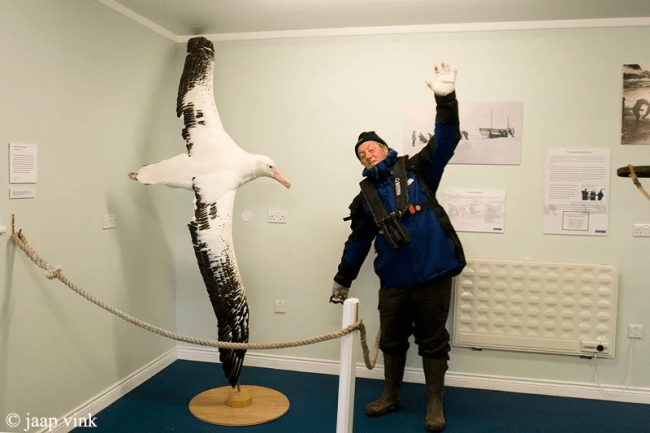
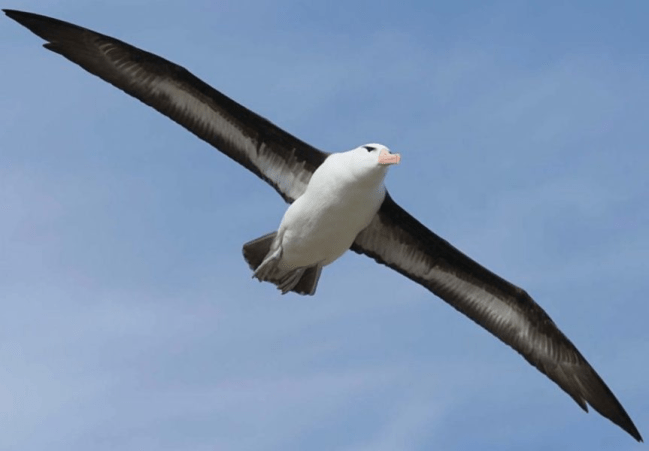
WANDERING ALBATROSS showing wingspan ( > 9 feet ), Jaap Vink photo credit

First, the Wandering Albatross is an unintentional example—this is the same wide-winged bird that ICR recently reported as harnessing the wild winds that flow above the ocean waves near Antarctica.(4) Also, this illustration involves recklessly greedy and wasteful overfishing in international waters— a perennial problem previously reported by ICR.(5),(6)    After that, an illustration of chicken self-defense toughness.

On behalf of BBC News, Samantha Patrick reported on her satellite-related data-logging albatrosses, who spy on ocean-faring fish-poaching pirates who, ironically, are routinely guilty of harming albatrosses as by-catch casualties.(1)  The spy-like surveillance program began, she says, as an attempt to track the albatrosses who were vulnerable to fishing bycatch risks in the open ocean.

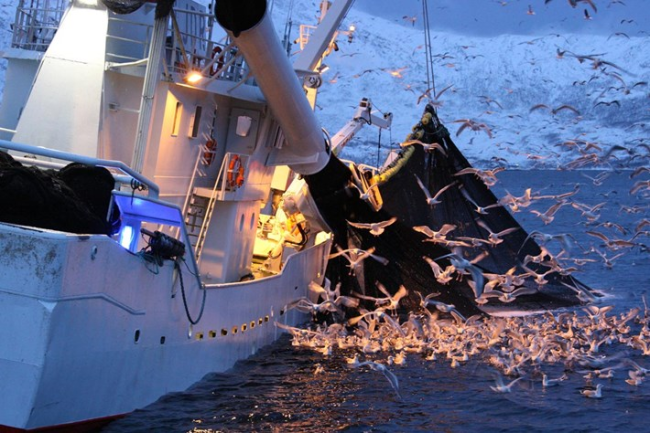
SEABIRDS congregating at fishing nets [Alessandro de Maddalena/Shutterstock image credit]

So many of these birds were dying as a result of getting caught in fishing lines that researchers started studying the overlap between albatrosses and fishing boats. Understanding where the birds came into contact with fisheries, and which birds followed boats the most, helped explain which parts of the population were most at risk of bycatch. It’s possible to map the distribution of boats using data transmitted from onboard monitoring systems, but these records are often only available around land and rarely in real time. … To try another approach, my colleagues and I developed data loggers that could be attached to an albatross. The logger detects the radar of boats, collecting information on where boats are in real time. The loggers took years to perfect and I can still remember the excitement of getting the first one back that had successfully detected a boat’s radar.(1)

[see Patrick cite below]

The high-tech surveillance provided by these wide-winged investigators enables treaty enforcers to locate those fishing boats who furtively poach in international waters, and who often recklessly endangering seabirds as by-catch casualties.

The wandering albatross can fly 10,000 km in a month, making these tireless birds ideal agents to catch the very same fish pirates that are killing albatrosses.  … They can fly 8.5 million kilometres (5.2 million miles) during their lifetimes – the equivalent of flying to the Moon and back more than 10 times. Their 3.5m wingspan is the same length as a small car and they can weigh as much as 24 puffins. Their body shape means they can effortlessly glide over the ocean waves, flying in some of the strongest winds on Earth. Now researchers have found that these seabirds may have promising careers in the fight against overfishing.(1)

[see Patrick cite below]

New technological approaches to improving remote surveillance of the oceans are necessary if we are to implement effective conservation. Of particular concern is locating nondeclared and illegal fisheries that dramatically impact oceanic ecosystems. Here, we demonstrate that animal-borne, satellite-relayed data loggers both detected and localized fishing vessels over large oceanic sectors. Attraction of albatrosses to fishing vessels [resulted in] … high proportions of nondeclared fishing vessels operating in international waters, as well as in some remote national seas. Our results demonstrate the potential of using animals as Ocean Sentinels for operational conservation.(2)

[see Weimerskirch cite below]
WANDERING ALBATROSS in flight [Critter Science photo credit]

So, how are albatrosses able to acts as surveillance spies, and as informants, to fishing quota treaty-enforcing authorities?  It wasn’t planned by the albatrosses. In fact, it wasn’t originally planned by the humans, either.

The discovery came about by accident when researchers at the Centre d’études biologiques de Chizé in France were investigating bycatch in fishing lines and nets – when fishers unintentionally snare animals they weren’t trying to catch, like albatrosses.  …  In the past few decades, countries implemented cross-border policies to directly address the causes of bycatch, particularly for albatroses and petrels, which have been severely affected. With onboard human observers or electronic devices tracking activity, albatross bycatch rates have fallen dramatically on monitored vessels.  But what about illegal fishing boats? Military vessels and aircraft patrol the Southern Ocean looking for criminal fishers, but there are no observers or monitoring to ensure these boats are using methods to protect albatrosses, and without these, we know that bycatch rates are very high.(1)

[see Patrick cite below]

Eventually the idea of harnessing albatrosses with high-tech sensors was thought of, originally as a way to track the movements of the albatrosses themselves. However, when the albatrosses gave information on undocumented fishing boats, making it much easier to locate and catch poachers, the playing field of the poaching-at-sea industry was suddenly tilted in favor of law enforcement.

Boats that are legally fishing are generally registered and licensed, and so must adhere to laws regarding where and when they fish, and what and how much they can catch. Monitoring fishery activity around land masses is one thing, but beyond these limits, the open ocean is deemed international waters and doesn’t come under the jurisdiction of a single nation. Patrolling this enormous area by ship or air is rarely effective.  But what if there were 100 officers that could cover 10,000km each in a 30-day stretch? Meet the albatross ocean sentinels who patrol the seas for illegal fishers. Wandering albatrosses breed on remote islands around Antarctica. These are usually only accessible by boat, and researchers must brave the “furious 50s” of the Southern Ocean – powerful winds found between the latitudes of 50 and 60 degrees – to get there, across some of the roughest seas in the world.(1)

[see Patrick cite below]
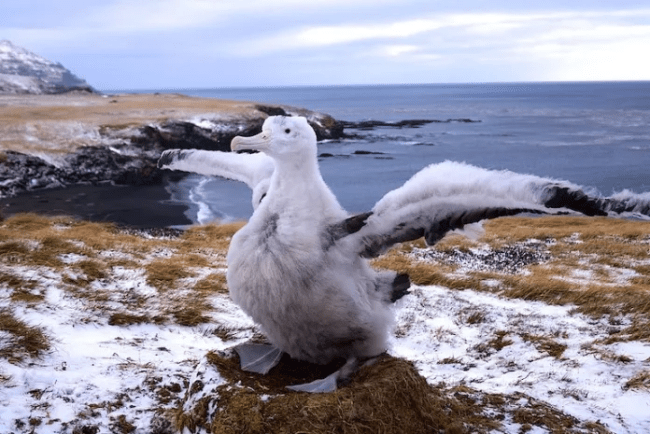
WANDERING ALBATROSS chick on island coast [Alain Ricci / Wikimedia Commons photo credit]

It wasn’t long before it was discovered that some of the boats were fishing without disclosing their identities, i.e., illegally—they did not want to be recognized for who they really were.

But when we combined the data collected by the loggers with a global map, we could see the location of all boats with an active Automatic Identification System (AIS). This radar allows vessels to detect each other, preventing collisions. Our study found that over 20% of boats within French waters didn’t have their AIS on, rising to 35% in international waters. Since the AIS is intended to keep vessels safe, it’s likely that these vessels operating without it in international waters were doing so to avoid detection, and so could be fishing illegally.(1)

[see Patrick cite below]

So now the surveilling albatrosses can report the radar of undocumented fishing boats, with that information being relayed on to law-enforcement authorities who then know where to find the poachers.

ALBATROSSES WEARING RADAR USED TO CATCH POACHERS! [Angkutan dari Berita.Blogspot.com image credit]

As a result, the albatross data had unintentionally revealed the potential extent and scale of illegal fishing in the Southern Ocean. It’s difficult to imagine a human patrol boat being able to cover enough area to efficiently track illegal fisheries. But each wandering albatross could potentially cover the same area of ocean as a boat, and when its logger detects a fishing boat with its AIS turned off, it can relay that information to the authorities, who can alert nearby vessels to investigate. … This [can] help conserve fish stocks, protect albatrosses and other seabirds, and manage the marine ecosystem as a whole. As ocean sentinels, it turns out that albatrosses have a unique ability to collect the data needed for their own conservation.(1)

[see Patrick cite below]

So the Wandering Albatross, fitted with satellite-relayed data loggers, exemplify self-defense by unintentionally calling the law when they spot (and report) undocumented fish poachers at sea—who are the same poachers famous for carelessly killing albatrosses as bycatch.

But what about chickens? How can they illustrate self-defense?

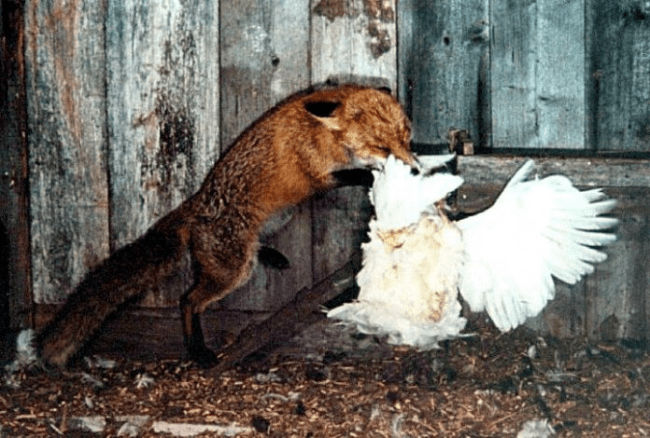
Consider the proverbial fox entrusted with guarding the henhouse.  Except in one French henhouse, however, where the results were quite unexpected.

“Chickens kill fox . . . ” [STARCTMAG.com photo credit]

Chickens in a poultry farm in northwest France are suspected of killing a fox who tried to sneak into their coop.(3)

[see “The Local — France” cite below]

Yes, you read that right—it was the chickens who killed the home-invading fox.

The young predator [fox] is thought to have entered the henhouse at an agricultural school at dusk last week and become trapped inside by light-controlled automatic hatch doors that close when the sun goes down. Students at Le Gros Chene school in Brittany discovered the body of the animal when making their rounds to check on the chickens the following morning. “There, in the corner, we found this dead fox,” Pascal Daniel, head of farming at the school, [reported]. “There was a herd instinct and they attacked him with their beaks.”(3)

[see “The Local — France” cite below]

So, being “hen-pecked” can be fatal! Wow! Chickens in Brittany are tough—respect their space—they do defend themselves. It seems that even in the world of nature, after the Fall, self-defense must be practiced, one way or another. 

And, in the case of God’s wonderful Wandering Albatrosses(4), you might say that the albatrosses are now “appealing to Caesar” (as Paul did in Acts 25:10-11), defensively, without even knowing it!(7)

WANDERING ALBATROS pair [Samantha Patrick photo credit]

References

  1. Patrick, S. 2020. The Albatrosses who Catch Pirates on the High Seas. BBC News (July 8, 2020), posted at https://www.bbc.com/future/article/20200708-the-albatrosses-who-catch-pirates-on-the-high-seas .
  2. Weimerskirch, H., J. Collet, A. Corbeau, et al. 2020. Ocean Sentinel Albatrosses Locate Illegal Vessels and Provide the First Estimate of the Extent of Nondeclared Fishing. Proceedings of the National Academy of Sciences (February 11, 2020), posted at https://www.pnas.org/content/117/6/3006 .  
  3. Staff writer. 2019. Furious French Chickens Team Up to Henpeck Fox to Death. The Local – France (March 13, 2019), posted at https://www.thelocal.fr/20190313/gallic-chickens-team-up-to-peck-french-fox-to-death .
  4. Johnson, J. J. S. 2020. Wandering Albatross; Wide Wings on the Winds. Creation Science Update (July 2, 2020), posted at https://www.icr.org/article/wandering-albatross-wide-wings-on-the-winds .
  5. The North Atlantic Ocean has been lamentably depleted of its codfish, due to overfishing promoted by the evolution-friendly “science” teaching of Thomas Huxley, Charles Darwin’s ally.  See Thomas, B. 2009. Huxley Error Led to Cod Calamity. Acts & Facts. 38(8):17, posted at https://www.icr.org/article/huxley-error-led-cod-calamity .
  6. The North Pacific Ocean’s populations of Alaska Pollock have been shrinking dramatically, due to fraudulent under-reporting of pollock catch statistics—not due to “global warming”.  See Johnson, J. J. S. 2018. Something Fishy about Global Warming Claims. Acts & Facts. 47(3):21, posted at https://www.icr.org/article/something-fishy-about-global-warming .
  7. When the apostle Paul appealed to Caesar he was acting in self-defense, with the potential of a counterattack, because if Caesar became angry at Pauls’ accusers—a foreseeable scenario—Caesar could rule that the false accusers be put to death. See Acts 25:9-12.  Self-defense is also illustrated in Esther 8:11 and 9:1-22.

Crows and Other Corvids are Really Smart Birds!

Crows and Other Corvids are Really Smart Birds!

Dr. James J. S. Johnson

FOREST RAVEN (Corvus tasmanicus): eBird.org / David Irving photo credit
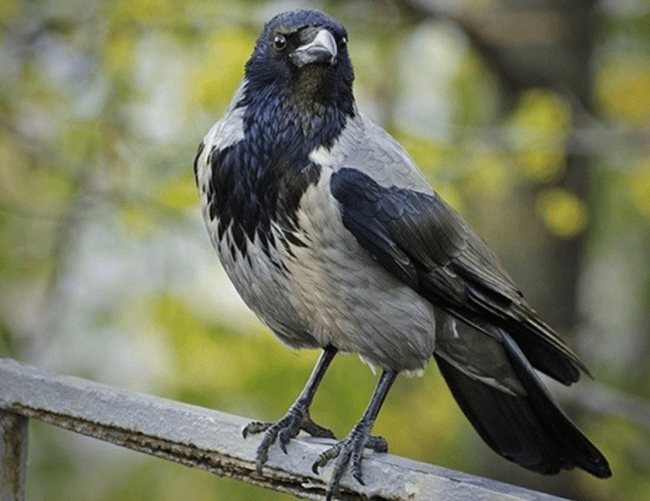
HOODED CROW (World Life Expectancy photo)

“Every raven after his kind”   (Leviticus 11:15)

Who provides for the raven his food? When his young ones cry unto God, they wander for lack of food.   (Job 38:41)

Consider the ravens: for they neither sow nor reap; they neither have storehouse nor barn, yet God feeds them; how much more are ye better than birds?   (Luke 12:24)

[quoting from the HOLY BIBLE]

There is, as Moses noted, a “kind” (i.e., genetically related family) of birds that we call “corvids”, crow-like birds, including ravens.  [In the English Bible (KJV), these birds are always called “ravens”.] 

These black (or mostly black – see Song of Solomon 5:11) omnivores are known to “crow”, often calling out a harsh KAWWWW!   Also famous for their “ravenous”appetites and eating habits, it is no wonder that the English labeled many varieties of these corvid birds as “ravens”.

The HOODED CROW (Corvus cornix) lives and thrives in the Great North – including Sweden, Finland, and Russia.  This I learned firsthand, on July 6th of AD2006, while visiting a grassy park near the Vasa Museum of Stockholm, Sweden.  The next day (July 7th of AD2006), it was my privilege to see another Hooded Crow in a heavily treed park in Helsinki, Finland.  Again, two days later (i.e., the 9th of July, AD2006), while visiting Pushkin (near St. Petersburg, Russia), I saw a Hooded Crow, in one of the “garden” parks of Catherine’s Palace.  Obviously, Hooded Crows appreciate high-quality parks of northern Europe!

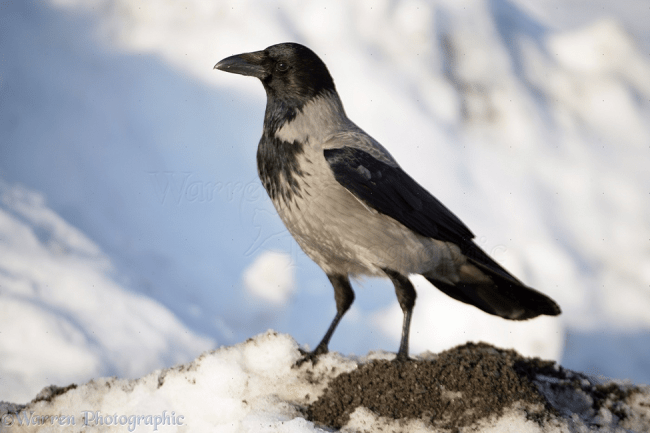
HOODED CROW (Warren Photographic photo credit)

The physical appearance of a Hooded Crow is, as one bird-book describes, “unmistakable”.

Unmistakable.  Head, wings and tail black, but body grey (can show pinkish cast in fresh plumage).

[Quoting Chris Kightley, Steve Madge, & Dave Nurney, POCKET GUIDE TO THE BIRDS OF BRITAIN AND NORTH-WEST EUROPE (Yale University Press / British Trust for Ornithology, 1998), page 271.]

Like most large corvids, the Hood Crow is quite versatile in filling various habitats.

Wary, aggressive scavenger found in all habitats from city centre to tideline, forest to mountain top.  Generally seen in ones and twos, but the adage ‘crows alone, rooks in a flock’ unreliable; often accompanies other crows, and hundreds may gather at favoured feeding spots and roosts.  Watch for crow’s frequent nervy wing flicks whenever on ground or perched.  Calls varied.  Typically a loud, angry kraa, usually given in series of 2—6 calls.  Unlike Rook, pairs nest alone (usually in tree).

[Again quoting Kightley, et al., POCKET GUIDE TO THE BIRDS OF BRITAIN AND NORTH-WEST EUROPE, page 271.]
CARRION CROW   (Ouiseaux-Birds photo)

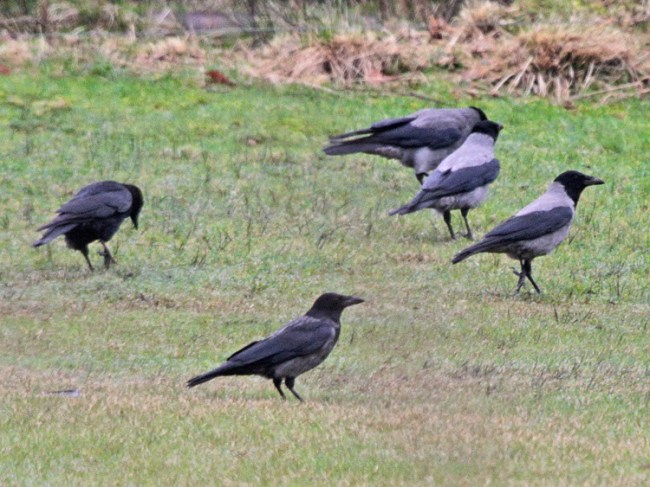
Yet the HOODED CROW is not a genetically self-contained “species”, regardless of what taxonomists might wish about them.  They happily hybridize with other crows, especially the CARRION CROW [Corvus corone], whose international range the Hooded Crow overlaps.

CARRION CROWS + HOODED CROWS = HYBRIDS   (Bird Hybrids photo)

CARRION AND HOODED CROWS.  The familiar crow.  Two distinct races occur … [In the]British Isles and western Europe, Carrion Crow (Corvus corone) is common everywhere except north and west Scotland, Ireland, Isle of Man and Europe east of Denmark, where it is replaced by Hooded (Corvus cornix).  Where breeding ranges overlap hybrids are frequent [emphasis added by JJSJ].

[Again quoting Kightley et al., page 271.]

The Carrion-Hooded Crow hybrids are also noted within a larger discussion (i.e., pages 224-228) of Corvid family hybrids, in Eugene M. McCarthy, HANDBOOK OF AVIAN HYBRIDS OF THE WORLD (Oxford University Press, 2006), at page 227. 

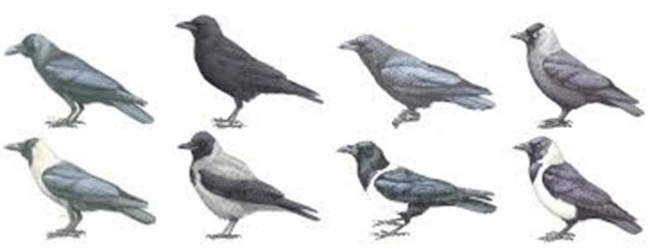
CORVIDS (Jelmer Poelstra / Uppsala University image credit)

Dr. McCarthy, an avian geneticist, has accumulated and summarized genetic research on Carrion-Hooded hybrids, especially examples observed in Eurasia:

Because the Carrion Crow has a split range … with the Hooded Crow intervening … there are two long contact zones, one extending from N. Ireland, through N. Scotland, to N.W. Germany, then S to N Italy, and another stretching from the Gulf of Ob (N Russia) to the Aral Sea.  … Even in the center of the [overlap] zone, only 30% of [these corvid] birds are obviously intermediate.  Due to hybridization these [corvid] birds are now sometimes lumped, but Parkin et al. (2003) recommend against this treatment since the two have obvious differences in plumage, as well as in vocalizations and ecology, and because hybrids have lower reproductive success than either parental type.  Hybrid young are less viable, too, than young produced from unmixed mating (Saino and Villa 1992).  Genetic variability increases within the hybrid zone (as has been observed in many other types of crossings).  Occasional mixed pairs occur well outside [the overlap range] zones (e.g., Schlyter reports one from Sweden).

[Quoting Eugene M. McCarthy, HANDBOOK OF AVIAN HYBRIDS OF THE WORLD (Oxford Univ. Press, 2006), at page 227.]

 Dr. McCarthy, on pages 224-228, lists several other examples of documented corvid hybridizations, including: Corvus capellanus [Mesopotamian Crow] X Corvus corone [Carrion Crow];  Corvus cornix [Hooded Crow] X Pica pica [Black-billed Magpie];  Corvus albus  [Pied Crow] X Corvus albicollis [White-necked Raven];  Corvus albus  [Pied Crow] X Corvus ruficollis [Brown-necked Raven];  Corvus albus [Pied Crow] X Corvus splendens [House Crow];  Corvus brachyrhynchos [American Crow] X Corvus caurinus [Northwestern Crow];  Corvus corax [Common Raven] X Corvus brachyrhynchos [American Crow];  Corvus corax [Common Raven] X Corvus corone [Carrion Crow];  Corvus corax [Common Raven] X Corvus cryptoleucus [Chihuahuan Raven];  Corvus corax [Common Raven] X Corvus levaillantii [Jungle Crow];  Corvus corax [Common Raven] X Corvus macrorhynchos  [Large-billed Crow];  Corvus corax [Common Raven] X Corvus ruficollis [Brown-necked Raven];  Corvus corone [Carrion Crow] X Corvus macrorhynchos  [Large-billed Crow];   Corvus daururicus [Jackdaw, a/k/a “Coloeus dauuricus”] X Corvus monedula [Jackdaw, a/k/a “Coloeus mondela”];  Corvus levaillantii [Jungle Crow] X Corvus macrorhynchos  [Large-billed Crow];  Pica nuttalli [Yellow-billed Magpie] X Pica pica [Black-billed Magpie];  plus it looks like an occasional Rook [Corvus frugilegus] joins the “mixer”, etc.   Looks like a good mix or corvids! 

Avian hybrids, of course, often surprise and puzzle evolutionist taxonomists, due to their faulty assumptions and speculations about so-called “speciation” – as was illustrated, during AD2013, in the discovery of Norway’s “Redchat”  —  see “Whinchat, Redstart, & Redchat:  Debunking the ‘Speciation’ Myth Again”, posted at https://leesbird.com/2017/12/12/whinchat-redstart-redchat-debunking-the-speciation-myth-again/ .

CORVID RANGES of the world (Wikipedia image credit)

Meanwhile, as the listed examples (of corvid hybridizations) above show, corvid hybrids are doing their part to “fill the earth”, including Hooded-Carrion Crows. 

Now that is are something to crow about!               ><> JJSJ    profjjsj@aol.com   

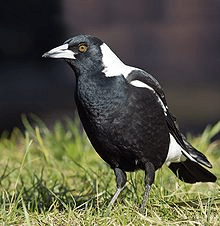
AUSTRALIAN MAGPIE (Gymnorhina tibicen) swooping to attack / CSIROscope photo credit

APPENDIX:  CROWS & OTHER CORVIDS ARE REALLY SMART BIRDS!

Crows, as well as other corvid birds (i.e., members of the Crow-Raven family), fascinate children. They should amaze adults, too, yet often we are too busy to take time to ponder and appreciate the God-given traits of the creatures who share our world.  Why should these birds capture our attention? They are alive!

Unlike plants, which are like biological machines (having no self-consciousness), higher-order animals like mammals and birds are truly alive, often displaying what might be called personalities. Although qualitatively distinct from humans—who are made in God’s image (Genesis 1:27)—animals have what Scripture calls a “soul” (the Biblical Hebrew noun is nephesh—see Genesis 1:20-21; 1:24; 2:19; 9:10; 9:12; 9:15-16 & Leviticus 11:46. )  This “soul” (nephesh)—is something more than the bird’s (or other animal’s) physical body. A bird’s nephesh-lifedeparts at death, yet its physical body remains. Thus, there is a difference between a bird’s immaterial life and its material body, just as we humans have physical bodies distinct from our own immaterial selves. The bird’s “soul” is revealed by how he or she intelligently thinks, communicates, learns, and makes decisions—including problem-solving choices.

Although many avian (and other animal) behaviors exhibit preprogrammed responses to outside world conditions, not all such behaviors are instinctive. Some such behaviors reveal that God chose to give these creatures real intelligence, real  cleverness—demonstrated by abilities to learn new ideas, to fit new situations, and to solve practical problems of daily living.

As [Benjamin] Beck tells us in his book Animal Tool Behavior, [a crow] was fed partly on dried mash, which its keepers were supposed to moisten. But sometimes (being merely human) they forgot. The crow, undaunted, would then pick up a small plastic cup that had been provided as a toy, dip it into a water trough, carry the filled cup across the room to the food, and empty the water onto the mash. “If the water was spilled accidently,” Beck writes, “the crow would return to the trough for a refill rather than proceed to the food pan with an empty cup.” The bird was not taught to do this. “The [problem-solving] behavior appeared spontaneously,” Beck reports

[Quoting from Candace Savage, Bird Brains: The Intelligence of Crows, Ravens, Magpies, and Jays (San Francisco: Sierra Club, 1997), pages 2-4.]
Australian Magpie (Wikipedia photo)

For another example of a corvid bird—in this case a magpie—demonstrating problem-solving intelligence, consider how Australian magpies deal with the unforeseeable problem of a human-imposed GPS “backpack”, which hinders its avian wearer similar to the inconvenience of a human wearing an “ankle bracelet”: 

Here, we describe one such study trialling [i.e., trial-experimenting] a novel harness design for GPS tracking devices on Australian Magpies Gymnorhina tibicen. Despite previous testing demonstrating the strength and durability of the harness, devices were removed within minutes to hours of initial fitting. Notably, removal was observed to involve one bird snapping another bird’s harness at the only weak point, such that the tracker was released. 

[Quoting from Joel Crampton, Celine H. Frère, & Dominique A. Potvin, “Australian Magpies Gymnorhina tibicen Cooperate to Remove Tracking Devices”, Australian Field Ornithology, 39:7-11 (2022).]

Likewise, some corvid birds (such as scrub jays)—acting like helpful “first responders”—are known to rescue distressed “birds of [the same] feather”, when a predator is threatening one of their own kind.

What if a large predatory bird attacks a small bird (or its nest of hatchlings)? Oftentimes, in such situations, the imperiled bird’s alarm-cry is followed by a “mob” attack. In effect, a vigilante-like “posse” of small birds chase and peck the predator, so the predator quickly flees to avoid the group counter-attack.  This has often been observed in corvid birds—the family of crows—such as Eurasia’s Siberian jay.

Jays sometimes gang up on owls and hawks, their primary predators, in an activity called “mobbing.” Uppsala University research [in Sweden] on Siberian jays, slated to appear in the Proceedings of the Royal Society Biological Sciences, investigated the specifics of how jays communicate when mobbing predators. The study found that these birds have “over 25 different vocalisations” which combine to form “over a dozen different calls [while mobbing], some of which are specific for owls and other [sic] for hawks.”

[Quoting from Brian Thomas, “Jay Talking”, Creation Science Update (June 29, 2009), posted at www.icr.org/article/jay-talking — quoting from a Uppsala University press release, “Siberian Jays Use Complex Communication to Mob Predators”, dated June 8, 2009]

Many other examples of problem solving by resourceful animals could be given. Domesticated livestock, family pets, wildlife, and laboratory-tested animals come up with clever solutions to the challenges of daily living to secure food, water, air, shelter, rest, information, and reproductive success. But the resourcefulness of animals should not surprise us.

Proverbs informs us that God wisely installed wisdom into the minds of corvid birds, as well as many other animals—even small creatures like ants, conies, locusts, and lizards.  To literally translate what Proverbs 30:24 [chakâmîm mechukkâmîm] says about such animals, they are “wise from receiving [God’s] wisdom.”  Truly amazing display — of God’s creativity and love for life !       

   ><> JJSJ     profjjsj@aol.com

father Australian Magpie (Corvus tibicen) feeding juvenile magpie (Wikipedia / Toby Hudson photo credit)

[P.S.: this blogpost updates and expands upon an earlier post on November 7th A.D.2018.]

What An Honor – Top 100 Bird Blogs and Websites

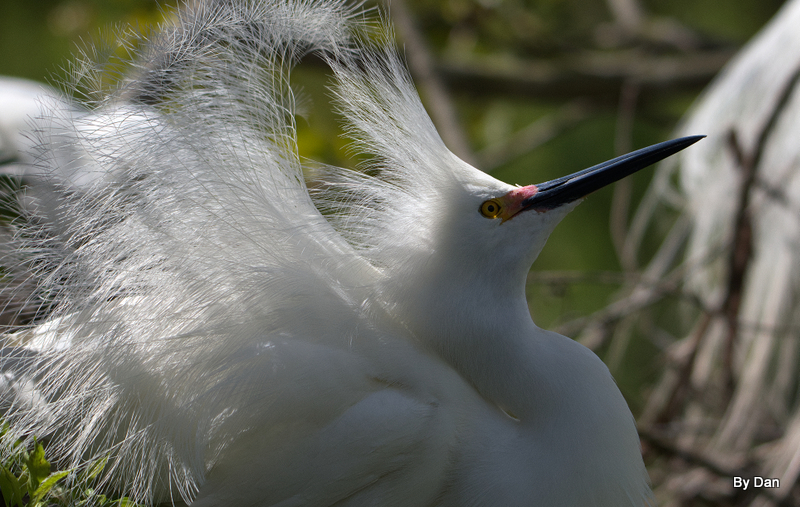
Snowy Egret in Mating Plumage by Dan at Gatorland

Top 100 Bird Blogs and Websites For Ornithologists and Bird Lovers

This blog has been selected “by our panelist as one of the Top 100 Bird Blogs on the web.” Wow! What an honor and totally unexpected.

I received an email from the Founder of this list, Anuj Agarwal.

“I personally give you a high-five and want to thank you for your contribution to this world. This is the most comprehensive list of Top 100 Bird Blogs on the internet, and I’m honored to have you as part of this!”

When I looked through the list, Lee’s Birdwatching Adventures Plus is #20! Wow!

Here is a list of the first 21 blogs or websites out of 100:

  1. Audubon

  2. The Cornell Lab of Ornithology – All About Birds

  3. BirdLife International News

  4. Surfbirds | The World Birding Website

  5. BirdWatching

  6. 10,000 Birds

  7. British Trust for Ornithology | BTO

  8. Bird Note Podcast

  9. Bird Watching HQ

  10. Wild Birds Unlimited

  11. World Birds

  12. Bird Feeder Hub

  13. BirdGuides

  14. Bird Watcher’s Digest | Out There With the Birds Blog

  15. Bird Spot

  16. International Bird Rescue

  17. FeederWatch Blog
  18. Ornithology – The Science of Birds

  19. Outside My Window

  20. Lee’s Birdwatching Adventures Plus

  21. Travels With Birds

  22. And the list goes on to 100

(P.S. This list seems to change. Sometimes it’s 19th or 20th. I’ve seen it change. Not sure how often it is updated.)

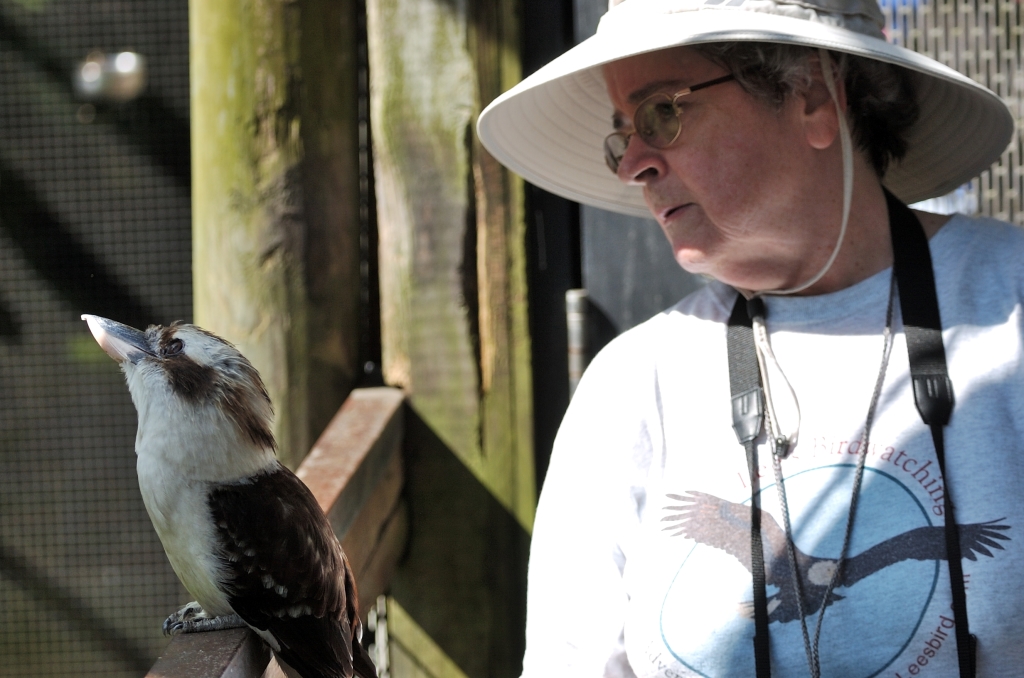
Lee with Laughing Kookabura at Brevard Zoo by Dan

Please check out this list of really great and interesting sites of information about our wonderful Avian Wonders!

Seems like I’ll be busy for awhile checking out some fantastic information on all sorts of birdwatching topics.

“But now ask the beasts, and let them teach you; And the birds of the heavens, and let them tell you.” (Job 12:7 NASB)

“Who teaches us more than the beasts of the earth And makes us wiser than the birds of the heavens?'” (Job 35:11 NASB)

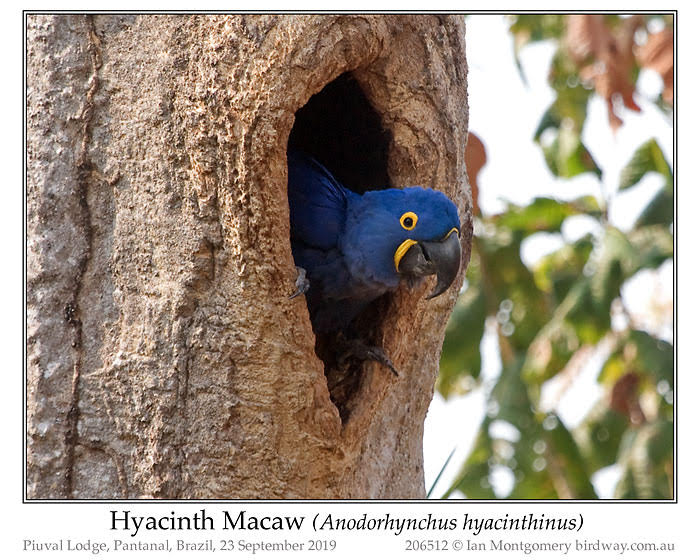
Hyacinth Macaw (Anodorhynchus hyacinthinus) ©Ian Montgomery

Hyacinth Macaw ©Ian Montgomery

Thank you, readers, for visiting this blog for all these 13+ years. Especially, thank you to all of those who have written articles for the blog.

Ian’s Bird of the Week

James J. S. Johnson

Bibleworld Adventures (Golden Eagle)

Emma’s Stories

William Wise

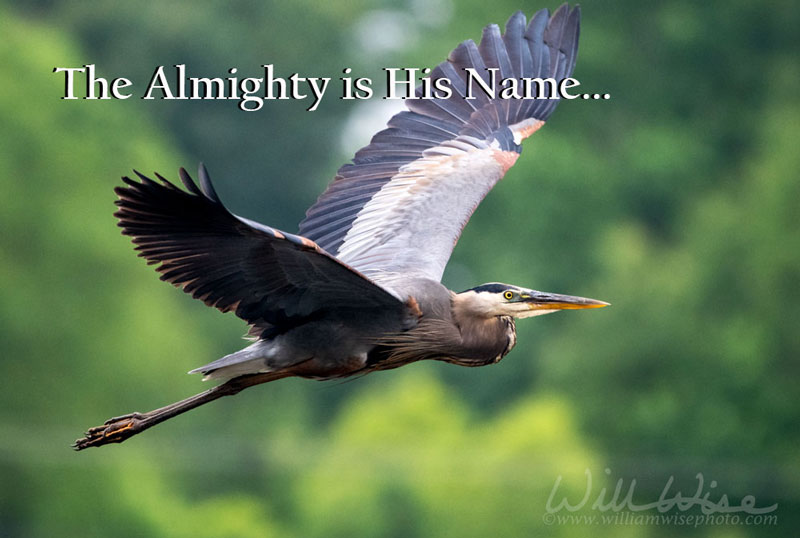
Great Blue Heron; Walton County, Georgia birding photogaphy blog by williamwisephoto.com

Plus, Thank you to our many previous writers like a j mithra, Dottie Malcolm, and others. Also, all the fantastic photographers who have given us permission to use their photos over the years. Especially, my husband, Dan.

The biggest Thanks and Praise goes to the Lord for giving me the idea and inspiration to begin this journey of writing about His Fantastic Avian Creations!

Eagles Wings – From Creation Moments

Isaiah 40:30-31

“Even the youths shall faint and be weary, and the young men shall utterly fall: but they that wait upon the LORD shall renew their strength; they shall mount up with wings as eagles; they shall run, and not be weary; and they shall walk, and not faint.”

As I sit in my backyard, enjoying some springtime sunshine while writing this script, my eyes are drawn to a pair of shapes, silhouetted against a bright sky, circling over the Cowlitz River. They look dark from where I am sitting, but I know that if they landed, they would not be so dark, and they would have white heads. They are eagles. A pair of them have been around this area since we moved here about three years ago.
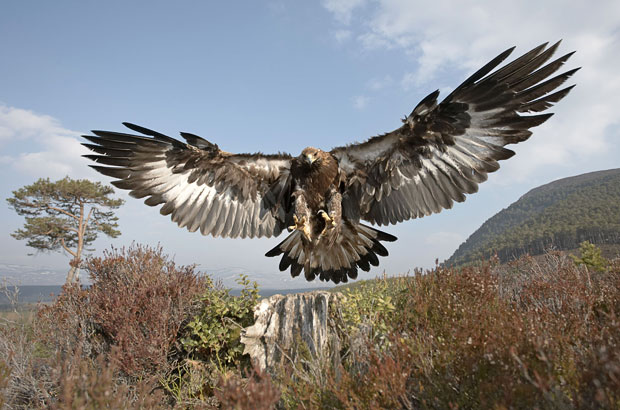
I love the way that eagles seem to fly as if they are not flying. They catch the air currents, and their large outstretched wings enjoy a lift force which is not from their own muscles, but from those air currents. To maintain that height for so long by their own muscle power would be too tiring for such large, flying birds.

The way that these eagles soar is used in the Bible as a beautiful illustration of God’s grace. In Isaiah 40:31 we read:

“They who wait for the LORD shall renew their strength; they shall mount up with wings like eagles; they shall run and not be weary; they shall walk and not faint.”

One can imagine that getting into the air, and flying high would cause the eagle to lose energy. But then it can rest and renew its strength. The Lord reminds us, through the things that He has created, that we should wait upon Him and rely on His strength.

Prayer: Help us, Father God, to wait for You, and to renew our strength through the grace that You give us. Amen.

Author: Paul F. Taylor

Ref:  With Wings Like Eagles , accessed 4/24/2020. Image: David R. Tribble, CC BY-SA 4.0 International.

© 2021 Creation Moments. Eagles Wings [Used with permission]

More Articles from Creation Moments

Who Paints The Leaves?

BIRDS DIDN’T EVOLVE FROM REPTILES

NO: BIRDS DID NOT ‘EVOLVE’ FROM REPTILES

All flesh is not the same flesh; but there is one kind of flesh of men [ανθρωπων], another flesh of beasts [κτηνων], another of fishes [ιχθυων], and another of birds [τηνων]. (1st Corinthians 15:39)

Q:  Are today’s birds genealogical ‘cousins’ to reptiles, due to shared (evolutionary) ancestry?

A:  No.  (Not even close!) However, today’s birds and reptiles do share the same Creator, the Lord Jesus Christ, Who created them (and their ancestors) to share the same earth, with us.


According to the evolutionary sequence of [imagined] events, birds are supposed to have evolved from reptiles.3

If that had occurred in the past, which it did not, it would mean that today’s birds—such as robins and roadrunners—would be distant ‘cousins’ of reptiles—such as cobras and crocodiles.

The Darwinian tale portrays today’s birds as winged dinosaurs who supposedly survived a global ‘extinction event’ that supposedly occurred about 66,000,000 years ago.1,2

Is there any eyewitness report supporting this magical scenario, or even evidence of any such timeframe? No and no.4,5

Although there are myriads of errors in this sensational speculation, only a few of which are mentioned here.

In particular, this pseudoscience scenario requires swallowing at least three invalid and drastic premises:

(1) the assumption that reptiles are not fundamentally different from birds;3 and

(2) the assumption that a secret agent (oxymoronically named “Natural Selection”, as if “its” naturalistic outcomes were intended) can accidently invent—and then successfully secure (i.e., genetically “lock down”)—such traumatic transitional transmogrifications;5 and

(3) the assumption that any such transitions’ biochemical and genetic details, in defiance of entropy’s universal destructiveness, repeatedly escaped thermodynamic reality.5

For starters, just imagine the first-listed problem, i.e., the complicated anatomical and physiological differences between birds and reptiles:

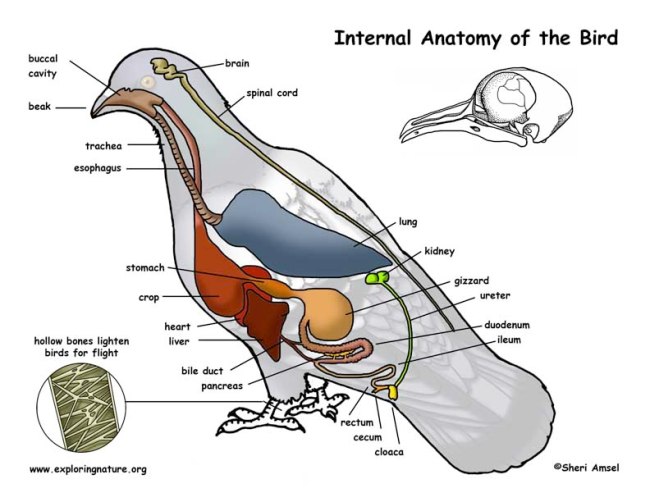
  • birds have hollow bones; reptiles, except for marrow cavities, have solid bones;
  • birds use air sacs for non-stop unidirectional (one-way) airflow through their lungs; most reptiles have two-way breathing systems;
  • birds are endothermic (warm-blooded), actively controlling their body “thermostats”; reptiles are mostly ectothermic (cold-blooded);
  • birds have muscle-controlled feathers; reptiles have dry skins or scales;
  • birds have four-chambered hearts; reptiles usually have three-chambered hearts;
  • most birds have major muscles anchored to their front, attached to a keeled sternum (breastbone), facilitating perching; reptiles’ main muscles anchor to their vertebral column (backbone), attached in arrangements conducive for standing, walking, and running.2

Don’t expect reptiles to accidentally change their genes to produce birds as descendants. As Fiona Smith says:

In other words, you don’t just put feathers on a reptile and then it can fly. There are a multitude of [essential] attributes, all working together, that make a bird fly.2

There is much more proof—to borrow Dr. Frank Sherwin’s observations—that birds have always (and only) been birds, and that reptiles have always (and only) been reptiles.

God created each bird, and each reptile, to be whatever He chose that creature to be–and it’s our privilege to see God’s magnificent creation and to learn about His magnificent majesty in the process (Revelation 4:11)!


References

1 For centuries evolutionists have proposed the notion that birds somehow evolved from reptiles, imagining “feathered dinosaurs” or dinosaur-like flying reptiles (like pterodactyls) as speculative ‘transitional’ animals. See, accord, R. Will Burnett, Harvey L. Fisher, & Herbert S. Zim, Zoology: An Introduction to the Animal Kingdom (New York, NY: Simon and Schuster, 1958), pages 5-7, 13-17, 72-75; Herbert S. Zim & Ira N. Gabrielson, Birds: A Guide to the Most Familiar American Birds (New York, NY: Golden Press, 1964), pages 12-13.

2 “Birds are incredible flying (and occasionally non-flying) machines. The Creator has designed these creatures with specialized flight apparatus, an amazing respiratory system, not to mention unbelievable migration and navigation abilities.” Sherwin, Frank J., “A ‘One-Hundred-Million-Year-Old Bird’ Is Still a Bird”, Creation Science Update (posted June 20, 2006). See also James J. S. Johnson, “Wandering Albatross: Wide Wings on the Winds”, Creation Science Update (July 2, 2020), citing Job 39:26-27 as illustrating God’s bioengineering that enables heavy birds to efficiently use wind current for launching their heavier-than-air bodies into the sky.

3 Smith, Fiona. 2015. Evidence for Creation: A Tour through Some East-Australian Zoos (Fremantle, Western Australia: Vivid Publishing), pages 164-165 (quotation), 251. The late Fiona Smith (now in Heaven with her Redeemer, the Lord Jesus Christ), an Australian professional geoscientist and science educator, graduated ICR’s School of Biblical Apologetics, during 2015 with a Master of Christian Education degree (joint major in Biblical Education & Apologetics).

4 Regarding the need for reliable eyewitnesses, to learn the real truth about unique events of the no-longer-observable past, see James J. S. Johnson, “There’s Nothing Like an Eyewitness”, Acts & Facts, 45(12):20 (December 2016).

5 Regarding the ubiquitous and inescapable destructiveness of biochemical entropy, see James J. S. Johnson, “Infinite Time Won’t Rescue Evolution”, Acts & Facts. 47(6):21 (June 2018). The phrase “natural selectin” is a misleading bait-and-switch term, because the action of “selection” necessarily requires a selector who can think (i.e., utilize information while exercising intelligence), prefer/favor one outcome as more valuable than another (i.e., make value judgments), and make/implement action-oriented decisions (i.e., make volitional choices). Regarding the mystical-animistic role that Darwinian selectionists imagine inanimate “nature” as playing, in order to “favor” or “select” a series of genetic mutations for producing phenotypically survivability-“fit” outcomes, see Randy J. Guliuzza, “Darwin’s Sacred Imposter: The Illusion that Natural Selection Operates on Organisms”, Acts & Facts, 40(9):121-15 (September 2011).

ABOUT THE AUTHOR: Dr. Jim Johnson (“JJSJ”), shown here with a Roger Tory Peterson bird-book (in St. Petersburg, Florida, birdwatching in the backyard of Chaplain Bob & Marcia Webel), was first taught this post’s main facts by Mrs. Thelma Bumgardner, his 2nd grade teacher (a true creation science educator), at Damascus Elementary School in Maryland. During the half-century thereafter Jim has enjoyed learning about birds–and, more importantly, about the Lord Jesus Christ (the Creator or birds and everything else, including us!)–and have acquired some relevant formal education (including college degrees with concentrations on the ecology and zoology of birds)–and a lot of birding adventures (including one that almost cost him his life). Due to the kind patience, WordPress-savvy knowledge/skills and accomplishments, and ever-ready technical expertise of Professor Lee Dusing (who owns, operates, and prolifically posts on Leesbird.com, as she indefatigably role-models what Christian ornithologists should be like), Jim has been able to occasionally post articles, for the past few years, on this Christian birdwatching blog. To God be the glory!

BIRDS DIDN’T EVOLVE FROM REPTILES

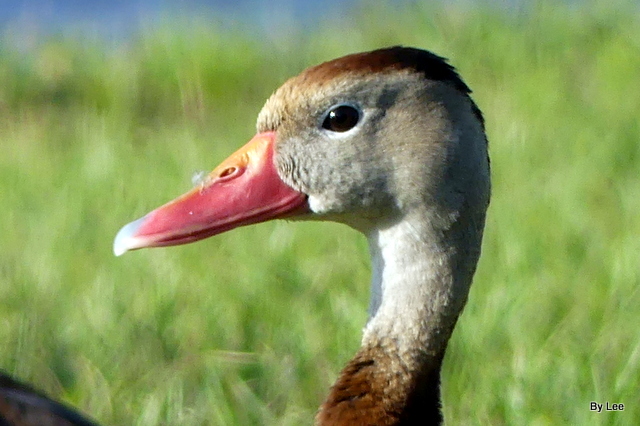
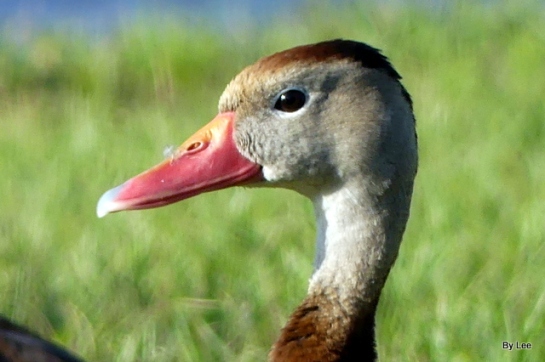
Wordless Whistling Ducks

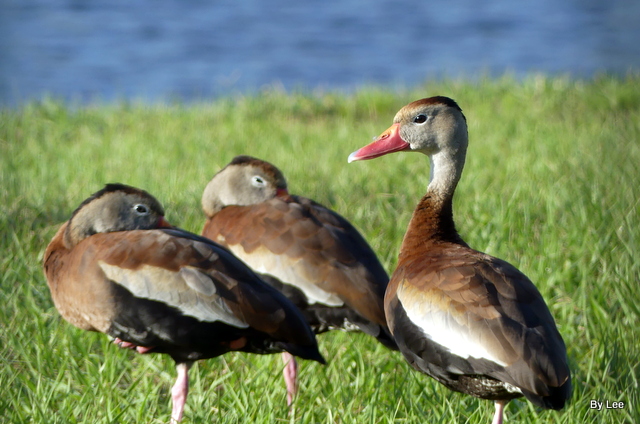
Black-bellied Whistling Ducks in yard

Over the last few weeks, we have had constant visiting Black-bellied Whistling Ducks in our back yard. After taking many pictures of them and their antics, I realized that they will make another great bird for our Wordless Bird posts.

The Wordless Book Colors are:

Black (or Dark) – Wings and Eyes

Gold – Lore

Red – Beak

White – Wings, Neck and Head

Green – Grass

Sometimes we need visual items to help us remember God’s Truths. He created these beautiful Whistling Ducks, so why not learn from them.

Our hearts are black or dark with sin. People like dark of night to do evil deeds many times.

Gold are how the streets of heaven are made.

Christ gave His blood on the cross to pay for our sins.

When we accept the Lord into our hearts, they become clean or white.

We are supposed to grow as a Christian, as the green grass.

This is a simple version of our Wordless Birds, but the truth is still the same.

“For God so loved the world, that he gave his only begotten Son, that whosoever believeth in him should not perish, but have everlasting life. For God sent not his Son into the world to condemn the world; but that the world through him might be saved.”

(John 3:16-17 KJV)
Black-bellied Whistling Duck by Lee

Hair Like Eagles’ Feathers Revisited

Steller’s Sea-eagle at San Diego Zoo 2015 by Lee

Immediately the word concerning Nebuchadnezzar was fulfilled; and he was driven away from mankind and began eating grass like cattle, and his body was drenched with the dew of heaven until his hair had grown like eagles’ feathers and his nails like birds’ claws.” (Daniel 4:33 NASB)

In the Birds of the Bible, we’ve written about this verse before Birds of the Bible – Hair Like Eagles Feathers, but it came up again today. In our devotions this morning, we read chapter 8 of Daniel. Along with the reading from it, we were reading our notes from various Study Bibles.

Crowned Eagle (Stephanoaetus coronatus) ©Wiki

Actually, the original article covers most of this about the king, but we read an interesting fact about his behavior. The fact that Nebuchadnezzar was eating grass like cattle is amazing.

This is from the King James Study Bible for Daniel “4:33. Two important questions arise from this incident: (1) Could it happen to a man? and (2) Could it have happened to Nebuchadnezzar? The answer to both questions is Yes. There is a mental illness known as zoanthropy in which a man thinks and acts like an animal. It is also called boanthropy, more specifically, when a man thinks of himself as an ox. In answer to the second question, this illness is not mentioned in Nebuchadnezzar’s annals, but one would not expect such a humiliating experience to be chronicled. On the other hand, his long reign of 43 years (605–562 b.c.) is more than long enough to include the lengthy sickness.”

Philippine Hawk-Eagle (Nisaetus philippensis) ©Flickr Billy Lopue

I am not sure what his hair looked like, so I have added these interesting eagles with feathers that might give an example of the kings hair.

Harpy Eagle (Harpia harpyja) by Lee at Zoo Miami 2014

Harpy Eagle (Harpia harpyja) by Lee at Zoo Miami 2014

As for what his fingernails might have looked like, here are some bird’s claws:

Sea Eagle (Haliaeetus pelagicus) Feet by Lee at National Aviary

Cape Eagle-Owl (Bubo capensis) on Right and Spotted Eagle-Owl on Left ©©

Cape Eagle-Owl (Bubo capensis) on Right and Spotted Eagle-Owl on Left ©©

The best part of this Bible story of Nebuchadnezzar, is how this ends. He come to his senses, and looks toward heaven, as we all should:

Daniel 8:34 “But at the end of [ae]that period, I, Nebuchadnezzar, raised my eyes toward heaven and my [af]reason returned to me, and I blessed the Most High and praised and honored Him who lives forever;

For His dominion is an everlasting dominion,
And His kingdom endures from generation to generation.
35 All the inhabitants of the earth are of no account,
But He does according to His will among the army of heaven
And among the inhabitants of earth;
And no one can [ag]fend off His hand
Or say to Him, ‘What have You done?’

36 At that time my [ah]reason returned to me. And my majesty and splendor were [ai]restored to me for the honor of my kingdom, and my state counselors and my nobles began seeking me out; so I was reestablished in my [aj]sovereignty, and surpassing greatness was added to me. 37 Now I, Nebuchadnezzar, praise, exalt, and honor the King of heaven, for all His works are [ak]true and His ways [al]just; and He is able to humble those who walk in pride.” (Links and scripture from Bible Gateway)

Birds of the Bible – Hair Like Eagles Feathers

Birds of the Bible

Birds of the Bible – Eagles

The Wise Owl

From Decorah Eagles – Most Adorable Eaglet

“Who satisfieth thy mouth with good things; so that thy youth is renewed like the eagle’s.” (Psalms 103:5 KJV)

“Out of the ground the LORD God formed every beast of the field and every bird of the air, and brought them to Adam to see what he would call them. And whatever Adam called each living creature, that was its name.” (Genesis 2:19 NKJV)

What an interesting video! Enjoy!

Bible Birds – Eagle

Birds of the Bible – Eagle

Wordless Birds