***

PAINTED WITH VERMILION
***
“That saith, I will build me a wide house and large chambers, and cut it out windows; and it is ceiled with cedar, and painted with vermilion.” (Jeremiah 22:14)
Vermilion Flycatcher (Pyrocephalus rubinus) ©ARKive
*
*
“That saith, I will build me a wide house and large chambers, and cut it out windows; and it is ceiled with cedar, and painted with vermilion.” (Jeremiah 22:14)
Vermilion Flycatcher (Pyrocephalus rubinus) ©ARKive
*
*
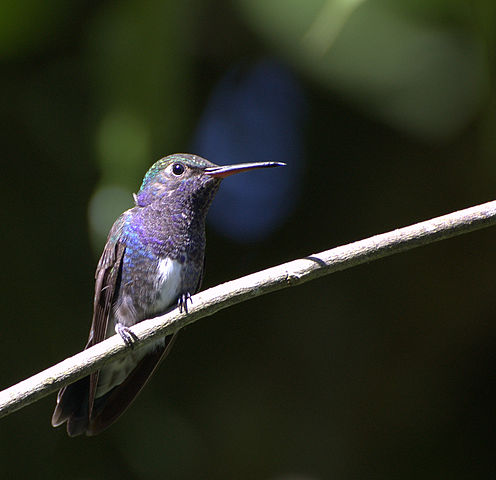
“And the weight of the golden earrings that he requested was a thousand and seven hundred shekels of gold; beside ornaments, and collars, and purple raiment that was on the kings of Midian, and beside the chains that were about their camels’ necks. (Judges 8:26)
Sapphire-spangled Emerald (Amazilia lactea) ©WikiC
*
*
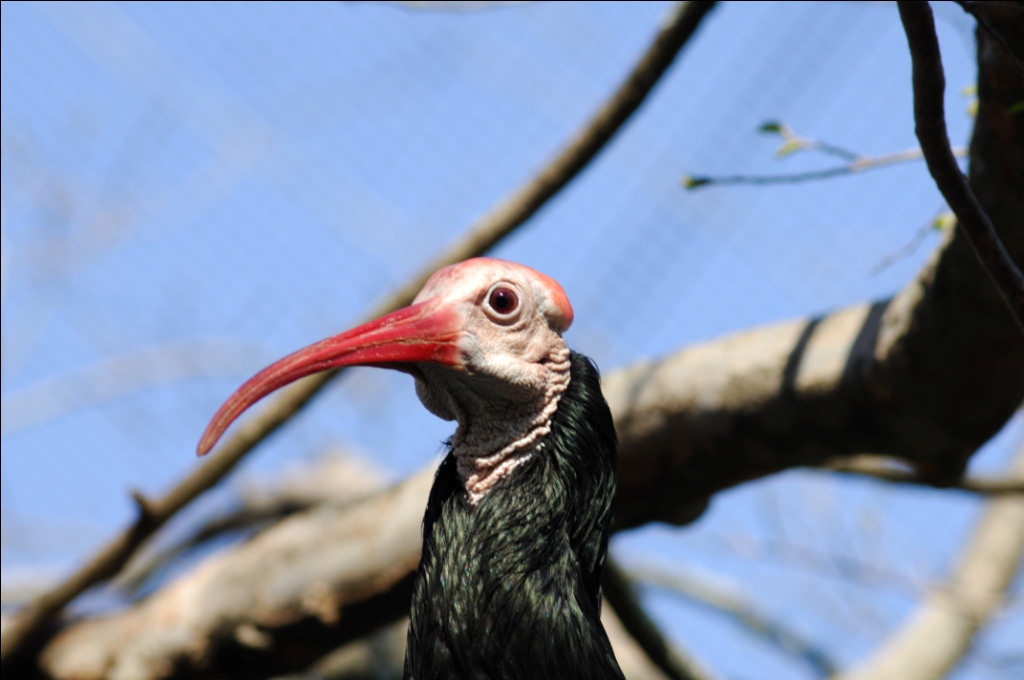
“And the man whose hair is fallen off his head, he is bald; yet is he clean.” (Leviticus 13:40)
Southern Bald Ibis (Geronticus calvus) by Dan at LPZoo
*
*

“And if ye walk contrary unto me, and will not hearken unto me; I will bring seven times more plagues upon you according to your sins.” (Leviticus 26:21 KJV)
Buff-necked Ibis (Theristicus caudatus) ©WikiC
*
*
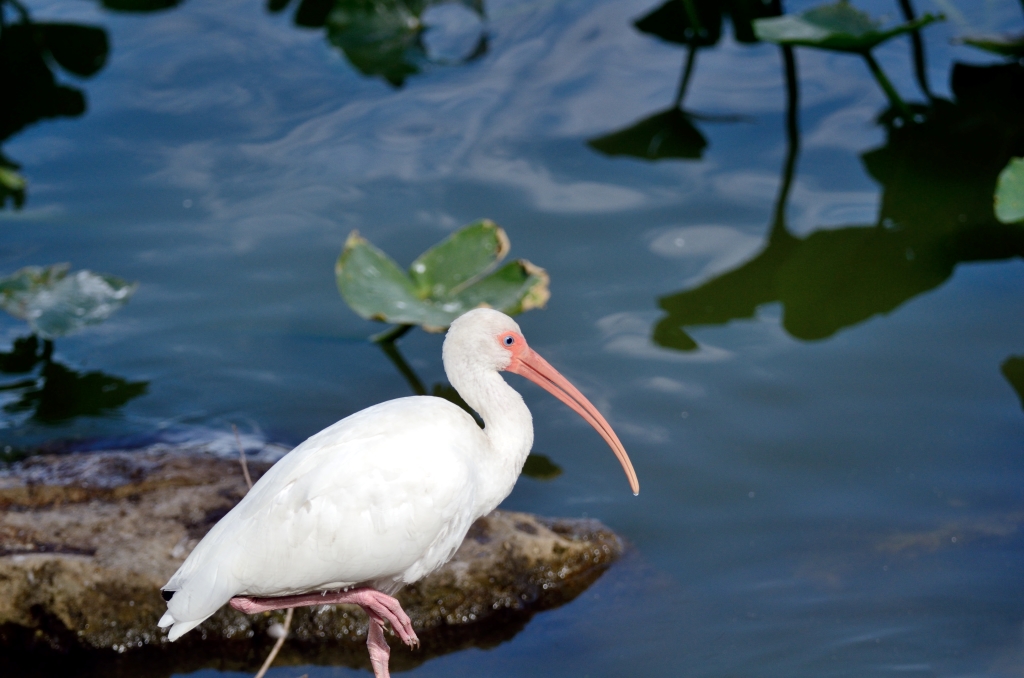
White Ibis Lake Morton by Dan
“and for a long time birds and hedgehogs, and ibises and ravens shall dwell in it: and the measuring line of desolation shall be cast over it, and satyrs shall dwell in it. (Isaiah 34:11 Brenton)”
The family Threskiornithidae includes 34 species of large wading birds. The family has been traditionally classified into two subfamilies, the ibises and the spoonbills; however recent genetic studies are casting doubt on the arrangement and revealing the spoonbills to be nested within the ibises.
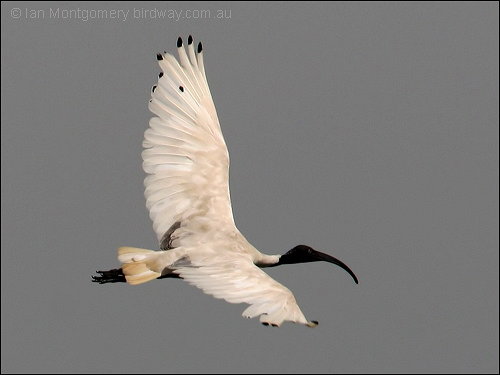
Australian White Ibis (Threskiornis molucca) by Ian
Members of the family have long, broad wings with 11 primary feathers and about 20 secondaries. They are strong fliers and, rather surprisingly, given their size and weight, very capable soarers. The body tends to be elongated, the neck more so, with rather long legs. The bill is also long, decurved in the case of the ibises, straight and distinctively flattened in the spoonbills. They are large birds, but mid-sized by the standards of their order, ranging from the dwarf olive ibis (Bostrychia bocagei), at 45 cm (18 in) and 450 g (0.99 lb), to the giant ibis (Thaumatibis gigantea), at 100 cm (39 in) and 4.2 kg (9.3 lb).
They are distributed almost worldwide, being found near almost any area of standing or slow-flowing fresh or brackish water. Ibises are also found in drier areas, including landfills.
All ibises are diurnal; spending the day feeding on a wide range of invertebrates and small vertebrates: ibises by probing in soft earth or mud, spoonbills by swinging the bill from side to side in shallow water. At night, they roost in trees near water. They are gregarious, feeding, roosting, and flying together, often in formation.

African Sacred Ibis (Threskiornis aethiopicus) by Lee at LPZoo
Threskiornis is a genus of ibises, wading birds of the family Threskiornithidae. They occur in the warmer parts of the Old World in southern Asia, nest in a tree or bush and lay two to four eggs. They occur in marshy wetlands and feed on various fish, frogs, crustaceans and insects. The species in this genus are the; African sacred ibis, T. aethiopicus, Malagasy sacred ibis, T. bernieri, Reunion ibis T. solitarius (extinct), Black-headed ibis, T. melanocephalus, Australian white ibis, T. moluccus, Solomons white ibis, T. m. pygmaeus, and the Straw-necked ibis, T. spinicollis.
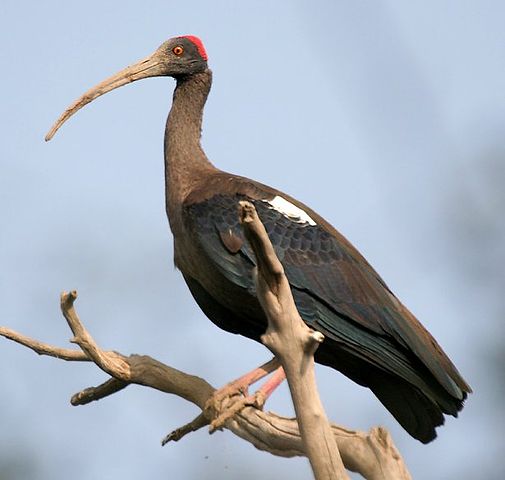
Red-naped Ibis (Pseudibis papillosa) ©WikiC
The bird genus Pseudibis consists of two South-East Asian species in the ibis subfamily, Threskiornithinae. The giant ibis is also sometimes placed in this genus. Red-naped Ibis, Pseudibis papillosa and White-shouldered Ibis, Pseudibis davisoni. The white-shouldered ibis is critically endangered.
Southern Bald Ibis (Geronticus calvus) by Dan at Lowry Park Zoo
The small bird genus Geronticus belongs to the ibis subfamily (Threskiornithinae). Its name is derived from the Greek gérontos (γέρωντος, “old man”) in reference to the bald head of these dark-plumaged birds; in English, they are called bald ibises.
Geronticus contains two living species. The northern bald ibis (G. eremita) has a neck crest of elongated feathers. It is a Critically Endangered species found around the Mediterranean. Its range had expanded after the last glacial period to the Alps of Germany and even a bit further north, but it was rendered extinct there mainly due to habitat destruction and unsustainable hunting. The southern bald ibis (G. calvus) with a red crown patch but no crest is classified as Vulnerable and is found in subtropical southern Africa.

Crested Ibis (Asian) (Nipponia nippon) One of Rarest Birds ©©Pinterest
Nipponia – The crested ibis (Nipponia nippon), also known as the Japanese crested ibis or toki (トキ?), variously written in kanji as 朱鷺, 鴇, 鵇 or 鴾, and written in hanzi as 朱䴉 or 朱鷺, is a large (up to 78.5 cm (30.9 in) long), white-plumaged ibis of pine forests. Its head is partially bare, showing red skin, and it has a dense crest of white plumes on the nape. This species is the only member of the genus Nipponia.
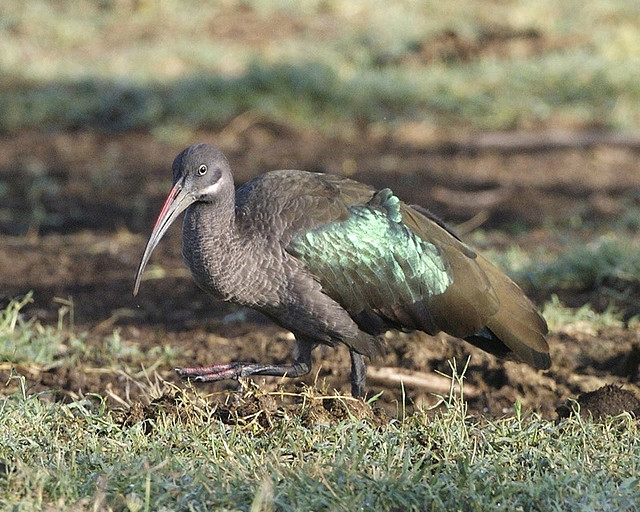
Hadada Ibis (Bostrychia hagedash brevirostris) ©©LipKee
Bostrychia is a genus of ibises in the family Threskiornithidae. Member species are found in many countries throughout Africa.
It contains the following five species: Wattled ibis (Bostrychia carunculata), Hadada ibis (Bostrychia hagedash), Olive ibis (Bostrychia olivacea), São Tomé ibis (Bostrychia bocagei), Spot-breasted ibis (Bostrychia rara)

Buff-necked Ibis (Theristicus caudatus) by Dario Sanches
Theristicus is a genus of birds in the family Threskiornithidae. They are found in open, grassy habitats in South America. All have a long, decurved dark bill, relatively short reddish legs that do not extend beyond the tail in flight (unlike e.g. Eudocimus and Plegadis), and at least the back is grey. They are the Plumbeous ibis, Theristicus caerulescens, Buff-necked ibis, Theristicus caudatus, Black-faced ibis, Theristicus melanopis, Andean ibis, Theristicus branickii,
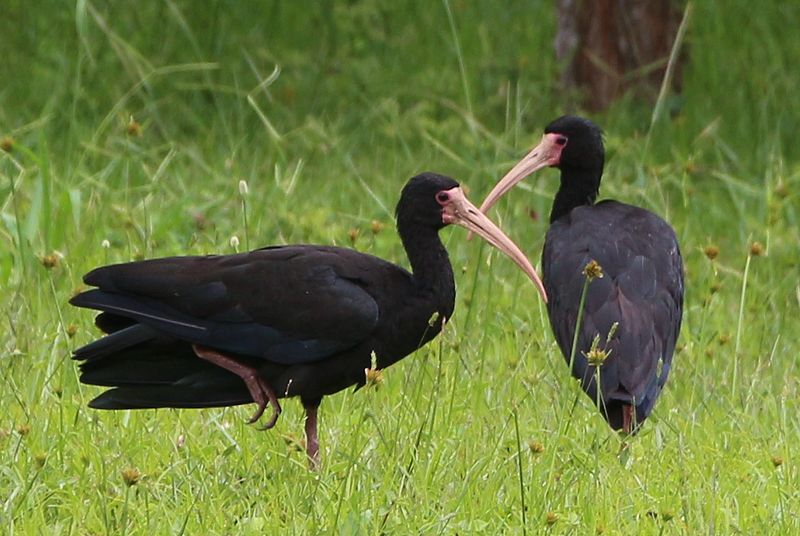
Sharp-tailed Ibis (Cercibis oxycerca) ©WikiC
Cercibis – The sharp-tailed ibis (Cercibis oxycerca) is a species of ibis native to open wet savannas in parts of northern South America.
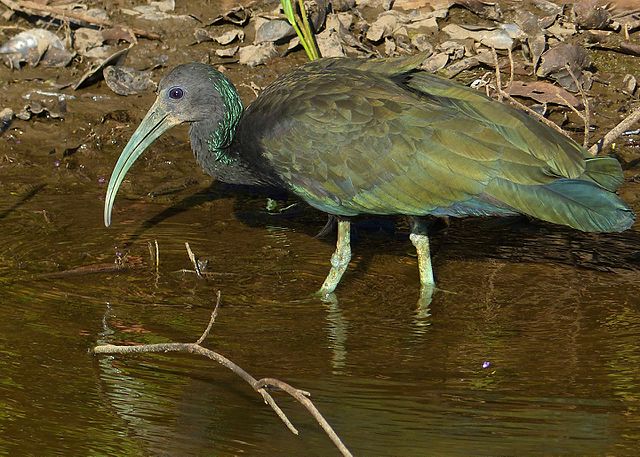
Green Ibis (Mesembrinibis cayennensis) ©WikiC
Mesembrinibis – The green ibis (Mesembrinibis cayennensis), also known as the Cayenne ibis, is a wading bird in the ibis family Threskiornithidae. It is the only member of the genus Mesembrinibis.
This is a resident breeder from Honduras through Nicaragua, Costa Rica and western Panama, and South America to northern Argentina. It undertakes some local seasonal movements in the dry season.

Bare-faced Ibis (Phimosus infuscatus) by Robert Scanlon
Phimosus – The bare-faced ibis (Phimosus infuscatus), also known as the whispering ibis, is a species of bird in the family Threskiornithidae, in the monotypic genus Phimosus.
It is found in Argentina, Bolivia, Brazil, Colombia, Ecuador, Guyana, Paraguay, Suriname, Uruguay, and Venezuela. Its natural habitat is swamps. The Bare-faced Ibis is either dark brown or a blackish color. It is called the Bare-faced Ibis because it does not have any feathers on its face. It has a long Decurved bill that’s pinkish to reddish brown. The skin on its face is usually a reddish color and it also has long orangely colored beak with pink legs. The total length of the ibis ranges between 45 and 50 cm.
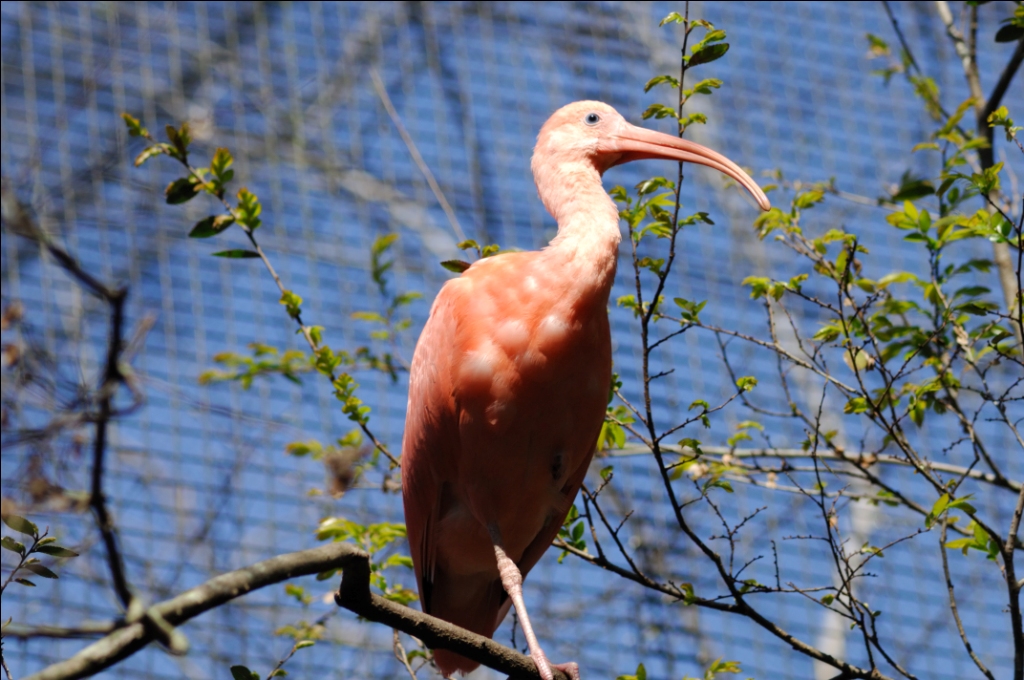
Scarlet Ibis (Eudocimus ruber) by Dan at LPZoo
Eudocimus is a genus of ibises, wading birds of the family Threskiornithidae. They occur in the warmer parts of the New World with representatives from the southern United States south through Central America, the West Indies, and South America.
There are just two species in this genus, American White Ibis (Eudocimus albus) and Scarlet Ibis (Eudocimus ruber)
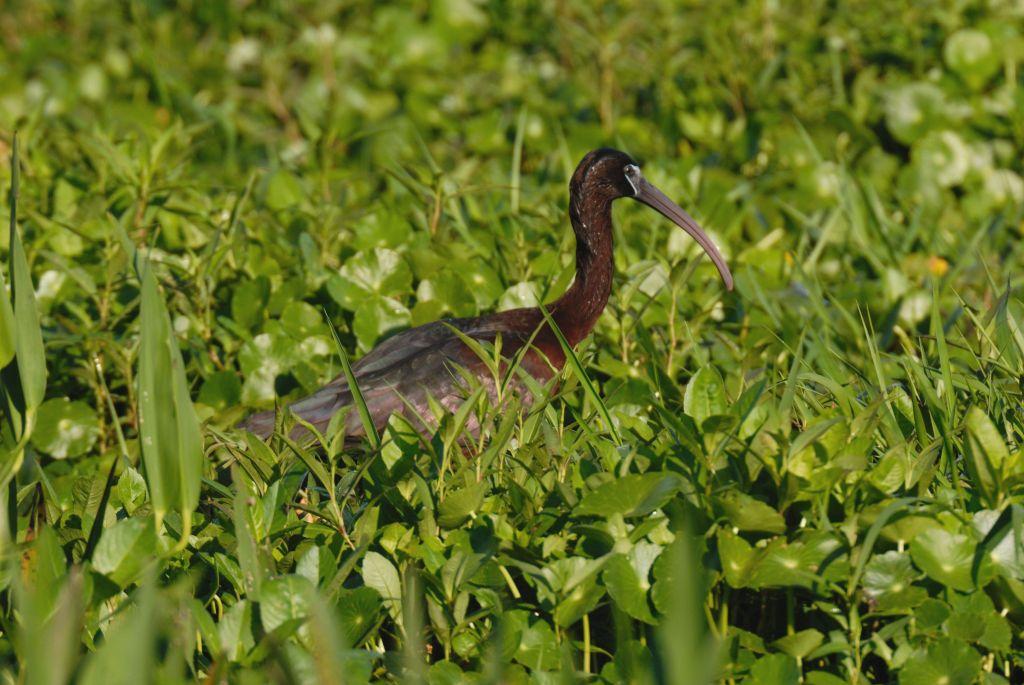
Glossy Ibis (Plegadis falcinellus) by Dan’s Pix
Plegadis is a bird genus in the family Threskiornithidae. The genus name derives from Ancient Greek plegados, “sickle”, referring to the distinctive shape of the bill. Member species are found on every continent except Antarctica as well as a number of islands. The glossy ibis is easily the most widespread of the three species. Plegadis contains the following three species: Glossy Ibis, Plegadis falcinellus, , White-faced Ibis, Plegadis chihi, Puna Ibis, Plegadis ridgwayi.

Madagascar Ibis (Lophotibis cristata) ©WikiC
Lophotibis – The Madagascan ibis (Lophotibis cristata), also known as the Madagascar crested ibis, white-winged ibis or crested wood ibis, is a medium-sized (approximately 50 cm long), brown-plumaged ibis. It has bare red orbital skin, yellow bill, red legs, white wings and its head is partially bare with a dense crest of green or gloss blue and white plumes on the nape. The Madagascan Ibis is the only member of the genus Lophotibis.

Roseate Spoonbill at Flamingo Gardens by Lee
Platalea – Spoonbills are a group of large, long-legged wading birds in the family Threskiornithidae, which also includes the ibises. The genus name platalea derives from Latin and means “broad”, referring to the distinctive shape of the bill. Six species are recognised, all either placed in a single genus or three genera. They are most closely related to the Old World ibises; Eurasian Spoonbill Platalea leucorodia, Black-faced Spoonbill Platalea minor, African Spoonbill Platalea alba, Royal Spoonbill Platalea regia, Yellow-billed Spoonbill Platalea flavipes, and our local Roseate Spoonbill Platalea ajaja.
All spoonbills have large, flat, spatulate bills and feed by wading through shallow water, sweeping the partly opened bill from side to side. The moment any small aquatic creature touches the inside of the bill—an insect, crustacean, or tiny fish—it is snapped shut. Spoonbills generally prefer fresh water to salt but are found in both environments. They need to feed many hours each day.

Black-faced Spoonbill (Platalea minor) ©WikiC
[Information from Wikipedia, with editing]
“And having an high priest over the house of God; Let us draw near with a true heart in full assurance of faith, having our hearts sprinkled from an evil conscience, and our bodies washed with pure water. Let us hold fast the profession of our faith without wavering; (for he is faithful that promised;)” (Hebrews 10:21-23 KJV)
“Stay Close To Me” ~ by the ©Hyssongs
*
Threskiornithidae – Ibises, Spoonbills
Threskiornithidae Family of Ibises and Spoonbills – Wikipedia

“On the mountain height of Israel will I plant it, that it may bring forth boughs and bear fruit and be a noble cedar, and under it shall dwell all birds of every feather; in the shade of its branches they shall nestle and find rest.” (Ezekiel 17:23 AMP)
Painted Stork (Mycteria leucocephala) by Lee at Zoo Miami 2014
*
*
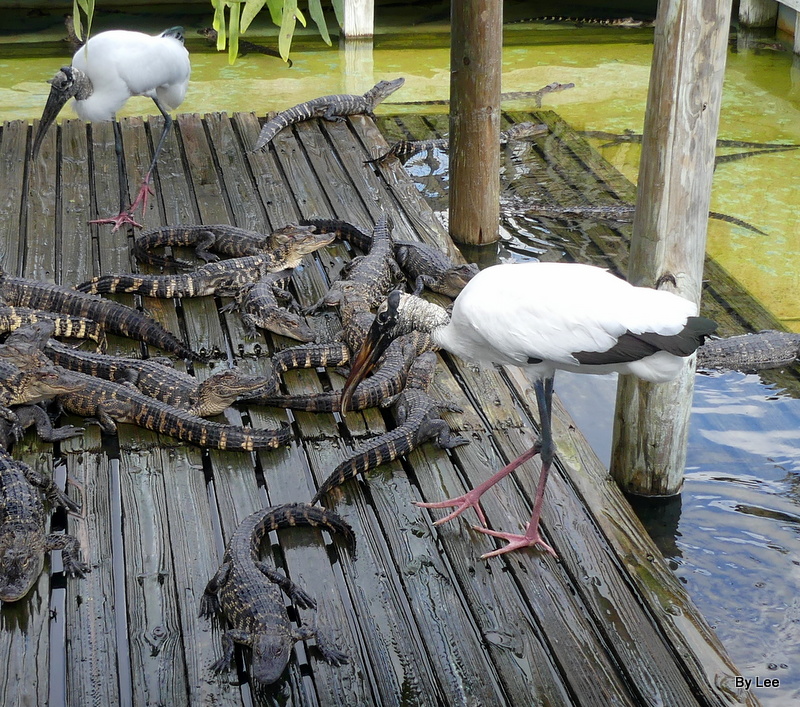
“Wherefore be ye not unwise, but understanding what the will of the Lord is.” (Ephesians 5:17 KJV)
Wood Stork Stealing Young Alligator’s Food at Gatorland by Lee
*
*
“A gift is as a precious stone in the eyes of him that hath it: whithersoever it turneth, it prospereth.” (Proverbs 17:8 KJV)
Once there was a family of common wood pigeons that lived deep in a large forest. The father and mother, David and Susan, had three children, Billy, Louisa, and Will. The children had not been in the nest for very long, but were now almost old enough to fly from the nest to make their own homes.
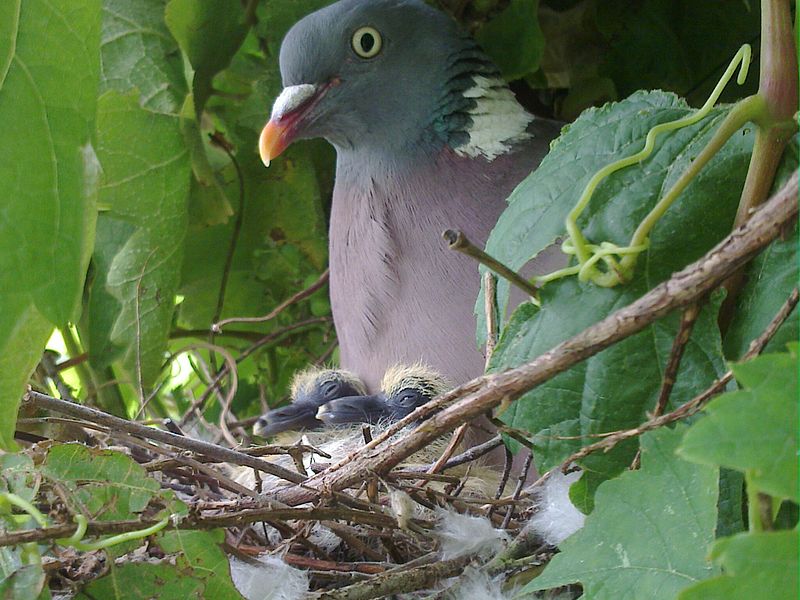
Common Wood Pigeon (Columba palumbus) with newly hatched young ©WikiC
One day when Susan was flying through the forest searching for worms, she met an owl named Winston who was casually sitting on a branch. Because Winston was considered the wisest owl in the entire forest, all of the birds and other animals came to him for advice on how to solve their problems. When Susan explained to Winston that her children were nearly old enough to begin flying to find their own place to live, Winston immediately suggested holding a graduation ceremony.
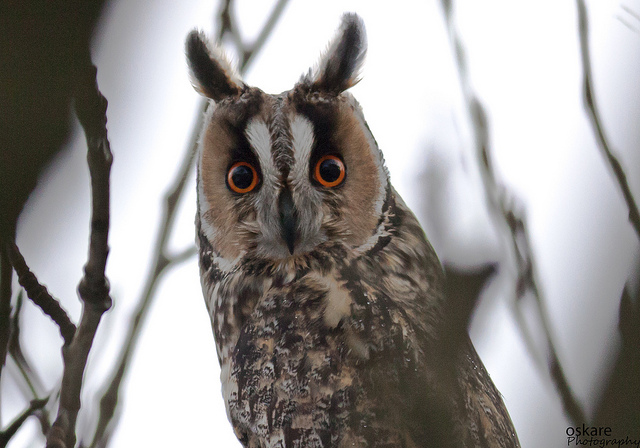
Long-eared Owl (Asio otus) ©Flickr Slgurossom
Susan, confused on what exactly a graduation ceremony entailed, waited patiently for most of the afternoon as Winston slowly explained every detail of what a graduation ceremony was, what must be done, and the reason for it. Susan almost wished she hadn’t said anything because Winston had a history of being extremely long-winded. From what Susan gathered, however, graduation ceremonies were for people who had reached a certain point in their lives. They left a place called ‘school’ where they learned everything they needed to know before being given a piece of paper and going to another place to learn. Susan thought it was almost like the way her children would fly from the nest.
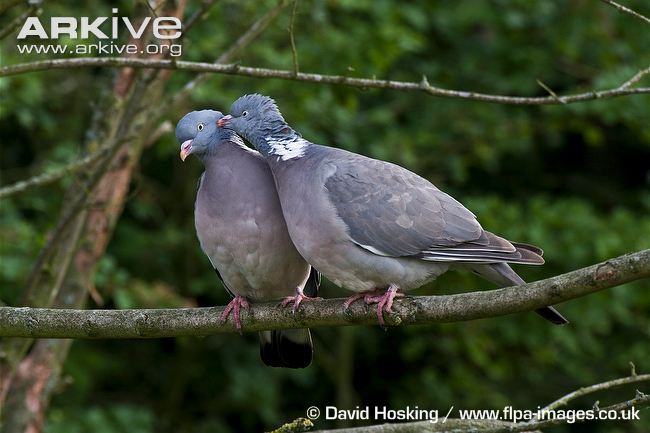
Common Rock Pigeon Pair ©ARKive
Susan quickly flew back home and told David everything that Winston had said, and David thought it was a great idea. They began to prepare for the ceremony by inviting all of the birds and animals in the woods, though they were informed that the turkeys couldn’t attend because hunters had been spotted and the turkeys were not taking any chances.
That Saturday, Winston flew over to a large nearby branch while all of the pigeons and several other birds and animals gathered around to listen. Winston’s speech lasted a very long time, and by the time he was done Billy, Louisa, Will, and most of the others were fast asleep.
David and Susan quickly woke their children up so they could rise for their diploma. David and Susan both decided that the perfect substitute for a diploma would be the biggest worms they could find. Winston called out each of their children’s names one by one, and, while the rest of the birds and animals all cheered, Billy, Louisa, and Will took their worms. The ceremony was officially over. Everyone had a party afterwards with all of the birds bringing worms and all the squirrels volunteering to bring nuts and berries for the others. Some of the animals even gave the young birds a few graduation presents. One kind squirrel brought the largest nut he could find, while a raccoon brought an assortment of leaves she had found that would look nice in a nest.
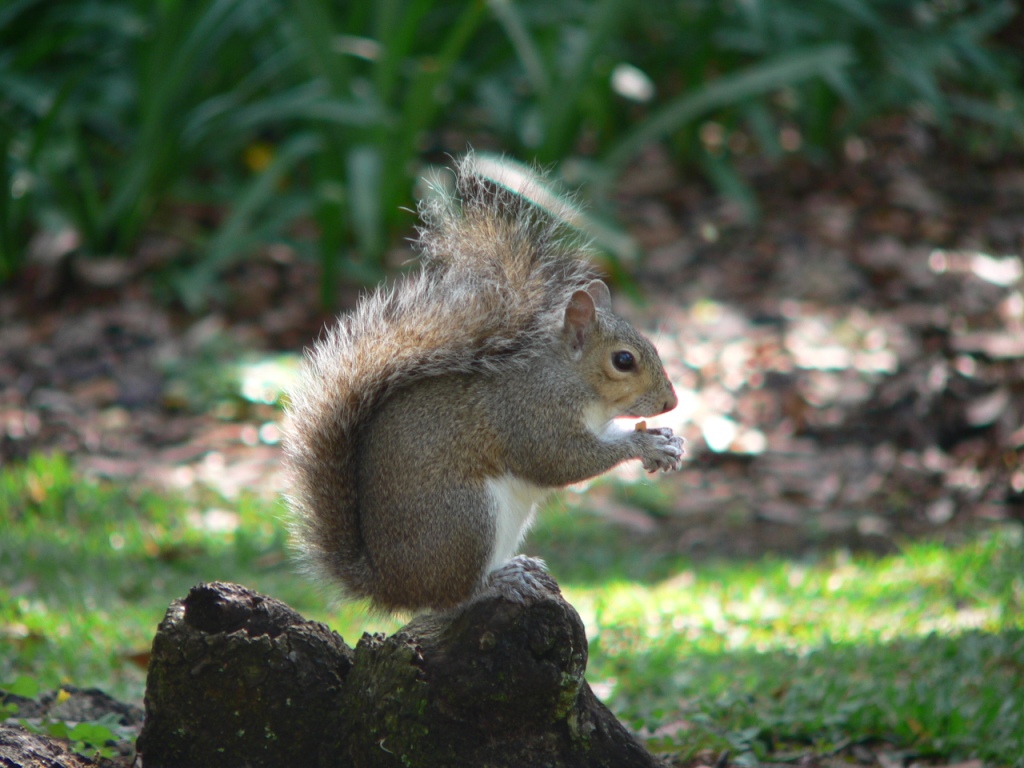
Bok Santuary Squirrel by Lee
When Billy, Louisa, and Will began to prepare to fly away to make their new nests, Susan tried not to cry. Finally, all of the guests left and her children flew away. She hoped they would come home to visit soon, and that they would not fly too far.
Lee’s Addition:
“Now there are diversities of gifts, but the same Spirit….But all these worketh that one and the selfsame Spirit, dividing to every man severally as he will.” (1 Corinthians 12:4, 11 KJV)
Our young writer, Emma Foster, has been growing up and has just graduated from High School. We trust you have enjoyed her Bird Tales over the last 5 1/2 years. She started writing for us on the blog in January of 2012. Her stories have continually improved as she has matured. I still chuckle over her first story of the parrot, Mrs. Patterson’s Parrot, that was too large to come home in the car.
About a week ago, I asked Emma to write a story about birds graduating. This was her answer to the request. I wanted to honor her for her graduation and the wish her well as she starts college and the future.
Now that she has graduated, she plans to work on a degree in writing. She has also assured us that she will continue to send more Bird Tales for us to enjoy. I look forward to those and will continue praying for her as she enters this new phase of her life.

Some of my favorites: (All of them actually)
I give up, they are all my favorites. Thank you, Emma, for all these enjoyable Bird Tales.

“Open thou mine eyes, that I may behold wondrous things out of thy law.” (Psalms 119:18 KJV)
Storm’s Stork (Ciconia stormi) ©©SanDiegoShooter
*
*

“Blessed is that man that maketh the LORD his trust, and respecteth not the proud, nor such as turn aside to lies.” (Psalms 40:4 KJV)
Marabou Stork LP Zoo by Lee
*
*
“Happy is the man that findeth wisdom, and the man that getteth understanding.
(Proverbs 3:13 KJV)
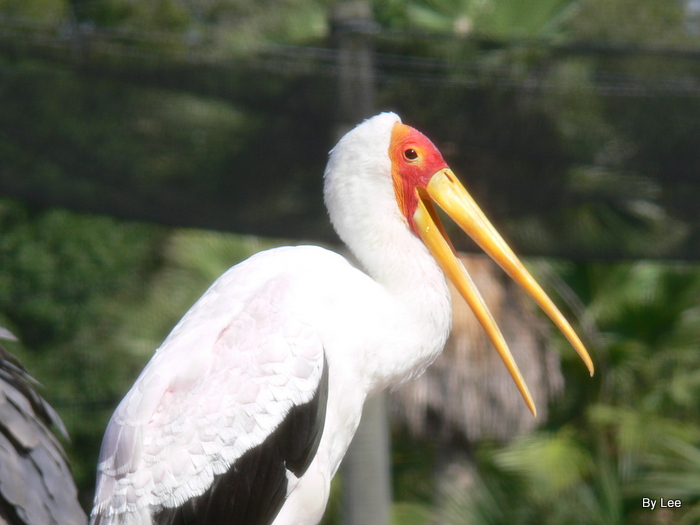
Yellow-billed Stork (Mycteria ibis) by Lee at Lowry Park Zoo
*
*