Logan, Morgan, and Their Historical Nest

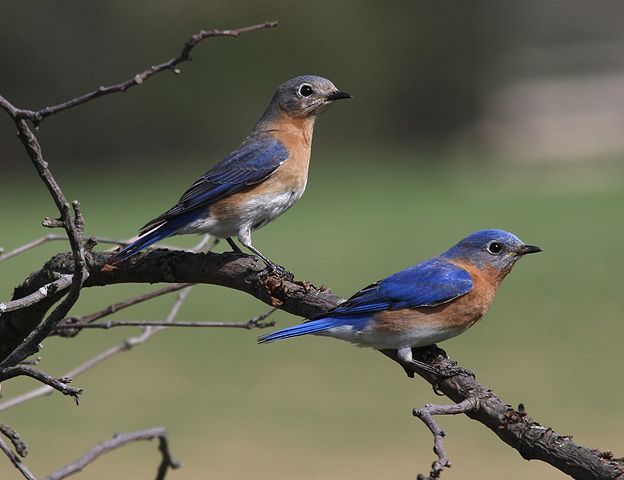
Eastern Bluebird (Sialia sialis) ©WikiC

Logan, Morgan, and Their Historical Nest ~ by Emma Foster

It was 1769 when a distinguished man came to a small plain with a few trees on a mountain and began building a house. In one of the trees, two bluebirds watched as the man oversaw the building of his house. This house was big and built with stone masons who were people who built and cut stone.

The house had white stone pillars and large stone steps in front of a long backyard. Farther down the hill was the plantation where the slaves worked.

The house would not be competed for a long time, and while it was being built, Logan and Morgan decided they would build their nest just like the house was being built.

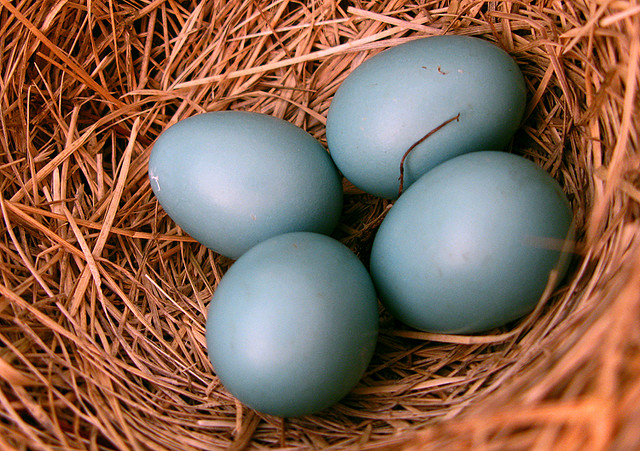
Eastern Bluebird (Sialia sialis) Eggs ©WikiC

Eastern Bluebird (Sialia sialis) Eggs ©WikiC

Logan and Morgan started looking for long, thick sticks to stack together. They started building their nest in one of the trees near the slave’s kitchen. However, this was difficult because of how hard it was to keep the sticks standing straight up in the branches. Logan and Morgan took turns holding the sticks with their beaks while the other looked for more sticks.

Eastern Bluebird (Sialia sialis) by S Slayton

Eastern Bluebird (Sialia sialis) by S Slayton

Eventually, Logan and Morgan finally completed their nest. It wasn’t as grand as the house that was still being built, but the two bluebirds decided that the nest was perfect.

They raised their children in that nest and their children raised their children, until long after the house, called Monticello, was completed.

Montecello. House of Thomas Jefferson

Montecello. House of Thomas Jefferson

Eventually the distinguished man who had built the house died, but Logan and Morgan’s children and grandchildren still lived there. And every year hundreds of people would come to take a tour of that house because it belonged to one of the Presidents of the United States, Thomas Jefferson. Of course, Logan and Morgan never knew that fact.

The End


Lee’s Addition:

Another parable put he forth unto them, saying, The kingdom of heaven is like to a grain of mustard seed, which a man took, and sowed in his field: Which indeed is the least of all seeds: but when it is grown, it is the greatest among herbs, and becometh a tree, so that the birds of the air come and lodge in the branches thereof. (Matthew 13:31-32 KJV)

Emma has now produced her first historical birdwatching tale. Thanks, Emma. Our young writer just turned 16 recently and has grown quite tall (5’11”) like her parents. We used to compare heights when she was shorter than me (4’10”), but now I have to look up at her. Not only has her height increased, but also her writing ability.

As a side note, her family visited Monticello this summer and actually watched some Eastern Bluebirds for some time in the trees there.

*

Other stories by Emma Foster

Eastern Bluebird – Wikipedia

Wordless Birds

*

Pileated Woodpeckers With a Chipmunk, One Singing, and One Eating

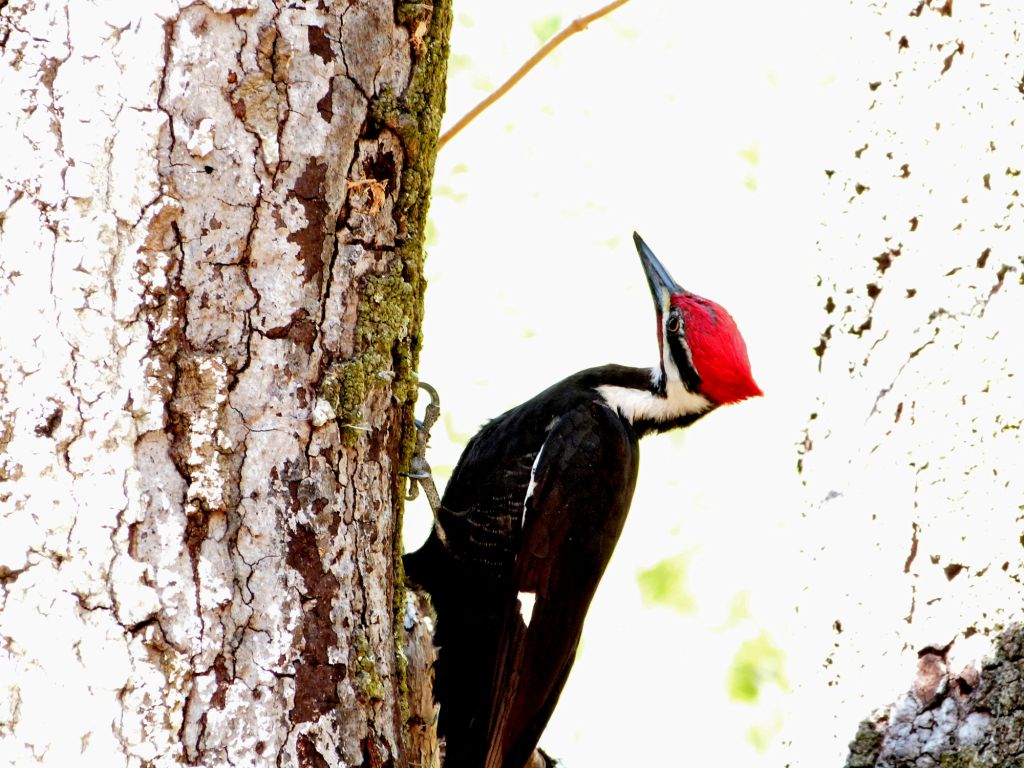
Pileated Woodpecker by Lee

Pileated Woodpecker by Lee

‘Ah, Lord GOD! Behold, You have made the heavens and the earth by Your great power and outstretched arm. There is nothing too hard for You. (Jeremiah 32:17 NKJV)

I always enjoy seeing Pileated Woodpeckers like this one at Circle B Bar Reserve here in the area. This was taken several years ago.

I found these videos on YouTube and they show the Pileated in a different way than we have observed them. Enjoy!

The first one is a YouTube by Dan & Joe. He discovers a chipmunk:

He has made the earth by His power; He has established the world by His wisdom, And stretched out the heaven by His understanding. (Jeremiah 51:15 NKJV)

Here’s another video of a Pileated Woodpecker Singing by Pureimaginationvideo:

This last one has a very good close-up of a Pileated digging for Grubs by Martyn Stewart:

But the LORD is the true God; He is the living God and the everlasting King. At His wrath the earth will tremble, And the nations will not be able to endure His indignation. Thus you shall say to them: “The gods that have not made the heavens and the earth shall perish from the earth and from under these heavens.” He has made the earth by His power, He has established the world by His wisdom, And has stretched out the heavens at His discretion. (Jeremiah 10:10-12 NKJV)

I have been reading through Jeremiah and these verse caught my attention.

*

Birds of the World

Picidae – Woodpeckers Family

Who Paints the Leaves?

*

Ian’s Bird of the Week – Small Lifou White-eye

Ian’s Bird of the Week – Small Lifou White-eye (and random Sacred Kingfisher) ~ by Ian Montgomery

Newsletter – 8/27/15

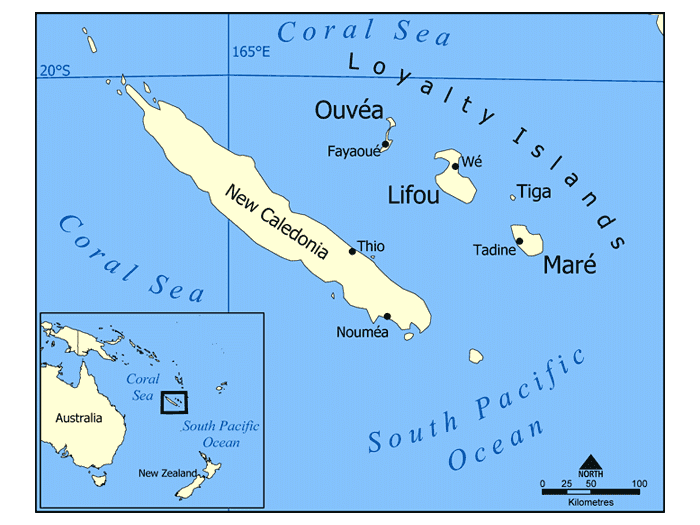
I’m a night-owl, as you may know already, so here is a photo of a noteworthy event: boarding a flight to the Loyalty Islands in complete darkness at 6:00am at Magenta, the domestic airport in Noumea. The goal was to check out several endemic species of birds that occur on two of the Loyalty Islands, Lifou and Ouvéa. The Lifou endemics were supposed to be easy to find near the airport, so we spent a morning there looking for them on foot before flying on to Ouvéa where we had booked a rental car and accommodation for the night (more about Ouvéa next time).

Magenta, the domestic airport in Noumea by Ian

Magenta, the domestic airport in Noumea by Ian

The Loyalty Islands, part of the French Territory of New Caledonia, are supposedly named after an obscure whaling ship called Loyalty or Loyalist built in Nova Scotia in 1788 that is thought to have come across them in 1790. The first recorded Western contact was three years later when another whaler, the Britannia, found them on a voyage from Norfolk Island to Batavia. Melanesians settled the islands about 3000 years ago and the French annexed them in the mid-nineteenth century.

Map of Lifou - New Caledonia

Map of Lifou – New Caledonia

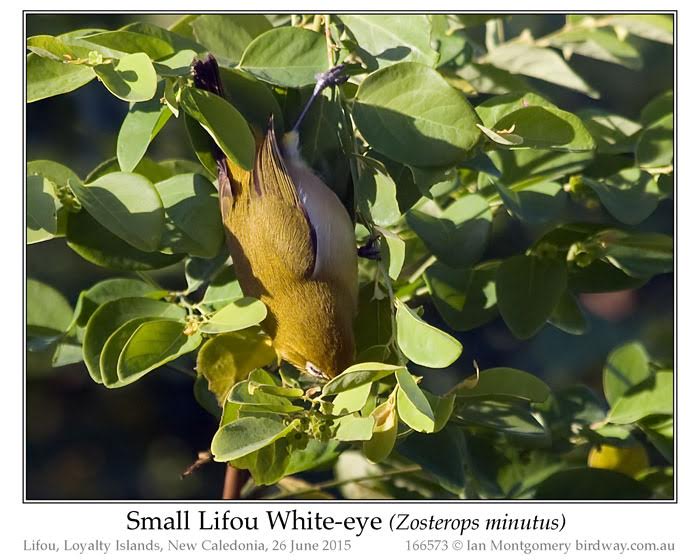
Lifou has two endemic White-eyes, cousins of the Silvereye which also occurs there. The endemic ones are called, accurately but unimaginatively, the Small and Large Lifou White-eyes. The small one we found without difficulty and it is indeed small with a length of 10-11cm/4-4-4.3in and weighting 7.5-9g/0.26-0.31g. Its diagnostic feature is the white flanks, most obvious in the third of its photos.

Small Lifou White-eye (Zosterops minutus) by Ian

We search quite hard but unsuccessfully for the Large Lifou White-eye. It’s very large for a White-eye (15cm/6in) making it even larger than the Giant White-eye (Megazosterops palauensis) of Palau. Interestingly both of these large species lack the white eye-rings that gives them, and the Silvereye, their common names. The Small Lifou White-eye feeds mainly on insects while the large one shows a preference for fruit. This specialisation in diet and divergence in size is to expected in similar species occupying the same habitat, but these two seem to have taken it to extremes.

Small Lifou White-eye (Zosterops minutus) by Ian

The Small Lifou White-eye is close related to the slightly larger Green-backed White-eye (fourth White-eye photo). It occurs on the main island of Grande Terre, the Isle of Pines (south of Grande Terre) and on Maré southwest of Lifou. Meanwhile there are three local races of the Silvereye, one on Grande Terre and the Isle of Pines, another on Maré and Ouvéa and the third on Lifou.

Small Lifou White-eye (Zosterops minutus) by Ian

This complex pattern of colonisation and speciation is typical of members of the family, the Zosteropidae. This is a very successful Old World family with almost 100 species in Africa, Asia and Australasia. They seem to be experts at colonizing out of the way islands, occurring on many islands in the Indian and eastern Pacific Oceans, where they settle down and develop new races and species. White-eyes are very sociable, so it is easy to imagine flocks being blown around by storms or cyclones and making landfall in sufficient numbers to colonise new places.

Green-backed White-eye (Zosterops xanthochroa) by Ian

For the random bird of the week, here’s another species that is good at island hopping, the Sacred Kingfisher. Well known throughout all but the driest parts of mainland Australia it also occurs on some southwest Pacific islands including those of New Zealand and New Caledonia. It has one race on Grande Terre and the Isle of Pines and, you guessed it, another one on the Loyalty Islands, below. This race has very buff underparts and a shorter, slightly flattened bill.

Sacred Kingfisher (Todiramphus sanctus) by Ian

Finishing on a quite unrelated matter, you may have come across recent news, if you live in Australia, about the ultimate in elusive birds , the Night Parrot and the work that Steve Murphy has been doing since its rediscovery by John Young. Bush Heritage Australia is raising money to create a sanctuary to protect this population in southwest Queensland. I’ve already made my (modest) donation and I’d ask you to do so too using this link to make a very practical contribution (yours doesn’t need to be modest) to conserving a very special bird.

Greetings
Ian
**************************************************
Ian Montgomery, Birdway Pty Ltd,
454 Forestry Road, Bluewater, Qld 4818
Tel 0411 602 737 ian@birdway.com.au
Bird Photos http://www.birdway.com.au/
Recorder Society http://www.nqrs.org.au


Lee’s Addition:

Do you not say, ‘There are still four months and then comes the harvest’? Behold, I say to you, lift up your eyes and look at the fields, for they are already white for harvest! (John 4:35 NKJV)

I love those EYES! Every since learning about the White-eyes, they have become one of my favorite species. Thanks, Ian for sharing these adorable birds with us. Kingfishers are also a favorite.

My problem is that when I use my “eyes” to view the Lord’s fantastic birds, how can I not have a problem figuring out which ones are my “most” favorites. I love all of the Lord’s Avian Wonders. I trust you do also.

*

Ian’s Bird of the Week

Ian’s Birdway Zosteropidae Family

Zosteropidae – White-eyes

Wordless Birds

*

Sunday Inspiration – Swallows and Martins

Barn Swallow (Hirundo rustica) baby by Neal Addy Gallery

Barn Swallow (Hirundo rustica) baby by Neal Addy Gallery

Even the sparrow has found a home, And the swallow a nest for herself, Where she may lay her young— Even Your altars, O LORD of hosts, My King and my God. (Psalms 84:3 NKJV)

This week’s 88 avian flyers are from the Hirundinidae Family of Swallows and Martins. The species in this group are River Martins, Saw-wings, Swallows, and Martins of various genus, Many here in America are familiar with the Barn Swallow.

Also, the Swallows are Birds of the Bible, being mentioned in at least four verses; Psalms 84:3, Proverbs 26:2, Isaiah 38:14, and Jeremiah 8:7,

Swallows are in the Hirundinidae – Swallows Family which includes Martins. “Within the Hirundiniae, the name ‘martin’ tends to be used for the squarer-tailed species, and the name “swallow” for the more fork-tailed species; however, there is no scientific distinction between these two groups. The family contains around 88 species in 19 genera.” The subfamilies are: Saw-wings (including Square-tailed, Mountain, White-headed, Black and Fanti), Swallows (many including Barn, Bank, Cave Mangrove, Golden, etc), Martins (Purple, Cuban, Sinaloa, Brown-chested, etc.), Sand Martins (including Brown-throated, Congo, Pale, Banded).

The swallows are found on all continents except Antarctica, with the largest diversity of species in Africa. They are found on many islands, as there are quite a few that migrate long distances. God has designed them with short bills, but with a wide mouth that has a strong jaw. This is useful in their hunt for insects which they catch on the wing. With their streamlined body and wings that are pointed, they are very maneuverable at great speeds. Their forked long tail, that has 12 feathers, helps them steer. They can range from 3.9-9.4 inches and weight between 0.4-2.1 ounces.

This family of birds, to me, are one of the hardest to photograph. They zip about often, but land very seldom to catch their picture. Thankfully the Lord gave these birds a tastebud for insects that have a tastebud for us.

This slideshow requires JavaScript.

Like a flitting sparrow, like a flying swallow, So a curse without cause shall not alight. (Proverbs 26:2 NKJV)

“If I Don’t Have Love” ~ by Jessie Padgett – Special at Faith Baptist

*

More Sunday Inspirations

Birds of the Bible – Swallows

Hirundinidae Family of Swallows and Martins

Swallow – (Wikipedia)

Sharing The Gospel

*

Helps For Updating Bird List To I.O.C. Version 5.3

Mourning Dove by Reinier Munguia

Mourning Dove by Reinier Munguia

Out of the ground the LORD God formed every beast of the field and every bird of the air, and brought them to Adam to see what he would call them. And whatever Adam called each living creature, that was its name. So Adam gave names to all cattle, to the birds of the air, and to every beast of the field… (Genesis 2:19-20a NKJV)

Today I want to share a little behind the scene helps that really make updating a blog and your files. As you may be aware, we use the I.O.C.’s list of world bird names here. About every quarter, they (IOC) delete, add, and revise the species names and positions in the list of all the birds in the world. If you are nutty enough to have had the bright idea, like I did several years back, to list ALL THE BIRDS, then you have a headache every quarter.

Each update they (IOC) provide files you can download with all the birds listed. Most of these are in the Excel format. Spreadsheets like Excel and others can greatly speed up fixing the list to update my site. I use simple (and I mean simple) formulas to combine the bird’s name and its scientific name together with the parenthesis around it. Then just copy the formula down the 10,000 plus birds and “wa laa” you have a

Black-headed Ibis (Threskiornis melanocephalus) instead of  a

Black-headed Ibis” and aThreskiornis melanocephalus with no parenthesis to be found.

=CONCATENATE(E796,” (“,G796,”)”)

E796 is the cell of the English name and G796 is the cell of the Scientific name. The ,” (, and the ,”)” tells it to add a space and parenthesis, and a parenthesis at the end.

I also came up with a naming system to help find the photos of birds on the hard drives. I use a 3-letter code – All Caps – for the Order of birds, a dash(-), followed by a 4-letter code to represent the Family of the birds. It really helps in aiding to find bird photos or to rename them. (that is next)

Another great program, this one is free, is ReNamer from Den4B.com. I use this a lot. ReNamer lets you change the name of files enmasse. File explorer will let you rename a group of files, but you cannot go in there and just change parts of it like ReNamer can do. As I mentioned in the last post about I.O.C. Version 5.3, the Parrot family was split into two families. Fixing the pages that list all the birds was tedious enough, but having to separate the photos on my hard drive was another situation.

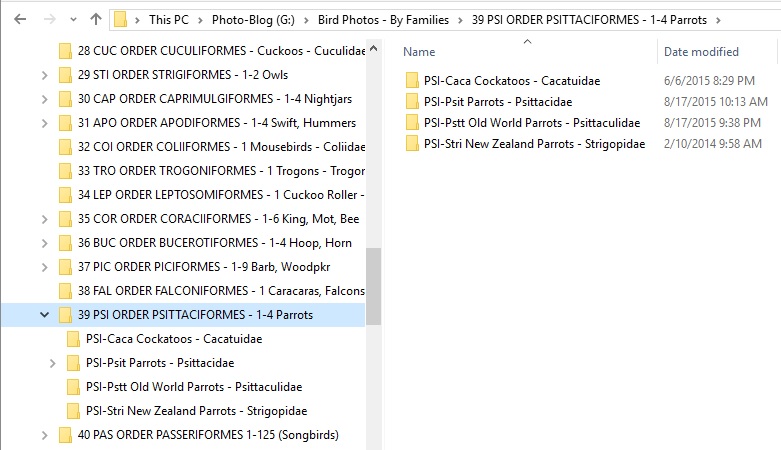
My File Explorer - For Parrots

My File Explorer – For Parrots

My Code for the original Parrot family was PSI-Psit (PSITTACIFORMES order and Psittacidae family) and now with the new Psittaculidae family I came up with PSI-Pstt. So how am I suppose to rename over 200 photos in the new family to the new code? Easy with ReNamer. Drag the files you want to rename into ReNamer, add a new Rule (Replace PSI-Psit with PSI-Pstt), then press the “Rename” button and 200 plus photos are renamed. There are lots of other options. It is a fantastic program in my opinion.

ReNamer from den4b.com

ReNamer from den4b.com

I know for some of you, this was a little more technical than normal, but thought you might find something in it you can use on your projects. The CONCATENATE (combining) feature of Excel and the ReNamer program are both very useful.

Because of health issues and other events going on, the update to I.O.C. Ver. 5.3 has not moved as fast as other versions. I am working on it and here are the families updated so far. I have been making a change to the pages as I work on them. I am adding a slideshow at the bottom of each page. Stay tuned!

‘I have made the earth, the man and the beast that are on the ground, by My great power and by My outstretched arm, and have given it to whom it seemed proper to Me. (Jeremiah 27:5 NKJV)

I.O.C. Version 5.3

Tinamous – Tinamidae
Ostriches – Struthionidae
Rheas – Rheidae
Cassowaries – Casuariidae
Emu – Dromaiidae
Kiwis – Apterygidae
Screamers – Anhimidae
Magpie Goose – Anseranatidae
Ducks, Geese and Swans – Anatidae
Megapodes – Megapodiidae
Chachalacas, Curassows and Guans – Cracidae
Guineafowl – Numididae
New World Quail – Odontophoridae
Pheasants and allies – Phasianidae
Loons – Gaviidae
Penguins – Spheniscidae
Austral Storm Petrels – Oceanitidae
Albatrosses – Diomedeidae
Northern Storm Petrels – Hydrobatidae
Petrels, Shearwaters – Procellariidae
Diving Petrels – Pelecanoididae
Grebes – Podicipedidae
Flamingos – Phoenicopteridae
Tropicbirds – Phaethontidae
Storks – Ciconiidae
Ciconiidae – Storks
* The Parrots
Strigopidae – New Zealand Parrots
Cacatuidae – Cockatoos
Psittacidae – African and New World Parrots
Psittaculidae – Old World Parrots
*

Trumpeter Swans: Trumpeting a Wildlife Conservation Comeback

If a bird’s nest chance to be before you in the way, in any tree, or upon the ground, whether they be young ones [i.e., nestling infant birds], or eggs [i.e., not-yet-hatched baby birds], and the mother [’em is the usual Hebrew noun for “mother”] sitting upon the young, or upon the eggs, you shall not take the mother with the young.  But you shall surely send forth the mother, and take the young [literally “children”] for yourself; that it may be well with you, and that you may prolong days.  Deuteronomy 22:6-7

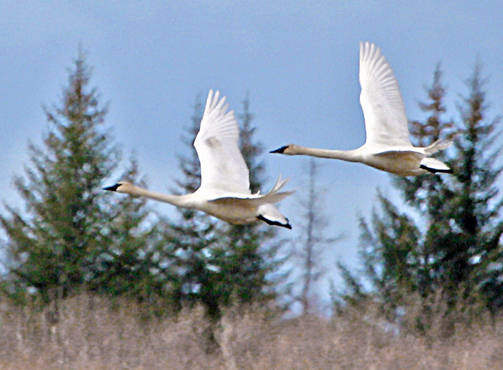
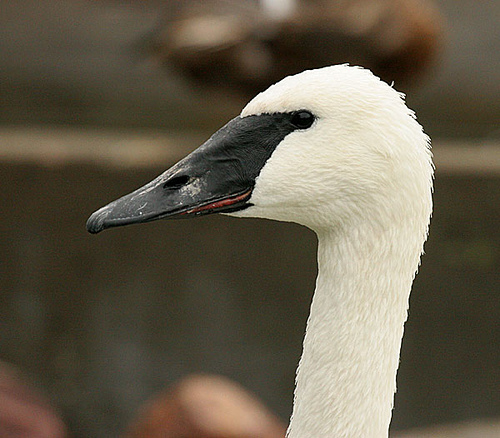
During mid-August (AD2015) my wife and I visited the Columbus Zoo (in Ohio), while vacationing, and I was surprised to see Trumpeter Swans (Cygnus buccinator) there —  and I realized that the Trumpeter Swan illustrated the importance of Deuteronomy 22:6-7.
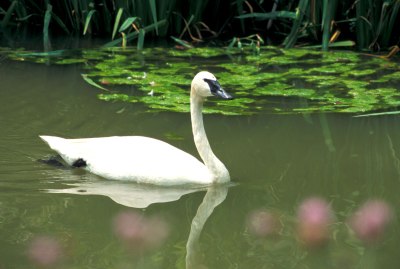
Trumpeter Swan (Cygnus buccinator) ©Columbus Zoo

Trumpeter Swan (Cygnus buccinator) ©Columbus Zoo

Seeing the snowy-white Trumpeter Swans, there, occurred during a telephone call, while we were viewing and identifying various animals, with our enthusiasm-exuding Ohio grandsons (who both call us Mimi and Farfar, the latter name being Norwegian for “father’s father”).  The unexpected telephone call came from a caller in crisis, seeking legal advice, on how to interpret and apply a mix of federal statutes.  It appeared that the call could not wait, till I returned to Texas – such is the lot and responsibility of a vacationing lawyer.

But a bird-watcher has his priorities!  So, as we rounded a bend in the walking trail, and I saw a couple of Trumpeter Swans, I interrupted the phone call with “hold on just a minute”, then I half-screamed to the grandsons: “Look, boys  –  Trumpeter Swans!  Look!  Trumpeter Swans!”

Seeing these massive swans, up close, helps you to appreciate how huge they are.  Trumpeter Swans are the heaviest of all birds that are “native” to North America – and one of the heaviest birds, alive today, that is capable of flight!  Unlike other swans, the Trumpeter Swan has a distinctively black bill, a stark contrast to the all-white hue of its adult plumage.
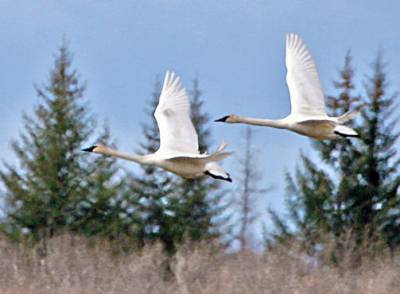
Trumpeter Swan (Cygnus buccinator) ©USFWS

The Trumpeter is a close cousin of Eurasia’s Whooper Swan [Cygnus cygnus], which I previously commented on, in an earlier blogpost about birdwatching in Iceland  (please check out  https://leesbird.com/2014/12/08/birdwatching-in-iceland-part-i/ .)  The Trumpeter Swans did not “trumpet” while we observed them; however, their name is due to their habit of loudly vocalizing with a musical sound like a trumpet, similar to the vocal sounds of their Cygninae cousins, the Whooper Swans and Bewick Swans.  Swans are shaped somewhat like geese, but swans grow larger and have longer (and proportionately thinner) necks.  The poise and posture of swans, accented by their flexible and long necks, appear more elegant than that of geese, some say, although surely mama geese would disagree.  Why are swan necks so lengthy and versatile?  Imagine being nick-named “Edith Swan-neck” — that is the name by which historians remember the wife and widow of England’s last Saxon king, Harold Godwinson, who lost the Battle of Hastings to William the Conqueror, in AD1066.  [ For more on that providentially historic battle, see http://www.norwegiansocietyoftexas.org/wp-content/uploads/2012/04/VikingHistory-GeoWash-ancestry-NST-AD2012.pdf  . ]  Geese have 17 to 23 neck vertebrae, yet swans have 24 or more!  Trumpeters also bob their heads a lot, apparently as a form of visual communication with one another.

Back to the very busy (and very tiring) adventure at the Columbus Zoo in Ohio.

As we all excitedly discussed the Trumpeter Swans, so close to us then, my mind recalled how these quietly graceful and magnificently dignified swans were once very close to the extinction cliff.   According to one study (by Banko, cited below), in AD1957, the United States then hosted only 488 Trumpeter Swans.  It got even worse!  In AD1932, fewer than 70 Trumpeter Swans were known to exist in all of America, with about half of them dwelling at or near Yellowstone National Park’s northwest section.  Would the Trumpeter Swan go extinct like the Passenger Pigeon and the Dodo bird?

What a loss it would have been, if our earthly home had seen a permanent demise of such noble anatids, especially since they once teemed when America was founded!

Trumpeter Swans were once hunted in huge numbers – thousands were killed for their skins and/or feathers.  Sir John Richardson (a Scottish scientist/surgeon who studied the Trumpeter extensively) once wrote that the Trumpeter Swan was “the most common Swan in the interior of the fur-counties.  …  It is to the trumpeter that the bulk of the Swan-skins imported by the Hudson’s Bay Company belong” [as quoted in Winston E. Banko, “The Trumpeter Swan:  Its History, Habits, and Population in the United States”, North American Fauna, 63:1-214 (April 1960), a data-source used for much of this article].  The Trumpeter Swan was well-known of its migratory habits, ranging from Canada to the Gulf of Mexico, according to ornithologist James Audubon:

“The Trumpeter Swans make their appearance on the lower portions of the waters of the Ohio about the end of October. They throw themselves at once into the larger ponds or lakes at no great distance from the river, giving a marked preference to those which are closely surrounded by dense and tall canebrakes, and there remain until the water is closed by ice, when they are forced to proceed southward. During mild winters I have seen Swans of this species in the ponds about Henderson [Kentucky] until the beginning of March, but only a few individuals, which may have stayed there to recover from their wounds. When the cold became intense, most of those which visited the Ohio would remove to the Mississippi, and proceed down that stream as the severity of the weather increased, or return if it diminished. . . . I have traced the winter migrations of this species as far southward as the Texas, where it is abundant at times, . . . At New Orleans . . . the Trumpeters are frequently exposed for sale in the markets, being procured on the ponds of the interior, and on the great lakes leading to the waters of the Gulf of Mexico. . . . The waters of the Arkansas and its tributaries are annually supplied with Trumpeter Swans, and the largest individual which I have examined was shot on a lake near the junction of that river with the Mississippi. It measured nearly ten feet in alar extent, and weighed above thirty-eight pounds.”   [Quotation taken from Banko, on page 15.]

During AD1862 George Barnston, a Scottish-born Hudson’s Bay Company official in Canada, noticed the Trumpeter Swan’s remarkable migration habit, as it is seen in America’s Northwest:
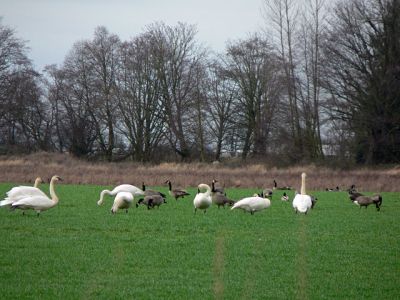
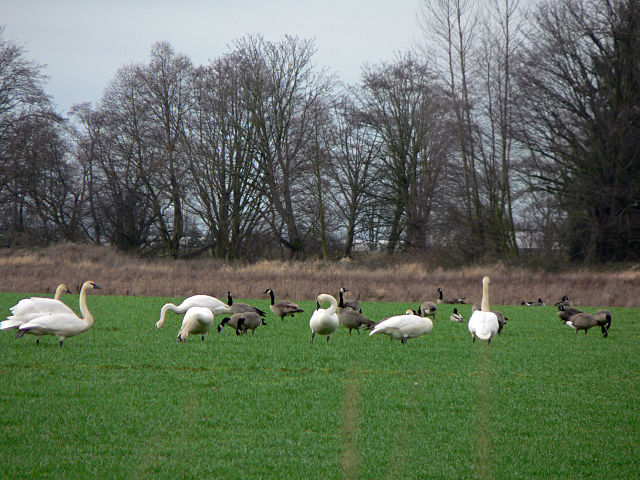
Trumpeter Swan (Cygnus buccinator) and Canadian Geese ©WikiC

Trumpeter Swan (Cygnus buccinator) and Canadian Geese ©WikiC

“In the winter months all the northern regions are deserted by the swans, and from November to April large flocks are to be seen on the expanses of the large rivers of the Oregon territory and California, between the Cascade Range and the Pacific where the climate is particularly mild, and their favourite food abounds in the lakes and placid waters. Collected sometimes in great numbers, their silvery strings embellish the landscape, and form a part of the life and majesty of the scene.”   [Quotation taken from Banko, on page 17.]

Records indicate that Trumpeter Swans were still present in “the states of Washington, Oregon, and California in the Pacific flyway ; Montana, Wyoming, North Dakota, Nebraska, Icansas, and Texas in the Central flyway ; Minnesota, Wisconsin, Iowa, Illinois, Missouri, and Louisiana in the Mississippi flyway ; and Maryland, Virginia, and North Carolina in the Atlantic flyway to demonstrate that the trumpeter still appeared as a migrant or winter resident in those states during the last half of the 19th century”, according to Banko (at page 20).  Banko further reported, in AD1960, that the marketable feathers of swans historically superceded the marketing of their skins (especially by the Hudson’s Bay Company), and soon the population numbers of North American swans were plummeting as swan feathers gained popularity as a glamorous ingredient in fancy hats for ladies, with less flamboyant quills being marketed as ink-pens.   Even the famous Audubon, in AD1828, observed that American Indians engaged in swan hunts, in order to gain the prized plumage of these wondrous waterfowl, many of which feathers would ultimately be exported for resale to ladies of fashion in Europe!  (Banko once served as Refuge Manager, Branch of Wildlife Refuges, for the U.S. Bureau of Sport Fisheries and Wildlife, part of the U.S. Department of the Interior’s Fish & Wildlife Service).
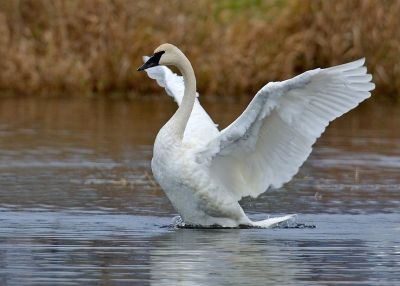
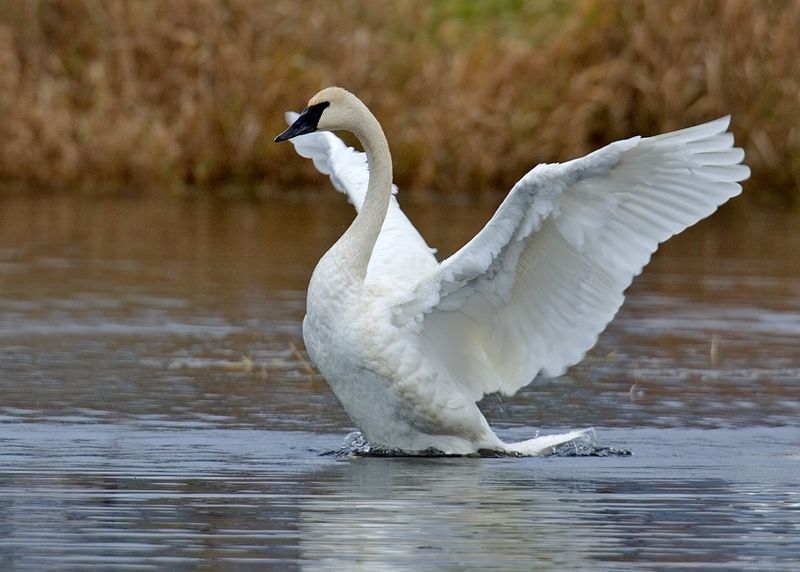
Trumpeter Swan (Cygnus buccinator) ©WikiC naturespicsonline

Trumpeter Swan (Cygnus buccinator) ©WikiC naturespicsonline

As transatlantic trade in fancy feathers burgeoned, the marketing of Trumpeter Swan plumage (as well as plumage of other large birds, such as flamingo, egret, heron, and many others), for fashionable female headgear, was driving the North American population of Trumpeter Swans toward regional extirpations and appeared aimed at a continental extinction, — unless regulatory brakes were somehow applied, with ameliorative conservation efforts to restore the population.

Many conservation efforts combined, to rescue the Trumpeter Swan’s perilous predicament,   four of which were:  (1) the Lacey Act of 1900, that banned trafficking in illegal wildlife; (2) the Migratory Bird Treaty Act of 1918, that implemented the migratory bird protection “convention” treaty, of AD1916, between America and Great Britain (f/b/o Canada); (3) President Franklin D. Roosevelt’s Executive Order 7023 (4-22-AD1935); and (4) the conservation-funding statute called the Federal Aid in Wildlife Restoration [Pittman-Robertson] Act of 1937.  For more on this last federal wildlife conservation-funding law, please review “Crayfish, Caribou, and Scientific Evidence in the Wild”, posted at http://www.icr.org/article/8775 ).

Saving America’s Trumpeter Swan from near-extinction is largely due – humanly speaking – to the establishment of the Red Rock Lakes Migratory Waterfowl Refuge (n/k/a “Red Rock Lakes National Wildlife Refuge”), part of the Greater Yellowstone ecosystem  —  located mostly within a 60-mile radius that includes portions of southwestern Montana, eastern Idaho, and northwestern Wyoming, including Yellowstone National Park, which itself includes a “Trumpeter Lake”.   The Trumpeters have enjoyed dwelling in the Red Rock Lakes neighborhood for generations —  for example, an aerial photograph during January AD1956 shows 80 of them on Culver Pond (east Culver Spring area, where warm spring waters, often found in the Greater Yellowstone Ecosystem, keep the pond from freezing), on a day when the outside air was -20 degrees Fahrenheit!  (See page 59 of Banko’s report, cited above.) This federal wildlife refuge was established by FDR’s presidential executive order (#7023), in AD1935, largely in reaction to the nadir-number of Trumpeter Swan count of less than 70 during AD1932.

Trumpeter Swan (Cygnus buccinator) by Daves BirdingPix

Trumpeter Swan (Cygnus buccinator) by Daves BirdingPix

According to the Red Rock Lakes National Wildlife Refuge’s official website (q.v., at http://www.fws.gov/refuge/Red_Rock_Lakes/about.html), this refuge now includes 51,386 acres, plus conservation easements totaling 23,806 acres, all of which blends into a marvelous mix of snowmelt-watered mountains, montane forests, flowing freshwater, and marshy meadows:

Red Rock Lakes National Wildlife Refuge has often been called the most beautiful national wildlife refuge in the United States. The rugged Centennial Mountains, rising to more than 10,000 feet, provide a dramatic backdrop for this extremely remote Refuge in Southwest Montana’s Centennial Valley. Red Rock Lakes NWR encompasses primarily high mountain, wetland-riparian habitat–the largest in the Greater Yellowstone Area– and is located near the headwaters of the Missouri River. Several creeks flow into the refuge, creating the impressive Upper Red Rock Lake, River Marsh, and Lower Red Rock Lake. The snows of winter replenish the refuge’s lakes and wetlands that provide secluded habitat for many wetland birds, including the trumpeter swan, white-faced ibis, and black-crowned night herons. The Refuge also includes wet meadows, willow riparian, grasslands, and forest habitats. This [ecological] diversity provides habitat for other species such as sandhill cranes, long-billed curlews, peregrine falcons, eagles, hawks, moose, badgers, bears, wolves, pronghorns and native fish such as Arctic grayling and westslope cutthroat trout.”    [Quoting from http://www.fws.gov/refuge/Red_Rock_Lakes/about.html ]

Trumpeter Swans are also seen afloat in lakes of Wyoming’s neighboring park, Grand Teton National Park, a scenic mountain-dominated park accented by the Snake River and Jackson Lake, and historically enjoyed, annually (in the summer), by many bankruptcy barristers (and their families), as they simultaneously attended the Norton Bankruptcy Law Institutes at Jackson Hole, Wyoming.  The Trumpeter pairs are often seen as isolated pairs, each “owning” its own lake, yet these swans also congregate in gregarious flocks, especially in the Red Rock Lakes area.

[Canadians, especially in British Columbia and Alberta, have also been intensively involved in serious efforts to conserve Canada’s population of Trumpeter Swans, for more than 65 years – but this birding report mostly notices and focuses on the Trumpeter conservation efforts in the United States.]

Has FDR’s Executive Order 7023 been followed by conservation and restoration success, for the Trumpeter Swan?   The U.S. Fish & Wildlife Service website reports a happy “yes”:
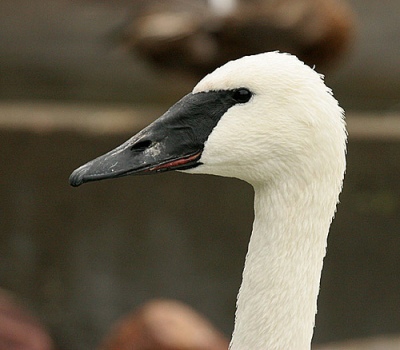
Trumpeter Swan (Cygnus buccinator) by Kent Nickel

Trumpeter Swan (Cygnus buccinator) by Kent Nickel

In 1932, fewer than 70 trumpeters were known to exist worldwide, at a location near Yellowstone National Park.  This led to the establishment of Red Rock Lakes National Wildlife Refuge in 1935.  Red Rock Lakes is located in Montana’s Centennial Valley and is part of the Greater Yellowstone ecosystem.  Nearly half of the known trumpeter swans in 1932 were found in this area.  Warm springs provide year-round open waters where swans find food and cover even in the coldest weather.  Today, estimates show about 46,225 trumpeter swans reside in North America, including some 26,790 in the Pacific Coast population (Alaska, Yukon, and NW British Columbia) which winter on the Pacific Coast; 8,950 in Canada; about 9,809 in the Midwest; and about 487 in the tri-state area of Idaho, Wyoming, and Montana (including the Red Rock Lakes refuge flock).”   [Quoting from http://www.fws.gov/refuge/Red_Rock_Lakes/about.html ]

Sounds like a winner to me  —   from less than 70 to more than 46,000!
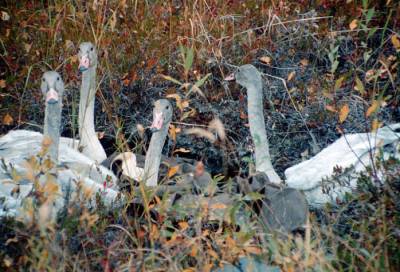
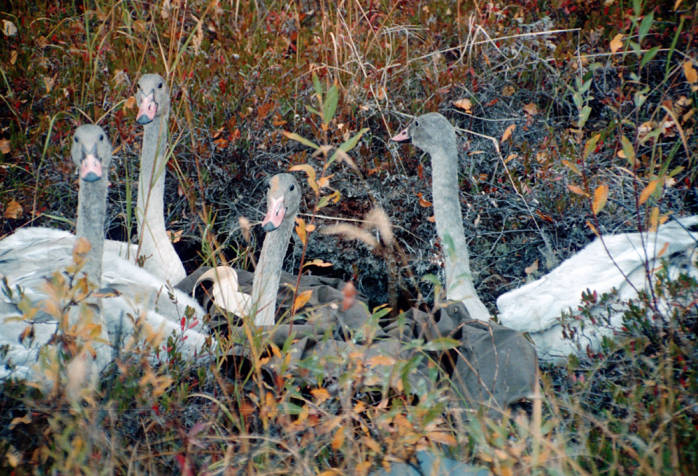
Trumpeter Swan (Cygnus buccinator) cygnets ©USFWS

Trumpeter Swan (Cygnus buccinator) cygnets ©USFWS

However, if only the wildlife conservation principle of Deuteronomy 22:6-7 (i.e., you can take the eggs and nestlings, but not the adult mother birds) had been practiced in North America, during the past 2 or 3 centuries, the continent’s Trumpeter Swan population would never have gotten so close to extinction.  Moses not only mandated restrictions on excessively hunting avian wildlife (Deuteronomy 22:6-7), Moses also banned imprudent deforestation (Deuteronomy 20:19-20).   Of course, creation conservation laws are always balanced to value human life over nonhuman life forms (Matthew 6:26-30; Psalm 8; Jonah 4:8-11).  Yet the promulgated priority of stewardly usage of God’s creation – because all of creation is God’s property, ultimately, not ours! — traces all the way back to Creation Week, because even Adam was put into Eden “to dress it and to keep it” (Genesis 2:15), and Noah managed the greatest biodiversity protection project ever (Genesis chapters 6-9).

Humans have been eating domesticated birds, such as chicken and turkey, ever since Noah’s family disembarked the Ark (Genesis 9:3).  People who raise domesticated fowl (such as chickens) are careful to preserve enough breeders so that they don’t eat up all of their fowl.  [This illustrates the old adage about balancing give and take: if your input exceeds your output, your upkeep is your downfall!]  Accordingly, chicken farmers avoid eating all of their chickens  — it’s important to protect the reproductive success of your chickens if you want poultry eggs and/or chicken meat to eat, on a continuing basis!  But what about wild birds?  The private ownership principle that guides common sense, in raising chickens and other domesticated fowl, doesn’t work so well with wild birds (especially migratory birds), because they are not privately “owned” – so they are a “public” resource vulnerable to irresponsible “tragedy-of-the-commons” depletion.

And most swans are wild, so greedy over-hunting can endanger their population success.

Providentially, the eating of wild birds, such as wild swans, was restricted under Mosaic law, for good reason  —  wild bird populations can be extinguished if one generation of hunters gets too greedy.
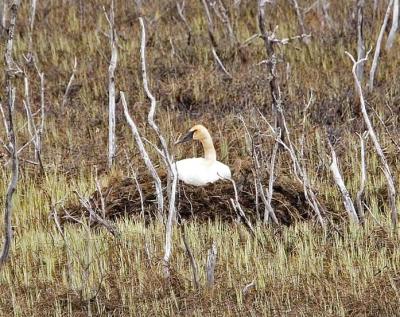
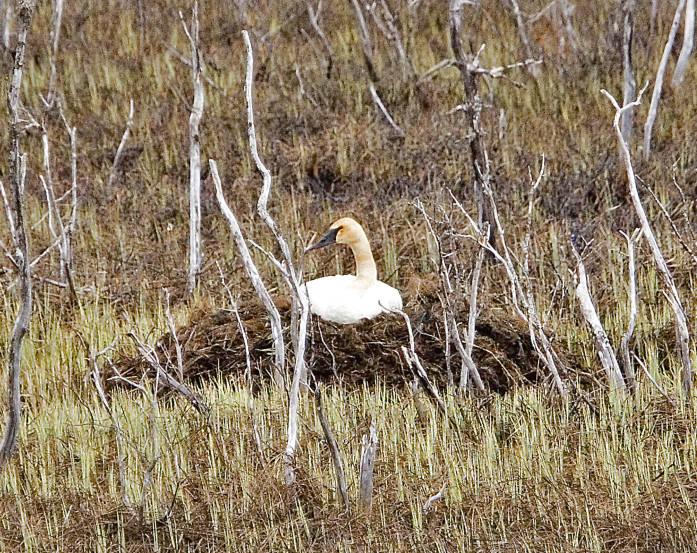
Trumpeter Swan (Cygnus buccinator) on nest ©USFWS

Trumpeter Swan (Cygnus buccinator) on nest ©USFWS

If a bird’s nest chance to be before you in the way, in any tree, or upon the ground, whether they be young one [i.e., nestling infant birds], or eggs [i.e., not-yet-hatched baby birds], and the mother [’em is the usual Hebrew noun for “mother”] sitting upon the young, or upon the eggs, you shall not take the mother with the young.  But you shall surely send forth the mother, and take the young [literally “children”] for yourself; that it may be well with you, and that you may prolong days.  Deuteronomy 22:6-7

This is a simple law of predator-prey dynamics:  if the predator population (i.e., the “eaters”) consume too many of the prey population (i.e., the “eatees”), the result is bad for both populations, because the prey population experiences negative population growth, a trend that can lead to its reproductive failure (and extirpation) if the excessive predation continues unabated.

Each generation of humans, therefore, needs to exercise wise stewardship of Earth’s food resources, so that adequate food resources will be available of posterity (i.e., later generations).  When greed leads to over-hunting, the foreseeable consequence is bad for both the birds (whose population declines, generationally) and the humans (whose food resources decline, generationally).

Sad to say, mankind’s track record for respecting and heeding God’s Word, as it teaches us to be godly stewards of His creation (and to use it in ways that glorify Him, its rightful and only true Owner), all-too-often misses the mark (Romans 3:23).

What slow learners we all-too-often are!   [For Genesis-based ecology perspectives, for this fallen “groaning” world, see http://www.icr.org/article/misreading-earths-groanings-why-evolutionists/ and  http://www.icr.org/article/7486/ and  http://www.icr.org/article/genesis-science-practical-not-just/  and  http://www.icr.org/article/why-we-want-go-home/ .]

Meanwhile, may God have mercy on the people of America, by restoring to us a serious and reverent respect for the whole counsel of God (Acts 20:27), that He has given us in the Holy Bible, His holy Word.  Only then, as we heartily heed His Word, will we properly appreciate and rightly treat His creation, including the Trumpeter Swan.  And, only then, will we properly revere and appreciate Him as our Creator (and Redeemer).  And living life responsibly on His earth, with that kind of reverence, would be far better than the fanciest feather in anyone’s cap!

by James J. S. Johnson

*

More articles by James J. S. Johnson

Orni-Theology

Good News

*
New Parrot Family – I.O.C. 5.3 Version

Mulga Parrot (Psephotellus varius) by Ian

Mulga Parrot (Psephotellus varius) by Ian

My son, fear thou the LORD and the king: and meddle not with them that are given to change: (Proverbs 24:21 KJV)

Finally have my computer and Excel back up running. I decided to start working on the new I.O.C. 5.3 version and was surprised to see that they had divided the Psittacidae – Parrots Family. Well, that family had 369 species and now the new family has been named Pittaculidae –  “Old World Parrots” with 192 parrots.

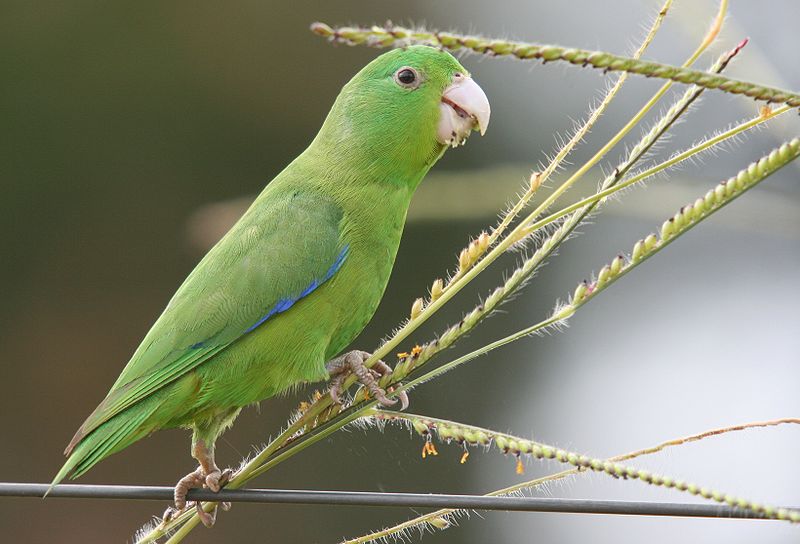
Blue-winged Parrotlet (Forpus xanthopterygius) ©WikiC

Blue-winged Parrotlet (Forpus xanthopterygius) ©WikiC

The old family, Psittacidae – African and New World Parrots has 178 avian wonders. They added two new ones to this family; the Turquoise-winged Parrolett (Forpus spengeli) and the Large-billed Parrotlet (Forpus crassirostris) that were subspecies of the Blue-winged Parrotlet family.

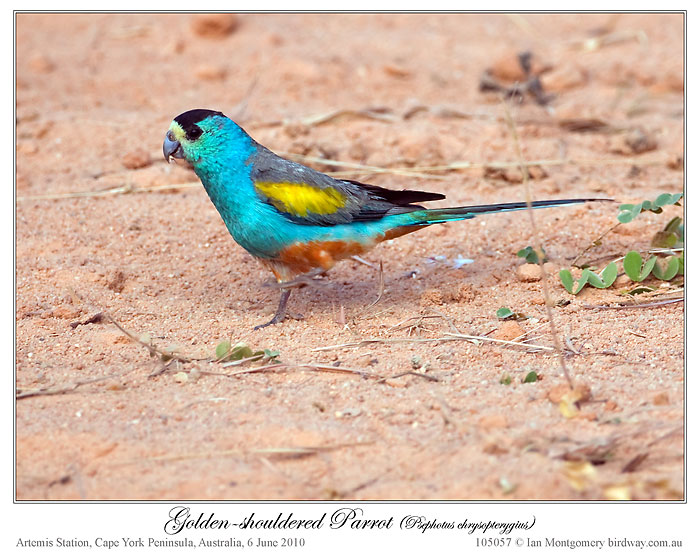
Golden-shouldered Parrot (Psephotellus chrysopterygius) by Ian

Golden-shouldered Parrot (Psephotellus chrysopterygius) by Ian

In the new Psittaculidae – Old World Parrots Family they changed the genus of several birds:

Mulga Parrot (Psephotus varius) to (Psephotellus varius)
Hooded Parrot (Psephotus dissimilis) to (Psephotellus dissimilis)
Golden-shouldered Parrot (Psephotus chrysopterygius) to (Psephotellus chrysopterygius)
Paradise Parakeet (Psephotus pulcherrimus) to (Psephotellus pulcherrimus)

Purple-crowned Lorikeet (Parvipsitta porphyrocephala) WikiC

Purple-crowned Lorikeet (Parvipsitta porphyrocephala) WikiC

Little Lorikeet (Glossopsitta pusilla) to (Parvipsitta pusilla)
Purple-crowned Lorikeet (Glossopsitta porphyrocephala) to (Parvipsitta porphyrocephala)

Cardinal Lory (Pseudeos cardinalis) Busch Gardens, Tampa Bay WikiC

Cardinal Lory (Pseudeos cardinalis) Busch Gardens, Tampa Bay WikiC

Cardinal Lory (Chalcopsitta cardinalis) to (Pseudeos cardinalis)

For now, that is about as far as I have gotten with the update. That was a major reshuffle which I plan to tell about in the next blog. Stay tuned!

The PSITTACIFORMES – Parrot Order

Strigopidae – New Zealand Parrots
Cacatuidae – Cockatoos
Psittacidae – African and New World Parrots
Psittaculidae – Old World Parrots

Gideon

*

Ian’s Bird of the Week – Goliath Imperial Pigeon

Ian’s Bird of the Week – Goliath Imperial Pigeon ~ by Ian Montgomery

Newsletter – 8/17/15

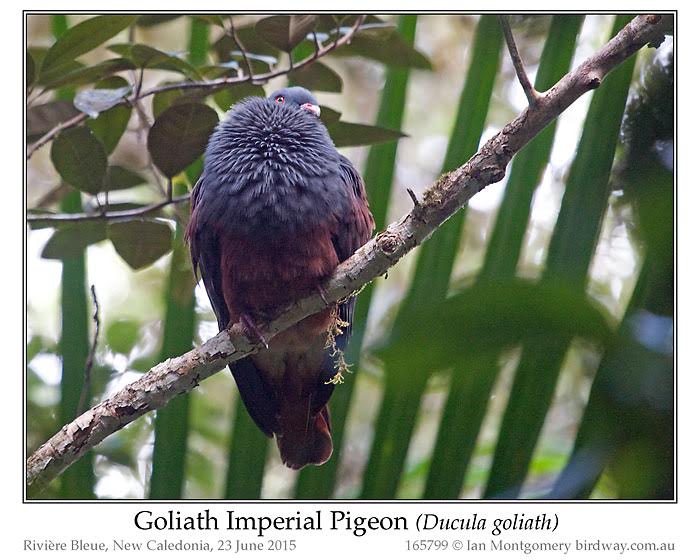
A characteristic sound of montane forests in New Caledonia is the far-carrying call of this splendid pigeon, the Goliath or New Caledonian Imperial Pigeon. The tone is similar to someone blowing in a (large) bottle but the rhythm accelerates like the sound of a table-tennis ball being dropped on a table. Needless to say, we started calling it the ping-pong pigeon. We first heard them in the dense forests of Rivière Bleue, but had trouble actually seeing any apart from one that flew off from feeding on Pandanus fruit. We eventually tracked this one through the forest and found it putting on a display.

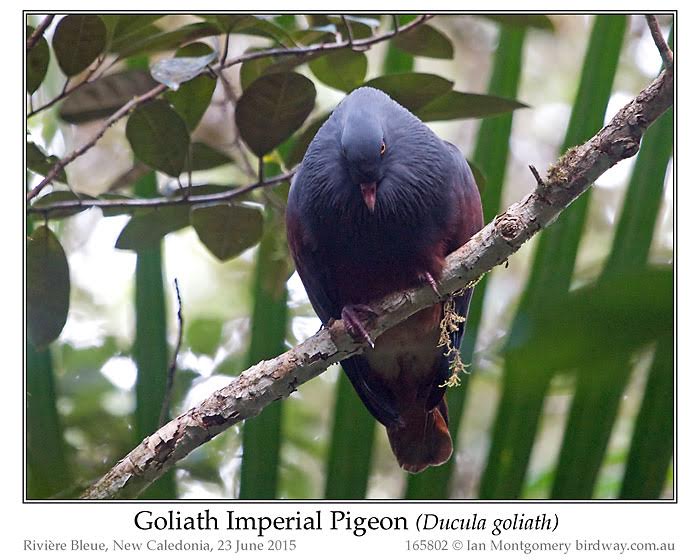
Goliath Imperial Pigeon (Ducula goliath) by IanThe display is similar to that of the domestic pigeon, alternating between puffing out the crop to show the silvery-tipped bifurcated feathers to best advantage (first photo) and bowing (second photo). The head, upperparts and breast are a steely grey while the breast is a rich rufous colour and the vent pale. The iris is a vivid orange red. With a length of up to 51cm/20in and weighing up to 720g/1.6lb, this is a huge pigeon, which unfortunately makes it good to eat. For comparison the Torresian (Pied) Imperial Pigeon of northern and northeastern Australia measures up to 44cm in length and 550g in weight.

Goliath Imperial Pigeon (Ducula goliath) by Ian

It is endemic to the main island of New Caledonia (Grande Terre) and the Isle of Pines. The population has suffered from habitat loss and hunting, so it remains common only in protected areas and is currently listed as Near Threatened. After our hard work finding it in Rivière Bleue we were amused to find one on perched in the open on a power line beside the road to Mount Koghi two days later, third photo. We also heard several and photographed one at Les Grandes Fougères.

Goliath Imperial Pigeon (Ducula goliath) by Ian

The subject of each bird of the week is usually a species that hasn’t featured previously. This tends to mean that I don’t get to share with you new photos of previous subjects. So I’ve decided to include random photos from time to time, such as this one of a Noisy Pitta. I was contacted by a neighbour recently with a wonderful, well-watered garden in which this Pitta has recently taken up residence. Pittas are such beautiful birds and I like this photo because of the way the bird is framed by the leaves behind it.

Noisy Pitta (Pitta versicolor) by Ian

Greetings,
Ian

P.S. (Be warned: this is a commercial break!) Did you know that some ebook sellers provide facilities of giving book as gifts. Maybe you know someone who would enjoy Where to Find Birds in Northeastern Queensland ($13.20 to $22). Kobo books has ebook readers from most devices and computer so check out their page on gifts. With Kobo you go to this page first and then browse for the item you want to give. With Apple iPads and iPhones, you find the item first e.g. Where to Find Birds on Northeastern Queensland in the iTunes Store and then select the Share icon at top right and select Gift:

COL-Colu Goliath Imperial Pigeon (Ducula goliath) by Ian AD

I haven’t found a similar facility in the iTunes store accessed from an Apple computer (the share icon is peculiar to iOS). You can however give gift cards with suggestions from iTunes, Google Play and Kobo.

**************************************************
Ian Montgomery, Birdway Pty Ltd,
454 Forestry Road, Bluewater, Qld 4818
Tel 0411 602 737 ian@birdway.com.au
Bird Photos http://www.birdway.com.au/
Recorder Society http://www.nqrs.org.au


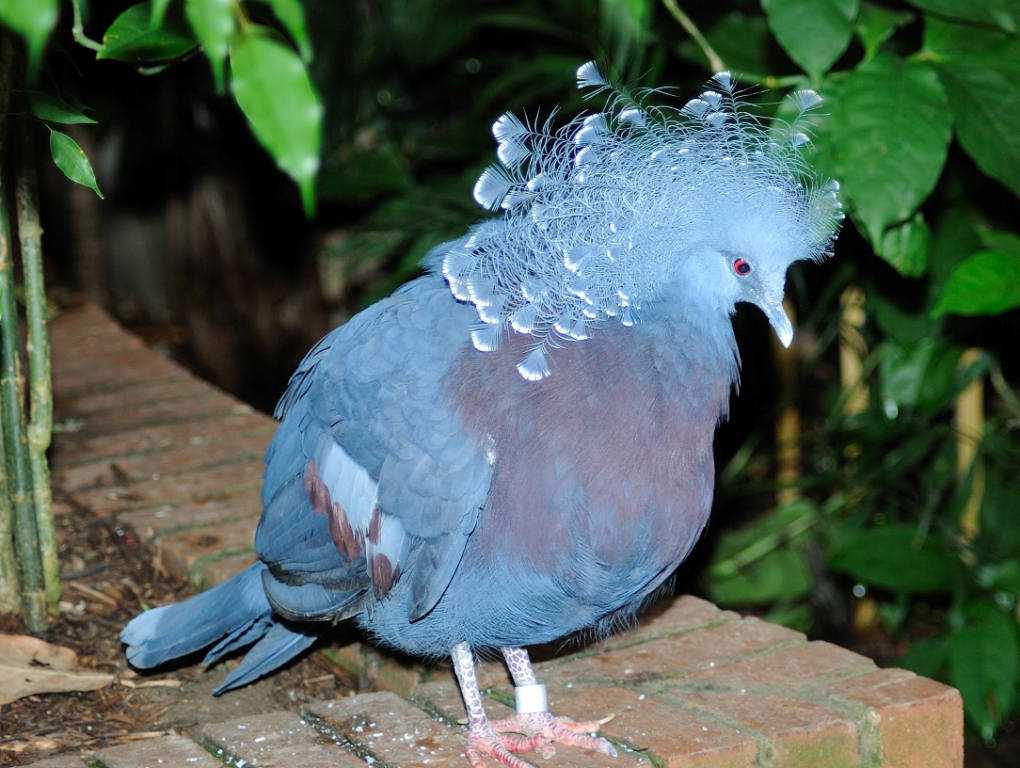
Victoria Crowned Pigeon by Dan at National Aviary

Victoria Crowned Pigeon by Dan at National Aviary

Lee’s Addition:

And a champion went out of the camp of the Philistines named Goliath of Gath, whose height was six cubits and a span [almost ten feet]. (1 Samuel 17:4 AMP)

We have seen the Victoria Crowned Pigeons at Zoos and they are typically 73 to 75 cm (29 to 30 in) long. Ian’s 51cm/20in Goliath Imperial Pigeon is not too far behind. The well-known rock dove is 29 to 37 cm (11 to 15 in) long, for comparison.  However you look at it, they are quite big. One source mentioned that the Goliaths are very strong flyers.

That is also a great photo of the Noisy Pitta. Thanks, Ian for sharing your photos with us each week (or whenever).

Ian’s Bird of the Week newsletters

Columbidae – Pigeons, Doves Family

Wordless Birds

*

Sunday Inspiration – Bulbuls

White-eared (Cheeked) Bulbul (Pycnonotus leucotis) at Zoo Miami by Lee

White-eared (Cheeked) Bulbul (Pycnonotus leucotis) at Zoo Miami by Lee

 Then the trees of the forest will sing for joy before the LORD; For He is coming to judge the earth. O give thanks to the LORD, for He is good; For His lovingkindness is everlasting. (1 Chronicles 16:33-34 NASB)

Bulbuls are a family, Pycnonotidae, of medium-sized passerine songbirds. Many forest species are known as greenbuls, brownbuls, leafloves, bristlebills, finchbills and  a Malia. The family is distributed across most of Africa and into the Middle East, tropical Asia to Indonesia, and north as far as Japan. A few insular species occur on the tropical islands of the Indian Ocean There are 151 species in around 28 genera. While some species are found in most habitats, overall African species are predominantly found in rainforest whilst rainforest species are rare in Asia, instead preferring more open areas.

Collared Finchbill by Dan at Zoo Miami

Bulbuls are short-necked slender passerines. The tails are long and the wings short and rounded. In almost all species the bill is slightly elongated and slightly hooked at the end. They vary in length from 13 cm for the tiny greenbul to 29 cm in the straw-headed bulbul. Overall the sexes are alike, although the females tend to be slightly smaller. In a few species the differences are so great that they have been described as functionally different species. The soft plumage of some species is colourful with yellow, red or orange vents, cheeks, throat or supercilia, but most are drab, with uniform olive-brown to black plumage. Species with dull coloured eyes often sport contrasting eyerings. Some have very distinct crests. Bulbuls are highly vocal, with the calls of most species being described as nasal or gravelly. One author described the song of the brown-eared bulbul as “the most unattractive noises made by any bird”

Let the field be joyful, and all that is therein: then shall all the trees of the wood rejoice (Psalms 96:12 KJV)

Maybe in the case of that brown-eared bulbul, this verse would be more appropriate:

Make a joyful noise unto the LORD, all the earth: make a loud noise, and rejoice, and sing praise. (Psalms 98:4 KJV)

This slideshow requires JavaScript.

“How Deep The Father’s Love For Us” ~ played by Megan Fee and Jill Foster

How deep the Father’s love for us
How vast beyond all measure
That He should give His only Son
To make a wretch His treasure

How great the pain of searing loss
The Father turns His face away
As wounds which mar the Chosen One
Bring many sons to glory

Behold the man upon a cross
My sin upon His shoulders
Ashamed, I hear my mocking voice
Call out among the scoffers

It was my sin that held Him there
Until it was accomplished
His dying breath has brought me life
I know that it is finished

I will not boast in anything
No gifts, no power, no wisdom
But I will boast in Jesus Christ
His death and resurrection

Why should I gain from His reward?
I cannot give an answer
But this I know with all my heart
His wounds have paid my ransom

Why should I gain from His reward?
I cannot give an answer
But this I know with all my heart
His wounds have paid my ransom

For God so loved the world, that he gave his only begotten Son, that whosoever believeth in him should not perish, but have everlasting life. (John 3:16 KJV)

*
More Sunday Inspirations

Pycnonotidae – Bulbuls Family

Bulbul – Wikipedia

Falling Plates

*

Taking A Ride

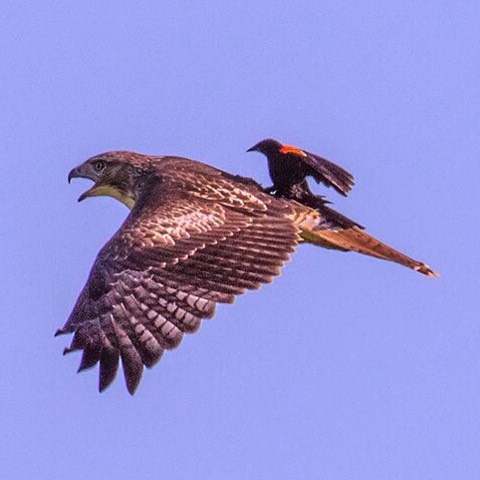
Blackbird on a Hawk's Back ©Dept of Interior

Blackbird on a Hawk’s Back ©Dept of Interior

Terrors shall make him afraid on every side and shall chase him at his heels. (Job 18:11 AMP)

Here we go again with a smaller bird attacking a larger bird. This time a Red-winged Blackbird is on a Hawk’s back.

See Rare Picture: Blackbird “Rides” Hawk. from Focusing on Wildlife.

*

Crow Versus Eagle, Free Ride Instead

Woodpecker With A Weasel On It’s Back

Birds of the Bible – Get Off My Back

Wordless Birds

*

Acorn Woodpecker and Rehab

“Dewey” Acorn Woodpecker at Rehab Ctr by Lee

The steps of a good man (lady) are ordered by the LORD: and he delighteth in his way. Though he fall, he shall not be utterly cast down: for the LORD upholdeth him with his hand. I have been young, and now am old; yet have I not seen the righteous forsaken, nor his seed begging bread. (Psa 37:23-25)

While on our vacation, we visited the Living Desert Museum and Rehab Center in California. One of the “rehab-ees” was an Acorn Woodpecker named Dewey. He is 25 years old and “despite being geriatric with multiple health problems, he is very active.

“Dewey” Acorn Woodpecker Sign at Rehab Ctr by Lee

As you can see by this next photo his beak is really in bad shape. He can not return to the wild of course and so is being well taken care of.

Dewey's Beak - Cropped

Dewey’s Beak – Cropped

I decided to share Dewey’s rehab because of what has been happening around Lee’s Birdwatching Adventures place. Dewey and I are becoming older and things happen.

About three weeks ago I started having sharp pains in my back and found it hard to stand up.  Long story, short, my vertebrae in my back has slipped. Nine years ago, my S1 and L5 slipped and I had surgery to fuse those two with a rod and screws. They were not able to do one side because my bones were too soft on one side to be able to put the normal two rods in.

Now the L4 has slid about 50%. That is considered serious and surgery is the main way to fix it. For now, we are going to try other options first. I started “rehab” yesterday to help strenghten my back muscles to keep it from sliding any more. They gave me a brace and walker. Today, we took a break and here is a photo of me with my new “gear.”

Lee at Brevard Zoo 8-13-15

Lee at Brevard Zoo 8-13-15

Because of what has been going on lately, I haven’t visited your sites as frequently as I try to do.

This “Rehab” does not stop there. My computer has been in “Rehab” also. We switched to the new Windows 10 and it has been a real challenge. Lost programs and have had other challenges that go with an upgrade.

No, that is not all of it. We upgraded to the new Office 365 and that is not working right either. It works fine on Dan’s Desk and Laptops, my laptop, but not my desktop. Days and two chats with the Office techs, and it still isn’t working. I have an appointment with a Level 2 tech on Saturday to try to get it running. I need the Excel to work on the new I.O.C. 5.3 version that recently came out.

See why we came to the zoo today? I needed to get away from the “zoo” at home. :)

Now also when I am old and grayheaded, O God, forsake me not; until I have shewed thy strength unto this generation, and thy power to every one that is to come. (Psa 71:18)

Thanks for your prayers as we work through these challenges. Not all that go in for rehab stay there forever. Many birds are patched up and released back outside to fly again. Soon these minor slow downs will be cleared up and the blog will be “flying again”. We still have more birdwatching adventures to share yet. The Lord’s creations are just waiting to be shown to our next generation.

*

Gideon

Birds of the Bible – Jeremiah 19:7

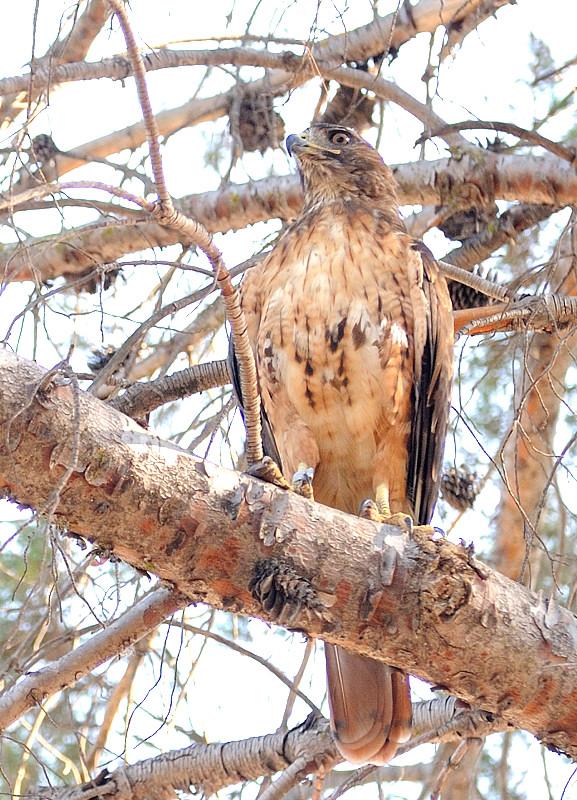
Bird of Prey by Phil Kwong Galleries

Bird of Prey by Phil Kwong Galleries

“And I will make void the counsel of Judah and Jerusalem in this place, and I will cause them to fall by the sword before their enemies and by the hands of those who seek their lives; their corpses I will give as meat for the birds of the heaven and for the beasts of the earth.” (Jeremiah 19:7 NKJV)

I’m currently traveling through Jeremiah in my personal reading of the Bible. Jeremiah is known as the weeping prophet and it is easy to see why he was called that. Parts of the Scripture are hard to read, not that the words are hard, but because of that which is happening.

When birds are mentioned, of course, those verses catch my attention. What, where, and why are they being mentioned? Normally if you just pick out a verse those questions would pop into your head. Because of reading through Jeremiah, those thoughts were already answered.

Jeremiah was sent to inform the Israelites of the judgment coming because of their sins. He was told: “Thus says the LORD: “Go and get a potter’s earthen flask, and take some of the elders of the people and some of the elders of the priests. And go out to the Valley of the Son of Hinnom.” So he did as commanded.

When they got to the valley, he was told to proclaim there the words that I will tell you.

and say, ‘Hear the word of the LORD, O kings of Judah and inhabitants of Jerusalem. Thus says the LORD of hosts, the God of Israel: “Behold, I will bring such a catastrophe on this place, that whoever hears of it, his ears will tingle. “Because they have forsaken Me and made this an alien place, because they have burned incense in it to other gods whom neither they, their fathers, nor the kings of Judah have known, and have filled this place with the blood of the innocents (they have also built the high places of Baal, to burn their sons with fire for burnt offerings to Baal, which I did not command or speak, nor did it come into My mind), therefore behold, the days are coming,” says the LORD, “that this place shall no more be called Tophet or the Valley of the Son of Hinnom, but the Valley of Slaughter. And I will make void the counsel of Judah and Jerusalem in this place, and I will cause them to fall by the sword before their enemies and by the hands of those who seek their lives; their corpses I will give as meat for the birds of the heaven and for the beasts of the earth. (Jeremiah 19:3-7 NKJV)

That is hard, but God is Just. God is Longsuffering. God is Love. God is all these at the same time. People like to say because God loves he would never condemn or judge someone. Not true. He destroyed the whole world with a universal flood because of sin, yet he saved eight souls and the critters. He destroyed Sodom because of sexual sin of those who perverted it, yet he saved three. There are other examples throughout the Bible.

Here we have a nation, His chosen people, had grown cold in their worship of Him and turned to other gods and even sacrificed their children. Sound like our nations today? People do not believe in God, but would rather believe in evolution, have abortions, pervert God’s gift of intimate relations in marriage. On and on, the churches are accepting all kinds of things that God said ” which I did not command or speak, nor did it come into My mind.” Will we come to that judgment also?

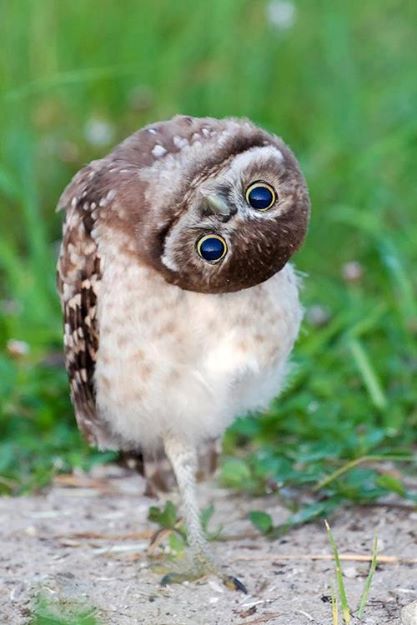
Burrowing Owl from Dusky's Wonders

Burrowing Owl from Dusky’s Wonders

I love watching the Birds of the Air, but am sorry that they have to become Birds of Prey because of people’s denial of the God and Savior, the Lord Jesus Christ.

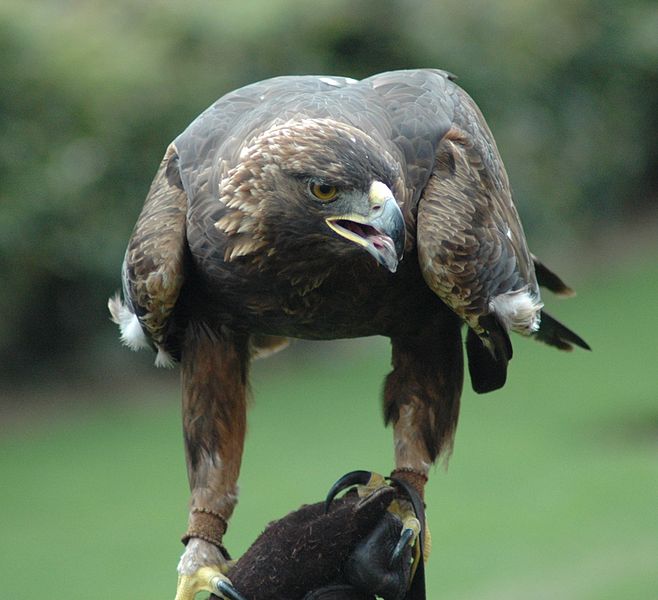
Golden Eagle (Aquila chrysaetos) ©WikiC

Golden Eagle (Aquila chrysaetos) ©WikiC

We are encouraged to return to the Lord God’s Word.

For God so loved the world that He gave His only begotten Son, that whoever believes in Him should not perish but have everlasting life. (17) For God did not send His Son into the world to condemn the world, but that the world through Him might be saved. (18) “He who believes in Him is not condemned; but he who does not believe is condemned already, because he has not believed in the name of the only begotten Son of God. (19) And this is the condemnation, that the light has come into the world, and men loved darkness rather than light, because their deeds were evil. (20) For everyone practicing evil hates the light and does not come to the light, lest his deeds should be exposed. (21) But he who does the truth comes to the light, that his deeds may be clearly seen, that they have been done in God.” (John 3:16-21 NKJV)

Like I said earlier, some things are hard to read and share, but it is there in the Word and the Word is True.

*

Birds of the Bible

Gospel Message

*