Cormorants are Great; Great Cormorants are Really Great!

Cormorants are Great; Great Cormorants are Really Great!

Dr. James J. S. Johnson

“But the cormorant [shalak] and the bittern shall possess it [i.e., the land of Idumea, a/k/a Edom]; the owl also and the raven shall dwell in it; and He [i.e., the LORD, in judgment] shall stretch out upon it the line of confusion, and the stones of emptiness.“

Isaiah 34:11
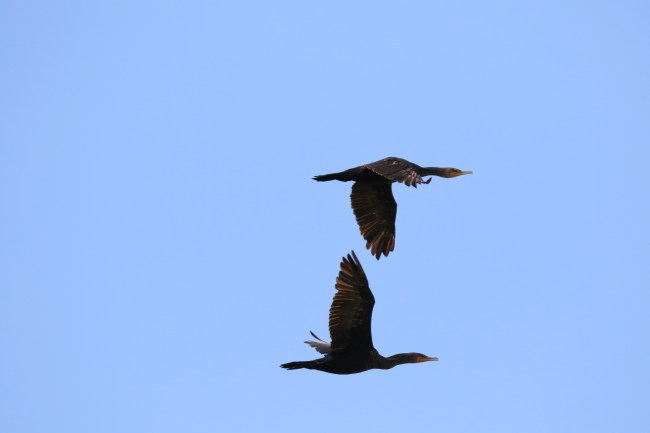
GREAT CORMORANTS in flight (Minnesota)
photo credit: Bryce Gaudian

In some contexts, CORMORANTS are not deemed as indicators of blessing — as in Isaiah 34;11, where it is prophetically mentioned as an indicator that the land of Edom is catastrophically destroyed. However, in many other contexts, these magnificent birds are recognized as wonderful creatures whom God has equipped to live by bodies of water, both freshwater and seawater.

GREAT CORMORANT aloft (Minnesota)
photo credit: Bryce Gaudian

Cormorants love to live by bodies of water. Cormorants are found busy hunting — darting (befitting the Hebrew noun shalak, in Leviticus 11:17 & Deuteronomy 14:17, translated “cormorant”, which matches the darting-like targeting movements) for food over and near coastlines, including the coasts of islands, such as the Hebridean isle of Staffa, which was reported earlier (on this Christian birdwatching blog), in the report titled “Birdwatching at Staffa: Puffins, Shags, and more”, posted at https://leesbird.com/2019/07/22/birdwatching-at-staffa-puffins-shags-more/ (July 22nd A.D.2019), citing Isaiah 42:12. [Regarding “cormorants” in the Holy Bible, see George S. Cansdale, ALL THE ANIMALS OF THE BIBLE LANDS (Zondervan, 1976), at page 175.]

Cormorants constitute a large “family” of birds; the mix of “cousins” include Crowned Cormorant (Phalacrocorax coronatus), Brandt’s Cormorant (Phalacrocorax penicillatus), Galapagos Cormorant (Phalacrocorax harrisi), Bank Cormorant (Phalacrocorax neglectus), Neo-tropic Cormorant (Phalacrocorax brasilianus), Double-crested Cormorant (Phalacrocorax auritus), Indian Cormorant Phalacrocorax fuscicollis), Socotra Cormorant (Phalacrocorax nigrogularis), Cape Cormorant (Phalacrocorax capensis), Guanay Cormorant (Phalacrocorax bougainvillii, a/k/a Guanay Shag), Kerguelen Shag (Phalacrocorax verrucosus), Imperial Shag (Phalacrocorax atriceps), Antarctic Shag (Phalacrocorax bransfieldensis). South Georgia Shag (Phalacrocorax georgianus), Campbell Island Shag (Phalacrocorax campbelli), New Zealand King Shag (Phalacrocorax carunculatus), Bronze Shag (Phalacrocorax chalconous), Chatham Island Shag (Phalacrocorax onslowi), Auckland Island Shag (Phalacrocorax colensoi), Rock Shag (Phalacrocorax magellanicus), Bounty Island Shag (Phalacrocorax ranfurlyi), Red-faced Cormorant (Phalacrocorax urile, a/k/a Red-faced Shag), European Shag (Phalacrocorax aristotelis), Pelagic Cormorant (Phalacrocorax pelagicus, a/k/a Pelagic Shag), Red-legged Cormorant (Phalacrocorax gaimardi), Spotted Shag (Phalacrocorax punctatus), Pied Cormorant (Phalacrocorax varius), Great Cormorant (Phalacrocorax carbo), Japanese Cormorant (Phalacrocorax capillatus), Olivaceous Cormorant (Phalacrocorax olivaceus, a/k/a Mexican Cormorant), and Pitt Island Shag (Phalacrocorax featherstoni).

That’s a lot of cormorant “cousins”, worldwide! [For details on each of these “cousins”, see pages 116-136 of Jim Enticott & David Tipling, SEABIRDS OF THE WORLD: THE COMPLETE REFERENCE (Stackpole Books, 1997).]

Notice: Cormorants are not anhingas!

To distinguish these 2 large black fish-loving birds, see “Of Cormorants and Anhingas” (June 13th A.D.2019), posted at https://leesbird.com/2019/06/13/of-cormorants-and-anhingas/ .
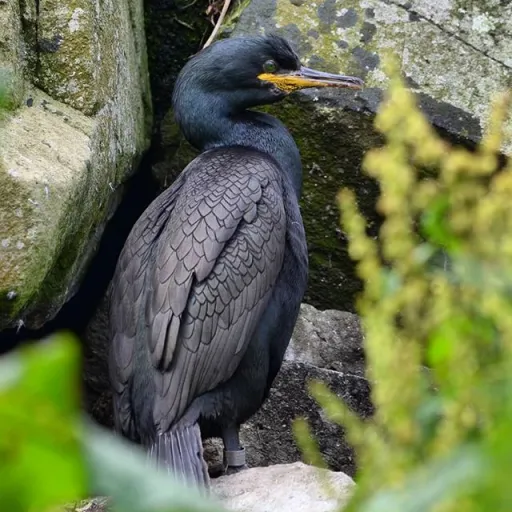
SHAG (a type of Cormorant), at Staffa, Hebrides (Scotland)
photo credit: Public Insta

Cormorants are famous “fishermen” along ocean coastlines, yet cormorants also thrive in inland freshwater habitats, such as over and near ponds and lakes, such as the Double-crested Cormorants that frequent inland ponds in Denton County, Texas, where they catch “fish of the day”.
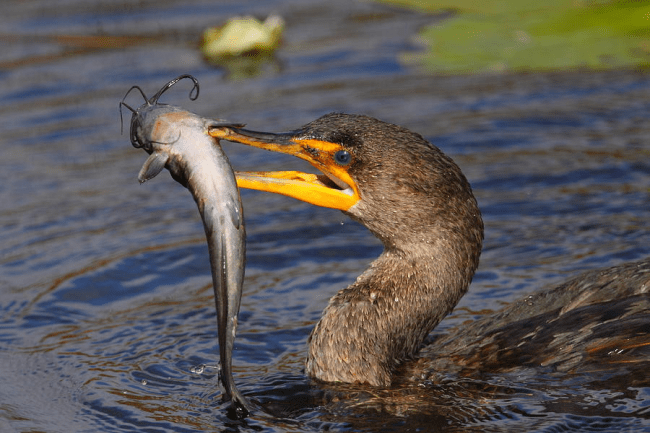
DOUBLE-CRESTED CORMORANT with fish
photo credit: Bruce J. Robinson

Cormorants are generally described, by ornithologist Roger Tory Peterson, as follows:

Large, blackish, slender-billed water birds. Often confused with loons, but tail longer, bill hook-tipped. In flight, wing action is more rapid and axis of body and neck is tilted upward slightly (loon’s neck droops). Young birds are browner, with a pale or whitish breast. Flocks [of cormorants] fly in line or wedge formation very much like geese but they are silent. Cormorants often perch in upright positions on buoys or posts with neck in an S [posture]; sometimes strike a “spread eagle” pose. Swimming, they lie low like loons, but with necks more erect and snakelike, and bills tilted upward at an angle. Food: Fish (chiefly non-game). Nearly cosmopolitan [in range].

[Quoting Roger Tory Peterson, cited below]

[See Roger Tory Peterson, A FIELD GUIDE TO THE BIRDS OF TEXAS AND ADJACENT STATES (Houghton Mifflin, 1988), page 10.]

Specifically, the Double-crested Cormorant (Phalacrocorax auritis) is perhaps the most common winter migrant of the cormorants; also, the Double-crested Cormorant is often seen in the coastline areas of Texas’ Gulf of Mexico shores.

GREAT CORMORANTS descending (Minnesota)
photo credit: Bryce Gaudian

Have you ever watching a silhouetted cormorant — or two — or three — winging their way across the late afternoon sky? It is a wonder to behold!

GREAT CORMORANTS silhouetted against the sky
photo credit: Bryce Gaudian

Now, try to imagine a dozen, or more, cormorants, flying in series. That’s a wondrous wonder to behold! That constitutes one of the “wonders without number” that Scripture refers to (in Job 9:10).
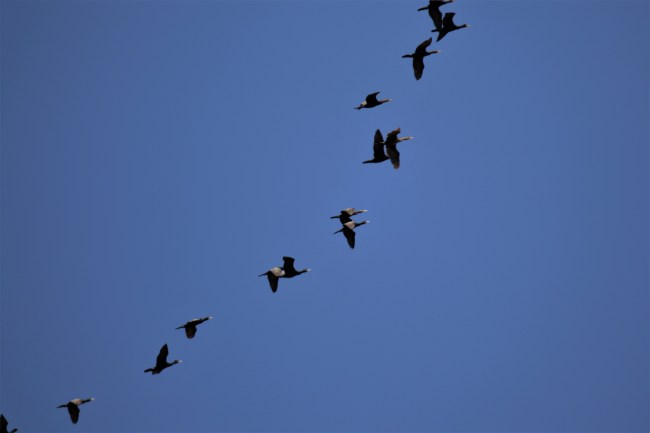
serial “line” of GREAT CORMORANTS in flight (Texas)
photo credit: Bryce Gaudian

And now here is my closing limerick, about cormorants:

APPRECIATING HUMBLE CORMORANTS (AND SHAGS)

Cormorants are not known to brag,

If they’re so-called, or called “shag”;

They oft fly, in a line,

And on fish, they oft dine —

But cormorants aren’t known to brag.
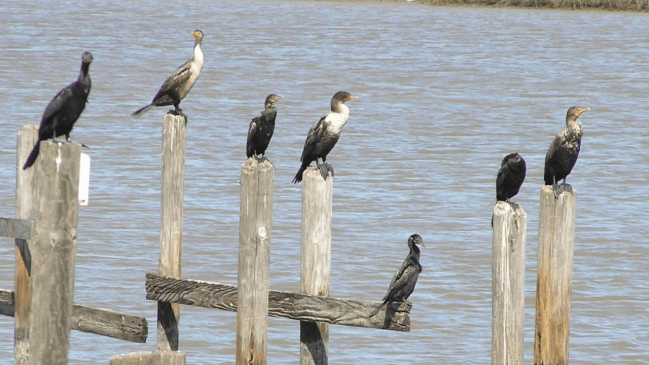
DOUBLE-CRESTED CORMORANTS perching on posts
photo credit: Mark Eising Birding

(Dr. Jim Johnson formerly taught ornithology and avian conservation at Dallas Christian College, among other subjects, and he has served as a naturalist-historian guest lecturer aboard 9 international cruise ships, some of which sailed in seawaters frequented by cormorants and shags. Jim was introduced to Christian birdwatching as an 8-year-old, by his godly 2nd grade teacher, Mrs. Thelma Bumgardner.)

An Apology and a Great Thank You!!

American Woodcock through door 12-3-19 by Lee

American Woodcock through door 12-3-19 by Lee

I would like to apologize for my lack of posting any articles since back in February of this year. (More explanation later.) What I am really thankful for is Dr. James J.S. Johnson, Dr. Jim, as Dan and I affectionately call him.

THANK YOU, DR. JIM!

Also a Hugh THANK YOU to all of you who have continued to stop by this blog. Many of you have read and commented of his articles and other previously published posts.

Black-bellied Whistling Ducks feeding in yard.

Back in February, a number of health problems began, and it seemed like about the time I improved, some other issue came up. It seems that it has just been one thing after another. Needless to say between Doctor visits, physical therapy, medical test, using cane or walker, etc. etc., birdwatching has come to a halt other than my view out the back door.

“God is faithful, by whom you were called into the fellowship of His Son, Jesus Christ our Lord.” (1 Cor. 1:9)

That top photo about describes the lack of birds lately. Like many of you around the country and parts of the world, we have had some very high heat indexes. Plus, the wintering birds have not arrived yet.

Other than Muscovy Ducks and the neighborhood Robins and Doves, there hasn’t been much going on.

Lord willing, I trust that there will be more post from me. Now that I’m improving some, I will try to at least write more about God’s amazingly Created Avian Wonders. Stay tuned!

Thanks again to all our visitors to this blog and “Dr. Jim” for keeping us blessed by his great articles.

Good News

Birds of the Bible Articles

Check the many other links on the main page.

ON SEEING A GRACKLE IN THE POND-SHORE CATTAILS

On Seeing a Grackle in the Pond-shore Cattails

Dr. James J. S. Johnson

This shall be written for the generation to come; and the people who shall be created shall praise the LORD.

(Psalm 102:18)
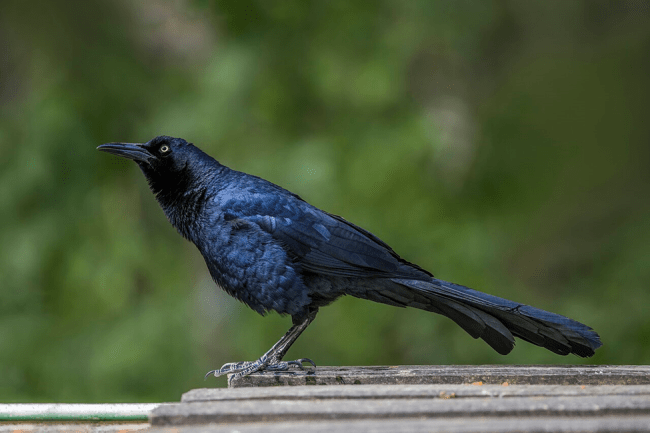
GREAT-TAILED GRACKLE (male)
Charles J. Sharp / Wikipedia photo credit

Last weekend, I drove past a familiar Texas pond, where 11 years ago I saw a “common” black-feathered bird (i.e., Quiscalus mexicanus = Great-tailed Grackle, to be exact), and was then jolted by an “uncommon” (and somewhat-scary) realization – God could have made me a grackle! 

Days later, during the summer of AD2012, I reported this important thought (and attitude fo gratitude) within an article [“Grackles and Gratitude”, ACTS & FACTS, 41(7):8-10 July 2012), posted at www.icr.org/article/grackles-gratitude ] about how uniquely and personally each one of us is, created by the Lord Jesus Christ, as exactly the specific individual that each one of us is. 

When was the last time that you saw a bird—perhaps a grackle or a pigeon—and shuddered with the scary realization: That could have been me! Maybe you have never thought about a grackle that way. Yet it is true—God did not need to make us just as we are. He had many other options. God could have created each of us as a bird, a butterfly, or a basalt rock. God could have made you or me a uranium-bearing rock, a nudibranch, an ice worm, a quince fruit, an ultraviolet ray, or an egret. [Notice the acrostic in the previous sentence: U.N.I.Q.U.E.!]

Yet, He deliberately chose otherwise. He chose to make us one-of-a-kind humans. What a fearful and wonderful reality!…

Surely we should thank Christ for being our very personal Creator. So the next time you see a grackle, think thankfully for a moment, “That could have been me!” And be grateful to your Creator, who made you a unique, one-of-a-kind creation.

[Quoting JJSJ’s “Of Grackles and Gratitude”)
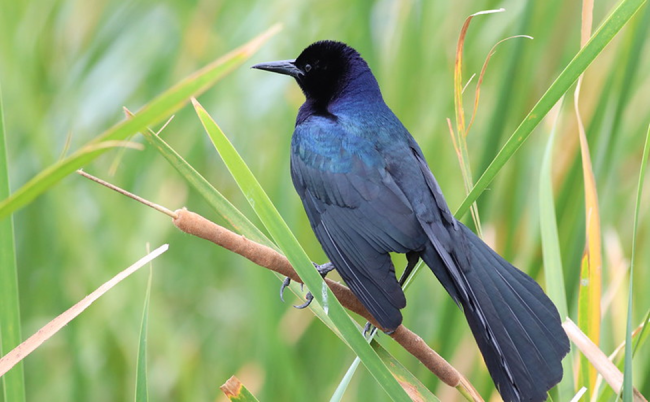
GRACKLE ON CATTAILS (BirdNote / Gary Leavens photo credit)

So, what an echo from yesteryear it was, last weekend, when I spied another “common” grackle (actually a Great-tailed Grackle, which is common in Denton County, Texas), ambling about the littoral cattails of that same pond that I drove by more than a decade ago. 

Whew!  What a journey the past 11 years have been, as I quickly recall and reconsider (and gratefully appreciate) God’s many personal and providential blessings unto me – including His kind and caring blessings that continue to make me the individual man I am – along with the many other blessings of His redemptive and always-sufficient grace, over those 11 years since that important icterid-aided insight. 

Plus, the best is yet to come (Luke 10:20)! So, thinking of Psalm 102:18, I close this nostalgic memoir with a limerick:

AN ATTITUDE OF GRATITUDE, ON SEEING A GRACKLE IN THE CATTAILS

Some troubles, in life, we must tackle,

Threatening us, with harm, like a jackal;

     Yet life, itself, we can face,

     Since life, itself, is God’s grace —

Each of us, God could’ve made, a grackle!

COMMON GRACKLE on Cattail
(National Park Service photo credit)

Looking at a Lone Lesser Scaup

LOOKING AT A LONE LESSER SCAUP

Dr. James J. S. Johnson

God … is wise in heart, and mighty in strength: … [and He] doeth great things past finding out; yea, and wonders without number.

[Job 9:2 & 9:4 & 9:10]

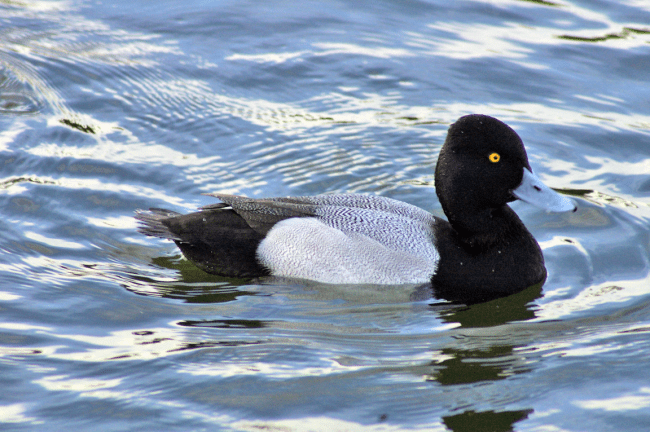
LESSER SCAUP male (photo credit: National Audubon Society)

Last Saturday (February 18th of A.D.2023), as I was birdwatching inside my wife’s car — while she was driving, so it’s okay that I was birdwatching! — I saw a lone Lesser Scaup (Aythya affinis, a/k/a “Little Bluebill”) floating in the middle of a favorite pond (where I have often seen grackles in the past — see http://www.icr.org/article/grackles-gratitude/ — and appreciated that God could have made me a grackle!).

As I thought about this Lesser Scaup, and how I’ve often seen such scaups (and other ducks) on Texas ponds during winter, it seems that the occasion deserves a poetic memorial of some kind, such as a limerick.

Now, a few days later, here is that limerick, although admittedly the limerick calls the pond a “lake” (which some ponds are called, anyway, by Floridians), because it’s easier to rhyme “lake” than “pond” when composing limericks.

LESSER SCAUP (photo credit: swartzentrover.com / BirdPages)

LOOKING AT A LONE LESSER SCAUP ON A WINTER DAY

One cold wintry day, on a lake,

A scaup floated by — ’twas a drake;

Little bluebills eat seeds,

Clams, mussels, pondweeds;

I’m glad that, such ducks, God did make!

LESSER SCAUP female (L) & male (R)

photo credit: BirdwatchingDaily.com / David Mundy

Apparently, the anatid name “scaup” derives from a European word referring to shellfish (e.g., Noah Webster’s 1828 AMERICAN DICTIONARY OF THE ENGLISH LANGUAGE notes that “scalp” comes from the Dutch schelp meaning “shell”), alluding to coastal bivalves (such as clams, mussels, and oysters), which are often eaten by these diving ducks. These wetland-frequenting ducks also eat shoreline vegetation, such as pondweeds, widgeon-grass, sedges, bulrushes, wild rice, wild celery, and other hydrophilic plants.

Generally speaking, scaups are migratory birds, so we Texans see them during the cold months of the year — however, there are some parts of North America where Lesser Scaups are seen year-round. Sometimes it’s hard to distinguish a Lesser Scaup from a Greater Scaup (Aythya marila, a/k/a “Common Scaup” or “Bluebill”), from a distance — plus, to confuse identifications further, these scaups can hybridize with each other, as well as with the American Redhead (Aythya americana), Ring-necked Duck (Aythya collaris), European Pochard (Aythya ferina), and Canvasback (Aythya valisineria). [See Eugene M. McCarthy, HANDBOOK OF AVIAN HYBRIDS OF THE WORLD (Oxford, UK: Oxford Univ. Press, 2006), page 90.] But they are all diving ducks!

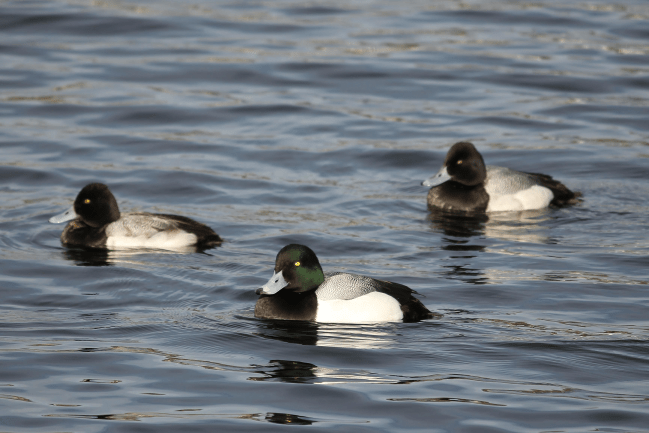
Greater Scaup between Lesseer Scaups (photo credit: reddit.com / birdpics)

So, as noted above (in the above limerick that is just “ducky”), I’m glad that, such ducks, God did make!

Birds of the Bible II – Raven Adventures

Common Raven at Cypress Provincial Park, British Columbia ©WikiC

In the First Bird Species Named post, you found out that it was the Raven that was sent out first from the Ark. He never came back in, but may have landed on it now and then. The Raven family has a very resourceful way of finding and collecting food and objects.

Today there are several species in the Raven family (Covidae). Of course, not all of those species were on the Ark. They spread out and reproduced after their kind. “every raven after its kind,” (Lev 11:15)

Chihuahuan Raven (Corvus cryptoleucus)Raven (Corvus corax) by Kent Nickell

Northern Raven (Corvus corax) by Kent Nickell

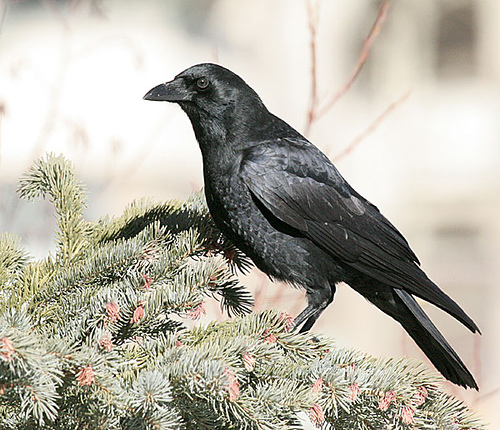
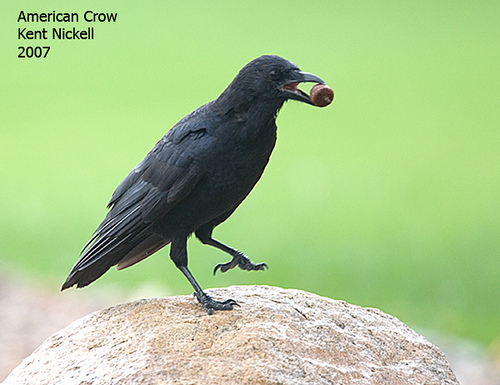
Compare the Common Raven and the Chihuahuan Raven

American Crow (Corvus brachyrhynchos) by Kent Nickell

American Crow (Corvus brachyrhynchos) by Kent Nickell

and compare the Common Raven and the American Crow.

All of these birds belong to the Covid family and Dr. Johnson posted a great article that covers this family.

Crows and Other Corvids are Really Smart Birds!

As was pointed out in that article, how the ravens came and fed Elijah. They brought him bread and flesh. (I Kings 17:6) But where do the Ravens get their food? (Job 38:41)

Much has been written about these interesting birds here over the years. Here are some of the links to help you find out more about the Ravens and their kind:

Birds of the Bible – Ravens

Other articles about the Raven:

Also check out articles by our various writers:

For younger readers:

**

All Birds of the Bible section

Gideon

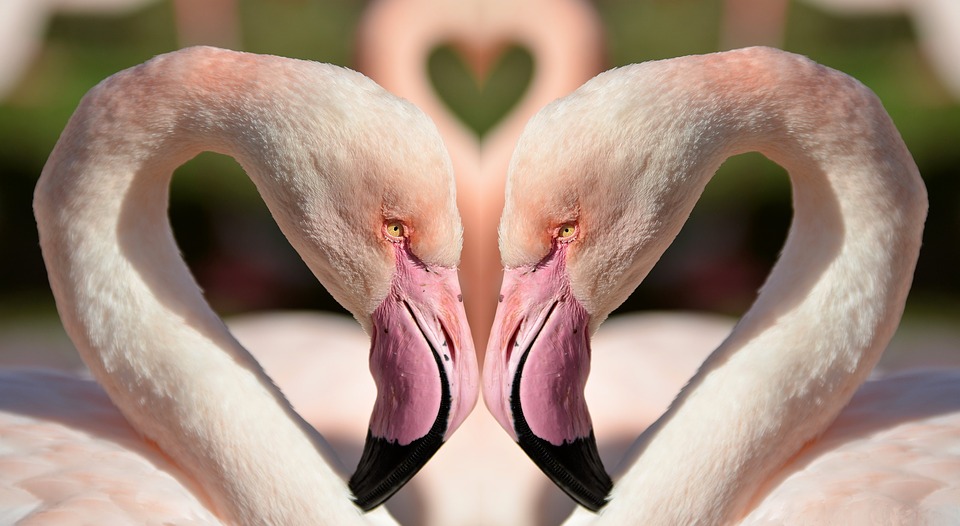
Valentines Greetings

Flamingos In Love ©Pixabay

In honor of Valentines tomorrow, I thought I would re-post this:

Tickle Me Tuesday – Dancing Birds I

“A time to weep, And a time to laugh; A time to mourn, And a time to dance;” (Ecc 3:4)

I apologize for not posting lately but was sick with food poisoning that zapped me for a while. All is well now and hope to get back to the Birds of the Bible II series.

Birds of the Bible II – Introduction

Birds of the Bible – First Bird Species Named

Also see all the previous Birds of the Bible posts

What will you do with Jesus?

Birds of the Bible II – First Bird Species Named

Raven; Grand Canyon National Park, by William Wise

Raven; Grand Canyon National Park, by William Wise

In the introduction to this new series, Birds of the Bible II – Introduction, several questions were asked. Did you check those questions out?

What were the names of first bird species listed in the Bible? (Genesis 8:7, 8)

If you checked these verses, you know that they were the Raven and the Dove. The Raven was released from the Ark first. It flew back and forth until the waters were abated or dried up. It does not say that Noah brought it back into the Ark. My imagination is that it landed on the ark but stayed outside.

While looking through several of the books I showed you in the first post, some interesting facts come to light:

The Raven’s feeding habits:

  • They are resourceful
  • They like plants and seeds
  • They eat carrion

If you imagine the total destruction that the worldwide flood caused, there would still be some things floating on the surface of the water. As the waters receded, the Raven would eventually not need to return to Noah or the Ark.

From All About Birds:

“Common Ravens will eat almost anything they can get hold of. They eat carrion; small animals from the size of mice and baby tortoises up to adult Rock Pigeons and nestling Great Blue Herons; eggs; grasshoppers, beetles, scorpions, and other arthropods; fish; wolf and sled-dog dung; grains, buds, and berries; pet food; and many types of human food including unattended picnic items and garbage.”

Northern Raven (Corvus corax) ©CreationWikiC

Northern Raven (Corvus corax) ©CreationWikiC

An interesting thought. Since all the fowls or birds were in pairs of seven, when did its mate finally join the first one?

Ravens are in the Corvidae Family and here are some of the articles about them:

Birds of the Bible – Ravens (Main page)

There are many links to the articles, facts, and photos about the Raven from previous post. Also, by typing in the Search,,, box on the right side of the page, you will find many more posts about Ravens.

LIKE:

Raven

April Lorier’s Article about the Ravens

Crows and Other Corvids are Really Smart Birds!

Ravin about Corvid Hybrids: Something to Crow About! by JJSJ

Diet of Jackdaws and Ravens by JJSJ

Scripture Alphabet of Animals: The Raven

And many others

What were the names of first bird species listed in the Bible? (Genesis 8:7, 8)

Okay, you now know that the Raven was listed first. What was the second bird listed?

Stay tuned!

What is the Gospel?

Birds Of The Bible II – Introduction

The Birds of the Bible are why Lee’s Birdwatching Adventures Plus was started. Now, 16 years later, do you or I remember what was posted?

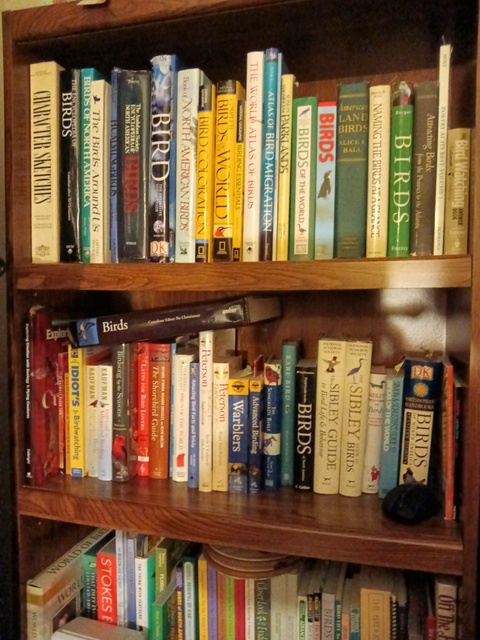
When we started this, we may have had one or two birdwatching books. Today, my bookshelves, at least three of them. have these books waiting on me to find new and interesting bird facts. I wonder what amazing information could be gleaned about God’s Creative Handiwork at work on the birds? Huh??

Bird Books in Library

We now have additional writers that would also be willing to contribute more articles. (I will invite them to join in this.)

When was the first bird created? (Genesis 1:20)

What day was that? (Genesis 1:23)

Who named the first birds? (Genesis 2:19)

What were the names of first bird species listed in the Bible? (Genesis 8:7, 8)

Did birds come from dinosaurs?

Do you know? Want to find out more? Leave me a comment. Stay tuned!

Birds of the Bible

Looking Back – Blog Anniversaries, and Why It Began

Good News

Looking Back – Blog Anniversaries, and Why It Began

Kathy Wire, one of our faithful followers of this blog, left some suggestions for this series of Looking Back for reviewing the articles and blessings from these many posts. Here are those suggestions. They are all very appropriate, and hard to choose which one. 
  • Time Flies
  • On the Wings of Time
  • Wings of the Winds of Time
  • Hovering Over the Past
  • A Bird’s-Eye Overview (…of the Glory of God)

Drop a comment and help decide which to use. For today’s article, I stuck with “Looking Back.”

To begin this series, I found all the post that looked back over the Anniversaries of Lee’s Birdwatching Adventures Plus. If you scan through them, you will discover why it was started and how the Lord has been blessing it over the years. As different writers began adding articles, photographers gave permission to use their photos, and linked their websites, the blog has continued to grow.

Beginning Post of Anniversaries of the Blog:

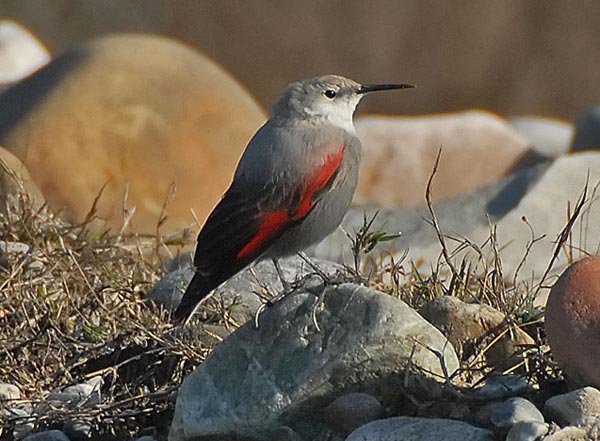
Wallcreeper (Tichodroma muraria) by Nikhil

Wallcreeper (Tichodroma muraria) by Nikhil

Sunbittern (Eurypyga helias) by Dan

Sunbittern (Eurypyga helias) by Dan

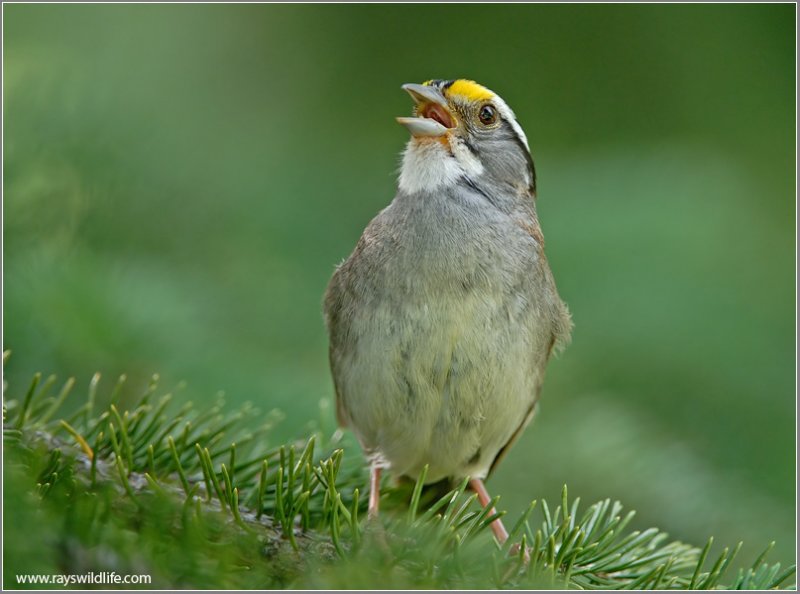
White-throated Sparrow by Ray Barlow

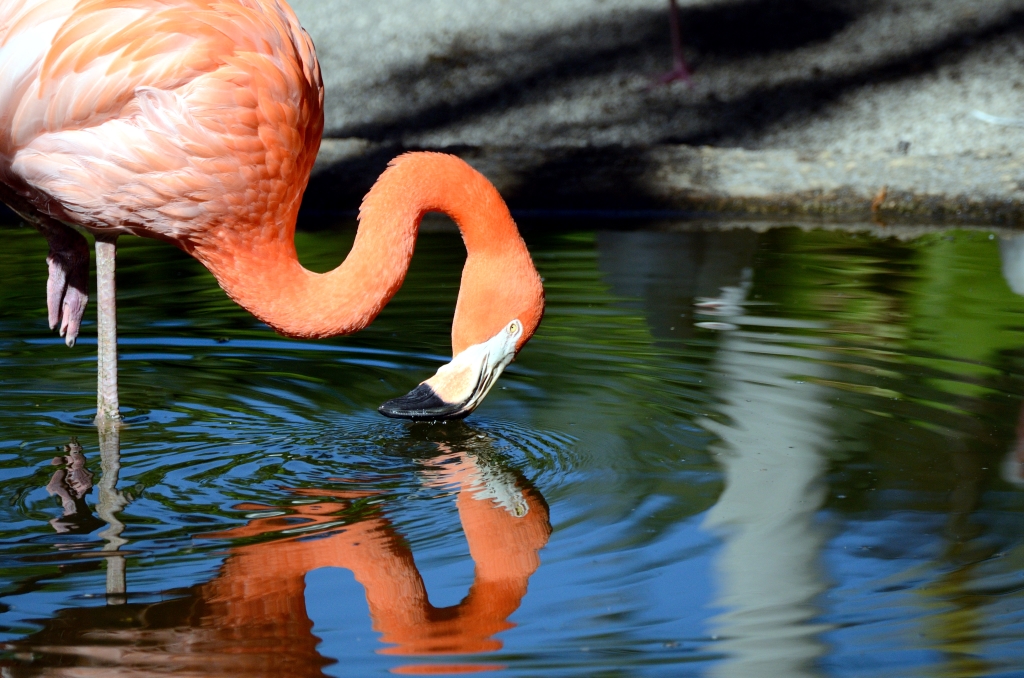
American Flamingo by Dan’ at Flamingo Gardens

Ring-necked Duck at Lake Morton by Dan

Ring-necked Duck at Lake Morton by Dan

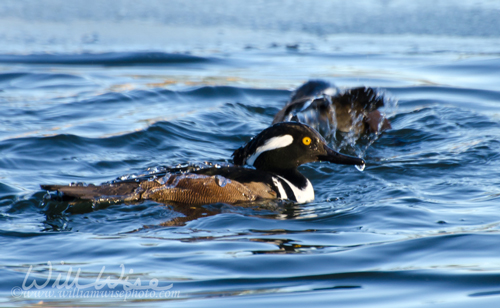
Hooded Merganser Diving Duck, Georgia by William Wise

When I look back over these, and the many posts about the Lord’s Creation, especially His beautiful Avian Wonders, I am reminded:

“Who can utter the mighty acts of the LORD? Who can declare all His praise?” (Psa 106:2)

Stay Tuned! (I have some ideas for more series)

The Wise Owl

Looking Back Through 2022 and Before

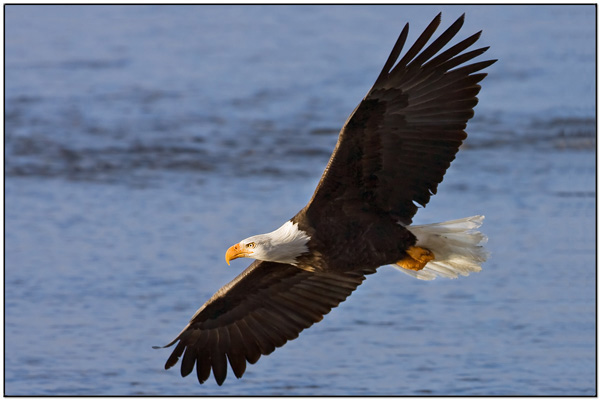
Bald Eagle flying by Dave's BirdingPix

Bald Eagle flying by Dave’s BirdingPix

As we head into the new year, 2023, many like to look back over the last year. They find many good memories and blessings, plus a few not so pleasant ones. Many of you liked and made remarks about the Christmas Bird Review series (that was just completed).  It seems you do not mind looking back.

That thought started me thinking about a new series that we could begin. “Looking Back – “, “Reviving the Past – “, or some other name to give it. ANY IDEAS?

Hornbill at Brevard Zoo by Dan Aug-2014

Many of you have chosen to follow this blog through many years, and some have just begun following us.

  • How did this all begin? Purpose?
  • When did it begin?
  • What topics have we covered?
  • What Birds have we highlighted?
  • Who have been the writers and photographers over the years?

As many know, I have been dealing with medical issues which have slowed our birding adventures down considerably. I still watch birds, but on a more limited basis. Having just received a new computer, and trying to transfer photos over to it, I have been finding photos that could be used to update or enhance updates.

I especially am thinking about the original purpose, which was to show and thank the Lord for all the Birds of the Bible.

“I will give You thanks in the great assembly; I will praise You among many people.” (Psalm 35:18)

This is from the main page Menu. As of today (Dec 30, 2022), that number is:

  • 2,371,257 visits

THANKS TO VISITORS

Moved to WordPress
00,000 – July 05, 2008
50,000 – Oct 10, 2009
100,000 – Apr 5, 2010
150,000 – Sep 6, 2010
200,000 – Dec 30, 2010
250,000 – Apr 9, 2011
300,000 – June 29, 2011
350,000 – Sep 19, 2011
400,000 – Nov 18, 2011
450,000 – Jan 21, 2012
500,000 – Mar 1, 2012
600,000 – May 24, 2012
700,000 – Sep 2, 2012
800,000 – Dec 16, 2012
900,000 – Ap 13, 2013
1,000,000 – Oct 20, 2013
2,200,000 – Jun 5, 2021

So, what are your thoughts? Please leave a comment, or at least a like. And even a suggestion for a series title.

Thanks for all your visits, likes, and remarks over the years.

Good News

Christmas Birds – Our Favorites (2022)

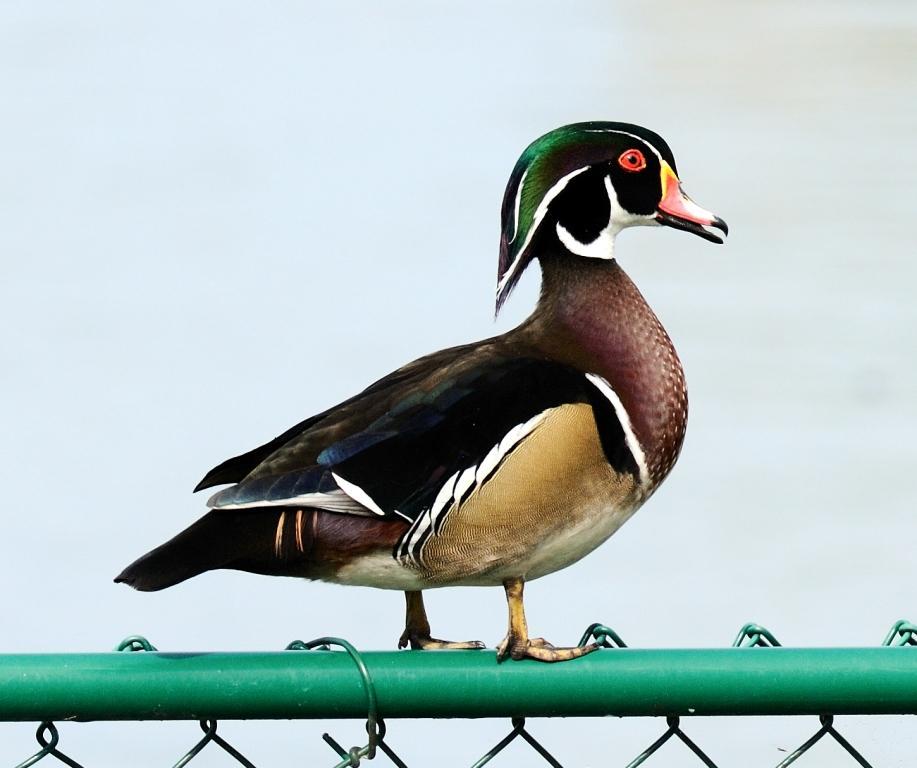
Wood Duck by Dan at Lake Hollingsworth

Here is a new Christmas Birds. These are some of my favorite photos of the Lord’s Creatures that we have taken over the years. I would most likely put them in the Ornament or just Favorites category. (This just a sampling)

“Thanks be to God for His indescribable gift!” (2Co 9:15) “For by grace you have been saved through faith, and that not of yourselves; it is the gift of God, not of works, lest anyone should boast.” (Eph 2:8-9);

We have the Greatest gift of Christ as the Savior, and as the Creator of all these beautiful birds that we have had the privilege to see, some up very close.
*

This slideshow requires JavaScript.

“Beloved, let us love one another, for love is of God; and everyone who loves is born of God and knows God. He who does not love does not know God, for God is love. In this the love of God was manifested toward us, that God has sent His only begotten Son into the world, that we might live through Him. In this is love, not that we loved God, but that He loved us and sent His Son to be the propitiation for our sins. Beloved, if God so loved us, we also ought to love one another.” (1Jn 4:7-11)

*

“Jesus Loves Me” by Bonnie Standifer

This piece was written and played by Bonnie Standifer. Played at our Orchestra Concert in March of 2013 at Faith Baptist Church. You have never heard it played this way before. Bonnie is a very gifted arranger and pianist. (I’ve used her song before, but it is so fantastic.)

*

See the original article – Christmas Birds – Ornaments

The Christmas Birds (Revisited 2022)

*

Christmas Birds – Ornaments – (Revisited 2022)

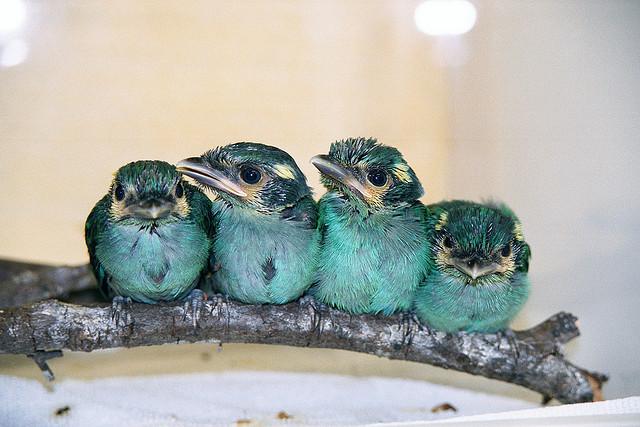
Long-tailed Broadbill (Psarisomus dalhousiae) babies ©WikiC coracii

Long-tailed Broadbill (Psarisomus dalhousiae) babies ©WikiC coracii

Here are the last of the Christmas Birds. The colors and designs would be pretty in ornaments. But most of all, they are superb examples of the Lord’s omniscient creative designs.

He was in the world, and the world was made by him, and the world knew him not. He came unto his own, and his own received him not. But as many as received him, to them gave he power to become the sons of God, even to them that believe on his name:.. And the Word was made flesh, and dwelt among us, (and we beheld his glory, the glory as of the only begotten of the Father,) full of grace and truth. (John 1:10-12, 14 KJV)

*

This slideshow requires JavaScript.

Whose adorning let it not be that outward adorning of plaiting the hair, and of wearing of gold, or of putting on of apparel; But let it be the hidden man of the heart, in that which is not corruptible, even the ornament of a meek and quiet spirit, which is in the sight of God of great price. (1 Peter 3:3-4 KJV)

*

Music to listen to while viewing the photos. “Ring The Bells” – Men’s Quartet – Faith Baptist 2012

*

See the original article – Christmas Birds – Ornaments

The Christmas Birds (Revisited 2018)

*