“D” is for Ducks, Dabblers and Divers: “D” Birds”, Part 1
James J. S. Johnson
“Be ye followers of me, even as I also am of Christ.” (1st CORINTHIANS 11:1)
“Not as though I had already attained, either were already perfect: but I follow after, if that I may apprehend that for which also I am apprehended of Christ Jesus.” (PHILIPPIANS 3:12)
“D” is for as Doves, Dippers, and Ducks (some being dabblers, some being divers) — plus other birds with names that begin with the letter D.
Regarding doves, see, e.g., Lee’s Birdwatching “Bible Birds: Doves and Pigeons” and “Bible Birds: Doves and Pigeons” plus “Columbidae: Pigeons, Doves”, etc.; regarding dippers, see, e.g., my “European Dipper, Norway’s National Bird”.
This present study will focus on ducks. Of the birds we call “ducks” there are two major categories, “divers” (which use their broad feet to propel themselves underwater) and “dabblers” (which typically tip forward to submerge their heads into the water), and these categories are due to those respective ducks’ eating habits (as will be explained below). Of course, to confuse matters a bit, ducks that dive for their food sometimes dabble too!
But first, because this blogpost-article calmly continues an alphabet-based series on birds, it will look at Psalm 119:25-32, before providing an introduction to 4 types of birds that start with the letter “D”, In particular, those four “D” birds are various DUCKS, both “divers”, the Lesser Scaup (Aythya affinis), — and “dabblers”, the American Wigeon (Anas americana) and the Northern Shoveler (Anas clypeata). Also, some mention will be given to “stiff-tailed divers” (e.g., Ruddy Duck) and “sea ducks” that dive (e.g., eiders, mergansers, oldsquaw, etc.).
=======
THE ALPHABET HELPS TO TEACH US ABOUT GOD’S TRUTH
As noted in three earlier articles on “alphabet birds”, i.e., on “A birds”, on “B birds” and “C birds” – using the alphabet, to organize a sequence of information, has Biblical precedent. The perfect example is the “acrostic” pattern of Psalm 119, the longest psalm (having 176 verses!), which psalm has 22 sections (comprised of 8 verses per section), representing the 22 letters of the Hebrew alphabet. (Compare that to English, which has 26 alphabet letters, and to Norwegian, which has 29 alphabet letters.)
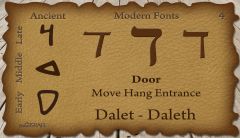
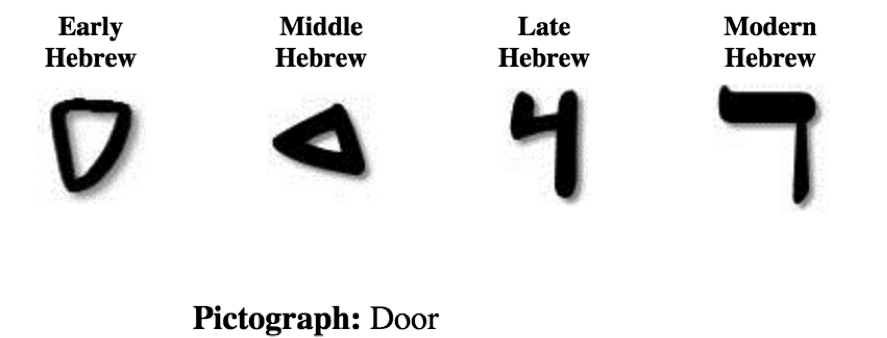
The sentences in each section start with the same Hebrew letter, so Verses 1-8 start with ALEPH, Verses 9-16 start with BETH, Verse 17-24 start with GIMEL, and so forth. In this serial study’s lesson, the fourth octet of verses in Psalm 119 (i.e., Psalm 119:25-32), each sentence starts with DALETH, the Hebrew consonant equivalent to the English “D”.
The noun based upon this letter is DELETH, which is routinely translated as a “door” (or “gate”) in the Old Testament (see YOUNG’S ANALYTICAL CONCORDANCE, Index-Lexicon to the Old Testament, page 14, column 1.) Doors are very important. In fact, JESUS Himself is the “door” to eternal life (compare John 10:7-9 with John 14:6 & Matthew 7:13-14). Some of the earliest “doors” of the ancient Hebrews were tent-flaps, hanging animal skins that covered an opening in a tent. This type of “door” appears to be illustrated by the hanging tent-flap (or “gate”) in the Mosaic Law’s blueprint for the Tabernacle (see Exodus 27:16). To enter into the Tabernacle the hanging tent-flap “door” needed to be pulled back. (The action of pulling also appears in what may be etymologically related Hebrew words: “bucket” [deli/dali in Isaiah 40:15 & Numbers 24:7] and “draw” [dalah in Exodus 2:16 & Exodus 2:19].)
But it is the usage of the doorway that is of amazing importance to the Christian, because doors provide ingress (entering) and egress (exiting).
Although space here prohibits a detailed analysis, it seems that the Scripture’s usage of DALETH emphasizes more the process of exiting through a doorway, i.e., moving from where one is already, out into something farther, toward a destination.
So, because DALETH is the fourth letter in the Hebrew alphabet, each verse (in Psalm 119:25-32) literally starts with that letter as the first letter in the first word (although the first Hebrew word may be differently placed in the English translation’s sentence):
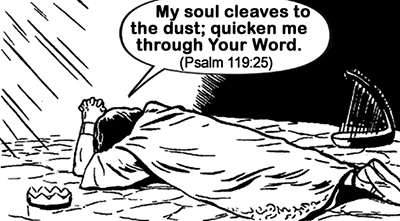
25 Cleaves [dâbqâh] my soul unto the dust; quicken Thou me according to Thy Word.
26 My ways [derek] have I documented, and Thou heard me; teach me Thy statutes.
27 The way [derek] of Thy precepts make me to understand, so shall I talk of Thy wondrous works.
28 Melts [dâlpâh] my soul, for heaviness; strengthen Thou me according unto Thy Word.
29 The way [derek] of falsity remove from me, and grant me Thy law graciously.
30 The way [derek] of truth have I chosen; Thy judgments have I laid before me.
31 I have stuck [dâbaqtî] unto Thy testimonies: O Lord, put me not to shame.
32 The way [derek] of Thy commandments will I run, when Thou shalt enlarge my heart.

Fair Use image Credit: http://markmcmillion.com/wp-content/uploads/2016/02/quicken-me-flat.jpg
As noted before, Psalm 119 is all about God’s revelation of truth – especially truth about Himself – to mankind (in a comprehensive “A to Z” panorama). The most important revelation of truth that God has given to us, and the most authoritative form of truth we have, is the Holy Bible – the Scriptures. Accordingly, Psalm 119 is dominated by references to the Scriptures, using terms like “the law of the LORD” (and “Thy Word”, “Thy commandments”, “Thy testimonies”, “Thy statutes”, “Thy judgments”, etc.). In Psalm 119:9-16 these terms are used, to denote God’s revealed truth to mankind: “Thy Word” (3x), “Thy commandments”, “Thy statutes”, ”Thy precepts”, Thy “judgments”, and “Thy testimonies”.
Fair Use image credit: http://fce-study.netdna-ssl.com/images/upload-flashcards/back/7/3/58537864_m.jpg
Notice how the Hebrew noun derek appears frequently in this section of Psalm 119 – because when you take a “door” of providential opportunity, to walk life’s journey according to God’s directions, you travel a pathway that leads to your God-designed destiny. Accordingly, the Hebrew letter DALETH refers to a “door” (or doorway, such as a tent-flap), which leads to a destination, after a “journey” (derek – see Genesis 24:21, Joshua 9:11, 1st Kings 19:4 & 19:7, etc.), such as where one is supposed to arrive after traveling a “highway” (derek – see Deuteronomy 2:27).
Accordingly, Psalm 119:25-32 illustrates how God’s Word serves as a “doorway” of opportunity (which requires us to leave our self-anchored selves and our humanistic self-confidences), to facilitate our passage into the spiritual journey that God has providentially predestined for us (Ephesians 2:8-10).
In Verse 25 (of Psalm 119), King David recognizes that his soul’s natural inclination, as a sinner, is to live an earthly life that tends and trends toward “dust” – a sad reminder that we are tragically dead in Adam (Genesis 3:19; Romans 5:12-21). Yet happily, by God’s gracious providence in Christ, God’s Word can reverse the death-sentence and provided David (and us) with life, because the Scripture is the written Word of God that tells us of the living Word of God, JESUS, through Whom we can have life (John 10:10 & 14:6). In other words, we use God’s written Word to leave our sinful selves, to obtain redemption in Christ, and thereby we leave our mortality for life eternal (1st Corinthians chapter 15).
In Verse 26, the psalmist reports his own “ways” to God, i.e., David was truthful in measuring his own life – this honesty pleases God, Who defines and gives truth (John 14:6 & John 17:17), and it is being truthful with God that keeps open the “door” of access to His forgiveness and cleansing (1st John 1:9).
In Verse 27, the psalmist meditates on God’s Word. This reverent Bible study is the “way” to understanding God’s precepts – it is the “way” to find real knowledge and understanding. As we soak in the holy Scriptures (which is our true “daily bread” – Matthew 4:4), we leave the finiteness and fallibility of our own minds and memories, to access God’s mind, God’s meanings, God’s morals.
In Verse 28, the psalmist acknowledges that his own soul is weak, losing strength in sorrows. However, thankfully, that sad situation is overcome by the strengthening that God’s Word provides to the reverent and trusting worshipper of God. This means leaving our own self-sufficiency to appropriate God’s ever-sufficient grace (2nd Corinthians 12:9) – and that is only accomplishes as we apply God’s Word to our own human weakness.
In Verse 29, the psalmist recognizes that he cannot access God’s kindness if he allows the way of falsity to distract him form God’s law. In other words, the books of Moses – which will one day judge us (see John 5:44-47) – are our foundation for understanding life (and death, and God, and ourselves, etc., etc.), so we must avoid all false distractions that would pull us away (sidetrack, derail, etc.) from that truth.
In Verse 30, the psalmist recognizes that choosing the faithful path is a choice; having made that choice life becomes many opportunities, moment by moment, to apply that choice to the decisions of life. This is the Bible-based spiritual journey – and it is this kind of “walking by faith” that pleases God (see Romans chapter 4 & Hebrews chapter 11).
Verse 31 contrast with Psalm 119:25, where the verb “cleave” was used in a negative way. In Verse 31 David is “cleaving” to God’s testimonies (which hare found in God’s Word); the result is that David will not be ashamed of how his life-journey ends, so long as he is “cleaving” to God’s testimonies along the way (Romans 8:28).
Verse 32, likewise, portrays the psalmist’s movement toward God’s Word. David is now running to God’s commandments, away from the curse of sin-and-death he alludes to in Verse 25 – because David knows that God’s Word enlarges David’s heart – and thus his (redeemed) life.
In sum, Scripture-based living is the way to leave your selfish “self” behind, as you take your godly (i.e., redeemed-in-Christ – Philippians 1:21) “self” closer to God (and toward what He wants for your life)!
Thus we see the theme, woven throughout the octet of DALETH verses (Psalm 119:25-32), that we are designed to rely upon the truth and values of the holy Scriptures, as we journey through life, as if God’s Word was our “door” of opportunity (as it informs us of the living “Door”, the Lord Jesus Christ – compare John 10:7-9 & John 14:6), to leave our selfish selves – and through which we journey toward God, Who Himself is our ultimate home and destination (Psalm 90:1 and 2nd Corinthians 5:1-6.) – see “Why We Want to Go Home” [posted at http://www.icr.org/article/why-we-want-go-home/ ].
========
Now back to the ducks. First, let’s consider some “dabbling” ducks, starting with one whose unusually broad shovel-shaped bill gives it its name.
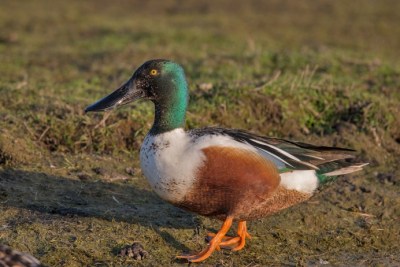
Northern Shoveler (Anas clypeata): male ©WikiC
*
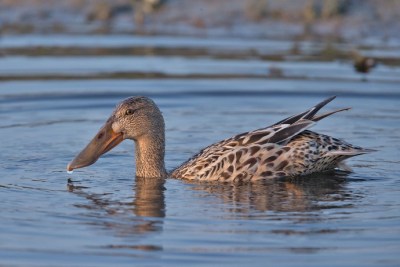
Northern Shoveler (Anas clypeata): female ©WikiC
The Northern Shoveler is a dabbler, ranging much of the Northern Hemisphere. Its habits are described by ornithologist Steve Madge: “Sociable duck of shallow freshwater lakes [including “prairie potholes”] and marshes. Usually found in pairs or small parties, but large concentrations form at migratory stop-over waters [such as Hagerman National Wildlife Refuge in north-central Texas]. Indirectly mixes with other dabbling ducks [such as Mallard, Green-winged Teal, Northern Pintail, and American Wigeon], but generally keeps apart in discrete gatherings. … Nests on ground among waterside vegetation, often several nests in close proximity. Feeds by dabbling and sifting in shallow water, swinging bill from side to side over surface, often immersing head and neck and sometimes up-ending; feeds chiefly while swimming, but also while wading. Loafing birds gather on banks and shores close to feeding waters. Swims buoyantly, with rear end high and fore parts low, the heavy bill often touching surface of water. Walks awkwardly. Flight fast and agile, rising suddenly from surface with whirring wings. Most populations highly migratory, arriving on breeding grounds from mid March onwards and departing again in August.” [Quoting Steve Madge & Hilary Burn, WATERFOWL: AN IDENTIFICATION GUIDE TO THE DUCKS, GEESE AND SWANS OF THE WORLD (Houghton Mifflin, 1988), page 236.]

Northern Shoveler (male closeup) ©WikiC
The male shoveler has an iridescent green head (like a Mallard), rusty sides (like a Ruddy Duck), a white breast, and a shovel-like (or spoon-like) bill. These ducks feed mostly “by filtering tiny aquatic insects and plants from the water’s surface with its bill.” [Quoting Stan Tekiela, BIRDS OF TEXAS FIELD GUIDE (Adventure Publications, 2004), page 332-333.
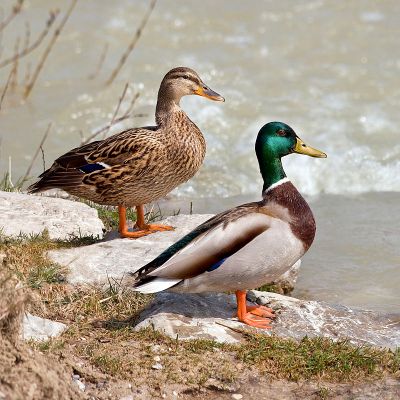
Mallard (Anas platyrhynchos): male (R) & female (L)
https://en.wikipedia.org/wiki/Mallard#/media/File:Anas_platyrhynchos_male_female_quadrat.jpg
The Mallard (alias “Greenhead”) is another dabbling duck, the most common duck in the world! (Oops! — once, at a Tampa church, I erred and said it was the most common “bird” in the world – but I meant to say it was the most common “duck” in the world.) The Mallard has been reported repeatedly — on www.leesbird.com — so it will not receive detailed treatment here. (See, e.g., ornithologist Lee Dusing’s “The Mallard Duck: Birds, Volume 2, #1” [at https://leesbird.com/2012/07/16/birds-vol-2-1-the-mallard-duck/ ], as well as my “Pondside Birdwatching in Florida, from Chaplain Bob’s Backyard, Part 1” [at https://leesbird.com/2015/02/18/pond-side-birdwatching-in-florida-i/ ]. See also, e.g., the report on mallards within my “Birdwatching in Iceland” [at https://leesbird.com/2014/12/08/birdwatching-in-iceland-part-i/ ] and also within my “Bird Brains: Amazing Evidence of God’s Genius” [at https://leesbird.com/2013/03/07/48484/ ].)

American Wigeon (Anas Americana): male
Fair Use photo credit: https://en.wikipedia.org/wiki/American_wigeon#/media/File:Anas_americana_-_drake.jpg
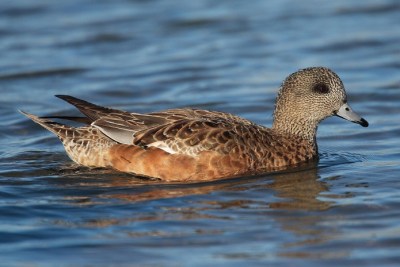
American Wigeon (Anas Americana): female
Fair Use photo credit: https://en.wikipedia.org/wiki/American_wigeon#/media/File:Anas-americana-004.jpg
The American Wigeon (also spelled “widgeon”, alias “Baldpate”) is another dabbling duck. This wigeon resembles its Eurasian cousin (Eurasian Wigeon) except the American Wigeon has a curved green side-stripe on its head – unlike the rut-colored head of the Eurasian variety. (Both have a white “racing stripe” from the bill’s top past the pate.)
American Wigeons are plentiful in America’s Great West; they are also growing numerically East of the Mississippi River. Winter grain fields and saltmarsh habitats serve as homes for this migratory duck. When wigeon flocks fly they do so noisily, bunched together, with obvious agility. For repeated years this writer observed wigeon flocks sharing a Denton County (Texas) pond with mallards and lesser scaups, during the winter. Generally speaking, he mallards grouped together, the wigeons grouped together, and the scaups grouped together.
========
Now let’s consider some “diving” ducks, sometimes called scaups or pochards. Despite having the overall outward morphology of dabbling ducks, these diving ducks have some anatomical traits (e.g., trachea structure) differing from those of the dabbling ducks, as well as some noticeable distinctions in their genetics (e.g., mitochondrial BNA cytochrome b and NADH dehydrogenase subunit 2 sequence).

Lesser Scaup (Aythya affinis): male (L)
Fair Use photo credit: https://en.wikipedia.org/wiki/Lesser_scaup#/media/File:Lesser_scaup_-_Aythya_affinis.jpg
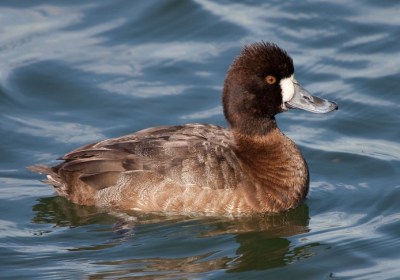
Lesser Scaup (Aythya affinis): female
Fair Use photo credit https://en.wikipedia.org/wiki/Lesser_scaup#/media/File:Aythya_affinis.JPG
The Lesser Scaup (a/k/a “Little Bluebill”) is a diving duck. This scaup is differentiated from the Greater Scaup in a previous report, “Pondside Birdwatching in Florida, from Chaplain Bob’s Backyard, Part 2” [at https://leesbird.com/2015/03/02/pond-side-birdwatching-in-florida-2-2/ ], q.v. – noting its gregarious nature, range, and other habits.
The typical habitat preferred by Lesser Scaup ducks is described by Steve Madge: “Breeds by freshwater ponds and lakes in open country, especially prairie marshes [i.e., prairie potholes]. In winter on lowland lakes, coastal lagoons, and estuaries and sheltered coastal bays, but chiefly in latter haunts after cold weather has frozen freshwater lakes.” [Quoting Steve Madge & Hilary Burn, WATERFOWL: AN IDENTIFICATION GUIDE TO THE DUCKS, GEESE AND SWANS OF THE WORLD (Houghton Mifflin, 1988), page 258.]
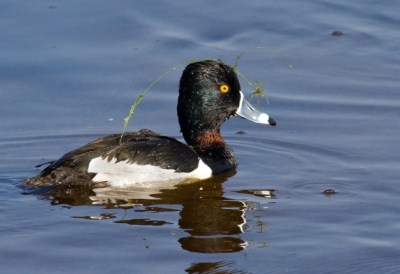
Ring-necked Duck (Aythya collaris): male
http://www.audubon.org/sites/default/files/styles/hero_cover_bird_page/public/Ringnecked_Duck_%20mark%20eden_FL_2011_KK_GBBC.jpg?itok=Qf8g5Vvu (Fair Use photo credit)
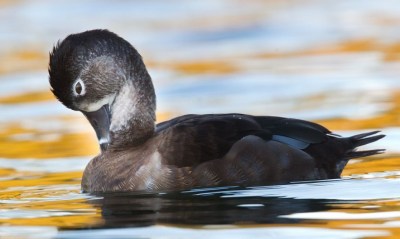
Ring-necked Duck (Aythya collaris): female
https://en.wikipedia.org/wiki/Ring-necked_duck#/media/File:Ring-necked_Duck1.jpg (Fair Use photo credit)
The Ring-necked Duck is a diving duck, usually migratory in its range. (However, as the range map below shows, there are some areas in America’s West where the Ring-necked Duck resides year-round.).
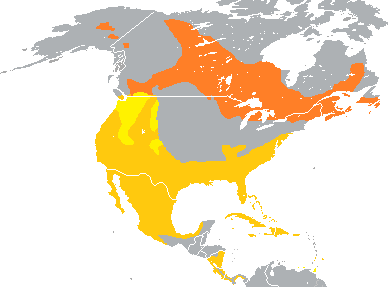
Ring-necked Duck range
map credit: https://en.wikipedia.org/wiki/Ring-necked_duck#/media/File:Aythya_collaris_range_map.png
[Orange = breeding range; yellow = year-round range; mustard = wintering range]
The male’s cinnamon-hued collar “ring” is often not visible, due to lighting and angle of observation – but it’s there, somewhere! One good place for viewing Ring-necked Ducks (as well as Ruddy Ducks) is Lake Morton (in Polk, Florida), the place where I first saw that particular duck in the wild — see Lee Dusing’s “Fantastic Weekend” [at https://leesbird.com/2014/11/10/fantastic-week-end/ ].
Ironically, the white stripe-like band on its dark bill is usually observable, on both the male and female, so this duck is sometimes called the “Ring-billed Duck”. [See Stan Tekiela, BIRDS OF TEXAS FIELD GUIDE (Adventure Publications, 2004), page 64-65 & 202-203. For photographs of the Ring-necked Duck, both male and female, taken by Lee Dusing at Lake Morton, see her report titled “Birdwatching at Lake Morton 11/22/13” [at https://leesbird.com/2013/11/22/birdwatching-at-lake-morton-112213/ ].
Ornithologist Steve Madge describes the Ring-necked Duck’s phenology-keyed habitat preferences: “Breeds in freshwater lakes and ponds in open lowland country, often by quite small pools in marshes. In winter, in larger freshwater lakes and locally on tidal bays and coastal brackish lagoons.” [Quoting Steve Madge & Hilary Burn, WATERFOWL: AN IDENTIFICATION GUIDE TO THE DUCKS, GEESE AND SWANS OF THE WORLD (Houghton Mifflin, 1988), page 250.]

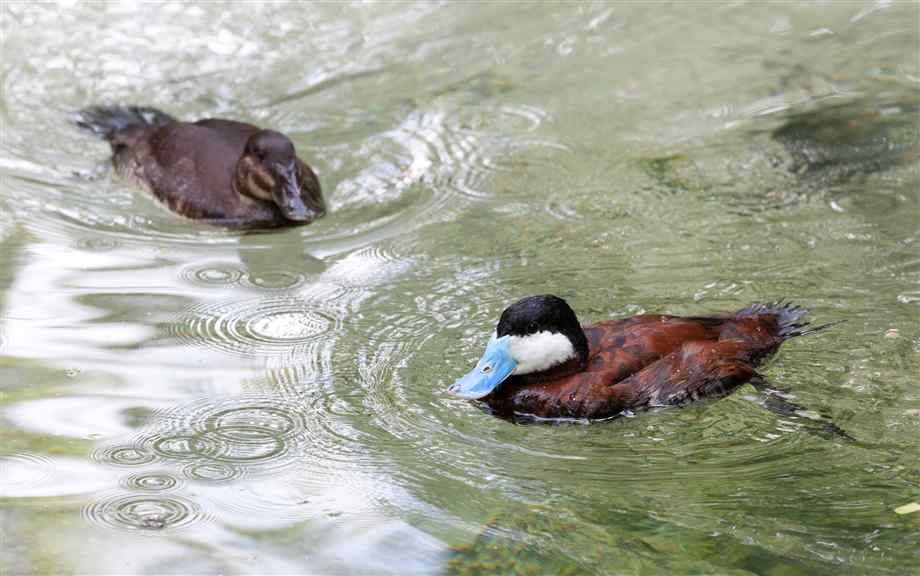
Ruddy Duck (Oxyura jamaicensis): male (L) & female (R)
Fair Use image credit (Jennifer Miller, Federal Duck Stamp competition winner for AD2014-AD2015): http://media.jsonline.com/images/39528847_Ruddy%20ducks%20by%20Jennifer%20Miller%202015-‘16%20Federal%20Duck%20Stamp%20winner%20.jpg
The Ruddy Duck exemplifies a type of duck called a “stiff-tailed diver”. Like other “stiff-tailed” ducks, the Ruddy Duck has lengthy and stiff tail feathers, which stick up prominently when the duck is resting (somewhat like the upturned tail that wrens sport). These ducks prefer to dive in freshwater, such as freshwater ponds or lakes.
Like other diving ducks their legs are located near the back of their bodies (with large paddle-like feet), equipping them for propelled paddling under water, as they dive for food. Underwater propulsion depends upon such legs and feet, but this anatomy is not inefficient for walking on land, so Ruddy Ducks tend to minimize their time doing “shore duty”.
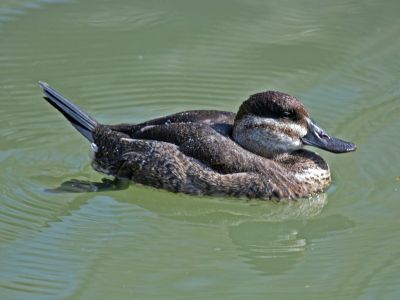
Ruddy Duck (Oxyura jamaicensis) female, displaying “stiff tail”
Fair Use photo credit: https://en.wikipedia.org/wiki/Ruddy_duck#/media/File:Ruddy_Duck_(Oxyura_jamaicensis)_RWD3.jpg
The range of the Ruddy Duck is almost all of the “lower 48” of the United States, wherever they can find available marshy ponds or lakes, especially places having fairly dense vegetation along the shoreline – optimal for their preferred diet: aquatic plant seeds and roots, as well as aquatic insects and crustaceans.
“Sea ducks” – such as mergansers, oldsquaw (a/k/a “long-tailed duck”), bufflehead, goldeneyes, and eiders – will be examined (hopefully, D.v.) in later articles of this series – because this article, albeit “ducky”, is already long enough.

Oldsquaw (Clangula hyemalis) male
Fair use photo credit: https://en.wikipedia.org/wiki/Long-tailed_duck#/media/File:Long-tailed-duck.jpg
God willing, the next contribution to this alphabetic series will be some more “D“ birds – perhaps a couple of these: Dippers, Doves, Dunlin, Dickcissel, Dusky Flycatcher, Downy Woodpecker, or the “snowbird” known nowadays as the Dark-eyed Junco! (Meanwhile, use God’s Word as you out into life, daily, with its opportunities to follow Christ!)
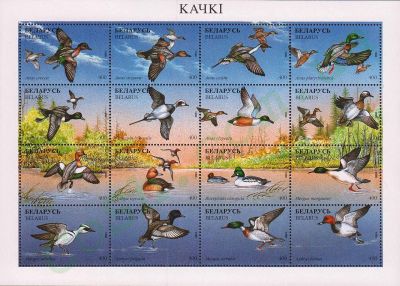
[Public Domain images: Belarus postage stamps]
So stay tuned! ><> JJSJ







)


 Lee's Birdwatching Adventures Plus


_RWD3.jpg)
