Vol 2 #2 – The Turkey Vulture

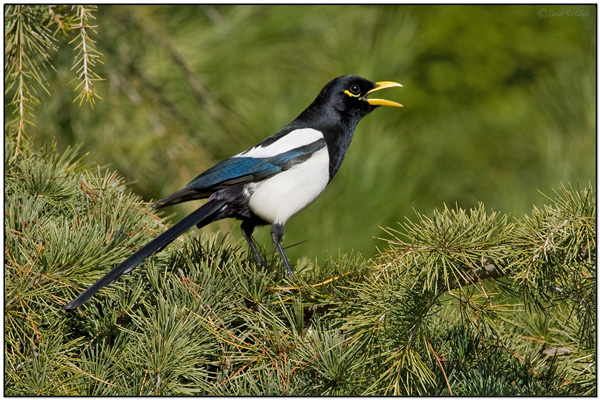
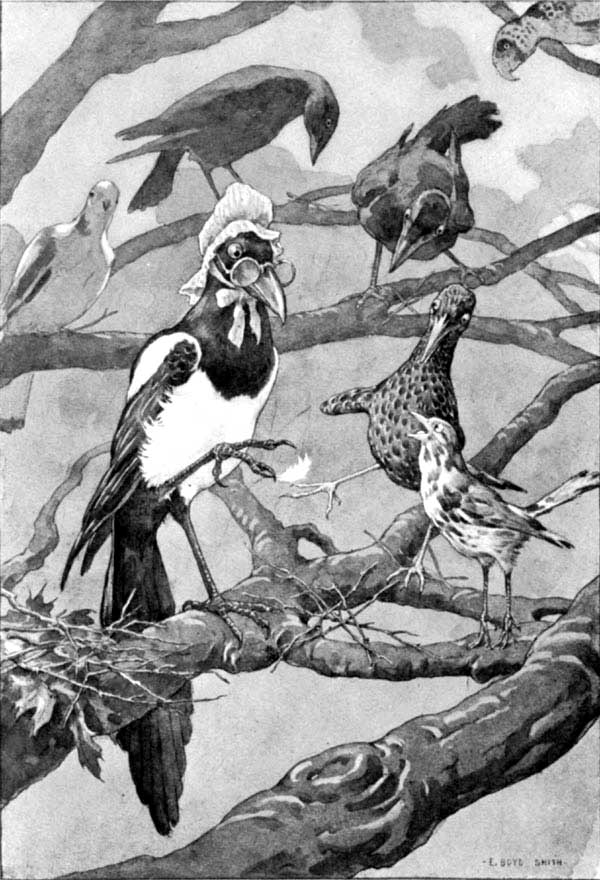
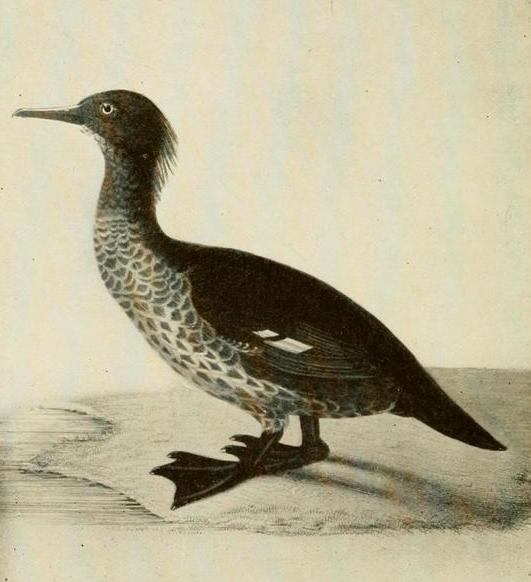
Turkey Vulture Tree at Saddle Creek by Lee

Turkey Vulture Tree at Saddle Creek by Lee

THE TURKEY VULTURE.

This bird is found mostly in the southern states. Here he is known by the more common name of Turkey Buzzard.

He looks like a noble bird but he isn’t. While he is well fitted for flying, and might, if he tried, catch his prey, he prefers to eat dead animals.

The people down south never think of burying a dead horse or cow. They just drag it out away from their homes and leave it to the Vultures who are sure to dispose of it.

It is very seldom that they attack a live animal.

They will even visit the streets of the cities in search of dead animals for food, and do not show much fear of man. Oftentimes they are found among the chickens and ducks in the barn-yard, but have never been known to kill any.

One gentleman who has studied the habits of the Vulture says that it has been known to suck the eggs of Herons. This is not common, though. As I said they prefer dead animals for their food and even eat their own dead.

The Vulture is very graceful while on the wing. He sails along and you can hardly see his wings move as he circles about looking for food on the ground below.

Many people think the Vulture looks much like our tame turkey.

If you know of a turkey near by, just compare this picture with it and you won’t think so.

See how chalk-white his bill is. No feathers on his head, but a bright red skin.

What do you think of the young chick? It doesn’t seem as though he could ever be the large, heavy bird his parent seems to be.

Now turn back to the first page of July “Birds” and see how he differs from the Eagle.

THE TURKEY VULTURE

THE TURKEY VULTURE

From col. F. M. Woodruff.


THE TURKEY VULTURE.

imgt

URKEY BUZZARD is the familiar name applied to this bird, on account of his remarkable resemblance to our common Turkey. This is the only respect however, in which they are alike. It inhabits the United States and British Provinces from the Atlantic to the Pacific, south through Central and most of South America. Every farmer knows it to be an industrious scavenger, devouring at all times the putrid or decomposing flesh of carcasses. They are found in flocks, not only flying and feeding in company, but resorting to the same spot to roost; nesting also in communities; depositing their eggs on the ground, on rocks, or in hollow logs and stumps, usually in thick woods or in a sycamore grove, in the bend or fork of a stream. The nest is frequently built in a tree, or in the cavity of a sycamore stump, though a favorite place for depositing the eggs is a little depression under a small bush or overhanging rock on a steep hillside.

Renowned naturalists have long argued that the Vulture does not have an extraordinary power of smell, but, according to Mr. Davie, an excellent authority, it has been proven by the most satisfactory experiments that the Turkey Buzzard does possess a keen sense of smell by which it can distinguish the odor of flesh at a great distance.

The flight of the Turkey Vulture is truly beautiful, and no landscape with its patches of green woods and grassy fields, is perfect without its dignified figure high in the air, moving round in circles, steady, graceful and easy, and apparently without effort. “It sails,” says Dr. Brewer, “with a steady, even motion, with wings just above the horizontal position, with their tips slightly raised, rises from the ground with a single bound, gives a few flaps of the wings, and then proceeds with its peculiar soaring flight, rising very high in the air.”

The Vulture pictured in the accompanying plate was obtained between the Brazos river and Matagorda bay. With it was found the Black Vulture, both nesting upon the ground. As the nearest trees were thirty or forty miles distant these Vultures were always found in this situation. The birds selected an open spot beneath a heavy growth of bushes, placing the eggs upon the bare ground. The old bird when approached would not attempt to leave the nest, and in the case of the young bird in the plate, the female to protect it from harm, promptly disgorged the putrid contents of her stomach, which was so offensive that the intruder had to close his nostrils with one hand while he reached for the young bird with the other.

The Turkey Vulture is a very silent bird, only uttering a hiss of defiance or warning to its neighbors when feeding, or a low gutteral croak of alarm when flying low overhead.

The services of the Vultures as scavengers in removing offal render them valuable, and almost a necessity in southern cities. If an animal is killed and left exposed to view, the bird is sure to find out the spot in a very short time, and to make its appearance as if called by some magic spell from the empty air.

“Never stoops the soaring Vulture
On his quarry in the desert,
On the sick or wounded bison,
But another Vulture, watching,
From his high aerial lookout,
Sees the downward plunge and follows;
And a third pursues the second,
Coming from the invisible ether,
First a speck, and then a Vulture,
Till the air is dark with pinions.”

Summary:

TURKEY VULTURE.Catharista Atrata.

Range—Temperate America, from New Jersey southward to Patagonia.

Nest—In hollow stump or log, or on ground beneath bushes or palmettos.

Eggs—One to three; dull white, spotted and blotched with chocolate marking.
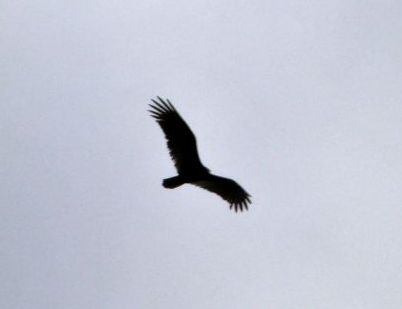

Turkey Vulture flying by - LPP

Turkey Vulture flying by – LPP

Lee’s Addition:

There is a path which no fowl knoweth, and which the vulture’s eye hath not seen: (Job 28:7 KJV)

We see Turkey and Black Vulture quite frequently here. I only disagree with one part of the article. “The Vulture is very graceful while on the wing. He sails along and you can hardly see his wings move as he circles about looking for food on the ground below.”

The way I distinguish the Turkey and Black Vultures apart is that the Black (BV) is steady on the wing, but the Turkey TV) is wobbly on the wing. They have a rocking motion, even when it is not windy. Another way to tell the two apart is the V of the Turkey and the flatter wings of the Black, who also has white on the tips of their wings.

They belong to the Cathartidae – New World Vultures Family. There are 7 Vultures and 2 Condors in that family.

*

Birds Illustrated by Color Photography – Revisited – Introduction

The above article is the first article in the monthly serial that was started in January 1897 “designed to promote Knowledge of Bird-Live.” These include Color Photography, as they call them, today they are drawings. There are at least three Volumes that have been digitized by Project Gutenberg.

To see the whole series of – Birds Illustrated by Color Photography – Revisited

*

(Information from Wikipedia and other internet sources)

Next Article – To A Water-Fowl

The Previous Article – The Evening Grosbeak

ABC’s Of The Gospel

Links:

Birds of the Bible – Vulture

Birds of the Bible – Gathering of Vultures or Eagles

Birds of the Bible – Griffon Vulture

Scripture Alphabet of Animals: The Vulture

Birds of the Bible – Vulture Eyesight

When I Consider! – Turkey Vulture

Turkey Vulture – Wikipedia

*

Vol 2 #2 – The Evening Grosbeak

The Evening Grosbeak by Birds Illustrated by Bird Photography, 1897

The Evening Grosbeak by Birds Illustrated by Bird Photography, 1897

THE EVENING GROSBEAK.

imgh

ANDSOMER birds there may be, but in the opinion of many this visitant to various portions of western North America is in shape, color, and markings one of the most exquisite of the feather-wearers. It has for its habitation the region extending from the plains to the Pacific ocean and from Mexico into British America. Toward the North it ranges further to the east; so that, while it appears to be not uncommon about Lake Superior, it has been reported as occuring in Ohio, New York, and Canada. In Illinois it was observed at Freeport during the winter of 1870 and 1871, and at Waukegan during January, 1873. It is a common resident of the forests of the State of Washington, and also of Oregon. In the latter region Dr. Merrill observed the birds carrying building material to a huge fir tree, but was unable to locate the nest, and the tree was practically inaccessable. Mr. Walter E. Bryant was the first to record an authentic nest and eggs of the Evening Grosbeak. In a paper read before the California Academy of Sciences he describes a nest of this species containing four eggs, found in Yolo county, California. The nest was built in a small live oak, at a height of ten feet, and was composed of small twigs supporting a thin layer of fibrous bark and a lining of horse hair. The eggs are of a clear greenish-ground color, blotched with pale brown. According to Mr. Davie, one of the leading authorities on North American birds, little if any more information has been obtained regarding the nests and eggs of the Evening Grosbeak.

As to its habits, Mr. O. P. Day says, that about the year 1872, while hunting during fine autumn weather in the woods about Eureka, Illinois, he fell in with a number of these Grosbeaks. They were feeding in the tree tops on the seeds of the sugar maple, just then ripening, and were excessively fat. They were very unsuspicious, and for a long time suffered him to observe them. They also ate the buds of the cottonwood tree in company with the Rose-Breasted Grosbeak.

The song of the Grosbeak is singularly like that of the Robin, and to one not thoroughly familiar with the notes of the latter a difference would not at first be detected. There is a very decided difference, however, and by repeatedly listening to both species in full voice it will be discovered more and more clearly. The sweet and gentle strains of music harmonize delightfully, and the concert they make is well worth the careful attention of the discriminating student. The value of such study will be admitted by all who know how little is known of the songsters. A gentleman recently said to us that one day in November the greater part of the football field at the south end of Lincoln Park was covered with Snow Birds. There were also on the field more than one hundred grammar and high school boys waiting the arrival of the football team. There was only one person present who paid any attention to the birds which were picking up the food, twittering, hopping, and flying about, and occasionally indulging in fights, and all utterly oblivious of the fact that there were scores of shouting school boys around and about them. The gentleman called the attention of one after another of ten of the high school boys to the snow birds and asked what they were. They one and all declared they were English Sparrows, and seemed astounded that any one could be so ignorant as not to know what an English Sparrow was. So much for the city-bred boy’s observation of birds.


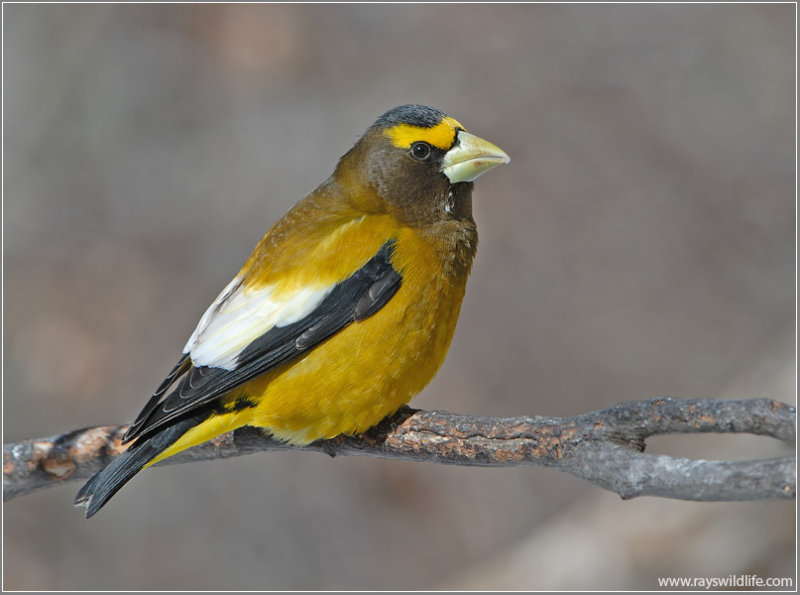
Evening Grosbeak (Hesperiphona vespertina) male by Raymond Barlow

Evening Grosbeak (Hesperiphona vespertina) male by Raymond Barlow

THE EVENING GROSBEAK.

In the far Northwest we find this beautiful bird the year around. During the winter he often comes farther south in company with his cousin, the Rose-Breasted Grosbeak.

What a beautiful sight it must be to see a flock of these birds—Evening Grosbeaks and Rose-Breasted in their pretty plumage.

Grosbeaks belong to a family called Finches. The Sparrows, Buntings, and Crossbills belong to the same family. It is the largest family among birds.

You will notice that they all have stout bills. Their food is mostly grains and their bills are well formed to crush the seeds.

Look at your back numbers of “Birds” and notice the pictures of the other Finches I have named. Don’t you think Dame Nature is very generous with her colors sometimes?

Only a few days ago while strolling through the woods with my field glass, I saw a pretty sight. On one tree I saw a Redheaded Woodpecker, a Flicker, an Indigo Bunting, and a Rose-Breasted Grosbeak. I thought then, if we could only have the Evening Grosbeak our group of colors would be complete.

Have you ever wondered at some birds being so prettily dressed while others have such dull colors?

Some people say that the birds who do not sing must have bright feathers to make them attractive. We cannot believe this. Some of our bright colored birds are sweet singers, and surely many of our dull colored birds cannot sing very well.

Next month you will see the pictures of several home birds. See if dull colors have anything to do with sweet song.


Lee’s Addition:

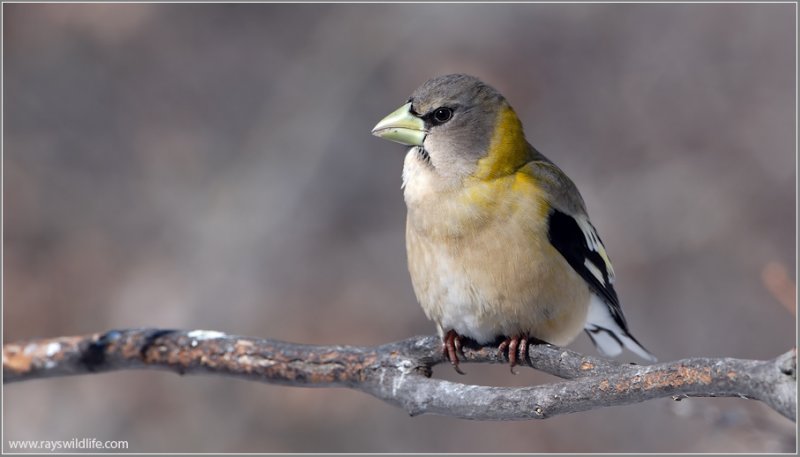
Evening Grosbeak (Hesperiphona vespertina) female by Raymond Barlow

Evening Grosbeak (Hesperiphona vespertina) female by Raymond Barlow

By awesome deeds you answer us with righteousness, O God of our salvation, the hope of all the ends of the earth and of the farthest seas; the one who by his strength established the mountains, being girded with might; who stills the roaring of the seas, the roaring of their waves, the tumult of the peoples, so that those who dwell at the ends of the earth are in awe at your signs. You make the going out of the morning and the evening to shout for joy. (Psalms 65:5-8 ESV)

What a beautiful bird the Lord created in the Evening Grosbeak. The Grosbeaks are in the Cardinalidae – Grosbeaks, Saltators & Allies Family. There are 17 Grosbeaks in the family and are found in 9 genera. The Evening Grosbeak is in the

The Evening Grosbeak (Coccothraustes vespertinus) is a large finch. In the past, it was treated in a genus of its own as Hesperiphona vespertina, but is now usually placed in the same genus as the Hawfinch of Eurasia.

The breeding habitat is coniferous and mixed forest across Canada and the western mountainous areas of the United States and Mexico. It is an extremely rare vagrant to the British Isles, with just two records so far. The nest is built on a horizontal branch or in a fork of a tree.

The migration of this bird is variable; in some winters, it may wander as far south as the southern U.S.

The Evening Grosbeak is similar in appearance to the Eurasian Hawfinch, both being bulky, heavily built finches with large bills and short tails. The Evening Grosbeak ranges in length from 6.3 to 8.7 in (16 to 22 cm) in length and spans 12 to 14 in (30 to 36 cm) across the wings. In a large sampling of grosbeaks in Pennsylvania during winter, males weighed from 1.37 to 3.04 oz (38.7 to 86.1 g), with an average of 2.1 oz (60 g), while females weighed from 1.52 to 2.59 oz (43.2 to 73.5 g), with an average of 2.07 oz (58.7 g). The adult has a short black tail, black wings and a large pale bill. The adult male has a bright yellow forehead and body; its head is brown and there is a large white patch in the wing. The adult female is mainly olive-brown, greyer on the underparts and with white patches in the wings.

These birds forage in trees and bushes, sometimes on the ground. They mainly eat seeds, berries and insects. Outside of the nesting season they often feed in flocks. Sometimes, they will swallow fine gravel.

The range of this bird has expanded far to the east in historical times, possibly due to plantings of Manitoba maples and other maples and shrubs around farms and the availability of bird feeders in winter.

“Calls from a large flock visiting a feeder” – from xeno-canto

*

Birds Illustrated by Color Photography – Revisited – Introduction

The above article is the first article in the monthly serial that was started in January 1897 “designed to promote Knowledge of Bird-Live.” These include Color Photography, as they call them, today they are drawings. There are at least three Volumes that have been digitized by Project Gutenberg.

To see the whole series of – Birds Illustrated by Color Photography – Revisited

*

(Information from Wikipedia and other internet sources)

Next Article – The Turkey Vulture

The Previous Article – Wilson’s Phalarope

Wordless Birds

Links:

Cardinalidae – Grosbeaks, Saltators & Allies Family

Evening Grosbeak Wikipedia

Evening Grosbeak All About Birds

Evening Grosbeak Sounds – xeno-canto

*

Vol 2 #2 – Wilson’s Phalarope

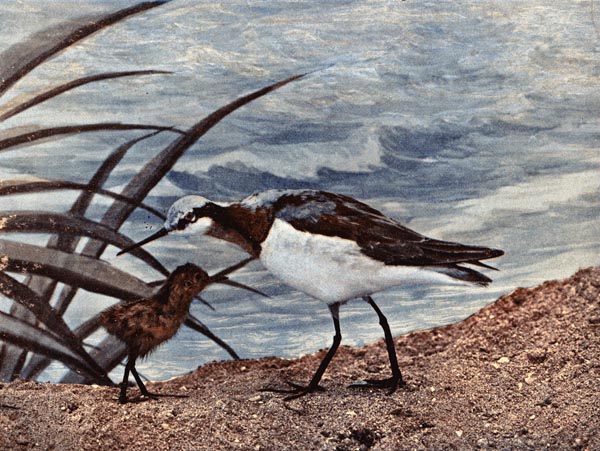
Wilson's Phalarope for Birds Illustrated by Color Photography

Wilson’s Phalarope for Birds Illustrated by Color Photography

WILSON’S PHALAROPE.

imgpERHAPS the most interesting, as it is certainly the most uncommon, characteristic of this species of birds is that the male relieves his mate from all domestic duties except the laying of the eggs. He usually chooses a thin tuft of grass on a level spot, but often in an open place concealed by only a few straggling blades. He scratches a shallow depression in the soft earth, lines it with a thin layer of fragments of old grass blades, upon which the eggs, three or four, are laid about the last of May or first of June. Owing to the low situation in which the nest is placed, the first set of eggs are often destroyed by a heavy fall of rain causing the water to rise so as to submerge the nest. The instinct of self preservation in these birds, as in many others, seems lacking in this respect. A second set, numbering two or three, is often deposited in a depression scratched in the ground, as at first, but with no sign of any lining.

Wilson’s Phalarope is exclusively an American bird, more common in the interior than along the sea coast. The older ornithologists knew little of it. It is now known to breed in northern Illinois, Iowa, Wisconsin, Minnesota, the Dakotas, Utah, and Oregon. It is recorded as a summer resident in northern Indiana and in western Kansas. Mr. E. W. Nelson states that it is the most common species in northern Illinois, frequenting grassy marshes and low prairies, and is not exceeded in numbers even by the ever-present Spotted Sandpiper. While it was one of our most common birds in the Calumet region it is now becoming scarce.

The adult female of this beautiful species is by far the handsomest of the small waders. The breeding plumage is much brighter and richer than that of the male, another peculiar characteristic, and the male alone possesses the naked abdomen. The female always remains near the nest while he is sitting, and shows great solicitude upon the approach of an intruder. The adults assume the winter plumage during July.


Wilson's Phalarope (Phalaropus tricolor) by J Fenton

Wilson’s Phalarope (Phalaropus tricolor) by J Fenton

Lee’s Addition:

Out of the ground the LORD God formed every beast of the field and every bird of the air, and brought them to Adam to see what he would call them. And whatever Adam called each living creature, that was its name. So Adam gave names to all cattle, to the birds of the air, and to every beast of the field. But for Adam there was not found a helper comparable to him. (Genesis 2:19-20 NKJV)

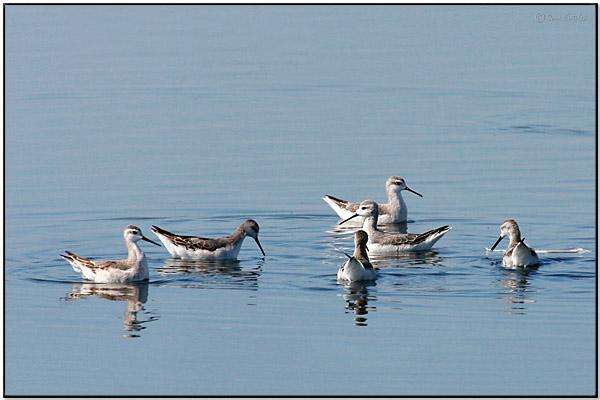
What another fantastically created bird. The Phalaropes belong to the Scolopacidae – Sandpipers, Snipes family. There are 96 species in the family, with 3 of those in the Phalaropus genus; the Wilson’s, Red-necked and Red Phalaropes. Phalarope are sometimes called “wadepipers.” They are especially notable for two things: their unusual nesting behavior (see above), and their unique feeding technique. When feeding, a phalarope will often swim in a small, rapid circle, forming a small whirlpool. This behavior is thought to aid feeding by raising food from the bottom of shallow water. The bird will reach into the center of the vortex with its bill, plucking small insects or crustaceans caught up therein.

The Wilson’s Phalarope, Phalaropus tricolor, is a small wader. This bird, the largest of the phalaropes, breeds in the prairies of North America in western Canada and the western United States. It is migratory, wintering around the central Andes in South America. They are passage migrants through Central America around March/April and again during September/October. The species is a rare vagrant to western Europe.

This species is often very tame and approachable. Its common name commemorates the American ornithologist Alexander Wilson. Sometimes, it is placed in a monotypic genus Steganopus.

Wilson's Phalarope (Phalaropus tricolor) by Daves BirdingPix

Wilson’s Phalarope (Phalaropus tricolor) by Daves BirdingPix

Wilson’s Phalarope is slightly larger than the Red Phalarope at about 9.1 in (23 cm) in length. As are all 3 phalaropes, it is a unique, dainty shorebird with lobed toes and a straight fine black bill. The breeding female is predominantly gray and brown above, with white underparts, a reddish neck and reddish flank patches. The breeding male is a duller version of the female, with a brown back, and the reddish patches reduced or absent. In a study of breeding phalaropes in Saskatchewan Providence in Canada, females were found to average around 10% larger in standard measurements and to weigh around 30% more than the males. Females weighed from 68 to 79 g (2.4 to 2.8 oz), whereas the males average 1.83 oz (51.8 g).

Young birds are grey and brown above, with whitish underparts and a dark patch through the eye. In winter, the plumage is essentially grey above and white below, but the dark eyepatch is always present.

*

Birds Illustrated by Color Photography – Revisited – Introduction

The above article is the first article in the monthly serial that was started in January 1897 “designed to promote Knowledge of Bird-Live.” These include Color Photography, as they call them, today they are drawings. There are at least three Volumes that have been digitized by Project Gutenberg.

To see the whole series of – Birds Illustrated by Color Photography – Revisited

*

(Information from Wikipedia and other internet sources)

Next Article – The Evening Grosbeak

The Previous Article – The Skylark

ABC’s Of The Gospel

Links:

*

Scolopacidae – Sandpipers, Snipes Family

Wilson’s Phalarope Wikipedia

Phalarope – Wikipedia

*

Vol 2 #2 – The Skylark

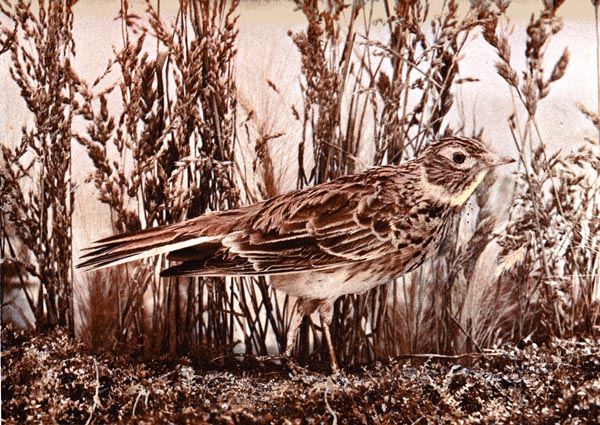
The Skylark - Birds Illustrated by Color Photography From col. F. M. Woodruff.

The Skylark – Birds Illustrated by Color Photography

From col. F. M. Woodruff.

THE SKYLARK.

This is not an American bird. I have allowed his picture to be taken and placed here because so many of our English friends desired it.

The skylark is probably the most noted of birds in Europe. He is found in all of the countries of Europe, but England seems to claim it. Here it stays during the summer, and goes south in the winter.

Like our own Meadow Lark, he likes best to stay in the fields. Here you will find it when not on the wing.

Early in the spring the Skylark begins his song, and he may be heard for most of the year.

Sometimes he sings while on the ground, but usually it is while he is soaring far above us.

Skylarks do not often seek the company of persons. There are some birds, you know, that seem happy only when they are near people. Of course, they are somewhat shy, but as a rule they prefer to be near people. While the Skylark does not seek to be near persons, yet it is not afraid of them.

A gentleman, while riding through the country, was surprised to see a Skylark perch on his saddle. When he tried to touch it, the Lark moved along on the horse’s back, and finally dropped under the horse’s feet. Here it seemed to hide. The rider, looking up, saw a hawk flying about. This explained the cause of the skylark’s strange actions.

A pair of these Larks had built their nest in a meadow. When the time came for mowing the grass, the little ones were not large enough to leave the nest. The mother bird laid herself flat on the ground, with her wings spread out. The father bird took one of the little ones from the nest and placed it on the mother’s back. She flew away, took the baby bird to a safe place, and came back for another.

This time the father took his turn. In this way they carried the little ones to a safe place before the mowers came.

Like our Meadow Lark, the Skylark builds her nest on the ground—never in bushes or trees. Usually it is built in a hole below the surface of the ground. It is for this reason that it is hard to find.

Then, too, the color of the nest is much like that of the ground.

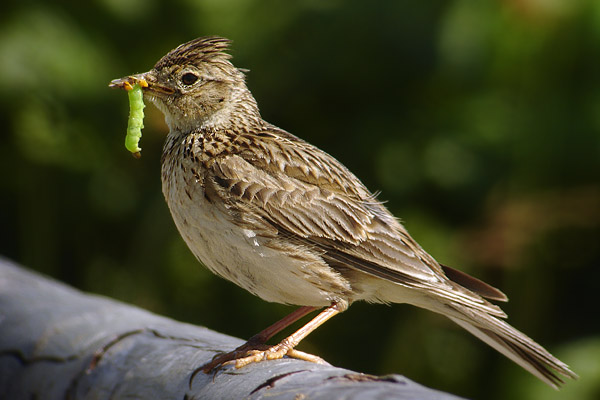
Four or five eggs are usually laid, and in two weeks the little larks crack the shells, and come into the world crying for worms and bugs.


Eurasian Skylark (Alauda arvensis) by Ian

Eurasian Skylark (Alauda arvensis) by Ian

THE SKYLARK.

imgt
HE English Skylark has been more celebrated in poetry than any other song-bird. Shelley’s famous poem is too long to quote and too symmetrical to present in fragmentary form. It is almost as musical as the sweet singer itself.

“By the first streak of dawn,” says one familiar with the Skylark, “he bounds from the dripping herbage, and on fluttering wings mounts the air for a few feet ere giving forth his cheery notes. Then upward, apparently without effort he sails, sometimes drifting far away as he ascends, borne as it were by the ascending vapors, so easily he mounts the air. His notes are so pure and sweet, and yet so loud and varied withal, that when they first disturb the air of early morning all the other little feathered tenants of the fields and hedgerows seem irresistibly compelled to join him in filling the air with melody. Upwards, ever upwards, he mounts, until like a speck in the highest ether he appears motionless; yet still his notes are heard, lovely in their faintness, now gradually growing louder and louder as he descends, until within a few yards of the earth they cease, and he drops like a fragment hurled from above into the herbage, or flits about it for a short distance ere alighting.” The Lark sings just as richly on the ground as when on quivering wing. When in song he is said to be a good guide to the weather, for whenever we see him rise into the air, despite the gloomy looks of an overcast sky, fine weather is invariably at hand.

The nest is most frequently in the grass fields, sometimes amongst the young corn, or in places little frequented. It is made of dry grass and moss, and lined with fibrous roots and a little horse hair. The eggs, usually four or five in number, are dull white, spotted, clouded, and blotched over the entire surface with brownish green. The female Lark, says Dixon, like all ground birds, is a very close sitter, remaining faithful to her charge. She regains her nest by dropping to the ground a hundred yards or more from its concealment.

The food of the Lark is varied,—in spring and summer, insects and their larvae, and worms and slugs, in autumn and winter, seeds.

Olive Thorne Miller tells this pretty anecdote of a Skylark which she emancipated from a bird store: “I bought the skylark, though I did not want him. I spared no pains to make the stranger happy. I procured a beautiful sod of uncut fresh grass, of which he at once took possession, crouching or sitting low among the stems, and looking most bewitching. He seemed contented, and uttered no more that appealing cry, but he did not show much intelligence. His cage had a broad base behind which he delighted to hide, and for hours as I sat in the room I could see nothing of him, although I would hear him stirring about. If I rose from my seat he was instantly on the alert, and stretched his head up to look over at me. I tried to get a better view of him by hanging a small mirror at an angle over his cage, but he was so much frightened by it that I removed it.”

“This bird,” Mrs. Miller says “never seemed to know enough to go home. Even when very hungry he would stand before his wide open door, where one step would take him into his beloved grass thicket, and yet that one step he would not take. When his hunger became intolerable he ran around the room, circled about his cage, looking in, recognizing his food dishes, and trying eagerly to get between the wires to reach them; and yet when he came before the open door he would stand and gaze, but never go in. After five months’ trial, during which he displayed no particular intelligence, and never learned to enter his cage, he passed out of the bird room, but not into a store.”


Eurasian Skylark (Alauda arvensis) ©WikiC

Eurasian Skylark (Alauda arvensis) ©WikiC

Lee’s Addition:

Don’t be afraid, land; rejoice and be glad, for the LORD has done great things. Don’t be afraid, wild animals, for the wilderness pastures have turned green, the trees bear their fruit, and the fig tree and grapevine yield their riches. (Joel 2:21-22 HCSB)

Skylarks are in the Alauda genus of the Alaudidae – Larks Family.

The Eurasian Skylark (Alauda arvensis) is a small passerine bird species. This lark breeds across most of Europe and Asia and in the mountains of north Africa. It is mainly resident in the west of its range, but eastern populations are more migratory, moving further south in winter. Even in the milder west of its range, many birds move to lowlands and the coast in winter. Asian birds appear as vagrants in Alaska; this bird has also been introduced in Hawaii, western North America, eastern Australia and New Zealand.

The Eurasian Skylark is 16 to 18 centimetres long. It is a bird of open farmland and heath, known throughout its range for the song of the male, which is delivered in hovering flight from heights of 50 to 100 m, when the singing bird may appear as just a dot in the sky from the ground. The song generally lasts two to three minutes, but it tends to last longer later in the mating season. The male has broader wings than the female. This adaptation for more efficient hovering flight may have evolved because of female Eurasian Skylarks’ preference for males that sing and hover for longer periods and so demonstrate that they are likely to have good overall fitness.

Like most other larks, the Eurasian Skylark is a rather dull-looking species on the ground, being mainly brown above and paler below. It has a short blunt crest on the head, which can be raised and lowered. In flight it shows a short tail and short broad wings. The tail and the rear edge of the wings are edged with white, which are visible when the bird is flying away, but not if it is heading towards the observer. The Eurasian Skylark has sturdy legs and spends much time on the ground foraging for seeds, supplemented with insects in the breeding season.

The Eurasian Skylark makes a grass nest on the ground, hidden amongst vegetation. It is sometimes found nesting in bracken, using it for cover. Generally the nests are very difficult to find. Three to six eggs are laid in June. A second or third brood may be started later in the year. The eggs are yellow/white with brownish/purple spots mainly at the large end. (Wikipedia)

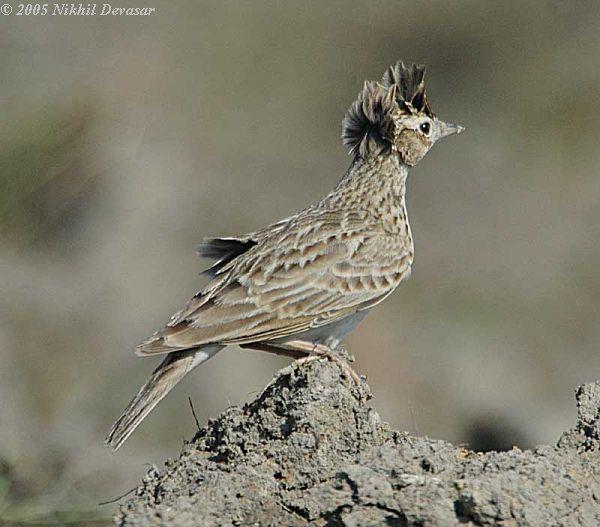
Oriental Skylark (Alauda gulgula) by Nikhil Devasar

Oriental Skylark (Alauda gulgula) by Nikhil Devasar

There is also the Oriental Skylark (Alauda gulgula), also known as the Oriental Lark or Small Skylark, is a species of skylark found in the Indian Subcontinent and Southeast Asia. Like other skylarks, it is found in open grassland – often near waterbodies – where it feeds on seeds and insects.

These skylarks frequently rocket up into the sky, fluttering and singing before descending down to earth. Male Oriental Skylarks may also hover in the air and sing, in order to attract a mate.

Oriental Skylarks are about 16 cm long. They have streaked, yellow-brown upper plumage, with white outer tail feathers and a short crest. Both sexes are similar. (Wikipedia)

*

Birds Illustrated by Color Photography – Revisited – Introduction

The above article is the first article in the monthly serial that was started in January 1897 “designed to promote Knowledge of Bird-Live.” These include Color Photography, as they call them, today they are drawings. There are at least three Volumes that have been digitized by Project Gutenberg.

To see the whole series of – Birds Illustrated by Color Photography – Revisited

*

(Information from Wikipedia and other internet sources)

Next Article – Wilson’s Phalarope

The Previous Article – The Yellow Legs

Wordless Birds

Links:

Alaudidae – Larks Family.

Eurasian Skylark – Wikipedia

Oriental Skylark – Wikipedia

*

Vol 2 #2 – The Yellow Legs

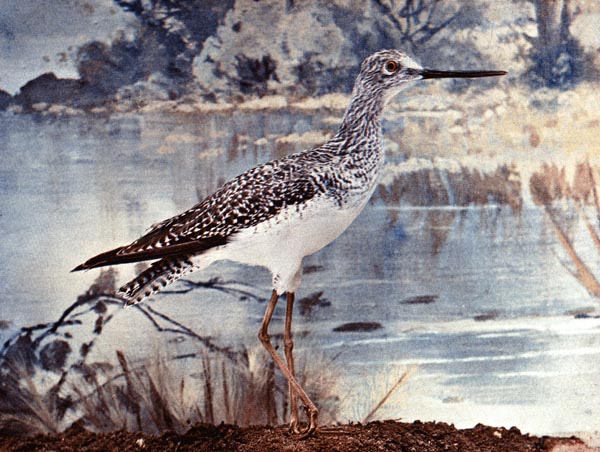
Lesser Yellow Legs for Birds Illustrated by Color Photography - From col. F. M. Woodruff.

Lesser Yellow Legs for Birds Illustrated by Color Photography – From col. F. M. Woodruff.

THE YELLOW LEGS.

imgy

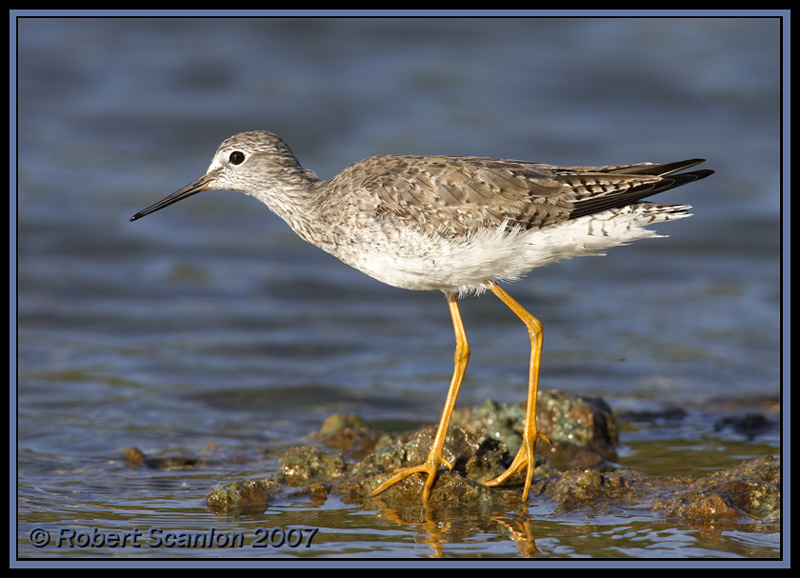
ELLOW LEGS, or Lesser Tell tale sometimes called Yellow-leg Snipe, and Little Cucu, inhabits the whole of North America, nesting in the cold temperate and subarctic districts of the northern continent, migrating south in winter to Argentine and Chili. It is much rarer in the western than eastern province of North America, and is only accidental in Europe. It is one of the wading birds, its food consisting of larvae of insects, small shell fish and the like.

The nest of the Lesser Yellow Shanks, which it is sometimes called, is a mere depression in the ground, without any lining. Sometimes, however, it is placed at the foot of a bush, with a scanty lining of withered leaves. Four eggs of light drab, buffy or cream color, sometimes of light brown, are laid, and the breast of the female is found to be bare of feathers when engaged in rearing the young. The Lesser Yellow legs breeds in central Ohio and Illinois, where it is a regular summer resident, arriving about the middle of April, the larger portion of flocks passing north early in May and returning about the first of September to remain until the last of October.

A nest of this species of Snipe was found situated in a slight depression at the base of a small hillock near the border of a prairie slough near Evanston, Illinois, and was made of grass stems and blades. The color of the eggs in this instance was a deep grayish white, three of which were marked with spots of dark brown, and the fourth egg with spots and well defined blotches of a considerably lighter shade of the same.


Lesser Yellowlegs (Tringa flavipes) by Robert Scanlon

Lesser Yellowlegs (Tringa flavipes) by Robert Scanlon

Lee’s Addition:

If you come across a bird’s nest in any tree or on the ground, with young ones or eggs and the mother sitting on the young or on the eggs, you shall not take the mother with the young. (Deuteronomy 22:6 ESV)

The Yellowlegs belong to the Scolopacidae – Sandpipers, Snipes Family. There are 96 species in the family. The Tringa genus that they are placed in also has Redshanks, Greenshanks, Sandpipers, Tattlers, and the Willet.

The Lesser Yellowlegs (Tringa flavipes) is a medium-sized shorebird similar in appearance to the larger Greater Yellowlegs. It is not closely related to this bird, however, but instead to the much larger and quite dissimilar Willet: merely the fine, clear and dense pattern of the neck shown in breeding plumage indicates these species’ actual relationships.

Their breeding habitat is clearings near ponds in the boreal forest region from Alaska to Quebec. They nest on the ground, usually in open dry locations.

They migrate to the Gulf coast of the United States and south to South America.

This species is a regular vagrant to western Europe, and the odd bird has wintered in Great Britain.

These birds forage in shallow water, sometimes using their bill to stir up the water. They mainly eat insects, small fish and crustaceans.

The call of this bird is softer than that of the Greater Yellowlegs.

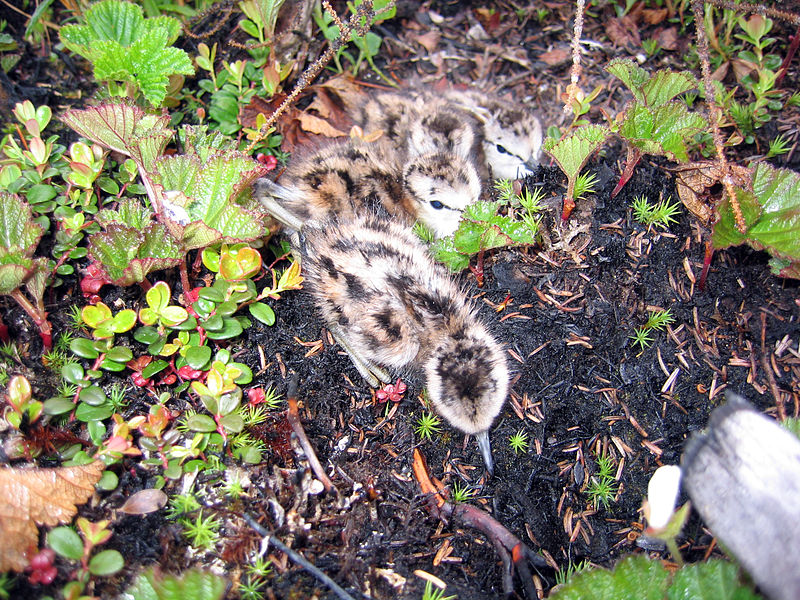
Lesser Yellowlegs (Tringa flavipes) chicks ©WikiC

Lesser Yellowlegs (Tringa flavipes) chicks ©WikiC

*

Birds Illustrated by Color Photography – Revisited – Introduction

The above article is the first article in the monthly serial that was started in January 1897 “designed to promote Knowledge of Bird-Live.” These include Color Photography, as they call them, today they are drawings. There are at least three Volumes that have been digitized by Project Gutenberg.

To see the whole series of – Birds Illustrated by Color Photography – Revisited

*

(Information from Wikipedia and other internet sources)

Next Article – The Skylark

The Previous Article – The Red Breasted Merganser

ABC’s Of The Gospel

Links:

Scolopacidae – Sandpipers, Snipes Family

Lesser Yellowlegs – All About Birds

Greater Yellowlegs – All About Birds

Lesser YellowlegsWikipedia

Greater Yellowlegs – Wikipedia

Tringa – Wikipedia

Birds Vol 2 #2 – The Red Breasted Merganser

Red-breasted Merganser from Birds Illustrated by Color Photography

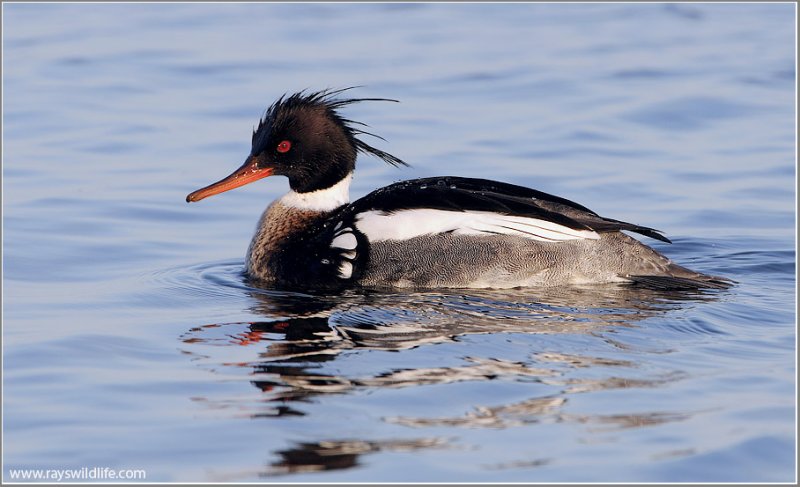
Red-breasted Merganser from Birds Illustrated by Color Photography

THE RED BREASTED MERGANSER.

imgy

HY this duck should be called red-breasted is not at first apparent, as at a distance the color can not be distinguished, but seen near, the reason is plain. It is a common bird in the United States in winter, where it is found in suitable localities in the months of May and June. It is also a resident of the far north, breeding abundantly in Newfoundland, Labrador, Greenland, and Iceland. It is liberally supplied with names, as Red-Breasted Goosander or Sheldrake, Garbill, Sea Robin, etc.

There is a difference in opinion as to the nesting habits of the Red-Breast, some authorities claiming that, like the Wood Duck, the nest is placed in the cavity of a tree, others that it is usually found on the ground among brushwood, surrounded with tall grasses and at a short distance from water. Davie says that most generally it is concealed by a projecting rock or other object, the nest being made of leaves and mosses, lined with feathers and down, which are plucked from the breast of the bird. The observers are all probably correct, the bird adapting itself to the situation.

Fish is the chief diet of the Merganser, for which reason its flesh is rank and unpalatable. The Bird’s appetite is insatiable, devouring its food in such quantities that it has frequently to disgorge several times before it is able to rise from the water. This Duck can swallow fishes six or seven inches in length, and will attempt to swallow those of a larger size, choking in the effort.

The term Merganser is derived from the plan of the bird’s bill, which is furnished with saw teeth fitting into each other.

The eggs of the Red-Breasted Merganser vary from six to twelve, are oval in shape, and are of a yellowish or reddish-drab, sometimes a dull buffy-green.

You may have seen pictures of this Duck, which frequently figures in dining rooms on the ornamental panels of stuffed game birds, but none which could cause you to remember its life-like appearance. You here see before you an actual Red-Breasted Merganser.

Birds Vol 2 #2 – The Red Breasted Merganser

From col. J. G. Parker, Jr.

Red-breasted Merganser (Mergus serrator) by Ray

Red-breasted Merganser (Mergus serrator) by Ray

Lee’s Addition:

Out of the ground the LORD God formed every beast of the field and every bird of the air, and brought them to Adam to see what he would call them. And whatever Adam called each living creature, that was its name. (Genesis 2:19 NKJV)

Another of one of the Lord’s neat birds. Mergansers are found in the Anatidae – Ducks, Geese & Swans Family. There are six of them in two Genera. The Hooded Merganser in Lophodytes genus and the Auckland (extinct), Brazilian, Common, Red-breasted, and Scaly-sided in the Mergus genus.

The adult Red-breasted Merganser is 20–24 in (51–62 cm) long with a 28–34 in (70–86 cm) wingspan. It has a spiky crest and long thin red bill with serrated edges. The male has a dark head with a green sheen, a white neck with a rusty breast, a black back, and white underparts. Adult females have a rusty head and a greyish body. The juvenile is like the female, but lacks the white collar and has a smaller white wing patch.

The call of the female is a rasping prrak prrak, while the male gives a feeble hiccup-and-sneeze display call. (from xeno-canto)

Red-breasted Mergansers dive and swim underwater. They mainly eat small fish, but also aquatic insects, crustaceans, and frogs.

Its breeding habitat is freshwater lakes and rivers across northern North America, Greenland, Europe, and Asia. It nests in sheltered locations on the ground near water. It is migratory and many northern breeders winter in coastal waters further south.

It has been claimed to be the fastest bird in level flight, reaching speeds of 161 km/h (100 mph), but is disputed whether the White-throated Needletail is faster, reportedly flying at 170 km/h (105 mph).

Here is a video of a Common Merganser flipping his feet after diving for food that was given him at the Zoo Miami Wings of Asia Aviary – by me.

*

Birds Illustrated by Color Photography – Revisited – Introduction

The above article is the first article in the monthly serial that was started in January 1897 “designed to promote Knowledge of Bird-Live.” These include Color Photography, as they call them, today they are drawings. There are at least three Volumes that have been digitized by Project Gutenberg.

To see the whole series of – Birds Illustrated by Color Photography – Revisited

*

(Information from Wikipedia and other internet sources)

Next Article – The Yellow Legs

The Previous Article – The Kentucky Warbler

ABC’s Of The Gospel

Links:

Birds Vol 2 #2 – The Kentucky Warbler

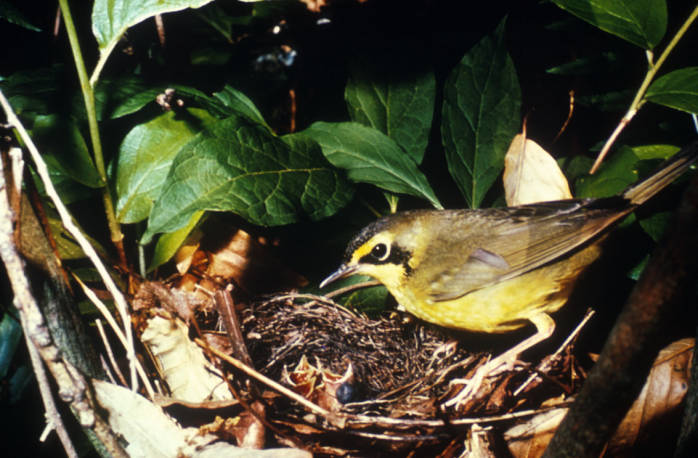
Kentucky Warbler (Oporornis formosus) ©USFWS

Kentucky Warbler (Oporornis formosus) ©USFWS

The Kentucky Warbler

Although this bird is called the Kentucky Warbler, we must not think he visits that state alone.

We find him all over eastern North America. And a beautiful bird he is.

As his name tells you he is one of a family of Warblers.

I told you somewhere else that the Finches are the largest family of birds. Next to them come the Warblers.

Turn back now and see how many Warblers have been pictured so far.

See if you can tell what things group them as a family. Notice their bills and feet.

This bird is usually found in the dense woods, especially where there are streams of water.

He is a good singer, and his song is very different from that of any of the other Warblers.

I once watched one of these birds—olive-green above and yellow beneath. His mate was on a nest near by and he was entertaining her with his song.

He kept it up over two hours, stopping only a few seconds between his songs. When I reached the spot with my field-glass I was attracted by his peculiar song. I don’t know how long he had been singing. I stayed and spent two hours with him and he showed no signs of stopping. He may be singing yet. I hope he is.

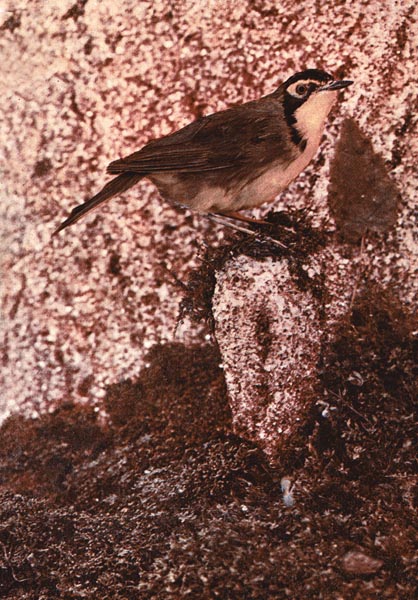
You see him here perched on a granite cliff. I suppose his nest is near by.

He makes it of twigs and rootlets, with several thicknesses of leaves. It is neatly lined with fine rootlets and you will always find it on or near the ground.

In the September and October number of “Birds” you will find several Warblers and Finches. Try to keep track of them and may be you can do as many others have done—tell the names of new birds that come along by their pictures which you have seen in “Birds.”

image
From col. F. M. Woodruff.


THE KENTUCKY WARBLER.

B

ETWEEN sixty and seventy warblers are described by Davie in his “Nests and Eggs of North American Birds,” and the Kentucky Warbler is recognized as one of the most beautiful of the number, in its manners almost the counterpart of the Golden Crowned Thrush (soon to delight the eyes of the readers of Birds), though it is altogether a more conspicuous bird, both on account of its brilliant plumage and greater activity, the males being, during the season of nesting, very pugnacious, continually chasing one another about the woods. It lives near the ground, making its artfully concealed nest among the low herbage and feeding in the undergrowth, the male singing from some old log or low bush, his song recalling that of the Cardinal, though much weaker.

The ordinary note is a soft schip, somewhat like the common call of the Pewee. Considering its great abundance, says an observer, the nest of this charmer is very difficult to find; the female, he thought, must slyly leave the nest at the approach of an intruder, running beneath the herbage until a considerable distance from the nest, when, joined by her mate, the pair by their evident anxiety mislead the stranger as to its location.

It has been declared that no group of birds better deserves the epithet “pretty” than the Warblers. Tanagers are splendid, Humming Birds refulgent, others brilliant, gaudy, or magnificent, but Warblers alone are pretty.

The Warblers are migratory birds, the majority of them passing rapidly across the United States in spring on the way to their northern nesting grounds, and in autumn to their winter residence within the tropics. When the apple trees bloom they revel among the flowers, vieing in activity and numbers with the bees; “now probing the recesses of a blossom for an insect, then darting to another, where, poised daintily upon a slender twig, or suspended from it, they explore hastily but carefully for another morsel. Every movement is the personification of nervous activity, as if the time for their journey was short; as, indeed, appears to be the case, for two or three days at most suffice some species in a single locality.”

We recently saw a letter from a gentleman living at Lake Geneva, in which he referred with enthusiasm to Birds, because it had enabled him to identify a bird which he had often seen in the apple trees among the blossoms, particularly the present season, with which he was unacquainted by name. It was the Orchard Oriole, and he was glad to have a directory of nature which would enable him to add to his knowledge and correct errors of observation. The idea is a capitol one, and the beautiful Kentucky Warbler, unknown to many who see it often, may be recognized in the same way by residents of southern Indiana and Illinois, Kansas, some localities in Ohio, particularly in the southwestern portion, in parts of New York and New Jersey, in the District of Columbia, and in North Carolina. It has not heretofore been possible, even with the best painted specimens of birds in the hand, to satisfactorily identify the pretty creatures, but with Birds as a companion, which may readily be consulted, the student cannot be led into error.


Lee’s Addition:

I know all the birds of the hills, and all that moves in the field is mine. (Psalms 50:11 ESV)

The Kentucky Warbler is in the New World Warblers – Parulidae Family. At present their are 115 species that make up this family. Warblers are confusing for me to figure out at times. Number 1, I don’t see them often, and then they are passing through on their migration south. They are neat birds and I always enjoy seeing them. Mostly here I see the Yellow-rumps and the Black-and-white occasionally.

The Kentucky Warbler, is a sluggish and heavy warbler with a short tail, preferring to spend most of its time on or near the ground, except when singing.

Kentucky Warbler song by Chris Parrish and call by Andrew Spencer from xeno-canto.org.

They are only about 5-6 inches long. They migrate to the Yucatan Peninsula and many of the Caribbean Islands. That is after they make a non-stop flight across the Gulf of Mexico. The Lord has given them quite a flying ability to do that.

*

Birds Illustrated by Color Photography – Revisited – Introduction

The above article is the first article in the monthly serial that was started in January 1897 “designed to promote Knowledge of Bird-Live.” These include Color Photography, as they call them, today they are drawings. There are at least three Volumes that have been digitized by Project Gutenberg.

To see the whole series of – Birds Illustrated by Color Photography – Revisited

*

(Information from Wikipedia and other internet sources)

Next Article – The Red Breasted Merganser

The Previous Article – The Sora Rail

Wordless Birds

Links:

Kentucky Warbler – Wikipedia

Kentucky Warbler – All About Birds

New World Warblers – Parulidae Family

*

Halcyone (Kingfisher)

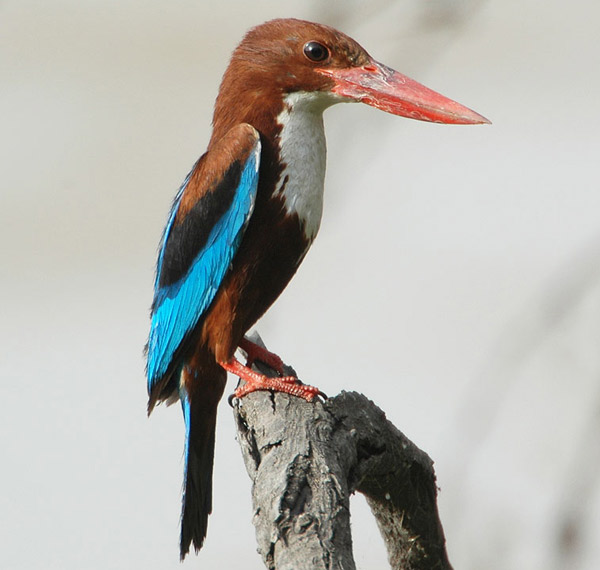
White-throated Kingfisher (Halcyon smyrnensis) by Nikhil Devasar

White-throated Kingfisher (Halcyon smyrnensis) by Nikhil Devasar

Halcyone ~ from The Curious Book of Birds

HALCYONE

Cur Book of Birds letter-tHE story of the first Kingfisher is a sad one, and you need not read it unless for a very little while you wish to feel sorry.

Long, long ago when the world was new, there lived a beautiful princess named Halcyone. She was the daughter of old Æolus, King of the Winds, and lived with him on his happy island, where it was his chief business to keep in order the four boisterous brothers, Boreas, the North Wind, Zephyrus, the West Wind, Auster, the South Wind, and Eurus, the East Wind. Sometimes, indeed, Æolus had a hard time of it; for the Winds would escape from his control and rush out upon the sea for their terrible games, which were sure to bring death and destruction to the sailors and their ships. Knowing them so well, for she had grown up with these rough playmates, Halcyone came to dread more than anything else the cruelties which they practiced at every opportunity.

One day the Prince Ceyx came to the island of King Æolus. He was the son of Hesperus, the Evening Star, and he was the king of the great land of Thessaly. Ceyx and Halcyone grew to love each other dearly, and at last with the consent of good King Æolus, but to the wrath of the four Winds, the beautiful princess went away to be the wife of Ceyx and Queen of Thessaly.

For a long time they lived happily in their peaceful kingdom, but finally came a day when Ceyx must take a long voyage on the sea, to visit a temple in a far country. Halcyone could not bear to have him go, for she feared the dangers of the great deep, knowing well the cruelty of the Winds, whom King Æolus had such difficulty in keeping within bounds. She knew how the mischievous brothers loved to rush down upon venturesome sailors and blow them into danger, and she knew that they especially hated her husband because he had carried her away from the island where she had watched the Winds at their terrible play. She begged Ceyx not to go, but he said that it was necessary. Then she prayed that if he must go he would take her with him, for she could not bear to remain behind dreading what might happen.

But Ceyx was resolved that Halcyone should not go. The good king longed to take her with him; no more than she could he smile at the thought of separation. But he also feared the sea, not on his own account, but for his dear wife. In spite of her entreaties he remained firm. If all went well he promised to return in two months’ time. But Halcyone knew that she should never see him again as now he spoke.

The day of separation came. Standing heart-broken upon the shore, Halcyone watched the vessel sail away into the East, until as a little speck it dropped below the horizon; then sobbing bitterly she returned to the palace.

Now the king and his men had completed but half their journey when a terrible storm arose. The wicked Winds had escaped from the control of good old Æolus and were rushing down upon the ocean to punish Ceyx for carrying away the beautiful Halcyone. Fiercely they blew, the lightning flashed, and the sea ran high; and in the midst of the horrible tumult the good ship went to the bottom with all on board. Thus the fears of Halcyone were proved true, and far from his dear wife poor Ceyx perished in the cruel waves.

That very night when the shipwreck occurred, the sad and fearful Halcyone, sleeping lonely at home, knew in a dream the very calamity which had happened. She seemed to see the storm and the shipwreck, and the form of Ceyx appeared, saying a sad farewell to her. As soon as it was light she rose and hastened to the seashore, trembling with a horrible dread. Standing on the very spot whence she had last seen the fated ship, she looked wistfully over the waste of stormy waters. At last she spied a dark something tossing on the waves. The object floated nearer and nearer, until a huge breaker cast before her on the sand the body of her drowned husband.

“O dearest Ceyx!” she cried. “Is it thus that you return to me?” Stretching out her arms toward him, she leaped upon the sea wall as if she would throw herself into the ocean, which advanced and retreated, seething around his body. But a different fate was to be hers. As she leaped forward two strong wings sprouted from her shoulders, and before she knew it she found herself skimming lightly as a bird over the water. From her throat came sounds of sobbing, which changed as she flew into the shrill piping of a bird. Soft feathers now covered her body, and a crest rose above the forehead which had once been so fair. Halcyone was become a Kingfisher, the first Kingfisher who ever flew lamenting above the waters of the world.

The sad bird fluttered through the spray straight to the body that was tossed upon the surf. As her wings touched the wet shoulders, and as her horny beak sought the dumb lips in an attempt to kiss what was once so dear, the body of Ceyx began to receive new life. The limbs stirred, a faint color returned to the cheeks. At the same moment a change like that which had transformed Halcyone began to pass over her husband. He too was becoming a Kingfisher. He too felt the thrill of wings upon his shoulders, wings which were to bear him up and away out of the sea which had been his death. He too was clad in soft plumage with a kingly crest upon his kingly head. With a faint cry, half of sorrow for what had happened, half of joy for the future in which these two loving ones were at least to be together, Ceyx rose from the surf-swept sand where his lifeless limbs had lain and went skimming over the waves beside Halcyone his wife.

Oriental Dwarf-Kingfisher (Ceyx erithaca) by Khong Tuck Khoon

Oriental Dwarf-Kingfisher (Ceyx erithaca) by Khong Tuck Khoon

So those unhappy mortals became the first kingfishers, happy at last in being reunited. So we see them still, flying up and down over the waters of the world, royal forms with royal crests upon their heads.

They built their nest of the bones of fish, a stout and well-joined basket which floated on the waves as safely as any little boat. And while their children, the baby Halcyons, lay in this rocking cradle, for seven days in the heart of winter, no storms ever troubled the ocean and mariners could set out upon their voyages without fear.

For while his little grandchildren rocked in their basket, the good King Æolus, pitying the sorrows of his daughter Halcyone, was always especially careful to chain up in prison those wicked brothers the Winds, so that they could do no mischief of any kind.

And that is why a halcyon time has come to mean a season of peace and safety.

Belted Kingfisher (Megaceryle alcyon) by Daves BirdingPix

Belted Kingfisher (Megaceryle alcyon) by Daves BirdingPix


Lee’s Addition:

Another enjoyable Bird Tale from the Curious Book of Birds. Kingfishers belong to the Alcedinidae – Kingfishers Family. There are two genus in the Kingfishers called Ceyx and Halcyon. Humm! What do you think? Must be those that name birds read the story?

We know the Lord created Kingfishers, but it is fun to read stories about them, even if they are make-believe.

And when he (Jesus) had finished speaking, he said to Simon, “Put out into the deep and let down your nets for a catch.” And Simon answered, “Master, we toiled all night and took nothing! But at your word I will let down the nets.” And when they had done this, they enclosed a large number of fish, and their nets were breaking. (Luke 5:4-6 ESV)

Kingfishers don’t have to use nets like these fishermen, which were the disciples. But they obeyed and they received a great many fish.

(Photos added by me.)

Links:

White-throated Kingfisher (Halcyon smyrnensis) by Nikhil Devasar


  Alcedinidae – Kingfishers Family


Painted Bunting (Passerina ciris) ©©Flickr


  Bird Tales


Curious Book of Birds - Cover


  The Curious Book of Birds


Spanish Sparrow (Passer Hispaniolensis) female ©WikiC


  Wordless Birds


*

King of the Birds

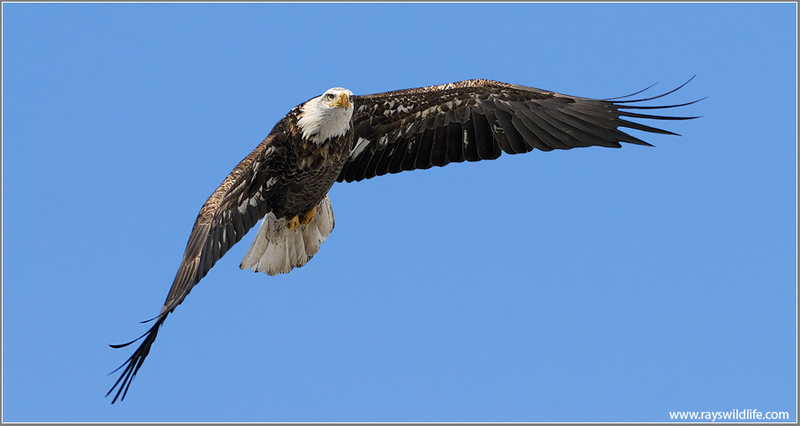
Bald Eagle (Haliaeetus leucocephalus) by Ray

Bald Eagle (Haliaeetus leucocephalus) by Ray

King of the Birds ~ from The Curious Book of Birds

KING OF THE BIRDS

Cur Book of Birds letter-oNCE upon a time, when the world was very new and when the birds had just learned from Mother Magpie how to build their nests, some one said, “We ought to have a king. Oh, we need a king of the birds very much!”

For you see, already in the Garden of Birds trouble had begun. There were disputes every morning as to which was the earliest bird who was entitled to the worm. There were quarrels over the best places for nest-building and over the fattest bug or beetle; and there was no one to settle these difficulties. Moreover, the robber birds were growing too bold, and there was no one to rule and punish them. There was no doubt about it; the birds needed a king to keep them in order and peace.

So the whisper went about, “We must have a king. Whom shall we choose for our king?”

They decided to hold a great meeting for the election. And because the especial talent of a bird is for flying, they agreed that the bird who could fly highest up into the blue sky, straight toward the sun, should be their king, king of all the feathered tribes of the air.

Therefore, after breakfast one beautiful morning, the birds met in the garden to choose their king. All the birds were there, from the largest to the smallest, chirping, twittering, singing on every bush and tree and bit of dry grass, till the noise was almost as great as nowadays at an election of two-legged folk without feathers. They swooped down in great clouds, till the sky was black with them, and they were dotted on the grass like punctuation marks on a green page. There were so many that not even wise Mother Magpie or old Master Owl could count them, and they all talked at the same time, like ladies at an afternoon tea, which was very confusing.

Little Robin Redbreast was there, hopping about and saying pleasant things to every one, for he was a great favorite. Gorgeous Goldfinch was there, in fine feather; and little Blackbird, who was then as white as snow. There were the proud Peacock and the silly Ostrich, the awkward Penguin and the Dodo, whom no man living has ever seen. Likewise there were the Jubjub Bird and the Dinky Bird, and many other curious varieties that one never finds described in the wise Bird Books,—which is very strange, and sad, too, I think. Yes, all the birds were there for the choosing of their king, both the birds who could fly, and those who could not. (But for what were they given wings, if not to fly? How silly an Ostrich must feel!)

Now the Eagle expected to be king. He felt sure that he could fly higher than any one else. He sat apart on a tall pine tree, looking very dignified and noble, as a future king should look. And the birds glanced at one another, nodded their heads, and whispered, “He is sure to be elected king. He can fly straight up toward the sun without winking, and his great wings are so strong, so strong! He never grows tired. He is sure to be king.”

Thus they whispered among themselves, and the Eagle heard them, and was pleased. But the little brown Wren heard also, and he was not pleased. The absurd little bird! He wanted to be king himself, although he was one of the tiniest birds there, who could never be a protector to the others, nor stop trouble when it began. No, indeed! Fancy him stepping as a peacemaker between a robber Hawk and a bloody Falcon. It was they who would make pieces of him. But he was a conceited little creature, and saw no reason why he should not make a noble sovereign.

Cobb's Wren (Troglodytes cobbi) ©WikiC

Cobb’s Wren (Troglodytes cobbi) ©WikiC

“I am cleverer than the Eagle,” he said to himself, “though he is so much bigger. I will be king in spite of him. Ha-ha! We shall see what we shall see!” For the Wren had a great idea in his wee little head—an idea bigger than the head itself, if you can explain how that could be. He ruffled up his feathers to make himself as huge as possible, and hopped over to the branch where the Eagle was sitting.

“Well, Eagle,” said the Wren pompously, “I suppose you expect to be king, eh?”

The Eagle stared hard at him with his great bright eyes. “Well, if I do, what of that?” he said. “Who will dispute me?”

“I shall,” said the Wren, bobbing his little brown head and wriggling his tail saucily.

“You!” said the Eagle. “Do you expect to fly higher than I?”

“Yes,” chirped the Wren, “I do. Yes, I do, do, do!”

“Ho!” said the Eagle scornfully. “I am big and strong and brave. I can fly higher than the clouds. You, poor little thing, are no bigger than a bean. You will be out of breath before we have gone twice this tree’s height.”

“Little as I am, I can mount higher than you,” said the Wren.

“What will you wager, Wren?” asked the Eagle. “What will you give me if I win?”

“If you win you will be king,” said the Wren. “But beside that, if you win I will give you my fat little body to eat for your breakfast. But if I win, Sir, I shall be king, and you must promise never, never, never, to hurt me or any of my people.”

“Very well. I promise,” said the Eagle haughtily. “Come now, it is time for the trial, you poor little foolish creature.”

The birds were flapping their wings and singing eagerly, “Let us begin—begin. We want to see who is to be king. Come, birds, to the trial. Who can fly the highest? Come!”

Then the Eagle spread his great wings and mounted leisurely into the air, straight toward the noonday sun. And after him rose a number of other birds who wanted to be king,—the wicked Hawk, the bold Albatross, and the Skylark singing his wonderful song. The long-legged Stork started also, but that was only for a joke. “Fancy me for a king!” he cried, and he laughed so that he had to come down again in a minute. But the Wren was nowhere to be seen. The truth was, he had hopped ever so lightly upon the Eagle’s head, where he sat like a tiny crest. But the Eagle did not know he was there.

Black-browed Albatross (Thalassarche melanophris) by Bob-Nan

Black-browed Albatross (Thalassarche melanophris) by Bob-Nan

Soon the Hawk and the Albatross and even the brave little Skylark fell behind, and the Eagle began to chuckle to himself at his easy victory. “Where are you, poor little Wren?” he cried very loudly, for he fancied that the tiny bird must be left far, far below.

“Here I am, here I am, away up above you, Master Eagle!” piped the Wren in a weak little voice. And the Eagle fancied the Wren was so far up in the air that even his sharp eyes could not spy the tiny creature. “Dear me!” said he to himself. “How extraordinary that he has passed me.” So he redoubled his speed and flew on, higher, higher.

Presently he called out again in a tremendous voice, “Well, where are you now? Where are you now, poor little Wren?”

Once more he heard the tiny shrill voice from somewhere above piping, “Here I am, here I am, nearer the sun than you, Master Eagle. Will you give up now?”

Of course the Eagle would not give up yet. He flew on, higher and higher, till the garden and its flock of patient birds waiting for their king grew dim and blurry below. And at last even the mighty wings of the Eagle were weary, for he was far above the clouds. “Surely,” he thought, “now the Wren is left miles behind.” He gave a scream of triumph and cried, “Where are you now, poor little Wren? Can you hear me at all, down below there?”

But what was his amazement to hear the same little voice above his head shrilling, “Here I am, here I am, Sir Eagle. Look up and see me, look!” And there, sure enough, he was fluttering above the Eagle’s head. “And now, since I have mounted so much higher than you, will you agree that I have won?”

“Yes, you have won, little Wren. Let us descend together, for I am weary enough,” cried the Eagle, much mortified; and down he swooped, on heavy, discouraged wings.

“Yes, let us descend together,” murmured the Wren, once more perching comfortably on the Eagle’s head. And so down he rode on this convenient elevator, which was the first one invented in this world.

When the Eagle nearly reached the ground, the other birds set up a cry of greeting.

“Hail, King Eagle!” they sang. “How high you flew! How near the sun! Did he not scorch your Majesty’s feathers? Hail, mighty king!” and they made a deafening chorus. But the Eagle stopped them.

“The Wren is your king, not I,” he said. “He mounted higher than I did.”

“The Wren? Ha-ha! The Wren! We can’t believe that The Wren flew higher than you? No, no!” they all shouted. But just then the Eagle lighted on a tree, and from the top of his head hopped the little Wren, cocking his head and ruffling himself proudly.

“Yes, I mounted higher than he,” he cried, “for I was perched on his head all the while, ha-ha! And now, therefore, I am king, small though I be.”

Now the Eagle was very angry when he saw the trick that had been played upon him, and he swooped upon the sly Wren to punish him. But the Wren screamed, “Remember, remember your promise never to injure me or mine!” Then the Eagle stopped, for he was a noble bird and never forgot a promise. He folded his wings and turned away in disgust.

“Be king, then, O cheat and trickster!” he said.

“Cheat and trickster!” echoed the other birds. “We will have no such fellow for our king. Cheat and trickster he is, and he shall be punished. You shall be king, brave Eagle, for without your strength he could never have flown so high. It is you whom we want for our protector and lawmaker, not this sly fellow no bigger than a bean.”

So the Eagle became their king, after all; and a noble bird he is, as you must understand, or he would never have been chosen to guard our nation’s coat of arms. And besides this you may see his picture on many a banner and crest and coin of gold or silver, so famous has he become.

But the Wren was to be punished. And while the birds were trying to decide what should be done with him, they put him in prison in a mouse-hole and set Master Owl to guard the door. Now while the judges were putting their heads together the lazy Owl fell fast asleep, and out of prison stole the little Wren and was far away before any one could catch him. So he was never punished after all, as he richly deserved to be.

The birds were so angry with old Master Owl for his carelessness that he has never since dared to show his face abroad in daytime, but hides away in his hollow tree. And only at night he wanders alone in the woods, sorry and ashamed.


Lee’s Addition:

No one who trusts in you will be disappointed. But disappointment will come to those who try to deceive others. They will get nothing. (Psalms 25:3 ERV)

We are not supposed to cheat or deceive others.

The wise accept instruction, but fools argue and bring trouble on themselves. Honest people can always feel secure, but lying cheaters will be caught. (Proverbs 10:8-9 ERV)

(Photos added by me.)

Links:

Bald Eagle (Haliaeetus leucocephalus) by Quy Tran


  Accipitridae – Family (Kites, Hawks & Eagles) Family


Painted Bunting (Passerina ciris) ©©Flickr


  Bird Tales


Curious Book of Birds - Cover


  The Curious Book of Birds


Spanish Sparrow (Passer Hispaniolensis) female ©WikiC


  Wordless Birds


*

Birds Vol 2 #2 – The Sora Rail

Sora - for the Birds Illustrated by Color Photography, 1897

Sora – for the Birds Illustrated by Color Photography, 1897

THE SORA RAIL.

imgv

ARIOUS are the names required to distinguish the little slate-colored Carolina Rail from its brethren, Sora, Common Rail, and, on the Potomac river, Ortolan, being among them. He is found throughout temperate North America, in the weedy swamps of the Atlantic states in great abundance, in the Middle states, and in California. In Ohio he is a common summer resident, breeding in the extensive swamps and wet meadows. The nest is a rude affair made of grass and weeds, placed on the ground in a tussock of grass in a boggy tract of land, where there is a growth of briers, etc., where he may skulk and hide in the wet grass to elude observation. The nest may often be discovered at a distance by the appearance of the surrounding grass, the blades of which are in many cases interwoven over the nest, apparently to shield the bird from the fierce rays of the sun, which are felt with redoubled force on the marshes.

The Rails feed on both vegetable and animal food. During the months of September and October, the weeds and wild oats swarm with them. They feed on the nutritious seeds, small snail shells, worms and larvae of insects, which they extract from the mud. The habits of the Sora Rail, its thin, compressed body, its aversion to take wing, and the dexterity with which it runs or conceals itself among the grass and sedge, are exactly similar to those of the more celebrated Virginia Rail.

The Sora frequents those parts of marshes preferably where fresh water springs rise through the morass. Here it generally constructs its nest, “one of which,” says an observer, “we had the good fortune to discover. It was built in the bottom of a tuft of grass in the midst of an almost impenetrable quagmire, and was composed altogether of old wet grass and rushes. The eggs had been flooded out of the nest by the extraordinary rise of the tide in a violent northwest storm, and lay scattered about the drift weed. The usual number of eggs is from six to ten. They are of a dirty white or pale cream color, sprinkled with specks of reddish and pale purple, most numerous near the great end.”

When on the wing the Sora Rail flies in a straight line for a short distance with dangling legs, and suddenly drops into the water.

The Rails have many foes, and many nests are robbed of their eggs by weasels, snakes, Blackbirds, and Marsh Hawks, although the last cannot disturb them easily, as the Marsh Hawk searches for its food while flying and a majority of the Rails’ nests are covered over, making it hard to distinguish them when the Hawk is above.


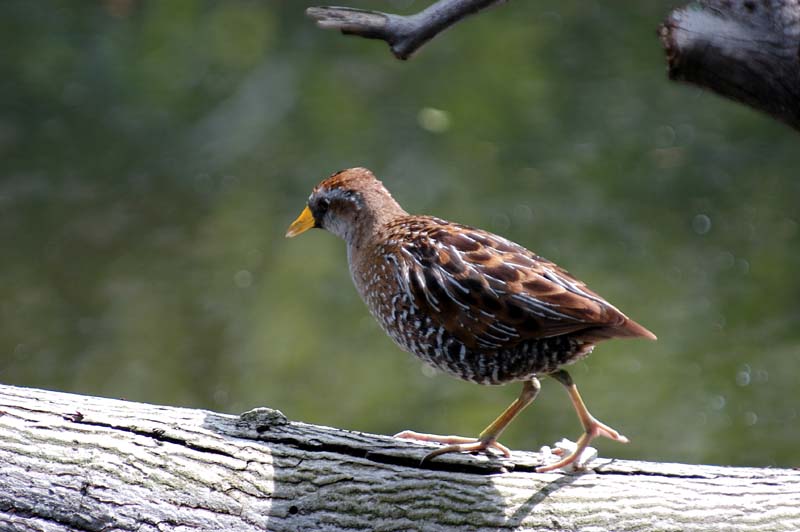
Sora(Porzana carolina) 4 by Bob-Nan

Sora(Porzana carolina) 4 by Bob-Nan

THE SORA RAIL.

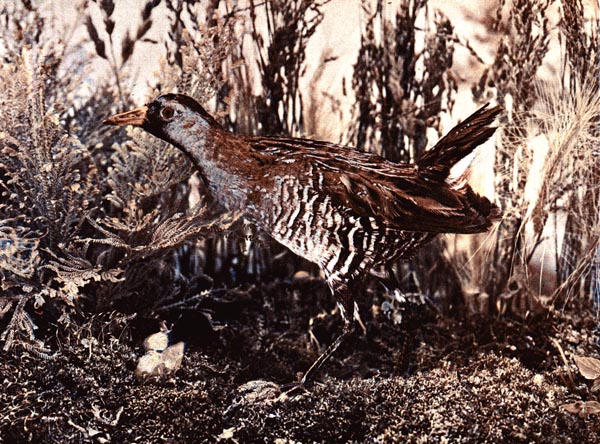
This is one of our fresh-water marsh birds. I show you his picture taken where he spends most of his time.

If it were not for the note calls, these tall reeds and grasses would keep from us the secret of the Rail’s home.

Like most birds, though, they must be heard, and so late in the afternoon you may hear their clear note, ker-wee.

From all parts of the marsh you will hear their calls which they keep up long after darkness has set in.

This Rail was just about to step out from the grasses to feed when the artist took his picture. See him—head up, and tail up. He steps along carefully. He feels that it is risky to leave his shelter and is ready at the first sign of danger, to dart back under cover.

There are very few fresh-water marshes where the Rail is not found.

When a boy, I loved to hear their note calls and would spend hours on the edge of a marsh near my home.

It seemed to me there was no life among the reeds and cat-tails of the marsh, but when I threw a stone among them, the Rails would always answer with their peeps or keeks.

And so I used to go down to the marsh with my pockets filled with stones. Not that I desired or even expected to injure one of these birds. Far from it. It pleased me to hear their calls from the reeds and grass that seemed deserted.

Those of you who live near wild-rice or wild-oat marshes have a good chance to become acquainted with this Rail.

In the south these Rails are found keeping company with the Bobolinks or Reed-birds as they are called down there.


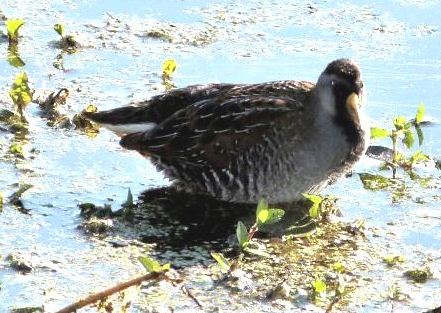
Sora(Porzana carolina)

Sora (Porzana carolina) by Lee at Circle B

Lee’s Addition:

Can the papyrus grow up without a marsh? Can the reeds flourish without water? (Job 8:11 NKJV)

Under the lotus plants he lies, in the shelter of the reeds and in the marsh. (Job 40:21 ESV)

Soras are in the Rallidae – Rails, Crakes & Coots Family. At present there are 151 species in the family. Sometimes the Sora has Rail or Crake attached to Sora. They spend most of their time in marshes.

Adult Soras are 7.5–12 in (19–30 cm) long, with dark-marked brown upperparts, a blue-grey face and underparts, and black and white barring on the flanks. They have a short thick yellow bill, with black markings on the face at the base of the bill and on the throat. Sexes are similar, but young Soras lack the black facial markings and have a whitish face and buff breast. They weigh about 1.7–4.0 oz (49–112 g).

The Sora’s breeding habitat is marshes throughout much of North America. They nest in a well-concealed location in dense vegetation. The female usually lays 10 to 12 eggs, sometimes as many as 18, in a cup built from marsh vegetation. The eggs do not all hatch together. Both parents incubate and feed the young, who leave the nest soon after they hatch and are able to fly within a month.

They migrate to the southern United States and northern South America. Sora is a very rare vagrant to western Europe, where it can be confused with Spotted Crake. However, the latter species always has spotting on the breast. a streaked crown stripe, and a different wing pattern.

Soras forage while walking or swimming. They are omnivores, eating seeds, insects and snails. Although Soras are more often heard than seen, they are sometimes seen walking near open water. They are fairly common, despite a decrease in suitable habitat in recent times. The call is a slow whistled ker-whee, or a descending whinny. The use of call broadcasts greatly increases the chances of hearing a Sora. Call broadcasts can also increase the chances of seeing a Sora, as they will often investigate the source of the call.

Interesting photo of a Sora defending it’s nest from a snake. (by nsxbirder)

*

Birds Illustrated by Color Photography – Revisited – Introduction

The above article is the first article in the monthly serial that was started in January 1897 “designed to promote Knowledge of Bird-Live.” These include Color Photography, as they call them, today they are drawings. There are at least three Volumes that have been digitized by Project Gutenberg.

To see the whole series of – Birds Illustrated by Color Photography – Revisited

*

(Information from Wikipedia and other internet sources)

Next Article – The Kentucky Warbler

The Previous Article – The American Osprey

ABC’s Of The Gospel

Links:

Sora (bird) – Wikipedia

Sora – All About Birds

*

Birds Vol 2 #2 – The American Osprey

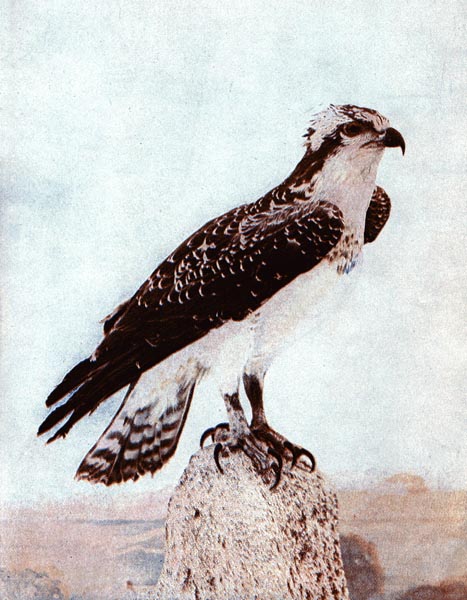
The American Osprey for Birds Illustrated by Color Photography, 1897 From col. F. M. Woodruff

The American Osprey for Birds Illustrated by Color Photography, 1897

The American Osprey.

Here is the picture of a remarkable bird. We know him better by the name Fish Hawk. He looks much like the Eagle in July “Birds.” The Osprey has no use for Mr. Eagle though.

You know the Bald Eagle or Sea Eagle is very fond of fish. Well, he is not a very good fisherman and from his lofty perch he watches for the Fish Hawk or Osprey. Do you ask why? Well, when he sees a Fish Hawk with his prey, he is sure to chase him and take it from him. It is for this reason that Ospreys dislike the Bald Eagle.

Their food is fish, which as a rule they catch alive.

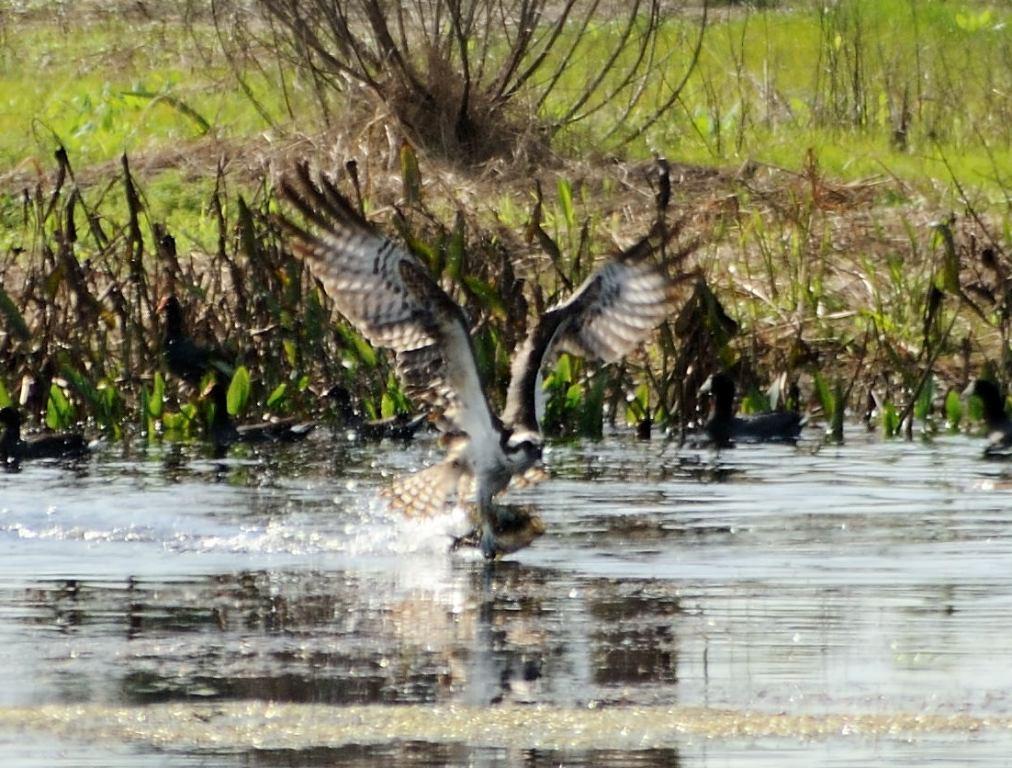
It must be interesting to watch the Osprey at his fishing. He wings his way slowly over the water, keeping a watch for fish as they appear near the surface.

When he sees one that suits him, he hovers a moment, and then, closing his wings, falls upon the fish.

Sometimes he strikes it with such force that he disappears in the water for a moment. Soon we see him rise from the water with the prey in his claws.

He then flies to some tall tree and if he has not been discovered by his enemy, the Eagle, can have a good meal for his hard work.

Look at his claws; then think of them striking a fish as they must when he plunges from on high.

A gentleman tells of an Osprey that fastened his claws in a fish that was too large for him.

The fish drew him under and nothing more was seen of Mr. Osprey. The same gentleman tells of a fish weighing six pounds that fell from the claws of a Fish Hawk that became frightened by an Eagle.

The Osprey builds his nest much like the Bald Eagle. It is usually found in a tall tree and out of reach.

Like the Eagle, he uses the same nest each year, adding to it. Sometimes it measures five feet high and three feet across. One nest that was found, contained enough sticks, cornstalks, weeds, moss, and the like, to fill a cart, and made a load for a horse to draw. Like the Crows and Blackbirds they prefer to live together in numbers. Over three hundred nests have been found in the trees on a small island.

One thing I want you to remember about the Osprey. They usually remain mated for life.


Osprey Catching Fish - Viera Wetlands

Osprey Catching Fish – Viera Wetlands by Dan

THE AMERICAN OSPREY.

N interesting bird, “Winged Fisher,” as he has been happily called, is seen in places suited to his habits, throughout temperate North America, particularly about islands and along the seacoast. At Shelter Island, New York, they are exceedingly variable in the choice of a nesting place. On Gardiner’s Island they all build in trees at a distance varying from ten to seventy-five feet from the ground; on Plum Island, where large numbers of them nest, many place their nests on the ground, some being built up to a height of four or five feet while others are simply a few sticks arranged in a circle, and the eggs laid on the bare sand. On Shelter Island they build on the chimneys of houses, and a pair had a nest on the cross-bar of a telegraph pole. Another pair had a nest on a large rock. These were made of coarse sticks and sea weed, anything handy, such as bones, old shoes, straw, etc. A curious nest was found some years ago on the coast of New Jersey. It contained three eggs, and securely imbedded in the loose material of the Osprey’s nest was a nest of the Purple Grackle, containing five eggs, while at the bottom of the Hawk’s nest was a thick, rotten limb, in which was a Tree Swallow’s nest of seven eggs.

In the spring and early autumn this familiar eagle-like bird can be seen hovering over creek, river, and sound. It is recognized by its popular name of Fish-Hawk. Following a school of fish, it dashes from a considerable height to seize its prey with its stout claws. If the fish is small it is at once swallowed, if it is large, (and the Osprey will occasionally secure shad, blue fish, bass, etc., weighing five or six pounds,) the fish is carried to a convenient bluff or tree and torn to bits. The Bald Eagle often robs him of the fish by seizing it, or startling him so that he looses his hold.

The Osprey when fishing makes one of the most breezy, spirited pictures connected with the feeding habits of any of our birds, as often there is a splashing and a struggle under water when the fish grasped is too large or the great talons of the bird gets entangled. He is sometimes carried under and drowned, and large fish have been washed ashore with these birds fastened to them by the claws.

Mrs. Mabel Osgood Wright says: “I found an Osprey’s nest in a crooked oak on Wakeman’s Island in late April, 1893. As I could not get close to the nest (the island is between a network of small creeks, and the flood tides covered the marshes,) I at first thought it was a monstrous crow’s nest, but on returning the second week in May I saw a pair of Osprey coming and going to and fro from the nest. I hoped the birds might return another season, as the nest looked as if it might have been used for two or three years, and was as lop-sided as a poorly made haystack. The great August storm of the same year broke the tree, and the nest fell, making quite a heap upon the ground. Among the debris were sticks of various sizes, dried reeds, two bits of bamboo fishing rod, seaweeds, some old blue mosquito netting, and some rags of fish net, also about half a bushel of salt hay in various stages of decomposition, and malodorous dirt galore.”

It is well-known that Ospreys, if not disturbed, will continue indefinitely to heap rubbish upon their nests till their bulk is very great. Like the Owls they can reverse the rear toe.


Osprey with Fish by Jim Fenton

Osprey with Fish by Jim Fenton

Lee’s Addition:

And these are they which ye shall have in abomination among the fowls; they shall not be eaten, they are an abomination: the eagle, and the ossifrage, and the ospray, (Leviticus 11:13 KJV)

We have the privilege of seeing Ospreys all the time. On a daily basis we spot them on their platforms that have been put up for them in this area. If they don’t place them there, then you find their nest in trees with bare branches that they can anchor the nest and have a good place to watch for fish.

Ospreys are in the Pandionidae – Ospreys Family and they are one of the Birds of the Bible.
*

Birds Illustrated by Color Photography – Revisited – Introduction

The above article is the first article in the monthly serial that was started in January 1897 “designed to promote Knowledge of Bird-Live.” These include Color Photography, as they call them, today they are drawings. There are at least three Volumes that have been digitized by Project Gutenberg.

To see the whole series of – Birds Illustrated by Color Photography – Revisited

*

(Information from Wikipedia and other internet sources)

Next Article – The Sora Rail

The Previous Article – Old Abe

Wordless Birds

Links:

Birds of the Bible – Osprey
Birds of the Bible – Osprey II
Birds of the Bible – Osprey III
Birds of the Bible – Ospreys in the Storm
Nave’s Topical Bible – Osprey

Osprey – WhatBird.com
Osprey – Wikipedia

*


Mother Magpie’s Kindergarten

Yellow-billed Magpie (Pica nuttalli) by Daves BirdingPix

Yellow-billed Magpie (Pica nuttalli) by Daves BirdingPix

Mother Magpie’s Kindergarten ~ from The Curious Book of Birds

MOTHER MAGPIE’S KINDERGARTEN

Cur Book of Birds letter-dID you ever notice how different are the nests which the birds build in springtime, in tree or bush or sandy bank or hidden in the grass? Some are wonderfully wrought, pretty little homes for birdikins. But others are clumsy, and carelessly fastened to the bough, most unsafe cradles for the feathered baby on the treetop. Sometimes after a heavy wind you find on the ground under the nest poor little broken eggs which rolled out and lost their chance of turning into birds with safe, safe wings of their own. Now such sad things as this happen because in their youth the lazy father and mother birds did not learn their lesson when Mother Magpie had her class in nest-making. The clumsiest nest of all is that which the Wood-Pigeon tries to build. Indeed, it is not a nest at all, only the beginning of one. And there is an old story about this, which I shall tell you.

In the early springtime of the world, when birds were first made, none of them—except Mother Magpie—knew how to build a nest. In that lovely garden where they lived the birds went fluttering about trying their new wings, so interested in this wonderful game of flying that they forgot all about preparing a home for the baby birds who were to come. When the time came to lay their eggs the parents knew not what to do. There was no place safe from the four-legged creatures who cannot fly, and they began to twitter helplessly: “Oh, how I wish I had a nice warm nest for my eggs!” “Oh, what shall we do for a home?” “Dear me! I don’t know anything about housekeeping.” And the poor silly things ruffled up their feathers and looked miserable as only a little bird can look when it is unhappy.

All except Mother Magpie! She was not the best—oh, no!—but she was the cleverest and wisest of all the birds; it seemed as if she knew everything that a bird could know. Already she had found out a way, and was busily building a famous nest for herself. She was indeed a clever bird! She gathered turf and sticks, and with clay bound them firmly together in a stout elm tree. About her house she built a fence of thorns to keep away the burglar birds who had already begun mischief among their peaceful neighbors. Thus she had a snug and cosy dwelling finished before the others even suspected what she was doing. She popped into her new house and sat there comfortably, peering out through the window-slits with her sharp little eyes. And she saw the other birds hopping about and twittering helplessly.

“What silly birds they are!” she croaked. “Ha, ha! What would they not give for a nest like mine!”

But presently a sharp-eyed Sparrow spied Mother Magpie sitting in her nest.

“Oho! Look there!” he cried. “Mother Magpie has found a way. Let us ask her to teach us.”

Then all the other birds chirped eagerly, “Yes, yes! Let us ask her to teach us!”

So, in a great company, they came fluttering, hopping, twittering up to the elm tree where Mother Magpie nestled comfortably in her new house.

“O wise Mother Magpie, dear Mother Magpie,” they cried, “teach us how to build our nests like yours, for it is growing night, and we are tired and sleepy.”

The Magpie said she would teach them if they would be a patient, diligent, obedient class of little birds. And they all promised that they would.

She made them perch about her in a great circle, some on the lower branches of the trees, some on the bushes, and some on the ground among the grass and flowers. And where each bird perched, there it was to build its nest. Then Mother Magpie found clay and bits of twigs and moss and grass—everything a bird could need to build a nest; and there is scarcely anything you can think of which some bird would not find very useful. When these things were all piled up before her she told every bird to do just as she did. It was like a great big kindergarten of birds playing at a new building game, with Mother Magpie for the teacher.

She began to show them how to weave the bits of things together into nests, as they should be made. And some of the birds, who were attentive and careful, soon saw how it was done, and started nice homes for themselves. You have seen what wonderful swinging baskets the Oriole makes for his baby-cradle? Well, it was the Magpie who taught him how, and he was the prize pupil, to be sure. But some of the birds were not like him, nor like the patient little Wren. Some of them were lazy and stupid and envious of Mother Magpie’s cosy nest, which was already finished, while theirs was yet to do.

As Mother Magpie worked, showing them how, it seemed so very simple that they were ashamed not to have discovered it for themselves. So, as she went on bit by bit, the silly things pretended that they had known all about it from the first—which was very unpleasant for their teacher.

Mother Magpie took two sticks in her beak and began like this: “First of all, my friends, you must lay two sticks crosswise for a foundation, thus,” and she placed them carefully on the branch before her.

“Oh yes, oh yes!” croaked old Daddy Crow, interrupting her rudely. “I thought that was the way to begin.”

Mother Magpie snapped her eyes at him and went on, “Next you must lay a feather on a bit of moss, to start the walls.”

Western Jackdaw (Coloeus monedula) ©WikiC

Western Jackdaw (Coloeus monedula) ©WikiC

“Certainly, of course,” screamed the Jackdaw. “I knew that came next. That is what I told the Parrot but a moment since.”

Mother Magpie looked at him impatiently, but she did not say anything. “Then, my friends, you must place on your foundation moss, hair, feathers, sticks, and grass—whatever you choose for your house. You must place them like this.”

“Yes, yes,” cried the Starling, “sticks and grass, every one knows how to do that! Of course, of course! Tell us something new.”

"Next you must lay a feather"

“Next you must lay a feather”

Now Mother Magpie was very angry, but she kept on with her lesson in spite of these rude and silly interruptions. She turned toward the Wood-Pigeon, who was a rattle-pated young thing, and who was not having any success with the sticks which she was trying to place.

“Here, Wood-Pigeon,” said Mother Magpie, “you must place those sticks through and across, criss-cross, criss-cross, so.”

“Criss-cross, criss-cross, so,” interrupted the Wood-Pigeon. “I know. That will do-o-o, that will do-o-o!”

Mother Magpie hopped up and down on one leg, so angry she could hardly croak.

“You silly Pigeon,” she sputtered, “not so. You are spoiling your nest. Place the sticks so!”

“I know, I know! That will do-o-o, that will do-o-o!” cooed the Wood-Pigeon obstinately in her soft, foolish little voice, without paying the least attention to Mother Magpie’s directions.

Common Wood Pigeon (Columba palumbus) with newly hatched young ©WikiC

Common Wood Pigeon (Columba palumbus) with newly hatched young ©WikiC

“We all know that—anything more?” chirped the chorus of birds, trying to conceal how anxious they were to know what came next, for the nests were only half finished.

But Mother Magpie was thoroughly disgusted, and refused to go on with the lesson which had been so rudely interrupted by her pupils.

“You are all so wise, friends,” she said, “that surely you do not need any help from me. You say you know all about it,—then go on and finish your nests by yourselves. Much luck may you have!” And away she flew to her own cosy nest in the elm tree, where she was soon fast asleep, forgetting all about the matter.

But oh! What a pickle the other birds were in! The lesson was but half finished, and most of them had not the slightest idea what to do next. That is why to this day many of the birds have never learned to build a perfect nest. Some do better than others, but none build like Mother Magpie.

But the Wood-Pigeon was in the worst case of them all. For she had only the foundation laid criss-cross as the Magpie had shown her. And so, if you find in the woods the most shiftless, silly kind of nest that you can imagine—just a platform of sticks laid flat across a branch, with no railing to keep the eggs from rolling out, no roof to keep the rain from soaking in—when you see that foolishness, you will know that it is the nest of little Mistress Wood-Pigeon, who was too stupid to learn the lesson which Mother Magpie was ready to teach.

And the queerest part of all is that the birds blamed the Magpie for the whole matter, and have never liked her since. But, as you may have found out for yourselves, that is often the fate of wise folk who make discoveries or who do things better than others.


Lee’s Addition:

Let the wise hear and increase in learning, and the one who understands obtain guidance, (Proverbs 1:5 ESV)

(Photos added by me.)

Links:

Black-billed Magpie (Pica hudsonia) ©USFWS


  Corvidae – Crows, Jays, Ravens Family


Painted Bunting (Passerina ciris) ©©Flickr


  Bird Tales


Curious Book of Birds - Cover


  The Curious Book of Birds


Spanish Sparrow (Passer Hispaniolensis) female ©WikiC


  Wordless Birds


*