Birds Vol 1 #3 – The Bobolink

Bobolinks - for Birds Illustrated

Bobolinks – for Birds Illustrated

Birds Illustrated by Color Photography – Revisited

Vol 1. March, 1897 No. 3

*

THE BOBOLINK.

“When Nature had made all her birds,
And had no cares to think on,
She gave a rippling laugh,
And out there flew a Bobolinkon.”

imgn

O American ornithologist omits mention of the Bobolink, and naturalists generally have described him under one of the many names by which he is known. In some States he is called the Rice Bird, in others Reed Bird, the Rice or Reed Bunting, while his more familiar title, throughout the greater part of America, is Bobolink, or Bobolinkum. In Jamaica, where he gets very fat during his winter stay, he is called the Butter Bird. His title of Rice Troopial is earned by the depredations which he annually makes upon the rice crops, though his food “is by no means restricted to that seed, but consists in a large degree of insects, grubs, and various wild grasses.” A migratory bird, residing during the winter in the southern parts of America, he returns in vast multitudes northward in the early Spring. According to Wilson, their course of migration is as follows: “In April, or very early in May, the Rice Buntings, male and female, arrive within the southern boundaries of the United States, and are seen around the town of Savannah, Georgia, sometimes in separate parties of males and females, but more generally promiscuously. They remain there but a short time, and about the middle of May make their appearance in the lower part of Pennsylvania. While here the males are extremely gay and full of song, frequenting meadows, newly plowed fields, sides of creeks, rivers, and watery places, feeding on May flies and caterpillars, of which they destroy great quantities. In their passage, however, through Virginia at this season, they do great damage to the early wheat and barley while in their milky state. About the 20th of May they disappear on their way to the North. Nearly at the same time they arrive in the State of New York, spread over the whole of the New England States, as far as the river St. Lawrence, and from Lake Ontario to the sea. In all of these places they remain during the Summer, building their nests and rearing their young.”

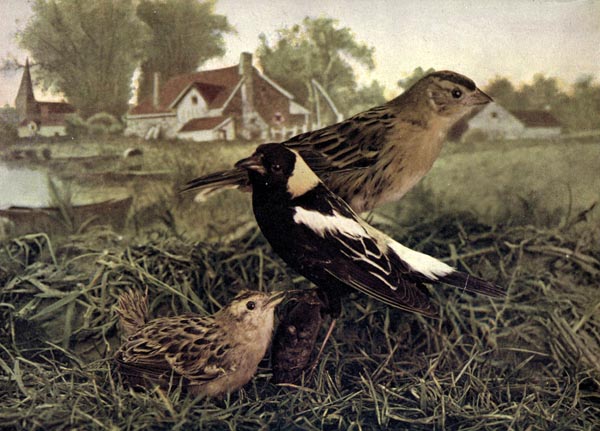
The Bobolink’s song is a peculiar one, varying greatly with the occasion. As he flys southward, his cry is a kind of clinking note; but the love song addressed to his mate is voluble and fervent. It has been said that if you should strike the keys of a pianoforte haphazard, the higher and the lower singly very quickly, you might have some idea of the Bobolink’s notes. In the month of June he gradually changes his pretty, attractive dress and puts on one very like the females, which is of a plain rusty brown, and is not reassumed until the next season of nesting. The two parent birds in the plate represent the change from the dark plumage in which the bird is commonly known in the North as the Bobolink, to the dress of yellowish brown by which it is known throughout the South as the Rice or Reed Bird.

His nest, small and a plain one, too, is built on the ground by his industrious little wife. The inside is warmly lined with soft fibers of whatever may be nearest at hand. Five pretty white eggs, spotted all over with brown are laid, and as soon

“As the little ones chip the shell
And five wide mouths are ready for food,
‘Robert of Lincoln’ bestirs him well,
Gathering seeds for this hungry brood.”
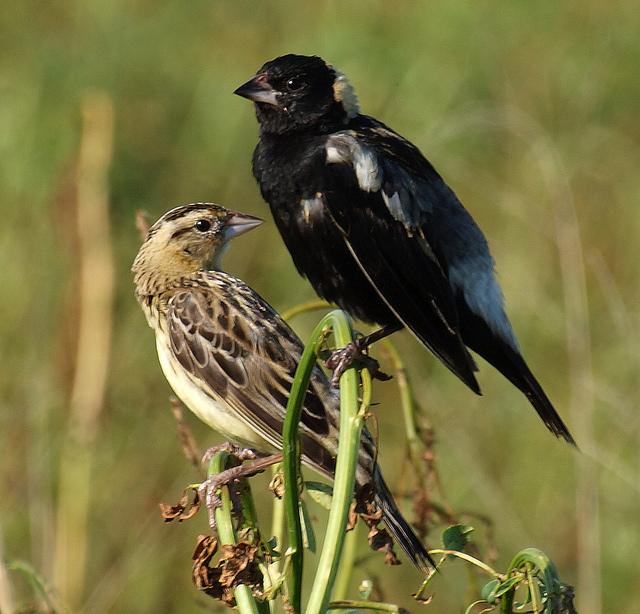
Bobolink (Dolichonyx oryzivorus) CC Pair ramendan

Bobolink (Dolichonyx oryzivorus) CC Pair ramendan

Other birds may like to travel alone, but when jolly Mr. Bobolink and his quiet little wife come from the South, where they have spent the winter, they come with a large party of friends. When South, they eat so much rice that the people call them Rice Birds. When they come North, they enjoy eating wheat, barley, oats and insects.

Mr. and Mrs. Bobolink build their simple little nest of grasses in some field. It is hard to find on the ground, for it looks just like dry grass. Mrs. Bobolink wears a dull dress, so she cannot be seen when she is sitting on the precious eggs. She does not sing a note while caring for the eggs. Why do you think that is?

Mr. Bob-Linkum does not wear a sober dress, as you can see by his picture. He does not need to be hidden. He is just as jolly as he looks. Shall I tell you how he amuses his mate while she is sitting? He springs from the dew-wet grass with a sound like peals of merry laughter. He frolics from reed to post, singing as if his little heart would burst with joy.

Don’t you think Mr. and Mrs. Bobolink look happy in the picture? They have raised their family of five. Four of their children have gone to look for food; one of them—he must surely be the baby—would rather stay with his mamma and papa. Which one does he look like?

Many birds are quiet at noon and in the afternoon. A flock of Bobolinks can be heard singing almost all day long. The song is full of high notes and low, soft notes and loud, all sung rapidly. It is as gay and bright as the birds themselves, who flit about playfully as they sing. You will feel like laughing as merrily as they sing when you hear it some day.

Bobolink (Dolichonyx oryzivorus) by J Fenton

Bobolink (Dolichonyx oryzivorus) by J Fenton


Lee’s Addition:

Even the birds in the sky know the right time to do things. The storks, doves, swifts, and thrushes know when it is time to fly to a new home. But my people don’t know what the LORD wants them to do. (Jeremiah 8:7 ERV)

The Bobolink (Dolichonyx oryzivorus) is a small New World blackbird and the only member of genus Dolichonyx. They are in the Icteridae – Oropendolas, Orioles & Blackbirds Family.

Adults are 16–18 cm (6–8 in) long with short finch-like bills. They weigh about 1 ounce (28 g).[1] Adult males are mostly black, although they do display creamy napes, and white scapulars, lower backs and rumps. Adult females are mostly light brown, although their coloring includes black streaks on the back and flanks, and dark stripes on the head; their wings and tails are darker. The collective name for a group of bobolinks is a chain.[2]
[edit]Distribution and movements

These birds migrate to Argentina, Bolivia and Paraguay. One bird was tracked flying 12,000 miles (19,000 km) over the course of the year, and up to 1,100 miles (1,800 km) in one day. They often migrate in flocks, feeding on cultivated grains and rice, which leads to them being considered a pest by farmers in some areas. Although Bobolinks migrate long distances, they have rarely been sighted in Europe—like many vagrants from the Americas, the overwhelming majority of records are from the British Isles.[citation needed] Each fall, Bobolinks gather in large numbers in South American rice fields, where they are inclined to eat grain. This has earned them the name “ricebird” in these parts. However, they are called something entirely different in Jamaica (Butterbirds) where they are collected as food, being that they are very fat as they pass through on migration.

Their breeding habitats are open grassy fields, especially hay fields, across North America. In high-quality habitats, males are often polygynous. Females lay 5 to 6 eggs in a cup-shaped nest, which is always situated on the ground and is usually well-hidden in dense vegetation. Both parents feed the young.

Bobolinks forage on, or near the ground, and mainly eat seeds and insects. Males sing bright, bubbly songs in flight; these songs gave this species its common name.
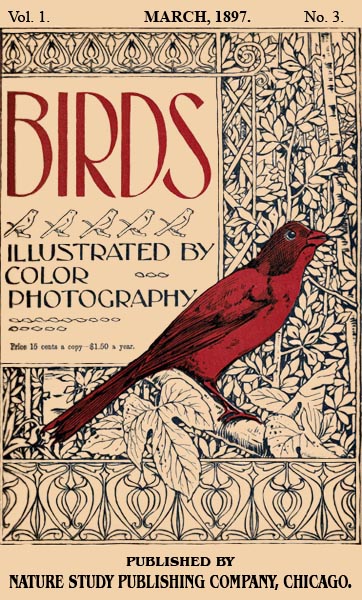
Birds Illustrated by Color Photograhy Vol 1 March 1897 No 3 - Cover

Birds Illustrated by Color Photography – Revisited – Introduction

The above article is the first article in the monthly serial for February 1897 “designed to promote Knowledge of Bird-Live.” These include Color Photography, as they call them, today they are drawings. There are at least three Volumes that have been digitized by Project Gutenberg.

To see the whole series of – Birds Illustrated by Color Photography – Revisited

*

(Information from Wikipedia and other internet sources)

Next Article – The Bobolink

Previous Article – The Japan Pheasant

Wordless Birds

Links:

Birds of the World – Woodpeckers

Flicker – Wikipedia

Woodpecker – Wikipedia

*
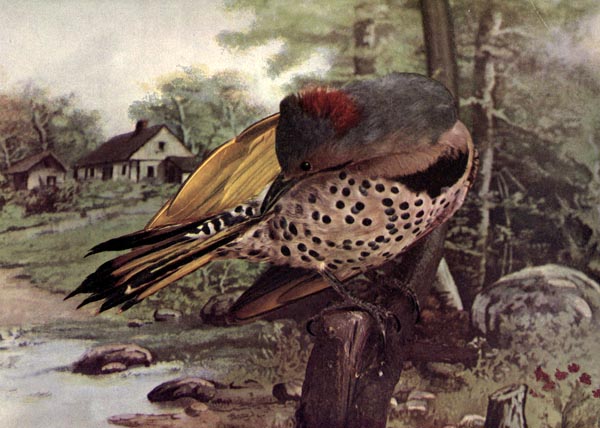
Birds Vol 1 #3 – The Flicker

Flicker

Birds Illustrated by Color Photography – Revisited

Vol 1. March, 1897 No. 3

*

THE FLICKER.

imga1

GREAT variety of names does this bird possess. It is commonly known as the Golden Winged Woodpecker, Yellow-shafted Flicker, Yellow Hammer, and less often as High-hole or High-holer, Wake-up, etc. In suitable localities throughout the United States and the southern parts of Canada, the Flicker is a very common bird, and few species are more generally known. “It is one of the most sociable of our Woodpeckers, and is apparently always on good terms with its neighbors. It usually arrives in April, occasionally even in March, the males preceding the females a few days, and as soon as the latter appear one can hear their voices in all directions.”

The Flicker is an ardent wooer. It is an exceedingly interesting and amusing sight to see a couple of males paying their addresses to a coy and coquettish female; the apparent shyness of the suitors as they sidle up to her and as quickly retreat again, the shy glances given as one peeps from behind a limb watching the other—playing bo-peep—seem very human, and “I have seen,” says an observer, “few more amusing performances than the courtship of a pair of these birds.” The defeated suitor takes his rejection quite philosophically, and retreats in a dignified manner, probably to make other trials elsewhere. Few birds deserve our good will more than the Flicker. He is exceedingly useful, destroying multitudes of grubs, larvæ, and worms. He loves berries and fruit but the damage he does to cultivated fruit is very trifling.

The Flicker begins to build its nest about two weeks after the bird arrives from the south. It prefers open country, interspersed with groves and orchards, to nest in. Any old stump, or partly decayed limb of a tree, along the banks of a creek, beside a country road, or in an old orchard, will answer the purpose. Soft wood trees seem to be preferred, however. In the prairie states it occasionally selects strange nesting sites. It has been known to chisel through the weather boarding of a dwelling house, barns, and other buildings, and to nest in the hollow space between this and the cross beams; its nests have also been found in gate posts, in church towers, and in burrows of Kingfishers and bank swallows, in perpendicular banks of streams. One of the most peculiar sites of his selection is described by William A. Bryant as follows: “On a small hill, a quarter of a mile distant from any home, stood a hay stack which had been placed there two years previously. The owner, during the winter of 1889-90, had cut the stack through the middle and hauled away one portion, leaving the other standing, with the end smoothly trimmed. The following spring I noticed a pair of flickers about the stack showing signs of wanting to make it a fixed habitation. One morning a few days later I was amused at the efforts of one of the pair. It was clinging to the perpendicular end of the stack and throwing out clipped hay at a rate to defy competition. This work continued for a week, and in that time the pair had excavated a cavity twenty inches in depth. They remained in the vicinity until autumn. During the winter the remainder of the stack was removed. They returned the following spring, and, after a brief sojourn, departed for parts unknown.”

From five to nine eggs are generally laid. They are glossy white in color, and when fresh appear as if enameled.

The young are able to leave the nest in about sixteen days; they crawl about on the limbs of the tree for a couple of days before they venture to fly, and return to the nest at night.

Northern Flicker (Colaptes auratus) Red-shafted ©WikiC

Northern Flicker (Colaptes auratus) Red-shafted ©WikiC


Lee’s Addition:

A man that hath friends must shew himself friendly: and there is a friend that sticketh closer than a brother. (Proverbs 18:24 KJV)

The Northern Flicker (Colaptes auratus) is a medium-sized member of the woodpecker family. It is native to most of North America, parts of Central America, Cuba, the Cayman Islands, and is one of the few woodpecker species that migrate. There are over 100 common names for the Northern Flicker. Among them are: Yellowhammer, clape, gaffer woodpecker, harry-wicket, heigh-ho, wake-up, walk-up, wick-up, yarrup, and gawker bird. Many of these names are attempts at imitating some of its calls.

The Northern Flicker is part of the genus Colaptes which encompasses 12 New-World woodpeckers. There are two living and one extinct subspecies of Colaptes auratus species. The existing sub-species were at one time considered separate species but they commonly interbreed where ranges overlap and are now considered one species by the American Ornithologists Union. Whether or not they are separate species is a well-known example of the species problem.

Northern Flicker (Colaptes auratus) Yellow shafted ©WikiC

Northern Flicker (Colaptes auratus) Yellow shafted ©WikiC

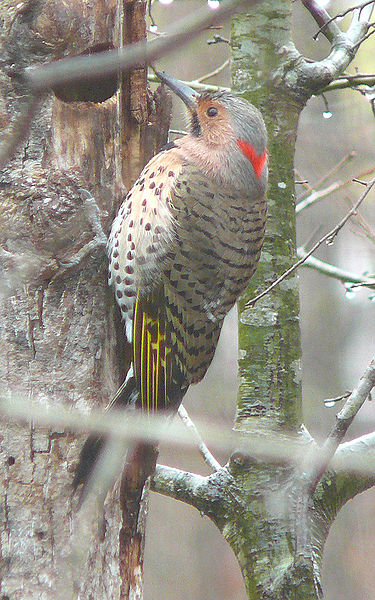
The Yellow-shafted Flicker Colaptes auratus resides in eastern North America. They are yellow under the tail and underwings and have yellow shafts on their primaries. They have a grey cap, a beige face and a red bar at the nape of their neck. Males have a black moustache. Colaptes comes from the Greek verb colapt, to peck. Auratus is from the Latin root aurat, meaning “gold” or “golden” and refers to the bird’s underwing.

Under the name “Yellowhammer” it is the state bird of Alabama.

The Red-shafted Flicker Colaptes auratus cafer resides in western North America. They are red under the tail and underwings and have red shafts on their primaries. They have a beige cap and a grey face. Males have a red moustache.

According to the Audubon guide, “flickers are the only woodpeckers that frequently feed on the ground”, probing with their beak, also sometimes catching insects in flight. Although they eat fruits, berries, seeds and nuts, their primary food is insects. Ants alone can make up 45% of their diet. Other invertebrates eaten include flies, butterflies, moths, beetles, and snails. Flickers also eat berries and seeds, especially in winter, including poison oak and ivy, dogwood, sumac, wild cherry and grape, bayberries, hackberries, and elderberries, and sunflower and thistle seeds. Flickers often go after ants underground (where the nutritious larvae live), hammering at the soil the way other woodpeckers drill into wood. Their tongues can dart out 2 inches beyond the end of the bill to snare prey. As well as eating ants, flickers have a behavior called anting, during which they use the acid from the ants to assist in preening, as it is useful in keeping them free of parasites.

Campo Flicker (Colaptes campestris) by Dario Sanches

Campo Flicker (Colaptes campestris) by Dario Sanches

The Northern Flicker is in the Picidae – Woodpeckers Family of the Piciformes Order. There are 6 Flickers; the Northern, Gilded, Fernandina’s, Chilean, Andean, and Campo Flicker. The other subgenus of the Colaptes (Chrysoptilus) includes the Black-necked, Spot-breasted, Green-barred, Golden-olive, Gray-crowned, Bronze-winged, and the Crimson-mantled Woodpeckers. The whole Woodpecker family has 231 species.

Birds Illustrated by Color Photograhy Vol 1 March 1897 No 3 - Cover

Birds Illustrated by Color Photography – Revisited – Introduction

The above article is the first article in the monthly serial for February 1897 “designed to promote Knowledge of Bird-Live.” These include Color Photography, as they call them, today they are drawings. There are at least three Volumes that have been digitized by Project Gutenberg.

To see the whole series of – Birds Illustrated by Color Photography – Revisited

*

(Information from Wikipedia and other internet sources)

Next Article – The Bobolink

Previous Article – The Japan Pheasant

ABC’s of the Gospel

Links:

Birds of the World – Woodpeckers

Flicker – Wikipedia

Woodpecker – Wikipedia

*

Birds Vol 1 #3 – The Japan Pheasant

Japan Pheasant for Birds Illustrated

Japan Pheasant for Birds Illustrated

Birds Illustrated by Color Photography – Revisited

Vol 1. March, 1897 No. 3

*

THE JAPAN PHEASANT.

imgo

RIGINALLY the Pheasant was an inhabitant of Asia Minor but has been by degrees introduced into many countries, where its beauty of form, plumage, and the delicacy of its flesh made it a welcome visitor. The Japan Pheasant is a very beautiful species, about which little is known in its wild state, but in captivity it is pugnacious. It requires much shelter and plenty of food, and the breed is to some degree artificially kept up by the hatching of eggs under domestic hens and feeding them in the coop like ordinary chickens, until they are old and strong enough to get their own living.

The food of this bird is extremely varied. When young it is generally fed on ants’ eggs, maggots, grits, and similar food, but when it is full grown it is possessed of an accommodating appetite and will eat many kinds of seeds, roots, and leaves. It will also eat beans, peas, acorns, berries, and has even been known to eat the ivy leaf, as well as the berry.

This Pheasant loves the ground, runs with great speed, and always prefers to trust to its legs rather than to its wings. It is crafty, and when alarmed it slips quickly out of sight behind a bush or through a hedge, and then runs away with astonishing rapidity, always remaining under cover until it reaches some spot where it deems itself safe. The male is not domestic, passing an independent life during a part of the year and associating with others of its own sex during the rest of the season.

The nest is very rude, being merely a heap of leaves and grass on the ground, with a very slight depression. The eggs are numerous, about eleven or twelve, and olive brown in color. In total length, though they vary considerably, the full grown male is about three feet. The female is smaller in size than her mate, and her length a foot less.

The Japan Pheasant is not a particularly interesting bird aside from his beauty, which is indeed brilliant, there being few of the species more attractive.

Green Pheasant (Phasianus versicolor) ©WikiC

Green Pheasant (Phasianus versicolor) ©WikiC


Lee’s Addition:

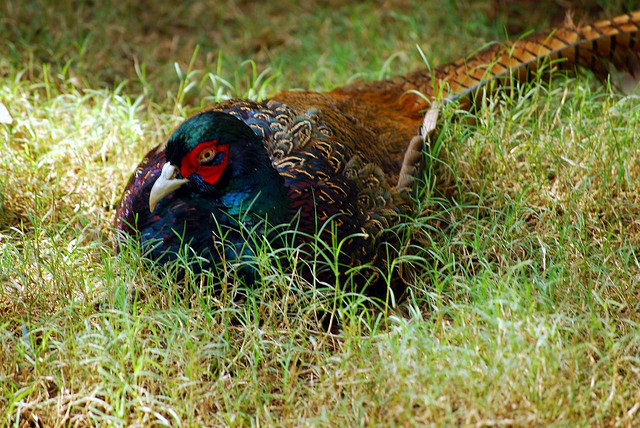
The Green Pheasant, Phasianus versicolor, also known as Japanese Pheasant, is native to the Japanese Archipelago, to which it is endemic. The male (cock) is distinguished from that species by its dark green plumage on the breast and mantle. The male also has an iridescent violet neck, red bare facial skin and purplish green tail. The female is smaller than male and has a dull brown plumage with dark spots.

This species is common and widespread throughout its native range. It frequents farmlands and is often seen close to human settlements; it also has been introduced in Hawaii and (unsuccessfully) in North America as a gamebird.

Some authorities consider the Green Pheasant a subspecies of the Common Pheasant. The Pheasant is in the Phasianidae – Pheasants, Fowl & Allies Family or the Galliformes Order. There are 181 members in the family.

Green Pheasant (Phasianus versicolor) ©©dhruvara

Green Pheasant (Phasianus versicolor) ©©dhruvara

It is the national bird of Japan. “It originally was designated as such in 1947 at the 81st Meeting of the National Bird Society of Japan. The Japanese pheasant was most likely selected because this green pheasant in unique to Japan,and futhermore because it appears in Japanese folk tales and so has become an integral part of the Japanese cultural landscape.”

Fagiano Okayama football club, a club based in Okayama, Okayama Prefecture, has a mascot based on the Green Pheasant.

*

Birds Illustrated by Color Photograhy Vol 1 March 1897 No 3 - Cover

Birds Illustrated by Color Photography – Revisited – Introduction

The above article is the first article in the monthly serial for February 1897 “designed to promote Knowledge of Bird-Live.” These include Color Photography, as they call them, today they are drawings. There are at least three Volumes that have been digitized by Project Gutenberg.

To see the whole series of – Birds Illustrated by Color Photography – Revisited

*

(Information from Wikipedia and other internet sources)

Next Article – The Flicker

Previous Article – The Brown Thrush

Sharing The Gospel

Links:

Green Pheasant – Wikipedia

Phasianidae – Wikipedia

Destinations, Green Pheasant

Video of Green Pheasant – from IBC

*

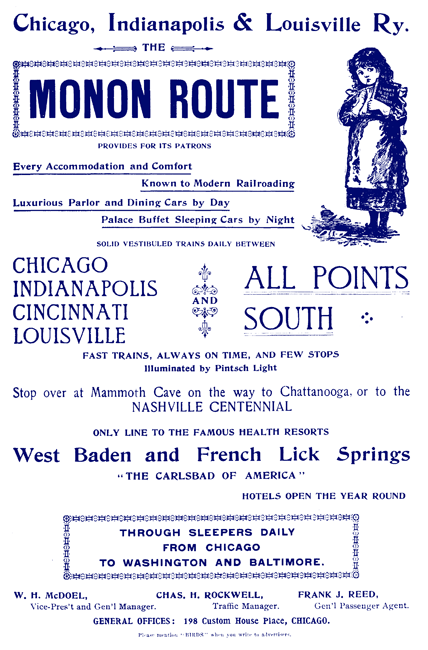
Ad from Article in 1897

Ad from Birds Illustrated by Photography, 1897

Ad from Birds Illustrated by Photography, 1897

Birds Vol 1 #3 – The Brown Thrush (Thrasher)

Brown Thrasher (Toxostoma rufum)

Brown Thrasher (Toxostoma rufum) – Birds Illustrated

Birds Illustrated by Color Photography – Revisited

Vol 1. March, 1897 No. 3

*

THE BROWN THRUSH.

“However the world goes ill,
The Thrushes still sing in it.”


imgt

HE Mocking-bird of the North, as the Brown Thrush (Brown Thrasher today) has been called, arrives in the Eastern and Middle States about the 10th of May, at which season he may be seen, perched on the highest twig of a hedge, or on the topmost branch of a tree, singing his loud and welcome song, that may be heard a distance of half a mile. The favorite haunt of the Brown Thrush, however, is amongst the bright and glossy foliage of the evergreens. “There they delight to hide, although not so shy and retiring as the Blackbird; there they build their nests in greatest numbers, amongst the perennial foliage, and there they draw at nightfall to repose in warmth and safety.” The Brown Thrasher sings chiefly just after sunrise and before sunset, but may be heard singing at intervals during the day. His food consists of wild fruits, such as blackberries and raspberries, snails, worms, slugs and grubs. He also obtains much of his food amongst the withered leaves and marshy places of the woods and shrubberies which he frequents. Few birds possess a more varied melody. His notes are almost endless in variety, each note seemingly uttered at the caprice of the bird, without any perceptible approach to order.

The site of the Thrush’s nest is a varied one, in the hedgerows, under a fallen tree or fence-rail; far up in the branches of stately trees, or amongst the ivy growing up their trunks. The nest is composed of the small dead twigs of trees, lined with the fine fibers of roots. From three to five eggs are deposited, and are hatched in about twelve days. They have a greenish background, thickly spotted with light brown, giving the whole egg a brownish appearance.

The Brown Thrush leaves the Eastern and Middle States, on his migration South, late in September, remaining until the following May.


THE THRUSH’S NEST.

“Within a thick and spreading hawthorn bush
That overhung a molehill, large and round,
I heard from morn to morn a merry thrush
Sing hymns of rapture while I drank the sound
With joy—and oft an unintruding guest,
I watched her secret toils from day to day;
How true she warped the moss to form her nest,
And modeled it within with wood and clay.
And by and by, with heath-bells gilt with dew,
There lay her shining eggs as bright as flowers,
Ink-spotted over, shells of green and blue:
And there I witnessed, in the summer hours,
A brood of nature’s minstrels chirp and fly,
Glad as the sunshine and the laughing sky.”


THE BROWN THRUSH.

Dear Readers:

My cousin Robin Redbreast told me that he wrote you a letter last month and sent it with his picture. How did you like it? He is a pretty bird—Cousin Robin—and everybody likes him. But I must tell you something of myself.

Folks call me by different names—some of them nicknames, too.

The cutest one of all is Brown Thrasher. I wonder if you know why they call me Thrasher. If you don’t, ask some one. It is really funny.

Some people think Cousin Robin is the sweetest singer of our family, but a great many like my song just as well.

Early in the morning I sing among the bushes, but later in the day you will always find me in the very top of a tree and it is then I sing my best.

Do you know what I say in my song? Well, if I am near a farmer while he is planting, I say: “Drop it, drop it—cover it up, cover it up—pull it up, pull it up, pull it up.”

One thing I very seldom do and that is, sing when near my nest. Maybe you can tell why. I’m not very far from my nest now. I just came down to the stream to get a drink and am watching that boy on the other side of the stream. Do you see him?

One dear lady who loves birds has said some very nice things about me in a book called “Bird Ways.” Another lady has written a beautiful poem about my singing. Ask your mamma or teacher the names of these ladies. Here is the poem:

There’s a merry brown thrush sitting up in a tree.
He is singing to me! He is singing to me!
And what does he say—little girl, little boy?
“Oh, the world’s running over with joy!
Hush! Look! In my tree,
I am as happy as happy can be.”

And the brown thrush keeps singing, “A nest, do you see,
And five eggs, hid by me in the big cherry tree?
Don’t meddle, don’t touch—little girl, little boy—
Or the world will lose some of its joy!
Now I am glad! now I am free!
And I always shall be,
If you never bring sorrow to me.”

So the merry brown thrush sings away in the tree
To you and to me—to you and to me;
And he sings all the day—little girl, little boy—
“Oh, the world’s running over with joy!
But long it won’t be,
Don’t you know? don’t you see?
Unless we’re good as good can be.”

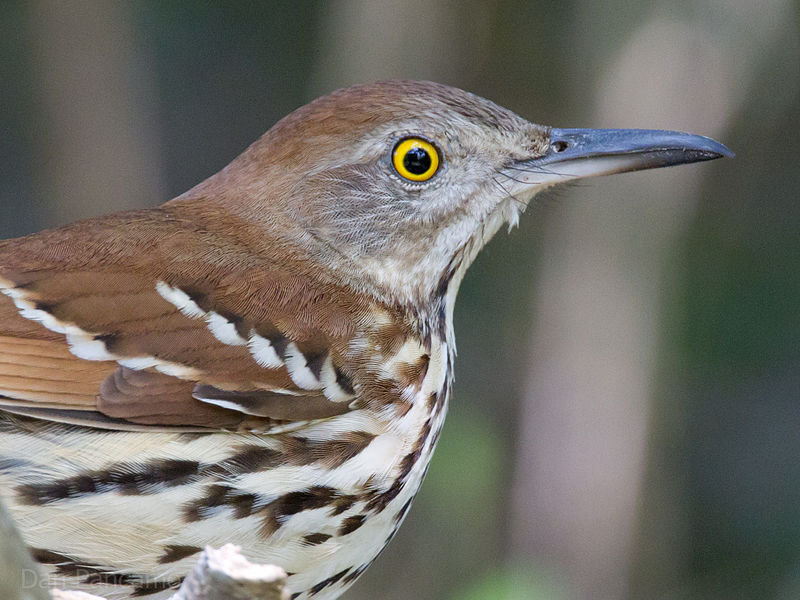
Brown Thrasher (Toxostoma rufum) By Dan'sPix

Brown Thrasher (Toxostoma rufum) By Dan’sPix


Lee’s Addition:

The Brown Thrush mentioned in this article is now known as the Brown Thrasher. They are members of the Mimidae – Mockingbirds, Thrashers Family. The family not only has the Thrashers (14) and Mockingbirds (16), but also Catbirds (2) and Tremblers (2).

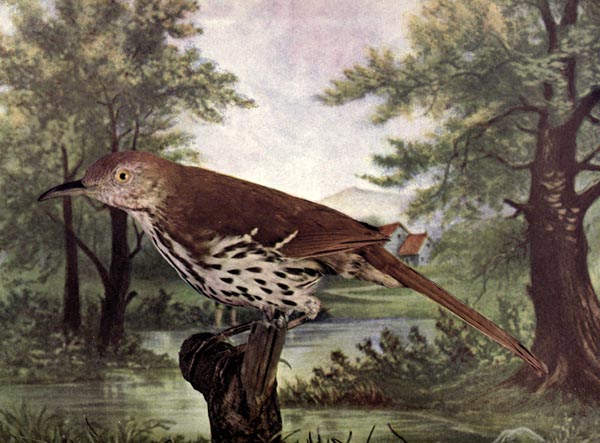
The Brown Thrasher is bright reddish-brown above with thin, dark streaks on its buffy underparts. Its long, rufous tail is rounded with paler corners, and eyes are a brilliant gold. Adults average about 11.5 in (29 cm) long with a wingspan of 13 in (33 cm), and weigh 2.4 oz (68 g).

It is found in thickets and dense brush, often searching for food in dry leaves on the ground. It also enjoys the convergence of mowed to unmowed lawns, particularly if there are ample shrubs or shrubby trees, i.e., fruit orchards that the undergrowth is left undisturbed. It also enjoys perennial gardens and can be seen jumping from the ground to catch insects on flowers and foliage. Its breeding range includes the United States and Canada east of the Rocky Mountains. It is a partial migrant, with northern birds wintering in the southern USA, where it occurs throughout the year.

The female lays 3 to 5 eggs in a twiggy nest lined with grass. The nest is built in a dense shrub or low in a tree. Both parents incubate and feed the young. These birds raise two or three broods in a year. They are able to call in up to 3000 distinct songs. The male sings a series of short repeated melodious phrases from an open perch to defend his territory and is also very aggressive in defending the nest.

Brown Thrasher by Chris Parrish

The Brown Thrasher is the official state bird of Georgia, and was the inspiration for the name of Atlanta’s former National Hockey League team, the Atlanta Thrashers.(Wikipedia)

Brown Thrasher (Toxostoma rufum) ©WikiC

Brown Thrasher (Toxostoma rufum) ©WikiC

The flowers appear on the earth; the time of the singing of birds is come, and the voice of the turtle is heard in our land; (Song of Solomon 2:12 KJV)

Birds Illustrated by Color Photograhy Vol 1 March 1897 No 3 - Cover

Birds Illustrated by Color Photography – Revisited – Introduction

The above article is the first article in the monthly serial for February 1897 “designed to promote Knowledge of Bird-Live.” These include Color Photography, as they call them, today they are drawings. There are at least three Volumes that have been digitized by Project Gutenberg.

To see the whole series of – Birds Illustrated by Color Photography – Revisited

*

*

(Information from Wikipedia and other internet sources)

Next Article – The Japan Pheasant

Previous Article – The Swallow

ABC’s of the Gospel

Links:

Brown Thrasher – Wikipedia

Wood Thrush – WhatBird

*


Birds Vol 1 #3 – The Swallow

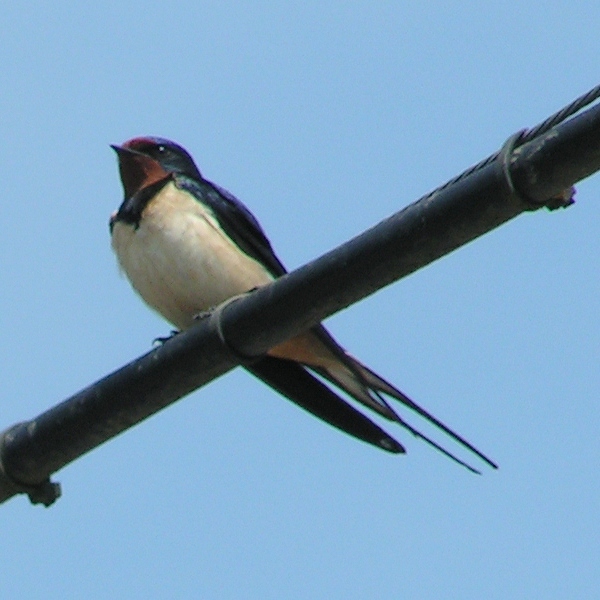
Barn Swallow

Barn Swallow by Birds Illustrated

Birds Illustrated by Color Photography – Revisited

Vol 1. March, 1897 No. 3

*

THE SWALLOW.

“Come, summer visitant, attach
To my reedroof thy nest of clay,
And let my ear thy music catch,
Low twitting underneath the thatch,
At the gray dawn of day.”


imgs

URE harbingers of spring are the Swallows. They are very common birds, and frequent, as a rule, the cultivated lands in the neighborhood of water, showing a decided preference for the habitations of man. “How gracefully the swallows fly! See them coursing over the daisy-bespangled grass fields; now they skim just over the blades of grass, and then with a rapid stroke of their long wings mount into the air and come hovering above your head, displaying their rich white and chestnut plumage to perfection. Now they chase each other for very joyfulness, uttering their sharp twittering notes; then they hover with expanded wings like miniature Kestrels, or dart downwards with the velocity of the sparrowhawk; anon they flit rapidly over the neighboring pool, occasionally dipping themselves in its calm and placid waters, and leaving a long train of rings marking their varied course. How easily they turn, or glide over the surrounding hedges, never resting, never weary, and defying the eye to trace them in the infinite turnings and twistings of their rapid shooting flight. You frequently see them glide rapidly near the ground, and then with a sidelong motion mount aloft, to dart downwards like an animated meteor, their plumage glowing in the light with metallic splendor, and the row of white spots on the tail contrasting beautifully with the darker plumage.”

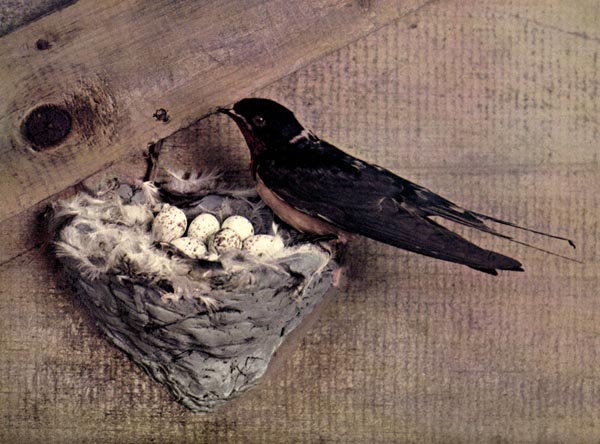
The Swallow is considered a life-paired species, and returns to its nesting site of the previous season, building a new nest close to the old one. His nest is found in barns and outhouses, upon the beams of wood which support the roof, or in any place which assures protection to the young birds. It is cup-shaped and artfully moulded of bits of mud. Grass and feathers are used for the lining. “The nest completed, five or six eggs are deposited. They are of a pure white color, with deep rich brown blotches and spots, notably at the larger end, round which they often form a zone or belt.” The sitting bird is fed by her mate.

The young Swallow is distinguished from the mature birds by the absence of the elongated tail feathers, which are a mark of maturity alone. His food is composed entirely of insects. Swallows are on the wing fully sixteen hours, and the greater part of the time making terrible havoc amongst the millions of insects which infest the air. It is said that when the Swallow is seen flying high in the heavens, it is a never failing indication of fine weather.

A pair of Swallows on arriving at their nesting place of the preceding Summer found their nest occupied by a Sparrow, who kept the poor birds at a distance by pecking at them with his strong beak whenever they attempted to dislodge him. Wearied and hopeless of regaining possession of their property, they at last hit upon a plan which effectually punished the intruder. One morning they appeared with a few more Swallows—their mouths filled with a supply of tempered clay—and, by their joint efforts in a short time actually plastered up the entrance to the hole, thus barring the Sparrow from the home which he had stolen from the Swallows.

Barn Swallow by Dan


Lee’s Addition:

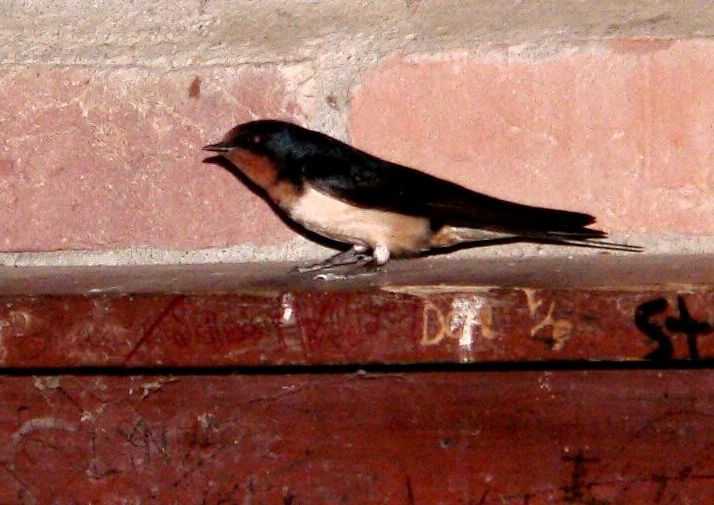
While visiting Cade’s Cove in the Smokey Mountains of Tennessee, found these Barn Swallows in an old house exhibit. We watched them, but they did not see alarmed by our being there. Having grown up in the city, this was my first experience being up close and personal with swallows.

Barn Swallow in Cades Cove by Dan

Barn Swallow in Cades Cove by Dan

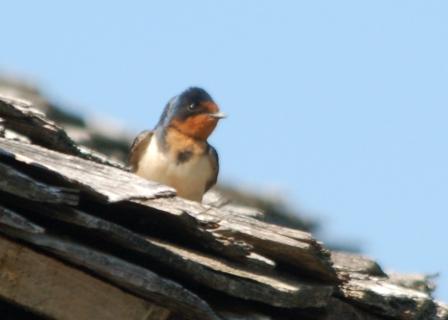
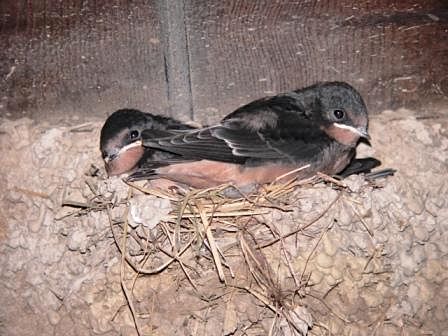
Here are a couple of my attempts to capture the babies and then one of the parents that was sitting on the fireplace mantle keeping an eye on us. Guess they were making sure that we didn’t hurt their offspring.

Smoky-Cades Cove - Swallows in nest by Lee

Smoky-Cades Cove – Swallows in nest by Lee

And the adult (cropped):

Barn Swallow on Fireplace - Smoky-Cades Cove by Lee

Barn Swallow on Fireplace – Smoky-Cades Cove by Lee

Swallows are mentions several times in Scripture and therefore are one of the Birds of the Bible.

Yea, the sparrow hath found an house, and the swallow a nest for herself, where she may lay her young, even thine altars, O LORD of hosts, my King, and my God. (Psalms 84:3 KJV)
As the bird by wandering, as the swallow by flying, so the curse causeless shall not come. (Proverbs 26:2 KJV)
Like a crane or a swallow, so did I chatter: I did mourn as a dove: mine eyes fail with looking upward: O LORD, I am oppressed; undertake for me. (Isaiah 38:14 KJV)

The Barn Swallow (Hirundo rustica) is the most widespread species of swallow in the world.] It is a distinctive passerine bird with blue upperparts, a long, deeply forked tail and curved, pointed wings. It is found in Europe, Asia, Africa and the Americas. In Anglophone Europe it is just called the Swallow; in Northern Europe it is the only common species called a “swallow” rather than a “martin”.

There are six subspecies of Barn Swallow, which breed across the Northern Hemisphere. Four are strongly migratory, and their wintering grounds cover much of the Southern Hemisphere as far south as central Argentina, the Cape Province of South Africa, and northern Australia. Its huge range means that the Barn Swallow is not endangered, although there may be local population declines due to specific threats, such as the construction of an international airport near Durban.

The Barn Swallow is a bird of open country which normally uses man-made structures to breed and consequently has spread with human expansion. It builds a cup nest from mud pellets in barns or similar structures and feeds on insects caught in flight. This species lives in close association with humans, and its insect-eating habits mean that it is tolerated by man; this acceptance was reinforced in the past by superstitions regarding the bird and its nest. There are frequent cultural references to the Barn Swallow in literary and religious works due to both its living in close proximity to humans and its conspicuous annual migration. The Barn Swallow is the national bird of Estonia.

Barn Swallow (Hirundo rustica) WikiC

Barn Swallow (Hirundo rustica) ©WikiC

The adult male Barn Swallow of the nominate subspecies H. r. rustica is 17–19 cm (6.7–7.5 in) long including 2–7 cm (0.8–2.8 in) of elongated outer tail feathers. It has a wingspan of 32–34.5 cm (12.6–13.6 in) and weighs 16–22 g (0.56–0.78 oz). It has steel blue upperparts and a rufous forehead, chin and throat, which are separated from the off-white underparts by a broad dark blue breast band. The outer tail feathers are elongated, giving the distinctive deeply forked “swallow tail.” There is a line of white spots across the outer end of the upper tail.

The female is similar in appearance to the male, but the tail streamers are shorter, the blue of the upperparts and breast band is less glossy, and the underparts more pale. The juvenile is browner and has a paler rufous face and whiter underparts. It also lacks the long tail streamers of the adult.

The song of the Barn Swallow is a cheerful warble, often ending with su-seer with the second note higher than the first but falling in pitch. Calls include witt or witt-witt and a loud splee-plink when excited.[5] The alarm calls include a sharp siflitt for predators like cats and a flitt-flitt for birds of prey like the Hobby. This species is fairly quiet on the wintering grounds.

The distinctive combination of a red face and blue breast band render the adult Barn Swallow easy to distinguish from the African Hirundo species and from the Welcome Swallow (Hirundo neoxena) with which its range overlaps in Australasia. In Africa the short tail streamers of the juvenile Barn Swallow invite confusion with juvenile Red-chested Swallow (Hirundo lucida), but the latter has a narrower breast band and more white in the tail. (Wikipedia)

*

Birds Illustrated by Color Photograhy Vol 1 March 1897 No 3 - Cover

Birds Illustrated by Color Photography – Revisited – Introduction

The above article is the first article in the monthly serial for February 1897 “designed to promote Knowledge of Bird-Live.” These include Color Photography, as they call them, today they are drawings. There are at least three Volumes that have been digitized by Project Gutenberg.

To see the whole series of – Birds Illustrated by Color Photography – Revisited

*

(Information from Wikipedia and other internet sources)

Next Article – The Brown Thrush

Previous Article – Little Boy Blue – The Blue Bird

Sharing The Gospel

Links:

Birds of the Bible – Swallow

Hirundinidae – Swallows, martins

Barn Swallow – Wikipedia

An Ad from the Publication:

Racycle Ad - Birds Illustrated - 1897

Racycle Ad – Birds Illustrated – 1897

Birds Vol 1 #3 – Little Boy Blue

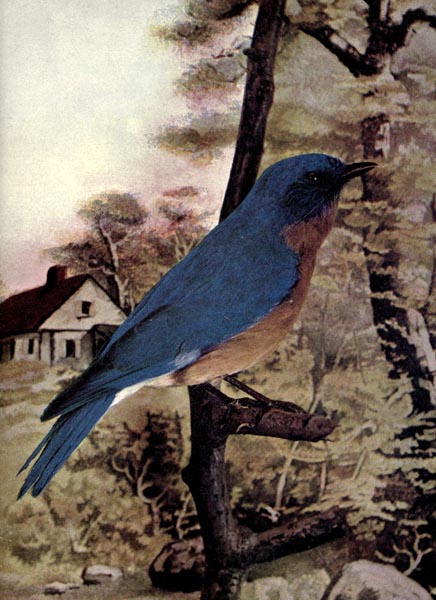
Bluebird - Little Boy Blue

Bluebird – Little Boy Blue

Birds Illustrated by Color Photography – Revisited

Vol 1. March, 1897 No. 3

LITTLE BOY BLUE – THE BLUE BIRD

Boys and girls, don’t you think that is a pretty name? I came from the warm south, where I went last winter, to tell you that Springtime is nearly here.

When I sing, the buds and flowers and grass all begin to whisper to one another, “Springtime is coming for we heard the Bluebird say so,” and then they peep out to see the warm sunshine. I perch beside them and tell them of my long journey from the south and how I knew just when to tell them to come out of their warm winter cradles. I am of the same blue color as the violet that shows her pretty face when I sing, “Summer is coming, and Springtime is here.”

I do not like the cities for they are black and noisy and full of those troublesome birds called English Sparrows. I take my pretty mate and out in the beautiful country we find a home. We build a nest of twigs, grass and hair, in a box that the farmer puts up for us near his barn.

Sometimes we build in a hole in some old tree and soon there are tiny eggs in the nest. I sing to my mate and to the good people who own the barn. I heard the farmer say one day, “Isn’t it nice to hear the Bluebird sing? He must be very happy.” And I am, too, for by this time there are four or five little ones in the nest.

Little Bluebirds are like little boys—they are always hungry. We work hard to find enough for them to eat. We feed them nice fat worms and bugs, and when their little wings are strong enough, we teach them how to fly. Soon they are large enough to hunt their own food, and can take care of themselves.

The summer passes, and when we feel the breath of winter we go south again, for we do not like the cold.


THE BLUE BIRD.

I know the song that the Bluebird is singing
Out in the apple tree, where he is swinging.
Brave little fellow! the skies may be dreary,
Nothing cares he while his heart is so cheery.
Hark! how the music leaps out from his throat,
Hark! was there ever so merry a note?

Listen a while, and you’ll hear what he’s saying,
Up in the apple tree swinging and swaying.
“Dear little blossoms down under the snow,
You must be weary of winter, I know;
Hark! while I sing you a message of cheer,
Summer is coming, and springtime is here!”

“Dear little snow-drop! I pray you arise;
Bright yellow crocus! come open your eyes;
Sweet little violets, hid from the cold,
Put on our mantles of purple and gold;
Daffodils! daffodils! say, do you hear,
Summer is coming! and springtime is here!”

Eastern Bluebird (Sialia sialis) by S Slayton

Eastern Bluebird (Sialia sialis) by S Slayton


THE BLUE BIRD.

Winged lute that we call a blue bird,
You blend in a silver strain
The sound of the laughing waters,
The patter of spring’s sweet rain,
The voice of the wind, the sunshine,
And fragrance of blossoming things,
Ah! you are a poem of April
That God endowed with wings.E. E. R.

****

imgl

IKE a bit of sky this little harbinger of spring appears, as we see him and his mate househunting in early March. Oftentimes he makes his appearance as early as the middle of February, when his attractive note is heard long before he himself is seen. He is one of the last to leave us, and although the month of November is usually chosen by him as the fitting time for departure to a milder clime, his plaintive note is quite commonly heard on pleasant days throughout the winter season, and a few of the braver and hardier ones never entirely desert us. The Robin and the Blue Bird are tenderly associated in the memories of most persons whose childhood was passed on a farm or in the country village. Before the advent of the English Sparrow, the Blue Bird was sure to be the first to occupy and the last to defend the little box prepared for his return, appearing in his blue jacket somewhat in advance of the plainly habited female, who on her arrival quite often found a habitation selected and ready for her acceptance, should he find favor in her sight. And then he becomes a most devoted husband and father, sitting by the nest and warbling with earnest affection his exquisite tune, and occasionally flying away in search of food for his mate and nestlings.

The Blue Bird rears two broods in the season, and, should the weather be mild, even three. His nest contains three eggs.

In the spring and summer when he is happy and gay, his song is extremely soft and agreeable, while it grows very mournful and plaintive as cold weather approaches. He is mild of temper, and a peaceable and harmless neighbor, setting a fine example of amiability to his feathered friends. In the early spring, however, he wages war against robins, wrens, swallows, and other birds whose habitations are of a kind to take his fancy. A celebrated naturalist says: “This bird seems incapable of uttering a harsh note, or of doing a spiteful, ill-tempered thing.”

Nearly everybody has his anecdote to tell of the Blue Bird’s courage, but the author of “Wake Robin” tells his exquisitely thus: “A few years ago I put up a little bird house in the back end of my garden for the accommodation of the wrens, and every season a pair have taken up their abode there. One spring a pair of Blue Birds looked into the tenement, and lingered about several days, leading me to hope that they would conclude to occupy it. But they finally went away. Late in the season the wrens appeared, and after a little coquetting, were regularly installed in their old quarters, and were as happy as only wrens can be. But before their honeymoon was over, the Blue Birds returned. I knew something was wrong before I was up in the morning. Instead of that voluble and gushing song outside the window, I heard the wrens scolding and crying out at a fearful rate, and on going out saw the Blue Birds in possession of the box. The poor wrens were in despair and were forced to look for other quarters.”

THE BLUE BIRD.

“Drifting down the first warm wind
That thrills the earliest days of spring,
The Bluebird seeks our maple groves
And charms them into tasselling.”

“He sings, and his is Nature’s voice—
A gush of melody sincere
From that great fount of harmony
Which thaws and runs when Spring is here.”

“Short is his song, but strangely sweet
To ears aweary of the low
Dull tramps of Winter’s sullen feet,
Sandalled in ice and muffled in snow.”
*****
“Think, every morning, when the sun peeps through
The dim, leaf-latticed windows of the grove,
How jubilant the happy birds renew
Their old, melodious madrigals of love!
And when you think of this, remember, too,
’Tis always morning somewhere, and above
The awakening continents, from shore to shore,
Somewhere the birds are singing evermore.

“Think of your woods and orchards without birds!
Of empty nests that cling to boughs and beams
As in an idiot’s brain remembered words
Hang empty ’mid the cobwebs of his dreams!
Will bleat of flocks or bellowing of herds
Make up for the lost music, when your teams
Drag home the stingy harvest, and no more
The feathered gleaners follow to your door?”
From “The Birds of Killingsworth.”

*

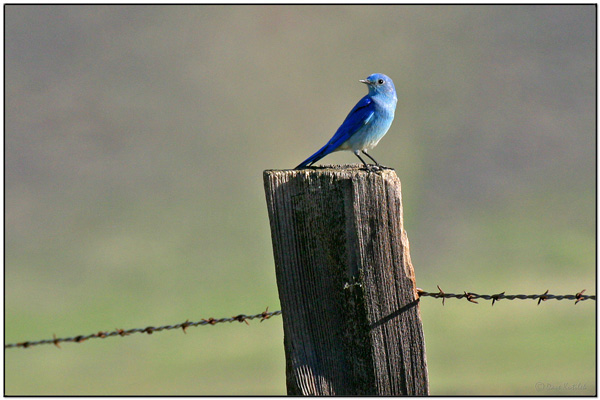
Mountain Bluebird (Sialia currucoides) by Daves BirdingPix

Mountain Bluebird (Sialia currucoides) by Daves BirdingPix


Lee’s Addition:

And he made the robe of the ephod of woven work, all of blue. (Exodus 39:22 KJV)

Another delightful story from the past. Who doesn’t like Bluebirds?

The bluebirds are a group of medium-sized, mostly insectivorous or omnivorous birds in the genus Sialia of the thrush family (Turdidae – Thrushes). Bluebirds are one of the few thrush genera in the Americas. They have blue, or blue and red, plumage. Female birds are less brightly colored than males, although color patterns are similar and there is no noticeable difference in size between sexes.
Species:

  • Eastern Bluebird, Sialia sialis
  • Western Bluebird, Sialia mexicana
  • Mountain Bluebird, Sialia currucoides
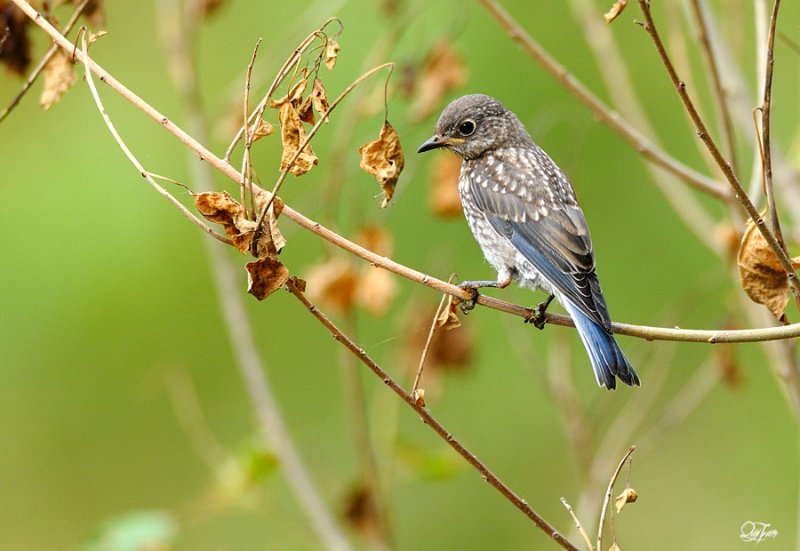
Western Bluebird (Sialia mexicana) juvenile by Quy Tran

Western Bluebird (Sialia mexicana) juvenile by Quy Tran

Bluebirds are territorial, prefer open grassland with scattered trees and are cavity nesters (similar to many species of woodpecker). Bluebirds can typically produce between two and four broods during the spring and summer (March through August in the Northeastern United States). Males identify potential nest sites and try to attract prospective female mates to those nesting sites with special behaviors that include singing and flapping wings, and then placing some material in a nesting box or cavity. If the female accepts the male and the nesting site, she alone builds the nest and incubates the eggs.

Bluebirds are attracted to platform bird feeders, filled with grubs of the darkling beetle, sold by many online bird product wholesalers as mealworms. Bluebirds will also eat raisins soaked in water. In addition, in winter bluebirds use backyard heated birdbaths. Of all the birds a gardener could choose to attract, the bluebird is the quintessential helpful garden bird. Gardeners go to extreme lengths to attract and keep them in the garden for their beneficial properties. Bluebirds are voracious insect consumers, quickly ridding a garden of insect pests.

By the 1970s, bluebird numbers had declined by estimates ranging to 70% due to unsuccessful competition with house sparrows and starlings, both introduced species, for nesting cavities, coupled with a decline in habitat. However, in late 2005 Cornell University’s Laboratory of Ornithology reported bluebird sightings across the southern U.S. as part of its yearly Backyard Bird Count, a strong indication of the bluebird’s return to the region. This upsurge can largely be attributed to a movement of volunteers establishing and maintaining bluebird trails.

While traveling full-time in our RV, one of our volunteer jobs was to clean the Bluebird houses of the “Trail” at the Avon Park Air Force Range in Avon Park, FL. There were 100 houses over a 78 mile distance. They were about 1/2 mile or so apart. Needless to say, it wasn’t done in one day. That year the Bluebirds had produced about 468 Bluebirds in those boxes. We were able to watch the Eastern Bluebirds quite frequently.

There are a few other “Bluebirds” around the world like the Asian Fairy-bluebird, Philippine Fairy-bluebird are in the Irenidae – Fairy-bluebird Family.

Birds Illustrated by Color Photograhy Vol 1 March 1897 No 3 - Cover

Birds Illustrated by Color Photography – Revisited – Introduction

The above article is the first article in the monthly serial for February 1897 “designed to promote Knowledge of Bird-Live.” These include Color Photography, as they call them, today they are drawings. There are at least three Volumes that have been digitized by Project Gutenberg.

To see the whole series of – Birds Illustrated by Color Photography – Revisited

*

(Information from Wikipedia and other internet sources)

Next Article – The Swallow

Previous Article – The American Red Bird

Sharing The Gospel

Links:

Bluebird – Wikipedia

FAIRY-BLUEBIRDS Irenidae

The Mountain Bluebird – The Zealous Bridegroom.. by ajmithra

Turdidae – Thrushes

Mountain Bluebirds – Vol 2, #6

*

Birds Vol 1 #2 – The American Red Bird

Red Bird - Northern Cardinal for Birds Illustrated

Red Bird – Northern Cardinal for Birds Illustrated

Birds Illustrated by Color Photography – Revisited

Vol 1. February, 1897 No. 2

*

THE AMERICAN RED BIRD.

imga1

MERICAN RED BIRDS are among our most common cage birds, and are very generally known in Europe, numbers of them having been carried over both to France and England. Their notes are varied and musical; many of them resembling the high notes of a fife, and are nearly as loud. They are in song from March to September, beginning at the first appearance of dawn and repeating successively twenty or thirty times, and with little intermission, a favorite strain.

The sprightly figure and gaudy plumage of the Red Bird, his vivacity, strength of voice, and actual variety of note, and the little expense with which he is kept, will always make him a favorite.

This species is more numerous to the east of the great range of the Alleghenies, but is found in Pennsylvania and Ohio, and is numerous in the lower parts of the Southern States. In January and February they have been found along the roadsides and fences, hovering together in half dozens, associating with snow birds, and various kinds of sparrows. In the northern states they are migratory, and in the southern part of Pennsylvania they reside during the whole year, frequenting the borders of rivulets, in sheltered hollows, covered with holly, laurel, and other evergreens. They love also to reside in the vicinity of fields of Indian corn, a grain that constitutes their chief and favorite food. The seeds of apples, cherries, and other fruit are also eaten by them, and they are accused of destroying bees.

Early in May the Red Bird begins to prepare his nest, which is very often fixed in a holly, cedar or laurel bush. A pair of Red Birds in Ohio returned for a number of years to build their nest in a honeysuckle vine under a portico. They were never disturbed and never failed to rear a brood of young. The nest was constructed of small twigs, dry weeds, slips of vine bark, and lined with stalks of fine grass. Four eggs of brownish olive were laid, and they usually raised two broods in a season.

In confinement they fade in color, but if well cared for, will live to a considerable age. They are generally known by the names: Red Bird, Virginia Red Bird, Virginia Nightingale, and Crested Red Bird. It is said that the female often sings nearly as well as the male.


THE REDBIRDS.

Two Redbirds came in early May,
Flashing like rubies on the way;
Their joyous notes awoke the day,
And made all nature glad and gay.

Thrice welcome! crested visitants;
Thou doest well to seek our haunts;
The bounteous vine, by thee possessed,
From prying eyes shall keep thy nest.

Sing to us in the early dawn;
’Tis then thy scarlet throats have drawn
Refreshing draughts from drops of dew,
The enchanting concert to renew.

No plaintive notes, we ween, are thine;
They gurgle like a royal wine;
They cheer, rejoice, they quite outshine
Thy neighbor’s voice, tho’ it’s divine.

Free as the circumambient air
Do thou remain, a perfect pair,
To come once more when Proserpine
Shall swell the buds of tree and vine.
—C. C. M.

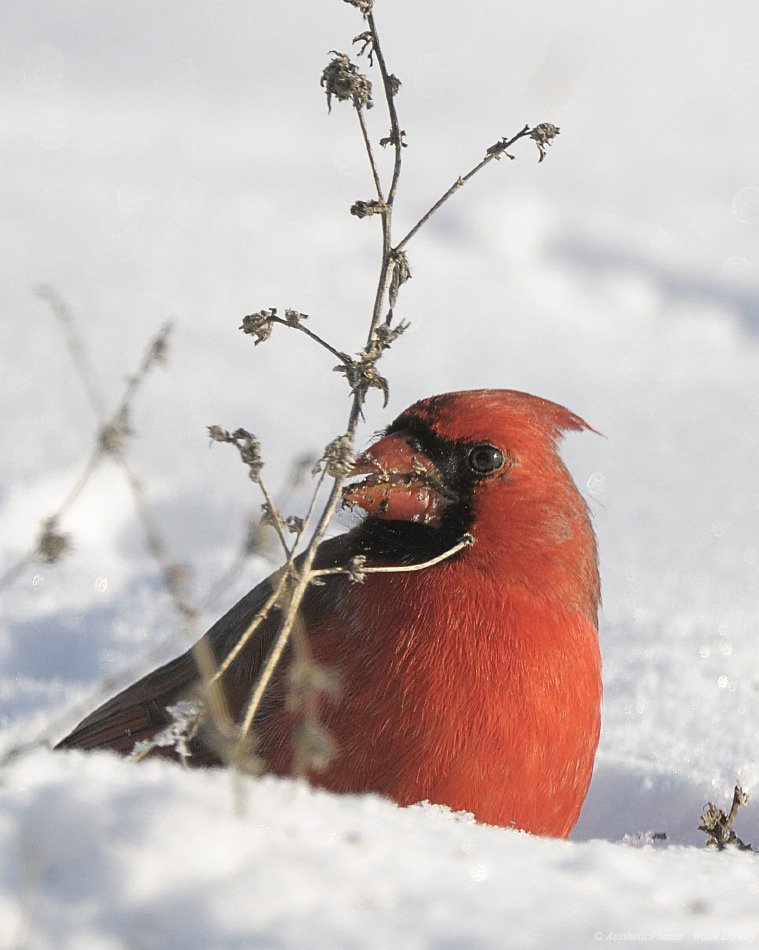
Northern Cardinal by Aestheticphotos

Northern Cardinal (Cardinalis cardinalis) by Aestheticphotos

THE RED BIRD.

Is it because he wears a red hat,
That we call him the Cardinal Bird?
Or is it because his voice is so rich
That scarcely a finer is heard?

’Tis neither, but this—I’ve guessed it, I’m sure—
His dress is a primary color of Nature.
It blends with the Oriole’s golden display,
And the garment of Blue Bird completes the array.
—C. C. M.


Lee’s Addition:

Come now, and let us reason together, saith the LORD: though your sins be as scarlet, they shall be as white as snow; though they be red like crimson, they shall be as wool. (Isaiah 1:18 KJV)

I hadn’t realized that back in 1897 that they carried the Cardinal or Red Bird overseas to be in cages. I suppose it is no different than those here, even today, cage birds from other countries. Personally, I think they should all be free, other than places like zoos where they are breeding them to help preserve endangered species. Even those young should be released once their numbers improve.

The Northern Cardinal is a favorite for most of us probably because they are seen in so many areas of our country. We had a pair stop by for a visit to the feeders within the last week. One chilly morning, the male sat out there and looked twice as large as normal. He was fluffed up trying to stay warm. Their song is quite known and we can hear them singing and identify them by there different songs and calls.

(Audio from xeno-canto.org)

The Northern Cardinal is one of three birds in the genus Cardinalis and is included in the family Cardinalidae, which is made up of passerine birds found in North and South America.

The Northern Cardinal was one of the many species originally described by Linnaeus in his 18th century work, Systema Naturae. It was initially included in the genus Loxia, which now contains only crossbills. In 1838, it was placed in the genus Cardinalis and given the scientific name Cardinalis virginianus, which means “Virginia Cardinal”. In 1918, the scientific name was changed to Richmondena cardinalis to honor Charles Wallace Richmond, an American ornithologist. In 1983, the scientific name was changed again to Cardinalis cardinalis and the common name was changed to “Northern Cardinal”, to avoid confusion with the seven other species also termed cardinals.

The common name, as well as the scientific name, of the Northern Cardinal refers to the cardinals of the Roman Catholic Church, who wear distinctive red robes and caps. The term “Northern” in the common name refers to its range, as it is the northernmost cardinal species.

The Northern Cardinal is a mid-sized songbird with a body length of 20–23 cm (7.9–9.1 in) and a wingspan of 25–31 cm (9.8–12 in). It weighs about 45 g (1.6 oz). The male is slightly larger than the female. The male is a brilliant crimson red with a black face mask over the eyes, extending to the upper chest. The color is dullest on the back and wings. The female is fawn, with mostly grayish-brown tones and a slight reddish tint on the wings, the crest, and the tail feathers. The face mask of the female is gray to black and is less defined than that of the male. Both sexes possess prominent raised crests and bright coral-colored beaks. The beak is cone-shaped and strong.

Northern Cardinal (Cardinalis cardinalis) Female ©WikiC

Northern Cardinal (Cardinalis cardinalis) Female ©WikiC

The Northern Cardinal is found in residential areas throughout its range. Backyard birders attract it using feeders containing seeds, particularly sunflower seeds and safflower seeds. Although some controversy surrounds bird feeding, an increase in backyard feeding by humans has generally been beneficial to this species. It has an estimated global range of 5,800,000 square kilometers (2,239,392.5 sq mi) and a global population estimated to be about 100,000,000 individuals. Populations appear to remain stable. It was once prized as a pet due to its bright color and distinctive song. In the United States, this species receives special legal protection under the Migratory Bird Treaty Act of 1918, which also banned their sale as cage birds. It is also protected by the Convention for the Protection of Migratory Birds in Canada. It is illegal to take, kill, or possess Northern Cardinals, and violation of the law is punishable by a fine of up to 15,000 US dollars and imprisonment of up to six months.

In the United States, the Northern Cardinal is the mascot of a number of athletic teams. In professional sports, it is the mascot of the St. Louis Cardinals of Major League Baseball’s National League and the Arizona Cardinals of the National Football League. In college athletics, it is the mascot of many schools, including the University of Louisville, the State University of New York at Plattsburgh, Ball State University, Illinois State University, Lamar University, the Catholic University of America, Wesleyan University, Wheeling Jesuit University, Massachusetts College of Pharmacy and Health Sciences, North Idaho College and Saint John Fisher College. It is also the state bird of seven states, more than any other species: North Carolina, West Virginia, Ohio, Illinois, Indiana, Kentucky, and Virginia. It was also a candidate to become the state bird of Delaware, but lost to the Blue Hen of Delaware.

*

*

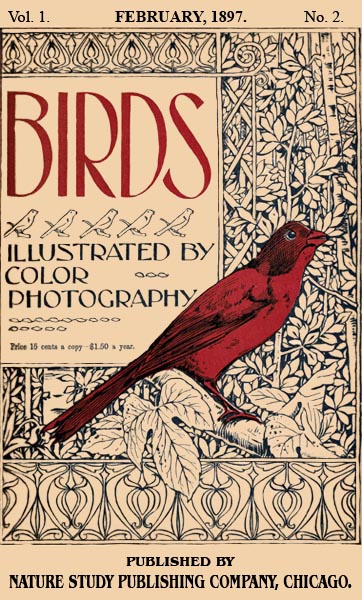
Birds Illustrated by Color Photograhy Vol 1 February 1897 No 2 - Cover

Birds Illustrated by Color Photograhy Vol 1 February 1897 No 2 – Cover

Birds Illustrated by Color Photography – Revisited – Introduction

The above article is the first article in the monthly serial for February 1897 “designed to promote Knowledge of Bird-Live.” These include Color Photography, as they call them, today they are drawings. There are at least three Volumes that have been digitized by Project Gutenberg.

To see the whole series of – Birds Illustrated by Color Photography – Revisited

*

(Information from Wikipedia and other internet sources)

Next Article – Little Boy Blue – The Blue Bird

Previous Article – Blue Mountain Lory (Rainbow Lorikeet)

Wordless Birds

Links:

Cardinalidae – Grosbeaks, Saltators & Allies

Northern Cardinal (Wikipedia)

*

Birds Vol 1 #2 – The Blue Mountain Lory – Rainbow Lorikeet

Blue Mountain Lory

Blue Mountain Lory

*

BLUE MOUNTAIN LORY.

imgt

HIS bird inhabits the vast plains of the interior of New South Wales. It is one of the handsomest, not only of the Australian Parrots, but takes foremost place among the most gorgeously dressed members of the Parrot family that are to be met with in any part of the world. It is about eleven or twelve inches in length. The female cannot with certainty be distinguished from her mate, but is usually a very little smaller. The Lory seldom descends to the ground, but passes the greater part of its life among the gum trees upon the pollen and nectar on which it mainly subsists. In times of scarcity, however, it will also eat grass seeds, as well as insects, for want of which it is said, it often dies prematurely when in captivity.

Dr. Russ mentions that a pair obtained from a London dealer in 1870 for fifty dollars were the first of these birds imported, but the London Zoological Society had secured some of them two years before.

Despite his beauty, the Blue Mountain Lory is not a desirable bird to keep, as he requires great care. A female which survived six years in an aviary, laying several eggs, though kept singly, was fed on canary seed, maize, a little sugar, raw beef and carrots. W. Gedney seems to have been peculiarly happy in his specimens, remarking, “But for the terribly sudden death which so often overtakes these birds, they would be the most charming feathered pets that a lady could possess, having neither the power nor inclination to bite savagely.” The same writer’s recommendation to feed this Lory exclusively upon soft food, in which honey forms a great part, probably accounts for his advice to those “whose susceptible natures would be shocked” by the sudden death of their favorite, not to become the owner of a Blue Mountain Lory.

Like all the parrot family these Lories breed in hollow boughs, where the female deposits from three to four white eggs, upon which she sits for twenty-one days. The young from the first resemble their parents closely, but are a trifle less brilliantly colored.

They are very active and graceful, but have an abominable shriek. The noise is said to be nearly as disagreeable as the plumage is beautiful. They are very quarrelsome and have to be kept apart from the other parrots, which they will kill. Other species of birds however, are not disturbed by them. It is a sort of family animosity. They have been bred in captivity.

The feathers of the head and neck are long and very narrow and lie closely together; the claws are strong and hooked, indicating their tree climbing habits. Their incessant activity and amusing ways make these birds always interesting to watch.

Birds Illustrated by Color Photography – Revisited

Vol 1. February, 1897 No. 2

*

Rainbow Lorikeet (Trichoglossus moluccanus) by Ian

Rainbow Lorikeet (Trichoglossus moluccanus) by Ian


Lee’s Addition:

Rainbow Lorikeet is what the Blue Mountain Lory is known as today. Actually, it is probably the subspecies “Swainson’s Lorikeet.” It is confusing at times with the Rainbow’s. Many of the Zoos give them various names.

Lories and lorikeets (tribe Lorini) are small to medium-sized arboreal parrots characterized by their specialized brush-tipped tongues for feeding on nectar of various blossoms and soft fruits, preferably berries. The species form a monophyletic group within the parrot family Psittaculidae. Traditionally, they were considered a separate subfamily (Loriinae) from the other subfamily (Psittacinae) based on the specialized characteristics, but recent molecular and morphological studies show that the group is positioned in the middle of various other groups. They are widely distributed throughout the Australasian region, including south-eastern Asia, Polynesia, Papua New Guinea, Timor Leste and Australia, and the majority have very brightly coloured plumage.

The usage of the terms “lory” and “lorikeet” is subjective, like the usage of “parrot” and “parakeet”. Species with longer tapering tails are generally referred to as “lorikeets”, while species with short blunt tails are generally referred to as “lories” (Wikipedia)

*

Rainbow Lorikeet (Trichoglossus moluccanus) WikiC

Rainbow Lorikeet (Trichoglossus moluccanus) also known as Swainson’s ©WikiC

*

Looking at these beautiful birds, by whatever name it is called, one can’t help but remember the Promise the LORD made to all his created creatures. He promised never to destroy the whole earth again with a worldwide flood and to remind Him and us of that promise, He gave us the rainbow.

It shall be, when I bring a cloud over the earth, that the rainbow shall be seen in the cloud; and I will remember My covenant which is between Me and you and every living creature of all flesh; the waters shall never again become a flood to destroy all flesh. The rainbow shall be in the cloud, and I will look on it to remember the everlasting covenant between God and every living creature of all flesh that is on the earth.” And God said to Noah, “This is the sign of the covenant which I have established between Me and all flesh that is on the earth.” (Genesis 9:14-17 NKJV)

Rainbow (aka Swainson's) Lorikeet by Lee at Lowry Pk Zoo

Rainbow (aka Swainson’s) Lorikeet by Lee at Lowry Pk Zoo

*

Birds Illustrated by Color Photograhy Vol 1 February 1897 No 2 - Cover

Birds Illustrated by Color Photograhy Vol 1 February 1897 No 2 – Cover

Birds Illustrated by Color Photography – Revisited – Introduction

The above article is the first article in the monthly serial for February 1897 “designed to promote Knowledge of Bird-Live.” These include Color Photography, as they call them, today they are drawings. There are at least three Volumes that have been digitized by Project Gutenberg.

To see the whole series of – Birds Illustrated by Color Photography – Revisited

*

(Information from Wikipedia and other internet sources)

Next Article – The American Red Bird

Previous Article – The Red Wing Black Bird – The Bird Of Society

ABC’s of the Gospel

Links:

Blue Mountain Lory

Swainson’s Blue Mountain, Swainson’s Blue Mt. Lorikeet, Swainson’s Lory, Blue Mountain Lories – Avian Web

Rainbow Lorikeet – Wikipedia

*
Birds Vol 1 #2 – The Red-Wing Black Bird

Red-winged Blackbird (Agelaius phoeniceus) - Birds Illustrated

Red-winged Blackbird (Agelaius phoeniceus) – Birds Illustrated

Birds Illustrated by Color Photography – Revisited

Vol 1. February, 1897 No. 2

*

THE RED WING BLACK BIRD – THE BIRD OF SOCIETY

THE BLACKBIRD.

“I could not think so plain a bird
Could sing so fine a song.”


One on another against the wall
Pile up the books—I am done with them all;
I shall be wise, if I ever am wise,
Out of my own ears, and of my own eyes.

One day of the woods and their balmy light—
One hour on the top of a breezy hill,
There in the sassafras all out of sight
The Blackbird is splitting his slender bill
For the ease of his heart:
Do you think if he said
“I will sing like this bird with the mud colored back
And the two little spots of gold over his eyes,
Or like to this shy little creature that flies
So low to the ground, with the amethyst rings
About her small throat—all alive when she sings
With a glitter of shivering green—for the rest,
Gray shading to gray, with the sheen of her breast
Half rose and half fawn—
Or like this one so proud,
That flutters so restless, and cries out so loud,
With stiff horny beak and a top-knotted head,
And a lining of scarlet laid under his wings—”
Do you think, if he said, “I’m ashamed to be black!”
That he could have shaken the sassafras-tree
As he does with the song he was born to? not he!
—Alice Cary.


“Do you ne’er think what wondrous beings these?
Do you ne’er think who made them—who taught
The dialect they speak, where melodies
Alone are the interpreters of thought?
Whose household words are songs in many keys,
Sweeter than instrument of man ere caught!
Whose habitation in the tree-tops even
Are half-way houses on the road to heaven!

* * * * * * *
“You call them thieves or pillagers; but know,
They are the winged wardens of your farms,
Who from the cornfields drive the insidious foe,
And from your harvest keep a hundred harms;
Even the blackest of them all, the crow,
Renders good service as your man-at-arms,
Crushing the beetle in his coat of mail,
And crying havoc on the slug and snail.”
—From “The Birds of Killingworth.”


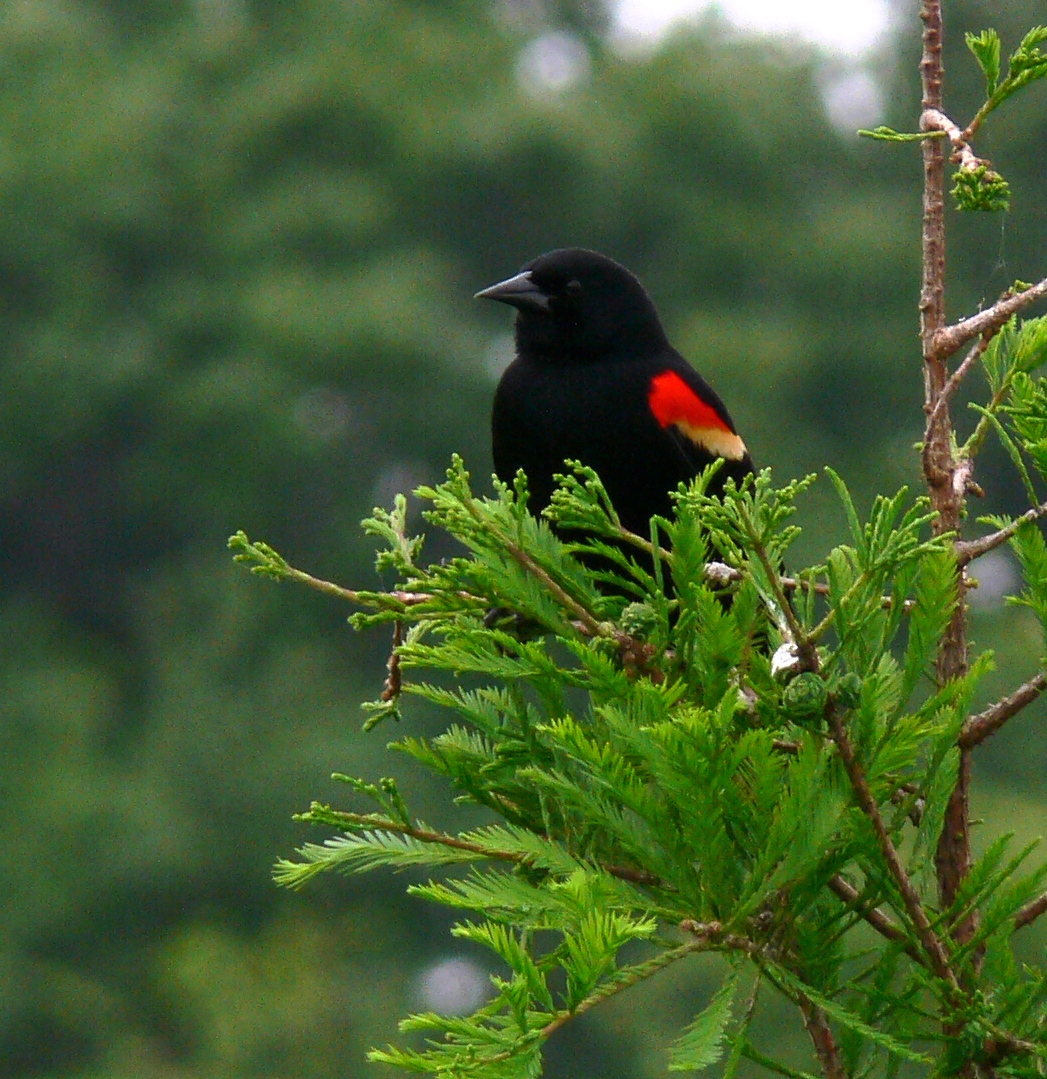
Red-winged Blackbird at S. Lake Howard Nature Pk. by Lee

Red-winged Blackbird at S. Lake Howard Nature Pk. by Lee

*

The blackbirds make the maples ring
With social cheer and jubilee;
The redwing flutes his o-ka-lee.—Emerson.

imgtHE much abused and persecuted Red Wing Black Bird is found throughout North America, from the Atlantic to the Pacific; and it breeds more or less abundantly wherever found. In New England it is generally migratory, though instances are on record where a few have been known to remain throughout the winter in Massachusetts. Passing, in January, through the lower counties of Virginia, one frequently witnesses the aerial evolutions of great numbers of these birds. Sometimes they appear as if driven about like an enormous black cloud carried before the wind, varying every moment in shape. Sometimes they rise suddenly from the fields with a noise like thunder, while the glittering of innumerable wings of the brightest vermillion, amid the black cloud, occasion a very striking effect. At times the whole congregated multitude will suddenly alight in some detached grove and commence one general concert, that can plainly be distinguished at the distance of more than two miles. With the Redwings the whole winter season seems one continued carnival. They find abundant food in the old fields of rice, buckwheat and grain, and much of their time is spent in aerial movements, or in grand vocal performances.

The Redwings, for their nest, always select either the borders of streams or low marshy situations, amongst thick bunches of reeds. One nest was found built on a slender sapling at the distance of fourteen feet from the ground. The nest was pensile, like that of the Baltimore Oriole.

They have from one to three or more broods in a season, according to locality.

In the grain growing states they gather in immense swarms and commit havoc, and although they are shot in great numbers, and though their ranks are thinned by the attacks of hawks, it seems to have but little effect upon the survivors.

On the other hand, these Black Birds more than compensate the farmer for their mischief by the benefit they confer in the destruction of grub worms, caterpillars, and various kinds of larvae, the secret and deadly enemies of vegetation. It has been estimated the number of insects destroyed by these birds in a single season, in the United States, to be twelve thousand millions.

The eggs average about an inch in length. They are oval in shape, have a light bluish ground, and are marbled, lined and blotched with markings of light and dark purple and black.


BLACKBIRD.

’Tis a woodland enchanted!
By no sadder spirit
Than blackbirds and thrushes,
That whistle to cheer it
All day in the bushes,
This woodland is haunted;
And in a small clearing,
Beyond sight or hearing
Of human annoyance,
The little fount gushes.—Lowell.


THE BIRD OF SOCIETY.

The blackbird loves to be one of a great flock. He talks, sings or scolds from morning until night. He cannot keep still. He will only stay alone with his family a few months in the summer. That is the reason he is called the “Bird of Society.” When he is merry, he gaily sings, “Conk-quer-ree.” When he is angry or frightened he screams, “Chock! Chock!” When he is flying or bathing he gives a sweet note which sounds like ee-u-u. He can chirp—chick, check, chuck, to his little ones as softly as any other bird. But only his best friends ever hear his sweetest tones, for the Blackbirds do not know how to be polite. They all talk at once. That is why most people think they only scream and chatter. Did you ever hear the blackbirds in the cornfields? If the farmers thought about it perhaps they would feel that part of every corn crop belongs to the Blackbirds. When the corn is young, the farmer cannot see the grubs which are eating the young plants. The Blackbirds can. They feed them to their babies—many thousands in a day. That is the way the crops are saved for the farmer. But he never thinks of that. Later when the Blackbirds come for their share of the corn the farmer says, “No, they shall not have my corn. I must stop that quickly.” Perhaps the Blackbirds said the same thing to the grubs in the spring. It is hard to have justice for everyone.

In April the Blackbird and his mate leave the noisy company. They seek a cosy home near the water where they can be quiet until August. They usually choose a swampy place among low shrubs and rushes. Here in the deep nest of coarse grass, moss and mud the mother bird lays her five eggs. They are very pretty—light blue with purple and black markings. Their friends say this is the best time to watch the blackbirds. In the flock they are all so much alike we cannot tell one from another. You would like to hear of some of the wise things Blackbirds do when they are tame.

One friend of the birds turned her home into a great open bird cage. Her chair was the favorite perch of her birds. She never kept them one minute longer than they wanted to stay. Yet her home was always full. This was Olive Thorne Miller. If you care to, you might ask mother to get “Bird Ways” and read you what she says about this “bird of society” and the other birds of this book.


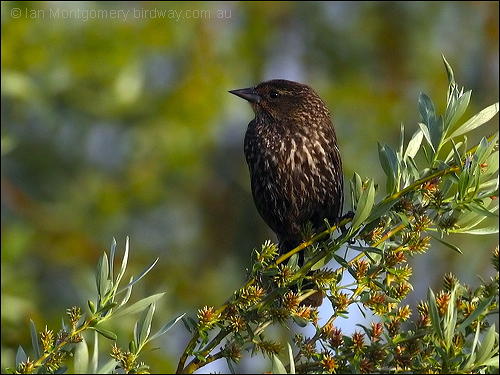
Red-winged Blackbird (Agelaius phoeniceus) female by Ian

Red-winged Blackbird (Agelaius phoeniceus) female by Ian

Lee’s Addition:

I combined the Blackbird and the Red Wing Blackbird together. The poems and some of the writing, combined them and only one photo was provided.

Today this bird is called the Red-winged Blackbird and they are in the Icteridae – Oropendolas, Orioles & Blackbirds Family, which has 108 species. We are fortunate here because we see Red-winged Blackbirds quite often and even have them stop by the feeders in our yard. I can always tell when they are near because of the male’s song. It is a loud, gurgling “conk-a-reeeee” or “o-ka-leeeee” sound.

And to every beast of the earth and to every bird of the heavens and to everything that creeps on the earth, everything that has the breath of life, I have given every green plant for food.” And it was so. And God saw everything that he had made, and behold, it was very good. And there was evening and there was morning, the sixth day. (Genesis 1:30-31 ESV)

*

Birds Illustrated by Color Photograhy Vol 1 February 1897 No 2 - Cover

Birds Illustrated by Color Photograhy Vol 1 February 1897 No 2 – Cover

Birds Illustrated by Color Photography – Revisited – Introduction

The above article is the first article in the monthly serial for February 1897 “designed to promote Knowledge of Bird-Live.” These include Color Photography, as they call them, today they are drawings. There are at least three Volumes that have been digitized by Project Gutenberg.

To see the whole series of – Birds Illustrated by Color Photography – Revisited

*

(Information from Wikipedia and other internet sources)

Next Article – Blue Mountain Lory

Previous Article –The Kingfisher – The Lone Fisherman

Wordless Birds

Links:

Red-winged Blackbirds

*

Birds Vol 1 #2 – The Kingfisher – The Lone Fisherman

Kingfisher – Birds Illustrated by Photography 1897

Birds Illustrated by Color Photography – Revisited

Vol 1. February, 1897 No. 2

*

THE KINGFISHER.

Dear Children:

I shall soon arrive from the south. I hear that all the birds are going to tell stories to the boys and girls.

I have never talked much with children myself for I never really cared for people. They used to say that the dead body of a Kingfisher kept them safe in war and they said also that it protected them in lightning.

Even now in some places in France they call us the moth birds, for they believe that our bodies will keep away moths from woolen cloth.

I wish that people would not believe such things about us. Perhaps you cannot understand me when I talk. You may think that you hear only a child’s rattle.

Listen again! It is I, the Kingfisher. That sound is my way of talking. I live in the deep woods. I own a beautiful stream and a clear, cool lake. Oh, the little fish in that lake are good enough for a king to eat! I know, for I am a king.

You may see me or some of my mates near the lake any pleasant day. People used to say that we always brought pleasant weather. That is a joke. It is the pleasant weather that always brings us from our homes. When it storms or rains we cannot see the fish in the lake. Then we may as well stay in our nests.

My home once belonged to a water rat. He dug the fine hall in the gravel bank in my stream. It is nearly six feet long. The end of it is just the kind of a place for a nest. It is warm, dry and dark. In June my wife and I will settle down in it. By that time we shall have the nest well lined with fish bones. We shall put in some dried grass too. The fish bones make a fine lining for a nest. You know we swallow the fish whole, but we save all the bones for our nest.

I shall help my wife hatch her five white eggs and shall try in every way to make my family safe.

Please tell the people not to believe those strange things about me and you will greatly oblige,
A neighbor,
The Kingfisher.


THE KINGFISHER.

The Lone Fisherman.

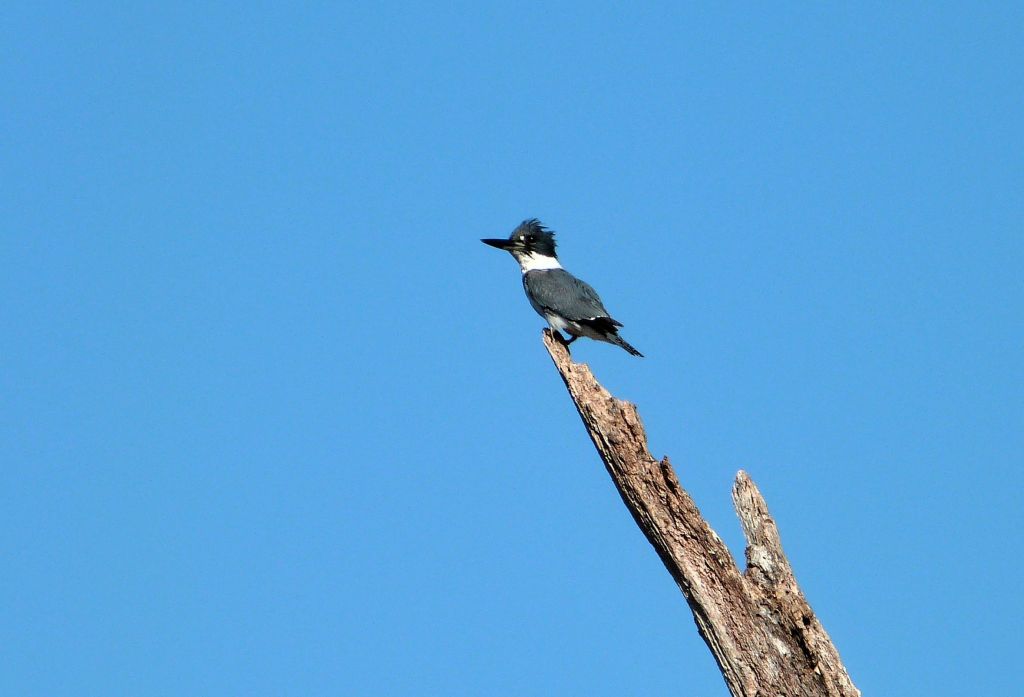
imgtHE American species belongs to the true group of Kingfishers. It occupies the whole continent of North America and although migrating in the north, he is a constant resident of our southern states. The belted Kingfisher is the only variety found along the inland streams of the United States. Audubon declares that “belted” should apply only to the female, however.

Like most birds of brilliant plumage, the Kingfisher prefers a quiet and secluded haunt. It loves the little trout streams, with wooded and precipitous banks, the still ponds and small lakes, ornamental waters in parks, where it is not molested, and the sides of sluggish rivers, drains and mill-ponds.

Here in such a haunt the bird often flits past like an indistinct gleam of bluish light. Fortune may sometimes favor the observer and the bird may alight on some twig over the stream, its weight causing it to sway gently to and fro. It eagerly scans the shoal of young trout sporting in the pool below, when suddenly it drops down into the water, and, almost before the observer is aware of the fact, is back again to its perch with a struggling fish in its beak. A few blows on the branch and its prey is ready for the dexterous movement of the bill, which places it in a position for swallowing. Sometimes the captured fish is adroitly jerked into the air and caught as it falls.

Fish is the principal food of the Kingfisher; but it also eats various kinds of insects, shrimps, and even small crabs. It rears its young in a hole, which is made in the banks of the stream it frequents. It is a slatternly bird, fouls its own nest and its peerless eggs. The nesting hole is bored rather slowly, and takes from one to two weeks to complete. Six or eight white glossy eggs are laid, sometimes on the bare soil, but often on the fish bones which, being indigestible, are thrown up by the bird in pellets.

The Kingfisher has a crest of feathers on the top of his head, which he raises and lowers, especially when trying to drive intruders away from his nest.

The plumage is compact and oily, making it almost impervious to water. The flesh is fishy and disagreeable to the taste, but the eggs are said to be good eating. The wings are long and pointed and the bill longer than the head. The voice is harsh and monotonous.

It is said that few birds are connected with more fables than the Kingfisher. The superstition that a dead Kingfisher when suspended by the throat, would turn its beak to that particular point of the compass from which the wind blew, is now dead. It was also supposed to possess many astonishing virtues, as that its dried body would avert thunderbolts, and if kept in a wardrobe would preserve from moths the woolen stuffs and the like contained in it.

Under the name of “halcyon,” it was fabled by the ancients to build its nest on the surface of the sea, and to have the power of calming the troubled waves during its period of incubation; hence the phrase “halcyon days.”

A pair of Kingfishers have had their residence in a bank at the south end of Washington Park, Chicago, for at least three seasons past. We have watched the Kingfisher from secluded spots on Long Island ponds and tidal streams, where his peculiar laughing note is the same as that which greets the ear of the fisherman on far inland streams on still summer days.

Belted Kingfisher (Megaceryle alcyon) by Daves BirdingPix


Lee’s Addition:

Another of my favorite birds. I think most of them are, but the Belted Kingfisher is a real challenge to photograph. They must sense that your camera is on. Dan says that many photographers call it the “Devil Bird” because it is so hard to photo. See http://jimt.zenfolio.com/p703966915 by James Thiel and another photographer at http://www.flickr.com/photos/johnklos/3049270990/.

I think of them as having a short squatty neck and a long beak. Actually the Laughing Kookaburra is in the Kingfisher family, the Kingfishers – Alcedinidae Family. The article mentioned that the Belted Kingfisher is the only one in the U. S., but there are actually two more; the Ringed and the Green Kingfishers that are found in south Texas. We have seen all three of them.

The Kingfisher – Alcedinidae family has a total of 95 members. Many of them are very colorful and again show the Lord’s Creative Hand at work. He has provided them with just the right kind of beak to snatch their meals with and even given them the ability to see their prey in the water. The distortion water gives is compensated for them.

And Jesus, walking by the sea of Galilee, saw two brethren, Simon called Peter, and Andrew his brother, casting a net into the sea: for they were fishers. And he saith unto them, Follow me, and I will make you fishers of men. (Matthew 4:18-19 KJV)

Belted Kingfisher (Megaceryle alcyon) by Lee Circle B

Belted Kingfisher (Megaceryle alcyon) by Lee Circle B

In January, I was able for the first time to get some photos of the Belted Kingfisher. Two of them were showing off and forgot someone was watching. They can hover over the water, keeping their head steady and watch for their prey. It is amazing to watch them do that. (Birdwatching Adventure – Circle B Bar Reserve – 1/16/12)

Birds Illustrated by Color Photograhy Vol 1 February 1897 No 2 - Cover

Birds Illustrated by Color Photograhy Vol 1 February 1897 No 2 – Cover

Birds Illustrated by Color Photography – Revisited – Introduction

The above article is the first article in the monthly serial for February 1897 “designed to promote Knowledge of Bird-Live.” These include Color Photography, as they call them, today they are drawings. There are at least three Volumes that have been digitized by Project Gutenberg.

To see the whole series of – Birds Illustrated by Color Photography – Revisited

*

(Information from Wikipedia and other internet sources)

Next Article – The Red Wing Black Bird – The Bird Of Society

Previous Article – The American Robin – The Bird Of The Morning

Wordless Birds

Links:


Birds Vol 1 #2 – The American Robin

American Robin for Birds Illustrated by Color Photography

American Robin for Birds Illustrated by Color Photography

Birds Illustrated by Color Photography – Revisited

Vol 1. February, 1897 No. 2

*

THE AMERICAN ROBIN.

The Bird of the Morning.

Yes, my dear readers, I am the bird of the morning. Very few of you rise early enough to hear my first song. By the time you are awake our little ones have had their breakfast, Mrs. Robin and I have had our morning bath and we are all ready to greet you with our morning song.

I wonder if any of you have seen our nest and can tell the color of the eggs that Mrs. Robin lays. Some time I will let you peep into the nest and see them, but of course you will not touch them.

I wonder, too, if you know any of my cousins—the Mocking bird, the Cat-bird or the Brown Thrush—I think I shall ask them to have their pictures taken soon and talk to you about our happy times.

Did you ever see one of my cousins on the ground? I don’t believe you can tell how I move about. Some of you may say I run, and some of you may say I hop, and others of you may say I do both. Well, I’ll tell you how to find out. Just watch me and see. My little friends up north won’t be able to see me though until next month, as I do not dare leave the warm south until Jack Frost leaves the ground so I can find worms to eat.

I shall be about the first bird to visit you next month and I want you to watch for me. When I do come it will be to stay a long time, for I shall be the last to leave you. Just think, the first to come and last to leave. Don’t you think we ought to be great friends? Let us get better acquainted when next we meet. Your friend,
Robin.

American Robin (Turdus migratorius) Eggs and 1 hatchling ©©SenzEnina

American Robin (Turdus migratorius) Eggs and 1 hatchling ©©SenzEnina


How do the robins build their nest?
Robin Red Breast told me,
First a wisp of yellow hay
In a pretty round they lay;
Then some shreds of downy floss,
Feathers too, and bits of moss,
Woven with a sweet, sweet song,
This way, that way, and across:
That’s what Robin told me.

Where do the robins hide their nest?
Robin Red Breast told me,
Up among the leaves so deep,
Where the sunbeams rarely creep,
Long before the winds are cold,
Long before the leaves are gold
Bright-eyed stars will peep and see
Baby Robins—one, two, three:
That’s what Robin told me.

American Robin (Turdus migratorius) by Raymond Barlow

American Robin (Turdus migratorius) by Raymond Barlow


THE AMERICAN ROBIN.

“Come, sweetest of the feathered throng.”

imgo


UR American Robin must not be confounded with the English Robin Redbreast, although both bear the same name. It is the latter bird in whose praise so much has been written in fable and song. The American Robin belongs to the Thrush family; the Mocking bird, Cat-bird and Brown Thrush, or Thrasher, being other familiar children. In this family, bird organization reaches its highest development. This bird is larger than his English cousin the Redbreast and many think has a finer note than any other of the Thrush family.

The Robin courts the society of man, following close upon the plow and the spade and often becoming quite tame and domestic. It feeds for a month or two on strawberries and cherries, but generally on worms and insects picked out of the ground. It destroys the larvae of many insects in the soil and is a positive blessing to man, designed by the Creator for ornament and pleasure, and use in protecting vegetation. John Burroughs, the bird lover, says it is the most native and democratic of our birds.

It is widely diffused over the country, migrating to milder climates in the Winter. We have heard him in the early dawn on Nantucket Island welcoming the coming day, in the valleys of the Great and the little Miami, in the parks of Chicago, and on the plains of Kansas, his song ever cheering and friendly. It is one of the earliest heralds of Spring, coming as early as March or April, and is one of the latest birds to leave us in Autumn. Its song is a welcome prelude to the general concert of Summer.

“When Robin Redbreast sings,
We think on budding Springs.”

The Robin is not one of our most charming songsters, yet its carol is sweet, hearty and melodious. Its principal song is in the morning before sunrise, when it mounts the top of some tall tree, and with its wonderful power of song, announces the coming of day. When educated, it imitates the sounds of various birds, and even sings tunes. It must be amusing to hear it pipe out so solemn a strain as Old Hundred.

American Robin’s Song from xeno.canto by Mike Nelson

It has no remarkable habits. It shows considerable courage and anxiety for its young, and is a pattern of propriety when keeping house and concerned with the care of its offspring. Two broods are often reared out of the same nest. In the Fall these birds become restless and wandering, often congregating in large flocks, when, being quite fat, they are much esteemed as food.

The Robin’s nest is sometimes built in a corner of the porch, but oftener it is saddled on the horizontal limb of an orchard tree. It is so large and poorly concealed that any boy can find it, yet it is seldom molested. The Robin is not a skillful architect. The masonry of its nest is rough and the material coarse, being composed largely of leaves or old grass, cemented with mud. The eggs number four to six and are greenish blue in color.

An observer tells the following story of this domestic favorite:

“For the last three years a Robin has nested on a projecting pillar that supports the front piazza. In the Spring of the first year she built her nest on the top of the pillar—a rude affair—it was probably her first effort. The same season she made her second nest in the forks of an Oak, which took her only a few hours to complete.

“She reared three broods that season; for the third family she returned to the piazza, and repaired the first nest. The following Spring she came again to the piazza, but selected another pillar for the site of her domicile, the construction of which was a decided improvement upon the first. For the next nest she returned to the Oak and raised a second story on the old one of the previous year, but making it much more symmetrical than the one beneath. The present season her first dwelling was as before, erected on a pillar of the piazza—as fine a structure as I ever saw this species build. When this brood was fledged she again repaired to the Oak, and reared a third story on the old domicile, using the moss before mentioned, making a very elaborate affair, and finally finishing up by festooning it with long sprays of moss. This bird and her mate were quite tame. I fed them with whortleberries, which they seemed to relish, and they would come almost to my feet to get them.”

The amount of food which the young robin is capable of absorbing is enormous. A couple of vigorous, half-grown birds have been fed, and in twelve hours devoured ravenously, sixty-eight earth worms, weighing thirty-four pennyweight, or forty-one per cent more than their own weight. A man at this rate should eat about seventy pounds of flesh per day, and drink five or six gallons of water.

The following poem by the good Quaker poet Whittier is sweet because he wrote it, interesting because it recites an old legend which incidentally explains the color of the robin’s breast, and unique because it is one of the few poems about our American bird.


THE ROBIN.

My old Welsh neighbor over the way
Crept slowly out in the sun of spring,
Pushed from her ears the locks of gray,
And listened to hear the robin sing.

Her grandson, playing at marbles, stopped,
And—cruel in sport, as boys will be—
Tossed a stone at the bird, who hopped
From bough to bough in the apple tree.

“Nay!” said the grandmother; “have you not heard,
My poor, bad boy! of the fiery pit,
And how, drop by drop, this merciful bird
Carries the water that quenches it?

“He brings cool dew in his little bill,
And lets it fall on the souls of sin:
You can see the mark on his red breast still
Of fires that scorch as he drops it in.

“My poor Bron rhuddyn! my breast-burned bird,
Singing so sweetly from limb to limb,
Very dear to the heart of Our Lord
Is he who pities the lost like Him.”

“Amen!” I said to the beautiful myth;
“Sing, bird of God, in my heart as well:
Each good thought is a drop wherewith
To cool and lessen the fires of hell.

“Prayers of love like rain-drops fall,
Tears of pity are cooling dew,
And dear to the heart of Our Lord are all
Who suffer like Him in the good they do.”


Lee’s Addition:

Robins have always been special. I suppose it was one of the first birds that I knew by name. Not that I was a birdwatcher back in my youth. Wish I had started back then.

Like the article mentioned, the American Robin is actually in the Turdidae – Thrushes Family of Passerines which has 184 members. There is another family of Robins and they are in the Chats, Old World Flycatchers – Muscicapidae Family which has 297 species. Wikipedia has this to say about these Robins:

European Robin (Erithacus rubecula) by Robert Scanlon

European Robin (Erithacus rubecula) by Robert Scanlon

“The European Robin (Erithacus rubecula), most commonly known in Anglophone Europe simply as the Robin, is a small insectivorous passerine bird that was formerly classed as a member of the thrush family (Turdidae), but is now considered to be an Old World flycatcher (Muscicapidae). Around 12.5–14.0 cm (5.0–5.5 in) in length, the male and female are similar in colouration, with an orange breast and face lined with grey, brown upperparts and a whitish belly. It is found across Europe, east to Western Siberia and south to North Africa; it is sedentary in most of its range except the far north.

The term Robin is also applied to some birds in other families with red or orange breasts. These include the American Robin (Turdus migratorius), which is a thrush, and the Australian red robins of the genus Petroica, members of a family whose relationships are unclear.” They are the Petroicidae – Australasian Robins Family with 46 species.

Scarlet Robin (Petroica boodang) by Ian

Scarlet Robin (Petroica boodang) by Ian

Hope you enjoy seeing the three different “Robin Families.” I am thankful the the Lord let at least three different continents have their very own “Robin.” He told the birds to multiply and fill up the earth. They seemed to have obeyed, were we that obedient.

Bring out with you every living thing of all flesh that is with you: birds and cattle and every creeping thing that creeps on the earth, so that they may abound on the earth, and be fruitful and multiply on the earth.” So Noah went out, and his sons and his wife and his sons’ wives with him. Every animal, every creeping thing, every bird, and whatever creeps on the earth, according to their families, went out of the ark. (Genesis 8:17-19 NKJV)

*

Birds Illustrated by Color Photograhy Vol 1 February 1897 No 2 - Cover

Birds Illustrated by Color Photograhy Vol 1 February 1897 No 2 – Cover

Birds Illustrated by Color Photography – Revisited – Introduction

The above article is the first article in the monthly serial for February 1897 “designed to promote Knowledge of Bird-Live.” These include Color Photography, as they call them, today they are drawings. There are at least three Volumes that have been digitized by Project Gutenberg.

To see the whole series of – Birds Illustrated by Color Photography – Revisited

*

(Information from Wikipedia and other internet sources)

Next Article – The Kingfisher – The Lone Fisherman

Previous Article – King Parrot Or King Lory

ABC’s of the Gospel

Links:

An Ad:

Ads for Desk and Pens - 1897

Ads for Desk and Pens – 1897

Birds Vol 1 #2 – The King Parrot or King Lory

Australian King Parrot (Alisterus scapularis) Birds Illustrated by Color Photography

King Parrot – Birds Illustrated by Color Photography

Birds Illustrated by Color Photography – Revisited

Vol 1. February, 1897 No. 2

*

KING PARROT OR KING LORY.

imgl

ORY is the name of certain birds, mostly from the Moluccas and New Guinea, which are remarkable for their bright scarlet or crimson coloring, though also applied to some others in which the plumage is chiefly green. Much interest has been excited by the discovery of Dr. A. B. Meyer that the birds of this genus having a red plumage are the females of those wearing green feathers. For a time there was much difference of opinion on this subject, but the assertion is now generally admitted.

They are called “brush-tongued” Parrots. The color of the first plumage of the young is still unsettled. This bird is a favorite among bird fanciers, is readily tamed, and is of an affectionate nature. It can be taught to speak very creditably, and is very fond of attracting the attention of strangers and receiving the caresses of those whom it likes.

There are few things a parrot prefers to nuts and the stones of various fruits. Wood says he once succeeded in obtaining the affections of a Parisian Parrot, solely through the medium of peach stones which he always saved for the bird and for which it regularly began to gabble as soon as it saw him coming. “When taken freshly from the peach,” he says, “the stones are very acceptable to the parrot, who turns them over, chuckling all the while to show his satisfaction, and picking all the soft parts from the deep indentations in the stone.” He used to crack the stone before giving it to the bird, when his delight knew no bounds. They are fond of hot condiments, cayenne pepper or the capsicum pod. If a bird be ailing, a capsicum will often set it right again.

The parrot is one of the hardiest of birds when well cared for and will live to a great age. Some of these birds have been known to attain an age of seventy years, and one seen by Vaillant had reached the patriarchal age of ninety three. At sixty its memory began to fail, at sixty-five the moult became very irregular and the tail changed to yellow. At ninety it was a very decrepit creature, almost blind and quite silent, having forgotten its former abundant stock of words.

A gentleman once had for many years a parrot of seemingly rare intelligence. It was his custom during the summer to hang the parrot’s cage in front of his shop in a country village, where the bird would talk and laugh and cry, and condole with itself. Dogs were his special aversion and on occasions when he had food to spare, he would drop it out of the cage and whistle long and loud for them. When the dogs had assembled to his satisfaction he would suddenly scream in the fiercest accents, “Get out, dogs!” and when they had scattered in alarm his enjoyment of it was demonstrative. This parrot’s vocabulary, however, was not the most refined, his master having equipped him with certain piratical idioms.

According to authority, the parrot owner will find the health of his pet improved and its happiness promoted by giving it, every now and then, a small log or branch on which the mosses and lichens are still growing. Meat, fish, and other similar articles of diet are given with evil effects.

It is impossible for anyone who has only seen these birds in a cage or small inclosure to conceive what must be the gorgeous appearance of a flock, either in full flight, and performing their various evolutions, under a vertical sun, or sporting among the superb foliage of a tropical forest which, without these, and other brilliant tenants, would present only a solitude of luxuriant vegetation.

Australian King Parrot (Alisterus scapularis) ©WikiC

Australian King Parrot (Alisterus scapularis) ©WikiC


Lee’s Addition:

And he hath on his vesture and on his thigh a name written, KING OF KINGS, AND LORD OF LORDS. (Revelation 19:16 KJV)

The king parrots are three species of medium-sized parrots in the genus Alisterus; the Australian King Parrot (Alisterus scapularis), the Papuan King Parrot (Alisterus chloropterus), and the Moluccan King Parrot (Alisterus amboinensis). The three species are found in Eastern Australia, New Guinea, and Indonesian islands including the Maluku islands respectively. Predominantly of red and green plumage, the long tailed parrots are related to the genera Aprosmictus and Polytelis.

Australian King Parrot (Alisterus scapularis) Female by Ian

Australian King Parrot (Alisterus scapularis) Female by Ian

King parrots are medium-sized parrots, 35–43 cm (14–17 in) in length with long-broad tails. They have relatively small beaks for their size. The beaks of the adults are two colours, blackish and orange-reddish, except for the subspecies buruensis of the Moluccan King Parrot which has a grey-black beak, and female Australian King Parrot which has a grey beak.

Moluccan King Parrot (Alisterus amboinensis) ©WikiC - Brevard_Zoo

Moluccan King Parrot (Alisterus amboinensis) ©WikiC – Brevard_Zoo

Wikipedia show this photo of a King Parrot, but somehow we missed it. The photo was taken in 2009, so it may no longer be there. The first and third photo favor the drawing, but I lean toward the Australian King Parrot. They are all closely related

Papuan King Parrot (Alisterus chloropterus) ©WikiC

Papuan King Parrot (Alisterus chloropterus) ©WikiC

The three species are forest-dwelling, and are found singly, in pairs, or in groups.[2] Australian King Parrots sometimes gather in groups of up to 30 or more around food sources, while Moluccan King Parrots sometimes form groups up to ten, and the Moluccan King Parrots may gather in groups of fives or sixes.[2] They generally feed on seeds, fruits and berries in trees.

The Psittacidae – Parrots Family is where you will find these Parrots. There are 350 species in 77 genus. Quite a large family. Their “cousins”, the Cockatoos and New Zealand Parrots join them in the Psittaciformes Order.


Birds Illustrated by Color Photograhy Vol 1 February 1897 No 2 - Cover

Birds Illustrated by Color Photograhy Vol 1 February 1897 No 2 – Cover

Birds Illustrated by Color Photography – Revisited – Introduction

The above article is the first article in the monthly serial for February 1897 “designed to promote Knowledge of Bird-Live.” These include Color Photography, as they call them, today they are drawings. There are at least three Volumes that have been digitized by Project Gutenberg.

To see the whole series of – Birds Illustrated by Color Photography – Revisited

*

(Information from Wikipedia and other internet sources)

Next Article – The American Robin – The Bird Of The Morning

Previous Article – Mexican Mot Mot

Wordless Birds

Links:

Australian King Parrot
Papuan King Parrot
Moluccan King Parrot

One of their Ads:

ATTEND THE BEST.

CHICAGO BUSINESS COLLEGE

Wabash Ave. & Randolph St.

Chicago Business College - Ad for Birds Illustrated

Chicago Business College – Ad for Birds Illustrated

*