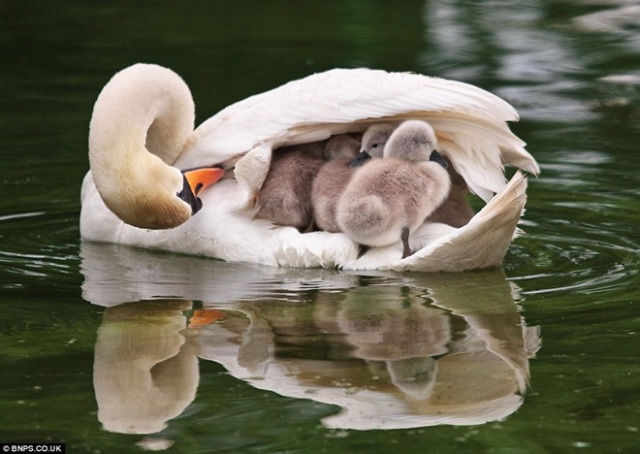
Yesterday’s My Mom And Me – Email blog inspired me to write a new article for the Birds of the Bible For Kids. It is called:”
Bible Birds – Mother Birds and Their Young.
Please check it out. It is geared for a younger audience.
*
Yesterday’s My Mom And Me – Email blog inspired me to write a new article for the Birds of the Bible For Kids. It is called:”
Bible Birds – Mother Birds and Their Young.
Please check it out. It is geared for a younger audience.
*

My Mom and Us
Yesterday, in My Mom and Me – Photos, you saw many photos of Mother Animals and Mother Birds with their young ones. Does the Bible mention mother birds and their young or eggs. Yes, it does.
“If a bird’s nest happens to be before you along the way, in any tree or on the ground, with young ones or eggs, with the mother sitting on the young or on the eggs, you shall not take the mother with the young;
you shall surely let the mother go, and take the young for yourself, that it may be well with you and that you may prolong your days. (Deuteronomy 22:6-7 NKJV)
That is very interesting verse. It tells us not to take both the mother and the young or eggs. Do you know why? Look at the last verse; it says “may be well with you and you will prolong your days (live longer). Do you know another reason not to take both? The Lord commanded the animals and birds to have babies and fill the earth. If you kill them both, then none of that family will be able to have more baby birds or the young will not get to grow up and have baby birds. Soon, there wouldn’t be any more of those kinds of birds and they would become “extinct.”
The Lord told us from the very beginning of the Bible to have “dominion” over the birds and animals. That does not mean to be mean to them, but more like to watch over them and care for them. That is what our verse above is telling us. Not to destroy all of them, but to leave some of the family alive to carry on.
Gather the people–men, women, children, and foreigners living within your gates–so that they may listen and learn to fear the LORD your God and be careful to follow all the words of this law. (Deuteronomy 31:12 HCSB)
See:
More Bible Birds
*
(Received this as an email. – Not sure who to credit them to.)
*
Here’s your AWE! for the day!!!
*
*
Bring forth every living thing that is with you of all flesh–birds and beasts and every creeping thing that creeps on the ground–that they may breed abundantly on the land and be fruitful and multiply upon the earth. (Genesis 8:17 AMP)
*

Ian’s Bird of the Week – White-throated (and Large-tailed) Nightjar ~ by Ian Montgomery
Newsletter – 04-29-13
On the recent inland trip I searched without success in various places for the Spotted Nightjar, a dry country species that roosts in spinifex and open woodland. Sometimes it is to be seen on gravel roads at night, but it seems rather shy and it’s still on my wanted-to-photograph list. I’m back home in Bluewater near Townsville with my sister Gillian, also interested in birds and on a visit from Ireland, so last Tuesday we drove up to the highland mixed forest, part sclerophyll part rainforest, on the range at the end of Forestry Road where I live. She spotted the bird in the first photo which we had disturbed walking along a forest track.
This is a White-throated Nightjar, also on my wanted list as the only one I had photographed before was the one in the second photo, taken 5 years ago in the vestibule of Reef HQ, the aquarium in Townsville in the less than ideal natural surroundings of the roof supports.

The sharp-eyed among you may have noticed that both photos were taken in April. This is no coincidence as this species is mainly seen here on migration and there are other reports of it turning up in strange places here, including a disused railway carriage that was used as travel accommodation for several years. Incidentally, its specific name mystacalis means ‘moustached’.
A much commoner species here is the Large-tailed Nightjar, often heard at night around Townsville in gallery forest, rainforest and mangroves. It has an unmistakable, very persistent ‘chop’ ‘chop’ call that gives it its colloquial name of Carpenter Bird or Axe Bird, and I often here it near my house, particular on moonlit nights.

On the day we saw the White-throated Nightjar I had been hoping that we’d see Large-tailed Nightjars on Forestry Road when we returned home at dusk, but the White-throated got in first. So we were delighted to see 3 Large-tailed as well on the way home, including one that obligingly flew up into a tree beside the road and called to us as we illuminated it with a spotlight. I had said to Gillian a few days before that this was one of the few places I knew where you could easily see two species of Stone-curlew/Thicknee in one day after we had seen a pair of Beach Stone-curlews when we went for fish and chips at nearby Balgal Beach and then found two Bush Stone-Curlews in the garden when we returned home. I could perhaps have said the same about Nightjars. You could also say something about the irony of travelling to distant places when there are so many things to be seen in one own back yard.
Best wishes
Ian
**************************************************
Ian Montgomery, Birdway Pty Ltd,
454 Forestry Road, Bluewater, Qld 4818
Tel 0411 602 737 ian@birdway.com.au
Check the latest website updates:
http://www.birdway.com.au/#updates
Lee’s Addition:
How true it is that sometimes we find great treasure right in our own back yard. I am so thankful, Ian, that you share so many of your adventures with us. And, it is nice to share those adventures with your sister.
We have been able to see three members of the Caprimulgidae – Nightjars Family; the Common Nighthawk, Whip-poor-will and the Chuck-will’s-widow.
They are also mentioned in Scripture – Birds of the Bible – Nighthawks and Nightjars
And the owl, and the night hawk, and the cuckow, and the hawk after his kind, (Deuteronomy 14:15 KJV)
See Also:
Ian’s Caprimulgidae Family Photos
Caprimulgidae – Nightjars Family
Nightjar– Wikipedia
*
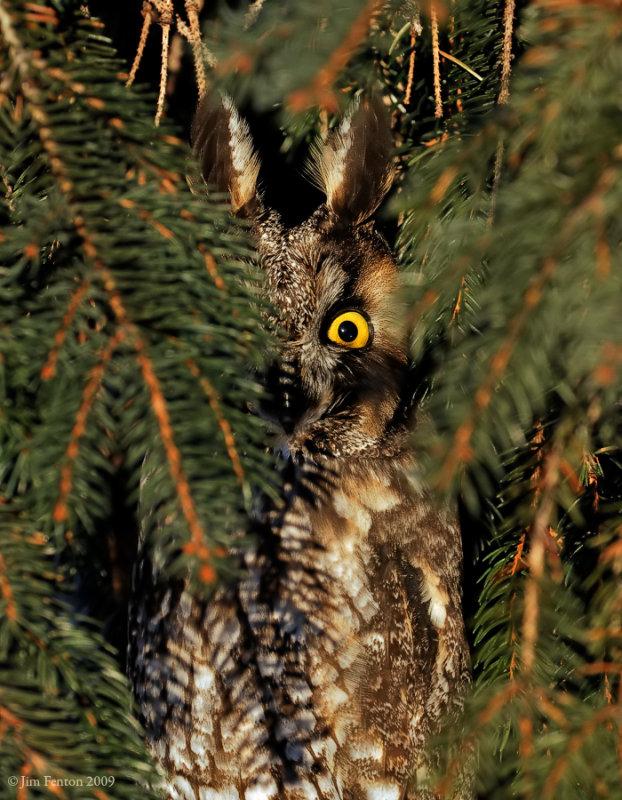
Long-eared Owl (Asio otus) by J Fenton
On Saturday, I concluded my search for the Birds of the World list of birds. Out of 10,615 (or 10,625) there are 74 birds who seem to have stayed hidden from the view of all the “Birdographers.” That is my name for those who are photographers, videographers, artists and stamp makers. All the major Ornithology and Birding websites are in need of them also.
I am thankful for every photo, drawing, video, specimen and sound recording of the birds that have links to them. They represent dedicated birdwatchers who have been on adventures that have taken them to places many of us would not go. Jungles, swamps, mountains, deserted islands, mudholes, etc have been traipsed so that these images could be recorded. Thank you, thank you, thank you!
When I started listing the Birds of the World several years back, I never envisioned ever seeing the images of as many as I have seen now. According to the IOC Version 3.3 list, I have seen over 10,500 species of the Lord’s fantastically created birds. That does not rate in any counting system used by birders, but it sure has been an unexpected enjoyment for me even though it represents hours of searching and updating the pages here. I have been exposed to birds that are so unique, beautiful, ugly, colorful, dull, loud, quite, etc. that I never knew even existed. Wow!
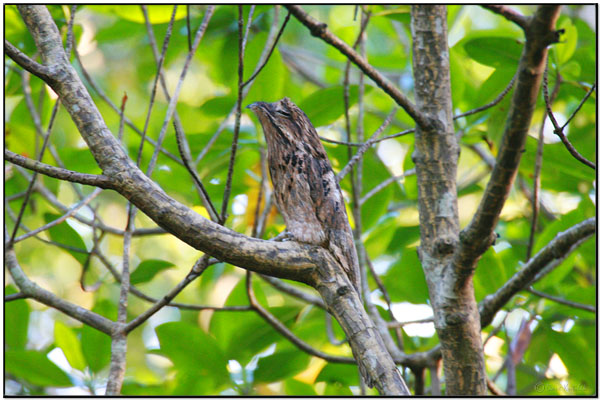
Do you see me?
Now for the plea. I made a page that list all the missing species, Missing Birds Needed. If anyone who has a photo, video, drawing, or whatever of those birds, or knows where a link can be found to them, please leave a comment or send me an email at:
Yes, there are sites out there that show photos for the listed birds, but they are of another bird in the family or genus. Here, and I am sure there are some mistakes, I would rather have a blank instead of misleading someone to think that is the real bird. Most leave the photo blank, but a few don’t. I fell for that a few times until I learned, now I am trying to find those misleading photos.
One of the biggest problems finding the birds is that the species have had name changes and several names at the same time. They also keep splitting the subspecies off into a new species. Toward the end of my searching, I felt like a detective trying to figure out a bird’s name and its past names just to be able to find it.
And further, my son, be admonished by these. Of making many books there is no end, and much study is wearisome to the flesh. (Ecclesiastes 12:12 NKJV)
Again, if you can help, check out the Missing Birds Needed page and see if you could supply an image or link to one. Let’s see if we can reduce that number down. I haven’t quit my search, just resting until the IOC updates their list next month and I get to start searching again.
Also, if you would like to become one of our photographers, leave a note.
*
Either what woman having ten pieces of silver, if she lose one piece, doth not light a candle, and sweep the house, and seek diligently till she find it? And when she hath found it, she calleth her friends and her neighbours together, saying, Rejoice with me; for I have found the piece which I had lost. Likewise, I say unto you, there is joy in the presence of the angels of God over one sinner that repenteth. (Luke 15:8-10 KJV)
*
*
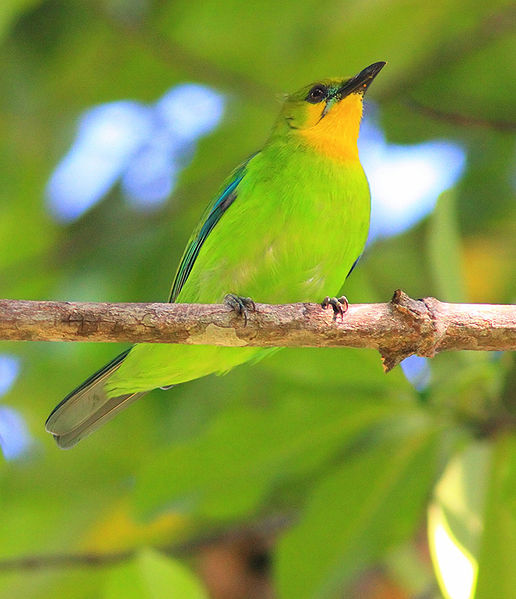
Yellow-throated Leafbird (Chloropsis palawanensis) @WikiC
David Cabedo, who visits this site frequently, posted this article with the video on Philippines Birdwatching. It is fantastic. After showing the area of the Philippines, it then starts showing one bird after another that are in that area. Thanks, David, for finding and posting the YouTube. It is entitled, Avian Archipelago – Birdwatching in the Philippines” by avianarchipelago.
Enjoy!
*
*
He has made His wonderful works to be remembered; The LORD is gracious and full of compassion. (Psalms 111:4 NKJV)
See:
*
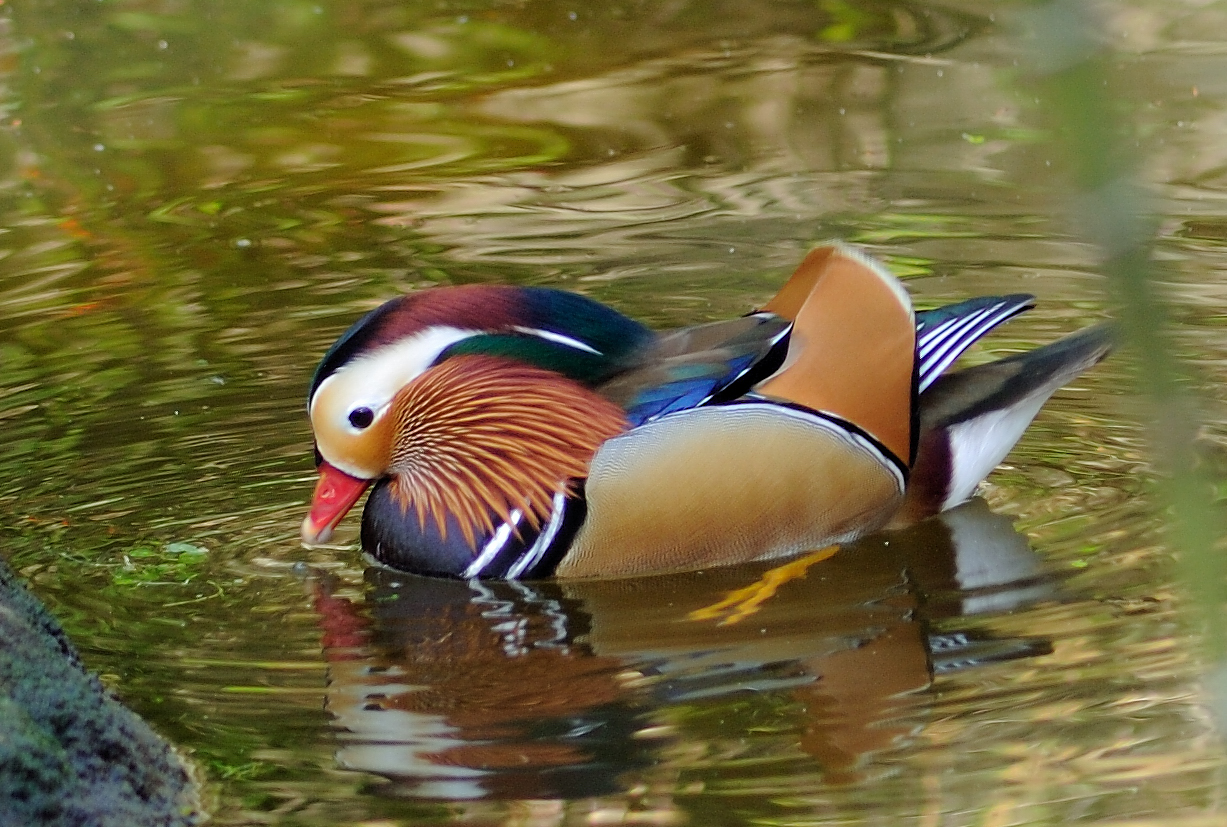
Mandarin Duck (Aix galericulata) by Dan
Currently, I am reading through Leviticus. When I cam to the Tabernacle, my first thoughts were, “Here we go again” with all the details about how to make it. The LORD gave Moses the details and then he shared those details with all the workers and skilled craftsmen as to how it was supposed to be prepared. It includes down to the number of rings to hold the curtains, like 50 on this side and 50 on that side, etc. The colors Gold, Blue, Purple and Scarlet are constantly mentioned.
Details, details, details. I stopped grumbling when I thought about how the LORD in His creative acts was so, “detailed.” Much of the Bible gives us details about God, the Lord, and the Holy Spirit.It is one of God’s attributes that He is so omnipotent, omniscient, understanding, etc. because He does know all the “details.”
For since the creation of the world His invisible attributes are clearly seen, being understood by the things that are made, even His eternal power and Godhead, so that they are without excuse, (Romans 1:20 NKJV)
We are told to look around us to observe creation and we can see His attributes. Think of just the birds. Are they not each different and made with so much detail. So, here is my attempt to share with you some of the neatly “detailed” birds in a slideshow. My first thoughts were of the Mandarin Duck with its lines and marks. Looks like a paintbrush was used by the Hand of our Creator. I have been trying to think of a bird that is gold, blue, purple and scarlet, but so far, it allude me. (The Mandarin Duck is close)
This slideshow is only featuring the colors and feather designs, but how about all the bills, feet, and other aspects of the birds? Enjoy these beautiful birds. (Thanks to all those who took the photos also.)
*
(I hardly got to the Passerines. Sorry)
See:
*
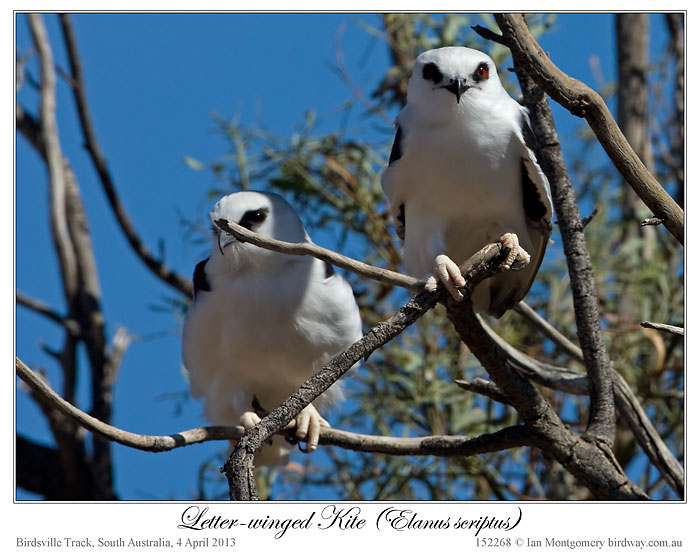
Letter-winged Kite (Elanus scriptus) by Ian 1
Ian’s Bird of the Week – Letter-winged Kite ~ by Ian Montgomery
Newsletter ~ 4/18/13
For all you patient bird of the week recipients, here is I hope a bird worth waiting for, the Letter-winged Kite, star attraction on the recent trip along the Birdsville Track in Northwestern South Australia.
The Letter-winged Kite saga that had its resolution here started in the 1970s when I was living in Surry Hills in inner city Sydney. One evening, I was walking around to the local pub, the Cricketers Arms, on Fitzroy Street a block away from busy South Dowling Street when I found a pair of Letter-winged Kites, unfazed by the traffic, landing in a small tree on the pavement. The L-shaped markings under the wing were clearly visible, so there was no doubt about the identification – I was going to the pub, not tottering home afterwards – no matter how unlikely the location for this species, usually more at home in the semi-desert of Central Australia.
I supposed at the time that they were escaped birds. I found out only later that not only are these Kites nocturnal, but that they spread far and wide in search of food from their usual, arid, home following the population crash that follows plagues of their main prey, the Long-haired Rat. Come to think of it, the rather arid open spaces of Moore Park lie on the other side of South Dowling Street, and I’m sure there are plenty of ordinary rats in Surry Hills.

Letter-winged Kite (Elanus scriptus) by Ian 2
Ordinary people drive the 500km of dirt road that constitutes the legendary Birdsville Track from Birdsville in Southwestern Queensland to Marree in Northeastern South Australia (and the parallel Strzelecki Track) for the experience. Birders do it to search for elusive dry country birds, particularly the Letter-winged Kite and the Grey Falcon and both of these were top of my wanted list on this trip. Letter-winged Kites roost in trees by day, so I searched the few trees – nearly all in creek beds – along the Birdsville Track until, 252km south of Birdsville I spotted a couple of suspects, screeched to a halt in a cloud of dusk and approached them in the car. Birders have 4WD vehicles, such as my modest Suzuki SZ4, mainly so that they can use them as mobile bird hides as most birds are more tolerant of vehicles than pedestrians.
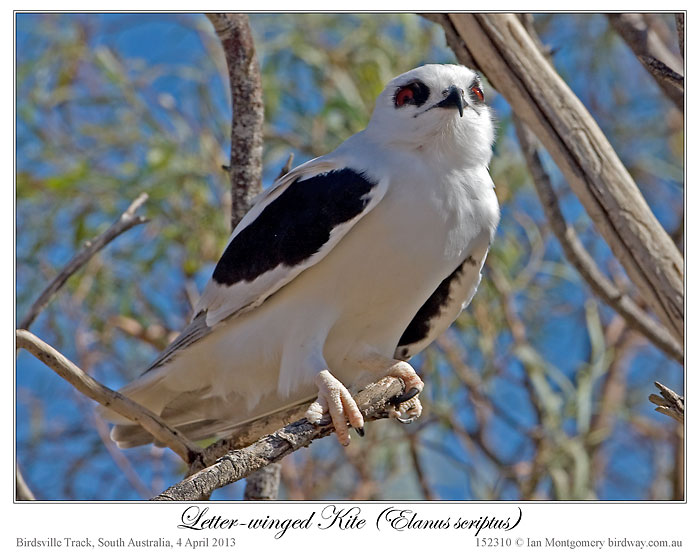
Letter-winged Kite (Elanus scriptus) by Ian 3
Letter-winged Kites indeed they were, but the tree was a tangle of branches and the sun was shining from behind the tree. The birds, however, seemed as unfazed by the traffic (relatively speaking) as the ones in Fitzroy Street, and let me approach to take the first photo (good lighting angle, bad branches), second photo (bad angle, good branches). Then they waited while I changed the lens from the 100-400mm to the 500mm and, eventually, looked on tolerantly while I got out of the car and did a relative close-up (third photo) and a portrait (fourth photo).
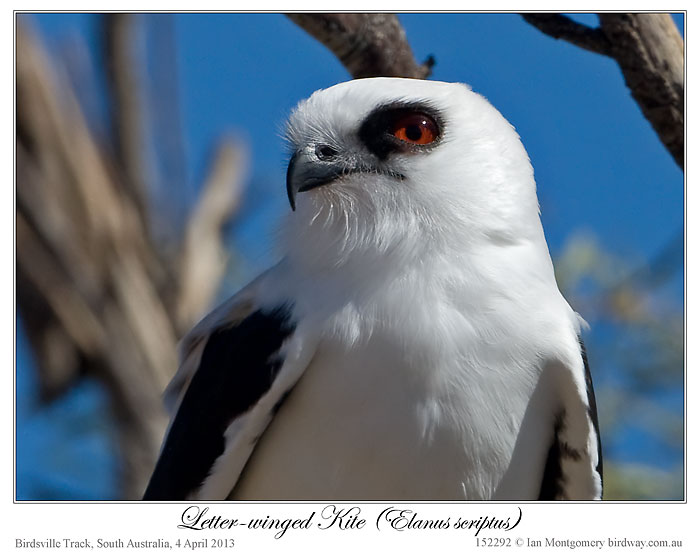
Letter-winged Kite (Elanus scriptus) by Ian 4
I then walked away to take a photo of the tree, the birds and a nest (I don’t know whether it was theirs) and turned around to find that they had silently vanished. If it hadn’t been for the photos definitely still on the SD card, the event might have all have been a fantasy. So I made do with a photo of the tree, the nest and the mobile bird hide, below.
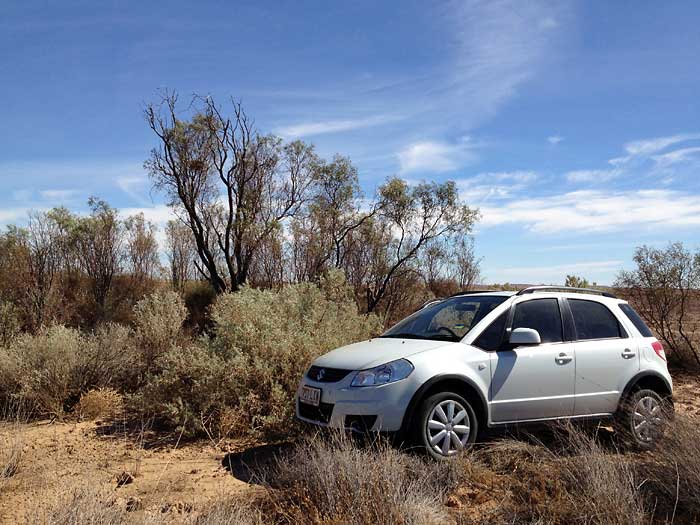
Letter-winged Kite (Elanus scriptus) by Ian 5
The Strzelecki Track is actually supposed to be better for Letter-winged Kites than the Birdsville, but, having found these birds, we decided to change our return travel plans from Plan B1 to Plan B2, skip the Strzelecki (similar landscape, worse road), spend a few days in the Flinders Ranges and drive home via Broken Hill, Bourke and Bowra (B2), instead of Birdsville, Bedourie and Boulia (B1).
Best wishes
Ian
**************************************************
Ian Montgomery, Birdway Pty Ltd,
454 Forestry Road, Bluewater, Qld 4818
Tel 0411 602 737 ian@birdway.com.au
Check the latest website updates:
http://www.birdway.com.au/#updates
Lee’s Addition:
And the glede, and the kite, and the vulture after his kind, (Deuteronomy 14:13 KJV)
What an awesome bird. They are beautiful. Thanks, Ian, for sharing another of your birdwatching adventures with us. His photography is fabulous also. I love that close-up in #4. Wow!
The Letter-winged Kite (Elanus scriptus) is a small, rare and irruptive Australian raptor with a core range in central Australia. The adult is a small and graceful, predominantly pale grey and white, raptor with black shoulders and red eyes. It is similar in appearance to the Black-shouldered Kite except for a very distinctive black underwing pattern of a shallow ‘M’ shape, seen when in flight. Roosting during the day in well-foliaged trees and hunting at night, it is the world’s only fully nocturnal raptor. Like all the elanid kites, it is a specialist predator of rodents, which it hunts by hovering in mid-air above grasslands and fields. (Wikipedia)
They belong to the Accipitridae Family . Check out all Ian’s Family Photos and then see the complete Accipitridae – Kites, Hawks and Eagles family list here.
See Also:
White-tailed Kite ~ 1-7-11
Whistling Kite ~ 5-31-10
Birds of the Bible – Glede and Kites
*

Sunset Lorikeet (Trichoglossus forsteni) ©WikiC
Now Israel loved Joseph more than all his children, because he was the son of his old age: and he made him a coat of many colours. (Genesis 37:3 KJV)
After I finished the Birds of the World – Kingfishers, Australasian Warblers, White-Eyes and Doves article last week, I decided to finish up the Psittacidae – Parrots Family. I still needed 150 photos or drawings to complete the 363 species needed. Well, last night, it was finished and at 100% for images.
Looking at all those Parrots and others in the family, they definitely have “Coats of Many Colors” also. Just wanted to share their beautifully created plumage also. Most of us are familiar with parrots and parakeets. Many have them as pets or have seen them in the wild. So you are sort of familiar with them, but I am sure as you view the slideshow, you will see many that you haven’t seen before.
I also want to share the only birds I had personally. My preference is that the birds roam free, or are being kept from extinction in zoos or other similar situation. There is nothing wrong with having a pet, but I am just stating my preference. We ended up with two Monk Parakeets when we lived in south Florida. They are wild down there (up here also), but one day the neighbor boys came to my door and told me about an injured Monk Parakeet. A teenager had shot it out of a tree and the smaller boys found it. They said, “You love birds and you will know what to do.” That began the adventure with my bird. I had never kept a bird in my life, but knew that my veterinarian was also a bird vet. Long story short, I ended up with a one-winged bird that could never go back to the wild. My “free bird” ended up costing over $200 for vet bills. (This was over 20 years ago). Dan wanted to call it “One-armed Bandit” because it cost me so much, but I took the “t” off of “Bandit” and it became “Bandi.” I think it was a “she” because she was so sweet.
Well a year later, my friend bought two Monks and told me there was one more, but it had a deformed leg. Another long story short, I bought “Hoppy” for $25 and ended up spending another $200 getting a broken leg repaired. It was an amazing surgery the vet performed. “Hoppy” had to be a male, because he could be mischievous at times, but he learned to talk and was quite enjoyable (most of the time). The picture shows “Hoppy” with the bandage in front and “Bandi” in the background.
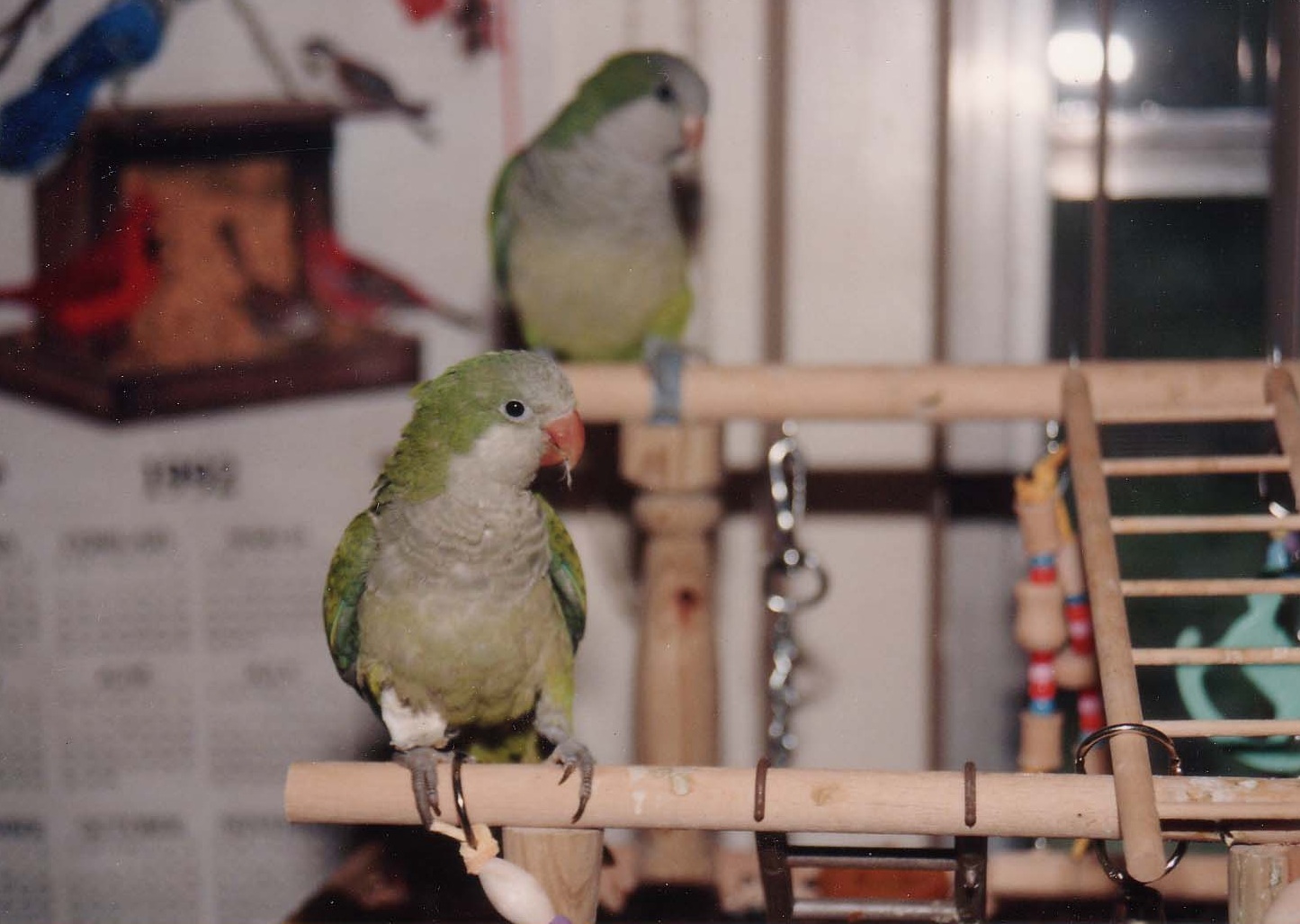
Hoppy in front, Bandi in back – Monk Parakeet (Myiopsitta monachus)
The only two verses in Scripture, that I know of, that would apply to this would be:
For every kind of beasts, and of birds, and of serpents, and of things in the sea, is tamed, and hath been tamed of mankind: (James 3:7 KJV)
As a cage is full of birds, so are their houses full of deceit: therefore they are become great, and waxen rich. (Jeremiah 5:27 KJV)
Back to the Coats of Many Colors, below is a slideshow showing some of our beautiful and personable members of the Psittacidae – Parrots Family.
*
See Also:
Psittacidae – Parrots Family
Birds of the Bible – Coat of Many Colors I
*
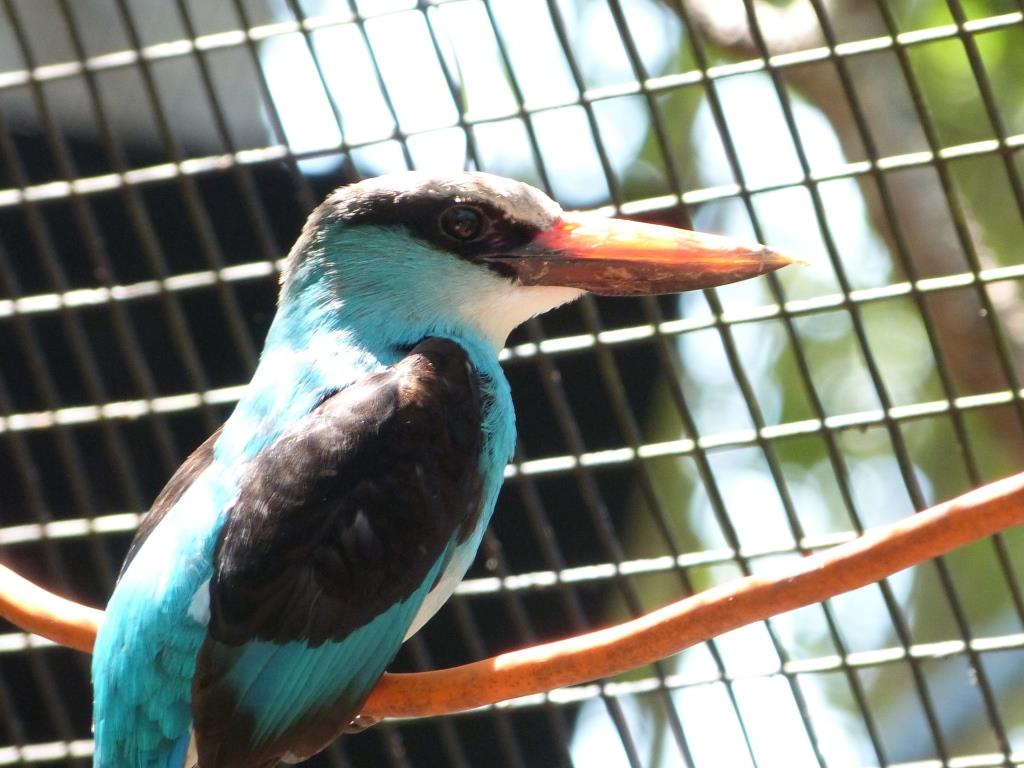
Blue-breasted Kingfisher (Halcyon malimbica) at LPZ by Lee – taken last week
Many, O LORD my God, are thy wonderful works which thou hast done, and thy thoughts which are to us-ward: they cannot be reckoned up in order unto thee: if I would declare and speak of them, they are more than can be numbered. (Psalms 40:5 KJV)
I have been working away on the different families of the Birds of the World. In the last few days, I was able to complete three more families at 100% and have one that needs five more images. Three of them have at least a photo or drawing of each of them. 100% done. That is a nice feeling. What beautiful birds are in those families. When the Lord created the birds, He used much variety in sizes, behaviors and colors. Even though it takes lots of time, it is enjoyable to be able to view so many of them. I am keeping an Excel spreadsheet of the families that shows each family, the number of species, how many are needed, and number seen so far. There are “10,476 extant species and 149 extinct species classified in 40 Orders, 231 Families (plus 6 Incertae Sedis) and 2268 Genera.” (IOC 3.3 Version) according to the IOC statement. Yet, when you add up the number of species of each family, they add up to 10,615. (10476+149=10,625) Somewhere there are 10 miscounted birds. Either way (10615 or 10,625), thats a lot of birds that are flying around the world for all of us to enjoy watching.

Alcedinidae – Kingfishers – 95 Species
Acanthizidae – Australasian Warblers – 65 Species
Zosteropidae – White-eyes – 128 Species
The Pigeon and Doves have five photos that need to be found. After extensive search, they are still avoiding all the great photographers and artists out there. If any know of a source for these evaders, please leave a comment as to where to find a link to them. At least looking through these inspired the Birds of the Bible – Coat of Many Colors article.
Columbidae – Pigeons, Doves – 335 Species
** Need Photo **
Below are a few of the birds from each family.
*
Click on any of the Families to see the complete list of the species.
Acanthizidae – Australasian Warblers
*
*

Many-colored Fruit Dove (Ptilinopus perousii) ©WikiC
While working on the Columbidae – Pigeons, Doves Family, I was enjoying the Fruit Doves and their beautiful colors. Of course the verse about Joseph’s Coat of Many Colors kept crossing my mind. Then I actually found the Many-colored Fruit Dove.
Now Israel loved Joseph more than all his children, because he was the son of his old age: and he made him a coat of many colours. (Genesis 37:3 KJV)
The Fruit Doves belong to the Ptilinopus genus. There are 53 Fruit Doves at present (I.O.C. 3.3) They eat fruit mostly and they may help enhance their colours, at least that is one opinion. “These small- to medium-sized doves generally have short, fan-shaped tails, and are remarkable for their colorful and often glossy plumage, as evidenced in the aptly named Orange Fruit Dove, Flame-breasted Fruit Dove, and Pink-headed Fruit Dove. Males and females of many fruit dove species look very different. For example, the female Many-coloured Fruit Dove shares the male’s crimson crown and deep pink undertail feathers, but is otherwise green, whereas the male has a crimson on the upper back and has areas of yellow, olive, cinnamon, and grey.
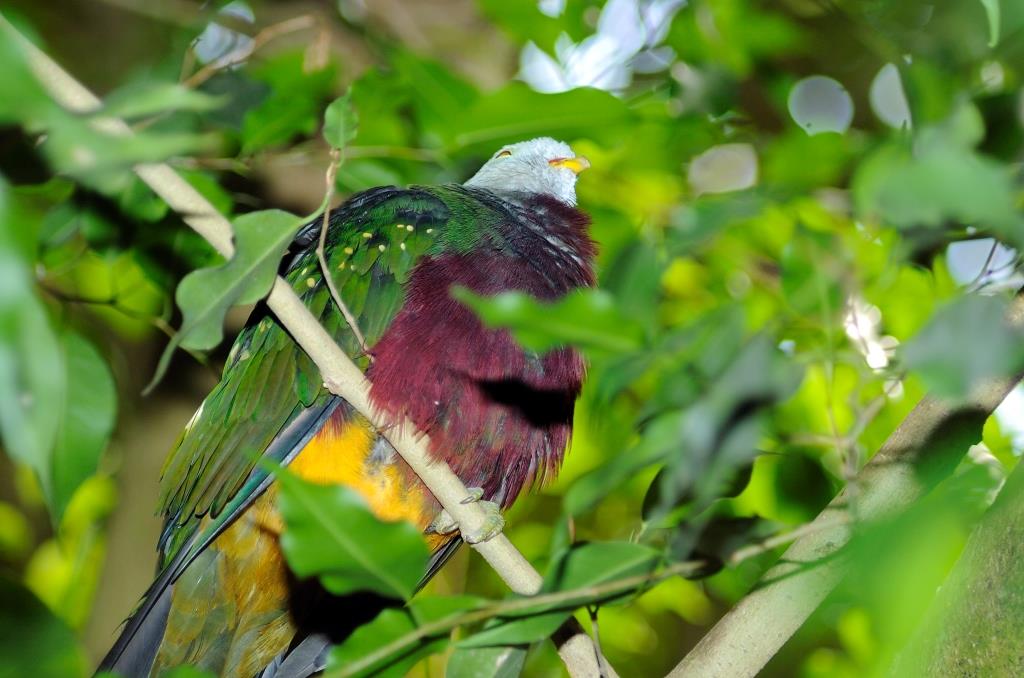
Wompoo Fruit Dove (Ptilinopus magnificus) by Dan at National Aviary
This is a large genus, most diverse in and around the island of New Guinea, in the Philippines, and in the biogeographical region of Wallacea. Some species have ranges as far west as the Sunda Islands, others north to Taiwan, south to Australia, and east into Polynesia.
Fruit doves, as their name implies, eat fruit — ficus is especially important — and live in various kinds of forest or woodland. Some species are restricted to primary forest, such as lowland rainforest, montane forest, or monsoon forest, while others prefer secondary forest or disturbed areas. Some species specialize in particular habitats, from lowland coastal forest to the cloud forest or moss forest of high altitudes. Some species of fruit doves are only found in habitats dominated by particular plants, such as mangrove, eucalyptus, or pandanus. Only a few species can commonly be seen around human habitation, these include the Knob-billed Fruit Dove, Makatea Fruit Dove, and Black-naped Fruit Dove, which are known to visit gardens and such.
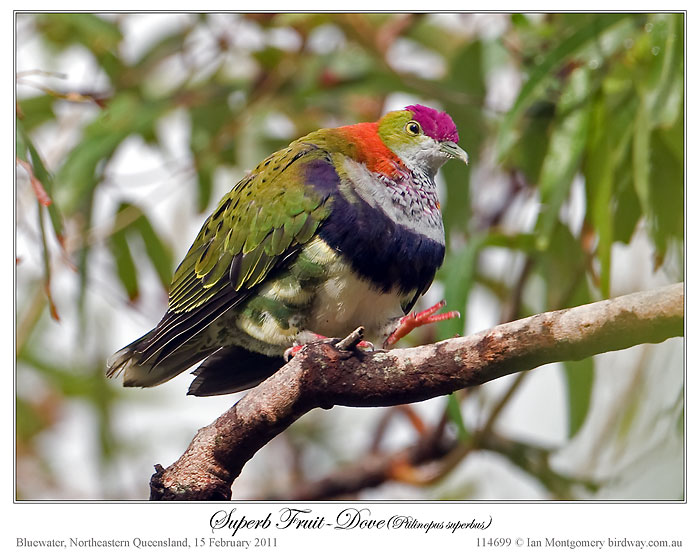
Superb Fruit Dove (Ptilinopus superbus) by Ian
Much is still to be learned about fruit doves. Many species are shy and difficult to observe in their natural habitat. For example, there are several species in the Philippines, and for most of them, little or nothing is known of their breeding or nesting behavior.” (Wikipedia with editing)
We have had the privilege of seeing several of the Fruit Doves at the Zoos we have visited. They are so beautiful and colorful. Isn’t the Lord great in His providing them the ability to show off all their “coats of many colors?” I trust you will enjoy looking at the slideshow below and seeing them. These are the ones that I have permission to show. I am putting the whole list of them from the Family pages so that you can view the others.
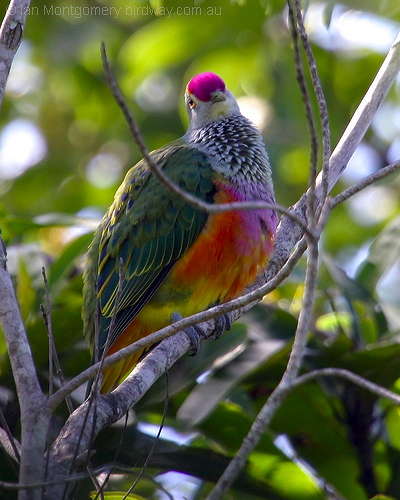
Rose-crowned Fruit Dove (Ptilinopus regina) by Ian
Divers colours is only associated with one bird in Scripture and that is with an eagle:
And say, Thus saith the Lord GOD; A great eagle with great wings, longwinged, full of feathers, which had divers colours, came unto Lebanon, and took the highest branch of the cedar: (Ezekiel 17:3 KJV)
“Divers colours” is used 6 times in the King James Version, others translate that phrase as; various colors, beautiful feathers, long, colorful feathers , full of varicolored feathers, of variety, feathers covered with spots, rich in plumage of many colors, full of plumage of embroidery, having different colors to him, multi-colored plumage, or in full plumage and bright colors.
I think those descriptions can well describe our feather colors the Creator placed on these Fruit Doves. Doves are mentioned many times in the Bible. See the Birds of the Bible – Dove and Pigeon page.
****
Columbidae – Pigeons, Doves Family
Birds of the Bible – Dove and Pigeon
*
P.S. I’ll be adding more of our as I find them.
*
Because the slideshow won’t allow larger photos, here are the photos for the Seeing Pink at Circle B Bar Reserve article in the Gallery format. Clicking any photo will begin an Image Gallery Carousel.
*





































 Lee's Birdwatching Adventures Plus