Ian’s Bird of the Week – Lesser Sooty Owl

Ian’s Bird of the Week – Lesser Sooty Owl ~ by Ian Montgomery

Newsletter – 9/7/15

You may remember that in March of this year Greater Sooty Owl featured as Bird of the Week when I visited East Gippsland east of Melbourne with my Victorian birding pals Barb, Jen and Joy. Last Thursday I met up with the trio again, this time at Kingfisher Park west of Cairns, Far North Queensland. The main target was, naturally, Lesser Sooty Owl , another member of the Barn Owl family and a species as elusive as its larger cousin. I’d seen one at Kingfisher Park in 2002 but hadn’t photographed it and none of the trio had seen it before.

Lesser Sooty Owl (Tyto multipunctata) by Ian

It’s a Wet Tropics endemic ranging from Paluma – and perhaps Bluewater Forest near me – in the south to Cedar Bay in the north, with an estimated population of 2000 pairs. I’ve searched for it many time since without success so I’d agree with the field guides that say: “seldom seen” (Morcombe) and “until field studies in recent decades … among our least-known birds” (Pizzey and Knight). On Wednesday night I’d searched for it along some dreadful tracks in Tumoulin Forest Reserve near Ravenshoe and on Thursday night we spotlighted the 10km length of the Mount Lewis road near Kingfisher Park with the usual result.

Lesser Sooty Owl (Tyto multipunctata) by Ian

It does occur at Kingfisher Park and Andrew Isles told us to listen for it in the evening “after the barn owls” which live in adjacent Geraghty Park. Barn and Sooty Owls make chirruping calls and both species of Sooty Owl have a characteristic descending whistle like a falling bomb. Sure enough at 6:55pm an owl chirruped maybe 50 metres from the trio’s apartment and we raced around the corner to find this bird had come to visit us and was perched in full view in a tree at a photography-friendly height. Later, I agreed with Joy that it was an OMG moment on a par with encountering the Kagu family on a forest track in New Caledonia.

Lesser Sooty Owl (Tyto multipunctata) by Ian

In the past, the Greater and Lesser have been treated as a single species, but the species split is now generally accepted. They are genetically close, but there is a big difference in sizes – Lesser 31-38cm/12-15in , Greater 37-51cm/14.5-20 (females of both are larger than the males) – and differences in appearance, call and behaviour. Their ranges are disjoint with the Greater found from near Melbourne (Strzelecki and Dandenong Ranges) along the east coast to Eungella National Park near Mackay in Central Queensland. There is also a Sooty Owl in New Guinea. It’s still lumped with the Greater, which is biogeographically unlikely, but has been placed with the Lesser and may even be a different species.
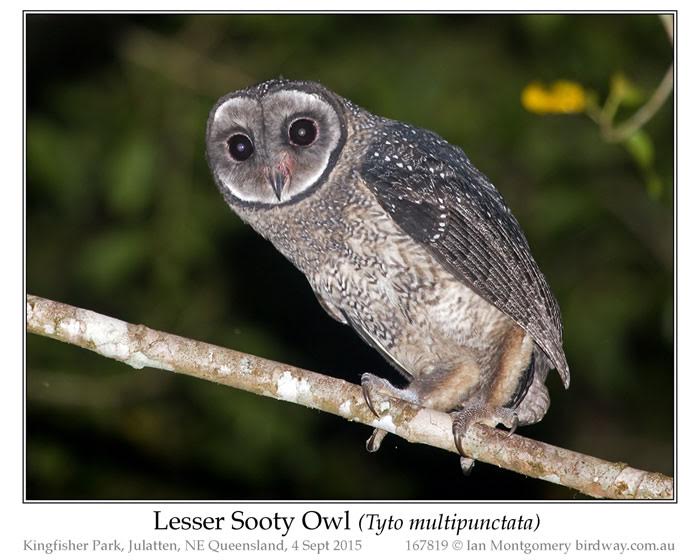
Lesser Sooty Owl (Tyto multipunctata) by Ian

The behaviour of the Lesser differs in that it uses lower perches for hunting, good for photographers, and is known to cling to the side of tree trunks like the Eastern Yellow and Pale-yellow Robins. The last photo shows its impressive talons: these would be able to cling on to anything.
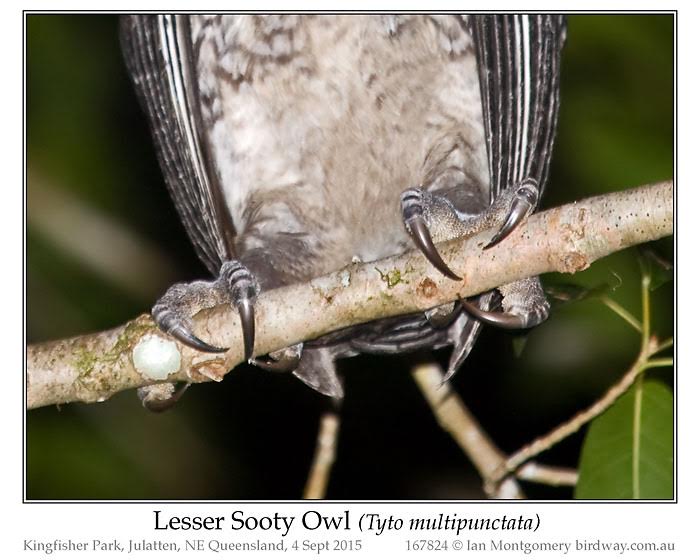
Lesser Sooty Owl (Tyto multipunctata) by Ian

If you’re into benchmarks, last week’s bird, the Ouvea Parakeet, was the 1500th global species on the Birday website (15% of all bird species) but the Australian total was stuck at 699 waiting for something special of course. The Lesser Sooty Owl will be a fitting 700th – I haven’t put it up yet, you get to see if first – that’s 700 out of the 898 ever recorded or 78%.

I’m back home now planning my next project now that the Diary of a Bird Photographer Volume 1 has been published. So far, 27 copies have been purchased and favourable comments are coming in from all over the place including California, UK, Italy and Dubai. The Fat Birder has published a review in which he said:

“I hope anyone who enjoys fine photography and fantastic birds will go to iTunes and download the book… I for one can’t wait for volume 2”

Happily, the remaining 940 members of the bird of the week list don’t have to wait that long for Volume 1!

Greetings
Ian

**************************************************
Ian Montgomery, Birdway Pty Ltd,
454 Forestry Road, Bluewater, Qld 4818
Tel 0411 602 737 ian@birdway.com.au
Check the latest website updates:
http://www.birdway.com.au/#updates


Lee’s Addition:

The beast of the field shall honour me, the dragons and the owls: because I give waters in the wilderness, and rivers in the desert, to give drink to my people, my chosen. (Isaiah 43:20 KJV)

I am impressed with this neat Lesser Sooty Owl from our Creator and also with Ian’s number of Global and Australian birds he has on his birding list.

Now that he is producing these books, I hope he will continue to give permission to reproduce his Bird of the Week Newsletters.

*

Ian’s Bird of the Week 

Ian’s Birdway

Barn Owls – Tytonidae

Wordless Birds

*

Birdwatching on Danish Zealand: Remembering a Sandwich Tern, at Hamlet’s Castle

Birdwatching on Danish Zealand:

Remembering a Sandwich Tern, at Hamlet’s Castle

 ~By James J. S. Johnson

Photo taken from http://mw2.google.com/mw-panoramio/photos/medium/14567172.jpg
(Photo taken from http://mw2.google.com/mw-panoramio/photos/medium/14567172.jpg )

This will be written for the generation to come, that a people yet to be created may praise the LORD. (Psalm 102:18)

Sandwich Tern

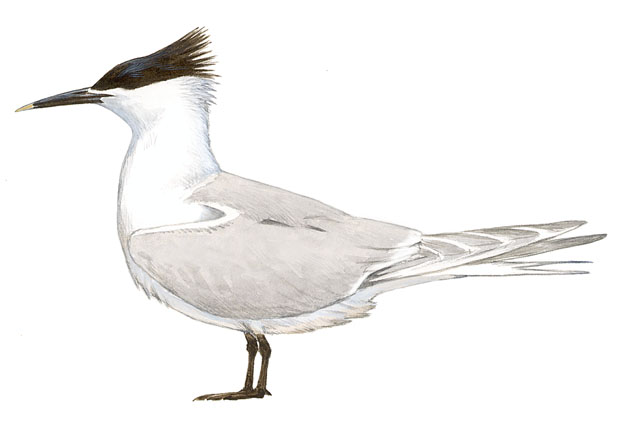
(picture taken from http://blog.fuertecharter.com/wp-content/uploads/2015/04/F295_Dibujo_01.jpg)

The SANDWICH TERN (Thalasseus sanvicensis) is, as its name suggests, a member of the “tern” [Sternidae] family of seagulls.  (The term “Sandwich” refers to Sandwich, in Kent, western England, where this tern was formally identified in AD1787 by ornithologist-physician John Latham, MD.)

The Sandwich Tern is medium-to-large in size (for a tern), with a fairly large head (for a tern), a long thin bill, and a relatively short tail.   It may grow to 16 inches in length and 36 inches in wingspan (!), so it is obviously designed for aerodynamic flight – well-fitted for flying above its oceanic and coastland habitats.  Its thin bill is black, with a “butter-yellow” tip.  The Sandwich Tern is mostly white, appearing whiter (especially from a distance) than the Common Tern and Arctic Tern; it has greyish-white wings and (top) tail feathers.  The newer feathers, produced according to the tern’s molting cycle, are more greyish in color. The top and back of its flat-crowned head is black.  It has short black legs.

Sandwich Tern (Thalasseus sandvicensis) ©Rafy Rodriguez

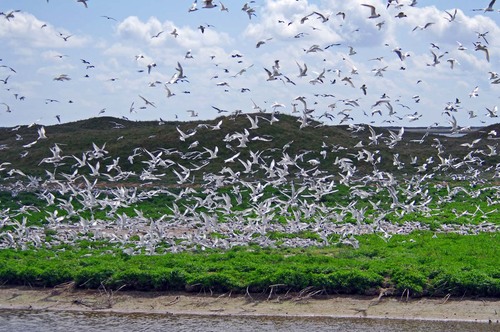
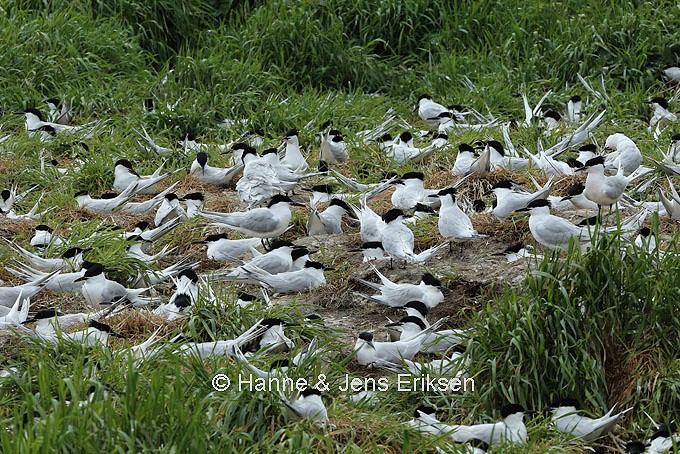
Sandwich Terns are sociable, nesting in densely packed colonies, sometimes mixed with other terns and small seagulls. [See Chris Kightley, Steve Madge, & Dave Nurney, POCKET GUIDE TO THE BIRDS OF BRITAIN AND NORTH-WEST EUROPE (New Haven: Yale University Press, 1998), page 150.]

Some consider the Cabot’s Tern of North America, which winters in and near the Caribbean (including Florida), as a close cousin of the Sandwich Tern.

SandwichTerns

Photo taken from http://www.birdsoman.com/Birds/061-Gulls/SandwichTern/SandwichTern-19098.jpg

The Sandwich Tern’s summer range is predominantly coastal – not surprising for a tern, with its most populous summer range includes various coastal shores of the British Isles (England, Scotland, Orkney, Hebrides, Ireland — but not Wales), Holland (where it is called Grote stern), and Denmark (where it is called Splitterne), especially from late March through early October.  (Sandwich Terns are known to winter in various coastal areas of North Africa.)

Besides those coastlands, the Sandwich Tern is also known as a summer visitor in parts of France (where it is called Sterne caugek), Estonia, Belgium, and Germany (where it is called Brandseeschwalbe).  Its migratory travels allow it to be observed in other countries as well, such as Poland (breeding), Sweden (where it is called Kentsk tärna – often seen where Sweden almost touches Denmark), Norway (as a “vagrant”), Spain’s Mediterranean coast, and even northeastern Italy.  [See Roger Tory Peterson, Guy Mountfort, & P. A. D. Hollom, A FIELD GUIDE TO BIRDS OF BRITAIN AND EUROPE, 5th edition (Boston: Houghton Mifflin, 1993), page 134 & Range Map 174.]

SandwichTern - Cemlyn Lagoon Anglesy

SandwichTern – Cemlyn Lagoon Anglesy

[ photo taken from https://ateambirding.files.wordpress.com/2013/07/0611-sandwich-tern-cemlyn-lagoon-anglesy-29th-june-2013-img_6143.jpg ]

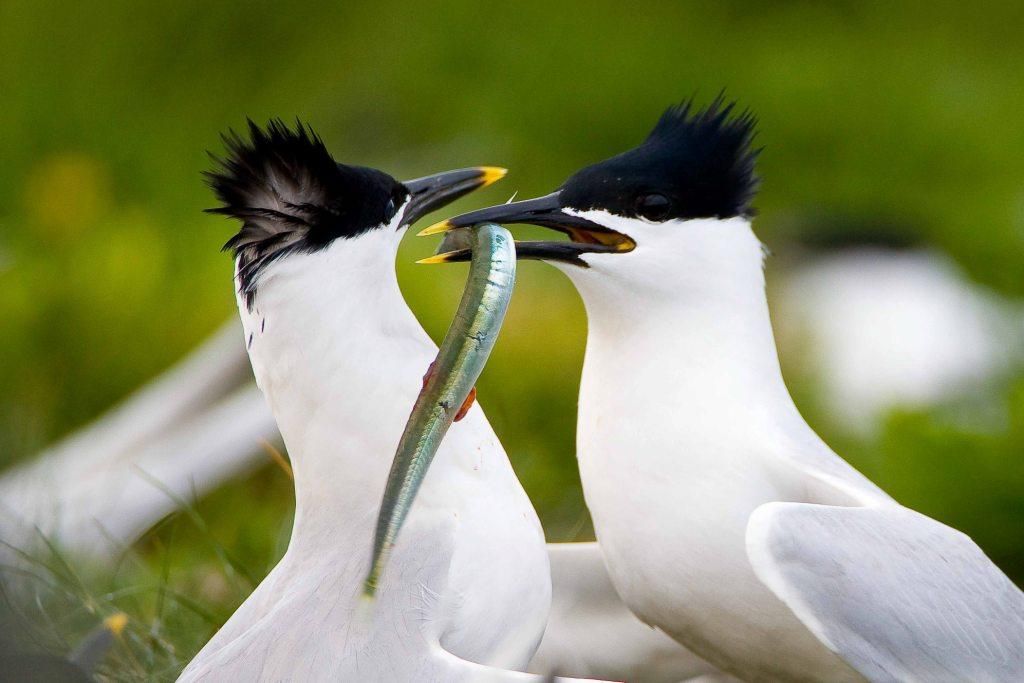
Like other terns (and gulls and fulmars, etc.), Sandwich Terns enjoy eating fish! Sandwich Terns catch their piscatorial repast by plunge-diving into the ocean.  (Occasionally they frequent lakes and ponds near coastlines, so lacustrine fish are also vulnerable to terns who elect to “go fishing” there.)

Sandwich Tern ©Jürgen Reich

Sandwich Tern ©Jürgen Reich

[Photo taken from http://www.helcom.fi/PublishingImages/baltic-sea-trends/environment-fact-sheets/latest-fact-sheets/population-development-of-sandwich-tern/Brandseeschwalben%20J%C3%BCrgen%20Reich_1.jpg ]

In addition to the shorelands of the British Isles, some parts of the Baltic Sea’s western coastline also host Sandwich Terns in the summer – including the shores at and near “Hamlet’s Castle” in Helsingør, in eastern Denmark.  In fact, it was at “Hamlet’s Castle” where I saw a Sandwich Tern on the 4th of July in AD2006.

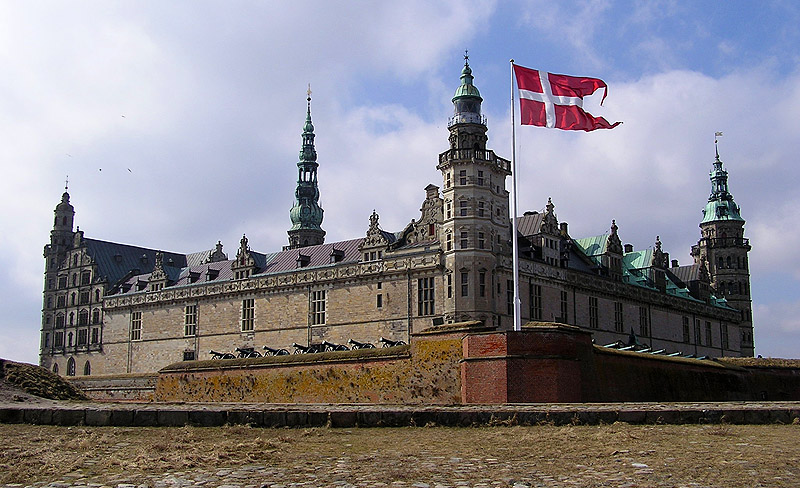
Medieval castle at Helsingør (on the island of Zealand)

Medieval castle at Helsingør (on the island of Zealand)

Photo from  https://en.wikipedia.org/wiki/Kronborg#/media/File:Helsingoer_Kronborg_Castle.jpg

Why is the medieval castle at Helsingør (on the island of Zealand, at the narrowest part of the strait of Øresund, which strait separated Denmark and Sweden), built back in the AD1420s (by the Kalmar Union triple-crown king, Eirik, “king of Denmark, Sweden, and Norway, king of the Wends and the Goths, and Duke of Pomerania”), called “Hamlet’s Castle”?

“Shakespeare brought Kronborg Slot [i.e., Kronborg Castle] world renown as the [fictional] backdrop of his ‘HAMLET’.  Most of the magnificent Renaissance castle, which has had its present appearance since 1585, is accessible to the public.”  [Quoting Reinhard Ilg, JOURNEY THROUGH DENMARK (Stürtz, 2002; translation by Faith Gibson Tegethoff; photos by Tina Herzig & Horst Herzig), page 46.]

Kronborg Castle

Kronborg Castle

[ photo taken from  http://i1.trekearth.com/photos/2765/tdanny_denmark_kronborg_1.jpg ]

In Shakespeare’s famous play, HAMLET, the fundamental question of life is asked, “To be, or not to be?”  This is a fundamental question for every human being, yet it was beforehand a fundamental question that was considered and decided by God Himself, when He chose to give each one of us the lives we call our own.  Why?  While Shakespeare’s character Hamlet considered the grave question of whether to end his earthly existence with the famous words “to be, or not to be”, the choice even more basic than that was God’s sovereign decision to create us “to be” in the first place! [See, regarding this great question of life, considered with Psalm 102:18, http://www.icr.org/article/people-yet-be-created/ .

Just as the Lord chose to imagine and invent the maritime birds that we call Sandwich Terns, of His own beneficent and sovereign volition, He chose to imagine and invent us, as the specific (and unique) humans who each one of us is.  What a choice God made, when He did so!

And, knowing that we needed redemption, as human sinners descended from Adam, God also foresaw the need for the Lord Jesus Christ to be our Redeemer – so He planned for Christ’s Messiahship – long before we ever were created as the individuals we are  (John 17:24;  Ephesians 1:4;  1st Peter 1:20)all wonderful Bible verses, that Bob Webel taught me as a teenager!).

It is God’s providential grace and kindness that He chose to make us.  It is even more grace and kindness that He provided redemption in Christ to save us!   How should we then live, to appreciate Him for Who He isthat is the question, that (by God’s grace) our lives must daily answer!

This will be written for the generation to come, that a people yet to be created may praise the LORD. (Psalm 102:18)

*

Orni-Theology

James J. S. Johnson

People Yet To Be Created

Sandwich Terns – All About Birds

Sandwich Tern – Wikipedia

*

Sunday Inspiration – Little Beauties From The Lord

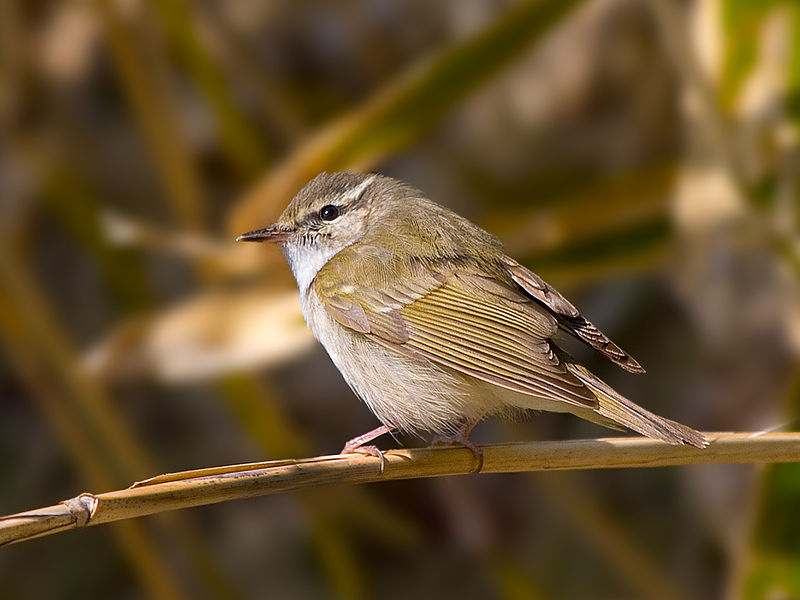
Sakhalin Leaf Warbler (Phylloscopus borealoides) ©WikiC

Sakhalin Leaf Warbler (Phylloscopus borealoides) ©WikiC

And Jesus saith unto him, The foxes have holes, and the birds of the air have nests; but the Son of man hath not where to lay his head. (Matthew 8:20 KJV)

We have another mixture of birds from our Creator found in several families, but most are Leaf Warblers from Phylloscopidae family. There are 77 in that family, but the families before them, taxonomically, have just a few species in them.

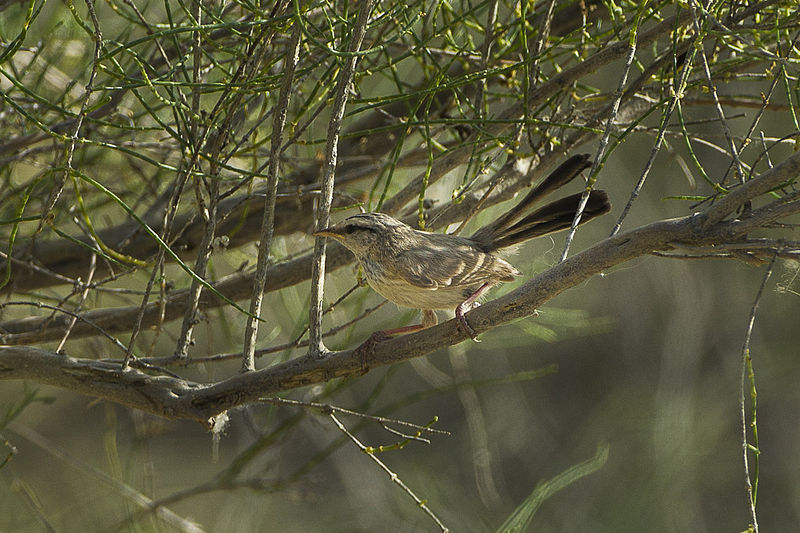
Streaked Scrub Warbler (Scotocerca inquieta) ©WikiC

Streaked Scrub Warbler (Scotocerca inquieta) ©WikiC

Streaked Scrub Warbler – Scotocercidae has only one bird – the Streaked Scrub Warbler (Scotocerca inquieta). It is found in Afghanistan, Algeria, Egypt, India, Iran, Israel, Jordan, Kazakhstan, Lebanon, Libya, Mauritania, Morocco, Oman, Pakistan, Palestine, Russia, Saudi Arabia, Syria, Tajikistan, Tunisia, Turkmenistan, United Arab Emirates, Uzbekistan,and Yemen. (Wikipedia)

Chestnut-capped Flycatcher (Erythrocercus mccallii) ©WikiC

Chestnut-capped Flycatcher (Erythrocercus mccallii) ©WikiC

Yellow Flycatchers – Erythrocercidae has 3 members; Little Yellow Flycatcher (Erythrocercus holochlorus), Chestnut-capped Flycatcher (Erythrocercus mccallii) and the Livingstone’s Flycatcher (Erythrocercus livingstonei). All three of these creations are found in Africa.

Tit Hylia (Pholidornis rushiae ussheri) ©WikiC

Tit Hylia (Pholidornis rushiae ussheri) ©WikiC

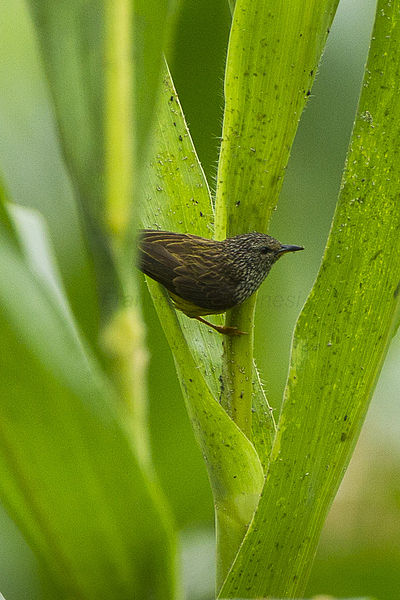
This next group of birds are assigned to an  Incertae Sedis family. That simply means they don’t which family to assign to them. They are the Grauer’s Warbler (Graueria vittata), Green Hylia (Hylia prasina) and Tit Hylia (Pholidornis rushiae). They get moved in and out of families, but the IOC Version 5.3 has them unassigned. They are all in Africa and are “basically” Old World Warblers.

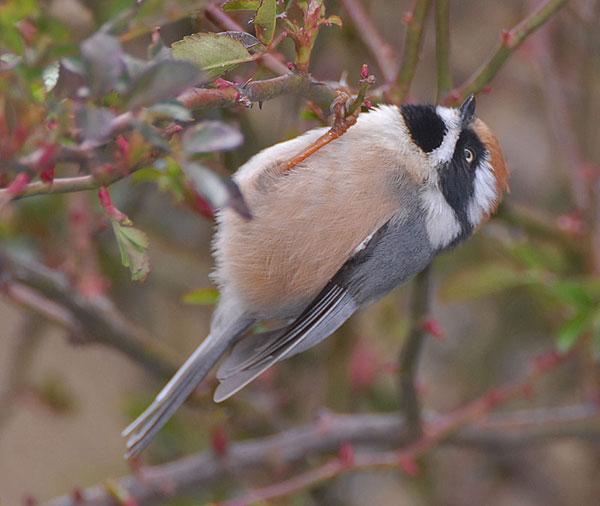
Black-throated Bushtit (Aegithalos concinnus) by Nikhil Devasar

Black-throated Bushtit (Aegithalos concinnus) by Nikhil Devasar

The Aegithalidae – Bushtits family has 13 members and are a family of small, drab passerine birds with moderately long tails. The family contains three genera, all but one of which are found in Eurasia. Bushtits are active birds, moving almost constantly while they forage for insects in shrubs and trees. During non-breeding season, birds live in flocks of up to 50 individuals. Several bushtit species display cooperative breeding behavior, also called helpers at the nest.

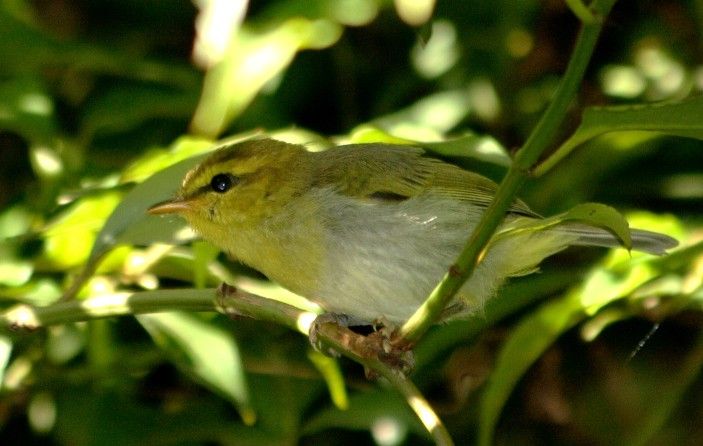
Yellow-throated Woodland Warbler (Phylloscopus ruficapilla) ©WikiC

Yellow-throated Woodland Warbler (Phylloscopus ruficapilla) ©WikiC

And our last family of avian wonders from the Lord is the Phylloscopidae – Leaf warblers and allies Family. This family of 77 species contains various Warblers and Chiffchaff. They were formerly included in the Old World warbler family but are now considered to belong to the Phylloscopidae, a family created in 2006. The genus is closely related to Seicercus and some species have been moved between the two genera in recent classification attempts. Leaf warblers are active, constantly moving, often flicking their wings as they glean the foliage for insects along the branches of trees and bushes. They forage at various levels within forests, from the top canopy to the understorey. Most of the species are markedly territorial both in their summer and winter quarters.

Most are greenish or brownish above and off-white or yellowish below. Compared to some other “warblers”, their songs are very simple.

Well, that’s our group of birds for this week. Trust you will enjoy seeing them as you listen to the music below. You have two options this week. You can listen or you can watch the Kid’s Choir as they sing. Figured little warblers needed young people singing as you view them.

But Jesus said, Suffer little children, and forbid them not, to come unto me: for of such is the kingdom of heaven. (Matthew 19:14 KJV)

*

This slideshow requires JavaScript.

*

Beautiful Savior (Fairest Lord Jesus) ~  by Kid’s Choir Faith Baptist

*

*

More Sunday Inspirations
Scotocercidae – Streaked Scrub Warbler
Erythrocercidae – Yellow Flycatchers
Incertae-Sedis1 – Family Uncertain-Warbler, Hylia
Aegithalidae – Bushtits
Phylloscopidae – Leaf Warblers and allies
Kids, You Are Special

*

White-faced Owl – Transformer

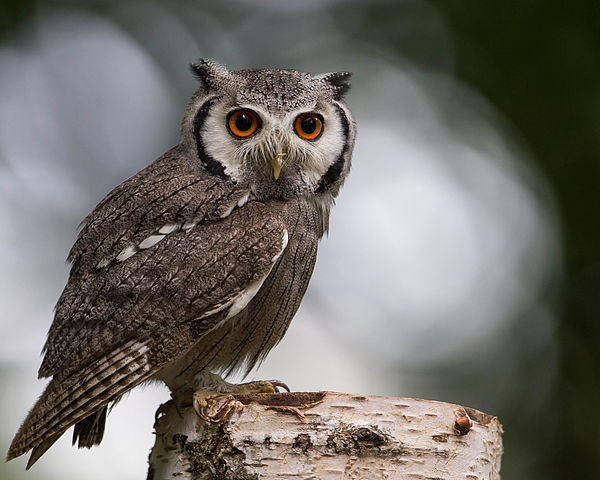
Southern White-faced Owl (Ptilopsis granti) ©PD

Southern White-faced Owl (Ptilopsis granti) ©PD

And be not conformed to this world: but be ye transformed by the renewing of your mind, that ye may prove what is that good, and acceptable, and perfect, will of God. (Romans 12:2 KJV)

Our contributing writer, James J. S. Johnson, sent me a really neat YouTube Video. It is called the Owl Transformer. After you watch this video, I will share the information I found about this cool owl.

There are two White-faced Owls. There is a Southern White-face Owl and a Northern White-faced Owl, but the one in the video is the Northern White-faced Owl. What a fantastic creation from the Creator.

Northern White-faced Owl (Ptilopsis leucotis) ©PD

Northern White-faced Owl (Ptilopsis leucotis) ©PD

These owls, both north and south, are from Africa. This northern one is from a band across Africa between the Sahara and the Equator. The southern owl appears in the southern part of Africa.

It is its “Fight-or-Flight” response that causes this defense mechanism. “When faced with another owl slightly larger than it, the bird flares its wings to appear larger. When faced with something much larger than itself, it pulls its feathers inwards, elongates its body, and narrows its eyes to thin slits. It is thought that it uses this ability to camouflage itself, and it shares the ability with relatives like the African scops owl.

In fact, many different types of owls have some ability to adopt a “concealing posture”, also known by the German word Tarnstellung, in which they squeeze and thin their body to look like a broken tree branch, and some types may also narrow their eyes to slits and fold a wing sideways across their chest in a Dracula-like manner to hide the lighter-colored feathers on their underparts. Such behavior has also been documented in eastern screech owls in a natural setting reacting to threats. (Wikipedia)

The Lord Jesus Christ gives these birds the ability to “transform” for their protection, just as he wants us to “transform” into His Image.

But we all, with open face beholding as in a glass the glory of the Lord, are changed into the same image from glory to glory, even as by the Spirit of the Lord. (2 Corinthians 3:18 KJV)

Here is another video found on YouTube:

*
Northern white-faced owl – Wikipedia

Southern white-faced owl – Wikipedia

Strigidae – Owls

Sharing The Gospel
*

The Newest I.O.C. World Bird List – Ver. 5.3 Finished Finally

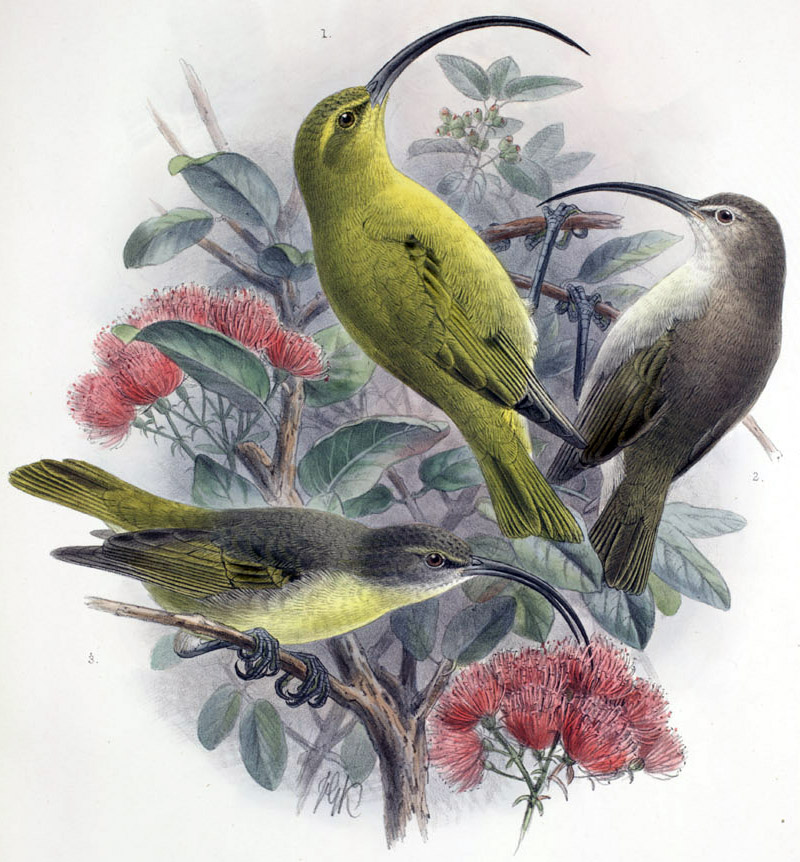
Hawaii Creeper (Loxops mana) ©WikiC

Hawaii Creeper (Loxops mana) ©WikiC – This bird is in the Loxops genus which now has add the Hawaii Akepa, Oahu Akepa and the Maui Akepa.

Be glad in the LORD, and rejoice, ye righteous: and shout for joy, all ye that are upright in heart. (Psalms 32:11 KJV)

I started working on the newest version of the I.O.C. World Bird List in mid August after I realized the 5.3 Version had been released. I was able to get the new Parrot Family updated and put these two blogs up.

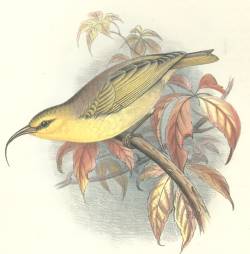
Nukupuu (Hemignathus lucidus) ©Drawing WikiC

Nukupuu (Hemignathus lucidus) ©Drawing WikiC – This is now the Oahu Nukupuu. The genus now has two new species Kauai Nukupuu (Hemignathus hanapepe) and Maui Nukupuu (Hemignathus affinis)

Well, it is now the third of September and I finally have the update finished. Since them I am older (birthday yesterday) and hope I am a little wiser. Between health, rainstorms, internet issues and just plain hard work fixing the update, IT IS FINISHED!

When Jesus therefore had received the vinegar, he said, It is finished: and he bowed his head, and gave up the ghost. (John 19:30 KJV)

The Lord said that when He had paid the debt for our sins on the cross, but this update no way compares to that greatest act of Love and Sacrifice for our salvation.

The “wiser” part came because as I had to update each Bird Family Page (241 pages), I changed the 5.2 Version to “The Latest I.O.C. Version.” Now I will only need to change the Family pages as needed. “Duhh” Why didn’t I think of that sooner. Since the pages were in edit mode, a Slideshow was added to each page. That is where a lot of time was spent.

Oahu Akialoa (Hemignathus procerus) Male Juvenile and Female ©WikiC Drawing

Oahu Akialoa (Hemignathus procerus) Male Juvenile and Female ©WikiC Drawing This was the Akialoa. There is now a Kauai Akialoa and a Maui-nui Akialoa (All are Extinct.)

That accomplished, it was time to get the indexes up to date. As they make changes to the Versions, new birds are added or deleted, name changes or misspellings corrected, and some genus are changed as they do the DNA studies.

That is when my hair started falling out as I pulled on it when The Next Problem showed up. While TRYING to edit the alphabetical pages, you know, A-Z on first names and last names (another 26 pages each), what is usually a “piece of cake” became a real challenge.

When I would select a Bird’s First Name – A, other “A” pages opened. Like Torrey’s Tropical  – “A” page or the Nave’s Topical “A” page or the Bird’s Last Name – “A” page.

So I owe all of you who have clicked around on this blog a BIG APOLOGY!!!!!  You have been going to all kinds of wrong pages. That took hours to find out why and then fix the pages. It appears, for those of us who blog, we should not to have more than one “A” page even if they are in different categories. For now I have pulled the Nave’s and Torrey’s indexes off-line until they can be corrected.

The IOC World Bird List 5.3 contains 10,580 extant species (and 152 extinct species)  classified in 40 Orders,  239 Families (plus 2 Incertae Sedis) and 2281 Genera.  The list also includes 20782 subspecies, their ranges and  authors.

Changes include:

SPECIES ADDED:                 19 (3 extinct)

SPECIES DELETED:               3

ENGLISH NAMES:                  13

TAXONOMY:                           18  including revised classification of world parrots

Now, maybe I can get back to writing some blog and visiting your websites again. Stay Tuned!

He that hath an ear, let him hear what the Spirit saith unto the churches; To him that overcometh will I give to eat of the hidden manna, and will give him a white stone, and in the stone a new name written, which no man knoweth saving he that receiveth it. (Revelation 2:17 KJV)

*

*

Ian’s Bird of the Week – Ouvéa Parakeet

Ian’s Bird of the Week – Ouvéa Parakeet ~ by Ian Montgomery

Newsletter ~ 9/2/15

I was half-way through preparing this bird of the week this afternoon when my 2008 iMac died, or at least got terribly ill, so I’ve delivered it to the Mac Doctors and am now working on my laptop. Thank goodness for automatic backups, as I lost only the email itself and the map below that I was in the middle of preparing. I want to get the email out today so that i can delivery 4 birds of the week this month – my level of enthusiasm for doing the bird of the week has risen considerably since I started preparing the first volume of the Diary of a Bird Photographer.

Anyway, back to the Loyalty Islands off the west coast of the main island of New Caledonia. After spending the morning in Lifou, we flew to the neighbouring island, Ouvéa, home to the endemic Ouvéa Parakeet. Ouvéa is a long thin island, thinnest in the middle in a way that reminded me of both Bribie Island in Tasmania and Lord Howe Island. Like Lord Howe, it has a coral lagoon on one side and an ocean beach on the other but the resemblance largely ends there, as Ouvéa is a coral atoll and very flat, while Lord Howe is volcanic in origin and spectacularly mountainous.

Map of where Ouvéa Parakeet Found, by Ian

Map of where Ouvéa Parakeet Found, by Ian

The parakeet occurs mainly on the northern end of the island so its geographical range is tiny – see the scale on the map above, courtesy of Google Earth. The airport is on the southern end and we decided not to emulate some energetic birders who wrote a trip report and travelled from the airport to the north end of the island by bicycle. Instead, we had booked a rental car at the airport and booked accommodation in a tribal village called Gossanah in parakeet territory near where our bird guide Benoit lived. I’ll say a bit more about both our guide and accommodation later, but first the parakeet.

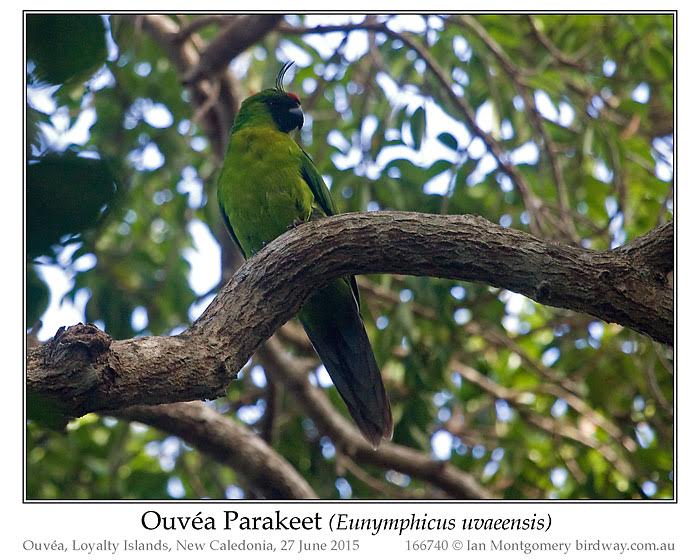
Ouvéa Parakeet (Eunymphicus uvaeensis) by Ian

It was dark by the time we reached Gossanah, so parakeet hunting had to wait until the morning. I was woken up by early-riser Joy with the exciting news that there were parakeets in the grounds of where we were staying. I stumbled out bleary-eyed (remember we had got up at 4:30am the morning before to get our flight to Lihou) camera in hand and sure enough there they were, or there it was, first photo. Later we joined Benoit and he took us around his garden and though an area of adjacent rainforest. There we found some more parakeets, including the one in the second photo.

Ouvéa Parakeet (Eunymphicus uvaeensis) by Ian

They aren’t as brightly coloured as the Horned Parakeet of the main island, Grand Terre, and the crest is different, containing more than two feathers and lacking red tips. The Ouvéa Parakeet used to be treated as a race of the Horned, but has now been given full species status.

Ouvéa Parakeet (Eunymphicus uvaeensis) Nesting Hollow by Ian

Benoit showed us an active nesting hollow, third photo. We saw a parakeet flying into it and waited for it to reappear, but it had either settled down for the morning or had more patience than we had. The parakeets are very partial to the seeds of Papaya. They don’t wait for the fruit to ripen before they chew their way into the centre to get at the seeds.

Papaya

Papaya

The parakeets are protected and the population has increased in recent years. We got the impression that the islanders are rather ambivalent about the birds. They are proud to have such an unusual endemic bird – its iconic status is actively promoted by the authorities – but are concerned about its effect on their largely subsistent way of life.

Ouvéa Parakeet (Eunymphicus uvaeensis) by Ian

Ouvéa Parakeet (Eunymphicus uvaeensis) by Ian

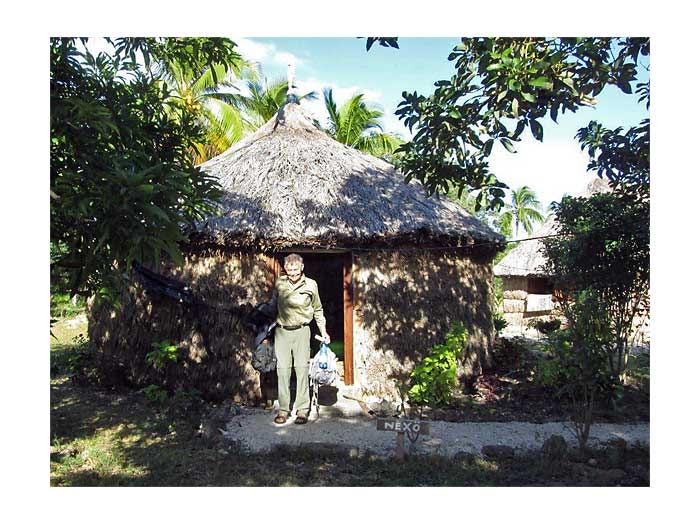
We stayed at a tribal home stay called Beauvoisin – ‘good neighbour’ run by Marc and his wife (see http://www.iles-loyaute.com/en/Prestataire/Fiche/1374/beauvoisin). They provided dinner in the evening, accommodation in a circular hut and breakfast – Joy took the photo above of me emerging from the hut in the morning. We enjoyed it very much and Marc and his family were delightful and looked after us very well. They spoke some English and have a Facebook page. Benoit Tangopi our guide was great too and we saw a variety of other interesting birds on the walk through the rainforest. We contacted him by phone +687 800549, but you might need to brush up your French as he doesn’t speak much English.

Greetings
Ian

**************************************************
Ian Montgomery, Birdway Pty Ltd,
454 Forestry Road, Bluewater, Qld 4818
Tel 0411 602 737 ian@birdway.com.au
Check the latest website updates:
http://www.birdway.com.au/#updates


Lee’s Addition:


If a bird’s nest should chance to be before you in the way, in any tree or on the ground, with young ones or eggs, and the mother bird is sitting on the young or on the eggs, you shall not take the mother bird with the young. You shall surely let the mother bird go, and take only the young, that it may be well with you and that you may prolong your days. (Deuteronomy 22:6-7 AMP)

Thanks, Ian, for taking us along on another birdwatching adventure. I don’t speak French, so we are glad you did the talking and photographing. Another neat creation you have found for us to enjoy.

*
Ian’s Bird of the Week Newsletters

Ian’s Ouvéa Parakeet Photos

Psittaculidae – Old World Parrots

Wordless Birds

*

Logan, Morgan, and Their Historical Nest

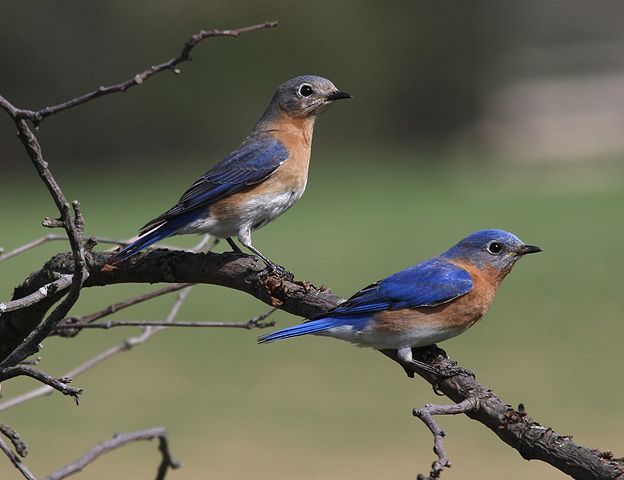
Eastern Bluebird (Sialia sialis) ©WikiC

Logan, Morgan, and Their Historical Nest ~ by Emma Foster

It was 1769 when a distinguished man came to a small plain with a few trees on a mountain and began building a house. In one of the trees, two bluebirds watched as the man oversaw the building of his house. This house was big and built with stone masons who were people who built and cut stone.

The house had white stone pillars and large stone steps in front of a long backyard. Farther down the hill was the plantation where the slaves worked.

The house would not be competed for a long time, and while it was being built, Logan and Morgan decided they would build their nest just like the house was being built.

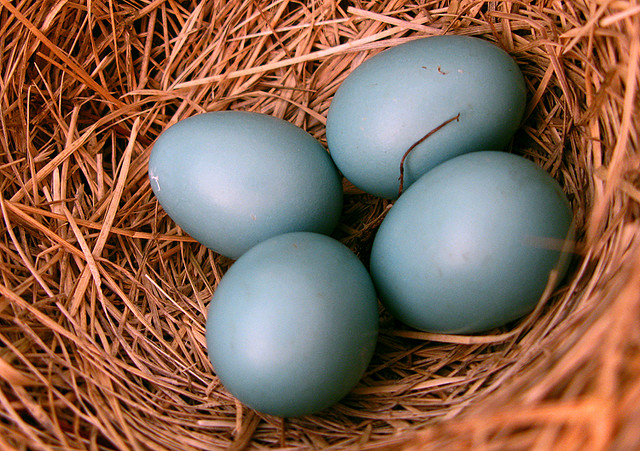
Eastern Bluebird (Sialia sialis) Eggs ©WikiC

Eastern Bluebird (Sialia sialis) Eggs ©WikiC

Logan and Morgan started looking for long, thick sticks to stack together. They started building their nest in one of the trees near the slave’s kitchen. However, this was difficult because of how hard it was to keep the sticks standing straight up in the branches. Logan and Morgan took turns holding the sticks with their beaks while the other looked for more sticks.

Eastern Bluebird (Sialia sialis) by S Slayton

Eastern Bluebird (Sialia sialis) by S Slayton

Eventually, Logan and Morgan finally completed their nest. It wasn’t as grand as the house that was still being built, but the two bluebirds decided that the nest was perfect.

They raised their children in that nest and their children raised their children, until long after the house, called Monticello, was completed.

Montecello. House of Thomas Jefferson

Montecello. House of Thomas Jefferson

Eventually the distinguished man who had built the house died, but Logan and Morgan’s children and grandchildren still lived there. And every year hundreds of people would come to take a tour of that house because it belonged to one of the Presidents of the United States, Thomas Jefferson. Of course, Logan and Morgan never knew that fact.

The End


Lee’s Addition:

Another parable put he forth unto them, saying, The kingdom of heaven is like to a grain of mustard seed, which a man took, and sowed in his field: Which indeed is the least of all seeds: but when it is grown, it is the greatest among herbs, and becometh a tree, so that the birds of the air come and lodge in the branches thereof. (Matthew 13:31-32 KJV)

Emma has now produced her first historical birdwatching tale. Thanks, Emma. Our young writer just turned 16 recently and has grown quite tall (5’11”) like her parents. We used to compare heights when she was shorter than me (4’10”), but now I have to look up at her. Not only has her height increased, but also her writing ability.

As a side note, her family visited Monticello this summer and actually watched some Eastern Bluebirds for some time in the trees there.

*

Other stories by Emma Foster

Eastern Bluebird – Wikipedia

Wordless Birds

*

Helps For Updating Bird List To I.O.C. Version 5.3

Mourning Dove by Reinier Munguia

Mourning Dove by Reinier Munguia

Out of the ground the LORD God formed every beast of the field and every bird of the air, and brought them to Adam to see what he would call them. And whatever Adam called each living creature, that was its name. So Adam gave names to all cattle, to the birds of the air, and to every beast of the field… (Genesis 2:19-20a NKJV)

Today I want to share a little behind the scene helps that really make updating a blog and your files. As you may be aware, we use the I.O.C.’s list of world bird names here. About every quarter, they (IOC) delete, add, and revise the species names and positions in the list of all the birds in the world. If you are nutty enough to have had the bright idea, like I did several years back, to list ALL THE BIRDS, then you have a headache every quarter.

Each update they (IOC) provide files you can download with all the birds listed. Most of these are in the Excel format. Spreadsheets like Excel and others can greatly speed up fixing the list to update my site. I use simple (and I mean simple) formulas to combine the bird’s name and its scientific name together with the parenthesis around it. Then just copy the formula down the 10,000 plus birds and “wa laa” you have a

Black-headed Ibis (Threskiornis melanocephalus) instead of  a

Black-headed Ibis” and aThreskiornis melanocephalus with no parenthesis to be found.

=CONCATENATE(E796,” (“,G796,”)”)

E796 is the cell of the English name and G796 is the cell of the Scientific name. The ,” (, and the ,”)” tells it to add a space and parenthesis, and a parenthesis at the end.

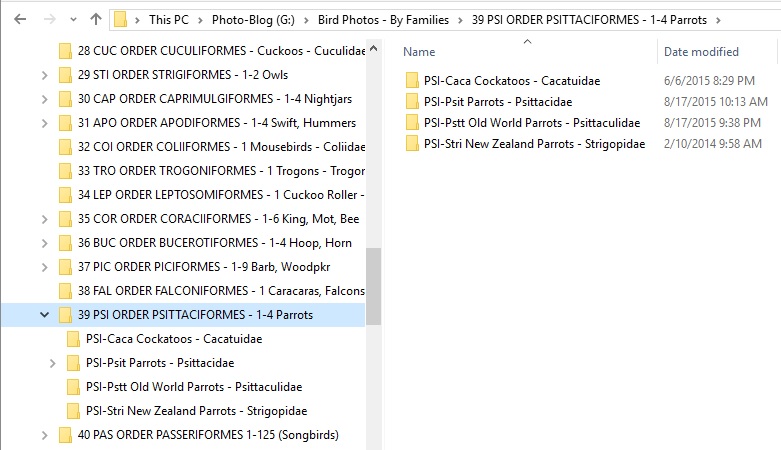
I also came up with a naming system to help find the photos of birds on the hard drives. I use a 3-letter code – All Caps – for the Order of birds, a dash(-), followed by a 4-letter code to represent the Family of the birds. It really helps in aiding to find bird photos or to rename them. (that is next)

Another great program, this one is free, is ReNamer from Den4B.com. I use this a lot. ReNamer lets you change the name of files enmasse. File explorer will let you rename a group of files, but you cannot go in there and just change parts of it like ReNamer can do. As I mentioned in the last post about I.O.C. Version 5.3, the Parrot family was split into two families. Fixing the pages that list all the birds was tedious enough, but having to separate the photos on my hard drive was another situation.

My File Explorer - For Parrots

My File Explorer – For Parrots

My Code for the original Parrot family was PSI-Psit (PSITTACIFORMES order and Psittacidae family) and now with the new Psittaculidae family I came up with PSI-Pstt. So how am I suppose to rename over 200 photos in the new family to the new code? Easy with ReNamer. Drag the files you want to rename into ReNamer, add a new Rule (Replace PSI-Psit with PSI-Pstt), then press the “Rename” button and 200 plus photos are renamed. There are lots of other options. It is a fantastic program in my opinion.

ReNamer from den4b.com

ReNamer from den4b.com

I know for some of you, this was a little more technical than normal, but thought you might find something in it you can use on your projects. The CONCATENATE (combining) feature of Excel and the ReNamer program are both very useful.

Because of health issues and other events going on, the update to I.O.C. Ver. 5.3 has not moved as fast as other versions. I am working on it and here are the families updated so far. I have been making a change to the pages as I work on them. I am adding a slideshow at the bottom of each page. Stay tuned!

‘I have made the earth, the man and the beast that are on the ground, by My great power and by My outstretched arm, and have given it to whom it seemed proper to Me. (Jeremiah 27:5 NKJV)

I.O.C. Version 5.3

Tinamous – Tinamidae
Ostriches – Struthionidae
Rheas – Rheidae
Cassowaries – Casuariidae
Emu – Dromaiidae
Kiwis – Apterygidae
Screamers – Anhimidae
Magpie Goose – Anseranatidae
Ducks, Geese and Swans – Anatidae
Megapodes – Megapodiidae
Chachalacas, Curassows and Guans – Cracidae
Guineafowl – Numididae
New World Quail – Odontophoridae
Pheasants and allies – Phasianidae
Loons – Gaviidae
Penguins – Spheniscidae
Austral Storm Petrels – Oceanitidae
Albatrosses – Diomedeidae
Northern Storm Petrels – Hydrobatidae
Petrels, Shearwaters – Procellariidae
Diving Petrels – Pelecanoididae
Grebes – Podicipedidae
Flamingos – Phoenicopteridae
Tropicbirds – Phaethontidae
Storks – Ciconiidae
Ciconiidae – Storks
* The Parrots
Strigopidae – New Zealand Parrots
Cacatuidae – Cockatoos
Psittacidae – African and New World Parrots
Psittaculidae – Old World Parrots
*

Ian’s Bird of the Week – Goliath Imperial Pigeon

Ian’s Bird of the Week – Goliath Imperial Pigeon ~ by Ian Montgomery

Newsletter – 8/17/15

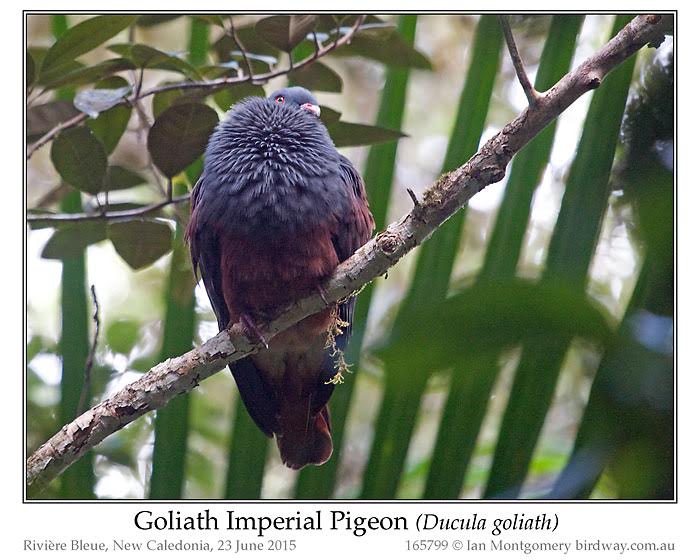
A characteristic sound of montane forests in New Caledonia is the far-carrying call of this splendid pigeon, the Goliath or New Caledonian Imperial Pigeon. The tone is similar to someone blowing in a (large) bottle but the rhythm accelerates like the sound of a table-tennis ball being dropped on a table. Needless to say, we started calling it the ping-pong pigeon. We first heard them in the dense forests of Rivière Bleue, but had trouble actually seeing any apart from one that flew off from feeding on Pandanus fruit. We eventually tracked this one through the forest and found it putting on a display.

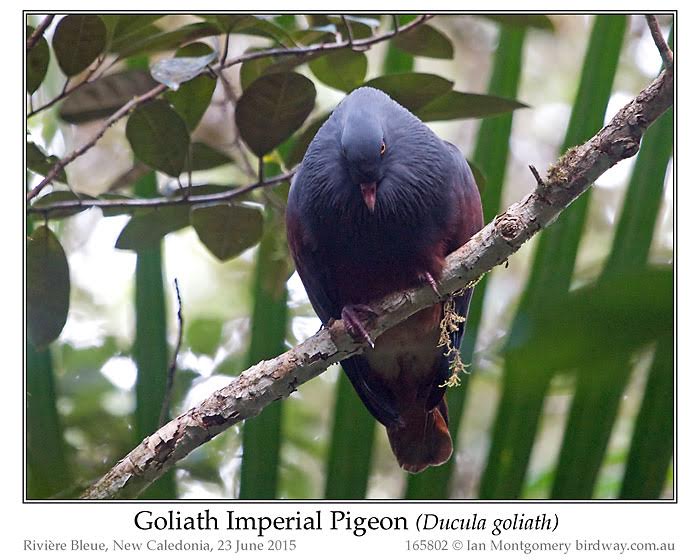
Goliath Imperial Pigeon (Ducula goliath) by IanThe display is similar to that of the domestic pigeon, alternating between puffing out the crop to show the silvery-tipped bifurcated feathers to best advantage (first photo) and bowing (second photo). The head, upperparts and breast are a steely grey while the breast is a rich rufous colour and the vent pale. The iris is a vivid orange red. With a length of up to 51cm/20in and weighing up to 720g/1.6lb, this is a huge pigeon, which unfortunately makes it good to eat. For comparison the Torresian (Pied) Imperial Pigeon of northern and northeastern Australia measures up to 44cm in length and 550g in weight.

Goliath Imperial Pigeon (Ducula goliath) by Ian

It is endemic to the main island of New Caledonia (Grande Terre) and the Isle of Pines. The population has suffered from habitat loss and hunting, so it remains common only in protected areas and is currently listed as Near Threatened. After our hard work finding it in Rivière Bleue we were amused to find one on perched in the open on a power line beside the road to Mount Koghi two days later, third photo. We also heard several and photographed one at Les Grandes Fougères.

Goliath Imperial Pigeon (Ducula goliath) by Ian

The subject of each bird of the week is usually a species that hasn’t featured previously. This tends to mean that I don’t get to share with you new photos of previous subjects. So I’ve decided to include random photos from time to time, such as this one of a Noisy Pitta. I was contacted by a neighbour recently with a wonderful, well-watered garden in which this Pitta has recently taken up residence. Pittas are such beautiful birds and I like this photo because of the way the bird is framed by the leaves behind it.

Noisy Pitta (Pitta versicolor) by Ian

Greetings,
Ian

P.S. (Be warned: this is a commercial break!) Did you know that some ebook sellers provide facilities of giving book as gifts. Maybe you know someone who would enjoy Where to Find Birds in Northeastern Queensland ($13.20 to $22). Kobo books has ebook readers from most devices and computer so check out their page on gifts. With Kobo you go to this page first and then browse for the item you want to give. With Apple iPads and iPhones, you find the item first e.g. Where to Find Birds on Northeastern Queensland in the iTunes Store and then select the Share icon at top right and select Gift:

COL-Colu Goliath Imperial Pigeon (Ducula goliath) by Ian AD

I haven’t found a similar facility in the iTunes store accessed from an Apple computer (the share icon is peculiar to iOS). You can however give gift cards with suggestions from iTunes, Google Play and Kobo.

**************************************************
Ian Montgomery, Birdway Pty Ltd,
454 Forestry Road, Bluewater, Qld 4818
Tel 0411 602 737 ian@birdway.com.au
Bird Photos http://www.birdway.com.au/
Recorder Society http://www.nqrs.org.au


Victoria Crowned Pigeon by Dan at National Aviary

Victoria Crowned Pigeon by Dan at National Aviary

Lee’s Addition:

And a champion went out of the camp of the Philistines named Goliath of Gath, whose height was six cubits and a span [almost ten feet]. (1 Samuel 17:4 AMP)

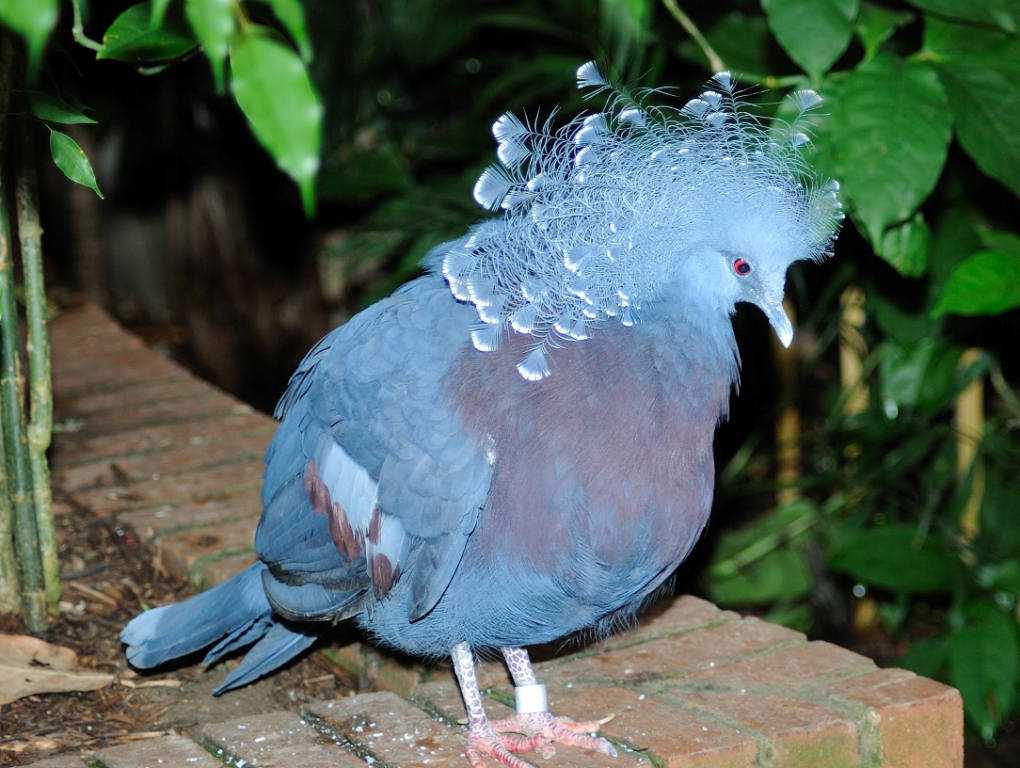
We have seen the Victoria Crowned Pigeons at Zoos and they are typically 73 to 75 cm (29 to 30 in) long. Ian’s 51cm/20in Goliath Imperial Pigeon is not too far behind. The well-known rock dove is 29 to 37 cm (11 to 15 in) long, for comparison.  However you look at it, they are quite big. One source mentioned that the Goliaths are very strong flyers.

That is also a great photo of the Noisy Pitta. Thanks, Ian for sharing your photos with us each week (or whenever).

Ian’s Bird of the Week newsletters

Columbidae – Pigeons, Doves Family

Wordless Birds

*

Sunday Inspiration – Bulbuls

White-eared (Cheeked) Bulbul (Pycnonotus leucotis) at Zoo Miami by Lee

White-eared (Cheeked) Bulbul (Pycnonotus leucotis) at Zoo Miami by Lee

 Then the trees of the forest will sing for joy before the LORD; For He is coming to judge the earth. O give thanks to the LORD, for He is good; For His lovingkindness is everlasting. (1 Chronicles 16:33-34 NASB)

Bulbuls are a family, Pycnonotidae, of medium-sized passerine songbirds. Many forest species are known as greenbuls, brownbuls, leafloves, bristlebills, finchbills and  a Malia. The family is distributed across most of Africa and into the Middle East, tropical Asia to Indonesia, and north as far as Japan. A few insular species occur on the tropical islands of the Indian Ocean There are 151 species in around 28 genera. While some species are found in most habitats, overall African species are predominantly found in rainforest whilst rainforest species are rare in Asia, instead preferring more open areas.

Collared Finchbill by Dan at Zoo Miami

Bulbuls are short-necked slender passerines. The tails are long and the wings short and rounded. In almost all species the bill is slightly elongated and slightly hooked at the end. They vary in length from 13 cm for the tiny greenbul to 29 cm in the straw-headed bulbul. Overall the sexes are alike, although the females tend to be slightly smaller. In a few species the differences are so great that they have been described as functionally different species. The soft plumage of some species is colourful with yellow, red or orange vents, cheeks, throat or supercilia, but most are drab, with uniform olive-brown to black plumage. Species with dull coloured eyes often sport contrasting eyerings. Some have very distinct crests. Bulbuls are highly vocal, with the calls of most species being described as nasal or gravelly. One author described the song of the brown-eared bulbul as “the most unattractive noises made by any bird”

Let the field be joyful, and all that is therein: then shall all the trees of the wood rejoice (Psalms 96:12 KJV)

Maybe in the case of that brown-eared bulbul, this verse would be more appropriate:

Make a joyful noise unto the LORD, all the earth: make a loud noise, and rejoice, and sing praise. (Psalms 98:4 KJV)

This slideshow requires JavaScript.

“How Deep The Father’s Love For Us” ~ played by Megan Fee and Jill Foster

How deep the Father’s love for us
How vast beyond all measure
That He should give His only Son
To make a wretch His treasure

How great the pain of searing loss
The Father turns His face away
As wounds which mar the Chosen One
Bring many sons to glory

Behold the man upon a cross
My sin upon His shoulders
Ashamed, I hear my mocking voice
Call out among the scoffers

It was my sin that held Him there
Until it was accomplished
His dying breath has brought me life
I know that it is finished

I will not boast in anything
No gifts, no power, no wisdom
But I will boast in Jesus Christ
His death and resurrection

Why should I gain from His reward?
I cannot give an answer
But this I know with all my heart
His wounds have paid my ransom

Why should I gain from His reward?
I cannot give an answer
But this I know with all my heart
His wounds have paid my ransom

For God so loved the world, that he gave his only begotten Son, that whosoever believeth in him should not perish, but have everlasting life. (John 3:16 KJV)

*
More Sunday Inspirations

Pycnonotidae – Bulbuls Family

Bulbul – Wikipedia

Falling Plates

*

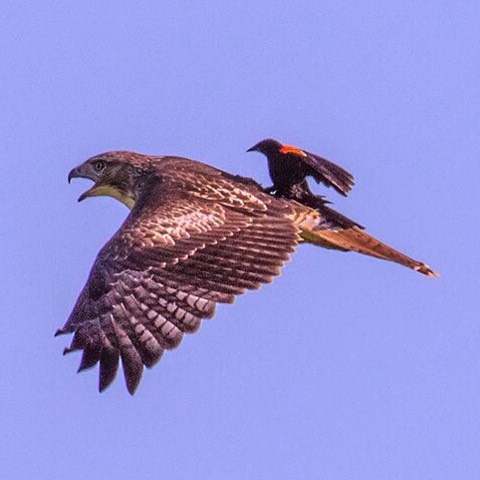
Taking A Ride

Blackbird on a Hawk's Back ©Dept of Interior

Blackbird on a Hawk’s Back ©Dept of Interior

Terrors shall make him afraid on every side and shall chase him at his heels. (Job 18:11 AMP)

Here we go again with a smaller bird attacking a larger bird. This time a Red-winged Blackbird is on a Hawk’s back.

See Rare Picture: Blackbird “Rides” Hawk. from Focusing on Wildlife.

*

Crow Versus Eagle, Free Ride Instead

Woodpecker With A Weasel On It’s Back

Birds of the Bible – Get Off My Back

Wordless Birds

*

Golden Eagle Returns After Long Voyage Around The World

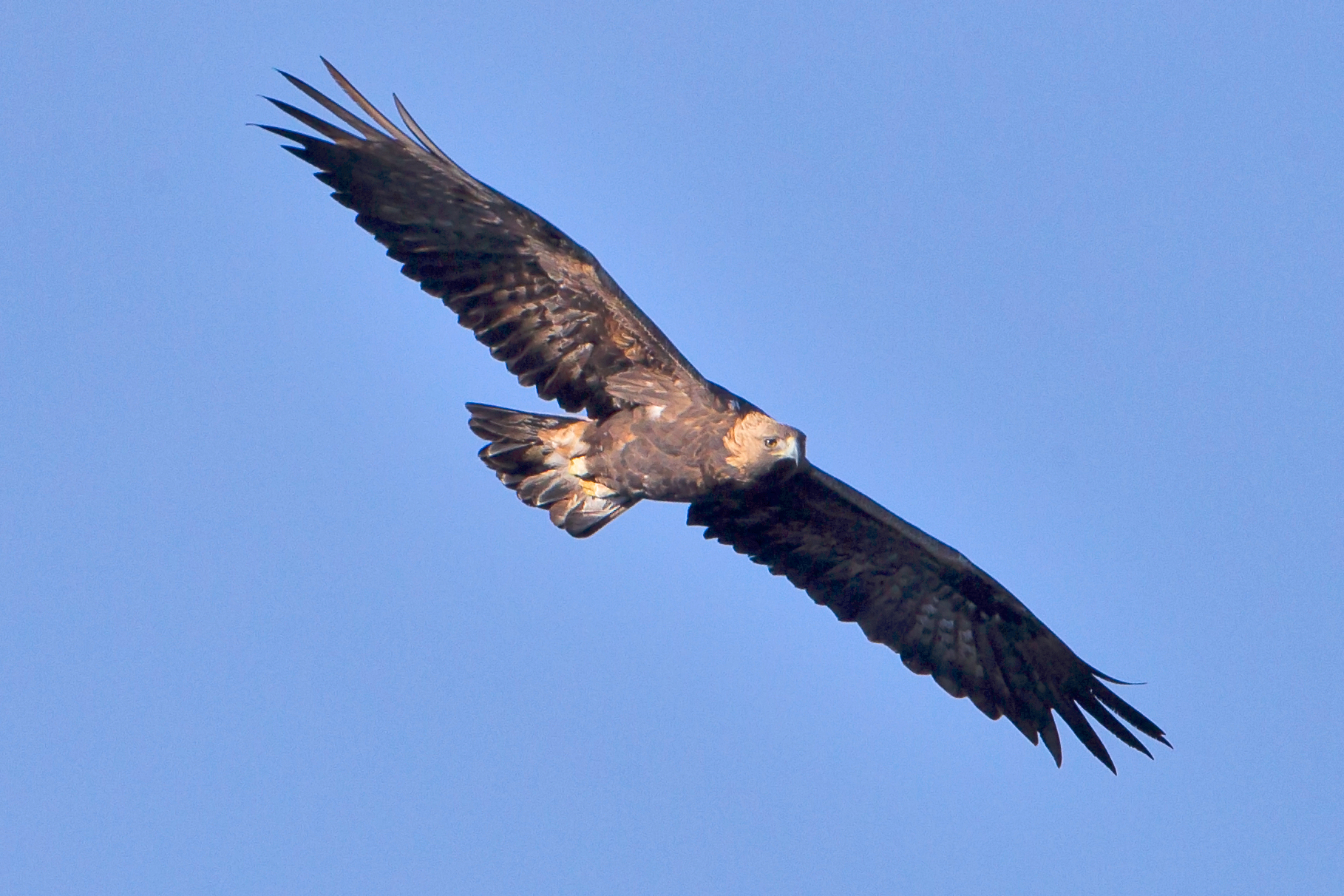
Golden Eagle (Aquila chrysaetos) Flying ©WikiC3

Golden Eagle (Aquila chrysaetos) Flying ©WikiC3

“A word fitly spoken is like apples of GOLD in pictures of SILVER.” (Proverbs 25:11)” 

Golden Eagle ©PD

Golden Eagle ©PD

Someone once told me to read one of the Proverbs each day for a month. There are 31 chapters in Proverbs, and that way we can read the Book of Proverbs 12 times during the year. You know, boys and girls, Solomon wrote about 3000 proverbs and he was the wisest man who ever lived (not counting Jesus, of course). Solomon was wiser than the wisest owl they tell me. Try reading a chapter each day and before you know it, you will gain some of Solomon’s wisdom.

Anyways, I just love the verse about apples and gold and silver. Why it reminds me delicious food and color and valuable metals. Everything that God created, He created for the benefit of you and me. He got this world ready in six literal 24 hour days and then God rested on the 7th day. He calls that day, the Sabbath. The word simply means “rest.” After my journey around the world, I can tell you that I need to rest and rest and rest some more. Don’t you just love to stay in your room where it is cold and dark and rest? Hey, why not get in your room and curl up with the best Book on this planet. This Bible came from another world. Did you know that? Look at this next Bible verse:

“For ever, O Lord, thy word is settled in Heaven.” (Psalm 119:89)” The Bible came from Heaven and it’s going to be around forever!!!

The Bible starts off with these words: “In the beginning God created the heaven and the earth.” (Genesis 1:1) God created time: “In the beginning.” That’s almost like baseball: In the big inning. (Yes, I was trying to make a joke) God created space: “heaven” and God created matter: “the earth.” That’s was this Universe is comprised of: time and space and matter. So cool…

In the weeks ahead, I will share with you guys some of the amazing things I enjoyed on my journey around the world. One of the things I really enjoy is food. I love to eat. How about you? Did you know that God created green plants with the ability to make their own food. The scientists call this photo, photosynthesis or something like that. The green plants, with chlorophyll, can somehow use the light from the sun to make starch and sugar and stuff like that. I just love to eat.

Of course, if I eat too much I will get big like the ostrich. Those birds are so heavy, they cannot fly anywhere. I don’t want to be known as the huge eagle that can’t get off the ground. Well, boys and girls, I am going to leave my nest for a short while and find something to eat. The Creator God of the Bible has created me with eyes that can see very far away. Until next time, Golden Eagle says God bless you everyone and have a fun, filled, fantastic day. This is after all, Saturday, where i am off for my next feast. See ya!!!

~~~


Lee’s Addition:

Golden Eagle, a.k.a., Baron B., is beginning a new blog called Bibleworld Adventures, Apples of Gold in Pictures of Silver. We have been helping him set up his new “nest” and he will now post under the name “Golden Adventures.”

He will not only continue the Golden Eagle articles for the younger people, but will also be writing articles about the Bible, Birds, Creation Science, History, and the Kid’s Corner where the Golden Eagle  adventures can be found.

More Golden Eagle articles at his new site.

We wish him well in his new adventure and look forward to sharing his Golden Eagle articles with you here. The fact that Golden Eagle is a bird, I have had the privilege of teaching how to blog. Birds don’t even know how to hold a pencil, let alone know how to type. That big beak of his does work okay on the keys though. As Golden Eagle, “learns the ropes,” we will help him and not desert him.

Lord Bless you, Baron, (a.k.a. Golden Eagle) as you venture in to the world of blogging.

*

Bibleworld Adventures

*