
Common Pheasant (Phasianus colchicus) “Ring-necked” for Birds Illustrated
From col. Chi. Acad. Sciences. Copyrighted by
Nature Study Pub. Co., 1897, Chicago.
Common Pheasant (Phasianus colchicus) “Ring-necked” for Birds Illustrated
From col. Chi. Acad. Sciences. Copyrighted by
Nature Study Pub. Co., 1897, Chicago.

Sharp-shinned Hawk (Accipiter striatus) ©USFWS
Is it by your understanding that the hawk soars and spreads his wings toward the south? (Job 39:26 ESV)
Job was being asked by the Lord if he knew how and why the Hawk knows that it needs to go south for the winter. The Lord is smarter than we are and when He created the birds, He gave them instincts (knowledge) to do certain tasks. He put within the Hawks and other birds that migrate (travel to other areas) the knowledge of when and where to go.
Why do they migrate? There are various reasons why they travel, many great distances, for the winter or summer. The weather turns cold in the northern part of the world (northern hemisphere) in the winter and many birds cannot survive in really cold weather. In the summer, those birds go back north, because it gets cold down where they spent the winter. (The seasons are reversed in the northern and southern hemispheres.) So, some birds just keep going north and south each year so they can live in warm weather.
Other birds move around or migrate because their food supply ends and they go to the next area to be able to feed themselves. The Lord promised the birds and animals to provide for them, but He does not “spoon-feed” them. They have to go where He has provided for them.
And to all the animals on the earth and to every bird of the air and to everything that creeps on the ground–to everything in which there is the breath of life–I have given every green plant for food. And it was so. (Genesis 1:30 AMP)
A tree in Daniel has this promise given about it:
Its leaves were fair and its fruit abundant, and in it was food for all. The living creatures of the field found shade under it, and the birds of the sky dwelt in its branches; and all flesh was fed from it. (Daniel 4:12 AMP)

Crane Hawk (Geranospiza caerulescens) ©WikiC
Look at the birds of the air; they neither sow nor reap nor gather into barns, and yet your heavenly Father keeps feeding them. Are you not worth much more than they? (Matthew 6:26 AMP)
Those are very good promises by the Lord, the Creator, that He will provide for them. That last verse also gives you and I the promise that He will also provide for us, because we are worth more. He loves us and has given us much more. See The Wordless Birds.
We will tell more things about the Hawks in other Bible Bird – Hawks articles.
See Also:
*
Just finished the Bible Birds – Owls page. A Photo gallery and some Fun Facts were added.
Bible Birds are the Birds of the Bible Birds written with to Younger Folks and those who are “Young at Heart”. As other pages are updated, a post will announce them also.
*

Mixed Flock of birds flying in a V Formation- Put together- ©Creative Commons
One of my readers of the blog had this in his post. After checking the internet, I found that it was free to use. So, now I am sharing it. I think it is adorable. Not sure who originally put it together, but, thank you.
When I showed it to Dan and ask him what I could write about it, he gave me the following example:
All those birds are from different species, yet they are all heading in the same direction. The Bible tells us:
And He has made from one blood every nation of men to dwell on all the face of the earth, and has determined their preappointed times and the boundaries of their dwellings, (Acts 17:26 NKJV)
Then I saw another angel flying in the midst of heaven, having the everlasting gospel to preach to those who dwell on the earth to every nation, tribe, tongue, and people—saying with a loud voice, “Fear God and give glory to Him, for the hour of His judgment has come; and worship Him who made heaven and earth, the sea and springs of water.” (Revelation 14:6-7 NKJV)
And they sang a new song, saying: “You are worthy to take the scroll, And to open its seals; For You were slain, And have redeemed us to God by Your blood Out of every tribe and tongue and people and nation, (Revelation 5:9 NKJV)
Praise the Lord that it matters not where you are from, the Lord Jesus Christ has made salvation available to “whosoever.”
*
(Lord willing that photo will be posted again.)

My Mom and Us
Yesterday, in My Mom and Me – Photos, you saw many photos of Mother Animals and Mother Birds with their young ones. Does the Bible mention mother birds and their young or eggs. Yes, it does.
“If a bird’s nest happens to be before you along the way, in any tree or on the ground, with young ones or eggs, with the mother sitting on the young or on the eggs, you shall not take the mother with the young;
you shall surely let the mother go, and take the young for yourself, that it may be well with you and that you may prolong your days. (Deuteronomy 22:6-7 NKJV)
That is very interesting verse. It tells us not to take both the mother and the young or eggs. Do you know why? Look at the last verse; it says “may be well with you and you will prolong your days (live longer). Do you know another reason not to take both? The Lord commanded the animals and birds to have babies and fill the earth. If you kill them both, then none of that family will be able to have more baby birds or the young will not get to grow up and have baby birds. Soon, there wouldn’t be any more of those kinds of birds and they would become “extinct.”
The Lord told us from the very beginning of the Bible to have “dominion” over the birds and animals. That does not mean to be mean to them, but more like to watch over them and care for them. That is what our verse above is telling us. Not to destroy all of them, but to leave some of the family alive to carry on.
Gather the people–men, women, children, and foreigners living within your gates–so that they may listen and learn to fear the LORD your God and be careful to follow all the words of this law. (Deuteronomy 31:12 HCSB)
See:
More Bible Birds
*
(Received this as an email. – Not sure who to credit them to.)
*
Here’s your AWE! for the day!!!
*
*
Bring forth every living thing that is with you of all flesh–birds and beasts and every creeping thing that creeps on the ground–that they may breed abundantly on the land and be fruitful and multiply upon the earth. (Genesis 8:17 AMP)
*

Many-colored Fruit Dove (Ptilinopus perousii) ©WikiC
While working on the Columbidae – Pigeons, Doves Family, I was enjoying the Fruit Doves and their beautiful colors. Of course the verse about Joseph’s Coat of Many Colors kept crossing my mind. Then I actually found the Many-colored Fruit Dove.
Now Israel loved Joseph more than all his children, because he was the son of his old age: and he made him a coat of many colours. (Genesis 37:3 KJV)
The Fruit Doves belong to the Ptilinopus genus. There are 53 Fruit Doves at present (I.O.C. 3.3) They eat fruit mostly and they may help enhance their colours, at least that is one opinion. “These small- to medium-sized doves generally have short, fan-shaped tails, and are remarkable for their colorful and often glossy plumage, as evidenced in the aptly named Orange Fruit Dove, Flame-breasted Fruit Dove, and Pink-headed Fruit Dove. Males and females of many fruit dove species look very different. For example, the female Many-coloured Fruit Dove shares the male’s crimson crown and deep pink undertail feathers, but is otherwise green, whereas the male has a crimson on the upper back and has areas of yellow, olive, cinnamon, and grey.
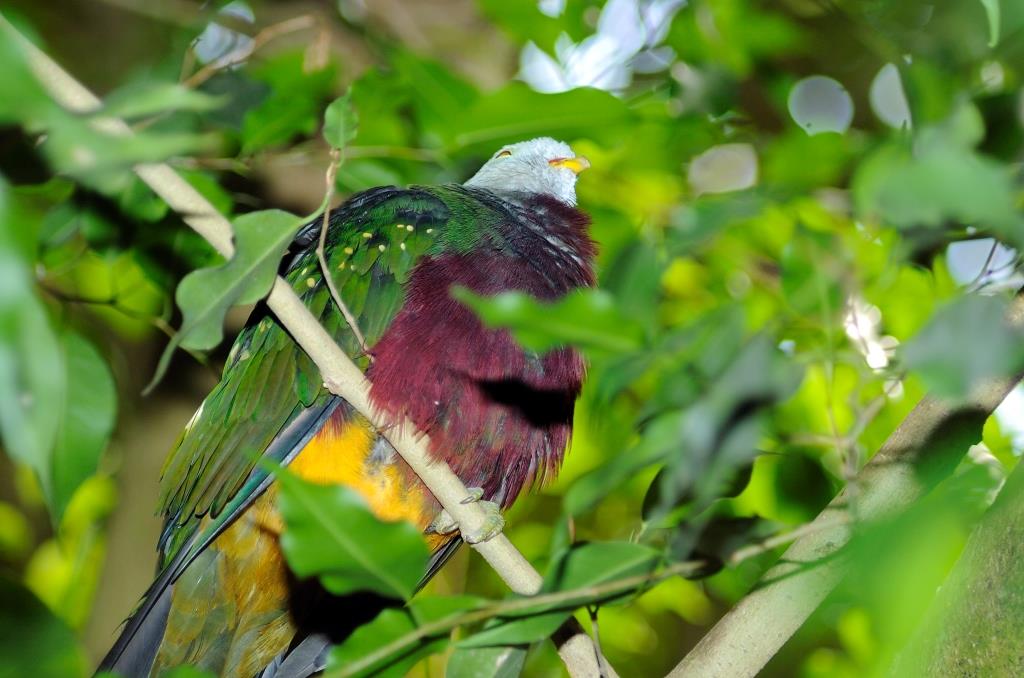
Wompoo Fruit Dove (Ptilinopus magnificus) by Dan at National Aviary
This is a large genus, most diverse in and around the island of New Guinea, in the Philippines, and in the biogeographical region of Wallacea. Some species have ranges as far west as the Sunda Islands, others north to Taiwan, south to Australia, and east into Polynesia.
Fruit doves, as their name implies, eat fruit — ficus is especially important — and live in various kinds of forest or woodland. Some species are restricted to primary forest, such as lowland rainforest, montane forest, or monsoon forest, while others prefer secondary forest or disturbed areas. Some species specialize in particular habitats, from lowland coastal forest to the cloud forest or moss forest of high altitudes. Some species of fruit doves are only found in habitats dominated by particular plants, such as mangrove, eucalyptus, or pandanus. Only a few species can commonly be seen around human habitation, these include the Knob-billed Fruit Dove, Makatea Fruit Dove, and Black-naped Fruit Dove, which are known to visit gardens and such.
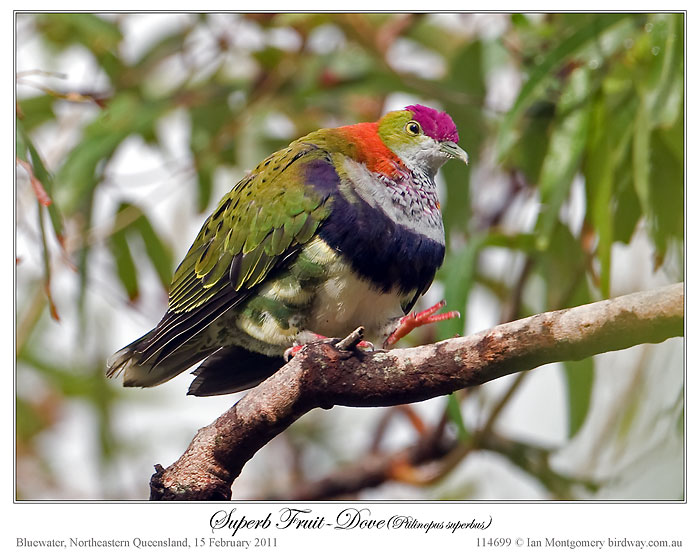
Superb Fruit Dove (Ptilinopus superbus) by Ian
Much is still to be learned about fruit doves. Many species are shy and difficult to observe in their natural habitat. For example, there are several species in the Philippines, and for most of them, little or nothing is known of their breeding or nesting behavior.” (Wikipedia with editing)
We have had the privilege of seeing several of the Fruit Doves at the Zoos we have visited. They are so beautiful and colorful. Isn’t the Lord great in His providing them the ability to show off all their “coats of many colors?” I trust you will enjoy looking at the slideshow below and seeing them. These are the ones that I have permission to show. I am putting the whole list of them from the Family pages so that you can view the others.
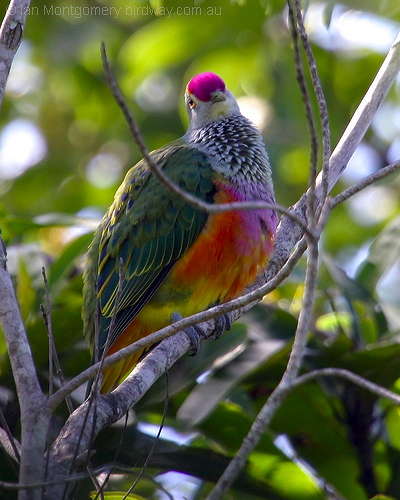
Rose-crowned Fruit Dove (Ptilinopus regina) by Ian
Divers colours is only associated with one bird in Scripture and that is with an eagle:
And say, Thus saith the Lord GOD; A great eagle with great wings, longwinged, full of feathers, which had divers colours, came unto Lebanon, and took the highest branch of the cedar: (Ezekiel 17:3 KJV)
“Divers colours” is used 6 times in the King James Version, others translate that phrase as; various colors, beautiful feathers, long, colorful feathers , full of varicolored feathers, of variety, feathers covered with spots, rich in plumage of many colors, full of plumage of embroidery, having different colors to him, multi-colored plumage, or in full plumage and bright colors.
I think those descriptions can well describe our feather colors the Creator placed on these Fruit Doves. Doves are mentioned many times in the Bible. See the Birds of the Bible – Dove and Pigeon page.
****
Columbidae – Pigeons, Doves Family
Birds of the Bible – Dove and Pigeon
*
P.S. I’ll be adding more of our as I find them.
*

Red-rumped Swallow (Cecropis daurica) by Nikhil Devasar
Even the stork in the heavens Knows her appointed times; And the turtledove, the swift, and the swallow Observe the time of their coming. But My people do not know the judgment of the LORD. (Jeremiah 8:7 NKJV)
Previously, we introduced the Thrush and used the above verse. Today, we will look at that same verse, but from a different version of Scripture that translates the bird as a Swallow. Here is the same little Greek study for you: The Greek word (the OT was written mostly in Greek) gives the word (H5693) עגוּר -or – ‛âgûr (aw-goor’) An unused root meaning to twitter; probably the swallow: – swallow. Translations using the word Swallow, have more than one verse that refers to the bird. The New King James Version has these other verses:
Even the sparrow has found a home, And the swallow a nest for herself, Where she may lay her young— Even Your altars, O LORD of hosts, My King and my God. (Psalms 84:3 NKJV) Like a flitting sparrow, like a flying swallow, So a curse without cause shall not alight. (Proverbs 26:2 NKJV) Like a crane or a swallow, so I chattered; I mourned like a dove; My eyes fail from looking upward. O LORD, I am oppressed; Undertake for me! (Isaiah 38:14 NKJV)
So there are at least four verses with the Swallow listed. The Swallows belong to the Hirundinidae – Swallows, martins Family. There are 88 members in the family at present. Many times in the Bible they mention a bird‘s name and then say “after its kind.” For now, let’s just same that it means all of those species in that family. The Swallows also have Saw-wings and Martins in the family. They live on all the continents except Antarctica.
This family is known for their aerial feeding. taking flying insects on the wing. Swallows hunt insects on the wing because they were designed with a slender, streamlined body and long pointed wings, which allow great maneuverability and endurance, as well as frequent periods of gliding. Their body shape allows for very efficient flight, which costs 50-75% less for swallows than equivalent passerines of the same size. Swallows usually forage at around 18.6-25 mph (30–40 km/h), although they are capable of reaching speeds of between 31-40 mph (50–65 km/h) when traveling.
The legs are short, and their feet were created for perching rather than walking, as the front toes are partially joined at the base. Swallows are capable of walking and even running, but they do so with a shuffling, waddling gait. The leg muscles of the river martins (Pseudochelidon) are stronger and more robust than those of other swallows.
The most common plumage is glossy dark blue or green above and plain or streaked underparts, often white or rufous. Species which burrow or live in dry or mountainous areas are often matte brown above (e.g. Sand Martin and Crag Martin). The typical song of swallows is a simple, sometimes musical twittering.
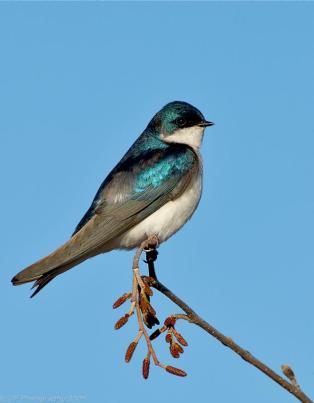
Tree Swallow (Tachycineta bicolor) by J Fenton
Our verse above mentions the birds and how they KNOW when it is time to migrate, but what about the end of the verse? The Lord uses birds and other critters as an example, BUT He is mainly trying to teach us something.
Let’s see what some of the different versions say about what we are supposed to learn from these birds.
(HCSB) ”are aware of their migration, but My people do not know the requirements of the LORD.”
(MSG) …know when it’s time to move south for winter… know when it’s time to come back again. But my people? My people know nothing, not the first thing of GOD and his rule.
(NET) …knows when it is time to move on…recognize the normal times for their migration. But my people pay no attention to what I, the LORD, require of them.
Do you know what the Lord wants you to do? Do you know Him as your Savior? If you do, are you doing what the Bible tells us we should do? Are you obeying your parents? And doing what the Lord wants you to do?.
The Lord loves us, just as your parents do. When you obey them you are happier and blessed. When you do not obey, are you happy or sad? The same is true with obeying the Word that the Lord has given us through His Word, the Bible.
See:
*

Chestnut-bellied Rock Thrush by Peter Ericsson
Even the stork in the sky Knows her seasons; And the turtledove and the swift and the thrush Observe the time of their migration; But My people do not know The ordinance of the LORD. (Jeremiah 8:7 NASB)
The Thrush only appears once in the Bible. Not all versions of the Scripture translates or says that it is a Thrush. The New American Standard Bible (NASB) is one of the ones that does. Also the CEV, ERV, GNB, HRB, LITV and the NIV use the word “Thrush”.
Here is a little Greek study for you:
The Greek word (the OT was written mostly in Greek) gives the word (H5693) עגוּר -or – ‛âgûr (aw-goor’)
An unused root meaning to twitter; probably the swallow: – swallow.
Many of the different Bibles use the word Swallow, and some of those above use both the Swallow and the Thrush.

White-necked Thrush (Turdus albicollis) by Dario Sanches
Both birds migrate and both “twitter.”
Listen to the song of the Wood Thrush and see if you can detect a “twitter” in its voice:

Wood Thrush (Hylocichla mustelina) by Daves BirdingPix
Thrushes are plump, soft-plumaged, small to medium-sized birds, inhabiting wooded areas, and are grey or brown in colour, often with speckled underparts.
They often feed on the ground or eat small fruit, but most species also eat worms, land snails, and fruit. Many species are permanently resident in warm climes, while others migrate to higher latitudes during summer, often over considerable distances.
The songs of some species, including members of the genera Catharus, Myadestes, and Turdus, are considered to be among the most beautiful in the avian world. (Wikipedia and other internet sources)
Our verse above mentions the birds and how they KNOW when it is time to migrate, but what about the end of the verse? The Lord uses birds and other critters as an example, BUT He is mainly trying to teach us something.
Let’s see what some of the different versions say about what we are supposed to learn from these birds.
(HCSB) “are aware of their migration, but My people do not know the requirements of the LORD.”
(MSG) …know when it’s time to move south for winter… know when it’s time to come back again. But my people? My people know nothing, not the first thing of GOD and his rule.
(NET) …knows when it is time to move on…recognize the normal times for their migration. But my people pay no attention to what I, the LORD, require of them.
Do you know what the Lord wants you to do? Do you know Him as your Savior? If you do, are you doing what the Bible tells us we should do? Are you obeying your parents? And many other things.
The Lord loves us, just as your parents do. When you obey them aren’t you more pleased and blessed than when you don’t obey? The same is true with obeying the Word that the Lord has given us through His Word, the Bible.
See:
*

Sarus Crane (Grus antigone) by Lee at Wings of Asia
The 15 species of Cranes worldwide are: Black Crowned, Black-necked, Brolga, Demoiselle, Eurasian, Grey Crowned, Hooded, Red-Crowned, Sandhill, Sarus(tallest flying bird-6’ tall), Siberian, Wattled, White-naped, and the Whooping Crane (tallest N. American flying bird-5’ tall). The Cranes belong to the Gruidae – Cranes Family.
Cranes are tall birds from 3 to 6 feet tall, with wingspans over 6 feet. The tallest Crane is the Sarus and the shortest is the Demoiselle. They fly with their neck straight out and their long legs trailing. They chatter and call when flying. We have plenty of Sandhill Cranes here in Central Florida walking around the neighborhoods. They seem pretty tame sometimes and will eat out of your hand. They were bringing a small flock of Whooping Cranes to Florida every fall that followed an Ultra Light Aircraft from Wisconsin. We have a few non-migratory Whooping Cranes in the area that I have seen in a cow field off US 27.

Sandhill Cranes and Babies in yard
There are only two verses in the Bible that mention the Crane.
Cranes migrate by following known paths taught them by their parents, or substitutes. Migrating birds know when and where to go and when to come. When God created them, He put that information in them.
Like a crane or a swallow, so did I chatter: I did mourn as a dove: mine eyes fail with looking upward: O LORD, I am oppressed; undertake for me. (Isaiah 38:14 KJV)
“So did I chatter – … The idea here is doubtless that of pain that was expressed in sounds resembling that made by birds – a broken, unmeaning unintelligible sighing; or quick breathing, and moaning. ” Barnes Commentary
Yea, the stork in the heaven knoweth her appointed times; and the turtle and the crane and the swallow observe the time of their coming; but my people know not the judgment of the LORD. (Jeremiah 8:7 KJV)
“The instinct of the migratory birds leads them with unfailing regularity to return every spring from their winter abodes in summer climes (Song of Solomon 2:12); but God’s people will not return to Him even when the winter of His wrath is past, and He invites them back to the spring of His favor.” Jameison, Faussett, and Brown Commentary
As you watch the following video notice that the two Bible verses are being demonstrated. Notice the chattering as they fly about and also that they are heading out for their migration to warmer climates. Migration means travel to another area. Usually here in America, the birds go south in the winter and then return north in the spring as it warms back up. This is God’s way of protecting birds that cannot survive in the cold.
Sandhill Cranes(grey) at the Plate River and some Whooping Cranes (white)
See:
On Our Main Site See:
*
Sandhill Cranes and Babies in yard
Cranes know when it’s time to move south for winter. And robins, warblers, and bluebirds know when it’s time to come back again. But my people? My people know nothing, not the first thing of GOD and his rule. (Jeremiah 8:7 MSG)
The Crane page of the Bible Birds has been updated. I added a Gallery of most of the Cranes and some other information. Cranes are interesting and we get to see them quite often. We have two that walk through the yard almost daily. They are Sandhill Cranes. When they have young, they have been known to parade them through the yard to “show them off.”
The tallest Crane I have seen were the two Sarus Cranes which we encountered at the Wings of Asia Aviary at Zoo Miami. They came strolling down the walkway in the aviary right past me. I am only 4′ 10″ and they are 5′ 6″. Needless to say, I had to look up to them. I also gave them some space.
Isn’t the Creator fantastic in the variety of critters, especially the birds, that He has made and for us to enjoy.
Sarus Crane (Grus antigone) by Lee at Wings of Asia
*
What an amazing animal! God did some very special engineering from the git-go! None of this “grocery store” new and improved nonsense. He got it entirely right the first time.
(From Moody Press)
If you ever doubted that God exists, Meet the Very Technical, Highly Engineered Dromedary Camel.

When I’m hungry, I’ll eat almost anything-A leather bridle, a piece of rope, my master’s tent, Or a pair of shoes.

My mouth is so tough a thorny cactus doesn’t bother it. I love to chow down grass and other plants That grow here on the Arabian desert.

I’m a dromedary camel, the one-hump kind That lives on hot deserts in the Middle East.
My hump, all eighty pounds of it, Is filled with fat-my body fuel-not water as some people believe. My Mighty Maker gave it to me because He knew I wouldn’t always be able to find food As I travel across the hot sands. When I don’t find any chow, my body automatically Takes fat from the hump, feeds my system, And keeps me going strong. This is my emergency food supply.

If I can’t find any plants to munch, my body uses up my hump. When the hump gets smaller, it starts to tip to one side. But when I get to a nice oasis and begin to eat again, My hump soon builds back to normal.
I’ve been known to drink twenty-seven gallons of water in ten minutes. My Master Designer made me in such a fantastic way that In a matter of minutes all the water I’ve swallowed Travels to the billions of microscopic cells that make up my flesh.

Naturally, the water I swallow first goes into my stomach. There thirsty blood vessels absorb and carry it to every part of my body. Scientists have tested my stomach and found it empty Ten minutes after I’ve drunk twenty gallons.
In an eight hour day I can carry a four hundred pound load A hundred miles across a hot, dry desert And not stop once for a drink or something to eat. In fact, I’ve been known to go eight days without a drink, But then I look a wreck. I lose 227 pounds, my ribs show through my skin, And I look terribly skinny. But I feel great! I look thin because the billions of cells lose their water. They’re no longer fat. They’re flat.

Normally my blood contains 94 percent water, just like yours. But when I can’t find any water to drink, The heat of the sun gradually robs a little water out of my blood. Scientists have found that my blood can lose up to 40 percent of its water, and I’m still healthy.
Doctor’s say human blood has to stay very close to 94 percent water. If you lose 5 percent of it, you can’t see anymore; 10 percent, you can’t Hear and you go insane; 12 percent, your blood is as thick as molasses And your heart can’t pump the thick stuff. It stops, and you’re dead.

But that’s not true with me. Why? Scientists say my blood is different. My red cells are elongated. Yours are round. Maybe that’s what makes the difference.

This proves I’m designed for the desert, Or the desert is designed for me. Did you ever hear of a design without a Designer?
After I find a water hole, I’ll drink for about ten minutes And my skinny body starts to change almost immediately. In that short time my body fills out nicely, I don’t look skinny anymore, And I gain back the 227 pounds I lost.

Even though I lose a lot of water on the desert, My body conserves it too. Way in the beginning when my intelligent Engineer made me, He gave me a specially designed nose that saves water. When I exhale, I don’t lose much. My nose traps that warm, moist air from my lungs And absorbs it in my nasal membranes.

Tiny blood vessels in those membranes take that back into my blood. How’s that for a recycling system? Pretty cool, isn’t it. It works because my nose is cool. My cool nose changes that warm moisture in the air From my lungs into water.
But how does my nose get cool? I breath in hot dry desert air, And it goes through my wet nasal passages. This produces a cooling effect, and my nose stays as much as 18 degrees cooler than the rest of my body.
I love to travel the beautiful sand dunes. It’s really quite easy, because My Creator gave me specially engineered sand shoes for feet. My hooves are wide, and they get even wider when I step on them. Each foot has two long, bony toes with tough, leathery skin between my soles, are a little like webbed feet.

They won’t let me sink into the soft, drifting sand. This is good, because often my master wants me to carry him one hundred miles across the desert in just one day. (I troop about ten miles per hour.)

Sometimes a big windstorm comes out of nowhere, bringing flying sand with it. My Master Designer put special muscles in my nostrils that close the openings, keeping sand out of my nose but still allowing me enough air to breathe.
My eyelashes arch down over my eyes like screens, keeping the sand and sun out but still letting me see clearly. If a grain of sand slips through and gets in my eye, the Creator took care of that too. He gave me an inner eyelid that automatically wipes the sand off my eyeball just like a windshield wiper.
Some people think I’m conceited because I always walk around with my head held high and my nose in the air.

But that’s just because of the way I’m made. My eyebrows are so thick and bushy I have to hold my head high to peek out from underneath them. I’m glad I have them though. They shade my eyes from the bright sun.

Desert people depend on me for many things. Not only am I their best form of transportation, but I’m also their grocery store. Mrs. Camel gives very rich milk that people make into butter and cheese. I shed my thick fur coat once a year, and that can be woven into cloth. A few young camels are used for beef, but I don’t like to talk about that.

For a long time we camels have been called the “ships of the desert” because of the way we sway from side to side when we trot. Some of our riders get seasick.
I sway from side to side because of the way my legs work. Both legs on one side move forward at the same time, elevating that side. My “left, right left, right” motion makes my rider feel like he is in a rocking chair going sideways.

When I was six months old, special knee pads started to grow on my front legs. The intelligent Creator knew I had to have them. They help me lower my 1000 pounds to the ground.

If I didn’t have them, my knees would soon become sore and infected, and I could never lie down. I’d die of exhaustion.

By the way, I don’t get thick knee pads because I fall on my knees. I fall on my knees because I already have these tough pads. Someone very great thought of me and knew I needed them. He designed them into my genes.
It’s real difficult for me to understand how some people say I evolved into what I now am. I’m very technical, highly engineered dromedary camel. Things like me don’t just happen.

They’re planned on a drawing board by Someone very brilliant, Someone very logical.
John 1:1 says,
“In the beginning was the Word.
And the Word was with God,
and the Word was God.”
The Word means “logical, intelligent One.”
(Received in an e-Mail, but found it on the Lakeside Church of Christ website. Not sure who to give the credit to. Could not find it on the Moody site. We do know the ultimate credit goes to – The Creator.)
 Lee's Birdwatching Adventures Plus