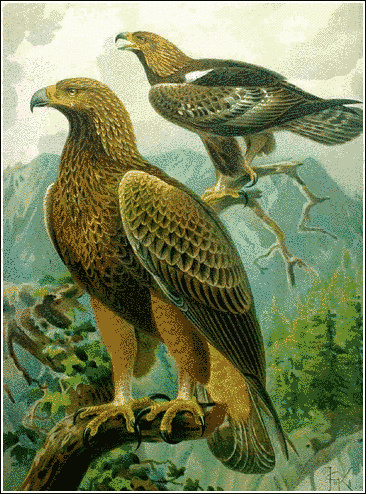
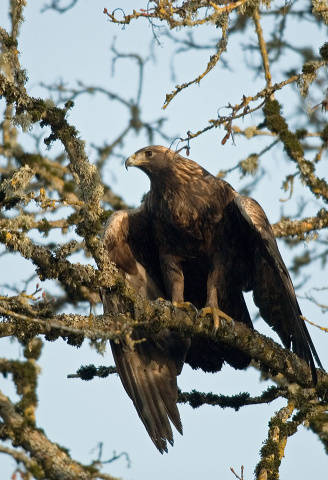
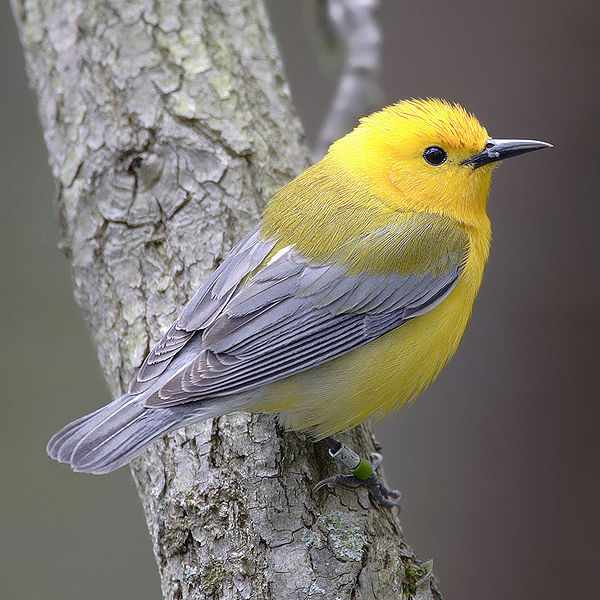
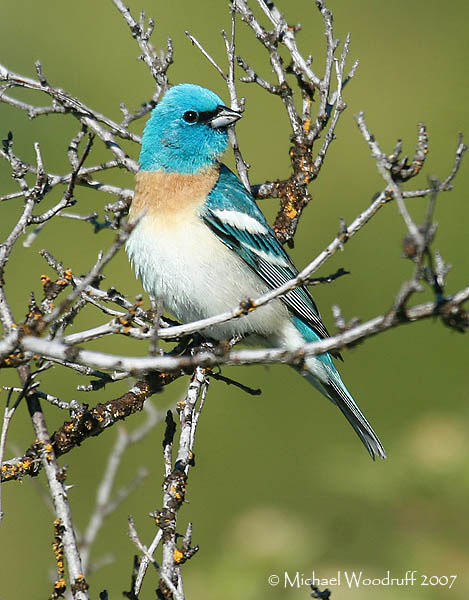
Sunday Inspiration – Crown Birds

White-crowned Sparrow ©WikiC

White-crowned Sparrow ©WikiC

but these are written that you may believe that Jesus is the Christ, the Son of God, and that believing you may have life in His name. (John 20:31 NKJV)

Therefore God also has highly exalted Him and given Him the name which is above every name, that at the name of Jesus every knee should bow, of those in heaven, and of those on earth, and of those under the earth, and that every tongue should confess that Jesus Christ is Lord, to the glory of God the Father. (Philippians 2:9-11 NKJV)

And this is His commandment: that we should believe on the name of His Son Jesus Christ and love one another, as He gave us commandment. (1 John 3:23 NKJV)

Trust you will enjoy many of the Lord’s Birds that have crowns. Many more could have been added, but this is a fair sampling.

*

This slideshow requires JavaScript.

*

“All Hail The Power of Jesus Name” – Faith Baptist Orchestra

*

More Sunday Inspirations

Faith Baptist Church

Gospel Presentation

*

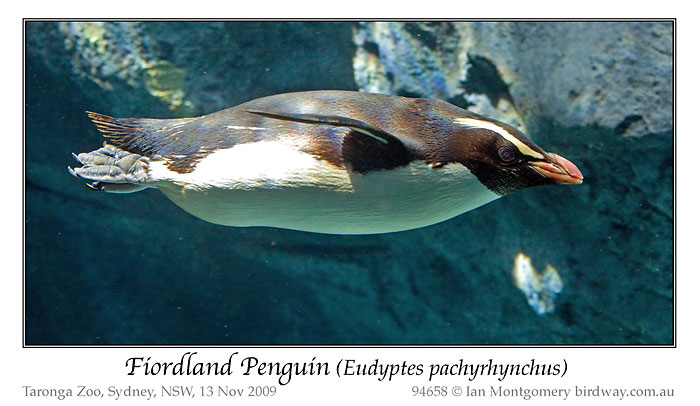
Ian’s Bird of the Week – Fiordland Penguin

Fiordland Penguin (Eudyptes pachyrhynchus) by IanIan’s Bird of the Week – Fiordland Penguin ~ Ian Montgomery

Newsletter – 9-5-14

I was talking with a friend the other day about visiting New Zealand and my experience with photographing Fiordland Penguin in Milford Sound, so here it is as bird of the week and a change from Where to Find Birds in Northern Queensland. It was my main reason for visiting Milford Sound, better known perhaps for its spectacular scenery and natural beauty, but if you go looking for wildlife then you find yourself in wonderful places anyway.

I camped the previous night in my rented campervan at Cascade Creek in Fiordland National Park, the nearest camping site to Milford Sound. It’s still a fair drive, so atypically I got up before dawn when the temperature was 3ºC to get to the sound early enough to get on the first tourist boat, as I’d been told that this provided the best chance of seeing the penguins. The boat I went on was one of the smaller ones so there were only a dozen or so passengers. I had a chat with the crew as departed and they were optimistic about finding the penguins.

Fiordland Penguin (Eudyptes pachyrhynchus) by Ian

Within ten minutes of leaving, they had located a nesting pair on the rocky shore. Very obligingly, they reversed the boat to what seemed perilously close to the rocks so that I could get some photos. The first photo shows one of them near the entrance to its nesting burrow, while the second is its mate wandering over the rocks closer to us.

Fiordland Penguin (Eudyptes pachyrhynchus) by Ian

I was very glad I’d make the early start, as we didn’t see many more penguins, though we did come across the party in the third photo about 20 minutes later. The bird in the foreground with the pale cheeks is a juvenile. An easier place to see them is Taronga Zoo in Sydney where their glass-sided tank provides great views of them at their best: they’re much more elegant gliding effortlessly through the water than hobbling around on rocks.

Fiordland Penguin (Eudyptes pachyrhynchus) by Ian

The wild population is estimated at about 3000 pairs and has suffered from predation by introduced mammals and the native Weka  which has been introduced to some islands where the penguins breed. I did see Wekas at Milford Sound, but I don’t know whether they are a problem there. The Fiordland Penguin is closely related to the Snares and Southern Rockhopper Penguins.

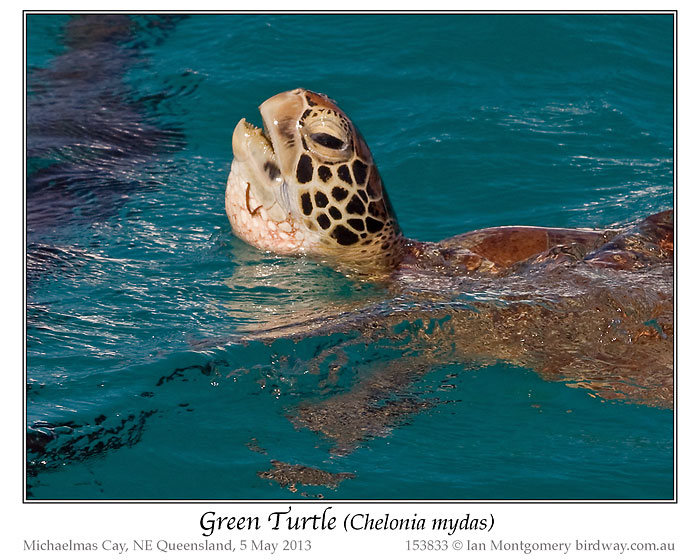
Green Turtle (Chelonia mydas) by Ian

While on the subject of animals that are expert swimmers and clumsy on land, I’ve just completed a new gallery of turtles and their relatives on the website. It contains a rather motley collection that I’ve stumbled across when birding, including the marine Green Turtle, above, four Australian and an American freshwater species, a South African and an Asian tortoise. This Green Turtle was grazing on the mooring cable, visible on the right, on a visit Michaelmas Cay off Cairns last year with my sister Gillian from Ireland. I’m going on a visit to Ireland in ten days time. Next week I’ll tell you more about my plans and some of the birds that I hope to bring your way.

Greetings
Ian

**************************************************
Ian Montgomery, Birdway Pty Ltd,
454 Forestry Road, Bluewater, Qld 4818
Tel 0411 602 737 ian@birdway.com.au
Bird Photos http://www.birdway.com.au/
Recorder Society http://www.nqrs.org.au


Lee’s Addition:

The birds of the air, And the fish of the sea That pass through the paths of the seas. O LORD, our Lord, How excellent is Your name in all the earth! (Psalms 8:8-9 NKJV)

What an interesting bird to switch to. The Fiordland Penguins are neat looking with that eyebrow stripe and those feathers at the end of it. Penguins definitely “pass through the paths of the seas.” Also, did you notice he was out there in 3C, that is 37.4F for us North Americans. (Brrr!)

Penguins are members of the Spheniscidae – Penguins Family which has 18 members. Ian has photos of half of the Penguin Family on his Birdway site. The Fiordlands are “medium-sized, yellow-crested, black-and-white penguins, growing to approximately 60 cm (24 in) long and weighing on average 3.7 kg (8.2 lbs), with a weight range of 2 to 5.95 kg (4.4 to 13.1 lb). It has dark, bluish-grey upperparts with a darker head, and white underparts. It has a broad, yellow eyebrow-stripe which extends over the eye and drops down the neck. Most birds have three to six whitish stripes on the face.” (Wikipedia)

*

Ian’s Bird of the Week

Penguin Family at Birdway

Spheniscidae – Penguins Family

*


Bible Birds – Cuckoo Introduction

Guira Cuckoo (Guira guira) at NA by Dan at National Aviary

Guira Cuckoo (Guira guira) at NA by Dan at National Aviary

Bible Birds – Cuckoo’s Introduction

The “Cuckoo” or old English”Cuckow” is found in these verses:

and the owl, and the night-hawk, and the cuckoo, and the hawk after its kind, (Leviticus 11:16 YLT)

And the owl, and the night hawk, and the cuckow, and the hawk after his kind, (Deuteronomy 14:15 KJV)

The Old Testament was written in Hebrew and the word used has several meanings and so some Bibles call the bird a Cuckoo or Cuckow, some a Gull. For now, we are introducing you to Cuckoos.

1) a ceremonially unclean bird

  • 1a) cuckow, gull, seagull, sea-mew
  • 1b) maybe an extinct bird, exact meaning unknown

Did you think Cuckoos only live in Clocks?

No, there actually is a bird called a Cuckoo. It belongs to a family Cuculidae – Cuckoos. There are 149 species in the family. Not only Cuckoos, but Coucals, Anis, Couas, and Malkohas are family members.

Here are some descriptions of North American Cuckoos: (from Color Key to NA Birds)

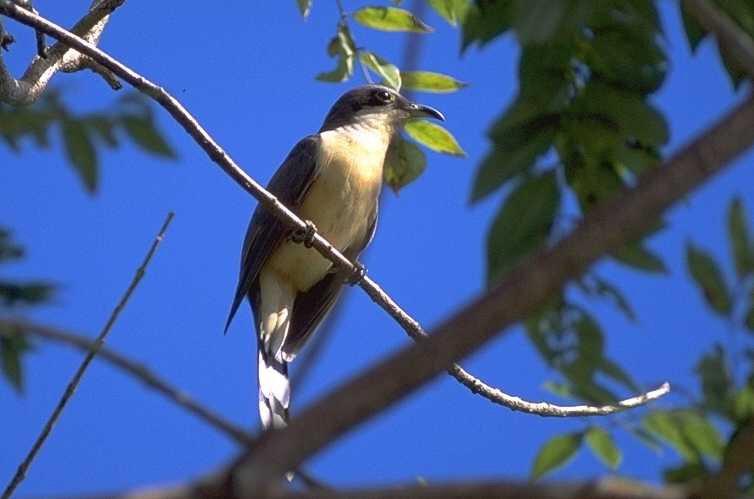
Mangrove Cuckoo

Mangrove Cuckoo

Mangrove Cuckoo (Coccyzus minor). Underparts uniformly rich buff; above grayish brown, crown grayer; ear-coverts black; tail black, outer feathers broadly tipped with white.

Range.—Northern South America, north through Central America, Mexico and Greater Antilles (except Porto Rico?) to Florida and Louisiana, migrating south in fall.

Maynard Cuckoo (C. m. maynardi). Similar to Mangrove Cuckoo, but underparts paler, the throat and forebreast more or less ashy white.

Range.—Bahamas and (eastern?) Florida Keys. (2012 Now Mangrove Cuckoo)

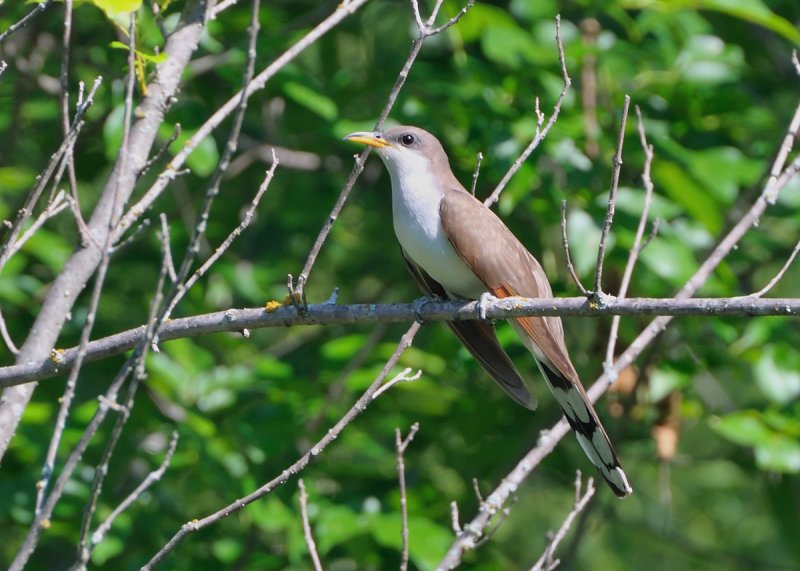
Yellow-billed Cuckoo (Coccyzus americanus) Neal Addy Gallery

Yellow-billed Cuckoo (Coccyzus americanus) Neal Addy Gallery

Yellow-billed Cuckoo (Coccyzus americanus). Length 12.2 in. Ads. Below white; lower mandible largely yellow, tail black, outer feathers widely tipped with white. Notes.Tut-tuttut-tuttut-tuttut-tutcl-uckcl-uckcl-uckcl-uckcl-uckcl-uckcowcowcowcowcowcow, usually given in part.

Range.—Eastern North America; breeds from Florida to New Brunswick and Minnesota; winters in Central and South America.

California Cuckoo (C. a. occidentalis). Similar to Yellow-billed Cuckoo but somewhat grayer and larger; the bill slightly longer, 1.05 in.

Range.—Western North America; north to southern British Columbia; east to Western Texas; winters south into Mexico.

Black-billed Cuckoo (Coccyzus erythropthalmus) by Jim Fenton

Black-billed Cuckoo (Coccyzus erythropthalmus) by Jim Fenton

Black-billed Cuckoo (Coccyzus erythrophthalmus). Length 11.8. Ads. White below; bill black; tail, seen from below, grayish narrowly tipped with white; above, especially on crown, browner than Yellow-billed Cuckoo. Notes. Similar to those of Yellow-billed Cuckoo, but softer, the cow notes connected.

Range.—Eastern North America; west to Rocky Mountains; breeds north to Labrador and Manitoba; winters south of United States to Brazil.

Cuckoo Sound with Pictures (From Poland)

Sort of sounds like the clock doesn’t it?

We will tell you more about the Cuckoo in the next Bible Birds – Cuckoo article.

*

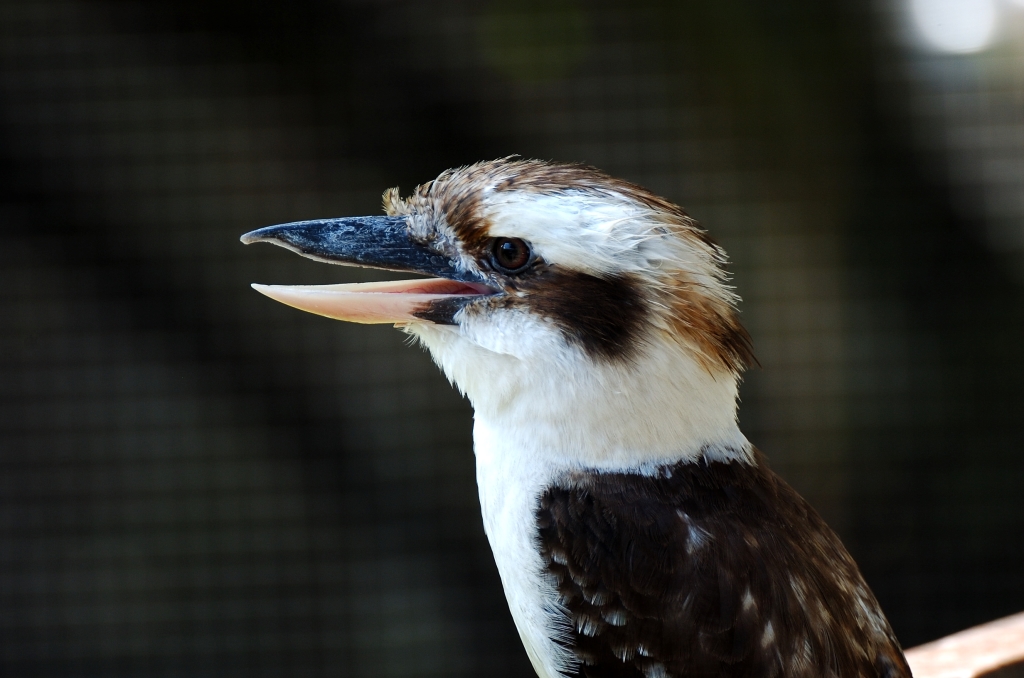
Kookaburra Encounter

Laughing Kookabura by Dan

Laughing Kookabura by Dan

On our vacation several weeks ago we stopped back by the Brevard Zoo in Melbourne, Florida.  I had a neat Kookaburra Encounter.

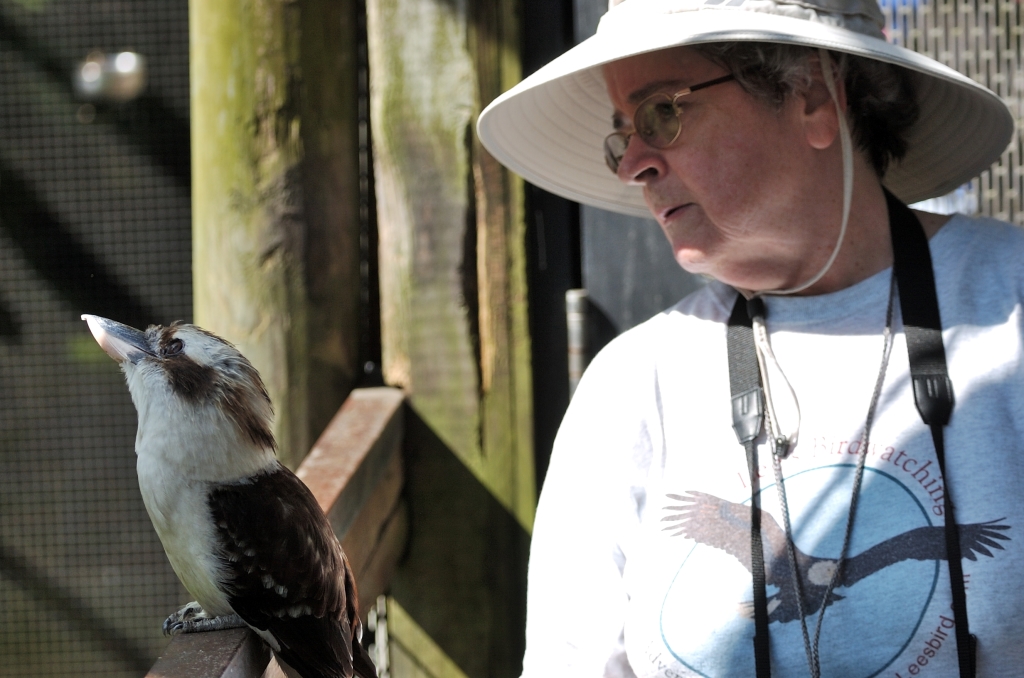
Lee with Laughing Kookabura at Brevard Zoo by Dan

Lee with Laughing Kookabura at Brevard Zoo by Dan

The Laughing Kookaburra is in the aviary where the Lorikeets, Galahs and other birds are kept. When I came through a door, right there on the rail sat a young Laughing Kookaburra. I have seen them before, but never as close as this one. I got within inches of him/or her. I could have touched it, but was afraid of that beak.

So God created great sea creatures and every living thing that moves, with which the waters abounded, according to their kind, and every winged bird according to its kind. And God saw that it was good. (Genesis 1:21 NKJV)

Here are some of the pictures we took.

Lee very close to Kookabura by Dan

Lee very close to Kookabura by Dan

I have to admit, I was thrilled. Just looking at one of the Lord’s creations so close. Wow! That one photo Dan took of me and the Kookaburra, my hand was within 5-6 inches from it. May I never lose my AWE at seeing and encountering the Lord’s critters.

*

Other Kookaburra encounters:
Birdwatching at the Cincinnati Zoo I
Birds Of The Bible – Joy And Laughter
Birdwatching Adventure to Brevard Zoo in Viera, FL
Birdwatching at the National Aviary – Introduction
Alcedinidae – Kingfishers – Family

*


Golden Eagle – Birds Are Free

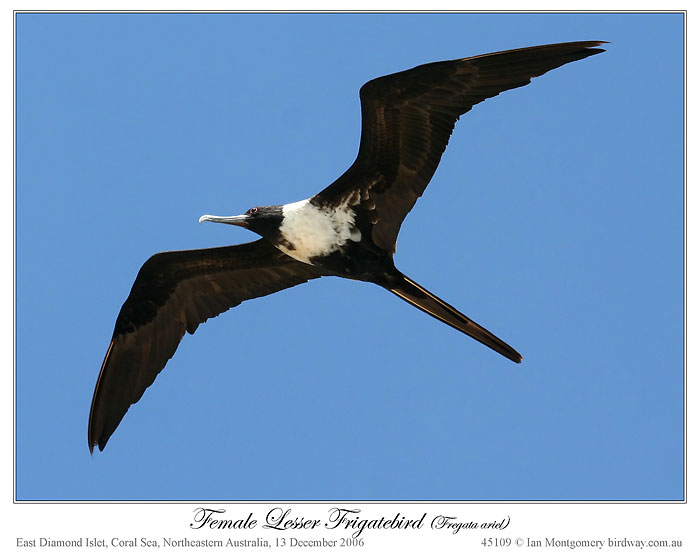
Lesser Frigatebird (Fregata ariel) female by Ian

Lesser Frigatebird (Fregata ariel) female by Ian

Golden Eagle ©PD

Golden Eagle ©PD

Hey kids! What do birds bring to your mind? To me, the Golden Eagle, they are free from this old world. I mean that they are free from gravity! They can soar above the trees and above the beautiful mountains that God created! Speaking of gravity-Jesus walked on water! Peter walked on water and Jesus was taken away in the clouds when He went back to Heaven!

And when Jesus had spoken these things, while they beheld, he was taken up; and a cloud received him out of their sight…THIS SAME JESUS, WHICH IS TAKEN UP FROM YOU INTO HEAVEN, SHALL SO COME IN LIKE MANNER AS YE HAVE SEEN HIM GO INTO HEAVEN” (Acts 1:9,11)


Jesus and the Bible has promised that He will return to this very earth someday in the future! It might even be today! Please make sure that you are born again, that you are saved, that you have received Him, a free GIFT OF ETERNAL LIFE from the Father! I for one want to live forever.

 Birds are free, they can soar to new heights, they are very colorful, and just full of beautiful colors! They make their nests in many different places! Sometimes in a tree, yes in a nest that they have made. Sometimes they live on the side of a cliff or they burrow a whole in the ground like some owls. Some birds will nest right on the ground. The cool thing is that God takes care of them and He takes care of us every day.
Painted Bunting (Passerina ciris) ©©Flickr

Painted Bunting (Passerina ciris) ©©Flickr

Hey, how’s that journal coming along? Have you spotted any birds? Have you entered that in your journal? Have you run across an interesting bird story? Do any of you have a question for the Golden Eagle? Free flight, fantastic colors, and fun builders of nests! The amazing creation of birds shows us the amazing ability of an awesome God! If you look around your room or you house, do you see any material things? Of course you do. And you know that each thing you see and touch, somebody made the things that you are looking at. They did not get there by pure chance, did they? Well, this earth, the Universe, you and me, the birds did not just get here by chance! That is what evolution teaches, but that doesn’t even make any sense. Nothing happens by pure chance. If that was true, there would be no purpose or reason for being in existence at all. The Bible teaches us that God made everything.

 For in six days the Lord made heaven and earth, the sea, and all that in them is… (Exodus 20:11)
That means that God made EVERYTHING and that He controls everything. There are no accidents with God. God is in control of each thing that happens around us and each thing that happens through us! Keep your eyes open, your ears alert, and watch today for the things that God is doing in your life and around you. I am certain that Jesus Christ, who is God, will be working TODAY!
Bye until the next adventure, I see a fish in my pond and I am hungry.
*

More from Golden Eagle

The Wordless Book

*

Golden Eagle – Goodness of God

Golden Eagle (Aquila chrysaetos) ©USFWS

Golden Eagle ©PD

Golden Eagle ©PD

Hi! Gals and Guys, this is Golden Eagle flying in for a few minutes. I remembered when I woke up this morning that this is my Father’s World. The gold is His , the silver belongs to Him, and He owns the cattle on a thousand hills. I rolled out of my nest early this morning and everything was wet. You know it rained really hard yesterday night. I stretched my wings out so the glistening sunlight could warm them up. I began to preen my feathers, sometimes they get really messy in the morning. I heard the melodious songs of other birds and smiled when I thought of the goodness of God. You know, some things are so simple that we often miss them. God is spelled G-O-D and good is spelled G-O-O-D. They’re almost the same. For you see, God is good all the time. He sends the rain and the sunshine on the saved and the lost.

Jesus said “Consider the lilies of the field, how they grow; they toil not, neither do they spin: And yet I say unto you, That even Solomon in all his glory was not arrayed (dressed) like one of these.”(Matthew 6:28-29)

Jesus also said “Behold the fowls of the air: (the birds) for they sow not, neither do they reap, nor gather into barns; yet your heavenly Father feedeth them. Are ye not much better than they?” You see, the Bible tells us of the Creator-God . He says that we were created just a “little lower than the angels.” You humans are much better than us birds. You really didn’t evolve.

Hey kids, we all have our troubles and problems. When Jesus says to think about the lilies, the flowers, the fowls, and the birds He is telling us to think about God. Put your mind on the Lord Jesus Christ. We do this by reading the Bible, the Word of God. Every day we should read the Bible. And with God’s help we should believe the Word of God and try to obey the Word of God.

Psalm 2:2-3 says that “his delight is in the law of the Lord (the Word of God): and in his law doth he meditate day and night.”

He delights in the Bible and thinks about God. In my nest I have ice-cream every night because that’s what I delight in! Jesus continues, “And he shall be like a tree planted by the rivers of water, that bringeth forth his fruit in his season; his leaf also shall not wither; and whatsoever he doeth shall prosper.” Thinking about God will make you a success every time!

Focus on God, the Lord Jesus Christ, and He will work a miracle in you. Get saved and His life will flow through you and He will pour out His blessings on all the people you come in contact with. This is my Father’s world.

See ya!!!

Goldie

*

Golden Eagle

Wordless Birds

Bible Birds

*

Introduction to Bible Birds

Prothonotary Warbler (Protonotaria citrea) ©WikiC

Prothonotary Warbler (Protonotaria citrea) ©WikiC

Introduction to Bible Birds

This is an Introduction to the Bible Birds. We have been adding many things about the birds in the Bible and other birds that are not named in the Bible, but the Lord made all the birds.

On Day Five (5) of creation, the birds were created. They didn’t just happen. They were designed by God and each one is different. Each one was given just what it needs to live, eat, and make more birds.

Genesis 1:20-23 NKJV
(20) Then God said, “Let the waters abound with an abundance of living creatures, and let birds fly above the earth across the face of the firmament of the heavens.”
(21) So God created great sea creatures and every living thing that moves, with which the waters abounded, according to their kind, andevery winged bird according to its kind. And God saw that it was good.
(22) And God blessed them, saying, “Be fruitful and multiply, and fill the waters in the seas, and let birds multiply on the earth.”
(23) So the evening and the morning were the fifth day.

I know there are some big words in those verses, but the bold letters help find important words.

Did you see the “let birds multiply”? That doesn’t mean they do math. It means that they were to have baby birds, then the baby could grow up and have more baby birds. Then there would be lots of birds.

We will be telling you more soon. Come back and find out about the many birds in the bible.

See:

Bible Birds

Birds of the Bible

Wordless Birds

*

(Sept 1 – Opened up a new section of the blog called Kids Section – Bible Birds. This is the Introduction for their Bible Birds section, which has links to easier reading articles or ones written for the younger folks.

Some of these articles were here already and others were written just for the Birds of the Bible For Kids blog.  We are placing a copy of all articles on this blog. This will save much duplications. Also, the younger readers will also have the benefit of the wealth of information here also.

Expect to see more articles for both our regular readers and our younger readers. You might be surprised how interesting they can be.

Sunday Inspiration – Passerines

Lazuli Bunting (Passerina amoena) by Michael Woodruff

Lazuli Bunting (Passerina amoena) by Michael Woodruff

By them the birds of the heavens have their home; They sing among the branches. He waters the hills from His upper chambers; The earth is satisfied with the fruit of Your works. He causes the grass to grow for the cattle, And vegetation for the service of man, That he may bring forth food from the earth, (Psalms 104:12-14 NKJV)

A passerine is any bird of the order Passeriformes, which includes more than half of all bird species. A notable feature of passerines is the arrangement of their toes (three pointing forward and one back) which facilitates perching. Sometimes known as perching birds or, less accurately, as songbirds, the passerines form one of the most diverse terrestrial vertebrate orders, with over 5,000 identified species. It has roughly twice as many species as the largest of the mammal orders, the Rodentia. It contains more than 110 families, the second-most of any order of tetrapods (after Squamata, the scaled reptiles).

The names “passerines” and “Passeriformes” are derived from Passer domesticus, the scientific name of the eponymous species (the house sparrow) and ultimately from the Latin term passer for Passer sparrows and similar small birds.

This slideshow requires JavaScript.

*

“Sweet Hour of Prayer” by Sean Fielder (Faith Baptist)

Enjoy God’s creation as you watch and listen to Sean play. May we all pray and thank the Lord for all He has given from His Hand.

The LORD will command His lovingkindness in the daytime, And in the night His song shall be with me— A prayer to the God of my life. (Psalms 42:8 NKJV)

Be anxious for nothing, but in everything by prayer and supplication, with thanksgiving, let your requests be made known to God; (Philippians 4:6 NKJV)

*

Sunday Inspiration

PASSERIFORMES – Passerines

Sharing The Gospel

*

Peterson’s Field Guide Videos Updated

Peregrine Falcon (Falco peregrinus) by Ray

Peregrine Falcon (Falco peregrinus) by Ray

Give instruction to a wise man, and he will be yet wiser: teach a just man, and he will increase in learning. (Proverbs 9:9 KJV)

Peterson Field Guide-Videos

Finished updating the missing videos for the Peterson Field Guide videos. The Vodpod company stopped supporting its videos, which was unknown to me. All of these videos were on YouTube and are now working properly again.

They are very interesting and if you haven’t seen them or at least for a while, they are worth checking out. Here are some of the titles:

How-to Videos:

Give instruction to a wise man, and he will be yet wiser: teach a just man, and he will increase in learning. (Proverbs 9:9 KJV)

How to Identify Birds
Topography (Parts of the Bird)
Bird Songs and Sounds
Range Maps

Bird Families:

Common Loon
Atlantic Puffin
Ducks, Geese, Swans
Wood Duck
Shorebirds Overview
Shorebirds ID
Gulls and Terns
Heron, Egrets, Bitterns – Updated
Wild Turkey
Raptors Overview
Raptors ID
Bald Eagle
Peregrine Falcon
Owls
Greater Roadrunner
Hummingbirds
Woodpeckers
Red-Headed Woodpecker
Flycatchers
Northern Mockingbird
Thrushes
American Robin
Warblers
Meadowlarks
Finches
Northern Cardinal
Sparrows

Enjoy! Dust is still flying as I’m still searching for other broken Vodpod videos.

*


Ian’s Bird of the Week – Great Frigatebird

Great Frigatebird (Fregata minor) Male by Ian

Ian’s Bird of the Week – Great Frigatebird ~ by Ian Montgomery

Newsletter – 8/28/14

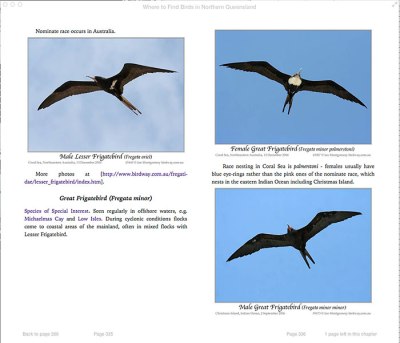
This week’s good news is that the ebook Where to Find Birds in Northern Queensland is now available on the iTunes store (in 51 countries). So if you have an iPhone, iPad, iPod Touch or Mac (running OS X Maverick) this is for you! Here is the link: https://itunes.apple.com/au/book/where-to-find-birds-in-northern/id912789825?mt=11&uo=4. To make a connection with this week’s bird, the Great Frigatebird, here is a screen shot from iBooks to show you what you can expect. All the text items highlighted in purple and links to either other places in the book – typically places, birds or lists – or external websites. The images are the same size as the ones that are included in the bird of the week, so if you double-click, or double-tap, on them, you can enlarge them to full size.
Great Frigatebird (Fregata minor) by Ian

If you think about birds in northern Queensland, perhaps iconic rainforest species like the Cassowary or Victoria’s Riflebird come to mind. Fair enough, but there is much more to this region than rainforest, important though that is.The area also has wonderful wetlands, tropical savannah forest, mountain ranges, dry country habitats and, last but not least, the coast with its Barrier Reef, beaches, mangroves, mudflats, continental islands and coral cays. So it should be no surprise that over 400 species of birds occur here and you need a reference devoted to the region to do it justice. I’ve chosen a dramatic seabird to make the point.

The term ‘frigate’ was first applied in the 17th century to warships built for speed and manoeuvrability and frigates were often used by pirates to attach merchant shipping. Frigatebirds, also called Man o’ War Birds, got their name for their piratical habitats of harrying other seabirds like boobies and tropicbirds to make them drop their prey. In fact, studies have shown that piracy accounts for perhaps only 20% of their food, and they are expert fishers as well. They fish by snatching prey, such as squid and young turtles, from the surface of the sea or in flight, in the case of their favourite prey, flying fish.

Great Frigatebird (Fregata minor) Female by Ian

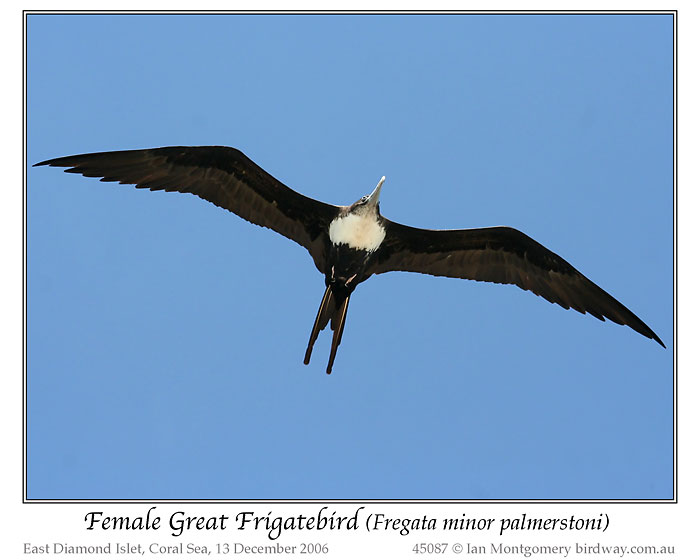
Despite their naval name, frigatebirds are wonderfully adapted for flying and are poor swimmers to the extent that they are reluctant to land on water, as they can take off only in strong winds and their plumage is not waterproof. They have very light bones making up only 5% of the body, huge pectoral muscles, enormous wing area, long forked tails for rudders and streamlined bodies with small heads. Despite their size, they are very light, soar effortlessly in good winds and are very acrobatic. Female Great Frigatebirds, larger than males, are about 1m/40in long, have a wingspan to 2.3m/90in but weight only 1.2-1.6kg/2.6-3.5lb.
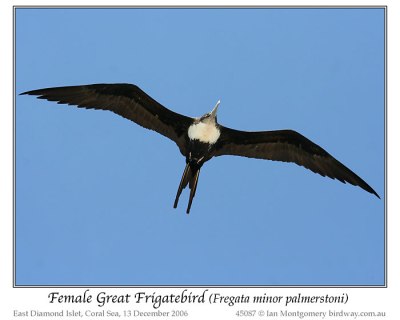
Great Frigatebird (Fregata minor palmerstoni) Female by Ian

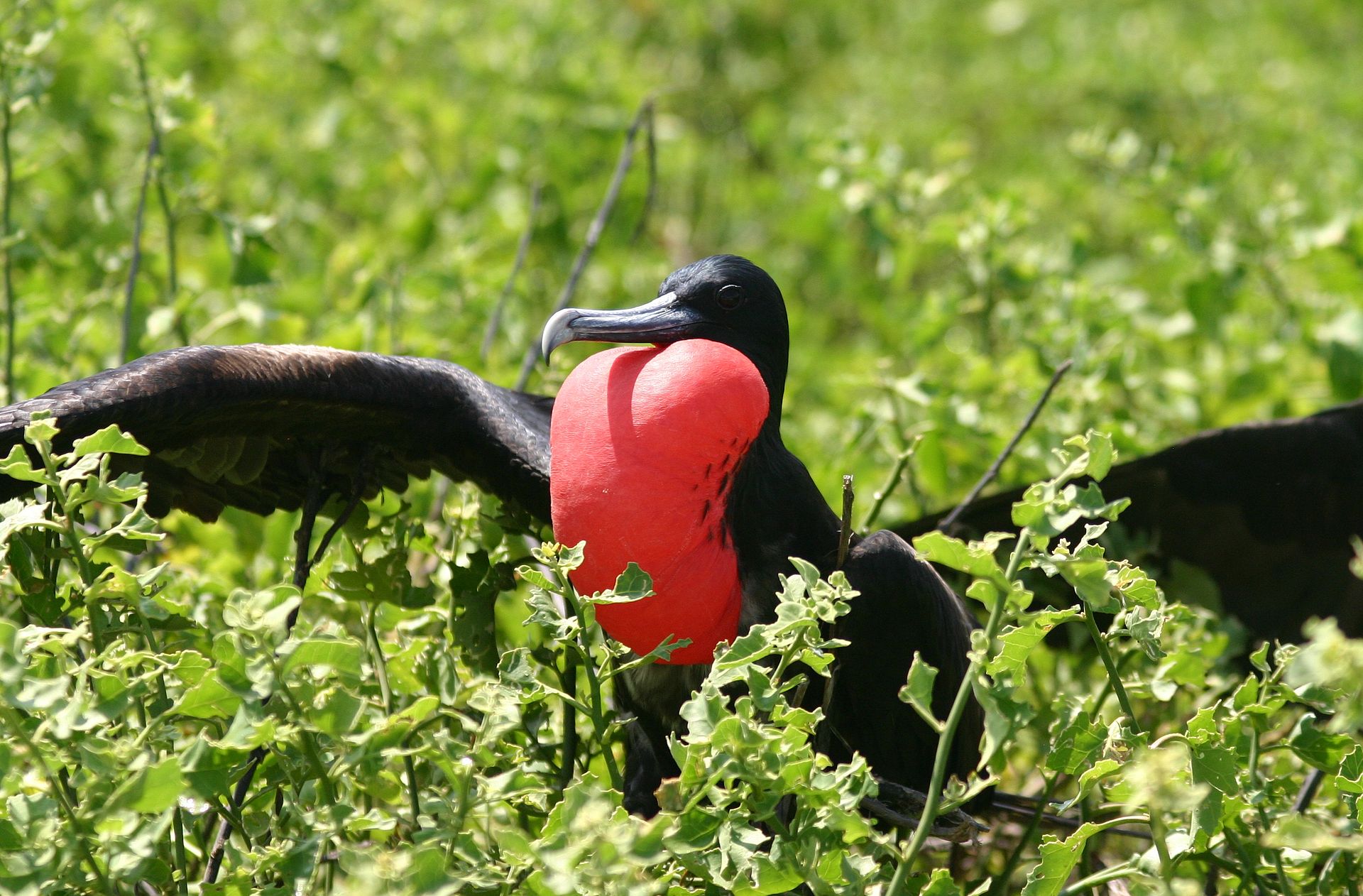
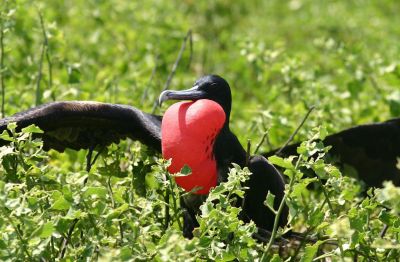
The male Great Frigatebird, first photo, is the only all-black frigatebird occurring in Australia – the other all-black males are the Magnificent Frigatebird of Atlantic Ocean and the eastern Pacific and the Ascencion Frigatebird of the east Atlantic. Frigatebirds are unusual among seabirds in drinking freshwater if they can get it, and this male is drinking at the mouth of freshwater stream on Christmas island by snatching a beak-full of water in flight. Frigatebirds also bathe in flight by splashing into the surface of the water and flying off. You can also see its red gular pouch. This is inflated to enormous size to impress females during courtship. I haven’t got a photo of displaying Great Frigatebird, but you can see a Magnificent Frigatebird doing so here: Magnificent_Frigatebird.
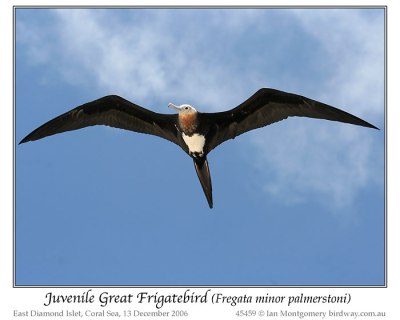
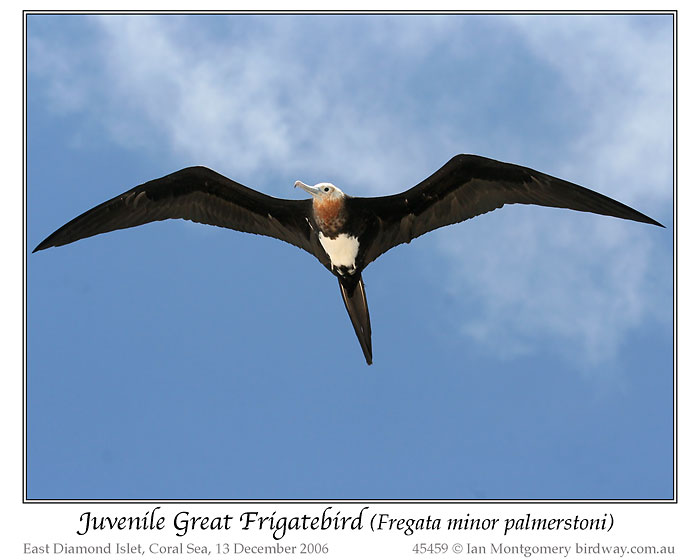
Great Frigatebird (Fregata minor palmerstoni) Juvenile by Ian

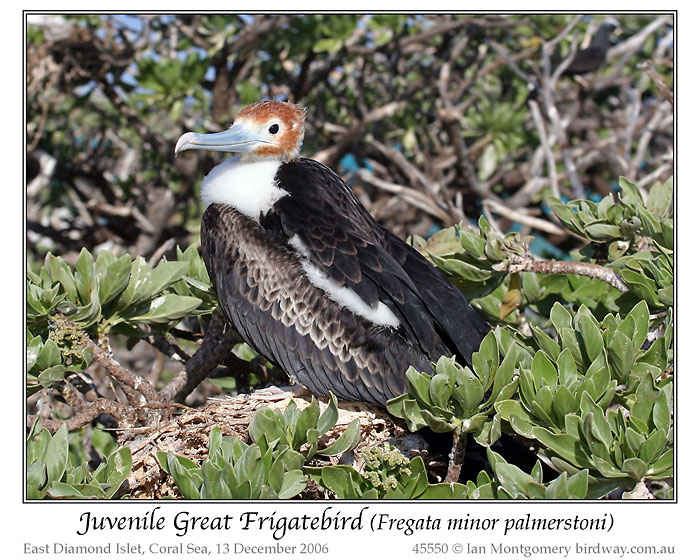
Female Great Frigatebirds have white breasts and care needs to be taken in distinguishing them from other female and juvenile frigatebirds – Lesser Frigatebirds of both sexes have white ‘spurs’ in the axil of the underwing, and Christmas Island Frigatebirds of both sexes, have white bellies. Birds in Indian Ocean waters in Australia belong to the nominate race minor, distinguished by the females having pink eye-rings, second photo. Birds in the Pacific belong to palmerstoni and usually have blue eye-rings, third photo, though doubt exists as to the validity of the races and the reliability of the fieldmarks.
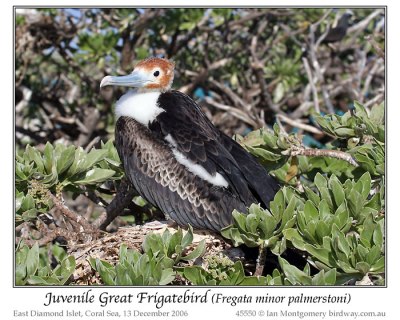
Great Frigatebird (Fregata minor palmerstoni) Juvenile by IanBecause of their need for consistent winds, frigatebirds are restricted to tropical waters where they can rely on the trade winds. Adults are sedentary and remain close to their roosting sites and breeding colonies, mostly on small isolated islands. Non-breeding birds and immature birds are pelagic and move over huge distances. Trade winds are unusual in that they form cumulus clouds and hence thermals over water both by day and night, and frigatebirds make great use of these to soar as high as the cloud base and will fly at night if conditions are right. Pelagic frigatebirds use the front of storms to move around and can cope with high winds very well. This is why they appear in coastal areas after cyclones and are supposed to be called ‘rain-brothers’ by Australian aborigines, though I haven’t been able to verify this.
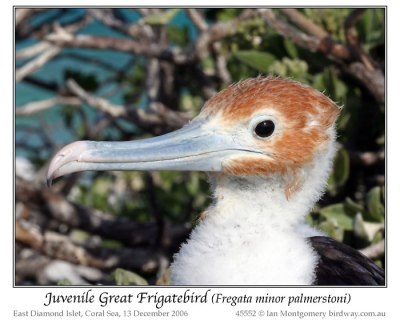
Great Frigatebird (Fregata minor palmerstoni) Juvenile by IanThe range of the Great Frigatebird includes the tropical Pacific, southern tropical Indian and western Atlantic Oceans. In Australia it breeds colonially on islands along the outer Great Barrier Reef, in the Coral Sea and on Christmas and Cocos (Keeling) Islands in the Indian Ocean, usually in mangroves. The juvenile in photos five and six was photographed on East Diamond Islet, about 600km east of Cairns http://www.satelliteviews.net/cgi-bin/w.cgi?c=cr&UF=34304&UN=456541&DG=ISL. Breeding birds form pair bonds and both parents share in the incubation and feeding of the young. The young develop very slowly. This is thought to adapt them to periods of starvation when the adults have trouble finding food, and remain under parental care for many months.

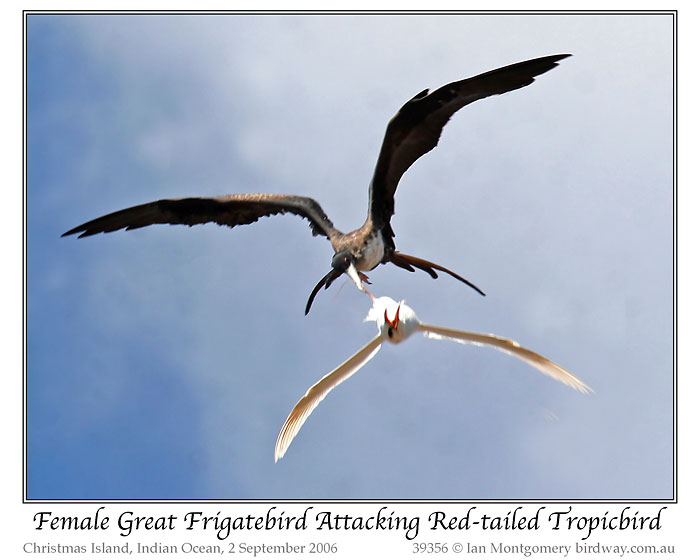
Great Frigatebird (Fregata minor) Female attacking Red-tailed Tropicbird by IanThe last photo shows a hapless Red-tailed Tropicbird near Christmas Island being harried by a female Great Frigatebird who has grabbed it by the tail-streamers. Frigatebirds hang out near seabird colonies waiting for birds carrying prey or with full crops returning to feed their young. It’s hard enough work being a parent without having to put up with this!

Greetings
Ian

**************************************************
Ian Montgomery, Birdway Pty Ltd,
454 Forestry Road, Bluewater, Qld 4818
Tel 0411 602 737 ian@birdway.com.au
Bird Photos http://www.birdway.com.au/
Recorder Society http://www.nqrs.org.au


Great Frigatebird (Fregata minor) Male Displaying ©WikiC

Great Frigatebird (Fregata minor) Male Displaying ©WikiC

Lee’s Addition:

but those who trust in the LORD will renew their strength; they will soar on wings like eagles; they will run and not grow weary; they will walk and not faint. (Isaiah 40:31 HCSB)

Thanks again, Ian, for introducing us to another interesting bird. We have seen the Magnificent Frigatebirds here in Florida, but these Great ones are also amazing. That fact about only 5% of their weight being the bone structure is another fantastic design from their Creator.

Frigatebirds belong to the Fregatidae – Frigatebirds Family which only has five species in it.

*
Ian’s Bird of the Week

Ian’s Bird of the Week – Lesser Frigatebird

Fregatidae – Frigatebirds Family

Great Frigatebird – Wikipedia

*


Eagles and Ravens

Bald Eagle (Haliaeetus leucocephalus) by PattiKru

Bald Eagle (Haliaeetus leucocephalus) by PattiKru

EAGLES AND RAVENS

He is Very Brave

He is Very Brave


“Some white-tailed eagles were boasting one day of their bravery,” commenced daddy. “They were also saying how fine they were in every way and that their very name meant something splendid and free and strong.

“As a matter of fact, though the white-tailed eagles won’t admit it, they are less brave than any of the eagle families.
“The ravens are not kindly at all and they love to fight. They had often thought it would be great sport to have those ‘silly white-tailed eagles,’ as they called them, admit that they were not brave and have their leader beg for mercy from General Raven.
“And, as you can imagine, when Brother Black Raven heard the eagles boasting he knew it was high time to begin and frighten them.
“So he called all the ravens together. Some of them were having their naps, but as soon as Brother Black Raven called them, up they got in a great hurry, spread their wings and drilled a little bit just like soldiers. Only instead of marching they flew.
“As General Raven came near the nest of the white-tailed eagles, he said in a very queer, croaking sort of voice:
“‘Good-morning!’ That was rather mean of him to say, for, of course, he didn’t really wish them a ‘Good-morning.’
“‘Do you want to fight?’ asked General Raven.
“Still not a sound from the eagles. There was a slight fluster and trembling, which the ravens could hear and which made them grin with delight, but the eagles never said a word. They didn’t even look at the ravens! For they were so frightened they didn’t dare look at them, and they kept thinking, ‘Oh, won’t those awful ravens and their ugly old general go away?’ The eagles, of course, thought the ravens were very ugly because they were so afraid of them.
“‘For the last time, do you want to fight us, eh?’ asked General Raven. And still the eagles said not a word—nor made a sound. ‘Well, let me say then for all of us,’ said General Raven, ‘that we think you’re very cowardly, and we heard you talking before we came of your bravery. We wouldn’t fight you because you’re afraid of us, but you’ll have to admit it after this,’ and with a deep chuckle off went General Raven and his followers.
“The eagles did not go on boasting, but they were very contented that the ravens had gone away!”

Northern Raven (Corvus corax) by Kent Nickell

Northern Raven (Corvus corax) by Kent Nickell

Lee’s Addition:

For I say, through the grace given to me, to everyone who is among you, not to think of himself more highly than he ought to think, but to think soberly, as God has dealt to each one a measure of faith. (Romans 12:3 NKJV)

By pride comes nothing but strife, But with the well-advised is wisdom. (Proverbs 13:10 NKJV)

We should be careful not to think too much or ourselves or boast. We can have confidence through Christ, but should never get “proud.”

*

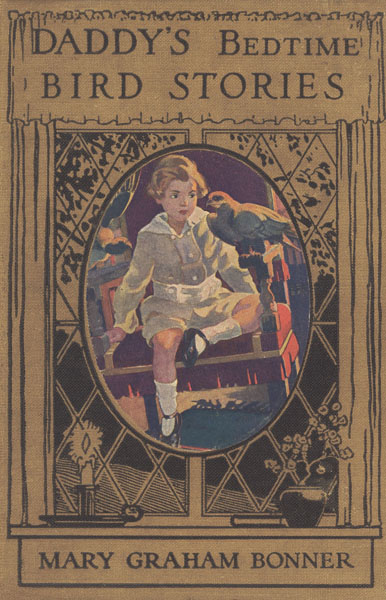
From Daddy’s Bedtime Bird Stories – Gutenberg ebooks By Mary Graham Bonner With four illustrations in color by Florence Choate and Elizabeth CurtisDaddys Bedtime Story ImagesThese stories first appeared in the American Press Association Service and the Western Newspaper Union.


Many of the sketches in this volume are the work of Rebecca McCann, creator of the “Cheerful Cherub,” etc.Daddy's Bedtime Bird Stories by Mary Graham Bonner - 1917Daddy’s Bedtime Bird Stories by Mary Graham Bonner – 1917

*

Links:

Painted Bunting (Passerina ciris) ©©Flickr


  Bird Tales


  Daddy’s Bedtime Bird Stories


Spanish Sparrow (Passer Hispaniolensis) female ©WikiC


  Wordless Birds


*

Ian’s Bird of the Week – Pale-headed Rosella

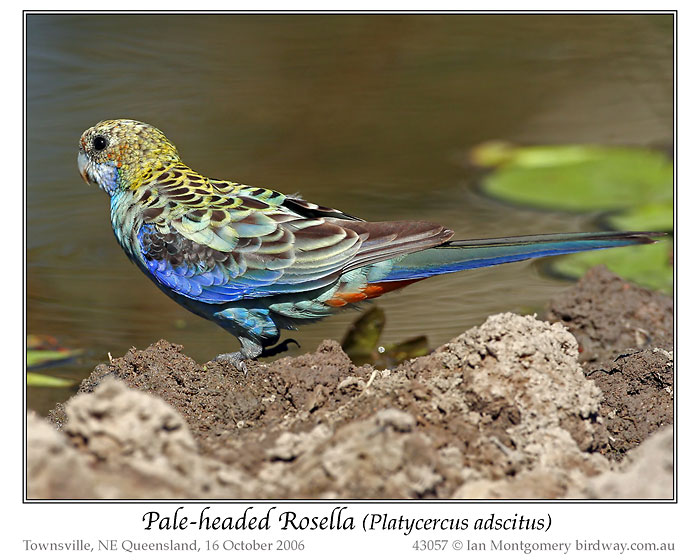
Pale-headed Rosella (Platycercus adscitus) by Ian

Pale-headed Rosella (Platycercus adscitus) by Ian

Ian’s Bird of the Week – Pale-headed Rosella ~ by Ian Montgomery

Newsletter – 8/24/14

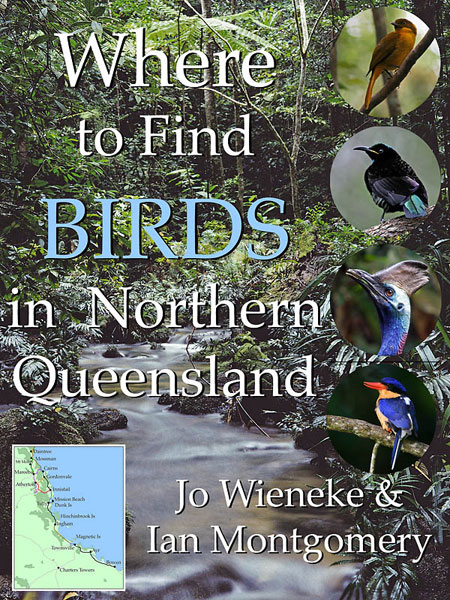
The bird of the week is the Pale-headed Rosella, which I’ll get to in a second, but this is a Special Edition as Where to Find Birds in Northern Queensland is at last being published. That is to say, it has been published on Google Play but not yet on the Apple iBook store. That will take a little longer as there are bureaucratic obstacles to be over come. These involve registering Birdway Pty Ltd with the US Inland Revenue and then Apple confirming the registration with the IRS. The first part was easy but the second seems harder as it takes a while for the registration to soak through and finally emerge in the IRS online databases. Anyway, I’ll let you know, loudly, when that happens. In the meantime, you can find it on Google at https://play.google.com/store/books/details?id=CblRBAAAQBAJ.

Where To Find Birds in Northern Queensland by Ian

Where To Find Birds in Northern Queensland

End of commercial!

The Pale-headed Rosella, is the widespread and familiar Rosella of Queensland, though it range does extend as far as northern New South Wales. There, and in southeastern Queensland, its range overlaps with the closely related Eastern Rosella and they sometimes interbreed.

The ones in the first two photos were taken outside my house. The first bird is feeding on the seeds of weeds, plenty of those here, and the second is feeding on the fruit of wild passionfruit, another weed, also called stinking passionfruit (Passiflora foetida) as the foliage emits a strong odour when crushed. They’re lovely birds, rather unobtrusive though their soft twittering calls reveal their presence, and I’ll always get pleasure from seeing them. They’re usually in pairs of family parties. The plumage is variable: the bird in the first photo has a much intense blue breast than the second one, but the field guides are tight-lipped about whether the plumage of the sexes differs.

Pale-headed Rosella (Platycercus adscitus) by Ian

Pale-headed Rosella (Platycercus adscitus) by Ian

They’re more forthcoming about the plumage of juveniles, as these often show traces of red or darker feathers on the head, like the one coming down for a drink in the third photo.

Pale-headed Rosella (Platycercus adscitus) by Ian

Pale-headed Rosella (Platycercus adscitus) by Ian

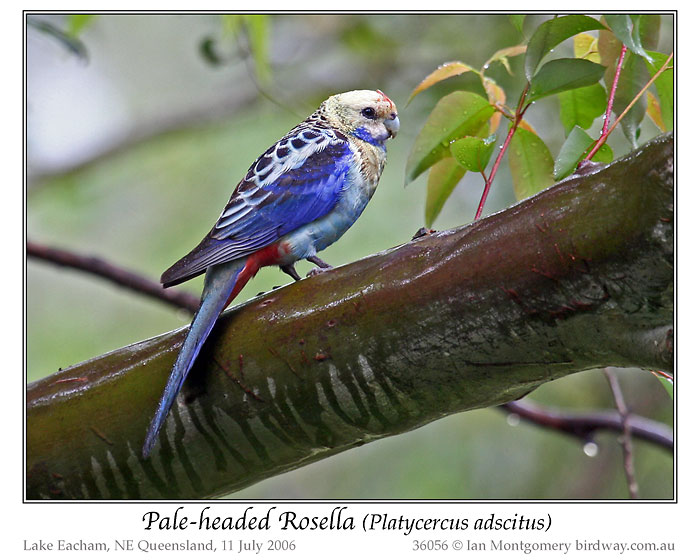
There are two races of the Pale-headed Rosella, a northern paler one on Cape York and south to about Cairns, and a southern darker one south of Townsville with a 300km/200mile band of intergrading between Cairns and Townsville. Originally these were described as two different species, the northern one being the Blue-cheeked Rosella, Platycercus adscitus, the southern one the Pale-headed Rosella, P. palliceps. When they were lumped together, the earlier name adscitus took priority, so the northern race is the nominate one and the southern darker one is race palliceps – unfortunately, given that it is the more intensely coloured. Adscitus means ‘approved’ or ‘accepted’, though exactly what was approved or accepted, I don’t know.

Pale-headed Rosella (Platycercus adscitus) by Ian

Pale-headed Rosella (Platycercus adscitus) by Ian

The Townsville birds in the first three photos belong to palliceps. The two, photographed together at Lake Eacham southwest of Cairns, are much closer the nominate race. The yellow is much paler overall, particularly on the back and the upper breast is mainly pale yellow, rather than blue, but there is a blue patch on the lower cheek. The bird in the fifth photo has clear traces of red on the forehead and is a juvenile; the one in the fourth photo has pinkish traces and may be a young bird too.

Pale-headed Rosella (Platycercus adscitus) by Ian

Pale-headed Rosella (Platycercus adscitus) by Ian

The taxonomy of Rosellas in general has been controversial and is still unsettled. Some authorities maintain that the Pale-headed, the Eastern Rosella and the Northern Rosella all belong to a single species even though they look quite different. Whatever, they’re lovely birds, and the good news is that the Pale-headed Rosella has benefitted from European settlement and the clearing of dense forests – they prefer more open areas.

Links:
Pale-headed Rosella 
Eastern Rosella 
Northern Rosella 

Greetings
Ian

**************************************************
Ian Montgomery, Birdway Pty Ltd,
454 Forestry Road, Bluewater, Qld 4818
Tel 0411 602 737 ian@birdway.com.au
Bird Photos http://www.birdway.com.au/
Recorder Society http://www.nqrs.org.au

Lee’s Addition:

Oh that my words were now written! oh that they were printed in a book! (Job 19:23 KJV)

I have fought a good fight, I have finished my course, I have kept the faith: (2 Timothy 4:7 KJV)

Glad they finally have their book published. I know that Ian has been working on this for some time. It is always a great feeling when a project is completed.

Also, the Pale-headed Rosella is a beautiful bird. Another great creation from their Creator. I especially like that first photo.

Rosellas are members of the Psittacidae – Parrots Family. You can see Ian’s photos of this family by clicking here.

See:

*