This is the second volume of a series intended to present, in accurate colored portraiture, and in popular and juvenile biographical text, a very considerable portion of the common birds of North America, and many of the more interesting and attractive specimens of other countries, in many respects superior to all other publications which have attempted the representation of birds, and at infinitely less expense. The appreciative reception by the public of Vol. I deserves our grateful acknowledgement. Appearing in monthly parts, it has been read and admired by thousands of people, who, through the life-like pictures presented, have made the acquaintance of many birds, and have since become enthusiastic observers of them. It has been introduced into the public schools, and is now in use as a text book by hundreds of teachers, who have expressed enthusiastic approval of the work and of its general extension. The faithfulness to nature of the pictures, in color and pose, have been commended by such ornithologists and authors as Dr. Elliott Coues, Mr. John Burroughs, Mr. J. W. Allen, editor of The Auk, Mr. Frank M. Chapman, Mr. J. W. Baskett, and others.
The general text of Birds—the biographies—has been conscientiously prepared from the best authorities by a careful observer of the feather-growing denizens of the field, the forest, and the shore, while the juvenile autobiographies have received the approval of the highest ornithological authority.
The publishers take pleasure in the announcement that the general excellence of Birds will be maintained in subsequent volumes. The subjects selected for the third and fourth volumes—many of them—will be of the rare beauty in which the great Audubon, the limner par excellence of birds, would have found “the joy of imitation.”
Nature Study Publishing Company.
BIRDS.
Illustrated by COLOR PHOTOGRAPHY.
Vol. II. No. 1. JULY, 1897.
Bald Eagle (Haliaeetus leucocephalus) by Lee
Lee’s Addition:
This second volume does not have a cover photo for each month like Volume I did. They apparently changed their format. Also, there are no old time advertisements. These were reproduced through Gutenberg Project.
Bird of the Week – Bohemian Waxwing ~ by Ian Montgomery
Newsletter – 7/5/12
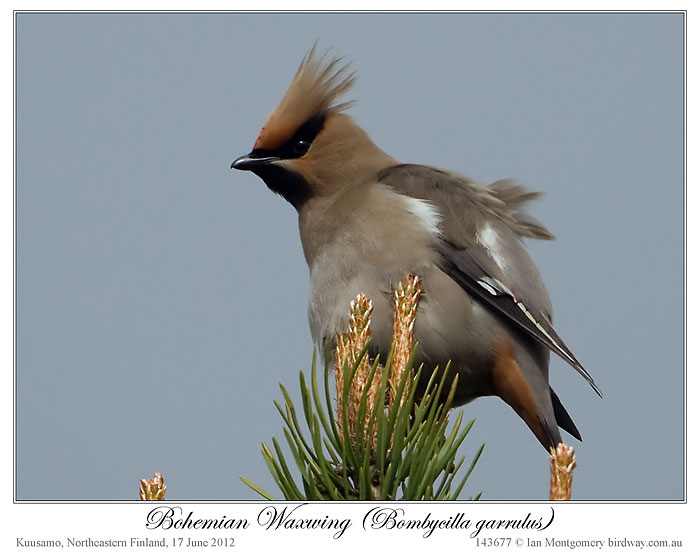
Following on from the Black Woodpecker, here is the (Bohemian) Waxwing another unusual northern European species that has a 50 year connection for me.
The Bohemian Waxwing breeds across northern Eurasian and North America and moves southwards in winter in search of its staple winter food, berries. In Western Europe, it usually goes only as far as Germany and northern France, but in some years, driven by food shortages, it makes its way as far west as Britain and, more rarely, Ireland. That happened in the early 1960s when I was a schoolboy in Ireland, and I once saw several feeding on berries in a suburban street in Dublin (Eglington Road). I hadn’t seen them again since until my trip to Finland two weeks ago and I drove down that street a few days ago.
Bohemian Waxwing by Ian 2
These starling-sized birds are exotic by European standards and beautiful by any, so you can imagine my excitement all those years ago. It was good to catch up with them again in Finland, and this female, perched on top of a conifer, allowed me to approach fairly closely. They get their name from the red waxy-looking tips to some of the wing feathers, which you can see if you look carefully at the photos. These are more obvious in males, and the whitish stripes below the red spot are much yellower in males.
Bohemian Waxwing by Ian 3
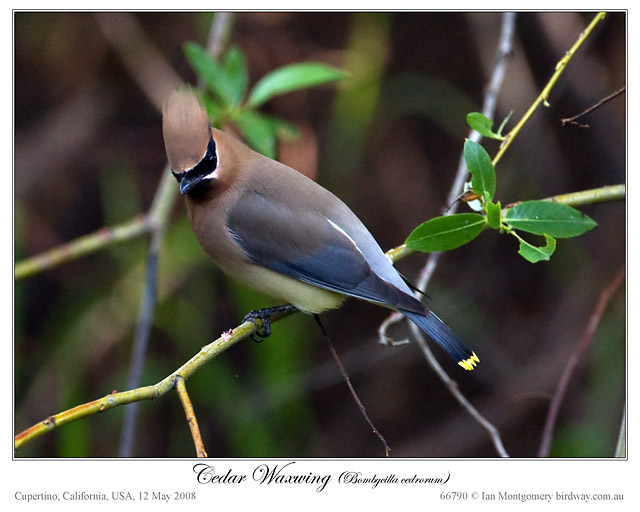
In Europe, these birds are just called Waxwings, but in North America there are two species and this one is qualified with the Bohemian tag to separate it from the slightly smaller but otherwise rather similar Cedar Waxwing. This featured as Bird of the Week three years ago and here it is again:
Bohemian Waxwing by Ian 4
Waxwings have silky feathers, and the generic name Bombycilla means, in pigeon Latin, ‘silky tail’. There are only 3 species – the third being the Japanese Waxwing – and they were originally the only members of the family Bombycillidae. Recent genetic studies have shown that several other species are related to them and have been moved into the family. Interestingly, these include the three species of aptly-named Silky-Flycatchers (the ‘silky’ being apt, not the greatly overused ‘flycatcher’), such as the Long-tailed Silky-Flycatcher and you’ll see the family resemblance if you follow the link.
Meanwhile in Dublin, my niece has given birth to a delightful baby girl, Aoibhinn, and both mother and child are doing well. Ancient Irish names are very fashionable here and ‘bh’ in Irish has a ‘v’ sound (strictly speaking it’s an aspirated ‘b’, traditionally represented by a dot over the ‘b’) so the name is pronounced something like ‘eaveen’. Aiobhinn timed her arrival well and waited until all the immediate members of the family were in Dublin, including my other niece who came over from Strasbourg with her husband.
Best wishes
Ian
**************************************************
Ian Montgomery, Birdway Pty Ltd, to a
454 Forestry Road, Bluewater, Qld 4818
Tel 0411 602 737 ian@birdway.com.au
Check the latest website updates: http://www.birdway.com.au/#updates
Lee’s Addition:
She maketh herself coverings of tapestry; her clothing is silk and purple. (Proverbs 31:22 KJV)
What a gorgeous bird and I am thankful that Ian met up with an old friend from years ago. Seeing her must have brought back memories. Thanks again for sharing your birding adventures with us, Ian.
With all that has been going on lately, we have not had much time or chance to go visit the birds. When Tropical Storm Debby came by, she dropped quite a bit of rain in the area. Some “true” birdwatchers were out and about seeing some really neat birds that were blown off course. We played the “fair weather” birders and stayed indoor where it was dry. Some areas had 12-15 inches, but we had about 6 inches of rain here at the house.
On the 28th we stopped by Lake Morton, in Lakeland, on the way to an errand. We took the cameras and knew the local birds would be there. Not too many surprises other than I counted over 30 Mute Swans. This is even with all the eggs that were stolen from the nests. Also, I found several Wood Ducks swimming around, an immature Wood Stork, and three “Aflac” Mallard Ducks sitting in the shade of a park bench.
On the 2nd, last evening, we took our cameras with us and spent a few minutes taking photos of the flooding at South Lake Howard Nature Park. The water has receded some from earlier. At one point last week, the “island” was under water completely. We saw it then, but didn’t have a camera with us as we drove by.
Decided to share some of the photos of the two visits. We saw – Mute and Black Swans, Wood Ducks and Wood Storks, Mallards, Ospreys, Laughing Gulls, Great Egret, Anhingas, Red-winged and Boat-tailed Blackbirds, Mourning Doves, Rock Pigeons, White Ibises, Great Blue Heron, Limpkins, Muscovy Ducks, Common Gallinules, and heard Monk Parakeets and a Red-bellied Woodpecker. Not bad for about 30 minutes at Morton and 10 minutes at the Nature Park. Some of the photos are just of the water. Trees are standing in water that normally are on dry ground.
He is like a man which built an house, and digged deep, and laid the foundation on a rock: and when the flood arose, the stream beat vehemently upon that house, and could not shake it: for it was founded upon a rock. (Luke 6:48 KJV)
*
All photos are by me. Dan hasn’t showed me his yet. Bummer, his are always better. If you know what kind of Gull that is, leave a comment, please. I think they are young and I am not the best at IDing them.
Black and white Creeping Warbler for Birds Illustrated by Color Photography, 1897
Birds Illustrated by Color Photography – Revisited
Vol 1. June, 1897 No. 6
*
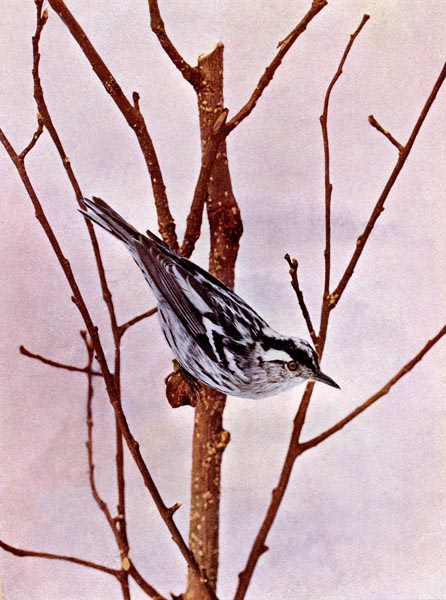
THE BLACK AND WHITE CREEPING WARBLER.
HIS sprightly little bird is met with in various sections of the country. It occurs in all parts of New England and New York, and has been found in the interior as far north as Fort Simpson. It is common in the Bahamas and most of the West India Islands, generally as a migrant; in Texas, in the Indian Territory, in Mexico, and throughout eastern America.
Dr. Coues states that this warbler is a very common summer resident near Washington, the greater number going farther north to breed. They arrive there during the first week in April and are exceedingly numerous until May.
In its habits this bird seems to be more of a creeper than a Warbler. It is an expert and nimble climber, and rarely, if ever, perches on the branch of a tree or shrub. In the manner of the smaller Woodpecker, the Creepers, Nuthatches, and Titmice, it moves rapidly around the trunks and larger limbs of the trees of the forest in search of small insects and their larvae. It is graceful and rapid in movement, and is often so intent upon its hunt as to be unmindful of the near presence of man.
It is found chiefly in thickets, where its food is most easily obtained, and has been known to breed in the immediate vicinity of a dwelling.
The song of this Warbler is sweet and pleasing. It begins to sing from its first appearance in May and continues to repeat its brief refrain at intervals almost until its departure in August and September. At first it is a monotonous ditty, says Nuttall, uttered in a strong but shrill and filing tone. These notes, as the season advances, become more mellow and warbling.
The Warbler’s movements in search of food are very interesting to the observer. Keeping the feet together they move in a succession of short, rapid hops up the trunks of trees and along the limbs, passing again to the bottom by longer flights than in the ascent. They make but short flight from tree to tree, but are capable of flying far when they choose.
They build on the ground. One nest containing young about a week old was found on the surface of shelving rock. It was made of coarse strips of bark, soft decayed leaves, and dry grasses, and lined with a thin layer of black hair. The parents fed their young in the presence of the observer with affectionate attention, and showed no uneasiness, creeping head downward about the trunks of the neighboring trees, and carrying large smooth caterpillars to their young.
They search the crevices in the bark of the tree trunks and branches, look among the undergrowth, and hunt along the fences for bunches of eggs, the buried larvae of the insects, which when undisturbed, hatch out millions of creeping, crawling, and flying things that devastate garden and orchard and every crop of the field.
Black-and-white Warbler (Mniotilta varia) by Anthony 747
Lee’s Addition:
Look at the birds of the air, for they neither sow nor reap nor gather into barns; yet your heavenly Father feeds them. Are you not of more value than they? (Matthew 6:26 NKJV)
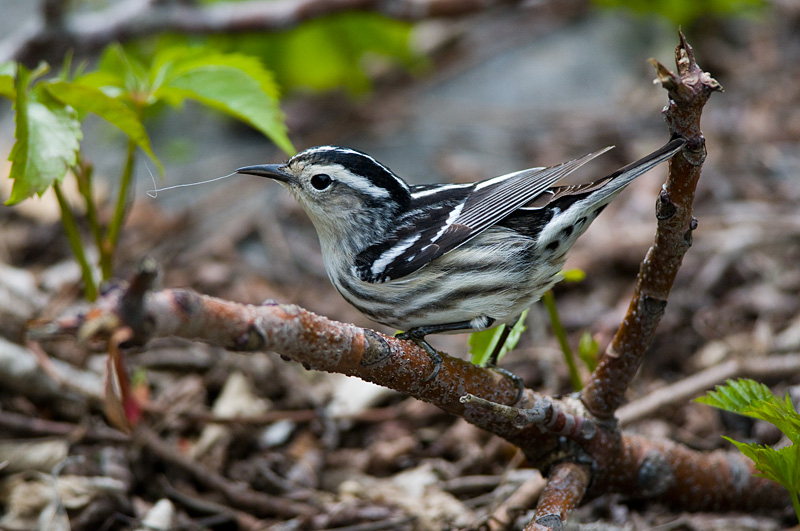
Today this birds is called the Black-and-white Warbler. But it still likes to climb around on the trees. It has a longer toe on the back of it foot that helps it cling to the tree as it checks for its meal. This bird feeds on insects and spiders, and unlike other warblers, forages like a nuthatch, moving up and down tree trunks and along branches.
Their measurements are: Length – 4.3–5.1 in (11–13 cm). Wingspan – 7.1–8.7 in (18–22 cm), Weight – 0.3–0.5 oz (8–15 g).
The Black-and-white Warbler (Mniotilta varia) is a species of New World warbler, the only member of its genus, Mniotilta.[2] It breeds in northern and eastern North America from the Northwest Territory and Newfoundland and Labrador, Canada to Florida. This species is migratory, wintering in Florida, Central America and the West Indies down to Peru. This species is a very rare vagrant to western Europe.
Its song is a high see wee-see wee-see wee-see wee-see wee-see or weesa weesa weetee weetee weetee weet weet weet. It has two calls, a hard tick, and a soft, thin fsss.
The breeding habitat is broadleaved or mixed woodland, preferably in wetter areas. Black-and-white Warblers nest on the ground, laying 4–5 eggs in a cup nest.
The noise of a whip And the noise of rattling wheels, Of galloping horses, Of clattering chariots! (Nahum 3:2 NKJV)
Better yet, here is a youtube of a Black-and-white Warbler singing.
*
*
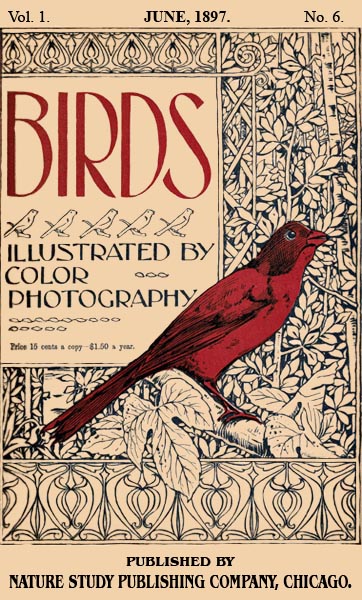
Birds Illustrated by Color Photograhy Vol 1 June, 1897 No 6 – Cover
The above article is the first article in the monthly serial that was started in January 1897 “designed to promote Knowledge of Bird-Live.” These include Color Photography, as they call them, today they are drawings. There are at least three Volumes that have been digitized by Project Gutenberg.
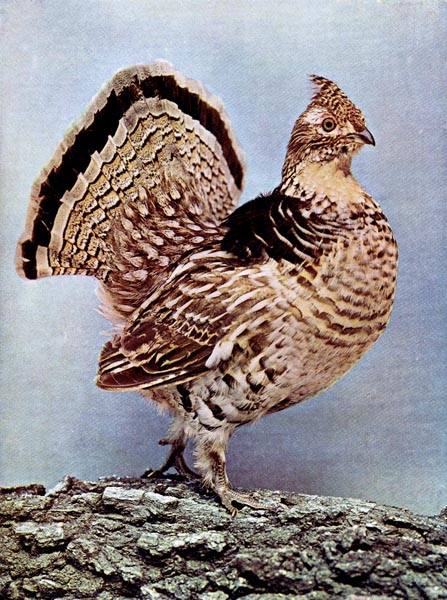
Ruffed Grous for Birds Illustrated by Color Photography, 1897, From col. F. M. Woodruff
Birds Illustrated by Color Photography – Revisited
Vol 1. June, 1897 No. 6
*
THE RUFFED GROUSE.
HE Ruffed Grouse, which is called Partridge in New England and Pheasant in the Middle and Southern States, is the true Grouse, while Bob White is the real Partridge. It is unfortunate that they continue to be confounded. The fine picture of his grouseship, however, which we here present should go far to make clear the difference between them.
The range of the Ruffed Grouse is eastern United States, south to North Carolina, Georgia, Mississippi, and Arkansas. They hatch in April, the young immediately leaving the nest with the mother. When they hear the mother’s warning note the little ones dive under leaves and bushes, while she leads the pursuer off in an opposite direction. Building the nest and sitting upon the eggs constitute the duties of the female, the males during this interesting season keeping separate, not rejoining their mates until the young are hatched, when they begin to roam as a family.
Like the Turkey, the Ruffed Grouse has a habit of pluming and strutting, and also makes the drumming noise which has caused so much discussion. This noise “is a hollow vibrating sound, beginning softly and increasing as if a small rubber ball were dropped slowly and then rapidly bounced on a drum.” While drumming the bird contrives to make himself invisible, and if seen it is difficult to get the slightest clue to the manner in which the sound is produced. And observers say that it beats with its wings on a log, that it raises its wings and strikes their edges above its back, that it claps them against its sides like a crowing rooster, and that it beats the air. The writer has seen a grouse drum, appearing to strike its wings together over its back. But there is much difference of opinion on the subject, and young observers may settle the question for themselves. When preparing to drum he seems fidgety and nervous and his sides are inflated. Letting his wings droop, he flaps them so fast that they make one continuous humming sound. In this peculiar way he calls his mate, and while he is still drumming, the hen bird may appear, coming slyly from the leaves.
The nest is on the ground, made by the female of dry leaves and a few feathers plucked from her own breast. In this slight structure she lays ten or twelve cream-colored eggs, specked with brown.
The eyes of the Grouse are of great depth and softness, with deep expanding pupils and golden brown iris.
Coming suddenly upon a young brood squatted with their mother near a roadside in the woods, an observer first knew of their presence by the old bird flying directly in his face, and then tumbling about at his feet with frantic signs of distress and lameness. In the meantime the little ones scattered in every direction and were not to be found. As soon as the parent was satisfied of their safety, she flew a short distance and he soon heard her clucking call to them to come to her again. It was surprising how quickly they reached her side, seeming to pop up as from holes in the ground.
THE RUFFED GROUSE.
At first sight most of you will think this is a turkey. Well, it does look very much like one. He spreads his tail feathers, puffs himself up, and struts about like a turkey. You know by this time what his name is and I think you can easily see why he is called Ruffed.
This proud bird and his mate live with us during the whole year. They are found usually in grassy lands and in woods.
Here they build their rude nest of dried grass, weeds and the like. You will generally find it at the foot of a tree, or along side of an old stump in or near swampy lands.
The Ruffed Grouse has a queer way of calling his mate. He stands on a log or stump, puffed up like a turkey—just as you see him in the picture. Then he struts about for a time just as you have seen a turkey gobbler do. Soon he begins to work his wings—slowly at first, but faster and faster, until it sounds like the beating of a drum.
His mate usually answers his call by coming. They set up housekeeping and build their rude nest which holds from eight to fourteen eggs. As soon as the young are hatched they can run about and find their own food. So you see they are not much bother to their parents. When they are a week old they can fly. The young usually stay with their parents until next Spring. Then they start out and find mates for themselves.
I said at the first that the Ruffed Grouse stay with us all the year. In the winter, when it is very cold, they burrow into a snowdrift to pass the night. During the summer they always roost all night.
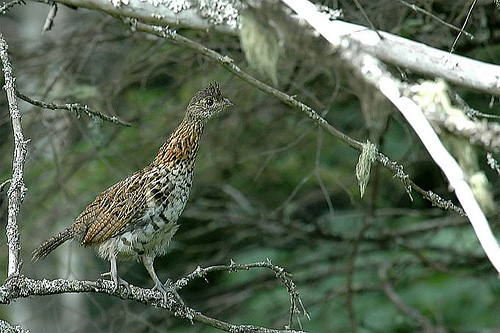
Ruffed Grouse (Bonasa umbellus) by Kent Nickel
Lee’s Addition:
If a bird’s nest happens to be before you along the way, in any tree or on the ground, with young ones or eggs, with the mother sitting on the young or on the eggs, you shall not take the mother with the young; you shall surely let the mother go, and take the young for yourself, that it may be well with you and that you may prolong your days. (Deuteronomy 22:6-7 NKJV)
Here is another one of God’s neat birds. The Ruffed Grouse (Bonasa umbellus) is a medium-sized grouse occurring in forests from the Appalachian Mountains across Canada to Alaska. It is non-migratory. The Ruffed Grouse is frequently referred to as a “partridge”. This is technically wrong—partridges are unrelated phasianids, and in hunting may lead to confusion with the Grey Partridge, it is a bird of woodlands, not open areas. It is a very popular game bird.
The Ruffed Grouse is also the state bird of Pennsylvania.
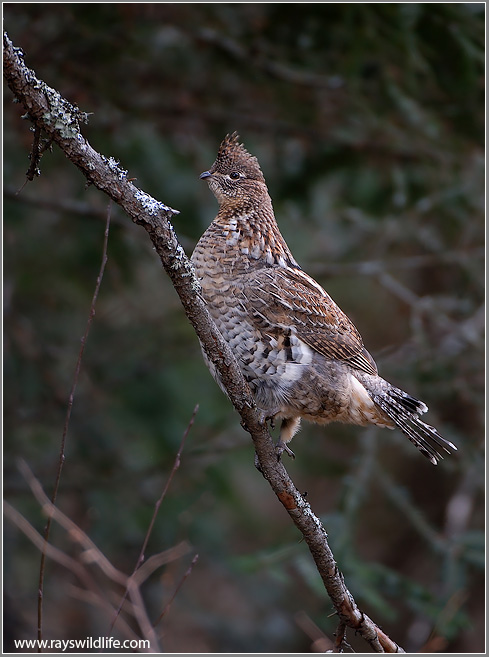
Ruffed Grouse (Bonasa umbellus) by Raymond Barlow
Ruffed Grouse look like chickens in appearance. They are medium to large with a thick body with a small crest on their head. When they fly their wings are rounded. Their coloration works very well to blend them with their habitat. The Lord has provided that protection for them. “One of the interesting ruffed grouse facts is that during winter, these birds develop a web-like structure that joins their toes, so that they can walk easily on snow.” Buzzle.com
The above article is the first article in the monthly serial that was started in January 1897 “designed to promote Knowledge of Bird-Live.” These include Color Photography, as they call them, today they are drawings. There are at least three Volumes that have been digitized by Project Gutenberg.
Ian’s Bird of the Week – Black Woodpecker ~ by Ian Montgomery
Newsletter – 6/26/12
I said last week that my main target in Finland the Black Woodpecker was another story. It’s a story that started 50 years ago when I started bird watching in Ireland as a teenager and received, as a Christmas present in 1962, the classic Guy Mountfort Field Guide to the Birds of Britain and Europe. It had, for its time, superb colour plates of all the European bird species by Roger Peterson. Some of these birds were to this Irish teenager unbelievably exotic and, living on a woodpecker-free island, I was struck by the woodpecker page in general and the huge Black Woodpecker in particular (I still have the field guide):
The concept of a bucket list (things to do before you ‘kick the bucket’) hadn’t been articulated then, but the Black Woodpecker went straight onto mine. So, when the only route that Qantas could offer me a few months ago for a frequent-flyer ticket in the general direction of Ireland was on Finnair via Helsinki, I immediately thought ‘Black Woodpecker’ (and ‘owls’, another great page in the field guide).
In fact finding birds such as woodpeckers and owls in the endless forests of Finland proved very difficult, so eventually I went out with an excellent Finnature guide, Antti (Finnish for Andrew) and a delightful English birding couple in the Kuusamo region. It was a very bad year for owls (owl years are very dependent on cycles in the vole population) but Antti did eventually find us a distant Pygmy Owl and, last bird of all, showed us the nesting site of a pair of Black Woodpeckers.
Black Woodpecker (Dryocopus martius) by Ian 2
We were treated to a view of the male – the female lacks the red crown, having on a small red patch on the back of the head – arriving to feed the young, but there then followed a long period without any activity and, as it was time to return to the hotel for breakfast, I returned later on my own so that I could photograph them at my leisure. Again, the male arrived (second photo) and three hungry chicks appeared at the nest entrance. The male then fed them, presumably by regurgitation – third photo – as he didn’t appear to be carrying any food when he arrived.
Black Woodpecker (Dryocopus martius) by Ian 3
At 45-50cm/18-20in in length, these are crow-sized birds are the largest Eurasian Woodpecker and comparable in size to the related Pileated Woodpecker of North America. Their white bill is 5cm/2in in length and an impressive implement. They usually dig a new nest hollow each year, but Antti told us that this pair had used the same one for two years running. The Black Woodpecker is quite widespread in mature forest in Eurasia and is expanding its range.
Black Woodpecker (Dryocopus martius) by Ian 4
After feeding the young, the male left the nest for several minutes and then returned and entered the hollow. Nothing further happened for over half an hour until the female, who had been in the nest all along, emerged and flew off (fourth photo). The nest was in a tree on a quiet road outside a house, so I was able to watch it in comfort from my rental car (fifth photo), the red arrow indicating the location of the nest.
Black Woodpecker (Dryocopus martius) by Ian 5
So, my visit to Finland reached a satisfactory conclusion and the Black Woodpecker lived up to expectations. Three days later I flew to Dublin, where I am now to join the rest of the family and await the arrival of the first member of the next generation. My niece went into hospital yesterday and the arrival of the baby, ten days overdue, is anticipated either tonight or tomorrow.
Best wishes,
Ian
**************************************************
Ian Montgomery, Birdway Pty Ltd,
454 Forestry Road, Bluewater, Qld 4818
Tel 0411 602 737 ian@birdway.com.au
Check the latest website updates: http://www.birdway.com.au/#updates
**************************************************
Lee’s Addition:
The trees of the LORD are full of sap; the cedars of Lebanon, which he hath planted; Where the birds make their nests: as for the stork, the fir trees are her house. (Psalms 104:16-17 KJV)
Congratulations on a new generation beginning. Also obtaining another of your bucket list birds. What a neat bird. That camera lens is something else!
Thanks again, Ian, for sharing your birdwatching photography with us. We await your next adventure in to the domain of the birds.
Scarlet Tanager for Birds Illustrated by Color Photography, 1897, From col. F. M. Woodruff
Birds Illustrated by Color Photography – Revisited
Vol 1. June, 1897 No. 6
*
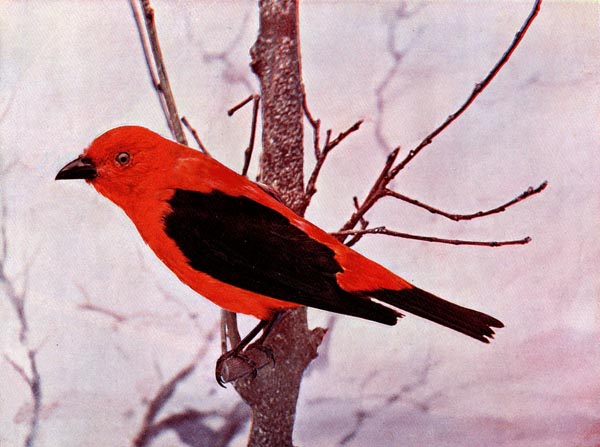
THE SCARLET TANAGER.
NE of the most brilliant and striking of all American birds is the Scarlet Tanager. From its black wings resembling pockets, it is frequently called the “Pocket Bird.” The French call it the “Cardinal.” The female is plain olive-green, and when seen together the pair present a curious example of the prodigality with which mother nature pours out her favors of beauty in the adornment of some of her creatures and seems niggardly in her treatment of others. Still it is only by contrast that we are enabled to appreciate the quality of beauty, which in this case is of the rarest sort. In the January number of Birds we presented the Red Rumped Tanager, a Costa Rica bird, which, however, is inferior in brilliancy to the Scarlet, whose range extends from eastern United States, north to southern Canada, west to the great plains, and south in winter to northern South America. It inhabits woodlands and swampy places. The nesting season begins in the latter part of May, the nest being built in low thick woods or on the skirting of tangled thickets; very often also, in an orchard, on the horizontal limb of a low tree or sapling. It is very flat and loosely made of twigs and fine bark strips and lined with rootlets and fibers of inner bark.
The eggs are from three to five in number, and of a greenish blue, speckled and blotted with brown, chiefly at the larger end.
The disposition of the Scarlet Tanager is retiring, in which respect he differs greatly from the Summer Tanager, which frequents open groves, and often visits towns and cities. A few may be seen in our parks, and now and then children have picked up the bright dead form from the green grass, and wondered what might be its name. Compare it with the Redbird, with which it is often confounded, and the contrast will be striking.
His call is a warble, broken by a pensive call note, sounding like the syllables chip-churr, and he is regarded as a superior musician.
From xeno-canto.org – Scarlet Tanager song:
“Passing through an orchard, and seeing one of these young birds that had but lately left the nest, I carried it with me for about half a mile to show it to a friend, and having procured a cage,” says Wilson, “hung it upon one of the large pine trees in the Botanic Garden, within a few feet of the nest of an Orchard Oriole, which also contained young, hoping that the charity and kindness of the Orioles would induce them to supply the cravings of the stranger. But charity with them as with too many of the human race, began and ended at home. The poor orphan was altogether neglected, and as it refused to be fed by me, I was about to return it to the place where I had found it, when, toward the afternoon, a Scarlet Tanager, no doubt its own parent, was seen fluttering around the cage, endeavoring to get in. Finding he could not, he flew off, and soon returned with food in his bill, and continued to feed it until after sunset, taking up his lodgings on the higher branches of the same tree. In the morning, as soon as day broke, he was again seen most actively engaged in the same manner, and, notwithstanding the insolence of the Orioles, he continued his benevolent offices the whole day, roosting at night as before. On the third or fourth day he seemed extremely solicitous for the liberation of his charge, using every expression of distressful anxiety, and every call and invitation that nature had put in his power, for him to come out. This was too much for the feelings of my friend. He procured a ladder, and mounting to the spot where the bird was suspended, opened the cage, took out his prisoner, and restored him to liberty and to his parent, who, with notes of great exultation, accompanied his flight to the woods.”
THE SCARLET TANAGER.
What could be more beautiful to see than this bird among the green leaves of a tree? It almost seems as though he would kindle the dry limb upon which he perches. This is his holiday dress. He wears it during the nesting season. After the young are reared and the summer months gone, he changes his coat. We then find him dressed in a dull yellowish green—the color of his mate the whole year.
Do you remember another bird family in which the father bird changes his dress each spring and autumn?
The Scarlet Tanager is a solitary bird. He likes the deep woods, and seeks the topmost branches. He likes, too, the thick evergreens. Here he sings through the summer days. We often pass him by for he is hidden by the green leaves above us.
He is sometimes called our “Bird of Paradise.”
Tanagers feed upon winged insects, caterpillars, seeds, and berries. To get these they do not need to be on the ground. For this reason it is seldom we see them there.
Both birds work in building the nest, and both share in caring for the little ones. The nest is not a very pretty one—not pretty enough for so beautiful a bird, I think. It is woven so loosely that if you were standing under it, you could see light through it.
Notice his strong, short beak. Now turn to the picture of the Rose-Breasted Grosbeaks in April Birds. Do you see how much alike they are? They are near relatives.
I hope that you may all have a chance to see a Scarlet Tanager dressed in his richest scarlet and most jetty black.
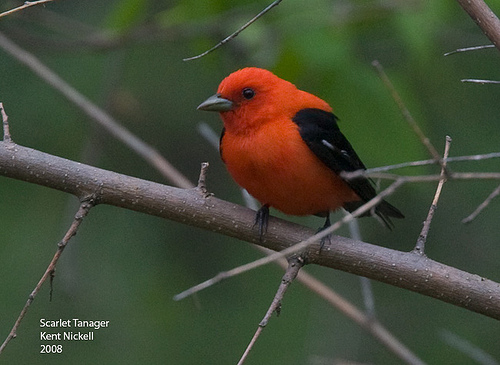
Scarlet Tanager (Piranga olivacea) by Kent Nickell
Lee’s Addition:
‘Come now, and let us reason together,” Says the LORD, “Though your sins are like scarlet, They shall be as white as snow; Though they are red like crimson, They shall be as wool. (Isaiah 1:18 NKJV)
The tanagers comprise the bird family Thraupidae, in the order Passeriformes. The family has an American distribution (Cardinalidae). Tanagers are small to medium-sized birds.
There were traditionally about 240 species of tanagers, but the taxonomic treatment of this family’s members is currently in a state of flux. As more of these birds are studied using modern molecular techniques it is expected that some genera may be relocated elsewhere. Already species in the genera Euphonia and Chlorophonia, which were once considered part of the tanager family, are now treated as members of Fringillidae, in their own subfamily (Euphoniinae). Likewise the genera Piranga (which includes the Scarlet Tanager, Summer Tanager, and Western Tanager), Chlorothraupis, and Habia appear to be members of the Cardinalfamily, and have been reassigned to that family by the AOU.
The Scarlet Tanager (Piranga olivacea) is a medium-sized American songbird. It and other members of its genus are now classified in the cardinal family (Cardinalidae). The specie’s plumage and vocalizations are similar to other members of the cardinal family.
Adults have pale stout smooth bills. Adult males are bright red with black wings and tail; females are yellowish on the underparts and olive on top, with olive-brown wings and tail. The adult male’s winter plumage is similar to the female’s, but the wings and tail remain darker. Young males briefly show a more complex variegated plumage intermediate between adult males and females. It apparently was such a specimen that was first scientifically described. Hence the older though somewhat confusing specific epithet olivacea (“the olive-colored one”) is used rather than erythromelas (“the red-and-black one”), as had been common throughout the 19th century.
Their breeding habitat is large forested areas, especially with oaks, across eastern North America. Scarlet Tanagers migrate to northwestern South America, passing through Central America around April, and again around October.
They begin arriving on the breeding grounds in numbers by about May and already start to move south again in mid-summer; by early October they are all on their way south.[3] The bird is an extremely rare vagrant to western Europe.
Scarlet Tanagers are often out of sight, foraging high in trees, sometimes flying out to catch insects in flight. They eat mainly insects and fruit.
These birds do best in the forest interior, where they are less exposed to predators and brood parasitism by the Brown-headed Cowbird. Their nests are typically built on horizontal tree branches. Specifically their numbers are declining in some areas due to habitat fragmentation, but on a global scale tanagers are a plentiful species.
*
Birds Illustrated by Color Photograhy Vol 1 June, 1897 No 6 – Cover
The above article is the first article in the monthly serial that was started in January 1897 “designed to promote Knowledge of Bird-Live.” These include Color Photography, as they call them, today they are drawings. There are at least three Volumes that have been digitized by Project Gutenberg.
Snowy Owl for Birds Illustrated by Color Photography, 1897
Birds Illustrated by Color Photography – Revisited
Vol 1. June, 1897 No. 6
*
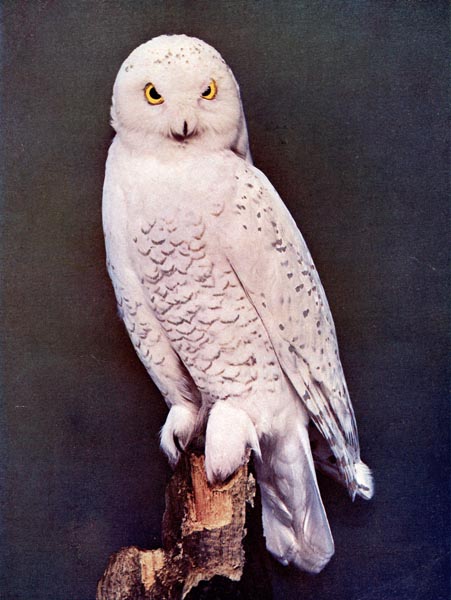
THE SNOWY OWL.
EW of all the groups of birds have such decided markings, such characteristic distinctions, as the Owl. There is a singular resemblance between the face of an Owl and that of a cat, which is the more notable, as both of these creatures have much the same habits, live on the same prey, and are evidently representatives of the same idea in their different classes. The Owl, in fact, is a winged cat, just as the cat is a furred owl.
The Snowy Owl is one of the handsomest of this group, not so much on account of its size, which is considerable, as by reason of the beautiful white mantle which it wears, and the large orange eyeballs that shine with the lustre of a topaz set among the snowy plumage.
It is a native of the north of Europe and America, but is also found in the more northern parts of England, being seen, though rather a scarce bird, in the Shetland and Orkney Islands, where it builds its nest and rears its young. One will be more likely to find this owl near the shore, along the line of salt marshes and woody stubble, than further inland. The marshes do not freeze so easily or deep as the iron bound uplands, and field-mice are more plentiful in them. It is so fleet of wing that if its appetite is whetted, it can follow and capture a Snow Bunting or a Junco in its most rapid flight.
Like the Hawk Owl, it is a day-flying bird, and is a terrible foe to the smaller mammalia, and to various birds. Mr. Yarrell in his “History of the British Birds,” states that one wounded on the Isle of Balta disgorged a young rabbit whole, and that a young Sandpiper, with its plumage entire, was found in the stomach of another.
In proportion to its size the Snowy Owl is a mighty hunter, having been detected chasing the American hare, and carrying off wounded Grouse before the sportsman could secure his prey. It is also a good fisherman, posting itself on some convenient spot overhanging the water, and securing its finny prey with a lightning-like grasp of the claw as it passes beneath the white clad fisher. Sometimes it will sail over the surface of a stream, and snatch the fish as they rise for food. It is also a great lover of lemmings, and in the destruction of these quadruped pests does infinite service to the agriculturist.
The large round eyes of this owl are very beautiful. Even by daylight they are remarkable for their gem-like sheen, but in the evening they are even more attractive, glowing like balls of living fire.
From sheer fatigue these birds often seek a temporary resting place on passing ships. A solitary owl, after a long journey, settled on the rigging of a ship one night. A sailor who was ordered aloft, terrified by the two glowing eyes that suddenly opened upon his own, descended hurriedly to the deck, declaring to the crew that he had seen “Davy Jones a-sitting up there on the main yard.”
THE SNOWY OWL.
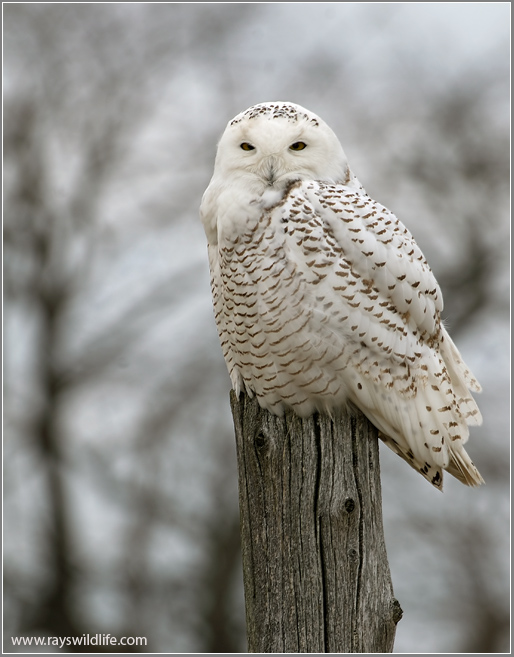
What do you think of this bird with his round, puffy head? You of course know it is an Owl. I want you to know him as the Snowy Owl.
Don’t you think his face is some like that of your cat? This fellow is not full grown, but only a child. If he were full grown he would be pure white. The dark color you see is only the tips of the feathers. You can’t see his beak very well for the soft feathers almost cover it.
His large soft eyes look very pretty out of the white feathers. What color would you call them? Most owls are quiet during the day and very busy all night. The Snowy Owl is not so quiet day times. He flies about considerably and gets most of his food in daylight.
A hunter who was resting under a tree, on the bank of a river, tells this of him:
“A Snowy Owl was perched on the branch of a dead tree that had fallen into the river. He sat there looking into the water and blinking his large eyes.
Suddenly he reached out and before I could see how he did it, a fish was in his claws.”
This certainly shows that he can see well in the day time. He can see best, however, in the twilight, in cloudy weather or moonlight. That is the way with your cat.
The wing feathers of the owl are different from those of most birds. They are as soft as down. This is why you cannot hear him when he flies. Owls while perching are almost always found in quiet places where they will not be disturbed.
Did you ever hear the voice of an owl in the night? If you never have, you cannot imagine how dreary it sounds. He surely is “The Bird of the Night.”
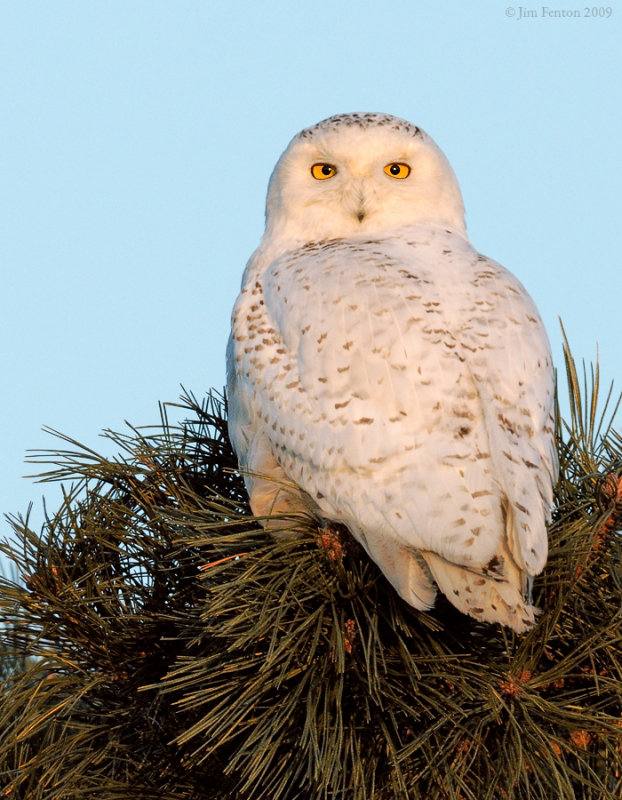
Snowy Owl (Bubo scandiacus) by J Fenton
Lee’s Addition:
The Owl is mentioned 8 times in the NKJV of the Bible and it qualifies as a Bird of the Bible. These verses are from the “unclean” list:
the white owl, the jackdaw, and the carrion vulture; (Leviticus 11:18 NKJV)
the little owl, the screech owl, the white owl, (Deuteronomy 14:16 NKJV)
Because Snowy Owls live in cold weather often, they have feathers that cover most of their legs and feet. The Lord has provided extra protection for them this way. A lack of pigment leaves extra space in the feathers to help keep them warm and also is the reason they are so white. Also being white helps protect them from being seen so well in snow. Another interesting thing is that they hunt in the daytime more than regular owls. When you live way up north by the Arctic Circle, the sun never sets for periods of time. An owl could get might hungry waiting for darkness to go hunting.
The Snowy Owl is a large owl and is the official bird of Quebec. It goes by several names, such as, the Arctic Owl, Great White Owl, Icelandic Snow Owl, or Harfang.
“Most of the owls’ hunting is done in the “sit and wait” style; prey may be captured on the ground, in the air or fish may be snatched off the surface of bodies of water using their sharp talons. Each bird must capture roughly 7 to 12 mice per day to meet its food requirement and can eat more than 1,600 lemmings per year.
Snowy Owls, like many other birds, swallow their small prey whole. Strong stomach juices digest the flesh, while the indigestible bones, teeth, fur, and feathers are compacted into oval pellets that the bird regurgitates 18 to 24 hours after feeding. Regurgitation often takes place at regular perches, where dozens of pellets may be found. Biologists frequently examine these pellets to determine the quantity and types of prey the birds have eaten. When large prey are eaten in small pieces, pellets will not be produced.
Though Snowy Owls have few predators, the adults are very watchful and are equipped to defend against any kind of threat towards them or their offspring. During the nesting season, the owls regularly defend their nests against arctic foxes, corvids and swift-flying jaegers; as well as dogs, gray wolves and avian predators. Males defend the nest by standing guard nearby while the female incubates the eggs and broods the young. Both sexes attack approaching predators, dive-bombing them and engaging in distraction displays to draw the predator away from a nest.” (Wikipedia)
*
Birds Illustrated by Color Photograhy Vol 1 June, 1897 No 6 – Cover
The above article is the first article in the monthly serial that was started in January 1897 “designed to promote Knowledge of Bird-Live.” These include Color Photography, as they call them, today they are drawings. There are at least three Volumes that have been digitized by Project Gutenberg.
Baltimore Oriole for Birds Illustrated by Color Photography, 1897, From Col. F. M. Woodruff.
Birds Illustrated by Color Photography – Revisited
Vol 1. June, 1897 No. 6
*
THE BALTIMORE ORIOLE.
ALTIMORE Orioles are inhabitants of the whole of North America, from Canada to Mexico. They enter Louisiana as soon as spring commences there. The name of Baltimore Oriole has been given it, because its colors of black and orange are those of the family arms of Lord Baltimore, to whom Maryland formerly belonged. Tradition has it that George Calvert, the first Baron Baltimore, worn out and discouraged by the various trials and rigours of temperature experienced in his Newfoundland colony in 1628, visited the Virginia settlement. He explored the waters of the Chesapeake, and found the woods and shores teeming with birds, among them great flocks of Orioles, which so cheered him by their beauty of song and splendor of plumage, that he took them as good omens and adopted their colors for his own.
When the Orioles first arrive the males are in the majority; they sit in the spruces calling by the hour, with lonely querulous notes. In a few days however, the females appear, and then the martial music begins, the birds’ golden trumpeting often turning to a desperate clashing of cymbals when two males engage in combat, for “the Oriole has a temper to match his flaming plumage and fights with a will.”
This Oriole is remarkably familiar, and fearless of man, hanging its beautiful nest upon the garden trees, and even venturing into the street wherever a green tree nourishes. The materials of which its nest is made are flax, various kinds of vegetable fibers, wool, and hair, matted together so as to resemble felt in consistency. A number of long horse-hairs are passed completely through the fibers, sewing it firmly together with large and irregular, but strong and judiciously placed stitching. In one of these nests an observer found that several of the hairs used for this purpose measured two feet in length. The nest is in the form of a long purse, six or seven inches in depth, three or four inches in diameter; at the bottom is arranged a heap of soft material in which the eggs find a warm resting place. The female seems to be the chief architect, receiving a constant supply of materials from her mate, occasionally rejecting the fibers or hairs which he may bring, and sending him off for another load more to her taste.
Like human builders, the bird improves in nest building by practice, the best specimens of architecture being the work of the oldest birds, though some observers deny this.
The eggs are five in number, and their general color is whitish-pink, dotted at the larger end with purplish spots, and covered at the smaller end with a great number of fine intersecting lines of the same hue.
In spring the Oriole’s food seems to be almost entirely of an animal nature, consisting of caterpillars, beetles, and other insects, which it seldom pursues on the wing, but seeks with great activity among the leaves and branches. It also eats ripe fruit. The males of this elegant species of Oriole acquire the full beauty of their plumage the first winter after birth.
The Baltimore Oriole is one of the most interesting features of country landscape, his movements, as he runs among the branches of trees, differing from those of almost all other birds. Watch him clinging by the feet to reach an insect so far away as to require the full extension of the neck, body, and legs without letting go his hold. He glides, as it were, along a small twig, and at other times moves sidewise for a few steps. His motions are elegant and stately.
THE BALTIMORE ORIOLE.
About the middle of May, when the leaves are all coming out to see the bright sunshine, you may sometimes see, among the boughs, a bird of beautiful black and orange plumage.
He looks like the Orchard Oriole, whose picture you saw in May “Birds.” It is the Baltimore Oriole. He has other names, such as “Golden Robin,” “Fire Bird,” “Hang-nest.” I could tell you how he came to be called Baltimore Oriole, but would rather you’d ask your teacher about it. She can tell you all about it, and an interesting story it is, I assure you.
You see from the picture why he is called “Hang-nest.” Maybe you can tell why he builds his nest that way.
The Orioles usually select for their nest the longest and slenderest twigs, way out on the highest branches of a large tree. They like the elm best. From this they hang their bag-like nest.
It must be interesting to watch them build the nest, and it requires lots of patience, too, for it usually takes a week or ten days to build it.
They fasten both ends of a string to the twigs between which the nest is to hang. After fastening many strings like this, so as to cross one another, they weave in other strings crosswise, and this makes a sort of bag or pouch. Then they put in the lining.
Of course, it swings and rocks when the wind blows, and what a nice cradle it must be for the baby Orioles?
Orioles like to visit orchards and eat the bugs, beetles and caterpillars that injure the trees and fruit.
There are few birds who do more good in this way than Orioles.
Sometimes they eat grapes from the vines and peck at fruit on the trees. It is usually because they want a drink that they do this.
One good man who had a large orchard and vineyard placed pans of water in different places. Not only the Orioles, but other birds, would go to the pan for a drink, instead of pecking at the fruit. Let us think of this, and when we have a chance, give the birds a drink of water. They will repay us with their sweetest songs.
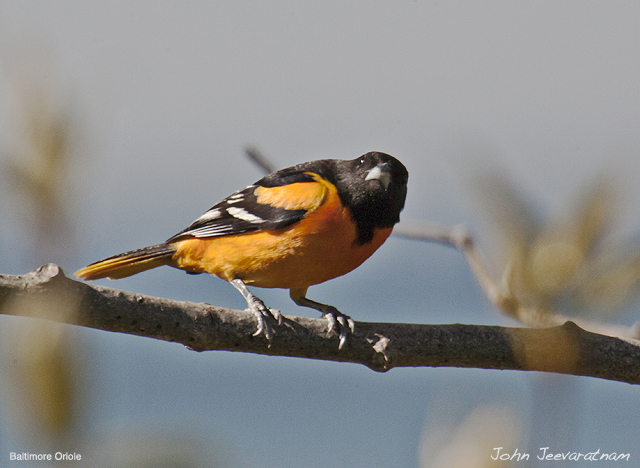
Baltimore Oriole (Icterus galbula) Male by Nature’s Hues
Lee’s Addition:
I know all the birds of the mountains, And the wild beasts of the field are Mine. (Psalms 50:11 NKJV)
This bird received its name from the fact that the male’s colors resemble those on the coat-of-arms of Lord Baltimore. Like all icterids called ‘oriole’, it is named after an unrelated, physically similar family found in the Old World: the Oriolidae. At one time, this species and the Bullock’s Oriole, (Icterus bullockii), were considered to be a single species called the Northern Oriole.
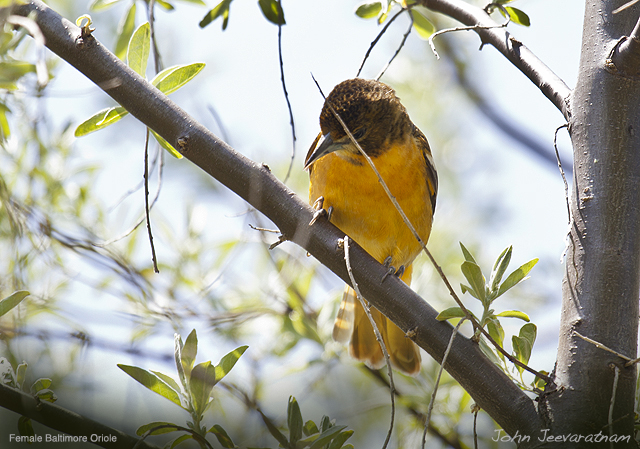
The male oriole is slightly larger than the female. Adults have a pointed bill and white bars on the wings. The adult male is orange on the underparts, shoulder patch and rump. All of the rest of the male is black. The adult female is yellow-brown on the upper parts with darker wings, and dull orange on the breast and belly.
Baltimore Oriole (Icterus galbula) Female by Nature’s Hues
The Baltimore Orioles, a Major League Baseball team in Baltimore, Maryland, were named after this bird. It is also the state bird of Maryland.
Song of an Oriole – by xeno-canto.org(recorded by Robin Carter)
The male sings a loud flutey whistle that often gives away the bird’s location before any sighting can be made.
Baltimore Orioles forage in trees and shrubs, also making short flights to catch insects. They mainly eat insects, berries and nectar, and are often seen sipping at hummingbird feeders. Oriole feeders contain essentially the same food as hummingbird feeders, but are designed for orioles, and are orange instead of red and have larger perches. Baltimore Orioles are also fond of halved oranges, grape jelly and, in their winter quarters, the red arils of Gumbo-limbo (Bursera simaruba).
*
Birds Illustrated by Color Photograhy Vol 1 June, 1897 No 6 – Cover
The above article is the first article in the monthly serial that was started in January 1897 “designed to promote Knowledge of Bird-Live.” These include Color Photography, as they call them, today they are drawings. There are at least three Volumes that have been digitized by Project Gutenberg.
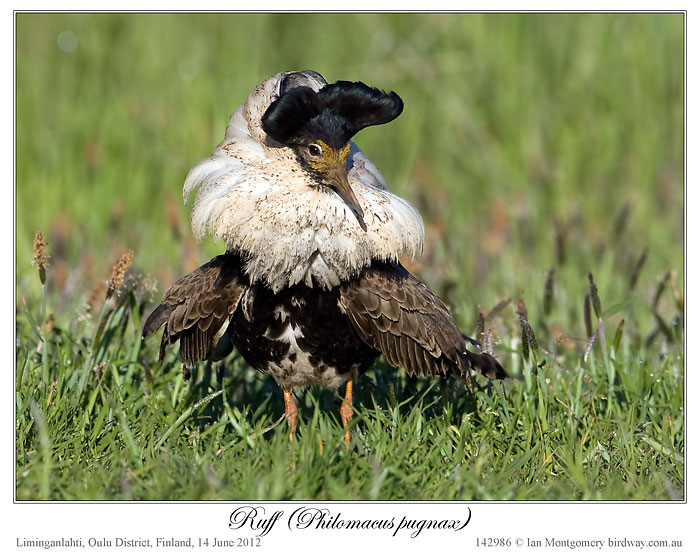
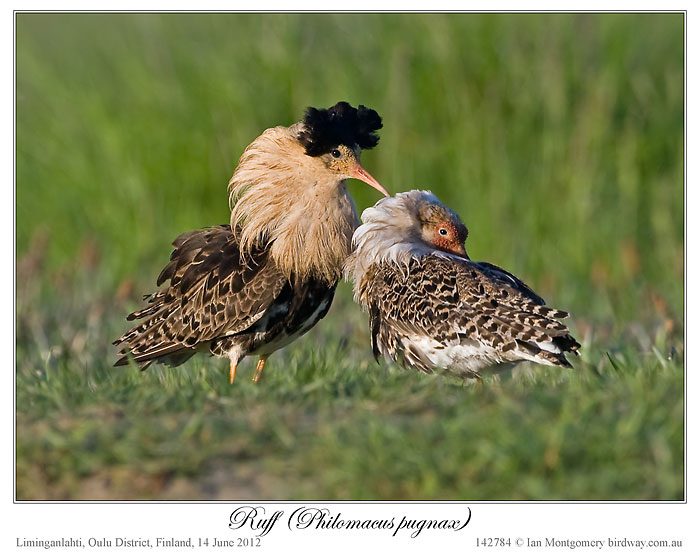
This week we have nothing short of a fashion parade, male Ruffs at a communal display ground or lek in eastern Finland. Finland is my second stop-over on the way to Ireland to visit my family and I am spending a week in the northern part of the country in search of some unusual northern European birds. I spent a couple of nights in Oulo on the west coast, a 1 hour flight north of Helsinki and then drove north west to Kuusamo near the Russian border where I am now.
In Oulu, the birding and wildlife tour company Finnature put me very early in the morning in a hide that they had set up near the lek. I settled down to watch a rather unpromising-looking piece of raised ground in a meadow, having been assured that, though it was late in the season, a couple of birds had been seen at the lek on the previous morning.
Ruff (Philomachus pugnax) by Ian 2
After about half an hour and shortly before 4:00am the black-ruffed bird in the second photo arrived but flew off when I moved the camera. Happily, it soon returned and this time the second white-ruffed bird arrived too and the pair started their extraordinary display, spreading their ruffs and wings apparently to make themselves appear as intimidating as possible. Sometimes, they jumped vertically in the air and at other times they crouched low on the ground in submissive looking postures.
Ruff (Philomachus pugnax) by Ian 3
Although the birds often came into close physical contact, there was no actual fighting and no physical damage. These black- and white-ruffed birds were the main performers during the 4 hours that I remained in the hide, but other birds joined in and at one stage there were about 10 birds on the lek. The colours of the ruffs and the erectile feathers on the head were varied. Here is a buff and black one with the white bird.
Ruff (Philomachus pugnax) by Ian 4
The colour of the bare wattled skin on the face varied too, being sometimes yellow and sometimes red, though it was my impression that this colour wan’t permanent and the red flush was associated with more intense display. This non-displaying one with a chestnut cap, piebald ruff has yellow facial skin.
Ruff (Philomachus pugnax) by Ian 5
This one is mainly chestnut.
Ruff (Philomachus pugnax) by Ian 6
While this one with an ermine ruff look suitably regal.
Ruff (Philomachus pugnax) by Ian 7
Ruffs are unusual among lekking birds in that the display is aimed mainly at other males to establish dominance, rather than at attracting females. Females may mate with multiple males producing young with different fathers and homosexual mating also occurs. The different ruff colours are apparently significant and white-ruffed males are smaller and less dominant and called satellite males.
Ruff (Philomachus pugnax) by Ian 8
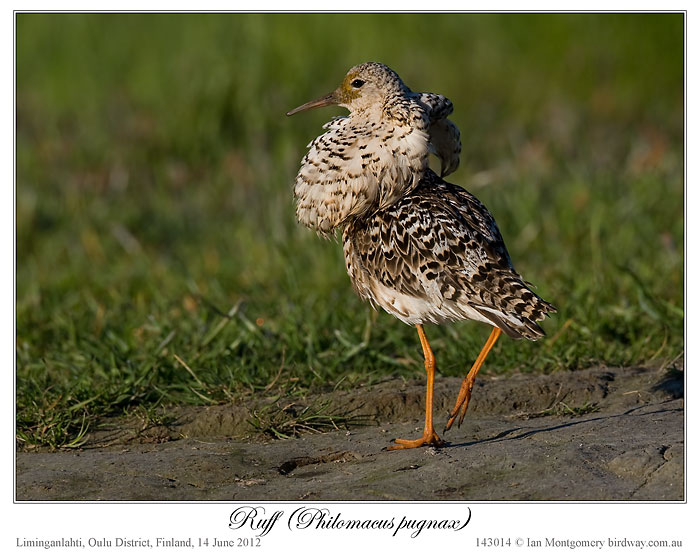
The females, called Reeves, are quite plain and look rather like other sandpipers such as Sharp-tailed and Pectoral. In non-breeding plumage, the males resemble the females but are larger and longer-necked. Ruffs breed across northern Eurasia from Scandinavia to Siberia and winter in Africa, Asia and, in small numbers, Australia. You can see a female and ruff-less male, photographed in India, here: http://www.birdway.com.au/scolopacidae/ruff/index.htm.
Who said waders are plain and boring? I had a wonderful time at this lek. The Ruffs wasn’t one of my target species in Finland but an unexpected bonus, thank you Finnature. My main target was the largest Woodpecker in Europe, the Black Woodpecker, but that’s another story.
Best wishes
Ian
**************************************************
Ian Montgomery, Birdway Pty Ltd,
454 Forestry Road, Bluewater, Qld 4818
Tel 0411 602 737 ian@birdway.com.au
Check the latest website updates: http://www.birdway.com.au/#updates
**************************************************
Lee’s Addition:
What a group of “show offs.” I find these birds amazing. Never thought of this family as having leks like the pheasants and those in that order. Just goes to show you that the birds are doing what they are suppose to and that is reproducing. What a show for the females to get to watch.
Bring out with you every living thing of all flesh that is with you: birds and cattle and every creeping thing that creeps on the earth, so that they may abound on the earth, and be fruitful and multiply on the earth.”
(Genesis 8:17 NKJV)
Loggerhead Shrike for Birds Illustrated by Color Photography, 1897
Birds Illustrated by Color Photography – Revisited
Vol 1. June, 1897 No. 6
*
THE LOGGERHEAD SHRIKE.
RAMBLER in the fields and woodlands during early spring or the latter part of autumn is often surprised at finding insects, grasshoppers, dragon flies, beetles of all kinds, and even larger game, mice, and small birds, impaled on twigs and thorns. This is apparently cruel sport, he observes, if he is unacquainted with the Butcher Bird and his habits, and he at once attributes it to the wanton sport of idle children who have not been led to say,
With hearts to love, with eyes to see,
With ears to hear their minstrelsy;
Through us no harm, by deed or word,
Shall ever come to any bird.
If he will look about him, however, the real author of this mischief will soon be detected as he appears with other unfortunate little creatures, which he requires to sustain his own life and that of his nestlings. The offender he finds to be the Shrike of the northern United States, most properly named the Butcher Bird. Like all tyrants he is fierce and brave only in the presence of creatures weaker than himself, and cowers and screams with terror if he sees a falcon. And yet, despite this cruel proceeding, which is an implanted instinct like that of the dog which buries bones he never seeks again, there are few more useful birds than the Shrike. In the summer he lives on insects, ninety-eight per cent. of his food for July and August consisting of insects, mainly grasshoppers; and in winter, when insects are scarce, mice form a very large proportion of his food.
The Butcher Bird has a very agreeable song, which is soft and musical, and he often shows cleverness as a mocker of other birds. He has been taught to whistle parts of tunes, and is as readily tamed as any of our domestic songsters.
The nest is usually found on the outer limbs of trees, often from fifteen to thirty feet from the ground. It is made of long strips of the inner bark of bass-wood, strengthened on the sides with a few dry twigs, stems, and roots, and lined with fine grasses. The eggs are often six in number, of a yellowish or clayey-white, blotched and marbled with dashes of purple, light brown, and purplish gray. Pretty eggs to study.
Readers of Birds who are interested in eggs do not need to disturb the mothers on their nests in order to see and study them. In all the great museums specimens of the eggs of nearly all birds are displayed in cases, and accurately colored plates have been made and published by the Smithsonian Institution and others. The Chicago Academy of Sciences has a fine collection of eggs. Many persons imagine that these institutions engage in cruel slaughter of birds in order to collect eggs and nests. This, of course, is not true, only the fewest number being taken, and with the exclusive object of placing before the people, not for their amusement but rather for their instruction, specimens of birds and animals which shall serve for their identification in forest and field.
The Loggerhead Shrike and nest shown in this number were taken under the direction of Mr. F. M. Woodruff, at Worth, Ill., about fourteen miles from Chicago. The nest was in a corner of an old hedge of Osage Orange, and about eight feet from the ground. He says in the Osprey that it took considerable time and patience to build up a platform of fence boards and old boxes to enable the photographer to do his work. The half-eaten body of a young garter snake was found about midway between the upper surface of the nest and the limb above, where it had been hung up for future use.
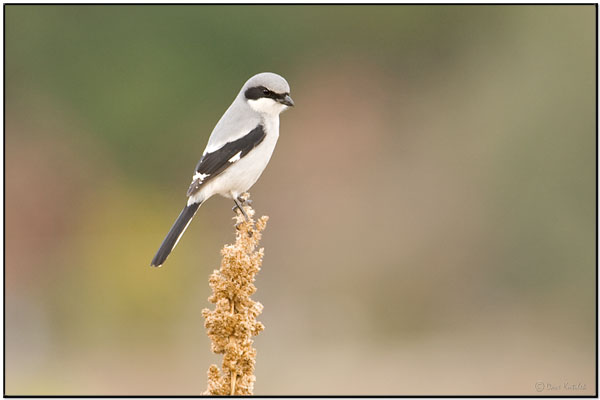
Loggerhead Shrike (Lanius ludovicianus) by Daves BirdingPix
Lee’s Addition:
“That path no bird of prey knows, and the falcon’s eye has not seen it. (Job 28:7 ESV)
What a surprise about a week or so ago when I looked out at my feeders/fountain area. There were 4 Loggerhead Shrikes around the fountain and chasing each other around the tree. That is the first time they have visited our yard. Saw my first Loggerhead out in Louisiana years ago. They can confuse you at first look with a Northern Mockingbird, which is what I thought I was looking at at the fountain.
Loggerhead Shrikes are in the Laniidae – ShrikesFamily which at the time has 33 members. The family name, and that of the largest genus, Lanius, is derived from the Latin word for “butcher”, and some shrikes were also known as “butcher birds” because of their feeding habits. Note that the Australasian butcherbirds (Artamidae family) are not shrikes.
Most shrike species have a Eurasian and African distribution, with just two breeding in North America (the Loggerhead and Great Grey shrikes). There are no members of this family in South America or Australia, although one species reaches New Guinea. The shrikes vary in the extent of their ranges, with some species like the Great Grey Shrike ranging across the northern hemisphere to the Newton’s Fiscal which is restricted to the island of São Tomé.
They inhabit open habitats, especially steppe and savannah. A few species of shrike are forest dwellers, seldom occurring in open habitats. Some species breed in northern latitudes during the summer, then migrate to warmer climes for the winter.
The Loggerhead Shrike (Lanius ludovicianus) is a passerine bird. It is the only member of the shrike family endemic to North America; the related Northern Shrike (L. excubitor) occurs north of its range but also in the Palearctic.
The bird has a large hooked bill; the head and back are grey and the underparts white. The wings and tail are black, with white patches on the wings and white on the outer tail feather. The black face mask extends over the bill, unlike that of the similar but slightly larger Northern Shrike.
The bird breeds in semi-open areas in southern Ontario, Quebec and the Canadian prairie provinces, south to Mexico. It nests in dense trees and shrubs. The female lays 4 to 8 eggs in a bulky cup made of twigs and grass. There is an increase in average clutch size as latitude increases.
The shrike is a permanent resident in the southern part of the range; northern birds migrate further south. They are considered a bird of prey even though they have weak legs and feet. The bird waits on a perch with open lines of sight and swoops down to capture prey. Its food is large insects and lizards . Known in many parts as the “Butcher Bird,” it impales its prey on thorns or barbed wire before eating it, because it does not have the talons of the larger birds of prey.
The population of this species has declined in the northeastern parts of its range, possibly due to loss of suitable habitat and pesticide use.
“Loggerhead” refers to the relatively large head as compared to the rest of the body.
*
Birds Illustrated by Color Photograhy Vol 1 June, 1897 No 6 – Cover
The above article is the first article in the monthly serial that was started in January 1897 “designed to promote Knowledge of Bird-Live.” These include Color Photography, as they call them, today they are drawings. There are at least three Volumes that have been digitized by Project Gutenberg.
Ring-billed Gull for Birds Illustrated by Color Photography, 1897, From col. Chi. Acad. Sciences.
Birds Illustrated by Color Photography – Revisited
Vol 1. June, 1897 No. 6
*
THE RING-BILLED GULL.
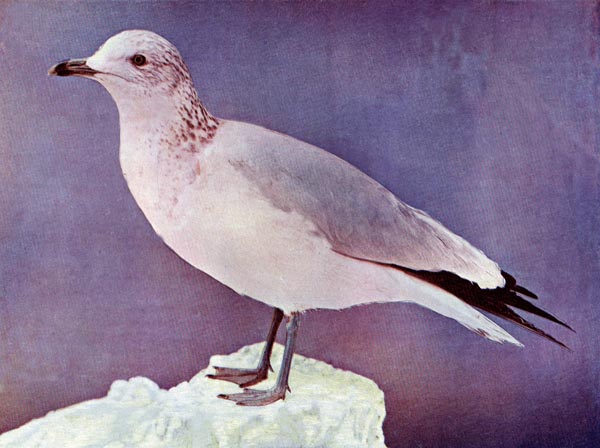
HE Ring-billed Gull is a common species throughout eastern North America, breeding throughout the northern tier of the United States, whose northern border is the limit of its summer home. As a rule in winter it is found in Illinois and south to the Gulf of Mexico. It is an exceedingly voracious bird, continually skimming over the surface of the water in search of its finny prey, and often following shoals of fish to great distances. The birds congregate in large numbers at their breeding places, which are rocky islands or headlands in the ocean. Most of the families of Gulls are somewhat migratory, visiting northern regions in summer to rear their young. The following lines give with remarkable fidelity the wing habits and movements of this tireless bird:
“On nimble wing the gull
Sweeps booming by, intent to cull
Voracious, from the billows’ breast,
Marked far away, his destined feast.
Behold him now, deep plunging, dip
His sunny pinion’s sable tip
In the green wave; now highly skim
With wheeling flight the water’s brim;
Wave in blue sky his silver sail
Aloft, and frolic with the gale,
Or sink again his breast to lave,
And float upon the foaming wave.
Oft o’er his form your eyes may roam,
Nor know him from the feathery foam,
Nor ’mid the rolling waves, your ear
On yelling blast his clamor hear.”
This Gull lives principally on fish, but also greedily devours insects. He also picks up small animals or animal substances with which he meets, and, like the vulture, devours them even in a putrid condition. He walks well and quickly, swims bouyantly, lying in the water like an air bubble, and dives with facility, but to no great depth.
As the breeding time approaches the Gulls begin to assemble in flocks, uniting to form a numerous host. Even upon our own shores their nesting places are often occupied by many hundred pairs, whilst further north they congregate in countless multitudes. They literally cover the rocks on which their nests are placed, the brooding parents pressing against each other.
Wilson says that the Gull, when riding bouyantly upon the waves and weaving a sportive dance, is employed by the poets as an emblem of purity, or as an accessory to the horrors of a storm, by his shrieks and wild piercing cries. In his habits he is the vulture of the ocean, while in grace of motion and beauty of plumage he is one of the most attractive of the splendid denizens of the ocean and lakes.
The Ring-billed Gull’s nest varies with localities. Where there is grass and sea weed, these are carefully heaped together, but where these fail the nest is of scanty material. Two to four large oval eggs of brownish green or greenish brown, spotted with grey and brown, are hatched in three or four weeks, the young appearing in a thick covering of speckled down. If born on the ledge of a high rock, the chicks remain there until their wings enable them to leave it, but if they come from the shell on the sand of the beach they trot about like little chickens. During the first few days they are fed with half-digested food from the parents’ crops, and then with freshly caught fish.
The Gull rarely flies alone, though occasionally one is seen far away from the water soaring in majestic solitude above the tall buildings of the city.
Ring-billed Gull (Larus delawarensis) Lk Hollingsworth by Lee
Lee’s Addition:
The Ring-billed Gull is a member of the Laridae Family in the Charadriiformes Order. They are mentioned in Bible’s New King James Version as one of the birds not to eat.
the ostrich, the short-eared owl, the sea gull, and the hawk after their kinds; (Deuteronomy 14:15 NKJV)
We see them on a frequent basis here in Central Florida. They not only like the many lakes here in Polk County, but also many of the parking lots. Of course as you head to either of our shores, Gulf or Atlantic, many more are seen.
The above article is the first article in the monthly serial that was started in January 1897 “designed to promote Knowledge of Bird-Live.” These include Color Photography, as they call them, today they are drawings. There are at least three Volumes that have been digitized by Project Gutenberg.


















 Lee's Birdwatching Adventures Plus