Today, when we looked out in our side yard, we were greeted by two Sandhill Cranes walking around. Grabbed the camera and here are some of the photos that I took. I have been so busy working on the blog, that we haven’t taken the time to go birdwatching. So, our great Lord just sent me some of His beauties.
O taste and see that the LORD is good: blessed is the man that trusteth in him. (Psalms 34:8 KJV)
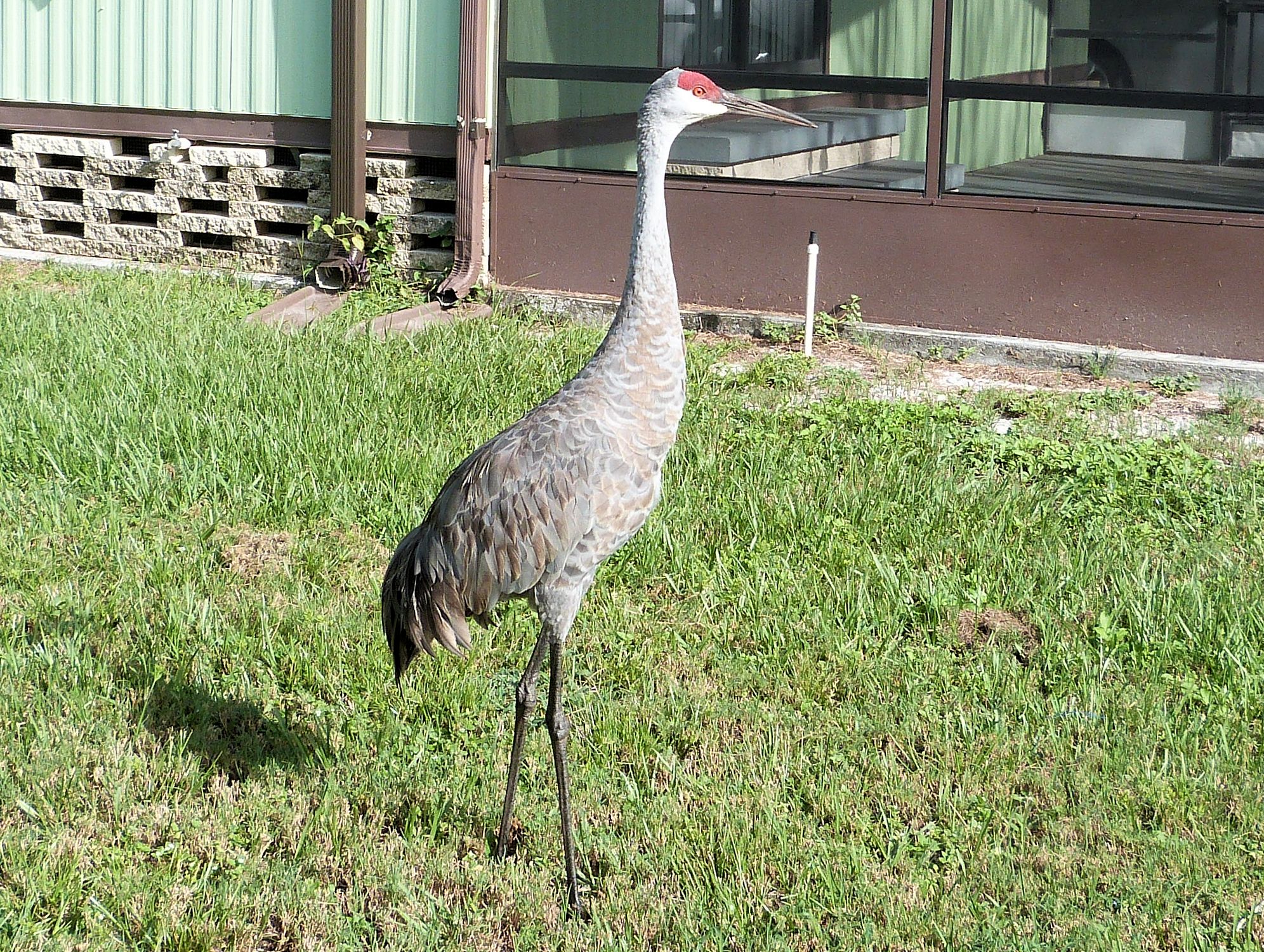
Sandhill Standing Guard Crop
They stroll through here from time to time, but haven’t seen them for a while. As usual, one stands guard, while one eats. Some how our flat feeder came off the hook and they found it. :))
Sandhill Cranes in side yard
He, the guard came over and was trying to encourage her to finish up.
Sandhill Cranes in side yard
Zoomed in on his beak and was surprised to find so much dirt in it. They do a lot of probing in people’s yards and are considered pests by some. Not me, I love them coming to visit. They can probe all they want, just as long as they let me take their photo.
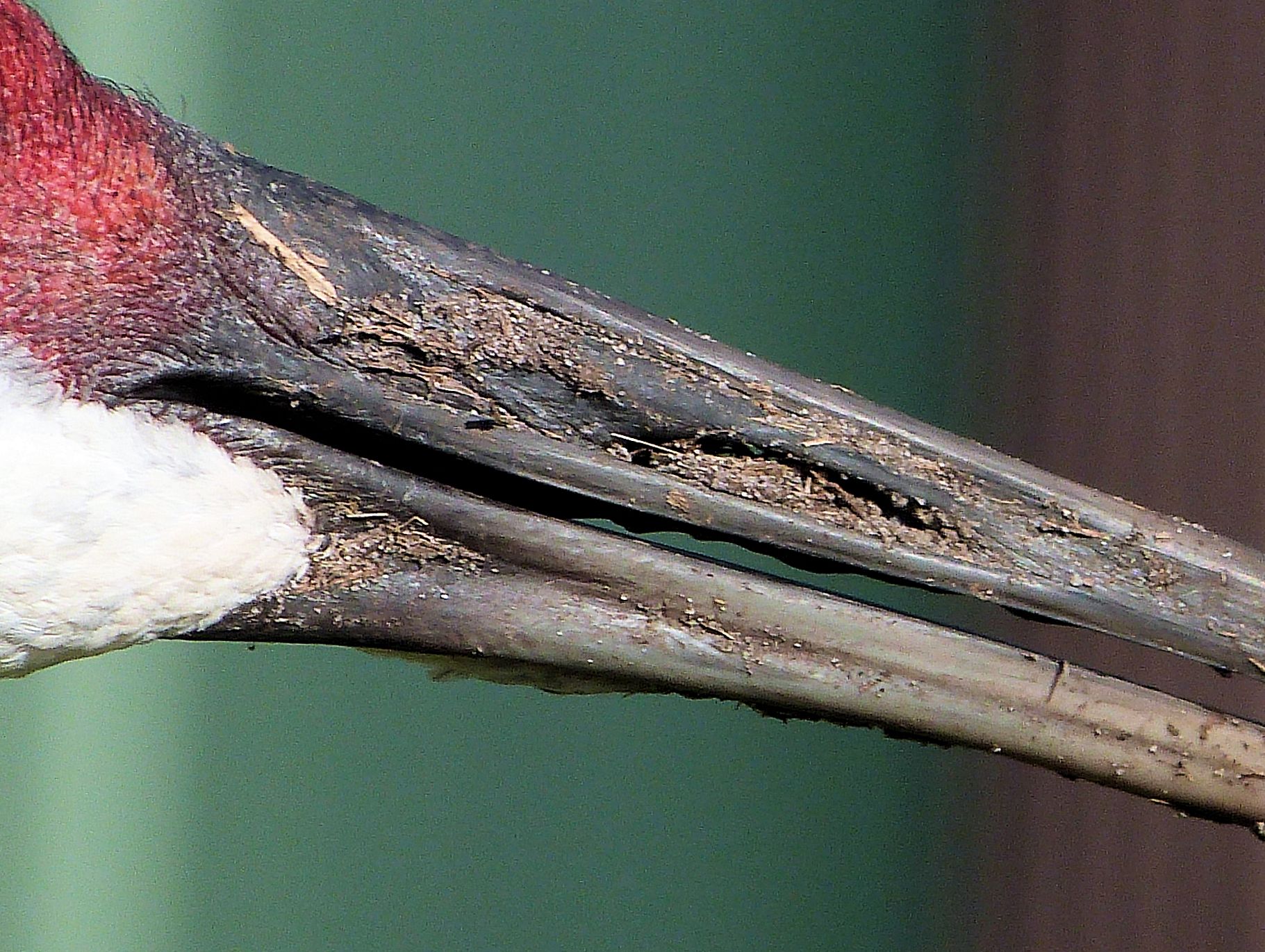
Sandhill Crane Beak Crop
Here are the photos that were taken this morning.
This slideshow requires JavaScript.
Like a crane or a swallow, so did I chatter: I did mourn as a dove: mine eyes fail with looking upward: O LORD, I am oppressed; undertake for me. (Isaiah 38:14 KJV)
Yea, the stork in the heaven knoweth her appointed times; and the turtle and the crane and the swallow observe the time of their coming; but my people know not the judgment of the LORD. (Jeremiah 8:7 KJV)
He shall cover thee with his feathers, and under his wings shalt thou trust: his truth shall be thy shield and buckler. (Psalm 91:4 KJV)
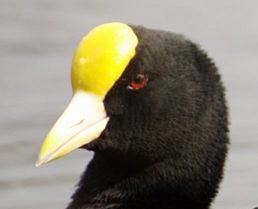
The Coot article mentioned the shield. “Coots have prominent frontal shields or other decoration on the forehead…”
What is a “frontal shield”?
The place above the upper beak (upper mandible) has a platelike area. It is made of a fleshy material. When the Lord created those birds that have the shield, He gave them each a different looking shield. It is neat to see the variety that the shields have. I am sure that the bird uses them to know which are their kind.
Below are some photos of the various Frontal Shields on the birds. There are more birds that have shield, but this just a sample of these unique birds.
This slideshow requires JavaScript.
You have also given me the shield of your salvation: and your right hand has held me up, and your gentleness has made me great.
(Psalms 18:35 AKJV)
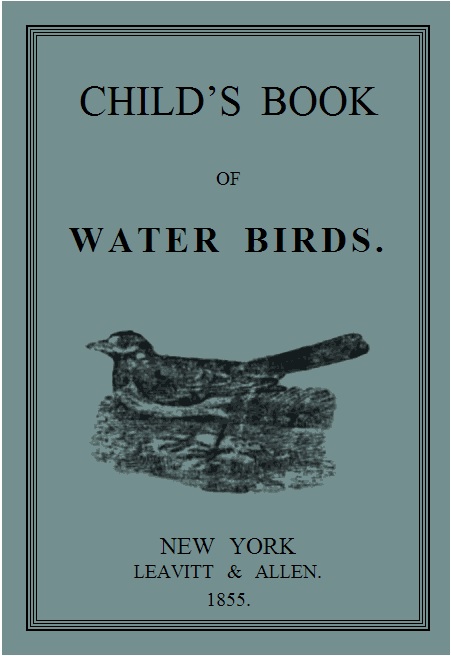
An anonymous writer wrote the Child’s Book of Water Birds in 1855. You can see how Project Gutenberg published it as an e-book. (Public Domain) CLICK HERE
Below are the links to my “Re-visited” versions here. Moved these over from the Birds of the Bible for Kids blog and can be found in the Kid’s Sectionunder Watching Birds.
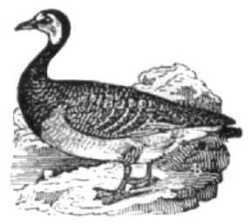
The six different birds were written to a very young reader. I trust you will enjoy reading them for yourself or to your children or grand-children. They can be used to introduce you/them to birds.
Train up a child in the way he should go: and when he is old, he will not depart from it. (Proverbs 22:6 KJV)
Introducing children to the amazing birds the Lord has created is a tiny step to help with that training. Introducing them to the Lord Jesus Christ, is the major step.
Oh, that men would give thanks to the LORD for His goodness, And for His wonderful works to the children of men! Let them sacrifice the sacrifices of thanksgiving, And declare His works with rejoicing. Those who go down to the sea in ships, Who do business on great waters, They see the works of the LORD, And His wonders in the deep. (Psalms 107:21-24 NKJV)
Those who go out to sea are able to see many of the birds that spend most of their lives on the wing. The oceans do not always remain calm, but their Creator has created them to survive many varied conditions. How about us? As things come into our lives, they are not always comfortable to us. If we are placing our faith in the Creator, the Lord Jesus Christ, we can sing the last verse of the hymn below:
O soul, sinking down ’neath sin’s merciless wave,
The strong arm of our Captain is mighty to save;
Then trust Him today, no longer delay,
Board the old ship of Zion, and shout on your way:
“Jesus saves! Jesus saves!”
Shout and sing on your way: “Jesus saves!”
This slideshow requires JavaScript.
*
“Ship Ahoy” ~ by Dr. Richard Gregory
And, behold, God himself is with us for our captain, (2 Chronicles 13:12a KJV)
I was drifting away on life’s pitiless sea,
And the angry waves threatened my ruin to be,
When away at my side, there I dimly descried,
A stately old vessel, and loudly I cried:
“Ship ahoy! Ship ahoy!”
And loudly I cried: “Ship ahoy!”
’Twas the “old ship of Zion,” thus sailing along,
All aboard her seemed joyous, I heard their sweet song;
And the Captain’s kind ear, ever ready to hear,
Caught my wail of distress, as I cried out in fear:
“Ship ahoy! Ship ahoy!”
As I cried out in fear: “Ship ahoy!”
The good Captain commanded a boat to be low’red,
And with tender compassion He took me on board;
And I’m happy today, all my sins washed away
In the blood of my Savior, and now I can say:
“Bless the Lord! Bless the Lord!”
From my soul I can say: “Bless the Lord!”
O soul, sinking down ’neath sin’s merciless wave,
The strong arm of our Captain is mighty to save;
Then trust Him today, no longer delay,
Board the old ship of Zion, and shout on your way:
“Jesus saves! Jesus saves!”
Shout and sing on your way: “Jesus saves!”
Out of the ground the LORD God formed every beast of the field and every bird of the air, and brought them to Adam to see what he would call them. And whatever Adam called each living creature, that was its name. (Genesis 2:19 NKJV)
Golden Eagle keeps telling you to write in your Journal. So, what is a journal?
A birdwatching journal is where you put down things about the bird you are looking at now or when you are at home. I keep a list of the birds I see every time I go birdwatching. It is a little 3X5 inch Memo Book (for my pocket) and a bigger one when I am at home. Here is what I put down in mine.
Date
Time
Where I am
Weather (sunny, cloudy, raining, windy and sometimes the temperature)
Name of the bird if I know it
How many
If I don’t know the name, I draw the beak or wing or whatever that will help me remember the bird)
When I get home I check my Bird Guide to see if I can find out what the bird is that I didn’t know.
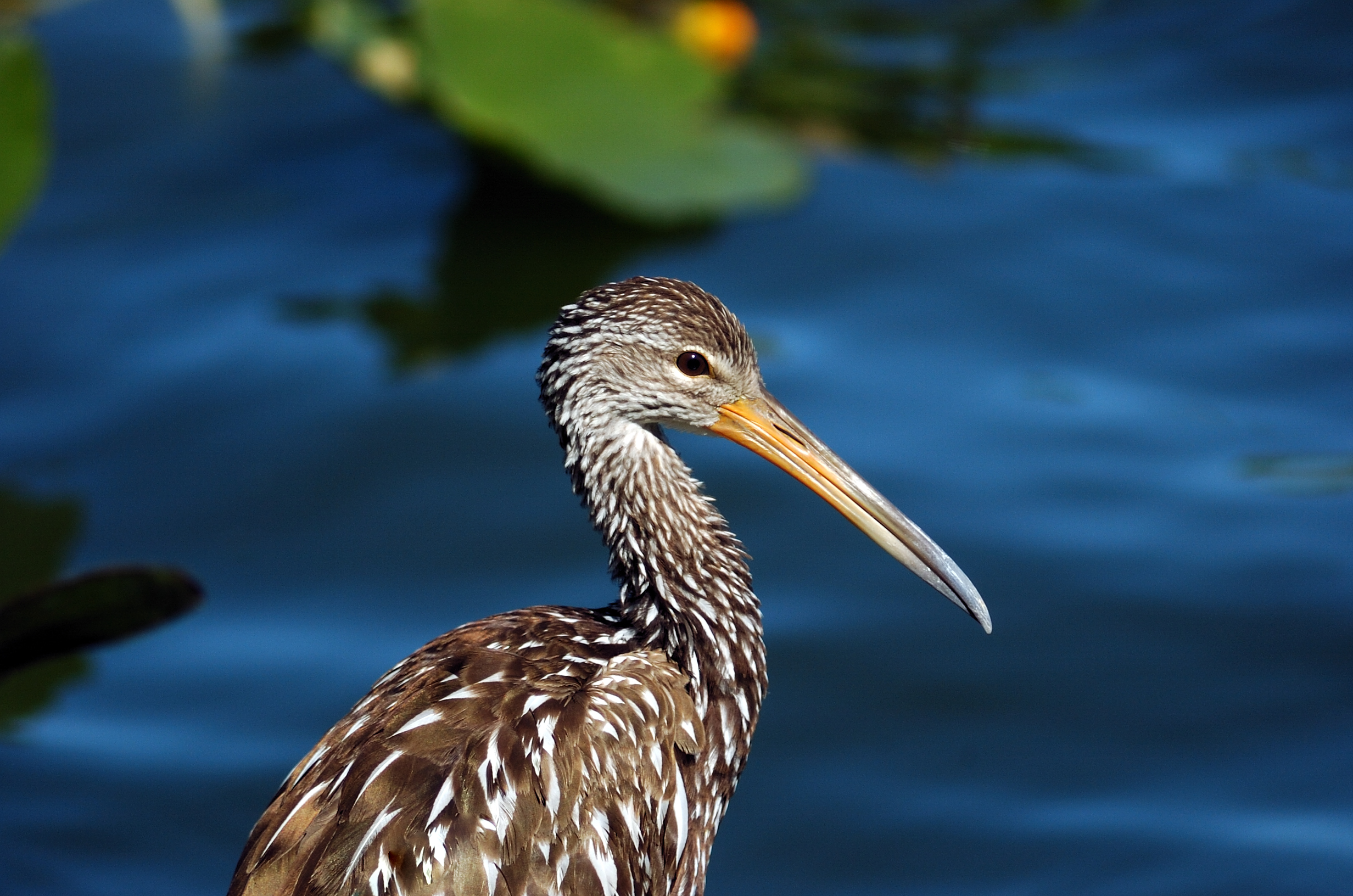
Limpkin (Aramus guarauna) by Dan at Lake Morton
Things to put in your journal:
Many write the item down and sometime draw the bird or something about it.
Outdoor Birds
What kind of bird (if you know)?
How big is it?
What color is it?
Shape? (duck, chicken, heron, sparrow,…)
Wings? (long, short, pointed, rounded,….)
Did it sing or make a noise? What did it sound like?
Date, time, and where you saw the bird
Bible Birds
Did you read the name in your Bible?
What was the name of the bird?
What verse?
What was said about the bird?
You can put other information in your journal. We will be telling you more about each thing. Everyone’s journal is different. Yours does not have to be like mine or Golden Eagles.
Why keep a list or journal?
Birdwatchers like to make lists. They keep some of these lists:
Life List (all the birds ever seen)
Year List (each years birds)
Trip List (a vacation or trip)
Park or Place List (Park, zoo, lake,…)
Whatever List (your list)
Most of us that are older wish we had kept a list of birds when we were young like you. We forget what we saw and then can’t put it on our life list. I have seen more birds than what is on my list, but I didn’t keep a journal when I was younger. Most people tell the truth and only list what they saw. Don’t make up birds you think you saw just so you have a long list. As you get older, your list will grow. The Lord has many birds for you to see and enjoy.
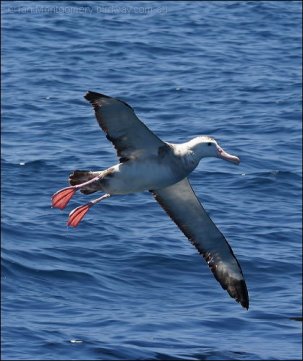
Ian’s Stamp of the Week – Antipodean Albatrosses ~ by Ian Montgomery
Newsletter – 9/13/14
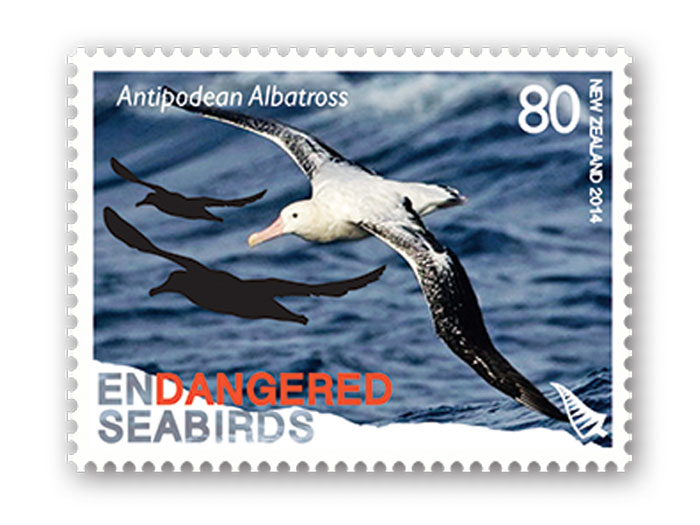
The reference to Stamp of the Week in the subject line isn’t a typo: I’m celebrating the issue of a stamp set by New Zealand Post on 3 September which includes a photo of mine in the design of one of the stamps.
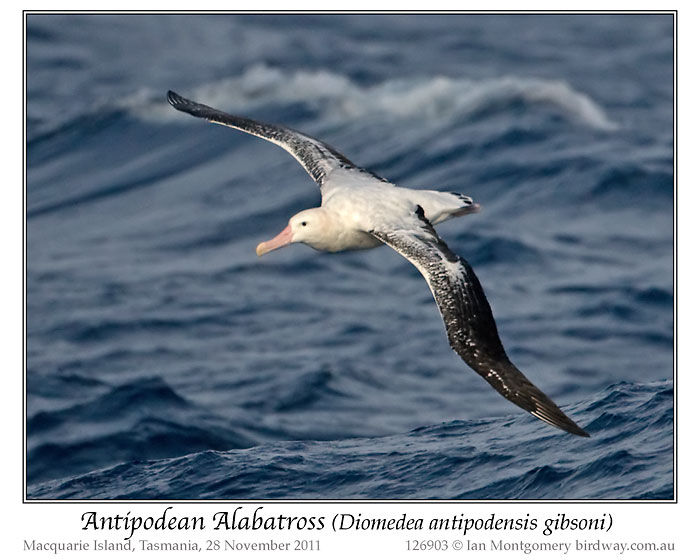
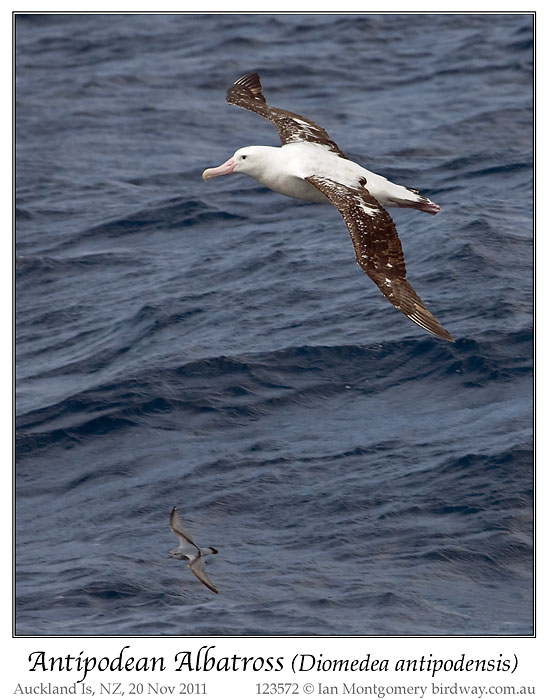
Here is the original photo, taken north of Macquarie Island when we were returning to Hobart at the end of a Subantarctic Islands trip in November 2011 that started in Dunedin. This was the same trip on which I photographed the Fiordland Penguins that featured as last week’s bird.
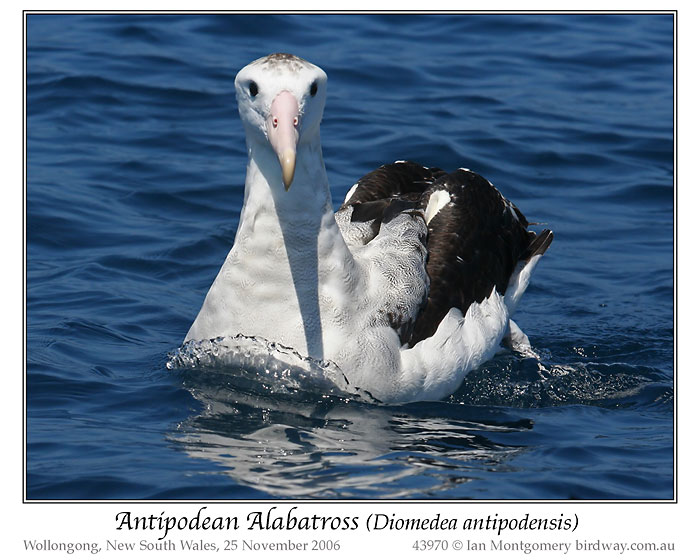
If you’re not familiar with Antipodean Albatrosses and think it looks like a Wandering Albatross, you may be relieved to hear that it’s all a matter of taxonomy and reflects the recent split of the Wandering Albatross into four species, one of which is the Antipodean. In fact this same taxon, for want of a better word, was bird of the week in November 2006 as Wandering Albatross after I’d photographed some on a pelagic trip off Wollongong south of Sydney. If we follow this split, and BirdLife Australia does, then most of the erstwhile Wandering Albatrosses in Australian waters are Antipodean and breed on the islands south of New Zealand, mainly Antipodes Island, Campbell Island and Adams Island in the Auckland Islands.
The Antipodean is one of the smaller of the Wandering Albatross group but they are still enormous: up to 117cm/46in in length with a wing span to 3.3m/11ft and weighing up to 8.6kg/19lbs. Look carefully at the second Albatross photo and you’ll see a grey and black Broad-billed Prion completely dwarfed by the Antipodean Albatross. The prion is about 30cm/12in in length with a wingspan of 60cm/2ft. You can get an impression of the size in the third photo taken on that Wollongong trip – look at the bow wave!
The Antipodean Albatross itself comes in two varieties, the nominate Antipodean which breeds on Antipodes and Campbell Island and ‘Gibson’s Albatross’ which breeds in the Auckland Islands Group. The various Wandering Albatross species all look rather similar and are difficult to identify in the field. They vary in size and they differ in the rate and extent of development of white plumage in adult birds – juveniles are mainly brown. The ones in the first two photos are very white and are probably older males of the race gibsoni. The bird swimming in the third photo shows less development of white plumage – not the darkish cap and the dark vermiculations on the neck, breast and shoulder and may be a younger male or female and could be either nominate Antipodes or Gibson’s: all too hard.
Antipodean Albatross (Diomedea antipodensis) Stamp by Ian
Here is the complete set of stamps. New Zealand Post wanted to pay me to use the albatross photo, but I so like the idea of having one of mine used in a stamp that they agreed to send me first day covers and a presentation pack instead and that arrived yesterday. Antipodean Albatrosses rate as Vulnerable/Endangered because of their few nesting sites and long-line fishing which leads to the death of adult birds as by-catch. The total population is perhaps 16,000 pairs but there is hope that the population has stabilised after significant declines at the end of the 20th century.
Anyway, I’m off to Dublin via Dubai on Monday to visit family and friends. I’m spending 3 nights in Dubai having found it, to my complete astonishment, ranked as #75 in a book on the top 100 places in the world to go birding. Because of its location at the tip of the Arabian Peninsula, it’s an important staging post for birds migrating from Asia to Africa in the northern spring and autumn migrations (i.e. now). I have two target species: the Crab Plover and the Cream-coloured Courser. The first because it’s an unusual and beautiful black and white wader in a family all to itself and the unusual looking and named Courser – a member of the Pratincole family – because it caught my eye in my Field Guide to the Birds of Britain in Europe when I was a teenager in Ireland half a century ago, below. So, I need your spiritual energy and goodwill to help me. You haven’t failed me in the past!
This was supposed to be a short bird of the week as I really should be packing but I almost forgot to mention that Where to Find Birds in Northern Queensland is now available through Kobo Books. I really like the Kobo ebook reader: I have it on both my Mac computer and my iPad/iPhone but Kobo reader software is also for Android tablets and phones, Blackberries and Windows computers and phone. A friend of mine has expressed concern over the complexity of ebook software/apps, devices/computers and methods of purchase/download etc. so I’m preparing a page to add to the existing one on publications on the website: http://www.birdway.com.au/publications.htm which already has links to Apple, Google Play and Kobo Books and a little bit about the differences. Something to do on the plane.
Greetings
Ian
**************************************************
Ian Montgomery, Birdway Pty Ltd,
454 Forestry Road, Bluewater, Qld 4818
Tel 0411 602 737 ian@birdway.com.au
Bird Photos http://www.birdway.com.au/
Behold, My servant will prosper, He will be high and lifted up and greatly exalted. (Isaiah 52:13 NASB)
Wow! Our Ian is famous. That is quite an honor! I was thinking of Ian as well as the Albatrosses when I picked the verse.
The Albatrosses are a members of the Diomedeidae – Albatrosses Family. There are 21 species in the family. (From CreationWiki) “Albatrosses have very long wings and large bodies. Their bills are hooked and they possess separate raised tubular nostrils. Their bodies range from sizes between 76 and 122 centimeters long (2.5 to 4 feet); and their wingspan ranges from 3 to 6 meters across(9.8 to 19.7 feet). The wings are usually darkly colored on the upper side and are pale colors or white on the underside. Albatross wings allow it to take advantage of the abundant winds across the surface of the sea. The birds make use of the fact that friction with the sea slows some of the wind down so that right above the surface of the water, the wind is relatively weak and slow. Then, as the bird climbs up from the surface, the speed and strength of the wind increases as well (around 50 feet or 15 meters above the surface of the water the albatrosses will reach their full flight speed).
Albatrosses’ wings are designed for a specified type of gliding. Being very long and somewhat thin in width, the wings are used best in the albatrosses’ cycle of flight. This cycle allows the bird to move great distances without once flapping it wings. What a great Creator!
And let the beauty of the LORD our God be upon us: and establish thou the work of our hands upon us; yea, the work of our hands establish thou it. (Psalms 90:17 KJV)
Man goeth forth unto his work and to his labour until the evening. (Psalms 104:23 KJV)
Been working most of the day, moving the Bible Birds pages to here at Lee’s Birdwatching Adventures. It has been a challenge, but with dust still flying, they are now here.
I posted an article on the Birds of the Bible For Kids blog explaining the move of those articles. You might want to read that article because it affects this blog.
Changes On The Way
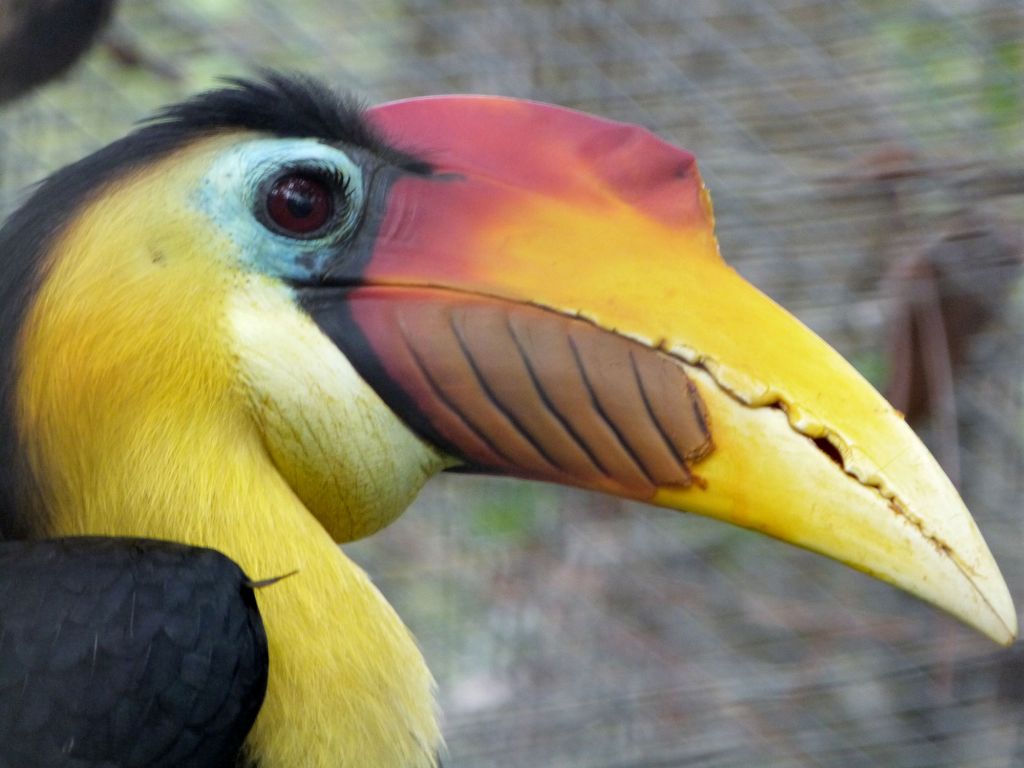
Wrinkled Hornbill (Aceros corrugatus) Brevard Zoo by Lee
You can find the Bible Birds listed in the Kid’s Section. The side menu is now working also for that section. (I think it’s correct). Just hover your mouse over the Kid’s Section and you will see the Bible Birds, along with the Watching Birds, Bird Tales and Scripture Alphabet of Animals sections.
Now that the Bible Bird pages are here, I can start improving them and the regular Birds of the Bible sections.
Thanks you for being patient while things are being moved around and I trust you will see much improvement soon. As mentioned in the Changes on the Way article, “Our purpose is to Glorify Our Lord and show forth His great creation through His Birds and other Critters.”
There is still lots of work ahead, as other sections are moved to this blog. Just wanted to let you know why things are changing and dust is flying still. I have another big challenge coming next, but that will have to hold for now.
but these are written that you may believe that Jesus is the Christ, the Son of God, and that believing you may have life in His name. (John 20:31 NKJV)
Therefore God also has highly exalted Him and given Him the name which is above every name, that at the name of Jesus every knee should bow, of those in heaven, and of those on earth, and of those under the earth, and that every tongue should confess that Jesus Christ is Lord, to the glory of God the Father. (Philippians 2:9-11 NKJV)
And this is His commandment: that we should believe on the name of His Son Jesus Christ and love one another, as He gave us commandment. (1 John 3:23 NKJV)
Trust you will enjoy many of the Lord’s Birds that have crowns. Many more could have been added, but this is a fair sampling.
*
This slideshow requires JavaScript.
*
“All Hail The Power of Jesus Name” – Faith Baptist Orchestra
Guira Cuckoo (Guira guira) at NA by Dan at National Aviary
Bible Birds – Cuckoo’s Introduction
The “Cuckoo” or old English”Cuckow” is found in these verses:
and the owl, and the night-hawk, and the cuckoo, and the hawk after its kind, (Leviticus 11:16 YLT)
And the owl, and the night hawk, and the cuckow, and the hawk after his kind, (Deuteronomy 14:15 KJV)
The Old Testament was written in Hebrew and the word used has several meanings and so some Bibles call the bird a Cuckoo or Cuckow, some a Gull. For now, we are introducing you to Cuckoos.
1) a ceremonially unclean bird
1a) cuckow, gull, seagull, sea-mew
1b) maybe an extinct bird, exact meaning unknown
Did you think Cuckoos only live in Clocks?
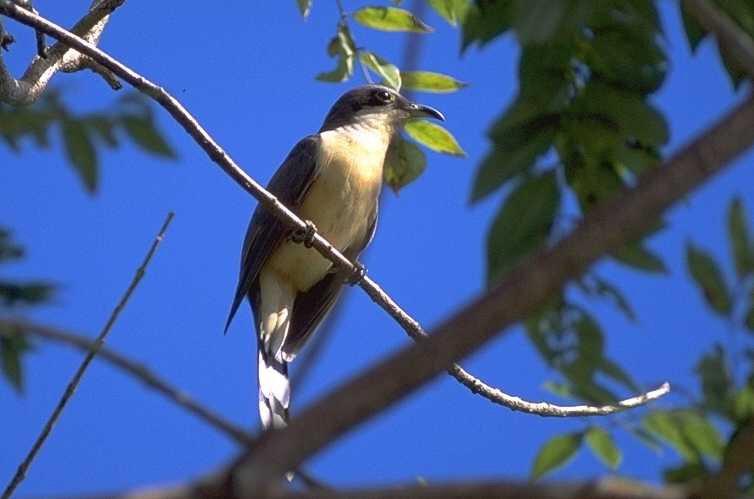
No, there actually is a bird called a Cuckoo. It belongs to a familyCuculidae – Cuckoos. There are 149 species in the family. Not only Cuckoos, but Coucals, Anis, Couas, and Malkohas are family members.
Here are some descriptions of North American Cuckoos: (from Color Key to NA Birds)
Range.—Northern South America, north through Central America, Mexico and Greater Antilles (except Porto Rico?) to Florida and Louisiana, migrating south in fall.
Maynard Cuckoo (C. m. maynardi). Similar to Mangrove Cuckoo, but underparts paler, the throat and forebreast more or less ashy white.
Range.—Bahamas and (eastern?) Florida Keys. (2012 Now Mangrove Cuckoo)
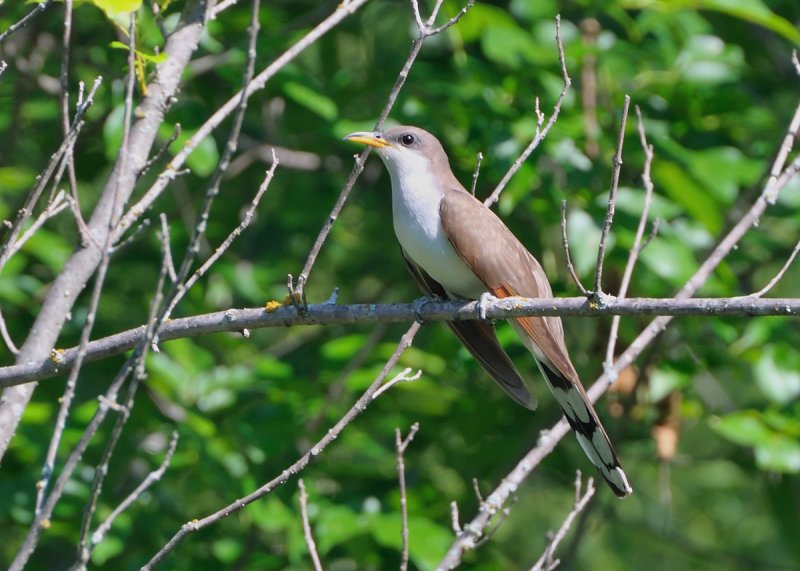
Yellow-billed Cuckoo (Coccyzus americanus). Length 12.2 in. Ads. Below white; lower mandible largely yellow, tail black, outer feathers widely tipped with white. Notes.Tut-tut, tut-tut, tut-tut, tut-tut, cl-uck, cl-uck, cl-uck, cl-uck, cl-uck, cl-uck, cow, cow, cow, cow, cow, cow, usually given in part.
Range.—Eastern North America; breeds from Florida to New Brunswick and Minnesota; winters in Central and South America.
California Cuckoo (C. a. occidentalis). Similar to Yellow-billed Cuckoo but somewhat grayer and larger; the bill slightly longer, 1.05 in.
Range.—Western North America; north to southern British Columbia; east to Western Texas; winters south into Mexico.
Black-billed Cuckoo (Coccyzus erythropthalmus) by Jim Fenton
Black-billed Cuckoo (Coccyzus erythrophthalmus). Length 11.8. Ads. White below; bill black; tail, seen from below, grayish narrowly tipped with white; above, especially on crown, browner than Yellow-billed Cuckoo. Notes. Similar to those of Yellow-billed Cuckoo, but softer, the cow notes connected.
Range.—Eastern North America; west to Rocky Mountains; breeds north to Labrador and Manitoba; winters south of United States to Brazil.
Cuckoo Sound with Pictures (From Poland)
Sort of sounds like the clock doesn’t it?
We will tell you more about the Cuckoo in the next Bible Birds – Cuckoo article.
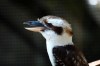
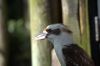
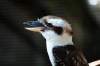
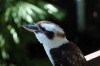
On our vacation several weeks ago we stopped back by the Brevard Zoo in Melbourne, Florida. I had a neat Kookaburra Encounter.
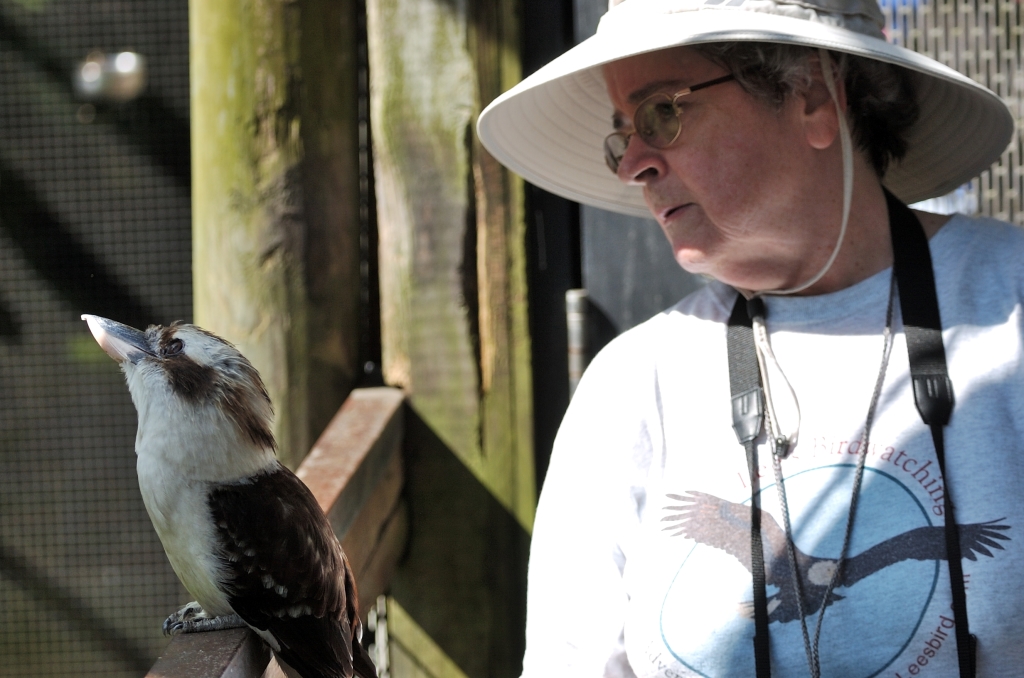
Lee with Laughing Kookabura at Brevard Zoo by Dan
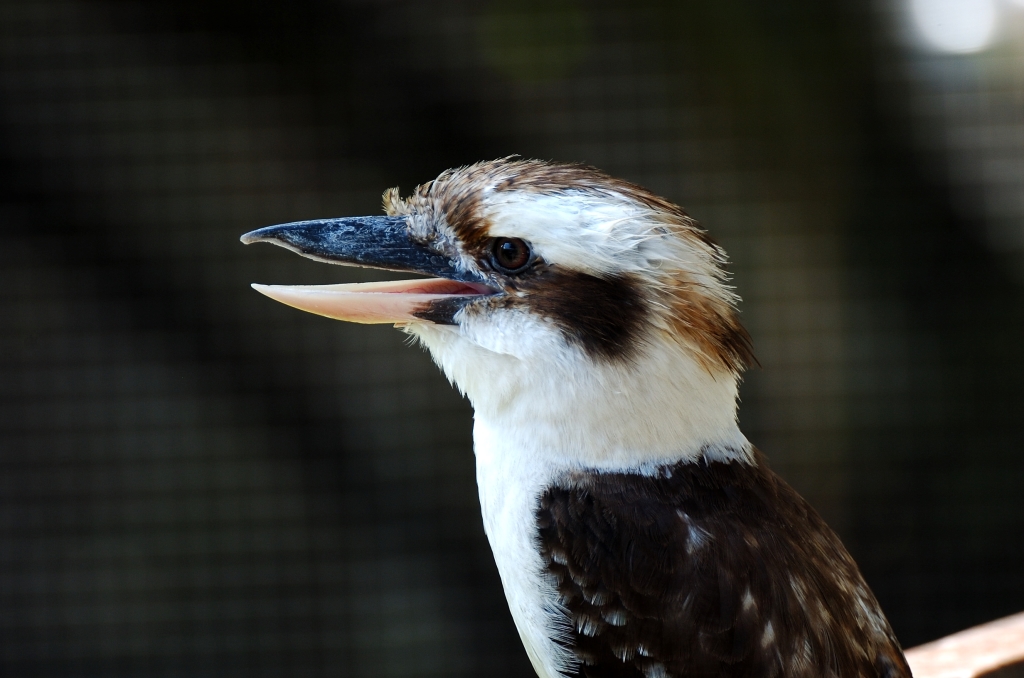
The Laughing Kookaburra is in the aviary where the Lorikeets, Galahs and other birds are kept. When I came through a door, right there on the rail sat a young Laughing Kookaburra. I have seen them before, but never as close as this one. I got within inches of him/or her. I could have touched it, but was afraid of that beak.
So God created great sea creatures and every living thing that moves, with which the waters abounded, according to their kind, and every winged bird according to its kind. And God saw that it was good. (Genesis 1:21 NKJV)
Here are some of the pictures we took.
Lee very close to Kookabura by Dan
I have to admit, I was thrilled. Just looking at one of the Lord’s creations so close. Wow! That one photo Dan took of me and the Kookaburra, my hand was within 5-6 inches from it. May I never lose my AWE at seeing and encountering the Lord’s critters.
Lee very close to Kookabura by Dan
Laughing Kookaburra at Brevard Zoo by Dan with my camera
Laughing Kookabura by Dan
Kookaburra at Brevard Zoo by Dan
Galah and Lorikeet watching nearby
at Brevard Zoo by Dan
Update (9/3) Just realized that when I added pre-dated articles, it is sending you notices of its posting. I thought that pre-dating would keep you from being notified. Since you will get notices (followers), I might as well post them as current dates. So expect more than one post a day for awhile!! The post are being copied from the Birds of the Bible For Kids website to the Kids Section here. Besides, you might enjoy them even though they are for the younger readers. The dust is still flying.
Update (9/1) Opened up a new section of the blog called Kids Section. This is the Introduction for their Bible Birdssection, which has links to easier reading articles or ones written for the younger folks.
Some of these articles were here already and others were written just for the Birds of the Bible For Kids blog. We are placing a copy of all articles on this blog. This will save much duplications. Also, the younger readers will also have the benefit of the wealth of information here also.
Expect to see more articles for both our regular readers and our younger readers. You might be surprised how interesting they can be.
Trust all of this is honoring to the Lord. He is the Creator of all these neat birds and I hope you will be able to easily navigate to the various sections. I really like the new menu on the left side.
Update: (8/29) 10:00pm – Vodpods fixed, now I am trying to adjust the new Sunspot Theme. The dust is really getting thick! Hope you like it, it will get better, I HOPE!
Update: (8/29) All the videos with Vodpod are broken and Peterson’s Bird Series – The dust is getting thick!
I am in the process of preparing this site for a theme change. There are some preparations that are being done behind the scenes. There are over 2,000 post and pages that are being checked.
Missing photos and videos have already been discovered and some broken links are crying for help. So ignore the dust again.
If you want to check out what the new theme will look like, check out the Birds of the Bible for Kids. It will be similar. Click a blog and you will see how the columns change. If you would like to leave a comment or like to let me know if you like it or not, it would be appreciated.
This is an Introduction to the Bible Birds. We have been adding many things about the birds in the Bible and other birds that are not named in the Bible, but the Lord made all the birds.
On Day Five (5) of creation, the birds were created. They didn’t just happen. They were designed by God and each one is different. Each one was given just what it needs to live, eat, and make more birds.
Genesis 1:20-23 NKJV
(20) Then God said, “Let the waters abound with an abundance of living creatures, and let birds fly above the earth across the face of the firmament of the heavens.”
(21) So God created great sea creatures and every living thing that moves, with which the waters abounded, according to their kind, andevery winged bird according to its kind. And God saw that it was good.
(22) And God blessed them, saying, “Be fruitful and multiply, and fill the waters in the seas, and let birds multiply on the earth.”
(23) So the evening and the morning were the fifth day.
I know there are some big words in those verses, but the bold letters help find important words.
Did you see the “let birds multiply”? That doesn’t mean they do math. It means that they were to have baby birds, then the baby could grow up and have more baby birds. Then there would be lots of birds.
We will be telling you more soon. Come back and find out about the many birds in the bible.
(Sept 1 – Opened up a new section of the blog called Kids Section – Bible Birds. This is the Introduction for their Bible Birds section, which has links to easier reading articles or ones written for the younger folks.
Some of these articles were here already and others were written just for the Birds of the Bible For Kids blog. We are placing a copy of all articles on this blog. This will save much duplications. Also, the younger readers will also have the benefit of the wealth of information here also.
Expect to see more articles for both our regular readers and our younger readers. You might be surprised how interesting they can be.