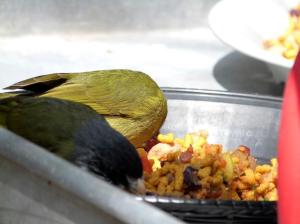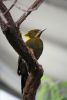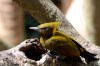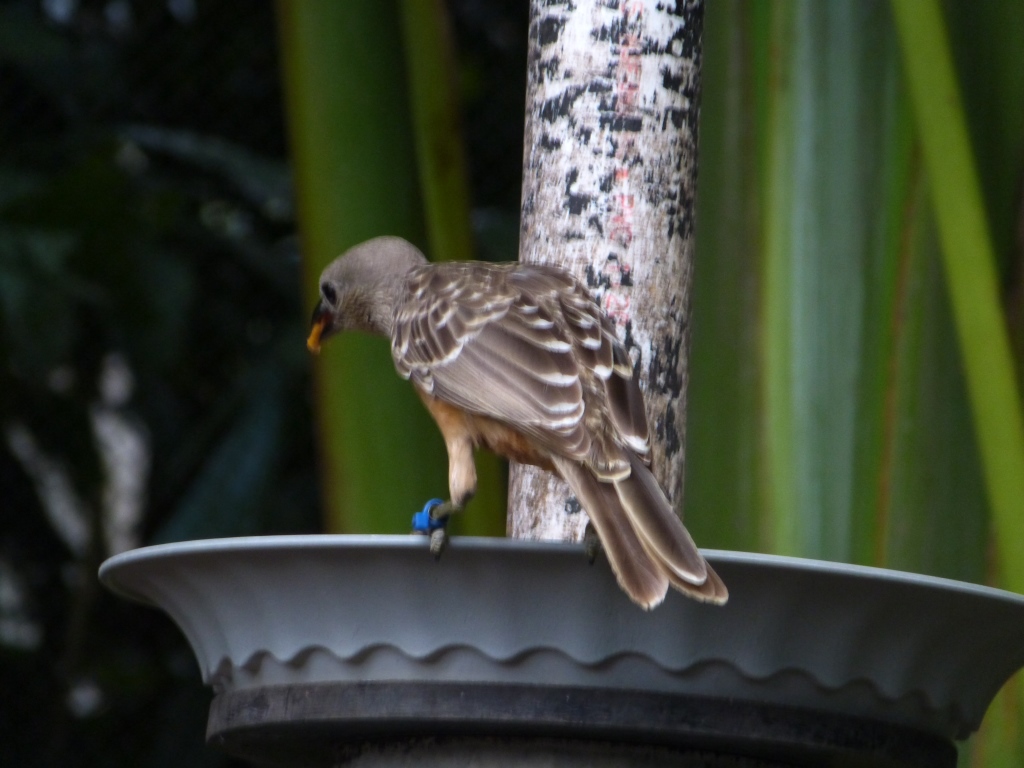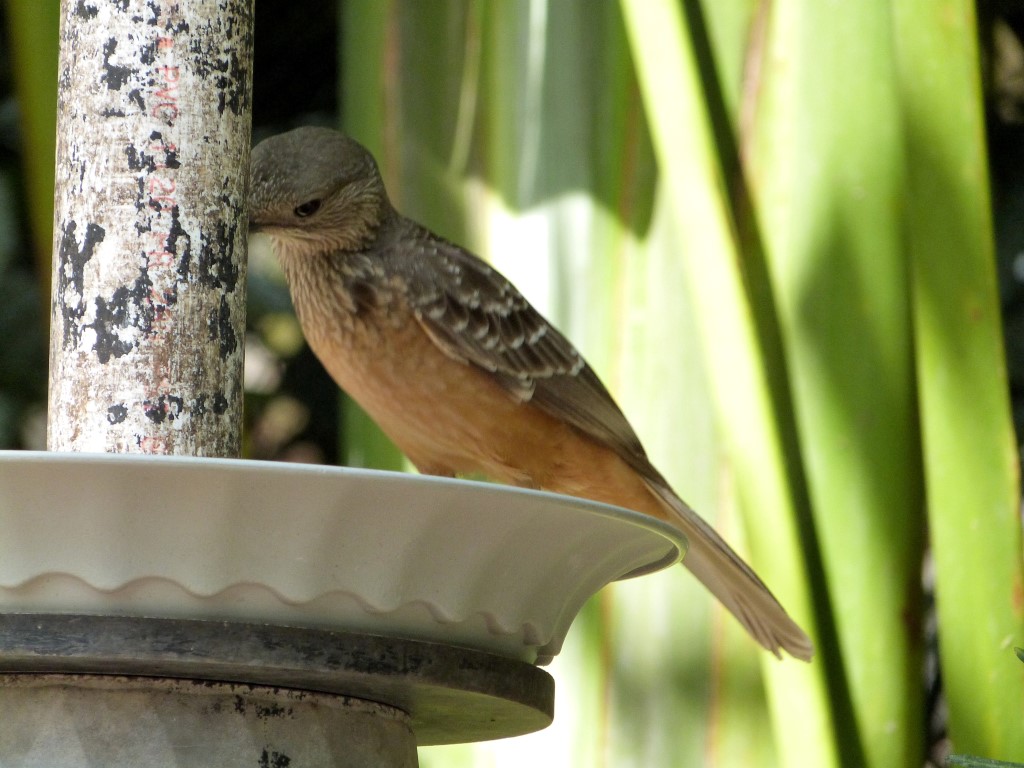
Crested Pigeon at Zoo Miami

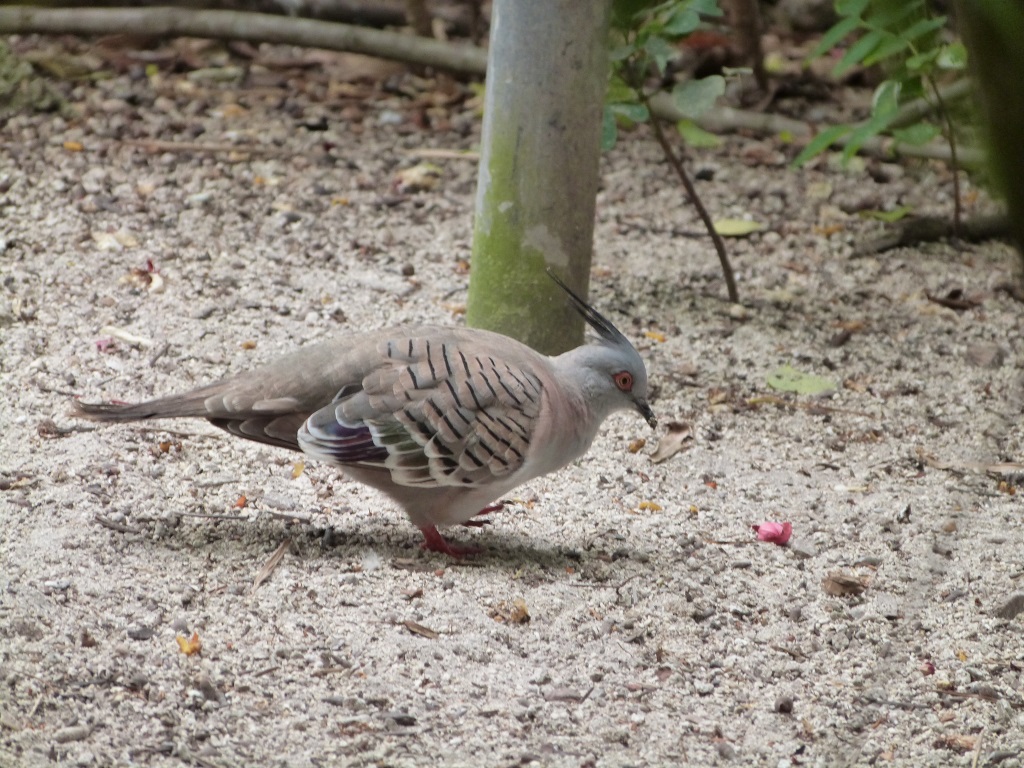
COL-Colu Crested Pigeon (Ocyphaps lophotes) at ZM by Lee

Crested Pigeon (Ocyphaps lophotes) at ZM by Lee

And he said unto him, Take me an heifer of three years old, and a she goat of three years old, and a ram of three years old, and a turtledove, and a young pigeon. (Genesis 15:9 KJV)

The Crested Pigeon was another interesting bird that we were able to watch at the Zoo Miami, Birds of Asia Aviary. I like their Crest. It adds some “class” to this creation from the Lord. They are colorful, but notice in the photos below how they blend in with their surrounding. The Creator has provided them with a nice camouflage design.

The Crested Pigeon (Ocyphaps lophotes, also commonly known as the Top Notch Pigeon) is a bird found widely throughout mainland Australia except for the far northern tropical areas. They belong to the Columbidae Family and is the only member of the genus Ocyphaps. There are only two Australian pigeon species that possess an erect crest, being the Crested Pigeon and the Spinifex Pigeon. The Crested Pigeon is the larger of the two species.

Habitat is grasslands, brush and wooded areas but they can also be seen at watercourses, homestead gardens, pastoral areas, sports grounds, and golf courses. Their habitat has expanded since settlement has produced pastoral lands (previously they were only found in inland and Western Australia). Foraging for grain, has adapted to grain farming areas, often feeding on the noxious weed of Salvation Jane. They are commonly misidentified as the Topknot Pigeon.

Their most distinctive behaviour is the beating and whistling sound their wings make when they take off. This is most likely to draw the attention of predators to birds on the wing, and away from any birds remaining on the ground and as an alarm call to other pigeons. When the birds land, the tail tilts upwards and the flight patterns are similar to the those of the Spotted Turtle-Dove. They are generally solitory. Although they can be seen in pairs, they can be highly social and tend to be seen in packs. They are highly gregarious birds when in contact with humans. (Wikipedia)


COL-Colu Crested Pigeon (Ocyphaps lophotes) at ZM by Lee

Crested Pigeon (Ocyphaps lophotes) at ZM by Lee

And I said, Oh that I had wings like a dove! for then would I fly away, and be at rest. (Psalms 55:6 KJV)

Lee’s Addition:

I trust you enjoy the Crested Pigeon (Ocyphaps lophotes). My computer is off line, in fact, not even set up. A new flooring is being installed in that room and it is getting a new coat of paint. So it will be down for several days. This is being scheduled ahead of time.

*

*

This slideshow requires JavaScript.

*

Australian King Parrot by Bellamoon Nature

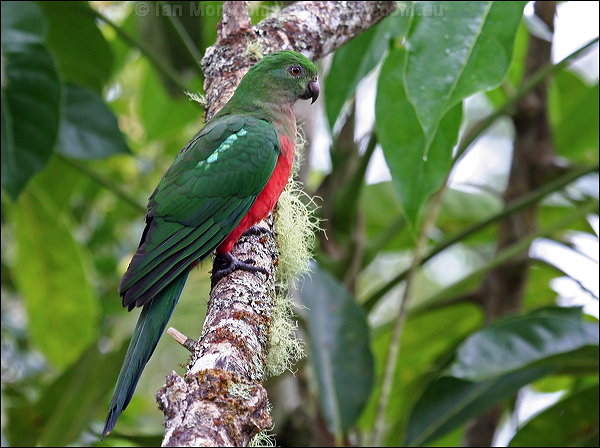
Australian King Parrot (Alisterus scapularis) Female by Ian

Australian King Parrot (Alisterus scapularis) Female by Ian

For God is the King of all the earth: sing ye praises with understanding. (Psalms 47:7 KJV)

Australian King Parrot by Bellamoonnature

*

KING PARROT – One of the most spectacular, brilliantly coloured of all parrots endemic to Eastern Australia. Male king parrots are the only Australian parrot with a completely red head, females have a green head and breast. Found in humid and heavily forested regions. Thank you for viewing Enjoy!

“Some birds are not meant to be caged, that’s all. Their feathers are too bright, their songs too sweet and wild. So you let them go, or when you open the cage to feed them they somehow fly out past you. And the part of you that knows it was wrong to imprison them in the first place rejoices, but still, the place where you live is that much more drab and empty for their departure.” – Stephen King.

“In order to see birds it is necessary to become part of the silence” – Robert Lynd

Australian King Parrots belong to the Psittacidae – Parrots Family.

Australian King Parrots range from North and Central to Southern Victoria. They are frequently seen in small groups with various species of rosella. Further from their normal eastern upland habitat, they are also found in Canberra during winter, the outer western suburbs and north shore of Sydney, and the Carnarvon Gorge in Central Queensland

There are three species of king parrots – medium-sized parrots in the genus Alisterus; the Australian King Parrot (Alisterus scapularis), the Papuan King Parrot (Alisterus chloropterus), and the Moluccan King Parrot (Alisterus amboinensis). The three species are found in Eastern Australia, New Guinea, and Indonesian islands including the Maluku islands respectively. Predominantly of red and green plumage, the long tailed parrots are related to the genera Aprosmictus and Polytelis.

(Information – Bellamoonnature and Wikipedia)


Moluccan King Parrot (Alisterus amboinensis) ©WikiC - Brevard_Zoo

Moluccan King Parrot (Alisterus amboinensis) ©WikiC – Brevard_Zoo

Let us come before his presence with thanksgiving, and make a joyful noise unto him with psalms. For the LORD is a great God, and a great King above all gods. (Psalms 95:2-3 KJV)

Lee’s Addition:

I trust you enjoy this video by Bellamoon. My computer is off line, in fact, not even set up. A new flooring is being installed in that room and it is getting a new coat of paint. So it will be down for several days. This is being scheduled ahead of time.

*

Bellamoonnature – YouTube

Ian’s Australian King Parrots

Psittacidae – Parrots Family

Australian King Parrot – Wikipedia

Birds of the World

*

For The Sheer Joy of Variety! – Creation Moments


Greater Painted Snipe (Rostratula benghalensis) by W Kwong

Greater Painted Snipe (Rostratula benghalensis) by W Kwong

FOR THE SHEER JOY OF VARIETY!

“Woe unto him that striveth with his Maker! Let the potsherd strive with the potsherds of the earth. Shall the clay say to him that fashioneth it, What makest thou? or thy work, He hath no hands?” (Isaiah 45:9)

Did you ever try to plan all the details of a simple project? How many plans do you think the Lord had to make when He created living things? A billion? A billion times a billion?

The hierarchy of biological classification’s eight major taxonomic ranks

The hierarchy of biological classification’s eight major taxonomic ranks

We all know that it takes time to plan the most simple project. Did you ever think about the planning God had to do when He created all the different kinds of living things? Our word “species” today includes many creatures that the Bible counts as being the same “kind” – as when God created the kinds. But God did design the genetic information that allowed the kinds to produce these variations.

Yes, God’s act of creating living things was much more than just wishing. Just think that there are more than 20,000 different species of bees – some with very complex societies – and their own languages! The figures and the beauty of it all makes one wonder at God. Why are there 4,500 different species of sponges? Why are some creatures – never seen by humans until this century – so eerily beautiful? For that matter, why have so many different kinds of beautiful flowers?

The variety in the creation reflects some of the joy of creation that God felt, and shows us the incredible unbridled creativity of our wonderful God. The fact that there is only one species of human – all related – confirms the human history related in the Bible.

Prayer:
Dear heavenly Father, I know that I shall never have Your ability to plan and carry out those plans. I confess that too often I waste the time and energy You give me because I don’t even bother to use the abilities You have given me. Forgive me for Jesus’ sake, and for His sake help me to be more like You in this. Amen.
Notes:
Diagram: The hierarchy of biological classification’s eight major taxonomic ranks. The biblical “kind” is roughly the same as the “family” classification.
(Used with permission of Creation Moments©2014)


Lee’s Addition:

We mention the Lord’s fantastic variety in His avian creations often. This article fits right in with those thoughts and thought it should be shared.


This slideshow requires JavaScript.

*

I selected different photos for the same article on my other site:

Creation Moments’ – For The Sheer Joy of Variety!

*

Feather Coloration

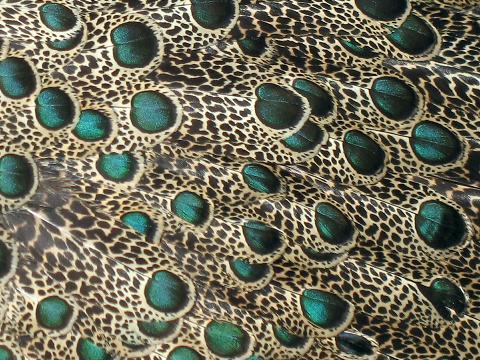
Malayan Peacock-Pheasant (Polyplectron malacense) Feathers ©WikiC

Malayan Peacock-Pheasant (Polyplectron malacense) Feathers ©WikiC

Gavest thou the goodly wings unto the peacocks? or wings and feathers unto the ostrich? (Job 39:13 KJV)

Though you lie down among the sheepfolds, You will be like the wings of a dove covered with silver, And her feathers with yellow gold.” (Psalms 68:13 NKJV)

and say, ‘Thus says the Lord GOD: “A great eagle with large wings and long pinions, Full of feathers of various colors, Came to Lebanon And took from the cedar the highest branch. (Ezekiel 17:3 NKJV)

Our Lord Jesus Christ has created an amazing array of colored feathers to clothe our avian friends. Found these intesting facts in the following book:

Feather Colors (by Dr Roger Lederer)

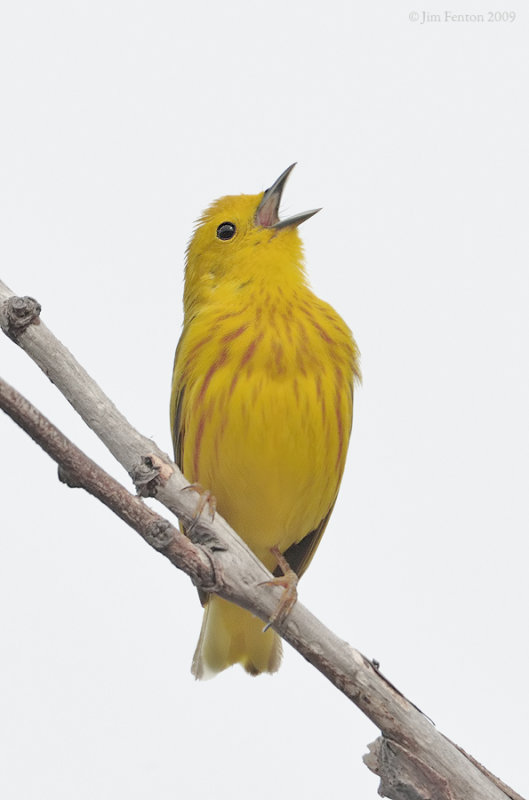
Good ground - American Yellow Warbler (Dendroica aestiva) by J Fenton

Good ground – American Yellow Warbler (Dendroica aestiva) by J Fenton

“The colors of feathers are produced in two ways: pigment and structure.

Brown, gray, yellow, black, tan, orange, and related colors are caused by pigments in the feathers.”

Brevard Zoo 120913 by Lee

Red-crested Turaco (Tauraco erythrolophus) Brevard Zoo by Lee

“The turaco family of Africa contains red and green copper pigments found in no other animal. Int other birds, different pigments combined with light refraction produce such colors.”

Australian King Parrot (Alisterus scapularis) Female by Ian

Australian King Parrot (Alisterus scapularis) Female by Ian

“Bluebird blue, parrot green, white, metallic red, and iridescence are produced by the structure of the feather. To produce blue color, brown granules in the barbs of the feather scatter light–red and yellow wavelengths pass through the granules, while blue is reflected.”

Mountain Bluebird (Sialia currucoides) for ajmithra's article

Mountain Bluebird (Sialia currucoides)

“If your find a feather from a blue bird–a bluebird or jay, for example–look at the feather in your hand: it will appear blue. Then hold the feather up to the light and look through it; it will appear brown.”

(From – “Feather Colors”, p.83, The Amazing Bird Facts and Trivia by Dr Roger Lederer)

*

All About Birds – Color

All About Birds – Feathers and Plumages

Why Are Some Feathers Blue? – Smithsonian

How Do Birds Get Their Color? – 10,000 Birds

Feather – Wikipedia

*

P.S. There will be no “Sunday Inspiration” this week. I am getting ready to take my computer apart. We will be painting and re-flooring this room. There are articles scheduled for Mon, Wed, and Thur. Should be back up and running by Friday, May 2nd. I will still be able to check “comments” and “likes” via a laptop. Thank you for your support. Lord Bless all of you who visit this site.

*

After Their Kinds – Creation Moments

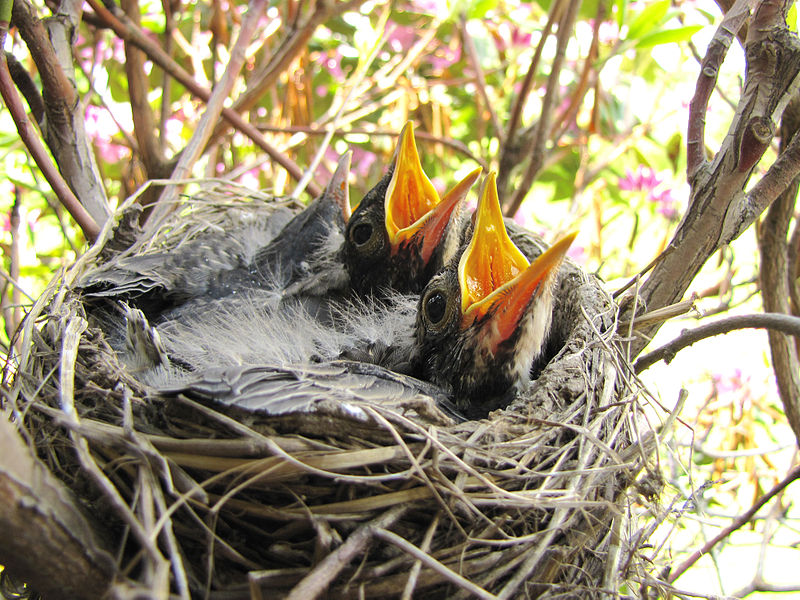
American Robin (Turdus migratorius) in nest ready to eat WikiC

American Robin (Turdus migratorius) in nest ready to eat WikiC

AFTER THEIR KINDS

And the earth brought forth grass, and herb yielding seed after his kind, and the tree yielding fruit, whose seed was in itself, after his kind: and God saw that it was good. (Genesis 1:12)

How wonderful! Your dog has just had puppies! But do you now have to sort through the litter and make sure there are no baby giraffes or kangaroos?

New born Welsh Springer Spaniel puppies ©WikiC

New born Welsh Springer Spaniel puppies ©WikiC

No, not a single giraffe or kangaroo in the litter!In God’s account of creation in Genesis 1, we repeatedly read that both plants and animals were created to reproduce “after their kind.” Genesis 1, in speaking about the creation of plants, repeats three times in just two verses that they are to reproduce “after their kind.” We see the same phrase repeated later in the chapter when animals are created. This is not just empty repetition. God is stressing a fundamental principle that all things reproduce “after their kind.” Mother dogs have puppies and mother cats have kittens. You can count on it.

Why does God stress this principle? Even before creation, God knew that humans would eventually sin and then seek to hide their responsibility by trying to explain things without a Creator. God knew that this idea of evolution would capture the faith of millions over the history of the world.

God stresses what our experience shows so that He might be harder for us to hide from. All things do reproduce after their kind. And despite evolutionists’ strong faith in evolution, they cannot offer one established scientific fact to explain how one kind of creature might eventually make a completely different kind!

Prayer:
I thank You, Lord, that You have made it hard for men to deny You. Yet men still deny You, seeking explanations and excuses outside of Your Word. I know that I, too, can do this, for I am both saint and sinner. I ask that You would correct me when I seek outside of Your Word what is so richly provided to me in Your Word. Amen.

Notes:
Photo: No, not a single giraffe or kangaroo in the litter!
Used with permission of Creation Moments ©2014


See:

Creation Moments – After Their Kind

More Creation Moment and Interesting Things articles here

*


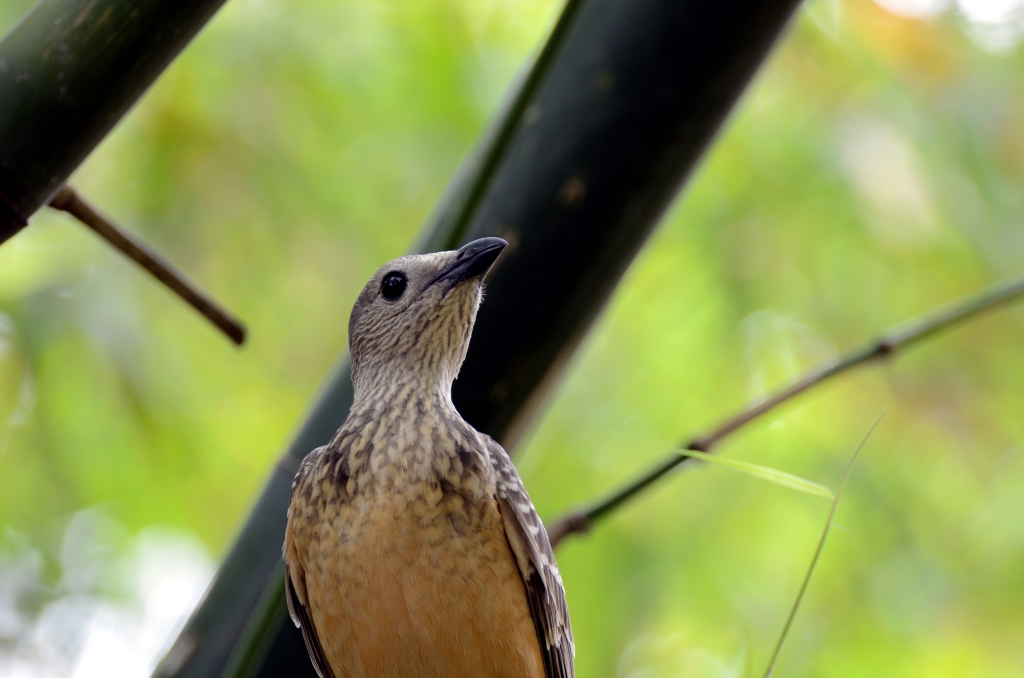
Fawn-breasted Bowerbird at Zoo Miami

Fawn-breasted Bowerbird (Chlamydera cerviniventris) Zoo Miami by Lee

Fawn-breasted Bowerbird (Chlamydera cerviniventris) Zoo Miami by Lee

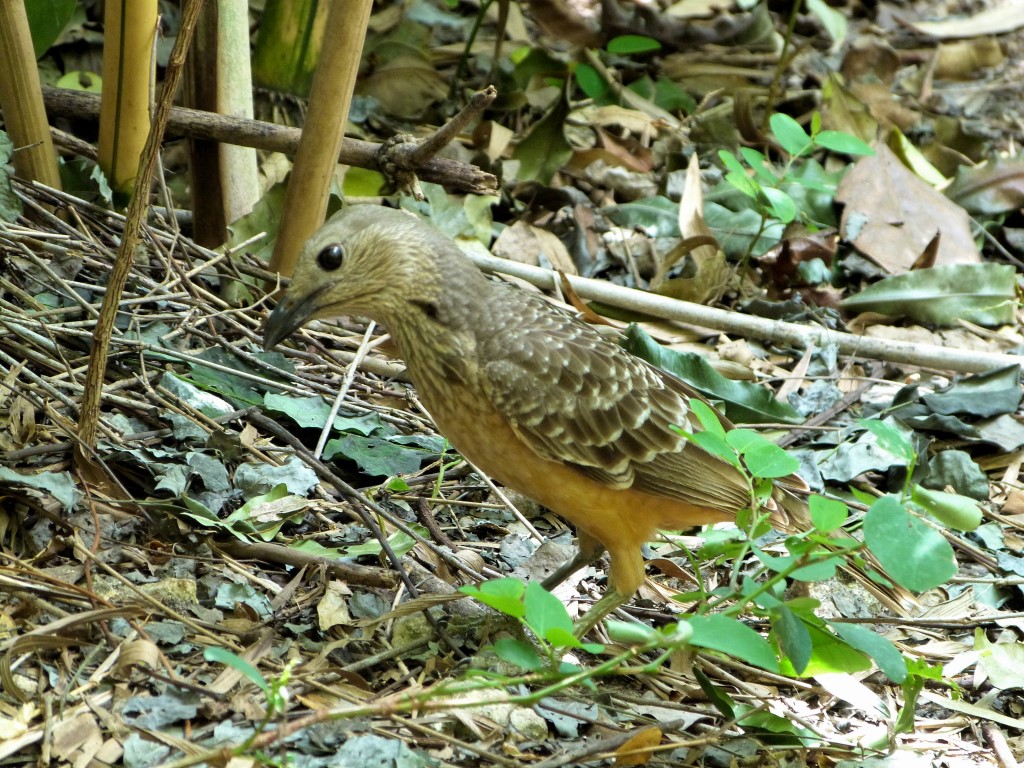
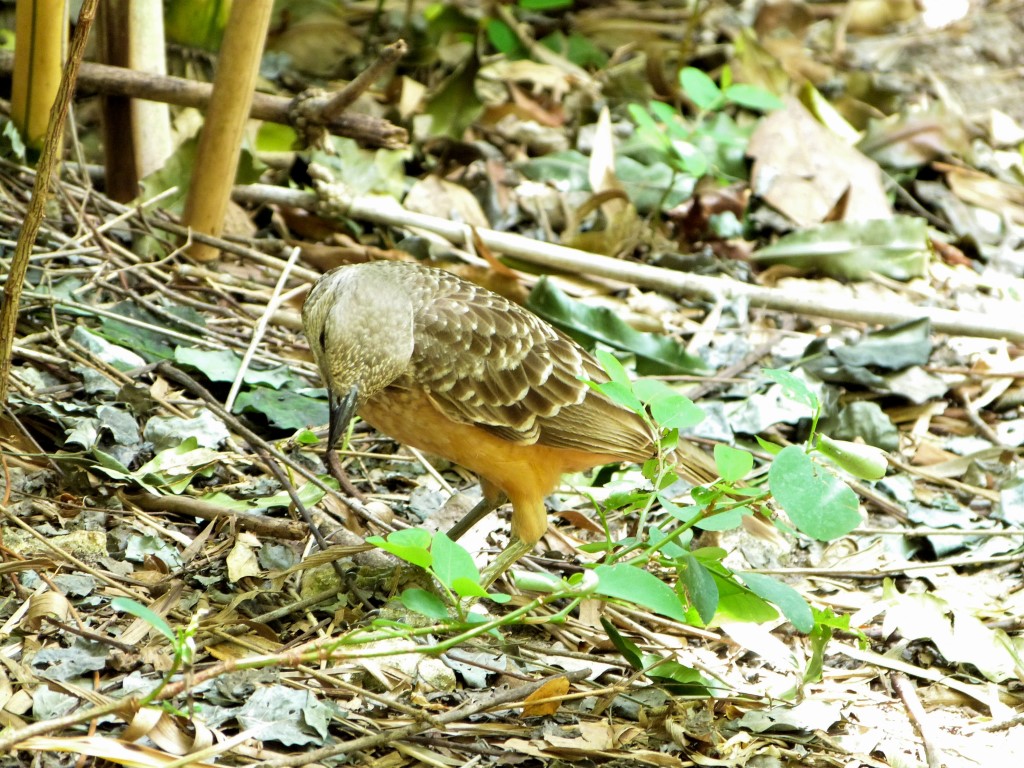
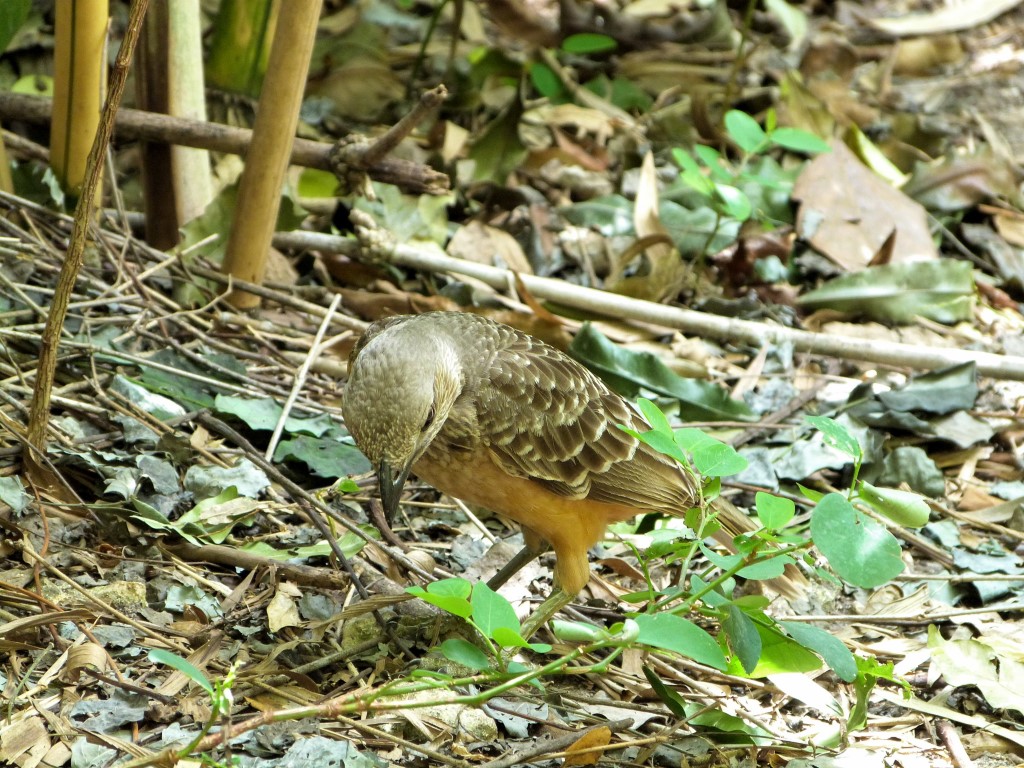
One of the neatest thing to watch on this last trip to the Wings of Asia Aviary at Zoo Miami was the Fawn-breasted Bowerbird working on his bower. “The bower itself is that of “avenue-type” with two sides of wall of sticks and usually decorated with green-colored berries.” In his case, he had green leaves laid out in front.

The Fawn-breasted Bowerbird (Chlamydera cerviniventris) is a medium-sized, up to 13 in (32 cm) long, bowerbird with a greyish brown spotted white plumage, a black bill, dark brown iris, yellow mouth and an orange buff below. Both sexes are similar. The female is slightly smaller than the male.

The Fawn-breasted Bowerbird is distributed in New Guinea and northern Australia, where it inhabits the tropical forests, mangroves, savanna woodlands and forest edges. Its diet consists mainly of figs, fruits and insects. The nest is a loose cup made of small sticks up in a tree. The bower itself is that of “avenue-type” with two sides of wall of sticks and usually decorated with green-colored berries. (Wikipedia with editing)

Fawn-breasted Bowerbird by Dan ZM

Fawn-breasted Bowerbird by Dan ZM

The Bowerbirds are in the Ptilonorhynchidae-Bowerbird Family. There are twenty species in the family, of which, 16 are Bowerbirds.

*

Here are two video clips of him working on the bower. Notice how he goes in and out the other end of the bower. Unfortunately we were only able to view it from the side. One shot he is actually placing the stick upright in the ground. (I recorded him for a bit and then Dan came along. As I was explaining it to him, I got tickled, so ignore the snorts.) I was absolutely amazed watching this bird, which the Lord created, knowing how to make his bower chamber.

*

*

Did you notice the birds chirping and singing in the background. It is so peaceful in that aviary. The birds have so much room and places to hang out. You actually “bird watch” there.

Fawn-breasted Bowerbird (Chlamydera cerviniventris) Sign Zoo Miami by Lee

Fawn-breasted Bowerbird (Chlamydera cerviniventris) Sign Zoo Miami by Lee

Bring out with you every living thing of all flesh that is with you: birds and cattle and every creeping thing that creeps on the earth, so that they may abound on the earth, and be fruitful and multiply on the earth.” (Genesis 8:17 NKJV)

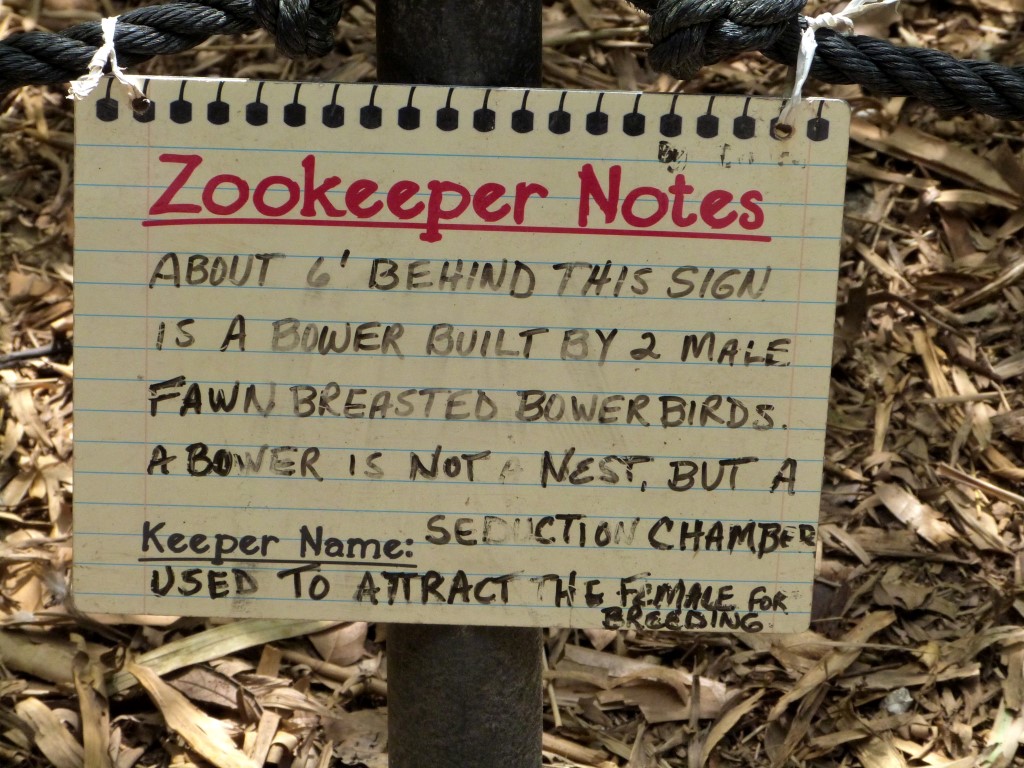
This is the sign telling about the Bowerbird and their name for it; a “Seduction Chamber.” We know that the Lord commanded the birds to reproduce and this bird is only following instructions. He builds his bower to entice a female to be his mate.

We were discussing this and several verses came to our minds:

My son, if sinners entice you, Do not consent. (Proverbs 1:10 NKJV)

And you shall stone him with stones until he dies, because he sought to entice you away from the LORD your God, who brought you out of the land of Egypt, from the house of bondage. (Deuteronomy 13:10 NKJV)

And then if any man shall say to you, Lo, here is Christ; or, lo, he is there; believe him not: For false Christs and false prophets shall rise, and shall shew signs and wonders, to seduce, if it were possible, even the elect. (Mark 13:21-22 KJV)

And this is the promise that he hath promised us, even eternal life. These things have I written unto you concerning them that seduce you. (1 John 2:25-26 KJV)

The Fawn-breasted is fine in what he is doing, but we can learn by watching and taking heed for ourselves.

But ask now the beasts, and they shall teach thee; and the fowls of the air, and they shall tell thee: (Job 12:7 KJV)

*

*

Ptilonorhynchidae-Bowerbird Family

Fawn-breasted Bowerbird – Wikipedia

Bowerbirds – Wikipedia

*

White-rumped Shama at Zoo Miami

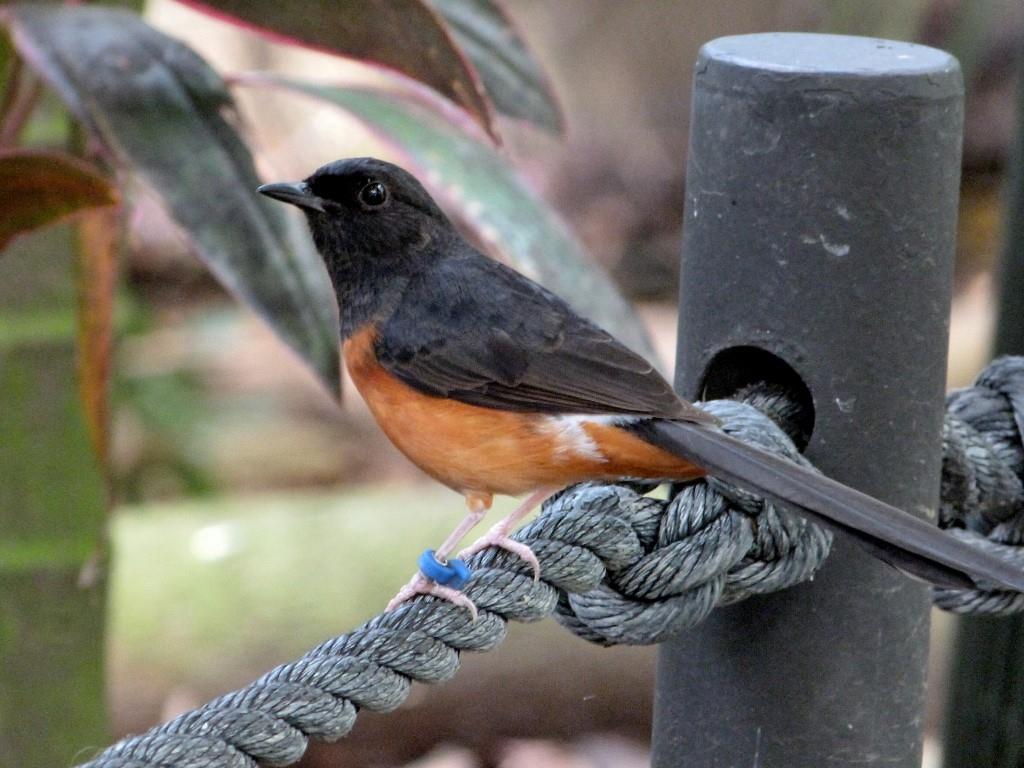
White-rumped Shama (Copsychus malabaricus)  at Zoo Miami - Lee

White-rumped Shama (Copsychus malabaricus) at Zoo Miami – Lee

Even the stork in the sky Knows her seasons; And the turtledove and the swift and the thrush Observe the time of their migration; But My people do not know The ordinance of the LORD. (Jeremiah 8:7 NASB)

The White-rumped Shama (Copsychus malabaricus) is a small passerine bird of the family Muscicapidae. Native to densely vegetated habitats in the Indian Subcontinent and Southeast Asia, its popularity as a cage-bird and songster has led to it being introduced elsewhere.

It was formerly classified as a member of the thrush family, Turdidae, causing it to be commonly known as the White-rumped Shama Thrush or simply Shama Thrush.

They typically weigh between 28 and 34 g (1.0 and 1.2 oz) and are around 23–28 cm (9–11 in) in length. Males are glossy black with a chestnut belly and white feathers on the rump and outer tail. Females are more greyish-brown, and are typically shorter than males. Both sexes have a black bill and pink feet. Juveniles have a greyish-brown colouration, similar to that of the females, with a blotchy or spotted chest.

The voice of this species is rich and melodious which made them popular as cage birds in South Asia with the tradition continuing in parts of Southeast Asia. It is loud and clear, with a variety of phrases, and often mimics other birds. They also make a ‘Tck’ call in alarm or when foraging. One of the first recordings of a bird song that was ever made was of this species. This recording was made in 1889 from a captive individual using an Edison wax cylinder by Ludwig Koch in Germany. (Wikipedia)

Here is a video of the Shama singing the second day we were at the Wings of Asia aviary at the Zoo. The pair have a nest and I think the chicks have hatched. (Senior moment-I don’t remember what they told me.)

The LORD is my strength and my shield; my heart trusted in him, and I am helped: therefore my heart greatly rejoiceth; and with my song will I praise him. (Psalms 28:7 KJV)

I am kicking up dust again behind the scenes. The new IOC 4.2 list came out while we were at the zoo. So far I have 237 pages updated, all but the Lark family. They added a new family and are scrambling the Larks around. I am now preparing to do the indexes.  The new 4.2 count is 10,530 species in the world. Stay tuned.

Birds of the World – Families – done

Birds of the Bible – Thrush

White-rumped Shama – Wikipedia

*

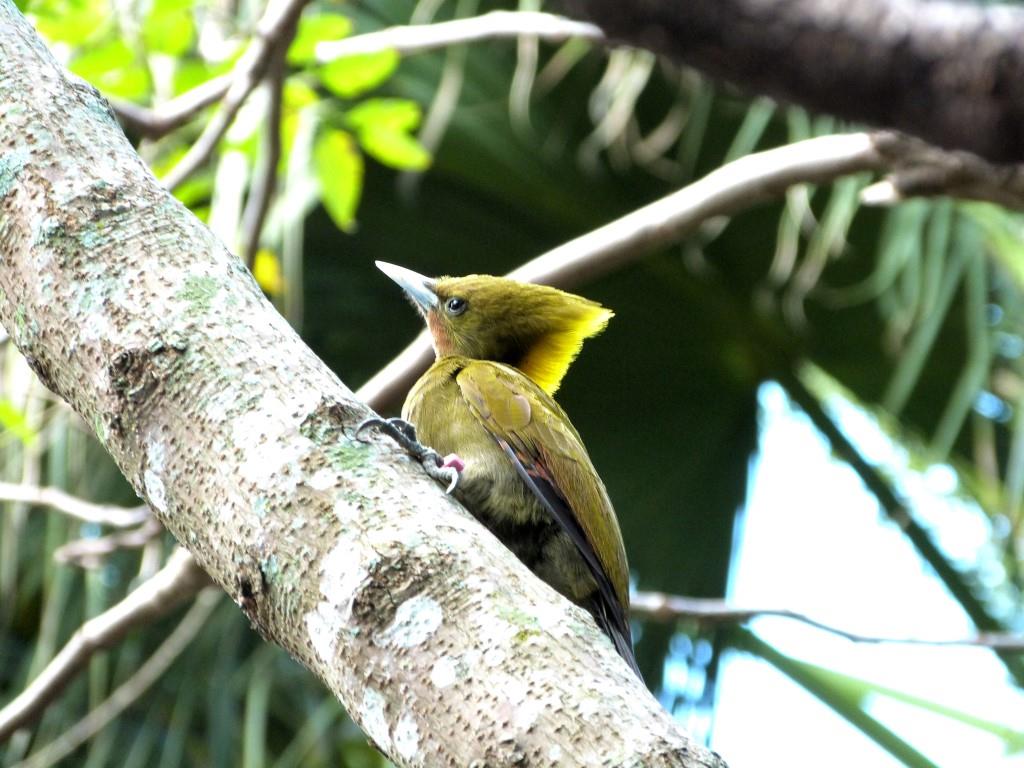
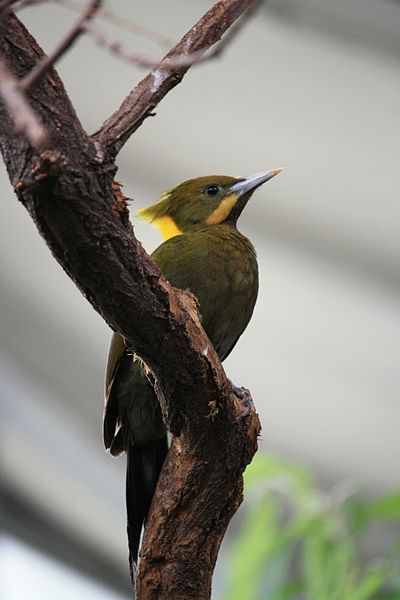
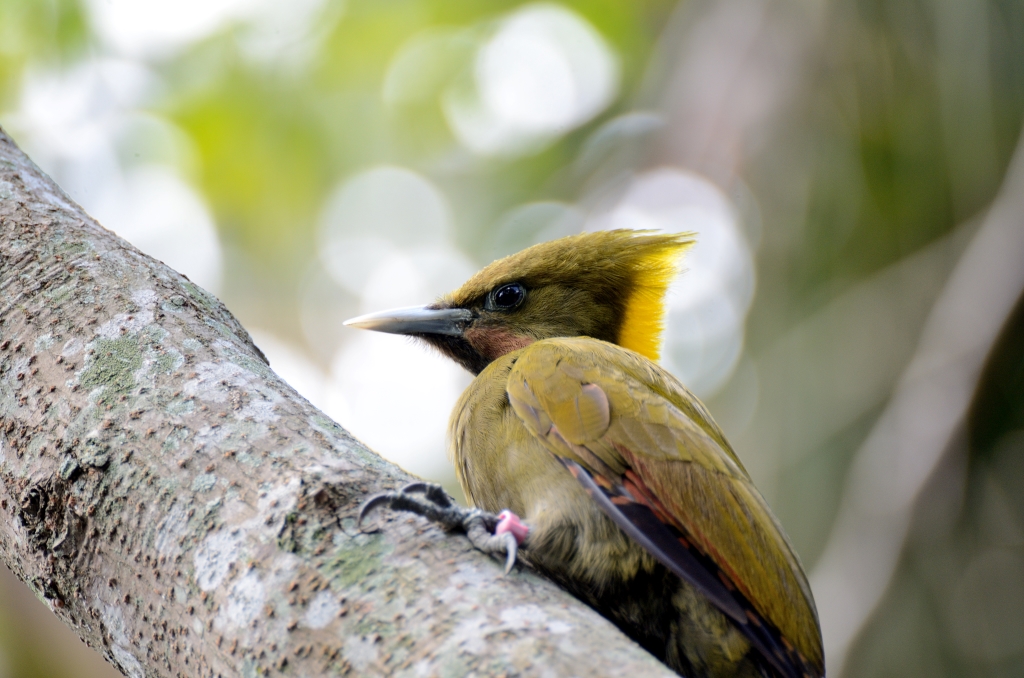
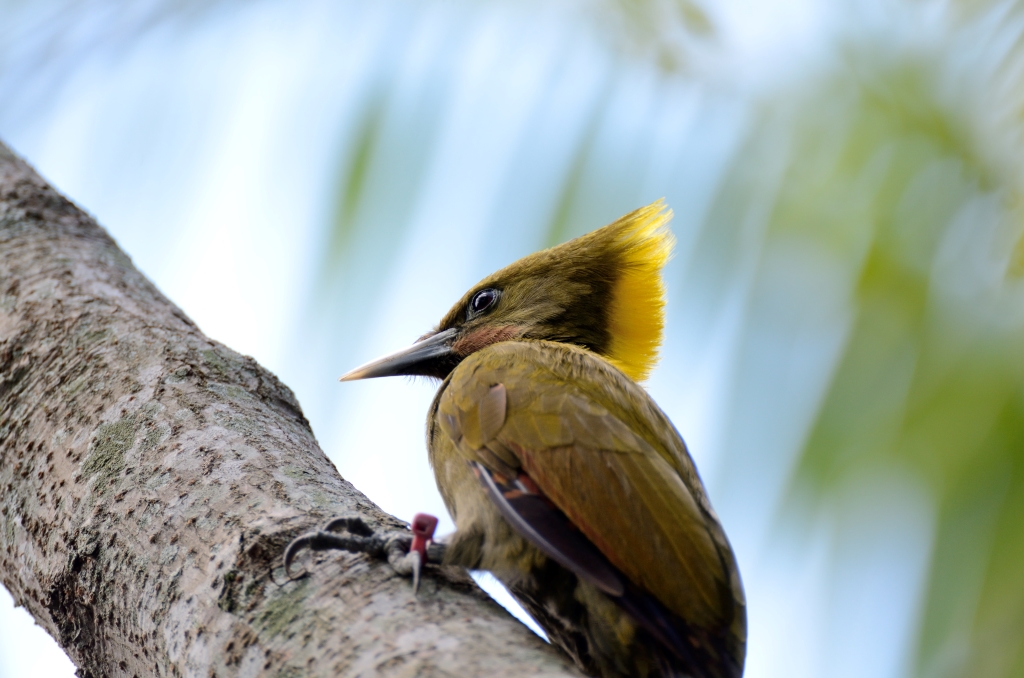
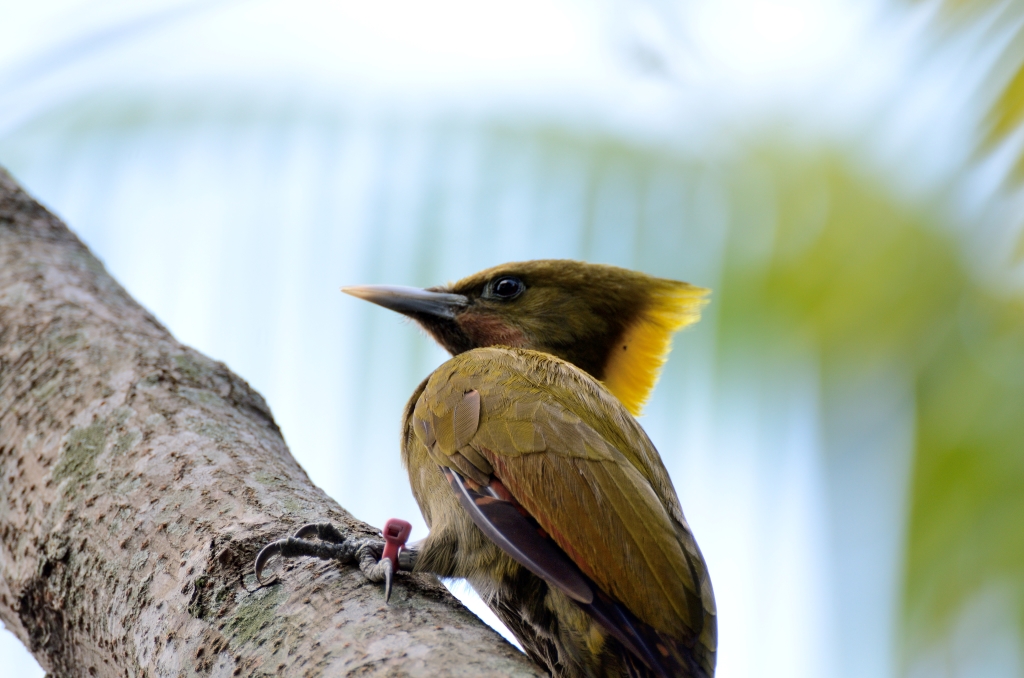
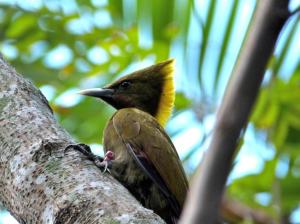
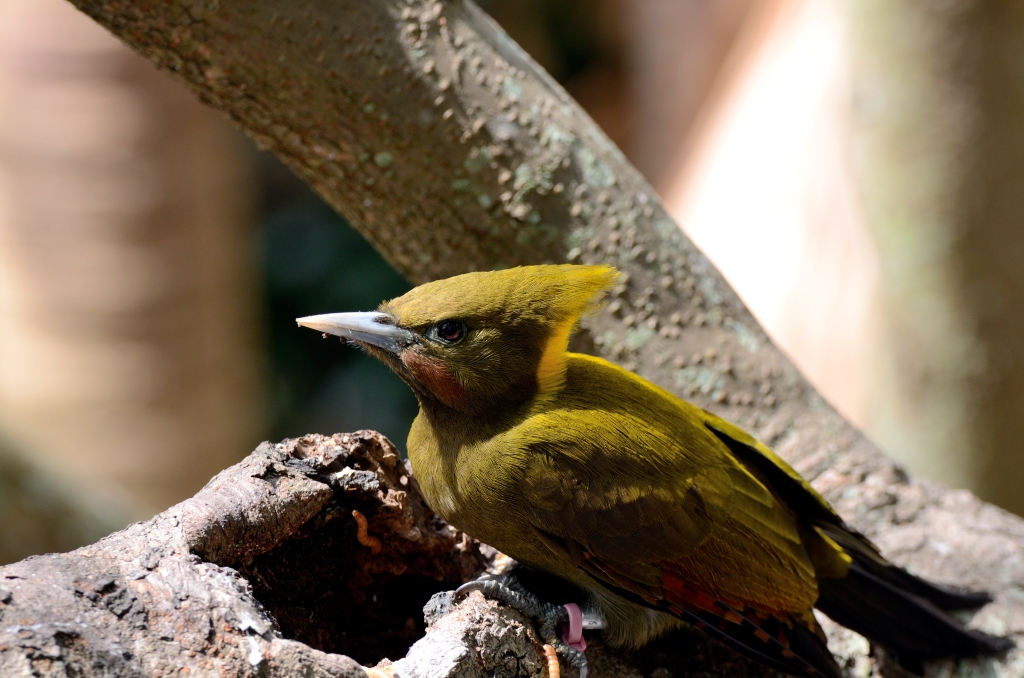
Zoo Miami’s Greater Yellownape

Greater Yellownape (Chrysophlegma flavinucha) female Zoo Miami by Lee

Greater Yellownape (Chrysophlegma flavinucha) female Zoo Miami by Lee

For they will be a graceful ornament on your head, And chains about your neck. (Proverbs 1:9 NKJV)

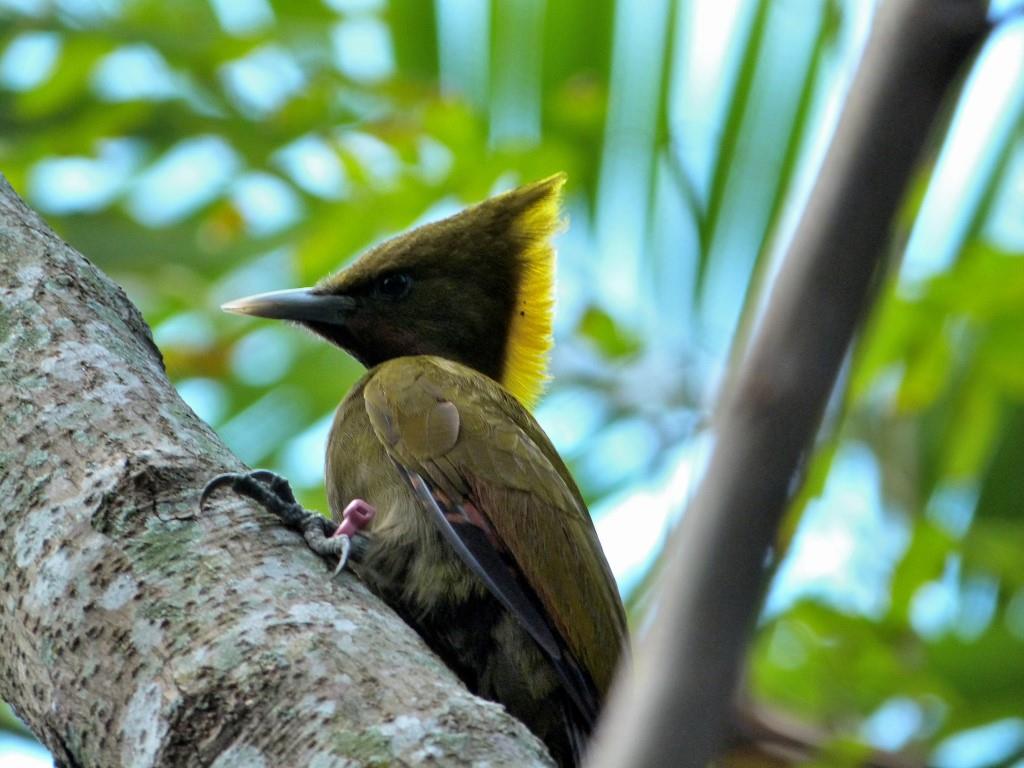
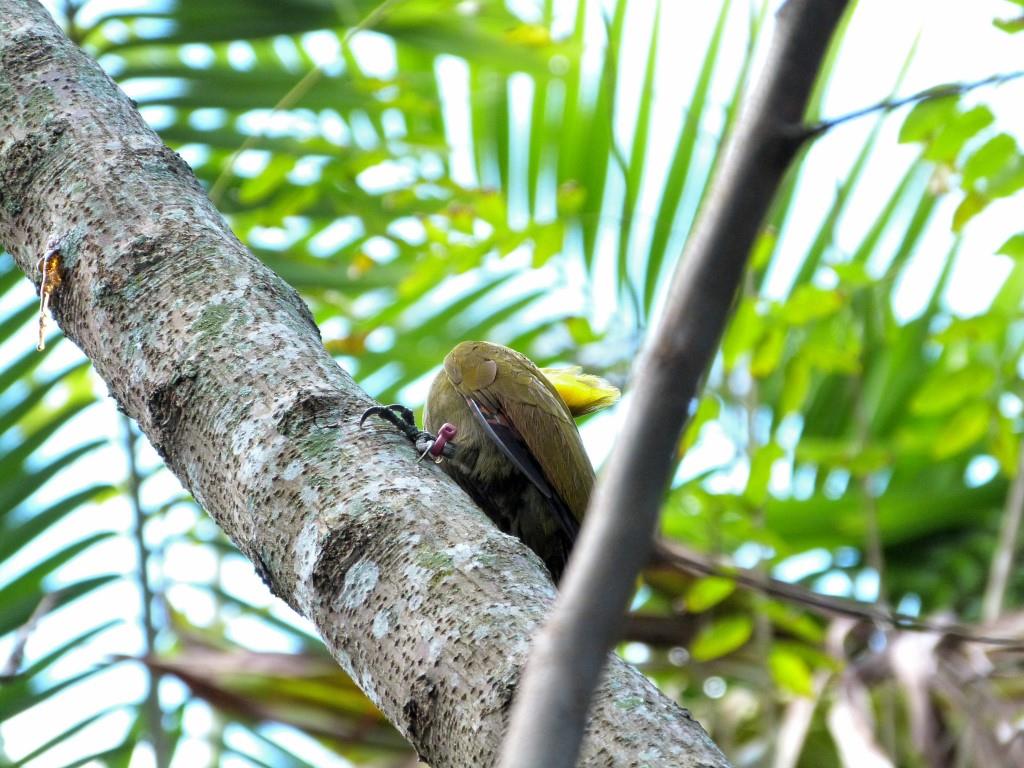
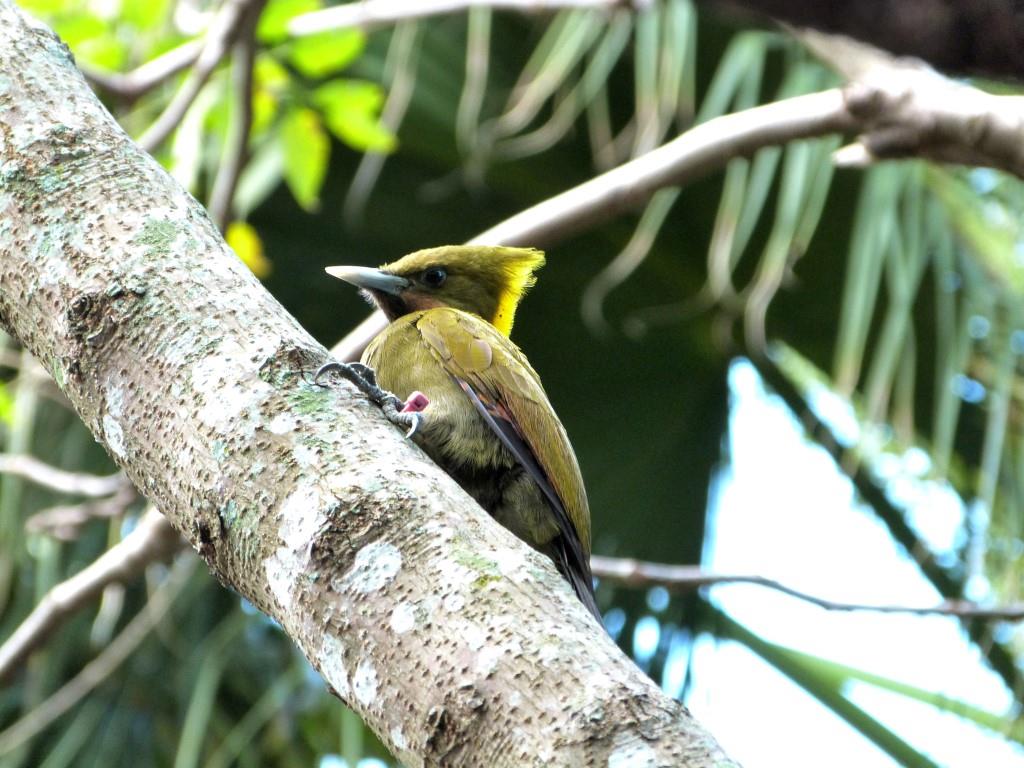
Here is one of my favorites at Zoo Miami’s Wings of Asia Aviary. They have 87 species and they are all my favorites, but this one is further up the scale. This is a Greater Yellownape (Chrysophlegma flavinucha) female and believe it is the only Yellownape there at present.

Dan and I went back down to Zoo Miami this week and spent two days just in the Aviary. When we were there earlier this year, most of my photos did not come out well. After some adjustments to my Panasonic Lumix FZ47 point-n-shoot (which I shoot in “program mode”), things didn’t do much better at first the first day. More adjustments and these came out better. Tuesday night in the motel, Dan made some more fixes. Yesterday, I finally got some really nice photos which I will share later.

Greater Yellownape (Chrysophlegma flavinucha) female Zoo Miami by Dan

Greater Yellownape (Chrysophlegma flavinucha) female Zoo Miami by Dan

My son, keep your father’s command, And do not forsake the law of your mother. Bind them continually upon your heart; Tie them around your neck. (Proverbs 6:20-21 NKJV)

For those of you into photography, the problem is that the Aviary is well landscaped with lots of trees and is covered with its wire mesh. My ISO and lens speed were to low to compensate for the environment. My camera normally does well when I am “outdoors” and not in an aviary. (As for ISOs and F-stops, I don’t know much them. I would rather study about the birds and let Dan worry about the camera.)

Back to our Yellownape. This is another neat creation from its Creator. They belong to the Woodpecker – Picidae Family. At the aviary, they call it the Greater Yellow Naped Woodpecker.

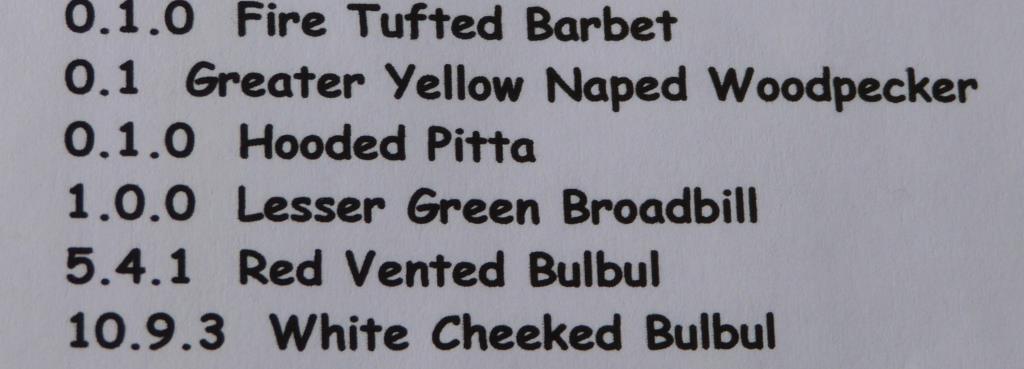
List of birds at Wings of Asia - Greater Yellow Nape

List of birds at Wings of Asia – Greater Yellownape

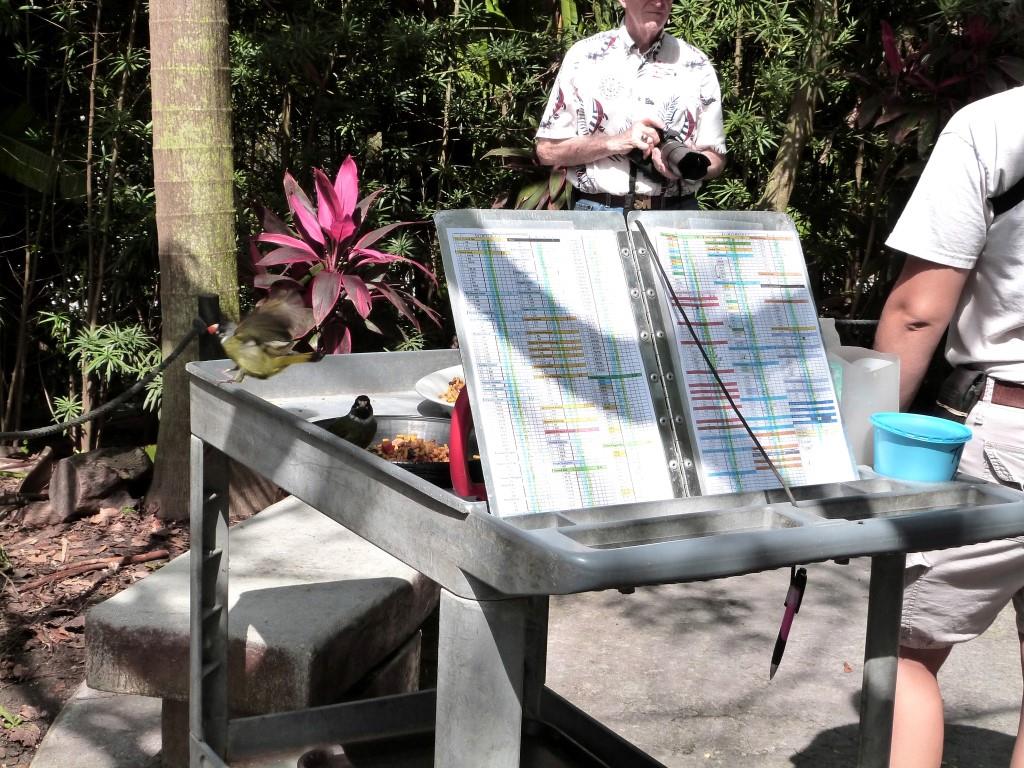
From a copy of their list, you can tell it is a female and the only one. The list has the number of males first, then number of females and then the third number is unknown sex. Every day they check on the birds and try to find each one. If after 3 days a bird isn’t spotted, then a real search begins. By following the counters around, who were very friendly and willing to help with names of birds, many of the birds come out and into view. Could it be because the counters have food with them? In fact some of the birds make themself right at home on the cart.

Counters with friends

Counters with friends

*

Counters with friends making themselves at home

Counters with friends making themselves at home

*

Counters with friends making themselves at home

Counters with friends making themselves at home

*

Actually the Yellownape came in close the second day, but I failed to get her photo, but Dan captured her in the second photo as she was eating worms from the hole in the tree. The worker had just placed some worms there to bring the birds in closer so they could be counted.

The Greater Yellownape is a large, olive-green woodpecker with prominent yellow-crested nape and throat. Dark olive-green with grey underparts. Crown brownish and flight feathers chestnut barred with black. Bill often looks whitish. “Nape” is the back or base of the neck area. See Birdwatching Term – Nape

It is found in Bangladesh, Bhutan, Cambodia, China, India, Indonesia, Laos, Malaysia, Myanmar, Nepal, Thailand, and Vietnam. Its natural habitats are subtropical or tropical moist lowland forests and subtropical or tropical moist montane forests. (Wikipedia)

Included in the photos below is a photo of a male from Wikipedia. Notice his line on his chin is more yellow than the female. Here is more of a rusty color.

Here are the photos of the Greater Yellownape (Chrysophlegma flavinucha).

“And he arose and came to his father. But when he was still a great way off, his father saw him and had compassion, and ran and fell on his neck and kissed him. …It was right that we should make merry and be glad, for your brother was dead and is alive again, and was lost and is found.’ ” (Luke 15:20, 32 NKJV)

See:

*

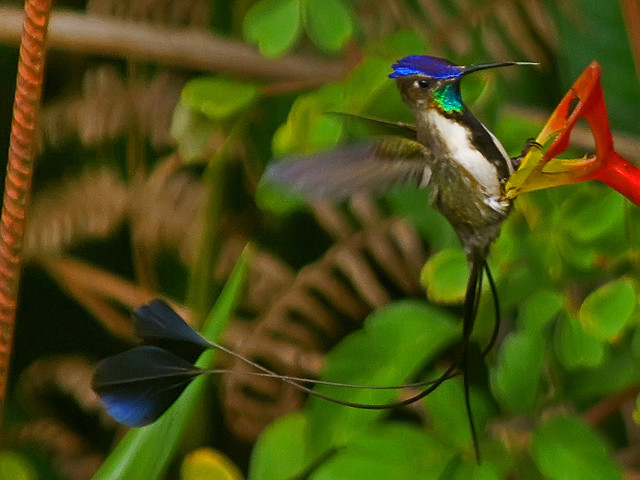
Peru’s Marvellous Hummingbird – Updated

Marvelous Spatuletail (Loddigesia mirabilis)©©

Marvelous Spatuletail (Loddigesia mirabilis)©©

Peru’s Marvellous Hummingbird

(from Creation Moments)

In that day the LORD of hosts will be for a crown of glory and a diadem of beauty to the remnant of His people. (Isaiah 28:5)

In 1835, when scientists first saw Peru’s most unusual hummingbird, they were so overcome with its beauty that they gave it the name “Marvellous.” This little bird treats the eye to iridescent green, yellow, orange, and purple feathers. But its most unusual feature is its tail. While most birds have eight to twelve tail feathers, the Marvellous hummingbird has only four. Two of these are long, pointed, thorn-like feathers that don’t seem to help much in flying or landing. The other two feathers are truly marvellous. They are six inches long, three times the length of the bird’s two-inch body. On the end of these two long narrow feathers are large feather fans that nearly equal the surface area of its wings.

Marvelous Spatuletail (Loddigesia mirabilis) ©©

Marvelous Spatuletail (Loddigesia mirabilis) ©©

Astonishingly, the Marvelous hummingbird has complete control of these feathers. At rest, the bird perches with these two feathers hanging down an inch or so from its body, and then crossing them until they are horizontal. In flight and landing they provide remarkable maneuverability. During mating, the hummingbird moves them as semaphores. Interestingly enough, evolutionists admit that they are stumped as to why these unusual feathers should have evolved.

One look at our creation clearly shows that our Creator appreciates beauty. But even the beautiful Marvelous hummingbird is but a poor and cloudy hint of the beauty of our Creator Himself.

Prayer:
Dear Father, help me treat the beauty You have created as You would have me to do. Let me be filled with thanksgiving to You for it, and let it remind me that You are the source of all that is truly beautiful. In Jesus’ Name. Amen.
Notes:
Crawford H. Greenewalt. The Marvelous Hummingbird Rediscovered. National Geographic, Vol. 130, No. 1. P. 98-101.”

©Creation Moments 2014


*

Lee’s Addition:

This was originally done in 2010, but needs to be re-blogged again. Also, the YouTube above was added. It is astonishing to watch the little bird in action. Thanks to one of our readers who found the video to add to their site. See The Vine Vigil.

The Marvellous Hummingbird is now the Marvelous Spatuletail (Loddigesia mirabilis). It is in the Hummingbird Family (Trochilidae) and is part of the Apodiformes Order.

Marvelous Spatuletail (Loddigesia mirabilis) ©WikiC-Gould_Troch._pl._161

Marvelous Spatuletail (Loddigesia mirabilis) ©WikiC-Gould_Troch._pl._161

The Marvelous (also Marvellous) Spatuletail (hummingbird), Loddigesia mirabilis, is a medium-sized (up to 5.9 in/15 cm long) white, green and bronze hummingbird adorned with blue crest feathers, a brilliant turquoise gorget, and a black line on its white underparts. It is the only member of the monotypic genus Loddigesia.

A Peruvian endemic, this species is found in the forest edge of the Río Utcubamba region. It was first reported in 1835 by the bird collector Andrew Matthews for George Loddiges. The Marvellous Spatuletail is unique among birds, for it has just four feathers in its tail. Its most remarkable feature is the male’s two long racquet-shaped outer tail feathers that cross each other and end in large violet-blue discs or “spatules”. He can move them independently.

Information gathered from Creation Moments, Wikipedia, and YouTube.

Wordless Birds

Peru’s Marvellous Hummmingbird – The Vine Vigil

*
*


Birdwatching at the Family Reunion

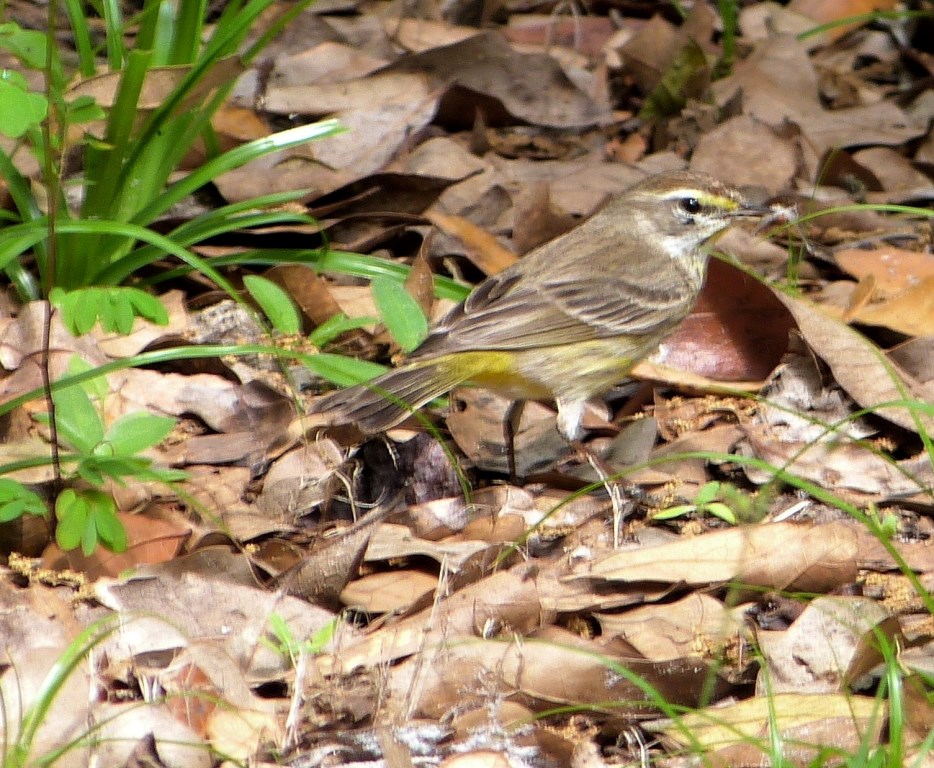
Palm Warbler

Palm Warbler

Last weekend, we had a family reunion at my brother’s place. He lives near Bushnell and Webster, FL on 5 acres of land. Since it is so wooded with Oak trees and others, I kept my camera at the ready.

We heard lots of birds, saw some and photographed even fewer. We still had a great time.

My nephew from south Florida was there with his family, so I asked four of my great-nieces and great-nephew to join me on a birdwatching adventure.  Figured I might as well start training another generation of birdwatchers. We headed off and my almost 5 yr old “chatterbox” nephew produced the first lesson. We encouraged him to “talk less” and “listen.”

Train up a child in the way he should go, And when he is old he will not depart from it. (Proverbs 22:6 NKJV)

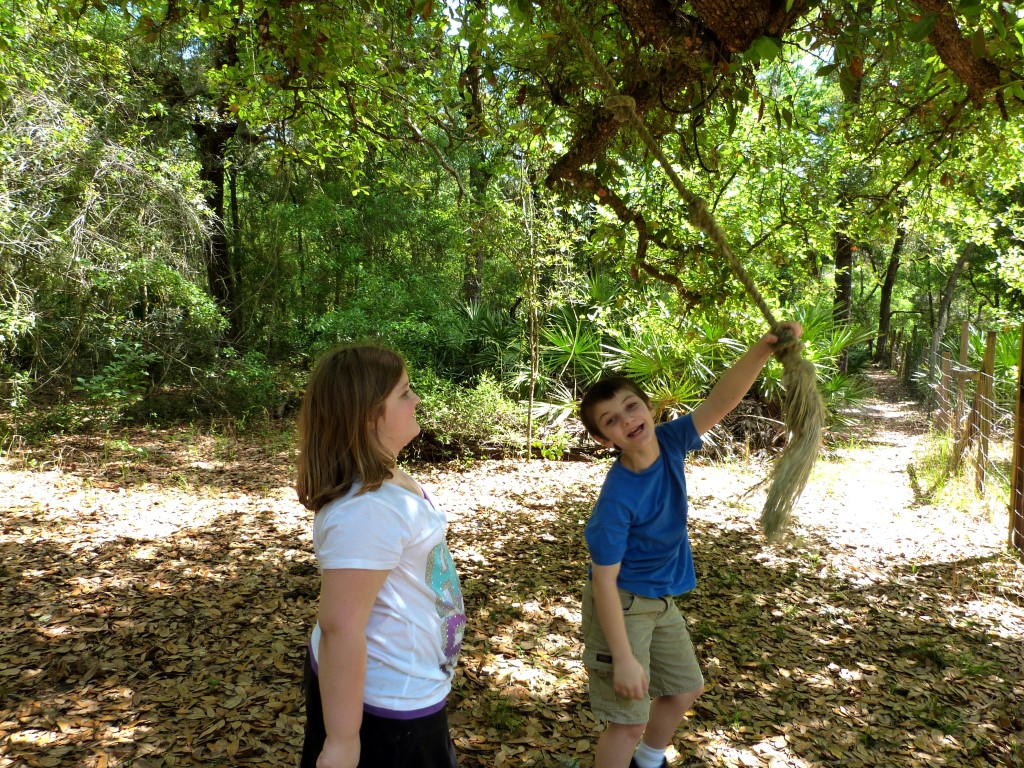
We heard several, but never saw any. (Northern Cardinal, Tufted Titmouse and a Blue Jay) When we got to the end of the property, turned right and followed the fence line. Not very far we came upon a tree with a rope hanging down with knots on it. At that point, all birdwatching and birdwatching lessons stopped.

The rope with the "Chatterbox" aboard.

The rope with the “Chatterbox” aboard.

Later, I gathered some more and off we went again. This time my great-niece and nephew from Tampa were with me. We heard those same birds, plus a Palm Warbler, and saw them very briefly. Another lesson was taught about having “soft eyes” as you look at trees. Don’t stare, just sort of look lightly and watch for movement. Fine, we turned the corner at the fence and ran into the “rope” again. That birdwatching adventure ended and another “rope adventure” began.

Oh, that men would give thanks to the LORD for His goodness, And for His wonderful works to the children of men! (Psalms 107:8 NKJV)

At the rope again.

At the rope again.

Needless to say, that “rope” became an unexpected highlight of the reunion. Every attempt to take a trip ended up there. They even loaded up my brother’s golf cart and brought a whole crew down there.

What did I eventually see and here? Let’s see; Northern Cardinal, Tufted Titmouse, Blue Jay, Carolina Wrens, Pileated Woodpecker, Ruby-throated Hummingbirds, Grey Catbird, and some Black Vultures flying overhead.

Carolina Wren

Carolina Wren

To me, one of the highlights was watching the Carolina Wrens flying into a cabinet in my brother’s pole barn. When they weren’t around, this is what I discovered:

Wren nest in a paper box.

Wren nest in a paper box.

On the next to the top shelf they had a nest in the works.

Wren nest in a Pepsi paper cup.

Wren nest in a Pepsi paper cup.

*

Wren nest in a Pepsi paper cup.

Wren nest in a Pepsi paper cup – closeup.

Talking with my sister-in-law, also a birdwatcher – who lives there, she figures that they feel safe in the pole barn because the hawks can’t fly through there and attack the nests. Several years ago on one of my visits, the Wrens had made a nest in a paper sack. There were eggs in it that time.

*

I had the blog on autopilot last week and through the week-end. My sister spent time with us before and after the reunion. Now it is time to get back to blogging.

*


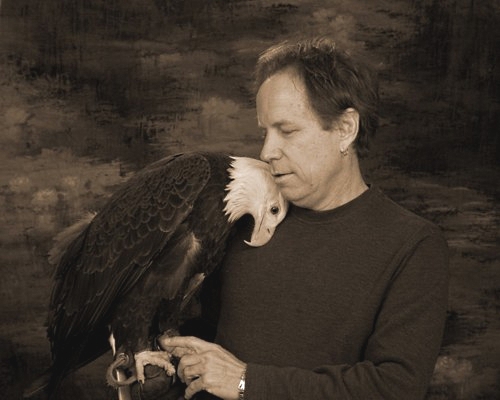
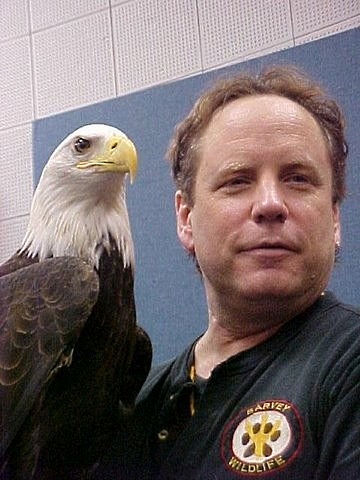
Jeff Guidry and His Eagle Named Freedom

(This was sent to me in an e-mail and thought I would share it. It’s been around awhile, but is new to me. Also, below is a video of the two of them.)

An Eagle Kiss

As an eagle stirs up its nest, Hovers over its young, Spreading out its wings, taking them up, Carrying them on its wings, (Deuteronomy 32:11 NKJV)

This is the kind of story you need when it seems like the world is spiraling out of control.. Not many people get a picture of this proud bird snuggled up next to them!

Freedom 1Freedom and Jeff

Freedom and I have been together 11 years this summer.  She came in as a baby in 1998 with two broken wings.  Her left wing doesn’t open all the way even after surgery, it was broken in 4 places. She’s my baby.

When Freedom came in, she could not stand and both wings were broken. She was emaciated and covered in lice. We made the decision to give her a chance at life, so I took her to the vet’s office. From then on, I was always around her. We had her in a huge dog carrier with the top off, and it was loaded up with shredded newspaper for her to lay in.

I used to sit and talk to her, urging her to live, to fight; and she would lay there looking at me with those big brown eyes. We also had to tube feed her for weeks. This went on for 4-6 weeks, and by then she still couldn’t stand. It got to the point where the decision was made to euthanize her if she couldn’t stand in a week. You know you don’t want to cross that line between torture and rehab, and it looked like death was winning.

She was going to be put down that Friday, and I was supposed to come in on that Thursday afternoon. I didn’t want to go to the center that Thursday, because I couldn’t bear the thought of her being euthanized; but I went anyway, and when I walked in everyone was grinning from ear to ear. I went immediately back to her cage; and there she was, standing on her own, a big beautiful eagle. She was ready to live. I was just about in tears by then.

That was a very good day. We knew she could never fly, so the director asked me to glove train her. I got her used to the glove, and then to jesses, and we started doing education programs for schools in western Washington. We wound up in the newspapers, radio (believe it or not) and some TV. Miracle Pets even did a show about us.

In the spring of 2000, I was diagnosed with non-Hodgkin’s lymphoma. I had stage 3, which is not good (one major organ plus everywhere), so I wound up doing 8 months of chemo. Lost the hair – the whole bit. I missed a lot of work.

When I felt good enough, I would go to Sarvey and take Freedom out for walks. Freedom would also come to me in my dreams and help me fight the cancer. This happened time and time again.

Fast forward to November 2000.  The day after Thanksgiving, I went in for my last checkup.  I was told that if the cancer was not all gone after 8 rounds of chemo, then my last option was a stem cell transplant. Anyway, they did the tests; and I had to come back Monday for the results. I went in Monday, and I was told that all the cancer was gone.

Freedom2

So the first thing I did was get up to Sarvey and take the big girl out for a walk. It was misty and cold. I went to her flight and jessed her up, and we went out front to the top of the hill. I hadn’t said a word to Freedom, but somehow she knew. She looked at me and wrapped both her wings around me to where I could feel them pressing in on my back (I was engulfed in eagle wings), and she touched my nose with her beak and stared into my eyes, and we just stood there like that for I don’t know how long.

That was a magic moment. We have been soul mates ever since she came in. This is a very special bird.

On a side note:  I have had people who were sick come up to us when we are out, and Freedom has some kind of hold on them. I once had a guy who was terminal come up to us and I let him hold her.  His knees just about buckled and he swore he could feel her power course through his body. I have so many stories like that.

I never forget the honor I have of being so close to such a magnificent spirit as Freedom.

Hope you enjoyed this!

*

*

Creation Moments’ – Designed For Flight

Peregrine Falcon Flying Over Niagara Falls

Doth the hawk fly by thy wisdom, [and] stretch her wings toward the south? Job 39:26

Many textbooks tell young people today that birds are modified reptiles. Suppose, they say, that millions of years ago the scales on some reptiles began to fray along the edges. In time, they say, the frayed scales turned into feathers and birds were born.

Designed for Flight The elegance and beauty of the feather make this story hard to believe. Can sticking a feather on a lizard produce a peacock? The bird’s feather is only a small part of the complete flying system of the bird. Even with very careful planning and redesigning, a reptile doesn’t have what it takes.

A bird needs massive breast muscles for flight. In some birds, 30 percent of the body weight of the bird is breast muscle. By comparison, in humans, breast muscles are only about 1 percent of body weight. A bird also needs an extremely high metabolism and blood pressure to deliver the energy those muscles need for flight. Birds have a higher metabolism than any other creature; they also have the necessary high blood pressure. Finally, as is well known, birds need light skeletons. The man-o’-war has a wingspan of seven feet. But its entire skeleton weighs only a few ounces – less than its feathers!

Even the most clever rebuilding of a reptile cannot produce a bird. In fact, birds have very little in common with reptiles. The entire being of the bird, from body to brain, has been specially designed for flight by a Creator who clearly knows everything there is to know about flight.

Prayer:
Father in heaven, the beauty, grace and huge variety of birds You have created are some of the most beautiful creatures on earth. As I thank You for them, fill me with new wonder over the wonderful work of Your hands. Amen.

Notes:
Vandeman, George. 1991. “The miracle of flight.” Signs of the Times, May. p. 25.

Designed For Flight ©Creation Moments 2014

Interesting Things

*