Pond-side Birdwatching in Florida I

PondsideBirdwatching.photo1

Pond-side Birdwatching in Florida,

from Chaplain Bob’s Backyard: Part 1

  by James J. S. Johnson

He turneth the wilderness into a standing water [’agam = “pond”], and dry ground into water-springs.  (Psalm 107:35)

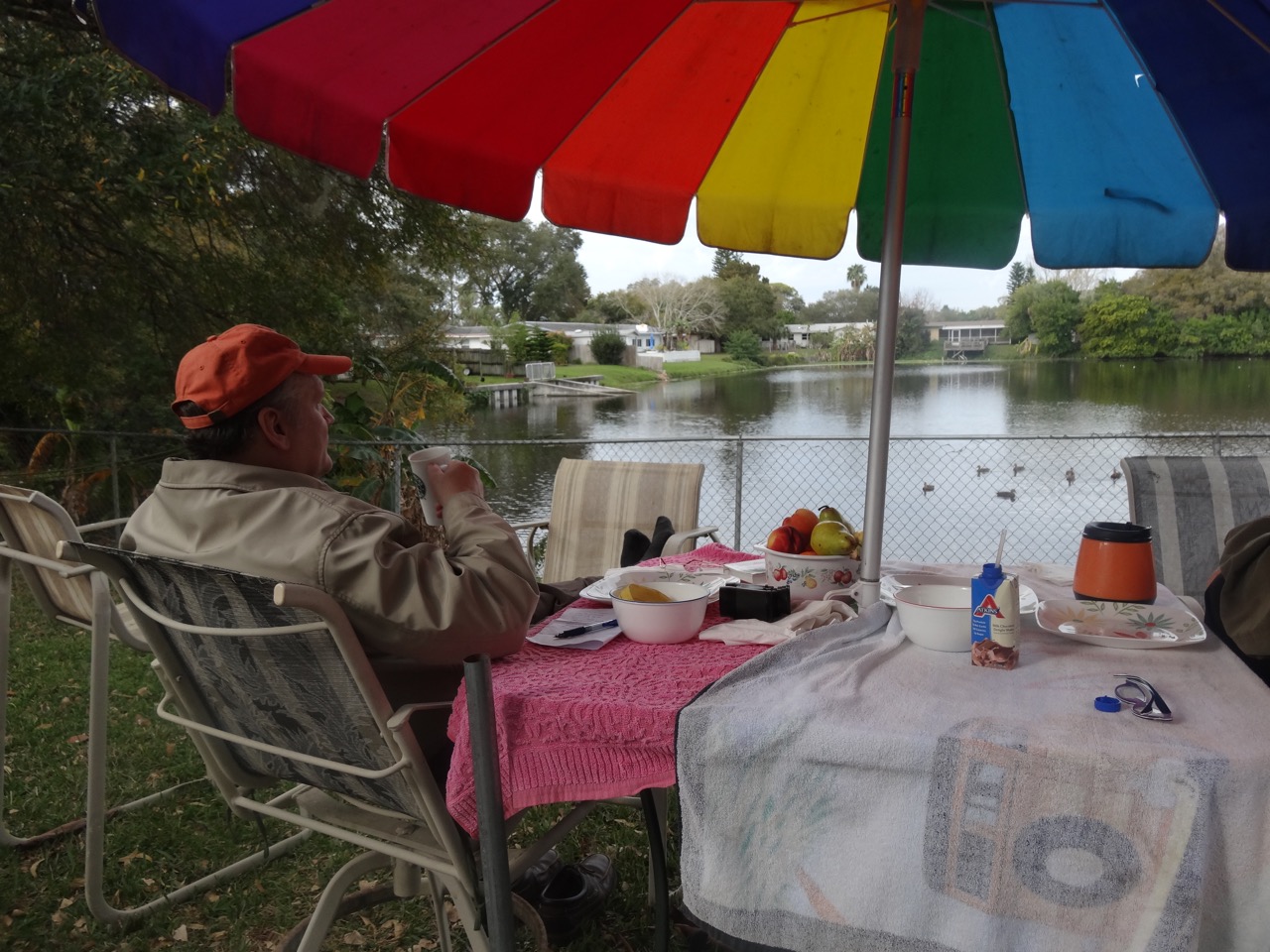
Another wonderful morning in St. Petersburg (Florida), gazing at the duck pond and its marshy shores, with mocha coffee, buttered rye toast, and my feet propped up, birdwatching from the pond-side backyard of Chaplain Bob and Marcia Webel   —   under a huge beach umbrella, shielded from the occasional post-digestion droppings (!) from several ibises and ospreys perched in branches that hung over where were sat, birdwatching, properly outfitted with binoculars, coffee mugs, breakfast foods, and a bird-book. That is what I was doing, by God’s grace, on Monday morning (2-9-AD2015) during February (which, by the way,  is officially “National Bird-Feeding Month” – see 103rd Congress, Volume 140, Congressional Record, for 2-23-1994, U.S. House of Representatives, Rep. John Porter speaking on “National Wild Bird Feeding Month”).

The lacustrine birds (in this backyard-and-pond setting) were busy, busy, busy,  —  and noisy!  — with their morning activities.  Most of them were ducks (mallards and lesser scaups).  These lentic water-loving birds were busy:  some were paddling across the pond, quacking, splashing, dabbling or diving, others were perching on shoreline tree branches, or loitering in the pond-edge marshy plants.  Most of them were sporadically flying here and there, sometimes alone, sometimes as a group.  (And they noticed the presence of turtles in the water, as well as a dog on the shoreline.)   Sometimes tall wading birds (e.g., egrets and herons) perched atop the roofs of houses near the pond-shore. In that one morning, in just an hour or two, I saw at least 14 different birds, plus we heard the distinctive cooing of a mourning dove!

To memorialize the happy experience (which was all the more enjoyable because it was shared with my good friends Bob and Marcia Webel), please appreciate this quick report on those pond-side birds, blended with a few thoughts about those fair fowl —  all of which birds were so carefully made and maintained by our Lord Jesus Christ. Of course, it would take too long to report, now, on all 15 birds that we then observed.  So this report  (God willing)  will be just the first installment – reporting on the Great Blue Heron, Brown Pelican, Mallard, Double-Crested Cormorant, and Black Vulture,  —  within what should be a mini-series, eventually covering  all 15 of those beautiful-to-behold  backyard-pond-birds.

Great Blue Heron by Dan

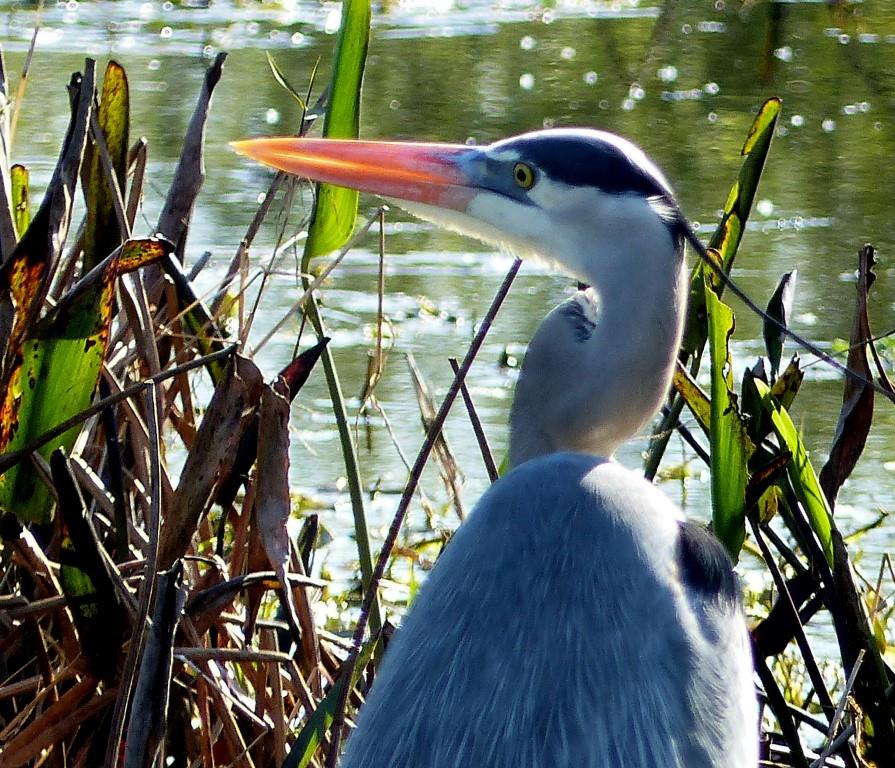
Great Blue Heron

GREAT  BLUE  HERON   (Ardea herodias). The Great Blue Heron is a tall, majestic egret-like bird, poised and dignified.  It can stand still as a statue for a long time, waiting for its food to become snatchable.  When the heron spies its prey (likely a fish or frog – but maybe a small mammal, bird, lizard, or even a snake!), at the side of a pond, it stabs with sudden speed – the prey never saw that powerful, sharp, dagger-like beak coming – till it was too late! When in flight, the Great Blue Heron is graceful, purposeful, and dignified.  The National Audubon Society’s Field Guide to North American Birds – Eastern Region (Alfred A, Knopf, 1994 revised edition), co-authored by John Bull & John Farrand, Jr., reports (at its page 367) this description of the Great Blue Heron:  “A common, large, mainly [Confederate] grayish heron with pale or yellowish bill.” Its most habitat – which changes with seasonal migrations — is a pond’s edge, or that of a lake, stream, river, or marshland.  What a regal bird!  “For most of us, sightings of great blue herons are confined to a glimpse of the bird as it flies slowly and steadily overhead, wings arching gracefully down with each beat, neck bent back, and feet trailing behind.  At other times we see it on its feeding grounds, standing motionless and staring intently into shallow water, or wading with measured steps as it searches for prey.” [Quoting from “Great Blue Heron”, by Donald W. Stokes & Lillian Q. Stokes, in Bird Behavior, Volume III (Little, Brown & Co., 1989), page 25.]
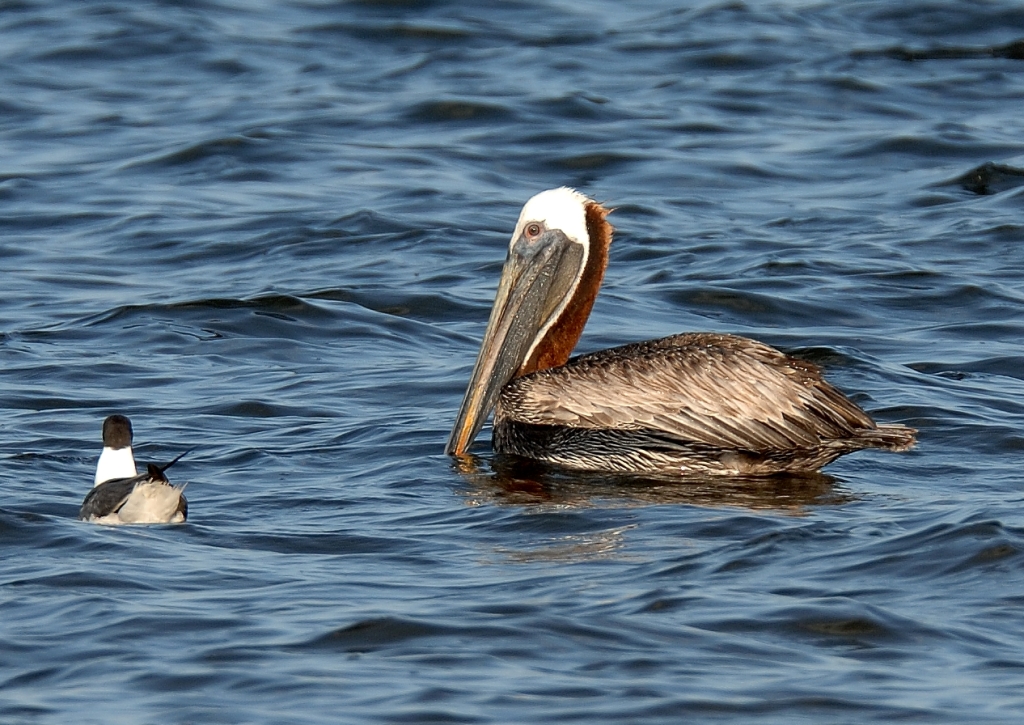
Brown Pelican and Laughing Gull by Dan MacDill Shore 2014

Brown Pelican and Laughing Gull by Dan MacDill Shore 2014

BROWN  PELICAN   (Pelecanus occidentalis). In their Field Guide to North American Birds – Eastern Region (noted above, in the Great Blue Heron entry), Bull & Farrand describe (at page 359) the Brown Pelican as a “very large, stocky bird with a dark brown body and a long flat bill”.  The adult storks have an ivory-white head, dark throat pouch, with dark brown hindneck coloring during the mating season.  The immature storks have dark brown heads and ivory-white breasts. These pelicans are year-round residents of Florida’s coastlands.  Bull & Farrand (on page 359) also report that the Brown Pelican is the “only nonwhite pelican in the world”, describing its eating habit as follows:  “…this marine bird obtains its food by diving from the air, its wings half folded as it plunges into the surf.  During one of these dives, the pouched bill takes in both fish and water; the bird drains out the water before throwing its head back and swallowing the fish.”  Donald and Lillian Stokes contrast this eating habit with that of the American White Pelican, which “feeds while floating on the water”.  (See Donald W. Stokes & Lillian Q. Stokes, Stokes Field Guide to Birds – Eastern Region [Little, Brown & Co., 1996], page 25.) One characteristic behavior of pelicans – the world over (including the Holy Land) – is the practice of adult pelicans regurgitating partially digested food into the mouths of their young.  “Pelicans” (Hebrew noun: qa’ath) are mentioned in Leviticus 11:18, Deuteronomy 14:17, and Psalm 102:6 [v. 7 in the Hebrew Bible’s verse numbering] – and apparently also in Isaiah 34:11 and Zephaniah 2:14.  George Cansdale says: “All pelicans feed their young by partly digested food, taken by the chick as it puts its head down the parent’s throat.  This regurgitation was the basis of the LXX and [Vulgate translation for] pelican, for [the Hebrew noun] qa’ath is said to mean ‘vomiter’.” (Quoting George S. Cansdale, All the Animals of the Bible [Zondervan, 1976], page 157.)  Cansdale rightly notices this, because the Hebrew noun for “vomitus” is qa’ (an etymologically related noun, which appears in Proverbs 26:11).
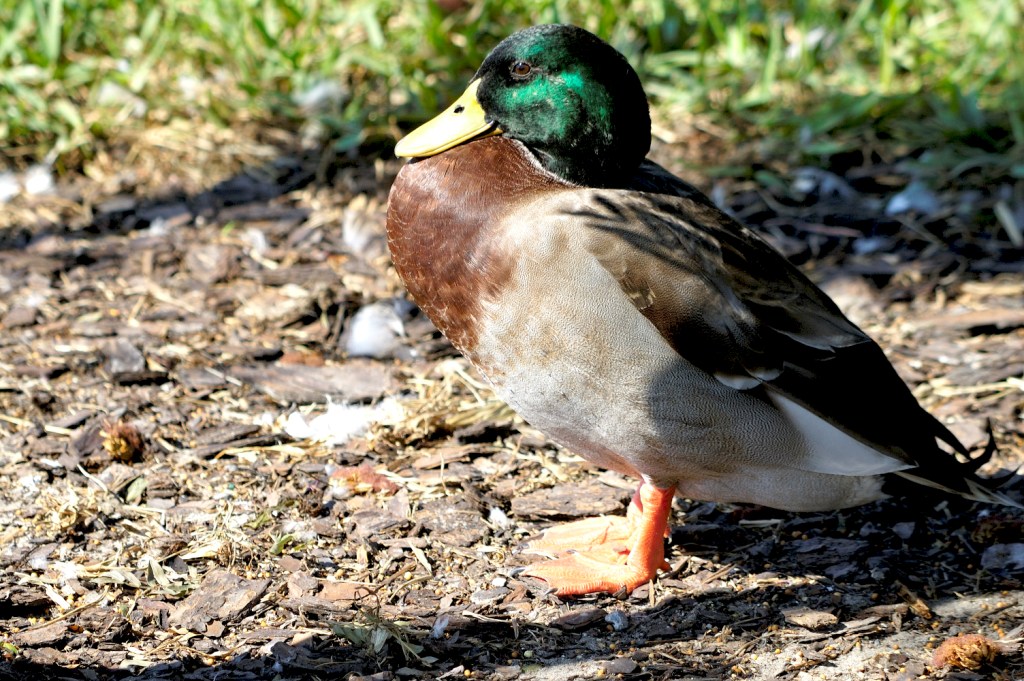
Mallard (Anas platyrhynchos) at Lake Parker By Dan'sPix

Mallard (Anas platyrhynchos) at Lake Parker By Dan’sPix

MALLARD   (a/k/a “GREEN-HEAD”:  Anas platyrhynchos). Mallards are nicknamed “green-heads”, due to the males’ iridescent green heads (which are bordered by a white neck ring).  The mallard male’s breast is chestnut-hued. Mallards live both on the coasts and inland (at ponds, lakes, prairie potholes, marshlands, including saltmarshes), including the entirety of America’s lower 48 states, so they are common (and well-known to American birdwatchers), so commonly known facts about them will not be repeated here.  Bull & Farrand [noted above, in the entry on Great Blue Heron] reports that the Mallard “is undoubtedly the most abundant duck in the world” (quoting page 392). Mallards are not only relatively ubiquitous, in their migratory or residential ranges (living or visiting in America, wherever migratory or residential ducks might be found), they are not shy around the habitat “edges” of human settlements.  Mallards frequent parks and backyards near ponds or other water bodies (including manmade reservoirs), often learning (and anticipating) that humans might provide bread crumbs or popcorn.  (But if you throw a piece of rotten banana into pond-water the mallards will not eat it.)  Donald Stokes reports that males and females make different noises:  “The quacking sound, which I had assumed that all Ducks made, can be made only by the female.  The male has two other calls of his own – a nasal rhaeb sound and a short Whistle-call, the latter accompanying all of the group courtship displays.”  (Donald W. Stokes, A Guide to Bird Behavior, Volume I (Stokes Nature Guides, Little, Brown & Co., 1979, page 31) Stokes goes on to say (pages 31-32) that this pattern of vocal behavior is not limited to Mallards – it also is observed in similar ducks including Gadwalls, Widgeons, Teals, Black Ducks, and Pintails.  Remember, therefore, if you see a large group of Mallards on a pond, and you hear a lot of quacking, it’s the females who are making all that noise.  (They might be trying to frighten of a turtle or other animal that is getting too close to their ducklings!)
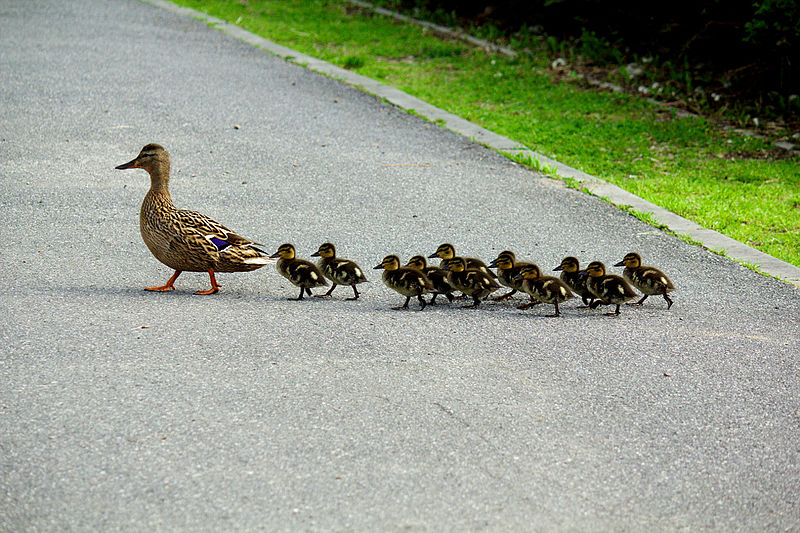
Mallard Duck army marching (I know it's not a King, but it's cute) ©WikiC

Mallard Duck army marching ©WikiC

Mallards have good memories (as do all birds, I assume), and I have personal knowledge of that fact.  More than 15 years ago, my son and I would regularly feed the ducks (mostly mallards, plus lesser scaups during the winter months) at a pond near Furneaux Creek (in Denton County, Texas), in the evening. But one day we were in a hurry — I don’t recall why — so we drove straight home, bypassing the pond, then driving about a block, taking a right turn, then after another block taking another right turn, then driving down the hilly street to near the end of the cul-de-sac in our neighborhood, parking the car by our mailbox. However, as we got out of the car (and I approached our mailbox at the edge of our small front yard), and as we stepped onto the sidewalk toward our home’s front yard, we were greeted by a host of energetically quacking ducks! — apparently they wanted to know why we didn’t make our usual stop to feed them at the pond. Embarrassed, we quickly found something to feed them, and we quickly scattered food scraps on our front yard, to satisfy our avian guests (and they gobbled up all the bread scraps)! Yes, I felt a bit ashamed of myself, that day, for disappointing the mallards that day — but I’m pretty sure that they “forgave” us. Life gets busy — but that should not become an excuse for ignoring those whom we have an opportunity to be kind to (Galatians 6:10), even if they are mallards who live at a nearby pond.
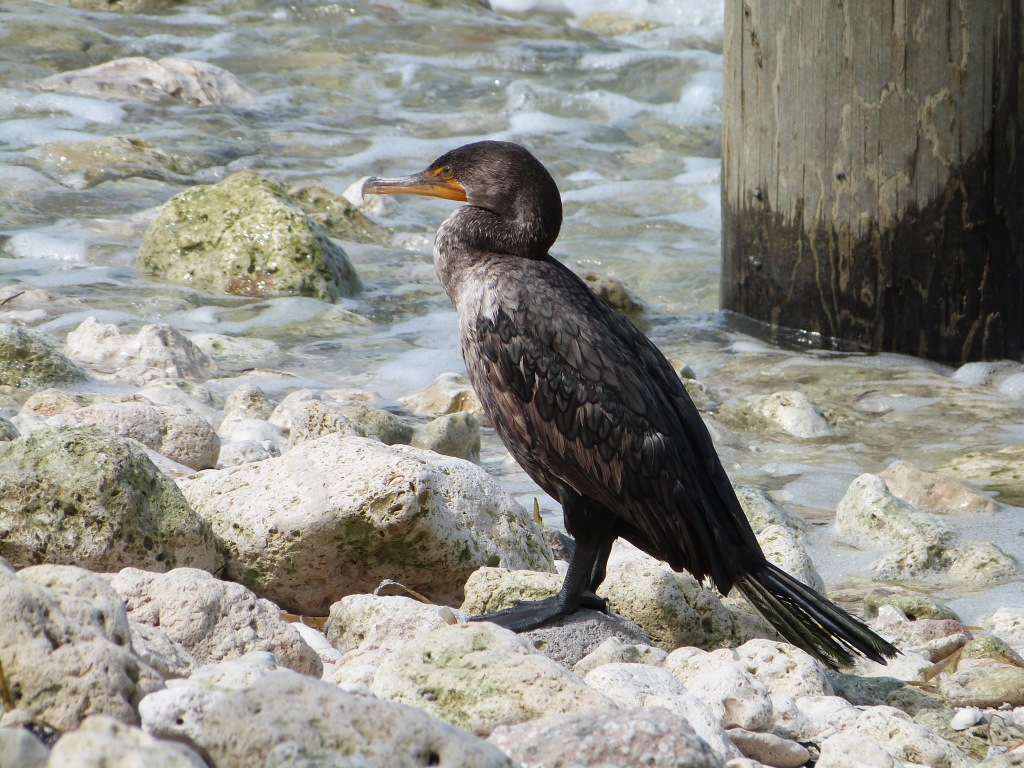
Double-crested Cormorant (Phalacrocorax auritus) by Lee at Honeymoon Is SP

Double-crested Cormorant (Phalacrocorax auritus) by Lee at Honeymoon Is SP

DOUBLE-CRESTED  CORMORANT   (Phalacrocorax auritus). The male of this bird is basically black, like a super-sized crow, with a goldish-orange bill and throat pouch, featuring a long neck that is usually posed in an S curve if perching.  (The female’s coloring is lighter – somewhat brownish-grey.)   But why is this bird called “double-crested”?   Don’t expect to observe any “crests” on its head (like a cardinal or a Steller’s jay), much less two of them!   Donald and Lillian Stokes inform us that the description “refers to crests that grow during breeding” that, even then, are “hard to see”.  (Stokes & Stokes, Stokes Field Guide to Birds – Eastern Region [noted above, in entry on Brown Pelican], page 27.)  Stokes & Stokes also note (on page 27) that this cormorant is the most common cormorant seen in the Eastern region of  America, on Atlantic (and Gulf of Mexico) coasts and farther inland, often wintering throughout the eastern half of Texas, and residing year-round in Florida.  (For example, the Heard Natural Science Museum and Wildlife Sanctuary — located in McKinney, Texas — is a good place to view these cormorants.) Cormorants are known to live in the coastal areas of the Holy Land.  The darting-to-its-prey habit, of diving cormorants, fits the Hebrew noun, shalak, often translated as “cormorant” (see Leviticus 11:17 & Deuteronomy 14:17). Like anhingas, these dark birds perch with outstretched wings, to dry out their wings after diving into and swimming in water for food (usually fish).  Like vultures, eagles, and hawks, these large birds have a bit of difficulty launching their heavy bodies from the ground, so after they do ascend high enough, to reach rising thermal air currents, they position themselves to “ride” those air currents (sometimes ascending as if riding an elevator), soaring and gliding whenever those air currents are conveniently available.   The double-crested cormorant’s neck is crooked in flight, unlike other cormorants.   These are gregarious birds – they nest in colonies and they often fly in groups, either in a straight line of in V formation.  (See Stokes & Stokes, page 27; see also page 361 of Bull & Farrand [noted above, in entry for Great Blue Heron].)

Black Vulture by Lee Myakka SP

Black Vulture by Lee Myakka SP

BLACK  VULTURE (Coragyps atratus). This eagle-like scavenger’s grey face distinguishes it from its cousin, the Turkey Vulture, which has a reddish-pink face Both of those faces are wrinkled, somber-looking, and – to put it bluntly – ugly.  The Black Vulture is distinguished by its conspicuously “short square tail that barely projects from the rear edge of the wings and by a whitish patch toward the wing tip”.  (Quoting Roger Tory Peterson, A Field Guide to the Birds Eastern Birds:  A Completely New Guide to All the Birds of Eastern and Central North America, abbreviated as “Eastern Birds” [Peterson Field Guides, Houghton Mifflin, 1980] page 160, with illustration on page 161.)  Black Vultures are somewhat feistier than their slightly larger cousins; they are known to scare off Turkey Vultures when there is competition for carrion.  (See Bull & Farrand [noted above, in entry for Great Blue Heron] at pages 416-417.   On the average, a Turkey Vulture grows about 4 inches larger than a Black Vulture, — yet both are about 2 feet long, from bill tip to tail tip.  Anyway, a vulture (sometimes colloquially called a “buzzard”) is a vulture is a vulture, and this is a vulture!   Vultures eat dead stuff – and sometimes even defenseless live animals.   Scavengers by God’s design (serving as garbage collectors/processors for this fallen world), vultures love to pick over and eat dead stuff!  God gave it a “naked” (featherless) head, which may be an advantage for keeping rotten food from besmirching its head with contagion, which might be more likely if its head was covered in feathers.  But Black Vultures   —   like other vultures  —   routinely consume flies-infested, rotting, bacteria-breeding dead animal carcasses  — why do they not get sick and die themselves of botulism or some other kind of food poisoning?  Dan “the Animal-man” Breeding has the answer:

“What is a vulture’s job? They find and eat what I call “road pizza.” They basically help keep the environment livable by limiting the build-up of dead animals and the spread of disease. God carefully designed vultures, giving them the needed tools to find, digest, and keep clean after eating dead animals.  Most meat-eating animals can find their dinner because it is mobile. Movement makes finding things easier. Have you noticed that when someone walks through your peripheral vision, you are acutely aware of it? But if you’ve misplaced your keys, it can take hours before you find them. God gave Buzz and vultures like him two special designs to help them find their motionless dinner—keen eyesight and an extraordinary sense of smell.
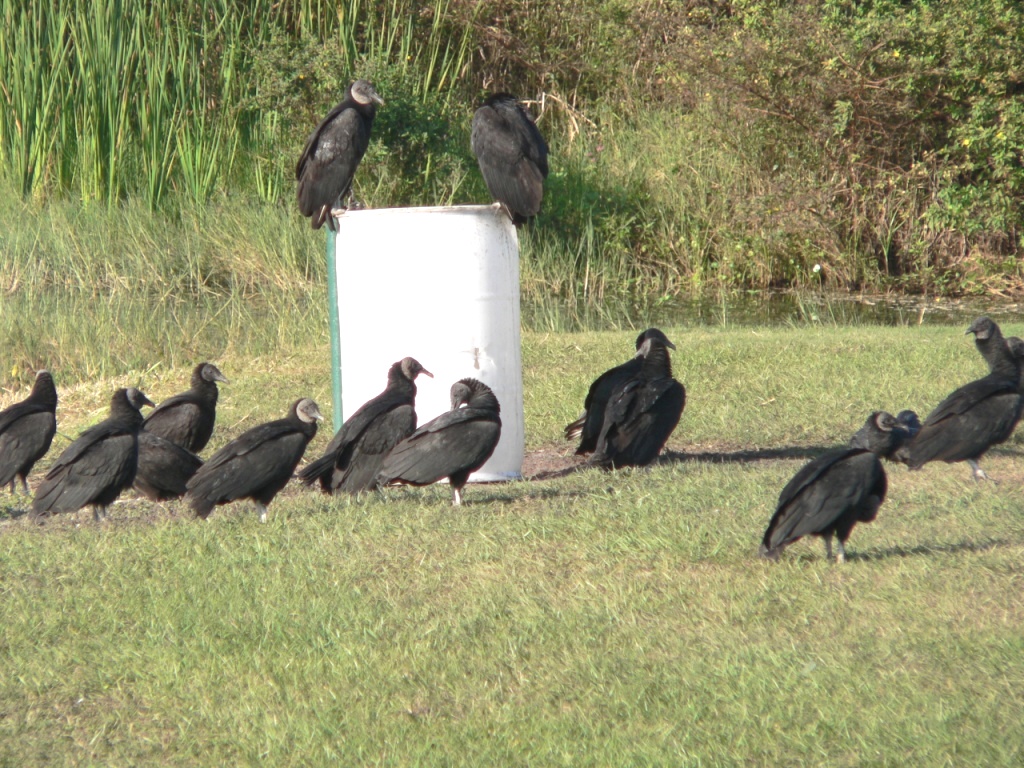
Black Vultures at Saddle Creek by Lee

Black Vultures at Saddle Creek by Lee

Vultures have very sharp eyesight. Even when they are soaring high above the ground, they can still see everything below them. God even provided them with sunglasses to protect their eyes against the sun’s harsh light. Vultures have dark lines around their eyes, which work the same way as the dark lines underneath a football player’s eyes. The dark color absorbs sunlight, reducing glare.  This way, vultures don’t have to worry about missing a single detail.  The lesser yellow-headed vultures have another advantage over most birds: a keen sense of smell. Their nares, or nose openings, look like holes in their beak. Wind from any direction funnels through the nares, which leads to the largest amount of sniffing possible. Each breeze is loaded with information, so God equipped these vultures with a very large olfactory lobe, able to handle all that information. Once the vultures find their dinner, how can they possibly eat it? Most other animals would get sick from eating dead animals. Why don’t vultures get sick all the time?  God gave them a very special digestive system. The acid in their crop (which functions like our stomach) is one of the strongest in the natural world. Strong enough to kill the harmful bacteria found in their dinner, it keeps them from getting sick from pretty much anything! In fact, vultures can use their digestive juices to defend themselves. If you were to startle a vulture while it was eating, you’d better back up quickly—vultures will vomit on you if you’re not careful. This not only makes them lighter (so they can more easily escape), but with the addition of the digestive acid, their lunch now smells much worse.”

(Quoting from  Dan Breeding, “Lesser Yellow-headed Vulture” [Answers in Genesis, 3-14-AD2012], posted at https://answersingenesis.org/birds/lesser-yellow-headed-vulture/ .)
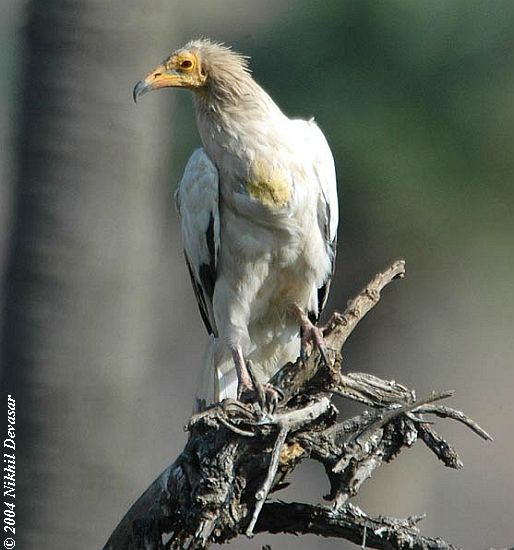
Egyptian Vulture (Neophron percnopterus) by Nikhil

Egyptian Vulture (Neophron percnopterus) by Nikhil

In the Holy Land proper (i.e., Israel), as well as in southwestern Europe and northern Africa to India, there is a vulture – the Egyptian Vulture (Neophron percnopterus – a/k/a White Scavenger Vulture) – that appears to match the Hebrew nouns rachma in Leviticus 11:18 (q.v.) and rachamah in Deuteronomy 14:17 (q.v.), and that same bird is nowadays known in Arabic as rachmah, essentially the same word.  (See, accord, George S. Cansdale, All the Animals of the Bible [Zondervan, 1976], pages 145-146.) The Black Vulture soars high in the sky, with a wingspan of about 5 feet (!), often in wide circles, scanning the ground for carrion – something dead yet nutritious to eat.   Scouting for rotting animal carcasses, vultures monitor the land below them:   marshy coastlands, tree-spotted hillsides, grasslands and other open fields, not-so-dense forests, riparian shore-banks, bushy thickets, — and but I’m not sure about the famous Hinckley under-brush of Minnesota (that we have heard so much about from Dr. Stan Toussaint — although he has confirmed that at Hinckley “the men are men, pansies are flowers, and the women are slightly above average”).  The Black Vulture’s body is heavy – like an eagle – so its wing-flappings are few, if possible, to conserve energy.  “Note the quick labored flapping — alternating with short glides”, notices Roger Tory Peterson (Eastern Birds, at page 160).  Its black-to-grey wings are two-tone-colored, with the flight feathers that trail behind the wings being paler (Peterson, Eastern Birds, page 160;  —  see also page 91 of Stokes & Stokes, Eastern Region, noted above in entry on Brown Pelican).  These scavengers are both residents and migrants:  they reside in most of the southern half of America’s lower 48 states, year-round, and summer in the northern half of those states.  Vultures are not picky eaters!  Roadkill, or even a partially picked-over animal carcass, is a wonderful “fast food” for a vulture.  If the roadkill (or other available animal carcass) is large enough it might provide a quick picnic for a family of vultures.

Wow!  That’s just 5 of the 15 birds we observed that morning, in the Webels’ pond-side backyard.   Stay tuned!  God willing, the other 10 birds will be given their proper recognition, at this excellent bird-site!

(On the morning of February 9th, AD2015, from the pond-side backyard of Bob & Marcia Webel (while enjoying breakfast and Christian fellowship with the Webels), I saw 14 birds:  Great Blue Heron, Brown Pelican, Mallard, Double-Crested Cormorant, and Black Vulture  –  as reported above – plus Wood Stork, Lesser Scaup, Osprey, Muscovy Duck, Great Egret, Snowy Egret, White Ibis, Common Tern, and Florida Gallinule, — plus the cooing of a nearby Mourning Dove was clearly recognizable.  It is hoped (D.v.) that later reports can supplement this one, so the latter-listed 10 birds will be properly recognized for their lacustrine appearances that morning.)

====================================================================================

James J. S. Johnson loves duck ponds, having formerly taught Environmental Limnology and Water Quality Monitoring for Dallas Christian College, as well as other courses on ecology and ornithology.  As noted in a recent comment to Emma Foster’s fascinating bird tale “The Old Man and the Ibises” (posted 2-11-AD2015), Jim enjoyed the habit of feeding ducks at a neighborhood pond during years when he lived near Furneaux Creek (in Carrollton, Texas).  Nowadays, from time to time, Jim feeds ducks (mostly mallards) and geese (mostly Canada geese) that visit the pond at the edge of his present home’s backyard.  Backyards and ponds are for bird-watching!
* Other Articles by James J. S. Johnson *

Color That Man Did Not (Could Not) Create

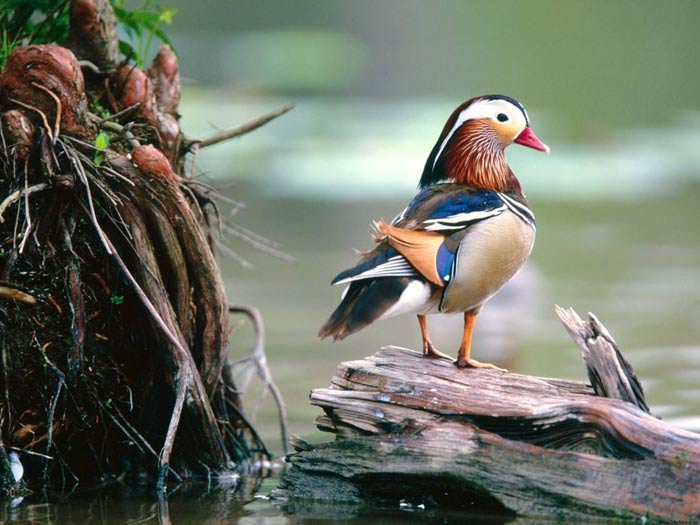
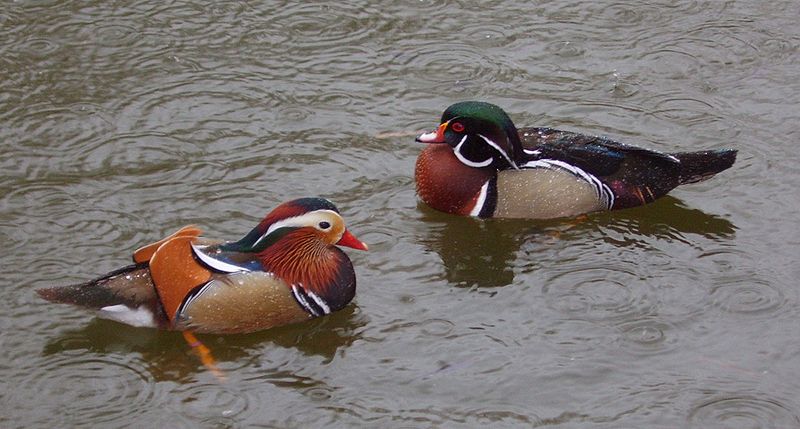
Wood Duck and Mandarin Duck

COLOR THAT MAN DID NOT (COULD NOT) CREATE… ONLY THE MASTER CREATOR COULD

Received this in an email and thought I would share it. Not sure of the source of the photos, but absolutely know who the Master Creator was.

So God created great sea creatures and every living thing that moves, with which the waters abounded, according to their kind, and every winged bird according to its kind. And God saw that it was good. And God blessed them, saying, “Be fruitful and multiply, and fill the waters in the seas, and let birds multiply on the earth.” So the evening and the morning were the fifth day. (Genesis 1:21-23 NKJV)

Click any photo to start the Gallery

Who Paints The Leaves?

*

Circle B Birdwatching Trip February 2015

Great Blue Heron

“But now ask the beasts, and they will teach you; And the birds of the air, and they will tell you; (Job 12:7 NKJV)

Today we finally got to go birdwatching at Circle B Bar Reserve. We were asked to join Baron Brown (A.K.A. Golden Eagle) and one of the classes he teaches. We were introducing them to Birdwatching. For most of the twelve students, this was their first trip of watch birds.

“Train up a child in the way he should go [and in keeping with his individual gift or bent], and when he is old he will not depart from it. (Proverbs 22:6 AMP)

After we finished, we went to our church where I presented a Powerpoint presentation on birding. Then they got to eat pizza. Not sure which they enjoyed more, the birds or the pizza. ;0)

For Dan and I, this was our first real birdwatching trip of the year. We stopped by the shore of the AF base a week or so ago and birded for about 15-20 minutes. Today’s trip was about two hours long.

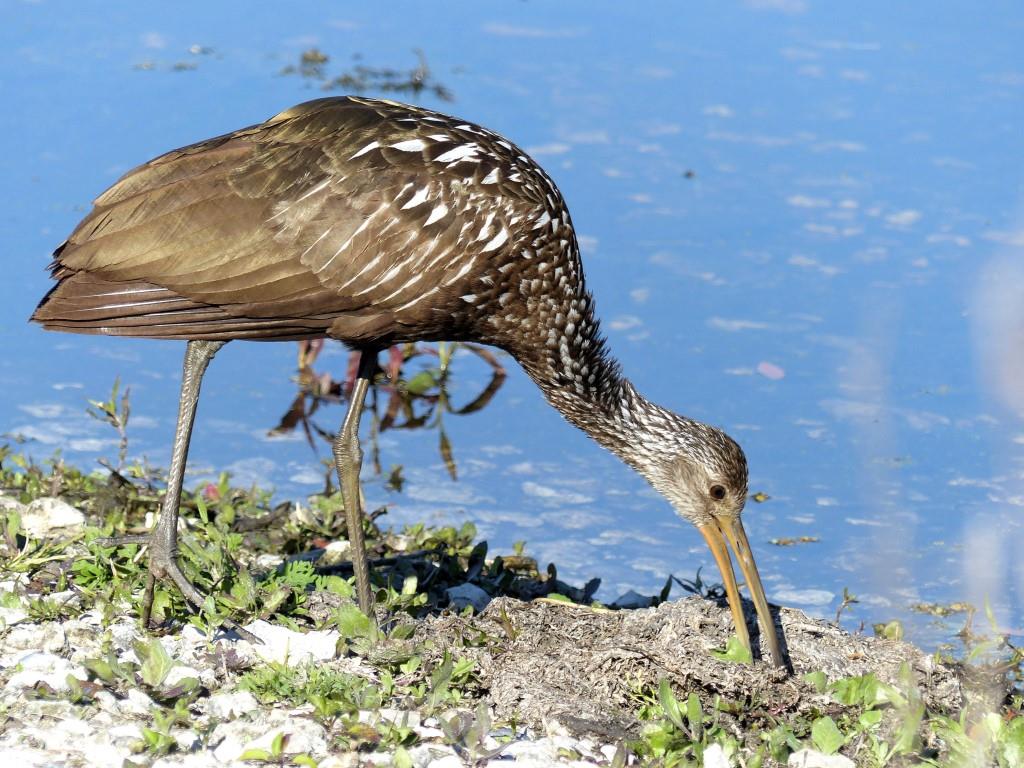
Limpkin

Limpkin

What did we see? Altogether, about 25-26 species were spotted. We saw some they didn’t see and they saw three Bald Eagles, that we didn’t see. (I stopped and waited for them to make a short trip up one of the trails. They are younger, you know.)

Osprey

Osprey

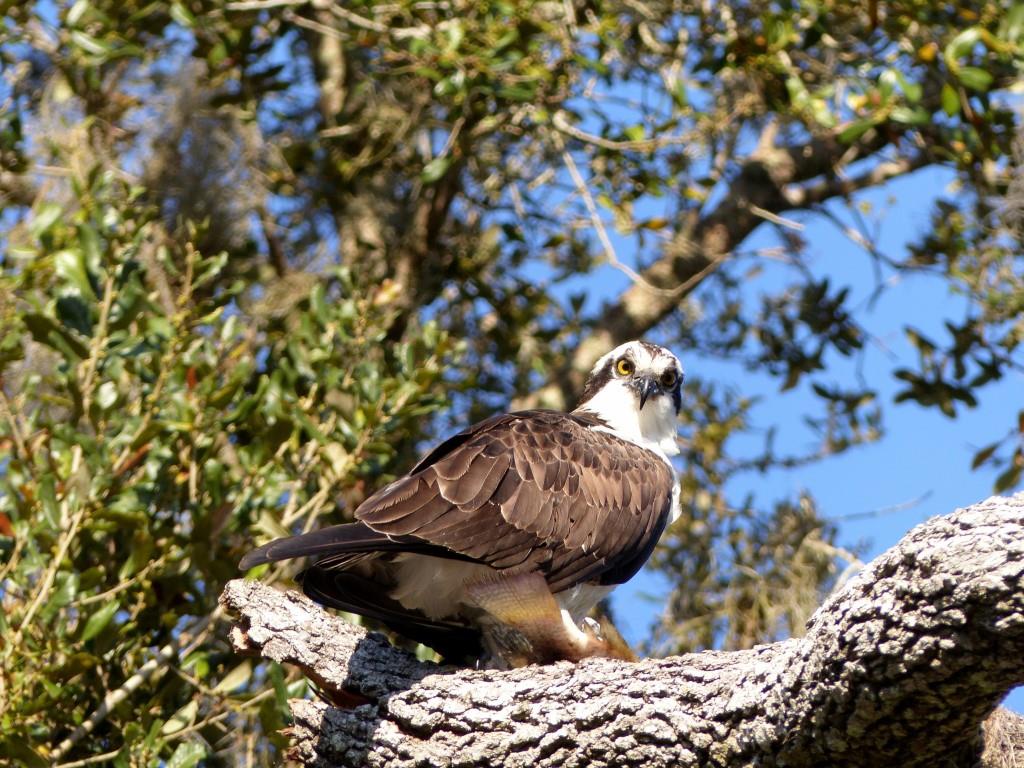
We were greeted in the parking lot by an Osprey sitting in the tree with a fish in his feet. That was a good start for them. From there we went out to the marsh where we started seeing the usual birds at Circle B; Great Egrets, Tri-colored Heron, Snowy Egrets, Little Blue Herons, Glossy and White Ibises, an Anhinga with wings spread, Limpkins, Great Blue Herons. There were lots of Turkey and Black Vultures flying overhead, and the Tree Swallows were zipping around all over the place. There was also a tree way down the marsh that was hosting a group of Double-crested Cormorants.

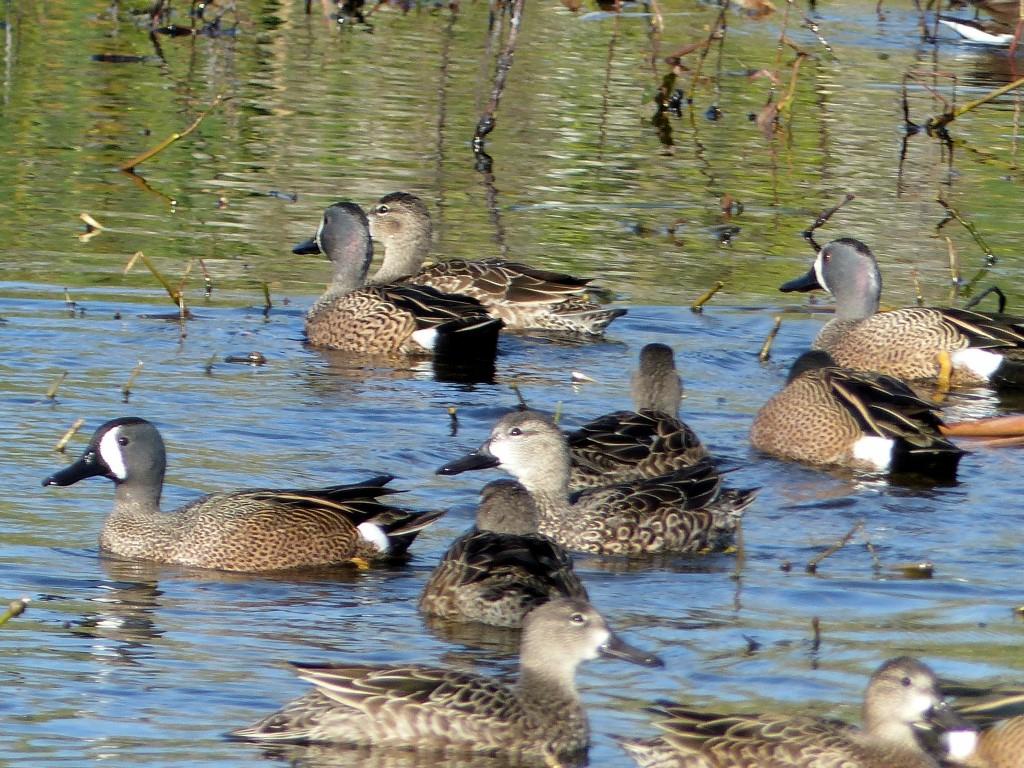
Water birds spotted were Coots, Common Moorhens, and a group of Blue-winged Teals.

Blue-winged Teals

Blue-winged Teals

All the heads turned when a Roseate Spoonbill flew by and later we saw one up close in the water. There was a pair of Red-shouldered Hawks sitting in a tree way off, but I zoomed in and was able to get a half-way decent photo of them. One even raised its tail up to preen, I suppose.

We were teaching them about listening for birds and some Mourning Doves, a Carolina Wren, some Red-bellied and Pileated Woodpeckers and a few others were heard.

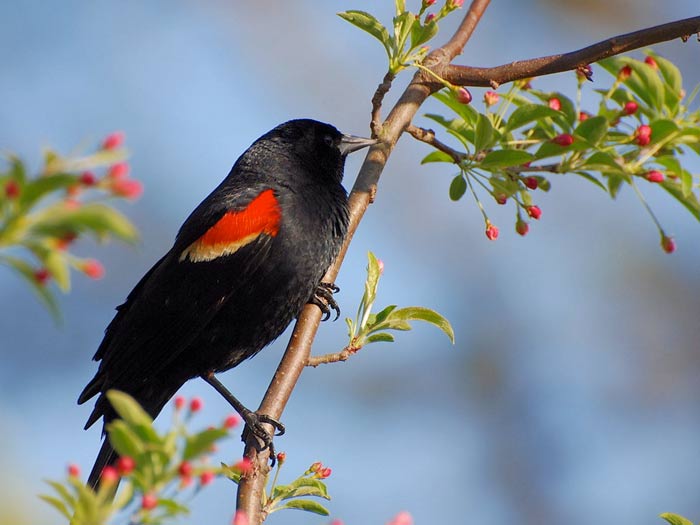
While they were off down the trail, we added Red-winged Blackbirds and Blue-gray Gnatcatcher to our list. We had also seen 16 White Pelicans flying right by the park as we were arriving.

All total, not a bad birdwatching trip. Looking forward to more trips as 2015 progresses. Here are just some of today’s photos.

This slideshow requires JavaScript.


*

*

Drummers and Carpenters – Chapter 11

Downy Woodpecker (Picoides pubescens) Brevard Zoo by Dan

Is it a Downy or Hairy Woodpecker? Brevard Zoo by Dan

Drummers and Carpenters

The Downy, Hairy and Red-headed Woodpeckers.

The Burgess Bird Book For Children

*

Listen to the story read.

CHAPTER 11. Drummers and Carpenters.

Peter Rabbit was so full of questions that he hardly knew which one to ask first. But Yellow Wing the Flicker didn’t give him a chance to ask any. From the edge of the Green forest there came a clear, loud call of, “Pe-ok! Pe-ok! Pe-ok!”
“Excuse me, Peter, there’s Mrs. Yellow Wing calling me,” exclaimed Yellow Wing, and away he went. Peter noticed that as he flew he went up and down. It seemed very much as if he bounded through the air just as Peter bounds over the ground. “I would know him by the way he flies just as far as I could see him,” thought Peter, as he started for home in the dear Old Briar-patch. “Somehow he doesn’t seem like a Woodpecker because he is on the ground so much. I must ask Jenny Wren about him.”

It was two or three days before Peter had a chance for a bit of gossip with Jenny Wren. When he did the first thing he asked was if Yellow Wing is a true Woodpecker.

Northern Flicker (Colaptes auratus) red-shafted F-left M-right ©WikiC

Northern Flicker (Colaptes auratus) red-shafted F-left M-right ©WikiC

“Certainly he is,” replied Jenny Wren. “Of course he is. Why under the sun should you think he isn’t?”

“Because it seems to me he is on the ground more than he’s in the trees,” retorted Peter. “I don’t know any other Woodpeckers who come down on the ground at all.”

“Tut, tut, tut, tut!” scolded Jenny. “Think a minute, Peter! Think a minute! Haven’t you ever seen Redhead on the ground?”

Peter blinked his eyes. “Ye-e-s,” he said slowly. “Come to think of it, I have. I’ve seen him picking up beechnuts in the fall. The Woodpeckers are a funny family. I don’t understand them.”

Just then a long, rolling rat-a-tat-tat rang out just over their heads. “There’s another one of them,” chuckled Jenny. “That’s Downy, the smallest of the whole family. He certainly makes an awful racket for such a little fellow. He is a splendid drummer and he’s just as good a carpenter. He made the very house I am occupying now.”

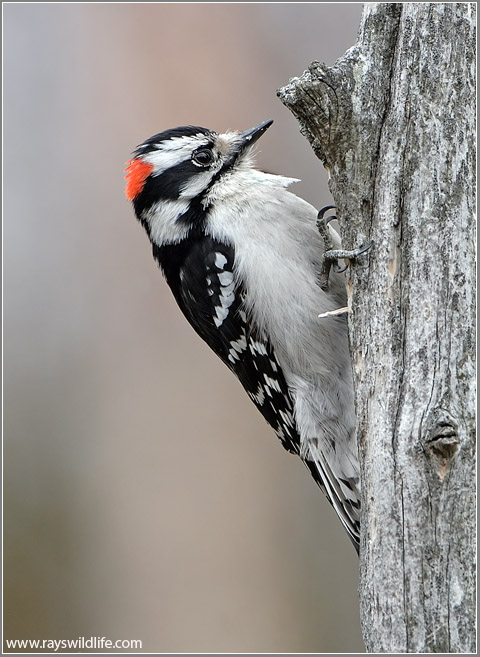
Peter was sitting with his head tipped back trying to see Downy. At first he couldn’t make him out. Then he caught a little movement on top of a dead limb. It was Downy’s head flying back and forth as he beat his long roll. He was dressed all in black and white. On the back of his head was a little scarlet patch. He was making a tremendous racket for such a little chap, only a little bigger than one of the Sparrow family.

“Is he making a hole for a nest up there?” asked Peter eagerly.

“Gracious, Peter, what a question! What a perfectly silly question!” exclaimed Jenny Wren scornfully. “Do give us birds credit for a little common sense. If he were cutting a hole for a nest, everybody within hearing would know just where to look for it. Downy has too much sense in that little head of his to do such a silly thing as that. When he cuts a hole for a nest he doesn’t make any more noise than is absolutely necessary. You don’t see any chips flying, do you?”

“No-o,” replied Peter slowly. “Now you speak of it, I don’t. Is—is he hunting for worms in the wood?”

Jenny laughed right out. “Hardly, Peter, hardly,” said she. “He’s just drumming, that’s all. That hollow limb makes the best kind of a drum and Downy is making the most of it. Just listen to that! There isn’t a better drummer anywhere.”

But Peter wasn’t satisfied. Finally he ventured another question. “What’s he doing it for?”

“Good land, Peter!” cried Jenny. “What do you run and jump for in the spring? What is Mr. Wren singing for over there? Downy is drumming for precisely the same reason—happiness. He can’t run and jump and he can’t sing, but he can drum. By the way, do you know that Downy is one of the most useful birds in the Old Orchard?”

Just then Downy flew away, but hardly had he disappeared when another drummer took his place. At first Peter thought Downy had returned until he noticed that the newcomer was just a bit bigger than Downy. Jenny Wren’s sharp eyes spied him at once.

“Hello!” she exclaimed. “There’s Hairy. Did you ever see two cousins look more alike? If it were not that Hairy is bigger than Downy it would be hard work to tell them apart. Do you see any other difference, Peter?”

Downy Woodpecker (Picoides pubescens) by Raymond Barlow

Downy Woodpecker (Picoides pubescens) by Raymond Barlow

Peter stared and blinked and stared again, then slowly shook his head. “No,” he confessed, “I don’t.”

“That shows you haven’t learned to use your eyes, Peter,” said Jenny rather sharply. “Look at the outside feathers of his tail; they are all white. Downy’s outside tail feathers have little bars of black. Hairy is just as good a carpenter as is Downy, but for that matter I don’t know of a member of the Woodpecker family who isn’t a good carpenter. Where did you say Yellow Wing the Flicker is making his home this year?”

“Over in the Big Hickory-tree by the Smiling Pool,” replied Peter. “I don’t understand yet why Yellow Wing spends so much time on the ground.”

Ants,” replied Jenny Wren. “Just ants. He’s as fond of ants as is Old Mr. Toad, and that is saying a great deal. If Yellow Wing keeps on he’ll become a ground bird instead of a tree bird. He gets more than half his living on the ground now. Speaking of drumming, did you ever hear Yellow Wing drum on a tin roof?”

Peter shook his head.

“Well, if there’s a tin roof anywhere around, and Yellow Wing can find it, he will be perfectly happy. He certainly does love to make a noise, and tin makes the finest kind of a drum.”

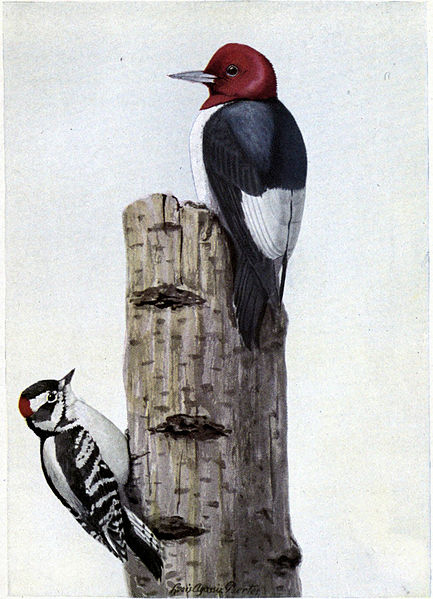
Just then Jenny was interrupted by the arrival, on the trunk of the very next tree to the one on which she was sitting, of a bird about the size of Sammy Jay. His whole head and neck were a beautiful, deep red. His breast was pure white, and his back was black to nearly the beginning of his tail, where it was white.

Redhead the Woodpecker, Downy the Woodpecker - Burgess Bird Book ©©

Redhead the Woodpecker, Downy the Woodpecker – Burgess Bird Book ©©

“Hello, Redhead!” exclaimed Jenny Wren. “How did you know we were talking about your family?”

“Hello, chatterbox,” retorted Redhead with a twinkle in his eyes. “I didn’t know you were talking about my family, but I could have guessed that you were talking about some one’s family. Does your tongue ever stop, Jenny?”

Jenny Wren started to become indignant and scold, then thought better of it. “I was talking for Peter’s benefit,” said she, trying to look dignified, a thing quite impossible for any member of the Wren family to do. “Peter has always had the idea that true Woodpeckers never go down on the ground. I was explaining to him that Yellow Wing is a true Woodpecker, yet spends half his time on the ground.”

Redhead nodded. “It’s all on account of ants,” said he. “I don’t know of any one quite so fond of ants unless it is Old Mr. Toad. I like a few of them myself, but Yellow Wing just about lives on them when he can. You may have noticed that I go down on the ground myself once in a while. I am rather fond of beetles, and an occasional grasshopper tastes very good to me. I like a variety. Yes, sir, I certainly do like a variety—cherries, blackberries, raspberries, strawberries, grapes. In fact most kinds of fruit taste good to me, not to mention beechnuts and acorns when there is no fruit.

Jenny Wren tossed her head. “You didn’t mention the eggs of some of your neighbors,” said she sharply.

Redhead did his best to look innocent, but Peter noticed that he gave a guilty start and very abruptly changed the subject, and a moment later flew away.

“Is it true,” asked Peter, “that Redhead does such a dreadful thing?”

Jenny bobbed her head rapidly and jerked her tail. “So I am told,” said she. “I’ve never seen him do it, but I know others who have. They say he is no better than Sammy Jay or Blacky the Crow. But gracious, goodness! I can’t sit here gossiping forever.” Jenny twitched her funny little tail, snapped her bright eyes at Peter, and disappeared in her house.

Bold points for questions at the bottom or for Christian traits.

*

For thou shalt eat the labour of thine hands: happy shalt thou be, and it shall be well with thee. (or your beak) (Psalms 128:2 KJV)

He that handleth a matter wisely shall find good: and whoso trusteth in the LORD, happy is he. (Proverbs 16:20 KJV)

Seems like these woodpeckers enjoy doing what that is a sign they are happy?

  • Who are the four members of the Woodpecker family mentioned?
  • How does a Woodpecker fly?
  • Which is the smallest member of the family?
  • Can you describe him?
  • Which Woodpecker is just a little bit larger?
  • What about its tail?
  • Which one likes to eat on the ground half the time?
  • What is he looking for?
  • What does Redhead like to eat?

Links:

Woodpeckers – Picidae Family

Woodpecker – All About Birds

Woodpecker – Wikipedia

*

Links:

Creaker the Purple Grackle, The Male Cowbird - Burgess Bird Book ©©Thum


  Next Chapter Some Unlikely Relatives


Burgess-Bird-Book-for-Children


Burgess Bird Book For Children


Robust Woodpecker (Campephilus robustus) by BirdPhotos_com


Wordless Birds

*

*


Tickle Me Tuesday – Bird of Paradise

Greater Bird-of-paradise (Paradisaea apoda) ©© captive

Greater Bird-of-paradise (Paradisaea apoda) ©© captive

A glad heart makes a cheerful countenance, but by sorrow of heart the spirit is broken. (Proverbs 15:13 AMP)

Sandra Connor has again come out with a challenge. This time she is calling it “Tickle Me Tuesday,” so here is my first attempt.

This video is of Attenborough trying to film a sequence about a Greater Bird of Paradise. The bird keeps stealing the script and writing his own. It is a series of takes where the bird shows off and quiets David. From BBC.

Bird interrupts David Attenborough – Attenborough’s Paradise Birds – BBC Two

A happy heart is good medicine and a cheerful mind works healing, but a broken spirit dries up the bones. (Proverbs 17:22 AMP)

If you would like to take up the challenge, check out Sandra’s page, or you can leave a comment here with a link to your “Tickle” article. Or Both!

*

Tickle Me Tuesday,” Challenge by Sandra Connor

Wages or a Gift

*

Ian’s Bird of the Week – Common/Black-billed Magpie

Black-billed Magpie (Pica hudsonia) by Ian

Ian’s Bird of the Week – Common/Black-billed Magpie ~ by Ian Montgomery

Newsletter ~ 2/9/2015

The Australian Magpie of last week generated quite some interesting correspondence, about both it being an iconic species and bird names and their derivation. I also got a request for a BotW on Butcherbirds, which I’ll do soon, but in the meantime here is the original Magpie of the the Northern Hemisphere. It is, incidentally, on the Australian list, a record from Port Hedland in May 2007 having been accepted by the rarities committee. This species is quite sedentary, the nearest place it occurs naturally is China and Port Hedland is an iron ore port so you don’t have to be Sherlock Holmes to work out how it got there.

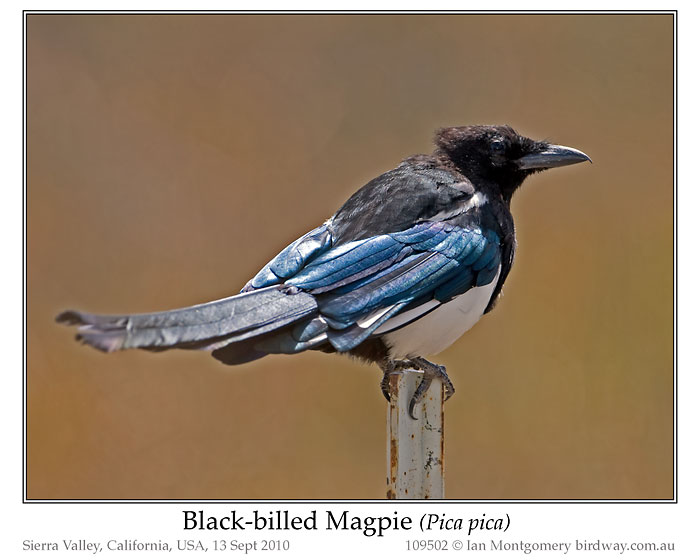
This, unlike the Australian Magpie, is a member of the crow family, Corvidae, and I think you’ll agree that the resemblance between the two species is fairly superficial, not that that ever got in the way of names. The Common or Black-billed Magpie – I’ll get back inevitably to names shortly – has beautifully iridescent wings and tail which can appear blue or green under different lighting conditions, which tells us that the colour is due to the prismatic microscopic structure of the feather rather than coloured pigment. The first photo shows one on a garden wall in suburban Dublin.

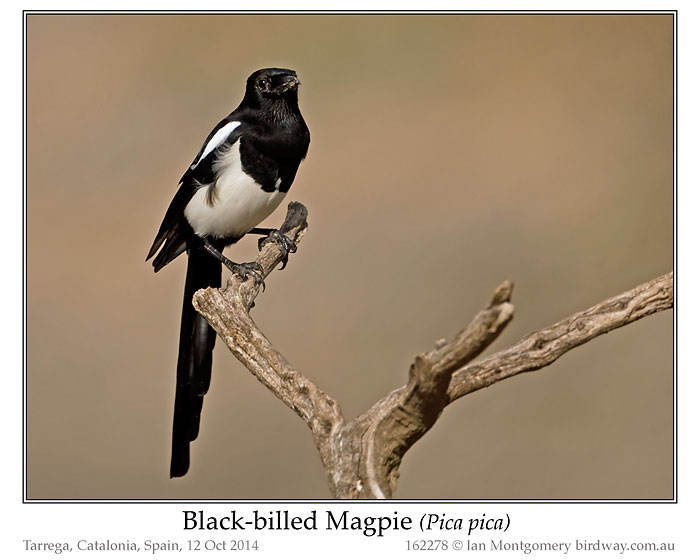
Black-billed Magpie (Pica hudsonia) by IanThe second one was taken in Catalonia at the Northern Goshawk site. Like their cousins the Common Ravens the Magpies were quite brazen and prepared to steal a morsel of food from under the noses of much larger raptors. Also like the Ravens and unlike the raptors, the Magpies noticed the sound of the camera shutter and you can see this one peering warily at the hide. This photo shows the extremely wedged-shaped tail, which is very obvious in flight. The third photo shows a juvenile one in Ireland, very similar to the adult plumage but it still has the slightly swollen gape of a very young bird and, maybe I’m imagining it, an atypically innocent expression.

Black-billed Magpie (Pica hudsonia) by IanCommon Magpies are iconic too, and as kids in Ireland we attached great significance to the number seen together, according to the nursery rhyme ‘One for sorrow, Two for joy …’ http://en.wikipedia.org/wiki/One_for_Sorrow_(nursery_rhyme). Magpies, and other crows, have long been considered birds of ill-omen.

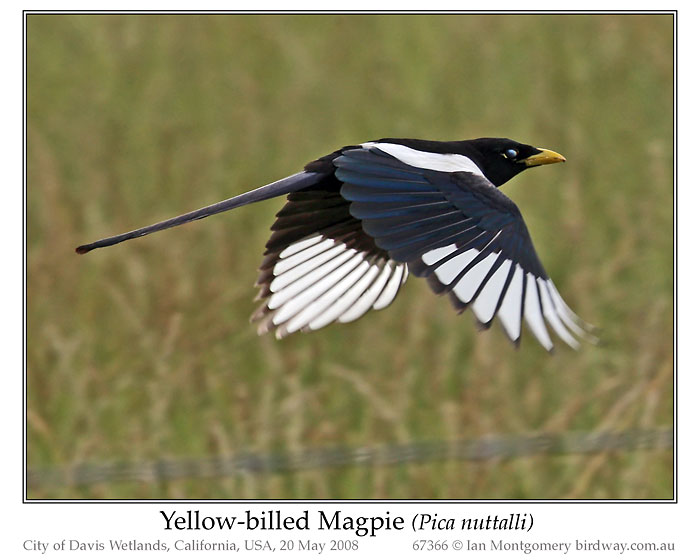
Black-billed Magpie (Pica hudsonia) by IanBack then, we called them just ‘Magpies’. In later decades, I became aware that, like The Kittiwake and for similar reasons, it acquired a coloured qualification ‘Black-billed’. In the case of the Kittiwake this was to distinguish the black-legged Eurasian one from the Red-legged Kittiwake of the eastern Bering Sea; in the case of the Magpie, it was because of the Yellow-billed Magpie of California, fifth photo, having a very restricted range that overlaps with the much more widespread Black-billed Magpie (fourth photo). The fifth photo, incidentally gives a good idea what the very similar Common/Black-billed Magpie looks like in flight and the white patches on the wing are very striking.

Black-billed Magpie (Pica hudsonia) by Ian

Plus ça change … as they say. I discovered while researching this BotW that Handbook of Birds of the World (HBW) and Birdlife International have accepted the split of the Black-billed/Common into three species: the Common Magpie (Pica pica) of Eurasia, the Black-billed Magpie of North America (Pica hudsonii) – fourth photo – and the Arabian Magpie (Pica asirensis), restricted to a tiny range in SW Saudi Arabia. So the European bird is back to where it started from.

I’m losing patience with avian taxonomists. Molecular studies over the past thirty years have led to countless changes in classification and naming, and not just at the species level. The 2014 HBW Checklist of Birds of the World, volume 1 (non-passerines) has many changes at every level up to order. I’ll repeat what I’ve said before that Linnaeus – he who tried to impose order on chaos – must be turning in his grave. Maybe he is just laughing, and perhaps that’s the right approach.

I used to think what the latest taxonomists said – starting with Sibley and Monroe in 1990 – was the gospel truth and a huge advance in our understanding. I don’t think that anymore! Here is a quote from Birdlife International on the fate of the Rainbow and Red-collared Lorikeets: Trichoglossus haematodus, … T. rubritorquis… (del Hoyo and Collar 2014) were previously lumped as T. haematodus following Christidis and Boles (1994), and before then were split as T. haematodus and T. rubritorquis following Sibley and Monroe (1990, 1993): Lump, split, lump, split!

On a lighter note, I’m giving a talk on ‘Australia: Land of Parrots?’ at the BirdLife Townsville AGM next Saturday 14 February at 2:00pm in the Sound Shell meeting room at Thuringowa. If you’re a local, and even if you’re not, it would be great to see you there. The talk is about parrot diversity and bio-geography – all the Gondwanaland stuff.

Greetings
Ian

**************************************************
Ian Montgomery, Birdway Pty Ltd,
454 Forestry Road, Bluewater, Qld 4818
Tel 0411 602 737 ian@birdway.com.au
Bird Photos http://www.birdway.com.au/


Lee’s Addition:

I know and am acquainted with all the birds of the mountains, and the wild animals of the field are Mine and are with Me, in My mind. (Psalms 50:11 AMP)

Ha! Ha! Ha! Thanks Ian for saying what I have been feeling. Sounds like we both agree on all the renaming, splitting, re-shuffling and “Lump, split, lump, split!” (Birds, People and DNA

The Magpies above are neat and I especially like that expression of the juvenile one. He (or she) still has the gape of an immature bird.

The Corvidae Family Crows, Jays, Ravens is where you will find the Magpies placed. (at this time). There are 130 members that make up this family.

*

*

Designed for Flight – Creation Moments TV

An eagle fishing

An eagle fishing

For thus says the LORD: “Behold, one will fly swiftly like an eagle And spread out his wings against Moab. (Jeremiah 48:40 NASB)

Creation Moments articles have been used here many times. Now they have a YouTube Channel called Creation Moments TV.

While checking out their new videos, I found this one about birds and thought you might enjoy seeing it. Watching instead of reading is more enjoyable at times. Though reading is still good for us or else those of us who do blogs would be out of business.

God created the great sea monsters and every living creature that moves, with which the waters swarmed after their kind, and every winged bird after its kind; and God saw that it was good. (Genesis 1:21 NASB)

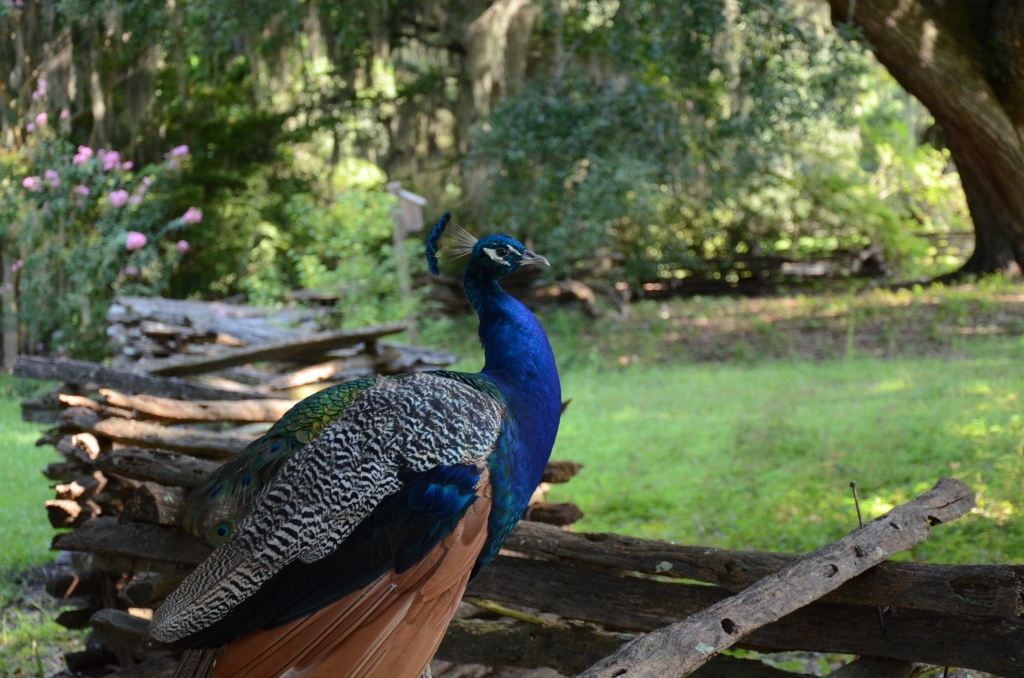
Peacock at Magnolia Plantation by Dan

Peacock at Magnolia Plantation by Dan

Creation Moments TV

Interesting Things from Creation Moments

When I Consider

*

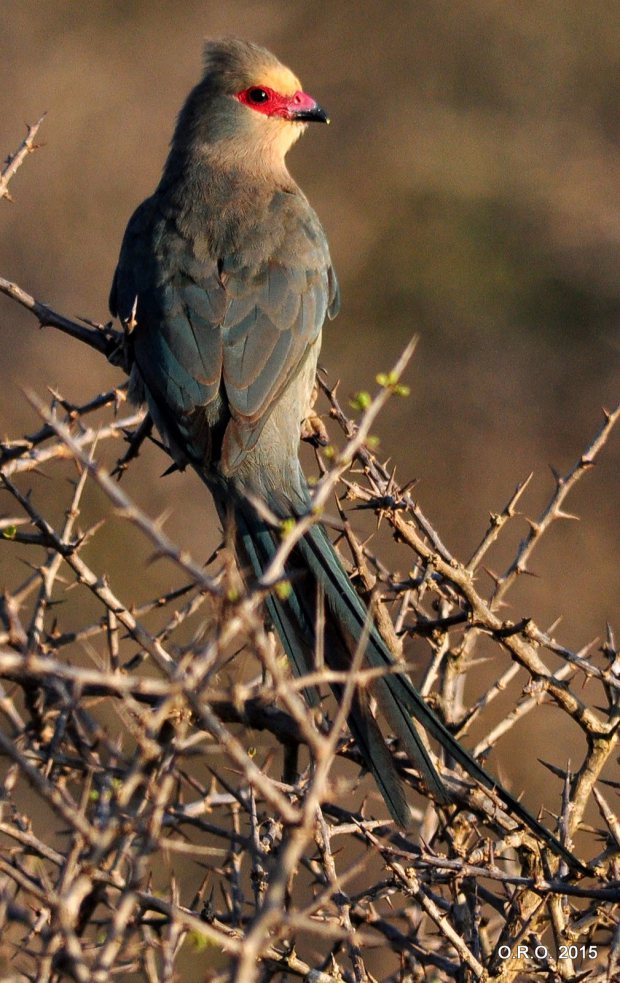
Strawberry (Red-faced) Mousebird – Urocolius Indicus

Red-faced Mousebird (Urocolius indicus) ©Our Rumbling Ocean

Red-faced Mousebird (Urocolius indicus) ©Our Rumbling Ocean

Red-faced Mousebird

Endemic to Africa, about the size of a normal sparrow, crested head and beautiful cinnamon colored breast and strawberry red mask and bill. They are especially beautiful in the early morning sun. Their general body color is blue-grey or slate-ish.

With its long tail, about the same length as the body, they look like mice when they climb around in trees, therefore the name. Their outside toes are reversed to allow them to do just that, moving forward and backward as they climb around in the trees. They are more nervous of people than especially the Speckled Mousebird, which we have done before….. (To see the rest of the article – click here)


Lee’s Addition:

The shield of his mighty men is made red, the valiant men are in scarlet: … (Nahum 2:3a KJV)

Strawberry (Red-faced) Mousebird – Urocolius Indicus is re-blogged and was written on one of the blogs I follow, Our Rumbling Ocean. It is produced in South Africa.

Anyway, I wanted to share these beautiful Mousebirds with you.

Mousebirds are members of the Mousebirds – Coliidae Family and consist of only six species. And, no, the plural of Mousebird is not “Micebirds.”

*

Our Rumbling Ocean

Mousebirds – Coliidae Family

Birds of the World

*


Live Cams from All About Birds

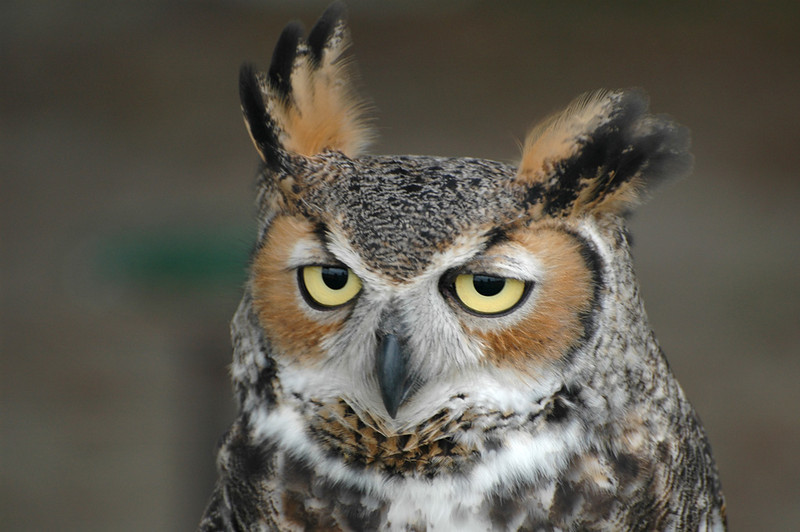
Great Horned Owl (Bubo virginianus) by Bob-Nan

Great Horned Owl (Bubo virginianus) by Bob-Nan

The little owl, and the great owl, and the swan, (Deuteronomy 14:16 KJV)

There shall the great owl make her nest, and lay, and hatch, and gather under her shadow: there shall the vultures also be gathered, every one with her mate. (Isaiah 34:15 KJV)

Are you aware of the Live Cameras that All About Birds are sharing? They are very interesting to watch. The latest that was shared with me is a Great Horned Owl nest Cam in Savannah, GA.

Take a look”

Here is a link that shows more about the Great Horned Owls there.

http://cams.allaboutbirds.org/channel/46/Great_Horned_Owls/

How about some Laysan Albatross nest in Hawaii?

Here is there link for the Albatross.

http://cams.allaboutbirds.org/channel/41/Laysan_Albatross/

Aren’t these amazing? It is alway great to watch the Lord’s amazing creations, but to get to see them at the nest or at feeders is neat with today’s technology.

If you would like to see all the current Cams from All About Birds click this link. Not all the camera are operating all the time, but this page will help you find the live one as the current time.

http://cams.allaboutbirds.org/all-cams/

*

Birds of the Bible – Owls

Strigidae – Owls

Diomedeidae – Albatrosses Family

*


Birds, People and DNA

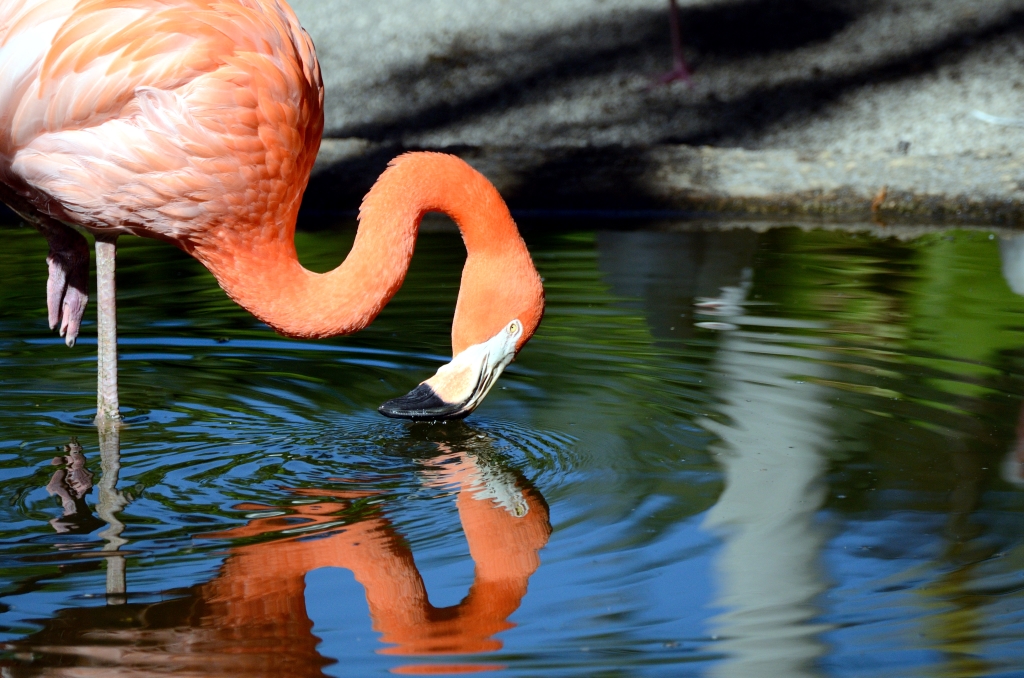
Flamingo by Dan' at Flamingo Gardens

Flamingo by Dan at Flamingo Gardens

So God created great sea creatures and every living thing that moves, with which the waters abounded, according to their kind, and every winged bird according to its kind. And God saw that it was good. And God blessed them, saying, “Be fruitful and multiply, and fill the waters in the seas, and let birds multiply on the earth.” (Genesis 1:21-22 NKJV)

Recently, I have been interested in genealogy. I have been working on our ancestry while staying home since I have been “under the weather.” It is really fun and exciting finding out about my previous generations. It also can be time-consuming and addictive, if you let it.

I can only imagine how those that are working on the DNA of our avian friends feel. If you have been following this blog very long, you know that I keep updating my Birds of the World when a new version comes out. When the Ver. 4.2 came out I.O.C. Version 4.2 Updated, I wrote this:

“They (the birds) are still doing as commanded by the Lord to reproduce and keeping the ornithologist busy naming, renaming, and rearranging them.

This time they renamed one and moved it to a new family just for it. The Spotted Wren-Babbler (Spelaeornis formosus) was in the Timaliidae Family. It has been renamed the Spotted Elachura (Elachura formosa) and placed in its own Elachuridae Family. (I do not have permission yet to post a photo.)

Version 4.2 also took the Lark Family and tossed it up in the air and rearranged it. See the Alaudidae – Larks Family. The DNA researches are keeping them busy keeping up with how the birds bred. Some of the scientific names were changed:”

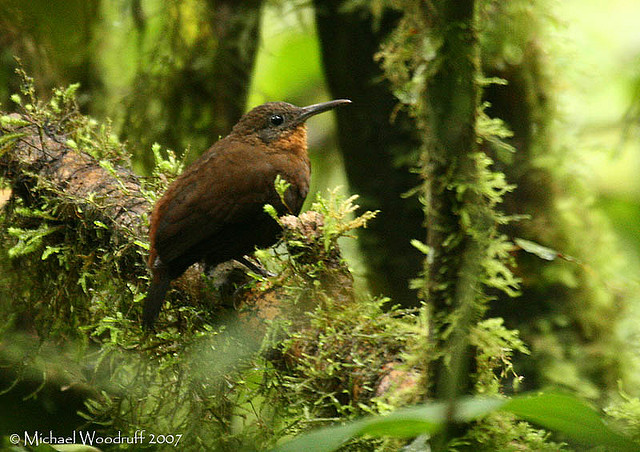
Tawny-throated Leaftosser (Sclerurus mexicanus) by Michael Woodruff

Tawny-throated Leaftosser (Sclerurus mexicanus) by Michael Woodruff

Maybe the DNA Bird Researchers could hire this Leaftosser to help them out. Not sure if the next version coming out soon will toss another family up in the air or not.

Of course, we believe that God created these beautiful, and not so beautiful, birds and not by evolution over millions of years. Yes, they did inter-breed over the years and you have different looks and songs within the families. But they are still birds and the Lord has wonderfully made DNA that helps trace that.

Today, you can trace your own ancestors through DNA. I don’t understand much about it, but what I do know is this:

I will praise You, for I am fearfully and wonderfully made; Marvelous are Your works, And that my soul knows very well. (Psalms 139:14 NKJV)

Here are some interesting articles that do discuss DNA from a Christian Perspective:

(From this article) But nowhere does the Bible say that species cannot change! Instead, it seems that they would have to change—within the limits of their own interbreeding kind—in order to fulfill God’s command in Genesis 1 for His living creatures to fill the earth and its many changing environments.

Darwin insisted that animals slowly change between kinds. In contrast, seedeater birds have shown that they rapidly changed within their kind. Despite Campagna’s touting of Darwin’s “accomplishments,” these birds display programmed variation, not evolution.

Marsh Seedeater (Sporophila palustris) ©WikiC

Marsh Seedeater (Sporophila palustris) ©WikiC

Good News
*

Photos by Michael Woodruff

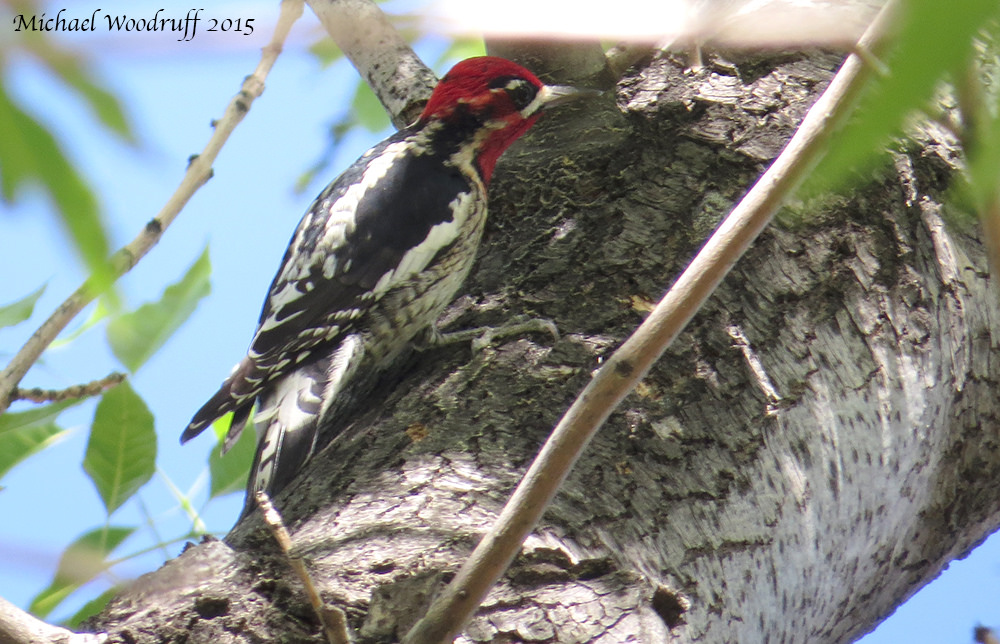
Red-breasted X Red-naped Sapsucker  By Michael Woodruff

Red-breasted X Red-naped Sapsucker By Michael Woodruff

Out of the ground the LORD God formed every beast of the field and every bird of the air, and brought them to Adam to see what he would call them. And whatever Adam called each living creature, that was its name. (Genesis 2:19 NKJV)

Thought I would share some of Michael Woodruff’s latest photos. He has been giving me permission to use his great photos for several years. The Lord created these birds and Michael has a great way of capturing their images for us to enjoy. Thanks, Michael.

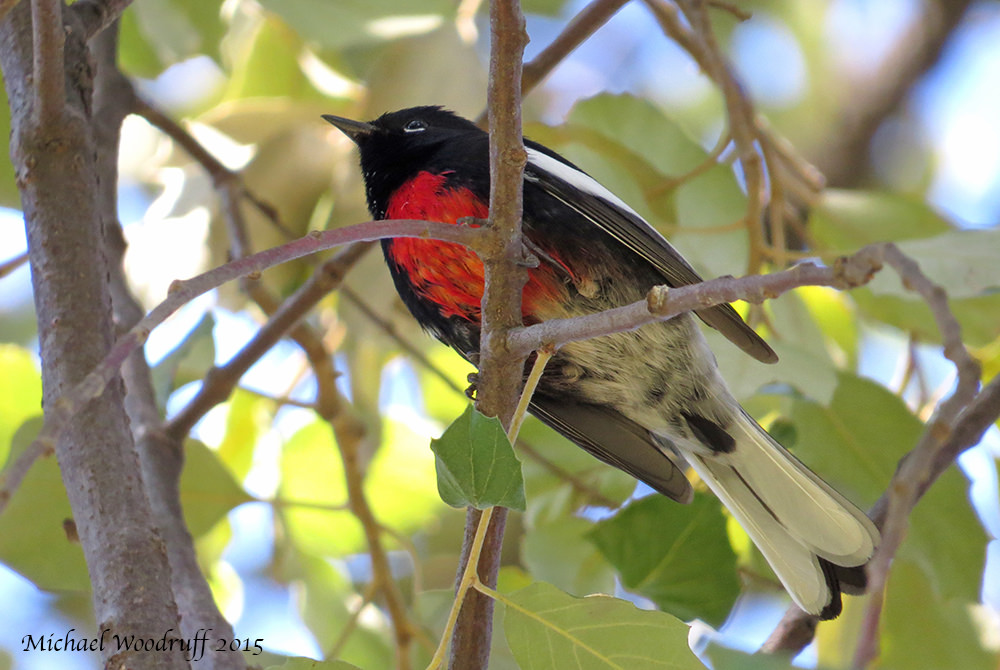
Painted Redstart by Michael Woodruff

Painted Redstart by Michael Woodruff

I know all the birds of the mountains, And the wild beasts of the field are Mine. (Psalms 50:11 NKJV)

And since we haven’t been on any birdwatching trips yet this year, you can enjoy photos from others. His Flickr photos can be see at:

Tropical Kingbird By Michael Woodruff

Tropical Kingbird By Michael Woodruff

Click to see Michael’s Pictures:

Michael Woodruff

Red-masked Parakeet by Michael Woodruff

Red-masked Parakeet by Michael Woodruff

Then God said, “Let the waters abound with an abundance of living creatures, and let birds fly above the earth across the face of the firmament of the heavens.” (Genesis 1:20 NKJV)

*

Here are some articles where Michael’s photos have been used:

*

I’m Little but…..

Squirrel at a park in Daytona

Squirrel at a park in Daytona

Thought you might enjoy this sent to me by a friend. Not sure how it was done, but National Geographic was involved.

A couple of verses come to mind:

But God hath chosen the foolish things of the world to confound the wise; and God hath chosen the weak things of the world to confound the things which are mighty; (1 Corinthians 1:27 KJV)

Call unto me, and I will answer thee, and shew thee great and mighty things, which thou knowest not. (Jeremiah 33:3 KJV)

If he watches out for these two, how much more does God watch out for us?

*

Wordless Birds

*