Formed By Him – Camouflaged Nest

Was sent a link to this fantastic video of how birds camouflage their nests by BBC Wildlife. This shows some of the great instinct and capabilities given to the birds by their Creator.

All the birds of the heavens made their nests in its boughs; Under its branches all the beasts of the field brought forth their young; And in its shadow all great nations made their home. (Ezekiel 31:6 NKJV)

Trust will enjoy this as well.

*

*

Another parable He put forth to them, saying: “The kingdom of heaven is like a mustard seed, which a man took and sowed in his field, which indeed is the least of all the seeds; but when it is grown it is greater than the herbs and becomes a tree, so that the birds of the air come and nest in its branches.” (Matthew 13:31-32 NKJV)

See also:

Wordless Birds

*

P.S. I know this is a short post, but last night I just discovered that the Slide.Com, which I used for many slideshows on various blogs, is closing. That means I have tons of work to do behind the scenes while I fix all of those and use another slideshow program. Watch out for dust!

Updated 2 Hours later: Just finished one with the new style Slideshow. I kind of like the new style. What do you think?

Formed by Him – Silver Birds

*

*

Birdwatching Trip to Viera Wetlands – February 2-3, 2012

Alligator on bank at Viera Wetlands

Alligator on bank at Viera Wetlands

We enjoyed our visit to Viera Wetlandslast week. Good thing we went then, because we are both sick this week. (Not from the trip.) But we are on the mend. “The wetlands are a popular site for birders, photographers, and eco-tourists.  The entire wetland system is accessible by automobile, making the site popular among those who find the rigors of hiking trails and summer temperatures daunting.  Even better, viewing the site from one’s automobile serves to screen visitors from birds and widlife, enhancing the experience.” They have 4 Cells and a Lake which have a berm around them. You drive on the berm and that gets you right up to the birds. (If they cooperate)

This was not our first visit to the wetlands, but it is 100 miles from home, so it is not something we do frequently. Other than a few different birds we have almost the same ones right here at the Circle B Bar Reserve (only 4 miles from home).

Here is a list of the birds turned in to eBird for the two days we visited the wetlands:

Hooded Merganser (Lophodytes cucullatus) with Hood up by Lee

Hooded Merganser (Lophodytes cucullatus) with Hood up

Mottled Duck
Blue-winged Teal
Northern Shoveler
Ring-necked Duck
Hooded Merganser
Pied-billed Grebe
Wood Stork
Double-crested Cormorant
Anhinga Viera Wetlands
Great Blue Heron
Great Egret
Snowy Egret
Little Blue Heron
Tricolored Heron
White Ibis
Glossy Ibis
Black Vulture
Turkey Vulture
Osprey
Northern Harrier
Crested Caracara

Savannah Sparrow (Passerculus sandwichensis) by Lee at Viera Wetlands

Savannah Sparrow (Passerculus sandwichensis) by Lee at Viera Wetlands

Common Gallinule
American Coot
Limpkin
Sandhill Crane
Caspian Tern
Royal Tern
Belted Kingfisher
Fish Crow
Purple Martin
Tree Swallow
House Wren
European Starling
Palm Warbler
Yellow-rumped Warbler
Savannah Sparrow
Red-winged Blackbird
Eastern Meadowlark
Boat-tailed Grackle

39 total birds seen that I can identify. If I include the rest of the birds spotted there in Brevard County including the wild birds at the Zoo and Beach, then the count goes to 52. The additional birds include the Brown Pelican, Black and Turkey Vultures, Red-shouldered Hawk, Eurasian Collared Dove, Mourning Dove, Red-bellied and Downy Woodpeckers, Pine Warbler, Northern Cardinal and Brown-headed Cowbird. Other than the Caracara, Sanderling, and Ruddy Turnstone, I have seen the rest in Polk County, where we live.

Does that mean, I wouldn’t go back, NO WAY! I love going over there to the Wetlands because every time you go, there are different birds waiting for you to discover them. That is what birdwatching is all about. Also, Brevard County has the Merritt Island Wild Life Refuge and other great birding places.

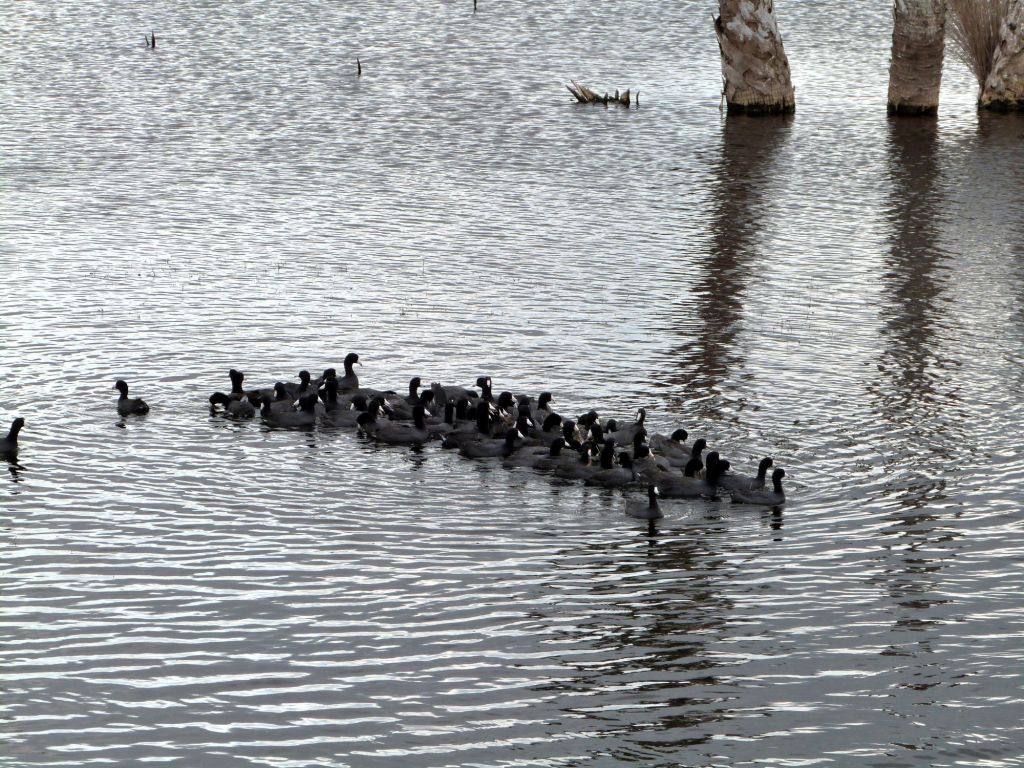
There had to be well over 1,000 American Coots out there. What amazed me was how they would all huddle together in long streams of them. This was just one of the smaller groups. Some were hundred of Coots long.

American Coots at Viera Wetlands

American Coots at Viera Wetlands

I am not sure what this Coot did, but it appears the Northern Shovelers are escorting him out of their area.

Coot Surrounded by Shovelers at Viera Wetlands

Coot Surrounded by Shovelers at Viera Wetlands

Managed to get a close-up of a Boat-tailed Grackle sitting on a sign.

Boat-tailed Grackle (Quiscalus major) at Viera by Lee

Boat-tailed Grackle (Quiscalus major) at Viera by Lee

It seemed a little dryer than on previous visits. Looks like they could use some rain. It does make an effect on what birds are present by the water levels. Was a great visit.

I know all the birds of the mountains, And the wild beasts of the field are Mine. (Psalms 50:11 NKJV)

*

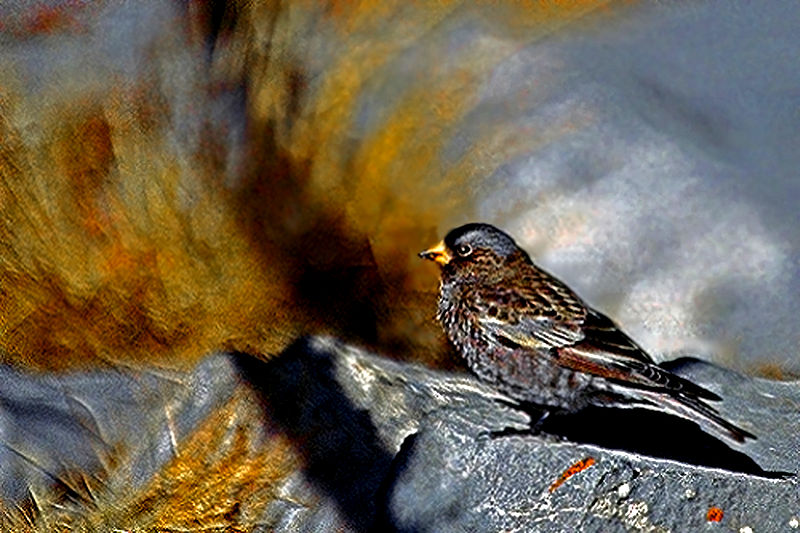
Black Rosy Finch – The Grace Seeker..

Black Rosy Finch – The Grace Seeker ~ by ajmithra

Black Rosy Finch (Leucosticte atrata) ©©Michaelandhelencox

Black Rosy Finch (Leucosticte atrata) ©©Michaelandhelencox

The Black Rosy-Finch breeds in the high mountains of the northern Great Basin. This encompasses the area from northeastern Nevada to southwestern Montana. It is not a long-distance migrant, but moves to lower elevations away from the breeding area as snow cover increases. In some winters these flights reach southward to Colorado, New Mexico, and rarely Arizona and California. Although population appears to be stable, it is uncommon over its very small breeding range.

The Black Rosy-finch breeds on the barren tundra of mountain summits, usually on rocky or grassy areas and near glaciers and continual snowfields. It winters at lower elevations in open areas such as fields, cultivated lands, roadsides, and human-made structures. Departure to higher elevations from the wintering grounds is by April. Nest building occurs between mid-June and mid-July, in a crevice or hole in near-inaccessible locations such as on vertical cliffs. The nest is made of grasses, moss, and sometimes feathers mixed with grass and animal hair, and contain four to five eggs on average. The diet consists of seeds of grasses and weeds except in summer when supplemented by insects.

Black Rosy Finch (Leucosticte atrata) ©WikiC

Black Rosy Finch (Leucosticte atrata) ©WikiC

These birds seem to know the secret of living in secret. They know that living on mountain summits, would be inaccessible for its predators. When the name of THE ROCK becomes our strong tower, it not only becomes inaccessible but also impossible for satan to even locate us.

The name of the LORD is a strong tower: the righteous runneth into it, and is safe. (Psalm 18:10)

There is not only protection on the rock, there is honey in its crevice too.

But he would feed you with the finest of the wheat, and with honey from the rock I would satisfy you. (Psalm 81:16)

The Black Rosy Finch builds a cup nest in a cavity on a cliff. Most birds migrate short distances to lower elevations and further south and return to the alpine areas in April. These birds forage on the ground, may fly to catch insects in flight. They mainly eat seeds from weeds and grasses and insects, often in areas where snow is melting, uncovering food items and new plant shoots.

God fed the Israelites with the dew wrapped Manna, bread of the angels.. God’s goodness is fresh each new morning and His goodness is like morning dew, underneath His dew lies our due. But do we seek for His dew every morning? Remember, as the sun goes up, the manna melts. His goodness too would melt if we don’t seek Him early in the morning isn’t it? When His dew melts our lives dry up..

O Ephraim, what shall I do unto thee? O Judah, what shall I do unto thee? for your goodness is as a morning cloud, and as the early dew it goeth away. (Hosea 6:4)

Black Rosy Finch (Leucosticte atrata) ©©Michaelandhelencox

Black Rosy Finch (Leucosticte atrata) ©©Michaelandhelencox

They often feed in small flocks, as the male will defend its female’s territory during breeding season, not just the nest but where ever she goes. This behavior is common with the rosy finches. When breeding both males and females develop throat pouches, known as gular pouches or gular skin, to carry food to their chicks.

God’s flock too is small, for He has promised to be present where two or three are gathered. These male birds remind us of how our Lord too defends our territories, though we haven’t yet taken steps to breed for the extension of His kingdom. We have an awesome God, who not only defends our territories but also followed us where ever we went and ended up giving His precious life for you and me.. What a mighty God we serve!!

Have I not commanded you? Be strong and courageous. Do not be afraid; do not be discouraged, for the LORD your God will be with you wherever you go. (Joshua 1:9)

Your’s in YESHUA,
a j mithra

Please visit us at:
Crosstree

ajmithra21

See more of aj’s articles – Click Here

Nice photo of a Black Rosy Finch

*

Birdwatching Adventure to Brevard Zoo in Viera, FL

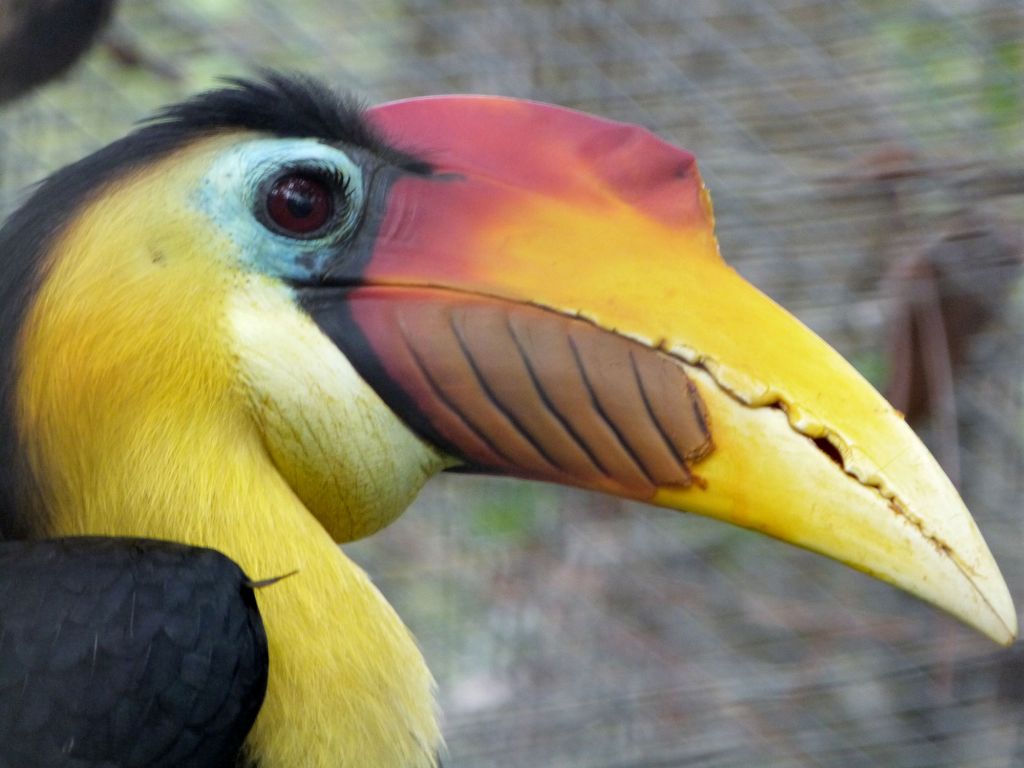
Wrinkled Hornbill (Aceros corrugatus) Brevard Zoo by Lee

Wrinkled Hornbill (Aceros corrugatus) Brevard Zoo by Lee

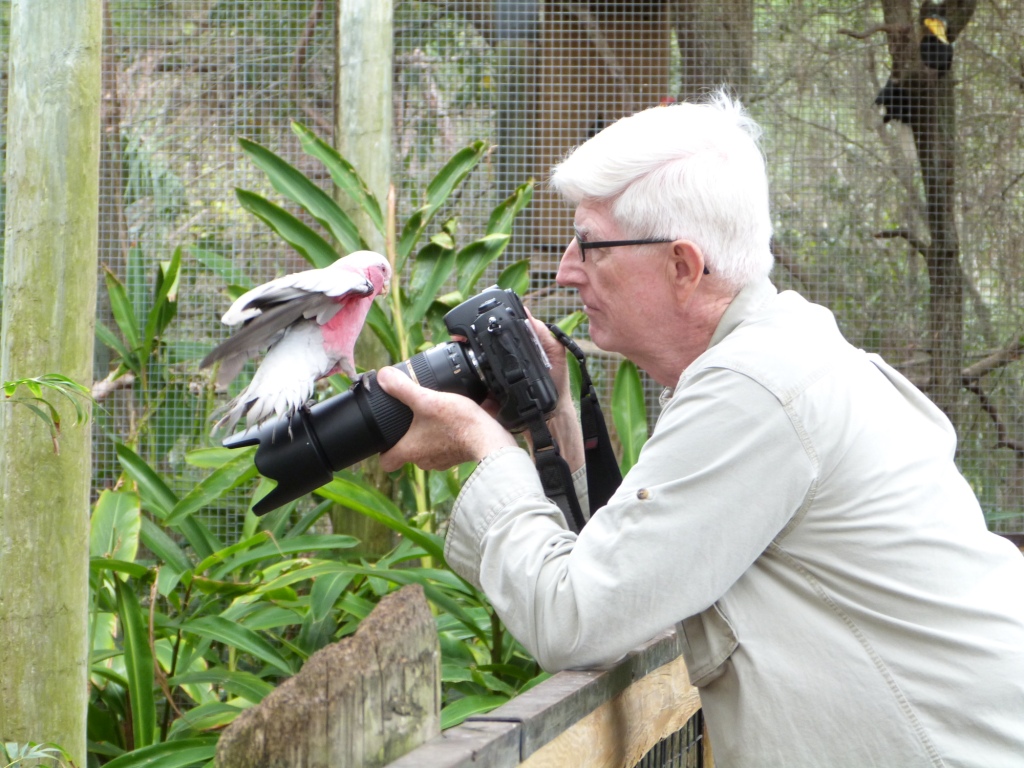
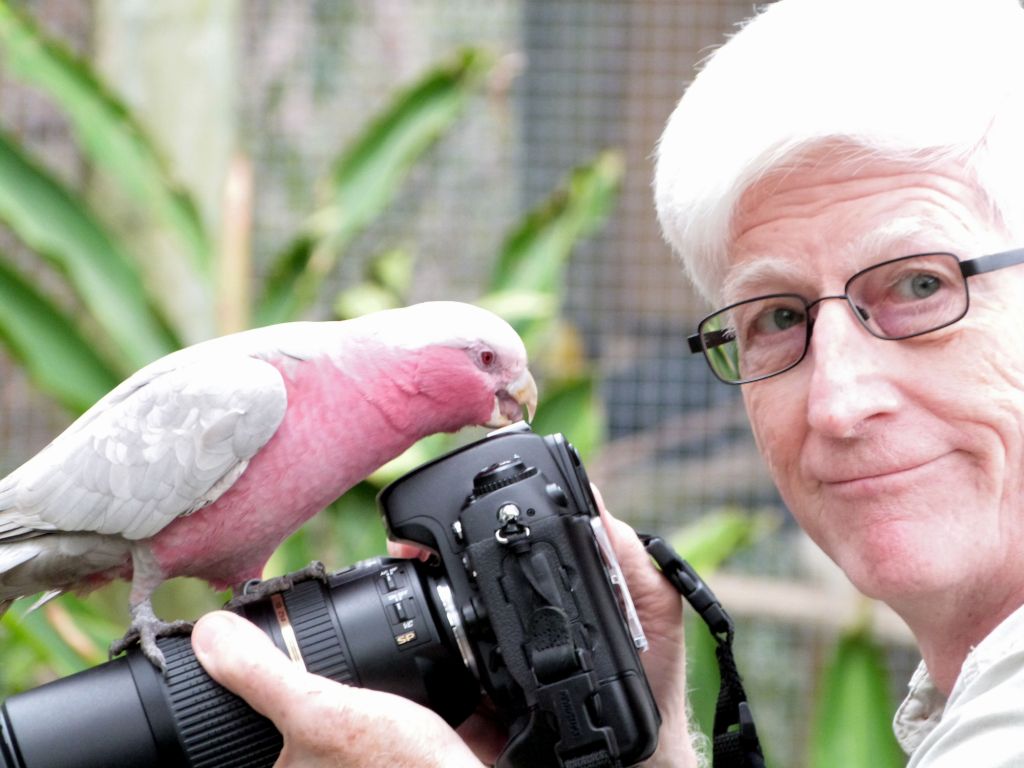
We had a delightful and interesting visit to the Brevard Zoo in Viera (Melbourne), Florida on Friday the 3rd. We were over there also visiting Viera Wetland (2nd & 3rd) (article to come) and also went to the Atlantic shore for a few minutes that evening (the 2nd). Some of the highlights were that Galah landing on Dan’s camera. See Just Back From A Birdwatching Adventure – Viera. Luckily I had my own camera and was able to “capture the moment.” What was so interesting about that Galah is that he (or she) had become intrigued by Dan’s camera. A child tried to offer it some of the liquid they sell to feed the birds, but no, the camera was more interesting. (This picture is not good, but it show the action)

 Galah (Eolophus roseicapilla) trying to off juice.

Galah (Eolophus roseicapilla) trying to off juice.

Then the Galah hopped up on his camera.

Galah (Eolophus roseicapilla) Hopping on the camera

Galah (Eolophus roseicapilla) Hopping on the camera

What a gorgeous color and nice bird.
Galah (Eolophus roseicapilla) Cockatoo - Brevard Zoo

Galah (Eolophus roseicapilla) Cockatoo – Brevard Zoo

In that same area I got a great picture of a Laughing Kookaburra. Couldn’t get it to laugh, but I tried. Sure the others around thought I was nuts, but who cared.
Laughing Kookaburra (Dacelo novaeguineae) Brevard Zoo by Lee

Laughing Kookaburra (Dacelo novaeguineae) Brevard Zoo by Lee

The photo at the top was a challenge to photograph. My camera is a point and shoot on program mode. Do you know how many fantastic photos I have taken of fences, wires, cages, limbs, grass, etc. instead of the bird or whatever?
White-crested Turaco (Tauraco leucolophus) with fencing.

White-crested Turaco (Tauraco leucolophus) with fencing.

With some patience and lots of tries, I can get a little better shot.
White-crested Turaco (Tauraco leucolophus) Through the fence somewhat.

White-crested Turaco (Tauraco leucolophus) Through the fence somewhat.

Here is the list of wild birds I turned in to eBird:
Walking around the Zoo – these are the wild birds freeloading at the zoo – 16 species
Mallard (Domestic type) 10
Great Blue Heron 2
White Ibis 18
Black Vulture 6
Turkey Vulture 1
American Coot 2
Eurasian Collared-Dove 1
Mourning Dove 2
Red-bellied Woodpecker 3
Downy Woodpecker 2
Fish Crow 7
House Wren 2
Pine Warbler 1
Yellow-rumped Warbler 2
Yellow-rumped Warbler (Myrtle) 1
Northern Cardinal 2
Boat-tailed Grackle 50
Besides all of those of course we saw the residents of the Zoo. All total, counting the wild birds we saw 48 of God’s wonderfully created birds. Some of them were absolutely fantastic. Even the ugly ones were wonderfully created for their purposes and place in the overall plan the Lord has for them.

For the invisible things of him from the creation of the world are clearly seen, being understood by the things that are made, even his eternal power and Godhead; so that they (we) are without excuse: (Romans 1:20 KJV)

 **Due to my site being hacked, some of the photo links were removed**
Birds observed at Brevard Zoo:
Total observations: 48
English name Scientific name
1 Southern Cassowary Casuarius casuarius
2 Emu Dromaius novaehollandiae
3 Wild Turkey Meleagris gallopavo
4 Black-bellied Whistling Duck Dendrocygna autumnalis
5 West Indian Whistling Duck Dendrocygna arborea
6 Coscoroba Swan Coscoroba coscoroba
7 Black Swan Cygnus atratus
8 Raja Shelduck Tadorna radjah
9 White-cheeked Pintail Anas bahamensis
10 American Flamingo Phoenicopterus ruber
11 Chilean Flamingo Phoenicopterus chilensis
12 Marabou Stork Leptoptilos crumeniferus
13 American White Ibis Eudocimus albus
14 Scarlet Ibis Eudocimus ruber
15 Roseate Spoonbill Platalea ajaja
16 Great Blue Heron Ardea herodias
17 Black Vulture Coragyps atratus
18 King Vulture Sarcoramphus papa
19 Bald Eagle Haliaeetus leucocephalus
20 Red-shouldered Hawk Buteo lineatus
21 Red-tailed Hawk Buteo jamaicensis
22 Northern Crested Caracara Caracara cheriway
23 American Coot Fulica americana
24 Black Crowned Crane Balearica pavonina pavonina
25 Sandhill Crane Grus canadensis
26 Blue Crane (Stanley) Grus paradisea
27 Masked Lapwing Vanellus miles
28 Eurasian Collared Dove Streptopelia decaocto
29 Mourning Dove Zenaida macroura
30 Galah Eolophus roseicapilla
31 Cockatiel Nymphicus hollandicus
32 Rainbow Lorikeet Trichoglossus moluccanus
33 Hyacinth Macaw Anodorhynchus hyacinthinus
34 Blue-and-yellow Macaw Ara ararauna
35 Scarlet Macaw Ara macao
36 Golden Parakeet Guaruba guarouba
37 White-crested Turaco Tauraco leucolophus
38 Laughing Kookaburra Dacelo novaeguineae
39 Wrinkled Hornbill Aceros corrugatus
40 Southern Ground Hornbill Bucorvus leadbeateri
41 Red-bellied Woodpecker Melanerpes carolinus
42 Downy Woodpecker Picoides pubescens
43 Fish Crow Corvus ossifragus
44 House Wren Troglodytes aedon
45 Yellow-rumped Warbler Dendroica coronata
46 Myrtle Warbler Dendroica coronata
47 Boat-tailed Grackle Quiscalus major
48 Northern Cardinal Cardinalis cardinalis

There were other animals at the zoo, but our main focus was on the birds. It is a very nice landscaped zoo and the over-all appearance was great. The critters all seemed to be well taken care of. It is definitely worth a visit to the Brevard Zoo if you are in that area. It is actually listed as being at 8225 North Wickham Road, Melbourne, FL 32940. Update: 2/11/12  –  Dan just posted his photos on his photography website. His photos at –  Dan’s Pix –  are much better than mine, of course, he has a better camera. Will be doing an article on our visit to the Viera Wetlands soon. *

Just Back From A Birdwatching Adventure – Viera

Galah (Eolophus roseicapilla) Cockatoo - Brevard Zoo

Galah (Eolophus roseicapilla) Cockatoo - Brevard Zoo

Deck thyself now with majesty and excellency; and array thyself with glory and beauty. (Job 40:10 KJV)

Dan and I took off yesterday and drove to Viera, Florida, which is about 30 miles south of Titusville. We birded Viera Wetlands, which is a prime birding spot in Florida, yesterday and then for awhile this morning. After that we went to the Brevard Zoo for about 3 hours and then drove back home this afternoon. It is 101 miles over there and only takes about 1 1/2 hours to drive it. It is interstate or toll road all the way.

That trip is the reason there has not been a blog posted in the last few days. I now have over 140 email messages to go through and 800 photos to sort.

Galah (Eolophus roseicapilla) and Dan

Galah (Eolophus roseicapilla) and Dan

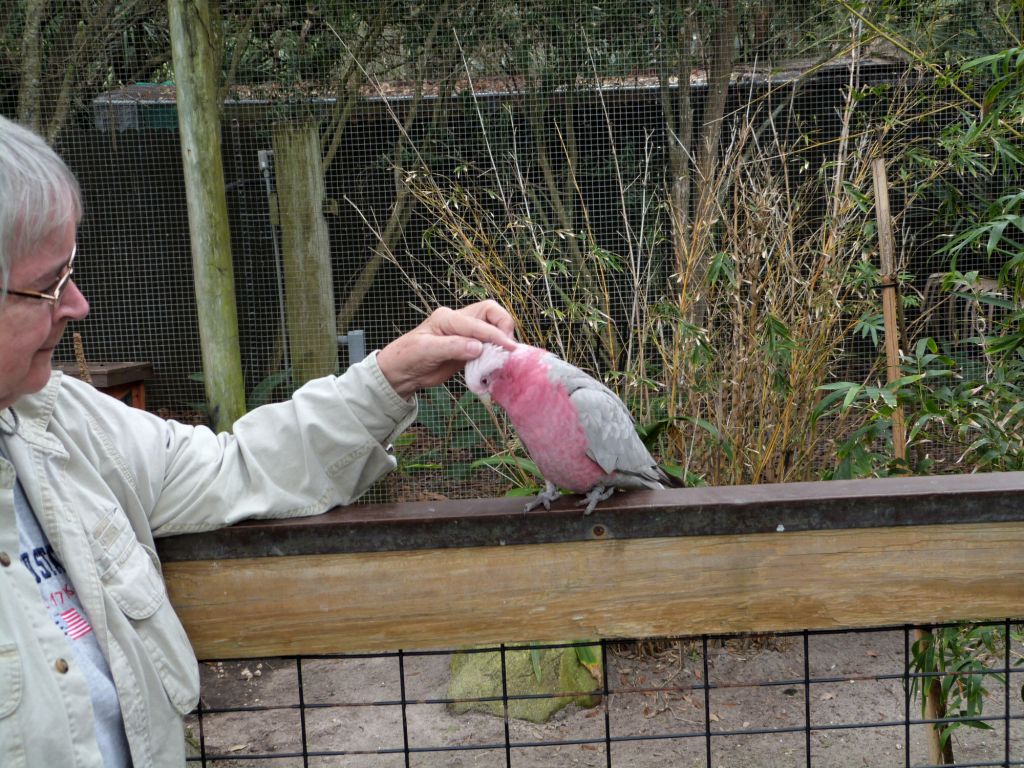
Just as something to share, today at the Zoo, a Galah, in the Cockatoo family, hopped up on Dan’s camera and I was able to take a couple of neat photos I want to share. Ian has photos of the Galah and I was anxious to see one. I never dreamed that we would get this close to one. I even rubbed it’s head for awhile. Wow! What beauty and colors the Lord has given His Creation.

Galah (Eolophus roseicapilla) and Dan

Galah (Eolophus roseicapilla) and Dan

The Galah is in the Cacatuidae – Cockatoos Family.

“The Galah ( /ɡəˈlɑː/), Eolophus roseicapilla, also known as the Rose-breasted Cockatoo, Galah Cockatoo, Roseate Cockatoo or Pink and Grey, is one of the most common and widespread cockatoos, and it can be found in open country in almost all parts of mainland Australia.

Galah and Lee - Brevard Zoo

Galah and Lee - Brevard Zoo

It is endemic on the mainland and was introduced to Tasmania, where its distinctive pink and grey plumage and its bold and loud behaviour make it a familiar sight in the bush and increasingly in urban areas. It appears to have benefited from the change in the landscape since European colonisation and may be replacing the Major Mitchell’s Cockatoo in parts of its range.
The term galah is derived from gilaa, a word found in Yuwaalaraay and neighbouring Aboriginal languages.” (Wikipedia)

More of the trip in future posts.

*

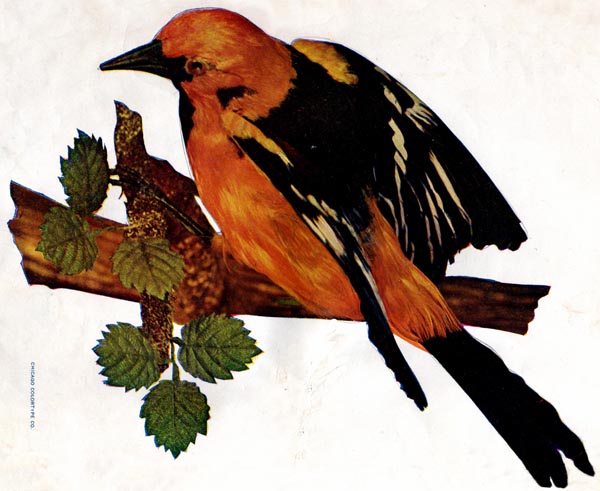
Birds Vol 1 #1 – The Golden Oriole (or Hooded Oriole)

Golden Oriole

Golden Oriole

Birds Illustrated by Color Photography – Revisited

Vol 1. January, 1897 No. 1

*

THE GOLDEN ORIOLE

imgw

E find the Golden Oriole in America only. According to Mr. Nuttall, it is migratory, appearing in considerable numbers in West Florida about the middle of March. It is a good songster, and in a state of captivity imitates various tunes.

This beautiful bird feeds on fruits and insects, and its nest is constructed of blades of grass, wool, hair, fine strings, and various vegetable fibers, which are so curiously interwoven as to confine and sustain each other. The nest is usually suspended from a forked and slender branch, in shape like a deep basin and generally lined with fine feathers.

“On arriving at their breeding locality they appear full of life and activity, darting incessantly through the lofty branches of the tallest trees, appearing and vanishing restlessly, flashing at intervals into sight from amidst the tender waving foliage, and seem like living gems intended to decorate the verdant garments of the fresh clad forest.”

It is said these birds are so attached to their young that the female has been taken and conveyed on her eggs, upon which with resolute and fatal instinct she remained faithfully sitting until she expired.

An Indiana gentleman relates the following story:

“When I was a boy living in the hilly country of Southern Indiana, I remember very vividly the nesting of a pair of fine Orioles. There stood in the barn yard a large and tall sugar tree with limbs within six or eight feet of the ground.

“At about thirty feet above the ground I discovered evidences of an Oriole’s nest. A few days later I noticed they had done considerably more work, and that they were using horse hair, wool and fine strings. This second visit seemed to create consternation in the minds of the birds, who made a great deal of noise, apparently trying to frighten me away. I went to the barn and got a bunch of horse hair and some wool, and hung it on limbs near the nest. Then climbing up higher, I concealed myself where I could watch the work. In less than five minutes they were using the materials and chatted with evident pleasure over the abundant supply at hand.

“They appeared to have some knowledge of spinning, as they would take a horse hair and seemingly wrap it with wool before placing it in position on the nest.

“I visited these birds almost daily, and shortly after the nest was completed I noticed five little speckled eggs in it. The female was so attached to the nest that I often rubbed her on the back and even lifted her to look at the eggs.”


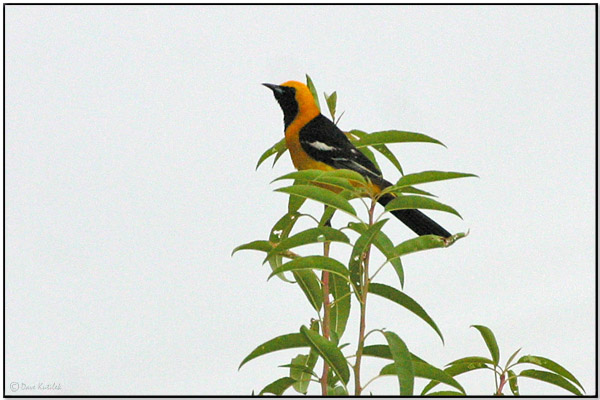
Hooded Oriole (Icterus cucullatus) by Daves BirdingPix

Hooded Oriole (Icterus cucullatus) by Daves BirdingPix


Lee’s Addition:

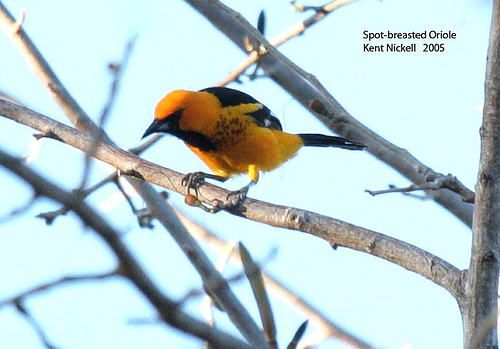
According to the article, the bird came here to Florida. Checking Thayer’s Birding Software and limiting it to Florida and Orioles, I think it must have been the Spot-breasted or the Hooded (but they don’t come to Florida, so it must be the Spot-breasted) Oriole as we call it today. The only “Golden Oriole” is the “Golden Oriole or European (or EurasianGolden Oriole (Oriolus oriolus) is the only member of the oriole family of passerine birds breeding in northern hemisphere temperate regions. It is a summer migrant in Europe and western Asia and spends the winter season in the tropics.” “The African Golden Oriole (Oriolus auratus) is a member of the oriole family of passerine birds which is a resident breeder in Africa south of the Sahara and the “Indian Golden Oriole (Oriolus kundoo)” of India. All three of those birds leave Florida and Indiana out of the picture.

The Orioles are actually found in two different families; the Icteridae – Oropendolas, Orioles, & Blackbirds Family (New World) and the Oriolidae – Figbirds, Orioles Family (Old World).

Spot-breasted Oriole (Icterus pectoralis) by Kent Nickell

Spot-breasted Oriole (Icterus pectoralis) by Kent Nickell

New World orioles, comprising the genus Icterus, are a group of birds in the blackbird family. They are not related to Old World orioles which are in the family Oriolidae, but are strikingly similar in size, diet, behaviour and in their strongly contrasting plumage, and are a good example the Lord’s Creative Hand. Because of similarities and being from the same kind, the two took the same vernacular name.

The males are typically black and yellow or orange, with white markings; the plumage of females and immature birds is duller. These birds go through one moult in a year. They are generally slender with long tails and a pointed bill. They mainly eat insects, often also nectar and fruit. The nest is a woven, elongated pouch. Several species are easy to attract to birdtables by the provision of cut oranges and grape jelly. Species nesting in areas with cold winters (including most of the United States) are strongly migratory, while subtropical and tropical species are more sedentary.

The name “oriole” was first recorded (in the Latin form oriolus) by Albertus Magnus in about 1250, and was stated by him to be onomatopoeic, from the song of the European Golden Oriole.

The genus name Icterus as used by classical authors, referred to a bird with yellow or green plumage. In modern times this has been identified as the golden oriole. Brisson re-applied the name to the New World birds because of their similarity in appearance.

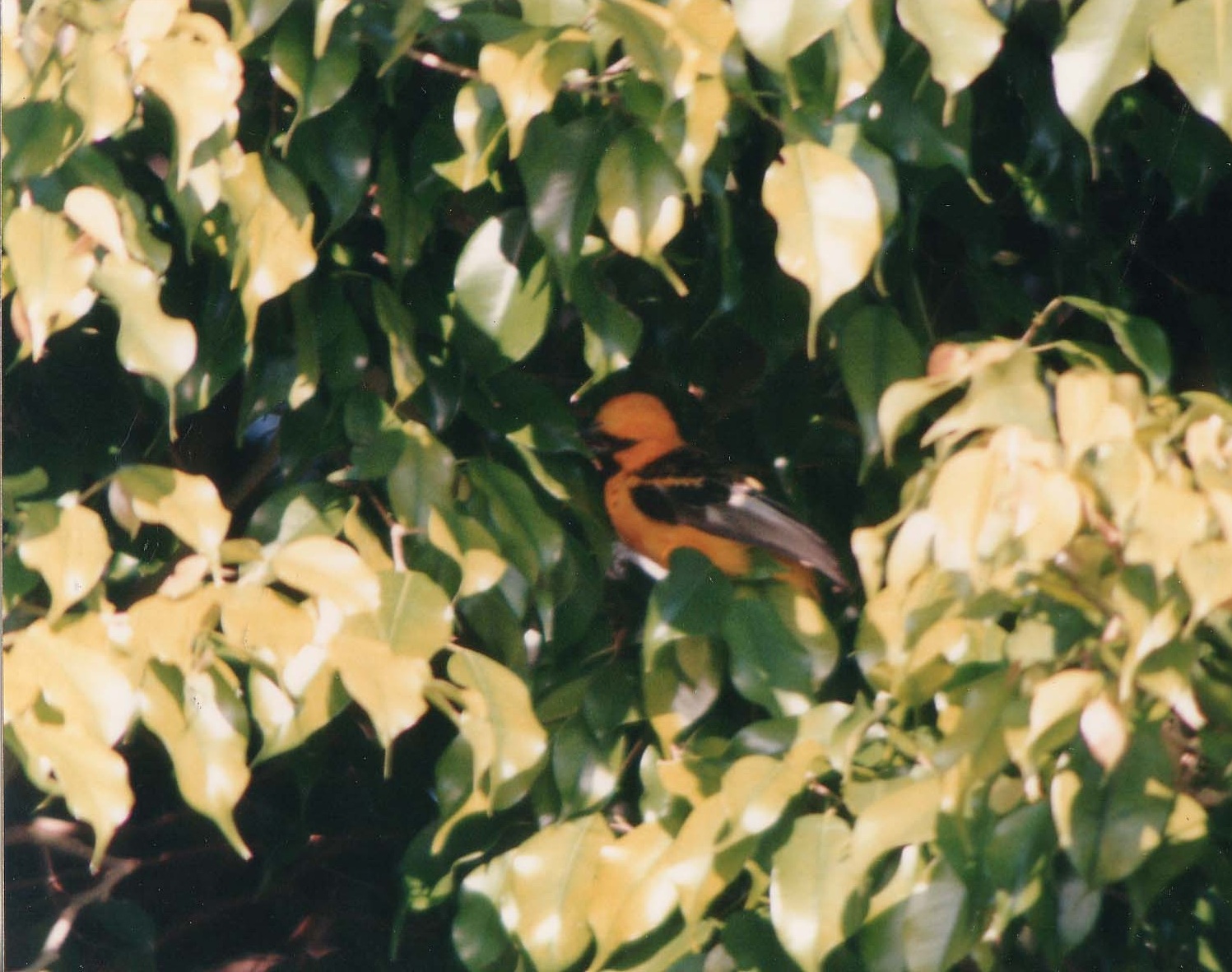
Spot-breasted Oriole (Icterus pectoralis) by Lee -Tamarac from photo

Spot-breasted Oriole (Icterus pectoralis) by Lee -in Tamarac, FL from photo in 1990’s

*

Birds Illustrated by Color Photograhy Vol 1 January 1897 No 1 - Cover

Birds Illustrated by Color Photography – Revisited – Introduction

The above article is the tenth article in the monthly serial that was started in January 1897 “designed to promote Knowledge of Bird-Live.” These include Color Photography, as they call them, today they are drawings. There are at least three Volumes that have been digitized by Project Gutenberg.

To see the whole series of – Birds Illustrated by Color Photography – Revisited

*

(Information from Wikipedia and other internet sources)

Next Article – Vol 1 #2 February 1897

Previous Article – The Red-Rumped Tanager

ABC’s of the Gospel

Links:

New World Oriole – Wikipedia

Spot-breasted Oriole – Wikipedia

*

Birds Vol 1 #1 – The Red-Rumped Tanager (Scarlet-Rumped or ?)

Red-Rumped Tanager

Red-Rumped Tanager

Birds Illustrated by Color Photography – Revisited

Vol 1. January, 1897 No. 1

*

THE RED-RUMPED TANAGER.

I have just been singing my morning song, and I wish you could have heard it. I think you would have liked it.

I always sing very early in the morning. I sing because I am happy, and the people like to hear me.

My home is near a small stream, where there are low woods and underbrush along its banks.

There is an old dead tree there, and just before the sun is up I fly to this tree.

I sit on one of the branches and sing for about half an hour. Then I fly away to get my breakfast.

I am very fond of fruit. Bananas grow where I live, and I like them best of all.

I eat insects, and sometimes I fly to the rice fields and swing on the stalks and eat rice.

The people say I do much harm to the rice, but I do not see why it is wrong for me to eat it, for I think there is enough for all.

I must go now and get my breakfast. If you ever come to see me I will sing to you.

I will show you my wife, too. She looks just like me. Be sure to get up very early. If you do not, you will be too late for my song.


“Birds, Birds! ye are beautiful things,
With your earth-treading feet and your cloud-cleaving wings.
Where shall man wander, and where shall he dwell—
Beautiful birds—that ye come not as well?
Ye have nests on the mountain, all rugged and stark,
Ye have nests in the forest, all tangled and dark;
Ye build and ye brood ‘neath the cottagers’ eaves,
And ye sleep on the sod, ’mid the bonnie green leaves;
Ye hide in the heather, ye lurk in the brake,
Ye dine in the sweet flags that shadow the lake;
Ye skim where the stream parts the orchard decked land,
Ye dance where the foam sweeps the desolate strand.”


Silver-beaked Tanager Through wire cage at Lowry Park Zoo by Lee

Silver-beaked Tanager Through wire cage at Lowry Park Zoo by Lee


THE RED-RUMPED TANAGER.

imga1

N American family, the Tanagers are mostly birds of very brilliant plumage. There are 300 species, a few being tropical birds. They are found in British and French Guiana, living in the latter country in open spots of dwellings and feeding on bananas and other fruits. They are also said to do much harm in the rice fields.

In “The Auk,” of July, 1893, Mr. George K. Cherrie, of the Field Museum, says of the Red-Rumped Tanager:

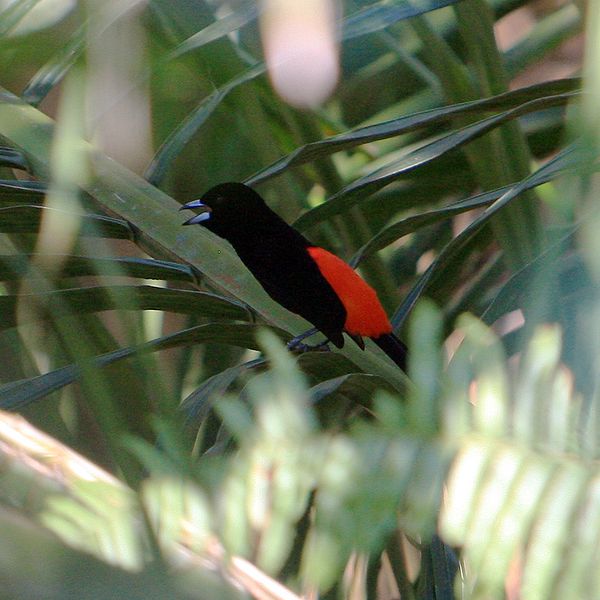
“During my stay at Boruca and Palmar, (the last of February) the breeding season was at its height, and I observed many of the Costa Rica Red-Rumps nesting. In almost every instance where possible I collected both parents of the nests, and in the majority of cases found the males wearing the same dress as the females. In a few instances the male was in mottled plumage, evidently just assuming the adult phase, and in a lesser number of examples the male was in fully adult plumage—velvety black and crimson red. From the above it is clear that the males begin to breed before they attain fully adult plumage, and that they retain the dress of the female until, at least, the beginning of the second year.

“While on this trip I had many proofs that, in spite of its rich plumage, and being a bird of the tropics, it is well worthy to hold a place of honor among the song birds. And if the bird chooses an early hour and a secluded spot for expressing its happiness, the melody is none the less delightful. At the little village of Buenos Aires, on the Rio Grande of Terraba, I heard the song more frequently than at any other point. Close by the ranch house at which we were staying, there is a small stream bordered by low woods and underbrush, that formed a favorite resort for the birds. Just below the ranch is a convenient spot where we took our morning bath. I was always there just as the day was breaking. On the opposite bank was a small open space in the brush occupied by the limbs of a dead tree. On one of these branches, and always the same one, was the spot chosen by a Red-rump to pour forth his morning song. Some mornings I found him busy with his music when I arrived, and again he would be a few minutes behind me. Sometimes he would come from one direction, sometimes from another, but he always alighted at the same spot and then lost no time in commencing his song. While singing, the body was swayed to and fro, much after the manner of a canary while singing. The song would last for perhaps half an hour, and then away the singer would go. I have not enough musical ability to describe the song, but will say that often I remained standing quietly for a long time, only that I might listen to the music.”


Lee’s Addition:

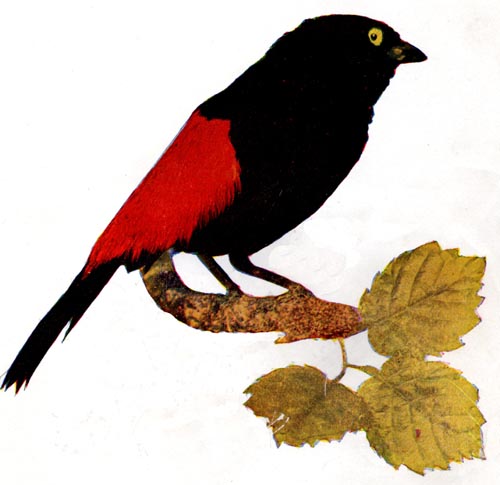
The Red-Rumped Tanager has of course been renamed and renamed again. Tracking this bird was not too difficult because of its “red-rump.” It appears the bird became known as the Scarlet-rumped Tanager and now recently has been split into two species. According to Wikipedia – “The Cherrie’s TanagerRamphocelus costaricensis, is a medium-sized passerine bird. This tanager is a resident breeder in the Pacific lowlands of Costa Rica and western Panama. This bird was formerly known as the Scarlet-rumped Tanager, but was split as a separate species from the Caribbean form, which was itself renamed as Passerini’s Tanager,Ramphocelus passerinii. While most authorities have accepted this split, there are notable exceptions (e.g. the Howard and Moore checklist).

So now you see why I have so much “fun” every three months updating my Birds of the World pages when the IOC (International Ornithologists’ Union) updates their Birds of the World List. That is the standard used for this site.

Take you choice. Is it the Passerini’s Tanager (Ramphocelus passerinii)?

Passerini's Tanager (Ramphocelus passerinii) Male ©BirdPhotos.com

Passerini’s Tanager (Ramphocelus passerinii) Male ©BirdPhotos.com

Passerini’s Tanager (Ramphocelus passerinii) Xeno-canto org

Or is it the Cherrie’s Tanager (Ramphocelus costaricensis)?

Cherrie's Tanager (Ramphocelus costaricensis) WikiC

Cherrie’s Tanager (Ramphocelus costaricensis) WikiC

Cherrie’s Tanager (Ramphocelus costaricensis) xeno-canto.org

Or is it the Flame-rumped Tanager (Ramphocelus flammigerus)?

Flame-rumped Tanager (Ramphocelus flammigerus) ©WikiC

Flame-rumped Tanager (Ramphocelus flammigerus) ©WikiC

Flame-rumped Tanager (Ramphocelus flammigerus) by xeno-canto.org

Which ever one you choose, they are all in the same Genus called Ramphocelus. They are silver-beaked tanagers and are found in Central and South America. They all like fruit and insects and are closely related.

Crimson-collared Tanager (Ramphocelus sanguinolentus )
Masked Crimson Tanager (Ramphocelus nigrogularis )
Crimson-backed Tanager (Ramphocelus dimidiatus )
Huallaga Tanager (Ramphocelus melanogaster )
Silver-beaked Tanager (Ramphocelus carbo )
Brazilian Tanager (Ramphocelus bresilia )
Passerini’s Tanager (Ramphocelus passerinii )
Cherrie’s Tanager (Ramphocelus costaricensis )
Flame-rumped Tanager (Ramphocelus flammigerus )
Lemon-rumped Tanager (Ramphocelus icteronotus )

And they stripped him, and put on him a scarlet robe. And when they had platted a crown of thorns, they put it upon his head, and a reed in his right hand: and they bowed the knee before him, and mocked him, saying, Hail, King of the Jews! (Matthew 27:28-29 KJV)

Birds Illustrated by Color Photograhy Vol 1 January 1897 No 1 - Cover

Birds Illustrated by Color Photography – Revisited – Introduction

The above article is the eighth article in the monthly serial that was started in January 1897 “designed to promote Knowledge of Bird-Live.” These include Color Photography, as they call them, today they are drawings. There are at least three Volumes that have been digitized by Project Gutenberg.

To see the whole series of – Birds Illustrated by Color Photography – Revisited

*

(Information from Wikipedia and other internet sources)

Next Article – The Golden Oriole

Previous Article – The Yellow Throated Toucan

ABC’s of the Gospel

Links:

Birds of the World

Tanagers and Allies – Thraupidae Family

Ramphocelus – Wikipedia

*


Birds Vol 1 #1 – The Yellow Throated or (Black-mandibled) Toucan

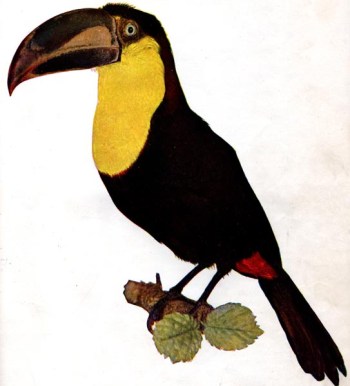
Black-mandibled Toucan (Ramphastos ambiguus) for the Birds Illustrated article

Yellow Throated Toucan for the Birds Illustrated article

Birds Illustrated by Color Photography – Revisited

Vol 1. January, 1897 No. 1

*

THE YELLOW THROATED TOUCAN

(Ramphastos ambiguus) or Black-mandibled) Toucan

.

I am a Toucan and I live in a very warm country.

See my handsome black coat and my yellow vest.

My toes are like a parrot’s, two in front and two behind.

They help me to hold to the limbs.

Look at my large beak. It looks heavy but it is not, as it is filled with air cells. These make it very light. Do you like my blue eyes?

My nest is very hard to find. If I tell you where it is, you will not take the eggs, will you? It is in a hollow limb of a very high tree.

I am very fond of fruit, and for this reason the people on the plantations do not like me very well.

I can fly very fast, but I cannot get along so well on the ground. I keep my feet far apart and hop.

I like to sit in the top of the tallest trees. Then I am not afraid. Nothing can reach me there but a rifle ball.

I do not like the owl, he is so ugly. When we find an owl we get in a circle around him and snap our great beaks, and jerk our tails up and down and scream. He is very much afraid of us.

The people where I live like our yellow breasts. They wear them on their heads, and also put them on the ends of their bows.

We sometimes sit together in a tree and snap our beaks and shout. This is why we have been called “Preacher Birds.”

We can scream so loud that we may be heard a mile away. Our song is “Tucano! Tucano!”

I think it is a pretty song, but the people do not like it very much.
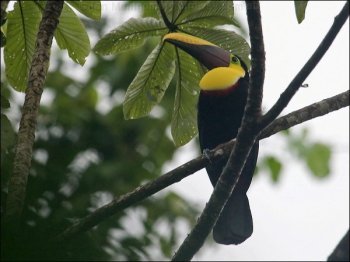
Chestnut-mandibled Toucan (Ramphastos swainsonii) by Ian

Chestnut-mandibled Toucan (Ramphastos swainsonii) by Ian


THE YELLOW THROATED TOUCAN.

imgt

HE Toucans are a numerous race of South American birds, at once recognizable by the prodigious size of their beaks and by the richness of their plumage. “These birds are very common,” says Prince Von Wied, “in all parts of the extensive forests of the Brazils and are killed for the table in large numbers during the cool seasons. Their eggs are deposited in the hollow limbs and holes of the colossal trees, so common in the tropical forests, but their nests are very difficult to find. The egg is said to be white. They are very fond of fruit, oranges, guavas and plantains, and when these fruits are ripe make sad havoc among the neighboring plantations. In return for these depredations the planter eats their flesh, which is very delicate.”

The flight of these birds is easy and graceful, sweeping with facility over the loftiest trees of their native forests, their strangely developed bills being no encumbrance to them, replete as they are with a tissue of air-filled cells rendering them very light and even buoyant.

On the ground they get along with a rather awkward hopping movement, their legs being kept widely apart. In ascending a tree they do not climb but mount from one branch to another with a series of jumps, ascending to the tops of the very loftiest trees, safe from every missile except a rifle ball. They have a habit of sitting on the branches in flocks, lifting their bills, clattering them together, and shouting hoarsely all the while, from which custom the natives call them Preacher-birds. Sometimes the whole party, including the sentinel, set up a simultaneous yell so deafeningly loud that it can be heard a mile. They are very loquacious birds and are often discovered through their perpetual chattering. Their cry resembles the word “Tucano,” which has given origin to the peculiar name.

When settling itself to sleep, the Toucan packs itself up in a very systematic manner, supporting its huge beak by resting it on its back, and tucking it completely among the feathers, while it doubles its tail across its back just as if it moved on hinges. So completely is the large bill hidden among the feathers, that hardly a trace of it is visible in spite of its great size and bright color, so that the bird when sleeping looks like a great ball of loose feathers.

Sir R. Owen concludes that the large beak is of service in masticating food compensating for the absence of any grinding structures in the intestinal tract.

Says a naturalist: “We turned into a gloomy forest and for some time saw nothing but a huge brown moth, which looked almost like a bat on the wing. Suddenly we heard high upon the trees a short shrieking sort of noise ending in a hiss, and our guide became excited and said, “Toucan!” The birds were very wary and made off. They are much in quest and often shot at. At last we caught sight of a pair, but they were at the top of such a high tree that they were out of range. Presently, when I had about lost hope, I heard loud calls, and three birds came and settled in a low bush in the middle of the path.”

(Edited)
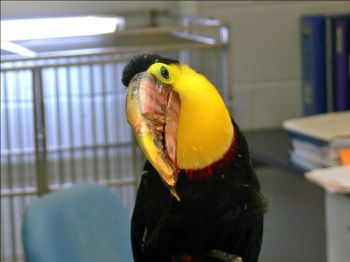
Gracie the retired Chestnut-mandibled Toucan (Ramphastos swainsonii)

Gracie the retired Chestnut-mandibled Toucan (Ramphastos swainsonii)


Lee’s Addition:

Today the Yellow Throated Toucan is also referred to as the Black-mandibled Toucan, at least by the IOC list of World Birds and the Internet Bird Collection. Actually, there are several Toucans that have a yellow throat and hope this is the one referred to in the 1897 article. The way they keep changing the names and splitting the species, the Chestnut-mandibled is also in that species.

What a fantastic bird and such an amazing creation from the Lord. Such a beautiful beak and yet so light.

All things were made through Him, and without Him nothing was made that was made. (John 1:3 NKJV)

All of these Toucans have Yellow Throats:
Chestnut-mandibled Toucan (Ramphastos swainsonii) Lee petting at National Aviary
Rainbow-billed Toucan (Ramphastos sulfuratus) IBC
Choco Toucan (Ramphastos brevis) IBC
Channel-billed Toucan (Ramphastos vitellinus) IBC
Black-mandibled Toucan (Ramphastos ambiguus) IBC

Toucans are members of the family Ramphastidae of near passerine birds from the Neotropics. The Ramphastidae family is most closely related to the American barbets. They are brightly marked and have large, often colorful bills. The family includes five genera and about forty different species. The name of this bird group is derived from the Tupi word tukana, via Portuguese.

Toucans range in size from the Lettered Aracari (Pteroglossus inscriptus), at 130 g (4.6 oz) and 29 cm (11.5 inches), to the Toco Toucan (Ramphastos toco), at 680 g (1.5 lb) and 63 cm (29 inches). Their bodies are short (of comparable size to a crow’s) and compact. The tail is rounded and varies in length, from half the length to the whole length of the body. The neck is short and thick. The wings are small, as they are forest-dwelling birds who only need to travel short distances, and are often of about the same span as the bill-tip-to-tail-tip measurements of the bird.

The colourful and large bill, which in some large species measures more than half the length of the body, is the hallmark of toucans. Despite its size, the toucan is very light, being composed of bone struts filled with spongy tissue of keratin between them. The bill has forward-facing serrations resembling teeth, which historically led naturalists to believe that toucans captured fish and were primarily carnivorous; today it is known that they eat mostly fruit. Researchers have discovered that the large bill of the toucan is a highly efficient thermoregulation system, though its size may still be advantageous in other ways. It does aid in their feeding behavior (as they sit in one spot and reach for all fruit in range, thereby reducing energy expenditure), and it has also been theorized that the bill may intimidate smaller birds, so that the toucan may plunder nests undisturbed. Also, the beak allows the bird to reach deep into tree-holes to access food unavailable to other birds, and also to ransack suspended nests built by smaller birds. However, as there is no sexual dimorphism in coloration it is unlikely to be a sexual signal.
A toucan’s tongue is long (up to 14–15 cm, or 6 inches), narrow, grey, and singularly frayed on each side, adding to its sensitivity as an organ of taste.

A structural complex probably unique to toucans involves the modification of several tail vertebrae. The rear three vertebrae are fused and attached to the spine by a ball and socket joint. Because of this, toucans may snap their tail forwards until it touches the head. This is the posture in which they sleep, often appearing simply as a ball of feathers, with the tip of the tail sticking out over the head.

Toucans are primarily frugivorous (fruit eating), but are opportunistically omnivorous and will take prey such as insects and small lizards. Captive toucans have been reported to actively hunt insects in their cages, and it is possible to keep toucans on an insect-only diet. They also plunder nests of smaller birds, taking eggs and nestlings. This probably provides a crucial addition of protein to their diet. However, in their range, toucans are the dominant frugivores, and as such play an extremely important ecological role as vectors for seed dispersal of fruiting trees. Often when eating small fruits, toucans will throw their heads back and allow the fruit to roll into their throats before swallowing.

*
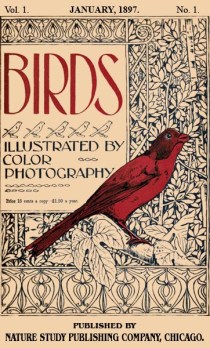
Birds Illustrated by Color Photograhy Vol 1 January 1897 No 1 - Cover

Birds Illustrated by Color Photography – Revisited – Introduction

The above article is the second article in the monthly serial that was started in January 1897 “designed to promote Knowledge of Bird-Live.” These include Color Photography, as they call them, today they are drawings. There are at least three Volumes that have been digitized by Project Gutenberg.

To see the whole series of – Birds Illustrated by Color Photography – Revisited

*

(Information from Wikipedia and other internet sources)

Next Article – The Red-Rumped Tanager

Previous Article – The Red Bird Of Paradise

Wordless Toucan

*

Birds Vol 1 #1 – The Cock-Of-The-Rock

Birds Illustrated by Color Photography – Revisited

Vol 1. January, 1897 No. 1

*

Cock-of-th-Rock

Cock-of-th-Rock


THE COCK-OF-THE-ROCK.

imgtHE Cock-of-the-Rock lives in Guiana. Its nest is found among the rocks. T. K. Salmon says: “I once went to see the breeding place of the Cock-of-the-Rock; and a darker or wilder place I have never been in. Following up a mountain stream the gorge became gradually more enclosed and more rocky, till I arrived at the mouth of a cave with high rock on each side, and overshadowed by high trees, into which the sun never penetrated. All was wet and dark, and the only sound heard was the rushing of the water over the rocks. We had hardly become accustomed to the gloom when a nest was found, a dark bird stealing away from what seemed to be a lump of mud upon the face of the rock. This was a nest of the Cock-of-the-Rock, containing two eggs; it was built upon a projecting piece, the body being made of mud or clay, then a few sticks, and on the top lined with green moss. It was about five feet from the water. I did not see the male bird, and, indeed, I have rarely ever seen the male and female birds together, though I have seen both sexes in separate flocks.”

The eggs are described as pale buff with various sized spots of shades from red-brown to pale lilac.

It is a solitary and wary bird, feeding before sunrise and after sunset and hiding through the day in sombre ravines.

Robert Schomburgh describes its dance as follows:

“While traversing the mountains of Western Guiana we fell in with a pack of these splendid birds, which gave me the opportunity of being an eye witness of their dancing, an accomplishment which I had hitherto regarded as a fable. We cautiously approached their ballet ground and place of meeting, which lay some little distance from the road. The stage, if we may so call it, measured from four to five feet in diameter; every blade of grass had been removed and the ground was as smooth as if leveled by human hands. On this space we saw one of the birds dance and jump about, while the others evidently played the part of admiring spectators. At one moment it expanded its wings, threw its head in the air, or spread out its tail like a peacock scratching the ground with its foot; all this took place with a sort of hopping gait, until tired, when on emitting a peculiar note, its place was immediately filled by another performer. In this manner the different birds went through their terpsichorean exercises, each retiring to its place among the spectators, who had settled on the low bushes near the theatre of operations. We counted ten males and two females in the flock. The noise of a breaking stick unfortunately raised an alarm, when the whole company of dancers immediately flew off.”

The Cock-Of-The-Rock video by IBirdCollection


Guianan Cock-of-the-rock (Rupicola rupicola) ©©lolodoc

Guianan Cock-of-the-rock (Rupicola rupicola) ©©lolodoc

Lee’s Addition:

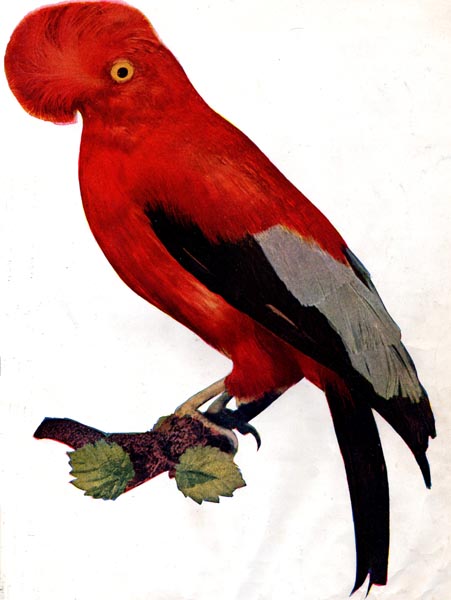
I removed one paragraph that talked about natives killing some of them. The Cock-of the-Rock is an interesting bird. Just their appearance tickles me. They don’t seem to have a beak. There are two Cock-of-the-rocks; the Guianan and the Andean which is the National Bird of Peru.

“The Cock-of-the-rock, which compose the genus Rupicola, are South American cotingid birds. They are found in tropical and subtropical rainforests close to rocky areas, where they build their nests. Like some other cotingids, they have a complex court behaviour, performing impressive lek displays.

Andean Cock-of-the-rock (Rupicola peruvianus) by ©Wiki Closeup

Andean Cock-of-the-rock (Rupicola peruvianus) by ©Wiki Closeup

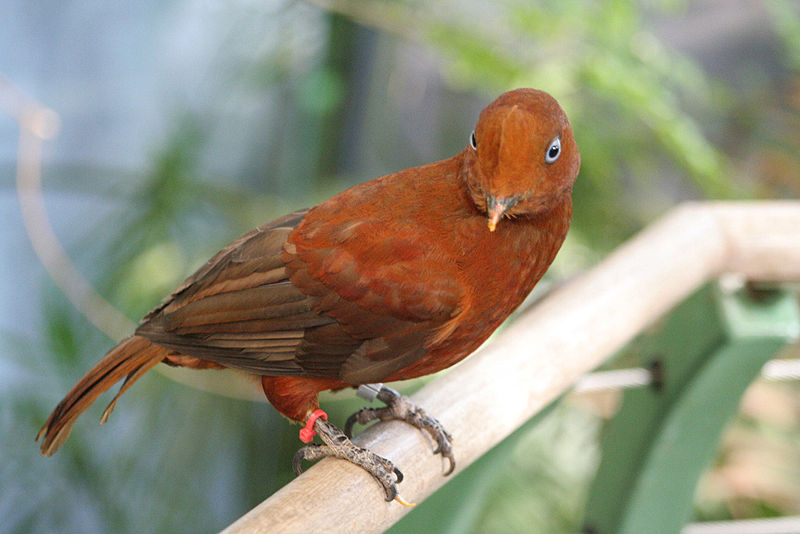
The males are magnificent birds, not only because of their bright orange or red colors, but also because of their very prominent fan-shaped crests. The far duller females are overall brownish. They are wary animals and primarily feed on fruits and berries.” (Wikipedia)

Andean Cock-of-the-rock (Rupicola peruvianus) female by SanDiegoZoo

Andean Cock-of-the-rock (Rupicola peruvianus) female by SanDiegoZoo

The Cotingidae – Cotingas Family is where you will find the Cock-of-the-Rocks. “The cotingas are a large family of passerine bird species found in Central America and tropical South America. Cotingas are birds of forests or forest edges, which mostly eat fruit or insects and fruit. Comparatively little is known about this diverse group, although all have broad bills with hooked tips, rounded wings, and strong legs. They may be the most diverse passerine family in body size, ranging from the 8-cm Kinglet Calyptura to the 50-cm male Amazonian Umbrellabird, although the smaller bird may not be a true cotinga.

The males of many species, such as the cock-of-the-rocks, are brightly coloured, or decorated with plumes or wattles, like the umbrellabirds, with their umbrella-like crest and long throat wattles. Some, like the bellbirds and the Screaming Piha, have distinctive and far-carrying calls. The females of most species are duller than the males.

Most species are polygynous, and only the females care for the eggs and young. Both brilliant male colors and loud vocalizations are the result of sexual selection. Many have striking courtship displays, often grouped together in leks. In such canopy-dwelling genera as Carpodectes, Cotinga, and Xipholena, males gather high in a single tree or in adjacent trees, but male cocks-of-the-rock, as befits their more terrestrial lives, give their elaborate displays in leks on the ground.

On the other hand, the Purple-throated Fruitcrow lives in mixed groups in which one female lays an egg and the others help provide insects to the chick.

Nests differ greatly. Many species lay a single egg in a nest so flimsy that the egg can be seen from underneath. This may make the nests hard for predators to find. Fruiteaters build more solid cup nests, and the cocks-of-the-rock attach their mud nests to cliffs.”

Birds Illustrated by Color Photograhy Vol 1 January 1897 No 1 - Cover

Birds Illustrated by Color Photography – Revisited  – Introduction

The above article is the sixth article in the monthly serial that was started in January 1897 “designed to promote Knowledge of Bird-Live.” These include Color Photography, as they call them, today they are drawings. There are at least three Volumes that have been digitized by Project Gutenberg.

To see the whole series of – Birds Illustrated by Color Photography – Revisited 

*

(Information from Wikipedia and other internet sources)

Next Article – The Red Bird Of Paradise

Previous Article – The Australian Grass Parrakeet

*

ABC’s Of The Gospel

Links:

Cotingidae – Cotingas Family

Cock-of-the-rock – Wikipedia

Cotinga – Wikipedia

*


Birds Vol 1 #1 – The Australian Grass Parrakeet(Parakeet)

Elegant Parrot (Neophema petrophila) aka Australian Grass Parakeet

Elegant Parrot (Neophema petrophila) aka Australian Grass Parakeet

Birds Illustrated by Color Photography – Revisited

Vol 1. January, 1897 No. 1

*

THE AUSTRALIAN GRASS PARRAKEET (Parakeet)

I am a Parrakeet. I belong to the Parrot family. A man bought me and brought me here. It is not warm here, as it was where I came from. I almost froze coming over here. I am not kept in a cage. I stay in the house and go about as I please. There is a Kitty Cat in the house. Sometimes I ride on her back. I like that. I used to live in the grass lands. It was very warm there. I ran among the thick grass blades, and sat on the stems and ate seeds. I had a wife then. Her feathers were almost like mine. We never made nests. When we wanted a nest, we found a hole in a gum tree. I used to sing to my wife while she sat on the nest. I can mock other birds. Sometimes I warble and chirp at the same time. Then it sounds like two birds singing. My tongue is short and thick, and this helps me to talk. But I have been talking too much. My tongue is getting tired. I think I’ll have a ride on Kitty’s back. Good bye.


Elegant Parrot (Neophema elegans) WikiC

Elegant Parrot (Neophema elegans) WikiC

imgp

ARRAKEETS have a great fondness for the grass lands, where they may be seen in great numbers, running amid the thick grass blades, clinging to their stems, or feeding on their seeds. Grass seed is their constant food in their native country. In captivity they take well to canary seed, and what is remarkable, never pick food with their feet, as do other species of parrots, but always use their beaks. “They do not build a nest, but must be given a piece of wood with a rough hole in the middle, which they will fill to their liking, rejecting all soft lining of wool or cotton that you may furnish them.” Only the male sings, warbling nearly all day long, pushing his beak at times into his mate’s ear as though to give her the full benefit of his song. The lady, however, does not seem to appreciate his efforts, but generally pecks him sharply in return. A gentleman who brought a Parrakeet from Australia to England, says it suffered greatly from the cold and change of climate and was kept alive by a kind-hearted weather-beaten sailor, who kept it warm and comfortable in his bosom. It was not kept in a cage, but roamed at will about the room, enjoying greatly at times, a ride on the cat’s back. At meals he perched upon his master’s shoulder, picking the bits he liked from a plate set before him. If the weather was cold or chilly, he would pull himself up by his master’s whiskers and warm his feet by standing on his bald head. He always announced his master’s coming by a shrill call, and no matter what the hour of night, never failed to utter a note of welcome, although apparently asleep with his head tucked under his wing.


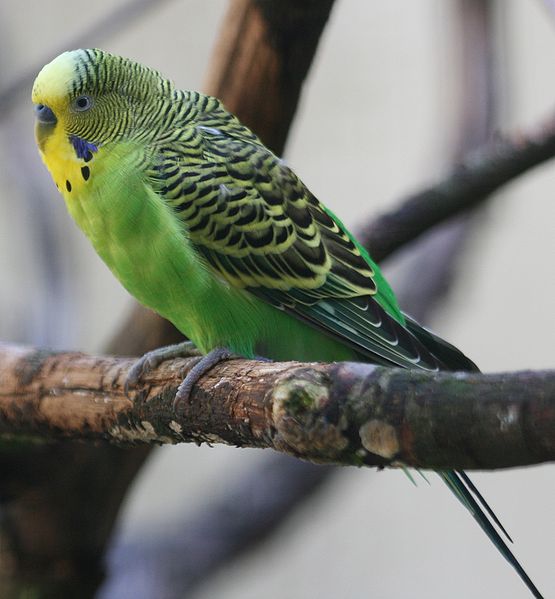
Budgerigar (Melopsittacus undulatus) by Lee LPZ

Budgerigar (Melopsittacus undulatus) by Lee LPZ


Lee’s Addition:

I am not really sure which Parakeet they are referring to in this article. Today their is not really an Australian Grass Parakeet, but the Elegant Parakeet favors the photo-drawing, but also Budgerigars also favor that drawing. At any rate, they are neat little birds and both can talk as mentioned.

Wikipedia says this about Grass Parakeets:  “Its common name is Elegant Parrot, but has also been called Elegant Parakeet, Elegant Grass Parakeet, and Grass Parrot in the past. The Elegant Parrot is 23 cm (9 in) long and predominantly golden olive in colour with a dark blue frontal band line above with lighter blue. while abdomen and vent are yellow. The female is a duller shade of olive all over and has a narrower blue frontal band. The wings are predominantly olive with outer flight feathers dark blue. The yellow edged tail has shades of olive and blue. The bill and legs are grey and the eyes dark brown. Juveniles are duller and lack the frontal bands.”

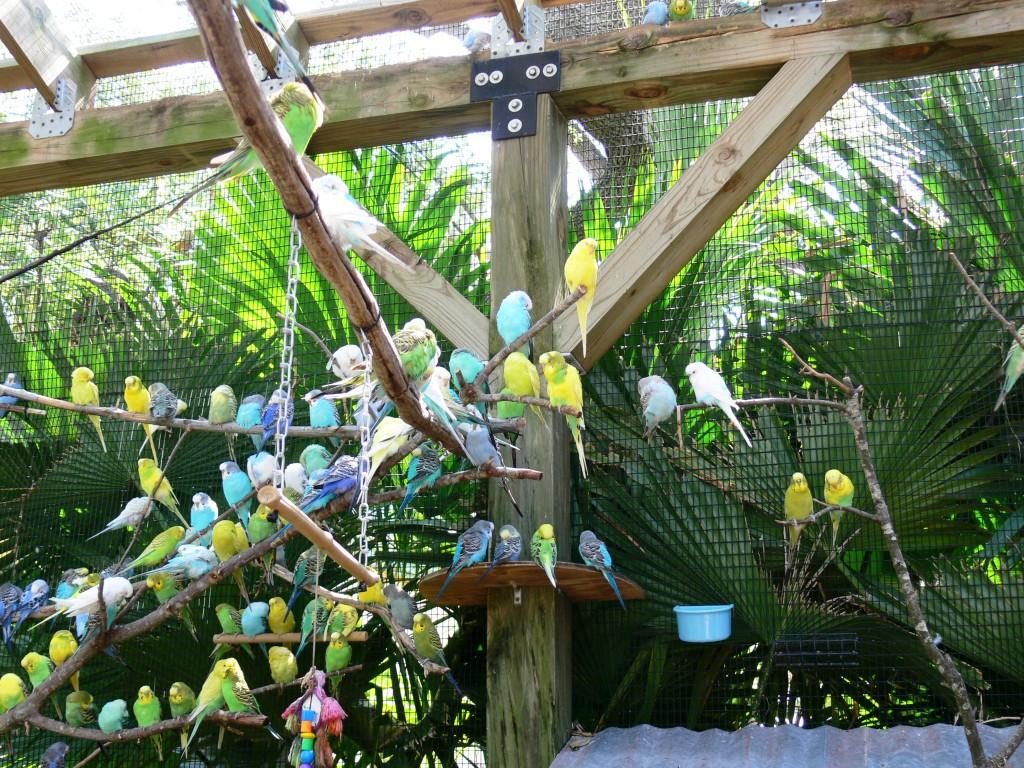
“The Budgerigar (Melopsittacus undulatus), also known as common pet parakeet or shell parakeet informally nicknamed the budgie, is a small, long-tailed, seed-eating parrot, and the only species in the Australian genus Melopsittacus. Wild budgerigars are found throughout the drier parts of Australia, where the species has survived harsh inland conditions. Naturally green and yellow with black, scalloped markings on the nape, back, and wings, breeders have created a rainbow of blues, whites, and yellows, greys, and even forms with small crests. Budgerigars are popular pets around the world due to their small size, low cost, ability to mimic human speech and playful nature.
The budgerigar is closely related to the lories and the fig parrots. Although budgerigars are often, especially in American English, called “parakeets“, this term refers to any of a number of small parrots with long, flat tails.

Alternative common names include shell parrot, warbling grass parakeet, canary parrot, zebra parrot, flight bird, scallop parrot and the alternate spellings budgerygah and betcherrygah.” (Wikipedia)

Budgerigar (Melopsittacus undulatus) WikiC

Budgerigar (Melopsittacus undulatus) WikiC

Both the Elegant Parrot (Neophema elegans) and the Budgerigar (Melopsittacus undulatus) are in the Psittacidae – Parrots Family. I lean toward the Budgerigar, but take your choice. Whatever, they are very colorful and a delight to watch and observe. The Lord put lots of color potential in the parakeet family.

Which doeth great things past finding out; yea, and wonders without number. (Job 9:10 KJV)

Birds Illustrated by Color Photograhy Vol 1 January 1897 No 1 - Cover

Birds Illustrated by Color Photography – Revisited – Introduction The above article is the fifth article in the monthly serial that was started in January 1897 “designed to promote Knowledge of Bird-Live.” These include Color Photography, as they call them, today they are drawings. There are at least three Volumes that have been digitized by Project Gutenberg.

To see the whole series of – Birds Illustrated by Color Photography – Revisited* (Information from Wikipedia and other internet sources)

Next Article – The Cock-Of-The-Rock

Previous Article – The Golden Pheasant

*

Gospel Presentation

*

Birds Of The Bible – Gull With A Broken Wing

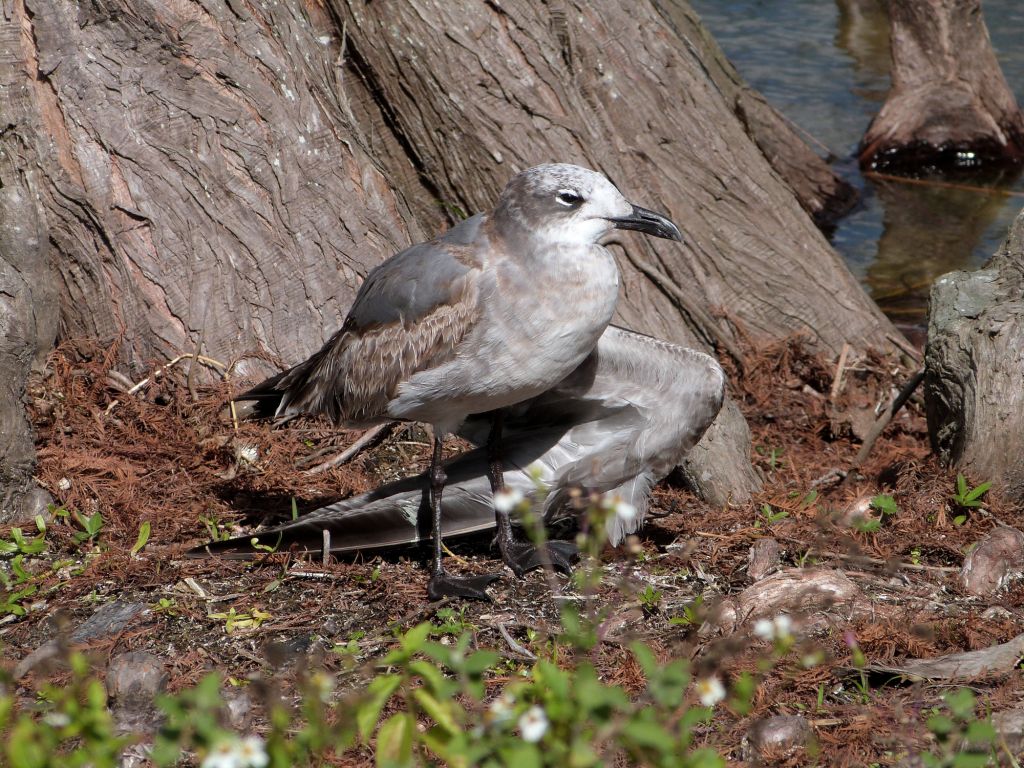
Laughing Gull Imm injured wing

Laughing Gull Imm injured wing

Are not two sparrows sold for a farthing? and one of them shall not fall on the ground without your Father. (Matthew 10:29 KJV)

Yesterday, Dan and I went to Lake Hollingsworth in Lakeland, FL for a little birdwatching and to just enjoy the day. It was around 77 degrees and a few clouds were hanging out. Just another beautiful day from the Lord. After walking as far as I could, we turned around and retraced our steps back along the southern shore of the lake.

My legs are doing much better, praise the Lord, but I still have issues. I stopped to rest a minute and spotted a Laughing Gull along the shore. Something in its appearance didn’t seem right, so I got up to investigate. (They have benchs along the way.) What I found was that the Gull had a wing hanging down and I assume it was broken. It appears to be an immature Laughing.

Laughing Gull Imm injured wing

Laughing Gull Imm injured wing

The bird walked up by the tree and kept dragging it’s wing as you can see in the third photo.

Laughing Gull Imm injured wing

Laughing Gull Imm injured wing

I know that verse has been many used times here with the Birds of the Bible articles, but it still applies so well. That verse popped into my thoughts while observing the Gull’s situation. The verse mentions the Sparrow, but all birds were created by the Lord and it applies to them as well. I do not believe that He is only aware of just Sparrows that fall. God is ever-present, all-knowing, and all-powerful, so how could God NOT KNOW?

We know that verse was used to encourage those being persecuted (v.23) to not fear, knowing that the Father is aware of what they were experiencing. They did not need to worry about someone who could destroy their soul. (v.28) The passage goes on to reassure them that they are more valuable than sparrows or birds.

Fear ye not therefore, ye are of more value than many sparrows. (Matthew 10:31 KJV)

Not sure if Gulls “worry.” but that immature bird was in a very precarious situation. Without that wing he (or she) was very vulnerable to what could happen to it. There was a Red-shouldered Hawk flying by and I believe that that might be the tree it landed in when we went by the first time. I was trying to get its photo, but it flew off. I didn’t notice the Gull then. When we noticed the bird on the way back, the Hawk was still flying in the area.

The Bible Knowledge Commentary says this about verse 31: “for their (the persecuted) Father was truly concerned for them and aware of their circumstances. He is aware of the death of a sparrow which is worth so little. Two sparrows were sold for a mere penny (assarion, a Gr. copper coin worth about 1/16 of a Roman denarius, a day’s wages). God the Father also knows the number of hairs on a person’s head (Mat_10:30). The apostles were instructed not to fear for they, being far more valuable to God than sparrows, were seen and known by Him. ”

Believer’s Bible Commentary: “10:30, 31 The same God who takes a personal interest in the tiny sparrow keeps an accurate count of the hairs of the head of each of His children. A strand of hair is of considerably less value than a sparrow. This shows that His people are of more value to Him than many sparrows, so why should they fear?”

Whosoever therefore shall confess me before men, him will I confess also before my Father which is in heaven. But whosoever shall deny me before men, him will I also deny before my Father which is in heaven. (Matthew 10:32-33 KJV)

We should not be afraid to tell others about the Saving Grace of the Lord Jesus Christ, nor that we believe that God is the Self-Existent, All-Knowing, All-Powerful, Ever-Present, Loving (He gave His Son to die for our sins.), Creator of the world and all these birds, critters, and us.

What will be the fate of the Laughing Gull? I have no clue, but God already knows all about its situation, but better yet, He knows all out us and our situations and circumstances. He cares and wants us to put our trust in Him.

Sharing The Gospel

And wisdom and knowledge shall be the stability of thy times, and strength of salvation: the fear of the LORD is his treasure. (Isaiah 33:6 KJV)

See more Birds of the Bible

*

Ian’s Bird of the Week – Kea

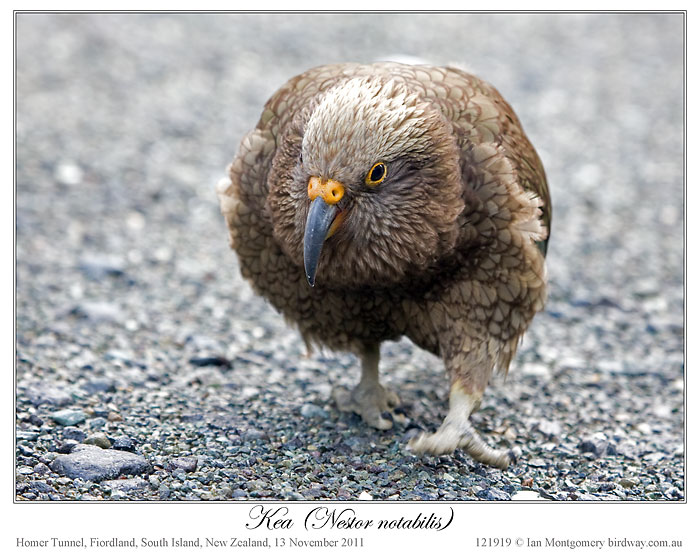
Kea (Nestor notabilis) by Ian #1

Kea (Nestor notabilis) by Ian #1

Ian’s Bird of the Week – Kea ~ by Ian Montgomery

Newsletter ~ 1/26/12

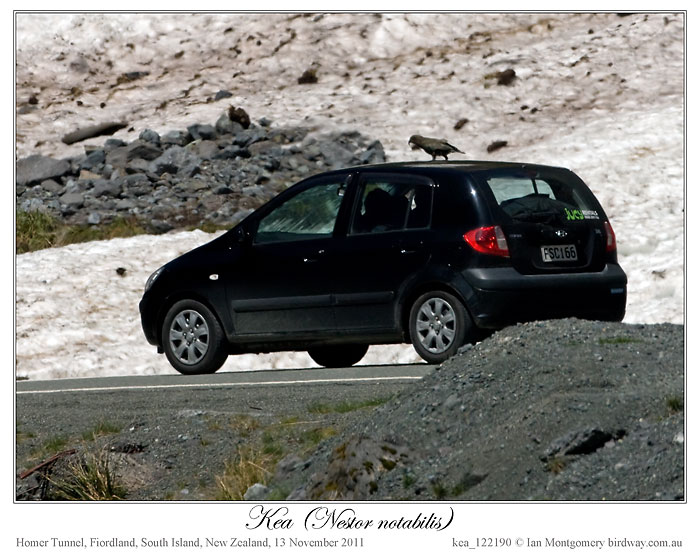
If you park near the entrance to the Homer Tunnel on the way to Milford Sound in Fiordland on the South Island of New Zealand, you are likely to be approached by one of these interesting-looking parrots.

‘Friendly-looking chap’, you might think, ‘I wonder what he’s after? Just saying Hello? Some food maybe?’. Wrong. This one, the Kea, has a one-track mind, and is only interested in destruction, or more specifically dismantling your vehicle.
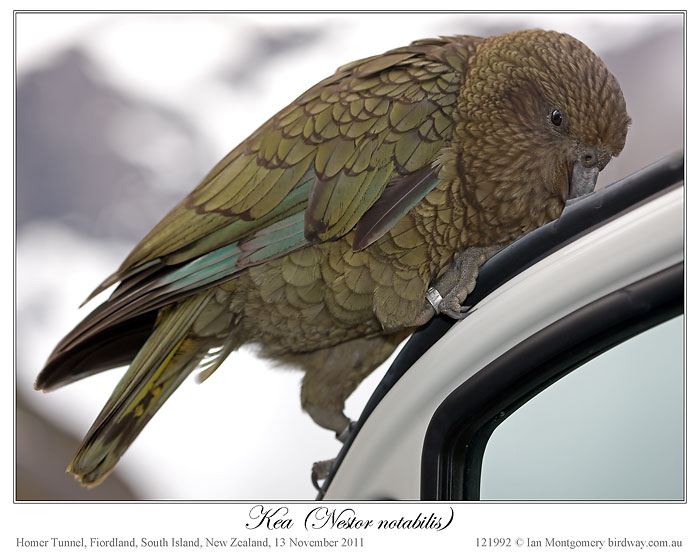
Kea (Nestor notabilis) by Ian #2

Kea (Nestor notabilis) by Ian #2

Quick as a flash, it and his pals will check it out for weak spots and set to work – this one with yellow cere, lower mandible and eye-ring is a juvenile delinquent (yes, that’s snow in the background, these are tough birds). Let’s see if we can rip the roof off.

Kea (Nestor notabilis) by Ian #3

Kea (Nestor notabilis) by Ian #3

Oh well, the roof was stronger than it looked. How about the braking light above the back door, this has some promising cracks.

Kea (Nestor notabilis) by Ian #4

Kea (Nestor notabilis) by Ian #4

Meanwhile, this hardened criminal (this is an adult bird) has learnt that the rubber is more vulnerable and attacks the lining of the front door.
Kea (Nestor notabilis) by Ian #5

Kea (Nestor notabilis) by Ian #5

And don’t think you can get rid of us by just driving off. We’ll hang on grimly until we get blown off by the breeze.

Kea (Nestor notabilis) by Ian #6

Kea (Nestor notabilis) by Ian #6

Keas have the reputation of being playful, but the intensity and obsessiveness of their attacks looked anything like a game to me and more like a compulsion. In fact, their attacks did no noticeable damage even though I parked the camper there for some time so that I could look for the Rock Wrens (Bird of the Week #438). According to my field guide ‘the worst offending birds are caught and transferred to distant sites or taken into captivity’. Sounds familiar.

At one time, Keas were supposed to kill sheep, and the resulting bounty led to their persecution and decline. They have been fully protected since 1986 and the population is recovering.
Keas are quite large birds, 46cm/18in in length and weighting up to 1Kg/2.2lbs. They and their relatives the Kaka and the Kakapo comprise a taxonomically distinct lineage of New Zealand parrots not closely related to any others and usually placed either in their own family (IOC) or sub-family (Birdlife International). While the flightless Kakapo is critically endangered and the subject of an intensive rescue mission http://www.kakaporecovery.org.nz/ , the Kea is quite common in Alpine areas of the South Island and the Kaka occurs in the forests of both islands, though I failed to find it on this trip. It’s good to leave something for the next visit.
Best wishes
Ian

Ian Montgomery, Birdway Pty Ltd,
454 Forestry Road, Bluewater, Qld 4818
Phone: 0411 602 737 +61-411 602 737
Preferred Email: ian@birdway.com.au
Website: http://birdway.com.au


Lee’s Addition:

Sounds like you might want to keep an eye on your personal property around those birds! It is amazing how much the birds vary in their habits and diets. Every time Ian writes about his encounters with the various birds, it’s always different and interesting. Keep up the great birding, Ian, we enjoy your encounters with our avian friends around the world.

I know all the birds of the mountains, And the wild beasts of the field are Mine. (Psalms 50:11 NKJV)

See Ian’s Cockatoos & Allies and his Parrots & Allies, which are part of the Strigopidae Family. Those parrots along with the Cockatoos – Cacatuidae and Parrots – Psittacidae Families make up the Psittaciformes Order.

*