Cranes know when it’s time to move south for winter. And robins, warblers, and bluebirds know when it’s time to come back again. But my people? My people know nothing, not the first thing of GOD and his rule. (Jeremiah 8:7 MSG)
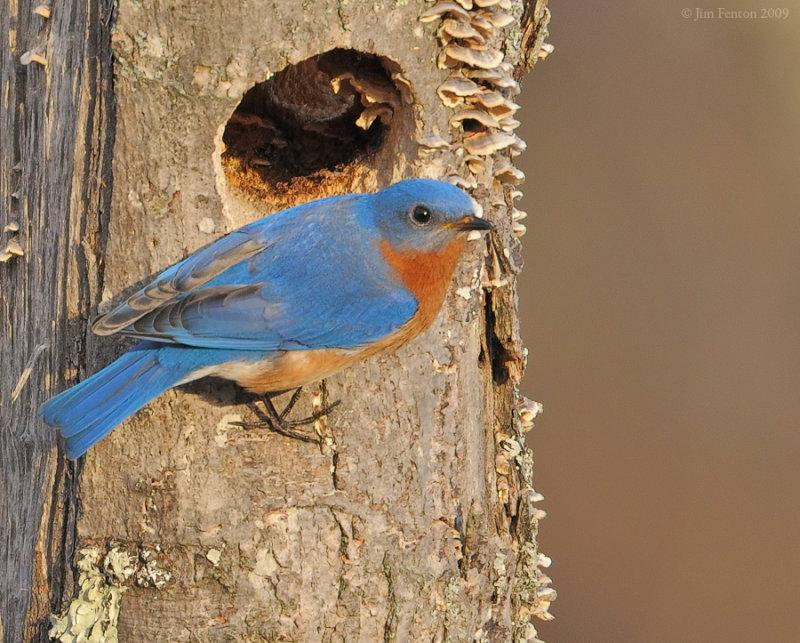
As far as I know, the only Version of the Bible (English) that used the word “bluebirds is the Message. It is not a version I use, but that verse makes for chance to write about the Bluebirds. In many of the other versions, “Thrush” is used. Bluebirds are in the Turdidae – Thrushes Family. There are three species; the Eastern, Western and Mountain Bluebirds. In a completely different family, the Irenidae – Fairy-bluebirds Family you will find the Asian and Philippine Fairy-bluebirds. These are not “thrushes” per se.
This verse has been written about in Birds of the Bible – Thrush and Thrushes II. It mentions that the birds know more about migration than the people know that much about God and His dominion.
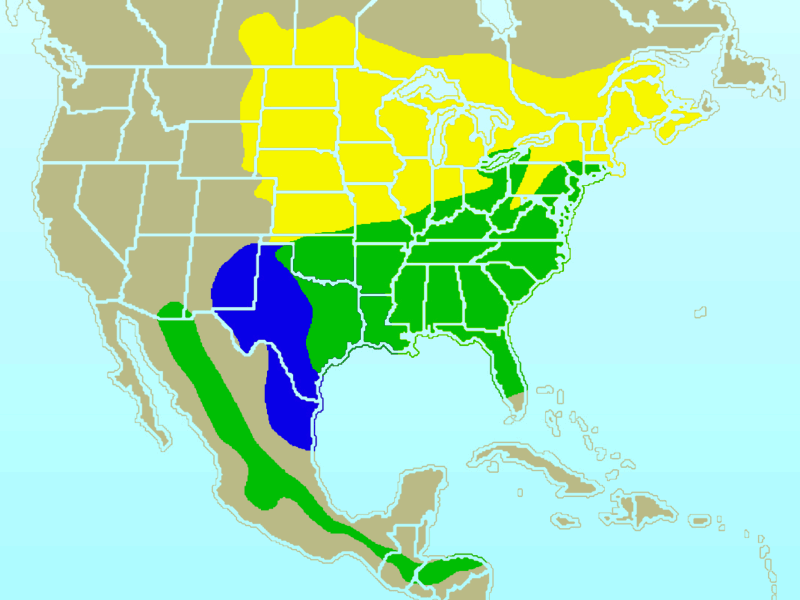
Do the Bluebirds migrate? Only the Eastern Bluebird. Here is their range map. Yellow is summer, blue – winter and green is year round. The summer breeding range extends as far north as the Pacific Northwest, British Columbia, and Montana. The northern Western Bluebirds can migrate to the southern parts of the range; southern birds are often permanent residents. The mountain bluebird is migratory. The Mountain Bluebird range varies from Mexico in the winter to as far north as Alaska, throughout the western U.S. and Canada. Northern birds migrate to the southern parts of the range; southern birds are often permanent residents. Some birds may move to lower elevations in winter.
So, not so sure that was a good choice of birds to use especially since they aren’t even anywhere near the Middle East. Nevertheless they are beautiful birds that the Lord has created for His pleasure and our enjoyment. The majority of their diet is “insects and other invertebrates. The remainder of the bird’s diet is made up of wild fruits. Favored insect foods include grasshoppers, crickets, katydids, and beetles. Other food items include earthworms, spiders, millipedes, centipedes, sow bugs and snails. (Eastern) Bluebirds are very helpful with pest control in the territory surrounding the nest.”
Mountain Bluebird (Sialia currucoides) by Daves BirdingPix
All three of them are cavity dwellers or nest box residents. They are all territorial and “Bluebirds can typically produce between two and four broods during the spring and summer (March through August in the Northeastern United States). Males identify potential nest sites and try to attract prospective female mates to those nesting sites with special behaviors that include singing and flapping wings, and then placing some material in a nesting box or cavity. If the female accepts the male and the nesting site, she alone builds the nest and incubates the eggs.”
“The bluebirds are a group of medium-sized, mostly insectivorous or omnivorous birds in the genus Sialia of the thrush family (Turdidae). Bluebirds are one of the few thrush genera in the Americas. They have blue, or blue and red, plumage. Female birds are less brightly colored than males, although color patterns are similar and there is no noticeable difference in size between sexes.
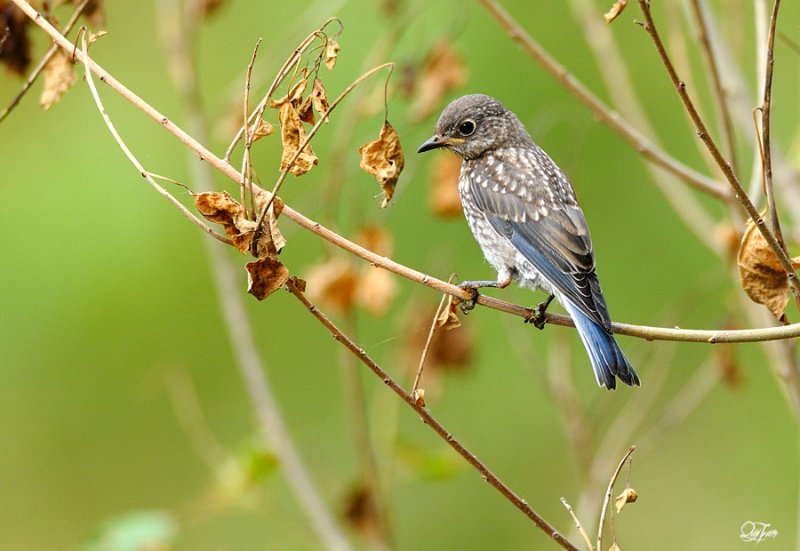
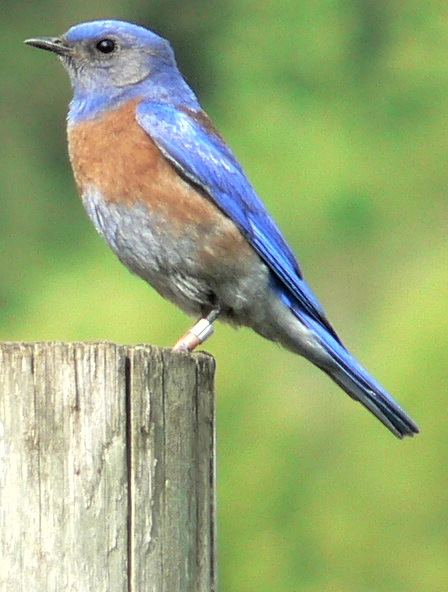
Western Bluebird (Sialia mexicana) juvenile by Quy Tran
Western Bluebirds are sometimes confused with other bluebirds, however they can be distinguished without difficulty. The Western Bluebird has a blue (male) or gray (female) throat, the Eastern Bluebird has an orange throat, and the Mountain Bluebird lacks orange color anywhere on its body.
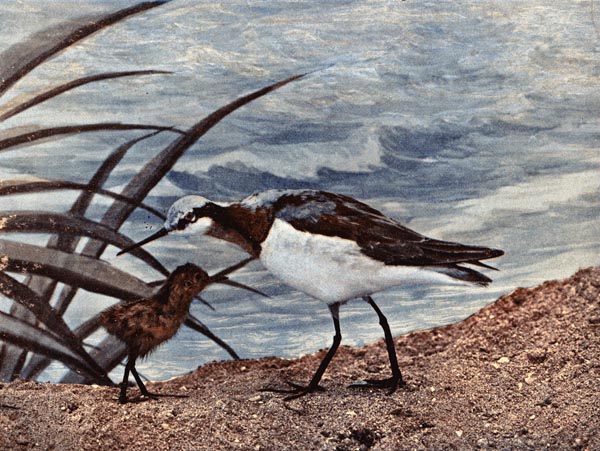
Wilson’s Phalarope for Birds Illustrated by Color Photography
WILSON’S PHALAROPE.
ERHAPS the most interesting, as it is certainly the most uncommon, characteristic of this species of birds is that the male relieves his mate from all domestic duties except the laying of the eggs. He usually chooses a thin tuft of grass on a level spot, but often in an open place concealed by only a few straggling blades. He scratches a shallow depression in the soft earth, lines it with a thin layer of fragments of old grass blades, upon which the eggs, three or four, are laid about the last of May or first of June. Owing to the low situation in which the nest is placed, the first set of eggs are often destroyed by a heavy fall of rain causing the water to rise so as to submerge the nest. The instinct of self preservation in these birds, as in many others, seems lacking in this respect. A second set, numbering two or three, is often deposited in a depression scratched in the ground, as at first, but with no sign of any lining.
Wilson’s Phalarope is exclusively an American bird, more common in the interior than along the sea coast. The older ornithologists knew little of it. It is now known to breed in northern Illinois, Iowa, Wisconsin, Minnesota, the Dakotas, Utah, and Oregon. It is recorded as a summer resident in northern Indiana and in western Kansas. Mr. E. W. Nelson states that it is the most common species in northern Illinois, frequenting grassy marshes and low prairies, and is not exceeded in numbers even by the ever-present Spotted Sandpiper. While it was one of our most common birds in the Calumet region it is now becoming scarce.
The adult female of this beautiful species is by far the handsomest of the small waders. The breeding plumage is much brighter and richer than that of the male, another peculiar characteristic, and the male alone possesses the naked abdomen. The female always remains near the nest while he is sitting, and shows great solicitude upon the approach of an intruder. The adults assume the winter plumage during July.
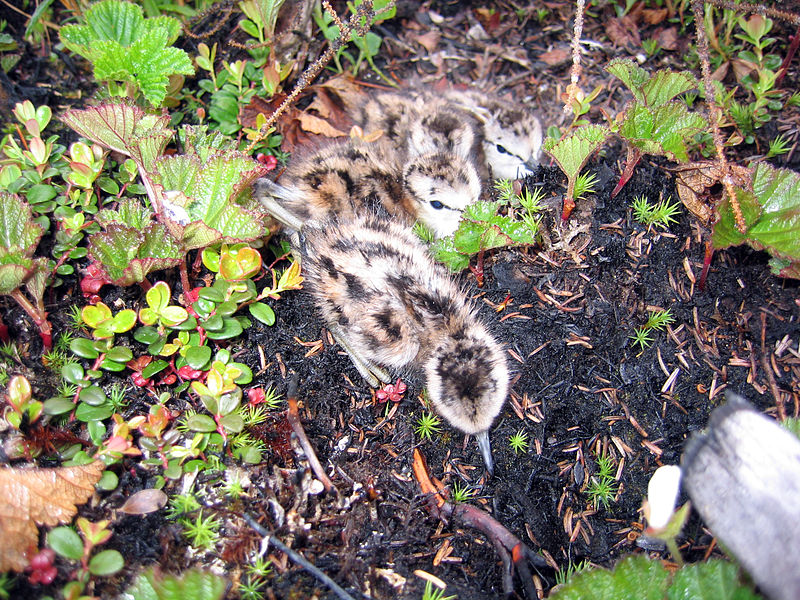
Wilson’s Phalarope (Phalaropus tricolor) by J Fenton
Lee’s Addition:
Out of the ground the LORD God formed every beast of the field and every bird of the air, and brought them to Adam to see what he would call them. And whatever Adam called each living creature, that was its name. So Adam gave names to all cattle, to the birds of the air, and to every beast of the field. But for Adam there was not found a helper comparable to him. (Genesis 2:19-20 NKJV)
What another fantastically created bird. The Phalaropes belong to the Scolopacidae – Sandpipers, Snipes family. There are 96 species in the family, with 3 of those in the Phalaropus genus; the Wilson’s, Red-necked and Red Phalaropes. Phalarope are sometimes called “wadepipers.” They are especially notable for two things: their unusual nesting behavior (see above), and their unique feeding technique. When feeding, a phalarope will often swim in a small, rapid circle, forming a small whirlpool. This behavior is thought to aid feeding by raising food from the bottom of shallow water. The bird will reach into the center of the vortex with its bill, plucking small insects or crustaceans caught up therein.
The Wilson’s Phalarope, Phalaropus tricolor, is a small wader. This bird, the largest of the phalaropes, breeds in the prairies of North America in western Canada and the western United States. It is migratory, wintering around the central Andes in South America. They are passage migrants through Central America around March/April and again during September/October. The species is a rare vagrant to western Europe.
This species is often very tame and approachable. Its common name commemorates the American ornithologist Alexander Wilson. Sometimes, it is placed in a monotypic genus Steganopus.
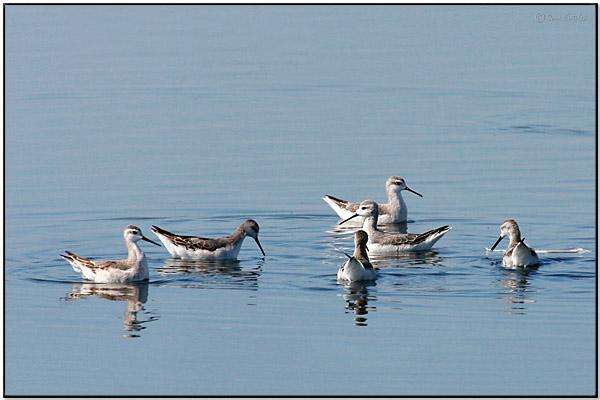
Wilson’s Phalarope (Phalaropus tricolor) by Daves BirdingPix
Wilson’s Phalarope is slightly larger than the Red Phalarope at about 9.1 in (23 cm) in length. As are all 3 phalaropes, it is a unique, dainty shorebird with lobed toes and a straight fine black bill. The breeding female is predominantly gray and brown above, with white underparts, a reddish neck and reddish flank patches. The breeding male is a duller version of the female, with a brown back, and the reddish patches reduced or absent. In a study of breeding phalaropes in Saskatchewan Providence in Canada, females were found to average around 10% larger in standard measurements and to weigh around 30% more than the males. Females weighed from 68 to 79 g (2.4 to 2.8 oz), whereas the males average 1.83 oz (51.8 g).
Young birds are grey and brown above, with whitish underparts and a dark patch through the eye. In winter, the plumage is essentially grey above and white below, but the dark eyepatch is always present.
The above article is the first article in the monthly serial that was started in January 1897 “designed to promote Knowledge of Bird-Live.” These include Color Photography, as they call them, today they are drawings. There are at least three Volumes that have been digitized by Project Gutenberg.
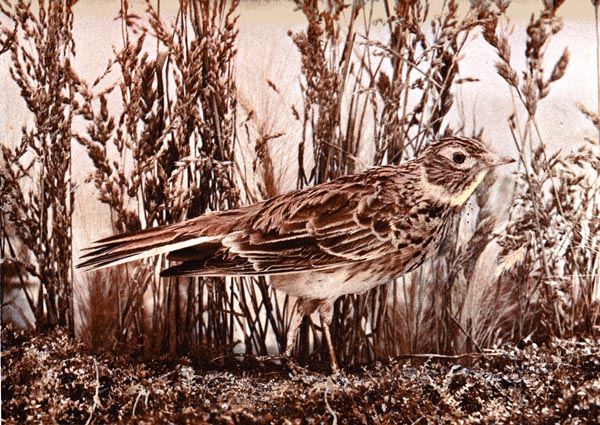
The Skylark – Birds Illustrated by Color Photography
From col. F. M. Woodruff.
THE SKYLARK.
This is not an American bird. I have allowed his picture to be taken and placed here because so many of our English friends desired it.
The skylark is probably the most noted of birds in Europe. He is found in all of the countries of Europe, but England seems to claim it. Here it stays during the summer, and goes south in the winter.
Like our own Meadow Lark, he likes best to stay in the fields. Here you will find it when not on the wing.
Early in the spring the Skylark begins his song, and he may be heard for most of the year.
Sometimes he sings while on the ground, but usually it is while he is soaring far above us.
Skylarks do not often seek the company of persons. There are some birds, you know, that seem happy only when they are near people. Of course, they are somewhat shy, but as a rule they prefer to be near people. While the Skylark does not seek to be near persons, yet it is not afraid of them.
A gentleman, while riding through the country, was surprised to see a Skylark perch on his saddle. When he tried to touch it, the Lark moved along on the horse’s back, and finally dropped under the horse’s feet. Here it seemed to hide. The rider, looking up, saw a hawk flying about. This explained the cause of the skylark’s strange actions.
A pair of these Larks had built their nest in a meadow. When the time came for mowing the grass, the little ones were not large enough to leave the nest. The mother bird laid herself flat on the ground, with her wings spread out. The father bird took one of the little ones from the nest and placed it on the mother’s back. She flew away, took the baby bird to a safe place, and came back for another.
This time the father took his turn. In this way they carried the little ones to a safe place before the mowers came.
Like our Meadow Lark, the Skylark builds her nest on the ground—never in bushes or trees. Usually it is built in a hole below the surface of the ground. It is for this reason that it is hard to find.
Then, too, the color of the nest is much like that of the ground.
Four or five eggs are usually laid, and in two weeks the little larks crack the shells, and come into the world crying for worms and bugs.
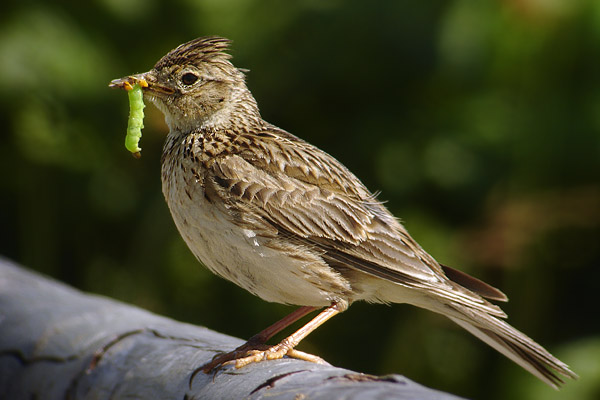
Eurasian Skylark (Alauda arvensis) by Ian
THE SKYLARK.
HE English Skylark has been more celebrated in poetry than any other song-bird. Shelley’s famous poem is too long to quote and too symmetrical to present in fragmentary form. It is almost as musical as the sweet singer itself.
“By the first streak of dawn,” says one familiar with the Skylark, “he bounds from the dripping herbage, and on fluttering wings mounts the air for a few feet ere giving forth his cheery notes. Then upward, apparently without effort he sails, sometimes drifting far away as he ascends, borne as it were by the ascending vapors, so easily he mounts the air. His notes are so pure and sweet, and yet so loud and varied withal, that when they first disturb the air of early morning all the other little feathered tenants of the fields and hedgerows seem irresistibly compelled to join him in filling the air with melody. Upwards, ever upwards, he mounts, until like a speck in the highest ether he appears motionless; yet still his notes are heard, lovely in their faintness, now gradually growing louder and louder as he descends, until within a few yards of the earth they cease, and he drops like a fragment hurled from above into the herbage, or flits about it for a short distance ere alighting.” The Lark sings just as richly on the ground as when on quivering wing. When in song he is said to be a good guide to the weather, for whenever we see him rise into the air, despite the gloomy looks of an overcast sky, fine weather is invariably at hand.
The nest is most frequently in the grass fields, sometimes amongst the young corn, or in places little frequented. It is made of dry grass and moss, and lined with fibrous roots and a little horse hair. The eggs, usually four or five in number, are dull white, spotted, clouded, and blotched over the entire surface with brownish green. The female Lark, says Dixon, like all ground birds, is a very close sitter, remaining faithful to her charge. She regains her nest by dropping to the ground a hundred yards or more from its concealment.
The food of the Lark is varied,—in spring and summer, insects and their larvae, and worms and slugs, in autumn and winter, seeds.
Olive Thorne Miller tells this pretty anecdote of a Skylark which she emancipated from a bird store: “I bought the skylark, though I did not want him. I spared no pains to make the stranger happy. I procured a beautiful sod of uncut fresh grass, of which he at once took possession, crouching or sitting low among the stems, and looking most bewitching. He seemed contented, and uttered no more that appealing cry, but he did not show much intelligence. His cage had a broad base behind which he delighted to hide, and for hours as I sat in the room I could see nothing of him, although I would hear him stirring about. If I rose from my seat he was instantly on the alert, and stretched his head up to look over at me. I tried to get a better view of him by hanging a small mirror at an angle over his cage, but he was so much frightened by it that I removed it.”
“This bird,” Mrs. Miller says “never seemed to know enough to go home. Even when very hungry he would stand before his wide open door, where one step would take him into his beloved grass thicket, and yet that one step he would not take. When his hunger became intolerable he ran around the room, circled about his cage, looking in, recognizing his food dishes, and trying eagerly to get between the wires to reach them; and yet when he came before the open door he would stand and gaze, but never go in. After five months’ trial, during which he displayed no particular intelligence, and never learned to enter his cage, he passed out of the bird room, but not into a store.”
Don’t be afraid, land; rejoice and be glad, for the LORD has done great things. Don’t be afraid, wild animals, for the wilderness pastures have turned green, the trees bear their fruit, and the fig tree and grapevine yield their riches. (Joel 2:21-22 HCSB)
The Eurasian Skylark (Alauda arvensis) is a small passerine bird species. This lark breeds across most of Europe and Asia and in the mountains of north Africa. It is mainly resident in the west of its range, but eastern populations are more migratory, moving further south in winter. Even in the milder west of its range, many birds move to lowlands and the coast in winter. Asian birds appear as vagrants in Alaska; this bird has also been introduced in Hawaii, western North America, eastern Australia and New Zealand.
The Eurasian Skylark is 16 to 18 centimetres long. It is a bird of open farmland and heath, known throughout its range for the song of the male, which is delivered in hovering flight from heights of 50 to 100 m, when the singing bird may appear as just a dot in the sky from the ground. The song generally lasts two to three minutes, but it tends to last longer later in the mating season. The male has broader wings than the female. This adaptation for more efficient hovering flight may have evolved because of female Eurasian Skylarks’ preference for males that sing and hover for longer periods and so demonstrate that they are likely to have good overall fitness.
Like most other larks, the Eurasian Skylark is a rather dull-looking species on the ground, being mainly brown above and paler below. It has a short blunt crest on the head, which can be raised and lowered. In flight it shows a short tail and short broad wings. The tail and the rear edge of the wings are edged with white, which are visible when the bird is flying away, but not if it is heading towards the observer. The Eurasian Skylark has sturdy legs and spends much time on the ground foraging for seeds, supplemented with insects in the breeding season.
The Eurasian Skylark makes a grass nest on the ground, hidden amongst vegetation. It is sometimes found nesting in bracken, using it for cover. Generally the nests are very difficult to find. Three to six eggs are laid in June. A second or third brood may be started later in the year. The eggs are yellow/white with brownish/purple spots mainly at the large end. (Wikipedia)
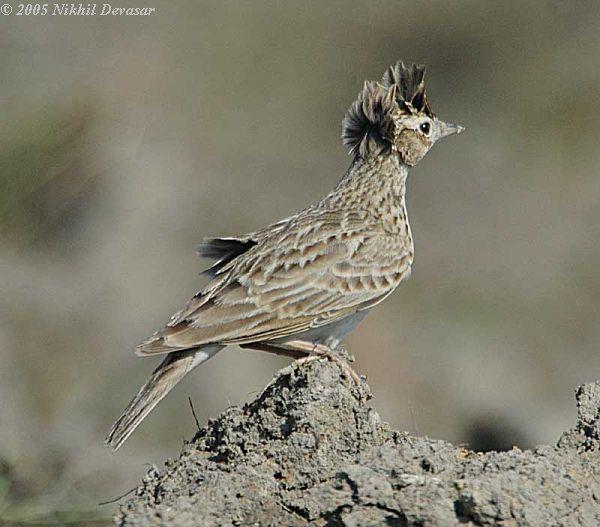
Oriental Skylark (Alauda gulgula) by Nikhil Devasar
There is also the Oriental Skylark (Alauda gulgula), also known as the Oriental Lark or Small Skylark, is a species of skylark found in the Indian Subcontinent and Southeast Asia. Like other skylarks, it is found in open grassland – often near waterbodies – where it feeds on seeds and insects.
These skylarks frequently rocket up into the sky, fluttering and singing before descending down to earth. Male Oriental Skylarks may also hover in the air and sing, in order to attract a mate.
Oriental Skylarks are about 16 cm long. They have streaked, yellow-brown upper plumage, with white outer tail feathers and a short crest. Both sexes are similar. (Wikipedia)
The above article is the first article in the monthly serial that was started in January 1897 “designed to promote Knowledge of Bird-Live.” These include Color Photography, as they call them, today they are drawings. There are at least three Volumes that have been digitized by Project Gutenberg.
Lesser Yellow Legs for Birds Illustrated by Color Photography – From col. F. M. Woodruff.
THE YELLOW LEGS.
ELLOW LEGS, or Lesser Tell tale sometimes called Yellow-leg Snipe, and Little Cucu, inhabits the whole of North America, nesting in the cold temperate and subarctic districts of the northern continent, migrating south in winter to Argentine and Chili. It is much rarer in the western than eastern province of North America, and is only accidental in Europe. It is one of the wading birds, its food consisting of larvae of insects, small shell fish and the like.
The nest of the Lesser Yellow Shanks, which it is sometimes called, is a mere depression in the ground, without any lining. Sometimes, however, it is placed at the foot of a bush, with a scanty lining of withered leaves. Four eggs of light drab, buffy or cream color, sometimes of light brown, are laid, and the breast of the female is found to be bare of feathers when engaged in rearing the young. The Lesser Yellow legs breeds in central Ohio and Illinois, where it is a regular summer resident, arriving about the middle of April, the larger portion of flocks passing north early in May and returning about the first of September to remain until the last of October.
A nest of this species of Snipe was found situated in a slight depression at the base of a small hillock near the border of a prairie slough near Evanston, Illinois, and was made of grass stems and blades. The color of the eggs in this instance was a deep grayish white, three of which were marked with spots of dark brown, and the fourth egg with spots and well defined blotches of a considerably lighter shade of the same.
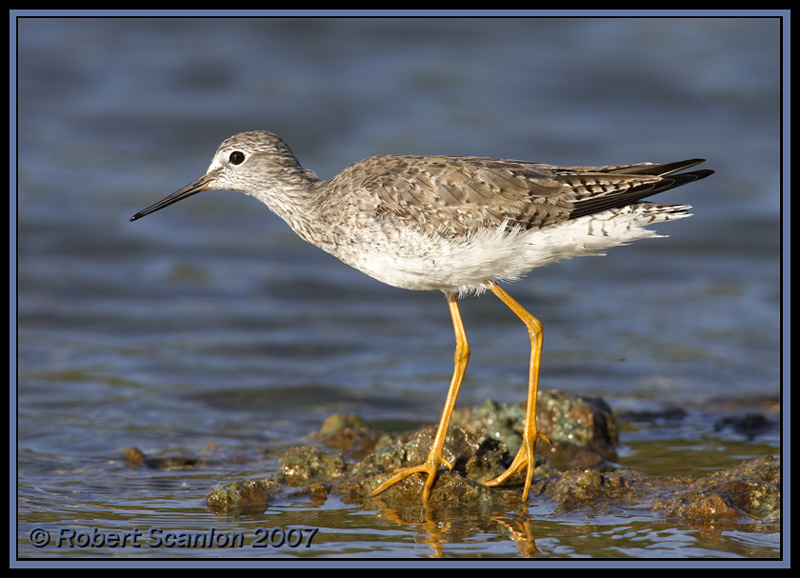
Lesser Yellowlegs (Tringa flavipes) by Robert Scanlon
Lee’s Addition:
If you come across a bird’s nest in any tree or on the ground, with young ones or eggs and the mother sitting on the young or on the eggs, you shall not take the mother with the young. (Deuteronomy 22:6 ESV)
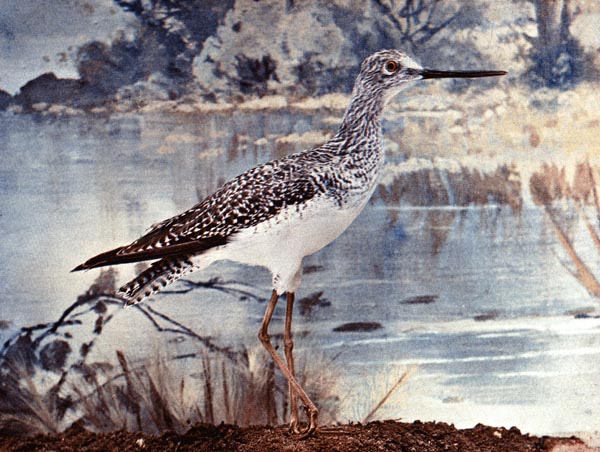
The Yellowlegs belong to the Scolopacidae – Sandpipers, Snipes Family. There are 96 species in the family. The Tringa genus that they are placed in also has Redshanks, Greenshanks, Sandpipers, Tattlers, and the Willet.
The Lesser Yellowlegs (Tringa flavipes) is a medium-sized shorebird similar in appearance to the larger Greater Yellowlegs. It is not closely related to this bird, however, but instead to the much larger and quite dissimilar Willet: merely the fine, clear and dense pattern of the neck shown in breeding plumage indicates these species’ actual relationships.
Their breeding habitat is clearings near ponds in the boreal forest region from Alaska to Quebec. They nest on the ground, usually in open dry locations.
They migrate to the Gulf coast of the United States and south to South America.
This species is a regular vagrant to western Europe, and the odd bird has wintered in Great Britain.
These birds forage in shallow water, sometimes using their bill to stir up the water. They mainly eat insects, small fish and crustaceans.
The call of this bird is softer than that of the Greater Yellowlegs.
The above article is the first article in the monthly serial that was started in January 1897 “designed to promote Knowledge of Bird-Live.” These include Color Photography, as they call them, today they are drawings. There are at least three Volumes that have been digitized by Project Gutenberg.
While looking up the word “birds” in the Dictionary section of my e-Sword program, there is an “i” symbol that shows on the tab of the name of a dictionary. That “i” indicates that there is information about your search word. The Smith’s Bible Dictionary had an “i” so I investigated it. This is what I saw:
Birds Birds. See Sparrow.
So when I went there, this interesting definition of “sparrow” was found and I wanted to share it with you.
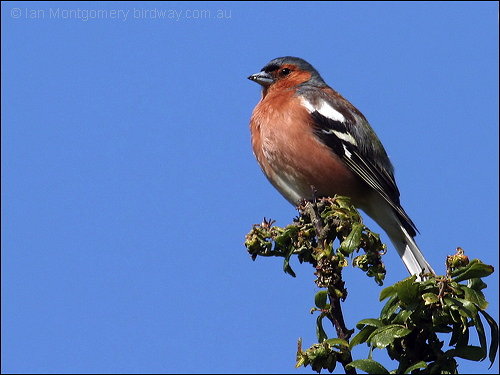
Eurasian Chaffinch (Fringilla coelebs) by Ian
Sparrow
Sparrow. (Hebrew, tzippor, from a root signifying to “chirp” or “twitter”, which appears to be a phonetic representation of the call-note of any passerine (sparrow-like) bird). This Hebrew word occurs upwards of forty times in the Old Testament. In all passages, except two, it is rendered by the Authorized Version indifferently as “bird” or “fowl,” and denotes any small bird, both of the sparrow-like species and such as the starling, chaffinch, greenfinch, linnet, goldfinch, corn-bunting, pipits, blackbird, song-thrush, etc. In Psalm 84:3, and Psalm 102:7, it is rendered “sparrow.”
Yea, the sparrow hath found an house, and the swallow a nest for herself, where she may lay her young, even thine altars, O LORD of hosts, my King, and my God. (Psalms 84:3 KJV)
I watch, and am as a sparrow alone upon the house top. (Psalms 102:7 KJV)
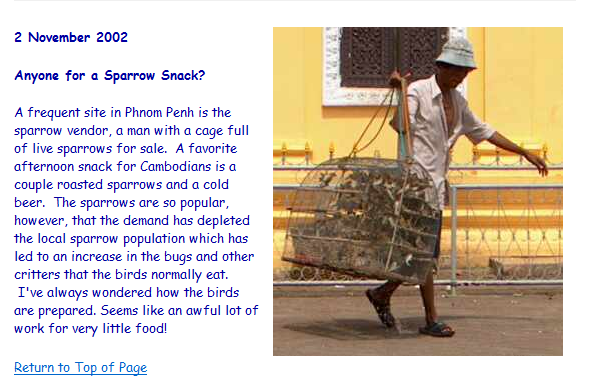
Anyone for a Sparrow Snack?
The Greek, stauthion, (Authorized Version, “sparrow”), occurs twice in the New Testament, Matthew 10:29; Luke 12:6-7. (The birds above mentioned are found in great numbers in Palestine, and are of very little value, selling for the merest trifle, and are, thus, strikingly used by our Saviour, Matthew 10:20, as an illustration of our Father’s care for his children. — Editor).
Are not two sparrows sold for a farthing? and one of them shall not fall on the ground without your Father. (Matthew 10:29 KJV)
Are not five sparrows sold for two farthings, and not one of them is forgotten before God? But even the very hairs of your head are all numbered. Fear not therefore: ye are of more value than many sparrows. (Luke 12:6-7 KJV)
Blue Rock Thrush (Monticola solitarius) by Nikhil Devasar
The blue thrush, (Petrocossyphus cyaneus), is probably the bird to which the psalmist alludes in Psa_102:7, as “the sparrow that sitteth alone upon the house-top.” It is a solitary bird, eschewing the society of its own species, and rarely more than a pair are seen together. The English tree-sparrow, (Passer montanus), is also very common, and may be seen in numbers on Mount Olivet, and also about the sacred enclosure of the mosque of Omar. This is, perhaps, the exact species referred to in Psalm 84:3.
Yea, the sparrow hath found an house, and the swallow a nest for herself, where she may lay her young, even thine altars, O LORD of hosts, my King, and my God. (Psalms 84:3 KJV)
House Sparrows visiting NA Parrot Show Outside
Dr. Thompson, in speaking of the great numbers of the house-sparrows and field-sparrows in troublesome and impertinent generation, and nestle just where you do not want them. “They stop your stove — and water-pipes with their rubbish, build in the windows and under the beams of the roof, and would stuff your hat full of stubble in half a day, if they found it hanging in a place to suit them.”
(I added the verses to make it easier and also the “blue thrush, (Petrocossyphus cyaneus)” could not be found. Photos also inserted.)
The Blue Rock Thrush (Monticola solitarius) is a species of chat. This thrush-like Old World flycatcher was formerly placed in the family Turdidae. It is now found in the Muscicapidae family.
Smith’s Bible Dictionary, originally named A Dictionary of the Bible, was a 19th century Bible dictionary containing upwards of four thousand entries that became named after its editor, William Smith. Its popularity was such that condensed dictionaries appropriated the title, “Smith’s Bible Dictionary”.
The original dictionary was published as a three volume set in 1863, in London and Boston, USA. This first edition was followed in 1893 by an expanded four volume version which was published in the United States as A dictionary of the Bible comprising its antiquities, biography, geography, and natural history, edited by Smith and J. M. Fuller.
The original publications are now in the public domain; some derivative, commercial versions are still in copyright.
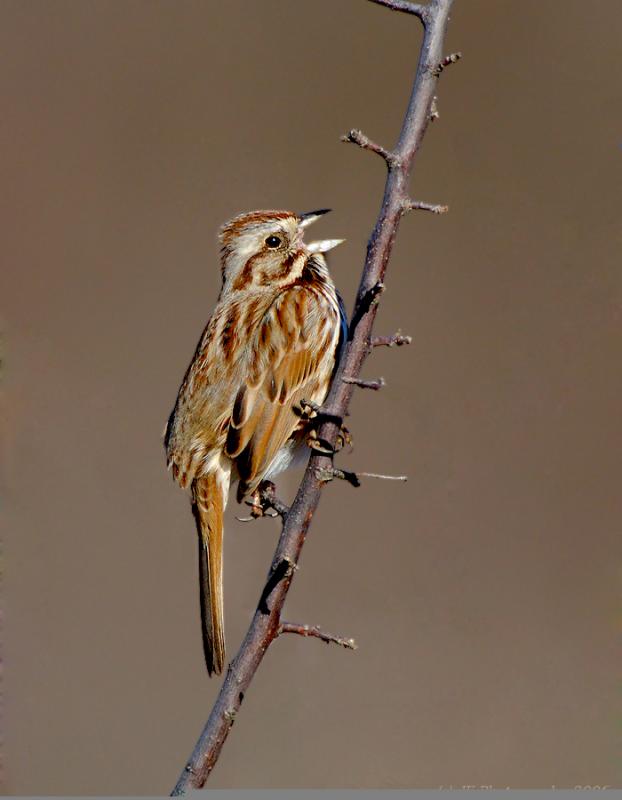
Russet Sparrow (Passer rutilans) by Nikhil Devasar
In the Bible, the Sparrows are mentioned in 7 verses. Check out these from the NKJV:
Even the sparrow has found a home, And the swallow a nest for herself, Where she may lay her young— Even Your altars, O LORD of hosts, My King and my God. (Psalms 84:3 NKJV)
I lie awake, And am like a sparrow alone on the housetop. (Psalms 102:7 NKJV)
Like a flitting sparrow, like a flying swallow, So a curse without cause shall not alight. (Proverbs 26:2 NKJV)
Are not two sparrows sold for a copper coin? And not one of them falls to the ground apart from your Father’s will. (Matthew 10:29 NKJV)
Do not fear therefore; you are of more value than many sparrows. (Matthew 10:31 NKJV)
Are not five sparrows sold for two copper coins? And not one of them is forgotten before God. (Luke 12:6 NKJV)
But the very hairs of your head are all numbered. Do not fear therefore; you are of more value than many sparrows. (Luke 12:7 NKJV)
Sparrows are not always thought of very highly. Many people think they are just “little brown birds” and are of no use. But is that what the Scriptures says in those verses? No.
What can you learn from those verses?
The sparrow has found a ____________
The sparrow is found on the __________________
How does the sparrow fly? (see Proverbs 26:2) _______________
Who is aware of or allows a sparrow to fall to the ground? ______________
Are sparrows forgotten by God? ______________
How many sparrows were sold for one copper coin? ________
For two copper coins? ___________
Who is more valuable, you or a sparrow? _____________
We will talk more about Sparrows in the next Bible Birds – Sparrows II. For now, here are a few pictures of different Sparrows around the world.
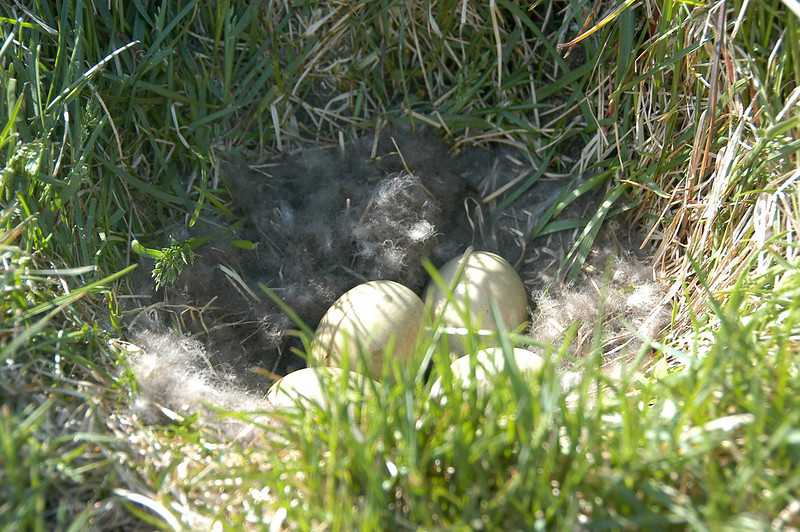
Common Eider (Somateria mollissima) nest by Bob-Nan
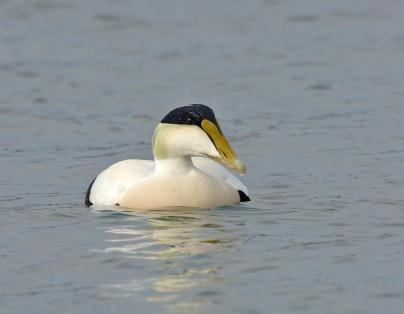
The Eider Duck – The cushion maker.. ~ by a j mithra
When constructing her nest,
a Female Eider Duck will line it
with soft down feathers
that she plucks from her own breast.
This gives the eggs
the best possible cushioning and insulation.
Nuggets Plus
Jesus didn’t pluck His down feathers,
but, plucked Himself from heaven
and came down to give His whole life
to cushion and insulate our lives..
So that we may hatch to become
more like Him to do His will
in our lives on earth as it is in heaven..
I will both lay me down in peace, and sleep: for thou, LORD, only makest me dwell in safety. (Psalm 4:8)
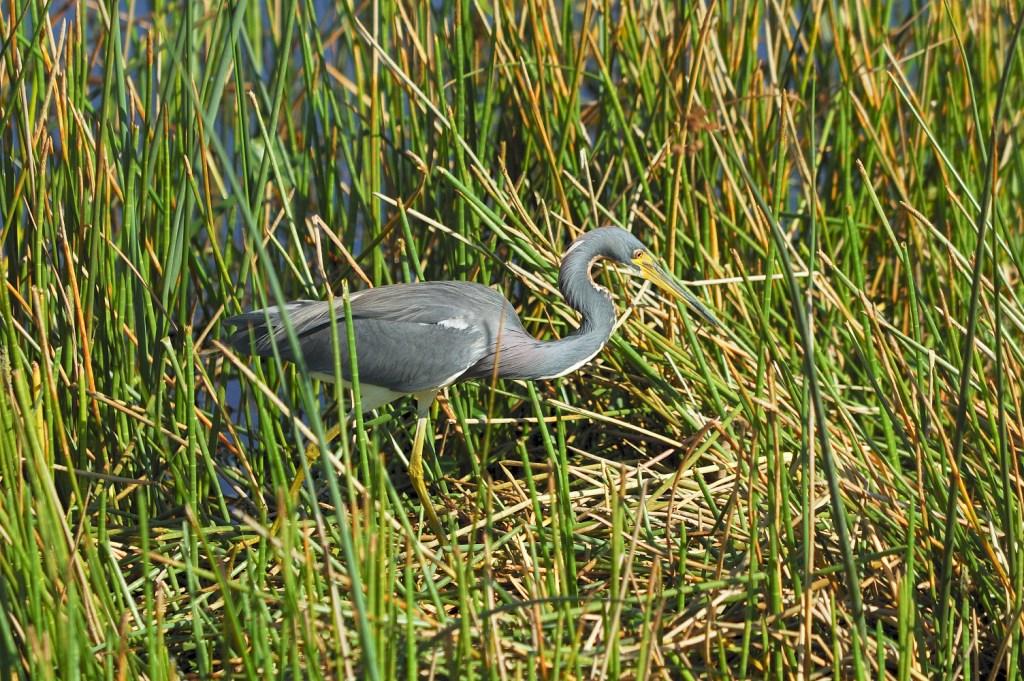
I watch Great Blue Herons, Great Egrets, Cattle Egrets, Little Blue Herons, Tricolored Herons and Green Herons which are quite common in our area. They are all in the same family and all seem to have a characteristic of being very patient. Have you just sat and watched them? When you are out birdwatching it is a habit of those in the Ardeidae – Herons, Bitterns Family to stand very still and wait for some food to swim by or to lean over and strike a pose. They freeze other than a side-to-side movement of their neck.
Herons are mentioned twice in the Bible, and only in a list of unclean birds to not eat. Leviticus 11:19 and Deuteronomy 14:18.
the stork, the heron after its kind, the hoopoe, and the bat. (Leviticus 11:19 NKJV)
the stork, the heron after its kind, and the hoopoe and the bat. (Deuteronomy 14:18 NKJV)
Here is a video of a Great Egret at Lake Parker looking for something in a tree. I strung three short videos together. Taken back in 2008.
The Herons are so patient it reminds me that I need to be more patient. So, here are some of the verses in Scripture that tell us to be patient or to wait:
Rest in the LORD, and wait patiently for Him; Do not fret because of him who prospers in his way, Because of the man who brings wicked schemes to pass. (Psalms 37:7 NKJV)
…I waited patiently for the LORD; And He inclined to me, And heard my cry. (Psalms 40:1 NKJV)
The end of a thing is better than its beginning; The patient in spirit is better than the proud in spirit. (Ecclesiastes 7:8 NKJV)
And a servant of the Lord must not quarrel but be gentle to all, able to teach, patient, (2 Timothy 2:24 NKJV)
Here’s a good one for us and the heron when he catches his fish:
And so, after he had patiently endured, he obtained the promise. (Hebrews 6:15 NKJV)
And then one of my favorite passages that has to with waiting, even though the Eagle is mentioned instead of the Heron.
Have you not known? Have you not heard? The everlasting God, the LORD, The Creator of the ends of the earth, Neither faints nor is weary. His understanding is unsearchable. He gives power to the weak, And to those who have no might He increases strength. Even the youths shall faint and be weary, And the young men shall utterly fall, But those who wait on the LORD Shall renew their strength; They shall mount up with wings like eagles, They shall run and not be weary, They shall walk and not faint. (Isaiah 40:28-31 NKJV)
They are walking birds, feeding both on the ground and in trees; bill slender, grooved, nostrils opening in a fleshy membrane; tail variable, short and square, or long and pointed; feet stout, often reddish. Color usually grayish brown. Call-notes a characteristic cooing.
Mourning Dove (Zenaida macroura) 2 Neal Addy Gallery
Family Columbidae includes some 310 species. In general the terms “dove” and “pigeon” are used somewhat interchangeably. In ornithological practice, there is a tendency for “dove” to be used for smaller species and “pigeon” for larger ones, but this is in no way consistently applied, and historically the common names for these birds involve a great deal of variation between the terms “dove” and “pigeon.” This family occurs worldwide, but the greatest variety is in Indomalaya and Australasia. Young doves and pigeons are called “squabs.”
Pigeons and doves are stout-bodied birds with short necks, and have short slender bills with a fleshy cere. The species commonly referred to just as “pigeon” is the Feral Rock Pigeon, common in many cities.
Doves and pigeons build relatively flimsy nests from sticks and other debris, which may be placed in trees, on ledges or on the ground, depending on species. They lay one or two eggs, and both parents care for the young, which leave the nest after 7 to 28 days. Doves feed on seeds, fruit and plants. Unlike most other birds, the doves and pigeons produce “crop milk”, which is secreted by a sloughing of fluid-filled cells from the lining of the crop. Both parents produce this highly nutritious substance to feed to the young.
Victoria Crowned Pigeon (Goura victoria) by Lee at Zoo Miami
Pigeons and doves exhibit considerable variations in size. The largest species is the crowned pigeon of New Guinea, which is nearly turkey-sized, at a weight of 4.4-8.8 lb (2-4 kg) The smallest is the New World ground-dove of the genus Columbina, which is the same size as a House Sparrow and weighs as little as 22 g. With a total length of more than 19 in (50 cm) and weight of almost 2 lb (1 kg), the largest arboreal species is the Marquesan Imperial Pigeon, while the Dwarf Fruit Dove, which may measure as little as 5.1 in (13 cm), has a marginally smaller total length than any other species from this family. Smaller species tend to be known as doves, while larger species as pigeons.
Overall, the Columbidae tend to have short bills and legs, and small heads on large compact bodies. They have a habit of head bobbing was shown to be due to their natural desire to keep their vision constant. The wings are large and have low wing loadings; pigeons have strong wing muscles (wing muscles comprise 31–44% of their body weight) and are amongst the strongest fliers of all birds. They are also highly maneuverable in flight.
Superb Fruit Dove (Ptilinopus superbus) by Ian
The plumage (feathers and colors) of the family is variable. Granivorous (seed eater) species tend to have dull plumage, with a few exceptions, whereas the frugivorous (fruit eater) species have brightly-coloured plumage. The Ptilinopus fruit doves are some of the brightest coloured pigeons, with the three endemic species of Fiji and the Indian Ocean Alectroenas being amongst the brightest coloured. In addition to bright colours pigeons may sport crests or other ornamentation.
Seeds and fruit form the major component of the diet of pigeons and doves. In fact, the family can be divided into the seed-eating or granivorous species (subfamily Columbinae) and the fruit-eating or frugivorous species (the other four subfamilies). The granivorous typically feed on seed found on the ground, whereas the species that feed on fruit and mast tend to feed in trees.
Now when the days of her purification according to the law of Moses were completed, they brought Him to Jerusalem to present Him to the Lord (as it is written in the law of the Lord, “EVERY MALE WHO OPENS THE WOMB SHALL BE CALLED HOLY TO THE LORD” ), and to offer a sacrifice according to what is said in the law of the Lord, “A PAIR OF TURTLEDOVES OR TWO YOUNG PIGEONS.” (Luke 2:22-24 NKJV)
In the Bible (Old Testament), doves or young pigeons were acceptable burnt offerings for those who couldn’t afford a more expensive animal. In the book of Genesis, Noah sent out a dove after the great flood in order to determine how far the floodwaters had receded. Dove is also a term of endearment in the Song of Songs and elsewhere.
When He had been baptized, Jesus came up immediately from the water; and behold, the heavens were opened to Him, and He saw the Spirit of God descending like a dove and alighting upon Him. (Matthew 3:16 NKJV)
Jesus’ parents sacrificed doves on his behalf after his circumcision (Luke 2:24). Later the Holy Spirit descended upon Jesus at his baptism like a dove (Matthew 3:16), and subsequently, the “peace dove” became a common Christian symbol of the Holy Spirit.
(Information from Wikipedia and other internet sources.)
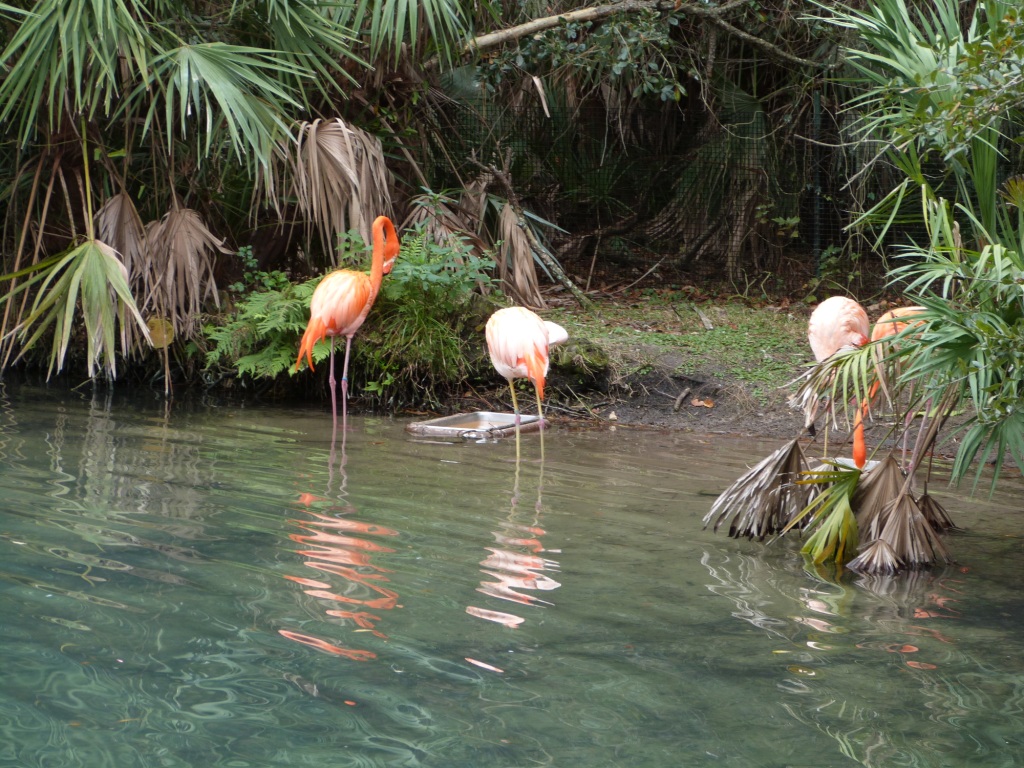
American Flamingo (Phoenicopterus ruber) Brevard Zoo by Lee
“During my research I noticed how common it is to run into articles that talk about how “surprising,” “unexpected,” or even “baffling” the results of a study or find is to scientists. Although I know Creation Scientists are probably often surprised as well, I can’t help thinking that scientists would be less surprised if they all had a more accurate worldview.”…
In the beginning was the Word, and the Word was with God, and the Word was God. He was in the beginning with God. All things were made through Him, and without Him nothing was made that was made. In Him was life, and the life was the light of men. And the light shines in the darkness, and the darkness did not comprehend it. (John 1:1-5 NKJV)
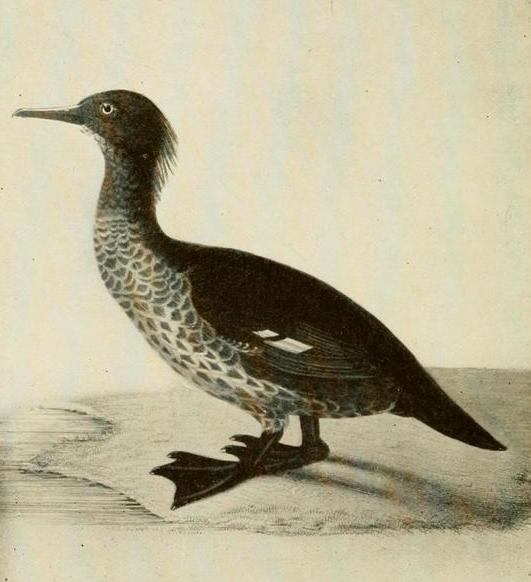
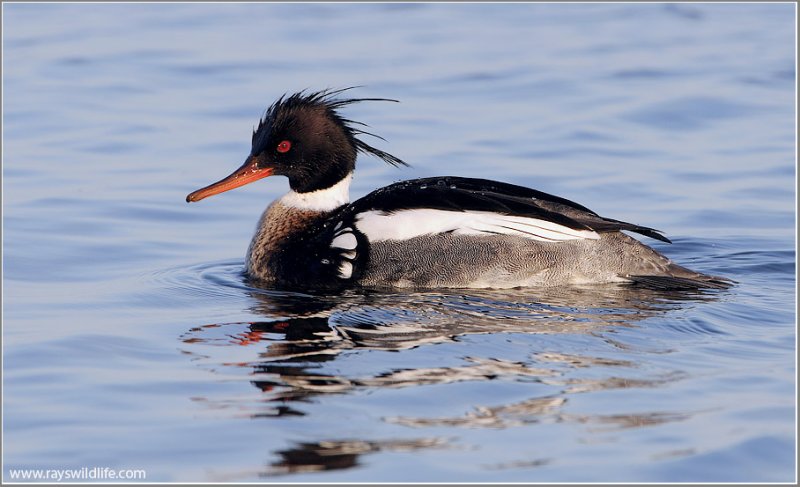
Red-breasted Merganser from Birds Illustrated by Color Photography
THE RED BREASTED MERGANSER.
HY this duck should be called red-breasted is not at first apparent, as at a distance the color can not be distinguished, but seen near, the reason is plain. It is a common bird in the United States in winter, where it is found in suitable localities in the months of May and June. It is also a resident of the far north, breeding abundantly in Newfoundland, Labrador, Greenland, and Iceland. It is liberally supplied with names, as Red-Breasted Goosander or Sheldrake, Garbill, Sea Robin, etc.
There is a difference in opinion as to the nesting habits of the Red-Breast, some authorities claiming that, like the Wood Duck, the nest is placed in the cavity of a tree, others that it is usually found on the ground among brushwood, surrounded with tall grasses and at a short distance from water. Davie says that most generally it is concealed by a projecting rock or other object, the nest being made of leaves and mosses, lined with feathers and down, which are plucked from the breast of the bird. The observers are all probably correct, the bird adapting itself to the situation.
Fish is the chief diet of the Merganser, for which reason its flesh is rank and unpalatable. The Bird’s appetite is insatiable, devouring its food in such quantities that it has frequently to disgorge several times before it is able to rise from the water. This Duck can swallow fishes six or seven inches in length, and will attempt to swallow those of a larger size, choking in the effort.
The term Merganser is derived from the plan of the bird’s bill, which is furnished with saw teeth fitting into each other.
The eggs of the Red-Breasted Merganser vary from six to twelve, are oval in shape, and are of a yellowish or reddish-drab, sometimes a dull buffy-green.
You may have seen pictures of this Duck, which frequently figures in dining rooms on the ornamental panels of stuffed game birds, but none which could cause you to remember its life-like appearance. You here see before you an actual Red-Breasted Merganser.
Birds Vol 2 #2 – The Red Breasted Merganser
From col. J. G. Parker, Jr.
Red-breasted Merganser (Mergus serrator) by Ray
Lee’s Addition:
Out of the ground the LORD God formed every beast of the field and every bird of the air, and brought them to Adam to see what he would call them. And whatever Adam called each living creature, that was its name. (Genesis 2:19 NKJV)
The adult Red-breasted Merganser is 20–24 in (51–62 cm) long with a 28–34 in (70–86 cm) wingspan. It has a spiky crest and long thin red bill with serrated edges. The male has a dark head with a green sheen, a white neck with a rusty breast, a black back, and white underparts. Adult females have a rusty head and a greyish body. The juvenile is like the female, but lacks the white collar and has a smaller white wing patch.
The call of the female is a rasping prrak prrak, while the male gives a feeble hiccup-and-sneeze display call. (from xeno-canto)
Red-breasted Mergansers dive and swim underwater. They mainly eat small fish, but also aquatic insects, crustaceans, and frogs.
Its breeding habitat is freshwater lakes and rivers across northern North America, Greenland, Europe, and Asia. It nests in sheltered locations on the ground near water. It is migratory and many northern breeders winter in coastal waters further south.
It has been claimed to be the fastest bird in level flight, reaching speeds of 161 km/h (100 mph), but is disputed whether the White-throated Needletail is faster, reportedly flying at 170 km/h (105 mph).
Here is a video of a Common Merganser flipping his feet after diving for food that was given him at the Zoo Miami Wings of Asia Aviary – by me.
The above article is the first article in the monthly serial that was started in January 1897 “designed to promote Knowledge of Bird-Live.” These include Color Photography, as they call them, today they are drawings. There are at least three Volumes that have been digitized by Project Gutenberg.
Although this bird is called the Kentucky Warbler, we must not think he visits that state alone.
We find him all over eastern North America. And a beautiful bird he is.
As his name tells you he is one of a family of Warblers.
I told you somewhere else that the Finches are the largest family of birds. Next to them come the Warblers.
Turn back now and see how many Warblers have been pictured so far.
See if you can tell what things group them as a family. Notice their bills and feet.
This bird is usually found in the dense woods, especially where there are streams of water.
He is a good singer, and his song is very different from that of any of the other Warblers.
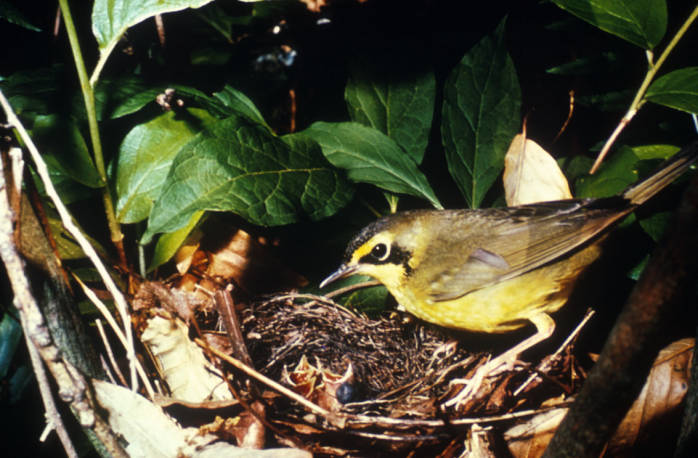
I once watched one of these birds—olive-green above and yellow beneath. His mate was on a nest near by and he was entertaining her with his song.
He kept it up over two hours, stopping only a few seconds between his songs. When I reached the spot with my field-glass I was attracted by his peculiar song. I don’t know how long he had been singing. I stayed and spent two hours with him and he showed no signs of stopping. He may be singing yet. I hope he is.
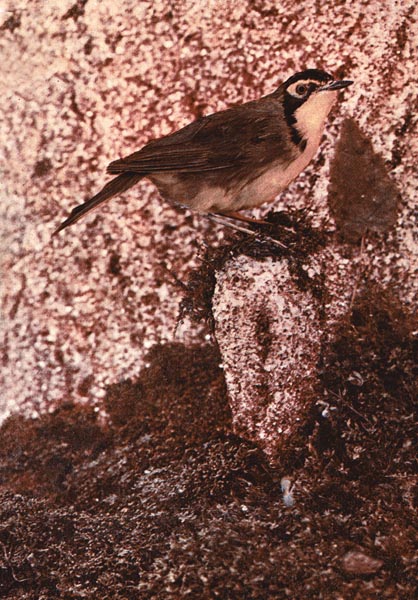
You see him here perched on a granite cliff. I suppose his nest is near by.
He makes it of twigs and rootlets, with several thicknesses of leaves. It is neatly lined with fine rootlets and you will always find it on or near the ground.
In the September and October number of “Birds” you will find several Warblers and Finches. Try to keep track of them and may be you can do as many others have done—tell the names of new birds that come along by their pictures which you have seen in “Birds.”
From col. F. M. Woodruff.
THE KENTUCKY WARBLER.
ETWEEN sixty and seventy warblers are described by Davie in his “Nests and Eggs of North American Birds,” and the Kentucky Warbler is recognized as one of the most beautiful of the number, in its manners almost the counterpart of the Golden Crowned Thrush (soon to delight the eyes of the readers of Birds), though it is altogether a more conspicuous bird, both on account of its brilliant plumage and greater activity, the males being, during the season of nesting, very pugnacious, continually chasing one another about the woods. It lives near the ground, making its artfully concealed nest among the low herbage and feeding in the undergrowth, the male singing from some old log or low bush, his song recalling that of the Cardinal, though much weaker.
The ordinary note is a soft schip, somewhat like the common call of the Pewee. Considering its great abundance, says an observer, the nest of this charmer is very difficult to find; the female, he thought, must slyly leave the nest at the approach of an intruder, running beneath the herbage until a considerable distance from the nest, when, joined by her mate, the pair by their evident anxiety mislead the stranger as to its location.
It has been declared that no group of birds better deserves the epithet “pretty” than the Warblers. Tanagers are splendid, Humming Birds refulgent, others brilliant, gaudy, or magnificent, but Warblers alone are pretty.
The Warblers are migratory birds, the majority of them passing rapidly across the United States in spring on the way to their northern nesting grounds, and in autumn to their winter residence within the tropics. When the apple trees bloom they revel among the flowers, vieing in activity and numbers with the bees; “now probing the recesses of a blossom for an insect, then darting to another, where, poised daintily upon a slender twig, or suspended from it, they explore hastily but carefully for another morsel. Every movement is the personification of nervous activity, as if the time for their journey was short; as, indeed, appears to be the case, for two or three days at most suffice some species in a single locality.”
We recently saw a letter from a gentleman living at Lake Geneva, in which he referred with enthusiasm to Birds, because it had enabled him to identify a bird which he had often seen in the apple trees among the blossoms, particularly the present season, with which he was unacquainted by name. It was the Orchard Oriole, and he was glad to have a directory of nature which would enable him to add to his knowledge and correct errors of observation. The idea is a capitol one, and the beautiful Kentucky Warbler, unknown to many who see it often, may be recognized in the same way by residents of southern Indiana and Illinois, Kansas, some localities in Ohio, particularly in the southwestern portion, in parts of New York and New Jersey, in the District of Columbia, and in North Carolina. It has not heretofore been possible, even with the best painted specimens of birds in the hand, to satisfactorily identify the pretty creatures, but with Birds as a companion, which may readily be consulted, the student cannot be led into error.
Lee’s Addition:
I know all the birds of the hills, and all that moves in the field is mine. (Psalms 50:11 ESV)
The Kentucky Warbler is in the New World Warblers – Parulidae Family. At present their are 115 species that make up this family. Warblers are confusing for me to figure out at times. Number 1, I don’t see them often, and then they are passing through on their migration south. They are neat birds and I always enjoy seeing them. Mostly here I see the Yellow-rumps and the Black-and-white occasionally.
The Kentucky Warbler, is a sluggish and heavy warbler with a short tail, preferring to spend most of its time on or near the ground, except when singing.
Kentucky Warbler song by Chris Parrish and call by Andrew Spencer from xeno-canto.org.
They are only about 5-6 inches long. They migrate to the Yucatan Peninsula and many of the Caribbean Islands. That is after they make a non-stop flight across the Gulf of Mexico. The Lord has given them quite a flying ability to do that.
The above article is the first article in the monthly serial that was started in January 1897 “designed to promote Knowledge of Bird-Live.” These include Color Photography, as they call them, today they are drawings. There are at least three Volumes that have been digitized by Project Gutenberg.













 Lee's Birdwatching Adventures Plus