***

A SONG OF PRAISE TO OUR GOD
***
He put a new song in my mouth, a song of praise to our God; Many will see and fear And will trust in the LORD. (Psalms 40:3 NASB)
American Yellow Warbler (Dendroica aestiva) singing by Jim Fenton
*
*
He put a new song in my mouth, a song of praise to our God; Many will see and fear And will trust in the LORD. (Psalms 40:3 NASB)
American Yellow Warbler (Dendroica aestiva) singing by Jim Fenton
*
*

“But those who wait on the LORD Shall renew their strength; They shall mount up with wings like eagles, They shall run and not be weary, They shall walk and not faint.” (Isaiah 40:31 NKJV)
Bald Eagle (Haliaeetus leucocephalus) Flying by Aesthetic Photos
*
*
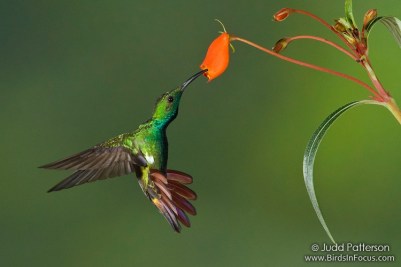
Green-breasted Mango (Anthracothorax prevostii) by Judd Patterson
Many, O LORD my God, are the wonders which You have done, And Your thoughts toward us; There is none to compare with You. If I would declare and speak of them, They would be too numerous to count.
(Psalms 40:5 NASB)
Green-breasted Mango (Anthracothorax prevostii) by Judd Patterson
*
*

Canada Goose (Branta canadensis) by Ian
~ by Emma Foster
High in North America, as summer was coming, there lived a flock of Canadian geese. They all lived together by a large lake. One of the Canadian geese was named Susie, and she loved to swim in the water every day.
On a particularly hot day, Susie was out on the water when she spotted a group of people in a boat. One person was driving the boat very quickly around the lake. Another person was holding onto a rope and riding along the water on a board of some kind.
Susie was very interested in this new sport she had discovered. She decided to call all of the geese together to watch the people.
When all of the geese had watched the people for a few minutes, they grew very excited. They decided to play the same game too, only they would have to build everything from scratch.
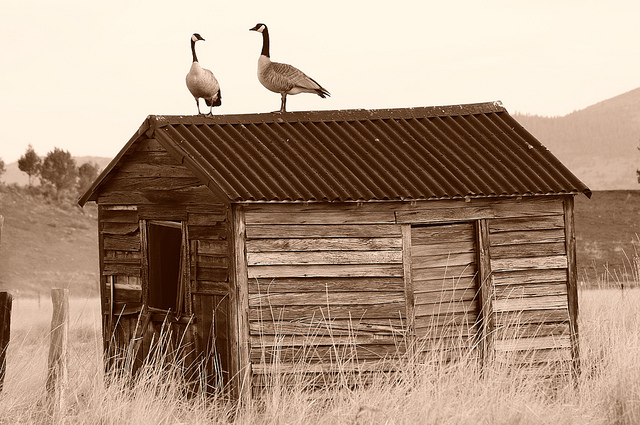
Canada Goose (Branta canadensis) On Shed ©Flickr Darron Birgwnheler
In an old shed in the backyard of one of the houses by the lake, Susie and the other geese found a long, thin piece of wood, an old rope, a canoe covered in cobwebs, and a few fishhooks. The geese shoved a hook into the back side of the boat and into the piece of wood, and tied the rope to both hooks. One goose sat down in the boat to direct it, four more geese stood behind the canoe to cast it off and push along in the water, and Susie stood on the piece of wood, bending down to hold the rope in her beak in case the hook came off. Another goose stood in the back of the boat to make sure that the hook in the boat did not come out either.
After taking off, the four geese started flying so that Susie was dragged behind them on the piece of wood. It took several attempts before Susie could stay on the board, but by the end of the day she was able to do a few tricks.
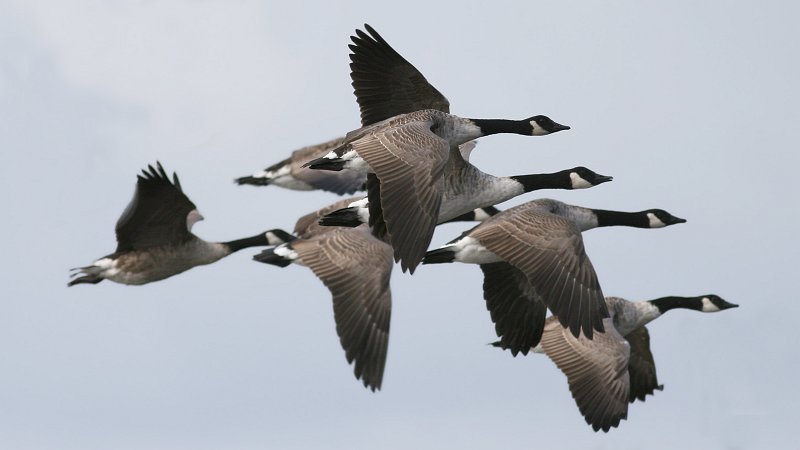
The Four Canadian Geese and two friends that joined them. ©WikiC
The next day, one of the geese came back to announce he had seen a flyer for a water skiing contest at the end of the week at that very pond. Susie immediately decided that she and the other geese should enter. It was only Tuesday, so they had plenty of time to practice. Susie wanted to make sure she could pull off all of the tricks she had seen the people do when they were on the lake.
By that Friday, Susie and all of the other geese had had enough practice so that they were able to accomplish all of the tricks. The geese even invented some of their own.
On that Saturday Susie, the geese, and lots of different people met on the lake and the contest began. A few people went before Susie and the other geese. They were really good and were able to perform all kinds of tricks. Finally, it was Susie’s turn. She jumped onto the piece of wood while the other geese got to their positions.

“They Were Off” – Canada Goose ©Pixabay
Then they were off! Susie did her best to perform all of the tricks she had practiced. This time, she tried to jump higher in the air when she performed one. One of the tricks was when Susie did a flip in the air after jumping the ramp and flying for about ten feet. Once Susie had completed her routine, she skidded onto the grass sticking the landing perfectly. Everyone cheered.
At the end of the contest, a blue ribbon was awarded to Susie and the geese. From then on, Susie entered the contest every year, and she always kept the blue ribbon pinned to the back of the shed where they had found the piece of wood, hooks, rope, and canoe.
Lee’s Addition:
Thanks, Emma, for another great bird tale. You just keep improving and each one becomes your best. This is definitely one of “your best.”
The teamwork and ingenuity by that group of geese reminds me of these verses:
Now the company of believers was of one heart and soul, and not one of them claimed that anything which he possessed was [exclusively] his own, but everything they had was in common and for the use of all. (Acts 4:32 AMP)
O magnify the LORD with me, and let us exalt his name together. (Psalms 34:3 KJV)
And all that believed were together, and had all things common; (Acts 2:44 KJV)
*
Canada Goose – Wikipedia
*
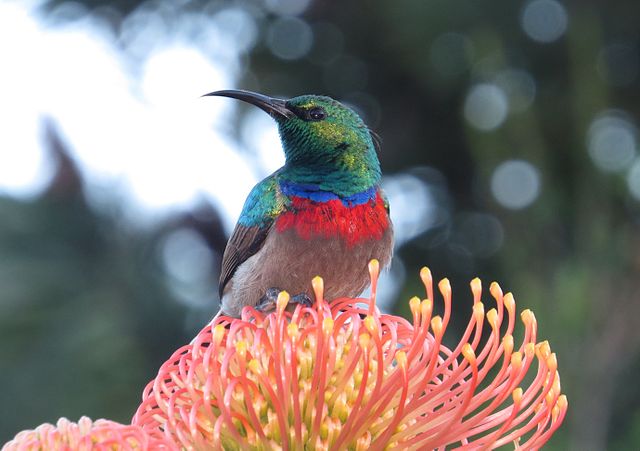
Southern Double-collared Sunbird (Cinnyris chalybeus) ©WikiC
Look at the birds of the air, for they neither sow nor reap nor gather into barns; yet your heavenly Father feeds them. Are you not of more value than they?
(Matthew 6:26 NKJV)
*
*
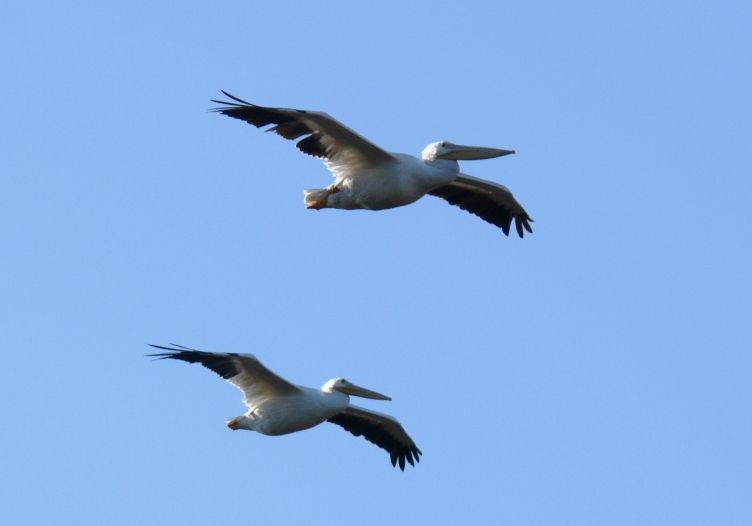
Then God said, “Let the waters abound with an abundance of living creatures, and let birds fly above the earth across the face of the firmament of the heavens.” (Genesis 1:20 NKJV)
American White Pelican (Pelecanus erythrorhynchos) by Lee at Circle B Bar Reserve
*
*
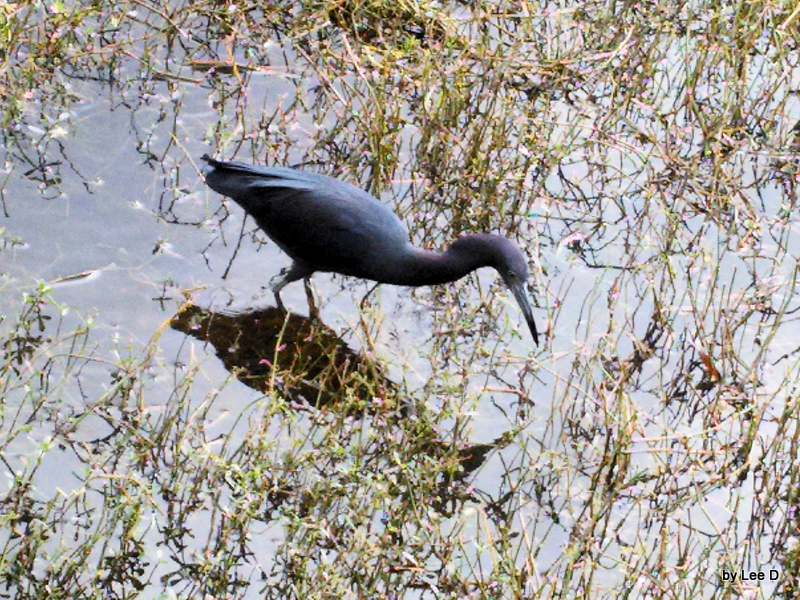
Recently we were on our way home from shopping and stopped in the little park at the south side of Lake Howard. All we had with us were our phones. Not much was going on, but one Little Blue Heron was searching for his lunch. It was interesting watching him move his head from side to side. Not sure if the bird was looking around the plants or just trying to see better. It was an overcast day. Our special Avian Wonder this time from the creator is this Little Blue Heron.
The “Little Blues,” as I many times refer to them, are another favorite of mine to watch here in central Florida. This one just seemed so intent on what he was doing, that it reminded me of the verse about the lady who was diligently searching for a coin. How diligently do we search God’s Word?
Either what woman having ten pieces of silver, if she lose one piece, doth not light a candle, and sweep the house, and seek diligently till she find it? (Luke 15:8 KJV)
And you will seek Me and find Me, when you search for Me with all your heart. (Jeremiah 29:13 NKJV)
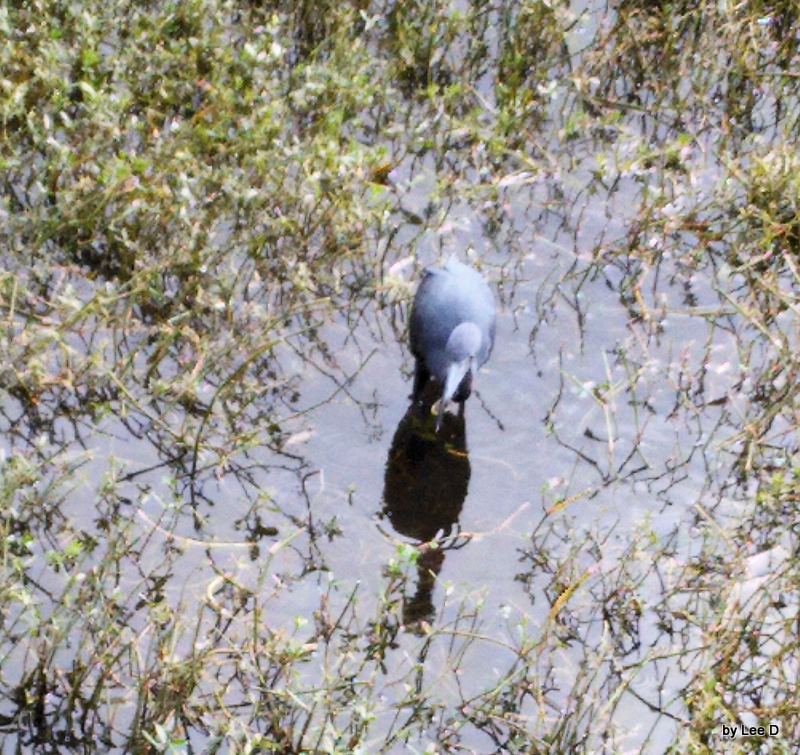
Little Blue Heron with catch at S. Lake Howard Park
Bad photo, but you can see the results of one of his searches.
The Little Blue Heron “stalks its prey methodically in shallow water, often running as it does so. It eats fish, frogs, crustaceans, small rodents and insects.” (Wikipedia)
Find out more about them at:
*
 Who Colored These Originally?
In the beginning God created the heaven and the earth. (Genesis 1:1 KJV)
My Bible tells me in Genesis chapter 1 that God created everything, including all our avian wonders.
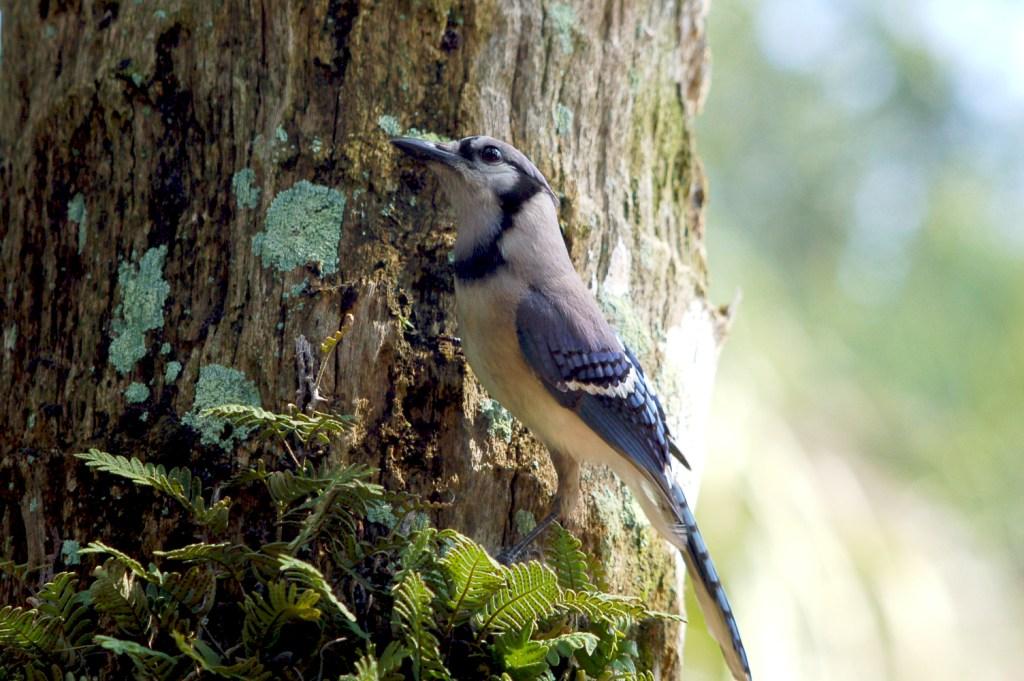
Blue Jay (Cyanocitta cristata) at Bok Tower By Dan’sPix
In fact, we are told specifically that on the fifth day of creation, God created the Birds:
Then God said, “Let the waters abound with an abundance of living creatures, and let birds fly above the earth across the face of the firmament of the heavens.” So God created great sea creatures and every living thing that moves, with which the waters abounded, according to their kind, and every winged bird according to its kind. And God saw that it was good. And God blessed them, saying, “Be fruitful and multiply, and fill the waters in the seas, and let birds multiply on the earth.” So the evening and the morning were the fifth day. (Genesis 1:20-23 NKJV)
When the birds were brought forth, judging from today, that they were beautifully arrayed. We can look around at the over 10,000 species today, in spite of being corrupted by the curse (Genesis 3), and see that they are magnificently arrayed in beautiful, fantastic colors and hues.
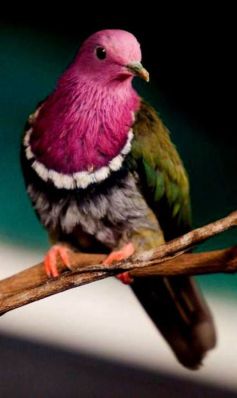
Nicobar Pigeon – Falsely Colored
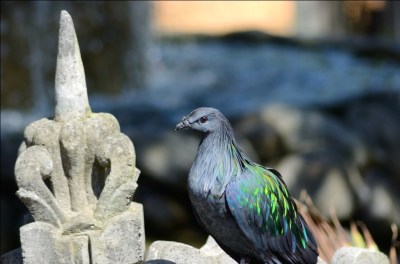
Nicobar Pigeon at Lower Park Zoo by Dan
Then again in John 1:1-3 we see that the Word, the Lord Jesus Christ, is the one who made them.
In the beginning was the Word, and the Word was with God, and the Word was God. The same was in the beginning with God. All things were made by him; and without him was not any thing made that was made. (John 1:1-3 KJV)
All of that was stated to establish who the birds were created by. Now for the point of this article.
I belong to Pinterest which is a visual discovery tool that you can use to find ideas for all your projects and interests. You can find all kinds of photos and of course, many bird photos.
Now, the irritation, for me, is that lately many photos of birds have been “photo-shopped” or someone has used other editing software programs to change their colors. No harm intended, but the colors they are adding to the birds, messes up the beauty of their Creator’s original design and color for them.
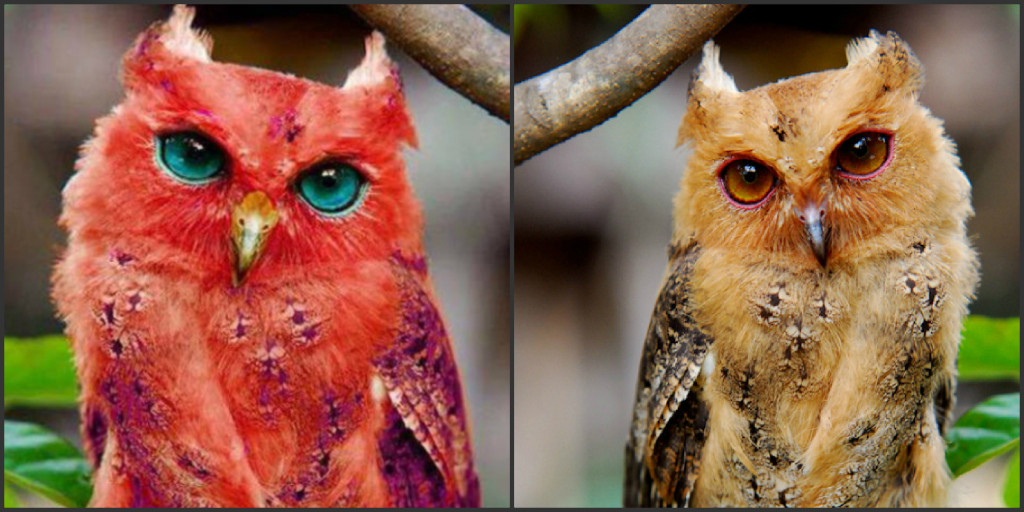
False – A Rare Red Owl – Snopes_com
Some people, who are not familiar with what the birds actually look like, may think that is the way they look in the wild. One such case fooled people into believing that a rare Red Owl actually exist. When the asked “Snopes” they found out the truth.
Two more examples:

False – Curl-crested Aricari from Pinterest by Virainova
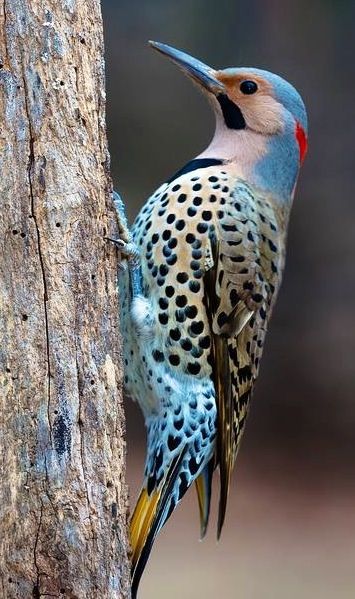
False – Flicker from Pinterest by Spykee
Now for the real birds in nature. Also, do you realize how easy they would be for birds of prey to catch these? They would stand out boldly in the crowd and would be the first captured. Only a Wise Creator, would provide for the safety of the birds by their proper coloration.

Curl-crested Aracari (Pteroglossus beauharnaesii) ©WikiC
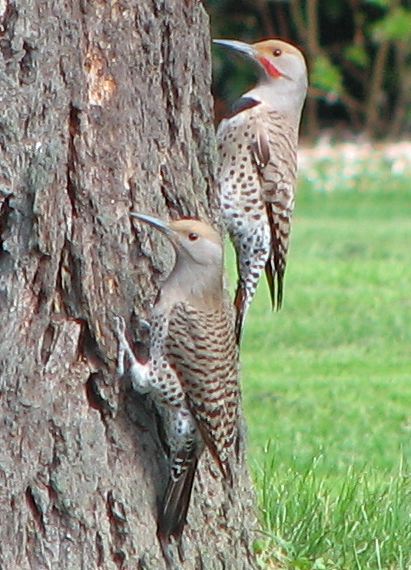
Northern Flicker (Colaptes auratus) red-shafted F-left M-right ©WikiC
I know all the birds of the mountains, And the wild beasts of the field are Mine. (Psalms 50:11 NKJV)
Again, I am not condemning those who color their birds in photos, as long as they don’t try to “pass them off” as the “real” bird.
God’s Wisdom, Majesty, and Knowledge cannot be improved upon.
I am the LORD, and there is no other; There is no God besides Me. I will gird you, though you have not known Me, That they may know from the rising of the sun to its setting That there is none besides Me. I am the LORD, and there is no other; I form the light and create darkness, I make peace and create calamity; I, the LORD, do all these things.’ (Isaiah 45:5-7 NKJV)
*
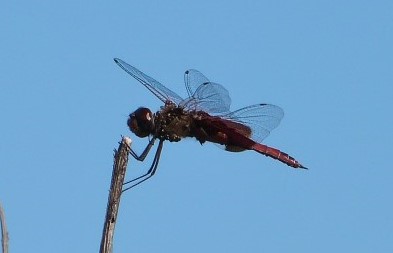
Dragonfly cropped by Lee at Circle B
“Does the hawk fly by your wisdom, And spread its wings toward the south?
(Job 39:26 NKJV)
Flight is a big problem for those who believe that we owe our existence to evolution. Birds, mammals, reptiles, insects, and even some fish fly or at least glide through the air in controlled flight. So many different creatures fly that evolutionists must say that flight evolved several different times.
The dragonfly is among the best fliers in the animal kingdom. The dragonfly can beat its four wings in unison or separately depending on the maneuver it wants to make. Dragonflies can fly at speeds up to 25 miles an hour and even faster. They can hover, take off backward and even make an unbanked turn. The dragonfly eats small insects, including mosquitoes, earning it the nickname “mosquito hawk.” A dragonfly can see a gnat from three feet away, fly to it, capture it and return to its original position in just over one second! One third to one half of its body mass is made up of flight muscles. Its two eyes have a total of 60,000 lenses and are situated so that its range of vision is nearly 360 degrees.
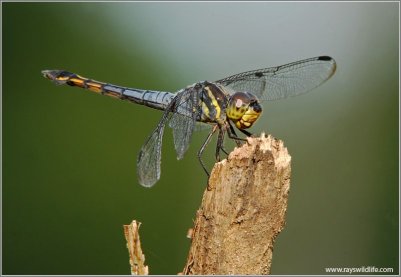
Dragonfly by Raymond Barlow
Dragonflies not only appear in the fossil record fully formed, but in much greater variety than today. One fossilized dragonfly was the size of a crow! Even the United States Air Force has studied the dragonfly to learn how it flies. The dragonfly is no product of natural selection. It is clearly a specially designed creature whose Designer understands flight better than we do. This Designer is our Creator God.
Prayer: I thank You, dear Father, for the beauty and wonder of the dragonfly. You are truly to be glorified! In Jesus’ Name. Amen.
Notes: Richard Conniff, “The Lord of Time”, Reader’s Digest, 6/99, p. 142. Photo: Close-up of a dragonfly head. Courtesy of Victor Korniyenko. (CC-BY-SA 3.0)
©Creation Moments Published on Jan 23, 2015
This topic from Creation Moments has been posted before, but this time they did it with a video. Trust you will find this amazing. Our Lord has shown his Great Wisdom again in the Dragonflies design.

Bald Eagle (Haliaeetus leucocephalus) by Aesthetic Photos
That very hour the word was fulfilled concerning Nebuchadnezzar; he was driven from men and ate grass like oxen; his body was wet with the dew of heaven till his hair had grown like eagles’ feathers and his nails like birds’ claws. (Daniel 4:33 NKJV emphasis mine)
What an interesting verse to read in the Bible. Most of you know what an Eagle looks like, because Eagles fly to many countries.
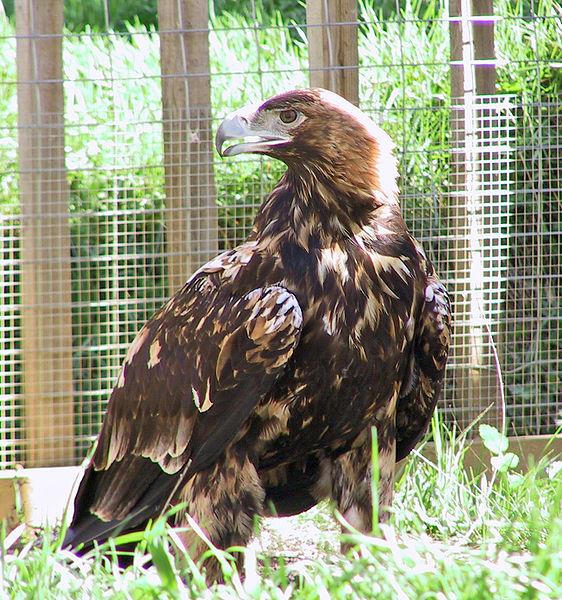
Adalbert’s Eagle Aquila adalberti) ©WikiC
Whose hair was going to grow so long that it would be as long as eagles’ feathers?

Sea Eagle (Haliaeetus pelagicus) Feet by Lee at National Aviary
This is what a person looks like with long nails:

Long nails like a bird’s claws
Whose fingernails and toenails was going to grow so long that they would look like bird claws?
The person that verse is referring to is Nebuchadnezzar. He was the King of Babylon in 605 BC – 562 BC. The Lord God had placed him in power to rule over the whole world, but he had forgotten to give God the credit. He started saying things like:
Do you know what that is called? Pride! The King was failing to give God the credit for making him the ruler, having majesty, and ability to build his royal place.
Do we have a false pride? Yes, we may do great things. You may make 100% on a test, earn a high award, or receive some other great recognition. Are you swelling up with pride? Have you thanked your parents, friends, or, if you know the Lord as Savior, the Lord for helping you achieve your success?
We should be thankful for the abilities that we have. Thank the Lord for helping you remember those answers to get the 100%. Thank Him for allowing you to earn that award. Thank the Lord for being recognized for something you did that was great.
Thank the Lord even if you didn’t get 100%, a trophy, award, or other prize. If you did your best, that is all He can expect you to do. If you didn’t do your best, then ask the Lord to help you do better the next time something comes up.
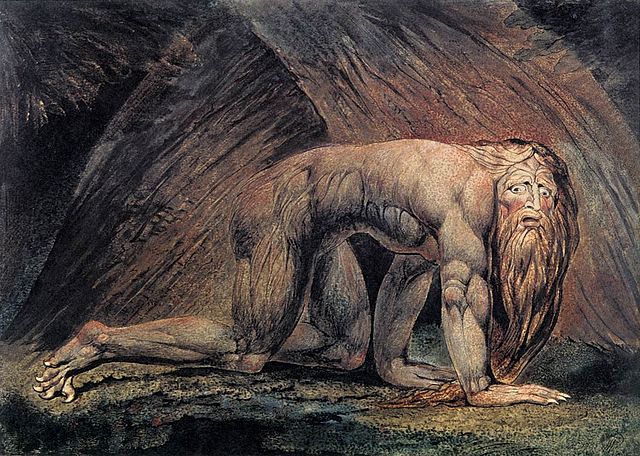
Nebuchadnezzar – showing the king during his bout of insanity by William Blake ©WikiC
Yes, after the Lord sent Nebuchadnezzar out to the field with an animal’s heart, eating grass, growing long hair like eagle’s feathers, and his nails growing long like bird’s claws, He finally looked to the Lord God.
Now I, Nebuchadnezzar, praise and extol and honor the King of heaven, all of whose works are truth, and His ways justice. And those who walk in pride He is able to put down. (Daniel 4:37 NKJV)
*
*

Bald Eagle at Lowry Park Zoo by Lee
That very hour the word was fulfilled concerning Nebuchadnezzar; he was driven from men and ate grass like oxen; his body was wet with the dew of heaven till his hair had grown like eagles’ feathers and his nails like birds’ claws. (Daniel 4:33 NKJV)
This Birds of the Bible Scripture was mentioned over five years ago and it’s time to update and review. “Repetition aids learning” they say. Also, I am currently reading through Daniel again.
Many times the birds mentioned in the Bible are listed as “clean or unclean” or as an “object lesson” to teach some truth. This time the mention of Eagle feathers and birds’ claws are used as a description of a man’s appearance and there is a lesson to be learned here.
So, who was this man? It is actually a very important king, King Nebuchadnezzar of Babylon. The information about the King is found throughout the book of Daniel. To make the story short, the king had a dream and wanted an interpretation of that dream. Not only did he want his dreams interpreted, but he wanted the interpreter to tell him what the dream was about. The wise men and others told the king that was impossible, so the king commanded to kill them. Daniel prayed to God that He would reveal the dream and it’s interpretation to him so he could tell it to the King. God answered that prayer and Daniel was able to reveal it to King Nebuchadnezzar.
King Nebuchadnezzar was the first world ruler and God had given the king great power. Later on, the king’s pride takes over and he thinks he has made this kingdom and does not give God the credit. He even has a great statue made of himself and demands that all fall down and worship him.
Back to making this short. In Daniel chapter 4 the king has another dream and Daniel (Belteshazzar) prays for revelation and again interprets the dream. Daniel 4:9 to 4:18 tells the dream. (Birds are mentions several times in it.) Then Daniel interprets the dream in Daniel 4:19-33. Basically, the Most High is going to let the king learn humility and get rid of the pride that he has.
The king spoke, saying, “Is not this great Babylon, that I have built for a royal dwelling by my mighty power and for the honor of my majesty? (Daniel 4:30 NKJV, emphasis mine)
For seven years, or time periods, will his kingdom be departed from him. He will be out in the field, “eating grass like oxen” and “until you know that the Most High rules in the kingdom of men, and gives it to whomever He chooses.” It is during this time that his hair will grow like “eagles’ feathers and his nails like birds’ claws.”
Sea Eagle (Haliaeetus pelagicus) Feet by Lee at National Aviary
That was the short version, now before we find out if the King learned from this, we will go a little further.
Summarized Bible – “Conclusion: God has power to humble the haughtiest of men who would in their pride act in competition with Him. Those so confident of their own sufficiency will be brought sooner or later to own God’s dominion over them and their own utter weakness. Many have been brought to themselves by being made beside themselves.”

Harpy Eagle (Harpia harpyja) by Lee at Zoo Miami 2014
Daniel & the Revelation by Uriah Smith: “The King’s Self-exaltation and Humiliation.–Nebuchadnezzar failed to profit by the warning he had received, yet God bore with him twelve months longer before the blow fell. All that time he cherished pride in his heart, and at length it reached a climax beyond which God could not suffer it to pass. The king was walking in the palace, and as he looked forth upon the splendors of that wonder of the world, great Babylon, the beauty of kingdoms, he forgot the source of all his strength, and greatness, and exclaimed, “Is not this great Babylon, that I have built?” Archaeologists have found the ruins of that ancient city, which Sir Frederic Kenyon describes in the following sentences:
“These confirmed the generally wrecked character of the site, but also revealed much as to its plan, architecture, and ornamentation. The buildings found were almost wholly the work of Nebuchadnezzar, who rebuilt the previous city most extensively, his own enormous palace (‘this great Babylon that I have build for the house of the kingdom by the might of my power and for the honor of my majesty’) being the most conspicuous building of all.” [3]
The time had come for Nebuchadnezzar’s humiliation. A voice from heaven again announced the threatened judgement, and divine providence proceeded immediately to execute it. His reason departed. No longer the pomp and glory of his great city charmed him. God with a touch of His finger took away his capability to appreciate and enjoy it. He forsook the dwellings of men, and sought a home and companionship among the beasts of the field.”
[3] Sir Frederic Kenyon, The Bible and Archaeology, p. 126.
Long nails like a bird’s claws
Day by Day by F. B. Meyer – “But how marvelous the contrast between those proud and vaunting words, and the ascriptions of humble homage and praise in Dan_4:34-37! If God could produce such a result on the haughty king of Babylon, is there any sinner He cannot subdue? May not the stern discipline to which some lives are subjected be intended to subdue their proud wills and bring them to similar confessions?”
Did King Nebuchadnezzar learn his lesson?
And at the end of the time I, Nebuchadnezzar, lifted my eyes to heaven, and my understanding returned to me; and I blessed the Most High and praised and honored Him who lives forever: For His dominion is an everlasting dominion, And His kingdom is from generation to generation. All the inhabitants of the earth are reputed as nothing; He does according to His will in the army of heaven And among the inhabitants of the earth. No one can restrain His hand Or say to Him, “What have You done?” At the same time my reason returned to me, and for the glory of my kingdom, my honor and splendor returned to me. My counselors and nobles resorted to me, I was restored to my kingdom, and excellent majesty was added to me. Now I, Nebuchadnezzar, praise and extol and honor the King of heaven, all of whose works are truth, and His ways justice. And those who walk in pride He is able to put down. (Daniel 4:34-37 NKJV)
May we all watch our pride and realize that:
“A man’s pride will bring him low, But the humble in spirit will retain honor.” (Proverbs 29:23 NKJV)
*
Birds of the Bible – Hair Like Eagle’s Feathers – original
*
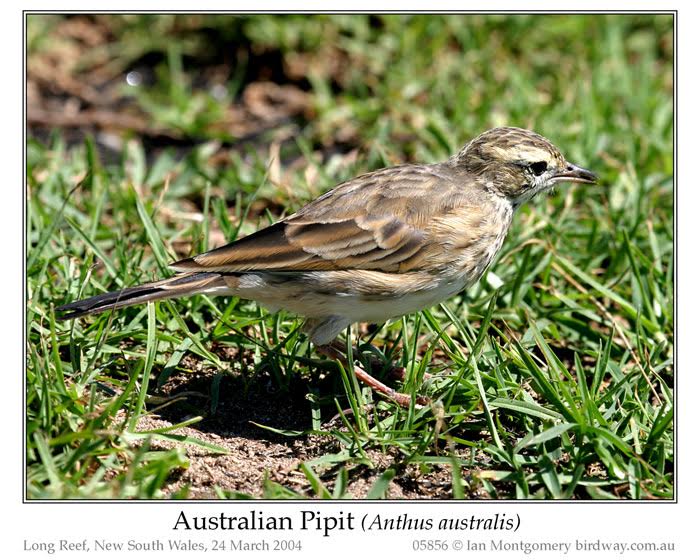
New Zealand Pipit (Anthus novaeseelandiae) by Ian
Lee’s Addition:
Are not five sparrows sold for two farthings, and not one of them is forgotten before God? But even the very hairs of your head are all numbered. Fear not therefore: ye are of more value than many sparrows. (or Pipits) (Luke 12:6-7 KJV) (emphasis mine)
All work and no play is hard for anyone. We will be praying that you find that elusive Black Bittern. Then you can tell us all about them next.
Here are a few articles that tell about Carolus Linnaeus:
*
*

