Lord’s Avian Wonders – Dipper and a Beluga Whale

Oops! Had to withdraw an article and will re-post it later. For now. This video is amazing. A baby Beluga plays with an American Dipper at the Vancouver Aquarium. When the Creator originally brought the critters into existence they got along fine.

Reminds me of the following passage from Isaiah. That condition will return again in the future. Enjoy!

And the wolf shall dwell with the lamb, and the leopard shall lie down with the kid, and the calf and the young lion and the fatted domestic animal together; and a little child shall lead them. And the cow and the bear shall feed side by side, their young shall lie down together, and the lion shall eat straw like the ox. And the sucking child shall play over the hole of the asp, and the weaned child shall put his hand on the adder’s den. They shall not hurt or destroy in all My holy mountain, for the earth shall be full of the knowledge of the Lord as the waters cover the sea. (Isaiah 11:6-9 AMP)

Maybe we should learn to get along with our neighbors also.

A new commandment I give unto you, That ye love one another; as I have loved you, that ye also love one another. (John 13:34 KJV)

*

Sunday Inspiration – Dippers, Leafbirds and Flowerpeckers

*


George And The Happy New Year

House Finch (Carpodacus mexicanus) by Ian

House Finch (Carpodacus mexicanus) by Ian

George and the Happy New Year

~ by Emma Foster

   In the countryside, where farms dotted the land along the hills and the only sounds that could be heard were birds chirping and cows mooing, there lived a small finch named George. He lived in a small red barn out in the countryside. George had built his nest up in the rafters where he could look down at all the other farm animals during the day. In the barn, he had a clear view out the window of the sky and the big city very far away.

New Year’s Day was drawing near, and every night for the past week, George and the other animals were kept up late because of all of the fireworks being set off outside the city. One night, George decided he would fly to the city. He had always wondered what people did on New Year’s Eve and how they celebrated the coming year. George figured the city was the perfect place for celebration.

That morning, on December thirty-first, George flew out the window while all the other farm animals were still sleeping, and began flying to the city.

House Finch Resting

House Finch Resting

The dirt road that stretched to the farm eventually turned into a gravel road as George flew farther on. He flew past many apple tree orchards and corn fields until the gravel road split off into two concrete roads. Here there were many different houses and stores.

Every now and then George would take a break from flying and land on a powerline. He was able to see how far he had to fly before arriving at the city.

By the time George could see large skyscrapers up ahead it was late evening. When he entered the city, he could see many other birds flying around looking for tall buildings to land on so they could see the celebration with a good point of view. George passed by lots of buildings, but none of them seemed good enough. He wanted to be able to see everything, including all the people celebrating.

Finally George spotted a large, shiny ball on top of a tall building in the middle of a busy street. Flying to it, he decided this would be the perfect place to watch the celebration because he could see throngs of people standing in the street below eagerly cheering. By then it was late at night, and George hoped he hadn’t missed much.

Times Square Ball

Times Square Ball

Landing on the ball, he watched the crowd, and he remarked how bright the ball was and wondered what it was for. Suddenly it started lowering and everyone began counting down from ten. When they all reached one, everyone cheered. George didn’t know why, but afterwards, everyone started to leave and call for taxis to take them home. George realized this must have been the celebration.

It was late in the afternoon when George arrived back at the farm, and all of the animals were eager to hear where he had been. George was glad to tell all the animals what he had seen, and of how people celebrated New Year’s Day. None of the animals ever understood exactly why people celebrated the day by counting backwards from ten, and George never understood what the huge ball was used for other than to go up and down.

The End


Lee’s Addition:

O sing unto the LORD a new song: sing unto the LORD, all the earth. (Psalms 96:1 KJV)

Yes, they shall sing of the ways of the Lord and joyfully celebrate His mighty acts, for great is the glory of the Lord. (Psalms 138:5 AMP)

What a celebration for George even if he didn’t quite figure out what it was all about. Thanks, Emma, for another great bird tale. Sounds like you must have stayed up and watched the celebration New Years Eve. At least you didn’t have to fly to see it.

You can see all of Emma’s other great articles here:

Sunday Inspiration – Dippers, Leafbirds and Flowerpeckers

White-throated Dipper (Cinclus cinclus) by Ian 5

White-throated Dipper (Cinclus cinclus) by Ian

This week we have birds running around in the water, another family of birds that are mostly green and a group that loves nectar. Which ones are they?

Let’s start with the Cinclidae – Dippers family. There are only five members in the Cinclus genus. They get their name from their bobbing or dipping movements. They are unique among passerines for their ability to dive and swim underwater. What an ability the Lord gave this family of dippers. Watch!

***

Orange-bellied Leafbird (Chloropsis hardwickii) by W Kwong

Orange-bellied Leafbird (Chloropsis hardwickii) by W Kwong

Our next group belong to the Chloropseidae – Leafbirds Family and they have 11 species with many subspecies. They are small birds found in India, Sri Lanka and Southeast Asia. They are one of only three bird families that are entirely endemic to the Indomalayan ecozone.

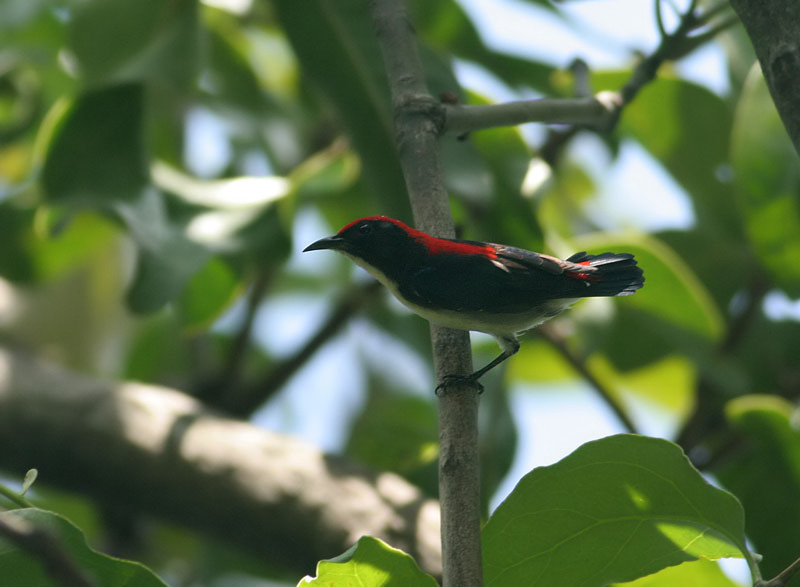
Scarlet-backed Flowerpecker (Dicaeum cruentatum) by Peter Ericsson

Scarlet-backed Flowerpecker (Dicaeum cruentatum) by Peter Ericsson

The flowers appear on the earth; The time of singing has come (Song of Solomon 2:12a NKJV)

This last family,  Dicaeidae – Flowerpeckers, has 48 species. The family is distributed through tropical southern Asia and Australasia from India east to the Philippines and south to Australia. The family is catholic in its habitat preferences, occupying a wide range of environments from sea level to montane habitats. Some species, such as the Mistletoebird of Australia, are recorded as being highly nomadic over parts of their range.

Nectar forms part of the diet, although they also take berries, spiders and insects. Mistletoes of 21 species in 12 genera have been found to be part of the diet of flowerpeckers, and it is thought that all species have adaptations (Creative design) to eat these berries and dispose of them quickly. (Wikipedia with modification)

This slideshow requires JavaScript.

“Faith Medley” ~ Faith Baptist Choir

*

Sunday Inspirations

Cinclidae – Dippers

Chloropseidae – Leafbirds

Dicaeidae – Flowerpeckers

Assurance: The Certainty of Salvation

*

Deceptive Cuckoo

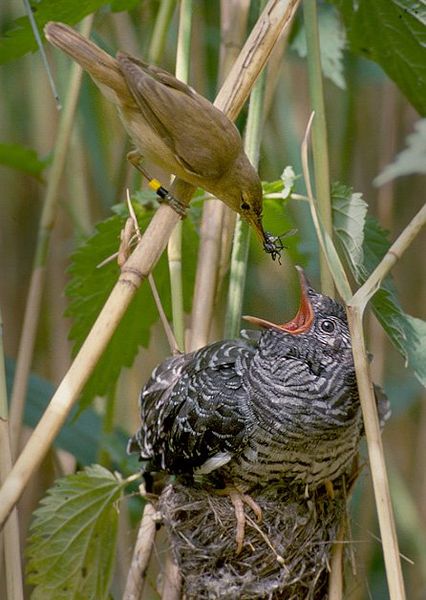
Common Cuckoo (Cuculus canorus) being raised by a Reed Warbler©WikiC

Common Cuckoo (Cuculus canorus) being raised by a Reed Warbler©WikiC

Earlier this week James J. S. Johnson wrote Teach Your Children The Right Passwords! He mentioned brood parasitism by the Cuckoo and how they like to lay their egg in another unsuspecting bird’s nest. Creation Moments just released this video and I thought you would enjoy seeing it.

The thoughts of the righteous are right: but the counsels of the wicked are deceit. (Proverbs 12:5 KJV)

Deceit is in the heart of them that imagine evil: but to the counsellors of peace is joy. (Proverbs 12:20 KJV)

*

Creation Moments YouTube Channel

Teach Your Children The Right Passwords! by James J. S. Johnson

Orni-Theology

Wordless Birds

*

Lord’s Avian Wonders – Some Zoo Critters

Thought I would share some more photos from the Zoo and a video that has challenged me. So far, in this new year the Lord is treating me well. I trust it is starting out alright for you also.

A land which the LORD thy God careth for: the eyes of the LORD thy God are always upon it, from the beginning of the year even unto the end of the year. (Deuteronomy 11:12 KJV)

Sacred Ibis Lowry Park Zoo 12-31-15 by Lee

Sacred Ibis Lowry Park Zoo 12-31-15 by Lee

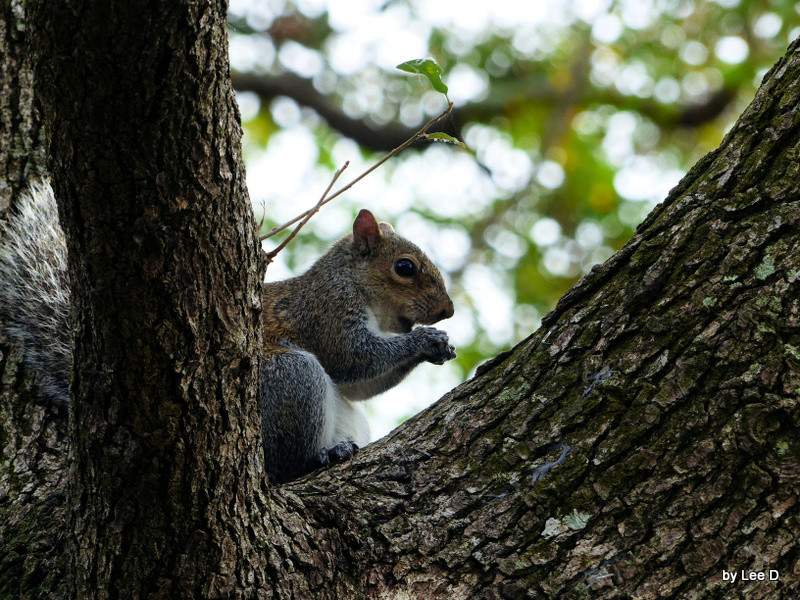
Squirrel Lowry Park Zoo 12-31-15 by Lee

Squirrel Lowry Park Zoo 12-31-15 by Lee

The fear of the LORD is the beginning of knowledge: but fools despise wisdom and instruction. (Proverbs 1:7 KJV)

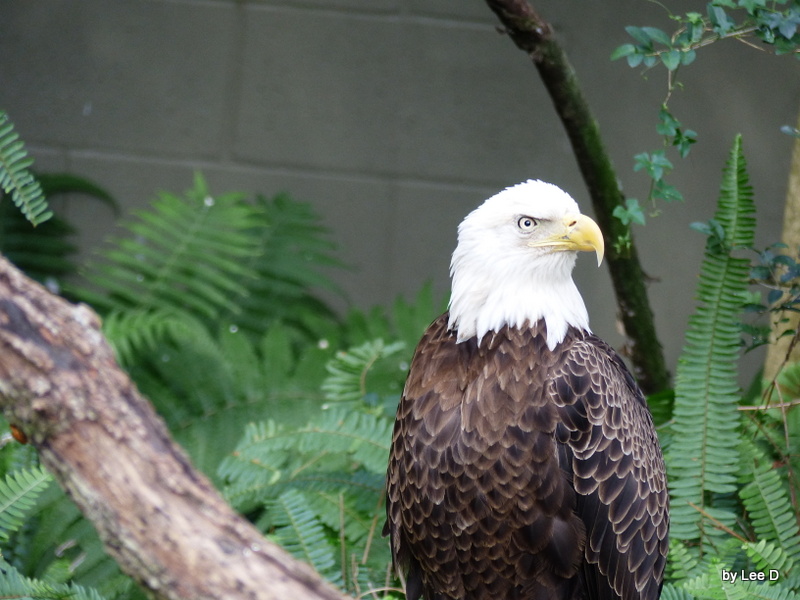
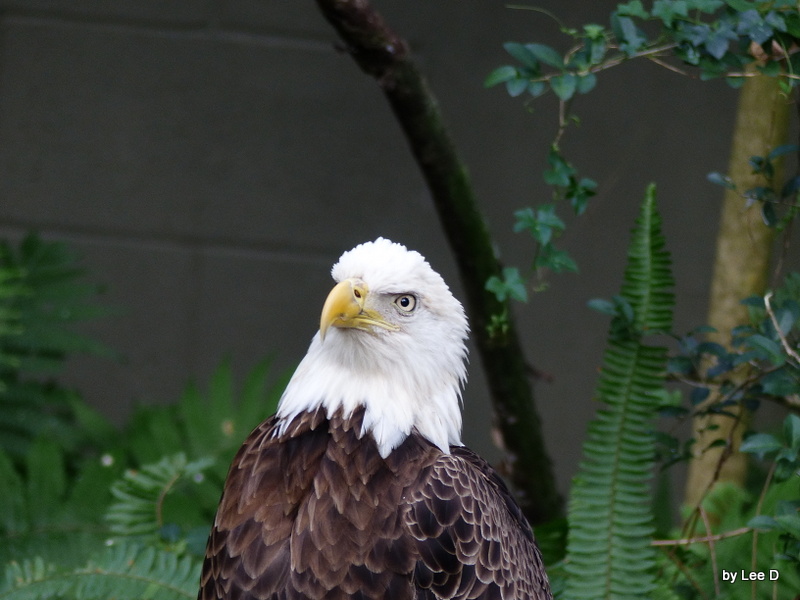
Bald Eagle Lowry Park Zoo 12-31-15 by Lee

Bald Eagle Lowry Park Zoo 12-31-15 by Lee

Bald Eagle Lowry Park Zoo 12-31-15 by Le

Bald Eagle Lowry Park Zoo 12-31-15 by Le

In the beginning was the Word, and the Word was with God, and the Word was God. The same was in the beginning with God. All things were made by him; and without him was not any thing made that was made. (John 1:1-3 KJV)

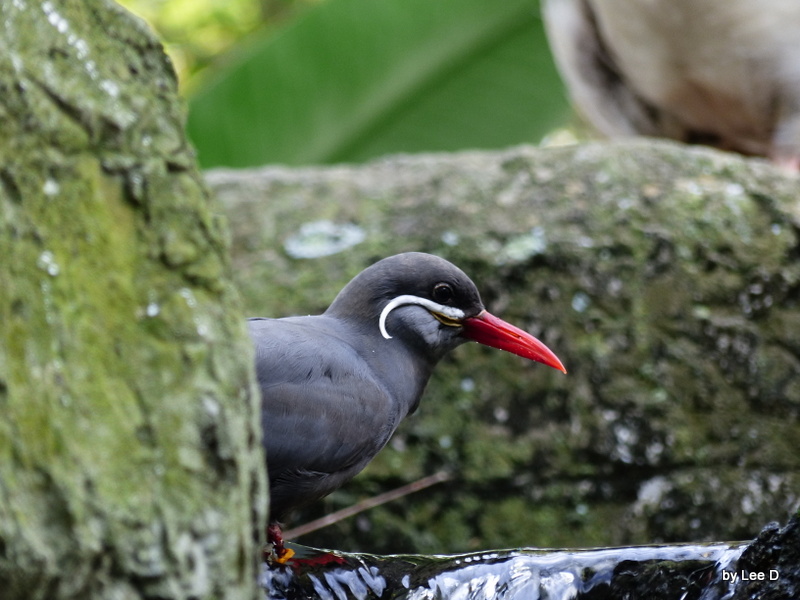
Inca Tern Lowry Park Zoo 12-31-15 by Lee

Inca Tern Lowry Park Zoo 12-31-15 by Lee

Inca Tern Lowry Park Zoo 12-31-15 by Lee

Inca Tern Lowry Park Zoo 12-31-15 by Lee

Thy word is true from the beginning: and every one of thy righteous judgments endureth for ever. (Psalms 119:160 KJV)

“Winning Life’s Battles” by Pastor Nathan Osborne was a great message that challenged for AD 2016. It is worth the time to watch. Our pastor’s messages are now being placed on the Faith Baptist Church website.

“Reach for the impossible” was one of his points that challenged my heart. I have some interesting challenges coming during this new year and the Lord has and is using this message to encourage me.

I can do all things through Christ which strengtheneth me. (Philippians 4:13 KJV)

Abide in me, and I in you. As the branch cannot bear fruit of itself, except it abide in the vine; no more can ye, except ye abide in me. I am the vine, ye are the branches: He that abideth in me, and I in him, the same bringeth forth much fruit: for without me ye can do nothing. (John 15:4-5 KJV)

I trust we will all have a productive new year. Whether it is accepting new challenges or just doing regular things like birdwatching and, then after finding the bird, trying to get a decent photo of it. :0)

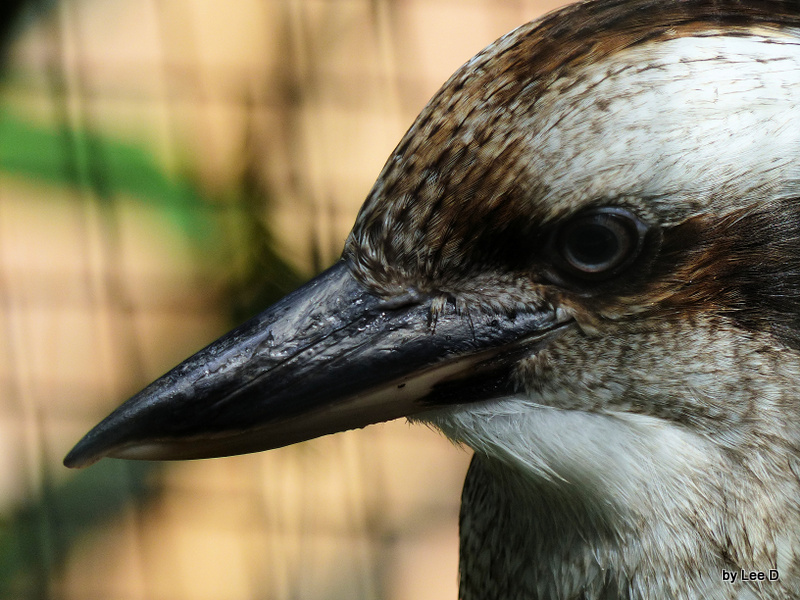
Kookaburra Lowry Park Zoo 12-31-15 by Lee

Kookaburra Lowry Park Zoo 12-31-15 by Lee

Kookaburra Lowry Park Zoo 12-31-15 by Lee

Kookaburra Lowry Park Zoo 12-31-15 by Lee

Better is the end of a thing than the beginning thereof: and the patient in spirit is better than the proud in spirit. (Ecclesiastes 7:8 KJV)

(Bolding in verses is mine)

*

*


Birdwatching Trip – Zoo 12-31-15

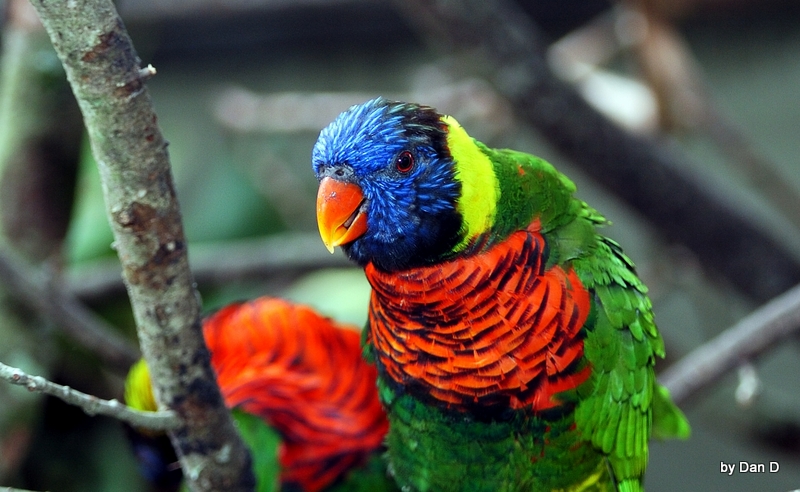
Rainbow Lorikeet by Dan

Rainbow Lorikeet by Dan

So God created great sea creatures and every living thing that moves, with which the waters abounded, according to their kind, and every winged bird according to its kind. And God saw that it was good. (Genesis 1:21 NKJV)

Off we went on the last day of 2015 to try to pick up our updated Lowry Park Zoo passes. They still weren’t ready to issue all of the new ones, so, all was not lost. Never head to a zoo without a camera.

The place was sort of crowded because they were throwing a “Noon Days Eve” party for the young folks. At noon they had a count-down to Noon “10-9-8-7-6-5-4-3-2-1”. Then they shot off paper confetti and ribbons. They were all having a great time. Most of those kids would never make to 12 midnight anyway. For that matter, neither did Dan or I. :)

This slideshow requires JavaScript.

Over in the Lorikeet feeding aviary, they seemed more colorful than normal and several of them were bouncing around and carrying on. Must have been their way of celebrating the coming New Year AD 2016. Also, like those celebrating, sometimes they get carried away and start becoming destructive.

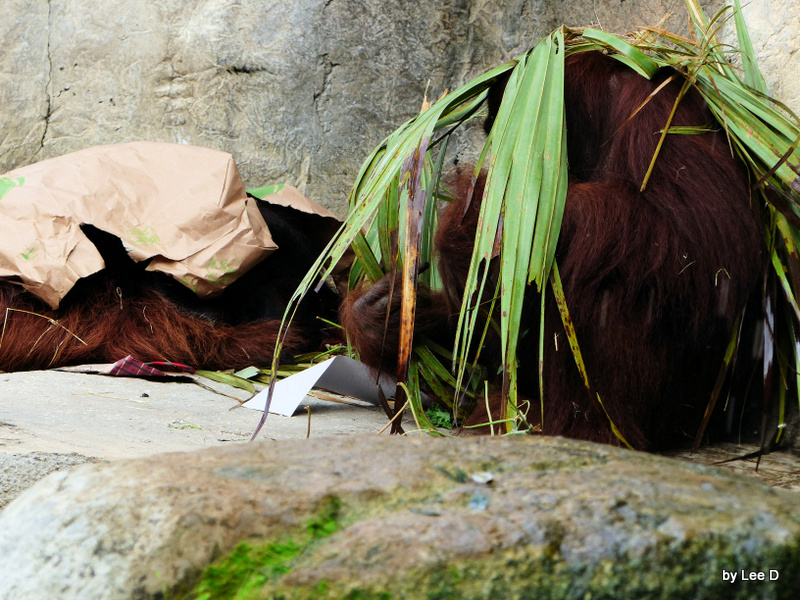
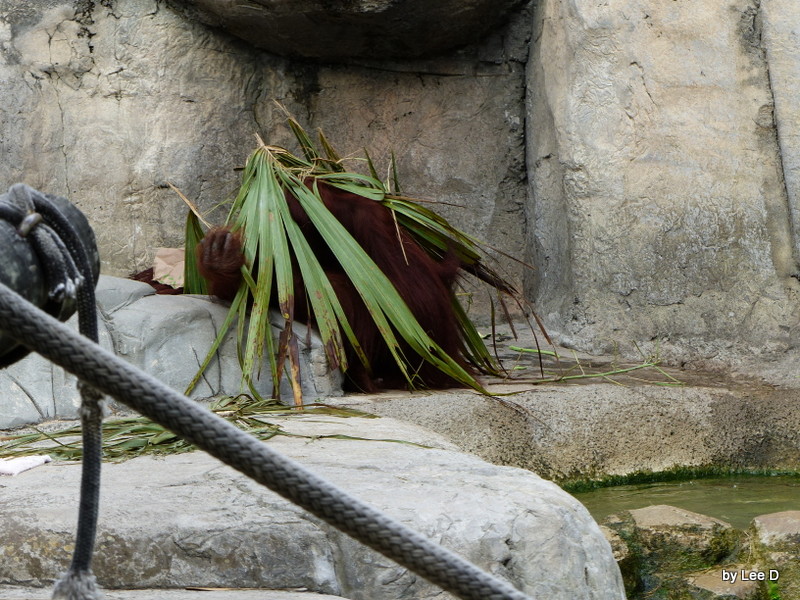
A new Orangutan was born on December 21st and hoped to see the little one, but Momma had different plans. She was laying with the baby between her and her big arm and had a piece of cardboard over her. Her mate was nearby with leaves over his head. (This is normal for these at this zoo.)

Mom and Papa Orangutan

Mom and Papa Orangutan

Mom Orangutan looking out and weary.

Mom Orangutan looking out and weary.

Papa Orangutan blocks the view.

Papa Orangutan blocks the view.

When a crowd came around to look also, he got up and sat right in front of her to block all views. The Lord even gives His critters a sense that they need privacy.

Here is a beautiful creation that takes your breath away. Wow! How did the Lord come up with so many designs in all His critters, not just the birds. I have no idea what the second fish is. He looks happy. If you know, leave a comment.

“But now ask the beasts, and they will teach you; And the birds of the air, and they will tell you; Or speak to the earth, and it will teach you; And the fish of the sea will explain to you. Who among all these does not know That the hand of the LORD has done this, (Job 12:7-9 NKJV)

Off to check out the other birds and see what else was going on. Enjoy the photos. These were our last ones of AD 2015. By the way, the first bird I spotted this year was a Sandhill Crane. (Later the same day, 1st, saw a Belted Kingfisher and a Bald Eagle, plus more normal residents.

This slideshow requires JavaScript.

*

You can see videos of a Masked Lapwing, a Demoiselle Crane and a Blue-faced Honeyeater that I also took by clicking the links.

Birdwatching Trips

Good News

*

Teach Your Children The Right Passwords!

Teach  your  children  the  right  passwords!

~ by James J. S. Johnson
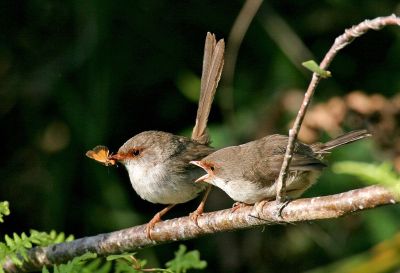
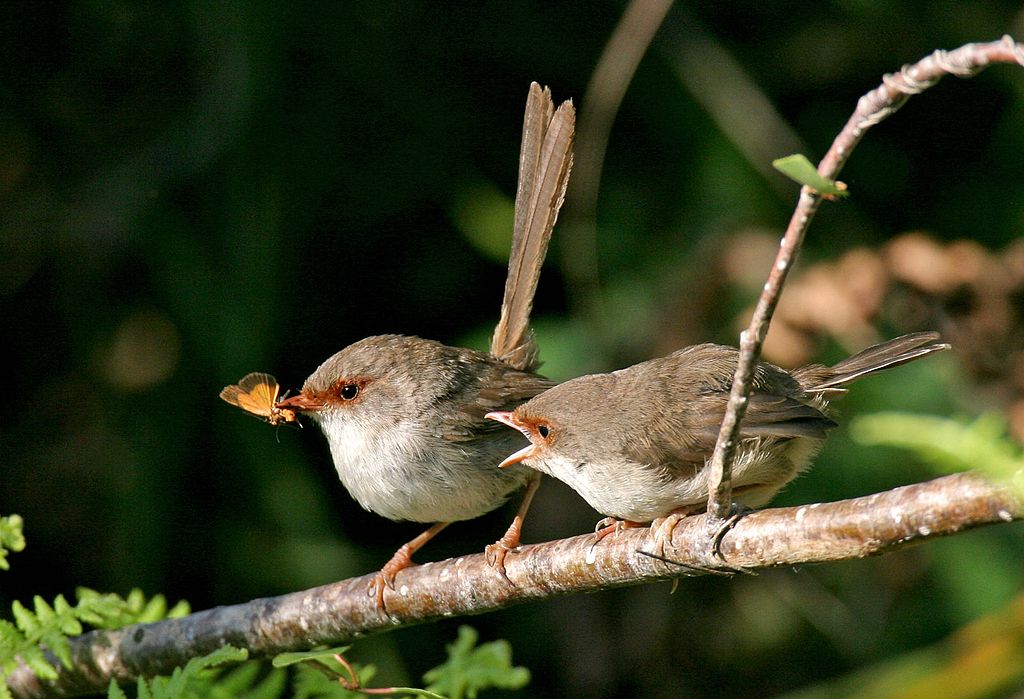
Superb Fairywren (Malurus cyaneus) Juvenile and Female ©WikiC

We will not hide them [“them” refers to God’s prophetic words – see verses 1-3] from their children, shewing to the generation to come the praises of the Lord, and His strength, and his wonderful works that He hath done.  For He established a testimony in Jacob, and appointed a law in Israel, which He commanded our [fore]fathers, that they should make them known to their children,  that the generation to come might know them, even the children which should be born [יִוָּלֵ֑דוּ — niphâl imperfect form of the verb yâlad], who should arise and declare [וִֽיסַפְּר֥וּ — piêl imperfect form of the verb sâphar] them to their children, that they might set their hope in God, and not forget the works of God, but keep His commandments, and [that they] might not be as their [fore]fathers, a stubborn and rebellious generation, a generation that set not their heart aright, and whose spirit was not steadfast with God.   Psalm 78:4-8

Superb Fairywrens teach their children to use passwords, but how?

In this fallen world even bird families have troubles.

One kind of family problem, confronted by many bird parents, is the problem of “brood parasites”, which is really a sneaky kind of “home invasion”.

Brood parasitism” is not a problem of parasitic worms or bugs.  Rather, this is a different kind of parasite – a bold “home invasion” parasite – a “foster child”, from another bird family, who was dropped into a “host” family.  The “host” family is thereafter burdened (unless and until the newcomer is evicted from the nest) with the cost of nurturing the intruding stranger who “moved in” without an invitation.  Worse, the invasive “foster child” often competes with the legitimate nestling birds for food and shelter, sometimes even competing aggressively.
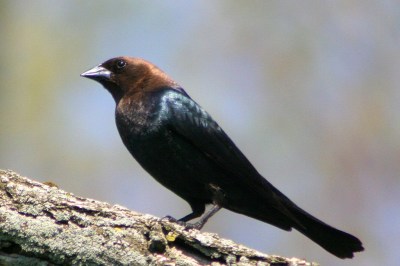
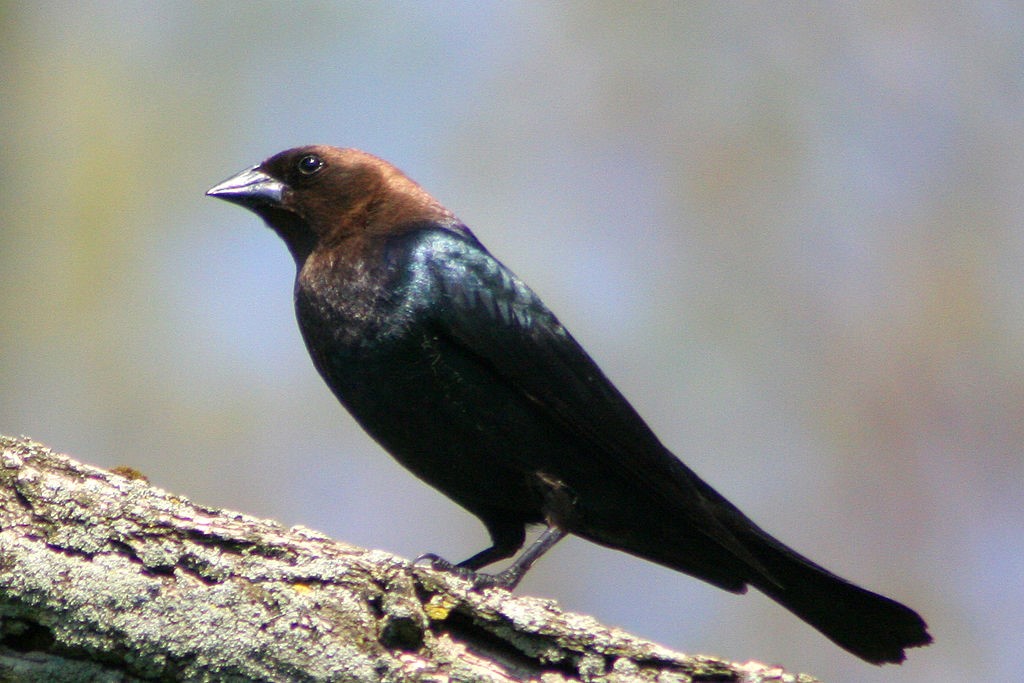
PAS-Icte Brown-headed Cowbird (Molothrus ater) ©WikiC

Male Brown-headed Cowbird  (Molothrus ater) ©WikiC

One of the best-known examples of such “brood parasitism” practices is those of the Brown-headed Cowbird (Molothrus ater), an icterid (i.e., member of the blackbird family) with a head that is distinctively chocolate-brown in color.

“A small, black-bodied [and iridescent-plumed] bird, a bit larger than a House Sparrow, with a brown head and a rather finchlike bill.  Females are nondescript gray [like the hue of female grackles] with a finchlike bill.

A brood parasite, the Cowbird lays its eggs in the nests of other birds.”
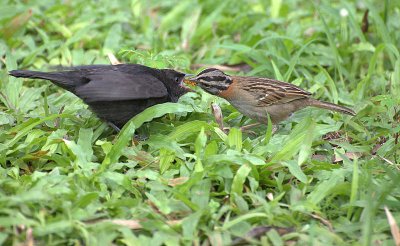
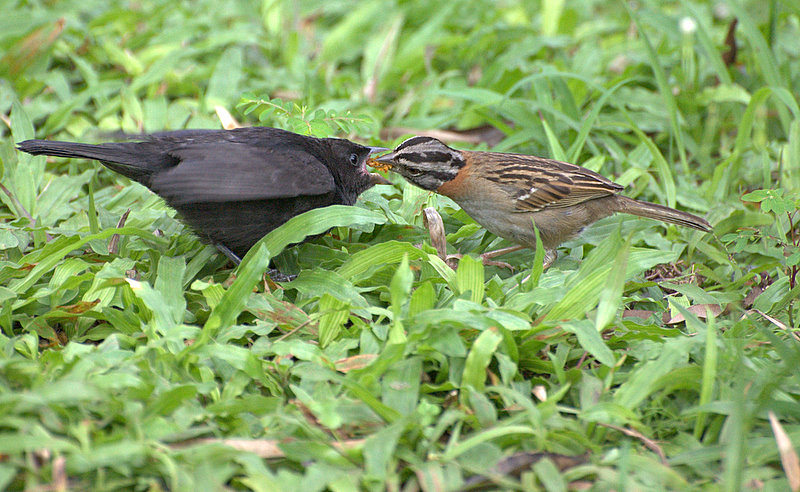
A Shiny Cowbird (Molothrus bonariensis) chick being fed by a Rufous-collared Sparrow (Zonotrichia Capensis)

A Shiny Cowbird (Molothrus bonariensis) chick being fed by a Rufous-collared Sparrow (Zonotrichia Capensis)

[Quoting from Roger Tory Peterson, PETERSON FIRST GUIDE TO BIRDS: A Simplified Field Guide to the Commonest Birds of North America (Houghton Mifflin, 1986), page 102.]

But cowbirds of North America are not the only birds that abuse the (involuntary) charity care of avian “foster parents”;  cuckoos (such as the Common Cuckoo of Eurasia) are known for the same “externalizing” of their parenting costs, producing nestling competitions that result in “changeling” conflicts.

“Once a brood parasite [mother] has managed to slip her egg into a host’s nest, her reproductive role is essentially over.  She leaves each chick to fend for itself, in a [bird] family that did not choose to raise it.

There’s no reason to feel [too] sorry for the uninvited foster chick, however; it is the unwitting adoptive parents that might soon face an unexpected brutality—the ruthless slaying of all their own offspring.

Many brood parasites, such as cuckoos, immediately dispatch of their nest mates [i.e., the children of the caring bird parents who built and maintain the nest that is now compromised] as soon as they hatch by summarily tossing them over the side of the nest.  [So much for refugee gratitude!]
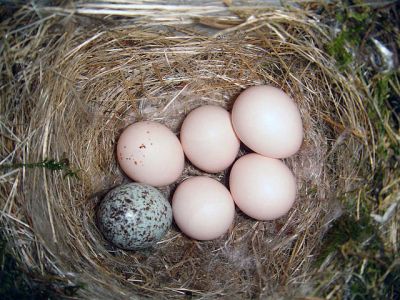
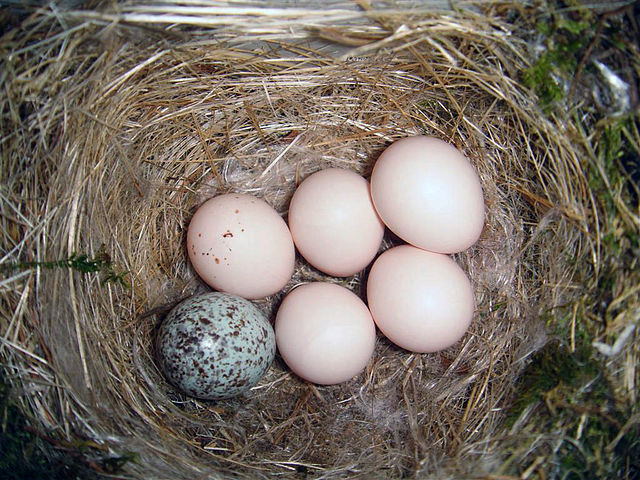
Brown-headed Cowbird (Molothrus ater) Egg in Eastern Phoebe Nest ©WikiC

Brown-headed Cowbird (Molothrus ater) Egg in Eastern Phoebe Nest ©WikiC

African Honeyguides use far deadlier methods to eliminate their [nest] fellows.  Equipped from birth with hooks at the tips of their mandibles, they efficiently wield these needle-sharp barbs against their defenseless nest mates.

Cowbirds do not employ such direct methods, yet they just as effectively eliminate the competition.  Their companions often die of starvation because the larger, more aggressive cowbird grabs all the food [delivered by the nestling-caring parent birds].  It is a wonder that the adults still feed the chick when they realize the disparity in size.  Yet in most cases, the adults accept it [i.e., the cowbird “foster child”], even if it appears double the size of its foster parent and requires twice the care of its [foster] siblings.
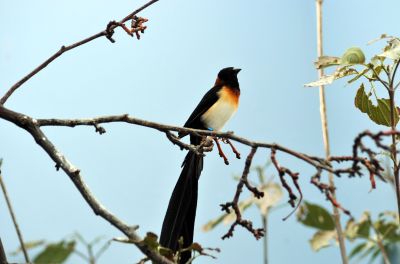
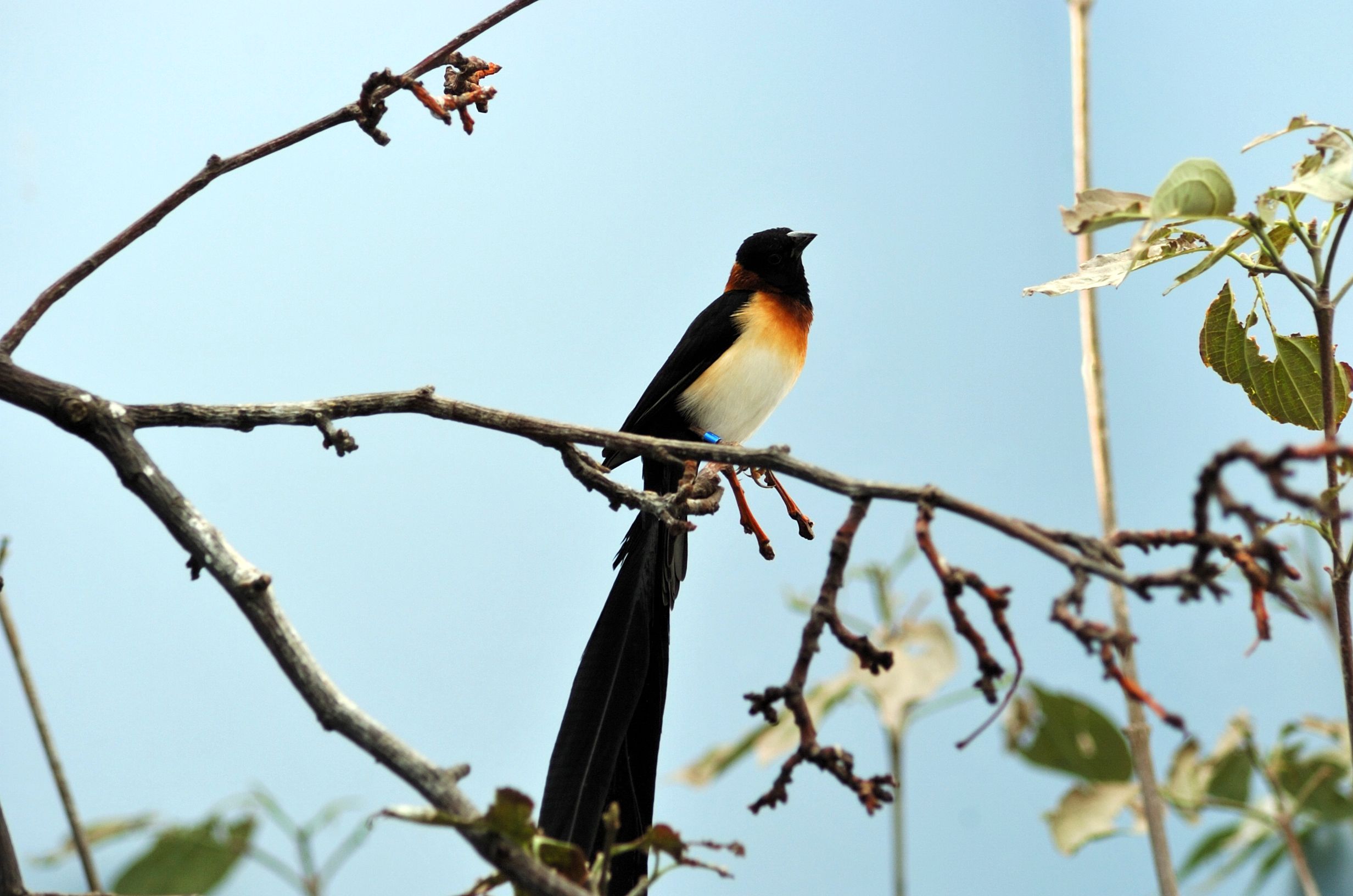
Long-tailed Paradise Whydah by Dan

Long-tailed Paradise Whydah by Dan

Not all brood parasites oust their nest mates.  Parents of the whydah family choose species that closely resemble them, such as waxbills.  Not only do the eggs match in coloration, but the chicks resemble their hosts as well.  They even have the same markings in their gaping mouths which signal hunger to an observing adult.  Whylahs blend in with their adopted families instead of destroying them.”

[Quoting from Sharon A. Cohen, BIRD NESTS (Harper Collins, 1993), page 110.]

So cowbird “parenting” is a short-lived experience, somewhat like clandestinely depositing a newborn on the front steps of an orphanage, trusting that the baby will be nurtured (successfully) by others.  But is this surreptitious forced-fostering habit a guarantee of avian reproductive success, at the populational level?

“At first, you may wonder why more birds are not parasites—after all, parasites don’t need to build a nest [for raising their babies], and once they have laid eggs there is no more to it [i.e., to parenting responsibilities on a daily basis]; but there are hidden costs [and risks] to being a [brood] parasite, mainly that the [child-abandoning] bird gives up control over its eggs and young.

Female cowbirds lay an average of forty eggs per year, but only two or three [on average] mature to adulthood.”

[Quoting from Donald Stokes & Lillian Stokes, A GUIDE TO BIRD BEHAVIOR, VOLUME II (Little Brown & Company, 1983), page 213.]

So what does this have to do with avian parents teaching “passwords” to their natural progeny? 

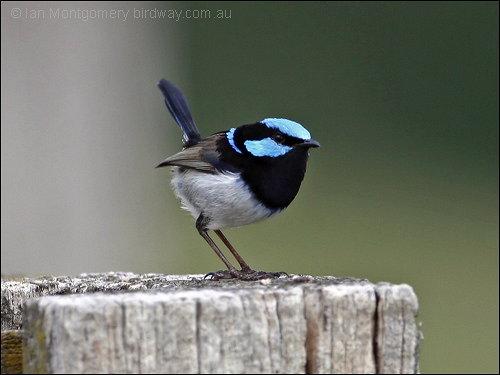
Superb Fairy-wren (Malurus cyaneus) by Ian

Male Superb Fairywren (Malurus cyaneus) by Ian

Consider this amazing news about the Superb Fairywren (Malurus cyaneus) of Australia, which is forced to react to the “child-abandonment” brood parasitism habits of the Horsfield’s Bronze Cuckoo. (Chrysococcyx basalis).

Horsfield's Bronze Cuckoo (Chrysococcyx basalis) by Tom Tarrant

Male Horsfield’s Bronze Cuckoo (Chrysococcyx basalis) by Tom Tarrant

The Horsfield’s Bronze Cuckoo deposits its somewhat elongated pink-white egg, with rust-colored spots, into the nest of a fairywren.  The rust-speckled egg looks like a fairywren egg, confusing the fairywren nest owners of its true biogenetic identity.  (This is an avian version of family “identity fraud!)  The fairywren’s upside-down-dome-shaped nest is often dark inside, so visual confusion about which eggs really belong there is common – hence Horsfield’s bronze cuckoos often get by with their “changeling” deceptions, recruiting fairywren parents into fostering cuckoo eggs that hatch into cuckoo nestlings.

After a dozen days of incubation, in a fairywren nest, a bronze cuckoo chick hatches – 2 days before the hatching of fairywren eggs.  The “older” nestling often ejects the fairywren eggs from the nest, displacing the rightful “heirs”.  (What kind of “refugee gratitude” is that?!)

What can fairywrens do about this parasitic (and quasi-predatory) menace?

Is there a way to avoid the involuntary “home invasion” of such Trojan horses?

Yes, there are a few defensive habits that help to protect the fairywren from such home hijackings, including:

(1) nesting in fairywren colonies – so that teamwork is employed to drive off trespassing cuckoos when cuckoos fly near the fairywrens’ nesting colony;

(2) females attend their nests with vigilance, usually, limiting the opportunities that stealthy cuckoos have to access unattended fairywren nests;

(3) when female fairywren recognize a “changeling” in the nest, prior to laying any fairywren eggs therein, the fairywren female may abandon that (cuckoo) egg and build herself a new nest elsewhere;

(4) female fairywrens “teach” their eggs vocal “passwords” to use, to prompt being fed by their mother.  It is this last habit that demonstrates communication from (fairywren) mother to child, before the chick is hatched from its egg!

A few years ago, Diane Colombelli-Négrel, Sonia Kleindorfer, and colleagues from Flinders University in Australia discovered a remarkable way one bird fights back against brood parasites. Female superb fairywrens teach their embryos a “password” while they’re still in their eggs. Each female’s incubation call contains a unique acoustic element. After they hatch, fairywren chicks incorporate this unique element into their begging calls to ask for food. Colombelli-Négrel, Kleindorfer, and colleagues showed that chicks whose begging calls most resembled their mothers’ incubation calls received more food. But the brood parasites of the fairywren, Horsfield’s bronze-cuckoos, produced begging calls that did not so closely resemble the parental password.

[Quoting  Mary Bates, “To Beat a Parasite, Birds Teach their Young a Secret Password”, posted at http://www.wired.com/2014/06/to-beat-a-parasite-birds-teach-their-young-a-secret-password/ , accessed 11-23-AD2015.]

If fairywrens observe cuckoos in the neighborhood they become more diligent in their efforts to teach the “please-feed-me” passwords to their unhatched progeny, increasing the likelihood that the babies will successfully beg for food (using the vocal “password”) when they soon become hatchling chicks.

In a new study, Colombelli-Négrel, Kleindorfer, and colleagues again looked at the relationship between superb fairywrens and Horsfield’s bronze-cuckoos to see if a greater threat of brood parasitism would cause the fairywren to up its teaching efforts.

First, the researchers recorded calls from 17 fairywren nests in South Australia. They found the similarity between the mother’s password and the chick’s begging call was predicted by the number of incubation calls produced by the mother: If females made many incubation calls, their chicks ended up producing more similar begging calls.

Next, the researchers conducted a playback experiment at 29 nests. They broadcast either the song of Horsfield’s bronze-cuckoo or a neutral bird. After the cuckoo calls, but not after the neutral bird calls, female fairywrens made more incubation calls to their embryos. In other words, female fairywrens that heard a cuckoo near their nest increased their efforts to teach their password to their embryos.  Colombelli-Négrel and Kleindorfer say their results provide a mechanism for how fairywrens could get better at decision-making and lower the probability of committing an acceptance error for a cuckoo chick or a rejection error for one of their own chicks.  ‘When there are cuckoos in the area, you should call more to your eggs so that they have a higher call similarity after hatching and you can decide if the offspring is yours,’ Colombelli-Négrel and Kleindorfer wrote in an email. ‘We show a mechanism that starts in the nest and involves active teaching and sensorimotor learning in embryos.’”  [again quoting Mary Bates, supra]

This is truly amazing!  Anyone who is not amazed at how God programmed parenting skills into Superb Fairywrens is blind to the facts.

Also, by analogy, there may be a lesson for humans:  be careful about vulnerabilities to intrusive “foster children” that are “accepted” without informed consent  —  your own legitimate children may be put unfairly at risk.

Meanwhile, just as fairywrens teach “passwords” to their children, so should we humans.  But it is much more than “please feed me!” that we must teach our children, and our children’s children.

The vital “words of life” that we must teach, repeatedly, as the words of God, the Scriptures without which there is no real life, because mankind cannot live by physical bread alone, but by every Scriptural saying – every word that proceeds from God (Matthew 4:4).

We will not hide them [“them” refers to God’s prophetic words – see verses 1-3] from their children, shewing to the generation to come the praises of the Lord, and His strength, and his wonderful works that He hath done.  For He established a testimony in Jacob, and appointed a law in Israel, which He commanded our [fore]fathers, that they should make them known to their children,  that the generation to come might know them, even the children which should be born [יִוָּלֵ֑דוּ — niphâl imperfect form of the verb yâlad], who should arise and declare [וִֽיסַפְּר֥וּ — piêl imperfect form of the verb sâphar] them to their children, that they might set their hope in God, and not forget the works of God, but keep His commandments, and [that they] might not be as their [fore]fathers, a stubborn and rebellious generation, a generation that set not their heart aright, and whose spirit was not steadfast with God.   Psalm 78:4-8

<> JJSJ

*

Orni-Theology

Maluridae – Australasian Wrens

James J. S. Johnson’s Articles

*

The Long Christmas Journey

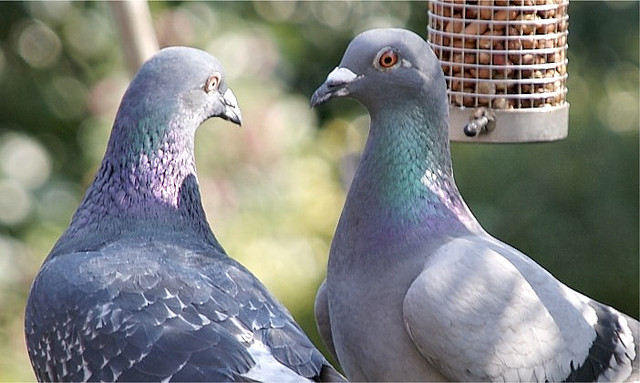
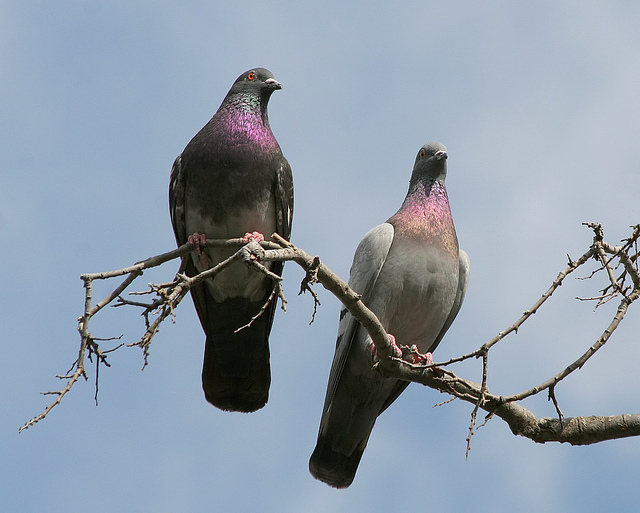
Rock Dove (Columba livia) ©Flickr Oleg Sidorenko

Rock Dove (Columba livia) ©Flickr Oleg Sidorenko

The Long Christmas Journey

~ by Emma Foster

Once there were two birds who lived in Portland, Oregon. Their names were Belinda and Steven and they were pigeons (a.k.a. Rock Doves).

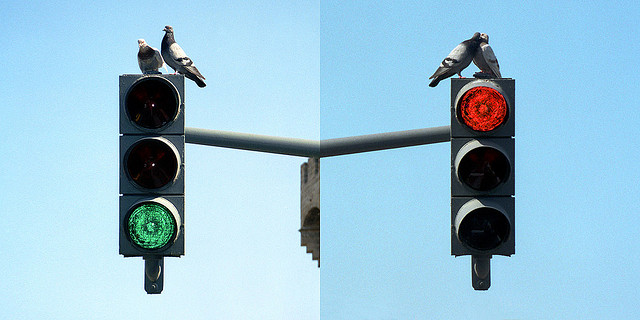
Belinda and Steven lived on top of a stop-and-go light in the middle of a busy street where they had built their nest. They loved the city life so they didn’t mind all of the cars driving by, especially when they honked. They also didn’t mind all of the headlights that lit up the streets at night. Every day, Steven would fly through the city to search for food. And every day lots of cars would drive by.

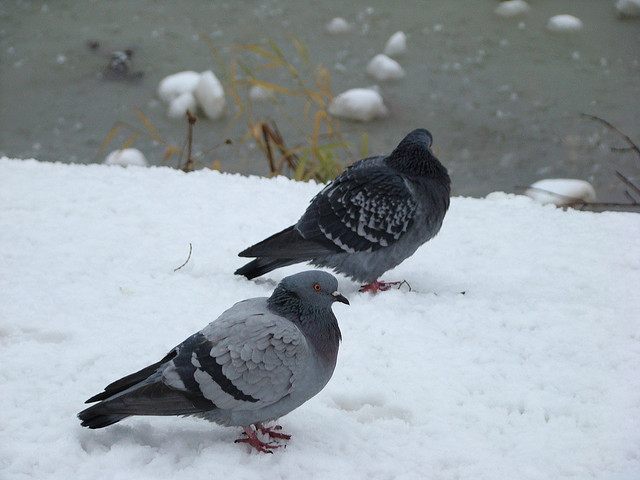
Rock Dove (Columba livia) ©Flickr Edward Townend

Rock Dove (Columba livia) ©Flickr Edward Townend

As December drew near, it started to get colder. Eventually, snow started to fall. The more snow fell, the colder it became.

Belinda and Steven decided it was time for them to fly down south for the winter. They would spend Christmas down there just as they did every year. They both liked spending Christmas down where it was warm.

Rock Dove (Columba livia) ©Flickr Andrey

Rock Dove (Columba livia) ©Flickr Andrey

They started flying early the next morning because it was going to be a long journey to fly down south. As Belinda and Steven travelled, they were careful to not fly too high when they flew through the mountains because the tops of the mountains were cold and snowy. They flew past many mountains because Belinda and Steven were flying through the Rocky Mountains.

Rock Dove (Columba livia) ©Flickr Ingrid Taylar

Eventually, after several hours, Belinda and Steven reached Death Valley. It was nice and warm there. But Death Valley was a little too warm for them. Fortunately there was a group of road runners that gave them directions to Arizona. Belinda and Steven were already in eastern California so it wasn’t that long of a flight to get there.

Belinda and Steven were able to fly to Arizona and made it there by Christmas Eve. It was nice and warm and the desert was filled with cactuses. Belinda and Steven decorated a cactus with some Christmas decorations they had brought with them so the cactus looked festive.

Together, Belinda and Steven had a wonderful Christmas, and they didn’t even mind that it would still be a long trip back to Oregon. They would have to come back to Arizona next year.

The End

Rock Dove (Columba livia) ©Flickr Ken Slade

Rock Dove (Columba livia) ©Flickr Ken Slade


Lee’s Addition:

Storks, doves, swallows, and thrushes all know when it’s time to fly away for the winter and when to come back. But you, my people, don’t know what I demand. (Jeremiah 8:7 CEV)

Thanks, Emma, for telling us about your migrating Pigeon friends, Belinda and Steven. Smart birds for escaping the winter cold up there in the Northwest.

Keep up the great stories. We are all enjoying them and you a gaining quite a fan club. We are looking forward to more stories through this New Year. Happy New Year.

*

See more of Emma Foster’s Stories

ABC’s of the Gospel

*


Ian’s Bird of the Week – Temminck’s Stint

Ian’s Bird of the Week – Temminck’s Stint ~by Ian Montgomery
Newsletter – 12/31/15
Surprise, surprise, Facebook can be useful! I was contemplating a suitable species to wish you a Happy New Year, when I discovered from a post by Rohan Clark that Temminck’s Stint is the newest addition to the Australian bird list, one having turned up in Broome, Western Australia about a month. And no, I didn’t rush off there to photograph it: here are a couple of old photos that I took in India twelve years ago. So that satisfies the Old Year/New Year metaphor. You’ll have noticed by now that I’ll use any excuse as a metaphor to nominate a species as Bird of the Week.
This is probably one for the serious birder as small waders in winter plumage not only pose serious problems of identification but also fail to excite people who are into more dramatic plumages. That said, it’s distinguishing features are the down-curved bill, short legs and, in flight, the white sides to the tail. The latter is probably the best field mark, as it’s shared with no other members of the genus and easy to see in flight, even if it doesn’t show when the birds are on the ground. There are four species of Stints (see Typical Waders on Birdway) the Eurasian name for very small waders; comparable species of the same genus in North America are usually named Sandpipers, e.g. the Least Sandpiper  and are collectively, colloquially and somewhat disparagingly called Peeps after their calls.
Temminck’s Stint nest right across northern Eurasia from Norway to eastern Siberia. The short Arctic breeding season is something of a frenzy, as Temminck’s Stints of both sexes are territorial and serially bigamous and sometimes fit in three clutches with different mates. They winter mainly in equatorial Africa and southern and southeastern Asia, with Borneo being the closest regular winter haunt to Australia. It is to be expected that they would sometimes overshoot their destination and there have been several reports of them in Australia in recent years but none has been accepted until now.
Coenraad Temminck was a Dutch ‘aristocrat and zoologist’ born in Amsterdam in 1778. He was director of the National Museum (then the Rijksmuseum) of Natural History in Leiden from 1830 until his death in 1851. He made a huge contribution towards the classification of birds and other vertebrates at a time when the species and type concepts were contentious. He inherited a large collection of bird skins from his father who was treasurer of the Dutch East India Company, so it would be easy to imagine that his specimen of the stint came from Indonesia.
Sixteen bird species still include his name as part of the scientific and/or common name, including the Australian Logrunner (Orthonyx temminckii), which as featured as bird of the week before. He also make a fundamental contribution to biogeography, though his views on the divine aspects of species design and their unchanging nature proved unpopular with other scientists after about 1840.
You nearly got the Eurasian/Winter/Pacific Wrens as bird of the week as today I’ve got as far as the wren family page in the website redesign. I’m switching from BirdLife International to the IOC for classification and the IOC splits the old Winter Wren of the almost the entire Northern Hemisphere into Old World (Eurasian Wren) and New World (Winter and Pacific Wrens , which also suited the Old Year/New Year transition nicely. However, the Eurasian Wren has featured as bird of the week before in the guise of Winter Wren so you ended up with an obscure wader instead.
I send you very best wishes for the New Year and a rewarding 2016 and don’t make your New Year Resolutions too ambitious!
Ian
**************************************************
Ian Montgomery, Birdway Pty Ltd,
454 Forestry Road, Bluewater, Qld 4818
Tel 0411 602 737 ian@birdway.com.au
Bird Photos http://www.birdway.com.au/
Recorder Society http://www.nqrs.org.au

Lee’s Addition:

“If a bird’s nest happens to be before you along the way, in any tree or on the ground, with young ones or eggs, with the mother sitting on the young or on the eggs, you shall not take the mother with the young; (Deuteronomy 22:6 NKJV)

Well, Happy New Years to you also, Ian. We look forward to your newsletters again this new year. Thanks for letting our blog share your very informative articles along with super photos of species. Many of those species we have never heard of, let alone have the opportunity to see. Thanks for sharing.

*

Ian’s Bird of the Week articles

Ian’s Scolopacidae Family

Scolopacidae – Sandpipers, Snipes – Stint Family

Good News

*

Birds of the Bible – Nebuchadnezzar and Birds

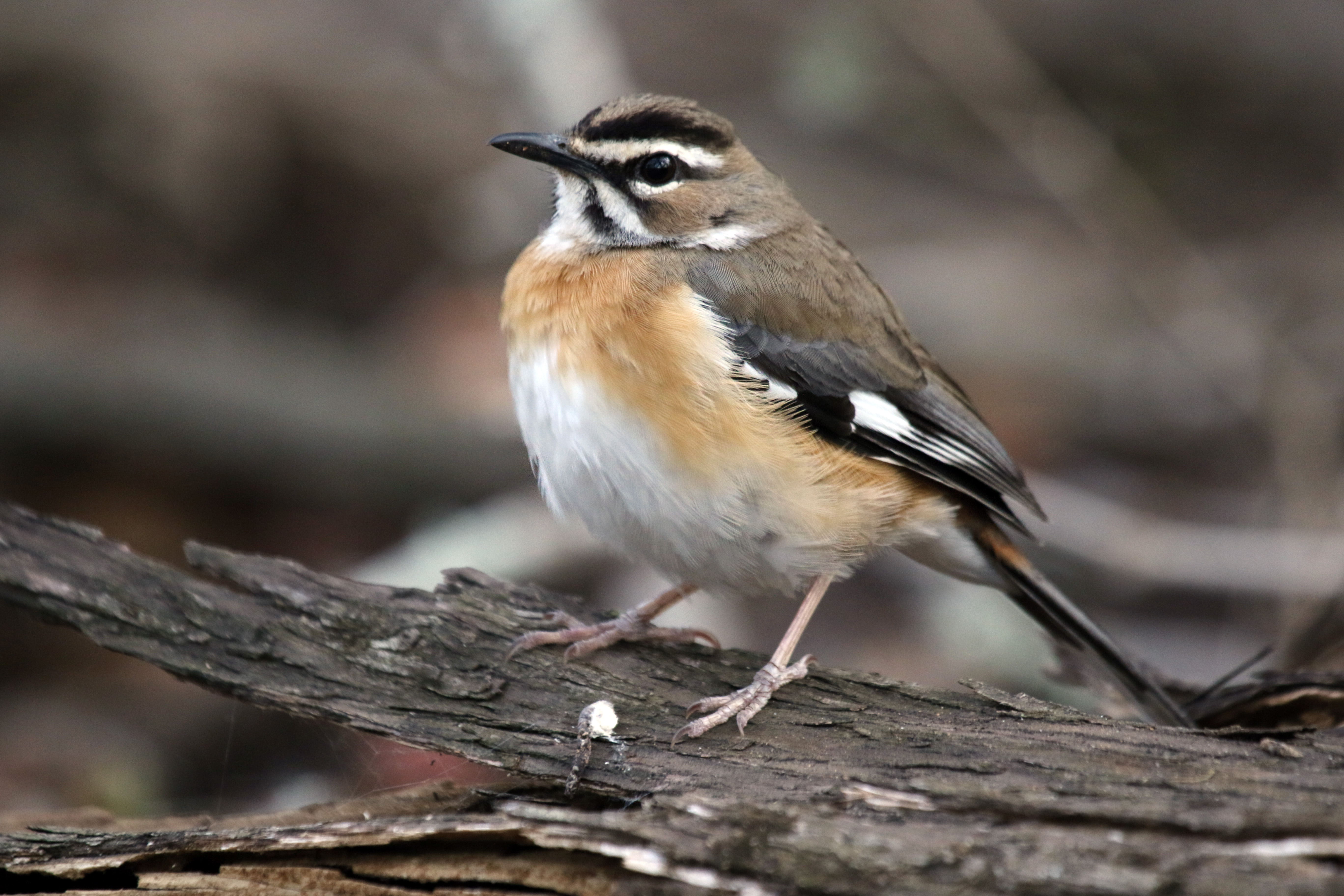
Bearded Scrub Robin (Cercotrichas quadrivirgata) ©WikiC

Bearded Scrub Robin (Cercotrichas quadrivirgata) ©WikiC

While reading Daniel chapter 2 today in the Bible, I was captivated by a passage that mentions birds. Here is that passage:

“This was the dream; now we will tell its interpretation before the king. “You, O king, are the king of kings, to whom the God of heaven has given the kingdom, the power, the strength and the glory; and wherever the sons of men dwell, or the beasts of the field, or the birds of the sky, He has given them into your hand and has caused you to rule over them all. You are the head of gold.” (Daniel 2:36-38 NASB) (emphasis mine)

Wow! Men, I can understand, but the birds being put under Nebuchadnezzar’s hand? This calls for some investigation.

First, if you are familiar with the book of Daniel, especially the first few chapters, you will recall that Daniel had been taken captive to Babylon when Nebuchadnezzer had captured Jerusalem. (Daniel 1) In Babylon, where Daniel was now one of the wise men, he was threatened with death unless the King’s dream could be interpreted. (Daniel 2:1-18) After praying with his three friend, the God of heaven reveals the dream and the interpretation to Daniel. Daniel tells him his dream and then gives the interpretation, where our verses above are found. Daniel 2:19-45)

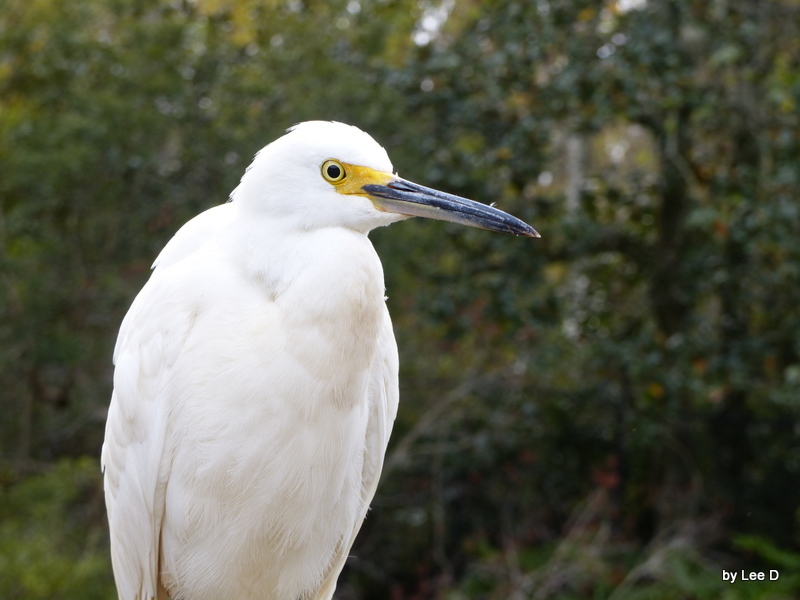
Snowy Egret by Lee

Snowy Egret by Lee

Bible Knowledge Commentary – “Nebuchadnezzar’s rule was viewed as a worldwide empire, in which he ruled over all mankind as well as over beasts and birds. At the time of Creation the right to rule over the earth was given man who was to have dominion over it and all the creatures in it (Gen-1:26). Here Nebuchadnezzar by divine appointment was helping fulfill what God had planned for man.”

Cambridge – “the beasts of the field] i.e. wild animals (cf. in Heb. e.g. Exo 23:11; Exo 23:29). These and the birds are mentioned in order to represent Nebuchadnezzar’s rule as being as absolute as possible; the former are borrowed, no doubt, from Jer 27:6; Jer 28:14.”

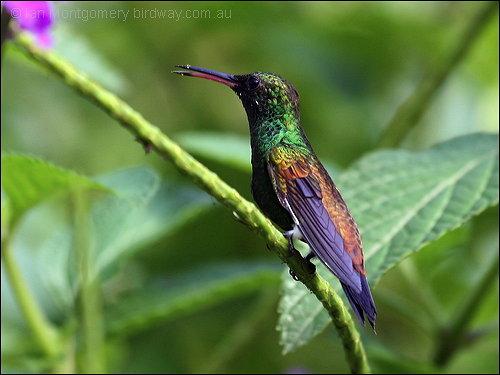
Copper-rumped Hummingbird (Amazilia tobaci) by Ian

Copper-rumped Hummingbird (Amazilia tobaci) by Ian

John Gill – “the beasts of the field, and the fowls of the heaven, hath he given into thine hand; all parks, chases, and forests (so that none might hunt or hawk without his permission), as well as the persons and habitations of men, were at his dispose; showing the despotic power and sovereign sway he had over his subjects:

and hath made thee ruler over all: men, beasts, and fowl: he not only conquered the Egyptians, Tyrians, and Jews, and other nations about them; but, according to Megasthenes (l) he exceeded Hercules in strength, and conquered Lybia and Iberia, and carried colonies of them into Pontus; and, as Strabo (m) says, carried his arms as far as the pillars of Hercules:

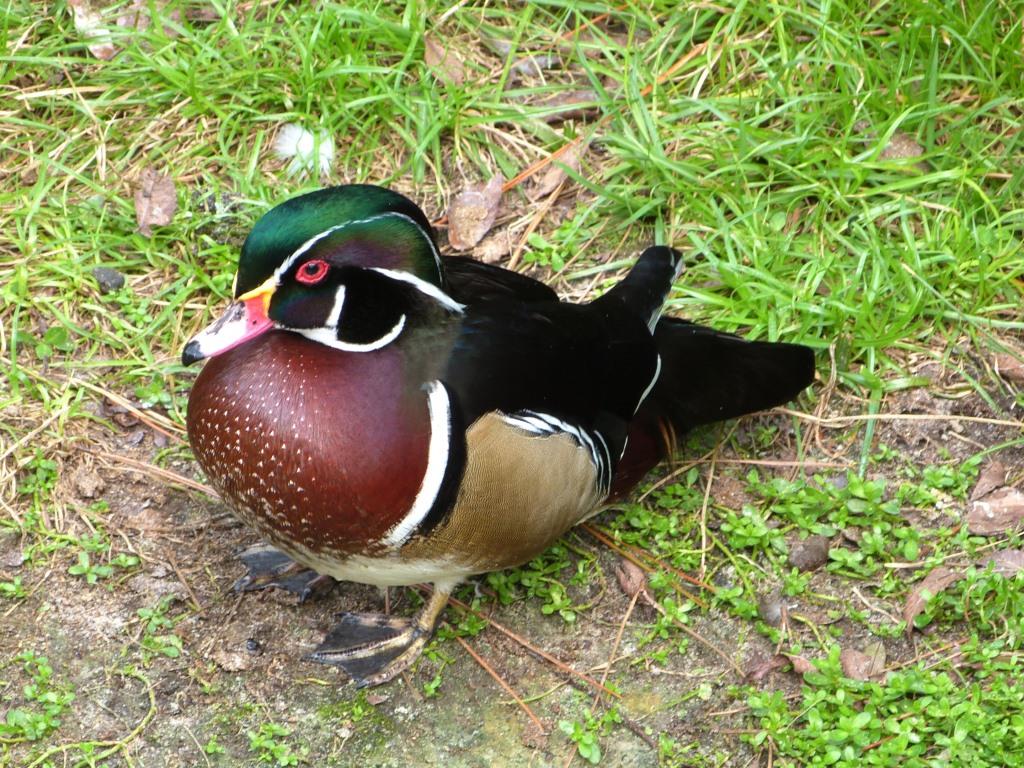
Wood Duck Brevard Zoo

Wood Duck Brevard Zoo by Lee

Henry – “The extent of his dominion is set forth (Dan 2:38), that wheresoever the children of men dwell, in all the nations of that part of the world, he was ruler over them all, over them and all that belonged to them, all their cattle, not only those which they had a property in, but those that were ferae naturae – wild, the beasts of the field and the fowls of the heaven. He was lord of all the woods, forests, and chases, and none were allowed to hunt or fowl without his leave.”

JFB – men … beasts … fowls — the dominion originally designed for man (Gen 1:28; Gen 2:19, Gen 2:20), forfeited by sin; temporarily delegated to Nebuchadnezzar and the world powers; but, as they abuse the trust for self, instead of for God, to be taken from them by the Son of man, who will exercise it for God, restoring in His person to man the lost inheritance (Psa 8:4-6).

Wesley – “Daniel 2:38  “Made thee ruler – He hath given thee absolute dominion of all creatures, men and beasts within the bounds of thy vast kingdom. Thou – He was first in order, as the head is before the other parts, and the vision began in him, and descended downwards to the other three monarchies. He was the head of gold, because of the vast riches wherein this monarchy abounded, and because it stood longest, five hundred years, and was fortunate and flourishing to the last.”

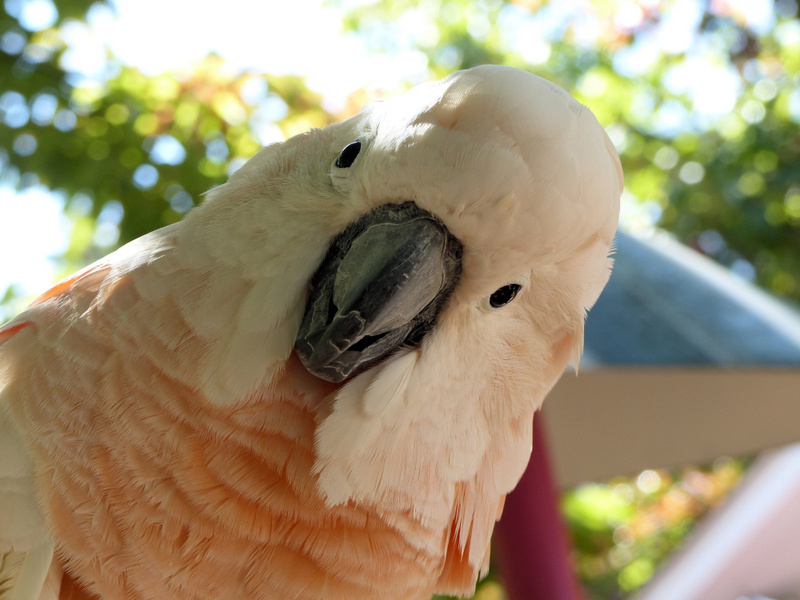
 Salmon-crested Cockatoo (Cacatua moluccensis) at Parrot Mtn by Lee

Salmon-crested Cockatoo (Cacatua moluccensis) at Parrot Mtn by Lee

Reading those commentaries, from my e-Sword, it appears from some that some are saying Nebuchadnezzer had all control of the birds as to when they could be hunted or hawked, etc. Others are saying that he was to be over the original dominion mandate given to man for the beast and birds which had been corrupted by man.

Peregrine Falcon (Falco peregrinus) by Ray

Peregrine Falcon (Falco peregrinus) by Ray

It is an interesting statement and trust you found it informing. I did. For me, I try to respect and help the birds when I can. Many are researching and finding ways to help the birds, even when making preserves to protect their habitat. The Lord created them and we should do what we can to help them. We can even help the birds when some teach they evolved, by countering that lie with the truth of God’s Word.

So God created great sea creatures and every living thing that moves, with which the waters abounded, according to their kind, and every winged bird according to its kind. And God saw that it was good. (Genesis 1:21 NKJV)

*

Birds of the Bible

Who Paints The Leaves?

*
Sunday Inspiration – Chats and Old World Flycatchers II

Rufous-bellied Niltava (Niltava sundara) by Nikhil Devasar

Rufous-bellied Niltava (Niltava sundara) by Nikhil Devasar

Out of the ground the LORD God formed every beast of the field and every bird of the sky, and brought them to the man to see what he would call them; and whatever the man called a living creature, that was its name. (Genesis 2:19 NASB)

Last week’s Sunday Inspiration – Chats and Old World Flycatchers covered the first part of the Muscicapidae Family. This week, we will show the some more of the Family. There are 321 Members that make up the Muscicapidae Family. What great looking birds from their Creator.

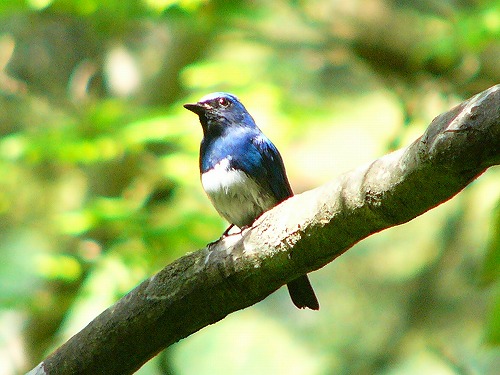
Blue-and-white Flycatcher (Cyanoptila cyanomelana) ©WikiC

Blue-and-white Flycatcher (Cyanoptila cyanomelana) ©WikiC

Chats (formerly sometimes known as “chat-thrushes”) are a group of small Old World insectivorous birds formerly classified as members of the thrush family Turdidae, but now are considered Old World flycatchers. The name is normally applied to the more robust ground-feeding flycatchers found in Europe and Asia and most northern species are strong migrants.

The Old World flycatchers, the Muscicapidae, are small passerine birds mostly restricted to the Old World (Europe, Africa and Asia). These are mainly small arboreal insectivores, many of which, as the name implies, take their prey on the wing.

White-starred Robin (Pogonocichla stellata) WikiC

White-starred Robin (Pogonocichla stellata) ©WikiC

The appearance of these birds is very varied, but they mostly have weak songs and harsh calls. They are small to medium birds, ranging from 9 to 22 cm in length. Many species are dull brown in colour, but the plumage of some can be much brighter, especially in the males. Most have broad, flattened bills suited to catching insects in flight, although the few ground-foraging species typically have finer bills.

Old World flycatchers live in almost every environment with a suitable supply of trees, from dense forest to open scrub, and even the montane woodland of the Himalayas. The more northerly species migrate south in winter, ensuring a continuous diet of insects.

Depending on the species, their nests are either well-constructed cups placed in a tree or cliff ledge, or simply lining in a pre-existing tree hole. The hole-nesting species tend to lay larger clutches, with an average of eight eggs, rather than just two to five.

White-browed Robin-Chat (Cossypha heuglini) by Daves BirdingPix

White-browed Robin-Chat (Cossypha heuglini) by Daves BirdingPix

Because this Muscicapidae family is so large, this week’s Sunday Inspiration and last week’s were divided. The reason for this is so the slideshow will not be too long. This divides them in taxonomic order in to several groups. I was going to divide this family in half, but there are so many photos available that I would have to find a symphony to provide enough music to show them all at once. ☺♪♫☺

Last week, the first 97-98 members were shown from these genera: Alethe, Cercotrichas, Copsychus, Fraseria, Myioparus, Melaenornis, Empidornis, Muscicapa, Anthipes, Cyornis.

This Slideshow of Muscicapidae in taxonomic order – Second Part (includes the genera- Niltava, Cyanoptila, Eumyias, Erithacus, Pseudalethe, Cossyphicula, Cossypha, Swynnertonia, Pogonocichla, Stiphrornis, Sheppardia, Cichladusa, Heinrichia, Leonardina, Heteroxenicus, Brachypteryx , Vauriella, Larvivora, Luscinia, Irania and Calliope.) 75 Species

Start with Niltava 

This slideshow requires JavaScript.

Let this mind be in you which was also in Christ Jesus, who, being in the form of God, did not consider it robbery to be equal with God, but made Himself of no reputation, taking the form of a bondservant, and coming in the likeness of men. And being found in appearance as a man, He humbled Himself and became obedient to the point of death, even the death of the cross. Therefore God also has highly exalted Him and given Him the name which is above every name, that at the name of Jesus every knee should bow, of those in heaven, and of those on earth, and of those under the earth, and that every tongue should confess that Jesus Christ is Lord, to the glory of God the Father. (Philippians 2:5-11 NKJV)

“The Birthday of a King” ~ by Dr. Richard Gregory, now in Glory.

*

Sunday Inspiration – Chats and Old World Flycatchers I

More Sunday Inspirations

Muscicapidae – Chats and Old World Flycatchers

Faith Baptist Church

Gospel Presentation

*

Good One – An Email

Peek-a-boo ©Flickr Kathy

Peek-a-boo ©Flickr Kathy

GOOD ONE
We were the only family with children in the restaurant. I sat Erik in a high chair and noticed everyone was quietly sitting and talking. Suddenly, Erik squealed with glee and said, ‘Hi.’ He pounded his fat baby hands on the high chair tray. His eyes were crinkled in laughter and his mouth was bared in a toothless grin, as he wriggled and giggled with merriment.
I looked around and saw the source of his merriment. It was a man whose pants were baggy with a zipper at half-mast and his toes poked out of would-be shoes. His shirt was dirty and his hair was uncombed and unwashed. His whiskers were too short to be called a beard and his nose was so varicose it looked like a road map.
We were too far from him to smell, but I was sure he smelled.. His hands waved and flapped on loose wrists.. ‘Hi there, baby; hi there, big boy. I see ya, buster,’ the man said to Erik.
My husband and I exchanged looks, ‘What do we do?’
Erik continued to laugh and answer, ‘Hi.’
Everyone in the restaurant noticed and looked at us and then at the man. The old geezer was creating a nuisance with my beautiful baby. Our meal came and the man began shouting from across the room, ‘Do ya patty cake? Do you know peek-a-boo? Hey, look, he knows peek- a-boo.’
Nobody thought the old man was cute. He was obviously drunk. My husband and I were embarrassed. We ate in silence; all except for Erik, who was running through his repertoire for the admiring skid-row bum, who in turn, reciprocated with his cute comments.
We finally got through the meal and headed for the door. My husband went to pay the check and told me to meet him in the parking lot. The old man sat poised between me and the door. ‘Lord, just let me out of here before he speaks to me or Erik,’ I prayed. As I drew closer to the man, I turned my back trying to sidestep him and avoid any air he might be breathing. As I did, Erik leaned over my arm, reaching with both arms in a baby’s ‘pick-me-up’ position. Before I could stop him, Erik had propelled himself from my arms to the man.
Suddenly a very old smelly man and a very young baby consummated their love and kinship. Erik in an act of total trust, love, and submission laid his tiny head upon the man’s ragged shoulder. The man’s eyes closed, and I saw tears hover beneath his lashes. His aged hands full of grime, pain, and hard labor, cradled my baby’s bottom and stroked his back. No two beings have ever loved so deeply for so short a time.
I stood awestruck. The old man rocked and cradled Erik in his arms and his eyes opened and set squarely on mine. He said in a firm commanding voice, ‘You take care of this baby.’
Somehow I managed, ‘I will,’ from a throat that contained a stone.
He pried Erik from his chest, lovingly and longingly, as though he were in pain. I received my baby, and the man said, ‘God bless you, ma’am, you’ve given me my Christmas gift.’
I said nothing more than a muttered thanks. With Erik in my arms, I ran for the car. My husband was wondering why I was crying and holding Erik so tightly, and why I was saying, ‘My God, my God, forgive me.’
I had just witnessed Christ’s love shown through the innocence of a tiny child who saw no sin, who made no judgment; a child who saw a soul, and a mother who saw a suit of clothes. I was a Christian who was blind, holding a child who was not.. I felt it was God asking, ‘Are you willing to share your son for a moment?’ when He shared His for all eternity. How did God feel when he put his baby in our arms 2000 years ago.
The ragged old man, unwittingly, had reminded me, ‘To enter the Kingdom of God , we must become as little children.’
If this has blessed you, please bless others by sending it on. Sometimes, it takes a child to remind us of what is really important. We must always remember who we are, where we came from and, most importantly, how we feel about others. The clothes on your back or the car that you drive or the house that you live in does not define you at all; it is how you treat your fellow man that identifies who you are.
This one is a keeper.
‘It is better to be liked for the true you, than to be loved for who people think you are……'(Amen! )
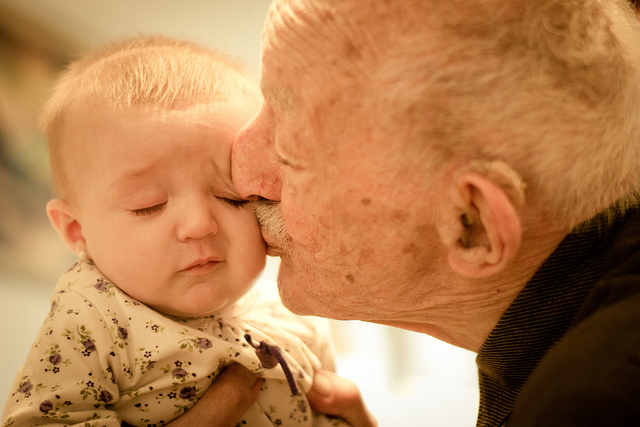
Old man and baby ©Flickr Gustavo Devito

Old man and baby ©Flickr Gustavo Devito

(Author Unknown)
*