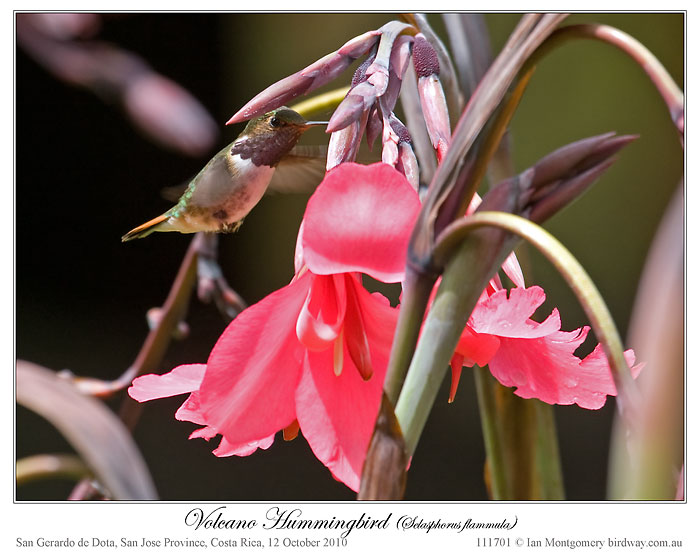
Hummingbirds and ornithophilous (bird-pollinated) flowers
were created to have a mutualistic relationship.
The flowers have nectar suited to the birds’ diet,
their color suits the birds’ vision
and their shape fits that of the birds’ bills.
The blooming times of the flowers have also been found
to coincide with hummingbirds’ breeding seasons….
The Rose of Sharon has the nectar
that suits our spiritual diet..
The Rose of Sharon has the power
to purify our soul…
The Rose of Sharon’s will
is to shape our lives for His glory…
If only we had pollinated the way
The Rose of Sharon wanted us to do,
our classmates and our colleagues.
our neighborhood and our nationhood
would not only have known Jesus,
but also would have been effective pollinators…
By the way,
are we seasonal pollinators or regulars?
And he (Jesus) said unto them, Go ye into all the world, and preach the gospel to every creature. (Mathew 16:15)
Ornithophily or Bird Pollination is the pollination of flowering plants by birds. The Creator created this association is derived from insect pollination (entomophily) and is particularly well developed in some parts of the world, especially in the tropics and on some island chains. The association involves several distinctive plant adaptations forming a “pollination syndrome”. The plants typically have colorful, often red, flowers with long tubular structures holding ample nectar and orientations of the stamen and stigma that ensure contact with the pollinator. Birds involved in ornithophily sre specialist nectarivores with brushy tongues, long beaks, capable of hovering flight or are light enough to perch on the flower structures. (Edited from Wikipedia)
And as ye would that men should do to you, do ye also to them likewise.” (Luke 6:31)
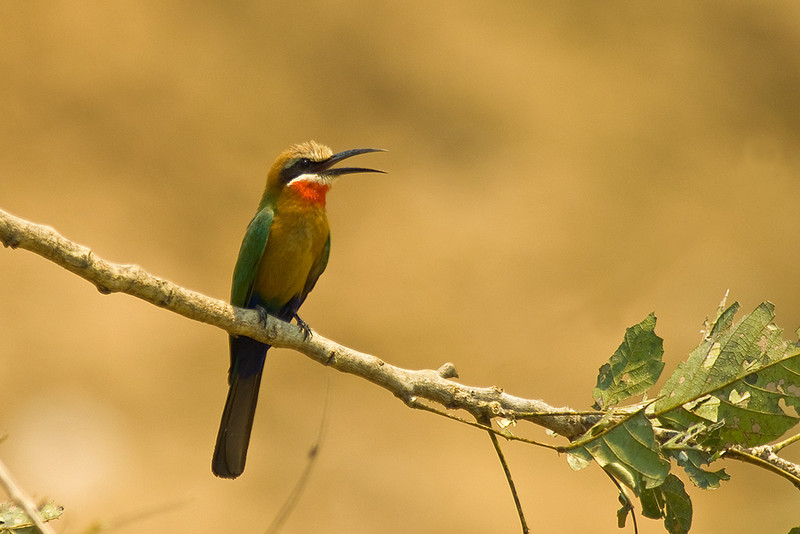
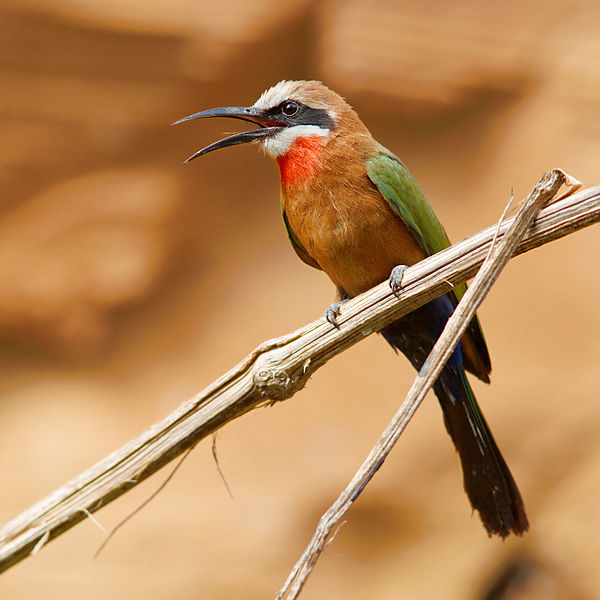
The White-fronted Bee-eater is an East African bird that lives in clans of up to fourteen members.
White-fronted bee-eaters have several problems to deal with. Since they nest on the cliffs overlooking riverbanks, youngsters need a great deal of attention until they learn to fly. Once they are on their own, the young birds are often put to work by their parents as helpers. A father may even drive away his sons’ mates in order to keep them as helpers.
Helpers bring food for their mother, brothers and sisters. They also clean the nest area and watch for danger. However, the most important job is guarding the nest at egg-laying time. This is necessary because a female who doesn’t have her own nest will sneak into another bee-eater’s nest and lay her eggs there. If the eggs are laid before the owner of the nest starts laying her eggs, she will simply toss out the foreign egg. If there are eggs already in the nest, she will also care for the foreign eggs. The important job of guarding the nest is usually given to a daughter. However, scientists have observed that sometimes it is the daughter, while on guard duty with the mother absent, who sneaks into the nest and adds a few eggs of her own!
In His goodness, the Creator has given bee-eaters a way of life in which helping each other is part of their nature. This kindness toward each other improves the quality of life. It can serve as an example to us that the world is not designed to favor the survival of the most selfish or aggressive.
Prayer:
Dear Lord, in a world that sees only personal loss when kindness is offered, help me to remember that You gave me all things freely. Help me to see the reward of good will in helping others, even those who cannot help me in return. Amen.
White-fronted Bee-eater (Merops bullockoides) cropped by Bob-Nan
Lee’s Addition:
Bee-eaters are one of the Lord more beautiful bird creations. I always enjoy see their photos. Soon we are going to a Zoo that I understand has Bee-eaters. Needless to say I am anxious to see them. Aren’t they gorgeous?
The Evening Grosbeak by Birds Illustrated by Bird Photography, 1897
THE EVENING GROSBEAK.
ANDSOMER birds there may be, but in the opinion of many this visitant to various portions of western North America is in shape, color, and markings one of the most exquisite of the feather-wearers. It has for its habitation the region extending from the plains to the Pacific ocean and from Mexico into British America. Toward the North it ranges further to the east; so that, while it appears to be not uncommon about Lake Superior, it has been reported as occuring in Ohio, New York, and Canada. In Illinois it was observed at Freeport during the winter of 1870 and 1871, and at Waukegan during January, 1873. It is a common resident of the forests of the State of Washington, and also of Oregon. In the latter region Dr. Merrill observed the birds carrying building material to a huge fir tree, but was unable to locate the nest, and the tree was practically inaccessable. Mr. Walter E. Bryant was the first to record an authentic nest and eggs of the Evening Grosbeak. In a paper read before the California Academy of Sciences he describes a nest of this species containing four eggs, found in Yolo county, California. The nest was built in a small live oak, at a height of ten feet, and was composed of small twigs supporting a thin layer of fibrous bark and a lining of horse hair. The eggs are of a clear greenish-ground color, blotched with pale brown. According to Mr. Davie, one of the leading authorities on North American birds, little if any more information has been obtained regarding the nests and eggs of the Evening Grosbeak.
As to its habits, Mr. O. P. Day says, that about the year 1872, while hunting during fine autumn weather in the woods about Eureka, Illinois, he fell in with a number of these Grosbeaks. They were feeding in the tree tops on the seeds of the sugar maple, just then ripening, and were excessively fat. They were very unsuspicious, and for a long time suffered him to observe them. They also ate the buds of the cottonwood tree in company with the Rose-Breasted Grosbeak.
The song of the Grosbeak is singularly like that of the Robin, and to one not thoroughly familiar with the notes of the latter a difference would not at first be detected. There is a very decided difference, however, and by repeatedly listening to both species in full voice it will be discovered more and more clearly. The sweet and gentle strains of music harmonize delightfully, and the concert they make is well worth the careful attention of the discriminating student. The value of such study will be admitted by all who know how little is known of the songsters. A gentleman recently said to us that one day in November the greater part of the football field at the south end of Lincoln Park was covered with Snow Birds. There were also on the field more than one hundred grammar and high school boys waiting the arrival of the football team. There was only one person present who paid any attention to the birds which were picking up the food, twittering, hopping, and flying about, and occasionally indulging in fights, and all utterly oblivious of the fact that there were scores of shouting school boys around and about them. The gentleman called the attention of one after another of ten of the high school boys to the snow birds and asked what they were. They one and all declared they were English Sparrows, and seemed astounded that any one could be so ignorant as not to know what an English Sparrow was. So much for the city-bred boy’s observation of birds.
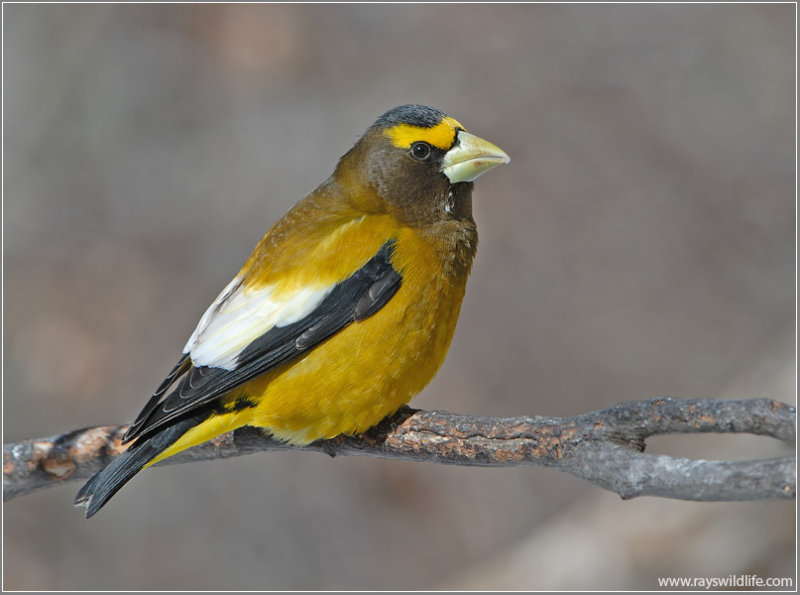
Evening Grosbeak (Hesperiphona vespertina) male by Raymond Barlow
THE EVENING GROSBEAK.
In the far Northwest we find this beautiful bird the year around. During the winter he often comes farther south in company with his cousin, the Rose-Breasted Grosbeak.
What a beautiful sight it must be to see a flock of these birds—Evening Grosbeaks and Rose-Breasted in their pretty plumage.
Grosbeaks belong to a family called Finches. The Sparrows, Buntings, and Crossbills belong to the same family. It is the largest family among birds.
You will notice that they all have stout bills. Their food is mostly grains and their bills are well formed to crush the seeds.
Look at your back numbers of “Birds” and notice the pictures of the other Finches I have named. Don’t you think Dame Nature is very generous with her colors sometimes?
Only a few days ago while strolling through the woods with my field glass, I saw a pretty sight. On one tree I saw a Redheaded Woodpecker, a Flicker, an Indigo Bunting, and a Rose-Breasted Grosbeak. I thought then, if we could only have the Evening Grosbeak our group of colors would be complete.
Have you ever wondered at some birds being so prettily dressed while others have such dull colors?
Some people say that the birds who do not sing must have bright feathers to make them attractive. We cannot believe this. Some of our bright colored birds are sweet singers, and surely many of our dull colored birds cannot sing very well.
Next month you will see the pictures of several home birds. See if dull colors have anything to do with sweet song.
Lee’s Addition:
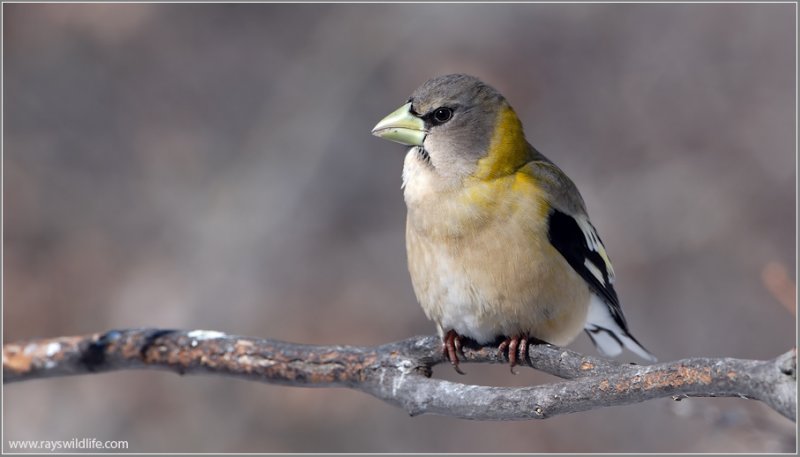
Evening Grosbeak (Hesperiphona vespertina) female by Raymond Barlow
By awesome deeds you answer us with righteousness, O God of our salvation, the hope of all the ends of the earth and of the farthest seas; the one who by his strength established the mountains, being girded with might; who stills the roaring of the seas, the roaring of their waves, the tumult of the peoples, so that those who dwell at the ends of the earth are in awe at your signs. You make the going out of the morning and the evening to shout for joy. (Psalms 65:5-8 ESV)
What a beautiful bird the Lord created in the Evening Grosbeak. The Grosbeaks are in the Cardinalidae – Grosbeaks, Saltators & Allies Family. There are 17 Grosbeaks in the family and are found in 9 genera. The Evening Grosbeak is in the
The Evening Grosbeak (Coccothraustes vespertinus) is a large finch. In the past, it was treated in a genus of its own as Hesperiphona vespertina, but is now usually placed in the same genus as the Hawfinch of Eurasia.
The breeding habitat is coniferous and mixed forest across Canada and the western mountainous areas of the United States and Mexico. It is an extremely rare vagrant to the British Isles, with just two records so far. The nest is built on a horizontal branch or in a fork of a tree.
The migration of this bird is variable; in some winters, it may wander as far south as the southern U.S.
The Evening Grosbeak is similar in appearance to the Eurasian Hawfinch, both being bulky, heavily built finches with large bills and short tails. The Evening Grosbeak ranges in length from 6.3 to 8.7 in (16 to 22 cm) in length and spans 12 to 14 in (30 to 36 cm) across the wings. In a large sampling of grosbeaks in Pennsylvania during winter, males weighed from 1.37 to 3.04 oz (38.7 to 86.1 g), with an average of 2.1 oz (60 g), while females weighed from 1.52 to 2.59 oz (43.2 to 73.5 g), with an average of 2.07 oz (58.7 g). The adult has a short black tail, black wings and a large pale bill. The adult male has a bright yellow forehead and body; its head is brown and there is a large white patch in the wing. The adult female is mainly olive-brown, greyer on the underparts and with white patches in the wings.
These birds forage in trees and bushes, sometimes on the ground. They mainly eat seeds, berries and insects. Outside of the nesting season they often feed in flocks. Sometimes, they will swallow fine gravel.
The range of this bird has expanded far to the east in historical times, possibly due to plantings of Manitoba maples and other maples and shrubs around farms and the availability of bird feeders in winter.
“Calls from a large flock visiting a feeder” – from xeno-canto
The above article is the first article in the monthly serial that was started in January 1897 “designed to promote Knowledge of Bird-Live.” These include Color Photography, as they call them, today they are drawings. There are at least three Volumes that have been digitized by Project Gutenberg.
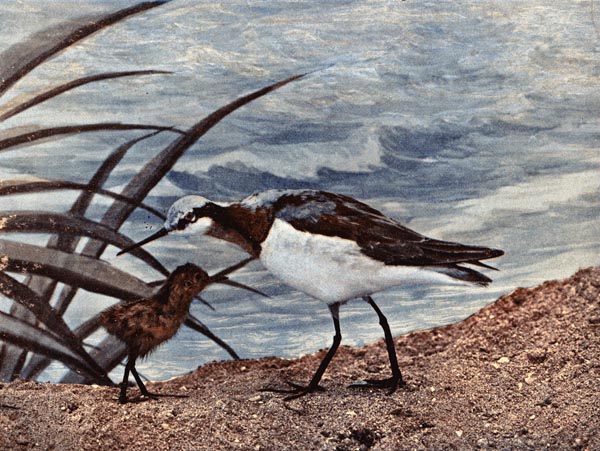
Wilson’s Phalarope for Birds Illustrated by Color Photography
WILSON’S PHALAROPE.
ERHAPS the most interesting, as it is certainly the most uncommon, characteristic of this species of birds is that the male relieves his mate from all domestic duties except the laying of the eggs. He usually chooses a thin tuft of grass on a level spot, but often in an open place concealed by only a few straggling blades. He scratches a shallow depression in the soft earth, lines it with a thin layer of fragments of old grass blades, upon which the eggs, three or four, are laid about the last of May or first of June. Owing to the low situation in which the nest is placed, the first set of eggs are often destroyed by a heavy fall of rain causing the water to rise so as to submerge the nest. The instinct of self preservation in these birds, as in many others, seems lacking in this respect. A second set, numbering two or three, is often deposited in a depression scratched in the ground, as at first, but with no sign of any lining.
Wilson’s Phalarope is exclusively an American bird, more common in the interior than along the sea coast. The older ornithologists knew little of it. It is now known to breed in northern Illinois, Iowa, Wisconsin, Minnesota, the Dakotas, Utah, and Oregon. It is recorded as a summer resident in northern Indiana and in western Kansas. Mr. E. W. Nelson states that it is the most common species in northern Illinois, frequenting grassy marshes and low prairies, and is not exceeded in numbers even by the ever-present Spotted Sandpiper. While it was one of our most common birds in the Calumet region it is now becoming scarce.
The adult female of this beautiful species is by far the handsomest of the small waders. The breeding plumage is much brighter and richer than that of the male, another peculiar characteristic, and the male alone possesses the naked abdomen. The female always remains near the nest while he is sitting, and shows great solicitude upon the approach of an intruder. The adults assume the winter plumage during July.
Wilson’s Phalarope (Phalaropus tricolor) by J Fenton
Lee’s Addition:
Out of the ground the LORD God formed every beast of the field and every bird of the air, and brought them to Adam to see what he would call them. And whatever Adam called each living creature, that was its name. So Adam gave names to all cattle, to the birds of the air, and to every beast of the field. But for Adam there was not found a helper comparable to him. (Genesis 2:19-20 NKJV)
What another fantastically created bird. The Phalaropes belong to the Scolopacidae – Sandpipers, Snipes family. There are 96 species in the family, with 3 of those in the Phalaropus genus; the Wilson’s, Red-necked and Red Phalaropes. Phalarope are sometimes called “wadepipers.” They are especially notable for two things: their unusual nesting behavior (see above), and their unique feeding technique. When feeding, a phalarope will often swim in a small, rapid circle, forming a small whirlpool. This behavior is thought to aid feeding by raising food from the bottom of shallow water. The bird will reach into the center of the vortex with its bill, plucking small insects or crustaceans caught up therein.
The Wilson’s Phalarope, Phalaropus tricolor, is a small wader. This bird, the largest of the phalaropes, breeds in the prairies of North America in western Canada and the western United States. It is migratory, wintering around the central Andes in South America. They are passage migrants through Central America around March/April and again during September/October. The species is a rare vagrant to western Europe.
This species is often very tame and approachable. Its common name commemorates the American ornithologist Alexander Wilson. Sometimes, it is placed in a monotypic genus Steganopus.
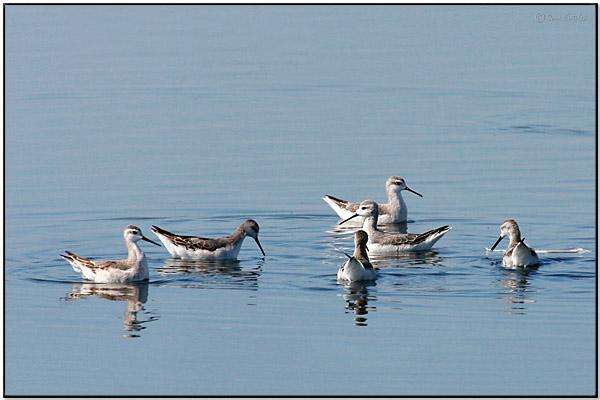
Wilson’s Phalarope (Phalaropus tricolor) by Daves BirdingPix
Wilson’s Phalarope is slightly larger than the Red Phalarope at about 9.1 in (23 cm) in length. As are all 3 phalaropes, it is a unique, dainty shorebird with lobed toes and a straight fine black bill. The breeding female is predominantly gray and brown above, with white underparts, a reddish neck and reddish flank patches. The breeding male is a duller version of the female, with a brown back, and the reddish patches reduced or absent. In a study of breeding phalaropes in Saskatchewan Providence in Canada, females were found to average around 10% larger in standard measurements and to weigh around 30% more than the males. Females weighed from 68 to 79 g (2.4 to 2.8 oz), whereas the males average 1.83 oz (51.8 g).
Young birds are grey and brown above, with whitish underparts and a dark patch through the eye. In winter, the plumage is essentially grey above and white below, but the dark eyepatch is always present.
The above article is the first article in the monthly serial that was started in January 1897 “designed to promote Knowledge of Bird-Live.” These include Color Photography, as they call them, today they are drawings. There are at least three Volumes that have been digitized by Project Gutenberg.
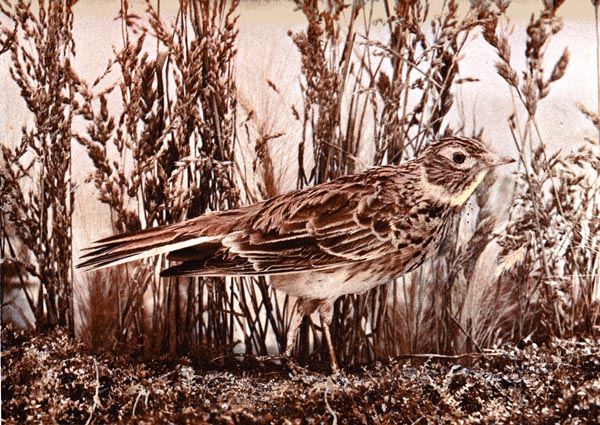
The Skylark – Birds Illustrated by Color Photography
From col. F. M. Woodruff.
THE SKYLARK.
This is not an American bird. I have allowed his picture to be taken and placed here because so many of our English friends desired it.
The skylark is probably the most noted of birds in Europe. He is found in all of the countries of Europe, but England seems to claim it. Here it stays during the summer, and goes south in the winter.
Like our own Meadow Lark, he likes best to stay in the fields. Here you will find it when not on the wing.
Early in the spring the Skylark begins his song, and he may be heard for most of the year.
Sometimes he sings while on the ground, but usually it is while he is soaring far above us.
Skylarks do not often seek the company of persons. There are some birds, you know, that seem happy only when they are near people. Of course, they are somewhat shy, but as a rule they prefer to be near people. While the Skylark does not seek to be near persons, yet it is not afraid of them.
A gentleman, while riding through the country, was surprised to see a Skylark perch on his saddle. When he tried to touch it, the Lark moved along on the horse’s back, and finally dropped under the horse’s feet. Here it seemed to hide. The rider, looking up, saw a hawk flying about. This explained the cause of the skylark’s strange actions.
A pair of these Larks had built their nest in a meadow. When the time came for mowing the grass, the little ones were not large enough to leave the nest. The mother bird laid herself flat on the ground, with her wings spread out. The father bird took one of the little ones from the nest and placed it on the mother’s back. She flew away, took the baby bird to a safe place, and came back for another.
This time the father took his turn. In this way they carried the little ones to a safe place before the mowers came.
Like our Meadow Lark, the Skylark builds her nest on the ground—never in bushes or trees. Usually it is built in a hole below the surface of the ground. It is for this reason that it is hard to find.
Then, too, the color of the nest is much like that of the ground.
Four or five eggs are usually laid, and in two weeks the little larks crack the shells, and come into the world crying for worms and bugs.
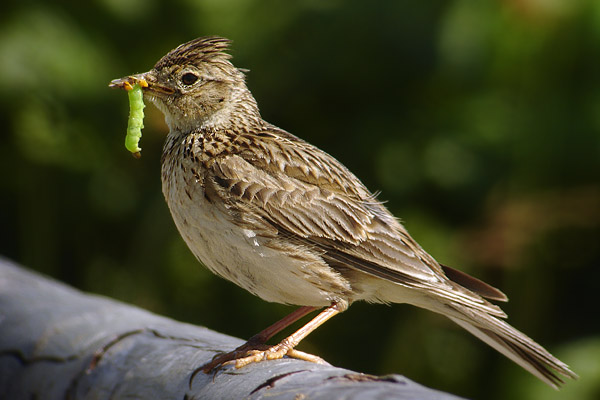
Eurasian Skylark (Alauda arvensis) by Ian
THE SKYLARK.
HE English Skylark has been more celebrated in poetry than any other song-bird. Shelley’s famous poem is too long to quote and too symmetrical to present in fragmentary form. It is almost as musical as the sweet singer itself.
“By the first streak of dawn,” says one familiar with the Skylark, “he bounds from the dripping herbage, and on fluttering wings mounts the air for a few feet ere giving forth his cheery notes. Then upward, apparently without effort he sails, sometimes drifting far away as he ascends, borne as it were by the ascending vapors, so easily he mounts the air. His notes are so pure and sweet, and yet so loud and varied withal, that when they first disturb the air of early morning all the other little feathered tenants of the fields and hedgerows seem irresistibly compelled to join him in filling the air with melody. Upwards, ever upwards, he mounts, until like a speck in the highest ether he appears motionless; yet still his notes are heard, lovely in their faintness, now gradually growing louder and louder as he descends, until within a few yards of the earth they cease, and he drops like a fragment hurled from above into the herbage, or flits about it for a short distance ere alighting.” The Lark sings just as richly on the ground as when on quivering wing. When in song he is said to be a good guide to the weather, for whenever we see him rise into the air, despite the gloomy looks of an overcast sky, fine weather is invariably at hand.
The nest is most frequently in the grass fields, sometimes amongst the young corn, or in places little frequented. It is made of dry grass and moss, and lined with fibrous roots and a little horse hair. The eggs, usually four or five in number, are dull white, spotted, clouded, and blotched over the entire surface with brownish green. The female Lark, says Dixon, like all ground birds, is a very close sitter, remaining faithful to her charge. She regains her nest by dropping to the ground a hundred yards or more from its concealment.
The food of the Lark is varied,—in spring and summer, insects and their larvae, and worms and slugs, in autumn and winter, seeds.
Olive Thorne Miller tells this pretty anecdote of a Skylark which she emancipated from a bird store: “I bought the skylark, though I did not want him. I spared no pains to make the stranger happy. I procured a beautiful sod of uncut fresh grass, of which he at once took possession, crouching or sitting low among the stems, and looking most bewitching. He seemed contented, and uttered no more that appealing cry, but he did not show much intelligence. His cage had a broad base behind which he delighted to hide, and for hours as I sat in the room I could see nothing of him, although I would hear him stirring about. If I rose from my seat he was instantly on the alert, and stretched his head up to look over at me. I tried to get a better view of him by hanging a small mirror at an angle over his cage, but he was so much frightened by it that I removed it.”
“This bird,” Mrs. Miller says “never seemed to know enough to go home. Even when very hungry he would stand before his wide open door, where one step would take him into his beloved grass thicket, and yet that one step he would not take. When his hunger became intolerable he ran around the room, circled about his cage, looking in, recognizing his food dishes, and trying eagerly to get between the wires to reach them; and yet when he came before the open door he would stand and gaze, but never go in. After five months’ trial, during which he displayed no particular intelligence, and never learned to enter his cage, he passed out of the bird room, but not into a store.”
Don’t be afraid, land; rejoice and be glad, for the LORD has done great things. Don’t be afraid, wild animals, for the wilderness pastures have turned green, the trees bear their fruit, and the fig tree and grapevine yield their riches. (Joel 2:21-22 HCSB)
The Eurasian Skylark (Alauda arvensis) is a small passerine bird species. This lark breeds across most of Europe and Asia and in the mountains of north Africa. It is mainly resident in the west of its range, but eastern populations are more migratory, moving further south in winter. Even in the milder west of its range, many birds move to lowlands and the coast in winter. Asian birds appear as vagrants in Alaska; this bird has also been introduced in Hawaii, western North America, eastern Australia and New Zealand.
The Eurasian Skylark is 16 to 18 centimetres long. It is a bird of open farmland and heath, known throughout its range for the song of the male, which is delivered in hovering flight from heights of 50 to 100 m, when the singing bird may appear as just a dot in the sky from the ground. The song generally lasts two to three minutes, but it tends to last longer later in the mating season. The male has broader wings than the female. This adaptation for more efficient hovering flight may have evolved because of female Eurasian Skylarks’ preference for males that sing and hover for longer periods and so demonstrate that they are likely to have good overall fitness.
Like most other larks, the Eurasian Skylark is a rather dull-looking species on the ground, being mainly brown above and paler below. It has a short blunt crest on the head, which can be raised and lowered. In flight it shows a short tail and short broad wings. The tail and the rear edge of the wings are edged with white, which are visible when the bird is flying away, but not if it is heading towards the observer. The Eurasian Skylark has sturdy legs and spends much time on the ground foraging for seeds, supplemented with insects in the breeding season.
The Eurasian Skylark makes a grass nest on the ground, hidden amongst vegetation. It is sometimes found nesting in bracken, using it for cover. Generally the nests are very difficult to find. Three to six eggs are laid in June. A second or third brood may be started later in the year. The eggs are yellow/white with brownish/purple spots mainly at the large end. (Wikipedia)
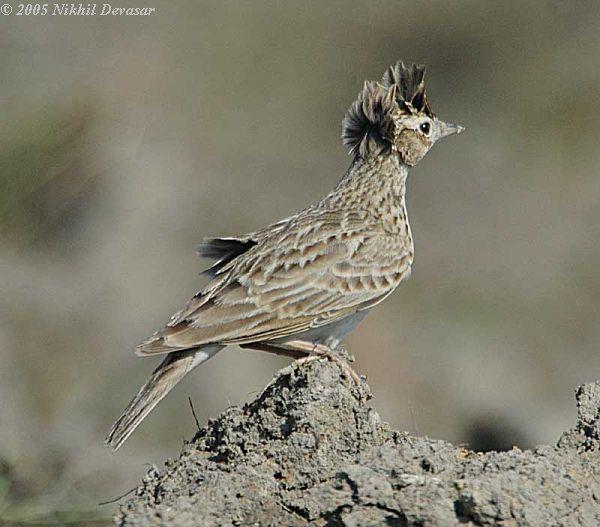
Oriental Skylark (Alauda gulgula) by Nikhil Devasar
There is also the Oriental Skylark (Alauda gulgula), also known as the Oriental Lark or Small Skylark, is a species of skylark found in the Indian Subcontinent and Southeast Asia. Like other skylarks, it is found in open grassland – often near waterbodies – where it feeds on seeds and insects.
These skylarks frequently rocket up into the sky, fluttering and singing before descending down to earth. Male Oriental Skylarks may also hover in the air and sing, in order to attract a mate.
Oriental Skylarks are about 16 cm long. They have streaked, yellow-brown upper plumage, with white outer tail feathers and a short crest. Both sexes are similar. (Wikipedia)
The above article is the first article in the monthly serial that was started in January 1897 “designed to promote Knowledge of Bird-Live.” These include Color Photography, as they call them, today they are drawings. There are at least three Volumes that have been digitized by Project Gutenberg.
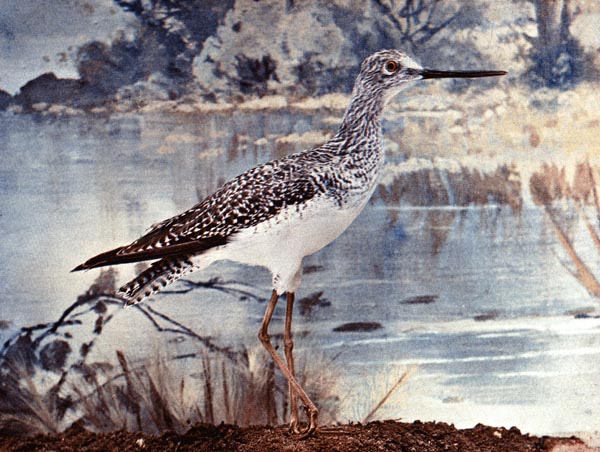
Lesser Yellow Legs for Birds Illustrated by Color Photography – From col. F. M. Woodruff.
THE YELLOW LEGS.
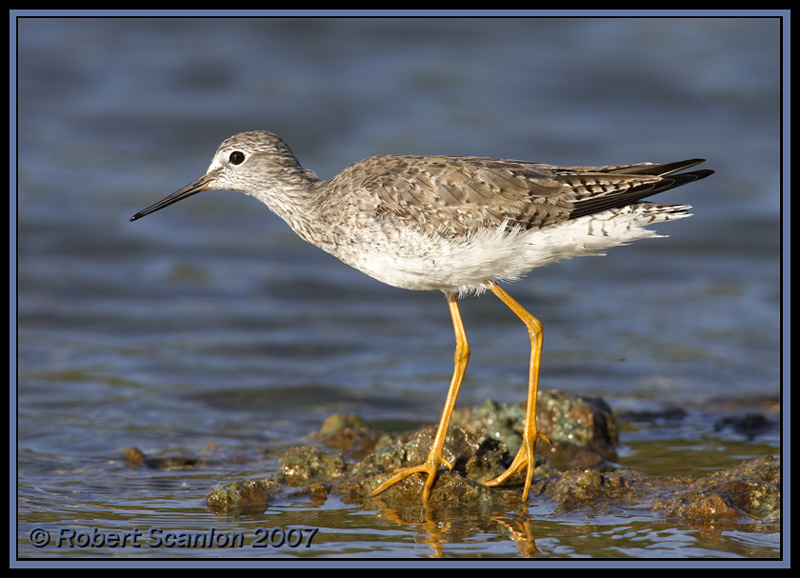
ELLOW LEGS, or Lesser Tell tale sometimes called Yellow-leg Snipe, and Little Cucu, inhabits the whole of North America, nesting in the cold temperate and subarctic districts of the northern continent, migrating south in winter to Argentine and Chili. It is much rarer in the western than eastern province of North America, and is only accidental in Europe. It is one of the wading birds, its food consisting of larvae of insects, small shell fish and the like.
The nest of the Lesser Yellow Shanks, which it is sometimes called, is a mere depression in the ground, without any lining. Sometimes, however, it is placed at the foot of a bush, with a scanty lining of withered leaves. Four eggs of light drab, buffy or cream color, sometimes of light brown, are laid, and the breast of the female is found to be bare of feathers when engaged in rearing the young. The Lesser Yellow legs breeds in central Ohio and Illinois, where it is a regular summer resident, arriving about the middle of April, the larger portion of flocks passing north early in May and returning about the first of September to remain until the last of October.
A nest of this species of Snipe was found situated in a slight depression at the base of a small hillock near the border of a prairie slough near Evanston, Illinois, and was made of grass stems and blades. The color of the eggs in this instance was a deep grayish white, three of which were marked with spots of dark brown, and the fourth egg with spots and well defined blotches of a considerably lighter shade of the same.
Lesser Yellowlegs (Tringa flavipes) by Robert Scanlon
Lee’s Addition:
If you come across a bird’s nest in any tree or on the ground, with young ones or eggs and the mother sitting on the young or on the eggs, you shall not take the mother with the young. (Deuteronomy 22:6 ESV)
The Yellowlegs belong to the Scolopacidae – Sandpipers, Snipes Family. There are 96 species in the family. The Tringa genus that they are placed in also has Redshanks, Greenshanks, Sandpipers, Tattlers, and the Willet.
The Lesser Yellowlegs (Tringa flavipes) is a medium-sized shorebird similar in appearance to the larger Greater Yellowlegs. It is not closely related to this bird, however, but instead to the much larger and quite dissimilar Willet: merely the fine, clear and dense pattern of the neck shown in breeding plumage indicates these species’ actual relationships.
Their breeding habitat is clearings near ponds in the boreal forest region from Alaska to Quebec. They nest on the ground, usually in open dry locations.
They migrate to the Gulf coast of the United States and south to South America.
This species is a regular vagrant to western Europe, and the odd bird has wintered in Great Britain.
These birds forage in shallow water, sometimes using their bill to stir up the water. They mainly eat insects, small fish and crustaceans.
The call of this bird is softer than that of the Greater Yellowlegs.
The above article is the first article in the monthly serial that was started in January 1897 “designed to promote Knowledge of Bird-Live.” These include Color Photography, as they call them, today they are drawings. There are at least three Volumes that have been digitized by Project Gutenberg.
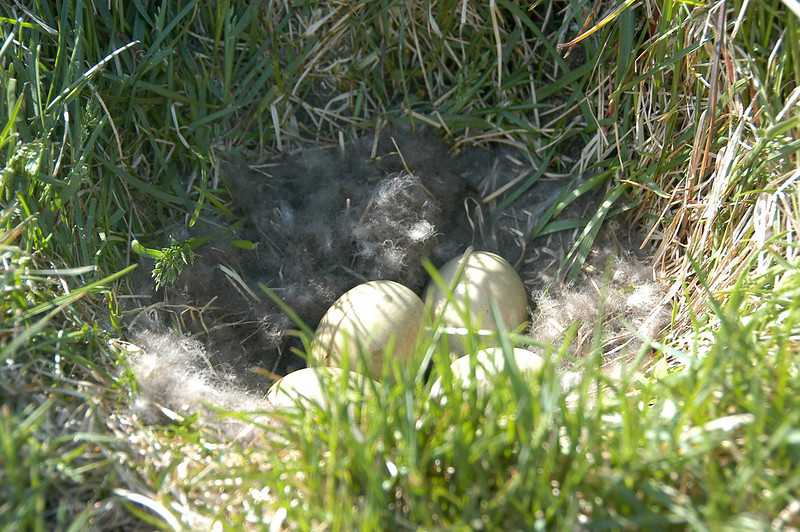
Common Eider (Somateria mollissima) nest by Bob-Nan
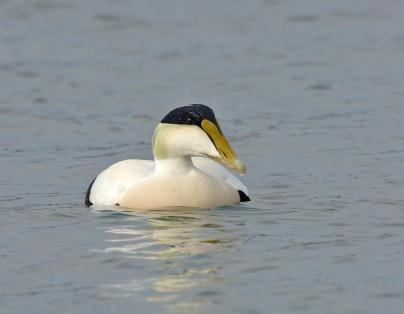
The Eider Duck – The cushion maker.. ~ by a j mithra
When constructing her nest,
a Female Eider Duck will line it
with soft down feathers
that she plucks from her own breast.
This gives the eggs
the best possible cushioning and insulation.
Nuggets Plus
Jesus didn’t pluck His down feathers,
but, plucked Himself from heaven
and came down to give His whole life
to cushion and insulate our lives..
So that we may hatch to become
more like Him to do His will
in our lives on earth as it is in heaven..
I will both lay me down in peace, and sleep: for thou, LORD, only makest me dwell in safety. (Psalm 4:8)
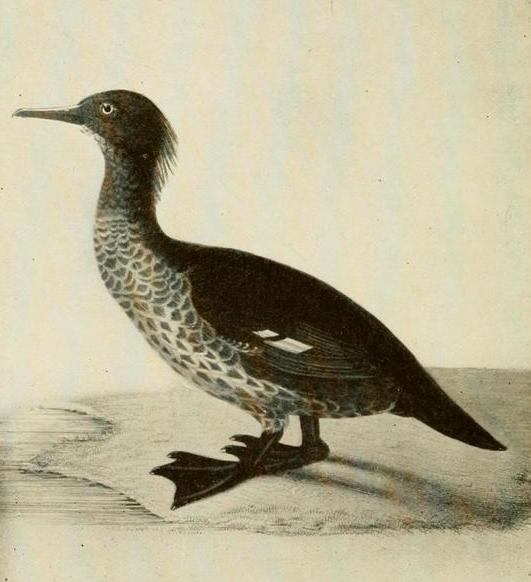
Red-breasted Merganser from Birds Illustrated by Color Photography
THE RED BREASTED MERGANSER.
HY this duck should be called red-breasted is not at first apparent, as at a distance the color can not be distinguished, but seen near, the reason is plain. It is a common bird in the United States in winter, where it is found in suitable localities in the months of May and June. It is also a resident of the far north, breeding abundantly in Newfoundland, Labrador, Greenland, and Iceland. It is liberally supplied with names, as Red-Breasted Goosander or Sheldrake, Garbill, Sea Robin, etc.
There is a difference in opinion as to the nesting habits of the Red-Breast, some authorities claiming that, like the Wood Duck, the nest is placed in the cavity of a tree, others that it is usually found on the ground among brushwood, surrounded with tall grasses and at a short distance from water. Davie says that most generally it is concealed by a projecting rock or other object, the nest being made of leaves and mosses, lined with feathers and down, which are plucked from the breast of the bird. The observers are all probably correct, the bird adapting itself to the situation.
Fish is the chief diet of the Merganser, for which reason its flesh is rank and unpalatable. The Bird’s appetite is insatiable, devouring its food in such quantities that it has frequently to disgorge several times before it is able to rise from the water. This Duck can swallow fishes six or seven inches in length, and will attempt to swallow those of a larger size, choking in the effort.
The term Merganser is derived from the plan of the bird’s bill, which is furnished with saw teeth fitting into each other.
The eggs of the Red-Breasted Merganser vary from six to twelve, are oval in shape, and are of a yellowish or reddish-drab, sometimes a dull buffy-green.
You may have seen pictures of this Duck, which frequently figures in dining rooms on the ornamental panels of stuffed game birds, but none which could cause you to remember its life-like appearance. You here see before you an actual Red-Breasted Merganser.
Birds Vol 2 #2 – The Red Breasted Merganser
From col. J. G. Parker, Jr.
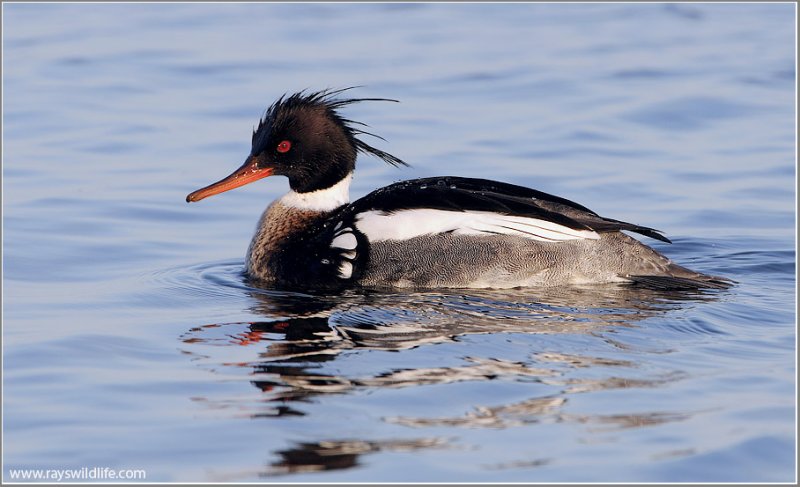
Red-breasted Merganser (Mergus serrator) by Ray
Lee’s Addition:
Out of the ground the LORD God formed every beast of the field and every bird of the air, and brought them to Adam to see what he would call them. And whatever Adam called each living creature, that was its name. (Genesis 2:19 NKJV)
The adult Red-breasted Merganser is 20–24 in (51–62 cm) long with a 28–34 in (70–86 cm) wingspan. It has a spiky crest and long thin red bill with serrated edges. The male has a dark head with a green sheen, a white neck with a rusty breast, a black back, and white underparts. Adult females have a rusty head and a greyish body. The juvenile is like the female, but lacks the white collar and has a smaller white wing patch.
The call of the female is a rasping prrak prrak, while the male gives a feeble hiccup-and-sneeze display call. (from xeno-canto)
Red-breasted Mergansers dive and swim underwater. They mainly eat small fish, but also aquatic insects, crustaceans, and frogs.
Its breeding habitat is freshwater lakes and rivers across northern North America, Greenland, Europe, and Asia. It nests in sheltered locations on the ground near water. It is migratory and many northern breeders winter in coastal waters further south.
It has been claimed to be the fastest bird in level flight, reaching speeds of 161 km/h (100 mph), but is disputed whether the White-throated Needletail is faster, reportedly flying at 170 km/h (105 mph).
Here is a video of a Common Merganser flipping his feet after diving for food that was given him at the Zoo Miami Wings of Asia Aviary – by me.
The above article is the first article in the monthly serial that was started in January 1897 “designed to promote Knowledge of Bird-Live.” These include Color Photography, as they call them, today they are drawings. There are at least three Volumes that have been digitized by Project Gutenberg.
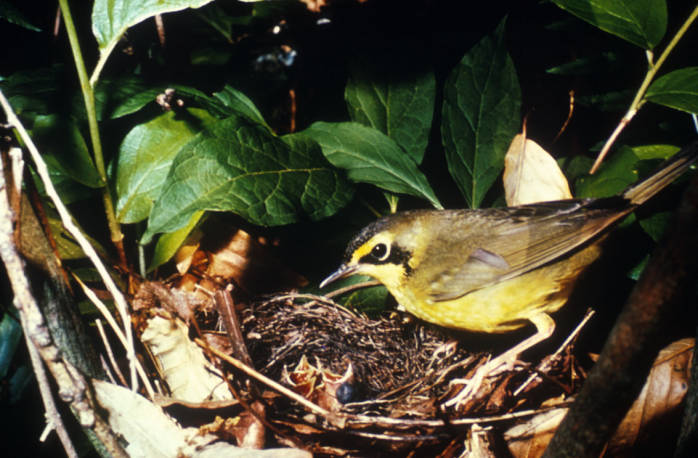
Although this bird is called the Kentucky Warbler, we must not think he visits that state alone.
We find him all over eastern North America. And a beautiful bird he is.
As his name tells you he is one of a family of Warblers.
I told you somewhere else that the Finches are the largest family of birds. Next to them come the Warblers.
Turn back now and see how many Warblers have been pictured so far.
See if you can tell what things group them as a family. Notice their bills and feet.
This bird is usually found in the dense woods, especially where there are streams of water.
He is a good singer, and his song is very different from that of any of the other Warblers.
I once watched one of these birds—olive-green above and yellow beneath. His mate was on a nest near by and he was entertaining her with his song.
He kept it up over two hours, stopping only a few seconds between his songs. When I reached the spot with my field-glass I was attracted by his peculiar song. I don’t know how long he had been singing. I stayed and spent two hours with him and he showed no signs of stopping. He may be singing yet. I hope he is.
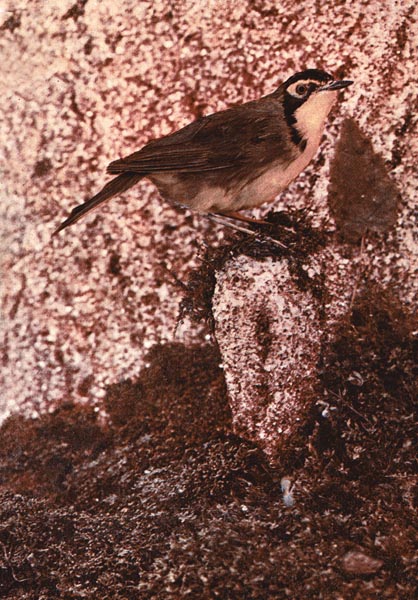
You see him here perched on a granite cliff. I suppose his nest is near by.
He makes it of twigs and rootlets, with several thicknesses of leaves. It is neatly lined with fine rootlets and you will always find it on or near the ground.
In the September and October number of “Birds” you will find several Warblers and Finches. Try to keep track of them and may be you can do as many others have done—tell the names of new birds that come along by their pictures which you have seen in “Birds.”
From col. F. M. Woodruff.
THE KENTUCKY WARBLER.
ETWEEN sixty and seventy warblers are described by Davie in his “Nests and Eggs of North American Birds,” and the Kentucky Warbler is recognized as one of the most beautiful of the number, in its manners almost the counterpart of the Golden Crowned Thrush (soon to delight the eyes of the readers of Birds), though it is altogether a more conspicuous bird, both on account of its brilliant plumage and greater activity, the males being, during the season of nesting, very pugnacious, continually chasing one another about the woods. It lives near the ground, making its artfully concealed nest among the low herbage and feeding in the undergrowth, the male singing from some old log or low bush, his song recalling that of the Cardinal, though much weaker.
The ordinary note is a soft schip, somewhat like the common call of the Pewee. Considering its great abundance, says an observer, the nest of this charmer is very difficult to find; the female, he thought, must slyly leave the nest at the approach of an intruder, running beneath the herbage until a considerable distance from the nest, when, joined by her mate, the pair by their evident anxiety mislead the stranger as to its location.
It has been declared that no group of birds better deserves the epithet “pretty” than the Warblers. Tanagers are splendid, Humming Birds refulgent, others brilliant, gaudy, or magnificent, but Warblers alone are pretty.
The Warblers are migratory birds, the majority of them passing rapidly across the United States in spring on the way to their northern nesting grounds, and in autumn to their winter residence within the tropics. When the apple trees bloom they revel among the flowers, vieing in activity and numbers with the bees; “now probing the recesses of a blossom for an insect, then darting to another, where, poised daintily upon a slender twig, or suspended from it, they explore hastily but carefully for another morsel. Every movement is the personification of nervous activity, as if the time for their journey was short; as, indeed, appears to be the case, for two or three days at most suffice some species in a single locality.”
We recently saw a letter from a gentleman living at Lake Geneva, in which he referred with enthusiasm to Birds, because it had enabled him to identify a bird which he had often seen in the apple trees among the blossoms, particularly the present season, with which he was unacquainted by name. It was the Orchard Oriole, and he was glad to have a directory of nature which would enable him to add to his knowledge and correct errors of observation. The idea is a capitol one, and the beautiful Kentucky Warbler, unknown to many who see it often, may be recognized in the same way by residents of southern Indiana and Illinois, Kansas, some localities in Ohio, particularly in the southwestern portion, in parts of New York and New Jersey, in the District of Columbia, and in North Carolina. It has not heretofore been possible, even with the best painted specimens of birds in the hand, to satisfactorily identify the pretty creatures, but with Birds as a companion, which may readily be consulted, the student cannot be led into error.
Lee’s Addition:
I know all the birds of the hills, and all that moves in the field is mine. (Psalms 50:11 ESV)
The Kentucky Warbler is in the New World Warblers – Parulidae Family. At present their are 115 species that make up this family. Warblers are confusing for me to figure out at times. Number 1, I don’t see them often, and then they are passing through on their migration south. They are neat birds and I always enjoy seeing them. Mostly here I see the Yellow-rumps and the Black-and-white occasionally.
The Kentucky Warbler, is a sluggish and heavy warbler with a short tail, preferring to spend most of its time on or near the ground, except when singing.
Kentucky Warbler song by Chris Parrish and call by Andrew Spencer from xeno-canto.org.
They are only about 5-6 inches long. They migrate to the Yucatan Peninsula and many of the Caribbean Islands. That is after they make a non-stop flight across the Gulf of Mexico. The Lord has given them quite a flying ability to do that.
The above article is the first article in the monthly serial that was started in January 1897 “designed to promote Knowledge of Bird-Live.” These include Color Photography, as they call them, today they are drawings. There are at least three Volumes that have been digitized by Project Gutenberg.
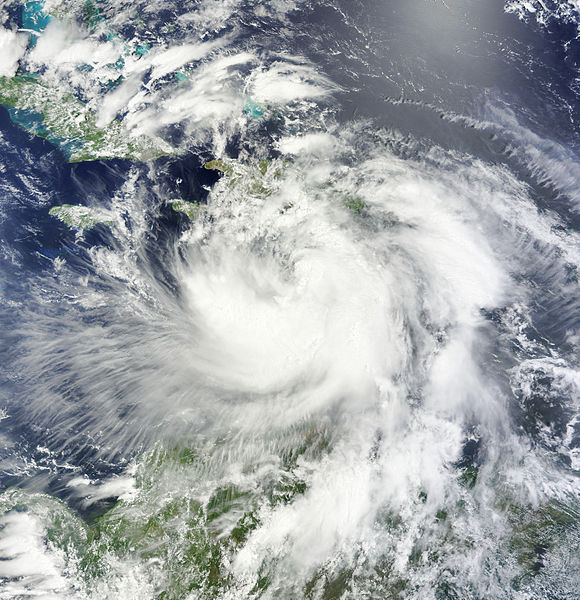
We here in central Florida are keeping an eye to the south of us as Tropical Storm Isaac marches up this way. They are predicting it to become a hurricane before it gets in this area. We expect rain, but not a direct hit. But! As I told Dan, “until the storm parks at the end of its journey, anything goes.” Do we worry, no, not as Christians. Do we prepare? Yes.
I just filled the feeders extra full for the birds to get a nice meal before they hunker down for what ever passes our way. Where will they go? What will they do? Those are some interesting questions. Let’s see what has been written about that.
How Birds Stay Safe During Hurricanes, “Where Do Birds Go During Hurricanes?” is an interesting article from Birding.com. They tell about the “a sharp drop in barometric pressure” that warns the birds of coming storms. God has given them senses and instincts to prepare.
If they don’t have babies or nest, they are likely to fly to safer regions. Larger birds can stay ahead of the storm. Others have to fly hard, or land and take cover. When the Lord created the birds, He gave them a locking mechanism on their legs and feet. When they perch, their feet sort of lock and that keeps them from falling off while sleeping or from being blown away. Of course, a 80 mph wind or more will get to a point that even they can’t hold on. They also have the chance the tree could be toppled. They also mention that shorebirds tend to go inland.
What Happens To Birds When Hurricanes Hit? from eNature.com says, “Numbers are hard to come by, but it’s clear that many birds are killed outright by hurricanes. This is especially true of seabirds, which have nowhere in which to seek shelter from these storms. Beaches may be littered with seabird carcasses following major storm events. Most Atlantic hurricanes occur in late summer and early fall—and fall storms coincide with bird migration and may disrupt migration patterns severely.” So, the outcome is not always good. One thing we do know from Scripture:
Are not five sparrows sold for two farthings, and not one of them is forgotten before God? But even the very hairs of your head are all numbered. Fear not therefore: ye are of more value than many sparrows. (Luke 12:6-7 KJV)
Are not two sparrows sold for a farthing? and one of them shall not fall on the ground without your Father. But the very hairs of your head are all numbered. Fear ye not therefore, ye are of more value than many sparrows. (Matthew 10:29-31 KJV)
The Lord know all about the deaths, but when they were created, they were given abilities, like above, to protect themselves as best they can.
So God created the great sea creatures and every living creature that moves, with which the waters swarm, according to their kinds, and every winged bird according to its kind. And God saw that it was good. And God blessed them, saying, “Be fruitful and multiply and fill the waters in the seas, and let birds multiply on the earth.” And there was evening and there was morning, the fifth day. (Genesis 1:21-23 ESV)
He has blessed them and told them to reproduce. Would He let them all be wiped out? I don’t think so. Yes, a few will fall.
Hurricane Charley damage at Captiva, Trees stripped.
After the storm, the birds have problems especially if the fruits and vegetables are destroyed. Also, trees, which provide shelter and places for nest might be in short supply. For those of who feed birds, after the storm, if you still have any feeders, they need to be filled up. Also, clean water needs to be provided.
One plus from a storm is that the Life List of birdwatchers could be increased. Many times birds are blown out of their area or off course. This provides a chance to see birds not normally seen. Seabirds can get caught up in the Eye of the storm and carried inland. Thus giving birdwatchers rare treats to see birds.
You can read those and other articles about the birds in a storm on the internet. I am no expert, nor do I claim to be. What I do know is that God loves them, maybe not with the same love He has for us, but He Cares. If He Cares for them, you can rest assured, we are more valuable in His Sight. He will help us humans as we go through the Hurricanes also.
Even the birds in the sky know the right time to do things. The storks, doves, swifts, and thrushes know when it is time to fly to a new home. But my people don’t know what the LORD wants them to do. (Jeremiah 8:7 ERV)
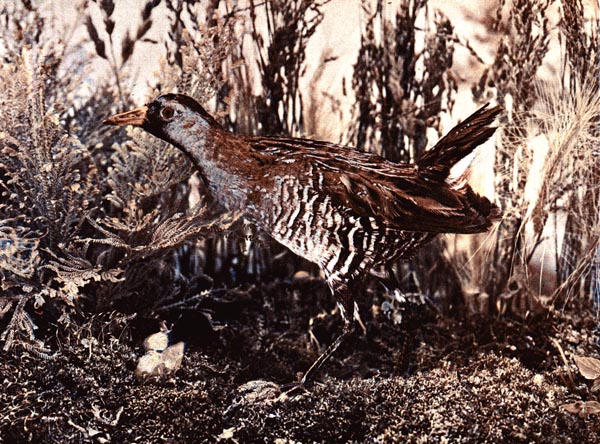
Sora – for the Birds Illustrated by Color Photography, 1897
THE SORA RAIL.
ARIOUS are the names required to distinguish the little slate-colored Carolina Rail from its brethren, Sora, Common Rail, and, on the Potomac river, Ortolan, being among them. He is found throughout temperate North America, in the weedy swamps of the Atlantic states in great abundance, in the Middle states, and in California. In Ohio he is a common summer resident, breeding in the extensive swamps and wet meadows. The nest is a rude affair made of grass and weeds, placed on the ground in a tussock of grass in a boggy tract of land, where there is a growth of briers, etc., where he may skulk and hide in the wet grass to elude observation. The nest may often be discovered at a distance by the appearance of the surrounding grass, the blades of which are in many cases interwoven over the nest, apparently to shield the bird from the fierce rays of the sun, which are felt with redoubled force on the marshes.
The Rails feed on both vegetable and animal food. During the months of September and October, the weeds and wild oats swarm with them. They feed on the nutritious seeds, small snail shells, worms and larvae of insects, which they extract from the mud. The habits of the Sora Rail, its thin, compressed body, its aversion to take wing, and the dexterity with which it runs or conceals itself among the grass and sedge, are exactly similar to those of the more celebrated Virginia Rail.
The Sora frequents those parts of marshes preferably where fresh water springs rise through the morass. Here it generally constructs its nest, “one of which,” says an observer, “we had the good fortune to discover. It was built in the bottom of a tuft of grass in the midst of an almost impenetrable quagmire, and was composed altogether of old wet grass and rushes. The eggs had been flooded out of the nest by the extraordinary rise of the tide in a violent northwest storm, and lay scattered about the drift weed. The usual number of eggs is from six to ten. They are of a dirty white or pale cream color, sprinkled with specks of reddish and pale purple, most numerous near the great end.”
When on the wing the Sora Rail flies in a straight line for a short distance with dangling legs, and suddenly drops into the water.
The Rails have many foes, and many nests are robbed of their eggs by weasels, snakes, Blackbirds, and Marsh Hawks, although the last cannot disturb them easily, as the Marsh Hawk searches for its food while flying and a majority of the Rails’ nests are covered over, making it hard to distinguish them when the Hawk is above.
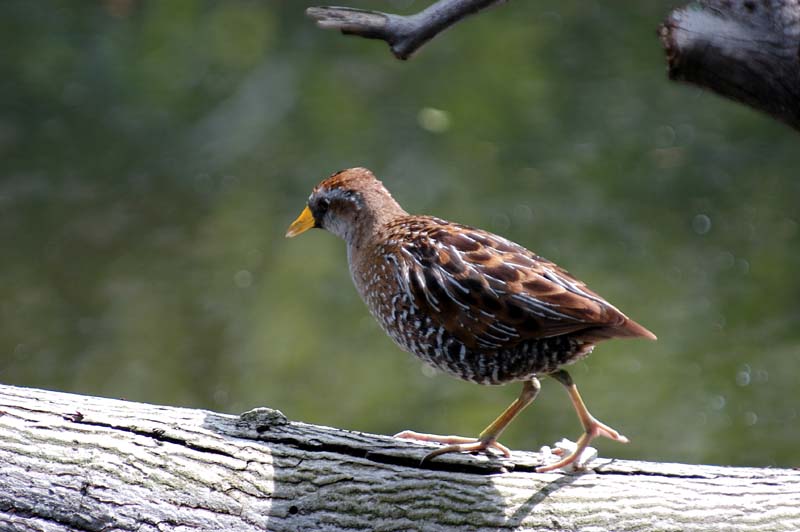
Sora(Porzana carolina) 4 by Bob-Nan
THE SORA RAIL.
This is one of our fresh-water marsh birds. I show you his picture taken where he spends most of his time.
If it were not for the note calls, these tall reeds and grasses would keep from us the secret of the Rail’s home.
Like most birds, though, they must be heard, and so late in the afternoon you may hear their clear note, ker-wee.
From all parts of the marsh you will hear their calls which they keep up long after darkness has set in.
This Rail was just about to step out from the grasses to feed when the artist took his picture. See him—head up, and tail up. He steps along carefully. He feels that it is risky to leave his shelter and is ready at the first sign of danger, to dart back under cover.
There are very few fresh-water marshes where the Rail is not found.
When a boy, I loved to hear their note calls and would spend hours on the edge of a marsh near my home.
It seemed to me there was no life among the reeds and cat-tails of the marsh, but when I threw a stone among them, the Rails would always answer with their peeps or keeks.
And so I used to go down to the marsh with my pockets filled with stones. Not that I desired or even expected to injure one of these birds. Far from it. It pleased me to hear their calls from the reeds and grass that seemed deserted.
Those of you who live near wild-rice or wild-oat marshes have a good chance to become acquainted with this Rail.
In the south these Rails are found keeping company with the Bobolinks or Reed-birds as they are called down there.
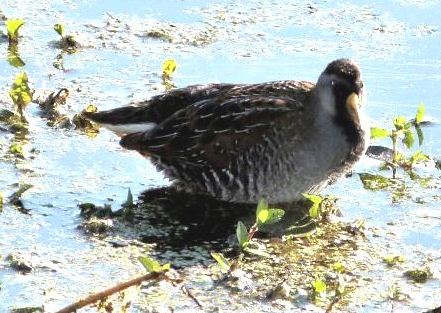
Sora (Porzana carolina) by Lee at Circle B
Lee’s Addition:
Can the papyrus grow up without a marsh? Can the reeds flourish without water? (Job 8:11 NKJV)
Under the lotus plants he lies, in the shelter of the reeds and in the marsh. (Job 40:21 ESV)
Soras are in the Rallidae – Rails, Crakes & Coots Family. At present there are 151 species in the family. Sometimes the Sora has Rail or Crake attached to Sora. They spend most of their time in marshes.
Adult Soras are 7.5–12 in (19–30 cm) long, with dark-marked brown upperparts, a blue-grey face and underparts, and black and white barring on the flanks. They have a short thick yellow bill, with black markings on the face at the base of the bill and on the throat. Sexes are similar, but young Soras lack the black facial markings and have a whitish face and buff breast. They weigh about 1.7–4.0 oz (49–112 g).
The Sora’s breeding habitat is marshes throughout much of North America. They nest in a well-concealed location in dense vegetation. The female usually lays 10 to 12 eggs, sometimes as many as 18, in a cup built from marsh vegetation. The eggs do not all hatch together. Both parents incubate and feed the young, who leave the nest soon after they hatch and are able to fly within a month.
They migrate to the southern United States and northern South America. Sora is a very rare vagrant to western Europe, where it can be confused with Spotted Crake. However, the latter species always has spotting on the breast. a streaked crown stripe, and a different wing pattern.
Soras forage while walking or swimming. They are omnivores, eating seeds, insects and snails. Although Soras are more often heard than seen, they are sometimes seen walking near open water. They are fairly common, despite a decrease in suitable habitat in recent times. The call is a slow whistled ker-whee, or a descending whinny. The use of call broadcasts greatly increases the chances of hearing a Sora. Call broadcasts can also increase the chances of seeing a Sora, as they will often investigate the source of the call.
The above article is the first article in the monthly serial that was started in January 1897 “designed to promote Knowledge of Bird-Live.” These include Color Photography, as they call them, today they are drawings. There are at least three Volumes that have been digitized by Project Gutenberg.
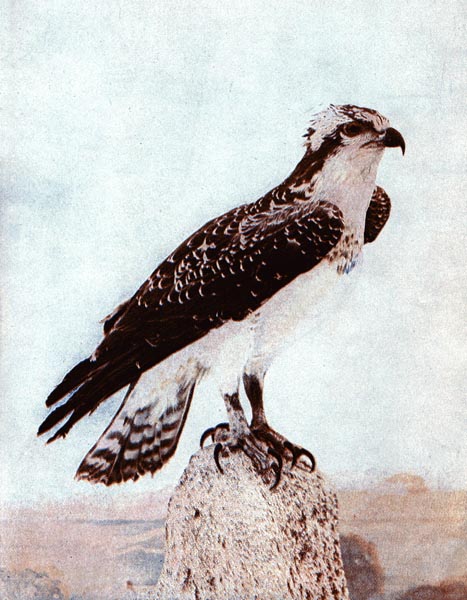
The American Osprey for Birds Illustrated by Color Photography, 1897
The American Osprey.
Here is the picture of a remarkable bird. We know him better by the name Fish Hawk. He looks much like the Eagle in July “Birds.” The Osprey has no use for Mr. Eagle though.
You know the Bald Eagle or Sea Eagle is very fond of fish. Well, he is not a very good fisherman and from his lofty perch he watches for the Fish Hawk or Osprey. Do you ask why? Well, when he sees a Fish Hawk with his prey, he is sure to chase him and take it from him. It is for this reason that Ospreys dislike the Bald Eagle.
Their food is fish, which as a rule they catch alive.
It must be interesting to watch the Osprey at his fishing. He wings his way slowly over the water, keeping a watch for fish as they appear near the surface.
When he sees one that suits him, he hovers a moment, and then, closing his wings, falls upon the fish.
Sometimes he strikes it with such force that he disappears in the water for a moment. Soon we see him rise from the water with the prey in his claws.
He then flies to some tall tree and if he has not been discovered by his enemy, the Eagle, can have a good meal for his hard work.
Look at his claws; then think of them striking a fish as they must when he plunges from on high.
A gentleman tells of an Osprey that fastened his claws in a fish that was too large for him.
The fish drew him under and nothing more was seen of Mr. Osprey. The same gentleman tells of a fish weighing six pounds that fell from the claws of a Fish Hawk that became frightened by an Eagle.
The Osprey builds his nest much like the Bald Eagle. It is usually found in a tall tree and out of reach.
Like the Eagle, he uses the same nest each year, adding to it. Sometimes it measures five feet high and three feet across. One nest that was found, contained enough sticks, cornstalks, weeds, moss, and the like, to fill a cart, and made a load for a horse to draw. Like the Crows and Blackbirds they prefer to live together in numbers. Over three hundred nests have been found in the trees on a small island.
One thing I want you to remember about the Osprey. They usually remain mated for life.
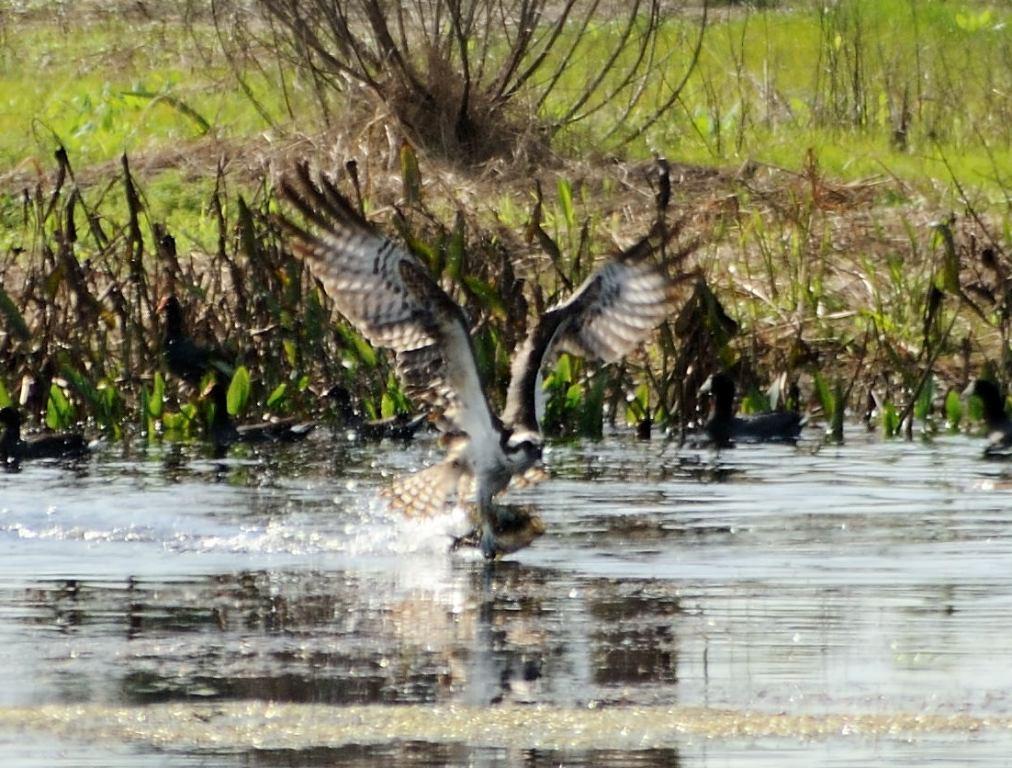
Osprey Catching Fish – Viera Wetlands by Dan
THE AMERICAN OSPREY.
N interesting bird, “Winged Fisher,” as he has been happily called, is seen in places suited to his habits, throughout temperate North America, particularly about islands and along the seacoast. At Shelter Island, New York, they are exceedingly variable in the choice of a nesting place. On Gardiner’s Island they all build in trees at a distance varying from ten to seventy-five feet from the ground; on Plum Island, where large numbers of them nest, many place their nests on the ground, some being built up to a height of four or five feet while others are simply a few sticks arranged in a circle, and the eggs laid on the bare sand. On Shelter Island they build on the chimneys of houses, and a pair had a nest on the cross-bar of a telegraph pole. Another pair had a nest on a large rock. These were made of coarse sticks and sea weed, anything handy, such as bones, old shoes, straw, etc. A curious nest was found some years ago on the coast of New Jersey. It contained three eggs, and securely imbedded in the loose material of the Osprey’s nest was a nest of the Purple Grackle, containing five eggs, while at the bottom of the Hawk’s nest was a thick, rotten limb, in which was a Tree Swallow’s nest of seven eggs.
In the spring and early autumn this familiar eagle-like bird can be seen hovering over creek, river, and sound. It is recognized by its popular name of Fish-Hawk. Following a school of fish, it dashes from a considerable height to seize its prey with its stout claws. If the fish is small it is at once swallowed, if it is large, (and the Osprey will occasionally secure shad, blue fish, bass, etc., weighing five or six pounds,) the fish is carried to a convenient bluff or tree and torn to bits. The Bald Eagle often robs him of the fish by seizing it, or startling him so that he looses his hold.
The Osprey when fishing makes one of the most breezy, spirited pictures connected with the feeding habits of any of our birds, as often there is a splashing and a struggle under water when the fish grasped is too large or the great talons of the bird gets entangled. He is sometimes carried under and drowned, and large fish have been washed ashore with these birds fastened to them by the claws.
Mrs. Mabel Osgood Wright says: “I found an Osprey’s nest in a crooked oak on Wakeman’s Island in late April, 1893. As I could not get close to the nest (the island is between a network of small creeks, and the flood tides covered the marshes,) I at first thought it was a monstrous crow’s nest, but on returning the second week in May I saw a pair of Osprey coming and going to and fro from the nest. I hoped the birds might return another season, as the nest looked as if it might have been used for two or three years, and was as lop-sided as a poorly made haystack. The great August storm of the same year broke the tree, and the nest fell, making quite a heap upon the ground. Among the debris were sticks of various sizes, dried reeds, two bits of bamboo fishing rod, seaweeds, some old blue mosquito netting, and some rags of fish net, also about half a bushel of salt hay in various stages of decomposition, and malodorous dirt galore.”
It is well-known that Ospreys, if not disturbed, will continue indefinitely to heap rubbish upon their nests till their bulk is very great. Like the Owls they can reverse the rear toe.
Osprey with Fish by Jim Fenton
Lee’s Addition:
And these are they which ye shall have in abomination among the fowls; they shall not be eaten, they are an abomination: the eagle, and the ossifrage, and the ospray, (Leviticus 11:13 KJV)
We have the privilege of seeing Ospreys all the time. On a daily basis we spot them on their platforms that have been put up for them in this area. If they don’t place them there, then you find their nest in trees with bare branches that they can anchor the nest and have a good place to watch for fish.
The above article is the first article in the monthly serial that was started in January 1897 “designed to promote Knowledge of Bird-Live.” These include Color Photography, as they call them, today they are drawings. There are at least three Volumes that have been digitized by Project Gutenberg.















 Lee's Birdwatching Adventures Plus