Birds Vol 1 #1 – The Australian Grass Parrakeet(Parakeet)

Elegant Parrot (Neophema petrophila) aka Australian Grass Parakeet

Elegant Parrot (Neophema petrophila) aka Australian Grass Parakeet

Birds Illustrated by Color Photography – Revisited

Vol 1. January, 1897 No. 1

*

THE AUSTRALIAN GRASS PARRAKEET (Parakeet)

I am a Parrakeet. I belong to the Parrot family. A man bought me and brought me here. It is not warm here, as it was where I came from. I almost froze coming over here. I am not kept in a cage. I stay in the house and go about as I please. There is a Kitty Cat in the house. Sometimes I ride on her back. I like that. I used to live in the grass lands. It was very warm there. I ran among the thick grass blades, and sat on the stems and ate seeds. I had a wife then. Her feathers were almost like mine. We never made nests. When we wanted a nest, we found a hole in a gum tree. I used to sing to my wife while she sat on the nest. I can mock other birds. Sometimes I warble and chirp at the same time. Then it sounds like two birds singing. My tongue is short and thick, and this helps me to talk. But I have been talking too much. My tongue is getting tired. I think I’ll have a ride on Kitty’s back. Good bye.


Elegant Parrot (Neophema elegans) WikiC

Elegant Parrot (Neophema elegans) WikiC

imgp

ARRAKEETS have a great fondness for the grass lands, where they may be seen in great numbers, running amid the thick grass blades, clinging to their stems, or feeding on their seeds. Grass seed is their constant food in their native country. In captivity they take well to canary seed, and what is remarkable, never pick food with their feet, as do other species of parrots, but always use their beaks. “They do not build a nest, but must be given a piece of wood with a rough hole in the middle, which they will fill to their liking, rejecting all soft lining of wool or cotton that you may furnish them.” Only the male sings, warbling nearly all day long, pushing his beak at times into his mate’s ear as though to give her the full benefit of his song. The lady, however, does not seem to appreciate his efforts, but generally pecks him sharply in return. A gentleman who brought a Parrakeet from Australia to England, says it suffered greatly from the cold and change of climate and was kept alive by a kind-hearted weather-beaten sailor, who kept it warm and comfortable in his bosom. It was not kept in a cage, but roamed at will about the room, enjoying greatly at times, a ride on the cat’s back. At meals he perched upon his master’s shoulder, picking the bits he liked from a plate set before him. If the weather was cold or chilly, he would pull himself up by his master’s whiskers and warm his feet by standing on his bald head. He always announced his master’s coming by a shrill call, and no matter what the hour of night, never failed to utter a note of welcome, although apparently asleep with his head tucked under his wing.

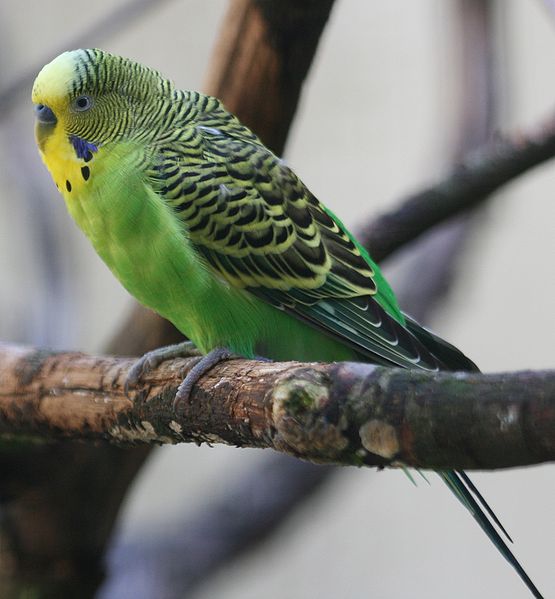
Budgerigar (Melopsittacus undulatus) by Lee LPZ

Budgerigar (Melopsittacus undulatus) by Lee LPZ


Lee’s Addition:

I am not really sure which Parakeet they are referring to in this article. Today their is not really an Australian Grass Parakeet, but the Elegant Parakeet favors the photo-drawing, but also Budgerigars also favor that drawing. At any rate, they are neat little birds and both can talk as mentioned.

Wikipedia says this about Grass Parakeets:  “Its common name is Elegant Parrot, but has also been called Elegant Parakeet, Elegant Grass Parakeet, and Grass Parrot in the past. The Elegant Parrot is 23 cm (9 in) long and predominantly golden olive in colour with a dark blue frontal band line above with lighter blue. while abdomen and vent are yellow. The female is a duller shade of olive all over and has a narrower blue frontal band. The wings are predominantly olive with outer flight feathers dark blue. The yellow edged tail has shades of olive and blue. The bill and legs are grey and the eyes dark brown. Juveniles are duller and lack the frontal bands.”

“The Budgerigar (Melopsittacus undulatus), also known as common pet parakeet or shell parakeet informally nicknamed the budgie, is a small, long-tailed, seed-eating parrot, and the only species in the Australian genus Melopsittacus. Wild budgerigars are found throughout the drier parts of Australia, where the species has survived harsh inland conditions. Naturally green and yellow with black, scalloped markings on the nape, back, and wings, breeders have created a rainbow of blues, whites, and yellows, greys, and even forms with small crests. Budgerigars are popular pets around the world due to their small size, low cost, ability to mimic human speech and playful nature.
The budgerigar is closely related to the lories and the fig parrots. Although budgerigars are often, especially in American English, called “parakeets“, this term refers to any of a number of small parrots with long, flat tails.

Alternative common names include shell parrot, warbling grass parakeet, canary parrot, zebra parrot, flight bird, scallop parrot and the alternate spellings budgerygah and betcherrygah.” (Wikipedia)
Budgerigar (Melopsittacus undulatus) WikiC

Budgerigar (Melopsittacus undulatus) WikiC

Both the Elegant Parrot (Neophema elegans) and the Budgerigar (Melopsittacus undulatus) are in the Psittacidae – Parrots Family. I lean toward the Budgerigar, but take your choice. Whatever, they are very colorful and a delight to watch and observe. The Lord put lots of color potential in the parakeet family.

Which doeth great things past finding out; yea, and wonders without number. (Job 9:10 KJV)
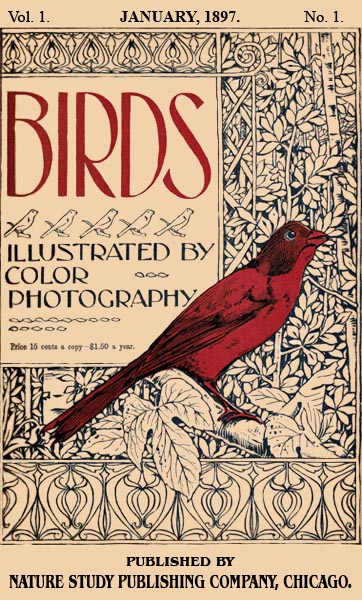
Birds Illustrated by Color Photograhy Vol 1 January 1897 No 1 - Cover

Birds Illustrated by Color Photography – Revisited – Introduction The above article is the fifth article in the monthly serial that was started in January 1897 “designed to promote Knowledge of Bird-Live.” These include Color Photography, as they call them, today they are drawings. There are at least three Volumes that have been digitized by Project Gutenberg.

To see the whole series of – Birds Illustrated by Color Photography – Revisited* (Information from Wikipedia and other internet sources)

Next Article – The Cock-Of-The-Rock

Previous Article – The Golden Pheasant

*

Gospel Presentation

*

Nuggets Plus – The Ant, stores to share…

Ants and aphids on a mango tree ©binux

Ants and aphids on a mango tree ©binux

The Ant, stores to share… ~ by a j mithra

Ants have two stomachs
one to store food for itself
and the other to store food
to be shared with the other ants!

Nuggets Plus

Nuggets Plus

We’ve been storing
lots of spiritual food since birth
but, do we share it or store it?

Remember, storing too much
could lead to spiritual cholesterol..

The King will reply, ‘Truly I tell you, whatever you did for one of the least of these brothers and sisters of mine, you did for me. Matthew 25:40)
Have a blessed day!
a j mithra
*

Redhead at Lake Morton – 1-20-12

*

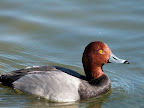
Saturday we headed over to Lakeland for some errands and took the cameras along. We stopped by Lake Morton to see who was there. Turned out to be quite a few interesting birds and got our third “Life Bird” of the year. This time I even was able to video it. There was a couple feeding the birds cracked corn and bread. They had quite a menagerie around them. They came from all over the Lake and we just stood there and photographed away. In amongst the Ring-necked Ducks was this Redhead. We searched all the birds, but he was the only Redhead to be found.

“The Redhead (Aythya americana) is a medium-sized diving duck, 14.5 in (37 cm) long with an 33 in (84 cm) wingspan.
The adult male has a blue bill, a red head and neck, a black breast, yellow eyes and a grey back. The adult female has a brown head and body and a darker bluish bill with a black tip.

The breeding habitat is marshes and prairie potholes in western North America. Loss of nesting habitat has led to sharply declining populations.

Females regularly lay eggs in the nests of other Redheads or other ducks, especially Canvasbacks. Redheads usually take new mates each year, starting to pair in late winter.

Following the breeding season, males go through a molt which leaves them flightless for almost a month. Before this happens, they leave their mates and move to large bodies of water, usually flying further north.

They overwinter in the southern and north-eastern United States, the Great Lakes region, northern Mexico and the Caribbean.

These birds feed mainly by diving or dabbling. They mainly eat aquatic plants” (Wikipedia)

For every kind of beast and bird, of reptile and creature of the sea, is tamed and has been tamed by mankind. (James 3:7 NKJV)

The people feeding these birds were practically proving this verse. Even the Great Blue Heron has come out to feed in the past.

Here is a list of all the birds I listed with eBird.org for 1-20-2012 at Lake Morton.

My Lake Morton List

Mute Swan 20 (Not even counting ones on north side of lake)
Black Swan 1
Muscovy Duck (Domestic type) 5
Mallard (Domestic type) 30 (Also at least 7 White Pekin type ducks)
Redhead 1

Ring-necked Duck 15


Ruddy Duck 1


American White Pelican 3
Great Blue Heron 1
Great Egret 2
White Ibis 18
Turkey Vulture 1
Bald Eagle 1


American Coot 40
Limpkin 2
Ring-billed Gull 10
Rock Pigeon 5
Tree Swallow 10
Boat-tailed Grackle 11

See also:

The whole Lake Morton Album

Redhead (duck) – Wikipedia

Sharing The Gospel

*

Birdwatching Adventure – Circle B Bar Reserve – 1/16/12

Sora (Porzana carolina) by Lee at Circle B

Sora (Porzana carolina) by Lee at Circle B

Dan and I went over to Circle B Bar Reserve on Monday, January 16th. We had a great time birding and we got to view a “Life Bird.” (This one is for real.) See the photo above. “Life Birds” are what you call a bird species the first time you see one. We now have 3 life birds this year. The Sora seen here is the second one for the year. The first one was a Hooded Grebe on Saturday. and I spotted a third one today, a Redhead, at Lake Morton.

The Sora is a bird in the Rails, Crakes & Coots – Rallidae Family. They are 7.9-9.8 in (20-25 cm) and weigh about 1.4-4 oz (49-112 g). So they are not a large bird. I found it among the Common Gallinule and that is what help me realize that it was different and smaller. Been looking for a Sora for months out at Circle B. Knew they were there, just never found one.

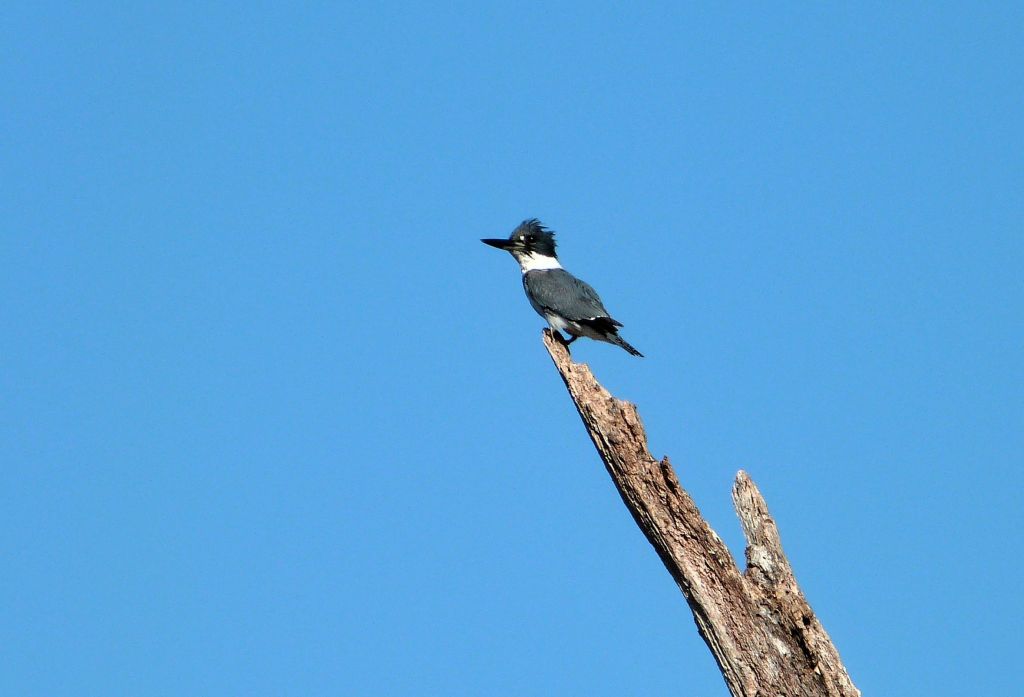
Belted Kingfisher (Megaceryle alcyon) by Lee Circle B

Belted Kingfisher (Megaceryle alcyon) by Lee Circle B

Another highlight of our trip was finding 2 Belted Kingfishers, close-up and personal. They are hard to photograph, but this time they were showing off right in front of us. They were hovering and then diving for their food. Was great to watch them. They are in the Kingfisher – Alcedinidae Family. They are medium sized, actually we both were surprised they are as large as they are. They always appear to have a very short squatty neck. They are 11–13.8 in (28–35 cm), weigh 4.9–6 oz (140–170 g) and have a 19-22 in (48-58cm) wingspan.

Belted Kingfisher (Megaceryle alcyon) by Lee Circle B

Belted Kingfisher (Megaceryle alcyon) by Lee Circle B

Let all those who seek You rejoice and be glad in You; And let those who love Your salvation say continually, “Let God be magnified!” (Psalms 70:4 NKJV)

We also spotted several Alligators.

Here is the list that I turned in to eBird.org:

37 species total

Black-bellied Whistling-Duck 20
Mottled Duck 2
Ruddy Duck 2
Double-crested Cormorant 2
Anhinga 1
Great Blue Heron 2
Great Egret 3
Little Blue Heron 2
Cattle Egret 15
Turkey Vulture 50
Osprey 1
Northern Harrier 1
Common Gallinule 10
American Coot 20
Sandhill Crane 6
Killdeer 1
Mourning Dove 5
Tree Swallow 30
Northern Mockingbird 1
Palm Warbler 3
Yellow-rumped Warbler 1
Boat-tailed Grackle 5

Wordless Birds

*

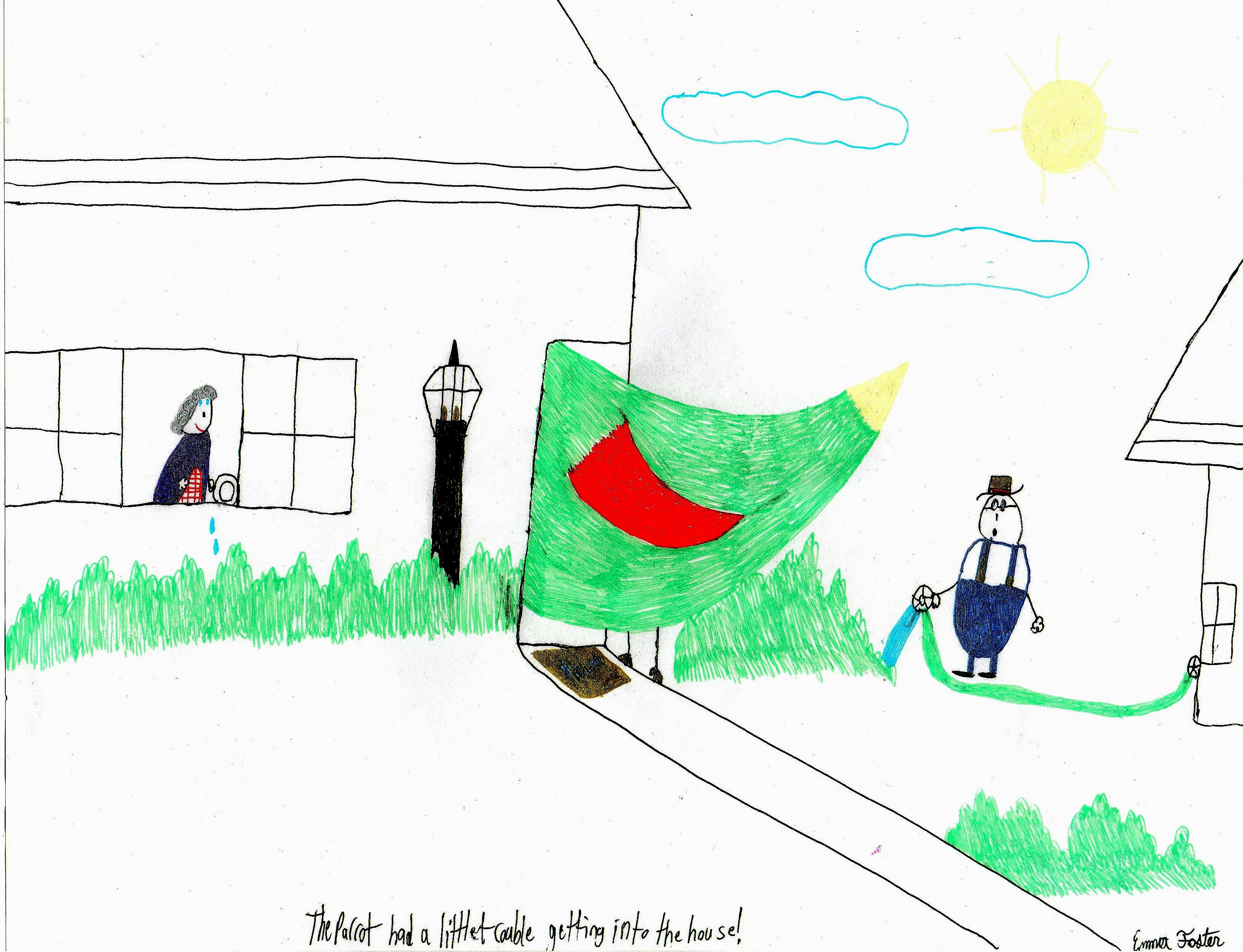
Mrs. Patterson’s Parrot – by Emma Foster


Parrot Had A Little Trouble Getting Into The House by Emma Foster

Parrot Had A Little Trouble Getting Into The House by Emma Foster

One day an old lady named Mrs. Patterson decided that she should have more company around. She traveled down to her local pet store and parked her car. Mrs. Patterson was guided by one of the workers through the store. When they came to the section where the birds were, Mrs. Patterson stopped at an enormous parrot. The parrot had red wings, green all over his body, a blue ring around his neck and a yellow spot on his tail. Mrs. Patterson wanted him for her bird.

It took awhile before the parrot could fit through the door! The parrot was so big that he had to wear a leash that Mrs. Patterson held through the window of her car and soar above it. The parrot had a little trouble getting in the house! When he got into the house, Mrs. Patterson named him Bob.

But one day a visitor came to the door and addressed himself as Mr. Field. He explained that Bob was his parrot that he had lost long ago. After saying goodbye, Bob left with Mr. Field, wearing a leash, and flew away above Mr. Field’s truck.

The next day Mr. Field came back with Bob! Mr. Field said that he worked at a circus with Bob, but Bob could not remember any of his tricks so he had to bring him back. Mrs. Patterson thanked him and sat down in a chair with Bob. She knew he would always be her parrot.

The End

(I did no editing of the article. Click the photo to enlarge it.)


Lee’s Addition:

Emma was 12 years old and Home Schooled when this was first posted. She attends our church and likes to draw and write. I told her that if she wrote about a bird, I would publish it here on the blog. Above is her story and drawing of Bob the enormous Parrot. I trust you enjoy it as well as I did. She was in the 7th Grade at the time. [She is now in college] If you enjoy it, please click the Like button as that will be an encouragement to her.

Train up a child in the way he should go; even when he is old he will not depart from it. (Proverbs 22:6 ESV)

P.S. Emma is the Granddaughter of another of our Guest Writers, Dot Malcolm. She has written three articles for us.

The Joy of Awareness

When the Robins Came

Return of the Robins

plus more

*

*** As I am bringing back the Kids articles, thought you might enjoy re-reading these tales.

If you would like to send in a Bird Tale that you have written, send it to Lee@Leesbird.com to be considered. It can be written by a younger writer or written with the young readers in mind. ***

Birdwatching Adventure for January 7, 2012

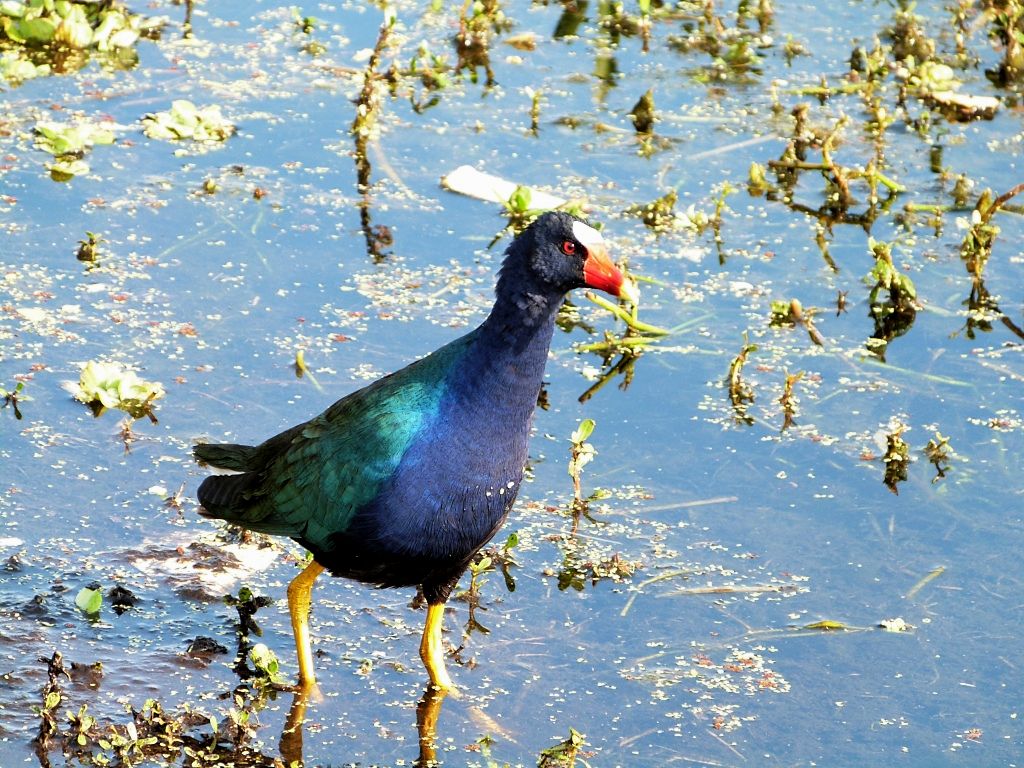
Purple Gallinule by Lee at Lake Parker 1-7-12

Purple Gallinule by Lee at Lake Parker 1-7-12

In the last 10 days, Dan and I have finally been able to go birdwatching. We have had three birding trips right here in Polk County.

Twice we went up to Lake Parker Park in Lakeland. We went on the 7th and again on the 14th of January. The 7th was our 1st adventure of 2012. Here is a list of what I turned in to ebird.org which is a listing service that was launched in 2002 by the Cornell Lab of Ornithology and National Audubon Society to track birds. Here is the list for the January 7, 2012:

Comments: Along shore on way to park and in park
26 species (+1 other taxa)
Mallard (Domestic type) 8
Ring-necked Duck 3
Pied-billed Grebe 4
Double-crested Cormorant – Immature 4
Anhinga 5
Great Blue Heron 2
Great Egret 2
Snowy Egret 3
Cattle Egret 1
White Ibis 10
Glossy Ibis 4
Roseate Spoonbill 1
Turkey Vulture 1
Osprey 4
Red-shouldered Hawk 1
Purple Gallinule 3
Common Gallinule 5
American Coot 7
Ring-billed Gull 20
Caspian Tern 1
Belted Kingfisher 1
Downy Woodpecker 1
Blue-gray Gnatcatcher 5
Palm Warbler 1
Pine Warbler 3
Yellow-rumped Warbler 2
Boat-tailed Grackle 20
American Coot showing feet by Lee LPkr

American Coot showing feet by Lee LPkr

American Coots have an amazing foot structure. It’s not what you would expect but has lobed toes rather than webbed feet. Photos of foot on Google Search

Which doeth great things past finding out; yea, and wonders without number. (Job 9:10 KJV)

I also turned in the birds I saw coming and going to the park, which is 10 miles from our house:
9 species
Black Vulture 5
Turkey Vulture 10
Sandhill Crane 3
Rock Pigeon 4
Eurasian Collared-Dove 10
Mourning Dove 1
Fish Crow 50
Boat-tailed Grackle 5
House Finch 2
Palm Warbler cropped by Lee LPP

Palm Warbler (Mistaken Pipit) by Lee LPP

All in all, it was a great birding day. The highlight was getting a new bird for my life list of birds seen. (Update This Pipit turned out to be a Palm Warbler, NOT a life bird: We spotted an American Pipit along the shore before we arrived at the park.) We stopped because Dan had spotted a Roseate Spoonbill. The county had a fair sized alligator pinned up right there also.

Last year I saw 2 “life birds” but it took all year to find them. I am writing this on the 17th and I already have 2  to tell you about, but I will save those for the next articles.
*

Nuggets Plus – African Lungfish, The Clay Dweller…

Protopterus - African Lungfish WikiC

Protopterus - African Lungfish WikiC

Nuggets Plus – African Lungfish, The Clay Dweller… ~ by a j mithra

Nuggets Plus

Nuggets Plus

African Lung fish
dig a hole and survive
under the mud
for even up to four years
without water!

What have we done
for those who live in miry clay
without the Living Water
all through their lives?

He that believeth on me, as the scripture hath said, out of his belly shall flow rivers of living water (John 7:38)

Have a blessed day!

a j mithra


More Nuggets Plus

a j mithra’s Articles

Protopterus – Wikipedia

Pardon The Dust

King Penguin (Aptenodytes patagonicus) 6 by Ian

King Penguin (Aptenodytes patagonicus) 6 by Ian

Update 1/14/12 I am releasing the “sticky” part and letting this flow with the rest of the blog. Looks like they got most of it fixed and the great people at WordPress are working to keep their host up and running.

Update 1/13/12 WordPress just put a fix on the site tonight. I will leave this up until tomorrow to see if it stays fixed or I find any other problems.

Lee

Please forgive the posts at the present. I just became aware of a change they made at WordPress.com, which is where this site is hosted. They made a revision to their software and it has knocked many of the photos here out of whack!

I knew I was seeing something weird for the last week or so when I went back to view older posts. Some of my pictures are not centered but off to the right, have letters flowing through them, are hugh, etc. They have been notified, and I have been making changes as I discover them. I am having to change them manually. The problem is that there are over 1,000 pages and over 1,000 posts on this site. Most with more than one photo. Many, many posters on WordPress are being affected. Especially those of us using photos.

To make improvements, sometimes things happen that they didn’t plan on. Be patient, they and I am working on correcting this.

I am not at ease, nor am I quiet; I have no rest, for trouble comes.” (Job 3:26 NKJV)

“Man who is born of woman Is of few days and full of trouble. (Job 14:1 NKJV)

The LORD also will be a refuge for the oppressed, A refuge in times of trouble. (Psalms 9:9 NKJV)

Then they cried out to the LORD in their trouble, And He delivered them out of their distresses. (Psalms 107:6 NKJV)

King Penguin (Aptenodytes patagonicus) 7 by Ian

King Penguin (Aptenodytes patagonicus) 7 by Ian

From – Ian’s Bird of the Week – King Penguin

PS If anyone finds a post with photo problems, please leave a comment on that post. It will help me get this problem fixed.

*

Birds Vol 1 #1 – The Golden Pheasant

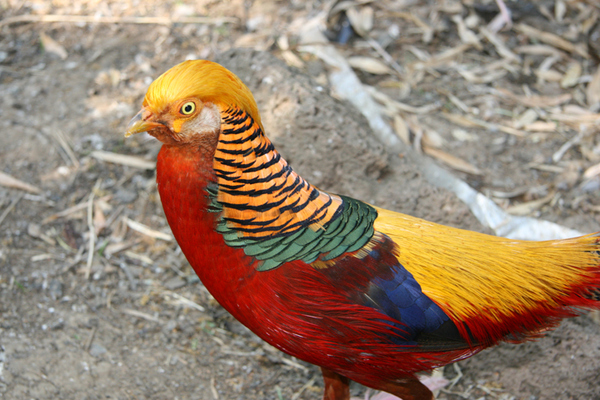
Golden Pheasant (Chrysolophus pictus)

Golden Pheasant (Chrysolophus pictus)

Birds Illustrated by Color Photography – Revisited

Vol 1. January, 1897 No. 1

*

THE GOLDEN PHEASANT

They call me the Golden Pheasant, because I have a golden crest. It is like a king’s crown. Don’t you think my dress is beautiful enough for a king?

See the large ruff around my neck. I can raise and lower it as I please.

I am a very large bird. I am fourteen inches tall and twenty-eight inches long. I can step right over your little robins and meadow larks and blue jays and not touch them.

Sometimes people get some of our eggs and put them under an old hen. By and by little pheasants hatch out, and the hen is very good to them. She watches over them and feeds them, but they do not wish to stay with her; they like their wild life. If they are not well fed they will fly away.

I have a wife. Her feathers are beginning to grow like mine. In a few years she will look as I do. We like to have our nests by a fallen tree.

Golden Pheasant (Chrysolophus pictus) WikiC

Golden Pheasant (Chrysolophus pictus) WikiC


imgt

HE well-known Chinese Pheasant, which we have named the Golden Pheasant, as well as its more sober-colored cousin, the Silver Pheasant, has its home in Eastern Asia.

China is pre-eminently the land of Pheasants; for, besides those just mentioned, several other species of the same family are found there. Japan comes next to China as a pheasant country and there are some in India.

In China the Golden Pheasant is a great favorite, not only for its splendid plumage and elegant form, but for the excellence of its flesh, which is said to surpass even that of the common pheasant. It has been introduced into Europe, but is fitted only for the aviary.

For purposes of the table it is not likely to come into general use, as there are great difficulties in the way of breeding it in sufficient numbers, and one feels a natural repugnance to the killing of so beautiful a bird for the sake of eating it. The magnificent colors belong only to the male, the female being reddish brown, spotted and marked with a darker hue. The tail of the female is short. The statement is made, however, that some hens kept for six years by Lady Essex gradually assumed an attire like that of the males.

Fly-fishers highly esteem the crest and feathers on the back of the neck of the male, as many of the artificial baits owe their chief beauty to the Golden Pheasant.

According to Latham, it is called by the Chinese Keuki, or Keukee, a word which means gold flower fowl.

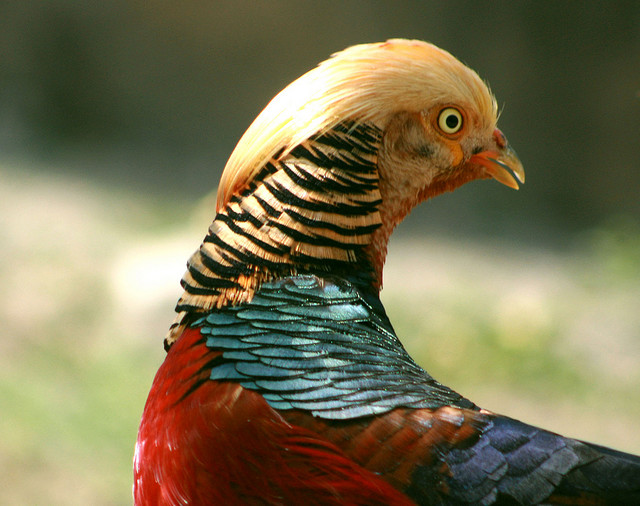
Golden Pheasant (Chrysolophus pictus) Male ©© NotMicroButSoft

Golden Pheasant (Chrysolophus pictus) Male ©© NotMicroButSoft


“A merry welcome to thee, glittering bird!
Lover of summer flowers and sunny things!
A night hath passed since my young buds have heard
The music of thy rainbow-colored wings—
Wings that flash spangles out where’er they quiver,
Like sunlight rushing o’er a river.”


Lee’s Addition:

What a beautiful bird. I am glad in 2012 that birds are not used for their feathers as much as they were back in the 1800’s. I’ve noticed in the first articles how the birds mentioned are either caged, captive, eaten or their feathers used for hats and other uses. Man was given dominion over the animals and are allowed to eat them, but I still like to see them out and about freely flying.

For You meet him with the blessings of goodness; You set a crown of pure gold upon his head. (Psalms 21:3 NKJV)

Now when He had taken the scroll, the four living creatures and the twenty-four elders fell down before the Lamb, each having a harp, and golden bowls full of incense, which are the prayers of the saints. (Revelation 5:8 NKJV)

The Golden Pheasant or “Chinese Pheasant”, (Chrysolophus pictus) is a gamebird of the order Galliformes (gallinaceous birds) and the family Phasianidae. It is native to forests in mountainous areas of western China but feral populations have been established in the United Kingdom and elsewhere.

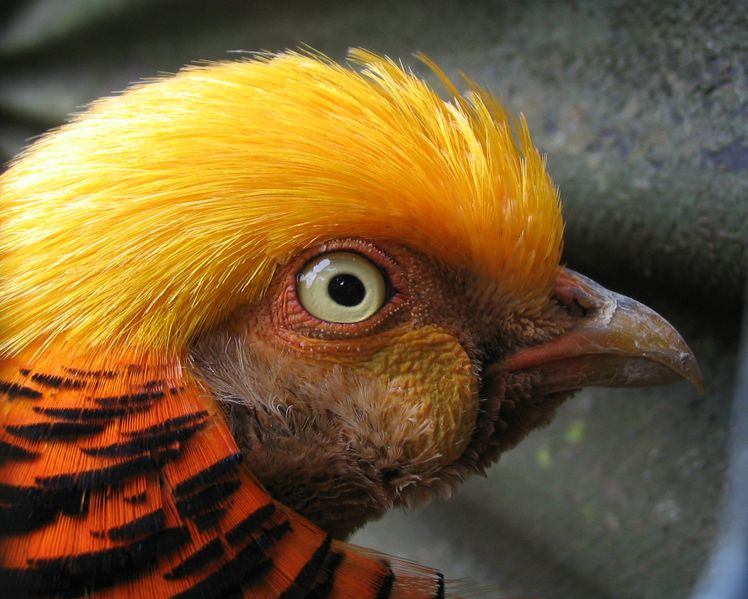
The adult male is 35.4-41.3 in (90–105 cm) in length, its tail accounting for two-thirds of the total length. It is unmistakable with its golden crest and rump and bright red body. The deep orange “cape” can be spread in display, appearing as an alternating black and orange fan that covers all of the face except its bright yellow eye, with a pinpoint black pupil.

Golden Pheasant (Chrysolophus pictus) ©WikiC

Golden Pheasant (Chrysolophus pictus) ©WikiC

Males have a golden-yellow crest with a hint of red at the tip. The face, throat, chin, and the sides of neck are rusty tan. The wattles and orbital skin are both yellow in colour, and the ruff or cape is light orange. The upper back is green and the rest of the back and rump are golden-yellow in colour. The tertiaries are blue whereas the scapulars are dark red. Another characteristic of the male plumage is the central tail feathers which are black spotted with cinnamon as well as the tip of the tail being a cinnamon buff. The upper tail coverts are the same colour as the central tail feathers. Males also have a scarlet breast, and scarlet and light chestnut flanks and underparts. Lower legs and feet are a dull yellow.

The female (hen) is much less showy, with a duller mottled brown plumage similar to that of the female Common Pheasant. She is darker and more slender than the hen of that species, with a proportionately longer tail (half her 60–80 cm length). The female’s breast and sides are barred buff and blackish brown, and the abdomen is plain buff. She has a buff face and throat. Some abnormal females may later in their lifetime get some male plumage. Lower legs and feet are a dull yellow.

Both males and females have yellow legs and yellow bills.

Despite the male’s showy appearance, these hardy birds are very difficult to see in their natural habitat, which is dense, dark young conifer forests with sparse undergrowth. Consequently, little is known of their behaviour in the wild.

They feed on the ground on grain, leaves and invertebrates, but roost in trees at night. While they can fly, they prefer to run: but if startled they can suddenly burst upwards at great speed, with a distinctive wing sound.

The Golden Pheasant is commonly found in zoos and aviaries, but often as impure specimens that have the similar Lady Amherst’s Pheasant in their lineage. (Wikipedia)

Birds Illustrated by Color Photograhy Vol 1 January 1897 No 1 - Cover

Birds Illustrated by Color Photography – Revisited  – Introduction

The above article is the third article in the monthly serial that was started in January 1897 “designed to promote Knowledge of Bird-Live.” These include Color Photography, as they call them, today they are drawings. There are at least three Volumes that have been digitized by Project Gutenberg.

To see the whole series of – Birds Illustrated by Color Photography – Revisited 

*

(Information from Wikipedia and other internet sources)

Next Article – The Australian Grass Parrakeet

Previous Article – Mandarin Duck

Links:

Phasianidae – Pheasants, Fowl & Allies
Galliformes Order
Golden Pheasant – Wikipedia
Golden Pheasant – ARKive

Gospel Presentation

*

Nuggets Plus – The Righteous Cedar…

Nuggets Plus – The Righteous Cedar… ~ by a j mithra

Nuggets Plus

Nuggets Plus

Not only Ships
but also God’s temple
and musical instruments
were built with the scented and
decay resistant wood
of the Cedar tree!
Cedar was even used for
ritual cleansing!
We say that we are God’s temple
and instruments in the hands of God!
God calls us as Cedar too!
But,
do we deserve to be called
as Cedar?
The righteous shall flourish like the palm tree:
he shall grow like a cedar in Lebanon.” (Psalm 92:12)
Have a blessed day!

*

“Wings of Life” from YouTube

This was taken from TedTalks.com and was received by me in an e-mail. It is FANTASTIC!

I do not know the story behind the video, but I see God’s mighty creation at work in helping plants be pollinated. The photography is phenomenal.

The flowers appear on the earth; the time of the singing of birds is come, and the voice of the turtle is heard in our land; (Song of Solomon 2:12 KJV)

The grass withereth, the flower fadeth: but the word of our God shall stand for ever. (Isaiah 40:8 KJV)

Today is also National Bird Day.

http://nationalbirdday.com/

*

Study Shows Bird Species Change Fast – Re-post

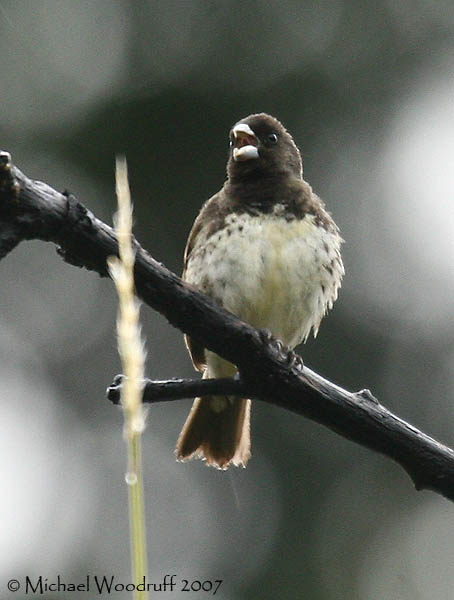
Yellow-bellied Seedeater (Sporophila nigricollis) by Michael Woodruff

Yellow-bellied Seedeater (Sporophila nigricollis) by Michael Woodruff

Study Shows Bird Species Change Fast
by Brian Thomas, M.S. *

“Biologists recently found that feather colors and songs vary among some species within the South American genus Sporophila, also known as seedeater birds. But strangely, they did not find any genetic differences in the form of species-specific DNA markers. Do these variations fit any evolutionary pattern?

The researchers published their species comparisons in the Proceedings of the Royal Society B. In their report, they wrote, “Taken together, we suggest that this is a compelling example of an extremely rapid, recent and ongoing continental radiation, with species diverging in male plumage [feather] coloration patterns and song.”

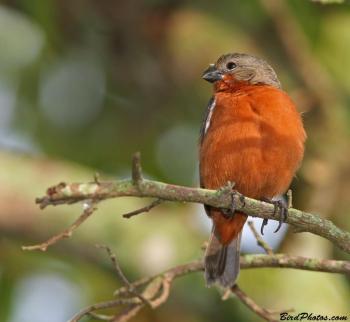
Ruddy-breasted Seedeater (Sporophila minuta) ©BirdPhotos.com

Ruddy-breasted Seedeater (Sporophila minuta) ©BirdPhotos.com

“Lead author of the seedeater study and graduate biology student Leonardo Campagna said in a Queen’s University press release, “One of Darwin’s accomplishments was to show that species could change, that they were not the unaltered, immutable products of creation.”5

But nowhere does the Bible say that species cannot change! Instead, it seems that they would have to change—within the limits of their own interbreeding kind—in order to fulfill God’s command in Genesis 1 for His living creatures to fill the earth and its many changing environments.

And God blessed them, saying, “Be fruitful and multiply, and fill the waters in the seas, and let birds multiply on the earth.” (Genesis 1:22 NKJV)

Darwin insisted that animals slowly change between kinds. In contrast, seedeater birds have shown that they rapidly changed within their kind. Despite Campagna’s touting of Darwin’s “accomplishments,” these birds display programmed variation, not evolution.”

…. See the complete article in Institute of Creation Research” – Study Shows Bird Species Change Fast

*

Birds of the World – Thraupidae – Tanagers and Allies

Wordless Birds

*