Northern Raven and Peregrine Falcon:
Two Birds Supporting the Manx Coat of Arms
James J. S. Johnson
He giveth to the beast his food, and to the young ravens which cry. (Psalm 147:9)
Dearly beloved, I beseech you as strangers and pilgrims, abstain from fleshly lusts, which war against the soul. (1st Peter 2:11)

Raven and Peregrine Falcon in flight ©kitundu.wordpress
The Isle of Man has a strange and providential history, a mix of ravenous opportunists and hardy pilgrims, amidst the furious storms of the Irish Sea, weathering conflicts of Romans, Celts, and Nordic Vikings – all but concealing God’s clever and caring hand as He reaches the world with the Word of His Son.
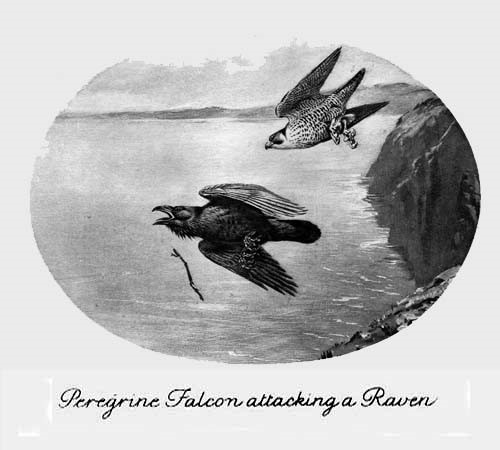
Interestingly, the Isle of Man connects two aggressive birds together, the Peregrine Falcon and the Raven (often. [See illustration below, by G. E. Lodge & H. Grönvold, in H. Eliot Howard’s TERRITORY IN BIRD LIFE (E. P. Dutton & Company, 1920), page 216.]

Soon we shall see how that is. Let us begin by considering the Common Raven (a/k/a Northern Raven), which may be “common” but nonetheless is an amazing bird, worldwide.
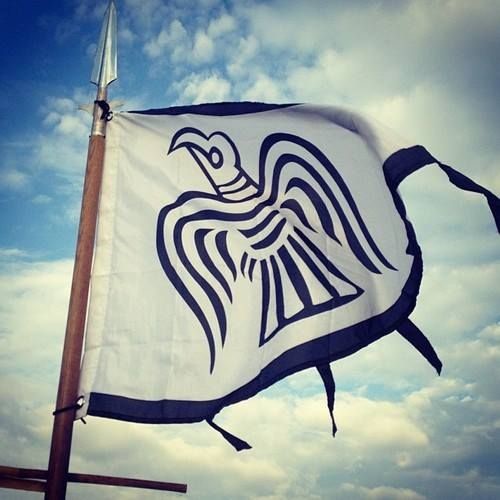
The black Raven (Corvus corax – often called the “Common Raven” or “Northern Raven“, to distinguish it from other very similar, yet recognizably variant, ravens, such as the Thick-billed Raven, Chihuahuan Raven, Fan-tailed Raven, Brown-necked Raven, Chough, and Jackdaw – regarding which, see A Diet of Jackdaws and Ravens, like our English word “ravenous” (see Isaiah 46:11; Ezekiel 39:4), denotes aggressive hunger and resourceful hunting, reminding us of rough-and-ready opportunists, a fitting emblem displayed on some of the Viking ship sails (and pennant banners) of old.

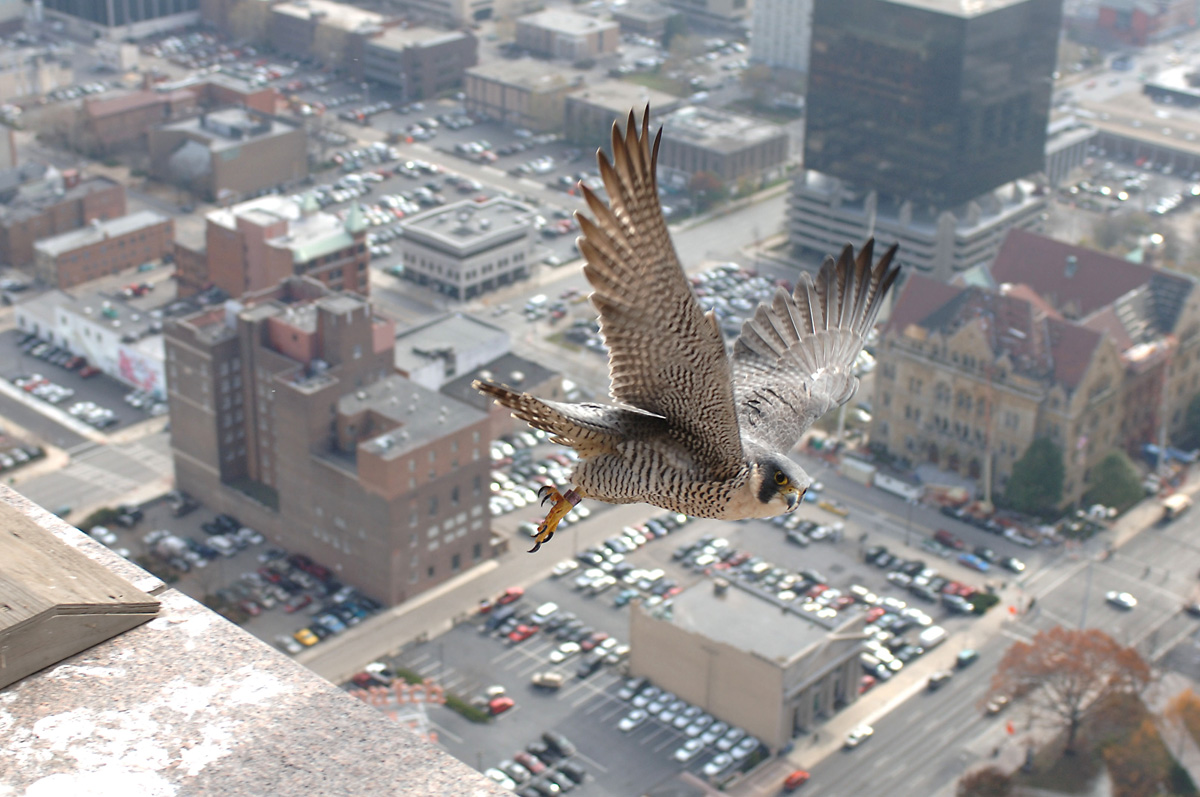
Peregrine Falcon On The Edge by Ray
What of the grey-hued Peregrine Falcon (Falco peregrinus)? Likewise, the word “peregrine” refers to a land-wanderer, a sojourner, a stranger-passing-through, an especially fitting label for Christians who daily experience the rough-and-tumble challenges of “pilgrim” life (Genesis 47:9; Exodus 6:4), on this presently fallen Earth, as we await our ultimate destiny that befits our heavenly citizenship (Philippians 3:20; Hebrews 11:13). Before finishing that thought, however, let us consider these two stalwart birds, the Raven and the Peregrine Falcon – and their connection to the ISLE OF MAN, a quasi-autonomous territory of the British Commonwealth.
In particular, behold the official Manx Coat of Arms – notice the two birds supporting the Manx Coast of Arms, a stark Raven and an equally stern Peregrine Falcon. Why do these birds so aptly match the Isle of Man?
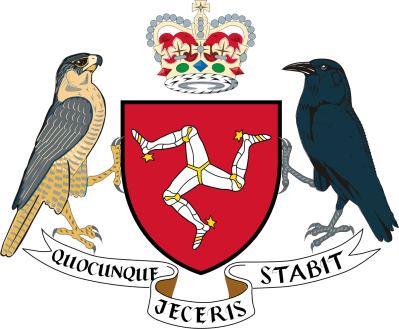
Manx Coat of Arms of the Isle of Man ©WikiC
Before appreciating some details about these two noble birds, the Raven and the Peregrine Falcon, it might help to gain a glimpse of the turbulent times that the Isle of Man has seen, centuries ago, when Vikings sailed the Irish Sea (and many seas beyond!) – and used the Isle of man as a staging ground for their naval adventures.
One illustration involves the tourney on the high seas, in AD1156, between a Norse-Manx Viking king, named Somerled (an ancestor of Dr. Bill Cooper), and his arch-foe, Godred.
“Godred … [alarmed that Somerled’s son was installed as ruler of the Isle of Man] hurriedly got ready a fleet and sailed north against the forces of Somerled. It was high time for Somerled to do something about Godred [so Somerled] collected a large fleet of eighty [80!] longships and sailed out to confront his enemy. The story that follows incites our admiration for the impressive seamanship of both kings, and the seaworthiness of their ships. The battle took place at night, in the dead of winter, in the open ocean somewhere off the coasts of Islay, on the 5-6 of January 1156. How they managed to manoeuvre under oars (no sails were used during battle), in darkness, in wild winter seas, without most of their ships colliding or foundering, was a miracle. It must have been a titanic struggle and the Chronicle of Man describes the terrible slaughter which ensued. By dawn both sides were exhausted, neither having won, so they agreed to make peace and divided up the sea kingdom between them, in a rather awkward division. Godred retained [the Isle of] Man and the islands to the north of the Ardnamurchan peninsula [of Scotland], while Somerled kept all the islands to the south including Kintyre, which was still class as an island [it being largely coastland].” (Quoting from Kathleen MacPhee’s Somerled, Hammer of the Norse (Glascow: Neil Wilson Publishing, 2004), pages 80-82, as quoted within “DNA says Manx King, Somerled, the Celebrated Founding Father of Scottish Clans, had a “Norse” Patrilinear Ancestry !”, posted at Somerled Family History.
In short, Viking sea battles were not an adventure for the faint of heart. But, one might wonder: who cares today about such people nowadays?
In other words: why would we care about some Viking king (of the Isle of Man), who lived and adventured some 800 or 900 years ago? Has that Norse-Manx Viking’s life impacted your life or mine, at all, in any kind of meaningful way?
The answer, if you read or speak English, is both simple and surprising: as a direct ancestor of the King James who sponsored the Holy Bible in English translation, King Somerled’s biogenetic footprint has impacted our world–to God’s glory and our benefit–in a permanent and indispensable way.
“Consider the following descent from King Somerled and Queen Ragnhild. Then try to imagine the big-picture providence of God, interacting through space and time … producing uncountable effects from the resultant galaxies of Great Commission “destiny dominoes”, all around the world, especially from AD1066 to AD1611 and beyond.…
P1 Somerled & wife Ragnhild begat Angus Somerledsson (F1);
F1 Angus Somerledsson & wife Ragnhild of the Isles begat James (F2);
F2 James & wife (whose name is lost) begat Jean (F3);
F3 Jean & husband Alexander 4th High Steward begat James 5th High Steward (F4);
F4 James 5th High Steward & wife Cecilia begat Walter 6th High Steward (F5);
F5 Walter 6th High Steward & wife Marjorie begat Scotland’s king Robert II (F6);
F6 Robert II & first wife Elizabeth Mure begat John l/k/a Scotland’s king Robert III (F7);
F7 Robert III & wife Annabella Drummond begat Scotland’s king James I (F8);
F8 James I & wife Joan Beaufort8 begat Scotland’s king James II (F9);
F9 James II & wife Mary of Gueldres begat Scotland’s king James III (F10);
F10 James III & wife Margaret of Denmark begat Scotland’s king James IV (F11);
F11 James IV & wife Margaret Tudor begat Scotland’s king James V (F12);
F12 James V & wife Mary of Guise begat Scottish queen Mary Queen of Scots (F13);
F13 Mary Queen of Scots & Lord Darnley begat James VI (F14, of the “King James” Bible)!
Thus, the “King James” of Great Britain (simultaneously “James VI” as Scotland’s king, and “James I” as England’s king), who authorized what became famous as the “King James Bible”, was an F14 descendant of Viking King Somerled and his wife, Queen Ragnhild. (This impacts the whole world!)
- The Holy Bible is the most-published and most-sold book of all time, with more than 6,000,000,000 copies (excluding mere portions, which in aggregate would further increase the statistics).
- Of the 6 billion copies of the Holy Bible [more than 2 billion of which were distributed by the GIDEONS INTERNATIONAL, as of AD2015!], the most-published and most-sold version of the Bible is the English translation known as the “King James Bible” (a/k/a “King James Version” and the “Authorized Version”).
- The largest amount of Bible-based missionary work, missionary literature, and Biblical education around the world, since the time of Christ, has been provided in English (e.g., from British missionaries, American missionaries, etc.)….” [Quoting from “To Globally Sow His Word, Did God Use Vikings?”.]
In other words, Somerled’s family lineage was indispensable, 14 generations after, for the procreative arrival – in God’s providence – of the man whom history knows as KING JAMES of the King James Bible!
How many lives do you know, personally, who have been blessed by the English translation of the Holy Bible that we today call the King James Bible? As you think of the answer to that question, consider also that God providentially protected the life of Norse-Manx Viking, named Somerled, in order that there would be – half a millennium later – a baby boy born in Edinburgh, Scotland (in a room that my wife and I visited, during AD2002), who would grow up – by God’s grace – to be King James VI (of Scotland) and also King James I (of England)!
Now back to the birds, starting with the Northern Raven.

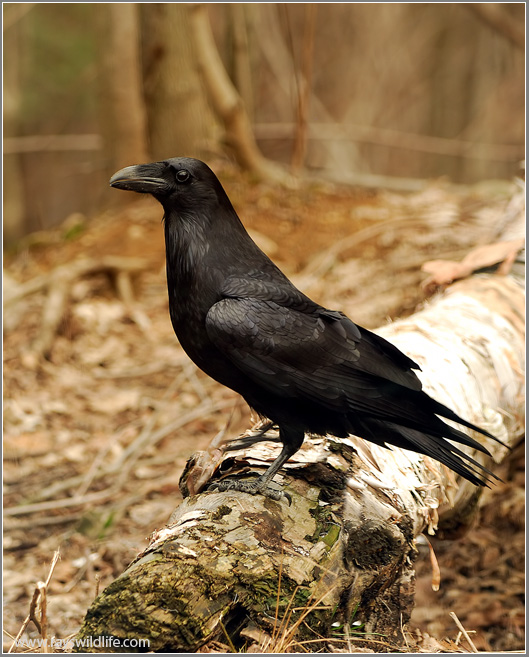
Northern/Common Raven (Corvus corax) by Kent Nickell
COMMON RAVEN a/k/a NORTHERN RAVEN (Corvus corax).
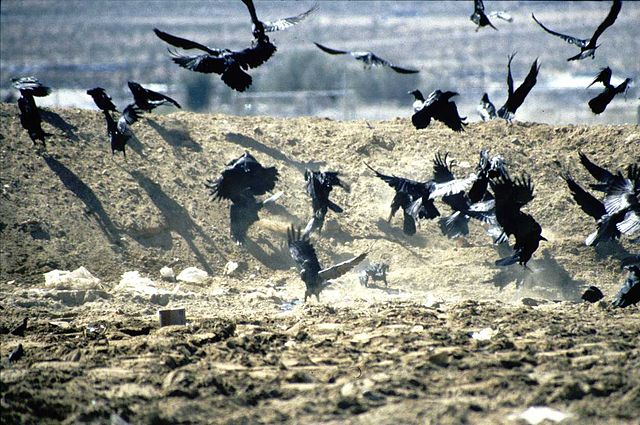
Ravens are repeatedly mentioned in Scripture; they are even mentioned once by Jesus Himself (Luke 12:24). What a beautiful bird, the Raven! – its monochrome plumage is iridescent black, appearing as glossy bluish-purple when sunlight reflects off the feathers (see Song of Solomon 5:11). Its omnivorous appetite matches its name: ravens are ravenous (Job 38:41; Proverbs 30:17)! Ravens eat small mammals, carrion (with its associated maggots and carrion beetles), small invertebrates (including roadkill invertebrates, such as dead grasshoppers and other bugs), amphibians, reptiles, bird eggs, human garbage (especially food with fat in it), — as well as plant food (such as agricultural grains) — whatever! Ravens are also infamous as “kleptoparasites” (prey thieves), i.e., they steal food from other carnivorous/omnivorous predators, such as grey wolf-kills in winter. Garbage dumps and landfills are special attractions — raven smörgåsbords!
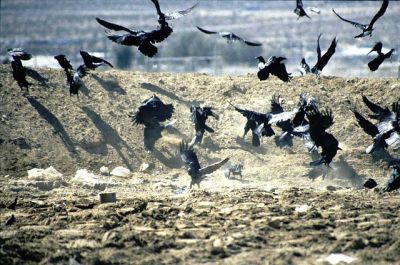
Common Ravens Feeding At Landfill ©WikiC
The historic role of a raven who survived the worldwide Flood with Noah’s family is recounted in Scripture (see Genesis 8:7). Ravens, ironically, were directed by God to feed the prophet Elijah (compare 1st Kings 17:4-6 with Luke 12:24).
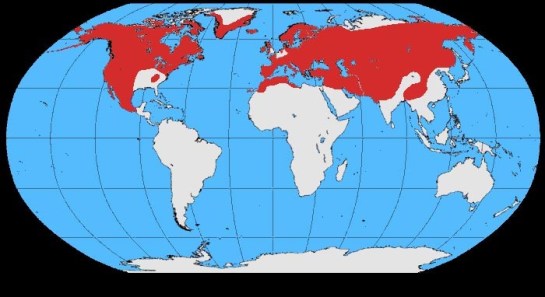
The name “Common Raven” is not an exaggeration, because ravens are known to live in virtually all of the Northern Hemisphere (see range map below).
The Raven is a corvid – a term that simply means “crow-like” – like its close cousins: rooks, jays, carrion crows (and other crows), choughs, jackdaws, etc. [See generally Lee Dusing’s “Crows, Jays, Ravens – Corvidae Family”.]
Ravens are well known for various behavior habits, including their harsh crow-like vocalizations (Job 38:41).
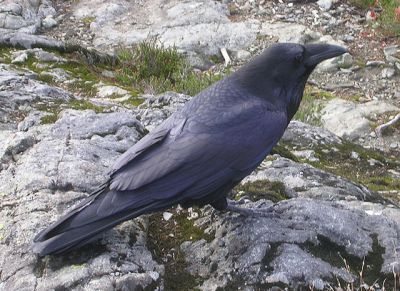
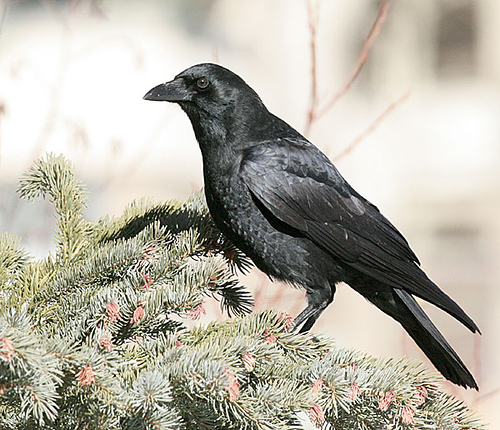
Common Raven at Cypress Provincial Park, British Columbia ©WikiC
The Common Raven (Northern Raven) appears in various localized “subspecies”, based upon geographically localized population forms: (1) the paradigmatic European Raven (Corvus corax corax), ranging over and beyond continental Europe; (2) the Icelandic-Faeroese Raven (Corvus corax varius), somewhat smaller and less glossy than the European Raven; (3) the Southwest Asia Raven (Corvus corax subcorax), ranging from Greece to India, and parts of western China; (4) the North Africa Raven (Corvus corax tingitanus), ranging in North Africa and the Canary Islands, with the Canary Islands variety being somewhat browner in color; (5) the Himalayan Raven (Corvus corax tibetanus), the largest and glossiest subspecies, ranging in Tibet and other regions of the Himalayan Mountains; (6) the Northeastern Asia Raven (Corvus corax kamtschaticus), thicker-billed than the European Raven, ranging from northeastern Asia into the Baikal region; (7) North American Raven (Corvus corax principalis, a/k/a “Northern Raven” — which is confusing because both the species and this subspecies are known as “Northern Raven”), close cousins to those of Europe, according to mitochondrial DNA studies, these corvids range all over North America and Greenland, having the thickest bill of any Common Raven subspecies; (8) the Western Raven (Corvus corax sinuatus), ranging in south-central America and Mesoamerica. The term “Northern Raven” is better used for the species (i.e., the “Common Raven”) that encompasses all of these subspecies, because all of these subspecies reside in the Northern Hemisphere — so they are all “Northern” Ravens.
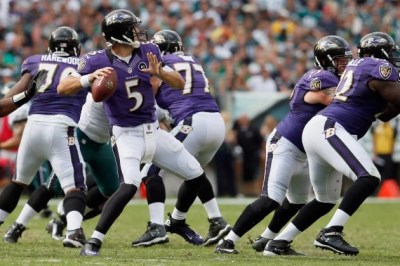
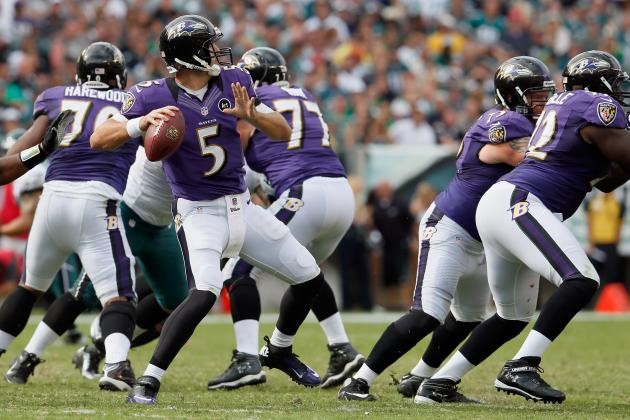
Also, it is worth mentioning that a football-playing variant (of “Ravens”) is famous in Maryland (on the East Coast of America), the “Baltimore Ravens” (see picture below — yet please notice that the Baltimore Ravens are not the kind of ravens who are mentioned in Luke 21:24 – see Hidden Assumptions Play ‘Hide Seek’ !
Regarding Ravens, the husband-wife ornithologist team of Donald and Lillian Stokes have observed their wariness of humans:
“The raven is … extremely wary of humans, spotting you form almost as far as half a mile away as you approach a nest, and then flying up and calling at your approach. … [so] studying ravens is best done through a scope or powerful binoculars….” [Quoting from Donald Stokes & Lillian Stokes, GUIDE TO BIRD BEHAVIOR, Volume 3 (Little, Brown & Company, 1989), page 299.]
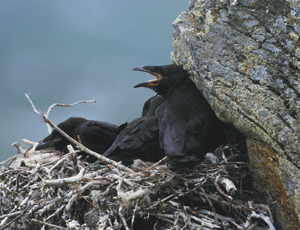
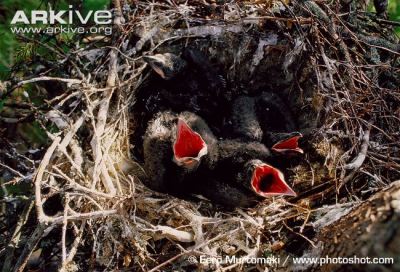
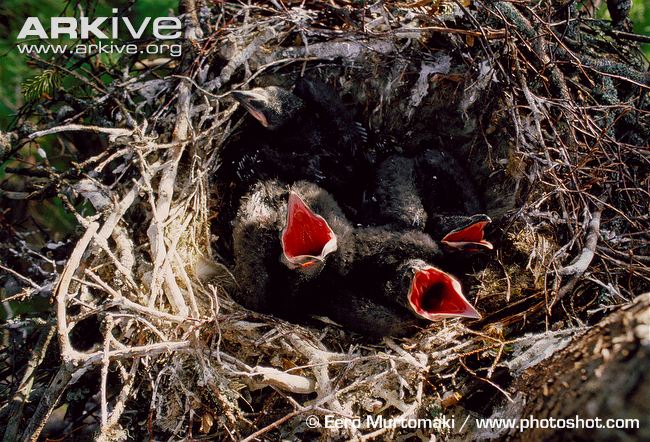
Raven Chicks
Ravens build a nest for their young, as most birds do. The behavior of the parent birds gives a clue as to when their eggs are being incubated, in expectation of hatching, according to the observations of the Stokes duo:
“One clue to incubation’s having started is seeing only one raven soaring above the nest. That would generally be the male since the incubating female spends most of her time on the eggs. During incubation, the male brings food to the female and gives it to her at the nest or nearby. When the female is about to receive the food she may flutter her wings close to her body and give the Kra-kra-call. … When the male is not actively hunting for food for himself or the female, he is usually perched near the nest on a dead branch or ledge. The female occasionally leaves he nest, at which time the male may come to the nest, but he does not actually incubate the eggs.” [Quoting from Stokes & Stokes, GUIDE TO BIRD BEHAVIOR, Volume 3, page 307.]
The nestling phase in the Raven family’s life cycle has been observed, with one activity making it easier to recognize where a raven nest is raising young:
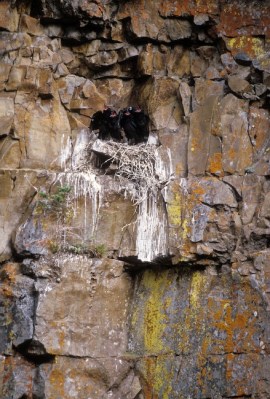
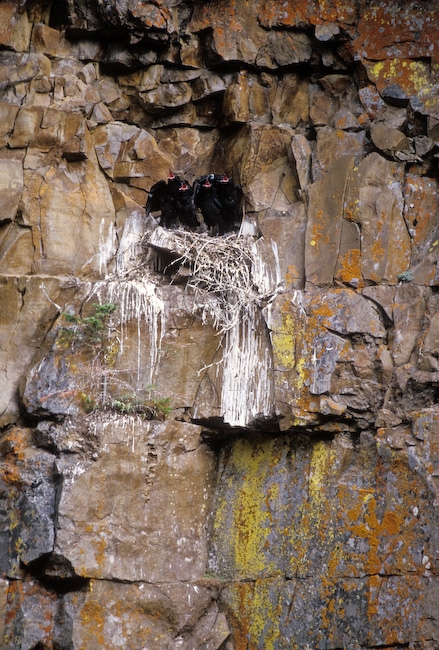
“The young hatch over a period of a day or two. The female eats the shells [a good source of calcium!] and broods the young for about two and a half weeks. During this time the male does most of the feeding; after that, both parents participate in feeding the young. During the first weeks of intensive brooding, when the female takes periodic leaves, the male stays near or on the nest until she returns. The parents at first bring small food items for the young, picking the items apart before offering them to the young. Later in the nestling phase larger food items are left at the nest and the young pull them apart to eat. The parents may also come to the nest with water in their crops, which is then fed to the young. On cold days the young are buried in the nest lining for warmth; on hot days the female may wet her underfeathers and cover the young to give them relief from the heat. The young lift their tails as they defecate over the rim of the nest [there being no in-house plumbing accommodations!]. The nest rim or cliff ledge can have large white stains resulting from this behavior; the stains may help you locate the nest. The young may fledge over a period of days.” [Quoting from Stokes & Stokes, GUIDE TO BIRD BEHAVIOR, Volume 3, page 308.]]
But now let us consider the other bird supporting the Manx coat-of-arms, the Peregrine Falcon.

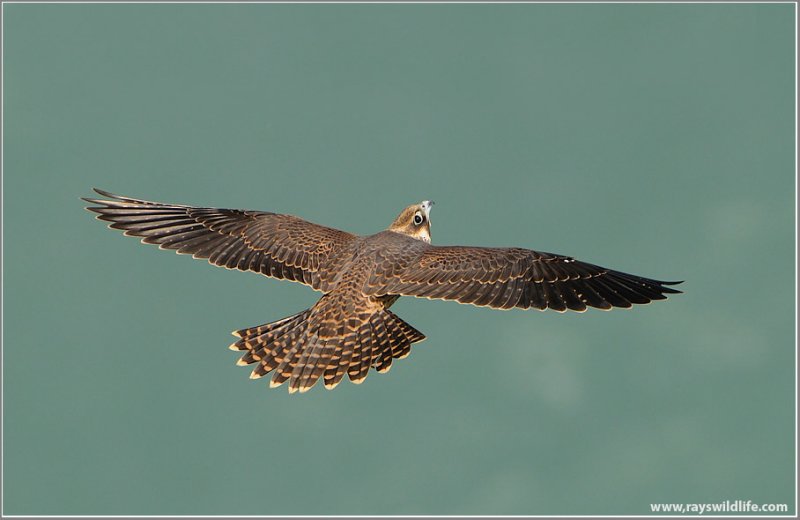
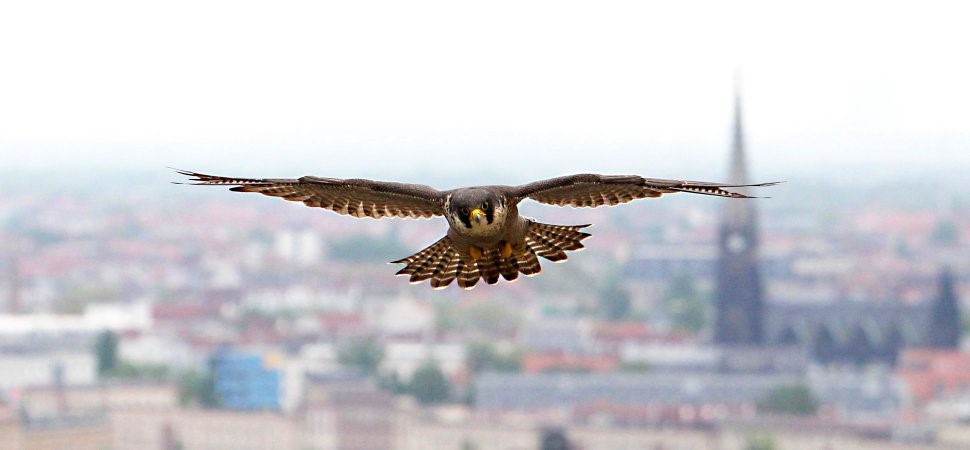
Peregrine Falcon (Falco peregrinus) by Ray
PEREGRINE FALCON (Falco peregrinus).
The Peregrine Falcon (also called the “Peregrine”) is dominated by bluish-grey plumage, with a pale underside (barred white), and a slate-black head. Its eyes are large, for hunting prey, and its pale-yellow beak is strong, with a shape convenient for its carnivorous lifestyle – so it can tear into its diet of
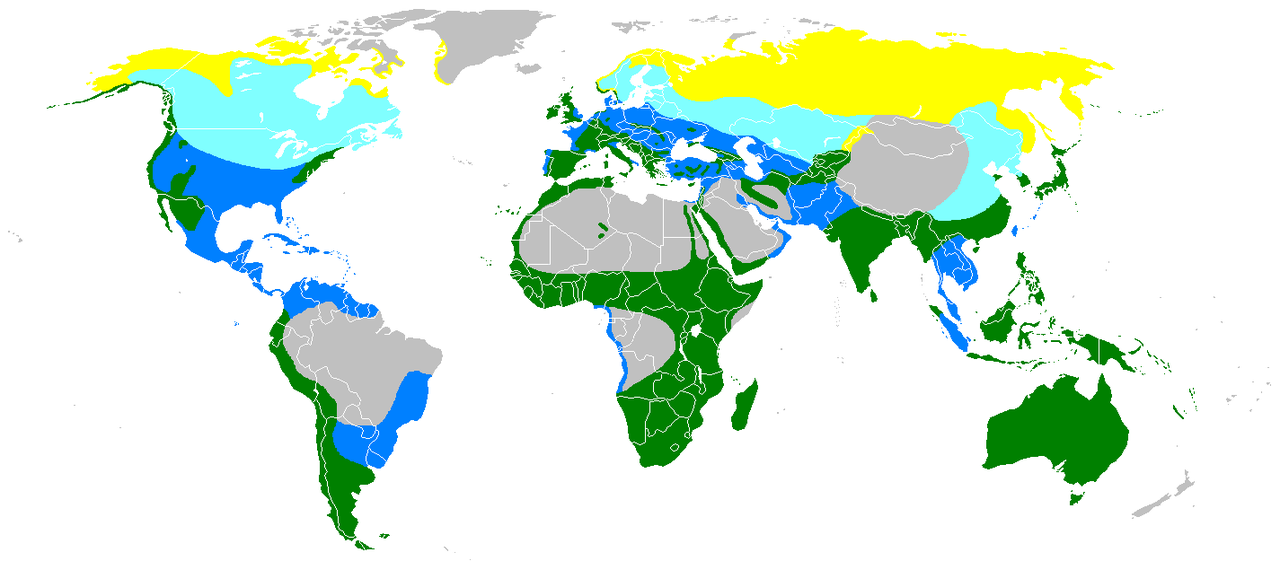
True to its name (“peregrine” meaning “wanderer”, “sojourner”, one that goes through/throughout the land), the Peregrine’s range is worldwide [see range map below: yellow = summer breeding migrant range; green = year-round breeding; indigo blue = winter migrant range; Carolina blue = migrant passage range].
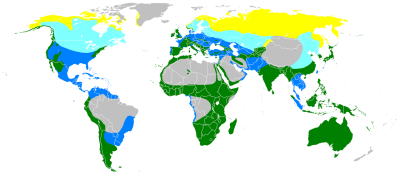
Peregrine Falcon Map ©WikiC
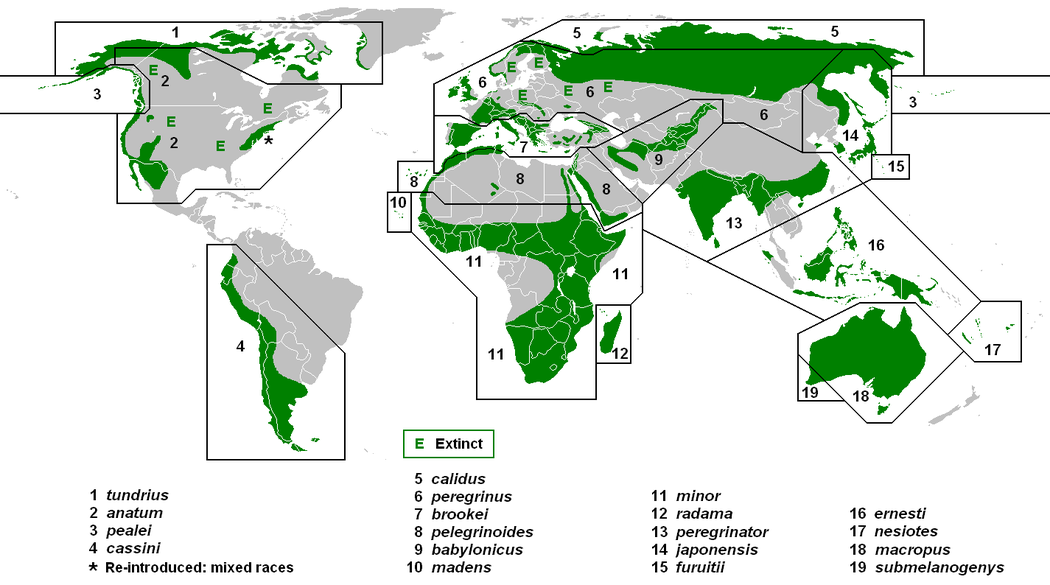
The Peregrine Falcon appears in about 20 various localized “subspecies”, based upon geographically localized population forms [see range map below, showing subspecies].
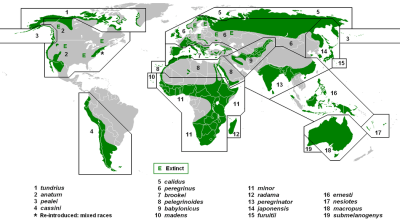
Breeding ranges of the subspecies of Peregrine Falcons ©WikiC
Six of those Peregrine subspecies are: (1) the paradigmatic Eurasian Peregrine Falcon (Falco peregrinus peregrinus), ranging throughout all of Europe, except for its Mediterranean Sea coastlands and the Iberian Peninsula, extending eastward through Siberia, except not its Arctic Ocean coastlands; (2) the once-endangered Arctic Peregrine Falcon (Falco peregrinus tundris), ranging in the tundras of northern Alaska, northern Canada, and Greenland; (3) the once-endangered American Peregrine Falcon (Falco peregrinus anatum, a/k/a “Duck Hawk”), ranging throughout all of North America, except the Arctic coastlands habituated by its Arctic cousin – although its main population clustering is in the Rocky Mountains regions. (However, Peregrine Falcons are making a “comeback” outside the Rockies, including revived populations in municipalities where they often prey on urban pigeons.) The Mediterranean Sea coastlands, as well as all of Spain and Portugal, are habituated by the Mediterranean Peregrine Falcon (Falco peregrinus brookei). The endangered close cousin of the Peregrine, in America, is the Northern Aplomado Falcon (Falco femoralis septentrionalis).

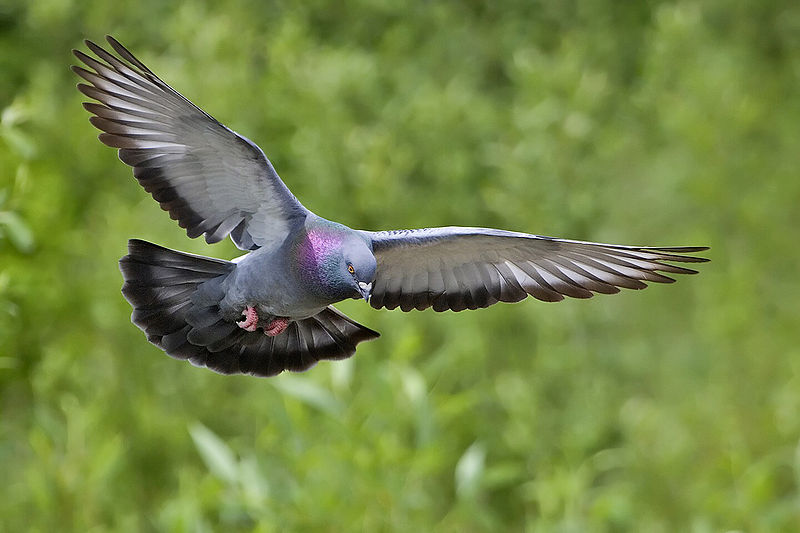
Peregrine Falcon in Flight by Ray
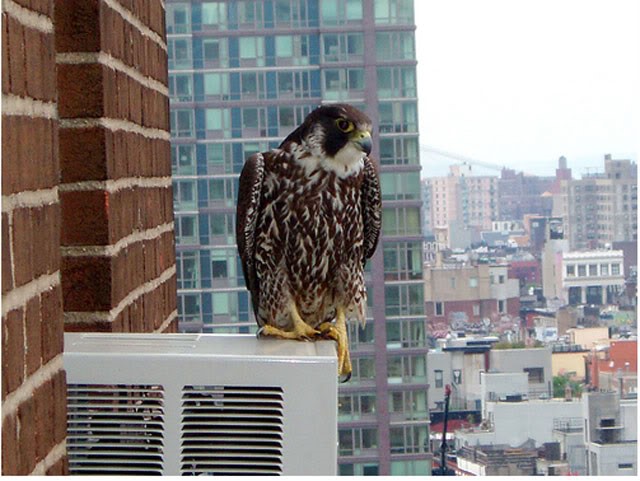
The Peregrine Falcon typically lives in coastal lands, river valleys, and in mountain ranges – yet urban skyscrapers are deemed montane “cliffs” for these birds of prey, so don’t be shocked when you see a falcon “dive-bomb” (and kill, in midair) a pigeon, in the air between city office buildings or high-rise apartments.

The typical nesting behavior of American Peregrine Falcons has been described as “… on cliff ledges [near to] open habitats from tundra, savanna [grassland], and seacoasts to high mountains, on which the falcon makes a well-formed scrape in piled debris … [sometimes using] abandoned tree nests or cavities … [or, in urban contexts] on ledges of tall buildings and bridges”. [Quoting Paul R. Ehrlich, David S. Dobkin, & Darryl Wheye, BIRDS IN JEOPARDY (Stanford University Press, 1992), page 48.]

Peregrine Falcon by ©©Weebly Uploads
The American Peregrine Falcon’s diet is quite a mixed bag: “Birds, particularly doves and [other] pigeons, but also waterfowl [especially ducks], shorebirds, and passerines [i.e., perching songbirds, such as European Starlings] … [chasing and catching] prey in midair, dropping on flying birds from above and killing them in flight with a blow from their feet…. [sometimes involving speeds of] 60 miles per hour, in a [closed-wings] stoop on prey it can reach speeds exceeding 200 miles per hour”. [Again quoting Ehrlich, Dobkin, & Wheye, BIRDS IN JEOPARDY, at page 48.]
In cities a Peregrine’s diet might consist 80% of mourning doves and pigeons. Other avian fare (i.e., birds eaten as prey) include icterids (such as grackles and other blackbirds), thrushes (such as American robins), swifts, and other corvids (such as crows). However, when available, Peregrines will also eat small rodents, such as mice, rats, voles, squirrels – or other small mammals such as shrews or rabbits (or sometimes even bats, at night!).
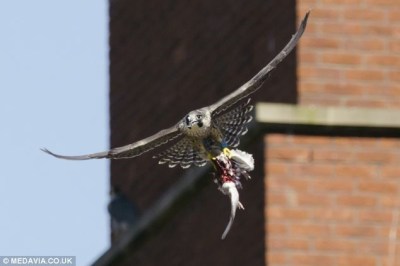
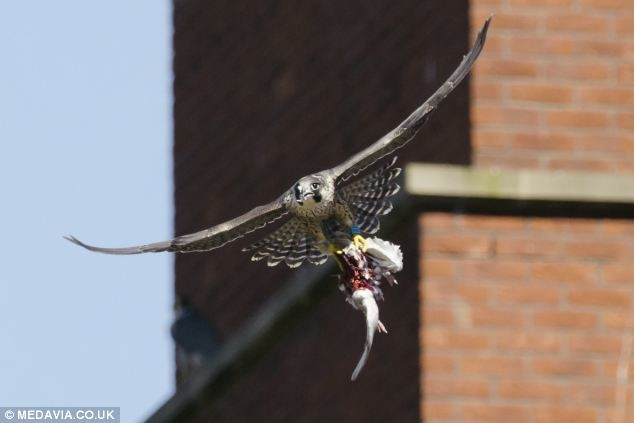
Peregrine Falcon (with doomed Pigeon in the falcon’s talons)
The flying abilities of Peregrine Falcons are almost legendary – they fly “with shallow elastic wingbeats in which [wing] tips [are] very springy (characteristic of the larger falcons)”. [Quoting Lars Jonsson, BIRDS OF EUROPE (Princeton University Press, 1992; translated by David Christie), page 160.]
And true to their name, they wander – they range to wherever they need to go.

Peregrine Falcoln ©Images Inc
Lessons for the Journey, as We “Hike” on our Earthly Pilgrimage
So, as “pilgrims” awaiting our future citizenship, in the Kingdom that is not yet here (Philippians 3:20) how should we approach our sometimes-stormy future – which mixes furies, frustrations, and failings with hopes, helps, and hallelujahs?
Thy statutes have been my songs in the house of my pilgrimage. (Psalm 119:54)
In other words, Jesus put a song in my heart!
Stormy weather or calm, I can be (and should be) at least as brave as a Manx Viking rowing in a rainstorm, tossed up and down, from side to side, in the cold salt-spray of the Irish Sea.
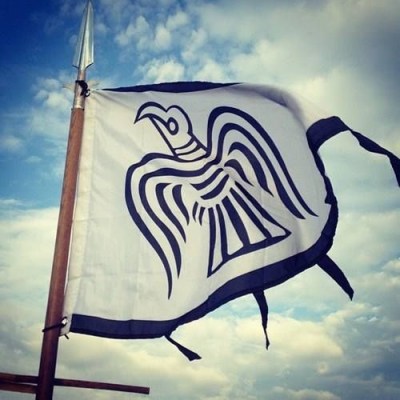
Pennant ©Pinimg.Com
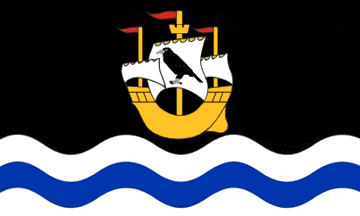
Mainsail ©crwflags.com
Just as the resilient and resourceful Nordic seamen of old, including ancient Norse-Manx Vikings (and their biogenetic progeny, including sjøfolk that sail the Seven Seas today) strove to stay afloat — till they rhed their destined safe-haven — let us “labor at the oars” of (this) life, until God brings us securely Home (see http://www.icr.org/article/why-we-want-go-home ).
It is good to keep in mind that God Himself is our only real Home. Meanwhile, He can guide and keep us, on the stormy seas of this temporal life, until it’s “our turn” to enter into His holy and happy presence, with everlasting joy. ><> JJSJ
*
*





![[Fair Use image credit: https://upload.wikimedia.org/wikipedia/commons/thumb/9/92/Cattle_egret_spread.svg/2000px-Cattle_egret_spread.svg.png ]](https://leesbird.com/wp-content/uploads/2016/02/map-1.png)















 Lee's Birdwatching Adventures Plus