“Hide not thy face from me in the day when I am in trouble; incline thine ear unto me: in the day when I call answer me speedily. (Psalms 102:2 KJV)
Dan and I just returned from a three-day birdwatching adventure. With almost 1,000 photos and videos to sort, name, and clean-up, I’ll have plenty to post.
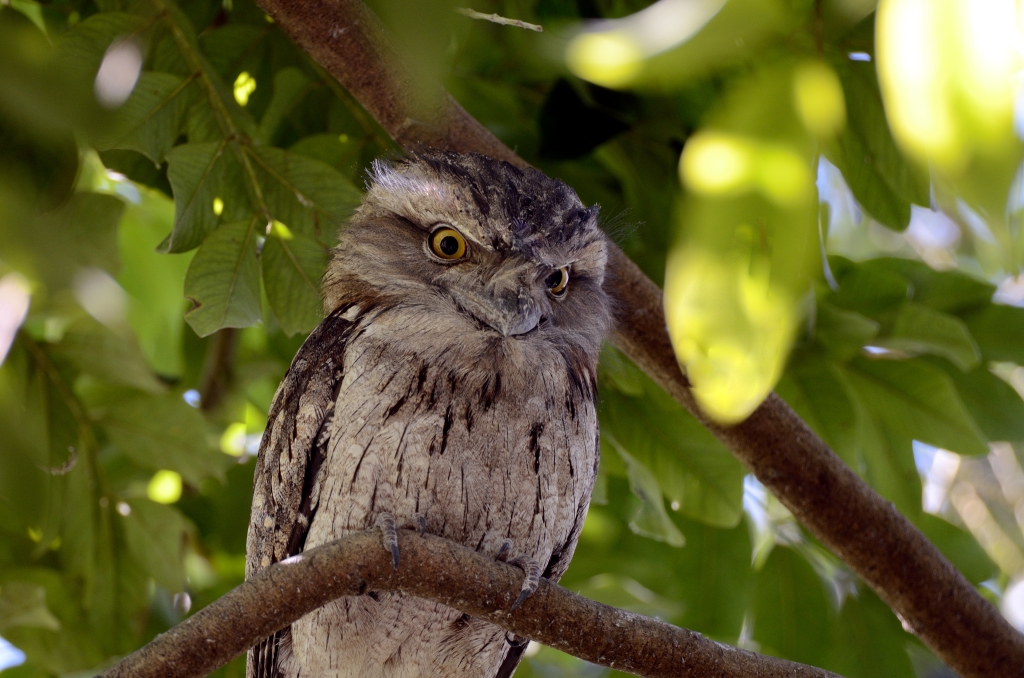
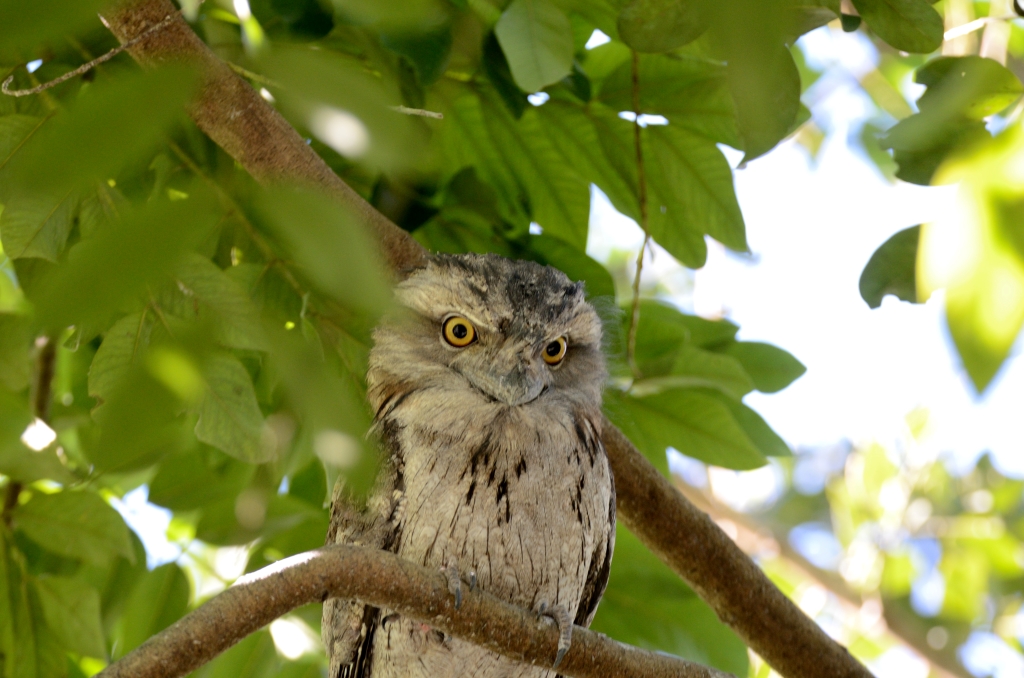
The Tawny Frogmouth (Podargus strigoides) is becoming a favorite of mine, because they are so hard to find. The Lord has given them such camouflage and an ability to freeze when threatened, they are a challenge. We were fortunate this time while visiting the Wings of Asia aviary at Zoo Miami. By following the feeder, that enjoys the birds as much as just working there, he helped us find the new Tawny Frogmouth. They now have two of them. This new one is more active and alert. Could it be that the feeder had a cup with 4 mice in it?
Tawny Frogmouth at Wings of Asia by Dan
We actually saw Tawny with his eyes open and I even got a short video of him opening that mouth that gives them their name.
“Masters of Camouflage Related to Oilbirds, Whip-poor-wills, and Nighthawks, the Tawny Frogmouth’s excellent camouflage covering makes it look like dried leaves. When frightened, the bird freezes in plosition and, with its cryptic colorations, looks like broken bramches.” (Amazing Bird Facts and Trivia, p 135) Isn’t the Lord’s Wisdom fantastic?
Tawny Frogmouth at Wings of Asia by Dan
Another book, (National Geographic, Bird Coloration, p 150-151). says this: “Some birds hide not by being hard to discern, but by appearing not to be birds. The birds that best mimic inanimate objects are found in two groups of distantly related nightjars, the potoos in the Neotropics and the frogmouths in tropical Asia and Australia. Species in both of these groups hunt flying insects at night and rest during the day. Potoos and frogmouths use a strategy to hide during the day that differs … They hide conspicuously in view. The strategy…is to look exactly like an extension of a branch on which the bird sit.”
“Deliver me, O LORD, from mine enemies: I flee unto thee to hide me. (Psalms 143:9 KJV)
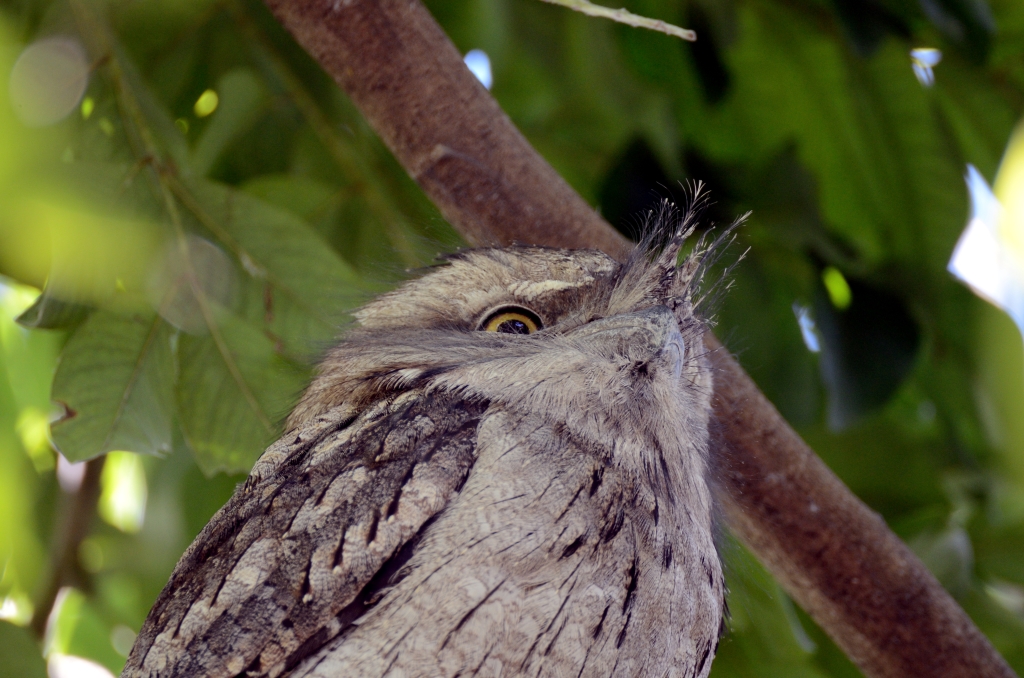
Tawny Frogmouth at Wings of Asia by Dan
“They are named for their large flattened hooked bills and huge frog-like gape, which they use to capture insects. Their flight is weak. Their longer bristles which may exist to protect the eyes from insect prey. Tawny frogmouths are large, big-headed birds that can measure from 13 to 21 in (34 to 53 cm) long….stocky and compact with rounded wings and short legs. They have wide, heavy olive-grey to blackish bills that are hooked at the tip and topped with distinctive tufts of bristles.Their eyes are large, yellow, and frontally placed, a trait shared by owls” (Wikipedia)
This slideshow requires JavaScript.
*
This video is of two segments. The keeper tried to get him to come down and then we came back a second time. Several photographers were waiting to get a photo of him coming down, but I guess this calls for another excuse to visit the Wings of Asia.
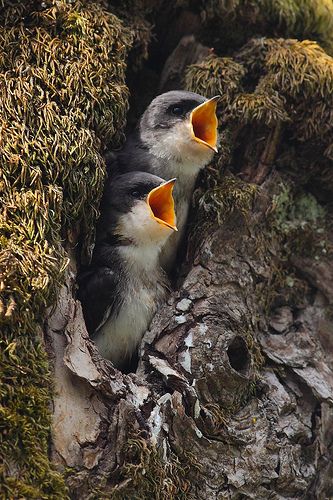
Tree Swallows Ridgefield National Wildlife Refuge by jeremyjonkman on Flickr From Pinterest
“Being enriched in every thing to all bountifulness, which causeth through us thanksgiving to God. (2 Corinthians 9:11 KJV)
While thinking about a post for this Thanksgiving, I looked back to see what had been written in the past. Wow! Had forgotten so many have been posted. From way back in 2008, the first year of the blog until last year when I got wound up and posted several. So, today, the day before Thanksgiving, it’s time to bring those back out to review. Part of Thanksgiving is remembering all our blessings from the past.
Happy Thanksgivingwas written in 2008. (I actually still had some color in my hair.) :))
I can see I am going to be challenged to come up with something for tomorrow. But the following verse assures me, there are still many blessings to recount. Your visits to the blog are a great blessings.
Through the LORD’s mercies we are not consumed, Because His compassions fail not. They are new every morning; Great is Your faithfulness. (Lamentations 3:22-23 NKJV)
CHAPTER 5. Peter Learns Something He Hadn’t Guessed.
Running over to the Old Orchard very early in the morning for a little gossip with Jenny Wren and his other friends there had become a regular thing with Peter Rabbit. He was learning a great many things, and some of them were most surprising.
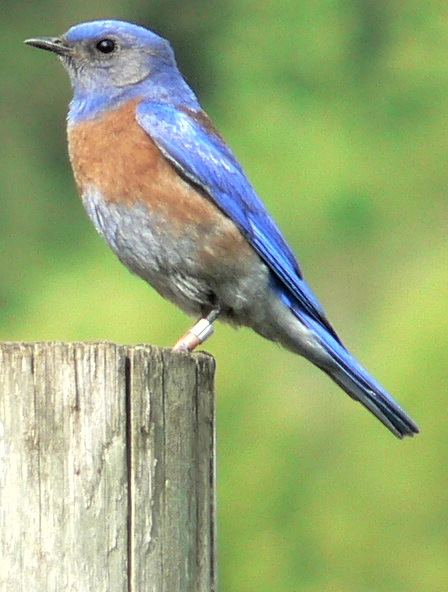
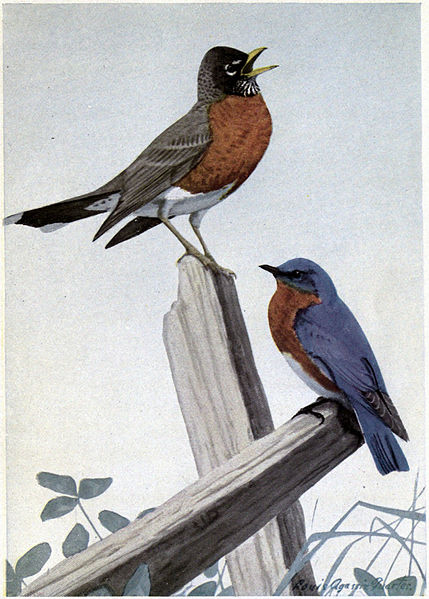
Now two of Peter’s oldest and best friends in the Old Orchard were Winsome Bluebird and Welcome Robin. Every spring they arrived pretty nearly together, though Winsome Bluebird usually was a few days ahead of Welcome Robin. This year Winsome had arrived while the snow still lingered in patches. He was, as he always is, the herald of sweet Mistress Spring. And when Peter had heard for the first time Winsome’s soft, sweet whistle, which seemed to come from nowhere in particular and from everywhere in general, he had kicked up his long hind legs from pure joy. Then, when a few days later he had heard Welcome Robin’s joyous message of “Cheer-up! Cheer-up! Cheer-up! Cheer-up! Cheer!” from the tiptop of a tall tree, he had known that Mistress Spring really had arrived.
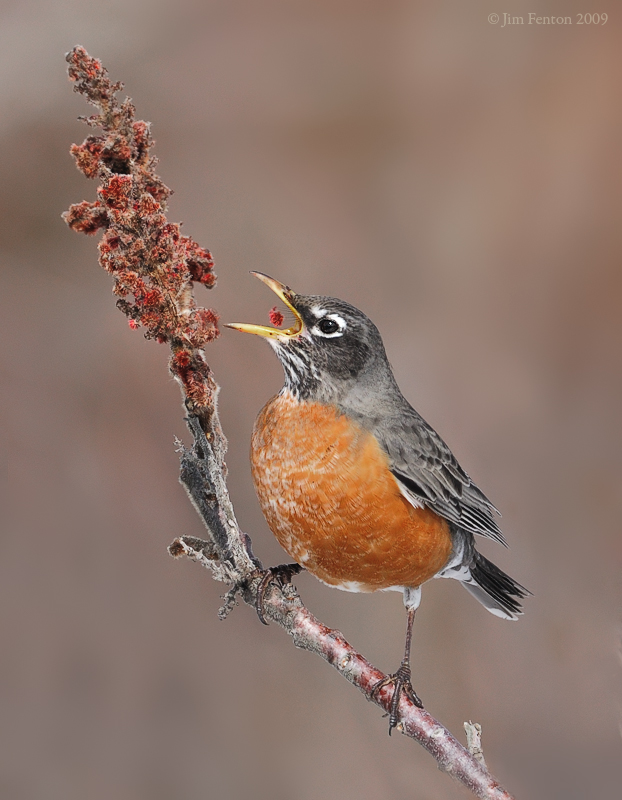
Robin Eating by Jim Fenton
Peter loves Winsome Bluebird and Welcome Robin, just as everybody else does, and he had known them so long and so well that he thought he knew all there was to know about them. He would have been very indignant had anybody told him he didn’t.
“Those cousins don’t look much alike, do they?” remarked Jenny Wren, as she poked her head out of her house to gossip with Peter.
“What cousins?” demanded Peter, staring very hard in the direction in which Jenny Wren was looking.
“Those two sitting on the fence over there. Where are your eyes, Peter?” replied Jenny rather sharply.
Peter stared harder than ever. On one post sat Winsome Bluebird, and on another post sat Welcome Robin. “I don’t see anybody but Winsome and Welcome, and they are not even related,” replied Peter with a little puzzled frown.
“Tut, tut, tut, tut, tut, Peter!” exclaimed Jenny Wren. “Tut, tut, tut, tut, tut! Who told you any such nonsense as that? Of course they are related. They are cousins. I thought everybody knew that. They belong to the same family that Melody the Thrush and all the other Thrushes belong to. That makes them all cousins.”
“What?” exclaimed Peter, looking as if he didn’t believe a word of what Jenny Wren had said. Jenny repeated, and still Peter looked doubtful.
Then Jenny lost her temper, a thing she does very easily. “If you don’t believe me, go ask one of them,” she snapped, and disappeared inside her house, where Peter could hear her scolding away to herself.
The more he thought of it, the more this struck Peter as good advice. So he hopped over to the foot of the fence post on which Winsome Bluebird was sitting. “Jenny Wren says that you and Welcome Robin are cousins. She doesn’t know what she is talking about, does she?” asked Peter.
Winsome chuckled. It was a soft, gentle chuckle. “Yes,” said he, nodding his head, “we are. You can trust that little busybody to know what she is talking about, every time. I sometimes think she knows more about other people’s affairs than about her own. Welcome and I may not look much alike, but we are cousins just the same. Don’t you think Welcome is looking unusually fine this spring?”
“Not a bit finer than you are yourself, Winsome,” replied Peter politely. “I just love that sky-blue coat of yours. What is the reason that Mrs. Bluebird doesn’t wear as bright a coat as you do?”
“Go ask Jenny Wren,” chuckled Winsome Bluebird, and before Peter could say another word he flew over to the roof of Farmer Brown’s house.
Back scampered Peter to tell Jenny Wren that he was sorry he had doubted her and that he never would again. Then he begged Jenny to tell him why it was that Mrs. Bluebird was not as brightly dressed as was Winsome.
“Mrs. Bluebird, like most mothers, is altogether too busy to spend much time taking care of her clothes; and fine clothes need a lot of care,” replied Jenny. “Besides, when Winsome is about he attracts all the attention and that gives her a chance to slip in and out of her nest without being noticed. I don’t believe you know, Peter Rabbit, where Winsome’s nest is.”
Peter had to admit that he didn’t, although he had tried his best to find out by watching Winsome. “I think it’s over in that little house put up by Farmer Brown’s boy,” he ventured. “I saw both Mr. and Mrs. Bluebird go in it when they first came, and I’ve seen Winsome around it a great deal since, so I guess it is there.”
“So you guess it is there!” mimicked Jenny Wren. “Well, your guess is quite wrong, Peter; quite wrong. As a matter of fact, it is in one of those old fence posts. But just which one I am not going to tell you. I will leave that for you to find out. Mrs. Bluebird certainly shows good sense. She knows a good house when she sees it. The hole in that post is one of the best holes anywhere around here. If I had arrived here early enough I would have taken it myself. But Mrs. Bluebird already had her nest built in it and four eggs there, so there was nothing for me to do but come here. Just between you and me, Peter, I think the Bluebirds show more sense in nest building than do their cousins the Robins. There is nothing like a house with stout walls and a doorway just big enough to get in and out of comfortably.”
Peter nodded quite as if he understood all about the advantages of a house with walls. “That reminds me,” said he. “The other day I saw Welcome Robin getting mud and carrying it away. Pretty soon he was joined by Mrs. Robin, and she did the same thing. They kept it up till I got tired of watching them. What were they doing with that mud?”
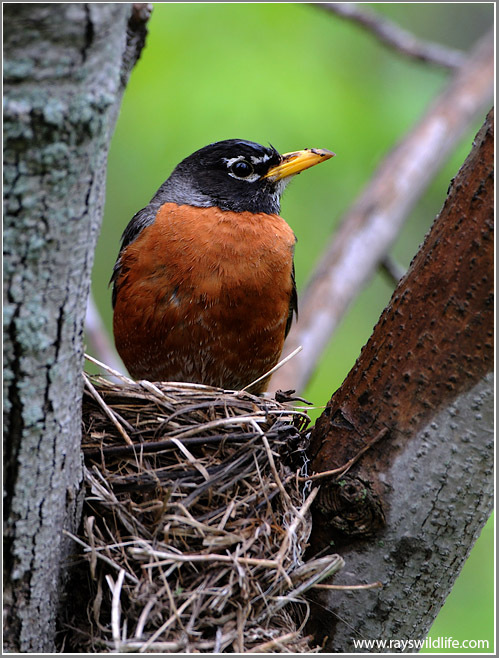
American Robin (Turdus migratorius) in nest by Ray
“Building their nest, of course, stupid,” retorted Jenny. “Welcome Robin, with that black head, beautiful russet breast, black and white throat and yellow bill, not to mention the proud way in which he carries himself, certainly is a handsome fellow, and Mrs. Robin is only a little less handsome. How they can be content to build the kind of home they do is more than I can understand. People think that Mr. Wren and I use a lot of trash in our nest. Perhaps we do, but I can tell you one thing, and that is it is clean trash. It is just sticks and clean straws, and before I lay my eggs I see to it that my nest is lined with feathers. More than this, there isn’t any cleaner housekeeper than I am, if I do say it.
“Welcome Robin is a fine looker and a fine singer, and everybody loves him. But when it comes to housekeeping, he and Mrs. Robin are just plain dirty. They make the foundation of their nest of mud,—plain, common, ordinary mud. They cover this with dead grass, and sometimes there is mighty little of this over the inside walls of mud. I know because I’ve seen the inside of their nest often. Anybody with any eyes at all can find their nest. More than once I’ve known them to have their nest washed away in a heavy rain, or have it blown down in a high wind. Nothing like that ever happens to Winsome Bluebird or to me.”
Jenny disappeared inside her house, and Peter waited for her to come out again. Welcome Robin flew down on the ground, ran a few steps, and then stood still with his head on one side as if listening. Then he reached down and tugged at something, and presently out of the ground came a long, wriggling angleworm. Welcome gulped it down and ran on a few steps, then once more paused to listen. This time he turned and ran three or four steps to the right, where he pulled another worm out of the ground.
“He acts as if he heard those worms in the ground,” said Peter, speaking aloud without thinking.
“He does,” said Jenny Wren, poking her head out of her doorway just as Peter spoke. “How do you suppose he would find them when they are in the ground if he didn’t hear them?”
“Can you hear them?” asked Peter.
“I’ve never tried, and I don’t intend to waste my time trying,” retorted Jenny. “Welcome Robin may enjoy eating them, but for my part I want something smaller and daintier, young grasshoppers, tender young beetles, small caterpillars, bugs and spiders.”
Peter had to turn his head aside to hide the wry face he just had to make at the mention of such things as food. “Is that all Welcome Robin eats?” he asked innocently.
“I should say not,” laughed Jenny. “He eats a lot of other kinds of worms, and he just dearly loves fruit like strawberries and cherries and all sorts of small berries. Well, I can’t stop here talking any longer. I’m going to tell you a secret, Peter, if you’ll promise not to tell.”
Of course Peter promised, and Jenny leaned so far down that Peter wondered how she could keep from falling as she whispered, “I’ve got seven eggs in my nest, so if you don’t see much of me for the next week or more, you’ll know why. I’ve just got to sit on those eggs and keep them warm.”
*
*
What bird family do the Bluebird and Robin belong to?
Why is it good that Mrs. Bluebird isn’t brightly dressed?
When the Robin runs and then stops, what is he doing? What might he find to eat?
What colors are the Robin’s head, breast, throat and bill?
What does the Robin’s song sound like?
Should we have an attitude like the Robin’s Song?
“Is anyone among you suffering? Then he must pray. Is anyone cheerful? He is to sing praises. (James 5:13 NASB)
“A joyful heart makes a cheerful face, But when the heart is sad, the spirit is broken. (Proverbs 15:13 NASB)
“Even the stork in the sky Knows her seasons; And the turtledove and the swift and the thrush Observe the time of their migration; But My people do not know The ordinance of the LORD. (Jeremiah 8:7 NASB)
There once was a turkey named Reginald who lived in the backwoods of Louisiana. Every year Reginald would band together with many other turkeys in a secret fortress underground to protect themselves from hunters hunting for turkeys to eat on Thanksgiving. Reginald and his friends had built the fortress a long time ago.
Reginald could tell it was Thanksgiving when one day he saw many hunters lurking in the backwoods searching for a turkey to eat on that special day. Reginald quickly went home to grab his Army helmet which he used as protection from gun shots, and called all his friends to their special underground fortress.
Many turkeys came prepared for the day. Most of them wore their Army helmets. Many other turkeys were there as well. They had brought food for Thanksgiving. Not just people celebrated Thanksgiving, turkeys did too, but without the turkey.
Soon there was a big party going on in the fortress. Not one hunter was aware that all the turkeys in the backwoods were in the underground fortress. The turkeys were joyously celebrating Thanksgiving. They were very thankful they were not “on the menu” that day.
Reginald was happy that the hunters could not find any turkeys. All the hunters eventually had to go to the grocery store to get a turkey, and every hunter from the backwoods hates to go to the grocery store and buy a turkey.
Soon Thanksgiving was over, and all the turkeys rejoiced. Even so, Reginald always made sure his Army helmet was where he needed it in case a hunter was nearby.
The End
Lee’s Addition:
“… But every man hath his proper gift of God, one after this manner, and another after that. (1 Corinthians 7:7b KJV)
“Now there are diversities of gifts, but the same Spirit. (1 Corinthians 12:4 KJV)
Emma has given us another great Bird Tale. I have been holding this for a while, waiting to get closer to Thanksgiving, but it is too adorable to hold any longer. So, it’s a little early, but ENJOY!
I keep encouraging her to write a tale for us, because she is developing into a gifted author. May we all encourage our young people to develop whatever talent the Lord has given them.
Maybe we can get a follow-up on Reginald and his friends.
Reginald – (Wild Turkey by Daves BirdingPix)
Reginald, Turkey Commander
By Emma Foster
There once was a turkey named Reginald who lived in the backwoods of Louisiana. Every year Reginald would band together with many other turkeys in a secret fortress underground to protect themselves from hunters hunting for turkeys to eat on Thanksgiving. Reginald and his friends had built the fortress a long time ago.
Reginald could tell it was Thanksgiving when one day he saw many hunters lurking in the backwoods searching for a turkey to eat on that special day. Reginald quickly went home to grab his Army helmet which he used as protection from gun shots, and called all his friends to their special underground fortress.
Many turkeys came prepared for the day. Most of them wore their Army helmets. Many other turkeys were there as well. They had brought food for Thanksgiving. Not just people celebrated Thanksgiving, turkeys did too, but without the turkey.
Soon there was a big party going on in the fortress. Not one hunter was aware that all the turkeys in the backwoods were in the underground fortress. The turkeys were joyously celebrating Thanksgiving. They were very thankful they were not “on the menu” that day.
Reginald was happy that the hunters could not find any turkeys. All the hunters eventually had to go to the grocery store to get a turkey, and every hunter from the backwoods hates to go to the grocery store and buy a turkey.
Soon Thanksgiving was over, and all the turkeys rejoiced. Even so, Reginald always made sure his Army helmet was where he needed it in case a hunter was nearby.
The End
Lee’s Addition:
“… But every man hath his proper gift of God, one after this manner, and another after that. (1 Corinthians 7:7b KJV)
“Now there are diversities of gifts, but the same Spirit. (1 Corinthians 12:4 KJV)
Emma has given us another great Bird Tale. I have been holding this for a while, waiting to get closer to Thanksgiving, but it is too adorable to hold any longer. So, it’s a little early, but ENJOY!
I keep encouraging her to write a tale for us, because she is developing into a gifted author. May we all encourage our young people to develop whatever talent the Lord has given them.
Maybe we can get a follow-up on Reginald and his friends.
While working on the latest I.O.C. Version 4.4 update (which is now complete), this bird caught my attention.
Wikipedia has this in their article about this neat bird: “The swallow-tailed cotinga (Phibalura flavirostris) is a species of passerine bird. As suggested by its common name, it has traditionally been considered a member of the cotinga family. Following the recent removal of several members from this family (now placed in Tityridae), the placement of this aberrant species is unclear. It is therefore considered incertae sedis by SACC.”
What this means that in a recent previous update, they took this bird out of the Cotinga family and placed it in an Uncertain Family holding place “Incertae Sedis” by itself. Now with this update, they put this one back in with the Cotingas, but have given it the “Phibalura” genus name. (Okay, so what is so interesting about that?)
Continuing Wikipedia: “Currently, it is monotypic within the genus Phibalura, but it has been suggested that the taxon boliviana should be considered a separate species, the Bolivian swallow-tailed cotinga or Palkachupa cotinga (P. boliviana). The nominate taxon (P. f. flavirostris) is found in Atlantic forest in south-eastern Brazil, eastern Paraguay and Argentina (Misiones only). The taxon boliviana, which only was rediscovered in 2000 (after 98 years without any records), is restricted to the vicinity of Apolo in Bolivia. Both populations are threatened by habitat loss.”
“Eighty percent of the Palkachupa Cotinga’s habitat has been destroyed by clearing and burning forest for firewood and pasture; unfortunately, this destruction is ongoing. Parts of the cotinga’s former range are now completely treeless. Nesting success in remaining habitat is low; predation by jays and severe weather are the biggest causes of breeding failure.” (American Bird Conservancy)
It appears that the sub-species of the Swallow-tailed, the now added Palkachupa disappeared from sight for over 98 years. I find that amazing, but considering where it lives, is understandable. That brings to mind some promises from these bird’s Creator.
1) He promised to provide for them. The Lord takes care of many things without man’s help.
Also, to every beast of the earth, to every bird of the air, and to everything that creeps on the earth, in which there is life, I have given every green herb for food”; and it was so. (Genesis 1:30 NKJV)
And I will send grass in your fields for your livestock, that you may eat and be filled.’ (Deuteronomy 11:15 NKJV)
They give drink to every beast of the field; The wild donkeys quench their thirst. By them the birds of the heavens have their home; They sing among the branches. He waters the hills from His upper chambers; The earth is satisfied with the fruit of Your works. (Psalms 104:11-13 NKJV)
Jesus Christ is the same yesterday, today, and forever. (Hebrews 13:8 NKJV)
2) We can learn from them – to trust their Creator who knows exactly where they are. We or the bird may be out of sight of man, but never from God. The Bible says the Lord will never leave us.
Who teaches us more than the beasts of the earth, And makes us wiser than the birds of heaven?’ (Job 35:11 NKJV)
Let your conversation be without covetousness; and be content with such things as ye have: for he hath said, I will never leave thee, nor forsake thee. (Hebrews 13:5 KJV)
“You are worthy, O Lord, To receive glory and honor and power; For You created all things, And by Your will they exist and were created.”(Revelation 4:11 NKJV)
We greatly enjoyed this past week-end. Dr. James J. S. Johnson, from Institute For Creation Research, who writes for this blog, came to speak at our church. We had not met him personally and so this was a time of getting to know him.
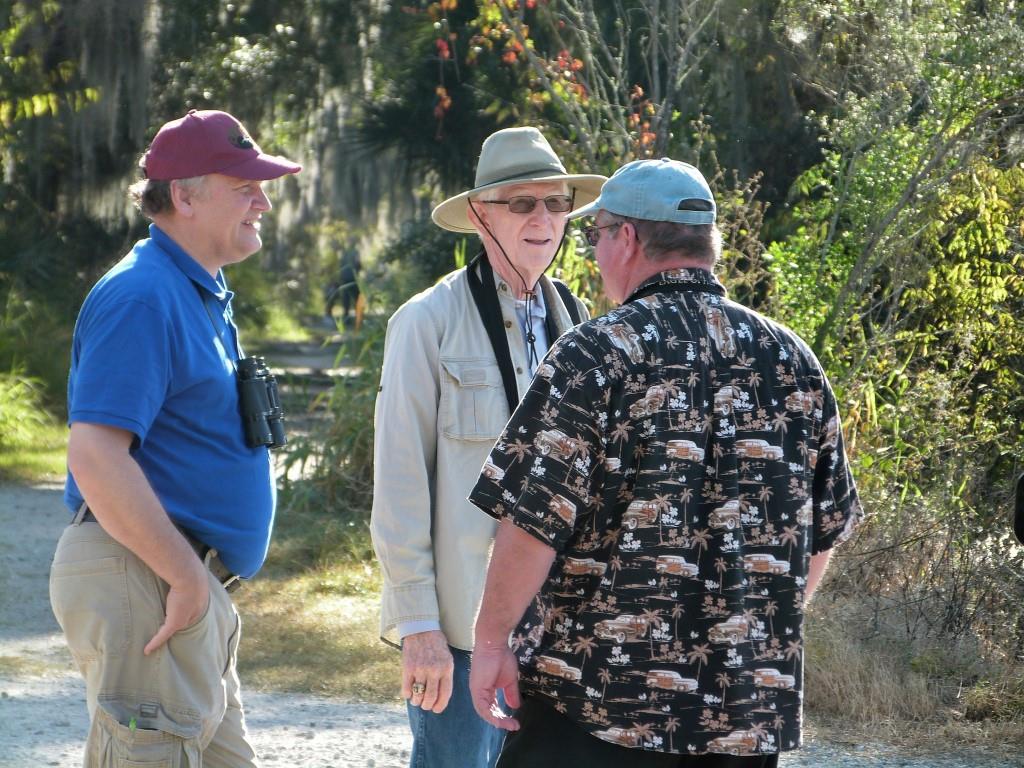
Dan and I, Dr. Jim (my name for him) and Golden Eagle (Baron) went birdwatching on Saturday. We took him to our favorite birding spot here, Circle B Bar Reserve. We saw 31 species, several “life birds” for him and one “life bird” for me, an Orange-crowned Warbler.
The Birders at Circle B Bar Reserve
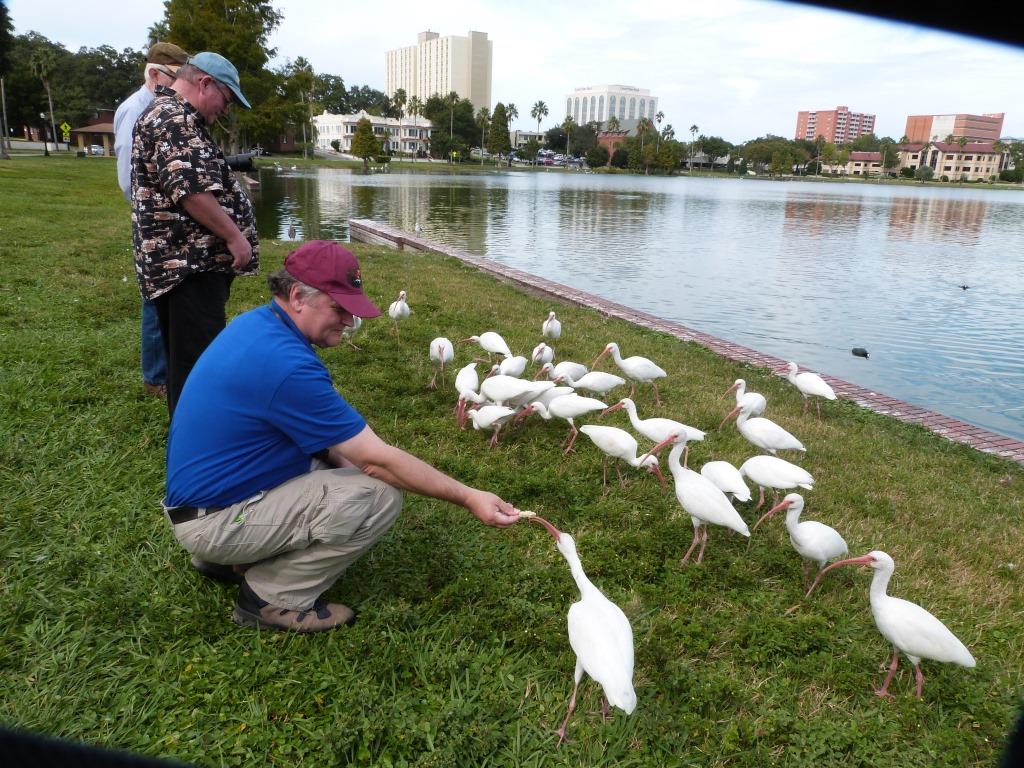
After we left there, we went to Lake Morton. I wanted two things to happen, but it didn’t. Was hoping to let them feed the Wood Stork over there and see a Wood Duck. Not to be. We saw one Wood Stork, but he must have already been fed. We did get to feed some of our other friends there. All total, we saw at least 19 species there. Also, the Lord prepared a great day for us. (Rained good part of Sunday, but Saturday was beautiful.)
Dr Jim Feeding White Ibises at Lake Morton
While describing our trip later, I misused the word “boring” which got mistaken. What I meant was that compared other visits to those two places, the number of species were less than normal. Birdwatching adventures are never “boring.” How can they when you are out enjoying the Lord’s great creation? Amazing! Fabulous! Superb! Those are better words.
“But now ask the beasts, and they will teach you; And the birds of the air, and they will tell you; (Job 12:7 NKJV)
“You are worthy, O Lord, To receive glory and honor and power; For You created all things, And by Your will they exist and were created.” (Revelation 4:11 NKJV)
As Dr. James told us in his presentations, the Lord uses so much variety, provision, and design in each of His created beings, humans included. If we just slow down, God’s hand can clearly be seen. (my paraphrase) Just with the birds, the wing structure, specialized beaks, programmed travels, interconnection between bird and plant, and on and on. Oh, Praise the Lord!
Anhinga Lake Morton by Dan
I am including the list of birds seen at both places. Also, a short video of a Snowy Egret using his foot to stir up something to eat. Wonder how that habit came about? Could it be that the Lord programmed that in it because of promising to provide for them?
“Consider the ravens, for they neither sow nor reap, which have neither storehouse nor barn; and God feeds them. Of how much more value are you than the birds? (Luke 12:24 NKJV)
Also, Dr. Johnson’s talks showed slides with examples of these points. (From an excerpt)
Witnesses for God’s Truth – “This presentation reviews 5 different kinds of witnesses for God’s truth, each of which takes away excuses from anyone who pretends to have no witness of God and His glory: (1) the physical creation, including our own physical bodies; (2) the uniqueness of humanity; (3) Scripture; (4) Christ’s incarnation; and (5) one more witness that we all are accountable for, and this one is quite scary!”
Lessons from the Zoo – “Did you know that the animal kingdom, in all of its diversity, reveals God’s creative genius and glory in uncountable ways? Why does God like and create variety in creation? How do the various animals living today, as well as other animals (like dinosaurs) which lived in earlier times, confirm the Bible’s account of creation – and refute Darwin’s evolutionary “natural selection” idea? This presentation provides a series of examples of big and little animals that display God’s handiwork in amazing ways. Mammals, reptiles, insects, spiders, fish, shellfish, jellyfish, and more!
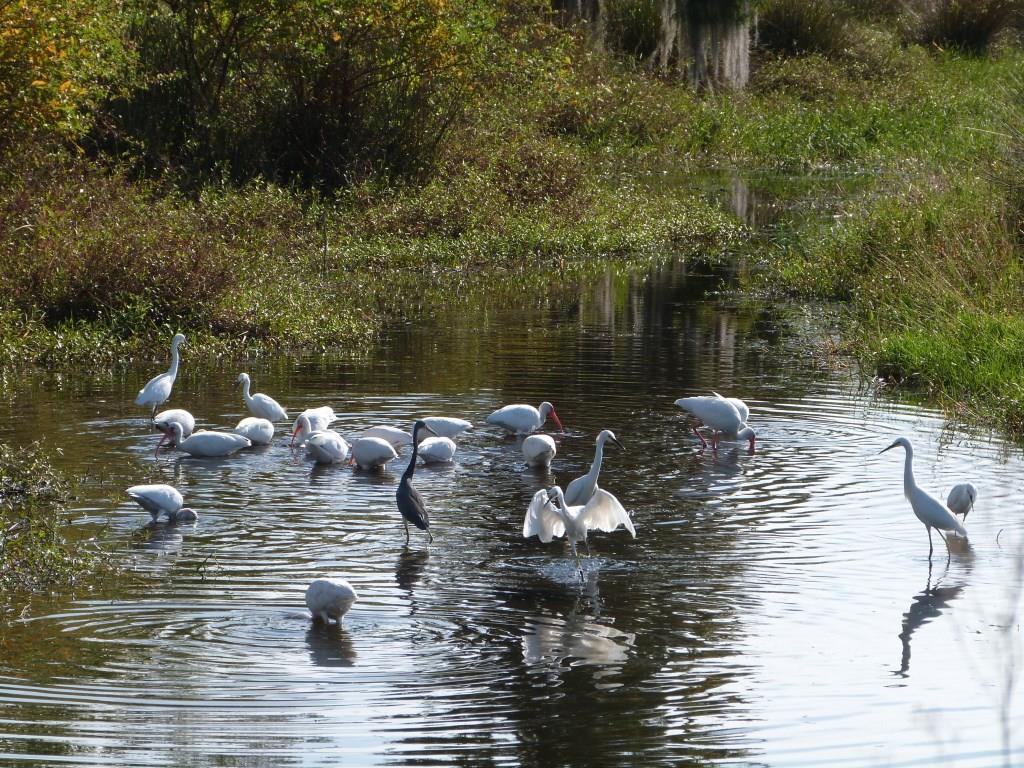
Tricolored-Snowy-Great Egret-White Ibis at Circle B
Circle B Bar Reserve, Polk, US-FL
Nov 8, 2014 8:00 AM – 10:00 AM
Us, Dr J and Baron – 31 species
Pied-billed Grebe
Double-crested Cormorant
Anhinga
Great Blue Heron
Great Egret
Snowy Egret
Little Blue Heron
Tricolored Heron
White Ibis
Glossy Ibis
Roseate Spoonbill 6
Black Vulture 50
Turkey Vulture 50
Osprey
Bald Eagle
Red-shouldered Hawk
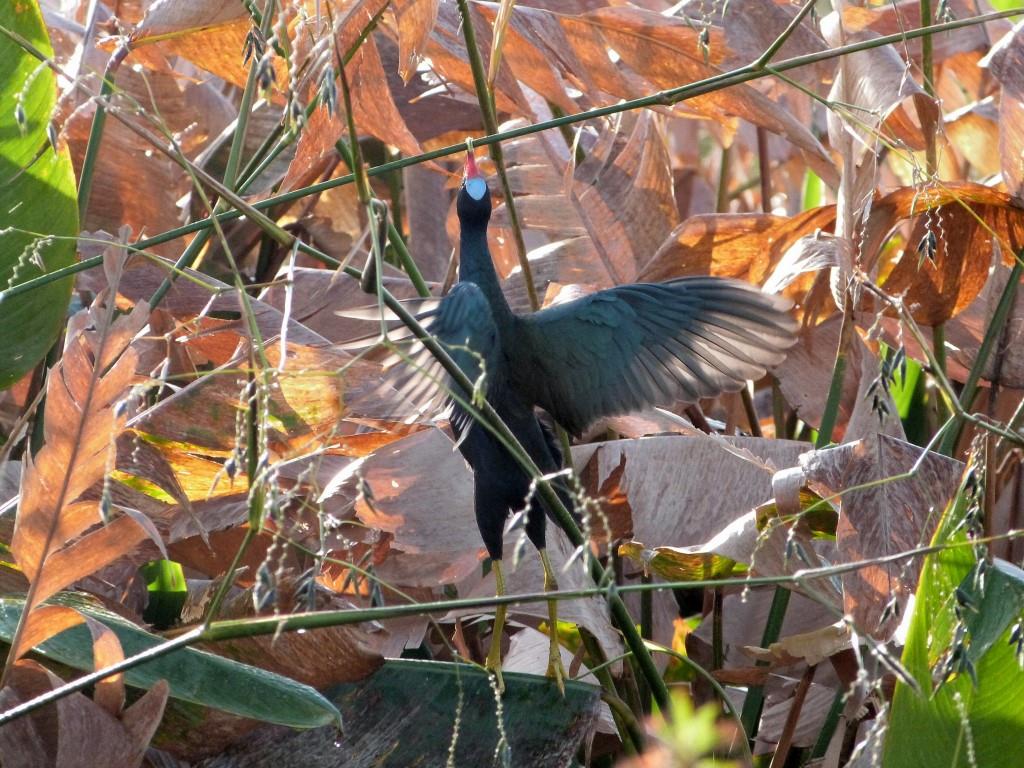
Purple Gallinule
Common Gallinule
Stilt Sandpiper
Red-bellied Woodpecker
Pileated Woodpecker
Eastern Phoebe
Carolina Wren
Blue-gray Gnatcatcher
Gray Catbird
Orange-crowned Warbler
Palm Warbler
Yellow-rumped Warbler
Northern Cardinal
Red-winged Blackbird
Boat-tailed Grackle
Lake Morton, Polk, US-FL
Nov 8, 2014 10:30 AM – 11:15 AM
Us, Dr J. and Baron – 18 species (+1 other taxa)
Mute Swan
Black Swan
Black-necked Swan
Muscovy Duck (Established Feral)
Mallard (Domestic type)
Blue-winged Teal
Ring-necked Duck
Anhinga
Great Blue Heron
Great Egret
Snowy Egret
White Ibis
Common Gallinule
American Coot
Laughing Gull
Rock Pigeon (Feral Pigeon)
Blue Jay
Palm Warbler
Boat-tailed Grackle
Our Men’s Quartet added an extra voice last Sunday night and sung a very powerful song.
Before I say more about that, an interesting application can be made. The voices of a quartet, any singing group or a choir are made up of a variety of voices. Some sing base, tenor, alto, baritone, soprano, but those like me, “off-key”, don’t join them. But notice how they blend to make such beautiful music.
Likewise our birds the Creator gave us come in much variety, each with different looks, heights, purposes, habitat they dwell in, and voices. Yet, when you walk through a park, woods, or other place you go birdwatching, they seem to blend together to make music. Most times it is very pleasing, but there are times, some of those “off-key” birds sound off.
We all come in a variety of talents, voices, gifts, personalities, yet when we use them for the Lord’s service, they come together to make great “music” That all is true as long as we know the Lord as our Savior. Please listen to the words of the song, and I pray that you will not be “One Day Too Late.”
This slideshow requires JavaScript.
“Marvel not that I said unto thee, Ye must be born again.” (John 3:7 KJV)
“One Day Too Late.” – Men’s Quartet + 1 – Faith Baptist Church
“For God so loved the world, that he gave his only begotten Son, that whosoever believeth in him should not perish, but have everlasting life. For God sent not his Son into the world to condemn the world; but that the world through him might be saved.
He that believeth on him is not condemned: but he that believeth not is condemned already, because he hath not believed in the name of the only begotten Son of God.
And this is the condemnation, that light is come into the world, and men loved darkness rather than light, because their deeds were evil. For every one that doeth evil hateth the light, neither cometh to the light, lest his deeds should be reproved.
But he that doeth truth cometh to the light, that his deeds may be made manifest, that they are wrought in God.” (John 3:16-21 KJV)
And they sung a new song, saying, Thou art worthy to take the book, and to open the seals thereof: for thou wast slain, and hast redeemed us to God by thy blood out of every kindred, and tongue, and people, and nation; (Revelation 5:9 KJV)
For a while Jenny Wren was too busy to talk save to scold Mr. Wren for spending so much time singing instead of working. To Peter it seemed as if they were trying to fill that tree trunk with rubbish. “I should think they had enough stuff in there for half a dozen nests,” muttered Peter. “I do believe they are carrying it in for the fun of working.” Peter wasn’t far wrong in this thought, as he was to discover a little later in the season when he found Mr. Wren building another nest for which he had no use.
Finding that for the time being he could get nothing more from Jenny Wren, Peter hopped over to visit Johnny Chuck, whose home was between the roots of an old apple-tree in the far corner of the Old Orchard. Peter was still thinking of the Sparrow family; what a big family it was, yet how seldom any of them, excepting Bully the English Sparrow, were to be found in the Old Orchard.
“Hello, Johnny Chuck!” cried Peter, as he discovered Johnny sitting on his doorstep. “You’ve lived in the Old Orchard a long time, so you ought to be able to tell me something I want to know. Why is it that none of the Sparrow family excepting that noisy nuisance, Bully, build in the trees of the Old Orchard? Is it because Bully has driven all the rest out?”
Johnny Chuck shook his head. “Peter,” said he, “whatever is the matter with your ears? And whatever is the matter with your eyes?”
“Nothing,” replied Peter rather shortly. “They are as good as yours any day, Johnny Chuck.”
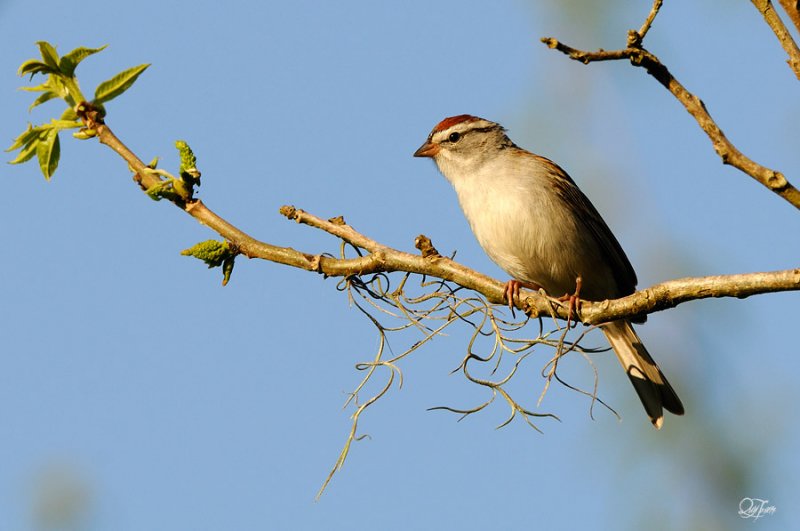
Johnny grinned. “Listen!” said Johnny. Peter listened. From a tree just a little way off came a clear “Chip, chip, chip, chip.” Peter didn’t need to be told to look. He knew without looking who was over there. He knew that voice for that of one of his oldest and best friends in the Old Orchard, a little fellow with a red-brown cap, brown back with feathers streaked with black, brownish wings and tail, a gray waistcoat and black bill, and a little white line over each eye—altogether as trim a little gentleman as Peter was acquainted with. It was Chippy, as everybody calls the Chipping Sparrow, the smallest of the family.
Chipping Sparrow (Spizella passerina) by Daves BirdingPix
Peter looked a little foolish. “I forgot all about Chippy,” said he. “Now I think of it, I have found Chippy here in the Old Orchard ever since I can remember. I never have seen his nest because I never happened to think about looking for it. Does he build a trashy nest like his cousin, Bully?”
Johnny Chuck laughed. “I should say not!” he exclaimed. “Twice Chippy and Mrs. Chippy have built their nest in this very old apple-tree. There is no trash in their nest, I can tell you! It is just as dainty as they are, and not a bit bigger than it has to be. It is made mostly of little fine, dry roots, and it is lined inside with horse-hair.”
“What’s that?” Peter’s voice sounded as it he suspected that Johnny Chuck was trying to fool him.
“It’s a fact,” said Johnny, nodding his head gravely. “Goodness knows where they find it these days, but find it they do. Here comes Chippy himself; ask him.”
Chippy and Mrs. Chippy came flitting from tree to tree until they were on a branch right over Peter and Johnny. “Hello!” cried Peter. “You folks seem very busy. Haven’t you finished building your nest yet?”
“Nearly,” replied Chippy. “It is all done but the horsehair. We are on our way up to Farmer Brown’s barnyard now to look for some. You haven’t seen any around anywhere, have you?”
Peter and Johnny shook their heads, and Peter confessed that he wouldn’t know horsehair if he saw it. He often had found hair from the coats of Reddy Fox and Old Man Coyote and Digger the Badger and Lightfoot the Deer, but hair from the coat of a horse was altogether another matter.
“It isn’t hair from the coat of a horse that we want,” cried Chippy, as he prepared to fly after Mrs. Chippy. “It is long hair from the tail or mane of a horse that we must have. It makes the very nicest kind of lining for a nest.”
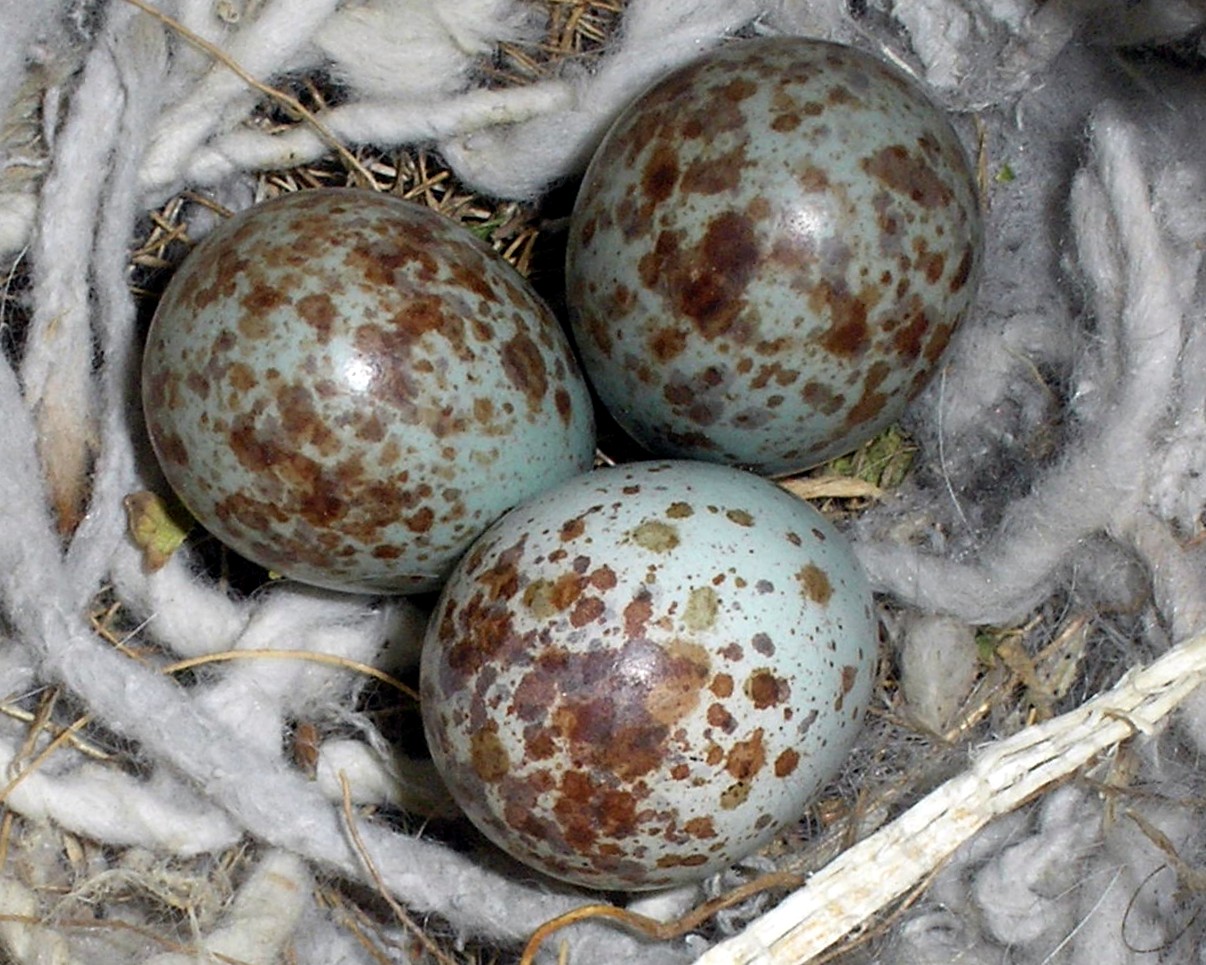
Chippy and Mrs. Chippy were gone a long time, but when they did return each was carrying a long black hair. They had found what they wanted, and Mrs. Chippy was in high spirits because, as she took pains to explain to Peter, that little nest would not soon be ready for the four beautiful little blue eggs with black spots on one end she meant to lay in it.
“I just love Chippy and Mrs. Chippy,” said Peter, as they watched their two little feathered friends putting the finishing touches to the little nest far out on a branch of one of the apple-trees.
“Everybody does,” replied Johnny. “Everybody loves them as much as they hate Bully and his wife. Did you know that they are sometimes called Tree Sparrows? I suppose it is because they so often build their nests in trees?”
“No,” said Peter, “I didn’t. Chippy shouldn’t be called Tree Sparrow, because he has a cousin by that name.”
Johnny Chuck looked as if he doubted that, “I never heard of him,” he grunted.
Peter grinned. Here was a chance to tell Johnny Chuck something, and Peter never is happier than when he can tell folks something they don’t know. “You’d know him if you didn’t sleep all winter,” said Peter. “Dotty the Tree Sparrow spends the winter here. He left for his home in the Far North about the time you took it into your head to wake up.”
“Why do you call him Dotty?” asked Johnny Chuck.
“Because he has a little round black dot right in the middle of his breast,” replied Peter. “I don’t know why they call him Tree Sparrow; he doesn’t spend his time in the trees the way Chippy does, but I see him much oftener in low bushes or on the ground. I think Chippy has much more right to the name of Tree Sparrow than Dotty has. Now I think of it, I’ve heard Dotty called the Winter Chippy.”
“Gracious, what a mix-up!” exclaimed Johnny Chuck. “With Chippy being called a Tree Sparrow and a Tree Sparrow called Chippy, I should think folks would get all tangled up.”
“Perhaps they would,” replied Peter, “if both were here at the same time, but Chippy comes just as Dotty goes, and Dotty comes as Chippy goes. That’s a pretty good arrangement, especially as they look very much alike, excepting that Dotty is quite a little bigger than Chippy and always has that black dot, which Chippy does not have. Goodness gracious, it is time I was back in the dear Old Briar-patch! Good-by, Johnny Chuck.”
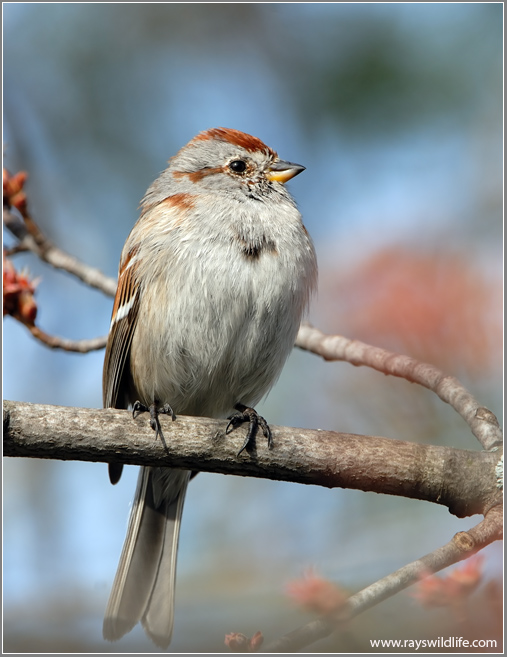
American Tree Sparrow by Ray
Away went Peter Rabbit, lipperty-lipperty-lip, heading for the dear Old Briar-patch. Out of the grass just ahead of him flew a rather pale, streaked little brown bird, and as he spread his tail Peter saw two white feathers on the outer edges. Those two white feathers were all Peter needed to recognize another little friend of whom he is very fond. It was Sweetvoice the Vesper Sparrow, the only one of the Sparrow family with white feathers in his tail.
“Come over to the dear Old Briar-patch and sing to me,” cried Peter.
Sweetvoice dropped down into the grass again, and when Peter came up, was very busy getting a mouthful of dry grass. “Can’t,” mumbled Sweetvoice. “Can’t do it now, Peter Rabbit. I’m too busy. It is high time our nest was finished, and Mrs. Sweetvoice will lose her patience if I don’t get this grass over there pretty quick.”
“Where is your nest; in a tree?” asked Peter innocently.
“That’s telling,” declared Sweetvoice. “Not a living soul knows where that nest is, excepting Mrs. Sweetvoice and myself. This much I will tell you, Peter: it isn’t in a tree. And I’ll tell you this much more: it is in a hoofprint of Bossy the Cow.”
“In a WHAT?” cried Peter.
“In a hoofprint of Bossy the Cow,” repeated Sweetvoice, chuckling softly. “You know when the ground was wet and soft early this spring, Bossy left deep footprints wherever she went. One of these makes the nicest kind of place for a nest. I think we have picked out the very best one on all the Green Meadows. Now run along, Peter Rabbit, and don’t bother me any more. I’ve got too much to do to sit here talking. Perhaps I’ll come over to the edge of the dear Old Briar-patch and sing to you a while just after jolly, round, red Mr. Sun goes to bed behind the Purple Hills. I just love to sing then.”
“I’ll be watching for you,” replied Peter. “You don’t love to sing any better than I love to hear you. I think that is the best time of all the day in which to sing. I mean, I think it’s the best time to hear singing,” for of course Peter himself does not sing at all.
That night, sure enough, just as the Black Shadows came creeping out over the Green Meadows, Sweetvoice, perched on the top of a bramble-bush over Peter’s head, sang over and over again the sweetest little song and kept on singing even after it was quite dark. Peter didn’t know it, but it is this habit of singing in the evening which has given Sweetvoice his name of Vesper Sparrow.
“Serve the LORD with gladness: come before his presence with singing.” (Psalms 100:2 KJV)
*
Who was the first new Sparrow we meet?
What were they busy doing?
Their nest was being built with what material?
What was the one thing needed to finish their nest?
*
Who was the next Sparrow that showed up?
Why did it confuse Johnny Chuck?
Why did the name “Dotty” fit for that sparrow?
Was Dotty or Chippy larger?
*
Sweetvoice is what kind of Sparrow?
What were these Sparrows making their nest out of?
Where was their nest?
When does Sweetvoice like to sing?
*
Are you busy doing the things that need to done? Do you sing? Most thought better of Chippy than Bully. Are more like Chippy or Bully?
Speaking to yourselves in psalms and hymns and spiritual songs, singing and making melody in your heart to the Lord; Giving thanks always for all things unto God and the Father in the name of our Lord Jesus Christ;
(Ephesians 5:19-20 KJV)
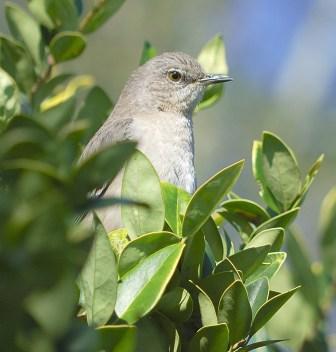
We have been attacked repeatedly lately by an Angry Bird. A Northern Mockingbird has decided that he has a rival inside our windows. As the sun shines on different windows during the day, he attacks those windows with vigor.
Apparently he has been thinking about starting another family and is trying to clear the area of competitors. He starts at early light and attacks the bird (his imaginary enemy) at one of the two bedroom windows. Then he goes out front and sits in the palm tree by the Florida room windows. Lo and behold, his enemy arrives and he starts attacking that window. It even has a screen on it. Later in the day, about mid-morning his “enemy” shows up in the side window of our living room.
I put some stick-on Christmas tree decorations on the back window, but he still sees his enemy and bangs on the windows. You just have to chuckle.
As most of you already know, our Northern Mockingbird is seeing his own reflection in the windows. I told Dan yesterday that the Angry Bird is “His own worst enemy!” He is causing his own problems. If he would just relax, (and stay away from the windows) things would be okay.
But be doers of the word, and not hearers only, deceiving yourselves. For if anyone is a hearer of the word and not a doer, he is like a man observing his natural face in a mirror; for he observes himself, goes away, and immediately forgets what kind of man he was. (James 1:22-24 NKJV)
How many times are we “our own worst enemy?” We make big “to-dos” about nothing. Or we think we have an issue when we really don’t have one. Sometimes we cause our own problems.
But seek first the kingdom of God and His righteousness, and all these things shall be added to you. Therefore do not worry about tomorrow, for tomorrow will worry about its own things. Sufficient for the day is its own trouble. (Matthew 6:33-34 NKJV)
One of the passages that mentions “face to face” that I like is:
“When I was a child, I spoke as a child, I understood as a child, I thought as a child; but when I became a man, I put away childish things. For now we see in a mirror, dimly, but then face to face. Now I know in part, but then I shall know just as I also am known. And now abide faith, hope, love, these three; but the greatest of these is love. (1 Corinthians 13:11-13 NKJV)
Our angry Mockingbird is definitely not showing love.
Have a great day and remember to put your trust in the Lord and not in things you think you see.
CHAPTER 3. Jenny Has a Good Word for Some Sparrows.
The morning after the fight between Jenny and Mr. Wren and Bully the English Sparrow found Peter Rabbit in the Old Orchard again. He was so curious to know what Jenny Wren would do for a house that nothing but some very great danger could have kept him away from there. Truth to tell, Peter was afraid that not being able to have their old house, Jenny and Mr. Wren would decide to leave the Old Orchard altogether. So it was with a great deal of relief that as he hopped over a low place in the old stone wall he heard Mr. Wren singing with all his might.
The song was coming from quite the other side of the Old Orchard from where Bully and Mrs. Bully had set up housekeeping. Peter hurried over. He found Mr. Wren right away, but at first saw nothing of Jenny. He was just about to ask after her when he caught sight of her with a tiny stick in her bill. She snapped her sharp little eyes at him, but for once her tongue was still. You see, she couldn’t talk and carry that stick at the same time. Peter watched her and saw her disappear in a little hole in a big branch of one of the old apple-trees. Hardly had she popped in than she popped out again. This time her mouth was free, and so was her tongue.
“You’d better stop singing and help me,” she said to Mr. Wren sharply. Mr. Wren obediently stopped singing and began to hunt for a tiny little twig such as Jenny had taken into that hole.
“Well!” exclaimed Peter. “It didn’t take you long to find a new house, did it?”
“Certainly not,” snapped Jenny “We can’t afford to sit around wasting time like some folk I know.”
Peter grinned and looked a little foolish, but he didn’t resent it. You see he was quite used to that sort of thing. “Aren’t you afraid that Bully will try to drive you out of that house?” he ventured.
Jenny Wren’s sharp little eyes snapped more than ever. “I’d like to see him try!” said she. “That doorway’s too small for him to get more than his head in. And if he tries putting his head in while I’m inside, I’ll peck his eyes out! She said this so fiercely that Peter laughed right out.
“I really believe you would,” said he.
“I certainly would,” she retorted. “Now I can’t stop to talk to you, Peter Rabbit, because I’m too busy. Mr. Wren, you ought to know that that stick is too big.” Jenny snatched it out of Mr. Wren’s mouth and dropped it on the ground, while Mr. Wren meekly went to hunt for another. Jenny joined him, and as Peter watched them he understood why Jenny is so often spoken of as a feathered busybody.
For some time Peter Rabbit watched Jenny and Mr. Wren carry sticks and straws into that little hole until it seemed to him they were trying to fill the whole inside of the tree. Just watching them made Peter positively tired. Mr. Wren would stop every now and then to sing, but Jenny didn’t waste a minute. In spite of that she managed to talk just the same.
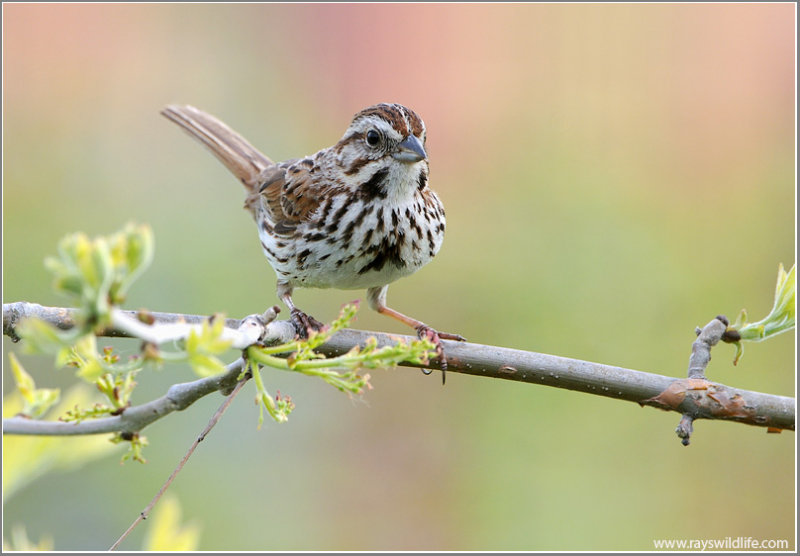
Song Sparrow by Ray
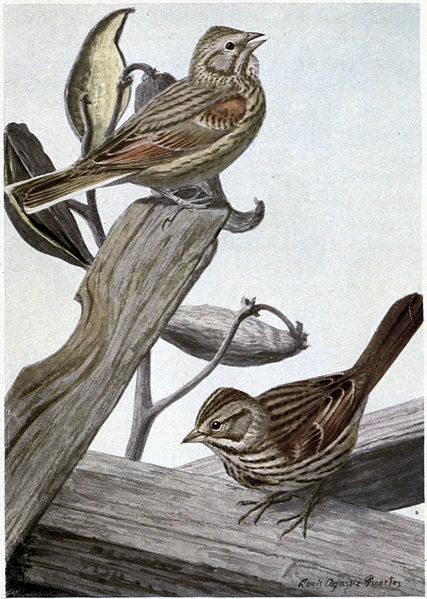
“I suppose Little Friend the Song Sparrow got here some time ago,” said she.
Peter nodded. “Yes,” said he. “I saw him only a day or two ago over by the Laughing Brook, and although he wouldn’t say so, I’m sure that he has a nest and eggs already.”
Jenny Wren jerked her tail and nodded her head vigorously. “I suppose so,” said she. “He doesn’t have to make as long a journey as we do, so he gets here sooner. Did you ever in your life see such a difference as there is betweenLittle Friend and his cousin, Bully? Everybody loves Little Friend.”
Once more Peter nodded. “That’s right,” said he. “Everybody does love Little Friend. It makes me feel sort of all glad inside just to hear him sing. I guess it makes everybody feel that way. I wonder why we so seldom see him up here in the Old Orchard.”
“Because he likes damp places with plenty of bushes better,” replied Jenny Wren. “It wouldn’t do for everybody to like the same kind of a place. He isn’t a tree bird, anyway. He likes to be on or near the ground. You will never find his nest much above the ground, not more than a foot or two. Quite often it is on the ground. Of course I prefer Mr. Wren’s song, but I must admit that Little Friend has one of the happiest songs of any one I know. Then, too, he is so modest, just like us Wrens.”
Peter turned his head aside to hide a smile, for if there is anybody who delights in being both seen and heard it is Jenny Wren, while Little Friend the Song Sparrow is shy and retiring, content to make all the world glad with his song, but preferring to keep out of sight as much as possible.
Jenny chattered on as she hunted for some more material for her nest. “I suppose you’ve noticed,” said she, “that he and his wife dress very much alike. They don’t go in for bright colors any more than we Wrens do. They show good taste. I like the little brown caps they wear, and the way their breasts and sides are streaked with brown. Then, too, they are such useful folks. It is a pity that that nuisance of a Bully doesn’t learn something from them. I suppose they stay rather later than we do in the fall.”
“Yes,” replied Peter. “They don’t go until Jack Frost makes them. I don’t know of any one that we miss more than we do them.”
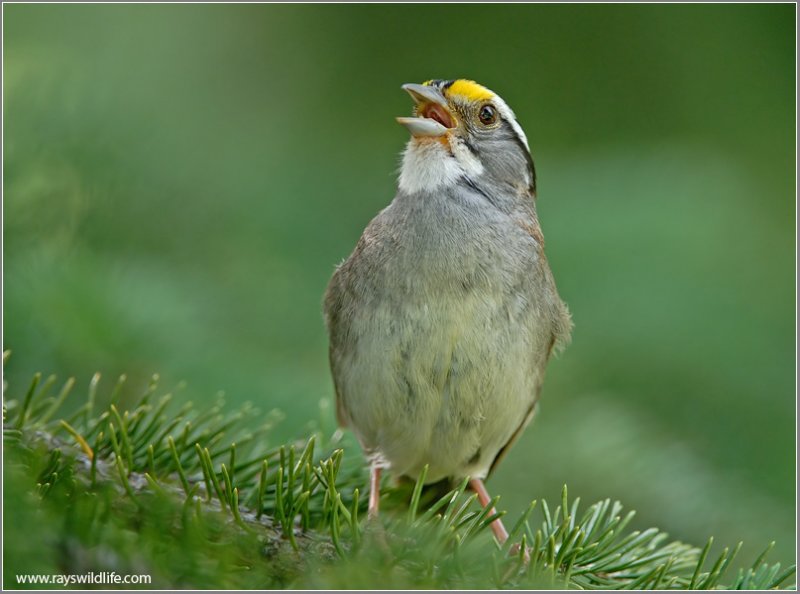
“Speaking of the sparrow family, did you see anything of Whitethroat?” asked Jenny Wren, as she rested for a moment in the doorway of her new house and looked down at Peter Rabbit.
Peter’s face brightened. “I should say I did!” he exclaimed. “He stopped for a few days on his way north. I only wish he would stay here all the time. But he seems to think there is no place like the Great Woods of the North. I could listen all day to his song. Do you know what he always seems to be saying?”
Jenny nodded in her usual emphatic way. “I don’t know him as well as I do some of the others,” said she, “but when I have seen him down in the South he always has appeared to me to be a perfect gentleman. He is social, too; he likes to travel with others.”
“I’ve noticed that,” said Peter. “He almost always has company when he passes through here. Some of those Sparrows are so much alike that it is hard for me to tell them apart, but I can always tell Whitethroat because he is one of the largest of the tribe and has such a lovely white throat. He really is handsome with his black and white cap and that bright yellow spot before each eye. I am told that he is very dearly loved up in the north where he makes his home. They say he sings all the time.”
Fox Sparrow (Passerella iliaca) by Ray
“I suppose Scratcher the Fox Sparrow has been along too,” said Jenny. “He also started sometime before we did.”
“Yes,” replied Peter. “He spent one night in the dear Old Briar-patch. He is fine looking too, the biggest of all the Sparrow tribe, and HOW he can sing. The only thing I’ve got against him is the color of his coat. It always reminds me of Reddy Fox, and I don’t like anything that reminds me of that fellow. When he visited us I discovered something about Scratcher which I don’t believe you know.”
“What?” demanded Jenny rather sharply.
“That when he scratches among the leaves he uses both feet at once,” cried Peter triumphantly. “It’s funny to watch him.”
“Pooh! I knew that,” retorted Jenny Wren. “What do you suppose my eyes are make for? I thought you were going to tell me something I didn’t know.”
Peter looked disappointed.
The heart of the wise instructs his mouth And adds persuasiveness to his lips. Pleasant words are a honeycomb, Sweet to the soul and healing to the bones. (Proverbs 16:23-24 NASB)
*
Jenny seems to be in a kinder mood in this chapter. She has kind words about three different Sparrows. Can you name them?
What kind of sparrow was Little Friend? What kind of songs does he sing? Where does he like to live? What color cap does he have?
Our second sparrow is pictured at the top. Where was Whitethroat headed? What color is his cap? What does his song sound like? (When people use word to descrbe a song, that is called – Mnemonics.
Who is the largest sparrow? What color is Scratcher’s coat? Why is he called “Scratcher”?
Jenny is using nice words about the sparrows this time. Don’t you like to have good words spoken about you? Do you use nice words when talking about someone?
Read the two verses and think about how the Lord wants your speech.
Let the words of my mouth and the meditation of my heart Be acceptable in Your sight, O LORD, my strength and my Redeemer. (Psalms 19:14 NKJV)














 Lee's Birdwatching Adventures Plus