Russet Sparrow (Passer rutilans) by Nikhil Devasar
In the Bible, the Sparrows are mentioned in 7 verses. Check out these from the NKJV:
Even the sparrow has found a home, And the swallow a nest for herself, Where she may lay her young— Even Your altars, O LORD of hosts, My King and my God. (Psalms 84:3 NKJV)
I lie awake, And am like a sparrow alone on the housetop. (Psalms 102:7 NKJV)
Like a flitting sparrow, like a flying swallow, So a curse without cause shall not alight. (Proverbs 26:2 NKJV)
Are not two sparrows sold for a copper coin? And not one of them falls to the ground apart from your Father’s will. (Matthew 10:29 NKJV)
Do not fear therefore; you are of more value than many sparrows. (Matthew 10:31 NKJV)
Are not five sparrows sold for two copper coins? And not one of them is forgotten before God. (Luke 12:6 NKJV)
But the very hairs of your head are all numbered. Do not fear therefore; you are of more value than many sparrows. (Luke 12:7 NKJV)
Sparrows are not always thought of very highly. Many people think they are just “little brown birds” and are of no use. But is that what the Scriptures says in those verses? No.
What can you learn from those verses?
The sparrow has found a ____________
The sparrow is found on the __________________
How does the sparrow fly? (see Proverbs 26:2) _______________
Who is aware of or allows a sparrow to fall to the ground? ______________
Are sparrows forgotten by God? ______________
How many sparrows were sold for one copper coin? ________
For two copper coins? ___________
Who is more valuable, you or a sparrow? _____________
We will talk more about Sparrows in the next Bible Birds – Sparrows II. For now, here are a few pictures of different Sparrows around the world.
In a tropical rainforest by the shores of Chile, there lived two hummingbirds. One was named George and the other was named Frank. They both lived next door to each other in the rainforest and looked a lot alike. They both had pink, green, and blue feathers which were great camouflage. They were great friends.
Now George and Frank were hummingbirds so they were supposed to be able to fly backward. But George never could fly backward. Finally, one day, he was determined to learn how to fly that way. He flew over to Frank’s house, the next tree over, and knocked on the door with his long beak.
“I need your help,” he said. “I want to finally learn how to fly backward.”
“That will be easy,” said Frank. “I’ll show you.”
They found a big enough space to fly long distances and Frank demonstrated. He flew to a giant palm tree and back quite easily, flying backward. After several attempts, George wasn’t getting any better. The first three times, he fell; and, the fourth time, working his wings the wrong way, he flew into a tree and got his head stuck. Frank had to pull him out.
Then Frank had a solution. He grabbed a battery-powered fan and some rope. He tied the fan onto George’s stomach and turned it on. George was off! Sometimes he would fly so fast, he would run into a tree. A Toucan, living nearby, was so unhappy about this that he squawked angrily and chased them to another tree.
Eventually, George mastered flying backward with the fan, so Frank decided to try him once without it. George tried again and again, but it was always better with the fan. Frank helped him put it back on. George used the fan for flying backward from then on. That was just his way of doing it.
The End
(By Emma Foster a Kids Writer. She is 13.)
One who is righteous is a guide to his neighbor…. (Proverbs 12:26 ESV)
Everyone helps his neighbor and says to his brother, “Be strong!” (Isaiah 41:6 ESV)
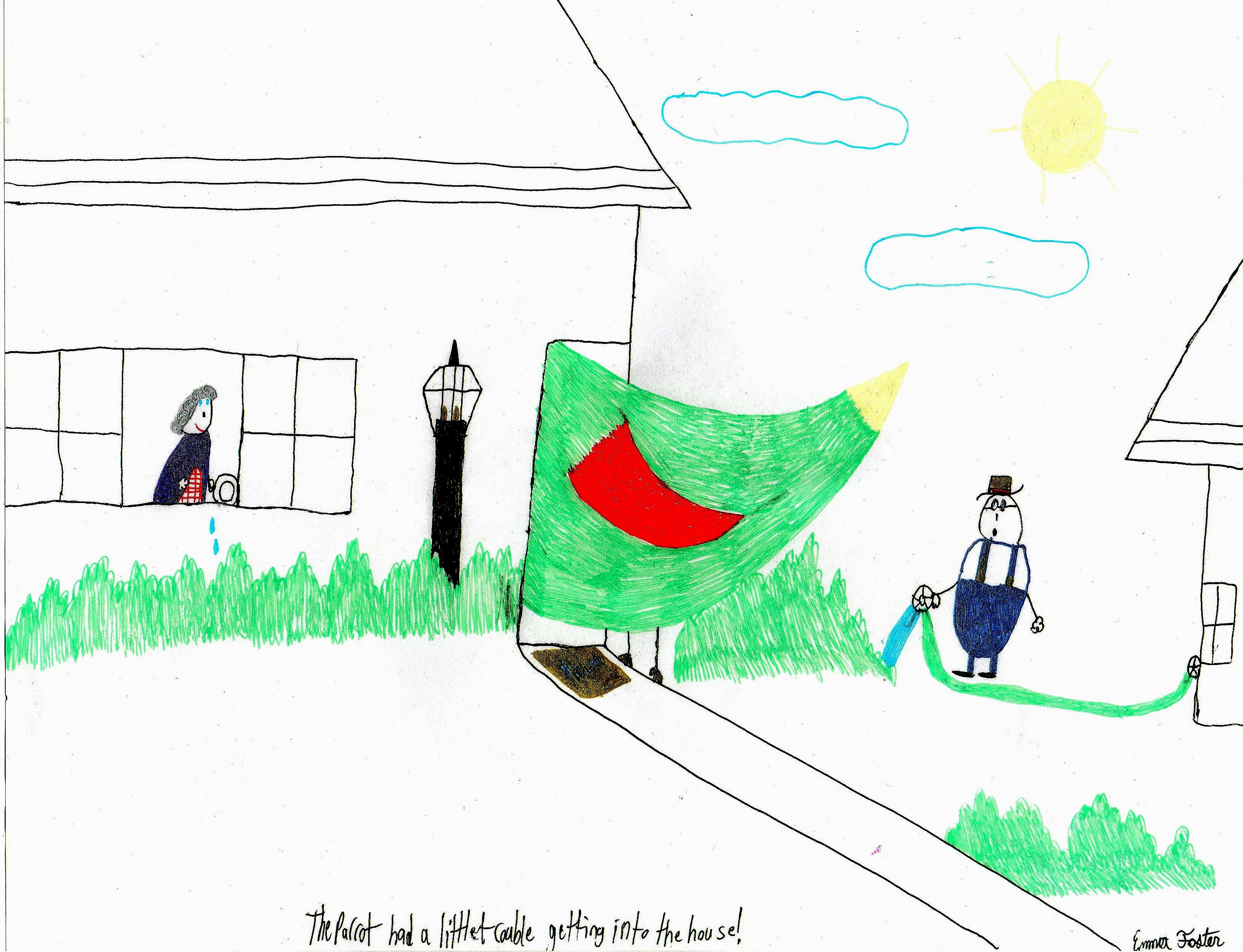
Parrot Had A Little Trouble Getting Into The House by Emma Foster
One day an old lady named Mrs. Patterson decided that she should have more company around. She traveled down to her local pet store and parked her car. Mrs. Patterson was guided by one of the workers through the store. When they came to the section where the birds were, Mrs. Patterson stopped at an enormous parrot. The parrot had red wings, green all over his body, a blue ring around his neck and a yellow spot on his tail. Mrs. Patterson wanted him for her bird.
It took awhile before the parrot could fit through the door! The parrot was so big that he had to wear a leash that Mrs. Patterson held through the window of her car and soar above it. The parrot had a little trouble getting in the house! When he got into the house, Mrs. Patterson named him Bob.
But one day a visitor came to the door and addressed himself as Mr. Field. He explained that Bob was his parrot that he had lost long ago. After saying goodbye, Bob left with Mr. Field, wearing a leash, and flew away above Mr. Field’s truck.
The next day Mr. Field came back with Bob! Mr. Field said that he worked at a circus with Bob, but Bob could not remember any of his tricks so he had to bring him back. Mrs. Patterson thanked him and sat down in a chair with Bob. She knew he would always be her parrot.
The End
(I did no editing of the article. Click the photo to enlarge it.)
Lee’s Addition:
Emma was 12 years old and Home Schooled when this was first posted. She attends our church and likes to draw and write. I told her that if she wrote about a bird, I would publish it here on the blog. Above is her story and drawing of Bob the enormous Parrot. I trust you enjoy it as well as I did. She was in the 7th Grade at the time. [She is now in college] If you enjoy it, please click the Like button as that will be an encouragement to her.
Train up a child in the way he should go; even when he is old he will not depart from it. (Proverbs 22:6 ESV)
P.S. Emma is the Granddaughter of another of our Guest Writers, Dot Malcolm. She has written three articles for us.
*** As I am bringing back the Kids articles, thought you might enjoy re-reading these tales.
If you would like to send in a Bird Tale that you have written, send it to Lee@Leesbird.com to be considered. It can be written by a younger writer or written with the young readers in mind. ***
And thorns shall come up in her palaces, nettles and brambles in the fortresses thereof: and it shall be an habitation of dragons, and a court for owls. (Isaiah 34:13 KJV)
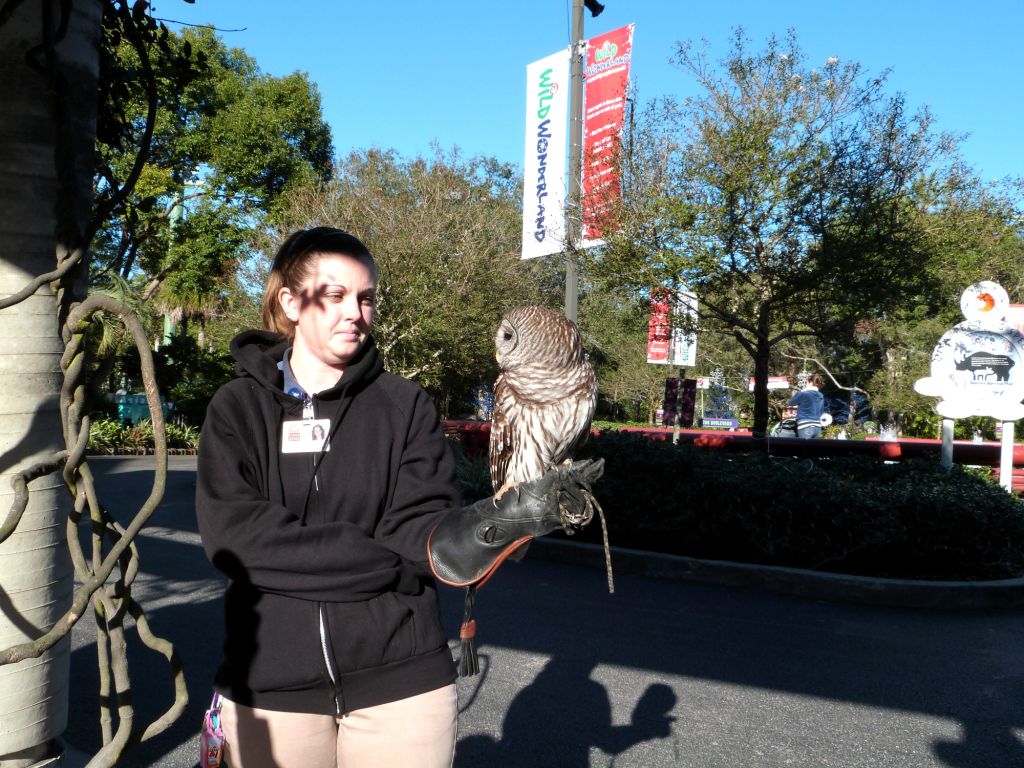
Dan and I went over to the Lowry Park Zoo/Zoo Tampa in Tampa again today. I was wanting to check out my Christmas present of a new camera. Enjoying learning to use it and retaking a lot of photos of birds to compare the old ones with the new ones on this camera. (It is still a point-and-shoot, but it has an improved “program mode.” Dan is our good photographer.)
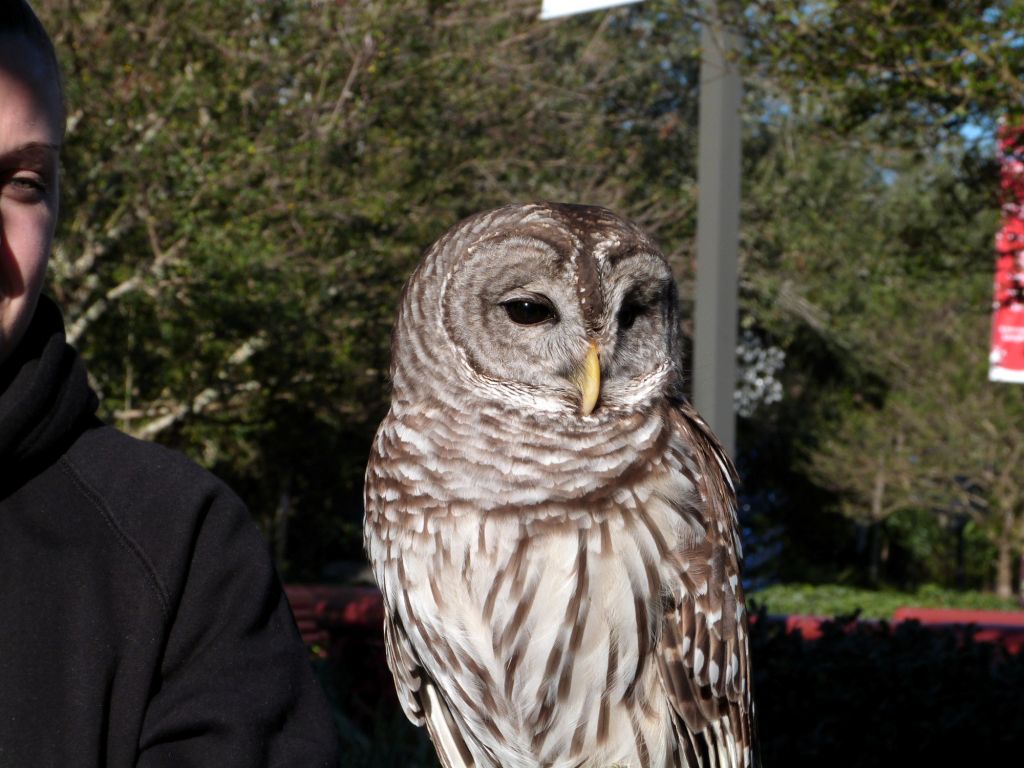
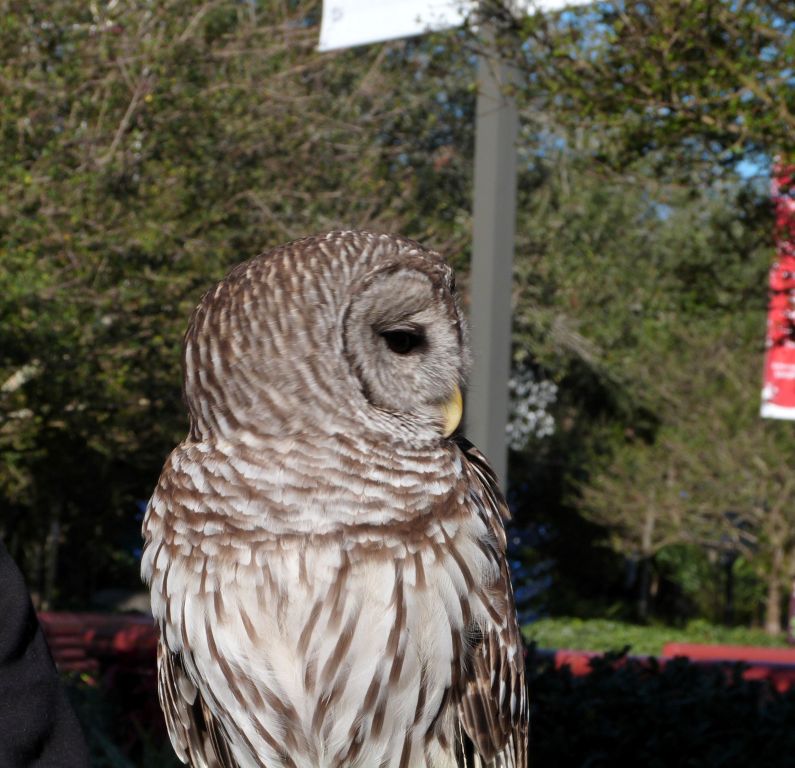
But when we entered the zoo, we were met by one of the zookeepers holding a beautiful Barred Owl. We had not encountered this Owl in our previous trips. While sharing some of the photos, I thought you might like to learn a little about them.
Face pale with dark concentric rings surrounding eye
Similar species:
The Spotted Owl is most similar, but can be separated with attention to its barred, not streaked, underpart coloration. Short-eared Owl is similar in size, but is not barred on the chest nor is as heavily streaked below, does not share the concentric rings in the facial disks, has yellow eyes and a dark bill, and is found in quite different habitat. Great Gray Owl is superficially similar, but much larger, gray rather than brown below, and has differently patterned underparts.”
Northern Barred Owl (Strix varia) LPZ by Lee
“The Barred Owl (Strix varia) is a large typical owl native to North America. It goes by many other names, including Eight Hooter, Rain Owl, Wood Owl, and Striped Owl, but is probably best known as the Hoot Owl based on its call.
The usual call is a series of eight accented hoots ending in oo-aw, with a downward pitch at the end. The most common mnemonic device for remembering the call is “Who cooks for you, who cooks for you all.” It is noisy in most seasons. When agitated, this species will make a buzzy, rasping hiss. While calls are most common at night, the birds do call during the day as well.” (Wikipedia)
(From xeno-canto.org)
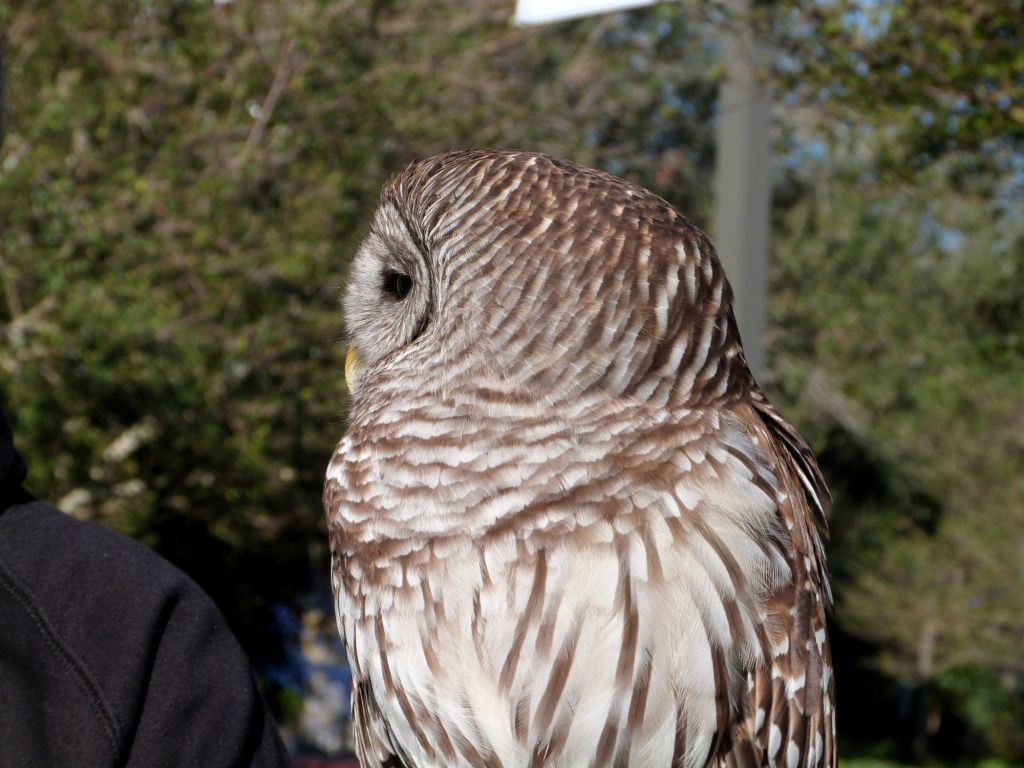
Northern Barred Owl (Strix varia) LPZoo by Lee
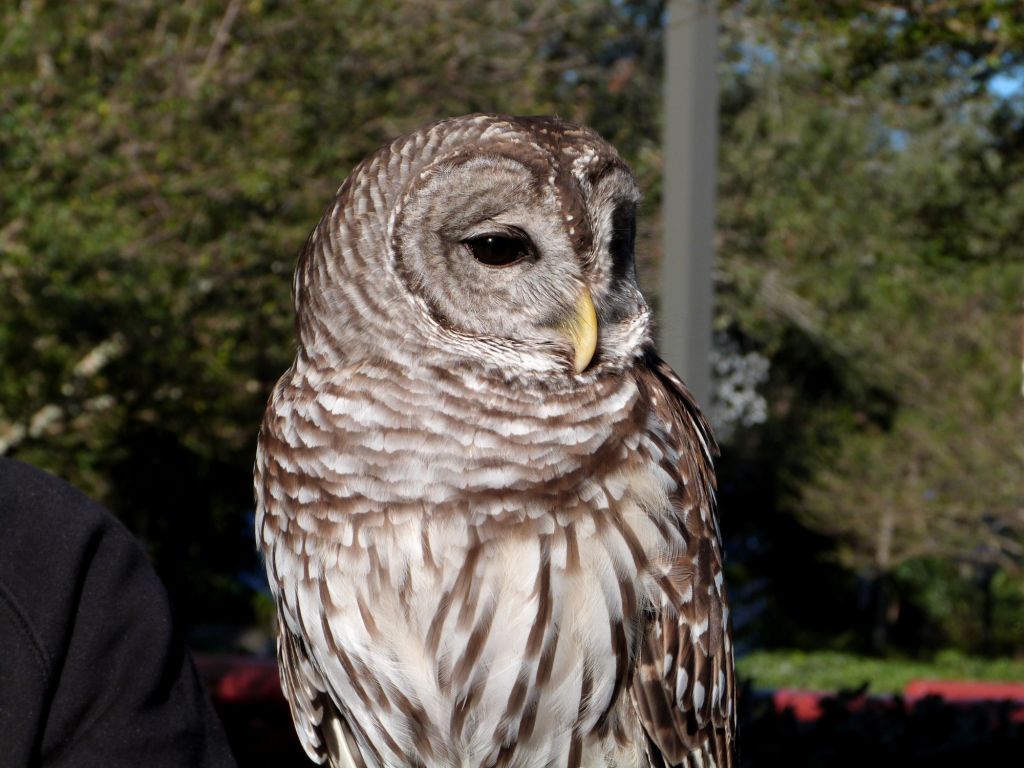
Looking the other way. No, they cannot turn their heads all the way around. Notice also that this owl does not have ear tufts like some owls.
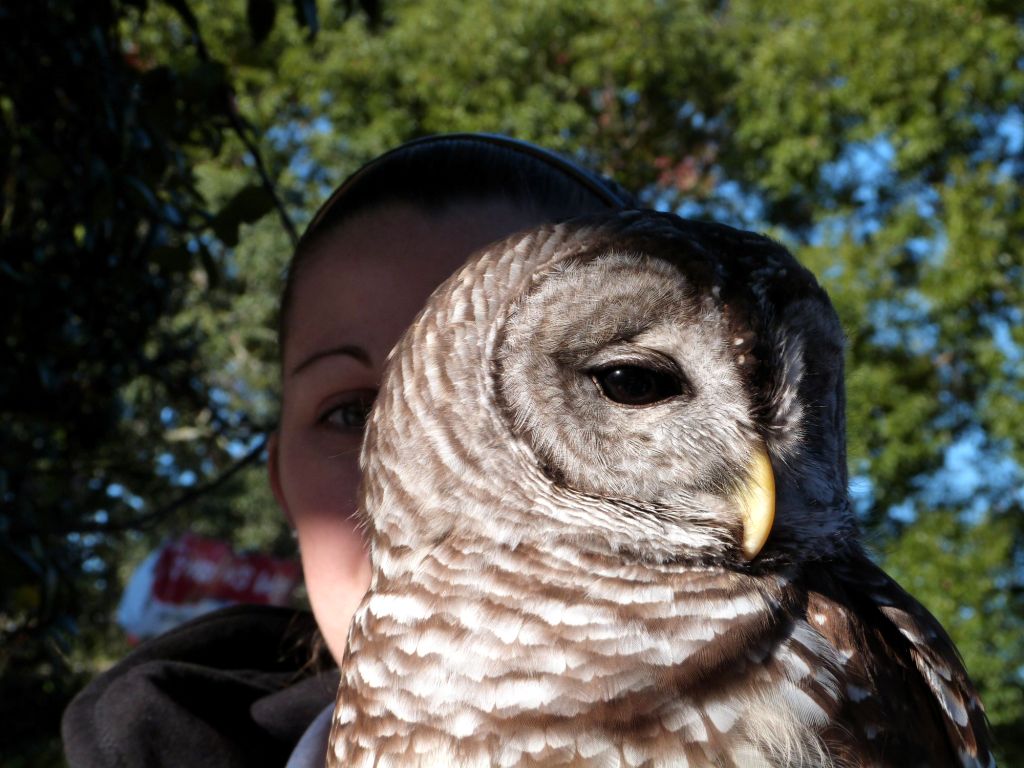
Northern Barred Owl (Strix varia) LPZ by Lee – Side of head
“Breeding habitats are dense woods across Canada, the eastern United States, and south to Mexico;in recent years it has spread to the western United States. Recent studies show suburban neighborhoods can be ideal habitat for barred owls. Using transmitters, scientists found that populations increased faster in the suburban settings than in old growth forest. The main danger to owls in suburban settings is from cars. The increased offspring offset the death rate due to impacts from cars and disease.”
The Barred Owl’s nest is often in a tree cavity, often ones created by pileated woodpeckers; it may also take over an old nesting site made previously by a red-shouldered hawk, cooper’s hawk, crow, or squirrel. It is a permanent resident, but may wander after the nesting season. If a nest site has proved suitable in the past they will often reuse it as the birds are non-migratory. In the United States, eggs are laid from early-January in southern Florida to mid-April in northern Maine, and consist of 2 to 4 eggs per clutch. Eggs are brooded by the female with hatching taking place approximately 4 weeks later. Young owls fledge four to five weeks after hatching. These owls have few predators, but young, unwary owls may be taken by cats. The most significant predator of Barred Owls is the Great Horned Owl. The Barred Owl has been known to live up to 10 years in the wild and 23 years in captivity.” (Wikipedia)
Northern Barred Owl (Strix varia) LPZ by Lee
“Owl” is mentioned 8 times in the King James Bible and “Owls” is mentioned 6 times. So that makes our friend here a “Bird of the Bible” and of course a “Bird of the World.” Owls are another of the Lord’s great creations.
It was a great birdwatching day at the Zoo. Cool, but the sun was bright and no clouds. I had some other great finds today, but will save them for later.
Harriet Newell Cook (1814-1843) – author of Scripture Alphabet of Animals
Baudet Donkey – Shaky and Brown
While looking for the quoted thoughts by G. D. Watson, “Others May, You Cannot,” I found the Christian Articles Website. It is loaded with articles by numerous pastors and preachers, but also other Christian writers. That is where I found Harriet N. Cook’s “Scripture Alphabet of Animals.” Her works and the others on that website are in the public domain and usable. I have decided to use her as a guest writer and produce the bird sections (finished) she wrote about. The other sections are being done also. They are listed below. Also, her books are available on Google Books and can be read on the computer or one of the eBook readers.
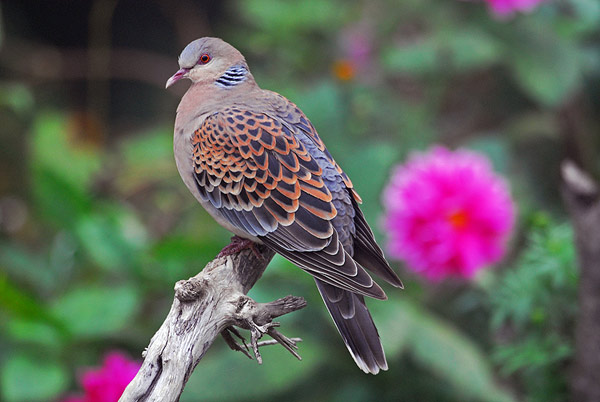
Oriental Turtle Dove (Streptopelia orientalis) by Nikhil
Harriet Newell Cook was born in 1814 and died in 1843. In her short 29 years of life she wrote several juvenile books and thought I would share parts of them here. “Her first volume for the young was one of Natural History, calculated to illustrate portions of the Bible, for the young, and entitled, “The Scripture Alphabet of Animals.” Nearly thirty thousand copies of the work have been printed in its English dress, and eight thousand of the German translation. The style of this work is eminently lucid…”
Beasts, and all cattle; creeping things, and flying fowl: Kings of the earth, and all people; princes, and all judges of the earth: Both young men, and maidens; old men, and children: Let them praise the name of the LORD: for his name alone is excellent; his glory is above the earth and heaven. (Psalms 148:10-13 KJV)
It was difficult finding information about her personally. Also, I couldn’t find a picture of her. One thing was for certain, she appears to have loved the Lord greatly and wanted to serve Him through her writing.




 Lee's Birdwatching Adventures Plus