Birds of the Bible – Who Colored These Originally?

Blue Jay Photo Chopped in Rainbow Colors - From Pinterest by Richard SequinWho Colored These Originally?

In the beginning God created the heaven and the earth. (Genesis 1:1 KJV)

My Bible tells me in Genesis chapter 1 that God created everything, including all our avian wonders.

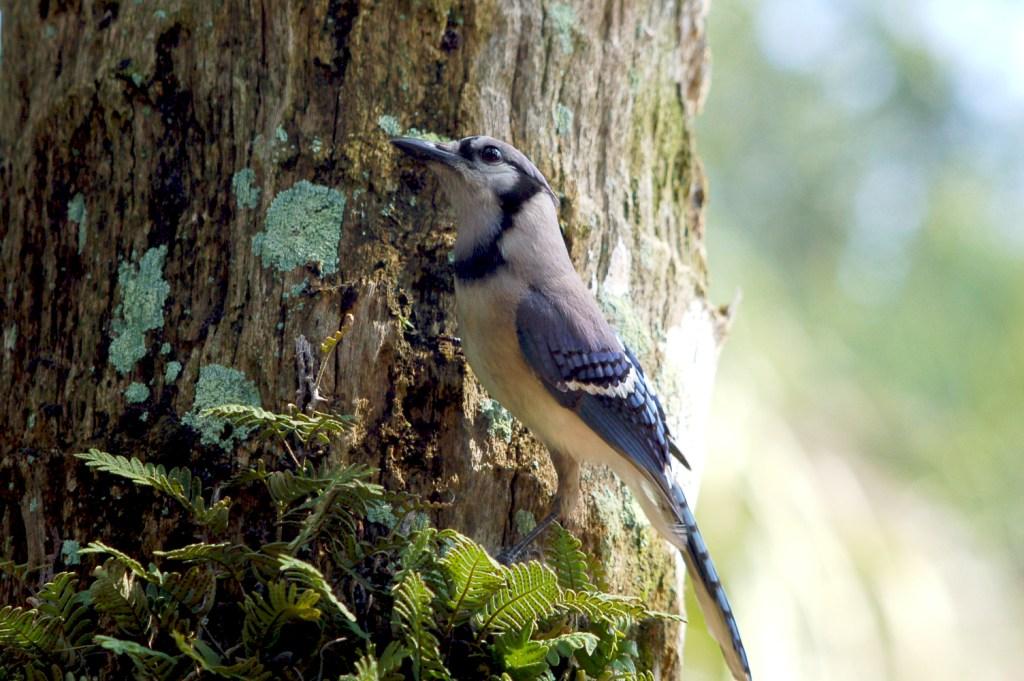
Blue Jay (Cyanocitta cristata) at Bok Tower By Dan'sPix

Blue Jay (Cyanocitta cristata) at Bok Tower By Dan’sPix

In fact, we are told specifically that on the fifth day of creation, God created the Birds:

Then God said, “Let the waters abound with an abundance of living creatures, and let birds fly above the earth across the face of the firmament of the heavens.” So God created great sea creatures and every living thing that moves, with which the waters abounded, according to their kind, and every winged bird according to its kind. And God saw that it was good. And God blessed them, saying, “Be fruitful and multiply, and fill the waters in the seas, and let birds multiply on the earth.” So the evening and the morning were the fifth day. (Genesis 1:20-23 NKJV)

When the birds were brought forth, judging from today, that they were beautifully arrayed. We can look around at the over 10,000 species today, in spite of being corrupted by the curse (Genesis 3), and see that they are magnificently arrayed in beautiful, fantastic colors and hues.


Nicobar Pigeon - False

Nicobar Pigeon – Falsely Colored

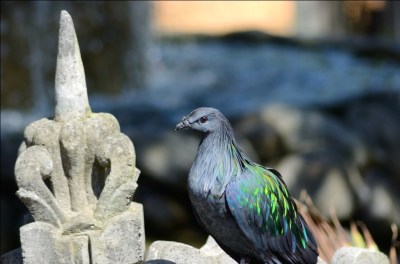
Nicobar Pigeon at Lower Park Zoo by Dan

Nicobar Pigeon at Lower Park Zoo by Dan

Then again in John 1:1-3 we see that the Word, the Lord Jesus Christ, is the one who made them.

In the beginning was the Word, and the Word was with God, and the Word was God. The same was in the beginning with God. All things were made by him; and without him was not any thing made that was made. (John 1:1-3 KJV)

All of that was stated to establish who the birds were created by. Now for the point of this article.

I belong to Pinterest which is a visual discovery tool that you can use to find ideas for all your projects and interests. You can find all kinds of photos and of course, many bird photos.

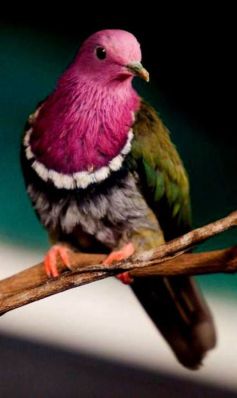
Now, the irritation, for me, is that lately many photos of birds have been “photo-shopped” or someone has used other editing software programs to change their colors. No harm intended, but the colors they are adding to the birds, messes up the beauty of their Creator’s original design and color for them.

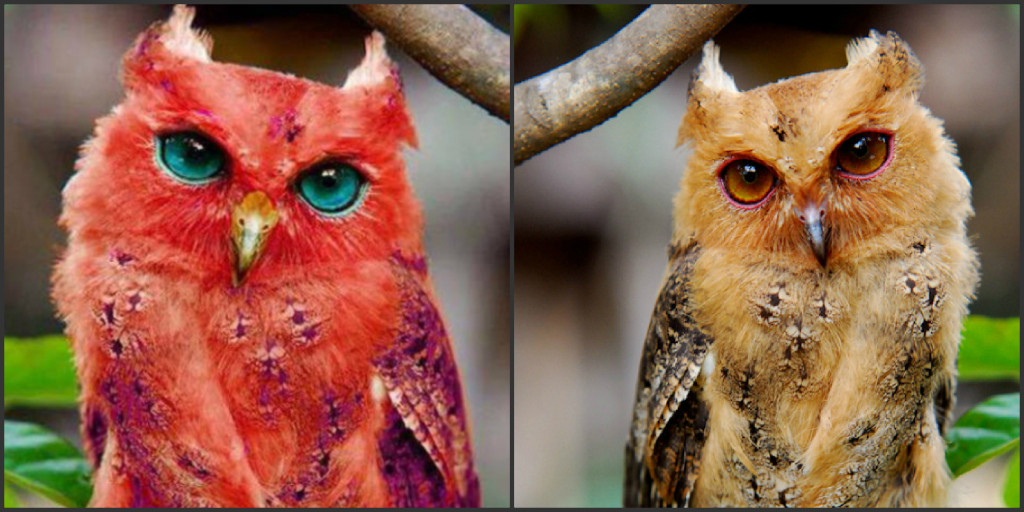
False - A Rare Red Owl - Snopes_com

False – A Rare Red Owl – Snopes_com

Some people, who are not familiar with what the birds actually look like, may think that is the way they look in the wild. One such case fooled people into believing that a rare Red Owl actually exist. When the asked “Snopes” they found out the truth.

Two more examples:

False - Curl-crested Aricari from Pinterest by Virainova

False – Curl-crested Aricari from Pinterest by Virainova

False - Flicker from Pinterest by Spykee

False – Flicker from Pinterest by Spykee

Now for the real birds in nature. Also, do you realize how easy they would be for birds of prey to catch these? They would stand out boldly in the crowd and would be the first captured. Only a Wise Creator, would provide for the safety of the birds by their proper coloration.

Curl-crested Aracari (Pteroglossus beauharnaesii) ©WikiC

Curl-crested Aracari (Pteroglossus beauharnaesii) ©WikiC

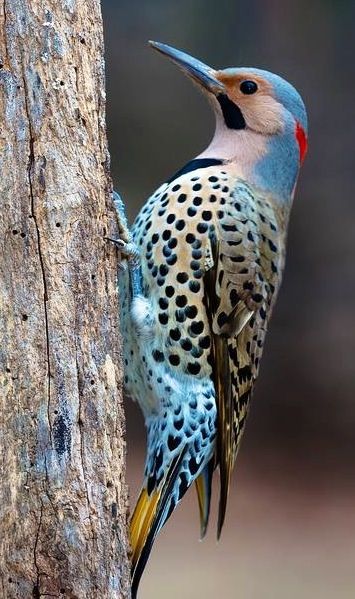
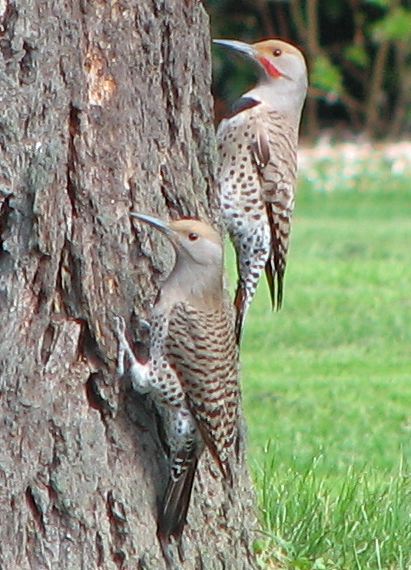
Northern Flicker (Colaptes auratus) red-shafted F-left M-right ©WikiC

Northern Flicker (Colaptes auratus) red-shafted F-left M-right ©WikiC

I know all the birds of the mountains, And the wild beasts of the field are Mine. (Psalms 50:11 NKJV)

Again, I am not condemning those who color their birds in photos, as long as they don’t try to “pass them off” as the “real” bird.

God’s Wisdom, Majesty, and Knowledge cannot be improved upon.

I am the LORD, and there is no other; There is no God besides Me. I will gird you, though you have not known Me, That they may know from the rising of the sun to its setting That there is none besides Me. I am the LORD, and there is no other; I form the light and create darkness, I make peace and create calamity; I, the LORD, do all these things.’ (Isaiah 45:5-7 NKJV)

*

Birds of the Bible

More False Colored Birds

Who Paints The Leaves?
*

Bible Birds – Bird Claws and Eagle Hair

Bald Eagle (Haliaeetus leucocephalus) by Aesthetic Photos

Bald Eagle (Haliaeetus leucocephalus) by Aesthetic Photos

Bible Birds – Bird Claws and Eagle Hair

That very hour the word was fulfilled concerning Nebuchadnezzar; he was driven from men and ate grass like oxen; his body was wet with the dew of heaven till his hair had grown like eagles’ feathers and his nails like birds’ claws. (Daniel 4:33 NKJV emphasis mine)

What an interesting verse to read in the Bible. Most of you know what an Eagle looks like, because Eagles fly to many countries.

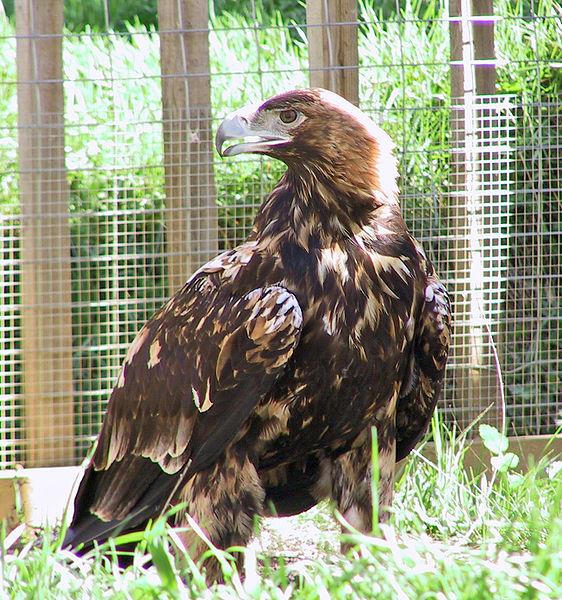
Adalbert's Eagle Aquila adalberti) ©WikiC

Adalbert’s Eagle Aquila adalberti) ©WikiC

Whose hair was going to grow so long that it would be as long as eagles’ feathers?

Sea Eagle (Haliaeetus pelagicus) Feet by Lee at National Aviary

Sea Eagle (Haliaeetus pelagicus) Feet by Lee at National Aviary

This is what a person looks like with long nails:

Long nails like a bird's claws

Long nails like a bird’s claws

Whose fingernails and toenails was going to grow so long that they would look like bird claws?

The person that verse is referring to is Nebuchadnezzar. He was the King of Babylon in 605 BC – 562 BC. The Lord God had placed him in power to rule over the whole world, but he had forgotten to give God the credit. He started saying things like:

  • “Is not this great Babylon, that I have built for a royal dwelling
  • by my mighty power
  • and for the honor of my majesty?” (Daniel 4:30 NKJV emphasis mine)

Do you know what that is called? Pride! The King was failing to give God the credit for making him the ruler, having majesty, and ability to build his royal place.

Do we have a false pride? Yes, we may do great things. You may make 100% on a test, earn a high award, or receive some other great recognition. Are you swelling up with pride? Have you thanked your parents, friends, or, if you know the Lord as Savior, the Lord for helping you achieve your success?

We should be thankful for the abilities that we have. Thank the Lord for helping you remember those answers to get the 100%. Thank Him for allowing you to earn that award. Thank the Lord for being recognized for something you did that was great.

Thank the Lord even if you didn’t get 100%, a trophy, award, or other prize. If you did your best, that is all He can expect you to do. If you didn’t do your best, then ask the Lord to help you do better the next time something comes up.

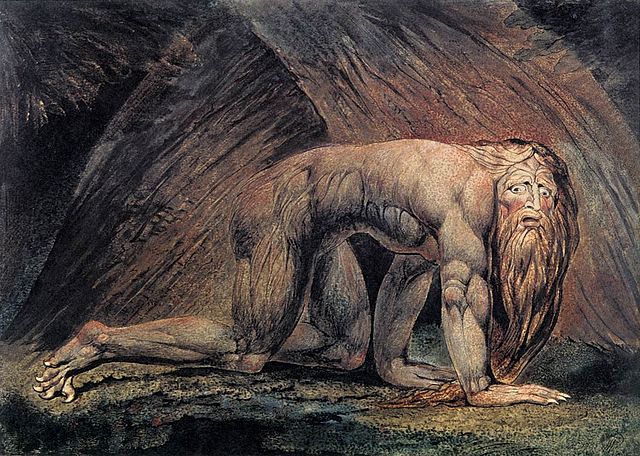
Nebuchadnezzar - depicting the king during his bout of insanity by William Blake ©WikiC

Nebuchadnezzar – showing the king during his bout of insanity by William Blake ©WikiC

Yes, after the Lord sent Nebuchadnezzar out to the field with an animal’s heart, eating grass, growing long hair like eagle’s feathers, and his nails growing long like bird’s claws, He finally looked to the Lord God.

Now I, Nebuchadnezzar, praise and extol and honor the King of heaven, all of whose works are truth, and His ways justice. And those who walk in pride He is able to put down. (Daniel 4:37 NKJV)

*

*

George And The Happy New Year

House Finch (Carpodacus mexicanus) by Ian

House Finch (Carpodacus mexicanus) by Ian

George and the Happy New Year

~ by Emma Foster

   In the countryside, where farms dotted the land along the hills and the only sounds that could be heard were birds chirping and cows mooing, there lived a small finch named George. He lived in a small red barn out in the countryside. George had built his nest up in the rafters where he could look down at all the other farm animals during the day. In the barn, he had a clear view out the window of the sky and the big city very far away.

New Year’s Day was drawing near, and every night for the past week, George and the other animals were kept up late because of all of the fireworks being set off outside the city. One night, George decided he would fly to the city. He had always wondered what people did on New Year’s Eve and how they celebrated the coming year. George figured the city was the perfect place for celebration.

That morning, on December thirty-first, George flew out the window while all the other farm animals were still sleeping, and began flying to the city.

House Finch Resting

House Finch Resting

The dirt road that stretched to the farm eventually turned into a gravel road as George flew farther on. He flew past many apple tree orchards and corn fields until the gravel road split off into two concrete roads. Here there were many different houses and stores.

Every now and then George would take a break from flying and land on a powerline. He was able to see how far he had to fly before arriving at the city.

By the time George could see large skyscrapers up ahead it was late evening. When he entered the city, he could see many other birds flying around looking for tall buildings to land on so they could see the celebration with a good point of view. George passed by lots of buildings, but none of them seemed good enough. He wanted to be able to see everything, including all the people celebrating.

Finally George spotted a large, shiny ball on top of a tall building in the middle of a busy street. Flying to it, he decided this would be the perfect place to watch the celebration because he could see throngs of people standing in the street below eagerly cheering. By then it was late at night, and George hoped he hadn’t missed much.

Times Square Ball

Times Square Ball

Landing on the ball, he watched the crowd, and he remarked how bright the ball was and wondered what it was for. Suddenly it started lowering and everyone began counting down from ten. When they all reached one, everyone cheered. George didn’t know why, but afterwards, everyone started to leave and call for taxis to take them home. George realized this must have been the celebration.

It was late in the afternoon when George arrived back at the farm, and all of the animals were eager to hear where he had been. George was glad to tell all the animals what he had seen, and of how people celebrated New Year’s Day. None of the animals ever understood exactly why people celebrated the day by counting backwards from ten, and George never understood what the huge ball was used for other than to go up and down.

The End


Lee’s Addition:

O sing unto the LORD a new song: sing unto the LORD, all the earth. (Psalms 96:1 KJV)

Yes, they shall sing of the ways of the Lord and joyfully celebrate His mighty acts, for great is the glory of the Lord. (Psalms 138:5 AMP)

What a celebration for George even if he didn’t quite figure out what it was all about. Thanks, Emma, for another great bird tale. Sounds like you must have stayed up and watched the celebration New Years Eve. At least you didn’t have to fly to see it.

You can see all of Emma’s other great articles here:

Deceptive Cuckoo

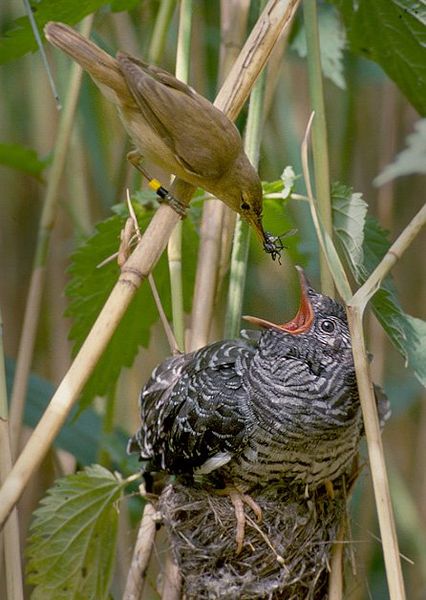
Common Cuckoo (Cuculus canorus) being raised by a Reed Warbler©WikiC

Common Cuckoo (Cuculus canorus) being raised by a Reed Warbler©WikiC

Earlier this week James J. S. Johnson wrote Teach Your Children The Right Passwords! He mentioned brood parasitism by the Cuckoo and how they like to lay their egg in another unsuspecting bird’s nest. Creation Moments just released this video and I thought you would enjoy seeing it.

The thoughts of the righteous are right: but the counsels of the wicked are deceit. (Proverbs 12:5 KJV)

Deceit is in the heart of them that imagine evil: but to the counsellors of peace is joy. (Proverbs 12:20 KJV)

*

Creation Moments YouTube Channel

Teach Your Children The Right Passwords! by James J. S. Johnson

Orni-Theology

Wordless Birds

*

Teach Your Children The Right Passwords!

Teach  your  children  the  right  passwords!

~ by James J. S. Johnson
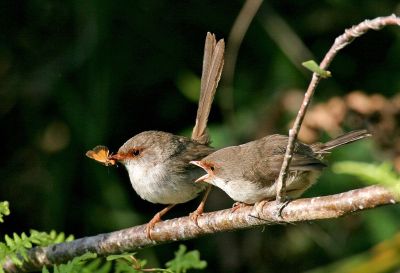
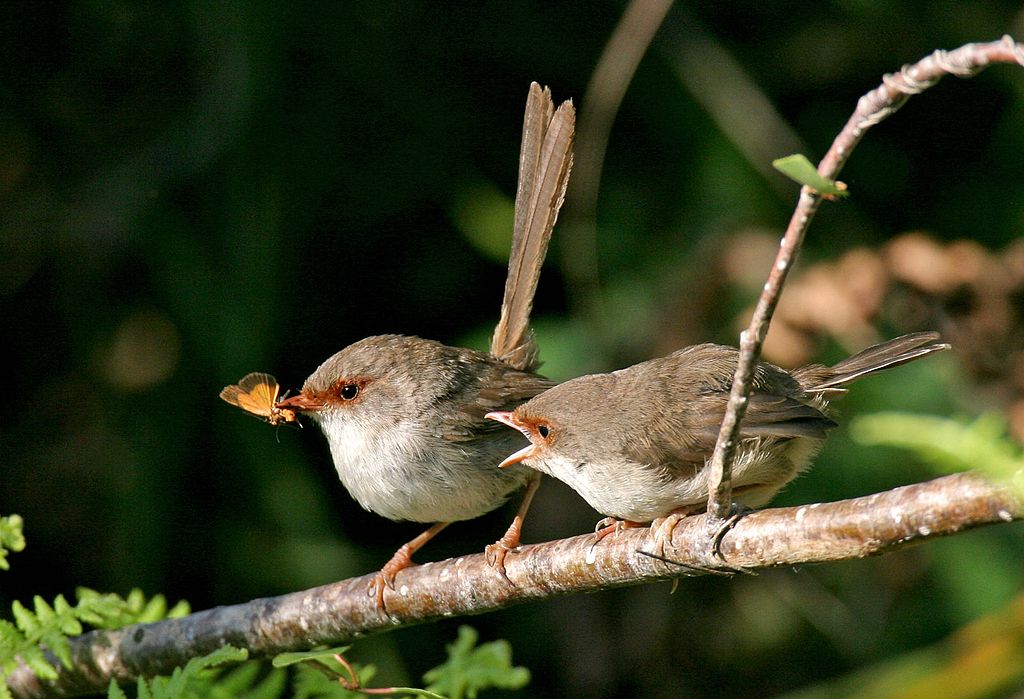
Superb Fairywren (Malurus cyaneus) Juvenile and Female ©WikiC

We will not hide them [“them” refers to God’s prophetic words – see verses 1-3] from their children, shewing to the generation to come the praises of the Lord, and His strength, and his wonderful works that He hath done.  For He established a testimony in Jacob, and appointed a law in Israel, which He commanded our [fore]fathers, that they should make them known to their children,  that the generation to come might know them, even the children which should be born [יִוָּלֵ֑דוּ — niphâl imperfect form of the verb yâlad], who should arise and declare [וִֽיסַפְּר֥וּ — piêl imperfect form of the verb sâphar] them to their children, that they might set their hope in God, and not forget the works of God, but keep His commandments, and [that they] might not be as their [fore]fathers, a stubborn and rebellious generation, a generation that set not their heart aright, and whose spirit was not steadfast with God.   Psalm 78:4-8

Superb Fairywrens teach their children to use passwords, but how?

In this fallen world even bird families have troubles.

One kind of family problem, confronted by many bird parents, is the problem of “brood parasites”, which is really a sneaky kind of “home invasion”.

Brood parasitism” is not a problem of parasitic worms or bugs.  Rather, this is a different kind of parasite – a bold “home invasion” parasite – a “foster child”, from another bird family, who was dropped into a “host” family.  The “host” family is thereafter burdened (unless and until the newcomer is evicted from the nest) with the cost of nurturing the intruding stranger who “moved in” without an invitation.  Worse, the invasive “foster child” often competes with the legitimate nestling birds for food and shelter, sometimes even competing aggressively.
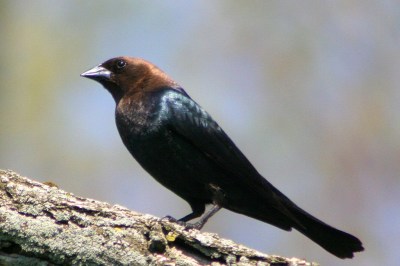
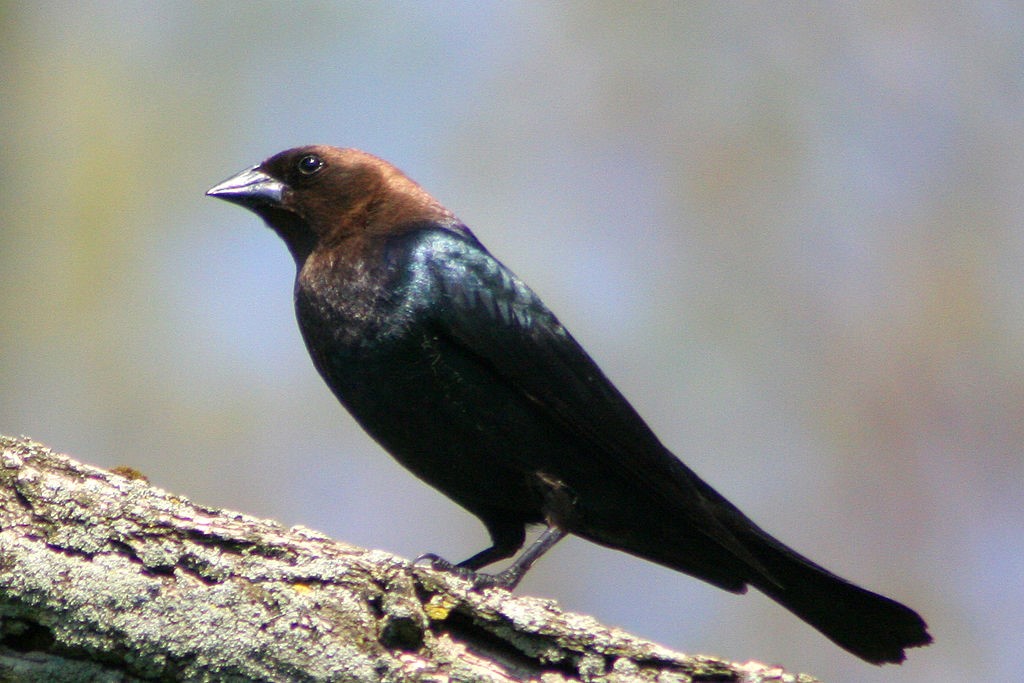
PAS-Icte Brown-headed Cowbird (Molothrus ater) ©WikiC

Male Brown-headed Cowbird  (Molothrus ater) ©WikiC

One of the best-known examples of such “brood parasitism” practices is those of the Brown-headed Cowbird (Molothrus ater), an icterid (i.e., member of the blackbird family) with a head that is distinctively chocolate-brown in color.

“A small, black-bodied [and iridescent-plumed] bird, a bit larger than a House Sparrow, with a brown head and a rather finchlike bill.  Females are nondescript gray [like the hue of female grackles] with a finchlike bill.

A brood parasite, the Cowbird lays its eggs in the nests of other birds.”
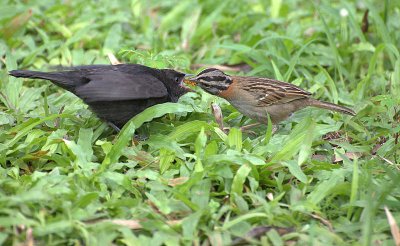
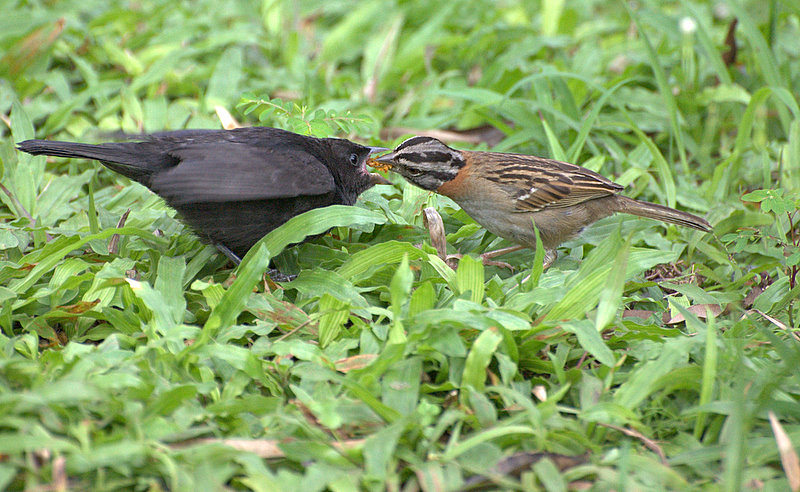
A Shiny Cowbird (Molothrus bonariensis) chick being fed by a Rufous-collared Sparrow (Zonotrichia Capensis)

A Shiny Cowbird (Molothrus bonariensis) chick being fed by a Rufous-collared Sparrow (Zonotrichia Capensis)

[Quoting from Roger Tory Peterson, PETERSON FIRST GUIDE TO BIRDS: A Simplified Field Guide to the Commonest Birds of North America (Houghton Mifflin, 1986), page 102.]

But cowbirds of North America are not the only birds that abuse the (involuntary) charity care of avian “foster parents”;  cuckoos (such as the Common Cuckoo of Eurasia) are known for the same “externalizing” of their parenting costs, producing nestling competitions that result in “changeling” conflicts.

“Once a brood parasite [mother] has managed to slip her egg into a host’s nest, her reproductive role is essentially over.  She leaves each chick to fend for itself, in a [bird] family that did not choose to raise it.

There’s no reason to feel [too] sorry for the uninvited foster chick, however; it is the unwitting adoptive parents that might soon face an unexpected brutality—the ruthless slaying of all their own offspring.

Many brood parasites, such as cuckoos, immediately dispatch of their nest mates [i.e., the children of the caring bird parents who built and maintain the nest that is now compromised] as soon as they hatch by summarily tossing them over the side of the nest.  [So much for refugee gratitude!]
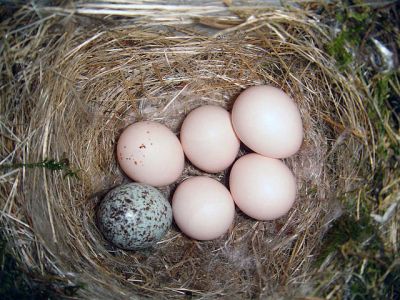
Brown-headed Cowbird (Molothrus ater) Egg in Eastern Phoebe Nest ©WikiC

Brown-headed Cowbird (Molothrus ater) Egg in Eastern Phoebe Nest ©WikiC

African Honeyguides use far deadlier methods to eliminate their [nest] fellows.  Equipped from birth with hooks at the tips of their mandibles, they efficiently wield these needle-sharp barbs against their defenseless nest mates.

Cowbirds do not employ such direct methods, yet they just as effectively eliminate the competition.  Their companions often die of starvation because the larger, more aggressive cowbird grabs all the food [delivered by the nestling-caring parent birds].  It is a wonder that the adults still feed the chick when they realize the disparity in size.  Yet in most cases, the adults accept it [i.e., the cowbird “foster child”], even if it appears double the size of its foster parent and requires twice the care of its [foster] siblings.
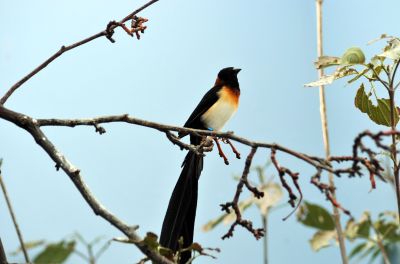
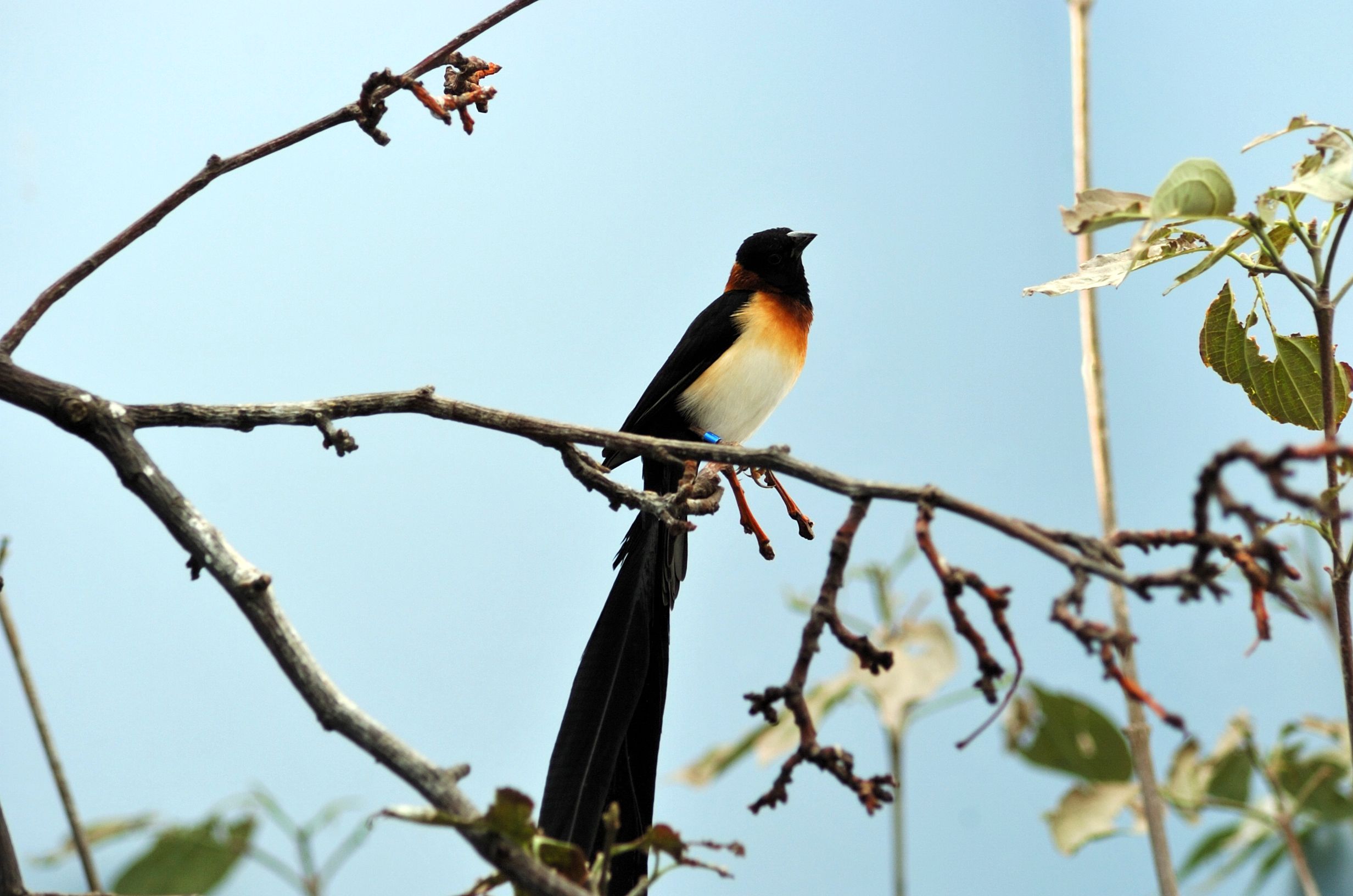
Long-tailed Paradise Whydah by Dan

Long-tailed Paradise Whydah by Dan

Not all brood parasites oust their nest mates.  Parents of the whydah family choose species that closely resemble them, such as waxbills.  Not only do the eggs match in coloration, but the chicks resemble their hosts as well.  They even have the same markings in their gaping mouths which signal hunger to an observing adult.  Whylahs blend in with their adopted families instead of destroying them.”

[Quoting from Sharon A. Cohen, BIRD NESTS (Harper Collins, 1993), page 110.]

So cowbird “parenting” is a short-lived experience, somewhat like clandestinely depositing a newborn on the front steps of an orphanage, trusting that the baby will be nurtured (successfully) by others.  But is this surreptitious forced-fostering habit a guarantee of avian reproductive success, at the populational level?

“At first, you may wonder why more birds are not parasites—after all, parasites don’t need to build a nest [for raising their babies], and once they have laid eggs there is no more to it [i.e., to parenting responsibilities on a daily basis]; but there are hidden costs [and risks] to being a [brood] parasite, mainly that the [child-abandoning] bird gives up control over its eggs and young.

Female cowbirds lay an average of forty eggs per year, but only two or three [on average] mature to adulthood.”

[Quoting from Donald Stokes & Lillian Stokes, A GUIDE TO BIRD BEHAVIOR, VOLUME II (Little Brown & Company, 1983), page 213.]

So what does this have to do with avian parents teaching “passwords” to their natural progeny? 

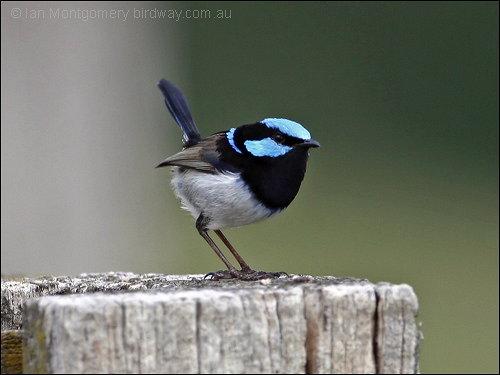
Superb Fairy-wren (Malurus cyaneus) by Ian

Male Superb Fairywren (Malurus cyaneus) by Ian

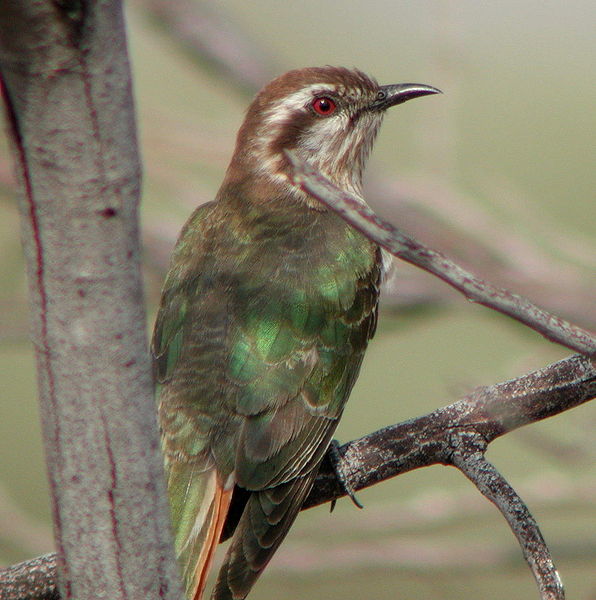
Consider this amazing news about the Superb Fairywren (Malurus cyaneus) of Australia, which is forced to react to the “child-abandonment” brood parasitism habits of the Horsfield’s Bronze Cuckoo. (Chrysococcyx basalis).

Horsfield's Bronze Cuckoo (Chrysococcyx basalis) by Tom Tarrant

Male Horsfield’s Bronze Cuckoo (Chrysococcyx basalis) by Tom Tarrant

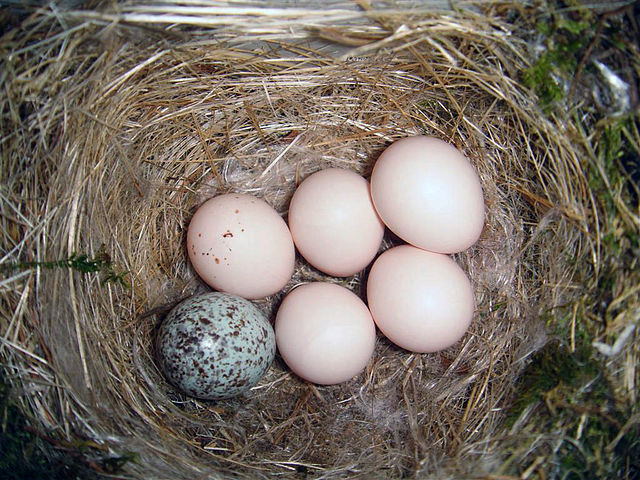
The Horsfield’s Bronze Cuckoo deposits its somewhat elongated pink-white egg, with rust-colored spots, into the nest of a fairywren.  The rust-speckled egg looks like a fairywren egg, confusing the fairywren nest owners of its true biogenetic identity.  (This is an avian version of family “identity fraud!)  The fairywren’s upside-down-dome-shaped nest is often dark inside, so visual confusion about which eggs really belong there is common – hence Horsfield’s bronze cuckoos often get by with their “changeling” deceptions, recruiting fairywren parents into fostering cuckoo eggs that hatch into cuckoo nestlings.

After a dozen days of incubation, in a fairywren nest, a bronze cuckoo chick hatches – 2 days before the hatching of fairywren eggs.  The “older” nestling often ejects the fairywren eggs from the nest, displacing the rightful “heirs”.  (What kind of “refugee gratitude” is that?!)

What can fairywrens do about this parasitic (and quasi-predatory) menace?

Is there a way to avoid the involuntary “home invasion” of such Trojan horses?

Yes, there are a few defensive habits that help to protect the fairywren from such home hijackings, including:

(1) nesting in fairywren colonies – so that teamwork is employed to drive off trespassing cuckoos when cuckoos fly near the fairywrens’ nesting colony;

(2) females attend their nests with vigilance, usually, limiting the opportunities that stealthy cuckoos have to access unattended fairywren nests;

(3) when female fairywren recognize a “changeling” in the nest, prior to laying any fairywren eggs therein, the fairywren female may abandon that (cuckoo) egg and build herself a new nest elsewhere;

(4) female fairywrens “teach” their eggs vocal “passwords” to use, to prompt being fed by their mother.  It is this last habit that demonstrates communication from (fairywren) mother to child, before the chick is hatched from its egg!

A few years ago, Diane Colombelli-Négrel, Sonia Kleindorfer, and colleagues from Flinders University in Australia discovered a remarkable way one bird fights back against brood parasites. Female superb fairywrens teach their embryos a “password” while they’re still in their eggs. Each female’s incubation call contains a unique acoustic element. After they hatch, fairywren chicks incorporate this unique element into their begging calls to ask for food. Colombelli-Négrel, Kleindorfer, and colleagues showed that chicks whose begging calls most resembled their mothers’ incubation calls received more food. But the brood parasites of the fairywren, Horsfield’s bronze-cuckoos, produced begging calls that did not so closely resemble the parental password.

[Quoting  Mary Bates, “To Beat a Parasite, Birds Teach their Young a Secret Password”, posted at http://www.wired.com/2014/06/to-beat-a-parasite-birds-teach-their-young-a-secret-password/ , accessed 11-23-AD2015.]

If fairywrens observe cuckoos in the neighborhood they become more diligent in their efforts to teach the “please-feed-me” passwords to their unhatched progeny, increasing the likelihood that the babies will successfully beg for food (using the vocal “password”) when they soon become hatchling chicks.

In a new study, Colombelli-Négrel, Kleindorfer, and colleagues again looked at the relationship between superb fairywrens and Horsfield’s bronze-cuckoos to see if a greater threat of brood parasitism would cause the fairywren to up its teaching efforts.

First, the researchers recorded calls from 17 fairywren nests in South Australia. They found the similarity between the mother’s password and the chick’s begging call was predicted by the number of incubation calls produced by the mother: If females made many incubation calls, their chicks ended up producing more similar begging calls.

Next, the researchers conducted a playback experiment at 29 nests. They broadcast either the song of Horsfield’s bronze-cuckoo or a neutral bird. After the cuckoo calls, but not after the neutral bird calls, female fairywrens made more incubation calls to their embryos. In other words, female fairywrens that heard a cuckoo near their nest increased their efforts to teach their password to their embryos.  Colombelli-Négrel and Kleindorfer say their results provide a mechanism for how fairywrens could get better at decision-making and lower the probability of committing an acceptance error for a cuckoo chick or a rejection error for one of their own chicks.  ‘When there are cuckoos in the area, you should call more to your eggs so that they have a higher call similarity after hatching and you can decide if the offspring is yours,’ Colombelli-Négrel and Kleindorfer wrote in an email. ‘We show a mechanism that starts in the nest and involves active teaching and sensorimotor learning in embryos.’”  [again quoting Mary Bates, supra]

This is truly amazing!  Anyone who is not amazed at how God programmed parenting skills into Superb Fairywrens is blind to the facts.

Also, by analogy, there may be a lesson for humans:  be careful about vulnerabilities to intrusive “foster children” that are “accepted” without informed consent  —  your own legitimate children may be put unfairly at risk.

Meanwhile, just as fairywrens teach “passwords” to their children, so should we humans.  But it is much more than “please feed me!” that we must teach our children, and our children’s children.

The vital “words of life” that we must teach, repeatedly, as the words of God, the Scriptures without which there is no real life, because mankind cannot live by physical bread alone, but by every Scriptural saying – every word that proceeds from God (Matthew 4:4).

We will not hide them [“them” refers to God’s prophetic words – see verses 1-3] from their children, shewing to the generation to come the praises of the Lord, and His strength, and his wonderful works that He hath done.  For He established a testimony in Jacob, and appointed a law in Israel, which He commanded our [fore]fathers, that they should make them known to their children,  that the generation to come might know them, even the children which should be born [יִוָּלֵ֑דוּ — niphâl imperfect form of the verb yâlad], who should arise and declare [וִֽיסַפְּר֥וּ — piêl imperfect form of the verb sâphar] them to their children, that they might set their hope in God, and not forget the works of God, but keep His commandments, and [that they] might not be as their [fore]fathers, a stubborn and rebellious generation, a generation that set not their heart aright, and whose spirit was not steadfast with God.   Psalm 78:4-8

<> JJSJ

*

Orni-Theology

Maluridae – Australasian Wrens

James J. S. Johnson’s Articles

*

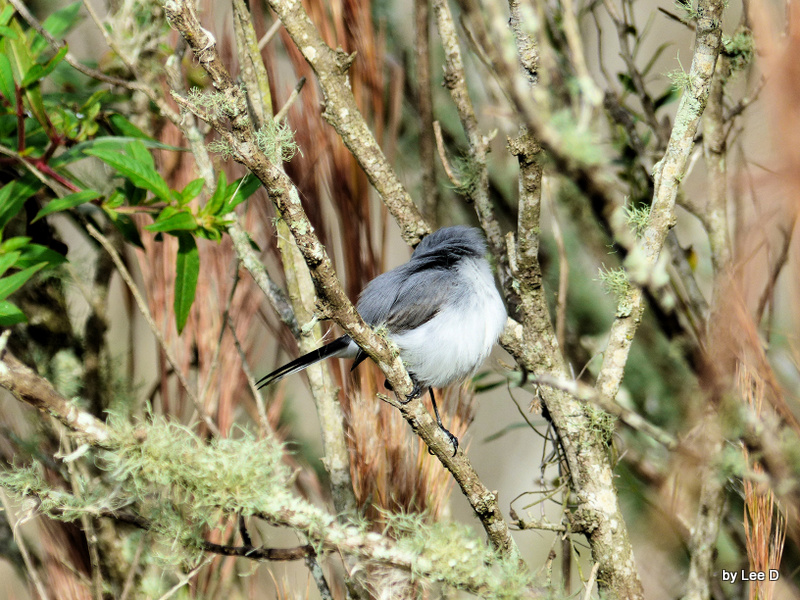
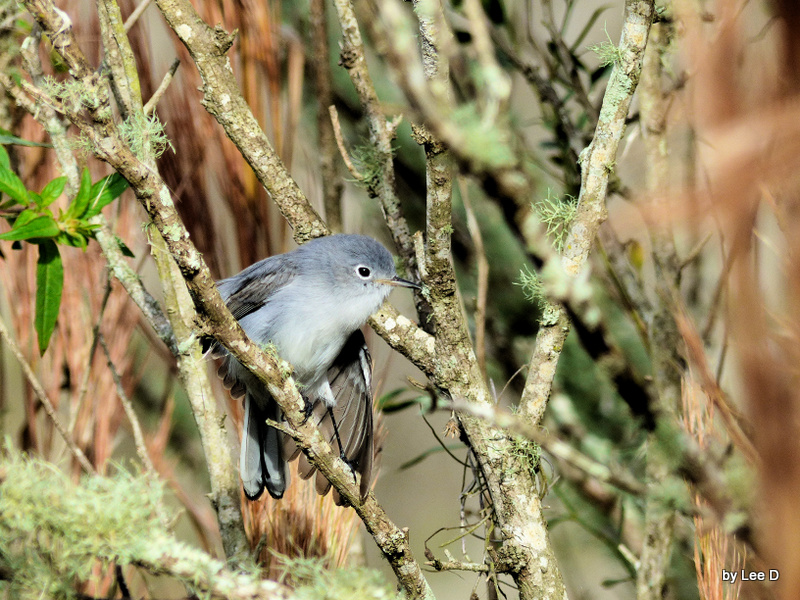
Lord’s Avian Wonders – Gnatcatcher Preening

Blue-gray Gnatcatcher preening at Circle B by Lee

Blue-grey Gnatcatcher preening at Circle B by Lee

“Be dressed in readiness, and keep your lamps lit. (Luke 12:35 NASB)

A visit to Circle B Bar Reserve last week provide a great opportunity to watch a Blue-grey Gnatcatcher (Polioptila caerulea) preening. Normally, they are flitting from here to there and never stay put long enough to catch a photo, let along some video.

To preen: personal grooming of a bird’s feathers especially by using its beak. Nice article at About Birding – What is Preening.

They are a very small songbird, 10–13 cm (3.9–5.1 in) in length and weighing only 5–7 g (0.18–0.25 oz). Adult males are blue-grey on the upperparts with white underparts, have a slender dark bill, and a long black tail edged in white. Females are less blue. Both sexes have a white eye ring.

The blue-grey gnatcatcher’s breeding habitat includes open deciduous woods and shrublands in southern Ontario, the eastern and southwestern United States, and Mexico. Though gnatcatcher species are common and increasing in number while expanding to the northeast,[4] it is the only one to breed in Eastern North America. They build a cone-like nest on a horizontal tree branch. The incubation period is 13 days for both sexes. Both parents construct the nest and feed the young; they may raise two broods in a season.

These birds migrate to the southern United States, Mexico, northern Central America – (Belize, Guatemala, and Honduras), Cuba, Bahamas, Turks and Caicos Islands, and the Cayman Islands. Yeah! They come to Circle B in the winter!

Blue-gray Gnatcatcher preening at Circle B by Lee

Blue-grey Gnatcatcher preening at Circle B by Lee

They forage actively in trees or shrubs, mainly eating insects, insect eggs and spiders. They may hover over foliage (gleaning), or fly to catch insects in flight (hawking). The tail is often held upright while defending territory or searching for food.

The songs (and calls) are often heard on breeding grounds, (usually away from nest) and occasionally heard other times of the year. Calls: “zkreee, zkreee, zkreee”, Songs: “szpree zpree spreeeeey spree spre sprzrreeeee”

Your adornment must not be merely external–braiding the hair, and wearing gold jewelry, or putting on dresses; but let it be the hidden person of the heart, with the imperishable quality of a gentle and quiet spirit, which is precious in the sight of God. (1 Peter 3:3-4 NASB)

Birdwatching Trips 

Circle B Bar Reserve, FL

Wordless Birds – with Hummingbirds

*

Sunday Inspiration – Chats and Old World Flycatchers II

Rufous-bellied Niltava (Niltava sundara) by Nikhil Devasar

Rufous-bellied Niltava (Niltava sundara) by Nikhil Devasar

Out of the ground the LORD God formed every beast of the field and every bird of the sky, and brought them to the man to see what he would call them; and whatever the man called a living creature, that was its name. (Genesis 2:19 NASB)

Last week’s Sunday Inspiration – Chats and Old World Flycatchers covered the first part of the Muscicapidae Family. This week, we will show the some more of the Family. There are 321 Members that make up the Muscicapidae Family. What great looking birds from their Creator.

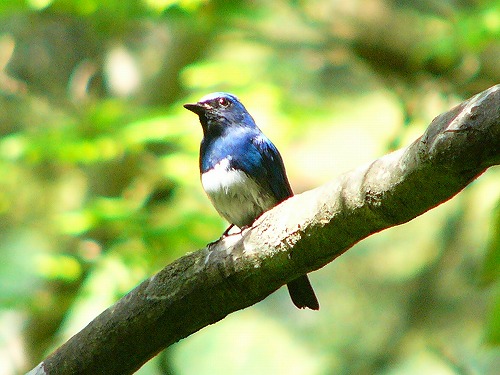
Blue-and-white Flycatcher (Cyanoptila cyanomelana) ©WikiC

Blue-and-white Flycatcher (Cyanoptila cyanomelana) ©WikiC

Chats (formerly sometimes known as “chat-thrushes”) are a group of small Old World insectivorous birds formerly classified as members of the thrush family Turdidae, but now are considered Old World flycatchers. The name is normally applied to the more robust ground-feeding flycatchers found in Europe and Asia and most northern species are strong migrants.

The Old World flycatchers, the Muscicapidae, are small passerine birds mostly restricted to the Old World (Europe, Africa and Asia). These are mainly small arboreal insectivores, many of which, as the name implies, take their prey on the wing.

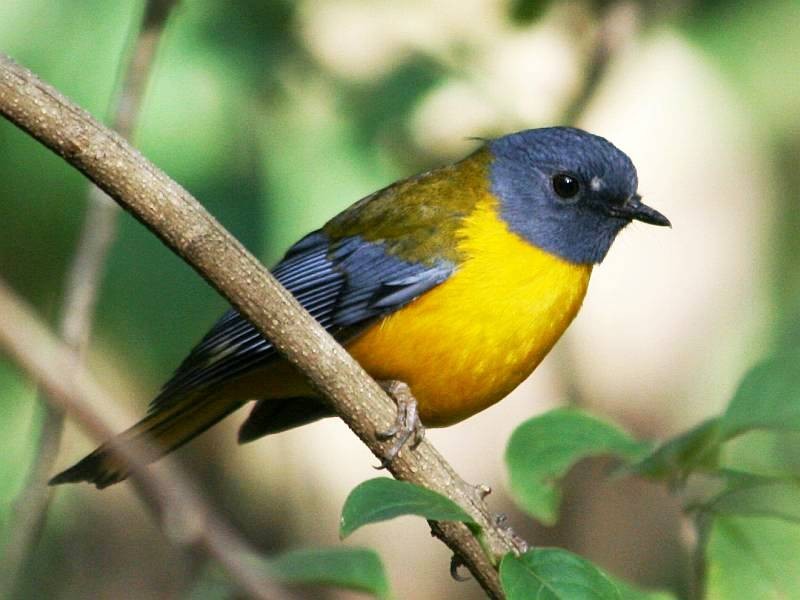
White-starred Robin (Pogonocichla stellata) WikiC

White-starred Robin (Pogonocichla stellata) ©WikiC

The appearance of these birds is very varied, but they mostly have weak songs and harsh calls. They are small to medium birds, ranging from 9 to 22 cm in length. Many species are dull brown in colour, but the plumage of some can be much brighter, especially in the males. Most have broad, flattened bills suited to catching insects in flight, although the few ground-foraging species typically have finer bills.

Old World flycatchers live in almost every environment with a suitable supply of trees, from dense forest to open scrub, and even the montane woodland of the Himalayas. The more northerly species migrate south in winter, ensuring a continuous diet of insects.

Depending on the species, their nests are either well-constructed cups placed in a tree or cliff ledge, or simply lining in a pre-existing tree hole. The hole-nesting species tend to lay larger clutches, with an average of eight eggs, rather than just two to five.

White-browed Robin-Chat (Cossypha heuglini) by Daves BirdingPix

White-browed Robin-Chat (Cossypha heuglini) by Daves BirdingPix

Because this Muscicapidae family is so large, this week’s Sunday Inspiration and last week’s were divided. The reason for this is so the slideshow will not be too long. This divides them in taxonomic order in to several groups. I was going to divide this family in half, but there are so many photos available that I would have to find a symphony to provide enough music to show them all at once. ☺♪♫☺

Last week, the first 97-98 members were shown from these genera: Alethe, Cercotrichas, Copsychus, Fraseria, Myioparus, Melaenornis, Empidornis, Muscicapa, Anthipes, Cyornis.

This Slideshow of Muscicapidae in taxonomic order – Second Part (includes the genera- Niltava, Cyanoptila, Eumyias, Erithacus, Pseudalethe, Cossyphicula, Cossypha, Swynnertonia, Pogonocichla, Stiphrornis, Sheppardia, Cichladusa, Heinrichia, Leonardina, Heteroxenicus, Brachypteryx , Vauriella, Larvivora, Luscinia, Irania and Calliope.) 75 Species

Start with Niltava 

This slideshow requires JavaScript.

Let this mind be in you which was also in Christ Jesus, who, being in the form of God, did not consider it robbery to be equal with God, but made Himself of no reputation, taking the form of a bondservant, and coming in the likeness of men. And being found in appearance as a man, He humbled Himself and became obedient to the point of death, even the death of the cross. Therefore God also has highly exalted Him and given Him the name which is above every name, that at the name of Jesus every knee should bow, of those in heaven, and of those on earth, and of those under the earth, and that every tongue should confess that Jesus Christ is Lord, to the glory of God the Father. (Philippians 2:5-11 NKJV)

“The Birthday of a King” ~ by Dr. Richard Gregory, now in Glory.

*

Sunday Inspiration – Chats and Old World Flycatchers I

More Sunday Inspirations

Muscicapidae – Chats and Old World Flycatchers

Faith Baptist Church

Gospel Presentation

*

Good One – An Email

Peek-a-boo ©Flickr Kathy

Peek-a-boo ©Flickr Kathy

GOOD ONE
We were the only family with children in the restaurant. I sat Erik in a high chair and noticed everyone was quietly sitting and talking. Suddenly, Erik squealed with glee and said, ‘Hi.’ He pounded his fat baby hands on the high chair tray. His eyes were crinkled in laughter and his mouth was bared in a toothless grin, as he wriggled and giggled with merriment.
I looked around and saw the source of his merriment. It was a man whose pants were baggy with a zipper at half-mast and his toes poked out of would-be shoes. His shirt was dirty and his hair was uncombed and unwashed. His whiskers were too short to be called a beard and his nose was so varicose it looked like a road map.
We were too far from him to smell, but I was sure he smelled.. His hands waved and flapped on loose wrists.. ‘Hi there, baby; hi there, big boy. I see ya, buster,’ the man said to Erik.
My husband and I exchanged looks, ‘What do we do?’
Erik continued to laugh and answer, ‘Hi.’
Everyone in the restaurant noticed and looked at us and then at the man. The old geezer was creating a nuisance with my beautiful baby. Our meal came and the man began shouting from across the room, ‘Do ya patty cake? Do you know peek-a-boo? Hey, look, he knows peek- a-boo.’
Nobody thought the old man was cute. He was obviously drunk. My husband and I were embarrassed. We ate in silence; all except for Erik, who was running through his repertoire for the admiring skid-row bum, who in turn, reciprocated with his cute comments.
We finally got through the meal and headed for the door. My husband went to pay the check and told me to meet him in the parking lot. The old man sat poised between me and the door. ‘Lord, just let me out of here before he speaks to me or Erik,’ I prayed. As I drew closer to the man, I turned my back trying to sidestep him and avoid any air he might be breathing. As I did, Erik leaned over my arm, reaching with both arms in a baby’s ‘pick-me-up’ position. Before I could stop him, Erik had propelled himself from my arms to the man.
Suddenly a very old smelly man and a very young baby consummated their love and kinship. Erik in an act of total trust, love, and submission laid his tiny head upon the man’s ragged shoulder. The man’s eyes closed, and I saw tears hover beneath his lashes. His aged hands full of grime, pain, and hard labor, cradled my baby’s bottom and stroked his back. No two beings have ever loved so deeply for so short a time.
I stood awestruck. The old man rocked and cradled Erik in his arms and his eyes opened and set squarely on mine. He said in a firm commanding voice, ‘You take care of this baby.’
Somehow I managed, ‘I will,’ from a throat that contained a stone.
He pried Erik from his chest, lovingly and longingly, as though he were in pain. I received my baby, and the man said, ‘God bless you, ma’am, you’ve given me my Christmas gift.’
I said nothing more than a muttered thanks. With Erik in my arms, I ran for the car. My husband was wondering why I was crying and holding Erik so tightly, and why I was saying, ‘My God, my God, forgive me.’
I had just witnessed Christ’s love shown through the innocence of a tiny child who saw no sin, who made no judgment; a child who saw a soul, and a mother who saw a suit of clothes. I was a Christian who was blind, holding a child who was not.. I felt it was God asking, ‘Are you willing to share your son for a moment?’ when He shared His for all eternity. How did God feel when he put his baby in our arms 2000 years ago.
The ragged old man, unwittingly, had reminded me, ‘To enter the Kingdom of God , we must become as little children.’
If this has blessed you, please bless others by sending it on. Sometimes, it takes a child to remind us of what is really important. We must always remember who we are, where we came from and, most importantly, how we feel about others. The clothes on your back or the car that you drive or the house that you live in does not define you at all; it is how you treat your fellow man that identifies who you are.
This one is a keeper.
‘It is better to be liked for the true you, than to be loved for who people think you are……'(Amen! )
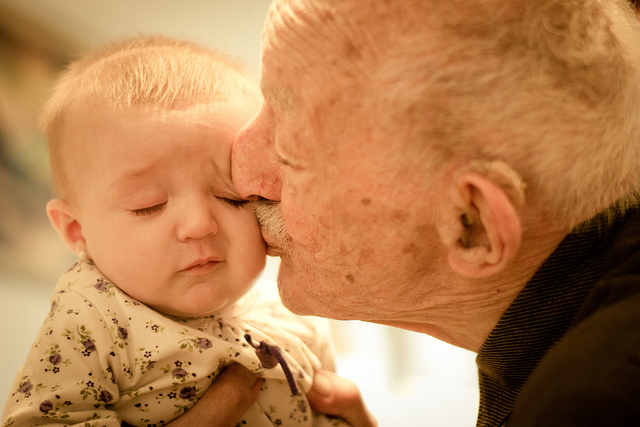
Old man and baby ©Flickr Gustavo Devito

Old man and baby ©Flickr Gustavo Devito

(Author Unknown)
*

Birds in Christmas Hymns – Review

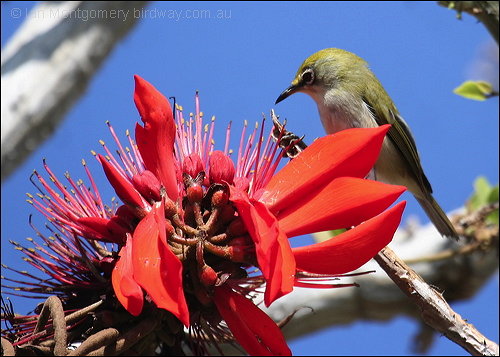
Christmas Island White-eye (Zosterops natalis) by Ian

Christmas Island White-eye (Zosterops natalis) by Ian

Birds in Christmas Hymns

Birds in Christmas Hymns

And when they had sung an hymn, they went out… (Mark 14:26a KJV)

Here are the Birds in Christmas Hymns from the Birds in Hymns Page. Many writers of these hymns must have enjoyed our beautiful created birds and included them in these Christmas Hymns.

Carol of Birds (Bird, Nightingale, Sparrow, Finch, Partridge, Nest), (Australian Birds)
Christmas Brings Joy To Every Heart – (Birds, Perch, Sparrow, Dove)
Hail to the Lord’s Anointed (Eagle, Dove, Wing, Pinion)
I Wonder As I Wander (Bird)
Joyful, Joyful, We Adore Thee – (Singing bird)
The Day The Christ-Child’s Tender Eyes – (Birds, Feather)
The Friendly Beasts – (Dove)
The Worcester Christmas Carol – (Bird)
This Endris Night – (Bird)
Thou Didst Leave Thy Throne –  (Bird, Nest)
Welcome To Christmas – (Dove, Wing)

*

O Holy Night – Card

That which was from the beginning, which we have heard, which we have seen with our eyes, which we have looked upon, and our hands have handled, of the Word of life; (1 John 1:1 KJV)

Please Click Here To See The Card

Here is the video they used with it:

*

A friend sent this to me and I trust you also are as moved by it as I am. Tears are still flowing as I type this.

Yes, I know the Wise Men showed up later, but enjoy the video.

Sunday Inspiration – Chats and Old World Flycatchers I

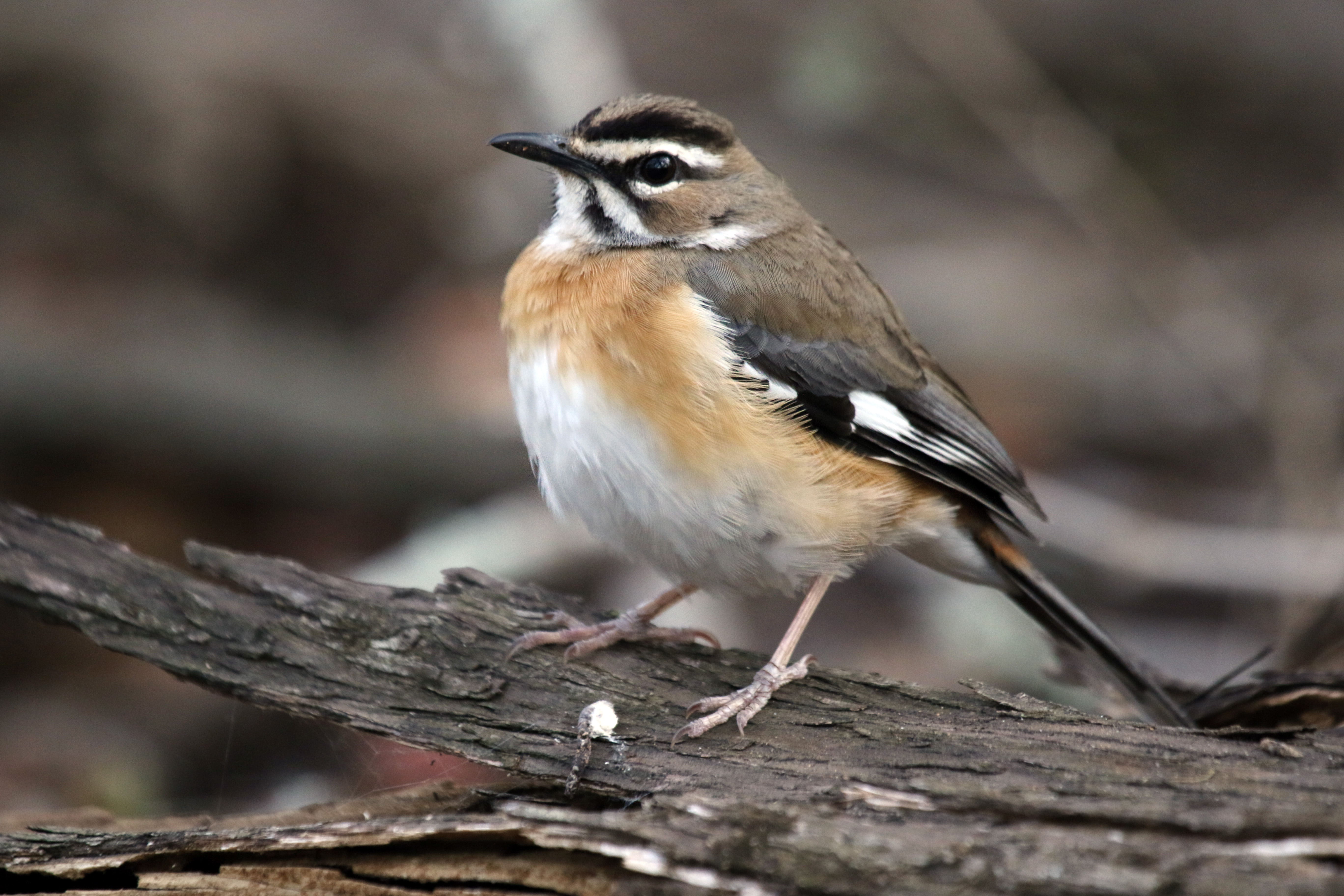
Bearded Scrub Robin (Cercotrichas quadrivirgata) ©WikiC

Bearded Scrub Robin (Cercotrichas quadrivirgata) ©WikiC

In all labor there is profit, But idle chatter leads only to poverty. (Proverbs 14:23 NKJV)

The Old World flycatchers are a large family (321 Members), the Muscicapidae, of small passerine birds mostly restricted to the Old World (Europe, Africa and Asia). These are mainly small arboreal insectivores, many of which, as the name implies, take their prey on the wing.

The appearance of these birds is very varied, but they mostly have weak songs and harsh calls. They are small to medium birds, ranging from 9 to 22 cm in length. Many species are dull brown in color, but the plumage of some can be much brighter, especially in the males. Most have broad, flattened bills suited to catching insects in flight, although the few ground-foraging species typically have finer bills.

Old World flycatchers live in almost every environment with a suitable supply of trees, from dense forest to open scrub, and even the montane woodland of the Himalayas. The more northerly species migrate south in winter, ensuring a continuous diet of insects.
Depending on the species, their nests are either well-constructed cups placed in a tree or cliff ledge, or simply lining in a pre-existing tree hole. The hole-nesting species tend to lay larger clutches, with an average of eight eggs, rather than just two to five.

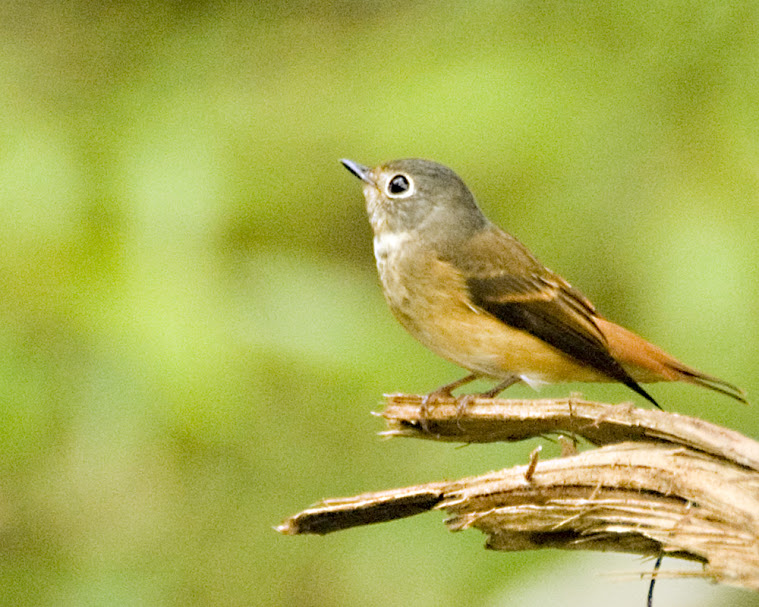
Ferruginous Flycatcher (Muscicapa ferruginea) by MAMuin

Ferruginous Flycatcher (Muscicapa ferruginea) by MAMuin

“For the wisdom of this world is foolishness with God. For it is written, “HE CATCHES THE WISE IN THEIR OWN CRAFTINESS”; (1 Corinthians 3:19 NKJV)

Because this Muscicapidae family is so large, this Sunday Inspiration and next week’s will be divided. The reason for this is so the slideshow is not too long. This will divide them in taxonomic order about half way.

Slideshow of Muscicapidae in taxonomic order – First Half

This slideshow requires JavaScript.

Now when Jesus was born in Bethlehem of Judaea in the days of Herod the king, behold, there came wise men from the east to Jerusalem, Saying, Where is he that is born King of the Jews? for we have seen his star in the east, and are come to worship him. (Matthew 2:1-2 KJV)

“Wise Men Still Seek Him” – Trio and Choir

*

“Heaven’s Announcement” – message by Pastor Osborne last Sunday. About the birth of Christ.

Shepherd ©Flickr

Shepherd ©Flickr

More Sunday Inspirations

Muscicapidae – Chats and Old World Flycatchers

Faith Baptist Church

*


Lord’s Avian Wonders – A Christmas Turkey?
“The works of the LORD are great, Studied by all who have pleasure in them.” (Psalms 111:2 NKJV)

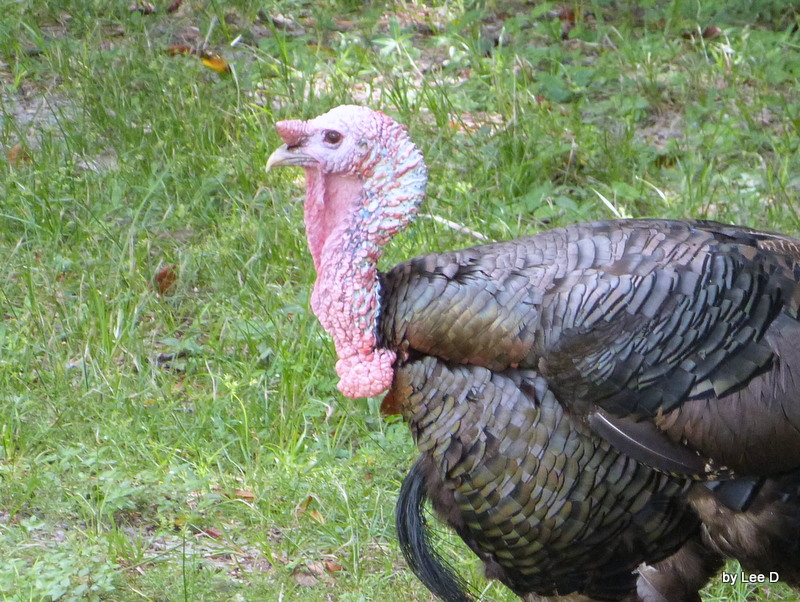
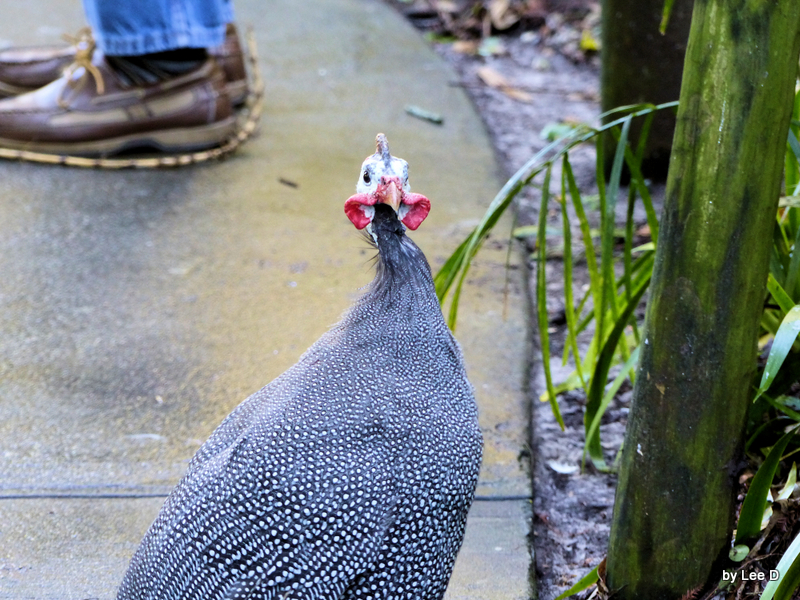
While updating our passes at Lowry Park Zoo last week, I found this startled “Turkey” insisting that he was not a “Turkey”

Non-Turkey at Lowry Park Zoo cropped

Startled Non-Turkey at Lowry Park Zoo (cropped)

To me, he had wattles like a turkey!

Well, maybe it’s not a turkey after all. It is actually is a Guineafowl. Plus, they are not even in the same family.

Guinefowl at Lowry Park Zoo

Helmeted Guineafowl (Numida meleagris) at Lowry Park Zoo

Turkeys have to keep a low profile during the Christmas season as you have learned from several of Emma’s stories about the Commander Turkey. 

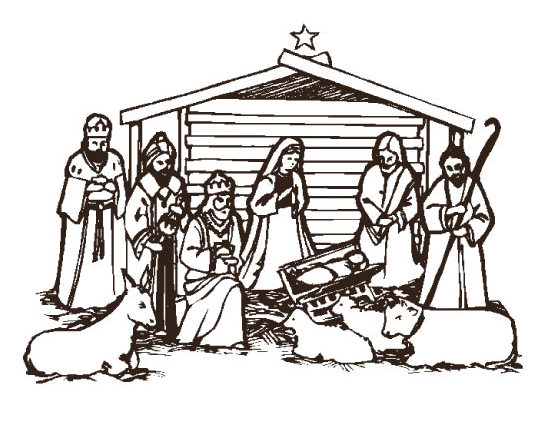
“Now the birth of Jesus Christ was as follows: After His mother Mary was betrothed to Joseph, before they came together, she was found with child of the Holy Spirit.” (Matthew 1:18 NKJV)

Here are some of the decorations as you enter the zoo:

*

Guineafowl – Numididae

Pheasants and allies – Phasianidae

Lowry Park Zoo

Gospel Presentation

*