50 Stunning Hummingbird Pictures – B & B

Ruby-throated Hummingbird by Ray's Wildlife

Ruby-throated Hummingbird by Ray’s Wildlife

“So God created great sea creatures and every living thing that moves, with which the waters abounded, according to their kind, and every winged bird according to its kind. And God saw that it was good. And God blessed them, saying, “Be fruitful and multiply, and fill the waters in the seas, and let birds multiply on the earth.” So the evening and the morning were the fifth day.” (Genesis 1:21-23 NKJV)

You have got to check out this interesting article from Birds & Blooms!!

50 Stunning Hummingbird Pictures You Need To See

Still haven’t been doing much birdwatching lately, except through my back door. So, I trust you will enjoy these great photos. We have had some nice photos of hummingbirds here over the years, but these are all right together.

Ruby-topaz Hummingbird (Chrysolampis mosquitus) Male ©WikiC

Some of our previous Hummingbird articles:

Ten Beautiful Hummingbirds

Hummingbirds See Colors Over (Beyond) the Rainbow

How Much Are You Being Monitored? A Hummingbird Lesson

Hummingbird from John 10:10 Project

Tickle Me Tuesday – Hummingbirds

Peru’s Marvellous Hummingbird – Again

Creation Moments – Double Life of the Hummingbird

Hummingbirds in Ultra Slow Motion

Hummingbird Families – Firecrowns

Calliope Hummingbirds – North America’s Smallest

Wordless Birds – Hummingbirds

Ian’s Irregular Bird – Solitary Sandpiper

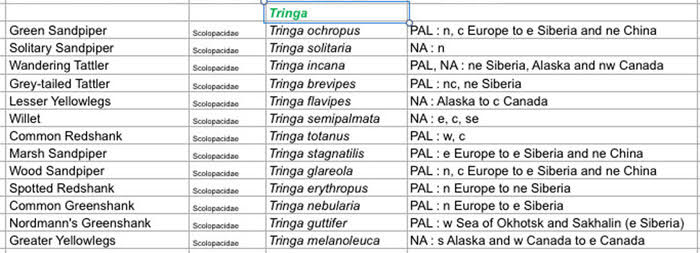
You may remember from the last Irregular Bird (Green Sandpiper) that the plan is to work through all the waders in the genus Tringa, the Shanks and relatives, in the order used by the IOC, below.  This is the next one the Solitary Sandpiper.

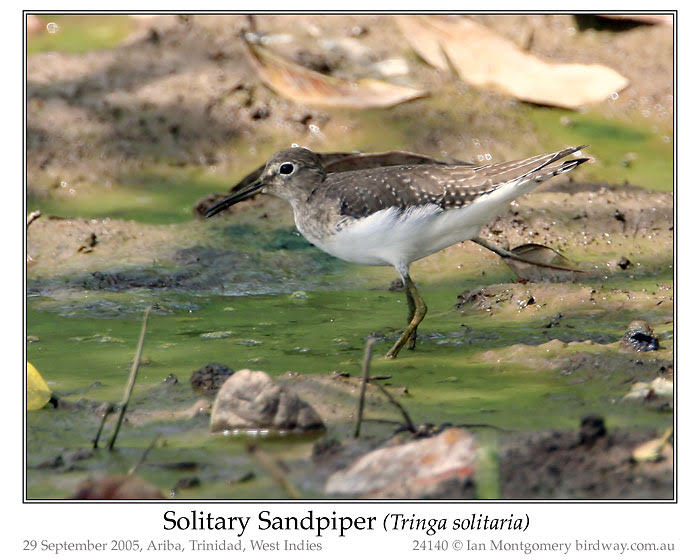
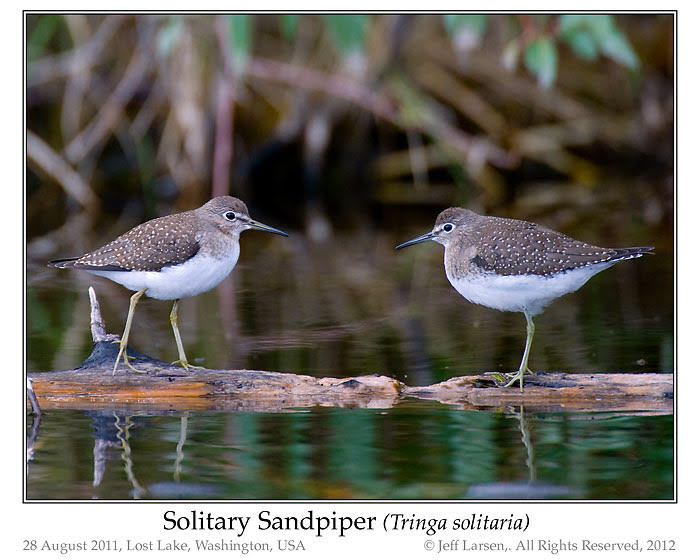
It’s fairly similar to the Green Sandpiper and they were originally treated as a single species. In fact, they are easy to distinguish in flight as the Green Sandpiper has a white rump and a tail with side to side barring, while the central feathers of the rump and tail of the Solitary Sandpiper are brown creating a longitudinal stripe. These features are visible under the flight feathers in the first photo and shown in a drawing later.
Solitary Sandpiper by Ian
In practice you can also use their ranges as the Green Sandpiper occurs in Eurasia and Africa, while the Solitary Sandpiper is an American species. It nesting range is almost entirely in Canada and Alaska.  It migrates through the United States and winters in Mexico, Central America, and in northern, central and eastern South America as far south as Peru in the west and northern Argentina in the east.
I haven’t got photos of either species in flight so here is a crude drawing to illustrate the difference in flight pattern. Don’t take too much notice of anything except the different rumps, tail and length of the legs. The latter are longer and protrude farther beyond the tail in the Solitary Sandpiper. So, if you’re a dedicated twitcher, as I am now, keep a beady eye out for something special if you are in a place where either or both of these birds don’t usually occur. There are a few records of Green Sandpipers in northern Australia and a few records of Solitary Sandpiper in Siberia and Western Europe.
Solitary Sandpiper by Ian
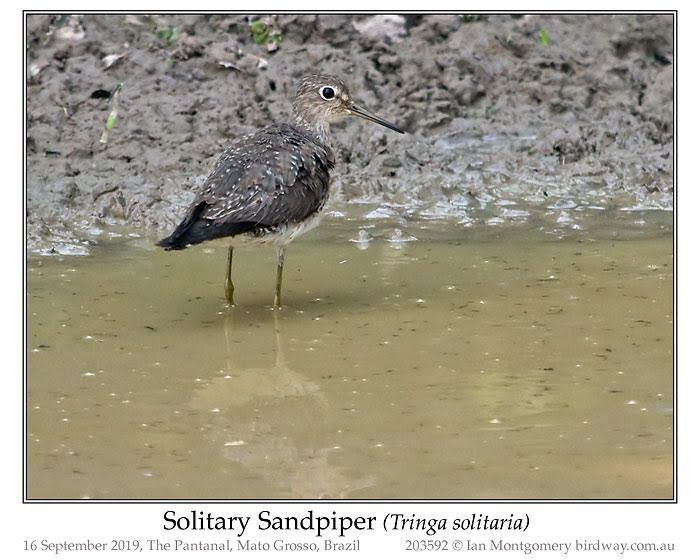
There isn’t much difference among the plumages of breeding adults, non-breeding adults, and juveniles though there is less streaking in juveniles and the spots on breeding adults are whiter, rather than buff and more conspicuous. I think the bird in the second photo in Trinidad is a juvenile, the one in the third photo in Brazil is an adult but I don’t know about the one in the first photo. If you’re an expert on the plumages of Solitary Sandpipers, I’d be happy to get your opinion: ianbirdway@gmail.com.
Solitary Sandpiper by Ian
Actually, I misidentified the two in Trinidad as Spotted Sandpipers in non-breeding plumage but maybe I had Spotted Sandpiper on the brain as I’d seen the one in the third photo in Tobago eleven days earlier. Non-breeding Spotted Sandpipers don’t have spots (go figure, as they say), just a little barring on the wings but they have conspicuous long white eyebrow stripes and shorter, much yellower legs, so I lack a reasonable excuse for the confusion.
Spotted Sandpiper by Ian
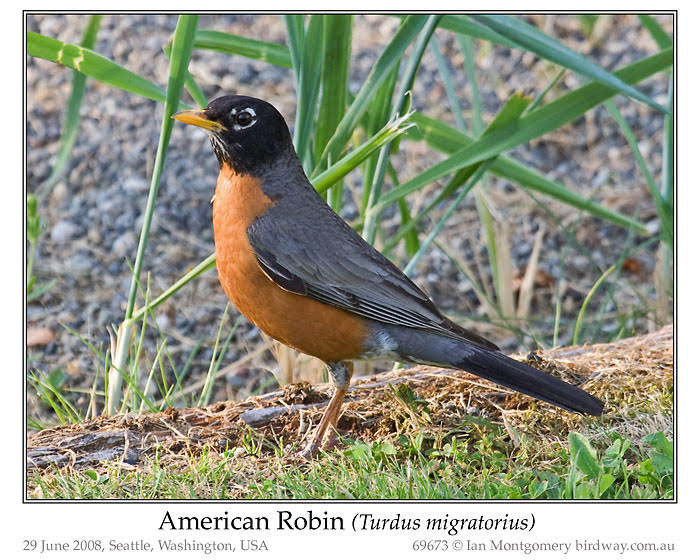
Like their Eurasian cousins, Solitary Sandpipers breed in trees and shrubs using the old nests of thrushes. It so happens that the range of perhaps the commonest thrush in North America, the American Robin, overlaps the range of the Solitary Sandpiper in Canada and Alaska. The Robin, despite its name which is based on colour not taxonomy, is a Thrush and a close relative of the Eurasian Blackbird and is the most likely candidate as a provider of nests, though not much is known about the breeding behaviour of the Sandpiper.
American Robin by Ian
So how does the Solitary Sandpiper get its name? Amazingly, unlike most waders which believe in safety in numbers, it migrates either alone or in small groups and often appear at stopovers or at the destination in ones or twos. It migrates mostly at night. I don’t know whether juvenile birds instinctively know where to go or whether the adults teach them. The mind boggles at what we don’t know about bird migration.
Jeff Larsen sent me this lovely photo of two birds together in Washington state, so they’re clearly not completely antisocial. He calls them Solitary Chickens, which appeals to me and he gave me permission to share this photo with you.
Solitary Sandpiper by Ian
Solitary Sandpipers are birds of freshwater and are usually found on small ponds or in marshy areas, even in winter. We spotted the one in Brazil in a roadside pond in the Pantanal.
Next time we’ll talk about the Tattlers, two rather similar species that are next on the IOC list.
Greetings
Ian


Google Groups “Birdway” group.
Write to him at ian@birdway.com.au, or visit this group at http://groups.google.com/group/Birdway


Lee’s Addition:

Here is the next Sandpiper in Ian’s “Tringa” series. He has promised more. Stay tuned.
He mentions the sameness of these birds:
“But thou art the same, and thy years shall have no end.” (Psalms 102:27 KJV)
See:

Ian’s Bird of the Week

Good News

Ian’s Irregular Bird – Green Sandpiper

The last irregular bird, Nordmann’s Greenshank, could have had a sub-heading of The Joys of Twitching. In it, I confessed to being a Twitcher at heart, discarding the respectable facade of “Wildlife Photographer”. Here follows the justifications, or at least illustrations of why it can be enjoyable. The background to this particular obsession/passion was the fact that, worldwide, there are thirteen species of Tringa sandpipers, or Shanks, characterised by different coloured legs. I had reasonable photos of all of them except the rarest, Nordmann’s Greenshank, since 2008 (when I photographed the second last one, the Willet of North America). That is, the seven-year itch twice over.
If you are, or ever were, a stamp collector, you would know the feeling. Suppose the following stamps are from a set of 13 stamps of Queen Victoria, including the first ever stamp, the Penny Black and imagine you have all of them except the rarest, the iconic Two Penny Blue, issued shortly after the first ever stamp, The Penny Black, in May 1840.
Imagine the thrill when you finally lay your hands on one, as I did in the 1960s. This one is a rather daggy example, but it is one from the original two plates issued until February 1841 and lacking white lines under “POSTAGE” and above “TWO PENCE”. The much commoner later series called ‘white lines added issue’ continued until 1858.  I’m still a kid at heart, and the subtlety of distinguishing different series of Two Penny Blues has a similar appeal to separating Common and Nordmann’s Greenshank.CHA-Scol victoria0730-01
Alternatively, maybe you were or are a card player. Suppose you’re playing a game in which you the best hand is an entire suit of cards, say a complete Straight Flush, as opposed to a mere Royal Straight Flush in Poker, but you lack the Queen.
At long last, after fourteen nail-biting years, you finally get the missing card. I’ve chosen the Queen as it’s number twelve (if you have the Ace as the first rather than the last in the suit) and Nordmann’s Greenshank is also the twelfth Tringa if you follow the IOC classification of birds. Continuing the metaphor, I’ve chosen Spades as the Queen of Spades is the most valuable card in the game Hearts. The metaphor fails if you go any further, because in Hearts, a vicious game which we loved as kids, the aim is not to win points and to force your opponents to get a high score, It’s Whist in reverse. Clearly, I also have a passion for Queens.

After that it’s just a question of whether you’re an introvert or an extrovert. An introvert gets a deep personal satisfaction from achieving a complete collection, an extrovert gets a sense  of triumph in beating the competition. Of course, you may be a bit of both: I’m mainly an introvert, but publishing all this stuff as the Irregular Bird, showing off obviously, is characteristic of extroverts.

So, back to Tringas. Waders (birdway) are fascinating birds, not least because many of them migrate extraordinary distances. As a consequence, they’re of special interest to twitchers when avian GPSs go awry and they end up in strange places. Many species, however, are hard to distinguish in non-breeding plumages, which is how we usually see them in temperate and tropical latitudes except just before the migration back to the breeding zones. Most, but not all, of the Shanks are fairly easy to identify because of their coloured legs; many of them having corresponding common names as you can see in the IOC table. Four of them, comprising the two Redshanks and the two Tattlers, have featured as Irregular Birds in the past, so I want to do a series on the remaining eight and I’ll do them in the IOC order shown in the table at the beginning of this article. The first is the Green Sandpiper.

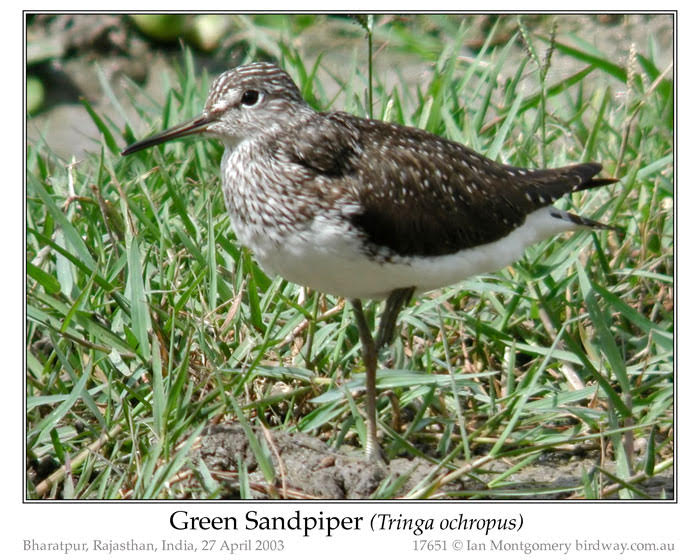
Green Sandpiper by Ian

The breeding range of the Green Sandpiper stretches right across northern Eurasian from Norway to Siberia and it winters mainly in tropical Africa, South and Southeast Asia, around the Mediterranean and, to a lesser extent in Western Europe. It’s mainly a bird of fresh water marshy areas even in the non-breeding zones. I’ve photographed it only once, in India in 2003, though I had seen it in England in the 1960s before I came to Australia.It’s even rarer in Australia than Nordmann’s Greenshank with only one confirmed record, near Darwin in 1998. There are a few unconfirmed records but care needs to be taken to distinguish it from the closely related Solitary Sandpiper of America and the Wood Sandpiper.
In fact, I mistakenly identified the Indian bird as a Wood Sandpiper, reasonably common in Australia and also a fresh water species, and posted it as such to the website, and only years later did the twitcher in me take a closer look and realise happily that it was actually a Green Sandpiper. Distinguishing features of the Green Sandpiper include larger size, bulkier appearance, short white eye-stripe ending at eye, longer bill, shorter, greenish legs, sharp gradation from streaked breast to white belly and, particularly in breeding plumage like this one, darker, greener rather than brown upper parts.

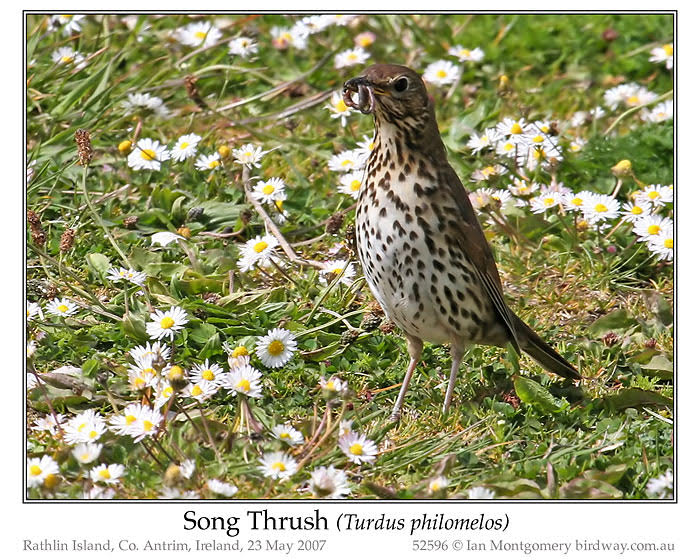
Green Sandpiper by IanI mentioned when discussing the unusual arboreal nest building habits of Nordmann’s Greenshank that the Green and Solitary Sandpipers also nest in trees, but use the old nests of thrushes.  Coincidentally the name Tringa comes from a description of a thrush-sized waterbird by Aristotle (“trungas”). He didn’t distinguish it further but later authors have suggested it was a sandpiper, a Wagtail Motacilla or a Dipper Cinclus. Thanks very much. While we’re at it, ochropus means pale-yellow footed, while the specific identifier of Normann’s Greenshank, guttifer, means spotted, which isn’t very illuminating either. Aristotle preceded the taxonomic and evolutionary ideas of Linnaeus and Darwin, and “thrush-like waterbird” is a reasonable description, except for the length of the legs. He was interested in biology, classified 500 species of animals in the work later known by philosophers as the Scala Naturae and would have been familiar with the Song Thrush, below, in Greece. The Scala Naturae was approved by the Christian Church (and probably all others) as it is hierarchical in form with man at the top, towering above all the lower species.

On the subject of passion and obsession, I’ve decided that the difference is mainly one of perception. A person might think they (in deference to gender fluidity) have a passion for another person and, if not reciprocated, the other party might regard it as an obsession. My cousin in Ireland suggests that obsessions have a negative effect, so maybe it’s more than just perception. Either way, I’ll continue the passion for Tringas next time with the closely related but geographically distinct (“allopatric”), thrush-nest-using, Solitary Sandpiper of America.
You can’t reply directly to these emails, so if you want to write to me, use my email address below. I’ve recently had occasional problems with receiving emails to ian@birdway.com.au, so ianbirdway@gmail.com is preferable.
Greetings,
Ian


Ian Montgomery,
454 Forestry Road, Bluewater, Qld 4818
Phone: 0411 602 737 +61-411 602 737
Preferred Email: ianbirdway@gmail.com

Recorder Society http://www.nqrs.org.au

Lee’s Addition:

Seems that Ian is getting active again with his birdwatching. He, like the rest of us, was quite for awhile during all these lockdowns. I have another of his articles coming soon. Stay tuned.
“As a bird that wandereth from her nest, so is a man that wandereth from his place.” (Proverbs 27:8 KJV)
See:

Ian’s Bird of the Week

Good News

Ian’s Irregular Bird – Nordmann’s Greenshank

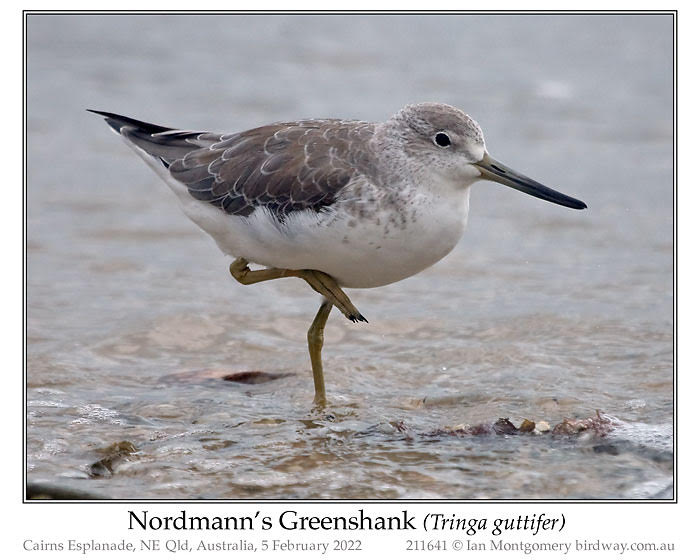
Because it’s so long since the last irregular bird, here is a special one of a very rare wader that has become something of a celebrity, perhaps the most photographed individual bird in Australian history. So you may already have superb photos of it, and I apologize in advance if you find this boring. Nordmann’s Greenshank is, sadly, one of the rarest waders in the world with a population of probably less than 2,000 individuals and a red book status of endangered as its population is declining.

Nordmann’s Greenshank (Tringa guttifer) by Ian

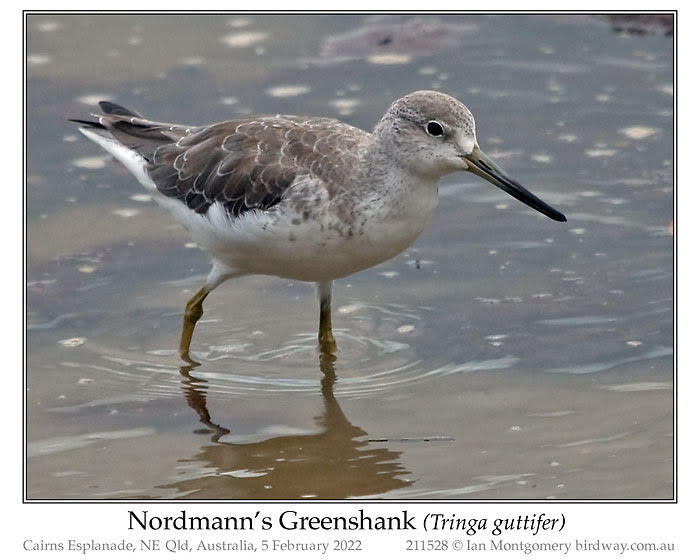
Its breeding range is along the coast of the Sea of Okhotsk in Siberia and is subject to disturbance from oil and gas extraction. It normally winters in southeast Asia and, very occasionally, birds end up in Australia. There are three records from wader counts along 80 Mile Beach near Broome in NW Western Australia, and this one. It first appeared in Cairns in the (northern) winter of 2021 and stayed around long enough for anyone able to navigate covid restrictions and see it. I couldn’t drive to Cairns then and resigned myself to the prospect of missing out on it. To everyone’s surprise, it reappeared this year and the scramble to see it started again.

Nordmann’s Greenshank (Tringa guttifer) by Ian

I drove the 340km/210 miles to Cairns at the end of January to catch up with some good friends of long standing from Victoria. They were on the hunt for it, in airline transit from a boat trip to Torres Strait islands to Iron Range National Park on Cape York. We spent four days checking every wader along the Cairns Esplanade at suitable and sometimes unsuitable tides without success. It definitely wasn’t there, but reappeared when they had gone to Cape York and I had returned to Townsville. I rejoined them in Cairns for two days, when it did its disappearing act again, only to reappear for them after I’d returned to Townsville for a meeting that, in hindsight, I deeply regretted attending. so I dropped everything again and returned to Cairns, determined to see and photograph it.
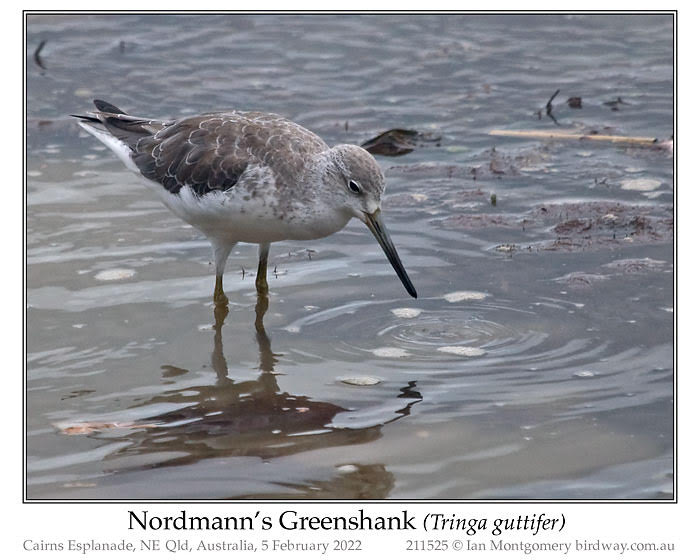
On the second morning of my third visit, the bird relented and I spent an exciting two hours as the incoming tide slowly coaxed it closer and closer. Ultimately, I ended up sitting a mere 6m/20ft from it on the sandy edge of the mudflat, second photo, having taken more than 400 photos. I’ll talk about obsession later. Then I rang Trish, the friend with whom I went to Brazil pre-Covid, who was flying from Brisbane to Townsville that afternoon and suggested she fly to Cairns instead. Which she did, changing her flight at the airport, and we got lovely views of it the following day. We also visited the wonderful Bill Cooper exhibition of tropical bird and fruit paintings at the Cairns Gallery.

Nordmann’s Greenshank (Tringa guttifer) by Ian

Trish suggested bringing our painter/birder friend Marjory and a botanist friend Chrissa to Cairns to see the bird and the exhibition before the latter finished on the 13 February. So we came up again at the weekend, this time in her larger, more comfortable car and saw both the exhibition and the bird yet again. What fun.

Nordmann’s Greenshank (Tringa guttifer) by Ian

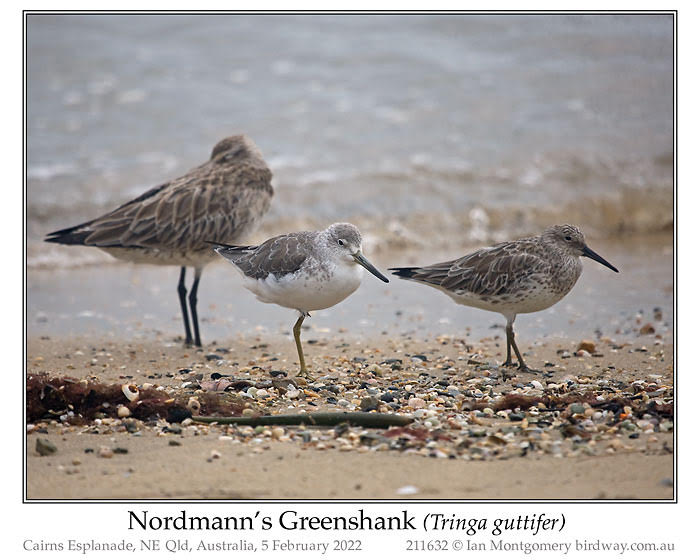
Time to mention the bird itself. It looks quite similar to the Common Greenshank and, slightly less so, to the Terek Sandpiper, both of which were present along the Esplanade. The first photo shows some of the diagnostic features: shorter, yellowish rather than greenish legs, the more robust bi-coloured bill (paler at the base) and shorter legs and bigger head (‘bull-headed’) which give it a rather stocky appearance. It’s behaviour when feeding is different too, and when one becomes accustomed to it, this is a good distinction at a distance, with poor light or muddy legs and bill. In the third and fourth photos it is feeding actively in shallow water, attempting to catch prey with a stabbing motion. It also uses its slightly upcurved bill to sieve the water surface by sweeping it back and forth, in a similar way to other waders with such bills such as the Terek Sandpiper and the Avocets. The fifth photo shows its size relative to a Bar-tailed Godwit, left, and a Great Knot, right.

Nordmann’s Greenshank (Tringa guttifer) by Ian

The second photo shows it standing on one leg, a pose it adopted often using one or the other leg, when resting or roosting (second and fifth photos) and when forced by the tide to move, it often hopped quite long distances to do so, sixth photo. In flight, last photo, the shorter legs protrude less beyond the tail than those of the Common Greenshank, it has less barring on the tail, whiter underwing coverts contrasting with dark flight feathers and it look stockier. Not much is known about its breeding habits, though it’s the only shorebird known to often build its own nest in trees. unlike its tree nesting relatives the Green and Solitary Sandpipers which use old nests of thrushes.

Nordmann’s Greenshank (Tringa guttifer) by Ian

This whole saga has revived my interest in bird photography, which rather flagged during Covid, when I took up other interests less dependent on mobility. It was also a time for personal honesty and admitting my twitching tendencies to myself rather than hiding behind the more dignified facade of a wildlife photographer. Next time, I’ll talk a bit more about the joy of twitching and explain why getting photos of this particular species was so important for me. I’m still pondering the difference between a passion and an obsession.
Greetings
Ian

Ian Montgomery,

454 Forestry Road, Bluewater, Qld 4818
Phone: 0411 602 737 +61-411 602 737
Preferred Email: ian@birdway.com.au

Recorder Society http://www.nqrs.org.au

Lee’s Addition:

Thanks, Ian. Like many of us, the Covid has slowed our birdwatching adventures. Glad you were able to finally catch up with neat Greenshank.
This Nordmann’s Greenshank is in the Scolopacidae Family of the Charadriformes Order.
More of Ian’s Articles:

Wordless Birds

Birds of the Bible – How Many Sparrows?

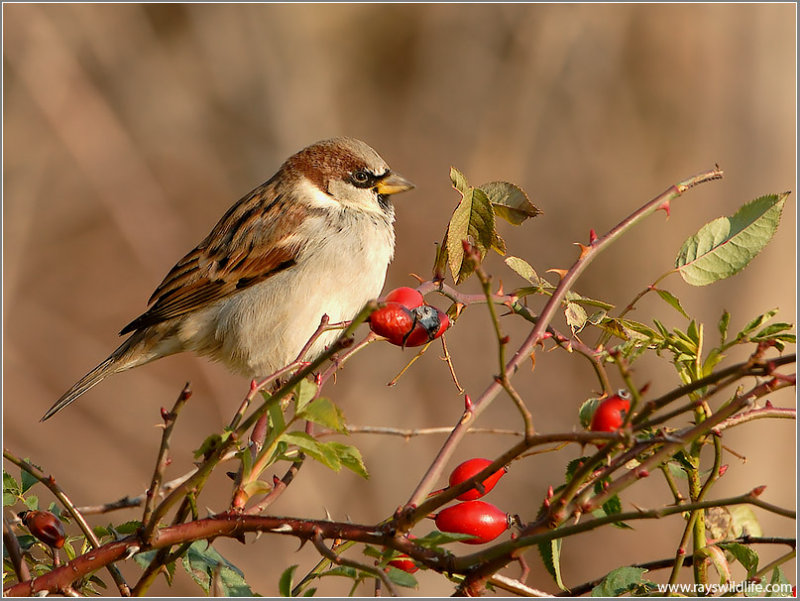
House Sparrow by Ray

While working on updating the indexes to the Birds of the Bible-Sparrows, I came across an interesting question. How many Sparrows are mentioned in the Bible? I discovered a previous search I had started from the Bible Gateway website.

The Young’s Literal Translation found 6 verses mentioning Sparrows.

Psalm 84:3 – “a sparrow

Hosea 11:11- “a sparrow

Matthew 10:29 – “two sparrows

Matthew 10:31 – “many sparrows

Luke 12:6 – “five sparrows

Luke 12:7 – “many sparrows

House Sparrows visiting National Aviary Parrot Show by Lee

House Sparrows visiting NA Parrot Show Outside by Lee

Okay, so what, you might ask? One, it challenges you to actually study what’s in the Word of God. It is also nice to see what the Bible actually says about the Sparrows and how that impacts us. Try using a website like e-sword.net or Biblegateway.com, and do a little investigation of these questions:

In Psalm 84:3, where was the sparrow and what was she doing?

Hosea 11:22, why was the sparrow trembling?

Matthew 10:29 and 31, what assurance can we get from that verse?

Luke 12:6, who remembers the sparrows?

Luke 12:7, what has been numbered? What about fear?

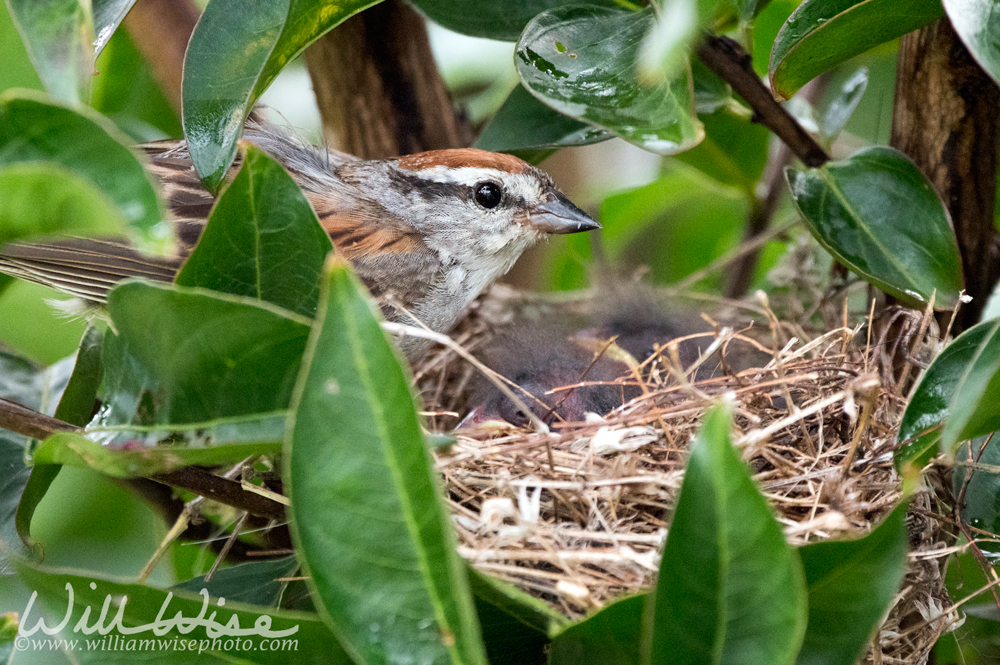
Female Chipping Sparrow bird feeding three baby Chipping Sparrow nestlings, Athens, Clarke County, GA. by William Wise

These are just some of the previous posts about these little Avian Wonders:

To find out more about Sparrows:
Birds of the Bible – Sparrow I
Birds of the Bible – Sparrow II
Birds of the Bible – More Value
Birds of the Bible – Little Brown Jobs
Birds of the Bible – Worry and Sparrows
Birds of the Bible – Lord Who Is There
Eye of the Beholder – House Sparrows
Sparrows Peterson’s Video
His Eye Is On The Sparrow (Birds in Hymns)
The Eyed Sparrow
Mighty God, While Angels Bless Thee (Birds in Hymns)
The Birds, the Economy, and My Provider – by April Lorier
Sparrows and God Care – by April Lorier
Ian’s Bird of the Week – Masked Finch
World Sparrow Days – by a j mithra
Worthen’s Sparrow – Lost, but found… – by a j mithra
White-crowned Sparrow – The Restorer – by a j mithra
Renewed Day by Day: Signs of Spring
Sparrow Quote from The Life Project ~ from Don Merritt
Sunday Inspiration – Old World Sparrows
Sunday Inspiration – Sparrows
Sunday Inspiration – Sparrows II
Emberizidae’s – Buntings
Emberizidae – Part II
Emberizidae Family Allies I
Emberizidae Family Allies II


Good News Tracts – Various Topics

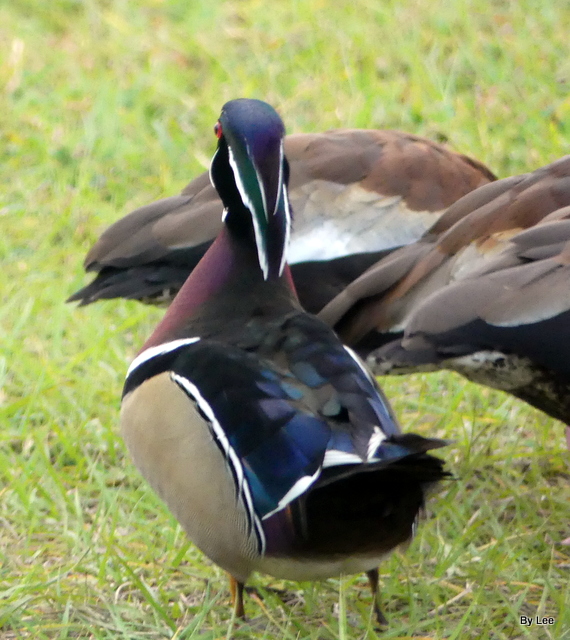
New Duck In The Yard

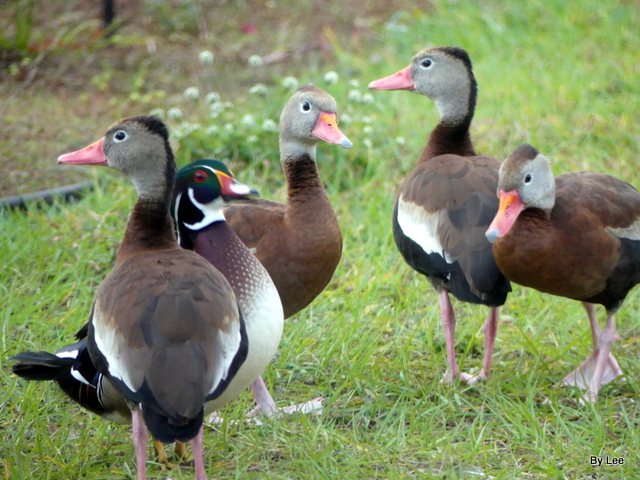
Wood Duck among Black-bellied Whistling Ducks by Lee

Yesterday we added a new bird to our backyard list. He tried to hide, but with a look like that, it’s hard to do. So finally, he came out of hiding. Some of those Whistling Ducks don’t seem to be too happy with him being there. [I was very happy! :) ]

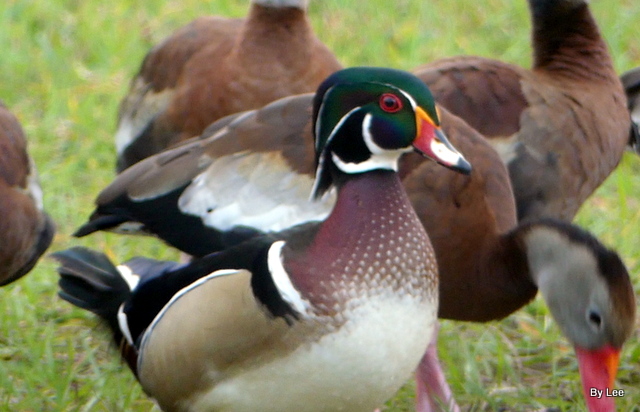
Wood Duck in our yard. 1-17-22

We’ve written about this beautiful bird before, but usually, we have seen them over in Lakeland on their lakes. So, this was a treat to be able to have him visit us.

When I see this duck, I think about how the Lord when he created these Avian Wonders must have had a delight in decorating this Wood Duck. What clear lines!

Wood Duck’s Crested Head and Back

I have to admit that the Duck had a bit of an attitude. While he was strutting around, ever so often he would throw his head like he was trying to flip that long “bonnet” of his. [my term] I tried to capture it on video, but I was only able to capture it once.

https://youtu.be/ugJdSeL5gNo&rel=0

Several verses came to mind about this encounter with our beautiful duck:

The first photo, where he was sort of hidden behind the others.

“Ye are the light of the world. A city that is set on an hill cannot be hid. Neither do men light a candle, and put it under a bushel, but on a candlestick; and it giveth light unto all that are in the house. Let your light so shine before men, that they may see your good works, and glorify your Father which is in heaven.” (Matthew 5:14-16 KJV)

We should not be afraid to let our Christianity be seen. Also, the look on the faces reminds me of how some people react to us when we do accept the Lord as our Savior.

Other Information:

All About Birds – Wood Duck

While putting these links about Wood Ducks here, I discovered that a Wood Duck and it’s mate HAS been here. I was surprised.

  1. Our Ducky Backyard
  2. Wood Duck
  3. Paintbrush Birds – Wood Ducks
  4. Lee’s One Word Monday – 3/28/16

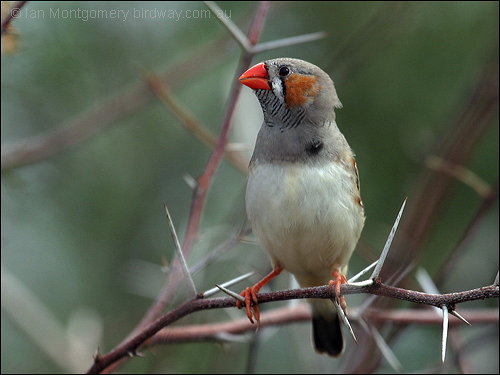
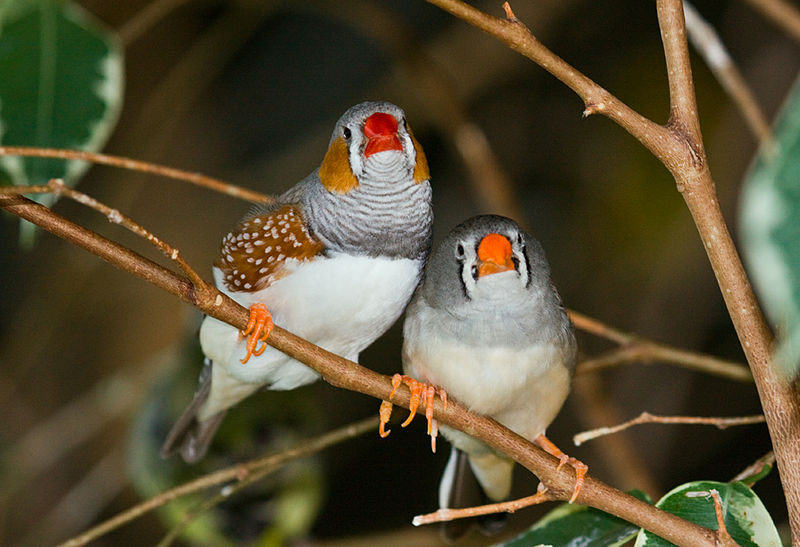
Zebra Finch Duets and Bird Origins – I.C.R.

PAS-Estr Zebra Finch (Taeniopygia by Ian

“The flowers appear on the earth; the time of the singing of birds is come,…” (Song of Solomon 2:12 KJV)

What an interesting and informative article about the creation of Zebra Finches and their singing duets. Bryian Thomas, PH.D. from the Institute For Creation Research wrote “Finch Duets Open Surprising Window on Bird Origins

The Zebra Finches appears to have a pattern of singing that goes against what evolutionists suppose is to be the normal behavior of Finches.

“A male finch sings to females while courting, but then quiets down after finding his mate. According to evolution, finches have no reason to continue to communicate at that point, since they’ve already ensured that their genes will be passed on to a new generation. Thus, researchers were surprised to find that wild zebra finches sing to each other only after becoming a couple.”

Zebra Finch (Taeniopygia guttata) by Ian

Zebra Finch (Taeniopygia guttata) by Ian

He also discusses how these songs are thought to have happened through natural selection, but….

“For male finches to sing their songs, they have to have a fully-formed system of pulmonary tubing, valves, musculature, and integrated skeletal structures. Then, the larynx (many birds have two) has to be located near the mouth and properly “wired” to the correct areas of the brain. All of that would still be useless, however, without the instinctive knowledge required to compose a song, or without the females’ ears being tuned to their specific tones. To consider this seamless array of parts as a product of just nature is imaginative–not scientific.”

A very good article to continue reading at “Finch Duets Open Surprising Window on Bird Origins“.

“Zebra finches are active and colorful birds from Australia, and they choose a mate for life.” Thankfully, Ian has provided us with great photos of the unique Avian Wonders.

PAS-Estr Zebra Finch (Taeniopygia by Ian

See Also:

Zebra Finch (Taeniopygia guttata) ©WikiC

Sharing The Gospel

Birds of the Bible – Foundation Reviews in 2022

Wood Duck (Aix sponsa) by Dan

Wood Duck (Aix sponsa) by Dan

Wow! Looking over the previous articles that have been written through the years on our blog, I thought it would be nice to read through some of our many posts.

To build a house, you need a foundation. To build a blog, you need a foundation. So, our foundation from the beginning for Lee’s Birdwatching Adventures Plus, has always been this:

“For no other foundation can anyone lay than that which is laid, which is Jesus Christ.” (1 Corinthians 3:11 NKJV)

He created our world, universe, us, and all His Avian Wonders, which we like to write about. We love to write about His birds and how we can learn from them. We’ve done our best, with a few stumbles here and there, but we have tried to honor Him through it all. He has been gracious to send me extra writers, photographers, and friends along this journey.

My thanks to Him, these extra hands to assist, my husband, and all of you who have visited us along the way.

Now, what has been written about the Foundations? Let’s take a look:

White Pelicans in Flight - Circle B Bar by Dan

White Pelicans in Flight – Circle B Bar

Birds of the Bible – Foundation #1 (2009) and then Foundation #1 Updated (2015)

These two posts explain about the beginning of birds and how they came to be here.

Fischer’s Lovebird (Agapornis fischeri) by W Kwong

Birds of the Bible – Foundation #2 (2009) and then Foundation #2 Updated (2015)

In Genesis Chapter 2, the birds and animals were named, but what happened in Chapter 3 caused the birds to be cursed and death now became a reality to them and others. But there is hope.

Noah’s Ark ©©Flickr elmada

Birds of the Bible – Foundation #3 (2009) and then Foundation #3 Updated (2015)

Now we find God has a plan to preserve the life of some of the people, animals, and the birds by having them enter the Ark.

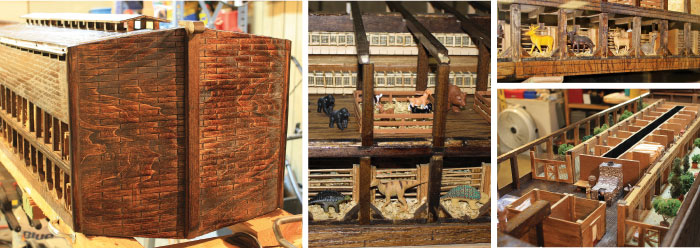
Ernesto Carrasco’s Noah’s Ark Model

Birds of the Bible – Foundation #4 (2009) and then Foundation #4 Updated (2016)

What did the birds encounter as they came off the ark and afterwards?

Rainbow-clouds.© Readers Digest

Rainbow-clouds ©Readers Digest

Birds of the Bible – Foundation #5 (2009) – Not Updated Yet (Stay tuned)

This post presents many of the “theories” about where birds came from, versus how the creationist view where and how the Avian Wonders of this world came into being.

We trust you will enjoy reading (or re-reading_ through these Foundation of the Birds of the Bible posts.

Western Tanager: Red, Yellow, Black and White

Birds of the Bible

Birds of the Bible – Introduced Here In 2008

ln honor of the Top 100 Bird Blogs and Websites For Ornithologists and Bird Lovers rating they gave us, [#20] here is a copy of that very first blog on Feb. 16, 2008.

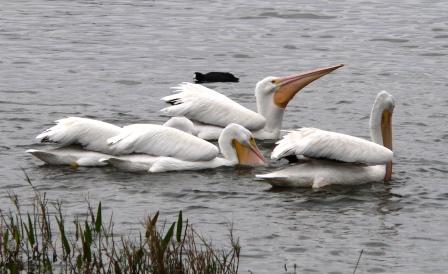
American White Pelicans at Lake Hollingsworth

American White Pelicans at Lake Hollingsworth

Goal: To encourage your understanding and help you form a mental picture of the fowls or birds of the air found in scripture.

God has created the fowls and birds and they are mentioned throughout the Bible. When you read the name of a bird, does a mental picture come to view or do you just keep reading without a thought to what you just read? Sure, you know some of them, like the Eagle or a Sparrow, but how about a Bittern, Ossifrage, Hoopoe, or Lapwing? Not just their names are important, but how about the illustrations that use birds to teach lessons? God’s care, strength, provision and other lessons are taught with birds as the examples.

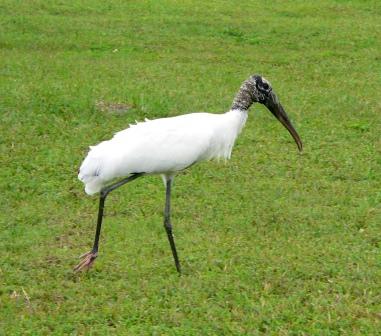
Wood Stork

“But now ask the beasts, and they will teach you; And the birds of the air, and they will tell you;” Job 12:7

So, let’s get started with:

The Birds of the Bible

“Then God said, ‘Let the waters abound with an abundance of living creatures, and let birds fly above the earth across the face of the firmament of the heavens.’ So God created great sea creatures and every living thing that moves, with which the waters abounded, according to their kind, and every winged bird according to its kind. And God saw that it was good. And God blessed them, saying, ‘Be fruitful and multiply, and fill the waters in the seas, and let birds multiply on the earth.’ So the evening and the morning were the fifth day.” Gen 1: 20-23

Here we see that God created the birds on day five of creation and that “it was good.”

“Out of the ground the LORD God formed every beast of the field and every bird of the air, and brought them to Adam to see what he would call them. And whatever Adam called each living creature, that was its name.” Gen 2:19-20a

Adam was given the privilege of giving all the “critters” their names. Were there as many varieties of birds then as now? There have been changes within the species (kinds), but not evolution (changing from one kind to another kind).

Depending on which copy of the Bible you use, here are some of the names of birds mentioned in the Bible. These will be introduced in following blogs. Not necessarily in the following order.
; Chicken; Cormorant; Crane; Cuckoo; Dove; Eagle; Falcon; Glede; Hawk; Hen; Heron; Hoopoe; Kite; Lapwing; Night Hawk; Osprey; Ossifrage; Ostrich; Owl; Partridge; Peacock; Pelican; Pigeon; Quail; Raven; Sparrow; Stork; Swallow; Swan; Vulture


House Sparrows visiting National Aviary Parrot Show by Lee

House Sparrows visiting NA Parrot Show Outside

“Look at the birds of the air, for they neither sow nor reap nor gather into barns; yet your heavenly Father feeds them. Are you not of more value than they?” (Matthew 6:26 NKJV)

Now it is 2022, and time to revisit these wonderful Birds of the Bible. Because of the Covid situation, we haven’t really been birdwatching much in almost two years. Yet, that doesn’t mean it’s time the “throw in the towel”, or the blog, in this case. So, we plan on writing more Birds of the Bible articles about the different Avian Wonders found in the Bible. Trying to bring in fresh material as we review the previous birds that we have written about. We will even ask some of our current writers like Dr. J. J. S. Johnson (Dr. Jim) and William Wise to join in.  Will also try to update the all the links to these articles.

STAY TUNED!

What An Honor – Top 100 Bird Blogs and Websites

Sunday Inspiration – Christmas Birds Revisited 2021

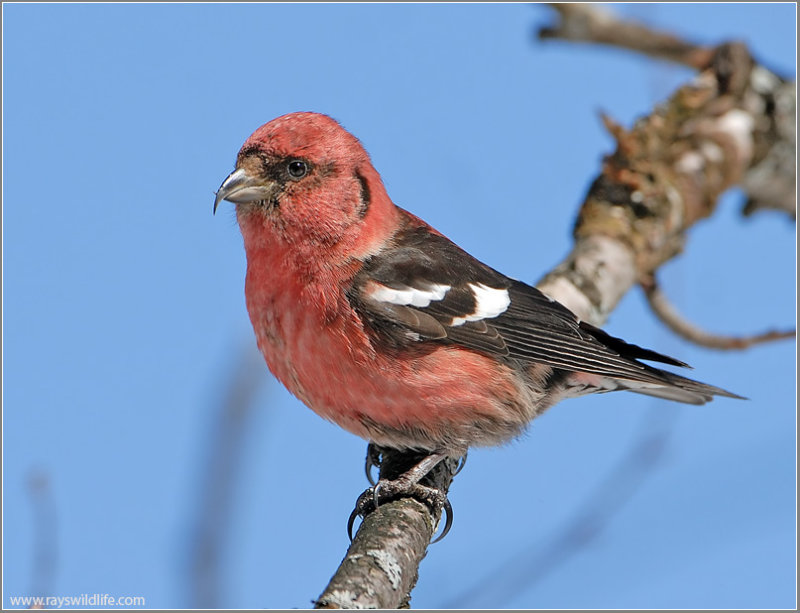
Two-barred Crossbill (Loxia leucoptera)(White-winged) by Raymond Barlow

Two-barred Crossbill (Loxia leucoptera)(White-winged) by Raymond Barlow

Now when Jesus was born in Bethlehem of Judaea in the days of Herod the king, behold, there came wise men from the east to Jerusalem, Saying, Where is he that is born King of the Jews? for we have seen his star in the east, and are come to worship him. (Matthew 2:1-2 KJV)

Thought you might enjoy a Christmas post from the past. (2012)

Today I am doing something a little different. Instead of a song, there is a short Christmas message from my pastor. This was given during the Camel Lot Christmas Musical that we had in 2012. It applies for today, as well. Listen to Pastor Nathan Osborne III as you watch some of the Lord Jesus Christ’s creation among the birds.

The birth of the Jesus, His death on the cross and His resurrection are all a part of Christmas.

This slideshow requires JavaScript.

Our Pastor at the Christmas Camel Lot Musical – 2012

*

(Started adding Christmas colored birds, but then added newer photos from this year.)

Sunday Inspirations

Some Previous Christmas Articles

Reginald’s Rescue by Emma Foster

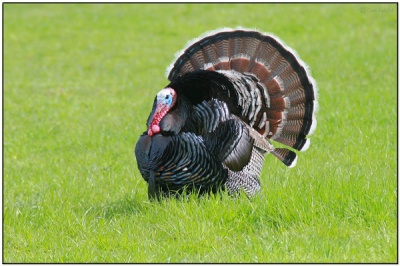
Wild Turkey (Meleagris gallopavo) by Daves BirdingPix

Reginald – (Wild Turkey by Daves BirdingPix)

Reginald, Oliver, and the rest of the turkeys spent all winter down south near the Oliver’s Ocean, which the turkeys had decided to call the lake they had visited. By early spring, however, the weather grew much warmer. The turkeys came together and decided to start for home. After saying goodbye to the turkey friends they had made at the orchard, Reginald slowly led his group back to the north.
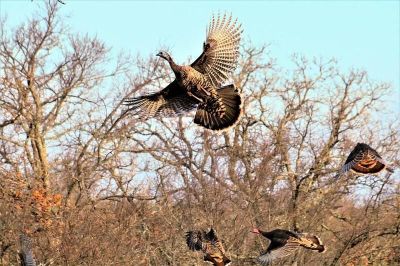
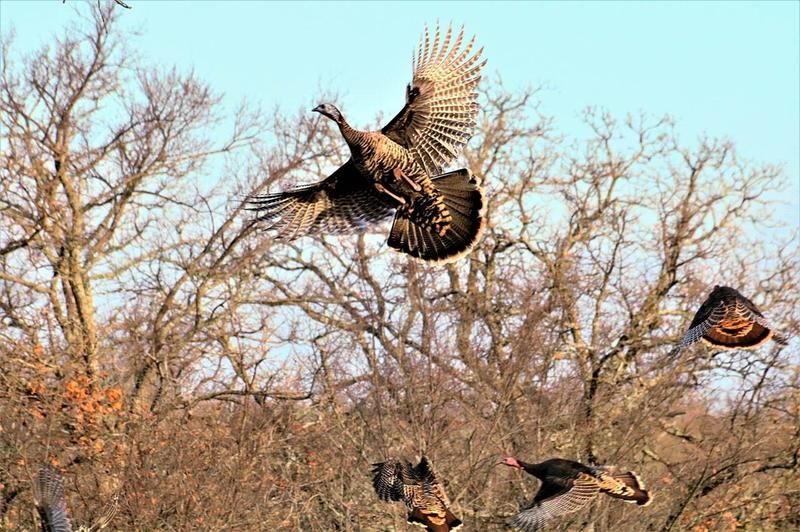
Turkeys Taking Flight (PD)

The turkeys enjoyed the weather up north now that winter had gone. To them, it was cold but not too cold, and most of the snow was quickly melting. But Reginald still had to guide the turkeys through different paths that he and a few others would have to create. Sometimes, the snow was soft enough to crush under their feet and walk through, but other times they had to climb over a large pile in their way. Oliver enjoyed stomping through the puddles, though once he fell into a hole he believed was a puddle, and Reginald had to help drag him out as Oliver flailed. The turkeys eventually made it back to their fortress, which was mostly clear of snow.

Inside the tunnels they had built, the turkeys worked to clear the remaining snow so they could easily walk through all the tunnels. They all hoped that, now that it was Spring, they wouldn’t have to worry about the cold, and they looked forward to heading back to their turkey friends in the South next winter.
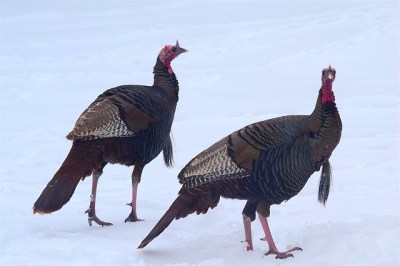
Wild Turkeys ©Pixabay

But one day, Reginald woke up and realized that the weather was incredibly cold. He tried to look outside, but the entrance to the front of the fortress was covered with a dark wall of snow that he couldn’t get through. The rest of the turkeys sleeping on that side woke up and tried to help Reginald push the snow away, but it was too thick. Some of them tried gobbling for help, but the rest of the turkeys couldn’t hear them.

Inside another set of tunnels, Oliver woke up and noticed the snow as well. Luckily, he and a few other turkeys were able to scramble out of an opening and examine the woods around the fortress. Several inches of snow lay around and on top of the fortress the turkeys had made, with some of the tunnels clogged with slush. Oliver suddenly realized that Reginald and the others must be stuck inside since they hadn’t come out.

Oliver sat in the snow and started thinking. The few other turkeys waited, unsure of what to do. Oliver knew he needed to come up with a good idea to clear the snow away so that the others could get out. After thinking long and hard, however, Oliver still couldn’t come up with anything.

Broken Limb/Branch off of Tree

Just then, a branch from one of the trees above him dropped onto his head, knocking Oliver over. One of the other turkeys with him had to pull it off. When Oliver got up, he noticed how the branch made marks in the snow, and suddenly he came up with an idea.

Oliver told the turkeys that he needed their help taking the branch to the tunnel entrance. One of the turkeys went ahead to locate where Reginald was trapped. As Oliver carried the branch ahead, the other turkey found the entrance to the tunnel where Reginald and the other turkeys were. Immediately, Oliver placed the branch in the snow and used its limbs to drag the snow away. The branch caught large chunks of snow and helped Oliver clear it away. The other turkeys helped by using their feathers, until most of the snow was cleared. Reginald pushed the rest aside and was surprised to discover Oliver with the branch, along with the other turkeys.
Collecting Branches

Reginald, impressed at Oliver’s idea and leadership, allowed Oliver to use the branch to clear the rest of the snow so that all the turkeys could get out. They all agreed to find more branches similar to the one Oliver discovered so they could keep clearing the snow once it snowed again.

Fortunately, no more snow fell, and the air started to get warmer again. In a couple more days, most of the new snow had melted, so the turkeys didn’t have to worry about being trapped again. They were now free to enjoy the spring without the snow, though Reginald asked Oliver to continue finding branches so that they would be prepared.

“Two are better than one because they have a good return for their labor. For if either of them falls, the one will lift up his companion. But woe to the one who falls when there is not another to lift him up.” (Ecclesiastes 4:9-10 NASB)

Lee’s Addition:

It is nice to receive another story from Emma. She has been busy growing up and finishing College and adventures beyond.

We have enjoyed all her stories, and you can read or re-read them here at:

Emma’s Stories

Christ’s Providence Is Clearly Seen in Bird Migrations

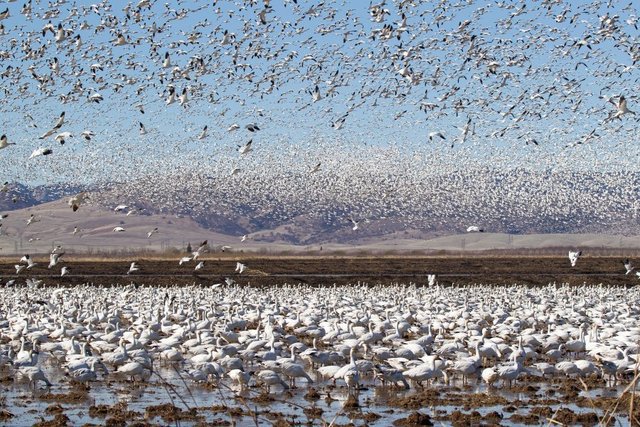
Snow Geese Migrating

Click to watch – Intro Video

Christ’s Providence Is Clearly Seen in Bird Migrations

Just as monkeys can’t accidently type Shakespeare texts, birds can’t migrate by evolutionary luck, despite imagined eons of time for “lucky” accidents.1 Why? Because the challenging mix of birds’ metabolic needs for long-distance travel, synchronized to seasonal and diurnal weather conditions, are exacerbated by unyielding entropy. This all-or-nothing complexity prohibits “lucky” bird migrations. In short, to seasonally migrate, birds need the Lord Jesus Christ’s providential bioengineering care.2,3

Flight failures are tragic when malfunctioning airplanes or spacecraft fall out of the sky.3 Likewise, if bird traits malfunctioned while trying to evolve migratory flight features, there would be no second chances.1 So, either birds are aptly fitted by their Creator with migration traits or they can’t migrate.4,5

Consider the air speeds that birds need to maintain over long distances before their flying fuel (i.e., metabolic assets dedicated to long-distance flight needs) is depleted.

The birds’ flight speed in relation to the air varies in general between approximately 30 km per hour, for the smallest birds, and 80 km per hour, for larger birds.…When the bird’s mass increases 100 times, then 200 times as much flight power is required.4

Yet, powering heavier-than-air flight requires adequate bird muscle strength and endurance.

The muscle power cannot, however, increase much more than the weight. Provided that the proportions are the same, the wing area is only 20 times as great in a bird that weighs 100 times more than another. The limited muscle power and wing area of heavy birds, in combination with the very high flight power that is required [for long-distance migrations], sets a size limit above which flying is no longer possible. This limit is estimated to be around 15 kg. This corresponds well with the weight of the largest animals in the world that can actively fly—swans, bustards, albatrosses and condors.4

Thus, interplay between flight speed and muscle power balances the complicated physics required for non-fixed-wing flying against long-distance migration.2-5
Moreover, the unforgiving biochemistry and physiology of each migratory bird’s metabolism (food acquisition, fuel utilization, respiration, etc.) must aptly fit the ongoing needs of seasonal migrations or else avian biochemical logistics fail.4,5 Thankfully, for all migratory birds—and all birdwatchers—the phenological phenomena of bird migrations is not dependent upon “luck,” as imagined by evolutionists.3,5 Rather, none less than the Lord Jesus Christ deserves all credit and acclaim for these winged wonders of biogeographic beauty.
“But now ask…the birds of the air, and they will tell [literally “explain to,” or “clarify to”] you…that the hand of the LORD has done this, in Whose hand is the life of every living thing.” (Job 12:7-10)

References

  1. “Thus, eons of time guarantee that the simian keypunchers can never type out Hamlet—the imagined luck is ‘not to be.’ Time plus entropy prevents the spontaneous generation of life and any hope of evolution.” Johnson, J. J. S. 2018. Infinite Time Won’t Rescue EvolutionActs & Facts. 47 (6): 21. Complex bird anatomies cannot spontaneously self-assemble, apart from Christ’s bioengineering providence, because ubiquitous entropy (i.e., the 2nd Law of Thermodynamics) absolutely prevents any mix of biochemicals from magically combining into purpose-working “all-or-nothing-unity” systems, regardless of how much time is allowed, because infinite time guarantees that (our fallen universe’s) entropy bars any such luck.
  2. Egevang, C. et al. 2010. Tracking of Arctic terns Sterna paradisaea reveals longest animal migrationProceedings of the National Academy of Sciences. 107 (5): 2078-2081, quoted in Johnson, J. J. S. 2010. Survival of the Fittest: God’s Providential ProgrammingActs & Facts. 39 (10): 17-18. See also, regarding phenological migrations, Johnson, J. J. S. 2013. God Fitted Habitats for BiodiversityActs & Facts. 42 (3): 10-12.
  3. Guliuzza, R. J. 2011. Darwin’s Sacred Imposter: The Illusion That Natural Selection Operates on OrganismsActs & Facts. 40 (9): 12-15; Guliuzza, R. J. 2017. Engineered Adaptability: Engineering Causality Studies Unmask Evolutionary ExternalismActs & Facts. 46 (11): 17-19. See also Sherwin, F. A ‘One-Hundred-Million-Year-Old Bird’ Is Still a BirdCreation Science Update. Posted on ICR.org June 20, 2006, accessed October 1, 2021.
  4. “The rule of thumb is that the speed roughly doubles when the mass of the bird increases 100 times. If a 10-g Willow Warbler flies at 30 km per hour, then a Raven of 1 kg [1,000 grams] flies, in round figures, at 60 km per hour. …The capacity of the flight muscles sets a ‘ceiling’ to how much flight power a bird can cope with—a lower ceiling for continuous power outtake and a somewhat higher ceiling for temporary all-out bursts. After this sort of brief ‘muscle spurt’ the muscles have to wind down while the lactic acid which is formed in the muscle tissue when energy is produced without sufficient oxygen supply is carried away.” Alerstam, T. 1993. Bird Migration. New York: Cambridge University Press, 252.
  5. Johnson, J. J. S. 2016. High-Altitude Flying Is for the BirdsActs & Facts. 45 (3): 20-21.

* Dr. Johnson is Associate Professor of Apologetics and Chief Academic Officer at the Institute for Creation Research.

Cite this article: James J. S. Johnson, J.D., Th.D. 2021. Christ’s Providence Is Clearly Seen in Bird MigrationsActs & Facts. 50 (12).

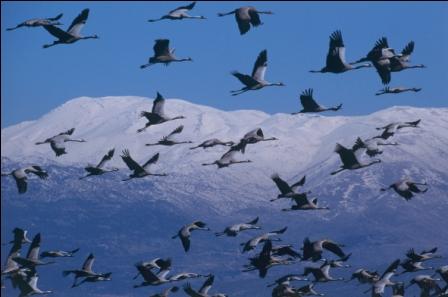
Crane Migration over Israel

Crane Migration over Israel

(Dr. Jim asked me to post this for him. Trust you will enjoy this. Copied directly from the website with his permission.)