***

FOLLOW ME
***
And as Jesus passed forth from thence, he saw a man, named Matthew, sitting at the receipt of custom: and he saith unto him, “Follow me!” And he arose, and followed him. (Matthew 9:9 KJV)
Mallard Duck and Followers ©WikiC
*
*
And as Jesus passed forth from thence, he saw a man, named Matthew, sitting at the receipt of custom: and he saith unto him, “Follow me!” And he arose, and followed him. (Matthew 9:9 KJV)
Mallard Duck and Followers ©WikiC
*
*
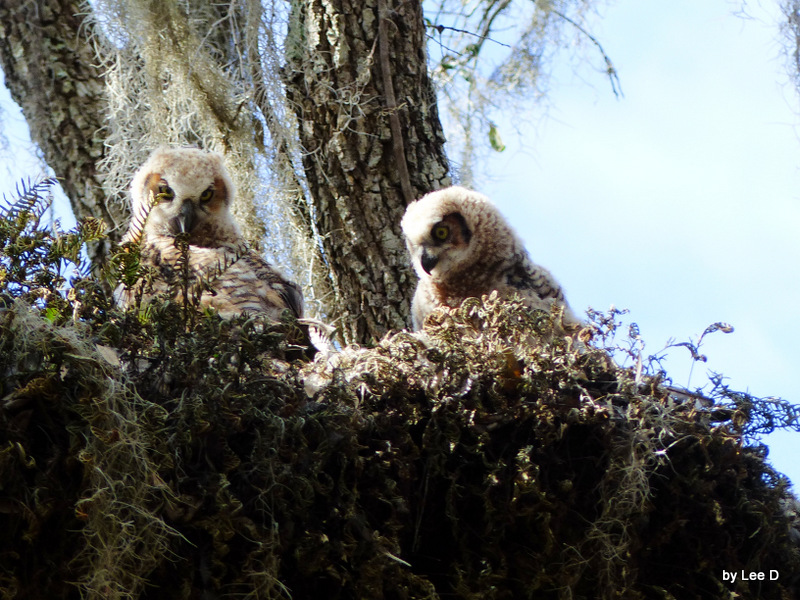
Great Horned Owl Youngsters at Circle B Bar Reserve by Lee
“And the little owl, and the cormorant, and the great owl,” (Leviticus 11:17 KJV)
This afternoon we were able to go to the Circle B Bar Reserve and watch the latest talk of the birders. Yesterday, our birding friends at church told us about these two youngsters that were stealing all the attention at the park.
It was easy to find the area, because it is roped off to keep everyone at a safe distance from the youngsters. An array of onlookers with binoculars and lots of cameras were watching and waiting for the youngsters to wake up from their naps.

Great Horned Owl Youngsters at Circle B Bar Reserve by Lee
Finally, a fuzzy ball appeared, and then a head popped up. Eventually, two heads were visible.
Notice how their Creator gave them just the right kind of feathers to blend in with their surroundings. Another example of the Lord’s Care for His creation.

Great Horned Owl Youngsters at Circle B Bar Reserve by Lee
Trust you will enjoy these glimpses of them. It was hard trying to catch a decent photo because they were quite a way from us. Trying to hold a zoomed in, hand-held, camera in “program mode” is a challenge. But, I am so thankful for the Lord allowing us to see some of his wonderfully created Great Horn Owl youngsters. These were my first GHO youngsters seen in the wild.
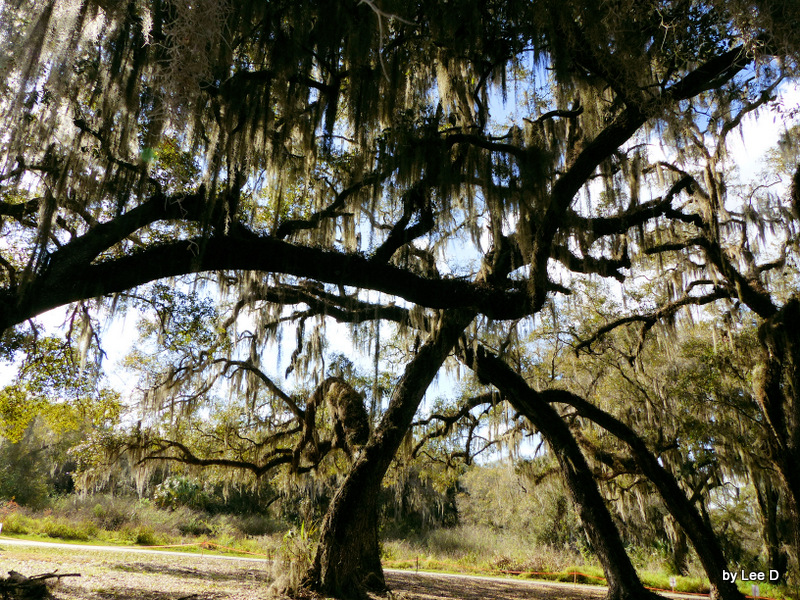
Do You See Them

Let Me Zoo In Some More. .. Do You See Them Now?
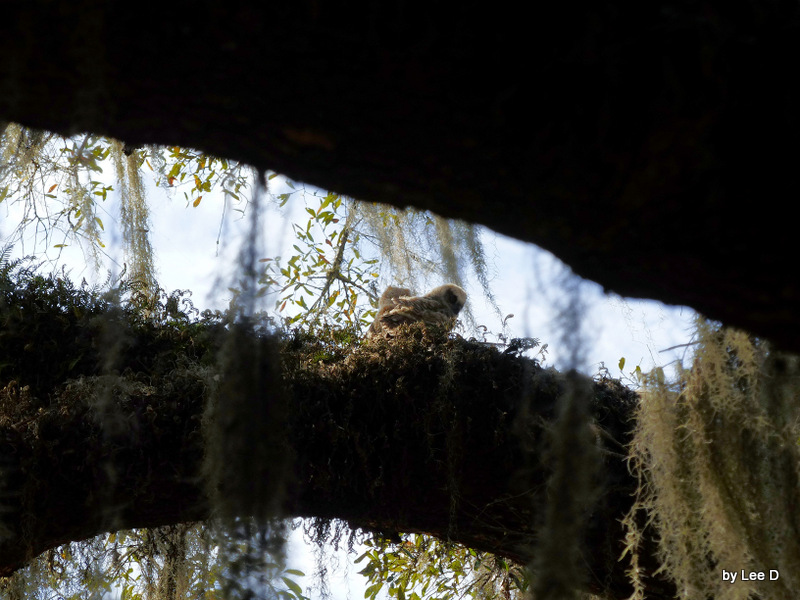
Zoomed In More…Do You See Them Now!
Here is a slide show of the photos in fairly decent order of how they were taken.
I was able to shoot some video, but again, it’s a little shaky. Enjoy.
*
*
If any of you lacks wisdom, let him ask of God, who gives to all liberally and without reproach, and it will be given to him. (James 1:5 NKJV)
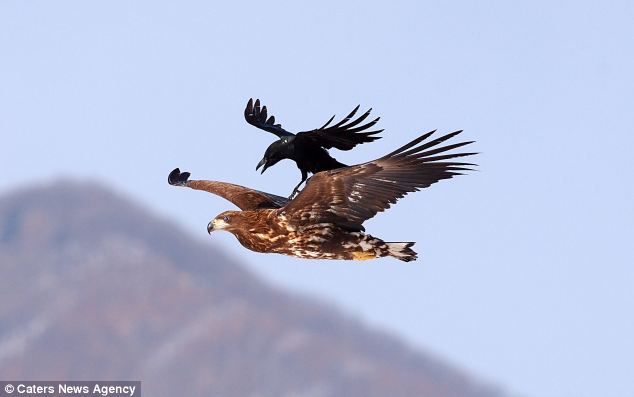
Crow on Eagle’s Back ©©
*
*
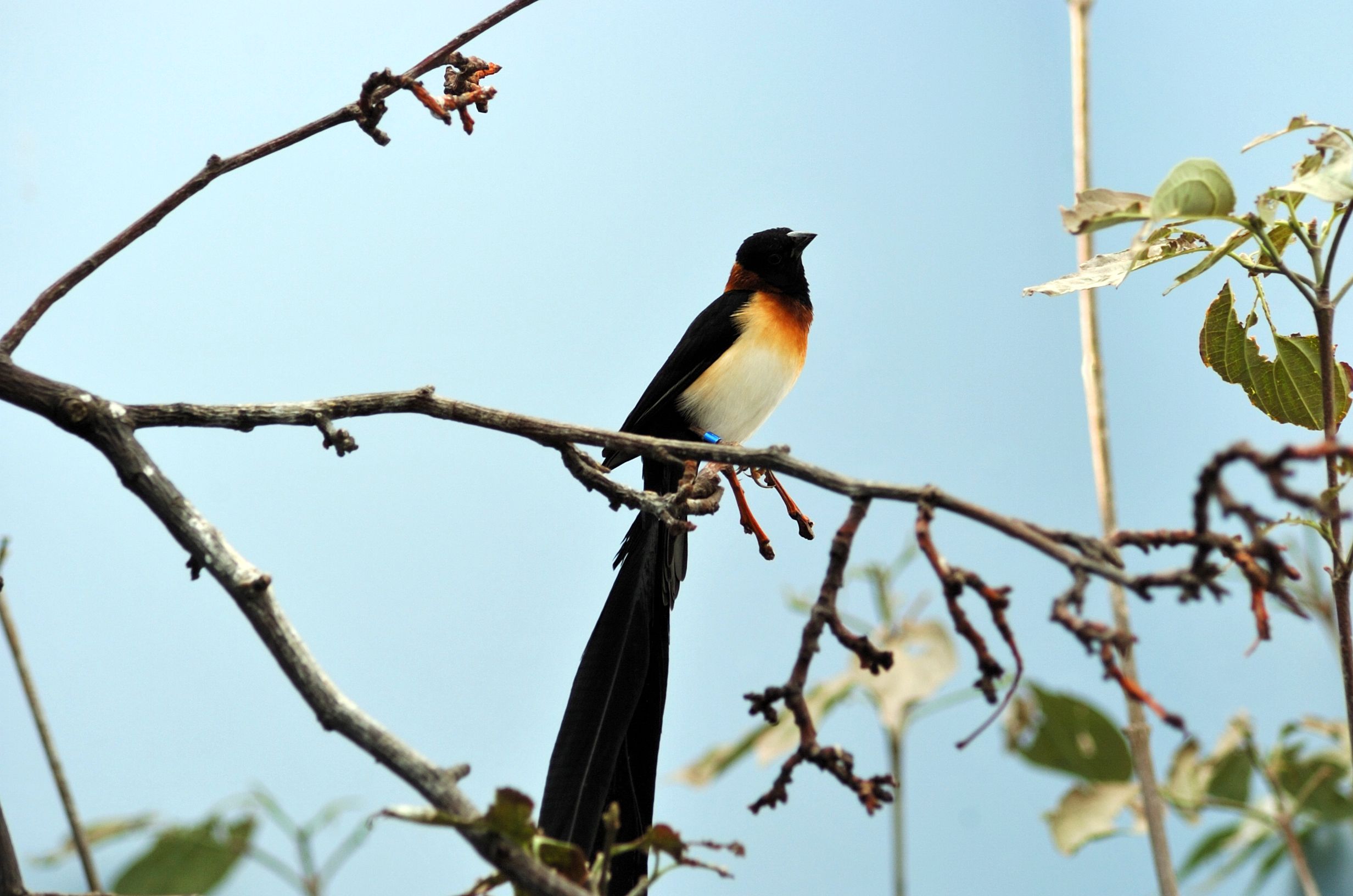
Long-tailed Paradise Whydah by Dan at the National Aviary
Better is little with the fear of the LORD than great treasure and trouble therewith. (Proverbs 15:16 KJV)
Our next families in our Passeriformes Order are small families. Because they are small in number does not mean they are small in beauty. I love the song, “Little Is Much When God Is In It.” Maybe because I am short. :) Sometimes these small groups are a result of the ornithologists not being sure which family to include them. As they (ornithologists) keep doing DNA studies, more shuffling in families will occur.
Our largest family, Viduidae, today has twenty species of Indigobirds, Whydahs, and a Cuckoo-finch. We saw our first Whydah at the National Aviary in Pittsburg, PA. It is appropriately called a Long-tailed Paradise Whydah. You can see its long tail, worn by males, in the photo. These are finch-like birds which usually have black or indigo predominating in their plumage.
All are brood parasites, which lay their eggs in the nests of estrildid finch species; most indigobirds use fire-finches as hosts, whereas the paradise whydahs chose pytilias. Unlike the cuckoo, the indigobirds and whydahs do not destroy the host’s eggs.
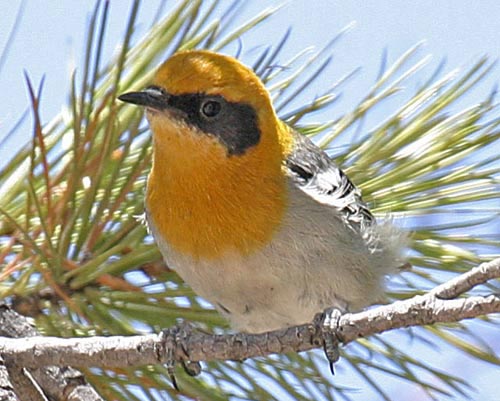
Olive Warbler (Peucedramus taeniatus) ©WikiC
The Olive Warbler is the solo member of his family, (Peucedramidae), but there are several sub-species. This species breeds from southern Arizona and New Mexico, USA, south through Mexico to Nicaragua. It is the only bird family endemic to North America (including Central America).
It is an insectivorous species of coniferous forests. Though it is often said to be non-migratory,[3] most New Mexican birds leave the state from November to late February. It lays 3–4 eggs in a tree nest”. (Wikipedia)
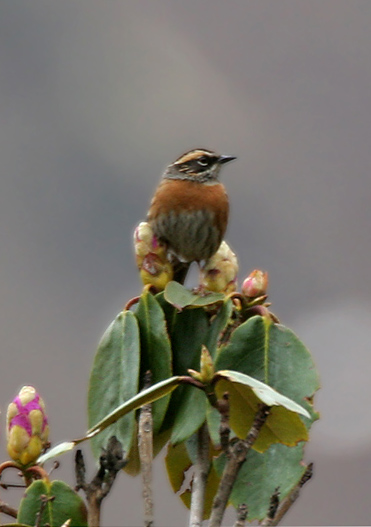
Rufous-breasted Accentor (Prunella strophiata) ©WikiC
The Prunellidae – Accentors Family has thirteen members named Accentors and one Dunnock, of the genus, Prunella. All but the Dunnock and the Japanese Accentor are inhabitants of the mountainous regions of Europe and Asia; these two also occur in lowland areas, as does the Siberian Accentor in the far north of Siberia. This genus is not strongly migratory, but they will leave the coldest parts of their range in winter, and make altitudinal movements.
Their typical habitat is mountainous regions in an area far above the tree-line, but below the snow-line. The Himalayan accentor can be found as high as 17,000 ft above sea level when breeding, however, most accentors breed in scrub vegetation at lower levels. Most species migrate downwards to spend the winter, with only some being hardy enough to remain. Accentors spend the majority of their time in the undergrowth and even when flushed, stay low to the ground until reaching cover. (Wikipedia)
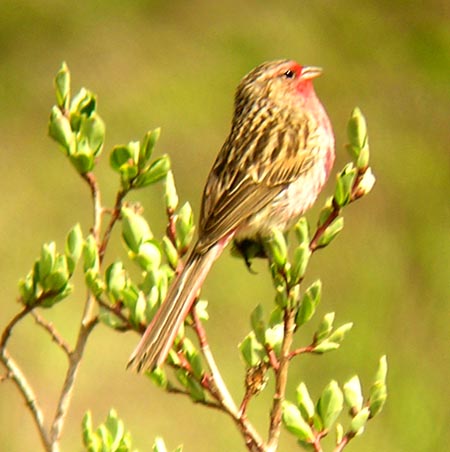
Przevalski’s Finch (Urocynchramus pylzowi) ©Montereybay
Skipping over the Wagtails and Pipits (covered next week), our last bird, the Przevalski’s Finch (Urocynchramus pylzowi), is again in a family by itself.
The Przevalski’s Finch or Przewalski’s Finch (Urocynchramus pylzowi) is an unusual passerine bird from the mountains of central-west China. The species is named for Nikolai Przhevalsky, the Russian explorer who described it. Its taxonomic affinities were unclear for a long time, giving rise to other common names, the Pink-tailed Bunting and the Przewalski’s Rosefinch. In 2000 it was proposed that it should in fact be regarded neither as a finch nor a bunting, but as the only member of the family Urocynchramidae,
Przewalski’s Finch is a small bird similar in appearance to the Long-tailed Rosefinch. The tail is long and – quite unlike in typical finches – graduated, with the outer feathers much shorter than the central ones. The sexes are sexually dimorphic, with the males having bright pink on the throat, breast and belly. Both sexes have brown streaked plumage on the back and wings. The bill is thinner than those of the rosefinches. (Wikipedia)
But Jesus said, Suffer little children, and forbid them not, to come unto me: for of such is the kingdom of heaven. (Matthew 19:14 KJV)
“Little Prayers” ~ by the ©The Hyssongs
*
Motacillidae – Wagtails, Pipits – Next Week
*

King Penguin (Aptenodytes patagonicus) by Bob-Nan
These see the works of the LORD, and his wonders in the deep. (Psalms 107:24 KJV)
*
https://player.vimeo.com/video/41225777?badge=0
*
Jeanie Boyette, who has written poems here on the blog, sent me this link. What a fantastic video! How can we not thank our Great Creator as we watch this. Richard Sidey produced this show of God’s Wonder’s.
*
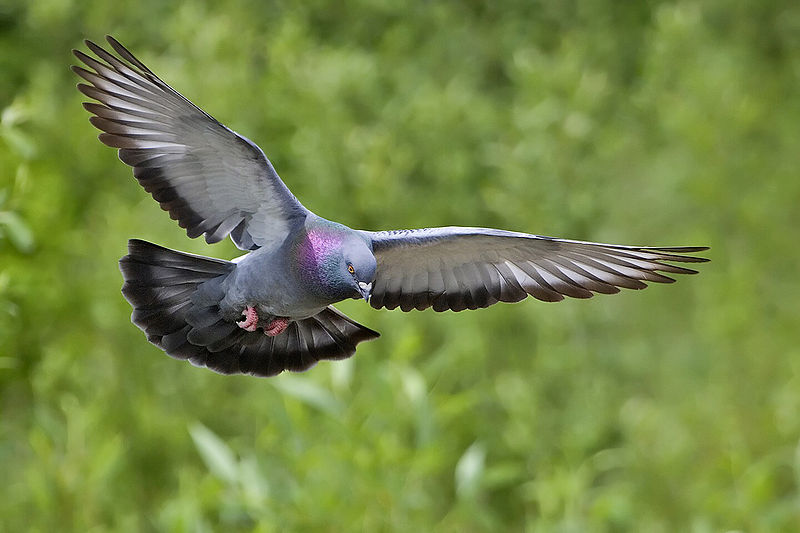
And I said, Oh that I had wings like a dove! for then would I fly away, and be at rest. (Psalms 55:6 KJV)
Rock Dove (Columba livia) ©WikiC
*
P. S. Sandra took me up on my challenge and today she posted Four-Word Thursday – Lee’s Challenge. She started the challenge and now she is challenged. :)
*

White-rimmed Brushfinch ©Dusan M Brinkhuizen
Jesus Christ is the same yesterday, today, and forever. (Hebrews 13:8 NKJV)
Well, they released a new I.O.C. version of World Bird Names. This version is 6.1 and I have been working on updating the site to reflect the new changes. It was not a really huge change, thankfully. In fact, they only added five new species and deleted one.
The IOC World Bird List 6.1 contains 10,615 extant species (and 154 extinct species) classified in 40 Orders, 239 Families (plus 2 Incertae Sedis) and 2283 Genera and 20,601 Subspecies.
The new species are:
The Roosevelt Stipple-throated Antwren (Epinecrophylla dentei) was deleted.
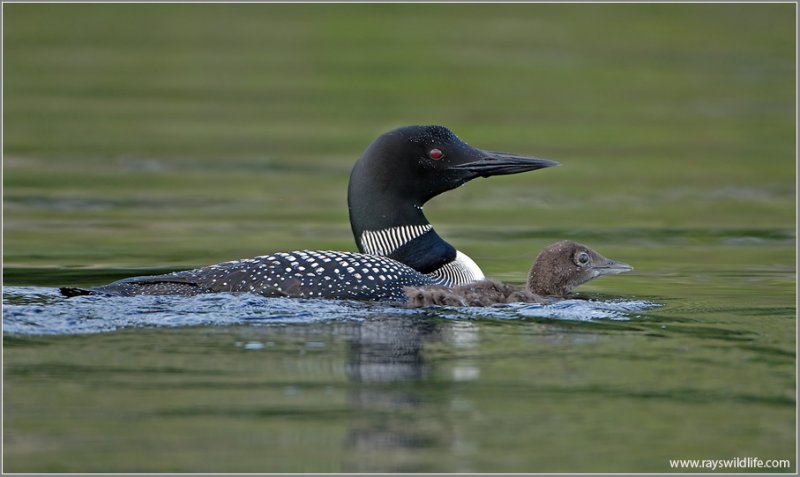
Common Loon (Gavia immer) with young by Raymond Barlow
There were some name changes, the biggest one was the forty (40) Brush Finch being renamed Brushfinch.
Here are the other name changes:

Yellow-shouldered Grosbeak (Parkerthraustes humeralis) Drawing ©WikiC
Then in the Taxonomy changes; here are those changes:
The biggest change here was moving the Yellow-shouldered ((Parkerthraustes humeralis) out of the Card family and placing it in the Thraupidae Family because it is actually a Tanager.
All the indexes are up to date except the Last Name – First Name listings. Because it was such a small amount of changes, they will be updated on the next update. The First Name – Last Name indexes are all corrected to the 6.1 Version. (That is the one most people search.)
*
*
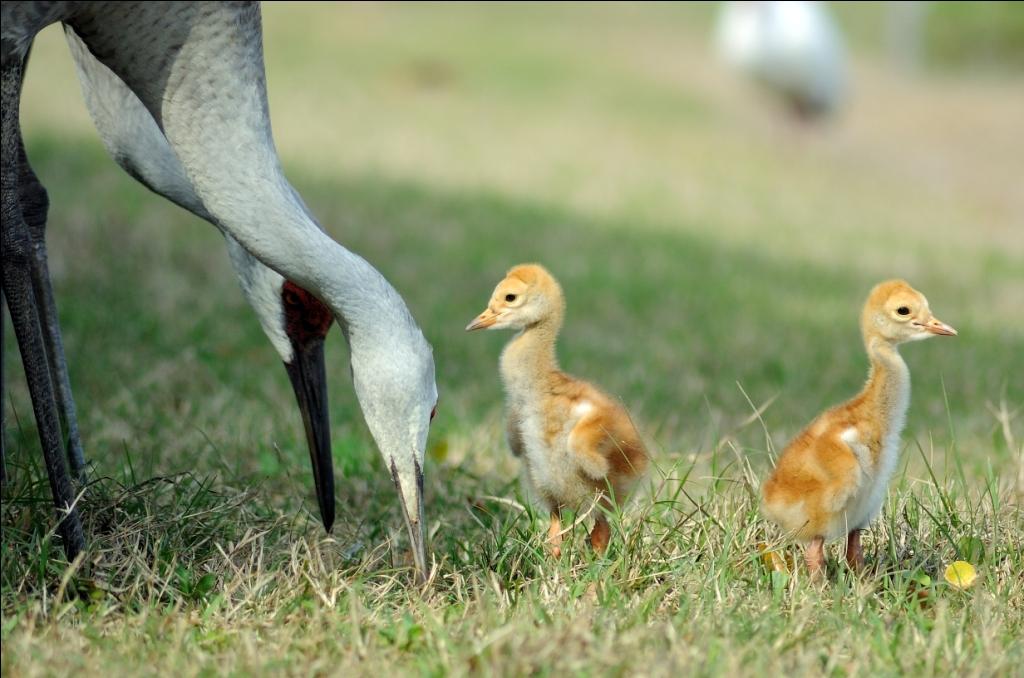
Therefore we were buried with Him through baptism into death, that just as Christ was raised from the dead by the glory of the Father, even so we also should walk in newness of life. (Romans 6:4 NKJV)
Sandhill Cranes “Colts” and parents by Lee
*
*

Henceforth there is laid up for me a crown of righteousness, which the Lord, the righteous judge, shall give me at that day: and not to me only, but unto all them also that love his appearing. (2 Timothy 4:8 KJV)
Black Crowned Crane (Balearica pavonina pavonina) (West African) Brevard Zoo by Lee
*
*
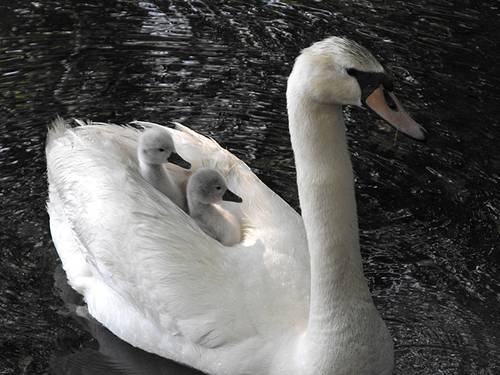
I will both lay me down in peace, and sleep: for thou, LORD, only makest me dwell in safety. (Psalms 4:8 KJV)
Mute Swan – Riding in Safety
*
Only one person commented about whether I should continue these or not, but over 30 of you liked the last one I did. So, this will continue for a little bit longer. At least a week or two. I really enjoy doing them, and trust you are enjoying them.
Guess this can no longer be called Sandra’s New Kooky Challenge, since her challenge is finished. In fact, she was the one encouraging me to continue. I have now challenged her to do some like these, but she doesn’t have to use birds. Scripture, yes, birds, no. Any of you other bloggers like to try your hand at this? Maybe you are into flowers, butterflies, or donkeys, or whatever, for all I know.
If you come up with a name for this series, let me know. I am open to suggestions.
Have a blessed day as you continue reading your emails and blogs.
The unnamed Challenge – Any Suggestions?
*
ANCIENT BIRDS FLEW OVER DINOSAURS’ HEADS
“And God created great whales, and every living creature that moveth, which the waters brought forth abundantly, after their kind, and every winged fowl after his kind: and God saw that it was good.” Genesis 1:21
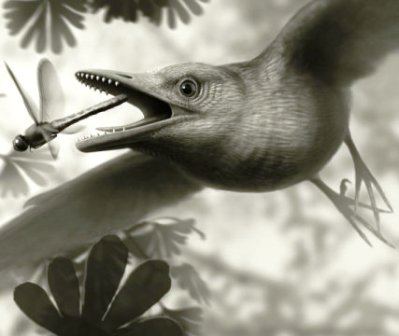
As the fierce T-Rex approaches its prey, the dinosaur is suddenly hit from above with something white that spatters on its upturned head. Yes, it’s the same kind of bird droppings that you’ll find all over your car when you park under the branches of a tree.
Ancient Birds Flew Over Dinosaurs’ Heads
What’s that again? Evolutionists have been telling us that modern-day birds evolved from dinosaurs. The two kinds of animals weren’t around at the same time, they say. But now, a report tells us that one “ancient bird’s intricate arrangement of the muscles and ligaments controlled the main feathers of its wings, supporting the notion that at least some of the most ancient birds performed aerodynamic feats in a fashion similar to those of many living birds.”
 Dr. Luis M. Chiappe, the investigation’s senior scientist, said, “The anatomical match between the muscle network preserved in the fossil and those that characterize the wings of living birds strongly indicates that some of the earliest birds were capable of aerodynamic prowess like many present-day birds.”
Of course, the research team didn’t want people to end up thinking that birds haven’t evolved over the past 125 million years, so they mentioned that the bones of the fossilized bird is “skeletally quite different from their modern counterparts.” In addition, the press release was accompanied with an artist’s rendition of the bird. To preserve the evolutionary story, the drawing shows a bird with an open beak filled with sharp teeth.
Prayer:
Heavenly Father, birds and dinosaurs were created just one day apart so they lived at the same time, just as You tell us in the Bible. Thank You for the scientific evidence that is now confirming this to be true. Amen.
Notes:
“Tiny ancient fossil from Spain shows birds flew over the heads of dinosaurs,” ScienceDaily, 10/6/15, Natural History Museum of Los Angeles County. Guillermo Navalón, Jesús Marugán-Lobón, Luis M. Chiappe, José Luis Sanz, Ángela D. Buscalioni. “Soft-tissue and dermal arrangement in the wing of an Early Cretaceous bird: Implications for the evolution of avian flight.” Scientific Reports, 2015; 5: 14864 DOI: 10.1038/srep14864. Illustration: Courtesy of Stephanie Abramowicz.
©Creation Moments 2016
Lee’s Addition:

Komodo Dragon by Dan
The beast of the field shall honour me, the dragons and the owls: because I give waters in the wilderness, and rivers in the desert, to give drink to my people, my chosen. (Isaiah 43:20 KJV)
And thorns shall come up in her palaces, nettles and brambles in the fortresses thereof: and it shall be an habitation of dragons, and a court for owls. (Isaiah 34:13 KJV) (bolding mine in the verses)
Those verses both have dragons (many creationist also call them dinosaurs) and owls mentioned together in the same verse. Interesting! If the scientist involved weren’t so steeped in their belief of evolution, they might realize how close to the truth they really are.
*

Tricolored Parrotfinch (Erythrura tricolor) ©WikiC
Last Sunday the first half of the Waxbills and allies were shown. This week we will finish up the large family of 141 species. You will see birds with these names; Finch, Firetail, Parrotfinch, Silverbill, Mannikin, Munia, and Sparrows.
“Parrotfinches are small, colorful passerine birds belonging to the genus Erythrura in the family Estrildidae, the estrildid finches. They occur from South-east Asia to New Guinea, northern Australia and many Pacific Islands. They inhabit forest, bamboo thickets and grassland and some can be found in man-made habitats such as farmland, parks and gardens. Several species are commonly kept as cagebirds.
The plumage is usually mainly green. Most species have blue or red markings on the head and a red rump and tail. The tail is pointed and often fairly long. Seeds, especially those of grasses, comprise the bulk of the diet. Some parrotfinches also feed on fruit and small insects. Many species forage in flocks, keeping in contact with high-pitched calls.” (Wikipedia with editing)

Double-barred Finch (Taeniopygia bichenovii) ©Wiki
“Lonchura is a genus of the estrildid finch family, and includes munias (or minias), mannikins, and silverbills. They are resident breeding birds in Africa and in South Asia from India and Sri Lanka east to Indonesia and the Philippines. The name mannikin is from Middle Dutch mannekijn ‘little man’ (also the source of the different bird name manakin).
They are small gregarious birds which feed mainly on seeds, usually in relatively open habitats, preferring to feed on the ground or on reeds of grasses. Several species have been noted to feed on algae such as Spirogyra.
The nest is a large domed grass structure into which four to ten white eggs are laid. Some species also build communal roosting nests for overnight rest.
The species in this genus are similar in size and structure, with stubby bills, stocky bodies and long tails. Most are 10–12 cm in length. Plumage is usually a combination of browns, black and white, with the sexes similar, but duller and less contrasted for immature birds.” (Wikipedia with editing)
Also, last week, some how I didn’t get Meagan’s song posted right and it didn’t play. It has been corrected now, but I am going to use it again because it is so well done.
Jesus said to them, “If God were your Father, you would love Me, for I proceeded forth and came from God; nor have I come of Myself, but He sent Me. (John 8:42 NKJV)
“My Jesus I Love Thee” ~ by Meagan Fee at Faith Baptist
*
Sunday Inspiration – Waxbill and Allies I
Estrildidae – Waxbills, Munias & Allies
*
 Lee's Birdwatching Adventures Plus