Give thanks unto the LORD, call upon his name, make known his deeds among the people. Sing unto him, sing psalms unto him, talk ye of all his wondrous works. (1 Chronicles 16:8-9 KJV)
O give thanks unto the LORD; for he is good; for his mercy endureth for ever. (1 Chronicles 16:34 KJV)
As we enter into the Thanksgiving Holiday week, with visits with family and friends, meals to prepare and eat, parades and games to watch, don’t forget to be thankful for our Creator of all this. He is Worthy of our Thanksgiving and Worship.
I am thankful for all the fantastic friends we have met through this blog (you, the readers). I am also thankful for those that contribute to the blog, like James J. S. Johnson (Dr. Jim) and Golden Eagle (Baron Brown) with which we recently went on a birdwatching adventure. Thankful for our other contributors as well.
Finally cleaned up the photos from that adventure and many are in the slideshow. Definitely thankful for all the birds the Lord gave us. He is “Worthy of Worship”
This slideshow requires JavaScript.
“Worthy of Worship” ~ Faith Baptist Orchestra
WORTHY OF WORSHIP
(York/Blankenship)
Worthy of Worship, worthy of praise,
Worthy of honor and glory,
Worthy of all the glad songs we can sing,
Worthy of all of the offerings we bring.
You are worthy, Father, Creator.
You are worthy, Savior, Sustainer.
You are worthy, worthy and wonderful;
Worthy of worship and praise.
Worthy of reverence, worthy of fear,
Worthy of love and devotion;
Worthy of bowing and bending of knees,
Worthy of all this, and added to these…
You are worthy, Father, Creator.
You are worthy, Savior, Sustainer.
You are worthy, worthy and wonderful;
Worthy of worship and praise.
Almighty Father, Master, and Lord,
King of all kings and Redeemer,
Wonderful Counselor, Comforter, Friend,
Savior and Source of our life without end.
You are worthy, Father, Creator.
You are worthy, Savior, Sustainer.
You are worthy, worthy and wonderful;
Worthy of worship and praise.
CHAPTER 5. Peter Learns Something He Hadn’t Guessed.
Running over to the Old Orchard very early in the morning for a little gossip with Jenny Wren and his other friends there had become a regular thing with Peter Rabbit. He was learning a great many things, and some of them were most surprising.
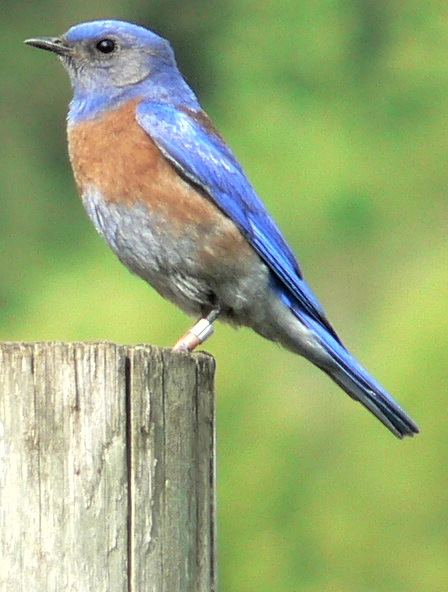
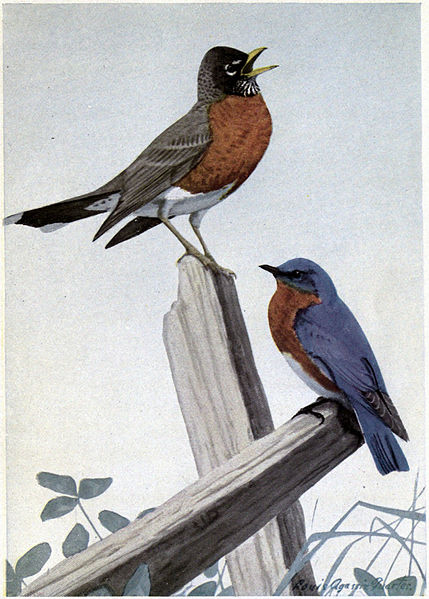
Now two of Peter’s oldest and best friends in the Old Orchard were Winsome Bluebird and Welcome Robin. Every spring they arrived pretty nearly together, though Winsome Bluebird usually was a few days ahead of Welcome Robin. This year Winsome had arrived while the snow still lingered in patches. He was, as he always is, the herald of sweet Mistress Spring. And when Peter had heard for the first time Winsome’s soft, sweet whistle, which seemed to come from nowhere in particular and from everywhere in general, he had kicked up his long hind legs from pure joy. Then, when a few days later he had heard Welcome Robin’s joyous message of “Cheer-up! Cheer-up! Cheer-up! Cheer-up! Cheer!” from the tiptop of a tall tree, he had known that Mistress Spring really had arrived.
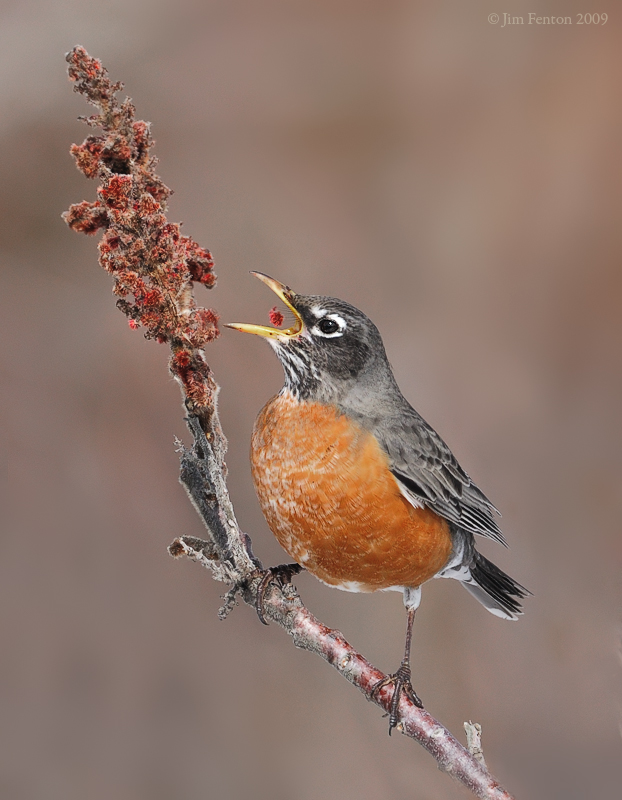
Robin Eating by Jim Fenton
Peter loves Winsome Bluebird and Welcome Robin, just as everybody else does, and he had known them so long and so well that he thought he knew all there was to know about them. He would have been very indignant had anybody told him he didn’t.
“Those cousins don’t look much alike, do they?” remarked Jenny Wren, as she poked her head out of her house to gossip with Peter.
“What cousins?” demanded Peter, staring very hard in the direction in which Jenny Wren was looking.
“Those two sitting on the fence over there. Where are your eyes, Peter?” replied Jenny rather sharply.
Peter stared harder than ever. On one post sat Winsome Bluebird, and on another post sat Welcome Robin. “I don’t see anybody but Winsome and Welcome, and they are not even related,” replied Peter with a little puzzled frown.
“Tut, tut, tut, tut, tut, Peter!” exclaimed Jenny Wren. “Tut, tut, tut, tut, tut! Who told you any such nonsense as that? Of course they are related. They are cousins. I thought everybody knew that. They belong to the same family that Melody the Thrush and all the other Thrushes belong to. That makes them all cousins.”
“What?” exclaimed Peter, looking as if he didn’t believe a word of what Jenny Wren had said. Jenny repeated, and still Peter looked doubtful.
Then Jenny lost her temper, a thing she does very easily. “If you don’t believe me, go ask one of them,” she snapped, and disappeared inside her house, where Peter could hear her scolding away to herself.
The more he thought of it, the more this struck Peter as good advice. So he hopped over to the foot of the fence post on which Winsome Bluebird was sitting. “Jenny Wren says that you and Welcome Robin are cousins. She doesn’t know what she is talking about, does she?” asked Peter.
Winsome chuckled. It was a soft, gentle chuckle. “Yes,” said he, nodding his head, “we are. You can trust that little busybody to know what she is talking about, every time. I sometimes think she knows more about other people’s affairs than about her own. Welcome and I may not look much alike, but we are cousins just the same. Don’t you think Welcome is looking unusually fine this spring?”
“Not a bit finer than you are yourself, Winsome,” replied Peter politely. “I just love that sky-blue coat of yours. What is the reason that Mrs. Bluebird doesn’t wear as bright a coat as you do?”
“Go ask Jenny Wren,” chuckled Winsome Bluebird, and before Peter could say another word he flew over to the roof of Farmer Brown’s house.
Back scampered Peter to tell Jenny Wren that he was sorry he had doubted her and that he never would again. Then he begged Jenny to tell him why it was that Mrs. Bluebird was not as brightly dressed as was Winsome.
“Mrs. Bluebird, like most mothers, is altogether too busy to spend much time taking care of her clothes; and fine clothes need a lot of care,” replied Jenny. “Besides, when Winsome is about he attracts all the attention and that gives her a chance to slip in and out of her nest without being noticed. I don’t believe you know, Peter Rabbit, where Winsome’s nest is.”
Peter had to admit that he didn’t, although he had tried his best to find out by watching Winsome. “I think it’s over in that little house put up by Farmer Brown’s boy,” he ventured. “I saw both Mr. and Mrs. Bluebird go in it when they first came, and I’ve seen Winsome around it a great deal since, so I guess it is there.”
“So you guess it is there!” mimicked Jenny Wren. “Well, your guess is quite wrong, Peter; quite wrong. As a matter of fact, it is in one of those old fence posts. But just which one I am not going to tell you. I will leave that for you to find out. Mrs. Bluebird certainly shows good sense. She knows a good house when she sees it. The hole in that post is one of the best holes anywhere around here. If I had arrived here early enough I would have taken it myself. But Mrs. Bluebird already had her nest built in it and four eggs there, so there was nothing for me to do but come here. Just between you and me, Peter, I think the Bluebirds show more sense in nest building than do their cousins the Robins. There is nothing like a house with stout walls and a doorway just big enough to get in and out of comfortably.”
Peter nodded quite as if he understood all about the advantages of a house with walls. “That reminds me,” said he. “The other day I saw Welcome Robin getting mud and carrying it away. Pretty soon he was joined by Mrs. Robin, and she did the same thing. They kept it up till I got tired of watching them. What were they doing with that mud?”
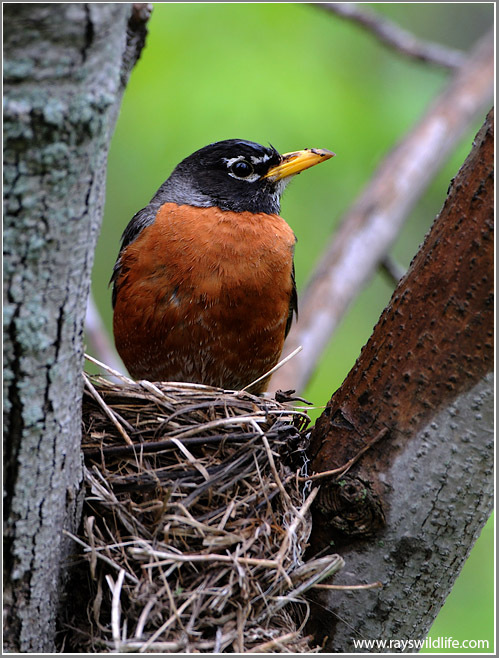
American Robin (Turdus migratorius) in nest by Ray
“Building their nest, of course, stupid,” retorted Jenny. “Welcome Robin, with that black head, beautiful russet breast, black and white throat and yellow bill, not to mention the proud way in which he carries himself, certainly is a handsome fellow, and Mrs. Robin is only a little less handsome. How they can be content to build the kind of home they do is more than I can understand. People think that Mr. Wren and I use a lot of trash in our nest. Perhaps we do, but I can tell you one thing, and that is it is clean trash. It is just sticks and clean straws, and before I lay my eggs I see to it that my nest is lined with feathers. More than this, there isn’t any cleaner housekeeper than I am, if I do say it.
“Welcome Robin is a fine looker and a fine singer, and everybody loves him. But when it comes to housekeeping, he and Mrs. Robin are just plain dirty. They make the foundation of their nest of mud,—plain, common, ordinary mud. They cover this with dead grass, and sometimes there is mighty little of this over the inside walls of mud. I know because I’ve seen the inside of their nest often. Anybody with any eyes at all can find their nest. More than once I’ve known them to have their nest washed away in a heavy rain, or have it blown down in a high wind. Nothing like that ever happens to Winsome Bluebird or to me.”
Jenny disappeared inside her house, and Peter waited for her to come out again. Welcome Robin flew down on the ground, ran a few steps, and then stood still with his head on one side as if listening. Then he reached down and tugged at something, and presently out of the ground came a long, wriggling angleworm. Welcome gulped it down and ran on a few steps, then once more paused to listen. This time he turned and ran three or four steps to the right, where he pulled another worm out of the ground.
“He acts as if he heard those worms in the ground,” said Peter, speaking aloud without thinking.
“He does,” said Jenny Wren, poking her head out of her doorway just as Peter spoke. “How do you suppose he would find them when they are in the ground if he didn’t hear them?”
“Can you hear them?” asked Peter.
“I’ve never tried, and I don’t intend to waste my time trying,” retorted Jenny. “Welcome Robin may enjoy eating them, but for my part I want something smaller and daintier, young grasshoppers, tender young beetles, small caterpillars, bugs and spiders.”
Peter had to turn his head aside to hide the wry face he just had to make at the mention of such things as food. “Is that all Welcome Robin eats?” he asked innocently.
“I should say not,” laughed Jenny. “He eats a lot of other kinds of worms, and he just dearly loves fruit like strawberries and cherries and all sorts of small berries. Well, I can’t stop here talking any longer. I’m going to tell you a secret, Peter, if you’ll promise not to tell.”
Of course Peter promised, and Jenny leaned so far down that Peter wondered how she could keep from falling as she whispered, “I’ve got seven eggs in my nest, so if you don’t see much of me for the next week or more, you’ll know why. I’ve just got to sit on those eggs and keep them warm.”
*
*
What bird family do the Bluebird and Robin belong to?
Why is it good that Mrs. Bluebird isn’t brightly dressed?
When the Robin runs and then stops, what is he doing? What might he find to eat?
What colors are the Robin’s head, breast, throat and bill?
What does the Robin’s song sound like?
Should we have an attitude like the Robin’s Song?
“Is anyone among you suffering? Then he must pray. Is anyone cheerful? He is to sing praises. (James 5:13 NASB)
“A joyful heart makes a cheerful face, But when the heart is sad, the spirit is broken. (Proverbs 15:13 NASB)
“Even the stork in the sky Knows her seasons; And the turtledove and the swift and the thrush Observe the time of their migration; But My people do not know The ordinance of the LORD. (Jeremiah 8:7 NASB)
The photos this week are from the Pin It (Pinterest) website. Thought sharing some of their great variety of bird photos would be enjoyable to watch. The ones selected do not even begin to show the photos they have in the various topics.
As mentioned in the latest article by Emma Foster, the Lord gives varying gifts, just as the Lord created the birds with such variety. May we use our varied talents to serve our Fantastic Lord and Creator.
“For through the grace given to me I say to everyone among you not to think more highly of himself than he ought to think; but to think so as to have sound judgment, as God has allotted to each a measure of faith. For just as we have many members in one body and all the members do not have the same function, so we, who are many, are one body in Christ, and individually members one of another. Since we have gifts that differ according to the grace given to us, each of us is to exercise them accordingly: if prophecy, according to the proportion of his faith; if service, in his serving; or he who teaches, in his teaching; or he who exhorts, in his exhortation; he who gives, with liberality; he who leads, with diligence; he who shows mercy, with cheerfulness.” (Romans 12:3-8 NASB)
This slideshow requires JavaScript.
“For who makes you differ from another? And what do you have that you did not receive? Now if you did indeed receive it, why do you boast as if you had not received it? (1 Corinthians 4:7 NKJV)
While working on the latest I.O.C. Version 4.4 update (which is now complete), this bird caught my attention.
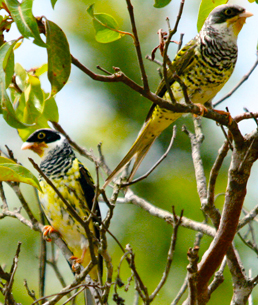
Wikipedia has this in their article about this neat bird: “The swallow-tailed cotinga (Phibalura flavirostris) is a species of passerine bird. As suggested by its common name, it has traditionally been considered a member of the cotinga family. Following the recent removal of several members from this family (now placed in Tityridae), the placement of this aberrant species is unclear. It is therefore considered incertae sedis by SACC.”
What this means that in a recent previous update, they took this bird out of the Cotinga family and placed it in an Uncertain Family holding place “Incertae Sedis” by itself. Now with this update, they put this one back in with the Cotingas, but have given it the “Phibalura” genus name. (Okay, so what is so interesting about that?)
Continuing Wikipedia: “Currently, it is monotypic within the genus Phibalura, but it has been suggested that the taxon boliviana should be considered a separate species, the Bolivian swallow-tailed cotinga or Palkachupa cotinga (P. boliviana). The nominate taxon (P. f. flavirostris) is found in Atlantic forest in south-eastern Brazil, eastern Paraguay and Argentina (Misiones only). The taxon boliviana, which only was rediscovered in 2000 (after 98 years without any records), is restricted to the vicinity of Apolo in Bolivia. Both populations are threatened by habitat loss.”
“Eighty percent of the Palkachupa Cotinga’s habitat has been destroyed by clearing and burning forest for firewood and pasture; unfortunately, this destruction is ongoing. Parts of the cotinga’s former range are now completely treeless. Nesting success in remaining habitat is low; predation by jays and severe weather are the biggest causes of breeding failure.” (American Bird Conservancy)
It appears that the sub-species of the Swallow-tailed, the now added Palkachupa disappeared from sight for over 98 years. I find that amazing, but considering where it lives, is understandable. That brings to mind some promises from these bird’s Creator.
1) He promised to provide for them. The Lord takes care of many things without man’s help.
Also, to every beast of the earth, to every bird of the air, and to everything that creeps on the earth, in which there is life, I have given every green herb for food”; and it was so. (Genesis 1:30 NKJV)
And I will send grass in your fields for your livestock, that you may eat and be filled.’ (Deuteronomy 11:15 NKJV)
They give drink to every beast of the field; The wild donkeys quench their thirst. By them the birds of the heavens have their home; They sing among the branches. He waters the hills from His upper chambers; The earth is satisfied with the fruit of Your works. (Psalms 104:11-13 NKJV)
Jesus Christ is the same yesterday, today, and forever. (Hebrews 13:8 NKJV)
2) We can learn from them – to trust their Creator who knows exactly where they are. We or the bird may be out of sight of man, but never from God. The Bible says the Lord will never leave us.
Who teaches us more than the beasts of the earth, And makes us wiser than the birds of heaven?’ (Job 35:11 NKJV)
Let your conversation be without covetousness; and be content with such things as ye have: for he hath said, I will never leave thee, nor forsake thee. (Hebrews 13:5 KJV)
“You are worthy, O Lord, To receive glory and honor and power; For You created all things, And by Your will they exist and were created.”(Revelation 4:11 NKJV)
“He taketh the wise in their own craftiness: and the counsel of the froward is carried headlong.” Job 5:13
Why do giraffes have long necks or kangaroos have pouches? Evolutionists answer that natural selection has favored the development of certain characteristics while discouraging and eliminating other features. But if this is what happened, we who believe in creation have a few questions.
Giraffe skeleton on exhibit at The Museum of Osteology, Oklahoma City, Oklahoma. (PD)
Giraffes have long necks, say evolutionists, because conditions favored the development of long-necked creatures that could feed on higher parts of the tree. But then many other grazing animals live side by side with giraffes and manage to get by. The horse, according to evolutionary explanations, has crowned teeth in order to survive in its environment. And yet the cow, with its uncrowned teeth, survives quite well in the same environment.
Some evolutionists say that plants developed berries so that their seeds, inside the berries, would be carried far and wide by hungry birds, thus ensuring the plants’ survival. Why then did some plants develop poisonous berries? And if the maternal instinct evolved to preserve the next generation, why do creatures like the stickleback fish, seahorse, and midwife toad, to name a few, leave total care of the young to the male?
The truth is that natural selection does not offer a clear and consistent explanation for the living world. The diversity of the created world does not bear witness to evolutionary principles, but to the artistry of our Creator God.
Prayer:
Dear Father, You confound those who are wise in their own hearts and give wisdom and clear vision to those Whom You have made pure through the blood of Christ. Let the wisdom and vision I seek be that which You provide. In Jesus’ Name. Amen.
We greatly enjoyed this past week-end. Dr. James J. S. Johnson, from Institute For Creation Research, who writes for this blog, came to speak at our church. We had not met him personally and so this was a time of getting to know him.
Dan and I, Dr. Jim (my name for him) and Golden Eagle (Baron) went birdwatching on Saturday. We took him to our favorite birding spot here, Circle B Bar Reserve. We saw 31 species, several “life birds” for him and one “life bird” for me, an Orange-crowned Warbler.
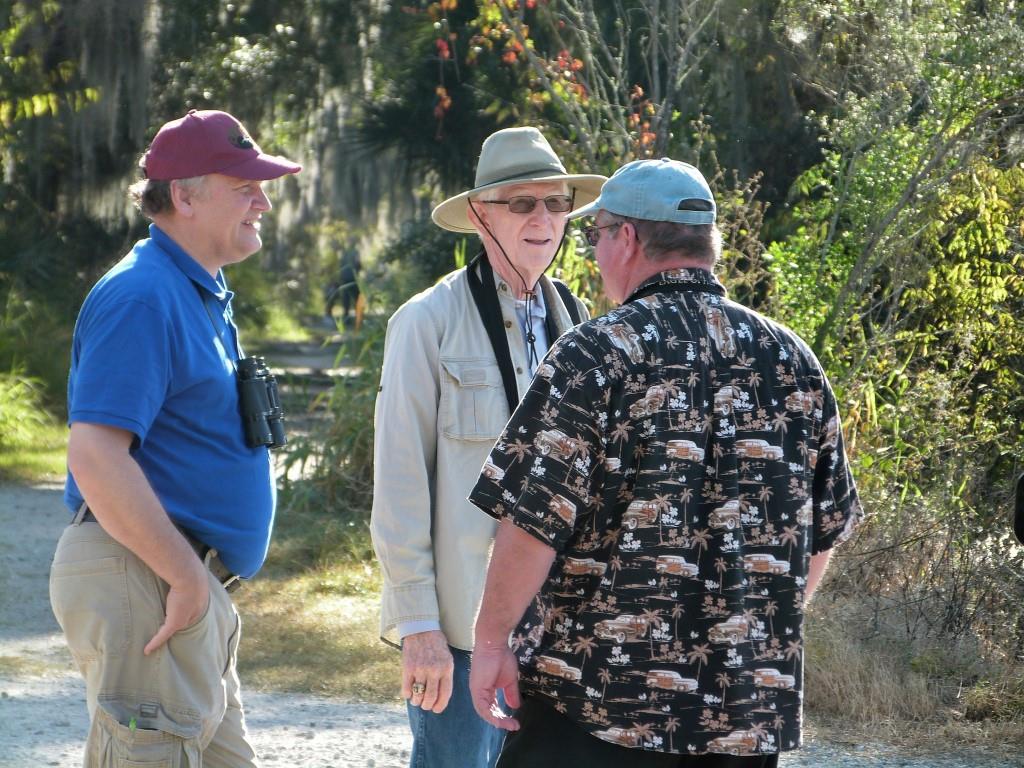
The Birders at Circle B Bar Reserve
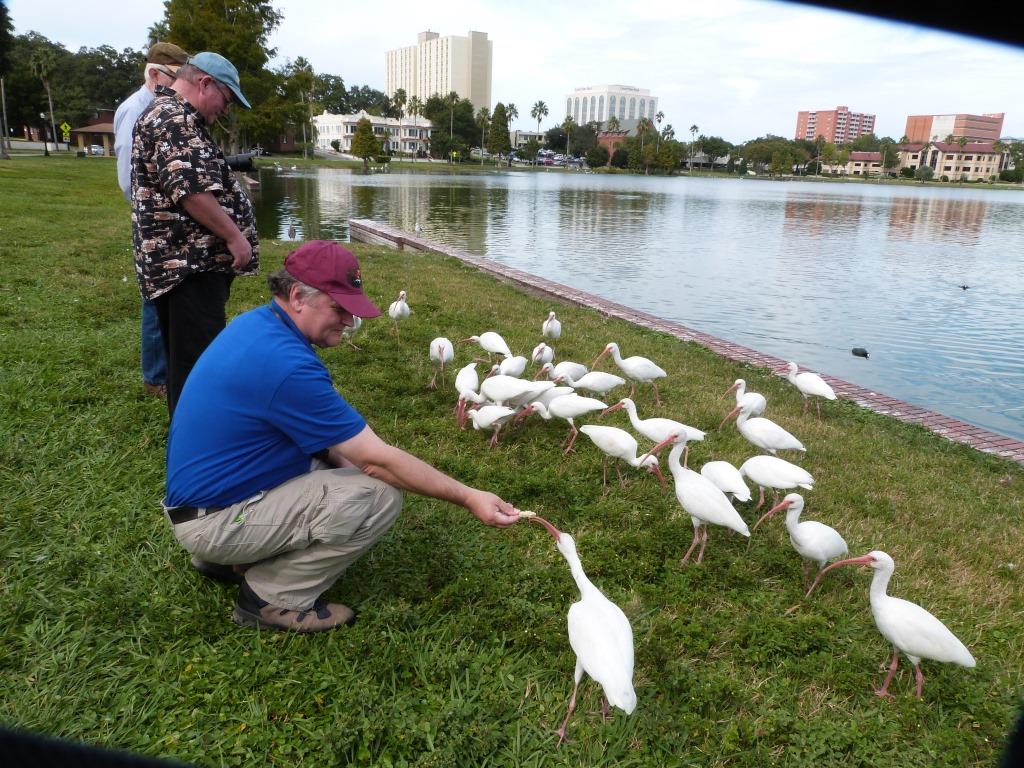
After we left there, we went to Lake Morton. I wanted two things to happen, but it didn’t. Was hoping to let them feed the Wood Stork over there and see a Wood Duck. Not to be. We saw one Wood Stork, but he must have already been fed. We did get to feed some of our other friends there. All total, we saw at least 19 species there. Also, the Lord prepared a great day for us. (Rained good part of Sunday, but Saturday was beautiful.)
Dr Jim Feeding White Ibises at Lake Morton
While describing our trip later, I misused the word “boring” which got mistaken. What I meant was that compared other visits to those two places, the number of species were less than normal. Birdwatching adventures are never “boring.” How can they when you are out enjoying the Lord’s great creation? Amazing! Fabulous! Superb! Those are better words.
“But now ask the beasts, and they will teach you; And the birds of the air, and they will tell you; (Job 12:7 NKJV)
“You are worthy, O Lord, To receive glory and honor and power; For You created all things, And by Your will they exist and were created.” (Revelation 4:11 NKJV)
As Dr. James told us in his presentations, the Lord uses so much variety, provision, and design in each of His created beings, humans included. If we just slow down, God’s hand can clearly be seen. (my paraphrase) Just with the birds, the wing structure, specialized beaks, programmed travels, interconnection between bird and plant, and on and on. Oh, Praise the Lord!
Anhinga Lake Morton by Dan
I am including the list of birds seen at both places. Also, a short video of a Snowy Egret using his foot to stir up something to eat. Wonder how that habit came about? Could it be that the Lord programmed that in it because of promising to provide for them?
“Consider the ravens, for they neither sow nor reap, which have neither storehouse nor barn; and God feeds them. Of how much more value are you than the birds? (Luke 12:24 NKJV)
Also, Dr. Johnson’s talks showed slides with examples of these points. (From an excerpt)
Witnesses for God’s Truth – “This presentation reviews 5 different kinds of witnesses for God’s truth, each of which takes away excuses from anyone who pretends to have no witness of God and His glory: (1) the physical creation, including our own physical bodies; (2) the uniqueness of humanity; (3) Scripture; (4) Christ’s incarnation; and (5) one more witness that we all are accountable for, and this one is quite scary!”
Lessons from the Zoo – “Did you know that the animal kingdom, in all of its diversity, reveals God’s creative genius and glory in uncountable ways? Why does God like and create variety in creation? How do the various animals living today, as well as other animals (like dinosaurs) which lived in earlier times, confirm the Bible’s account of creation – and refute Darwin’s evolutionary “natural selection” idea? This presentation provides a series of examples of big and little animals that display God’s handiwork in amazing ways. Mammals, reptiles, insects, spiders, fish, shellfish, jellyfish, and more!
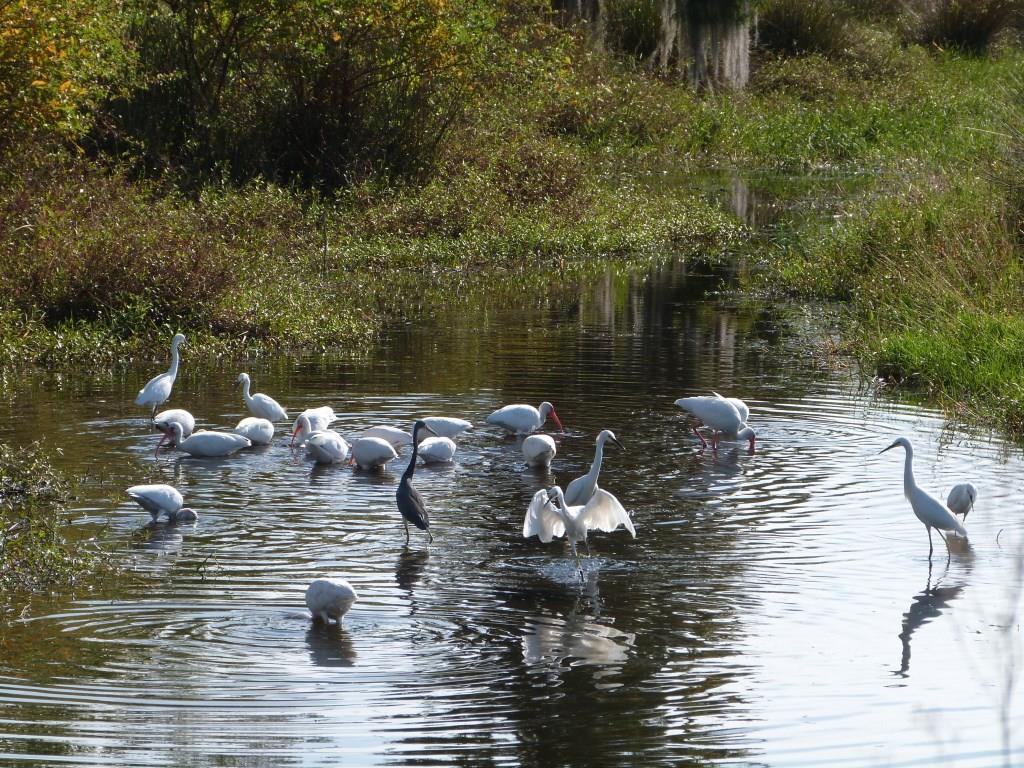
Tricolored-Snowy-Great Egret-White Ibis at Circle B
Circle B Bar Reserve, Polk, US-FL
Nov 8, 2014 8:00 AM – 10:00 AM
Us, Dr J and Baron – 31 species
Pied-billed Grebe
Double-crested Cormorant
Anhinga
Great Blue Heron
Great Egret
Snowy Egret
Little Blue Heron
Tricolored Heron
White Ibis
Glossy Ibis
Roseate Spoonbill 6
Black Vulture 50
Turkey Vulture 50
Osprey
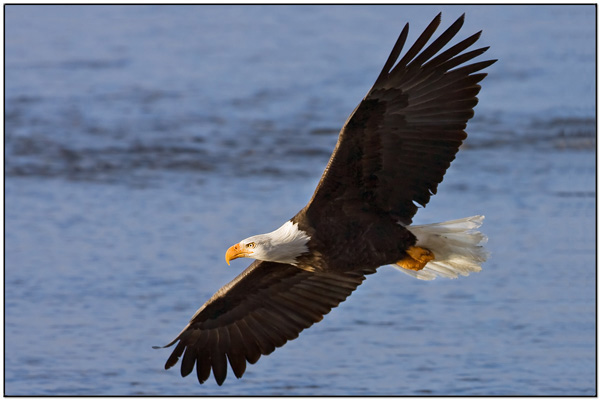
Bald Eagle
Red-shouldered Hawk
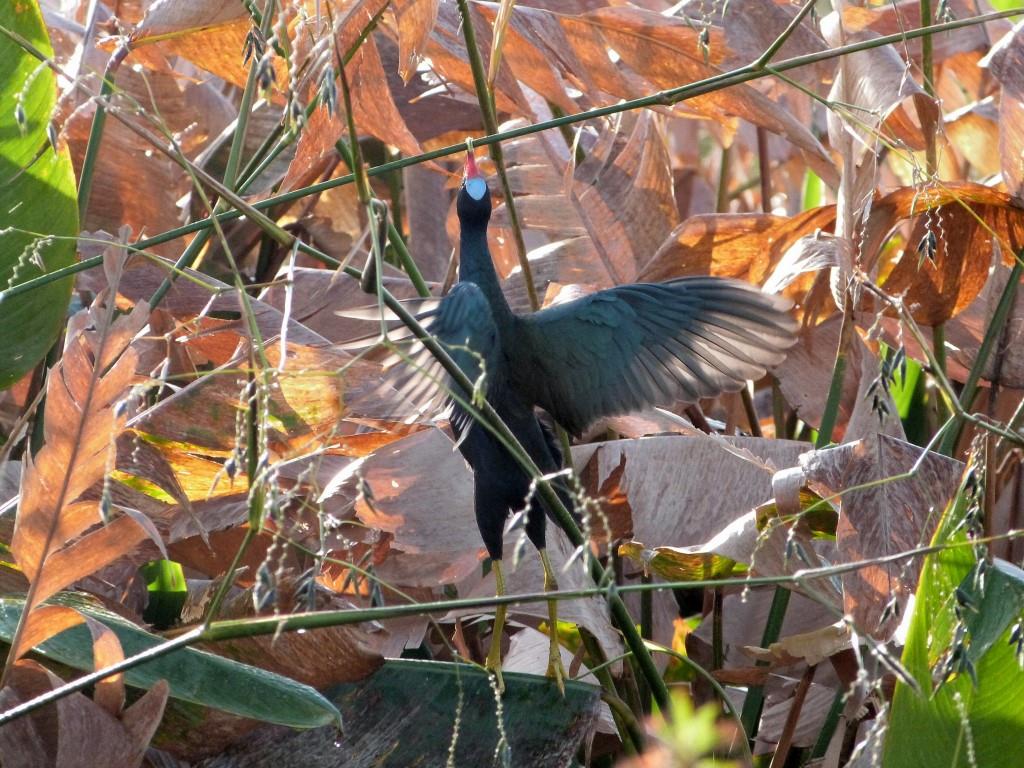
Purple Gallinule
Common Gallinule
Stilt Sandpiper
Red-bellied Woodpecker
Pileated Woodpecker
Eastern Phoebe
Carolina Wren
Blue-gray Gnatcatcher
Gray Catbird
Orange-crowned Warbler
Palm Warbler
Yellow-rumped Warbler
Northern Cardinal
Red-winged Blackbird
Boat-tailed Grackle
Lake Morton, Polk, US-FL
Nov 8, 2014 10:30 AM – 11:15 AM
Us, Dr J. and Baron – 18 species (+1 other taxa)
Mute Swan
Black Swan
Black-necked Swan
Muscovy Duck (Established Feral)
Mallard (Domestic type)
Blue-winged Teal
Ring-necked Duck
Anhinga
Great Blue Heron
Great Egret
Snowy Egret
White Ibis
Common Gallinule
American Coot
Laughing Gull
Rock Pigeon (Feral Pigeon)
Blue Jay
Palm Warbler
Boat-tailed Grackle
Remember the days of old, consider the years of many generations: ask thy father, and he will shew thee; thy elders, and they will tell thee. (Deuteronomy 32:7 KJV)
For whatsoever things were written aforetime were written for our learning, that we through patience and comfort of the scriptures might have hope. (Romans 15:4 KJV)
Lord Bless all of you as we remember our the military this Veteran’s Day. Many have served and given their all, others are now serving or have served faithfully. We Honor you and Thank You for your service for our country. Other have served their country’s military also. We should remember them also and I am sure they have a similar day. Our’s just happens to be November 11.
The birds chosen this week have either a military item as part of their name or there has been an airplane named after that type of bird.
Happy Veteran Day! Lord Bless You.
This slideshow requires JavaScript.
“Military Service Medley” – Faith Baptist Orchestra 7-3-11
Sulawesi Hornbill (Penelopides exarhatus)LPZoo by Lee
They have come out with the latest Update and I am again working on updating the blog. This time they added only 13 new species, deleted 2, and made 3 changes to names. But, as lately, they threw another family up in the air to rearrange it. This time it was the Hornbill-Bucerotidae family. It was really reshuffled and they changed some of the genus around.
Here are the new additions:
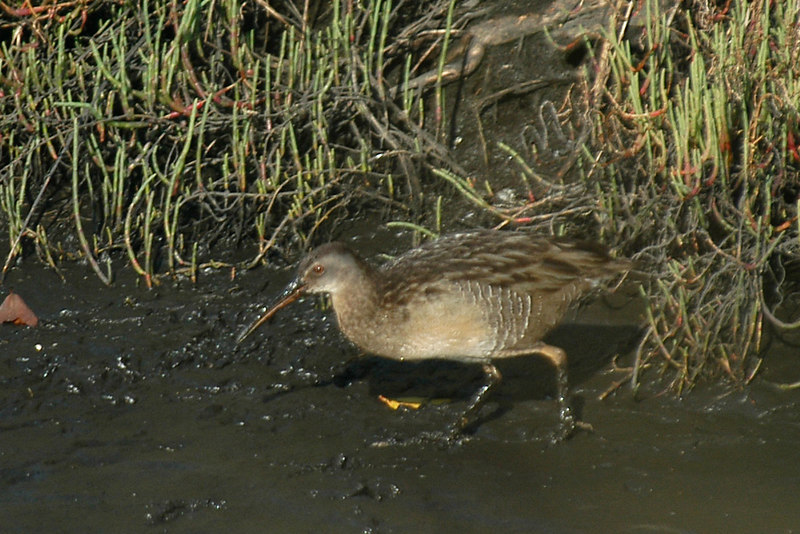
Aztec Rail (Rallus tenuirostris) – Was Subspecies of King Rail
Riparian Antbird (Cercomacra fuscicauda)- Was Subspecies
Bougainville Whistler (Pachycephala richardsi) – Was Subspecies
Black-eared Warbler (Basileuterus melanotis) – Was Subspecies
Tacarcuna Warbler (Basileuterus tacarcunae) – Was Subspecies
Yungas Warbler (Basileuterus punctipectus)- Was Subspecies
Roraiman Warbler (Myiothlypis roraimae)- Was Subspecies
Pale Baywing (Agelaioides fringillarius)- Was Subspecies
Deleted:
Norfolk Ground Dove
White-throated Whistler
Hard to find data yet on these because sites are being updated, just as this one is. Will update when all the 4.4 Version is complete.
Also: Sorry there has not been as many articles lately, but have been dealing with several health issues. The Bronchitis is almost over, now have stitches from skin cancer removal. Physical Therapy is helping. Praise the Lord, it could be a lot worse. It is just that everything came close together. Also, Praise the Lord for the way He created the human body.
I will praise You, for I am fearfully and wonderfully made; Marvelous are Your works, And that my soul knows very well. (Psalms 139:14 NKJV)
Our Men’s Quartet added an extra voice last Sunday night and sung a very powerful song.
Before I say more about that, an interesting application can be made. The voices of a quartet, any singing group or a choir are made up of a variety of voices. Some sing base, tenor, alto, baritone, soprano, but those like me, “off-key”, don’t join them. But notice how they blend to make such beautiful music.
Likewise our birds the Creator gave us come in much variety, each with different looks, heights, purposes, habitat they dwell in, and voices. Yet, when you walk through a park, woods, or other place you go birdwatching, they seem to blend together to make music. Most times it is very pleasing, but there are times, some of those “off-key” birds sound off.
We all come in a variety of talents, voices, gifts, personalities, yet when we use them for the Lord’s service, they come together to make great “music” That all is true as long as we know the Lord as our Savior. Please listen to the words of the song, and I pray that you will not be “One Day Too Late.”
This slideshow requires JavaScript.
“Marvel not that I said unto thee, Ye must be born again.” (John 3:7 KJV)
“One Day Too Late.” – Men’s Quartet + 1 – Faith Baptist Church
“For God so loved the world, that he gave his only begotten Son, that whosoever believeth in him should not perish, but have everlasting life. For God sent not his Son into the world to condemn the world; but that the world through him might be saved.
He that believeth on him is not condemned: but he that believeth not is condemned already, because he hath not believed in the name of the only begotten Son of God.
And this is the condemnation, that light is come into the world, and men loved darkness rather than light, because their deeds were evil. For every one that doeth evil hateth the light, neither cometh to the light, lest his deeds should be reproved.
But he that doeth truth cometh to the light, that his deeds may be made manifest, that they are wrought in God.” (John 3:16-21 KJV)
And they sung a new song, saying, Thou art worthy to take the book, and to open the seals thereof: for thou wast slain, and hast redeemed us to God by thy blood out of every kindred, and tongue, and people, and nation; (Revelation 5:9 KJV)
“He brought me out into a broad place; he rescued me, because he delighted in me. (Psalms 18:19 ESV)
“I will rejoice and be glad in your steadfast love, because you have seen my affliction; you have known the distress of my soul, and you have not delivered me into the hand of the enemy; you have set my feet in a broad place. (Psalms 31:7-8 ESV)
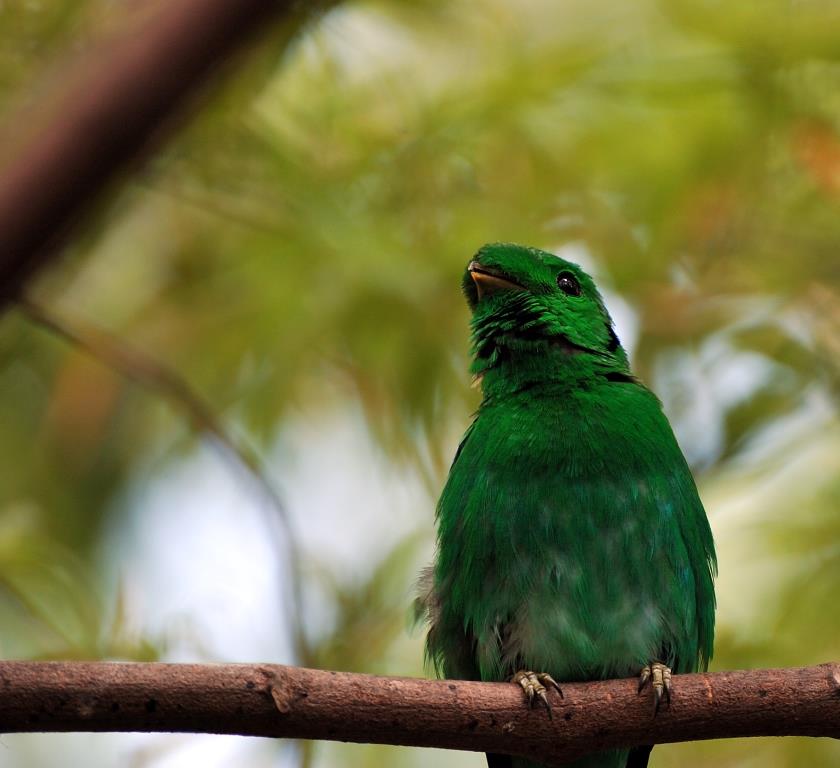
Broadbills are one of my favorite birds. To me, they are adorable. So far, we have only seen the Green Broadbill and the Long-tailed Broadbill. Both have been at zoos.
Notice their eyes. They always look so alert and expressive.
This slideshow requires JavaScript.
“Jesus Loves Me” by Bonnie Standifer
This piece was written and played by Bonnie Standifer. Played at our Orchestra Concert in March of 2013 at Faith Baptist Church. You have never heard it played this way before. Bonnie is a very gifted arranger and pianist. (I’ve used her song before, but it is so fantastic.)





 Lee's Birdwatching Adventures Plus