Migratory Bird Treaty Centennial (USF&WS)
Yea, the stork in the heaven knoweth her appointed times; and the turtle and the crane and the swallow observe the time of their coming; but my people know not the judgment of the Lord. (Jeremiah 8:7)
Dr. James J. S. Johnson
Bird migrations are marvelous — only God could preprogram and orchestrate such magnificent maneuverings! Did you know that this year (AD2016) marks the 100th anniversary of the Migratory Bird Treaty? Just how was that avian conservation treaty “hatched”, and why, 100 years ago?
There are several remarkable aspects of that historic Canadian-American treaty, looking back a century, at events during AD1916. Before looking at its impact today, however, a quick bird’s-eye-view “fly-over” of the historical background is appropriate.
AD1885: The U.S. Department of Agriculture was directed by Congress to have a “Division of Economic Ornithology and Mammalogy”, leading to studies about how birds can positively check the harm caused by “pests”; this part of the USDA was later modified to become the “Division of Biological Survey”, and that in turn was modified to become the present “Fish and Wildlife Service” (which merged with the U.S. Bureau of Fisheries as part of being transferred to the Department of the Interior).

AD1894: Charles Almanzo Babcock, school superintendent of Oil City (Pennsylvania), spearheaded “Bird Day”, to be celebrated as a special day for appreciating and celebrating the value of birds. Babcock’s holiday is celebrated on May 4th. Similar holidays have been established by others, e.g., Americans also use January 5th as “National Bird Day”. “International Migratory Bird Day” is celebrated in America and Canada on the second Saturday in May. However, in Mexico (and in several other Latin American countries) “International Migratory Bird Day” is celebrated on the second Saturday in October.
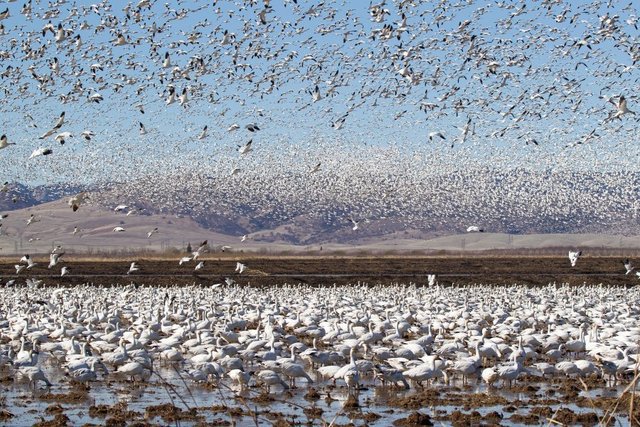
Snow Geese during migration (Colusa County, California)
AD1896: The U.S. Supreme Court decided a case regarding governmental regulation of wild game: Geer v. Connecticut, 161 U.S. 519 (1896). In that case — which resolved a controversy over transporting wild birds across state lines — the federal high court assumed that wild animals are subject to state government jurisdiction (and thus also state government regulation), as opposed to being subject to management under federal statutes passed by Congress. This ruling was interpreted by many to mean that Congress had no direct control over wildlife, because wild animals were deemed to be the collective property of whatever state they were in. (However, there was no “preemption” problem, then, because Congress had not yet passed any federal acts to regulate interstate commerce of wild game animals or their product.) If only state governments cold validly regulate interstate hunting and fishing, as many understood the Geer ruling, the consequence would be that Congress had no legal authority to pass an enforceable wildlife protection law that could bind each of the states (and their citizenry). Could Congress do nothing to protect wasteful overhunting of interstate-migrating birds? Did the U.S. Constitution have any provision that could be harnessed to circumvent the Geer ruling? Was Congress’s power to regulate “interstate commerce” enough to exercise valid jurisdiction over how migratory birds are treated, either dead or alive, so long as state lines were crossed? These legal question would soon be answered. First, the “interstate commerce” power of Congress was used to assert federal regulatory power to regulate the sale (and commercial transportation) of birds in one state if the acquisition of that bird (dead or alive) was accomplished by violating the law of another state. In effect, this approach would use a piggyback strategy, using federal “interstate commerce” powers to enforce state laws.
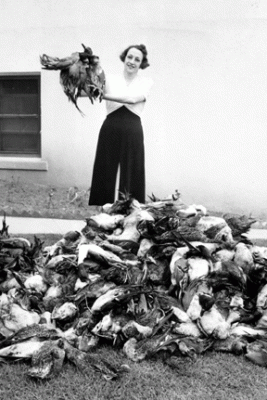
AD1900: Congress passed the “Lacey Act” of AD1900, declaring commercial transportation or sale of hunted birds (or products derived from their dead bodies) illegal, if crossing state lines was involved (i.e., if “interstate commerce” was involved), but only if the birds (dead or alive) were obtained in a way that violated the state laws of another state. This law was needed to ban the wholesale (and routinely wasteful) destruction of birds, for commercial purposes, primarily to provide flamboyant feathers for fancy ladies’ hats. To do this, the Lacey Act (as a federal law) prohibited using “interstate commerce” activity (i.e., crossing state lines as part of a commercial enterprise) to “get away with” violating any wildlife laws of states where birds were obtained. (The Lacey Act has been legislatively expanded since, by Congress, so that it now incorporates and enforces a treaty that bans trafficking in illegal wildlife, the “CITES treaty” [Convention on International Trade in Endangered Species of Wild Fauna and Flora] — which is an enforcement task assigned, nowadays, to the Office of Law Enforcement within the U.S. Fish & Wildlife Service.) Of course, the Lacey Act only equipped Congress with “piggyback” powers to regulate interstate commerce that facilitated illegal trafficking in wildlife, subject to the hunting laws passed according to the differing preferences of the various state legislatures. If migratory birds traverse 10 states (as they migrate seasonally from north to south, or vice versa), the migrating birds may be protected in only 9 of those 10 states, under applicable state laws, only to be legally shot out of the sky (or while resting in a stopover) while flying in the one state where they may be legally shot by hunter.
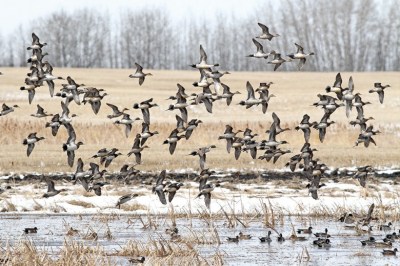
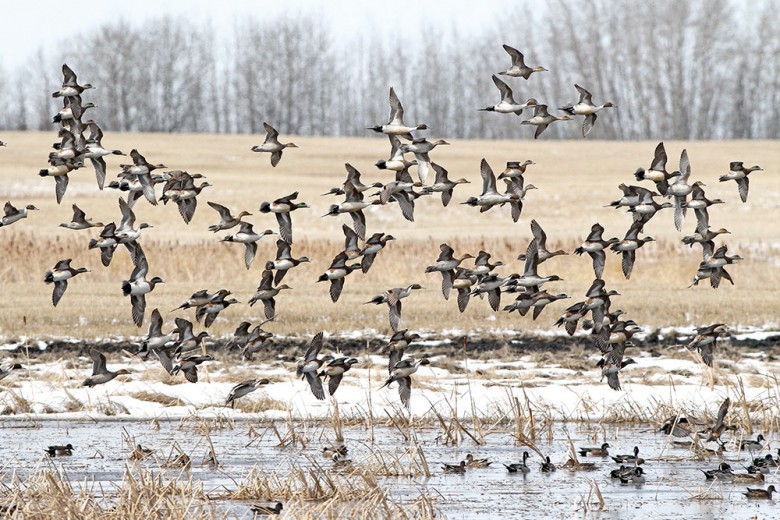
Wigeons and Pintails (Saskatchewan, Canada)©Conservator
AD1913-AD1914: Congress passed the Weeks-McLean Act of 1913, to ban bird-hunting in the spring (i.e., the vulnerable and “critical” timeframe when birds typically reproduce and nurture their hatchlings in the direction of successful fledging), and marketing of illegally hunted birds (and bird products, such as fancy bird feathers that were consumed by the fashion industry in what was called “millinery murder”). This Congress-issued law empowered the Secretary of Agriculture to promulgate bird-hunting seasons nationwide. However, judicial review of this federal statute — in the form of federal court rulings, styled United States v. Shauver, 214 Fed. 154 (E.D. Ark. 1914), and United States v. McCullagh, 221 Fed. 288 (D. Kan. 1915) — resulted in the Weeks-McLean Act being declared invalid (i.e., unauthorized), as an unconstitutional overreach regarding natural resources that jurisdictionally were subject to the police powers of state governments (and their state laws), not federal. It is noteworthy that the federal government, in the Shauver ruling, based their argument on the federal government’s rights under the Property Clause of the U.S. Constitution (in Article IV, section 3, subsection 2), not under the Constitution’s Commerce Clause (in Article I, section 8). However, in the McCullagh ruling, the federal government unsuccessfully argued that the Weeks-McLean Act was legitimate as a constitutional exercise of powers to protect the “general welfare” (Article IV, section, 3, subsection 2) and/or powers to regulate interstate commerce (Article I, section 8). It thus appeared to Congress that the federal courts were reluctant to enforce any kind of nationwide law that restricts hunting, transporting, and/or sale of migratory birds – even if the activities were provably part of “interstate commerce”.

AD1916-AD1920: The time was now ripe, in the knock-down wake of what had been the Weeks-McLean Act, for Congress to try a different approach to constitutionally constructing an enforceable law to protect migratory birds. The Weeks-McLean Act had 3 strikes against it, constitutionally speaking: it could not be validated by the Property Clause, nor by the General Welfare Clause, nor even by the Interstate Commerce Clause. What was left? What about using the Treaty Clause in the U.S. Constitution’s Article II, section 2, subsection 2) — which authorizes the U.S. president to use “power, by and with the advice and consent of the Senate, to make Treaties, provided two thirds of the Senators present concur”. The first step in this strategic process would be negotiating and ratifying a treaty, to protect migratory birds with migratory ranges that overlap Canada and America, followed by a Congressional statute to implement such a treaty. Canada was not sufficient independent (i.e., “sovereign”) to negotiate on its own behalf, so the United Kingdom (a/k/a Great Britain) represented Canada in the treaty (which is reprinted below, as an APPENDIX) —- the Convention Between the United States and Great Britain for the Protection of Migratory Birds (of 1916) — was successfully negotiated and approved by the U.S. Senate and president (in this case, Woodrow Wilson, ironically an evolutionist, whose Darwinian worldview logically clashed with the conservation ethic embodied by the treaty). This treaty was soon (i.e., “soon”, relatively speaking) endorsed for implementation purposes (including Congressional funding mechanisms) by the Migratory Bird Treaty Act of 1918. Immediately that Congressional act was challenged in the federal courts, by plaintiffs who claimed that it too was Congressional (i.e., federal) power-grab not authorized by the U.S. Constitution. In short, the U.S. Supreme Court was impressed by the strategic treaty-based/implementing statute — the U.S. Supreme Court validated the Migratory Bird Treaty Act (and, by necessary implication, the treaty itself) via its ruling in the case styled Missouri v. Holland (so named because the U.S. Game Warden involved was surnamed Holland). Specifically, Missouri v. Holland, 252 U.S. 416, 40 S.Ct. 382 (1920), vindicated Congress’ right to implement the Migratory Bird Treaty’s provisions, as a “federal preëmption” of all state laws notwithstanding, based on the constitutional logic that enforcing a proper federal treaty trumps whatever state-legislated wildlife regulation laws may exist to the contrary. The juristic rationale for this result was the Supremacy Clause of the U.S. Constitution (in Article VI, section 2).
Retroactively speaking, therefore, the Supreme Court ruling in AD1920 (i.e., in Missouri v. Holland) validated the Congressional statute (i.e., the Migratory Bird Treaty Act) enacted in AD1918, which itself endorsed, for implementation purposes, the actual Migratory Bird Treaty of AD1916. (With that history in mind, you can better appreciate the official text of the treaty, which is fairly succinct yet specific, reprinted as an APPENDIX at the foot of this article.)
So that is the bird’s-eye-view “fly-by” of how Americans (and, indirectly, Canadians too) the Migratory Bird Treaty was “hatched”, 100 years ago!
Yea, the stork in the heaven knoweth her appointed times; and the turtle and the crane and the swallow observe the time of their coming; but my people know not the judgment of the Lord. (Jeremiah 8:7)
Bird migrations are marvelous — only God could preprogram and orchestrate such magnificent maneuverings! Surely bird migrations, which seasonally display God’s bioengineering genius and care, deserve some respect and admiration from us too, as we watch such winged wonders.
ABOUT THE AUTHOR: James J. S. Johnson, in addition to continuously teaching at various Christian colleges in Texas, since AD1991 (including courses on ecology, birds life and avian conservation, environmental laws and treaties), and teaching now for ICR-SOBA (including course that analyze bird life from a Biblical creation perspective), is an attorney licensed to practice law in the State of Texas, in the State of Colorado, and in several federal courts and administrative tribunals (including the U.S. Supreme Court). No stranger to environmental laws and conservation programs, he formerly provided monitoring research data to the Trinity River Authority of Texas (during the mid-AD1990s) in his capacity (then) as a Certified Water Quality Monitor (credentialed as such by what was then the Texas Natural Resource Conservation Commission). Jim’s love for bird life, however, began much earlier in life, as is documented briefly at Attracted To Genesis By Magnets and a Bird Book (and more fully at Appreciating Baltimore Orioles and My First Bird Book ).
Selected Bibliography:
U.S. Fish & Wildlife Service, “Migratory Bird Treaty Centennial 1916-2016” (accessed 9-16-AD2016)
Geer v. Connecticut, 161 U.S. 519, 16 S.Ct. 600 (1896).
Missouri v. Holland, 252 U.S. 416, 40 S.Ct. 382 (1920).
United States v. Shauver, 214 Fed. 154 (E.D. Ark. 1914).
United States v. McCullagh, 221 Fed. 288 (D. Kan. 1915).
The Lacey Act of 1900, now codified as amended at 16 U.S.C. sections 3371-3378.
Migratory Bird Treaty (of 1916), formally titled Convention Between the United States and Great Britain for the Protection of Migratory Birds, USA-Great Britain, 39 Stat. 1702.
Migratory Bird Treaty Act of 1918, 40 Stat. 755, codified at 16 U.S.C. sections 703-712.
Weeks-McLean Act of 1913, 37 Stat. 828, 847-848 (1913).
CITES, formally titled Convention on International Trade in Endangered Species of Wild Fauna and Flora, 27 U.S.T. 1087, T.I.A.S. 8249 (entered into force, applicable to USA, in 1975).
Edward T. Swaine, “Putting Missouri v. Holland on the Map, 72 Missouri Law Review 1007 (fall 2008).
Paul Schmidt, “The Migratory Bird Treaty Centennial: For 100 Years, This Landmark Agreement has been the Cornerstone of Migratory Bird Management Across North America”, posted by DUCKS UNLIMITED.
Mallard drake photo credit: Legallabrador.org/ .
Migrating Snow Geese / Colusa County (California) <= click for photo credit
Migrating Wigeons & Pintails / Saskatchewan (Canada) photo credit: www.conservator/ca/ .
B&W photograph of lady with decorative bird-hat, next to pile of slaughtered birds (public domain), showing need for The Lacey Act of 1900
APPENDIX: official text of the Migratory Bird Treaty of AD1916
CONVENTION BETWEEN THE UNITED STATES AND GREAT BRITAIN FOR THE PROTECTION OF MIGRATORY BIRDS.
[U. S. Treaty Series, No. 628] Signed at Washington, August 16, 1916; ratifications exchanged December 7, 1916.
WHEREAS, Many species of birds in the course of their annual migrations traverse certain parts of the United States and the Dominion of Canada; and Whereas, Many of these species are of great value as a source of food or in destroying insects which are injurious to forests and forage plants on the public domain, as well as to agricultural crops, in both the United States and Canada, but are nevertheless in danger of extermination through lack of adequate protection during the nesting season or while on their way to and from their breeding grounds; The United States of America and His Majesty the King of the United Kingdom of Great Britain and Ireland and of the British Dominions beyond the Seas, Emperor of India, being desirous of saving from indiscriminate slaughter and of insuring the preservation of such migratory birds as are either useful to man or are harmless, have resolved to adopt some uniform system of protection which shall effectively accomplish such objects and to the end of concluding a convention for this purpose have appointed as their respective plenipotentiaries: The President of the United States of America, Robert Lansing, Secretary of State of the United States; and His Britannic Majesty, the Right Honorable Sir Cecil Arthur Spring Rice, G. C. V. O., K. C. M. G., etc., His Majesty’s Ambassador Extraordinary and Plenipotentiary at Washington; Who after having communicated to each other their respective full powers which were found to be in due and proper form, have agreed to and adopted the following articles:
ARTICLE I
The high contracting powers declare that the migratory birds included in the terms of this convention shall be as follows:
1. Migratory Game Birds:
(a) Anatidae or waterfowl, including brant, wild ducks, geese, and swans.
(b) Gruidae or cranes, including little brown, sandhill, and whooping cranes.
(c) Rallidae or rails, including coots, gallinules and sora and other rails.
(d) Limicolae or shorebirds, including avocets, curlew, dowitchers, godwits, knots, oyster catchers, phalaropes, plovers, sand- pipers, snipe, stilts, surf birds, turnstones, willet, woodcock and yellowlegs.
(e) Columbidae or pigeons, including doves and wild pigeons.
2. Migratory Insectivorous Birds: Bobolinks, catbirds, chickadees, cuckoos, flickers, flycatchers, grosbeaks, humming birds, kinglets, martins, meadowlarks, nighthawks, or bull bats, nut-hatches, orioles, robins, shrikes, swallows, swifts, tanagers, titmice, thrushes, vireos, warblers, wax-wings, whippoorwills, woodpeckers, and wrens, and all other perching birds which feed entirely or chiefly on insects.
3. Other Migratory Nongame Birds: Auks, auklets, bitterns, fulmars, gannets, grebes, guillemots, gulls, herons, jaegers, loons, murres, petrels, puffins, shear- waters, and terns.
ARTICLE II
The high contracting Powers agree that, as an effective means of preserving migratory birds, there shall be established the following close seasons during which no hunting shall be done except for scientific or propagating purposes under permits issued by proper authorities.
1. The close season on migratory game birds shall be between March 10 and September 1, except that the close season on the limicolae or shorebirds in the Maritime Provinces of Canada and in those States of the United States bordering on the Atlantic Ocean which are situated wholly or in part north of Chesapeake Bay shall be between February 1 and August 15, and that Indians may take at any time scoters for food but not for sale. The season for hunting shall be further restricted to such period not exceeding three and one-half months as the high contracting Powers may severally deem appropriate and define by law or regulation.
2. The close season on migratory insectivorous birds shall continue throughout the year. 3. The close season on other migratory nongame birds shall continue throughout the year, except that Eskimos and Indians may take at any season auks, auklets, guillemots, murres and puffins, and their eggs, for food and their skins for clothing, but the birds and eggs so taken shall not be sold or offered for sale.
ARTICLE III
The high contracting Powers agree that during the period of ten years next following the going into effect of this convention, there shall be a continuous close season on the following migratory game birds, to wit:- Band-tailed pigeons, little brown, sandhill and whooping cranes, swans, curlew and all shorebirds (except the black-breasted and golden plover, Wilson or jack snipe, woodcock, and the greater and lesser yellowlegs); provided that during such ten years the close seasons on cranes, swans and curlew in the Province of British Columbia shall be made by the proper authorities of that Province within the general dates and limitations elsewhere prescribed in this convention for the respective groups to which these birds belong.
ARTICLE IV
The high contracting Powers agree that special protection shall be given the wood duck and the eider duck either (1) by a close season extending over a period of at least five years, or (2) by the establishment of refuges, or (3) by such other regulations as may be deemed appropriate.
ARTICLE V
The taking of nests or eggs of migratory game or insectivorous or nongame birds shall be prohibited, except for scientific or propagating purposes under such laws or regulations as the high contracting Powers may severally deem appropriate.
ARTICLE VI
The high contracting Powers agree that the shipment or export of migratory birds or their eggs from any State or Province, during the continuance of the close season in such State or Province, shall be prohibited except for scientific or propagating purposes, and the international traffic in any birds or eggs at such time captured, killed, taken, or shipped at any time contrary to the laws of the State or Province in which the same were captured, killed, taken, or shipped shall be likewise prohibited. Every package containing migratory birds or any parts thereof or any eggs of migratory birds transported, or offered for transportation from the United States into the Dominion of Canada or from the Dominion of Canada into the United States, shall have the name and address of the shipper and an accurate statement of the contents clearly marked on the outside of such package.
ARTICLE VII
Permits to kill any of the above-named birds which, under extraordinary conditions, may become seriously injurious to the agricultural or other interests in any particular community, may be issued by the proper authorities of the high contracting Powers under suitable regulations prescribed therefor by them respectively, but such permits shall lapse, or may be cancelled, at any time when, in the opinion of said authorities, the particular exigency has passed, and no birds killed under this article shall be shipped, sold or offered for sale.
ARTICLE VIII
The high contracting Powers agree themselves to take, or propose to their respective appropriate law-making bodies, the necessary measures for insuring the execution of the present convention.
ARTICLE IX
The present convention shall be ratified by the President of the United States of America, by and with the advice and consent of the Senate thereof, and by His Brittanic Majesty. The ratifications shall be exchanged at Washington as soon as possible and the convention shall take effect on the date of the exchange of the ratifications. It shall remain in force for fifteen years and in the event of neither of the high contracting Powers having given notification, twelve months before the expiration of said period of fifteen years, of its intention of terminating its operation, the convention shall continue to remain in force for one year and so on from year to year. In faith whereof, the respective plenipotentiaries have signed the present convention in duplicate and have hereunto affixed their seals. Done at Washington this sixteenth day of August, one thousand nine hundred and sixteen.
[SEAL] ROBERT LANSING. [SEAL] CECIL SPRING RICE.
“Convention Between the United States and Great Britain for the Protection of Migratory Birds”, reprinted in The American Journal of International Law, Volume 11, No. 2, Supplement: Official Documents (April, 1917), pages 62-66 (published online by The American Society of International Law)










 Lee's Birdwatching Adventures Plus